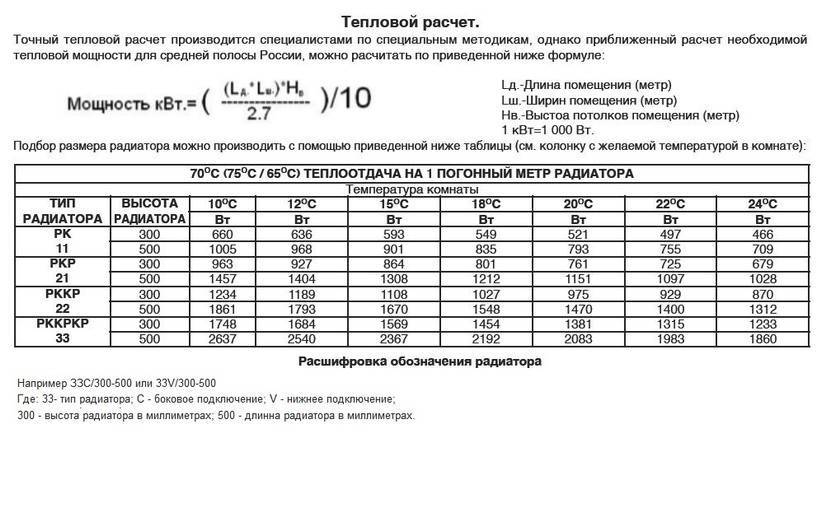
- Power calculation
- Scheme 1
- Scheme 2
- Scheme 3
- Very accurate calculation
- What if you need a very accurate calculation?
- Calculation of sections of aluminum radiators per square meter
- Rooms with standard ceiling heights
- Rooms with a ceiling height of more than 3 meters
- How to calculate the number of heating radiator sections
- Calculation based on room area
- Calculation of the number of sections in radiators, based on the volume of the room
- Calculation of heating radiators by area
- Determination of the number of radiators for one-pipe systems
- Heating appliances of one-pipe systems
- Initial data for calculations
Power calculation
Scheme 1
A simple scheme is present in the Soviet SNiP half a century ago: the power of the heating radiator per room is selected at the rate of 100 watts / 1m2.
The method is clear, extremely simple and… inaccurate.
Because of which?
- Real heat losses vary greatly for the outer and middle floors, for rooms and corner apartments in the center of the building.
- They depend on the total area of windows and doors, and on the structure of the glazing. It is clear that wooden frames with double-glazed windows will provide much greater heat loss than triple-glazed windows.
- In different climatic areas, heat loss will also vary. At -50 C, the apartment will obviously need more heat than at +5.
- Finally, the selection of a radiator according to the area of \u200b\u200bthe room makes it necessary to neglect the height of the ceilings; at the same time, the heat consumption with ceilings 2.5 and 4.5 meters high will vary greatly.
Scheme 2
Estimation of the thermal power and calculation of the number of radiator sections according to the volume of the room provide noticeably great accuracy.
Here's how to calculate power:
- The base heat quantity is estimated at 40 watts/m3.
- For corner rooms, it increases by 1.2 times, for extreme floors - by 1.3, for private houses - by 1.5.
- The window adds 100 watts to the heat demand of the room, the door to the street - 200.
- The regional coefficient is entered. It is taken equal to:
| Region | Coefficient |
| Chukotka, Yakutia | 2 |
| Irkutsk Region, Khabarovsk Territory | 1,6 |
| Moscow region, Leningrad region | 1,2 |
| Volgograd | 1 |
| Krasnodar region | 0,8 |
Let's, as an example, find with our own hands the need for heat in a corner room measuring 4x5x3 meters with one window, located in the city of Anapa.
- The number of rooms is 4*5*3=60 m3.
- The basic heat demand is estimated at 60*40=2400 watts.
- Because the room is angular, we use a coefficient of 1.2: 2400 * 1.2 = 2880 watts.
- The window aggravates the situation: 2880+100=2980.
- The mild climate of Anapa makes its own adjustments: 2980 * 0.8 = 2384 watts.
Scheme 3
Both past schemes are not good because they ignore the difference between different buildings in terms of wall insulation. At the same time, in a modern energy-efficient house with external insulation and in a brick shop with single-strand glazing, heat loss will be, to put it mildly, different.
Radiators for industrial premises and houses with non-standard insulation can be calculated using the formula Q \u003d V * Dt * k / 860, in which:
- Q is the power of the heating circuit in kilowatts.
- V is the heated quantity.
- Dt is the calculated temperature delta with the street.
| k | Description of the premises |
| 0,6-0,9 | External insulation, triple glazing |
| 1-1,9 | Masonry from 50 cm thick, double glazing |
| 2-2,9 | Bricklaying, single glazing in timber frames |
| 3-3,9 | Uninsulated room |
Let's also accompany the calculation method with an example in this case - we calculate the heat output that the heating radiators of a production room of 400 sq m should have at a height of 5 meters, a brick wall thickness of 25 cm and single glazing. This picture is quite typical for industrial zones.
Let's agree that the temperature of the coldest five-day period is -25 degrees Celsius.
- For production shops, +15 C is considered the lower limit of permissible temperature. So, Dt \u003d 15 - (-25) \u003d 40.
- We take the coefficient of insulation equal to 2.5.
- The number of premises is 400*5=2000 m3.
- The formula will buy the form Q \u003d 2000 * 40 * 2.5 / 860 \u003d 232 kW (rounded).
Very accurate calculation
Above, we gave as an example a very simple calculation of the number of heating batteries per area. It does not take into account many factors, such as the quality of the thermal insulation of the walls, the type of glazing, the minimum outside temperature, and many others. Using simplified calculations, we can make mistakes, as a result of which some rooms turn out to be cold, and some too hot. The temperature can be corrected using stopcocks, but it is best to foresee everything in advance - if only for the sake of saving materials.
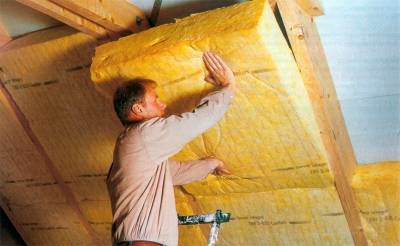
If during the construction of your house you paid due attention to its insulation, then in the future you will save a lot on heating. How is the exact calculation of the number of heating radiators in a private house made? We will take into account the decreasing and increasing coefficients
Let's start with glazing.If single windows are installed in the house, we use a coefficient of 1.27. For double glazing, the coefficient does not apply (in fact, it is 1.0). If the house has triple glazing, we apply a reduction factor of 0.85
How is the exact calculation of the number of heating radiators in a private house made? We will take into account the decreasing and increasing coefficients. Let's start with glazing. If single windows are installed in the house, we use a coefficient of 1.27. For double glazing, the coefficient does not apply (in fact, it is 1.0). If the house has triple glazing, we apply a reduction factor of 0.85.
Are the walls in the house lined with two bricks or is insulation provided in their design? Then we apply the coefficient 1.0. If you provide additional thermal insulation, you can safely use a reduction factor of 0.85 - heating costs will decrease. If there is no thermal insulation, we apply a multiplying factor of 1.27.
Note that heating a home with single windows and poor thermal insulation results in a large heat (and money) loss.
When calculating the number of heating batteries per area, it is necessary to take into account the ratio of the area of \u200b\u200bfloors and windows. Ideally, this ratio is 30% - in this case, we use a coefficient of 1.0. If you like large windows, and the ratio is 40%, you should apply a factor of 1.1, and at a ratio of 50% you need to multiply the power by a factor of 1.2. If the ratio is 10% or 20%, we apply reduction factors of 0.8 or 0.9.
Ceiling height is an equally important parameter. Here we use the following coefficients:
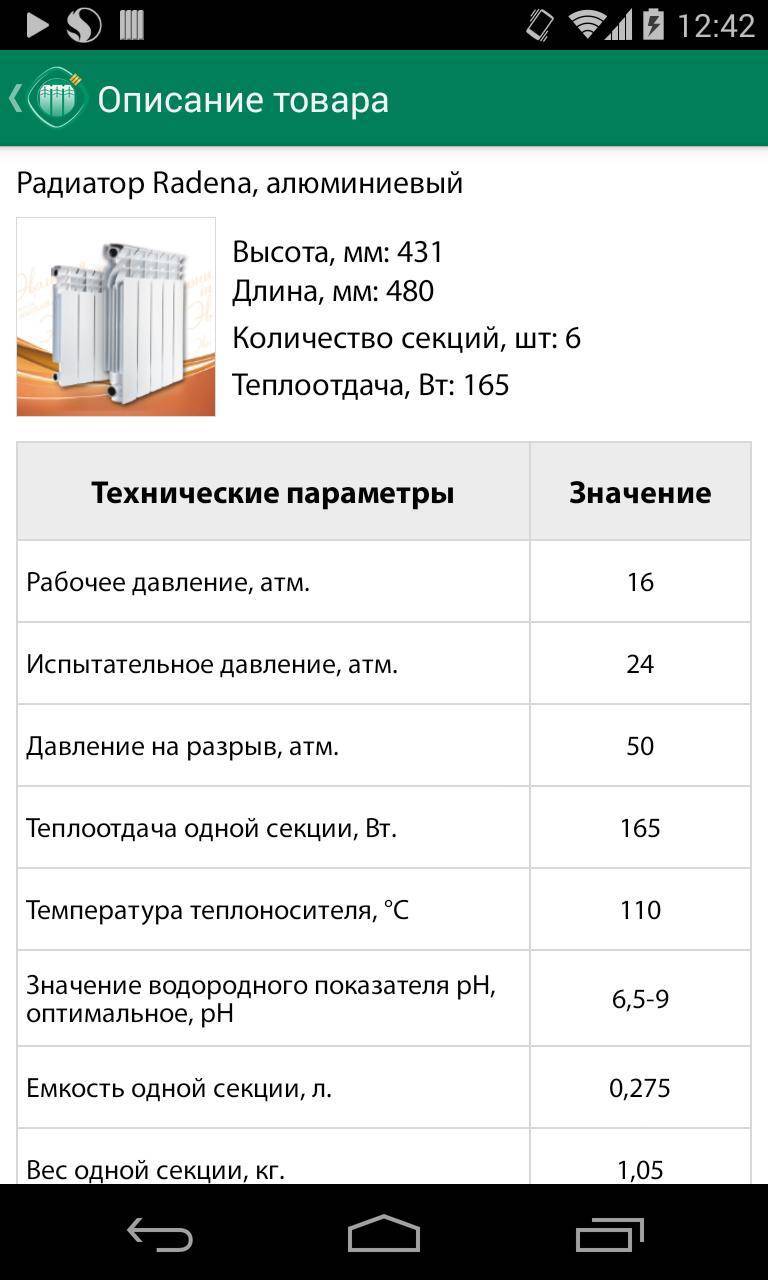
Table for calculating the number of sections depending on the area of \u200b\u200bthe room and the height of the ceilings.
- up to 2.7 m - 1.0;
- from 2.7 to 3.5 m - 1.1;
- from 3.5 to 4.5 m - 1.2.
Is there an attic behind the ceiling or another living room? And here we apply additional coefficients. If there is a heated attic upstairs (or with insulation), we multiply the power by 0.9, and if the dwelling is by 0.8. Is there an ordinary unheated attic behind the ceiling? We apply a coefficient of 1.0 (or simply do not take it into account).




After the ceilings, let's take up the walls - here are the coefficients:
- one outer wall - 1.1;
- two outer walls (corner room) - 1.2;
- three outer walls (the last room in an elongated house, hut) - 1.3;
- four outer walls (one-room house, outbuilding) - 1.4.
Also, the average air temperature in the coldest winter period is taken into account (the same regional coefficient):
- cold to -35 ° C - 1.5 (a very large margin that allows you not to freeze);
- frosts down to -25 ° C - 1.3 (suitable for Siberia);
- temperature up to -20 ° C - 1.1 (central Russia);
- temperature up to -15 ° C - 0.9;
- temperature down to -10 °C - 0.7.
The last two coefficients are used in hot southern regions. But even here it is customary to leave a solid supply in case of cold weather or especially for heat-loving people.
Having received the final thermal power necessary for heating the selected room, it should be divided by the heat transfer of one section. As a result, we will get the required number of sections and will be able to go to the store
Please note that these calculations assume a base heating power of 100 W per 1 sq. m
What if you need a very accurate calculation?
Unfortunately, not every apartment can be considered standard.This is even more true for private residences. The question arises: how to calculate the number of heating radiators, taking into account the individual conditions of their operation? To do this, you need to take into account many different factors.
When calculating the number of heating sections, it is necessary to take into account the height of the ceiling, the number and size of windows, the presence of wall insulation, etc.
The peculiarity of this method is that when calculating the required amount of heat, a number of coefficients are used that take into account the characteristics of a particular room that can affect its ability to store or release heat energy. The calculation formula looks like this:
CT = 100W/sq.m. * P * K1 * K2 * K3 * K4 * K5 * K6 * K7. where
KT - the amount of heat required for a particular room; P is the area of the room, sq.m.; K1 - coefficient taking into account the glazing of window openings:
- for windows with ordinary double glazing - 1.27;
- for windows with double glazing - 1.0;
- for windows with triple glazing - 0.85.
K2 - coefficient of thermal insulation of walls:
- low degree of thermal insulation - 1.27;
- good thermal insulation (laying in two bricks or a layer of insulation) - 1.0;
- high degree of thermal insulation - 0.85.
K3 - window area ratio and floor in the room:
K4 is a coefficient that takes into account the average air temperature in the coldest week of the year:
- for -35 degrees - 1.5;
- for -25 degrees - 1.3;
- for -20 degrees - 1.1;
- for -15 degrees - 0.9;
- for -10 degrees - 0.7.
K5 - adjusts the need for heat, taking into account the number of external walls:
K6 - accounting for the type of room that is located above:
- cold attic - 1.0;
- heated attic - 0.9;
- heated dwelling - 0.8
K7 - coefficient taking into account the height of the ceilings:
Such a calculation of the number of heating radiators includes almost all the nuances and is based on a fairly accurate determination of the room's need for thermal energy.
It remains to divide the result obtained by the heat transfer value of one section of the radiator and round the result to an integer.
Some manufacturers offer an easier way to get an answer. On their sites you can find a handy calculator specifically designed to do these calculations. To use the program, you need to enter the required values in the appropriate fields, after which the exact result will be displayed. Or you can use special software.
When we got an apartment, we didn’t think about what kind of radiators we have and whether they fit our house. But over time, a replacement was required, and here they began to approach from a scientific point of view. Since the power of the old radiators was clearly not enough. After all the calculations, we came to the conclusion that 12 is enough. But you also need to take into account this moment - if the CHPP does its job poorly and the batteries are a little warm, then no amount will save you.
I liked the last formula for a more accurate calculation, but the K2 coefficient is not clear. How to determine the degree of thermal insulation of walls? For example, a wall with a thickness of 375 mm from the GRAS foam block, is it a low or medium degree? And if you add 100mm thick construction foam to the outside of the wall, will it be high, or is it still medium?
Ok, the last formula seems to be solid, windows are taken into account, but what if there is also an external door in the room? And if it is a garage in which there are 3 windows 800*600 + a door 205*85 + garage sectional doors 45mm thick with dimensions 3000*2400?
If you do it for yourself, I would increase the number of sections and put a regulator. And voila - we are already much less dependent on the whims of the CHP.
home » Heating » How to calculate the number of radiator sections
Calculation of sections of aluminum radiators per square meter
As a rule, manufacturers pre-calculated the power standards of aluminum batteries. which depend on parameters such as ceiling height and room area. So it is believed that in order to heat 1 m2 of a room with a ceiling up to 3 m in height, a thermal power of 100 watts will be required.


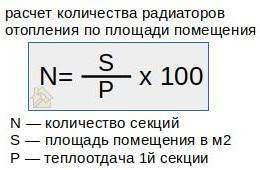

These figures are approximate, since the calculation of aluminum heating radiators by area in this case does not provide for possible heat loss in the room or higher or lower ceilings. These are generally accepted building codes that manufacturers indicate in the data sheet of their products.
Of considerable importance is the parameter of the thermal power of one radiator fin. For an aluminum heater, it is 180-190 W
The media temperature must also be taken into account.
It can be found in the thermal management, if the heating is centralized, or measured independently in an autonomous system. For aluminum batteries, the indicator is 100-130 degrees. Dividing the temperature by the heat output of the radiator, it turns out that 0.55 sections are required to heat 1 m2.
In the event that the height of the ceilings has "outgrown" the classical standards, then a special coefficient must be applied: if the ceiling is 3 m, then the parameters are multiplied by 1.05;
at a height of 3.5 m, it is 1.1;
with an indicator of 4 m - this is 1.15;
wall height 4.5 m - the coefficient is 1.2.
You can use the table that manufacturers provide for their products.
How many aluminum radiator sections do you need?
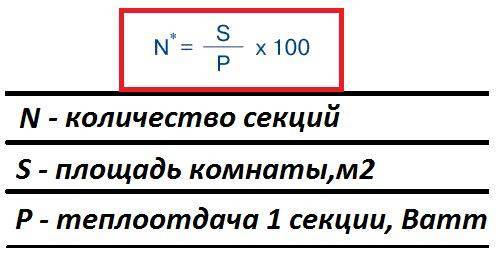
The calculation of the number of aluminum radiator sections is made in a form suitable for heaters of any type:
- S is the area of the room where the installation of the battery is required;
- k - correction factor of the indicator 100 W / m2, depending on the height of the ceiling;
- P is the power of one radiator element.
When calculating the number of sections of aluminum heating radiators, it turns out that in a room of 20 m2 with a ceiling height of 2.7 m, an aluminum radiator with a power of one section of 0.138 kW will require 14 sections.
Q = 20 x 100 / 0.138 = 14.49
In this example, the coefficient is not applied, since the ceiling height is less than 3 m
But even such sections of aluminum heating radiators will not be correct, since possible heat losses of the room are not taken into account. It should be borne in mind that depending on how many windows there are in the room, whether it is a corner room and whether it has a balcony: all this indicates the number of sources of heat loss. When calculating aluminum radiators by the area of the room, the percentage of heat loss should be taken into account in the formula, depending on where they will be installed:
When calculating aluminum radiators by the area of the room, the percentage of heat loss should be taken into account in the formula, depending on where they will be installed:
- if they are fixed under the windowsill, then the losses will be up to 4%;
- installation in a niche instantly increases this figure to 7%;
- if an aluminum radiator is covered for beauty on one side with a screen, then the losses will be up to 7-8%;
- completely closed by the screen, it will lose up to 25%, which makes it, in principle, unprofitable.
These are not all indicators that should be considered when installing aluminum batteries.
Rooms with standard ceiling heights
The calculation of the number of sections of heating radiators for a typical house is based on the area of the rooms. The area of a room in a typical house is calculated by multiplying the length of the room by its width. To heat 1 square meter, 100 watts of heater power is required, and to calculate the total power, you need to multiply the resulting area by 100 watts. The value obtained means the total power of the heater. The documentation for the radiator usually indicates the thermal power of one section. To determine the number of sections, you need to divide the total capacity by this value and round the result up.
A room with a width of 3.5 meters and a length of 4 meters, with the usual height of the ceilings. The power of one section of the radiator is 160 watts. Find the number of sections.
- We determine the area of \u200b\u200bthe room by multiplying its length by its width: 3.5 4 \u003d 14 m 2.
- We find the total power of heating devices 14 100 \u003d 1400 watts.
- Find the number of sections: 1400/160 = 8.75. Round up to a higher value and get 9 sections.
You can also use the table:
Table for calculating the number of radiators per M2
For rooms located at the end of the building, the calculated number of radiators must be increased by 20%.
Rooms with a ceiling height of more than 3 meters
The calculation of the number of sections of heaters for rooms with a ceiling height of more than three meters is based on the volume of the room. Volume is the area multiplied by the height of the ceilings. To heat 1 cubic meter of a room, 40 watts of heat output of the heater is required, and its total power is calculated by multiplying the volume of the room by 40 watts.To determine the number of sections, this value must be divided by the power of one section according to the passport.

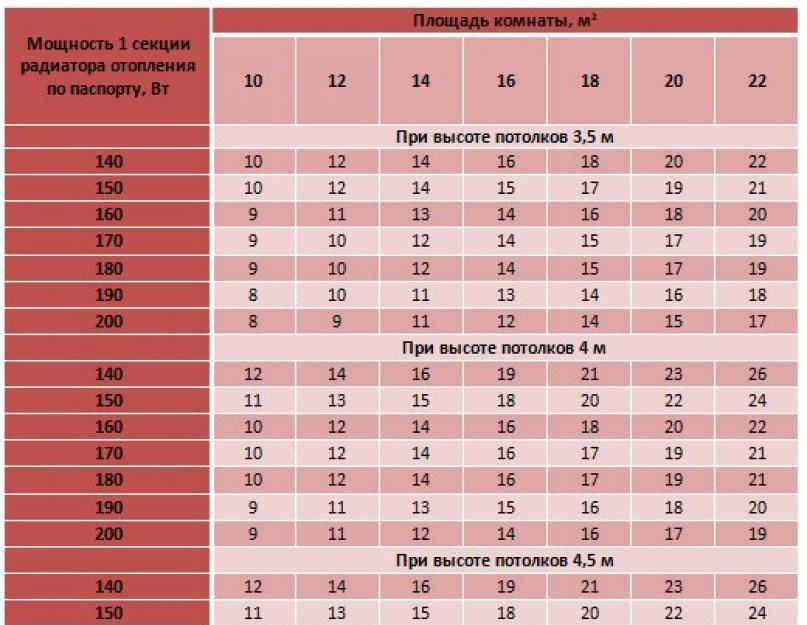

A room with a width of 3.5 meters and a length of 4 meters, with a ceiling height of 3.5 m. The power of one section of the radiator is 160 watts. It is necessary to find the number of sections of heating radiators.
- We find the area of the room by multiplying its length by the width: 3.5 4 \u003d 14 m 2.
- We find the volume of the room by multiplying the area by the height of the ceilings: 14 3.5 \u003d 49 m 3.
- We find the total power of the heating radiator: 49 40 \u003d 1960 watts.
- Find the number of sections: 1960/160 = 12.25. Round up and get 13 sections.
You can also use the table:
As in the previous case, for a corner room, this figure must be multiplied by 1.2. It is also necessary to increase the number of sections if the room has one of the following factors:
- Located in a panel or poorly insulated house;
- Located on the first or last floor;
- Has more than one window;
- Located next to unheated premises.
In this case, the resulting value must be multiplied by a factor of 1.1 for each of the factors.
Corner room with a width of 3.5 meters and a length of 4 meters, with a ceiling height of 3.5 m. Located in a panel house, on the ground floor, has two windows. The power of one section of the radiator is 160 watts. It is necessary to find the number of sections of heating radiators.
- We find the area of the room by multiplying its length by the width: 3.5 4 \u003d 14 m 2.
- We find the volume of the room by multiplying the area by the height of the ceilings: 14 3.5 \u003d 49 m 3.
- We find the total power of the heating radiator: 49 40 \u003d 1960 watts.
- Find the number of sections: 1960/160 = 12.25. Round up and get 13 sections.
- We multiply the resulting amount by the coefficients:
Corner room - coefficient 1.2;
Panel house - coefficient 1.1;
Two windows - coefficient 1.1;
First floor - coefficient 1.1.
Thus, we get: 13 1.2 1.1 1.1 1.1 = 20.76 sections. We round them up to a larger integer - 21 sections of heating radiators.
When calculating, it should be borne in mind that different types of heating radiators have different thermal output. When choosing the number of heating radiator sections, it is necessary to use exactly those values that correspond to the selected type of batteries.
In order for the heat transfer from the radiators to be maximum, it is necessary to install them in accordance with the manufacturer's recommendations, observing all the distances specified in the passport. This contributes to a better distribution of convective currents and reduces heat loss.
- Consumption of diesel heating boiler
- Bimetal heating radiators
- How to calculate heat for home heating
- Calculation of reinforcement for the foundation
How to calculate the number of heating radiator sections
In order for heat transfer and heating efficiency to be at the proper level, when calculating the size of radiators, it is necessary to take into account the standards for their installation, and by no means rely on the size of the window openings under which they are installed.
Heat transfer is not affected by its size, but by the power of each individual section, which are assembled into one radiator. Therefore, the best option would be to place several small batteries, distributing them around the room, rather than one large one. This can be explained by the fact that heat will enter the room from different points and evenly warm it up.
Each separate room has its own area and volume, and the calculation of the number of sections installed in it will depend on these parameters.
Calculation based on room area
To correctly calculate this amount for a certain room, you need to know some rules:
You can find out the required power for heating a room by multiplying by 100 W the size of its area (in square meters), while:
- The radiator power is increased by 20% if two walls of the room face the street and there is one window in it - this can be an end room.
- You will have to increase the power by 30% if the room has the same characteristics as in the previous case, but it has two windows.
- If the window or windows of the room face the northeast or north, which means that there is a minimum amount of sunlight in it, the power must be increased by another 10%.
- The radiator installed in a niche under the window has a reduced heat transfer, in this case it will be necessary to increase the power by another 5%.
Niche will reduce the energy efficiency of the radiator by 5%
If the radiator is covered with a screen for aesthetic purposes, then the heat transfer is reduced by 15%, and it also needs to be replenished by increasing the power by this amount.
Screens on radiators are beautiful, but they will take up to 15% of the power
The specific power of the radiator section must be indicated in the passport, which the manufacturer attaches to the product.
Knowing these requirements, it is possible to calculate the required number of sections by dividing the resulting total value of the required thermal power, taking into account all the specified compensating corrections, by the specific heat transfer of one section of the battery.
The result of the calculations is rounded up to an integer, but only up. Let's say there are eight sections.And here, returning to the above, it should be noted that for better heating and heat distribution, the radiator can be divided into two parts, four sections each, which are installed in different places in the room.

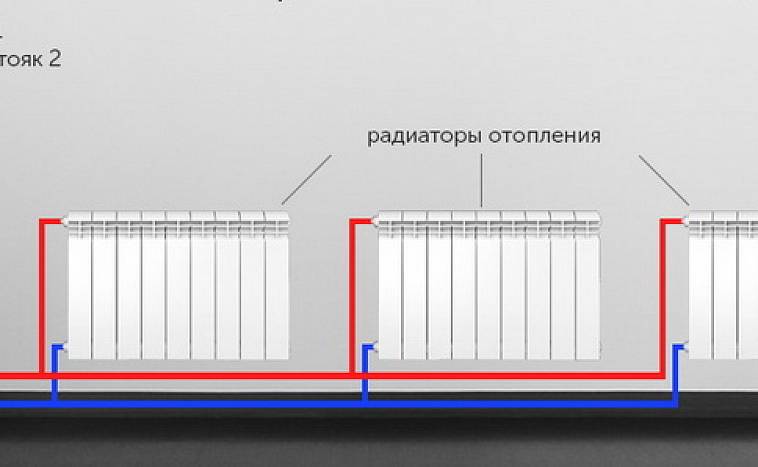


Each room is calculated separately
It should be noted that such calculations are suitable for determining the number of sections for rooms equipped with central heating, the coolant in which has a temperature of no more than 70 degrees.
This calculation is considered quite accurate, but you can calculate in another way.
Calculation of the number of sections in radiators, based on the volume of the room
The standard is the ratio of thermal power of 41 W per 1 cubic meter. meter of the volume of the room, provided that it contains one door, window and external wall.
To make the result visible, for example, you can calculate the required number of batteries for a room of 16 square meters. m and a ceiling, 2.5 meters high:
16 × 2.5 = 40 cubic meters
Next, you need to find the value of thermal power, this is done as follows
41 × 40=1640 W.
Knowing the heat transfer of one section (it is indicated in the passport), you can easily determine the number of batteries. For example, heat output is 170 W, and the following calculation is made:
1640 / 170 = 9,6.
After rounding, the number 10 is obtained - this will be the required number of sections of heating elements per room.
There are also some features:
- If the room is connected to the adjacent room by an opening that does not have a door, then it is necessary to calculate the total area of the two rooms, only then the exact number of batteries for heating efficiency will be revealed.
- If the coolant has a temperature below 70 degrees, the number of sections in the battery will have to be proportionally increased.
- With double-glazed windows installed in the room, heat losses are significantly reduced, therefore the number of sections in each radiator can be less.
- If old cast-iron batteries were installed in the premises, which coped well with creating the necessary microclimate, but there are plans to change them to some modern ones, then it will be very simple to calculate how many of them will be needed. One cast-iron section has a constant heat output of 150 watts. Therefore, the number of installed cast iron sections must be multiplied by 150, and the resulting number is divided by the heat transfer indicated on the sections of new batteries.
Calculation of heating radiators by area
The easiest way. Calculate the amount of heat required for heating, based on the area of \u200b\u200bthe room in which radiators will be installed. You know the area of \u200b\u200beach room, and the need for heat can be determined according to the building codes of SNiP:
- for an average climatic zone, 60-100W is required for heating 1m2 of a dwelling;
- for areas above 60o, 150-200W is required.
Based on these norms, you can calculate how much heat your room will require. If the apartment / house is located in the middle climatic zone, for heating an area of 16m2, 1600W of heat will be required (16 * 100 = 1600). Since the norms are average, and the weather does not indulge in constancy, we believe that 100W is required. Although, if you live in the south of the middle climatic zone and your winters are mild, consider 60W.
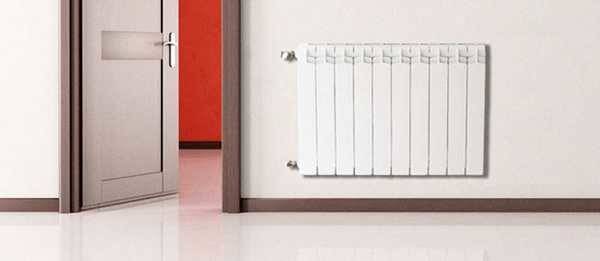
Calculation of heating radiators can be done according to the norms of SNiP
A power reserve in heating is needed, but not very large: with an increase in the amount of power required, the number of radiators increases.And the more radiators, the more coolant in the system. If for those who are connected to central heating this is not critical, then for those who have or plan individual heating, a large volume of the system means large (extra) costs for heating the coolant and a large inertia of the system (the set temperature is maintained less accurately). And the logical question arises: “Why pay more?”
Having calculated the need for heat in the room, we can find out how many sections are required. Each of the heaters can emit a certain amount of heat, which is indicated in the passport. The found heat demand is taken and divided by the radiator power. The result is the required number of sections to make up for losses.
Let's count the number of radiators for the same room. We have determined that we need to allocate 1600W. Let the power of one section be 170W. It turns out 1600/170 \u003d 9.411 pieces. You can round up or down as you wish. You can round it into a smaller one, for example, in the kitchen - there are enough additional heat sources, and into a larger one - it is better in a room with a balcony, a large window or in a corner room.
The system is simple, but the disadvantages are obvious: the height of the ceilings can be different, the material of the walls, windows, insulation and a number of other factors are not taken into account. So the calculation of the number of sections of heating radiators according to SNiP is indicative. You need to make adjustments for accurate results.
Determination of the number of radiators for one-pipe systems
There is one more very important point: all of the above is true for a two-pipe heating system. when a coolant with the same temperature enters the inlet of each of the radiators.A single-pipe system is considered much more complicated: there, colder water enters each subsequent heater. And if you want to calculate the number of radiators for a one-pipe system, you need to recalculate the temperature every time, and this is difficult and time consuming. Which exit? One of the possibilities is to determine the power of the radiators as for a two-pipe system, and then add sections in proportion to the drop in thermal power to increase the heat transfer of the battery as a whole.
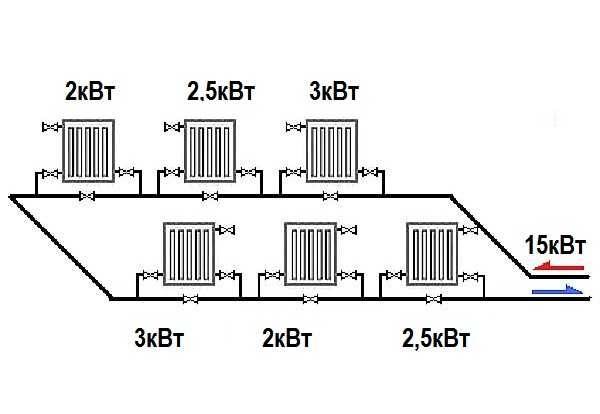
In a single-pipe system, the water for each radiator is getting colder and colder.
Let's explain with an example. The diagram shows a single-pipe heating system with six radiators. The number of batteries was determined for two-pipe wiring. Now you need to make an adjustment. For the first heater, everything remains the same. The second one receives a coolant with a lower temperature. We determine the % power drop and increase the number of sections by the corresponding value. In the picture it turns out like this: 15kW-3kW = 12kW. We find the percentage: the temperature drop is 20%. Accordingly, to compensate, we increase the number of radiators: if you needed 8 pieces, it will be 20% more - 9 or 10 pieces. This is where knowledge of the room comes in handy: if it is a bedroom or a nursery, round it up, if it is a living room or other similar room, round it down


You also take into account the location relative to the cardinal points: in the north you round up, in the south - down
In single-pipe systems, you need to add sections to the radiators located further along the branch
This method is clearly not ideal: after all, it turns out that the last battery in the branch will have to be simply huge: judging by the scheme, a coolant with a specific heat capacity equal to its power is supplied to its input, and it is unrealistic to remove all 100% in practice. Therefore, when determining the power of a boiler for single-pipe systems, they usually take some margin, put shutoff valves and connect radiators through a bypass so that heat transfer can be adjusted, and thus compensate for the drop in coolant temperature. One thing follows from all this: the number and / or dimensions of radiators in a single-pipe system must be increased, and as you move away from the beginning of the branch, more and more sections should be installed.
An approximate calculation of the number of sections of heating radiators is a simple and quick matter. But clarification, depending on all the features of the premises, size, type of connection and location, requires attention and time. But you can definitely decide on the number of heaters to create a comfortable atmosphere in winter.
Heating appliances of one-pipe systems
An important feature of the horizontal "Leningrad" is the gradual decrease in temperature in the main line due to the admixture of coolant cooled by batteries. If 1 loop line serves more than 5 appliances, the difference between the start and end of the distribution pipe can be up to 15 °C. The result is that the last radiators emit less heat.
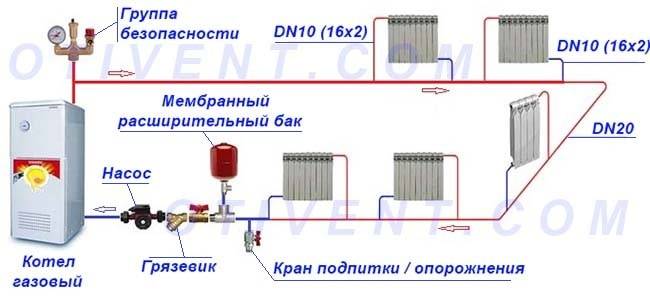
Single-pipe closed circuit - all heaters connected to 1 pipe
In order for distant batteries to transmit the required amount of energy to the room, make the following adjustments when calculating the heating power:
- Select the first 4 radiators according to the instructions above.
- Increase the power of the 5th device by 10%.
- Add another 10 percent to the calculated heat transfer of each subsequent battery.
Initial data for calculations
The calculation of the heat output of the batteries is carried out for each room separately, depending on the number of external walls, windows and the presence of an entrance door from the street. To correctly calculate the heat transfer indicators of heating radiators, answer 3 questions:
- How much heat is needed to heat a living room.
- What air temperature is planned to be maintained in a particular room.
- The average water temperature in the heating system of an apartment or a private house.
The answer to the first question - how to calculate the required amount of thermal energy in various ways, is given in a separate manual - calculating the load on the heating system. Here are 2 simplified calculation methods: by area and volume of the room.
A common way is to measure the heated area and allocate 100 W of heat per square meter, otherwise 1 kW per 10 m². We propose to clarify the methodology - to take into account the number of light openings and external walls:
- for rooms with 1 window or front door and one outer wall, leave 100 W of heat per square meter;
- corner room (2 external fences) with 1 window opening - count 120 W/m²;
- the same, 2 light openings - 130 W / m².
Distribution of heat losses over the area of a one-story house
With a ceiling height of more than 3 meters (for example, a corridor with a staircase in a two-story house), it is more correct to calculate the heat consumption by cubic capacity:
- a room with 1 window (outer door) and a single outer wall - 35 W/m³;
- the room is surrounded by other rooms, has no windows, or is located on the sunny side - 35 W / m³;
- corner room with 1 window opening - 40 W / m³;
- the same, with two windows - 45 W / m³.
It is easier to answer the second question: the temperature comfortable for living lies in the range of 20 ... 23 ° C. It is uneconomical to heat the air more strongly, it is colder weaker. The average value for calculations is plus 22 degrees.
The optimal mode of operation of the boiler involves heating the coolant to 60-70 ° C. An exception is a warm or too cold day, when the water temperature has to be reduced or, conversely, increased. The number of such days is small, so the average design temperature of the system is assumed to be +65 °C.
In rooms with high ceilings, we consider the heat consumption by volume