- Room temperature standards
- Consumption standards
- Calculation of the heating boiler power by area
- Determination of the number of radiators for one-pipe systems
- What to do in case of incorrect calculation?
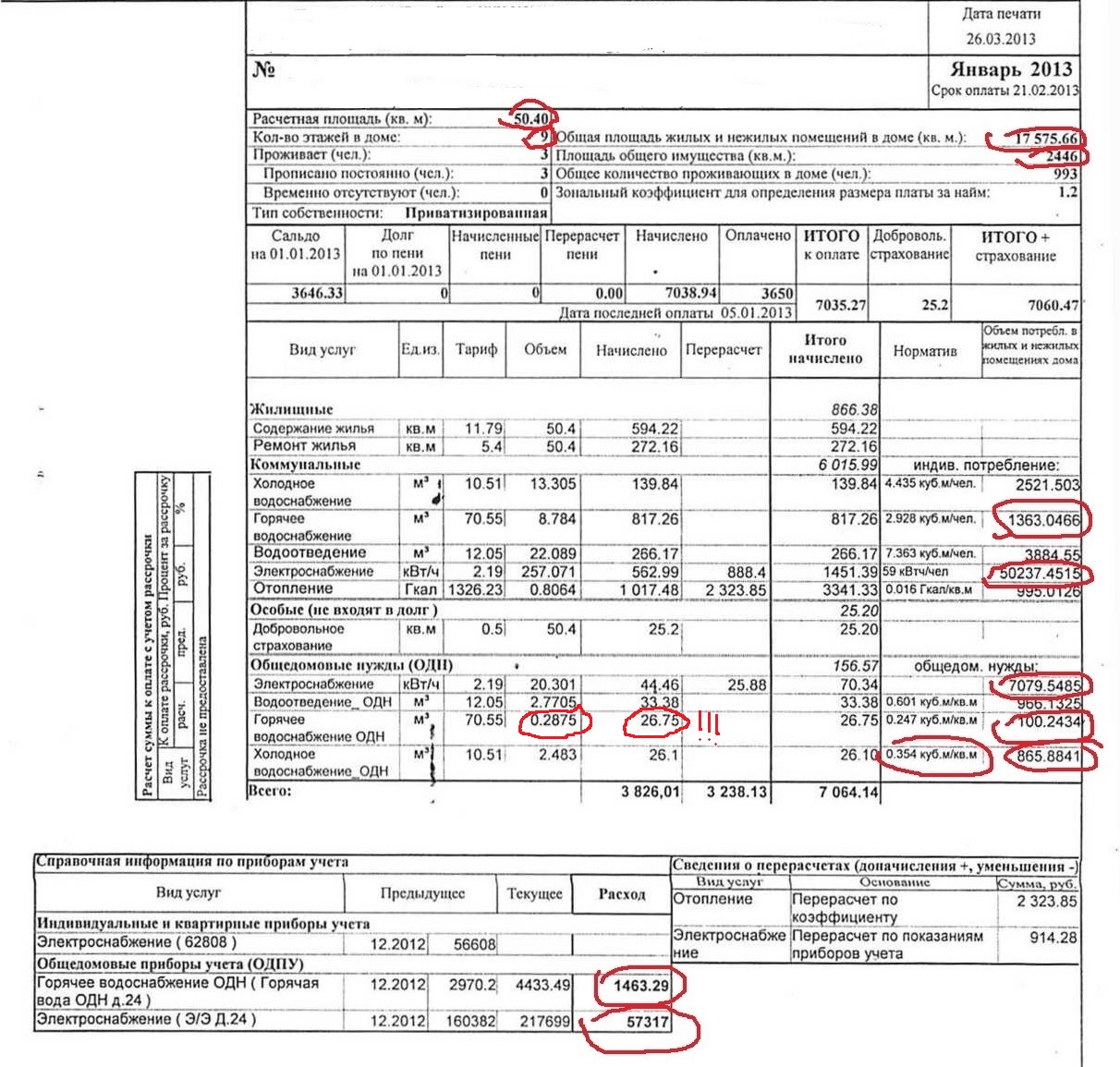
- How is the cost calculated in an apartment building?
- By area
- According to the meter in the apartment
- By public account
- “And we work with the Settlement Center”
- How is control carried out in an apartment building
- Benefits for labor veterans and the disabled
- Innovations in heating cost calculations
- Formulas for calculating the cost of heating
Room temperature standards
Before carrying out any calculations of system parameters, it is necessary, at a minimum, to know the order of expected results, and also to have standardized characteristics of some tabular values that must be substituted into formulas or be guided by them.
By performing parameter calculations with such constants, one can be confident in the reliability of the desired dynamic or constant parameter of the system.
For premises of various purposes, there are reference standards for the temperature regimes of residential and non-residential premises. These norms are enshrined in the so-called GOSTs.
For a heating system, one of these global parameters is the room temperature, which must be constant regardless of the period of the year and environmental conditions.
But the room temperature in winter is provided by the heating system. Therefore, we are interested in temperature ranges and their deviation tolerances for the winter season.
Most regulatory documents stipulate the following temperature ranges that allow a person to be comfortable in a room.
For non-residential premises of office type up to 100 m2:
- 22-24°C - optimal air temperature;
- 1°C - allowable fluctuation.
For office-type premises with an area of more than 100 m2, the temperature is 21-23°C. For non-residential premises of an industrial type, the temperature ranges vary greatly depending on the purpose of the premises and the established labor protection standards.
Comfortable room temperature for each person is “own”. Someone likes to be very warm in the room, someone is comfortable when the room is cool - it's all quite individual
As for residential premises: apartments, private houses, estates, etc., there are certain temperature ranges that can be adjusted depending on the wishes of the residents.
And yet, for specific premises of an apartment and a house, we have:
- 20-22°С - residential, including children's, room, tolerance ± 2°С -
- 19-21°C - kitchen, toilet, tolerance ± 2°C;
- 24-26°С - bathroom, shower room, swimming pool, tolerance ±1°С;
- 16-18°С - corridors, hallways, stairwells, storerooms, tolerance +3°С
It is important to note that there are a few more basic parameters that affect the temperature in the room and that you need to focus on when calculating the heating system: humidity (40-60%), the concentration of oxygen and carbon dioxide in the air (250: 1), the speed of movement of air masses (0.13-0.25 m/s), etc.
Consumption standards
Each subject of the Federation has a body that determines the amount of any energy needed for the needs of the population. Usually they are regional energy commissions. The rate is set every three years and adjusted if necessary.
The following table provides information on the tariffs that exist in various regions of the country:
Table 1.
| Region | Tariff (r/Gcal) |
|---|---|
| Moscow | 1747,47 |
| St. Petersburg | 1678,72 |
| Murmansk | 2364,77 |
| N-Novgorod | 1136,98 |
| Novosibirsk | 1262,53 |
| Khabarovsk | 1639,74 |
| Vladivostok | 2149,28 |
| Birobidzhan | 2339,74 |
However, with the beginning of the cold season, the cost of a communal resource will increase by about 100 rubles.
Calculation of the heating boiler power by area
For an approximate assessment of the required performance of a thermal unit, the area of \u200b\u200bthe premises is sufficient. In the simplest version for central Russia, it is believed that 1 kW of power can heat 10 m2 of area. If you have a house with an area of 160m2, the boiler power for heating it is 16kW.
These calculations are approximate, because neither the height of the ceilings nor the climate are taken into account. To do this, there are coefficients derived empirically, with the help of which appropriate adjustments are made.
The indicated norm - 1 kW per 10 m2 is suitable for ceilings 2.5-2.7 m. If you have higher ceilings in the room, you need to calculate the coefficients and recalculate. To do this, divide the height of your premises by the standard 2.7 m and get a correction factor.

Calculating the power of a heating boiler by area - the easiest way
For example, the ceiling height is 3.2m. We consider the coefficient: 3.2m / 2.7m \u003d 1.18 rounded up, we get 1.2. It turns out that for heating a room of 160m2 with a ceiling height of 3.2m, a heating boiler with a capacity of 16kW * 1.2 = 19.2kW is required. They usually round up, so 20kW.
To take into account climatic features, there are ready-made coefficients. For Russia they are:
- 1.5-2.0 for northern regions;
- 1.2-1.5 for regions near Moscow;
- 1.0-1.2 for the middle band;
- 0.7-0.9 for the southern regions.
If the house is located in the middle lane, just south of Moscow, a coefficient of 1.2 is applied (20kW * 1.2 \u003d 24kW), if in the south of Russia in the Krasnodar Territory, for example, a coefficient of 0.8, that is, less power is required (20kW * 0 ,8=16kW).
Calculation of heating and selection of a boiler is an important stage. Find the wrong power and you can get this result ...
These are the main factors to be considered. But the values found are valid if the boiler will only work for heating. If you also need to heat water, you need to add 20-25% of the calculated figure. Then you need to add a "margin" for peak winter temperatures. That's another 10%. In total we get:
- For home heating and hot water in the middle lane 24kW + 20% = 28.8kW. Then the reserve for cold weather is 28.8 kW + 10% = 31.68 kW. We round up and get 32kW. When compared with the original figure of 16kW, the difference is two times.
- House in the Krasnodar Territory. We add power for heating hot water: 16kW + 20% = 19.2kW. Now the "reserve" for the cold is 19.2 + 10% \u003d 21.12 kW. Rounding up: 22kW. The difference is not so striking, but also quite decent.
It can be seen from the examples that it is necessary to take into account at least these values. But it is obvious that in calculating the power of the boiler for a house and an apartment, there should be a difference.You can go the same way and use coefficients for each factor. But there is an easier way that allows you to make corrections in one go.
When calculating a heating boiler for a house, a coefficient of 1.5 is applied. It takes into account the presence of heat loss through the roof, floor, foundation. It is valid with an average (normal) degree of wall insulation - laying in two bricks or building materials similar in characteristics.
For apartments, different rates apply. If there is a heated room (another apartment) on top, the coefficient is 0.7, if a heated attic is 0.9, if an unheated attic is 1.0. It is necessary to multiply the boiler power found by the method described above by one of these coefficients and get a fairly reliable value.
To demonstrate the progress of calculations, we will calculate the power of a gas heating boiler for an apartment of 65m2 with 3m ceilings, which is located in central Russia.
- We determine the required power by area: 65m2 / 10m2 \u003d 6.5 kW.
- We make a correction for the region: 6.5 kW * 1.2 = 7.8 kW.
- The boiler will heat the water, so we add 25% (we like it hotter) 7.8 kW * 1.25 = 9.75 kW.
- We add 10% for cold: 7.95 kW * 1.1 = 10.725 kW.
Now we round the result and get: 11 kW.
The specified algorithm is valid for the selection of heating boilers for any type of fuel. The calculation of the power of an electric heating boiler will not differ in any way from the calculation of a solid fuel, gas or liquid fuel boiler. The main thing is the performance and efficiency of the boiler, and heat losses do not change depending on the type of boiler. The whole question is how to spend less energy. And this is the area of \u200b\u200bwarming.
Determination of the number of radiators for one-pipe systems
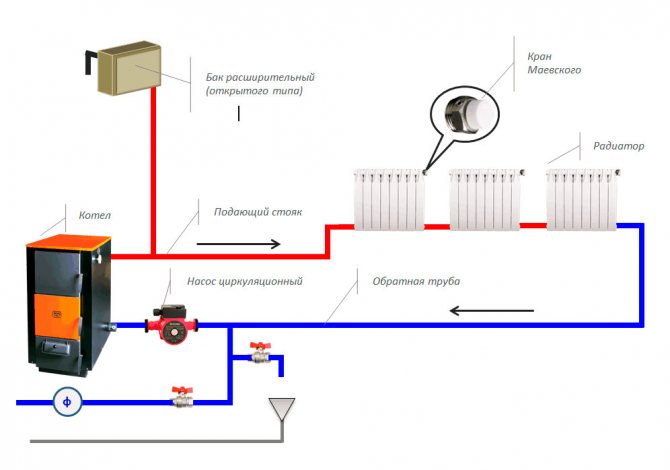
There is one more very important point: all of the above is true for a two-pipe heating system. when a coolant with the same temperature enters the inlet of each of the radiators. A single-pipe system is considered much more complicated: there, colder water enters each subsequent heater. And if you want to calculate the number of radiators for a one-pipe system, you need to recalculate the temperature every time, and this is difficult and time consuming. Which exit? One of the possibilities is to determine the power of the radiators as for a two-pipe system, and then add sections in proportion to the drop in thermal power to increase the heat transfer of the battery as a whole.
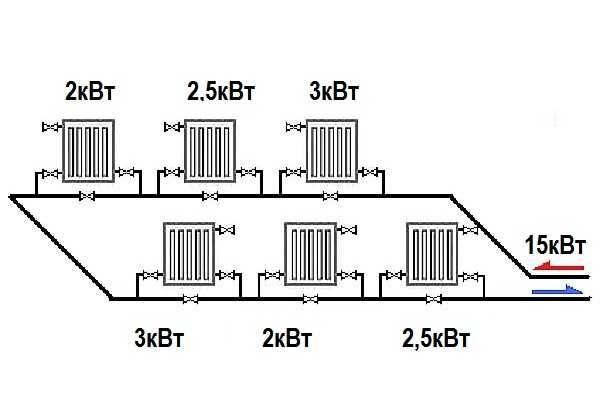
In a single-pipe system, the water for each radiator is getting colder and colder.
Let's explain with an example. The diagram shows a single-pipe heating system with six radiators. The number of batteries was determined for two-pipe wiring. Now you need to make an adjustment. For the first heater, everything remains the same. The second one receives a coolant with a lower temperature. We determine the % power drop and increase the number of sections by the corresponding value. In the picture it turns out like this: 15kW-3kW = 12kW. We find the percentage: the temperature drop is 20%. Accordingly, to compensate, we increase the number of radiators: if you needed 8 pieces, it will be 20% more - 9 or 10 pieces. This is where knowledge of the room comes in handy: if it is a bedroom or a nursery, round it up, if it is a living room or other similar room, round it down
You also take into account the location relative to the cardinal points: in the north you round up, in the south - down
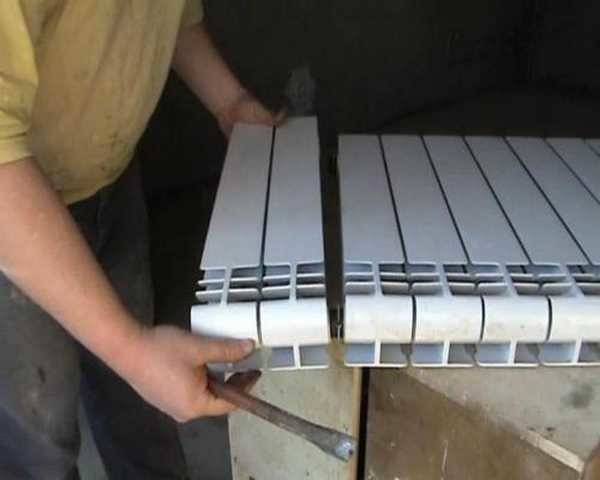
In single-pipe systems, you need to add sections to the radiators located further along the branch
This method is clearly not ideal: after all, it turns out that the last battery in the branch will have to be simply huge: judging by the scheme, a coolant with a specific heat capacity equal to its power is supplied to its input, and it is unrealistic to remove all 100% in practice. Therefore, when determining the power of a boiler for single-pipe systems, they usually take some margin, put shutoff valves and connect radiators through a bypass so that heat transfer can be adjusted, and thus compensate for the drop in coolant temperature. One thing follows from all this: the number and / or dimensions of radiators in a single-pipe system must be increased, and as you move away from the beginning of the branch, more and more sections should be installed.


An approximate calculation of the number of sections of heating radiators is a simple and quick matter. But clarification, depending on all the features of the premises, size, type of connection and location, requires attention and time. But you can definitely decide on the number of heaters to create a comfortable atmosphere in winter.
What to do in case of incorrect calculation?
Unfortunately, many consumers are facing the problem of incorrect charges more and more often. An unscrupulous accountant of the management company, errors in accruals, any inattention committed through someone else's fault - all this, ultimately, falls on the shoulders of the consumer of thermal energy.
Before paying the received receipt, you must verify all the data given in it with your own calculations.
If an error was detected at this stage, then there are several ways to solve the problem:
- Write an application / claim to the management company.
- File a complaint with the State Housing Inspectorate.
- File a complaint with the CPS.
- File a complaint with the prosecutor.
- Submit an application to the court.
When submitting a written application to the Management Company, you need to make sure that there was no increase in the tariff. If the tariff remains the same, then often, after writing such a statement, the company will find an error in the charges and go to a meeting.
With the help of a claim, you can determine the procedure for the return of overpaid funds:
- return by money;
- recalculation against future payments.
You can file complaints with Rospotrebnadzor and the State Housing Inspectorate if the management company deliberately raises tariffs. In this case, the application / claim is brought in person or sent by registered mail. Based on the results of the audit of these structures, an administrative penalty may be imposed on the Management Company.
An appeal to the prosecutor's office occurs when the previous instances do not solve the problem that has arisen. And when applying to the court, it is necessary to have irrefutable evidence of the revealed violations in the calculations.
How is the cost calculated in an apartment building?
Calculation methods are formulas that take into account the main parameters:
- area of the apartment;
- standard of heat consumption;
- approved tariff;
- duration of the heating season;
- meter readings, etc.
For a visual demonstration of the differences in formulas and methods, we assume the following parameter values:
- area - 62 sq.m;
- standard - 0.02 Gkl / sq.m;
- tariff - 1600 rubles / Gkl;
- heating season coefficient - 0.583 (7 out of 12);
- readings of a common house meter - 75 Gkl;
- total area of the house - 6000 sq.m;
- the volume of thermal energy consumed in the past year - 750 Gkl;
- readings of an individual device in the apartment - 1.2 Gkl;
- the sum of the readings of all meters in the apartments - 53 Gkl;
- average monthly readings of apartment meters - 0.7 Gkl;
- the sum of the average monthly readings of individual devices around the house - 40 Gkl;
- average monthly readings of a common house device - 44 Gkl.
By area
If the apartment building is not equipped with metering devices (neither collective nor individual), then in this case the fee is calculated by multiplying the area of the apartment, the consumption rate and the approved tariff. With uniform payment throughout the year, another multiplier is added - the ratio of the number of months of the heating season to the number of months in a year.
Then in the first case (when fees are charged only during the actual provision of the service), the owner will be presented with 62 * 0.02 * 1600 = 1984 rubles for payment. per month. When paying throughout the year, the amount will be lower per month and will amount to 62 * 0.02 * 1600 * 0.583 = 1156.67 rubles. However, for the year in both cases, the consumer will be charged approximately the same amount.
According to the meter in the apartment
When installing a general house and apartment meters in a house, the calculation formula consists of two steps:
- calculation of the difference between the readings of the collective device and the sum from the addition of the readings of apartment devices;
- calculation of fees, taking into account the readings of an individual device, a share of common house expenses and the approved tariff.
So, if tenants pay for heating services directly after the fact, i.e. during the heating season, then they will receive an amount in the amount of ((75-53) * 62/6000 + 1.2) * 1600 = 2118.40 rubles in the month of payment.When paying for the entire calendar year, not the actual readings of the instruments, but their average monthly values are substituted into the formula. In this case, the homeowner will be billed every month with the same amount ((44-40) * 62/6000 + 0.7) * 1600 = 1186.13 rubles.
By public account
If a common house metering device is installed in an apartment building, but there are no individual meters in the apartments, then the calculation formula changes somewhat. It is the product of the readings of the device, the approved tariff and the quotient from the area of the apartment to the total area of \u200b\u200bthe house. In this case, the owner will be charged 75*1600*(62/6000)=1240 rubles. in the current month.
If the tenants of the house pay for heating throughout the calendar year, then the formula undergoes changes and becomes equal to the product of the area of the apartment, the approved tariff and the quotient of dividing the annual heat volume by the number of months in the year and the total area of \u200b\u200bthe house. In such a situation, the user will receive a monthly receipt for payment 62*1600*(750/12/6000)=1033.33 rubles.
If there is a collective meter and the payment option is chosen throughout the year, an adjustment will take place in the first quarter of the new year, taking into account the actual energy consumed for the previous period. This means that overpaid amounts will be additionally accrued or written off. The following formula is used to calculate them:
volume of actually consumed heat per year*approved tariff*(apartment area / house area) - the amount paid by the consumer for the year
If the value is positive, the amount will be added to the next payment, if it is negative, it will be deducted from the next payment amount.
“And we work with the Settlement Center”
The utility service provider may involve any organization or individual entrepreneur to charge utility bills and prepare the delivery of payment documents to consumers (subparagraph “e” of paragraph 32 of Rules 354). Part 15 of Article 155 of the HC RF allows persons in whose favor payment for housing and utilities is paid to collect such a fee with the participation of payment agents engaged in accepting payments from individuals.
That is, the current housing legislation really allows you to collect payments from consumers of services with the participation of various Settlement Centers and other payment agents.
However, it is important to understand that the responsibility to consumers for the correctness of the calculations continues to be borne by service providers (MA / HOA / RSO). Including, for example, it is the service provider who is obliged “to check, directly at the consumer’s request, the correctness of the calculation of the amount of payment for utilities presented to the consumer, the debt or overpayment of the consumer for utilities, the correctness of the calculation of penalties (fines, penalties) to the consumer and immediately upon results checks to issue to the consumer documents containing correctly calculated payments
Documents issued to the consumer at his request must be certified by the signature of the head and the seal of the contractor (if any) ”(subparagraph “e” of paragraph 31 of Rules 354)
Including, for example, it is the service provider who is obliged “to check, directly at the consumer’s request, the correctness of the calculation of the amount of payment for utilities presented to the consumer, the debt or overpayment of the consumer for utilities, the correctness of the calculation of penalties (fines, penalties) to the consumer and immediately upon results checks to issue to the consumer documents containing correctly calculated payments. Documents issued to the consumer at his request must be certified by the signature of the head and the seal of the contractor (if any) ”(subparagraph “e” of paragraph 31 of Rules 354).
And to offer the consumer to apply for verification of the correctness of charges to the Settlement Center or to another contracting organization hired by the contractor, the service provider does not have the right.
In addition, it is the service provider (and not at all his paying agent!) who violates the procedure for calculating utility bills and is obliged to pay a fine in favor of the consumer (part 6 of article 157 of the LC RF, clause 155.2 of Rules 354).
And if the consumer starts to appeal the procedure for calculating the cost of heating, then the argument “But we work with the Settlement Center”, of course, will not be taken into account, and if violations of the calculation procedure are found, the service provider will be recognized as the guilty person
How is control carried out in an apartment building
Housing and communal services or contracting firms are in charge of control. If the check is unscheduled, then they can warn about it.
Photo 3. The process of controlling thermal communications in an apartment building. The inspection is carried out by a housing and communal services officer.
Scheduled inspections take place without warning, at any time of the season.Maintenance and repair is also carried out by housing and communal services workers, but the supplier of the meter can do the repair if the warranty period has not expired. You can contact the service center on your own or through housing and communal services workers, but the right to repair the device remains only with the employees of the managing organization.
Benefits for labor veterans and the disabled
Privileges for payment of heat energy are provided at 2 levels:
- On the federal:
- heroes of the USSR and social. labor;
- veterans and invalids of the Great Patriotic War;
- persons affected by the Chernobyl accident;
- invalids of all three groups;
- citizens raising a child with a disability.
- On the regional:
- low-income and large families;
- pensioners;
- labor veterans;
- home front workers during the Second World War and residents of besieged Leningrad;
- public sector workers.
The benefits themselves are provided either in the form of compensation (then part of the funds for the consumed resource is returned to the subject in the next month), or in the form of subsidies (which is less common).
The only way to move the modernization of housing and communal services in the country off the ground is to create a system of incentives for owners to optimize their costs for consumed utilities. To do this, it is necessary that there is a direct and strong correlation between the amount of payment and the volume of consumption. And this can be achieved only through the mass introduction of individual metering devices (in our case, heat).
To resolve your issue, contact a lawyer for help. We will select a specialist for you. Call 8 (800) 350-14-90
Badly
Healthy!
Innovations in heating cost calculations
In the first chapter of Appendix No. 2 of PP No. 354 of 05/06/2011, which deals with the procedure for calculating the cost of utilities for citizens, there have been changes in accordance with the RF PP No. 1708 of 12/28/2018.
Formulas for calculating the cost of heating
The cost of heating is calculated:
to calculate the price for a private residential building in which a metering device is not installed, when paying for services only in the season, formula No. 1 is used:
to calculate the price in a private residential building in which a metering device is not installed, when paying for the service throughout the year, formula No. 2 is used:
If the standards of 06/30/2012 are used, the cost of the space heating service for a residential private house not equipped with a meter should be calculated according to formulas No. 1, 2, 3 and 4 in accordance with paragraphs 42 and 43 of the sixth chapter of PP No. 354 of 05/06/2011 . This procedure will be valid until 01/01/2020, in accordance with the RF PP No. 603 of 06/29/2016 and the Letter of the Ministry of Construction of the Russian Federation No. 10561-OG / 04 of 03/21/2019;
to calculate the price for an MKD in which a common house metering device is not installed, when paying for services only in the season, formula No. 3 is used:
to calculate the price for an MKD, in which a common house metering device is not installed, when paying for the service throughout the year, formula No. 4 is used:
to calculate the amount of heat energy consumed by an MKD room in which a common house metering device is not installed, for the period that is accepted for calculation (when paid during the season), formula No. 5 is used:
to calculate the amount of heat energy consumed by the MKD premises, which is not equipped with a common house metering device, for the period that is accepted for calculation (when paying for the whole year), formula No. 6 is used:
for calculating the price for an MKD, which is equipped with a common house metering device (if none of the premises of the house has an individual metering device), in accordance with clauses No. 42 and 43 of the sixth chapter of PP No. 354 dated 06.05. year, formula No. 7 is used:
- if the common house metering device was installed less than a year ago (Chapter 6, paragraph 59 (1) of the Government Resolution No. 354 of 05/06/2011), the price is calculated in accordance with the provisions of this paragraph;
- to calculate the price for an MKD, which is equipped with a common house metering device (if all premises have individual metering devices), in accordance with paragraphs 42 and 43 of the sixth chapter of PP No. 354 of 05/06/2011 and when paying throughout the year, formula No. 8 is used:
to calculate the volume of heat supplied to the house minus the volume of heat used in the premises, formula No. 9 is used:
the price for MKD, calculated according to formulas 6, 7, 8, as well as the price calculated according to formula 11 for private houses that have individual metering devices, must be adjusted in the first quarter of the year following the calculated one. For this, formula No. 10 is used:
to calculate the price for private houses that have individual metering devices, formula No. 11 is used (clause 42 (1) of GD No. 354 of 05/06/2011):

to calculate the volume of heat energy consumption in the MKD premises, which has a common house metering device (if none of the premises of the house has an individual metering device), when paying throughout the year, formula No. 12 is used:
In the cases listed in the sixth chapter of paragraph No. 59 (1), the price is calculated in accordance with the provisions of this paragraph:
to calculate the volume of heat energy consumption in the MKD premises, which has a common house metering device (if one or more, but not all, premises of the house have individual metering devices), when paying throughout the year, formula No. 13 is used:
In the cases listed in the sixth chapter of paragraph 59, the price is calculated in accordance with the provisions of this paragraph.
In all cases, Vi will be equal to zero if, in accordance with the technical documentation of the MKD, it does not involve the use of means for heating, and also if individual metering devices are used;
in addition, the formula for calculating the price for gas supply in premises that are not equipped with metering devices has changed. So, for the housing stock, formula No. 14 looks like this:
for non-residential stock, the price is calculated by multiplying the estimated volume of gas consumed by the gas tariff.