- How to determine the cross section of the pipeline
- Materials for arranging storm sewers
- An example of the calculation of storm sewers
- Placement and size of wells
- Depth of storm sewer
- Channel depth
- Classification of types of "stormwater"
- Why do you need a calculation of storm sewers
- Methods for discharging collected water
- When the storm drain needs to be cleaned
- mechanical cleaning
- Hydrodynamic method
- Steam cleaning (thermal method)
- Use of chemicals
- Stormwater types
- Conclusions and useful video on the topic
How to determine the cross section of the pipeline
The choice of pipe diameter depends on the total inlet flow rates. The limit indicator is calculated according to the following example: Qr = Ψ *q20 * F. In this formula, Ψ is represented by the moisture absorption parameter of the material surface, q20 is the value of precipitation over a specific period of time, F is the area for water drainage.
When calculating the storm runoff, pay attention to the location of the slope of the pipeline. This indicator is approximately equal to 0.007 m with a cross section of the product up to 0.2 m
For the construction of a drainage system from an industrial area, it is better to use pipes with a cross section of 0.15 m and install them with a slope of 0.008 m.
There are situations when it is impossible to adhere to the above standard due to subjective circumstances. In this case, lower standards are allowed - the cross section of the product is 200 mm up to a slope of 0.005 m.
On a short pipe section, a slope can be dispensed with only if, with a certain type of terrain, it is not possible to achieve a minimum decrease in level.
We know that in accordance with the standards for the installation of an open type drainage structure, a slope of 0.003 m corresponds. For a sewer ditch, this dimension is considered ideal. When paved with paving stones or crushed stone, this value will increase to 0.004 m.
The results of the regulation assessment indicate that the surface roughness affects the slope, so it is advisable to design a wider angle. And vice versa than the pipe cross section will be larger, the smaller the slope will have to be performed.
Materials for arranging storm sewers
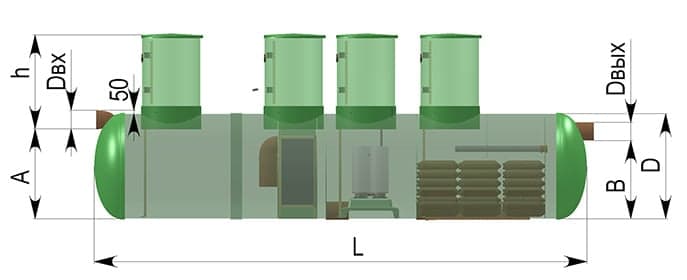
The project documentation should describe the requirements for the components and materials used for the installation of storm sewers. Their selection is carried out as follows.
Pipes. They can be rigid, made of PVC. Another option is corrugated pipes. PVC pipes are usually laid at shallow depths. Corrugated polymer pipes are more durable, and therefore they are used in the construction of sewers with significant depth. It is also possible to lay asbestos-cement or metal pipes. Their specialists from the Mos-drainage company recommend installing under sections of the roadway, parking lots - where an increased mechanical load can act on the pipeline.
Storm water inlets.They can be made of polymeric materials or polymer concrete. They are additionally equipped with siphons, in which small rubbish, dirt, silt settle. Polymer concrete products are used if it is necessary for the receiving device to have increased strength. Plastic storm water inlets are more affordable, they are easier to install, and have a smooth surface. At the same time, plastic is not as strong as fiber-reinforced concrete, and therefore products made of it, as a rule, are installed in private facilities with a small load.
Door trays. Are wide, from above are closed by a lattice. Used to drain the area directly at the entrance to the house. The door tray has an outlet that connects to the storm sewer pipe. The outlet and the pipe must match in diameter.
Wells. Are made plastic or reinforced concrete. The first option is used much more often due to its affordable price, low weight, and simple installation. The well must be selected not only in size, but also in terms of resistance to ascent, strength characteristics, and installation parameters.
In "Mos-drainage" you can order the design of storm sewers, its arrangement and the supply of all necessary materials and components. We guarantee efficiency and high quality of work.
An example of the calculation of storm sewers
Some designers do not go into the details of calculating storm sewers, using the recommended pipe diameters specified in SNiP. For non-pressure networks, a pipeline with a diameter of 200-250 mm is usually used as a drainage system. It is this size that guarantees optimal surface runoff speed in the case of heavy rainfall. However, a correctly performed calculation contributes to a more appropriate budget management, since pipes of a smaller diameter may be suitable for the normal functionality of the storm network.
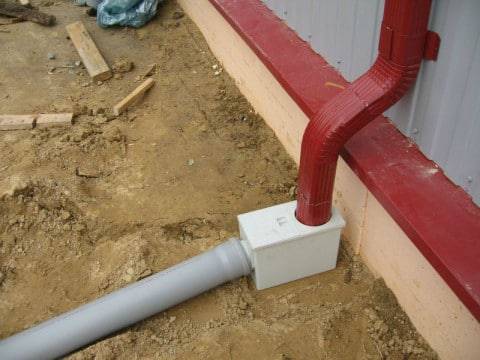
Pipe diameter calculation allows you to reduce costs without compromising the functionality of the system
As an example, let's calculate the parameters of a drainpipe for the roof of a private house with an area of 100 m² (0.01 ha), located in one of the settlements of the Moscow Region:
- According to the rain intensity map, the q20 parameter for Moscow and nearby areas is 80 l/s. The moisture absorption coefficient for the roof is 1. Based on these data, we calculate the flow of rainwater:
Qr \u003d 80 0.01 \u003d 0.8 l / s
- Since the slope of the roof in a private house, as a rule, significantly exceeds 0.03 (3 cm per 1 m), the fill factor of the free tank during the pressure regime is assumed to be 1. Thus:
Q = Qr = 0.8 l/s
- Knowing the indicator of rainwater consumption, it is possible not only to calculate the diameter of the storm sewer, but also to determine the required slope of the runoff. To do this, we use the reference book of A.Ya. Dobromyslova “Tables for hydraulic calculations of pipelines made of polymeric materials. Non-pressure pipelines. According to the calculated data presented in the tables, pipes with the following parameters are suitable for a flow rate of 0.8 l / s:
- diameter 50 mm, slope 0.03;
- diameter 63 mm, slope 0.02;
- diameter 75 mm (and above), slope 0.01.
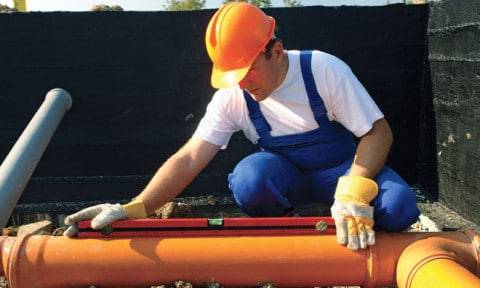
The slope of a pipe is inversely proportional to its diameter.
- pipeline material.
SNiP allows the use of pipes made of asbestos cement, steel and plastic (PVC).Asbestos-cement pipeline, although it is an economical option, is rarely used today due to the fragility of the material and its heavy weight (1 meter of a 100 mm pipe weighs 24 kg). Steel pipes are much lighter than asbestos, but they are prone to corrosion. Therefore, PVC pipes are most often used for stormwater pipes, which combine low weight, ease of installation and long service life.


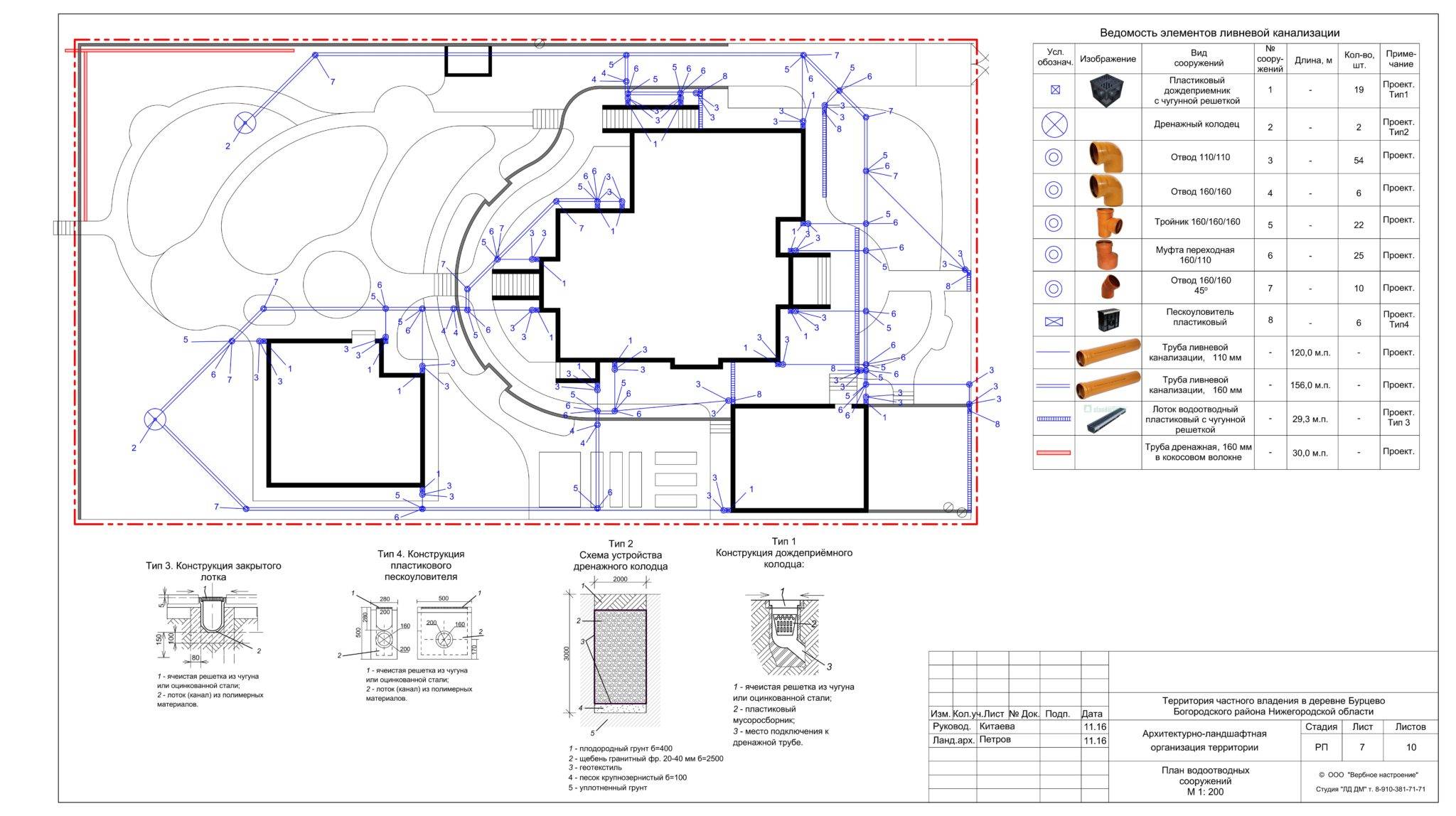
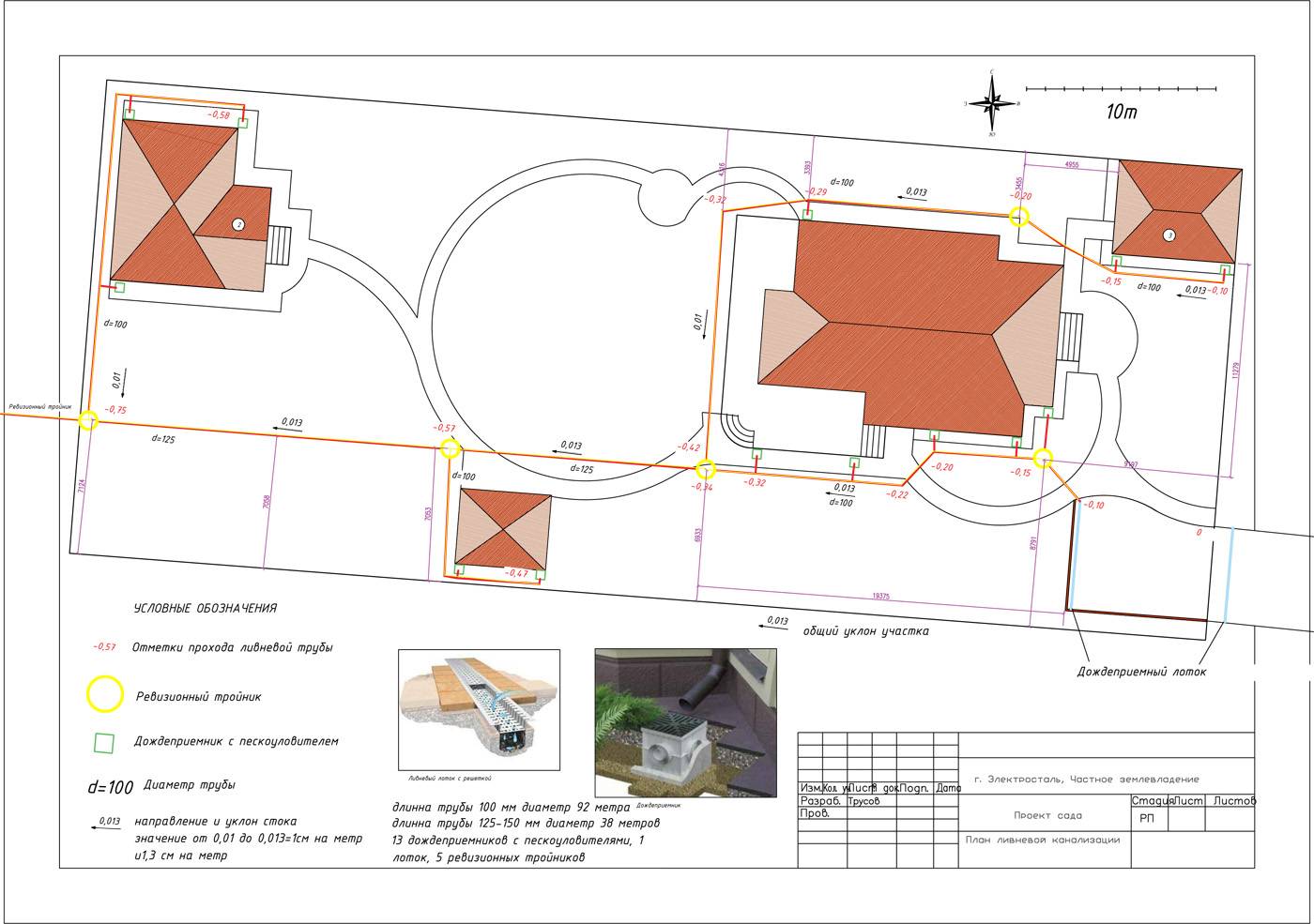


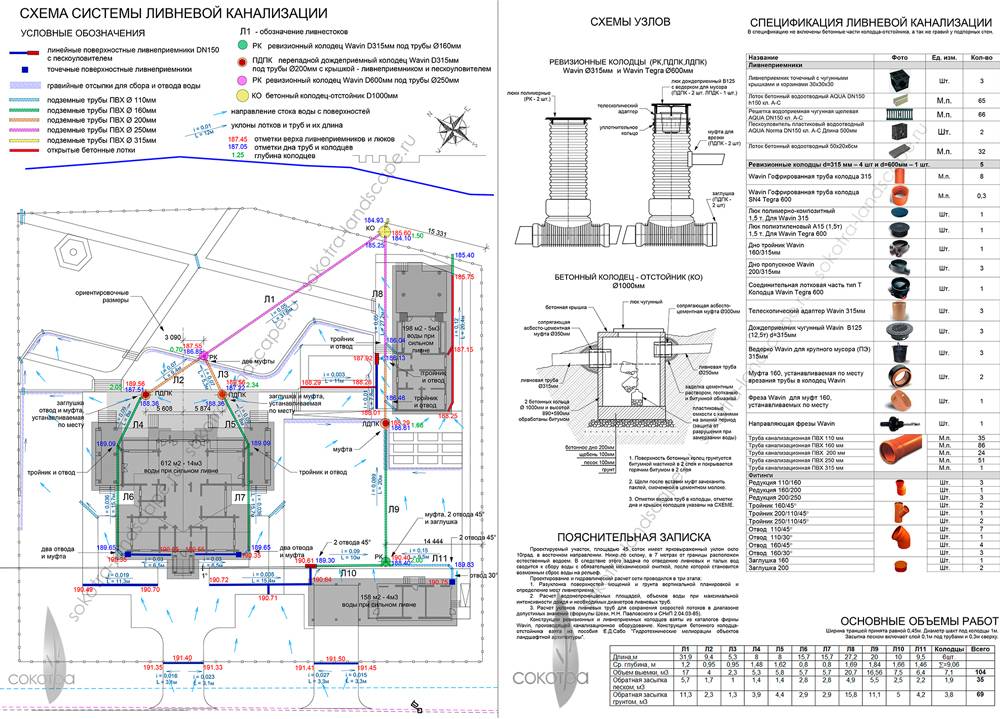
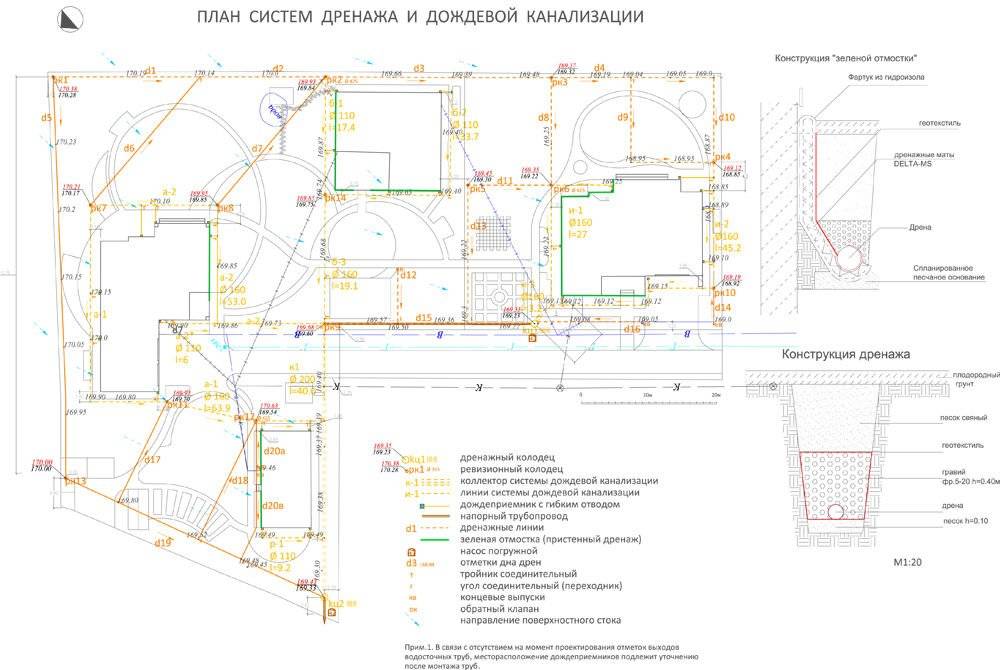
- Depth of laying the underground part.
The optimal location of the pipe is below soil freezing level and above the groundwater level. Since not every locality allows this condition to be met, it is allowed to lay the pipeline at a shallow depth, but not closer than 70 cm to the surface.
- Installation of risers.
Rainwater is drained from the roof by means of risers, under which point or linear storm water inlets are placed. Vertical drains are attached to the wall with clamps. The calculation of the mounting interval for storm sewer risers is carried out taking into account the material of the pipe. For PVC, clamps are placed at intervals of 2 m, for steel - 1-1.5 m.
- Secured territory.
SNiP provides for the organization of so-called security zones near the location of the storm network. At a distance of less than 3 m from the pipeline, it is forbidden to erect construction objects, plant bushes and trees, arrange a garbage dump, and equip a parking space.
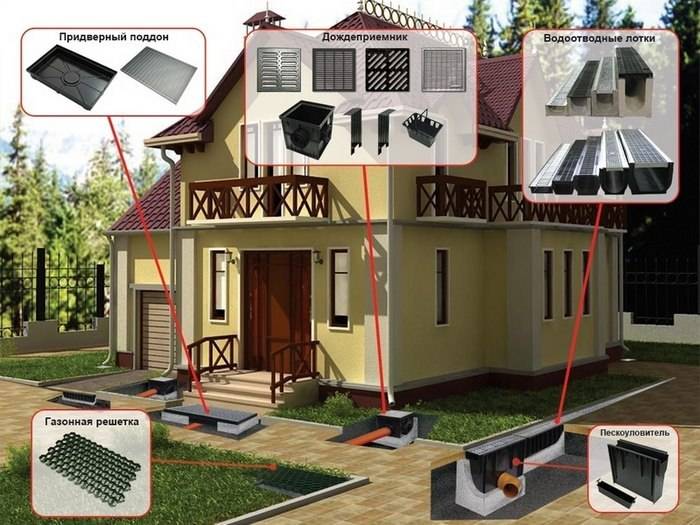
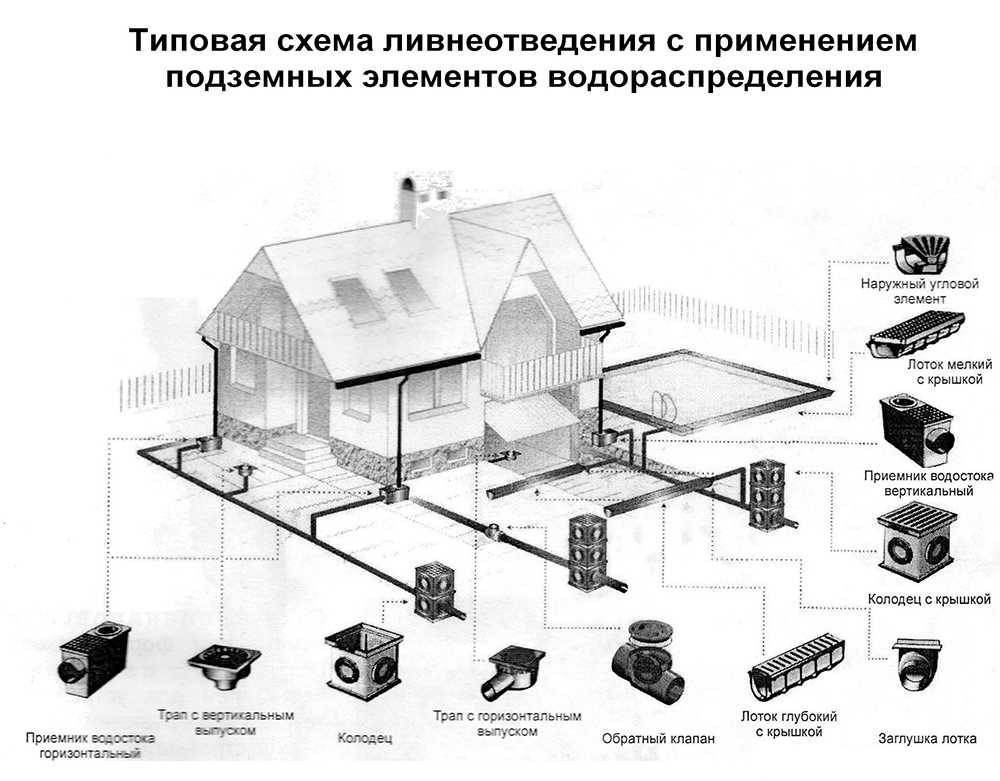
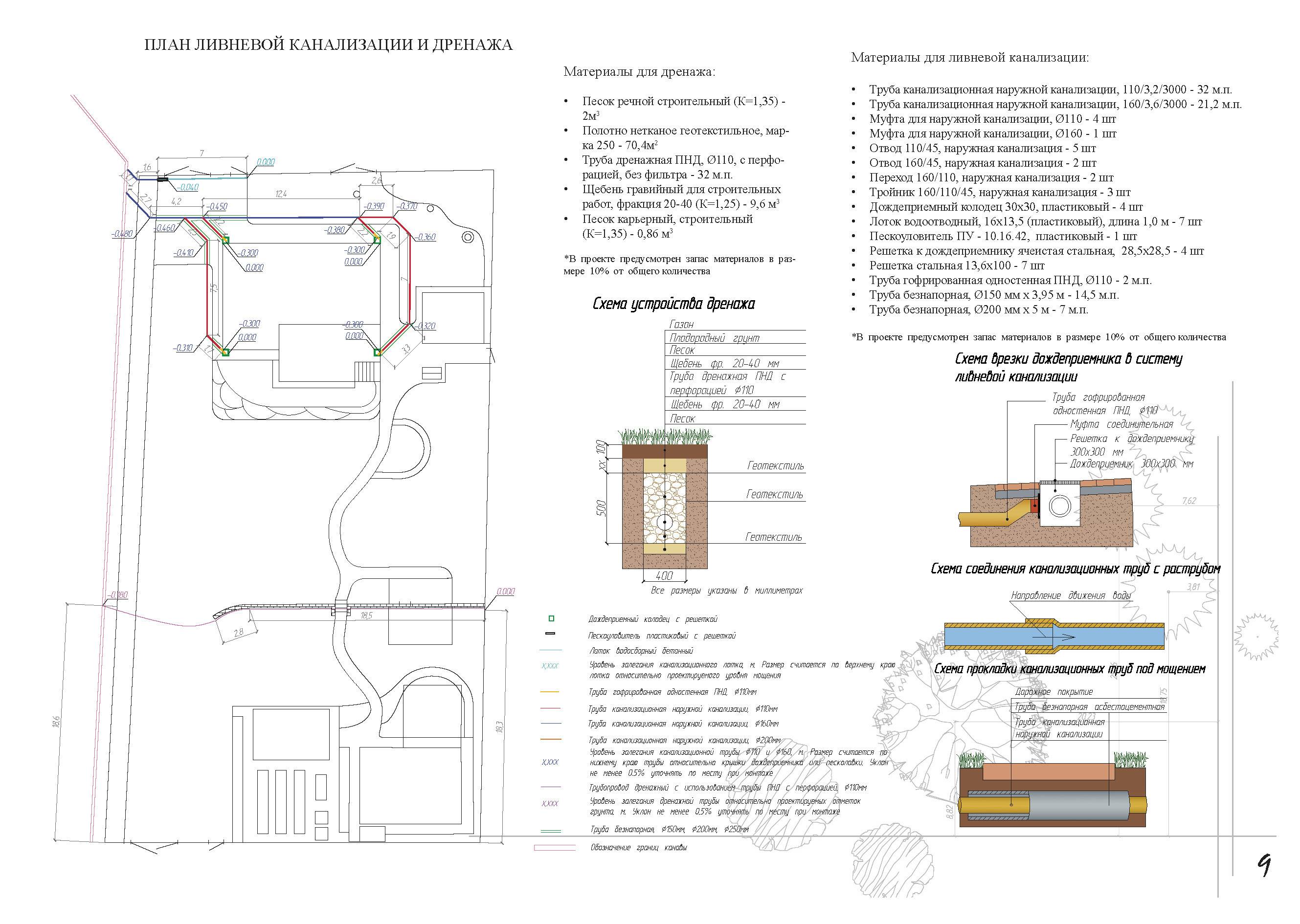
Typical stormwater drainage scheme for a private house
Designing a rainwater drainage system is an important stage in the construction of a residential building or industrial site. In this article formulas for rough calculation are given pipeline diameter, since they do not take into account such parameters as the friction of water on the inner surface of the pipe, the number of bends and connections in the system, etc. For a more accurate calculation storm sewers, there are special programs that can be found on the Internet. However, the surest method is to entrust the design to specialists who will take into account all the nuances and offer the most effective and cost-effective option.
Placement and size of wells
Referring to the rules of SNiP, manholes must be installed:
- In pipe joints.
- In sections where there is a change in speed and direction or a difference in water level, as well as a change in pipe diameter.
- On straight sections - at equal distances, depending directly on the size of the collector:
- DN 150 - 35 m;
- DN200-450 - 50 m;
- DN500-600 - 75 m.
The diameter and depth of the well also depend on the size of the pipeline entering it.
- When private construction is underway and pipes of large diameters (over 600 mm) are not used, wells should be made with a size of 1000? 1000 mm (if round - d=1000).
- With pipelines up to DN150, it is also allowed to use 700 mm, but then the depth of such a well should not exceed 1.2 m.
- But if the depth still exceeds 3 m, the size of the well must be at least 1500 mm.
Depth of storm sewer
The estimated depth adopted in the design of the network, according to SNiP 2.04.03-85, is the depth used in the given region.
The optimal depth for laying storm sewer pipelines is one at which the amount of earthwork is minimal, as well as ensuring the integrity of the pipes, avoiding freezing of communications and the formation of ice in it.
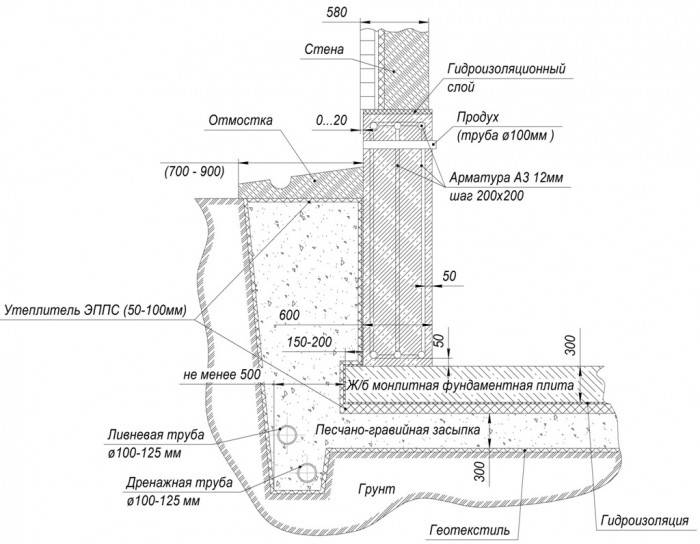
The calculation of storm sewers involves determining the slope according to the following principle: if the inner diameter of the pipe is 200 mm, the slope value should be 0.007 or more, and with a diameter of 150 mm - more than 0.008. Under certain conditions, the values can be reduced to 0.005 and 0.007, respectively, for given diameters.
For open gutters, the slope is:
- Channel for drainage - 0.003
- Tray of the road, the surface of which consists of asphalt concrete - 0.003
- Tray of the road, laid with crushed stone or paving stones - 0.004
- Tray covered with cobblestones - 0.005
- A ditch with a separate location - 0.005
It can be concluded that the slope is directly proportional to the roughness of the material - the larger it is, the greater the value of the slope. With the diameter, the definition is different - with its increase, the slope number decreases.

The values that are presented in the regulatory documentation are empirically derived, that is, they were derived from data obtained from a large number of ready-made systems. Having correctly carried out the design and calculation of storm sewers, the system will turn out to be reliable, and its service life will be long.
Channel depth
Another important parameter is the depth of the storm sewer. Trays are laid at a depth characteristic of the region. To find out how deep the storm sewer is, you can ask your neighbors or representatives of a construction company.This parameter also depends on the diameter of the pipes to be laid.

Storm sewer channels
It is desirable that storm sewer channels be laid higher ground level waters, but below the freezing level of the soil, and this range is from 1.2 to 1.5 meters. Considering that excavation requires a lot of effort and a lot of money, owners decide to reduce the minimum depth of storm sewers. If the pipe diameter is 50 mm, then laying should be carried out at a depth of at least 0.3 m, if the diameter is greater, then the pipe deepens by 0.7 m. When calculating the depth, the nature of the soils in the area is also taken into account.

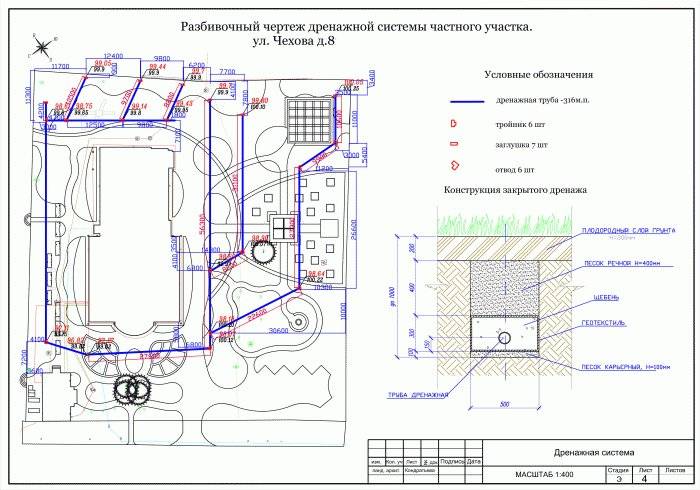
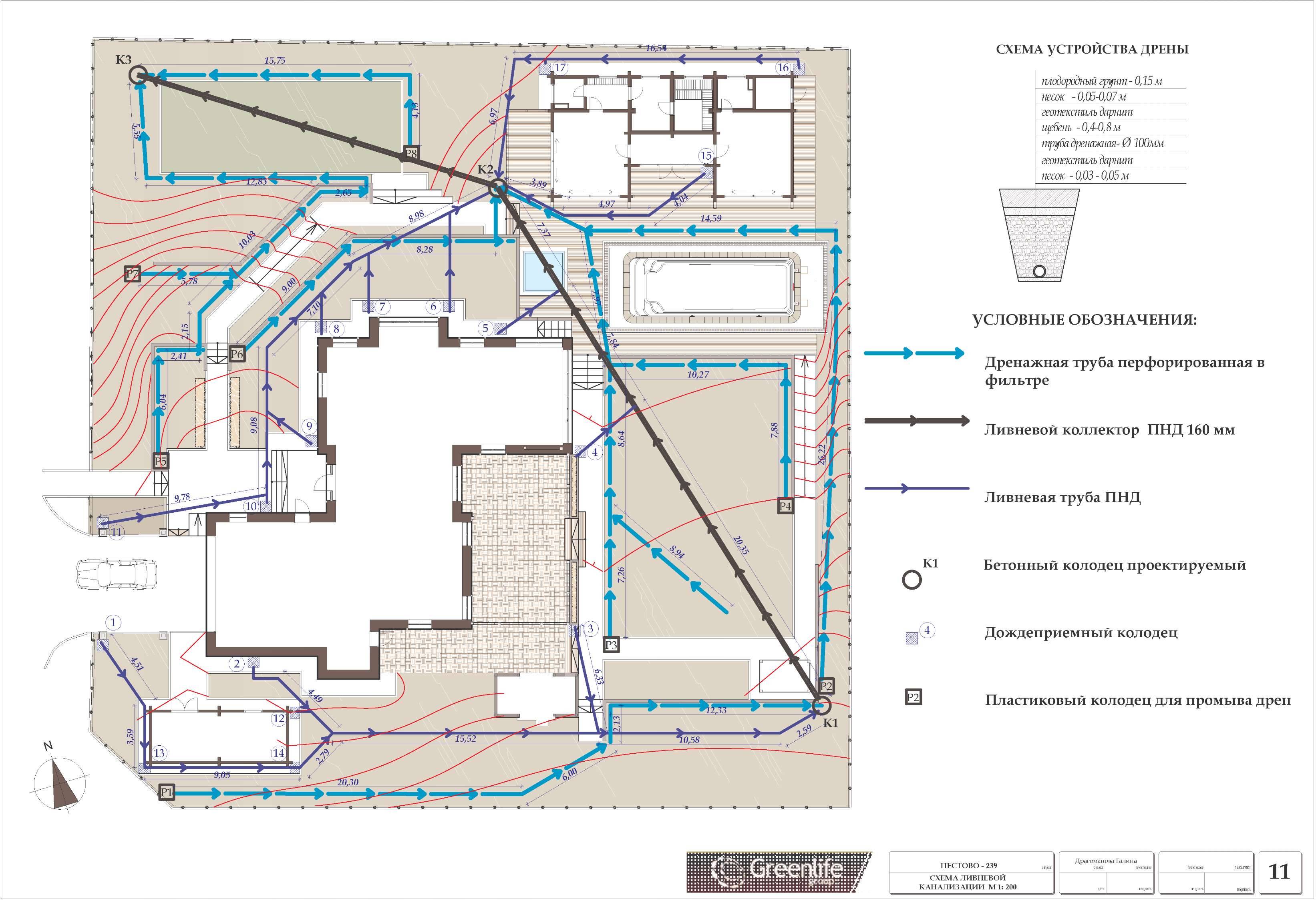
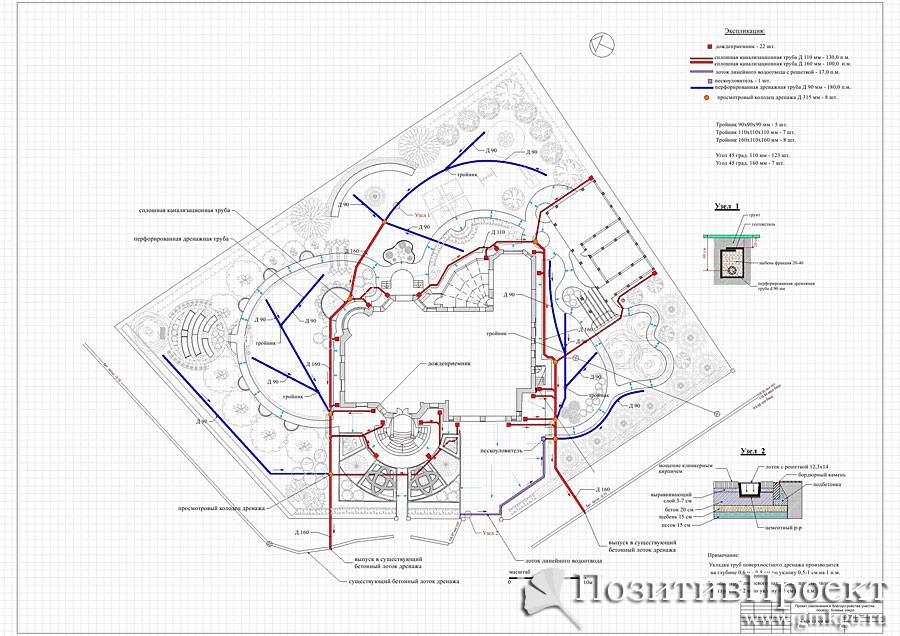
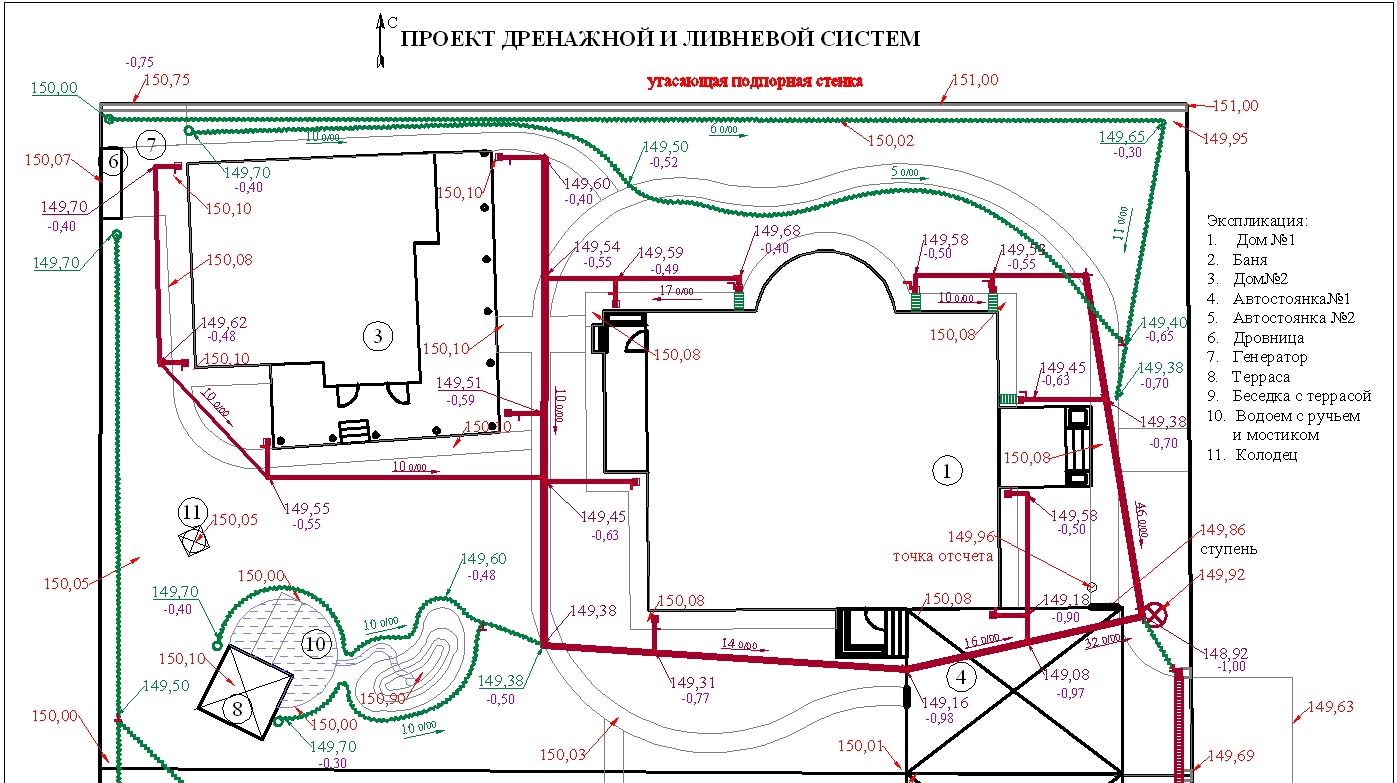
Classification of types of "stormwater"
The practice of building various kinds of structures shows the use of three types of systems, each of which differs in the methods of collecting and removing precipitation products:
- Based on open channels and trays (ditch).
- Based on closed wells and pipelines (closed).
- Based on a combined solution (mixed).
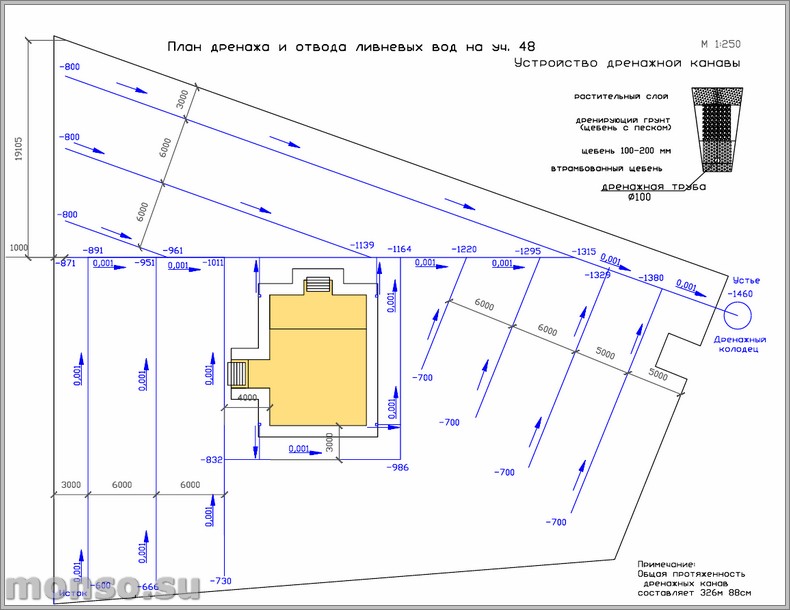
The first project is implemented in practice by constructing channels that connect the catchment trays with each other and, ultimately, divert the collected water outside the designated area.
All these elements of storm sewers have open communication with the environment. The construction of such structures requires a relatively small amount of resources and materials.
Storm sewerage of open type in industrial design. The main structural elements are concrete trays, on top of which lattice metal sheets are superimposed. By the same principle, open stormwater schemes for private housing construction are built.
A closed-type storm sewer scheme should be considered more advanced in terms of design. Hidden drainage lines are being built here, as well as a system of storm water inlets - special intermediate storage tanks.
The collected water is discharged through networks of pipelines laid and hidden underground. As a rule, the collected precipitation products are discharged to treatment facilities and further into the water area of natural reservoirs.
The third option is a mixed storm sewer. It is built on the basis of mounting components designed for both open and buried systems. The design of a mixed storm sewer is based on the rationality of operating the system in certain areas of the area. Not the last role in deciding the choice of the combined option is played by the financial side of its implementation.
Separately, it is necessary to highlight the ditch (tray) system for collecting and discharging rainwater. This storm sewer scheme, along with a simple scheme for its manufacture, is inherent in the versatility of operation.
Ditch storm sewerage has the advantage that, together with the function of removing rainwater, it can play the role of a supplier of moisture for agricultural plantations. It is also an economical construction option compared to other projects.
Thanks to the ditch design, it is possible to organize not only quite effective drainage of atmospheric precipitation products. The same system can be successfully used as an irrigation structure, for example, for the needs of a household (dacha) economy.
Why do you need a calculation of storm sewers
Calculation of storm sewers
needed to determine capacity of sewer pipes in push mode. it
means the occurrence of increased pressure in the underground pipeline network
due to large volumes of wastewater. A situation arises when the level of effluents in
rises in the collectors and due to the weight of the water, the pressure in the system increases. Introduced
fill factor
sewer collectors
effluents affecting the flow in the interior of the system. This storm systems fundamentally
different from domestic or industrial - the mode of operation is either minimal,
or maximum. If the section
pipelines are not able to provide the required performance, the system
not up to the task. Determine Diameter
storm sewer pipes can only be calculated, for which it is necessary to have a mass
statistical information:
- the frequency and quantitative indicators of precipitation characteristic of the region;
- possible content of sludge and solid particles in the drains;
- the distance over which the waste will have to be transported.
It is noteworthy that the regulations
documents define the maximum dimensions of pipelines. For rain outdoor
nets minimum diameter
taken equal to 200 mm. This size must be used even if the calculation of the diameter of the storm
sewerage requires the use of pipes of a smaller cross section. It's a few
simplifies the task, since in small areas the dimensions of the pipes can simply not be
calculate, and immediately take the minimum value. However, for large
areas that can be occupied by storm sewers, determining the diameter and other parameters
pipes becomes the main target.
Methods for discharging collected water
A serious task for owners of suburban real estate is the removal of rainwater collected from the total area of the site.
If there are no centralized communications near the house, there are two options left to solve this problem:
- Collection in a special tank with subsequent use for irrigation;
- Discharge of water from the reservoir into the ground or into natural areas.
The first option is considered rational, provided that there are objects for irrigation on the territory of the house. In this case, you will need a simple device (household pumping station) for pumping water from storage tank with its subsequent supply to irrigated areas.
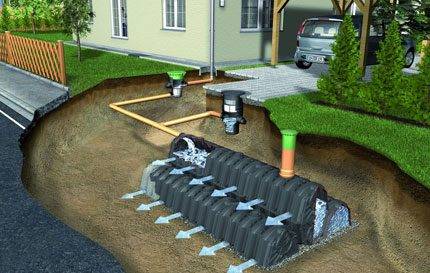
Scheme of drainage of collected rainwater into the ground. One of those possible schemes that are available to owners of country houses. Efficiency in retraction speed is low, but given the application in small areas, this scheme is quite suitable
The second option is accompanied by great difficulties. Conclusion to the ground is a long-term process. How long it takes to withdraw depends on the ability of the soil to absorb moisture. In different relief areas, the coefficient of saturation of soils with moisture can differ significantly.
In order to divert the storm sewer product to natural areas (“to the relief” or “to the landscape”), an additional scheme will have to be implemented. This scheme includes a central water collector and a ground treatment system, for example,.


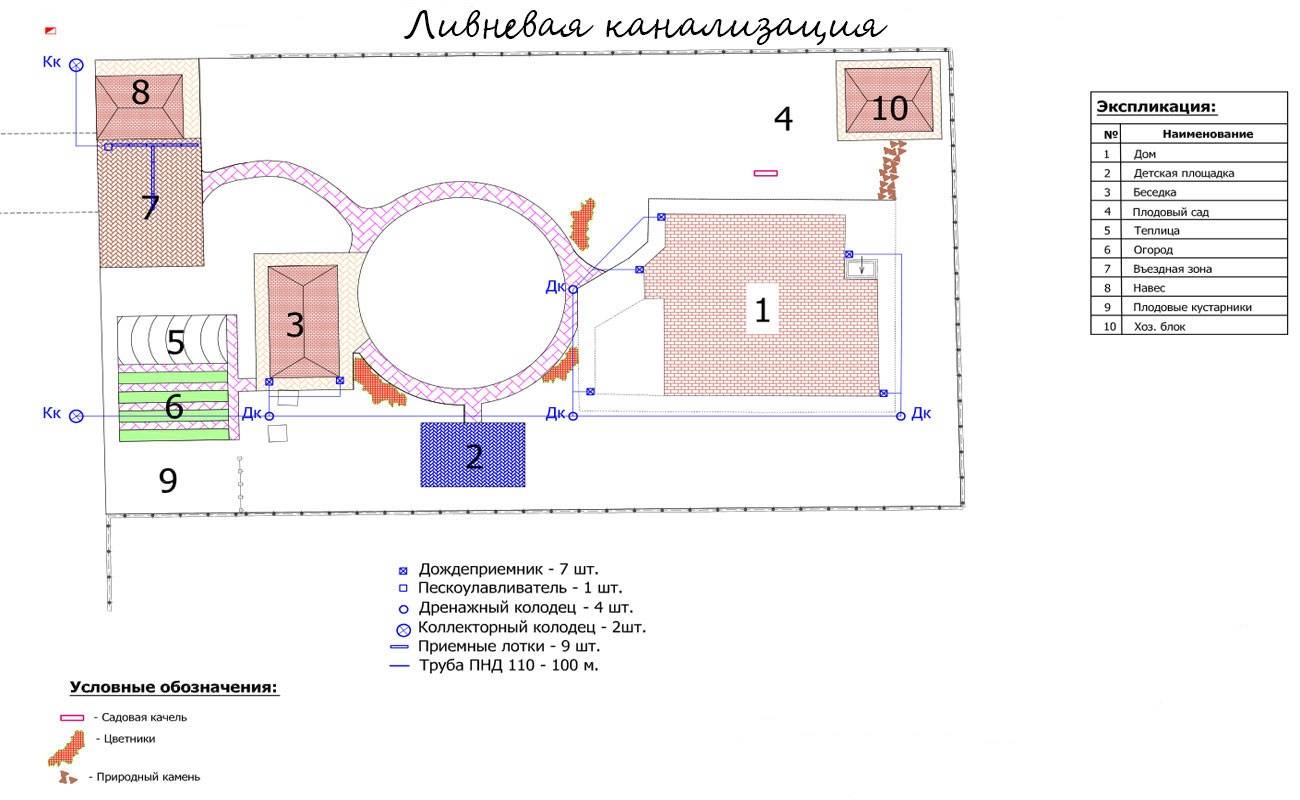
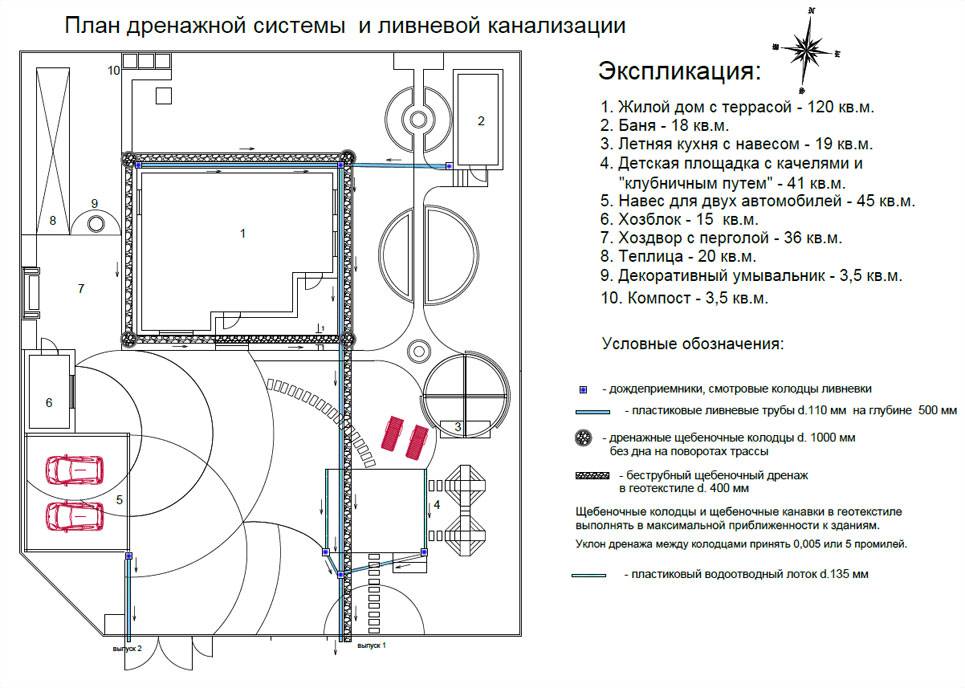
The output scheme "to the relief" or "to the landscape" is accompanied by the complexity of the construction of treatment modules. Both options require coordination with environmental authorities.
Usually, with the subject of coordination, the owner of real estate (land) has to contact the following organizations:
- Department of natural supervision.
- Fisheries Department.
- Department of consumer supervision.
- Basin and water management.
- TsGMS.
The subject of agreement is the “Draft standards characterizing the discharge procedure”. On the basis of such a project, a permit is issued that allows the discharge of pollution “on the landscape” or “on the relief”, and a decision is made to provide a water body.
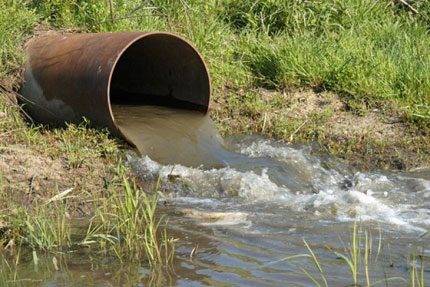
Discharge of water from storm sewers "to the relief" or "to the landscape". Such schemes are not regulated in any way by SNiP documents.
The implementation of such options illegally is associated with the risk of high fines, and legal discharge requires coordination with the authorities.
Private real estate projects traditionally include other communication networks along with storm sewers. Household sewerage is also part of household communications. The principle of their operation differs little from the functioning of stormwater, in which the owners of private houses often see the possibility of using these networks.
Meanwhile, the combination of storm sewers with a household sewer drainage scheme is prohibited by SNiP. The ban on combining different types of sewerage is due to obvious factors.
So, under the condition of the withdrawal of rainwater into the domestic sewer and taking into account the high intensity of precipitation, the normal level of sewage is overestimated several times.
Flooding of working wells leads to blocking of household and fecal effluents. Mud deposits, natural debris rush into the domestic sewer system.As a result, after the next downpour, the organizers of the structure will have to clean the system.
Combining storm water with a sewer line threatens to turn into a disastrous result. Overflow of the drainage system due to violation of the design loads leads to flooding of the building foundation.
Frequent flooding disrupts the structure of the soil, which causes displacement of the foundation blocks, washing away the foundation under the monolithic structure, and in the future can lead to the destruction of the building.
When the storm drain needs to be cleaned
It is recommended to check the system performance and remove debris accumulations twice a year - at the end of the autumn leaf fall and after the snow melts (once is enough for a closed system). But if trees grow above the house or the rainy season drags on, two cleanings may not be enough. Puddles in front of the house and on the site indicate that the system requires urgent debugging.
mechanical cleaning
This method is ideal for open systems. It is good because it does not require the use of expensive equipment or special skills. If you wish, you can clean the storm sewers with your own hands, without resorting to the expensive services of cleaning companies.
The work consists in the mechanical removal of blockages, starting from the highest point of the system. This will allow you to gradually put in order all the elements of the stormwater:
- gutters installed around the entire perimeter of the roof;
- rain pipes into which water flows from gutters;
- drainage channels;
- sewage storage tank (or system for their treatment).
 Work should begin with cleaning the gutters of debris
To carry out cleaning work, it is worth stocking up with gloves, brushes, shovels, a shovel, you can use a broom, ruff or other improvised means. If a blockage has formed in the pipes, remove it with a plumbing cable or a rotating drill. The main condition is not to damage the protective coating, otherwise the pipes may rust.
Special equipment can also be involved in the work - rod, drum or sectional machines. Their technical capabilities allow you to quickly clear blockages in the external and internal sections of the stormwater drain. Their penetration depth is 30-150 meters, many models are equipped with nozzles that speed up and facilitate the cleaning process.
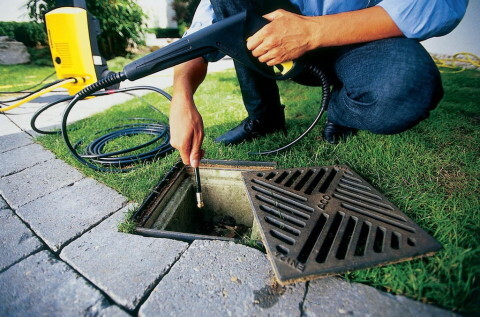 Storm drain cleaning using specialized equipment
Hydrodynamic method
A good water pressure will quickly and effortlessly rid the system of dirt and small debris without damaging the pipes. Therefore, it is considered the most effective method of dealing with blockages storm sewer cleaning hydrodynamically using specialized equipment that supplies water under high pressure. But if the farm has a powerful pump, you can flush the system with your own hands.
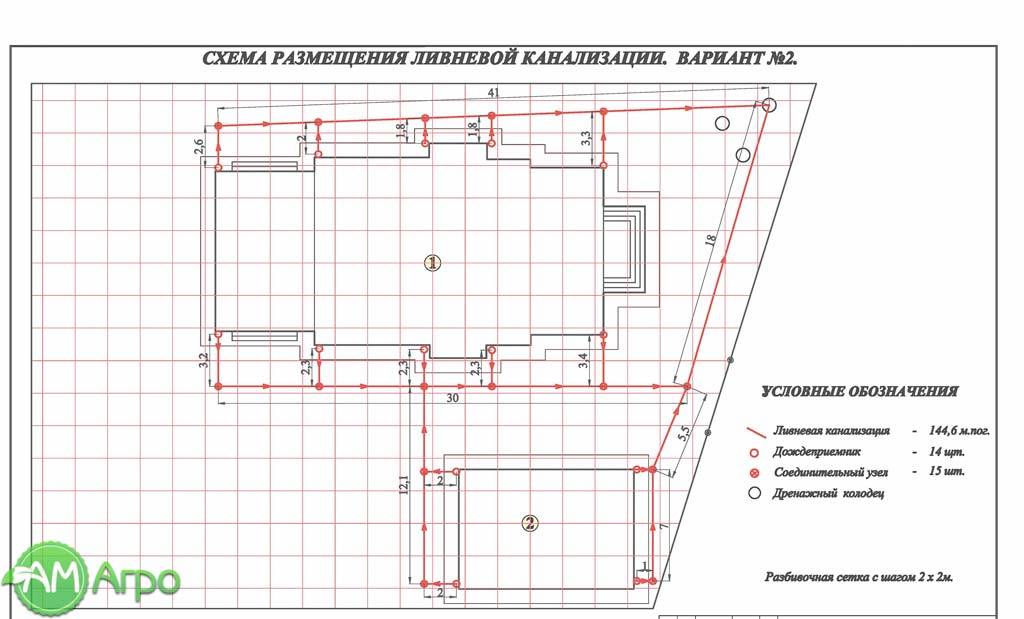




Specialized high-pressure cleaners cope even with complex blockages. They have a capacity of 190-200 MPa, equipped with a pump, a flexible hose, and nozzles with nozzles that spray the stream into thin jets.
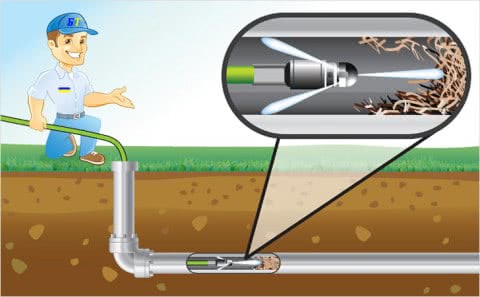 Hydrodynamic sewer cleaning
Modern hydrodynamic machines have several types of nozzles for working with any type of blockage:
- Universal - for standard flushing of pipes and removal of loose contaminants.
- Penetrating - cope with leaves, branches, accumulations of paper, glass fragments, sand.
- Chain-and-carousel - break through the most complex, old, caked blockages that are not amenable to simple water pressure.
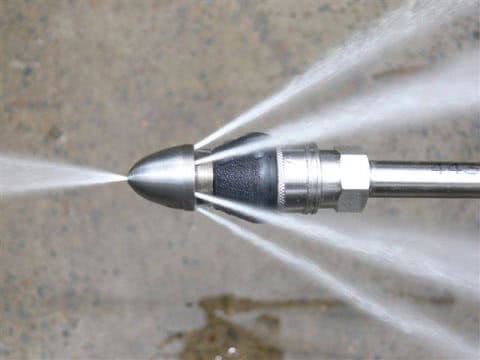 Nozzle for hydrodynamic machine
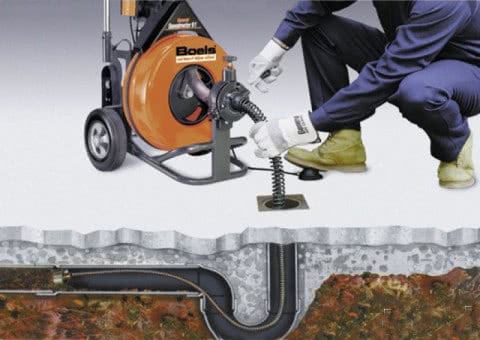 Operation of a portable hydrodynamic machine
Steam cleaning (thermal method)
Blockages are removed with special tools under the influence of steam - the water is heated to a temperature of 110-140ºС. This method allows you to clean the system not only from natural debris, but also from fatty deposits that accumulate on the walls of pipes and trays.
Use of chemicals
Chemical reagents can only be used if other methods have proved powerless. Most often, this method is resorted to in cases where oil products and other fatty waste have entered the sewerage system. They form dense “plugs”, growths and clumping of debris, which are difficult to deal with with plain water.
The chemicals are run down the drain, where they dissolve in the water and break down the buildup into flakes or small clumps. The system is then flushed with plenty of water.
Stormwater types
Sewerage, designed to drain melt and rainwater, is of two types:
Point provides collection of water from the roofs of buildings. Its main elements are storm water inlets located directly under the drainpipes. All catchment points are provided with special sedimentation tanks for sand (sand traps) and are interconnected by a single highway. Such a sewerage system is a relatively inexpensive engineering structure that can cope with the removal of yards from roofs and yards.
Linear - a more complex type of sewer designed to collect water from the entire site.The system includes a network of ground and underground drains located along the perimeter of the site, along the footpaths and the yard. Usually, water from drainage systems placed along the foundation or protecting the garden and garden beds is diverted into the common collector of a linear storm. The system is extremely sensitive to slope towards the collectors. If it is not observed, the water will stagnate in the pipes and the drainage system will not be able to perform its functions.
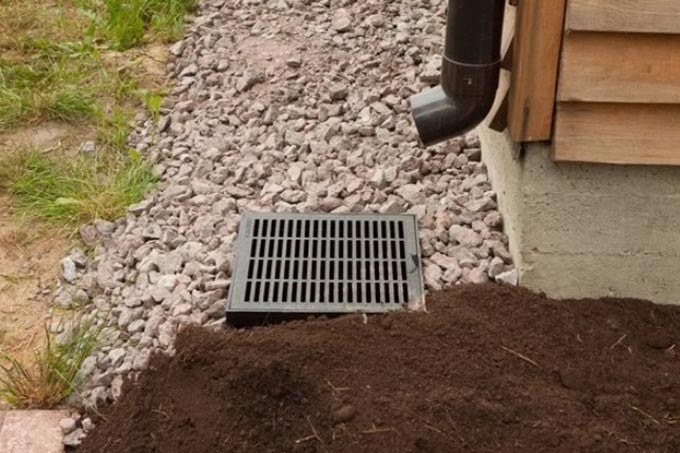
According to the method of water drainage, stormwater is divided into:
On open systems that collect water through trays and deliver it to collectors. The trays are covered with shaped gratings on top, which perfectly complement the landscape design and provide protection from debris. Such systems are mounted in small private areas.
Such a project is implemented in practice by constructing canals that connect the catchment trays to each other and, ultimately, divert the collected water outside the designated area.
For mixed-type drainage systems - hybrid systems that include elements of closed and open systems. They are built most often to save the family budget. Outdoor elements are easier to install and cost less.
For closed systems consisting of storm water inlets, flumes, a pipeline and a collector that opens into a ravine or reservoir. This is an ideal solution for draining streets, industrial sites and suburban areas with a large area.
On the sewerage of open type in industrial execution. The main structural elements are concrete trays, on top of which lattice metal sheets are superimposed. By the same principle, open stormwater schemes for private housing construction are built.
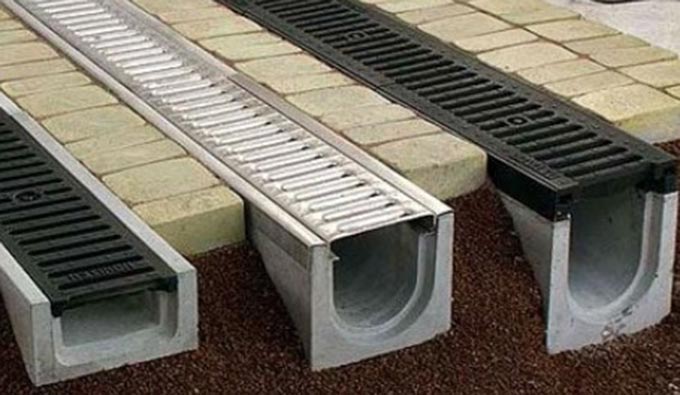
The collected water is discharged through networks of pipelines laid and hidden underground. As a rule, the collected precipitation products are discharged to treatment facilities and further into the water area of natural reservoirs.


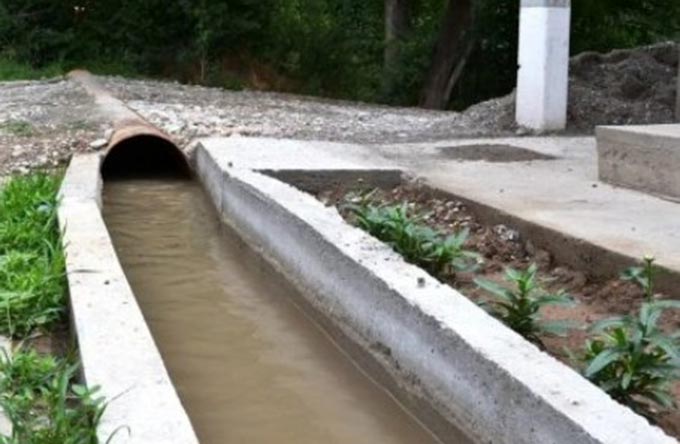
Separately, it is necessary to highlight the ditch (tray) system for collecting and discharging rainwater. This storm sewer scheme, along with a simple scheme for its manufacture, is inherent in the versatility of operation.
Ditch storm sewerage has the advantage that, together with the function of removing rainwater, it can play the role of a supplier of moisture for agricultural plantations. It is also an economical construction option compared to other projects.
Thanks to the ditch design, it is possible to organize not only quite effective drainage of atmospheric precipitation products. The same system can be successfully used as an irrigation structure, for example, for the needs of a household (dacha) economy.
Conclusions and useful video on the topic
Useful videos will expand your horizons about the appointment and installation of storm sewers.
Video #1 Stormwater in a private house - from design to installation:
Video #2 Industrial technologies:
The stages of design and careful calculation of storm sewers are an integral part of the construction of private houses. carefully thought out stormwater project and accurate calculations - this is the durability of the building and a comfortable environment for its inhabitants.
Do you want to talk about how you arranged a storm sewer in your own summer cottage? Would you like to provide useful information and post a photo on the topic of the article? Please write in the box below.