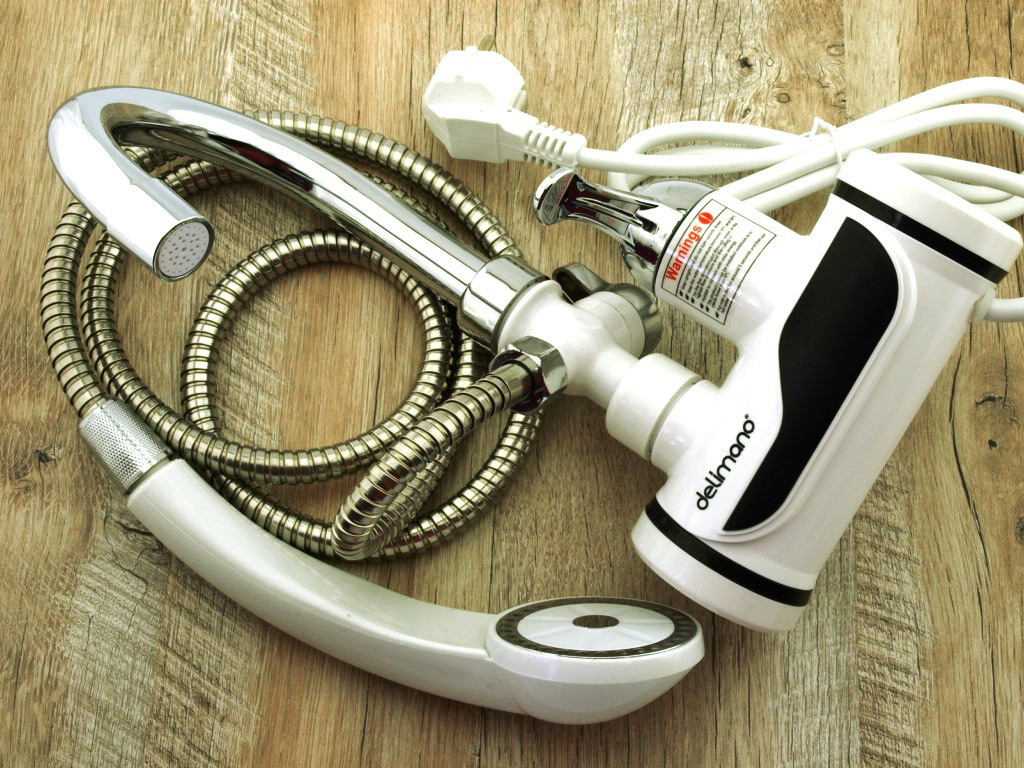
- Installation and connection of the water heater
- 3 types of water heaters for the shower
- Installation and installation of a water heater
- What size heater should I buy?
- Consumer indicators
- Video description
- Conclusion
- The principle of operation of instantaneous water heater
- Pressure type
- Non-pressure type
- Instantaneous electric water heaters
- Installation of water heaters: important points
- Ariston Bravo E7023 U-F7
- How to choose and what to look for?
- Performance and Power Ratings
- Modes of operation and control
- Instantaneous water heater
- Why is an electric model better than a gas model?
- The best instantaneous electric shower heaters
- Thermex Tip 500 (combi) Prime - with tap and shower
- Ariston Aures S 3.5 SH PL - impeccable style
- How big should the water heater be
- Expert advice
- What the market has to offer
- Types of compact electric heaters
- Separate faucet nozzle
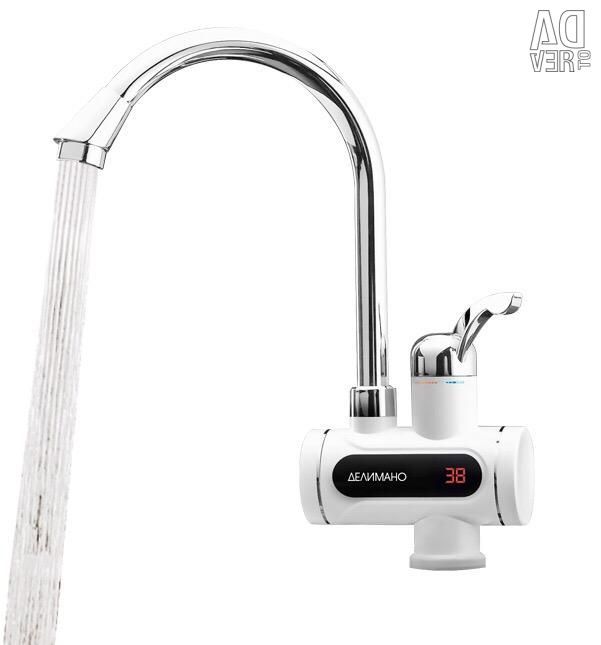
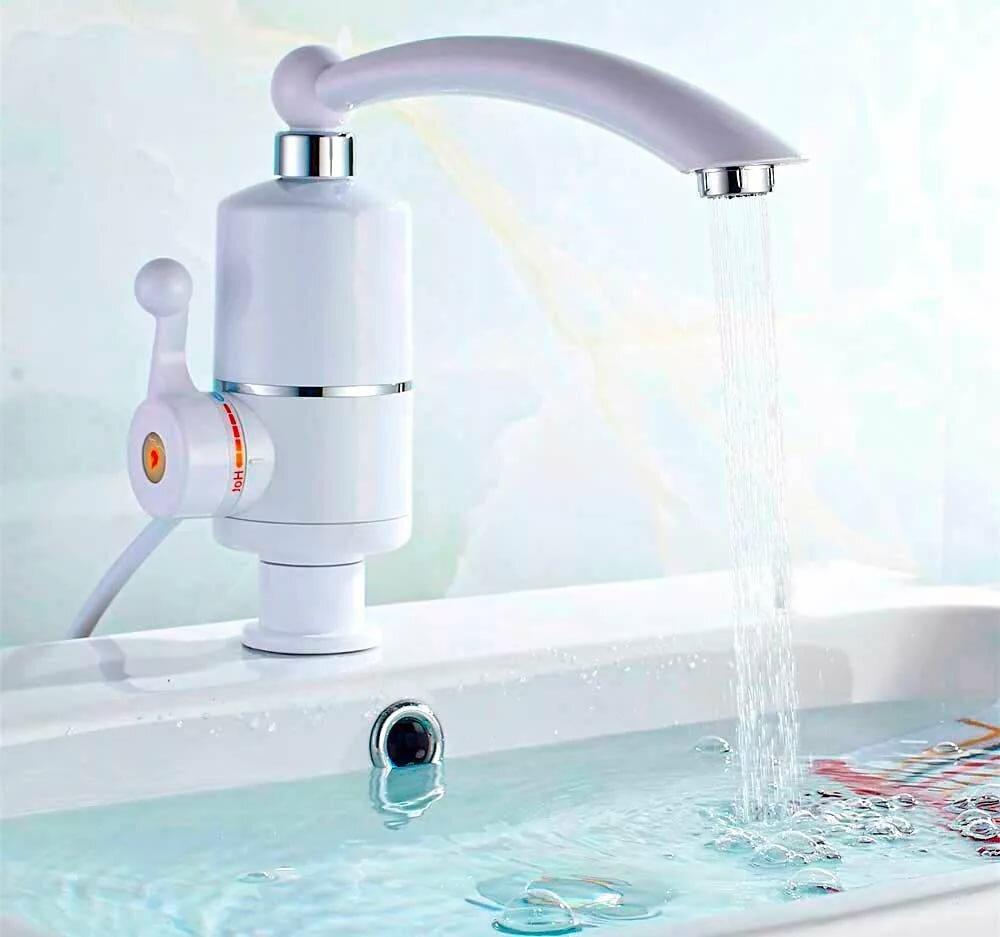
- Instant Water Heating Faucet
- Wall “groove”: pressure and non-pressure model
- 3 types of water heaters for the shower
Installation and connection of the water heater
Installation of the water heater is carried out in 3 stages:
- Laying a power cable power line, installation of a residual current device (RCD or differential machine).
- Mounting the water heater.
- Connection to the water supply and electrical network.
Powerful electrical appliances that consume more than 3 kW should not be plugged into a regular outlet. A separate power supply line must be installed, protected by a differential circuit breaker. The minimum leakage current for the operation of the machine is 30 mA.
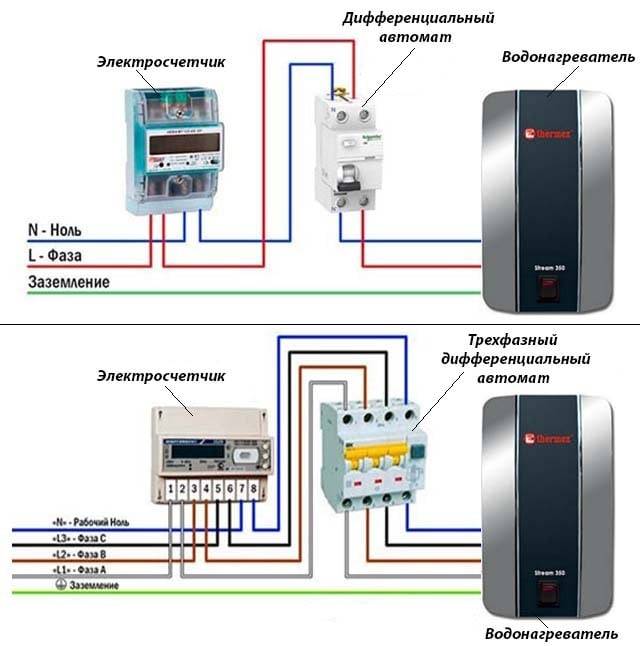
Connecting a water heater in a single-phase (top) and three-phase circuit (bottom)
We use a copper 3-core cable as a conductor (connection to a 220 volt network). When the water heater requires three-phase power, we take a 5-core cable. The working cross section of the cores depends on the power consumption of the device and is taken according to the table:
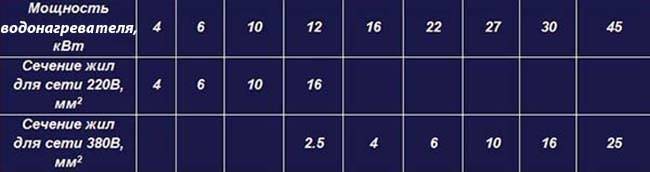
We lay the cable from the electric meter in the furrows of the walls or in an open way, necessarily - inside a plastic corrugated sleeve. We mount the difavtomat in a common cabinet with the rest of the switches. The rating of the device is selected according to the instructions of the electric heater.
How to install and connect an instantaneous water heater:
- The device must be mounted strictly according to the passport. If the housing is rotated 90°, part of the heating element may protrude from the water, overheat and burn out. The faucet-water heater with a shower head is screwed to the sink in a vertical position.
- The room where it is planned to place the pressure model must be heated. Otherwise, the water will freeze, the ice will split the pipes, this is obvious.
- At the outlet of hot water from a non-pressure heater, it is forbidden to install additional taps, since the internal elements of the device are not designed for water pressure.
- We make the piping of the water heater from polypropylene or metal-plastic pipes, we use American women for connection. Pressure versions of devices are best connected through shut-off valves, as shown in the diagram above.
3 types of water heaters for the shower
Flowing electric water heaters that can be used for the bathroom are of 3 types:
- non-pressure devices with a flexible hose and a shower head;
- faucet-water heater with a free-flow shower;
- pressure water heaters.
First, let's figure out how non-pressure models differ from pressure ones. The former can serve 1 consumer, for example, a kitchen sink or shower head. When the tap is closed, water does not enter the device, after opening it flows freely, so there is no excess pressure.
Pressure-type flow-through water heaters cut into the water supply network of a private house (like a boiler). Accordingly, the device is constantly under pressure and is able to serve several points of water intake, provided that there is enough power of the electric heater.
Features of each type of household water heaters:
- A pressureless instantaneous water heater with a shower is a flat plastic box attached to the bathroom wall. Inside there is a tubular or spiral heating element and a control unit - relay (mechanical) or electronic. Power consumption - 3 ... 6 kW, productivity - 1.6 ... 3.5 liters per minute when heated by 25 degrees.
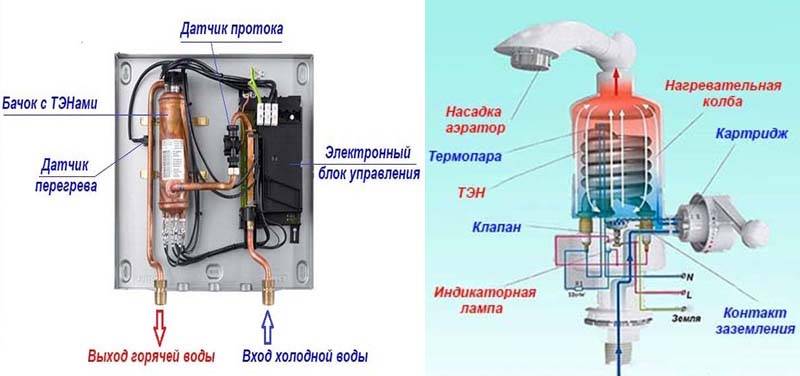
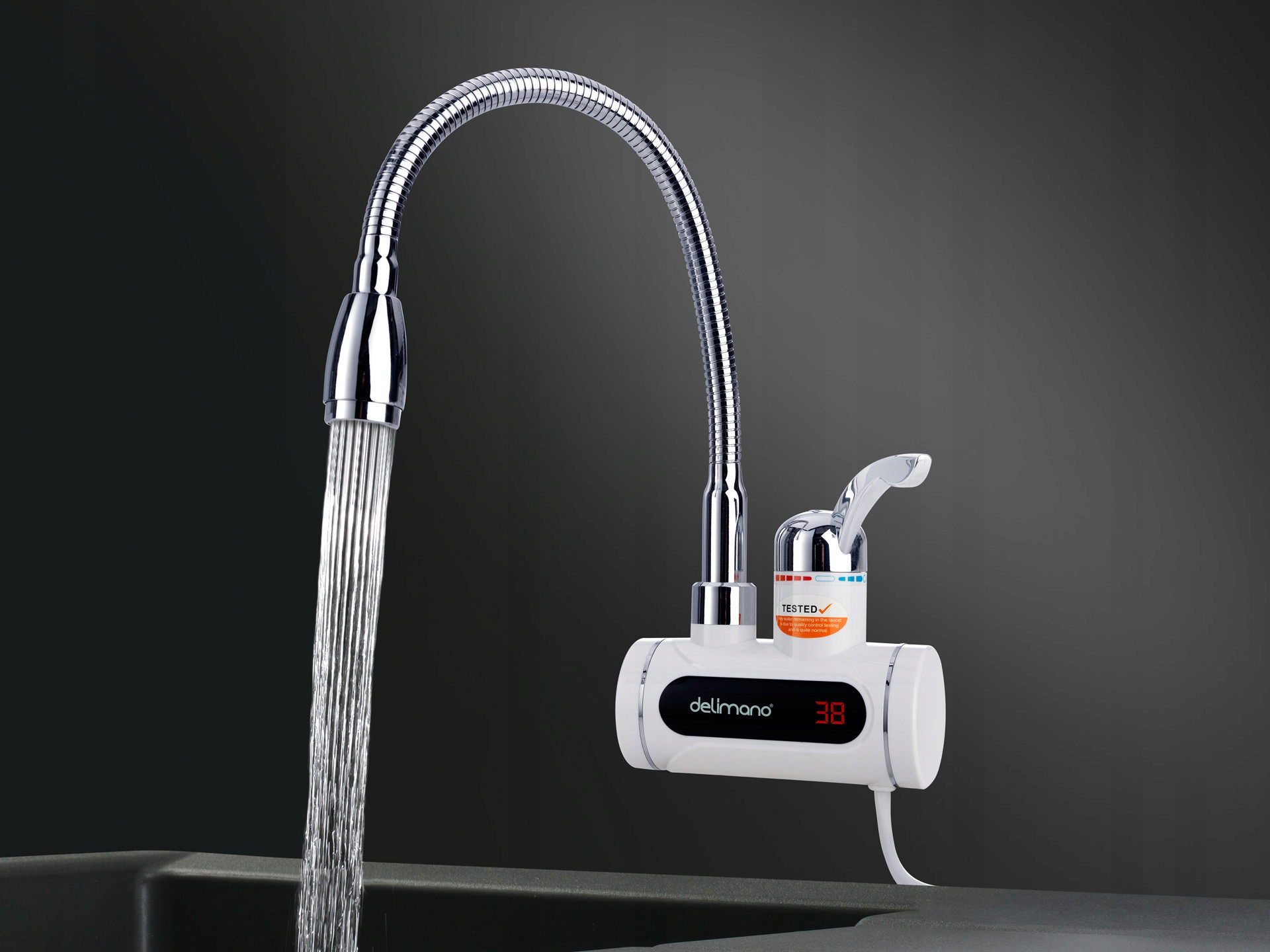
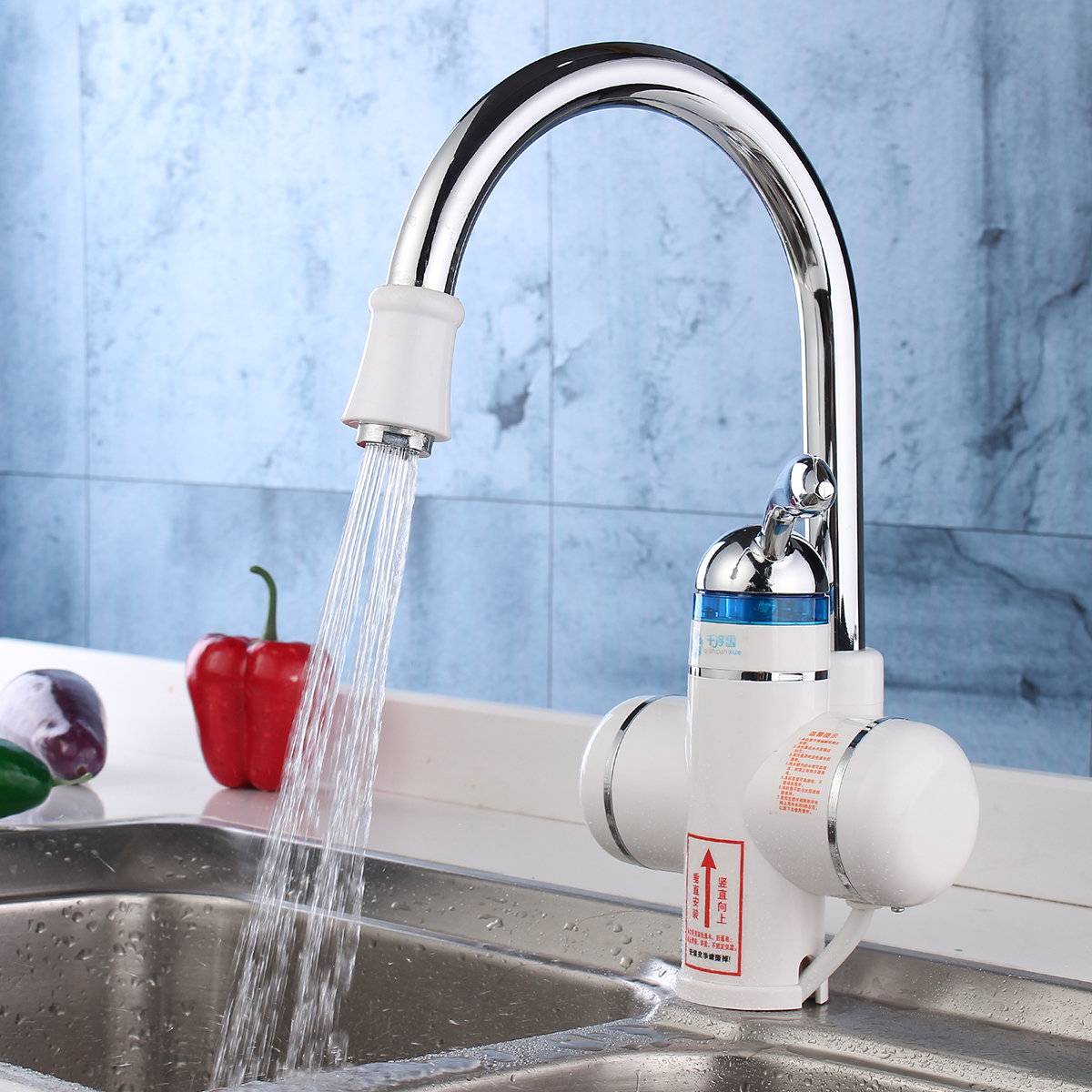
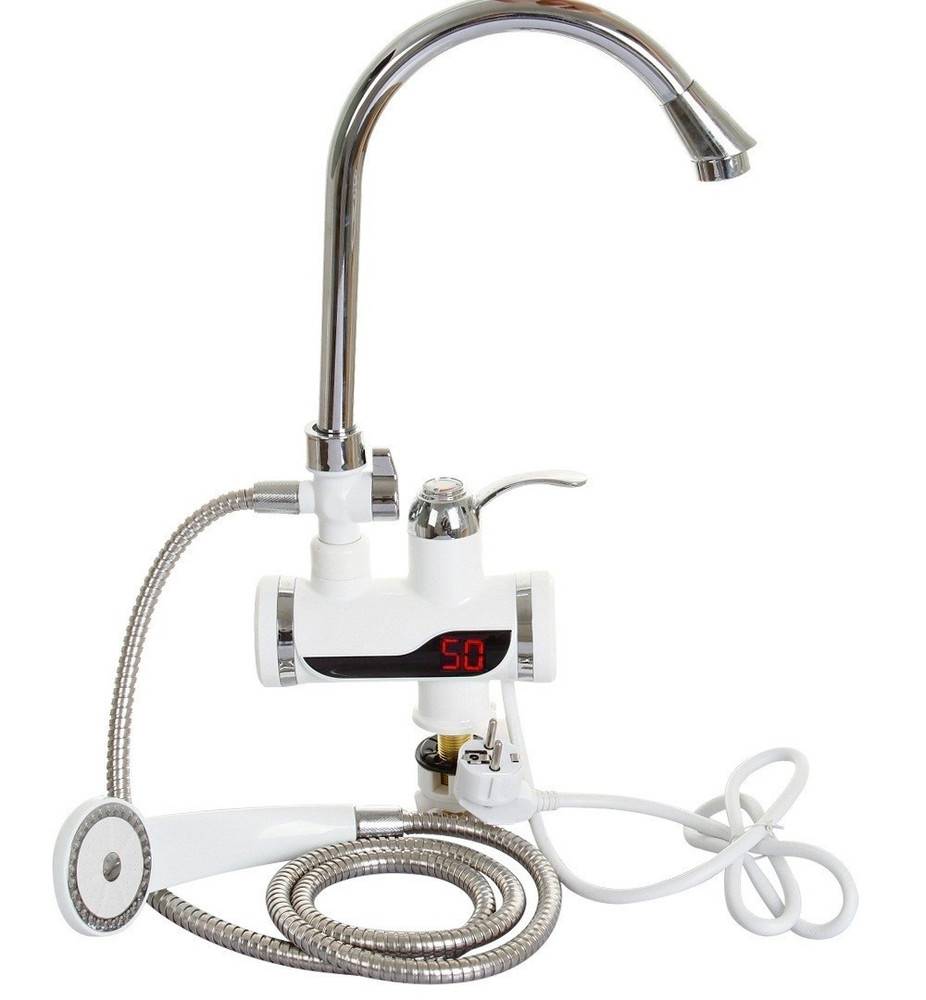
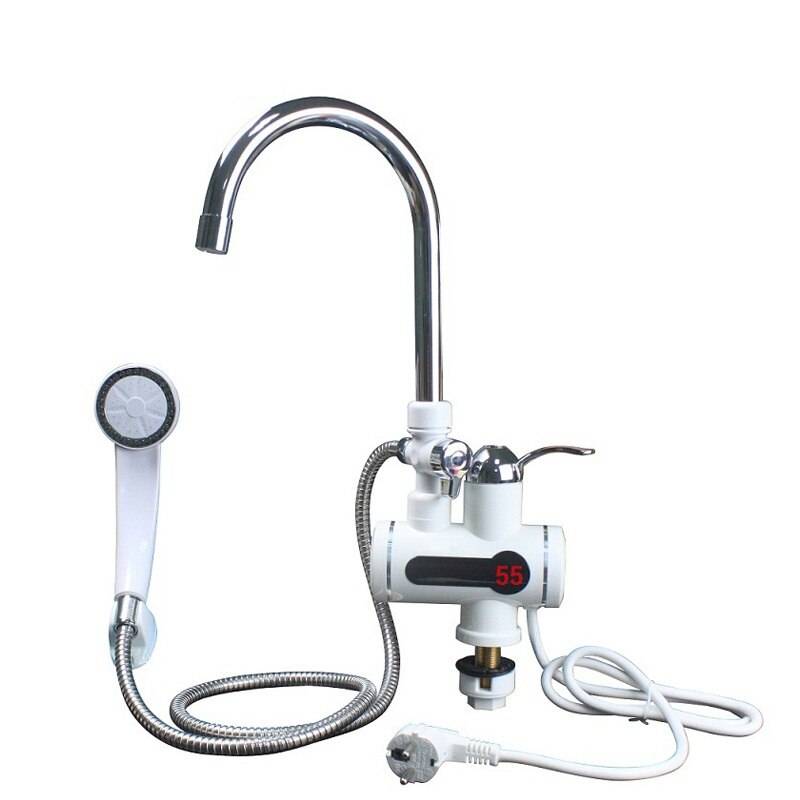
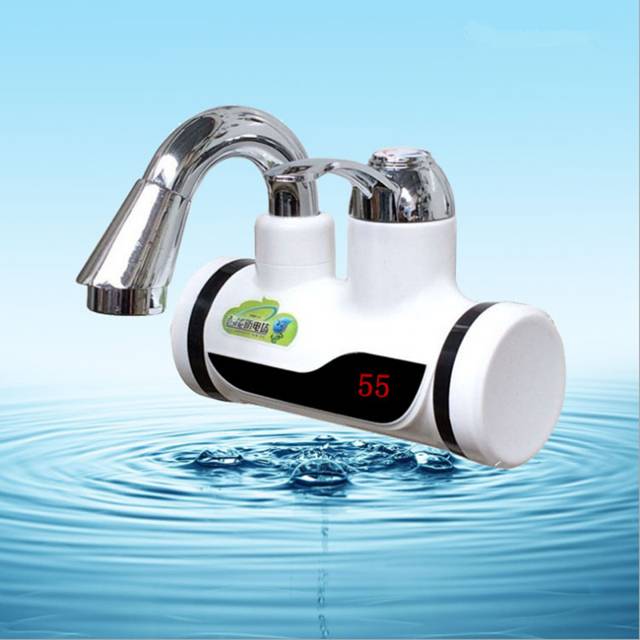
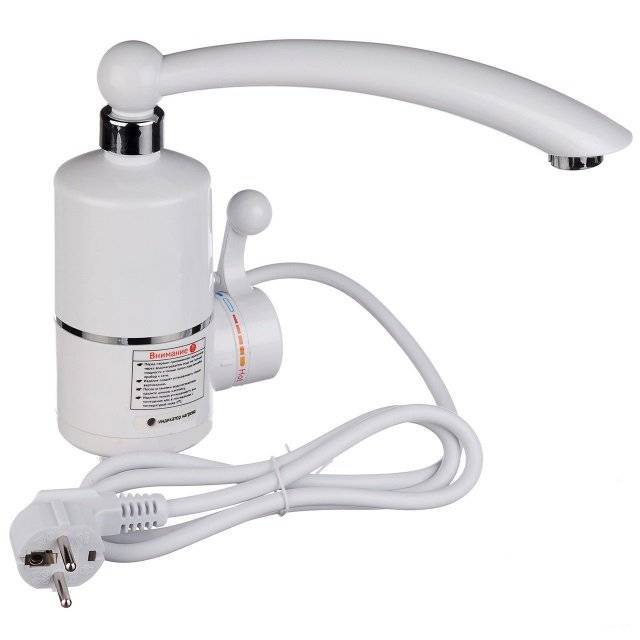
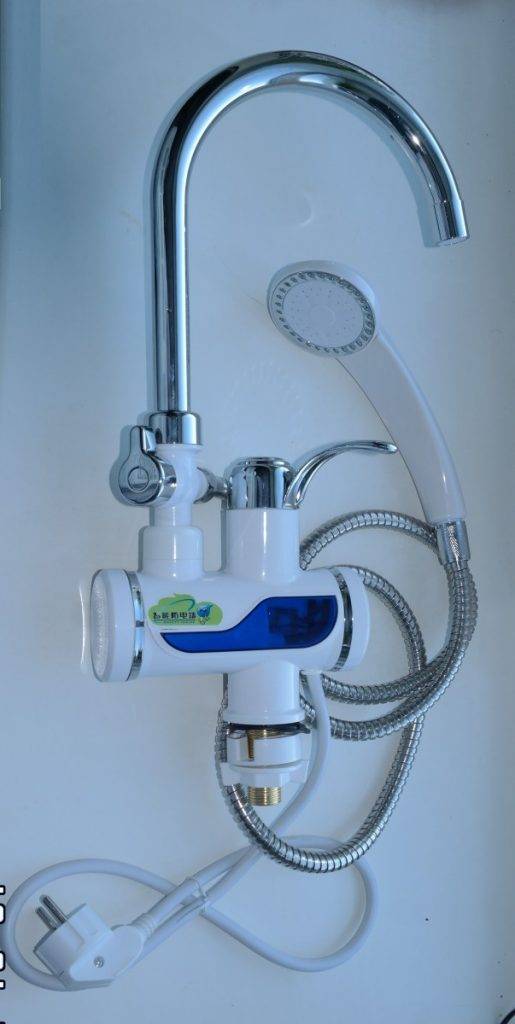
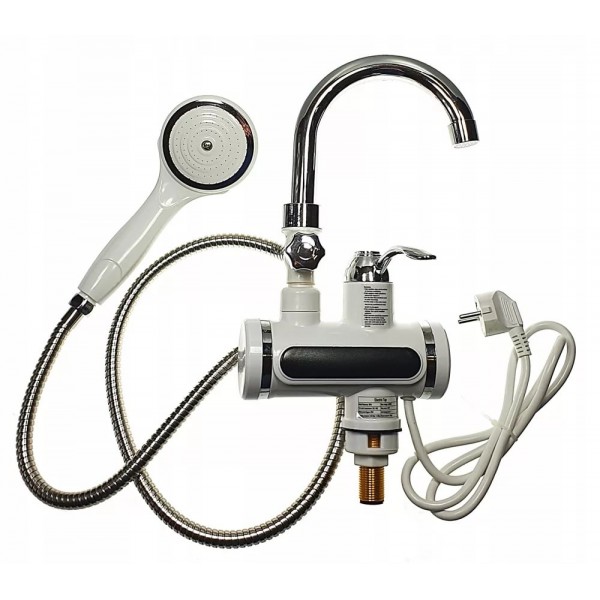
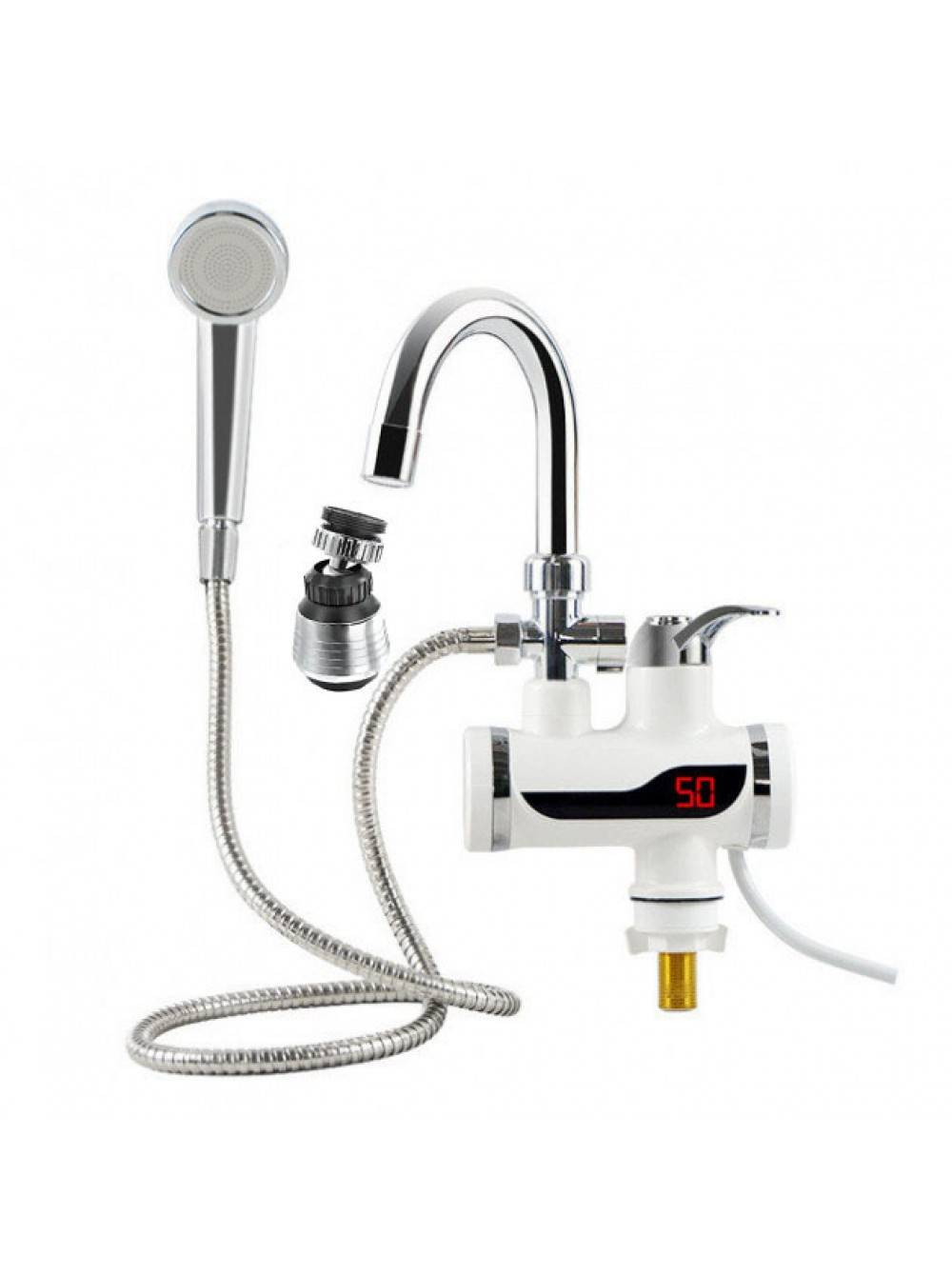
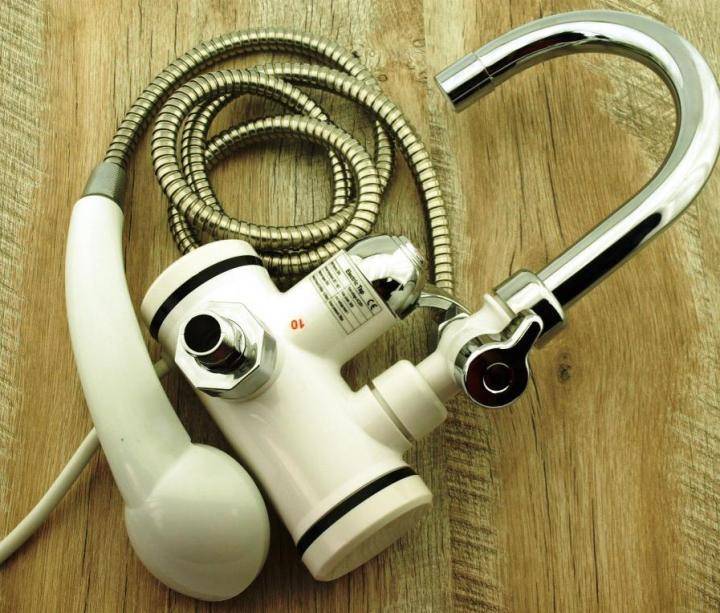
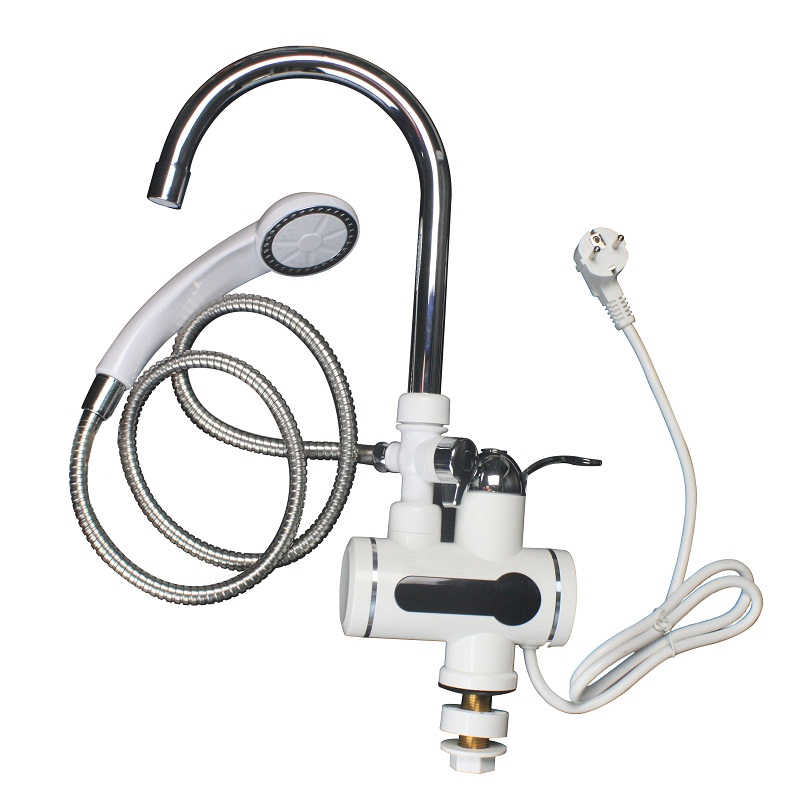
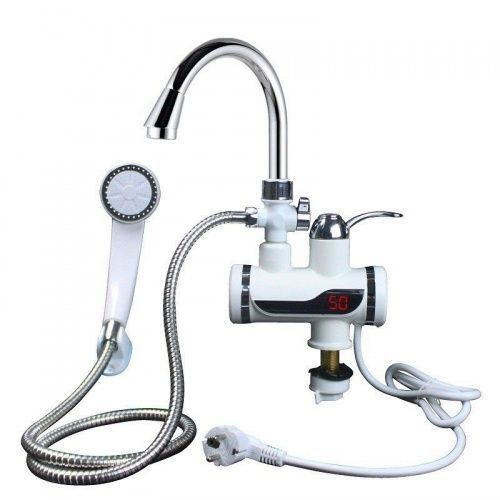
- The faucet-water heater with a shower head is similar in structure to a conventional water mixer, only larger. A “gander” of a faucet is installed on the cylindrical body and a hose with a shower is attached. Inside there is a spiral heating element with a power of 3 kW, which has time to heat up to 2 l / min. Some models are equipped with a digital temperature indicator.
- The pressure electric water heater is also made as compact as possible - a flat body with 2 pipes for connecting water pipes (male threaded fittings, ½ or ¾ inch diameter). Power of devices - from 6 to 25 kW, productivity - 3.3 ... 10 l / min.
The device, the pros and cons of different instantaneous water heaters, we examined in detail in another article. Judging by the above characteristics, the best option is a pressure "water heater" of sufficient capacity. But here another problem arises - a decent electrical power is needed at the input to the dwelling, which is often not available. How to provide hot water in various situations, read on.
Installation and installation of a water heater
According to manufacturers' recommendations, the best way to install electrical equipment is to use the services of professionals. However, the design and mechanism of an electric water heater is not very complicated, and all devices have a wiring diagram, so you can install it yourself. It is worth knowing that do-it-yourself installation of equipment and subsequent breakdown leads to the loss of rights to warranty service.
- Water heater installation. Initially, you need to decide on the place of attachment of the equipment. This is usually a wall next to the faucet to minimize heat loss. The weight of the equipment is small, so ordinary brackets will do.
- Connection to the water supply. Depending on the type of equipment, the water heater is connected either directly to the cold water supply or to pipes. In accordance with the installation scheme, it is necessary to connect the equipment, even the slightest deviations from the rules can disrupt the operation of the mechanism and lead to a quick breakdown.Manufacturers also recommend installing additional water purification filters.
- Supply of electricity. Conventional water heaters are simply plugged into the network. The main thing is that the load on the power grid is correctly calculated. In the operating instructions, prescribe the maximum power consumption of the equipment.
What size heater should I buy?
Given the principle of operation of the heater, flow models are usually made very powerful. For example, the “weakest” ones consume 3 kW, while boilers with such power are practically never found. Energy consumption directly affects the temperature and rate of water heating. The more powerful the device, the faster it heats the water, which means it can give out more of it (of the desired temperature).
Although much depends on the manufacturer, on average, the following dependence of performance on the power of the device can be distinguished:
- 3 kW - 1.5 - 1.9 l/min.
- 4 kW - 2 l/min.
- 5 kW - 3 - 3.5 l/min.
- 6 kW - 4 l/min.
- 7 kW - 4.4 - 5.5 l / min.
- 20 kW - 10 l/min.
Also, when selecting the power of the device, it is worth considering the cross section of the wiring in the apartment. So, for example, wiring with a cross section of 2.5 mm2 will withstand a load of up to 5.9 kW (this is the maximum that is best avoided). Therefore, for devices of higher power, it will be necessary to lay wiring of 4 mm2. If your apartment or house has old wiring with aluminum wire with a cross section of 1.5 mm2, then it is generally impossible to install a flow heater more powerful than 3.5 kW. At the same time, some powerful appliances require a three-phase connection to a voltage of 380 V, and not every home has such a network.
Consumer indicators
Modern instantaneous water heaters are safe devices that can provide reliable and efficient water heating.When choosing a device, it must be understood that its effectiveness depends not only on the parameters set by the manufacturer, but also on the inlet water temperature. This can be seen from the formula discussed above. The smaller the difference (T1 — T2), the faster the outlet temperature rises. This results in two useful consequences that increase the service life: energy is saved and the process of scale formation slows down.
The durability of flow heaters directly depends on the characteristics of the heating element and the flask in which it is placed; The following parameters affect the operating time:
- Closed (dry) heating elements work more reliably than open (wet) ones.
- Plastic flasks have a lower thermal conductivity and are less reliable than metal flasks. Among metal flasks, stainless steel products are of particular quality, and copper products are the most effective.
Thermocrane device
If you value reliability, give preference to heating elements with ceramic coating; they are famous for their durability and fast heating of water.
High-quality modifications are distinguished by a multi-level protection system, which contains the following components:
- Automatic shutdown. If the water supply stops in the system or the pressure changes (in either direction), the shutdown system comes into action and the heater stops working.
- Reliable isolation. The waterproof protective cover excludes contact of electric elements with water. The device is also reliably protected from mechanical damage.
- Surge protection. The RCD built into the faucet reacts to a sharp increase in voltage in the network and turns off the water heater, preventing its damage.
- Water temperature control.The sensor maintains the set temperature, if necessary turning on or off the heating element. Thanks to the operation of this device, water of the desired temperature is supplied uninterruptedly, and its overheating is not allowed.
Video description
About installing a flow heater in the following video:



Most instantaneous shower water heaters allow you to heat water up to 40-50°C. If you want to regulate the temperature as you wish, you should take a closer look at technological models that have several heating modes and multi-stage protection. Temperature control can be implemented in several ways:
- Classic adjustment. Available in the most budget design - you just turn the handle.
- Separate adjustment. One handle of the device controls the force of pressure, and the other controls the temperature, sharing allows you to achieve a jet with optimal parameters.
- Electronic control. Such heaters are equipped with a two-color touch display and liquid crystal controls; they provide any heating modes. The display screen reflects the set temperature value and changes color depending on the selected mode. An electronic device monitors any changes in the water supply and reliably protects against unexpected cold showers; minus - the cost of a heater with such a device is quite high.
Model with electronic control
Conclusion
An electric instantaneous water heater is a small but extremely useful device that finds many uses in conditions where hot water is needed in a limited amount and not constantly.The compact and reliable device instantly heats up enough water to wash dishes or take a shower after a tiring day at work. In order not to be disappointed in the purchase, you should first determine the requirements for the heating device and evaluate the offers of various manufacturers. Water heaters of various brands are provided with a general guarantee of one to three years; Heating elements are usually provided with a separate guarantee of up to eight years.
The principle of operation of instantaneous water heater
A potential buyer should be aware that there are two groups of threaders that work a little differently:
Pressure type
Such a water heater crashes into the water supply somewhere before branching, so that hot water can be supplied to several points of water intake. When the taps are closed, it experiences the pressure of the water supply, which is why it is called pressure.
Schematic diagram of the installation of a pressure instantaneous water heater
Non-pressure type
Commonly referred to as "faucet water heaters" or "heated faucets". To connect such a device, a tee cuts into the water supply, to the outlet of which a tap is screwed. The water heater is connected to this tap. Thus, only one hot water draw-off point will be available. It is most convenient to connect to the outlet to the washing machine, to which you just need to screw the tee.
It is even easier to connect to the nozzle on the faucet, to which a hose with a shower head is screwed. True, this option will not be very convenient to use: a regular shower hose and a water heater connection will have to be screwed in and out alternately.
Non-pressure flowers are equipped with a spout (this element is also called a gander) and a shower head of a special design, which provide a comfortable water supply at low flow rates. If you connect an ordinary shower head to the water heater, water will flow out of it not as a “rain”, but in one stream. If you increase the flow, "rain" will appear, but the water will become cool.
The spout and watering can supplied with the water heater are not only designed for low consumption, but also have structural elements that allow you to adjust the flow while maintaining the parameters of the jet.
In this case, the flow rate will change (and with it the temperature), but the water will in any case flow out in the form of “rain”. The spout is configured in the same way, only the nozzles for it are interchangeable.
It is convenient to use an electric water heater in a country house, in a private house of permanent residence, when there is no connected gas main, hot water supply. Acceptable cost (compared to gas) also plays an important role when buying, and often preference is given to an electric heater. At the same time, it must be remembered that the correct operation of the device is the key to a long uninterrupted service.
Instantaneous electric water heaters
These devices heat water without accumulating it. They consist of a heating element, equipped with an adjustment system, they also have a security system. The main panel is equipped with indicators of heating and inclusion. Heating of water is regulated electronically, or thanks to hydraulics.

In the first option, the required temperature must be set on the equipment, and the electrical equipment will adjust the power of the heating elements.

This type of device of pressure or non-pressure type is offered for sale. If you need to figure out how devices with different capacities differ externally from each other, you can familiarize yourself with the photo of instantaneous water heaters.

In addition, it is worth knowing that instantaneous water heaters operating with a voltage of 380V heat water up to 60 degrees. If you buy appliances designed for a regular household network, you can get water heated to 50 degrees.

Installation of water heaters: important points
Water heaters may differ in the type of installation. There are several options: horizontal, vertical, vertical and horizontal.
If you inattentively read the instructions for the device, then with self-assembly, you may encounter a number of obvious errors.
To avoid them, remember a few rules:
- The water heater is connected exclusively to a source of cold water (in the combined expensive models, otherwise indicated in the instructions).
- The water heater cannot act as a mixer.
- There is a need for a separate electrical cable with a cross section of at least 2.5 squares.
- There must be a protective earth.
- Faucet nozzles require additional cleaning. To increase the pressure and better warm the water, manufacturers make faucet nozzles with very narrow holes or a fine mesh, so they get clogged twice as often.
To prevent the device from breaking, make sure that limestone deposits are removed in a timely manner. An instantaneous water heater is an electrical device that heats water through current, which is already unsafe a priori.
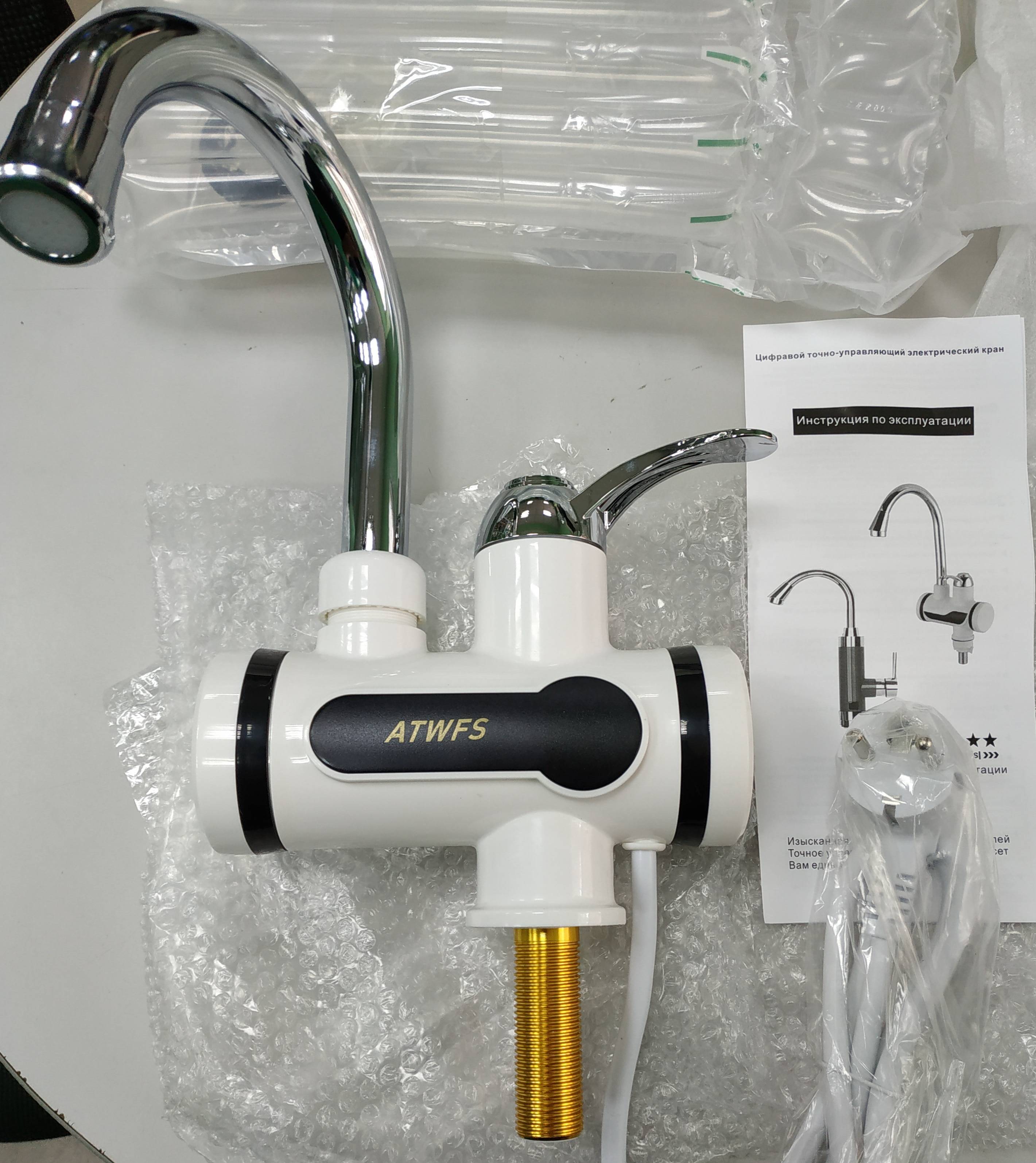
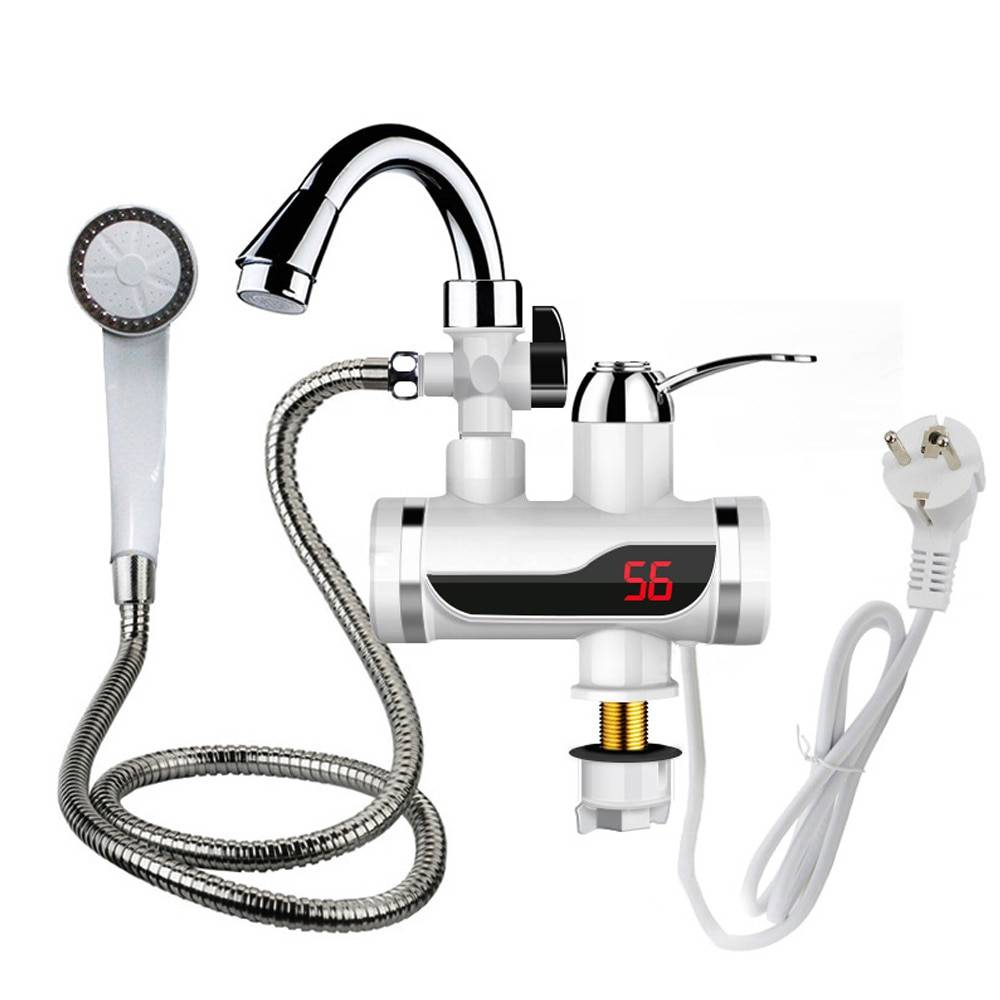

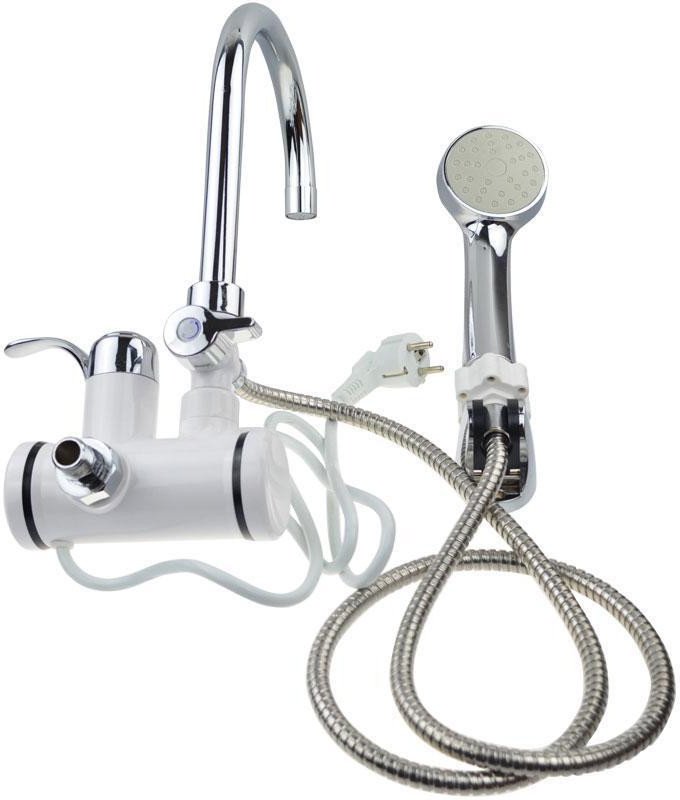
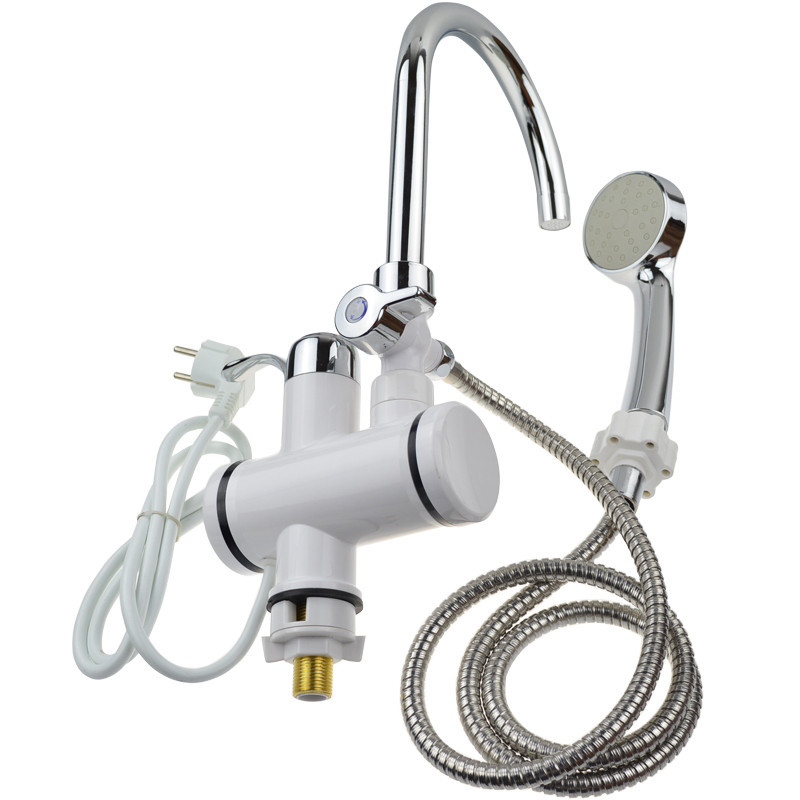

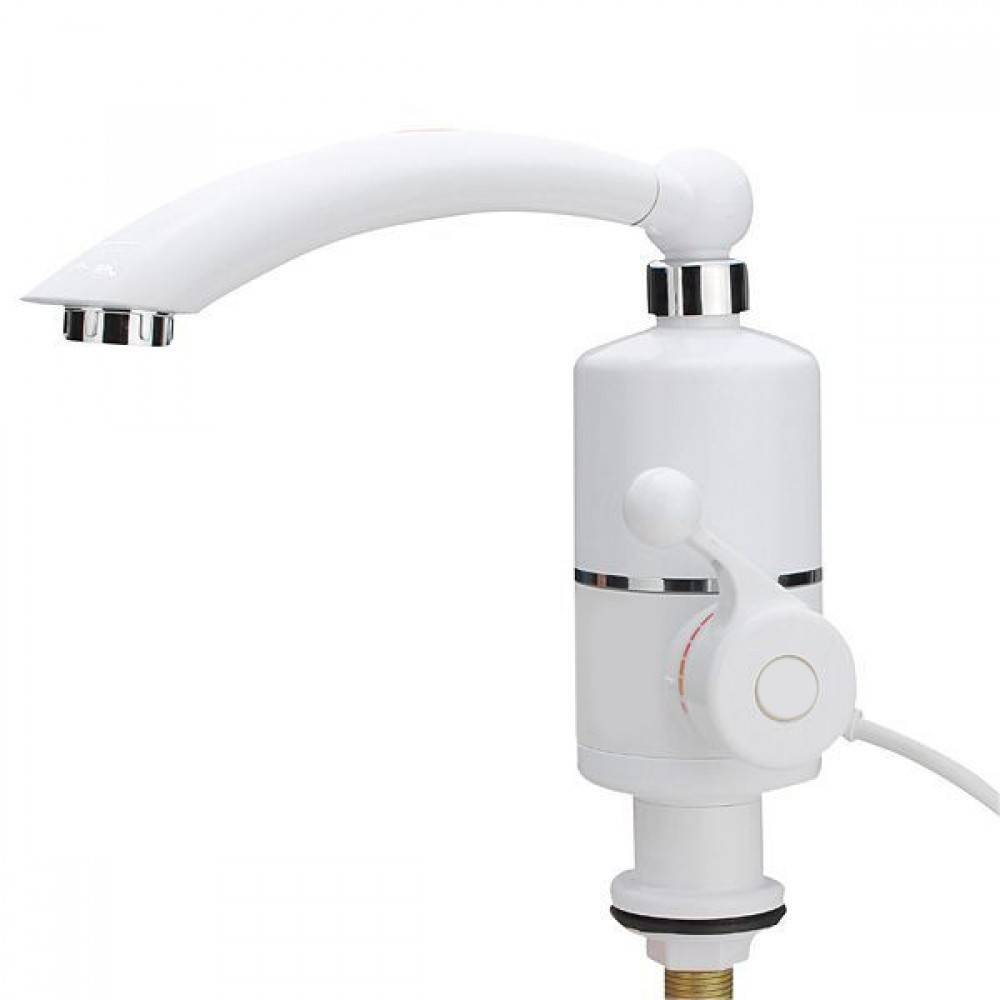

In high-quality devices, the manufacturer provides the maximum set of protection options:
- in order to secure the use of the device, a residual current device is built into it and in case of dangerous voltage fluctuations the device will not burn out, but simply turn off;
- the temperature sensor will not allow the device to overheat - when it reaches 60-65 ° C, the device will automatically turn off;
- the device will turn off in the absence of water, as well as a pressure of less than 0.4 atm. and more than 7 atm.;
- silicone damper and high-quality plastic housing will reduce the possibility of damage to the device;
- when choosing a water heater, make sure that the manufacturer has provided waterproof shells for structural elements, in accordance with the international standard IPx4.
Ariston Bravo E7023 U-F7
Another water heater made in Italy. At a fairly low cost, it is able to provide a couple of points of analysis with warm water at once. The device has a basic set of functions and is distinguished by build quality and reliability.
Power is decent - 7 kW, productivity - up to 4 liters per minute. There is an auto-shutdown system for the device in case of power failures, a safety valve to relieve excess pressure, and built-in overheating protection.
Completeness is quite wide - there is a hose, a shower head, a faucet and a cleaning filter. Like many other instantaneous water heaters, the model is not without flaws. First of all, you need to take care of proper grounding, so it is better to entrust the connection to professionals. The second criticism is the quality of the thermal insulation of the device.
Advantages:
- decent power and performance;
- high-quality protection system;
- good equipment;
- low cost;
- the ability to withstand pressure up to 6 atm;
- nice design.
Negative points:
- poor thermal insulation;
- separate wiring (powerful) is required.
How to choose and what to look for?
There are several important criteria for choosing an instantaneous electric heater. The most important of them are listed below.
Performance and Power Ratings
Power is the most important parameter on which the possibility of obtaining a certain volume of heated water in a certain unit of time will depend.
If residents need to take a shower or cook food quickly, a low-power appliance will suffice, which will heat three to five liters of water in one minute. After 20 seconds, the water will start to warm up.
If the family is large and has significant needs, heater models with higher power should be preferred.
The purpose of the water heater is usually indicated in the instructions for the device. Devices whose power does not exceed 8 kW are convenient to use in the country, where constant heating is not needed.
NOTE!
The water temperature of 50 degrees is quite sufficient for taking a shower or washing a small amount of dishes.
If there is a need for the constant availability of a large amount of heated water, the device must be more powerful - from 20 kW and above. In addition, it is worth considering the number of water points in the house or apartment.
If the bathroom and kitchen sink are located next to each other, one medium power heater will suffice.
If such zones are far from each other, you will need to purchase a pair of low-power water heaters, or one powerful pressure apparatus.
Modes of operation and control
The design of an instantaneous water heater is quite simple, but such devices also have their own classification:
- Hydraulic.
- Electronic.
The hydraulic type of control is also called mechanical. They are equipped with most inexpensive models. More often than others, there is a step switch, and the most budgetary water heaters may not have the ability to adjust the water pressure or temperature at all.
The principle of hydraulic control is that during the operation of the device, it is possible to set the rod in motion with the help of levers or buttons.
This part of the structure will change the force of water pressure, as a result of which its temperature will also change. The main disadvantage is that the degree of temperature control in models with a mechanical type of control is not very accurate. If the water pressure is low, the water heater may not turn on at all.
The electronic control system allows you to control the water pressure and the degree of its heating much more accurately. Such water heaters are equipped with built-in sensors and microprocessors that are sensitive to pressure changes and temperature changes in the line.
This allows you to change the current settings to those that will fully correspond to the mode that the user selects.
IMPORTANT!
In the latest models of devices, there is also a power saving function.
If the water heating device will serve only one zone of water intake, for example, a sink or shower, you can purchase a more budgetary mechanical model that can be configured at any time.
If you plan that the purchased water heater will serve several points at the same time, you should prefer a device with an electronic control unit.
Instantaneous water heater
In this case, we are talking about direct heating of water, at the moment the tap is turned on. There are three types of instantaneous water heaters:
- Stationary systems. Products are large and require a separate place for installation.
- Water heaters-nozzles. They are installed directly on the crane. It is easy to guess that they are enough only to wash their hands.
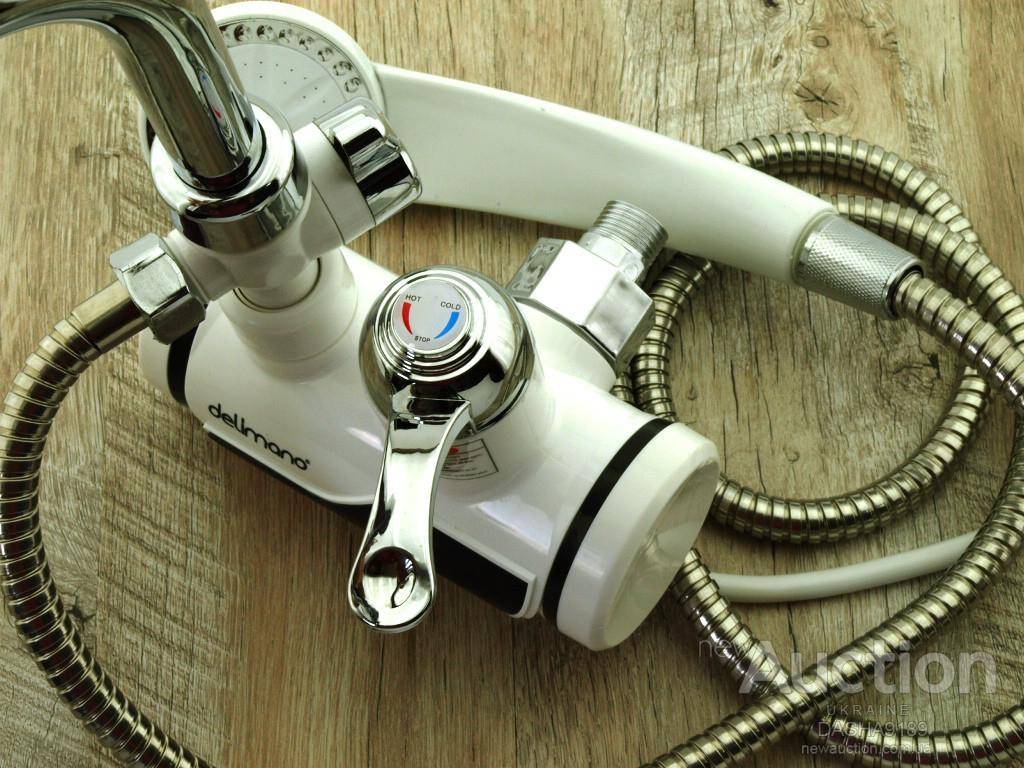
- Electrically heated faucet. It is a separate mixer. In fact, the water heats up according to the same principle as the nozzles, only faster. This means that the equipment has more performance.
Owners of suburban real estate give such models because of the low cost. But, such heaters also have a lot of disadvantages. First of all, they wear out much faster. In addition, the flow power of such units is at least 3 kW. And if you want to take a shower, then the power of such a protochnik exceeds 10 kW. Not every power grid can cope with such loads. For a storage boiler, this parameter is from 1.4 to 2.5 kW. Therefore, it is much easier and more profitable to buy this particular type of boiler.




Why is an electric model better than a gas model?
We are talking about electric instantaneous heaters and we already understand how they work. This is a great option for any apartment or country house. However, gas heaters are also on sale. Let's see what their features are and find out why the electric option is much better than the gas one.
So, in some apartments there is a pipeline for gas. Moreover, gas water heaters could well have been installed at the time of the commissioning of the house and still have a place to be. Usually these are very old houses of the 60s and 70s.And some in such conditions continue to use gas heaters, motivating their decision by the fact that, allegedly, gas is cheaper. Why is this not the best solution?
Gas water heater
So, for the operation of the gas column, it is necessary to comply with such a condition as sufficient water pressure (in the region of 0.25-0.33 atm). If it is not observed, then the start of the heating elements simply will not happen. That is, if the pressure of cold water has fallen, then it is simply pointless to expect hot water. In addition, gas is a dangerous substance that, if exposed to open fire, ignites. A gas leak can be devastating.
Also, when using gas equipment, it is important to think about the fact that the house has good ventilation - combustion products are harmful to health
Much more convenient and safer are small water heaters that operate just at the expense of electricity. Yes, you will have to pay a little more for their use, but they have a lot of advantages over gas-powered equipment.
The best instantaneous electric shower heaters
Flowing water heaters with a watering can are a great solution for showers or bathrooms (no need to buy and install a shower faucet). As a rule, these are non-pressure devices of medium power.
Thermex Tip 500 (combi) Prime - with tap and shower
4.8
★★★★★editorial score
88%
buyers recommend this product
Restrained design, compact dimensions and wall mounting will allow this water heater to fit into the interior of any bathroom. It has a clear mechanical control, and self-assembly will not cause difficulties.
The presence of not only a shower head, but also a faucet in the kit will allow it to replace all the main plumbing in your bathroom.Moreover, the spout is long and can be rotated (for example, towards the washbasin standing next to the bathroom).
There is a copper heating element in the Tip Prime case, which will provide fast water heating at low or medium pressure.
Advantages:
- Stylish design;
- Compact dimensions;
- Overheat protection;
- Faucet and shower included;
- Temperature regulation.
Flaws:
No display.
Thermex Tip 500 can be used for comfortable showering and washing when the central hot water supply is turned off.
Ariston Aures S 3.5 SH PL - impeccable style
4.7
★★★★★editorial score
82%
buyers recommend this product
See review
The high degree of protection of the housing makes this heater suitable for installation directly in the shower enclosure.
A copper heating element heats water at a low pressure up to +55 ° C, but the temperature here is adjustable, so you can make it cooler.
The device is protected from "dry" switching on and overheating. It comes with a shower head and hose.
Advantages:
- Simple control;
- Temperature setting;
- Copper heater;
- Overheat protection.
- Low price.
Flaws:
No faucet included.
In a country house or in the absence of hot water in the apartment, the cute Ariston Aures showerhead will allow you to comfortably take a shower - but only in summer. For "winter" water, it is rather weak.





How big should the water heater be
Boilers of 5-10 liters are usually used only for the kitchen. That is, they will only be enough to wash your hands and dishes. For the bathroom, you should choose models from 30 liters. This amount is enough for one person. For two, 50 liters is enough. But if guests come to you, then someone will have to wait until the boiler heats the next portion of water.
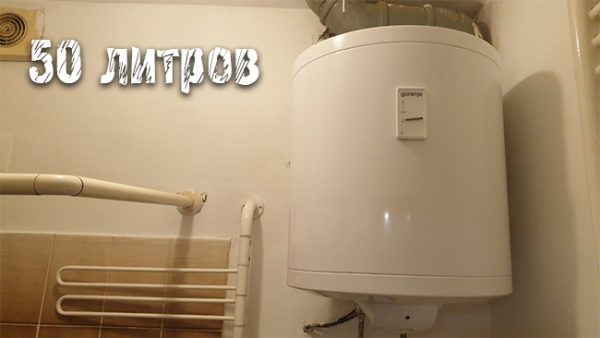
80-100 liters is enough for a family with children, plus you can wash the dishes. Large boilers of 150 liters are not so popular. Such models are used to connect to more water intake points. Well, the most dimensional water heaters, with a volume of more than 200 liters, can serve several families. But in addition to volume, it is worth clarifying other characteristics.
Expert advice
As a conclusion, let's summarize all of the above:
Power is the most important criterion in choosing an instantaneous electric water heater
For rapid heating of water up to 45 °C, the power of the heating elements is 4-6 kW;
Performance is the second most important parameter to pay attention to. For one sampling point, a device capacity of 3-4 l / min is sufficient. For each subsequent point, add 2 l / min;
Control type
The hydraulic one has a simpler design, but the heating is not regulated or can be positionally regulated. Electronic control allows you to control the heating depending on the incoming fluid temperature and system pressure;
Water heater type. Non-pressure are installed at one point of water selection. Pressure stations can serve several points at once;
Safety. Pay attention to devices with a multi-level security system. Ideally, the device should be equipped with an RCD.
Watch a video on how to choose an instantaneous water heater
What the market has to offer
The choice of electric instantaneous water heaters is at least large ... You can easily get confused
What should you pay attention to besides power and performance? On the material from which the tank and the heating element are made.The tank can be copper, stainless and plastic. This information is not provided by all manufacturers, but if it is not available, most likely the filling is made of plastic
It is, of course, heat resistant, but not as reliable as metals.
This information is not provided by all manufacturers, but if it is not available, most likely the filling is made of plastic. It is, of course, heat-resistant, but not as reliable as metals.
Also pay attention to the minimum and maximum cold water pressure at which the unit can operate. There are capricious models, for the connection of which it is required to install a reducer on our networks
| Name | Power | Dimensions | Performance | Amount of points | Control type | Operating pressure | Price |
|---|---|---|---|---|---|---|---|
| Thermex System 800 | 8 kW | 270*95*170mm | 6 l/min | 1-3 | hydraulic | 0.5-6 bar | 73$ |
| Electrolux Smartfix 2.0 TS (6.5 kW) | 6.5 kW | 270*135*100mm | 3.7 l/min | 1 | hydraulic | 0.7-6 bar | 45$ |
| AEG RMC 75 | 7.5 kW | 200*106*360mm | 1-3 | electronic | 0.5-10 bar | 230$ | |
| Stiebel Eltron DHM3 | 3 kW | 190*82*143mm | 3.7 l/min | 1-3 | hydraulic | 6 bar | 290$ |
| Evan B1 - 9.45 | 9.45 kW | 260*190*705mm | 3.83 l/min | 1 | mechanical | 0.49-5.88 bar | 240$ |
| Electrolux NPX 8 Flow Active | 8.8 kW | 226*88*370mm | 4.2 l/min | 1-3 | electronic | 0.7-6 bar | 220$ |
Separately, it is worth talking about taps with electric water heating. They are also called faucet-water heater. They appeared not so long ago, but are quickly gaining popularity, as they are easy to use, just connect.
| Name | Control type | Heating range | Operating pressure | Connection size | Power / voltage | Housing material | Price |
|---|---|---|---|---|---|---|---|
| ATLANTA ATH-983 | auto | 30-85°C | from 0.05 to 0.5 MPa | 1/2″ | 3 kW / 220 V | ceramics | 40-45$ |
| Aquatherm KA-002 | mechanical | up to +60°C | from 0.04 to 0.7 MPa | 1/2″ | 3 kW / 220 V | composite plastic | 80$ |
| Aquatherm KA-26 | mechanical | up to +60°C | from 0.04 to 0.7 MPa | 1/2″ | 3 kW / 220 V | composite plastic | 95-100$ |
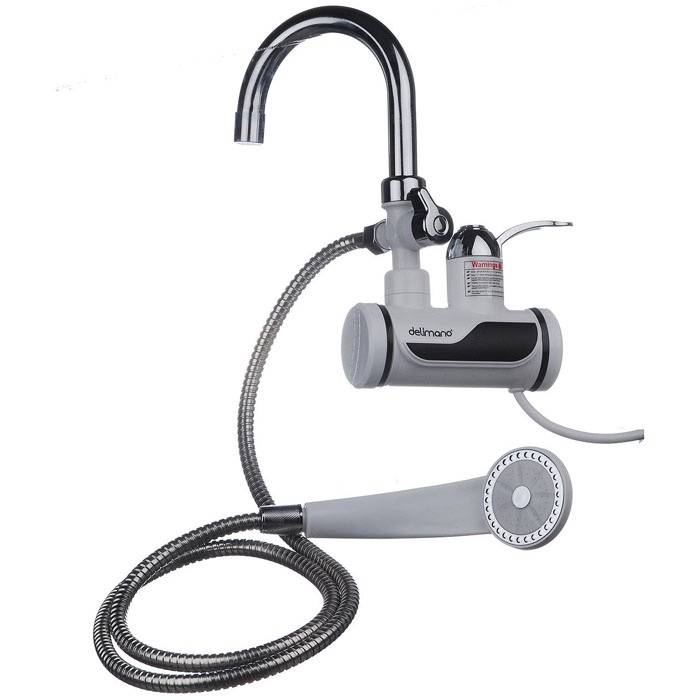
| Delimano | auto | up to +60°C | 0.04 - 0.6 MPa | 1/2″ | 3 kW/220-240 V | plastic, metal | 45$ |
| L.I.Z. (Delimano) | hydraulic | up to +60°C | 0.04-0.6 MPa | 1/2″ | 3 kW/220-240 V | heat resistant ABS plastic | 50$ |
Types of compact electric heaters
Hot water supply modules for a faucet are usually divided into two types: a removable heating nozzle and mixers with a built-in heating element. To supply warm water to the sink of the wash area and to the kitchen sink, universal wall outlets are often used.
Separate faucet nozzle
The module is installed on the spout of a previously built-in faucet. The main advantages of the mini-block: low cost, the ability to connect to an existing tap, compactness. The disadvantages are obvious - as a rule, the thermo-block has a small power and productivity (about 4 l / min).
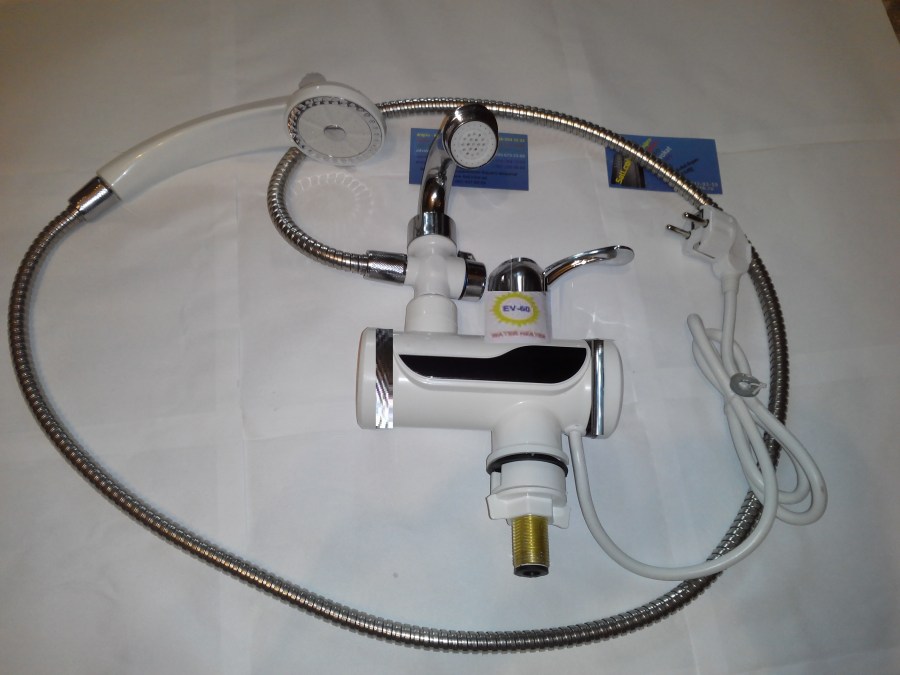
Small dimensions do not allow to equip the nozzle with a full-fledged security system and a more or less powerful heating element. The efficiency and reliability of the device is quite low
As a protective element, the module is equipped with a thermal sensor that prevents overheating of internal elements.
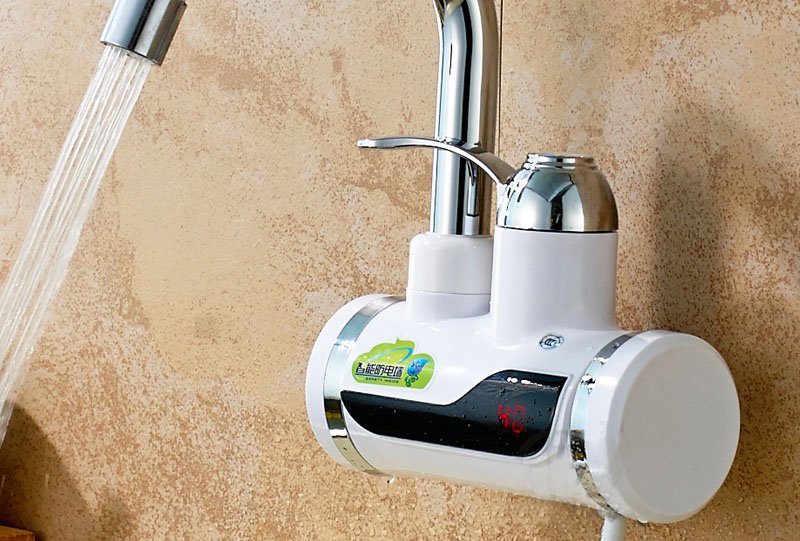
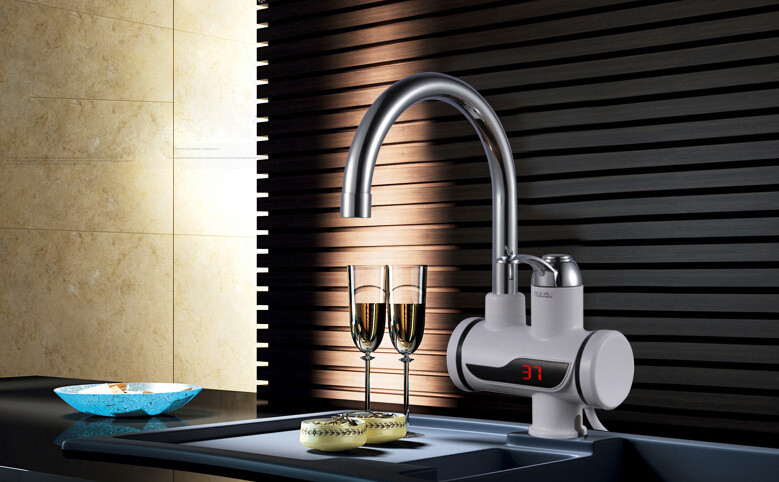
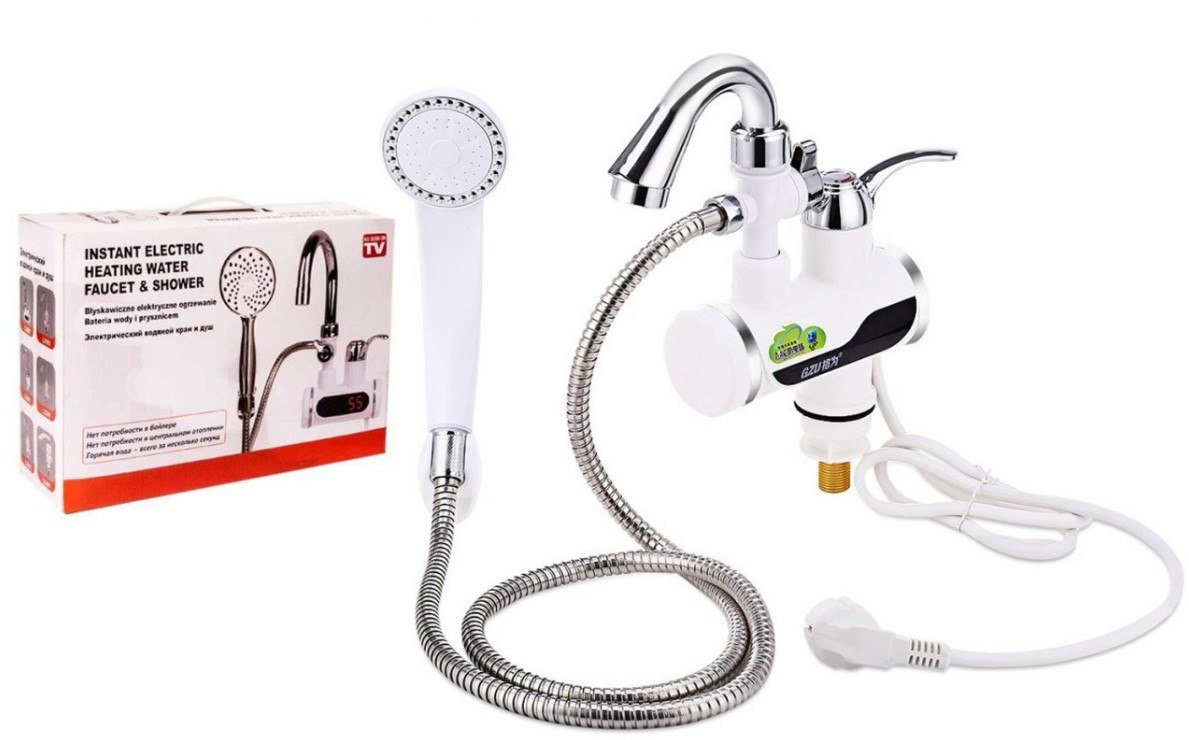
Instant Water Heating Faucet
Heated taps occupy a large part of the segment of flow-through miniature water heaters. The device operates in three modes:
- Hot water supply. Mixer handle turned to the right. The electrical system comes into action, providing an influx of warm water.
- Cold water supply. Turning the lever to the left turns off the electrical part of the tap - cold water runs from the mixer.
- Shutdown. Joystick knob in the central lowered position - the heating tap is inactive.The circuit is de-energized, the water supply is stopped.
In most flow-type models, the water temperature is controlled by changing the pressure. Moving the lever vertically allows you to select the heating mode with an error of 0.5-1°C.
A hot water faucet is more expensive than a separate nozzle. But the difference in price pays off with the increased performance of the device and a high degree of safety.
Wall “groove”: pressure and non-pressure model
A universal water heater can be connected to the tap.
The electrical module has a number of distinctive features:
- the ability to service several water intake points at the same time;
- high degree of protection;
- productivity up to 7-9 l / min, which is more in comparison with nozzles on the tap and mixer-heaters;
- wall mounting.
The body is made in the form of a capacious box. The increased area of the heating element explains the improved heating characteristics of the device.



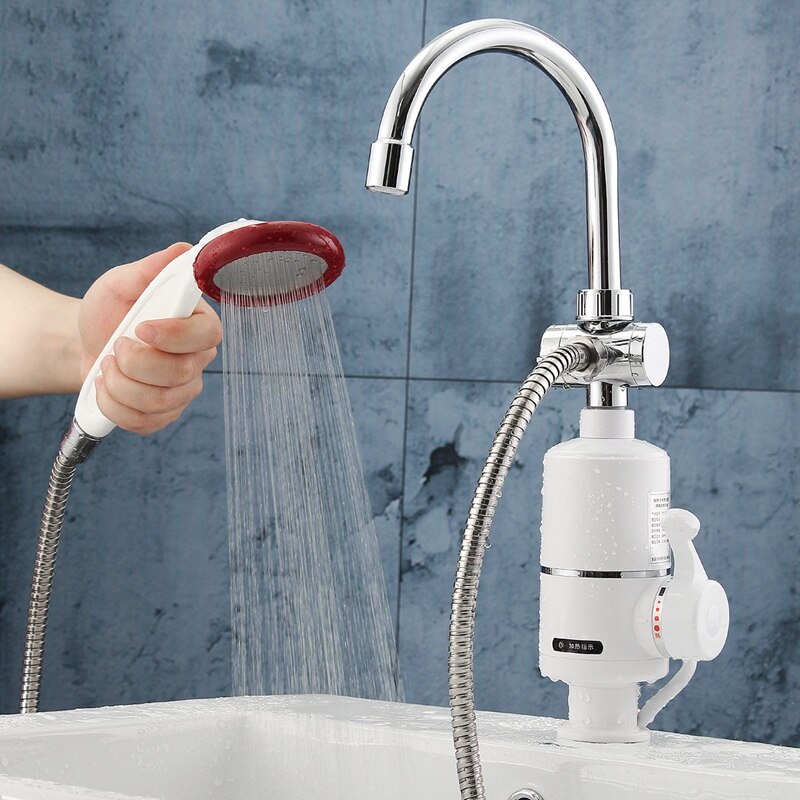
The block is attached to the wall near the crane. In order not to clutter up the space for a mirror or a spacious shelf, the module can be placed under the sink
Wall mounts are of two types:
- Pressure. Hot water from the heater is supplied to the distribution network, and then to the water intake points. The power of the units is 3-20 kW, one- and three-phase connection is possible.
- Non-pressure. Designed to serve one point of water consumption - water from the mini-boiler is immediately transferred to the outside through the tap. The power of the devices is 2-8 kW.
With a sharp drop in pressure in the plumbing system, the flow of water through the non-pressure module will slow down - there is a high probability of getting very hot water at the outlet. In devices with a temperature sensor, this problem is solved.
This is interesting: How to choose a bathtub in a small bathroom
3 types of water heaters for the shower
Flowing electric water heaters that can be used for the bathroom are of 3 types:
- non-pressure devices with a flexible hose and a shower head;
- faucet-water heater with a free-flow shower;
- pressure water heaters.
First, let's figure out how non-pressure models differ from pressure ones. The former can serve 1 consumer, for example, a kitchen sink or shower head. When the tap is closed, water does not enter the device, after opening it flows freely, so there is no excess pressure.
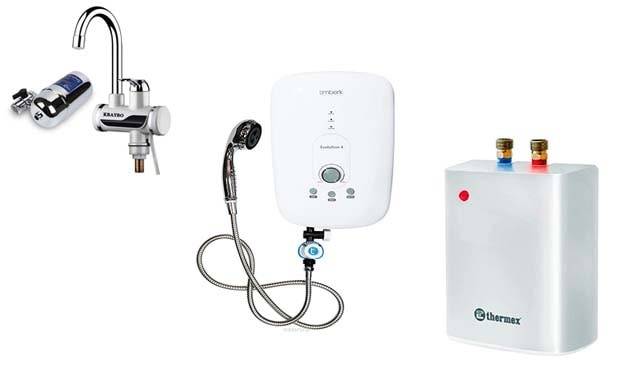
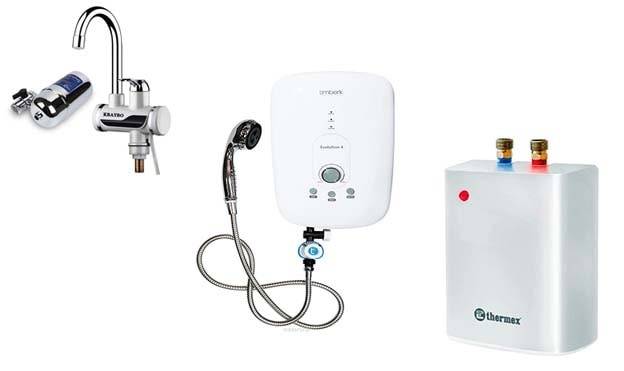
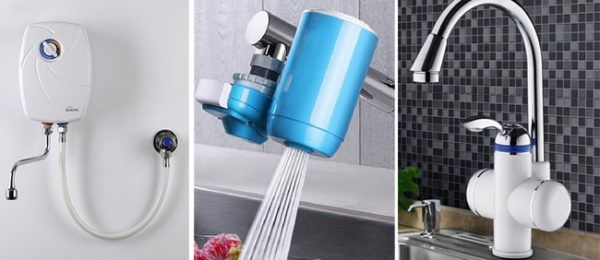
Faucet water heater, non-pressure and pressure water heater (from left to right)
Pressure-type flow-through water heaters cut into the water supply network of a private house (like a boiler). Accordingly, the device is constantly under pressure and is able to serve several points of water intake, provided that there is enough power of the electric heater.
Features of each type of household water heaters:
- A pressureless instantaneous water heater with a shower is a flat plastic box attached to the bathroom wall. Inside there is a tubular or spiral heating element and a control unit - relay (mechanical) or electronic. Power consumption - 3 ... 6 kW, productivity - 1.6 ... 3.5 liters per minute when heated by 25 degrees.
- The faucet-water heater with a shower head is similar in structure to a conventional water mixer, only larger. A “gander” of a faucet is installed on the cylindrical body and a hose with a shower is attached. Inside there is a spiral heating element with a power of 3 kW, which has time to heat up to 2 l / min. Some models are equipped with a digital temperature indicator.
- The pressure electric water heater is also made as compact as possible - a flat body with 2 pipes for connecting water pipes (male threaded fittings, ½ or ¾ inch diameter). Power of devices - from 6 to 25 kW, productivity - 3.3 ... 10 l / min.
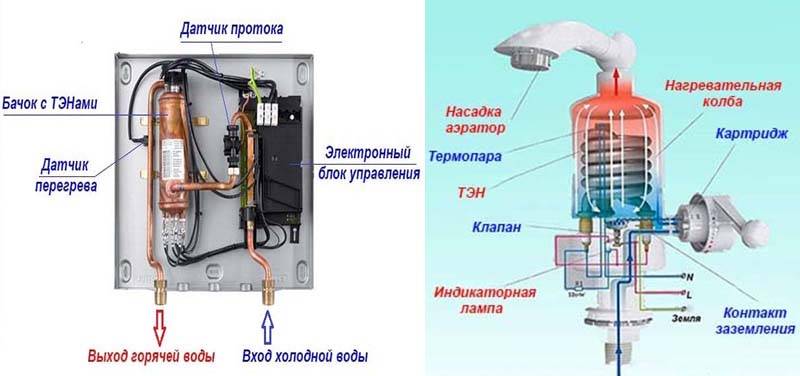
The device of the pressure model of the heater (photo on the left) and the tap with a spiral heating element (right)
The device, the pros and cons of different instantaneous water heaters, we examined in detail in another article. Judging by the above characteristics, the best option is a pressure "water heater" of sufficient capacity. But here another problem arises - a decent electrical power is needed at the input to the dwelling, which is often not available. How to provide hot water in various situations, read on.