- Top manufacturers and device models
- Operation Method
- Cumulative
- Flowing
- Rating of the best manufacturers of water heaters
- Budget models
- Middle price segment
- Premium Models
- Types of instantaneous water heaters
- Non-pressure instantaneous water heaters
- Pressure flow water heaters
- Varieties of control systems
- Hydraulic water heater control system
- Electronic control system
- Do-it-yourself boiler installation
- How to install a tankless water heater
- Rules for installing a storage boiler
- Construction of electric cranes
- Varieties
- How much electricity does the nozzle use
- What the market has to offer
- The subtleties of choosing a flowing electric water heater
- Summarizing
Top manufacturers and device models
According to the recommendations of experts, it is worth choosing only models of trusted brands, because they are the most convenient, functional and economical to use. Moreover, well-known manufacturers are constantly working to improve the efficiency of operation. branded devices occupy the first place among the ratio of electricity costs and received thermal energy.
In addition, there are other important features of water heaters that are advised to pay attention to when choosing an electric instantaneous water heater for a faucet or shower:
- the use of high-quality materials that are resistant to corrosion and high temperatures;
- high level of protection;
- compactness;
- safety;
- aesthetic appearance.
It is also worth remembering that before choosing a water heater, the more famous the manufacturer, the higher the price of the device.
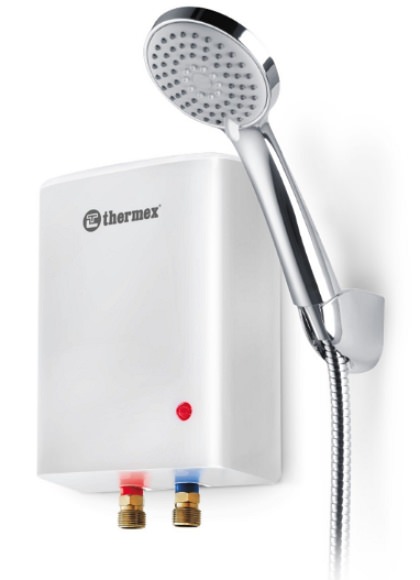
Rating of the best models of a wall-mounted instantaneous water heater, for 2019:
- Electrolux Smartfix. Model with a power of 5.5 kW, a capacity of 3 l / min. Heating up to 60°С. Faucet + shower head. The price is 2,500 - 3,000 rubles.
- Thermex Surf 6000. Bath device with a power of 6 kW, a capacity of 3.4 l / min. Heating up to 60°C Shower head. The cost is 4,200 - 4,800 rubles.
- Electrolux NPX 6 Aquatronic Digital. 4 kW unit, produces 2 l / min. Heating up to 60°С. Electronic control, overheating protection, connection to multiple sampling points. The price is 8,700 - 9,800 rubles.
- AEG RMC 45. Model with a power of 4.5 kW, produces 2.3 l / min. Heating up to 65°С. Pressure, protection against overheating and water, connection to several points of intake. The cost is 8,900 - 10,000 rubles.
- CLAGE CEX 9. Powerful device with 8.80 kW, with a capacity of 5 l/min. Heating up to 55°C, remote control, heating indicator, thermometer, display. The price is 24,000 - 25,000 rubles.
Top 5 best instantaneous mixer tap water heater models for 2019:
- Clever PKV-7 / PKV-9. Product power 3 kW, produces 2.5 l / min. Heating up to 65°С. Swivel spout. Models PKV-8, PKV-9, PKV-10 are equipped with a display. The cost is 4,200 - 5,300 rubles.
- Proffi Smart PH8841. Kitchen faucet with a power of 3 kW and a capacity of 2.5 l / min, up to 60 ° C.Electronic, temperature indicator, display. Overheat protection. The price is 3,900 - 4,600 rubles.
- Aquatherm KA-001W. RCD device. Power 3 kW, produces 2.3 l / min. Heating temperature up to 60 °C. Aerator with anti-calcium function. The cost is 3,900 - 4,500 rubles.
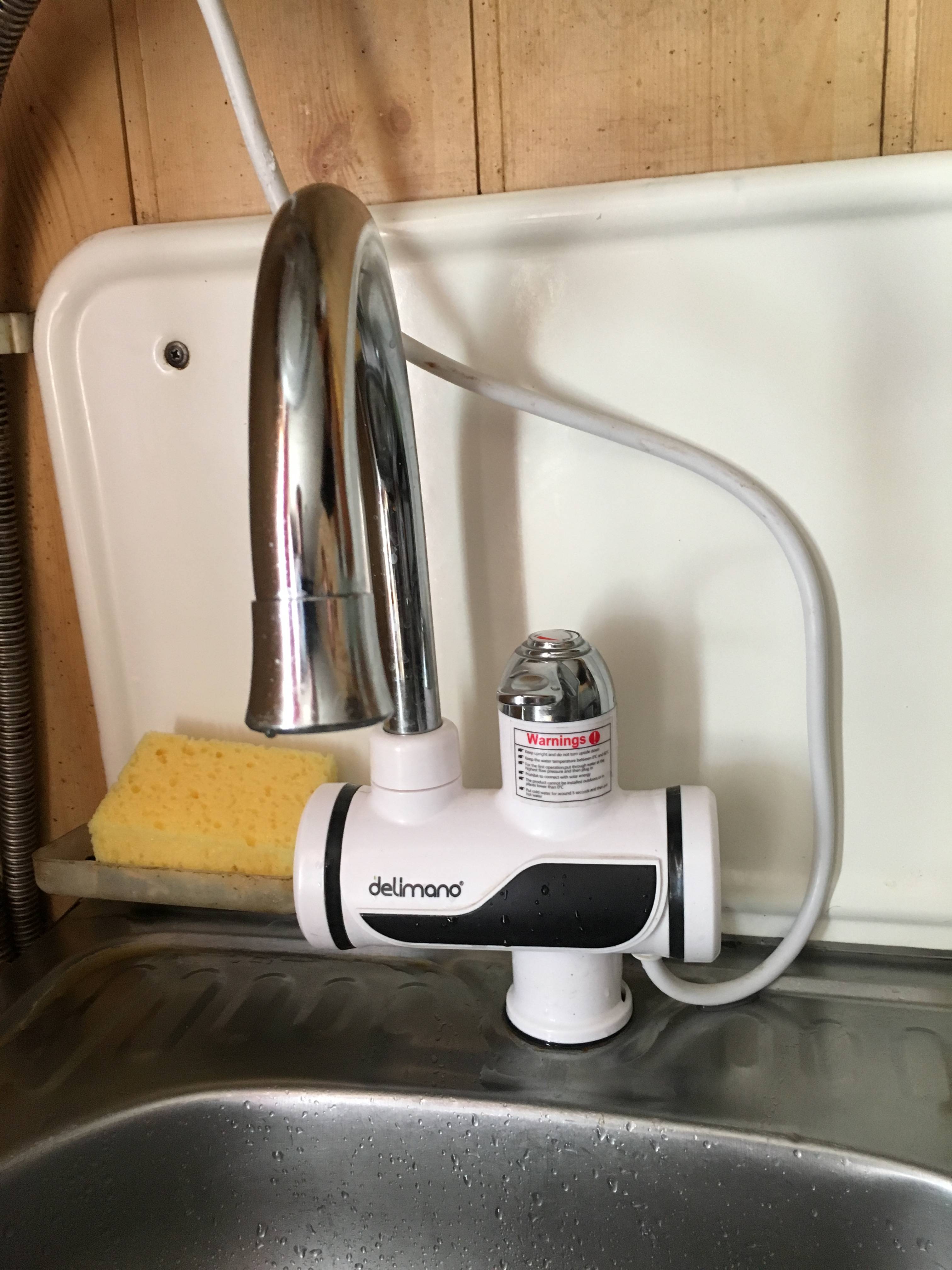
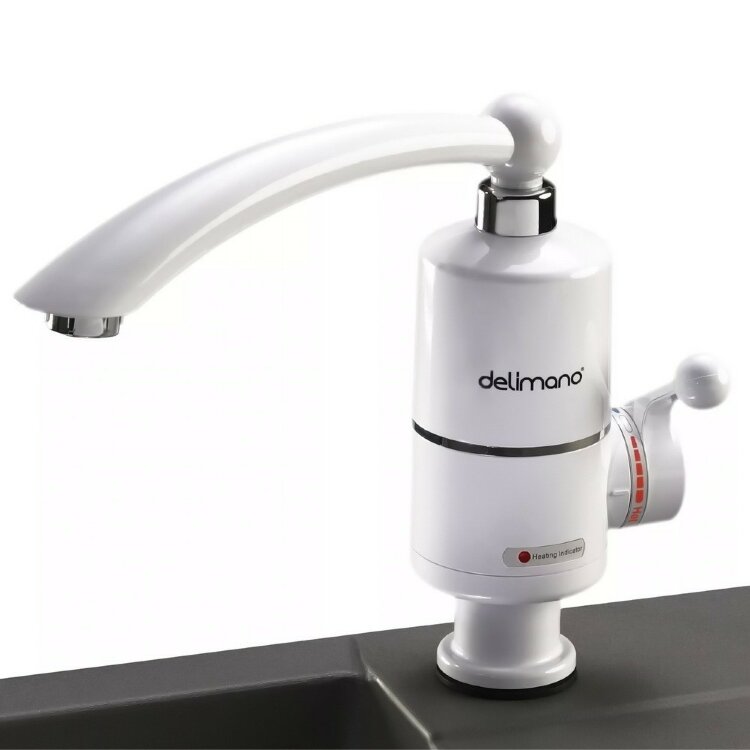
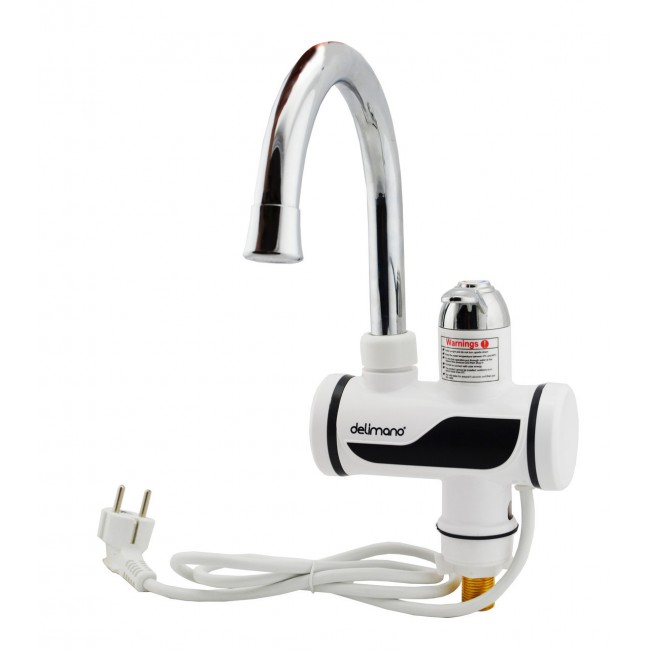
- Delimano. There are conventional mechanical and electronic models with two water intake points: faucet + shower. Well advertised medium quality mixer with 3 kW power and 2.3 l/min capacity, up to 60°C. The price is from 1,990 to 7,980 rubles.
- Atlanta ATH-7422. Product power 3 kW, produces 2.5 l / min. Heating up to 85°С. Crane with increased resource. LED-indicator of water temperature. Protection against dry switching on of the heating element and overheating. The cost is 2,200 - 3,000 rubles.
- Unipump bef 001-03. Power - 3 kW, productivity 2.4 l / min. Heating up to 60°С. Degree of protection - IPX4. With two points of water intake: faucet + shower. The price is 2,500 - 3,200 rubles.
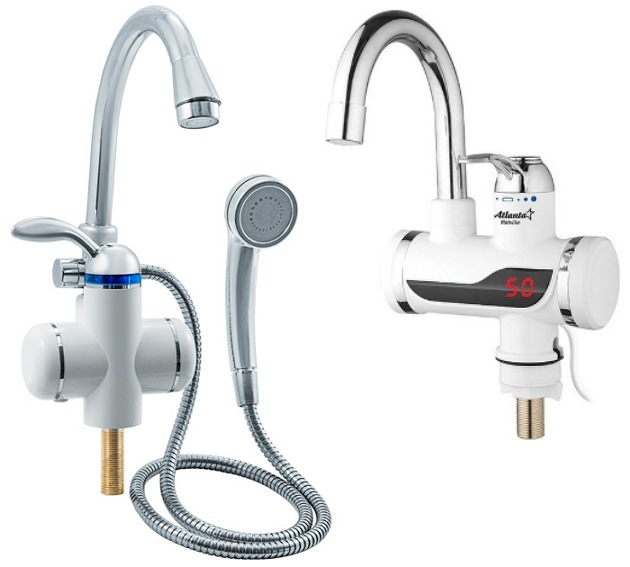
Some of the above units have alternative options with other parameters or equipment.
Operation Method
The vast majority of appliances used for heating water are of two types.
Cumulative
Apparatuses of this type are a reservoir with a heating element, which makes it possible to provide the consumer (moreover, several points from which water is taken from at the same time) with a sufficiently large volume of hot water. However, its initial heating takes time (as a rule, from a quarter of an hour). In the future, the water is constantly heated to the required value. The volume of the container can be from 5 to 300 liters. It is possible to choose the appropriate unit depending on the version.They can be hung on walls or placed on the floor, they are vertical and horizontal, flat or cylindrical.
Electrolux EWH 30 Formax is an electric storage water heater with an enamelled tank in a rectangular design
When operating this type of equipment, it is necessary to take into account some nuances:
- space is required to accommodate the tank;
- with long-term stagnation of water in the tank, such water cannot be used for cooking, and even more so for drinking, since bacteria can appear there (it is recommended to periodically heat the liquid to maximum temperature values, and also choose models that have a special coating that protects against the growth of bacteria);
- if the device is not used for a long time, the water has to be drained (especially if the owners leave for the winter).
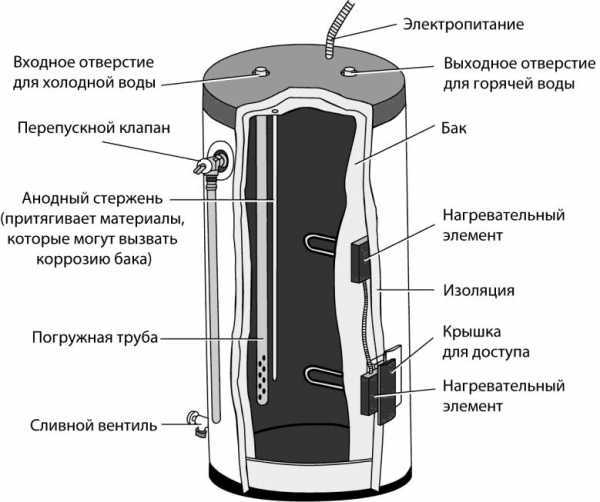
Diagram of a gas storage water heater
It is more expedient to install storage-type equipment where there is no centralized hot water supply.
Flowing
Installation of devices of this type is one of the most effective and simple way to provide consumers with hot water. Their power varies from 2 to 15 kW.
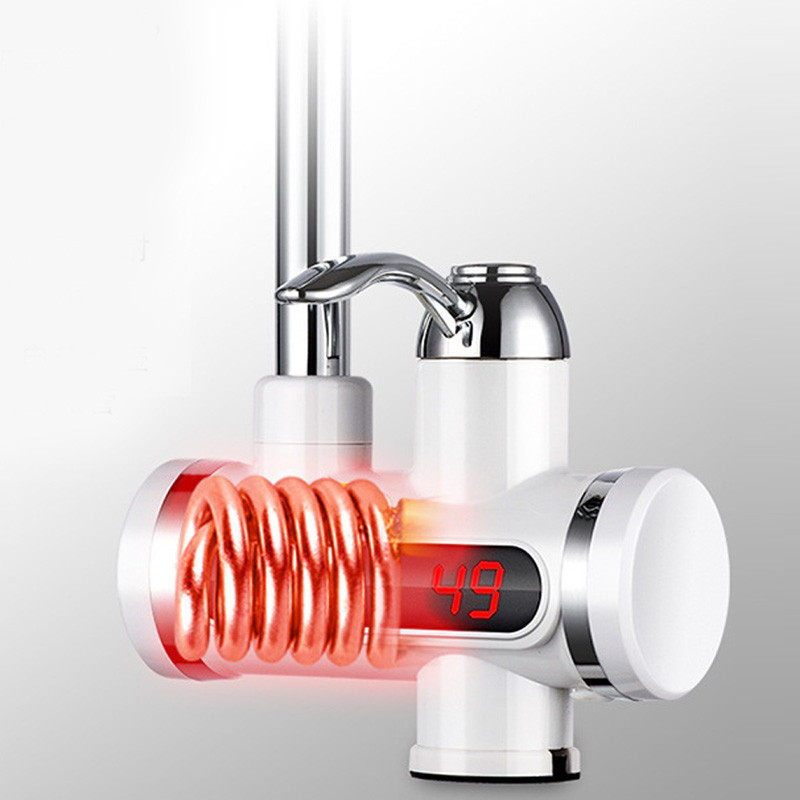
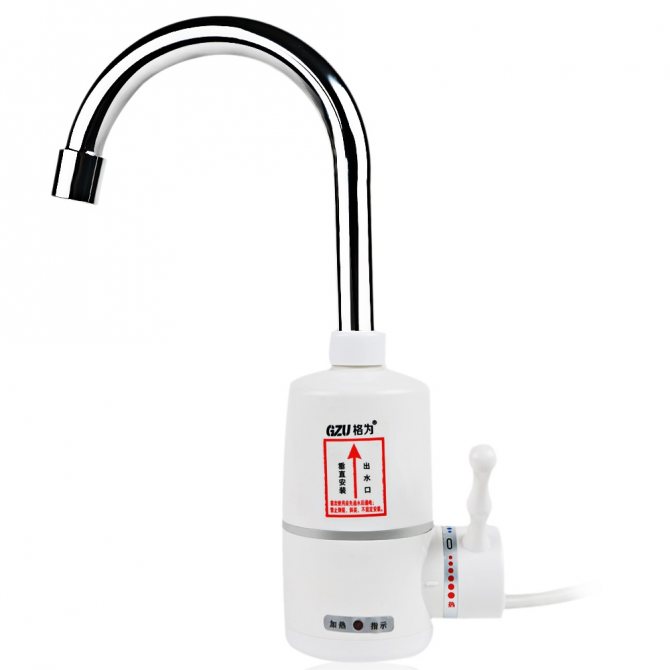
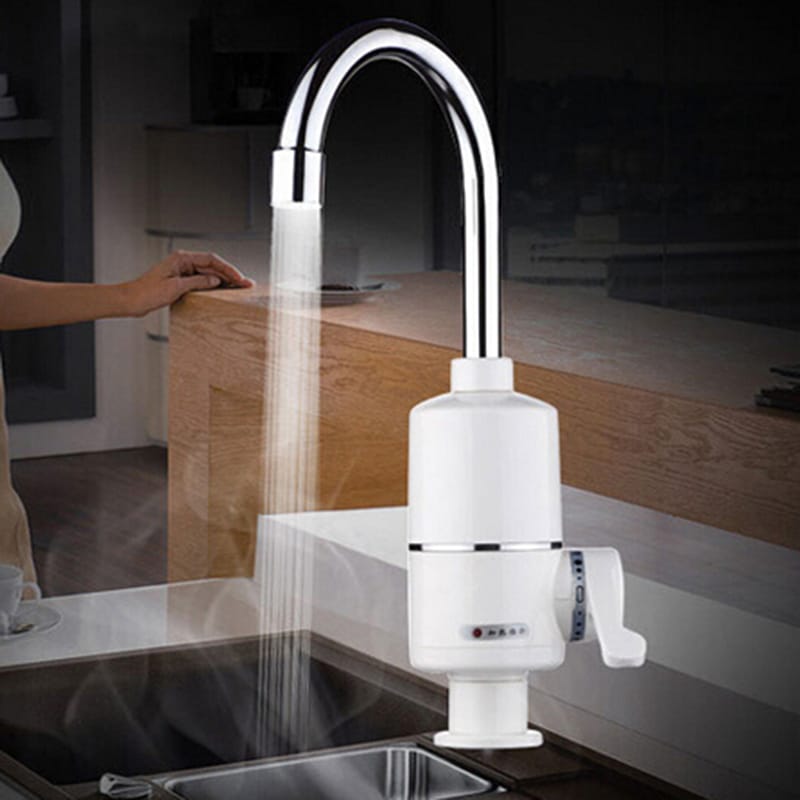
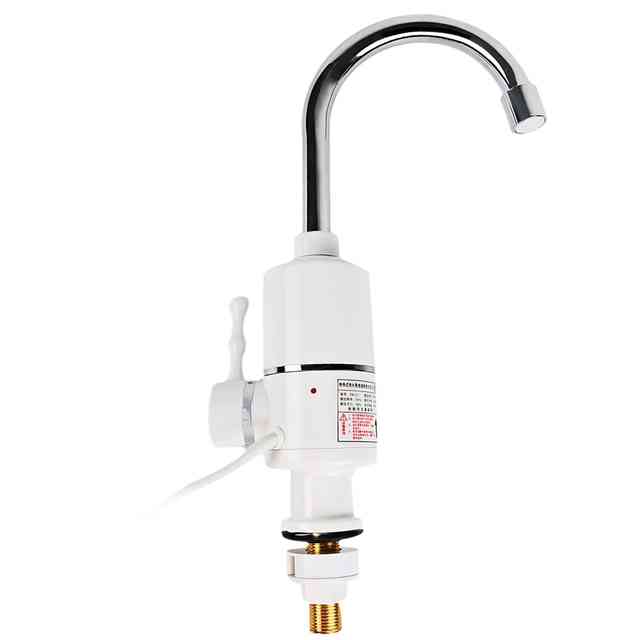
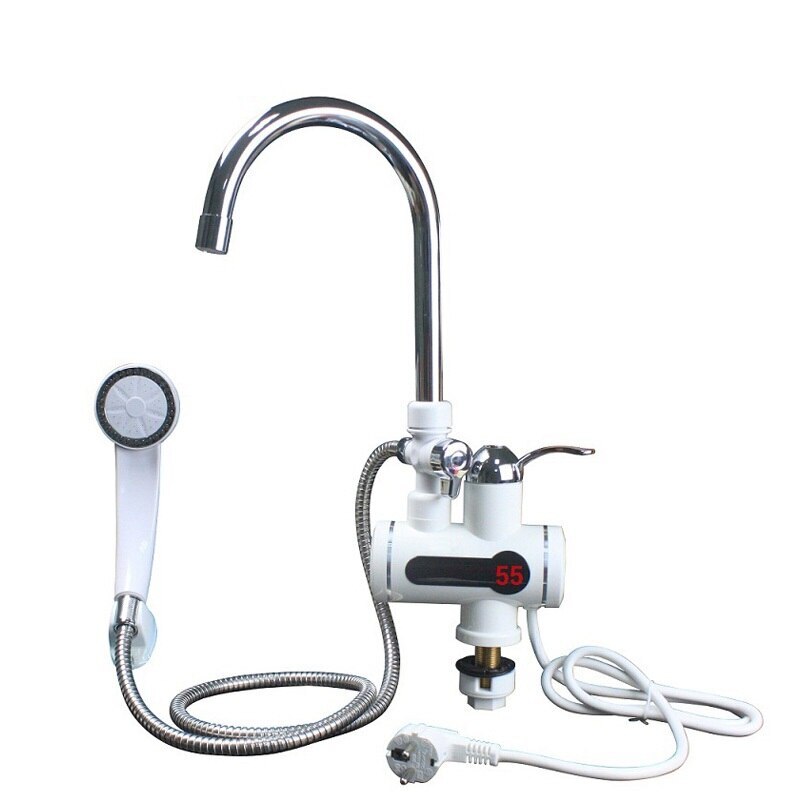
Flowing water heater on the faucet
Pressure models can be installed in a riser, which allows you to provide heated water to all water intake points in the house. Non-pressure devices, which are among the simplest and most popular, are mounted directly on the crane and put into operation after it is opened.
Flow devices consume more energy, moreover, they are dependent on its availability at the time of switching on. However, they are compact, easy to manage and cost less than storage counterparts.Some energy savings are provided by the absence of its consumption at rest.
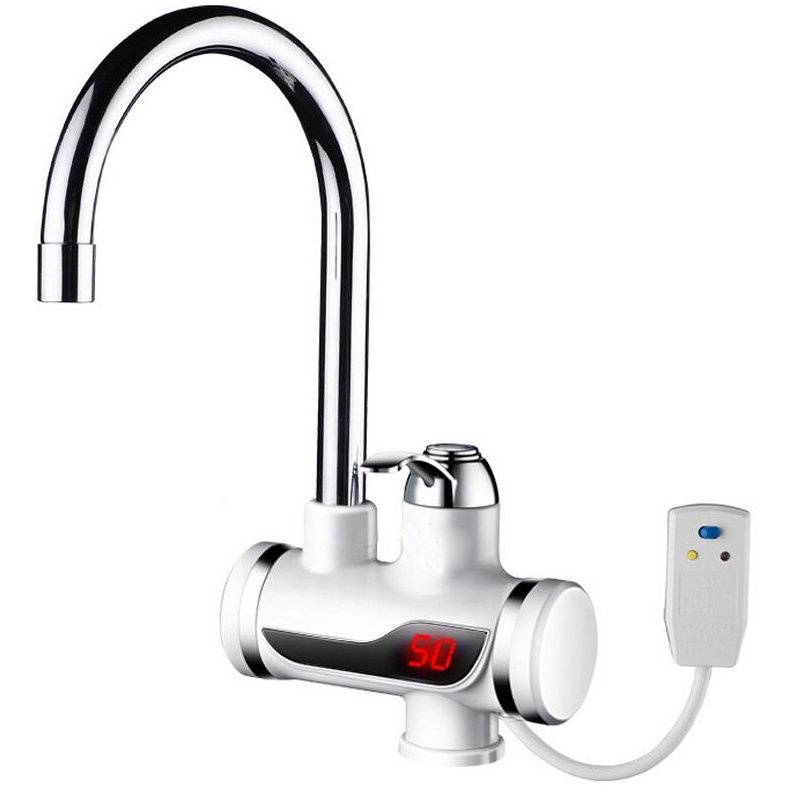
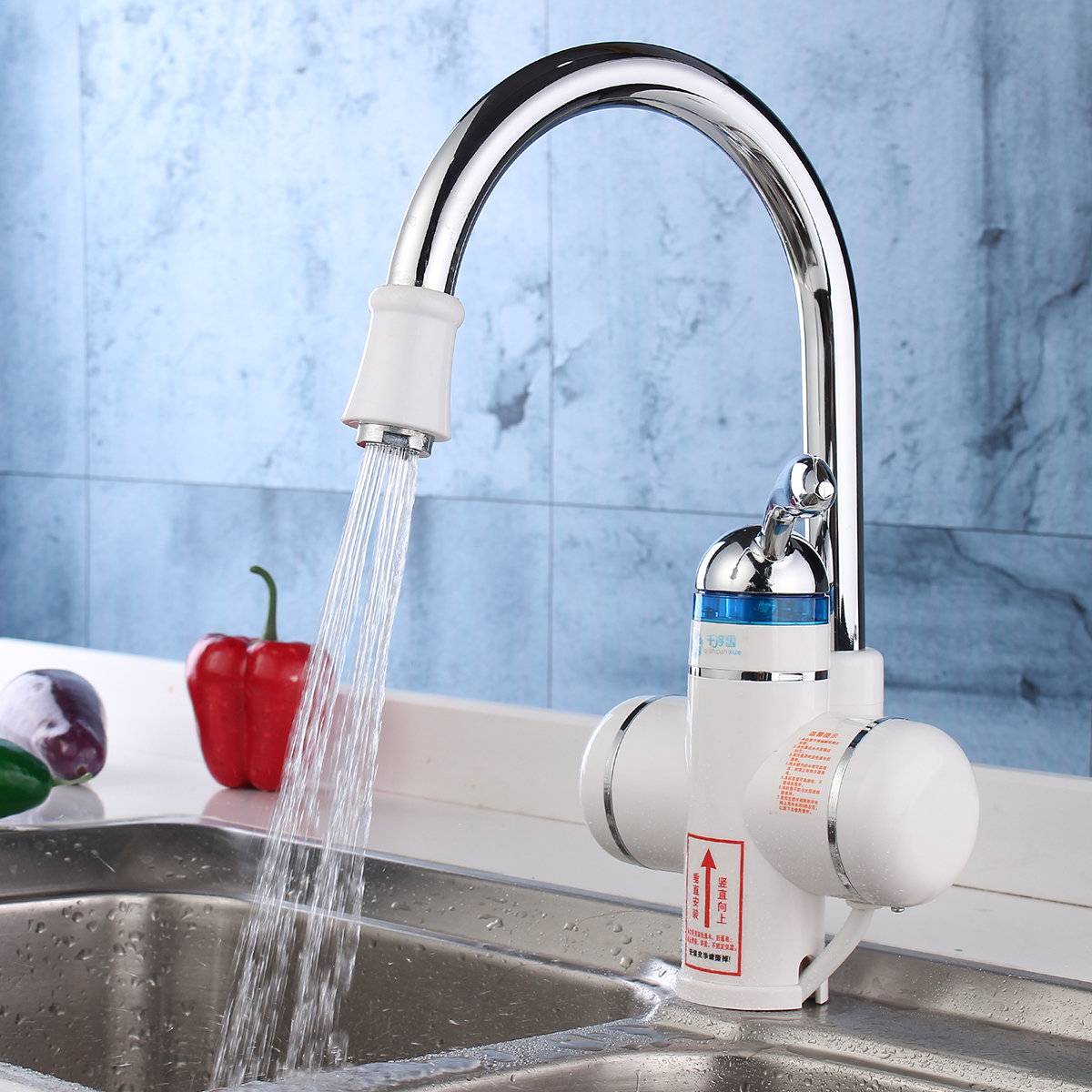
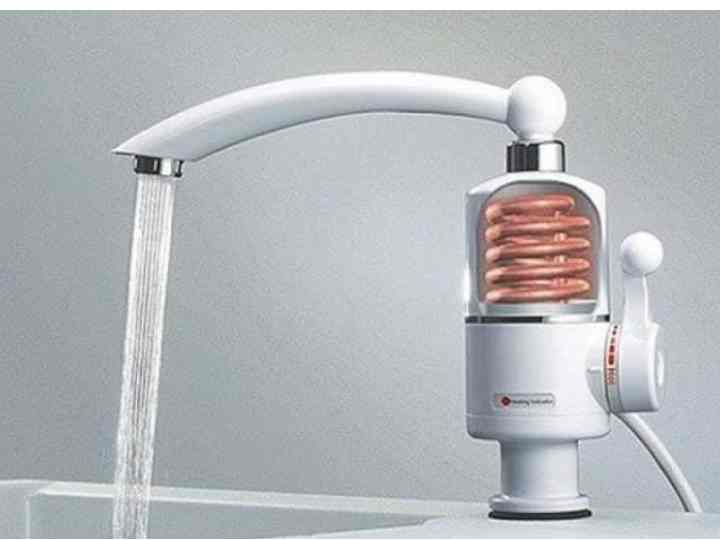
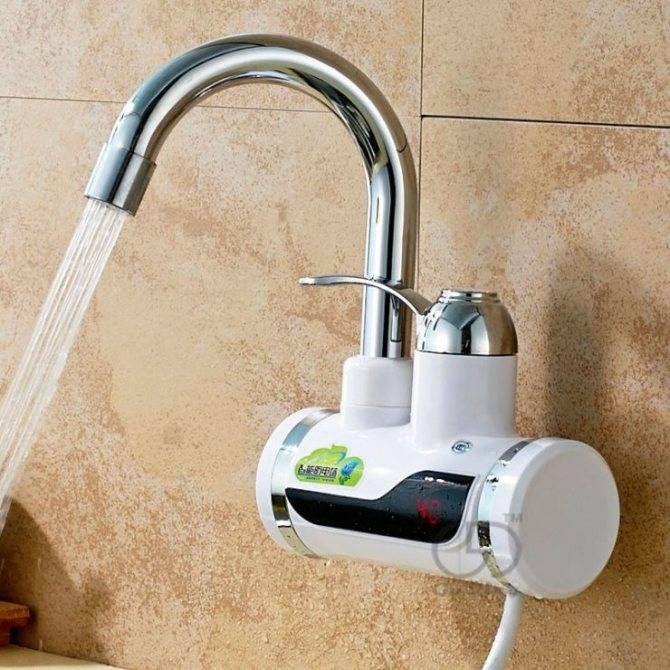
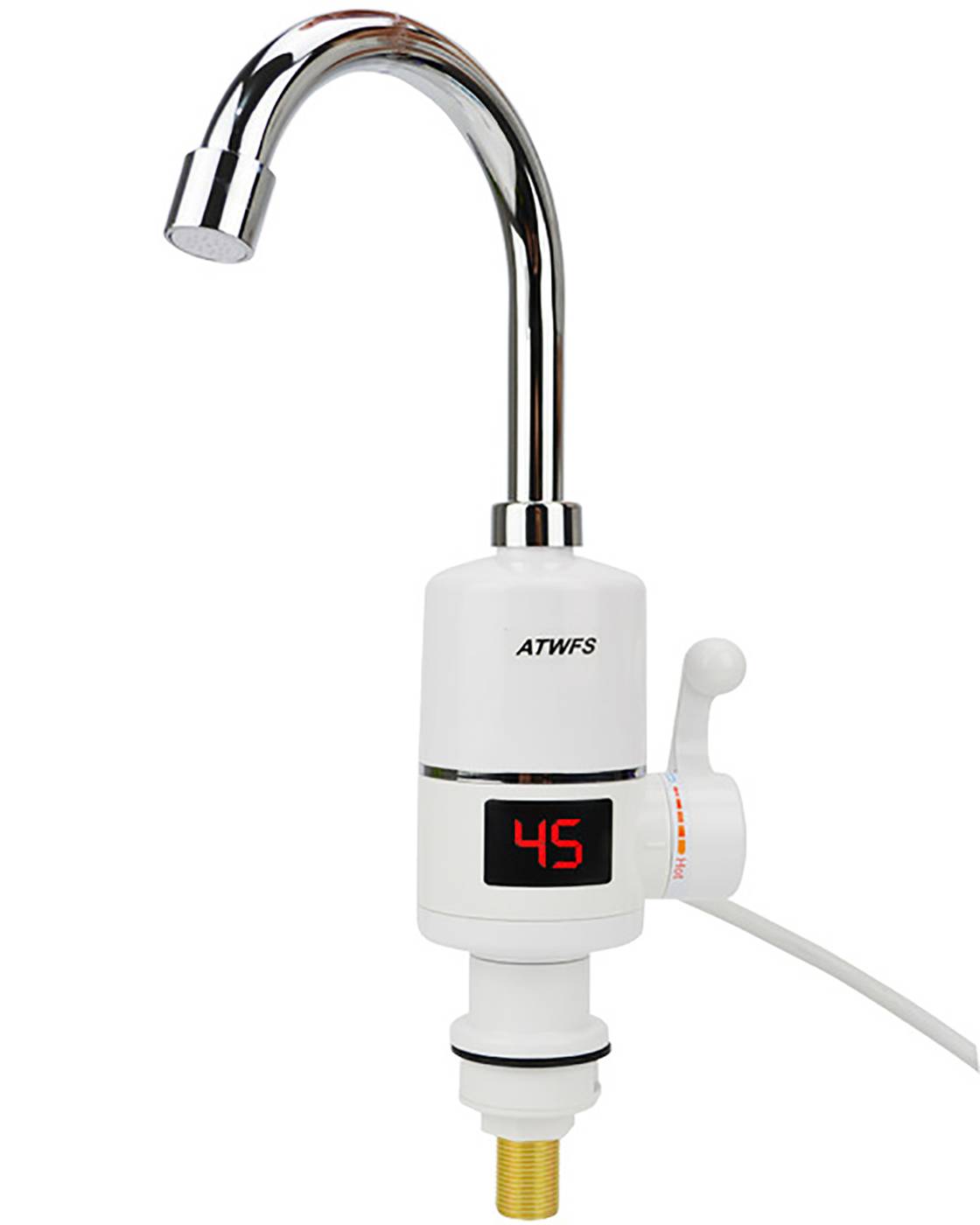


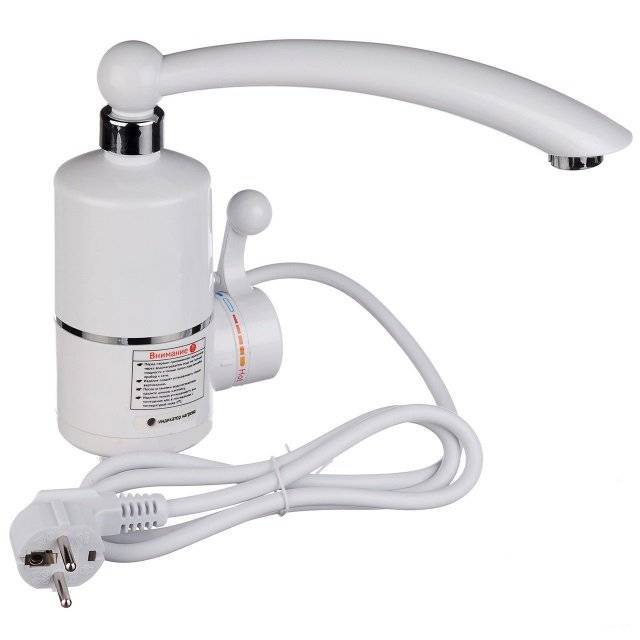
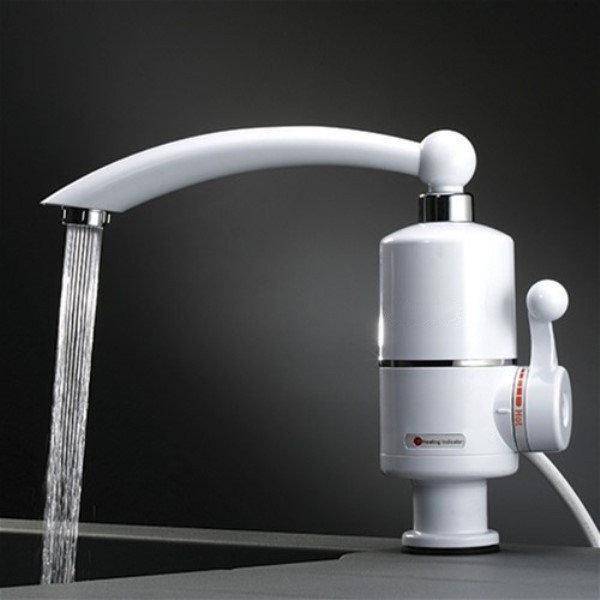
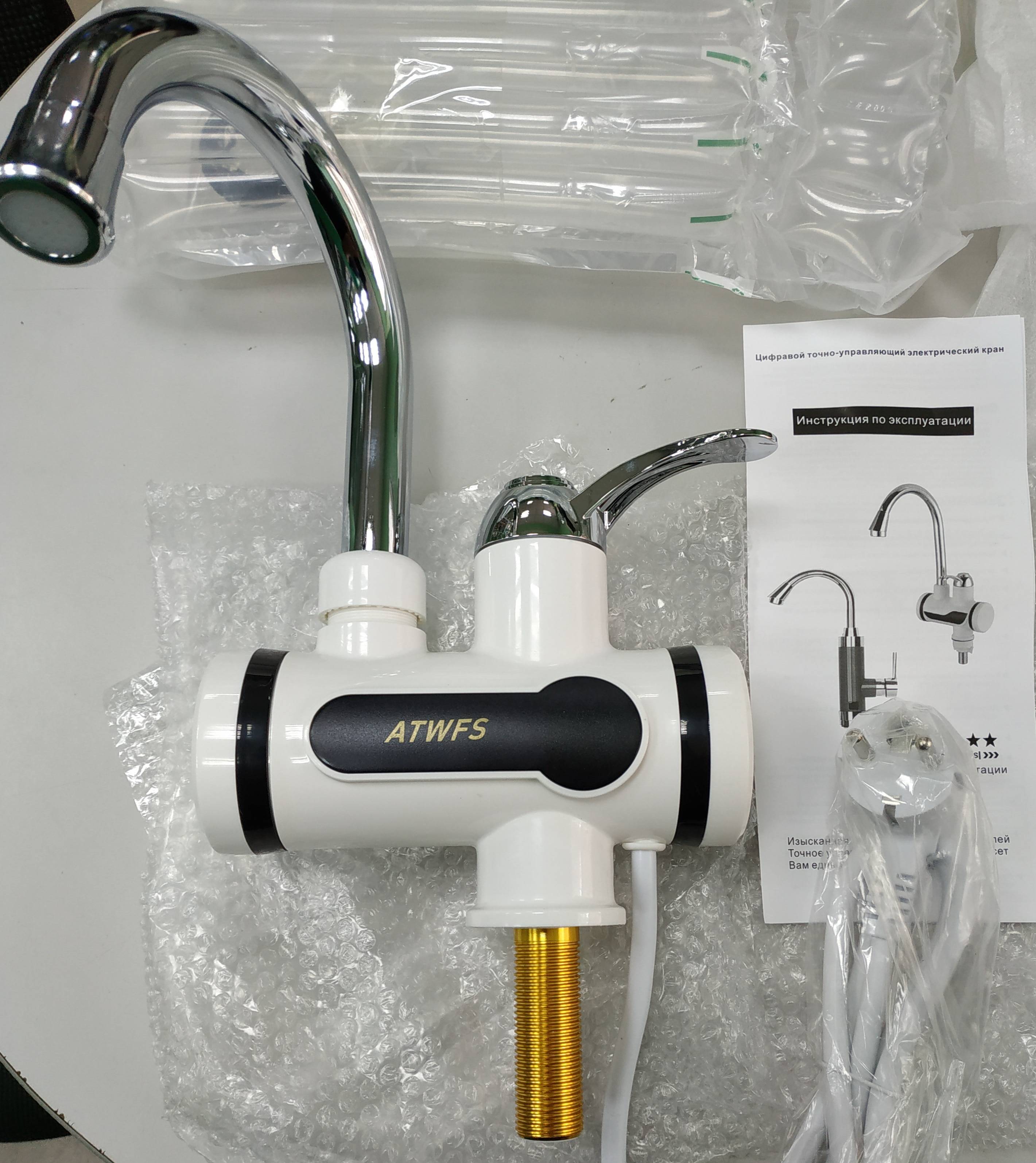
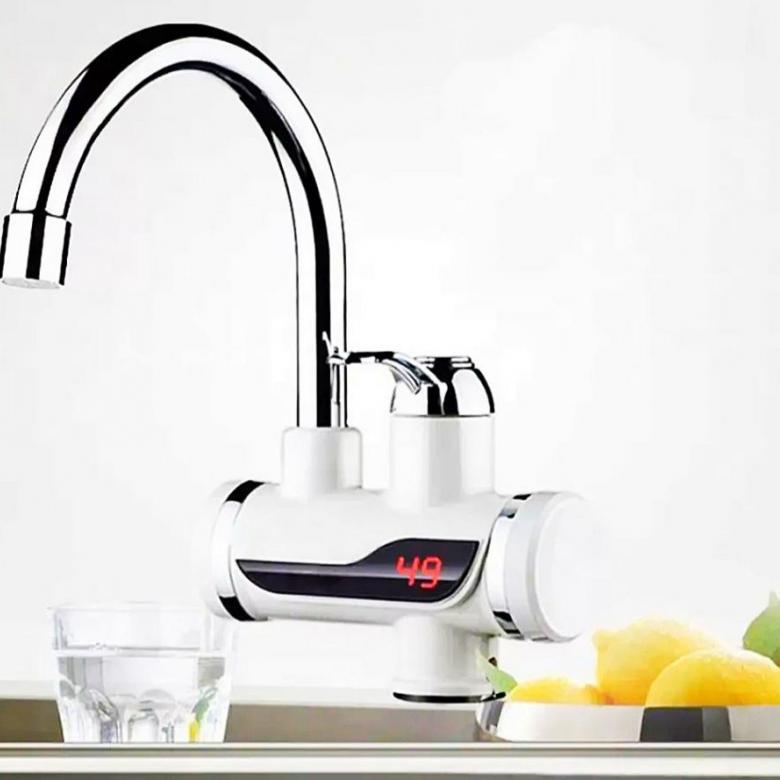
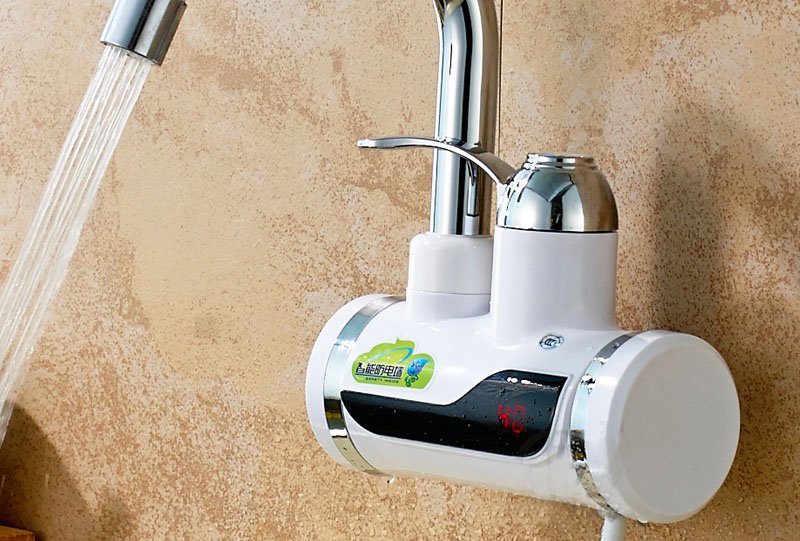
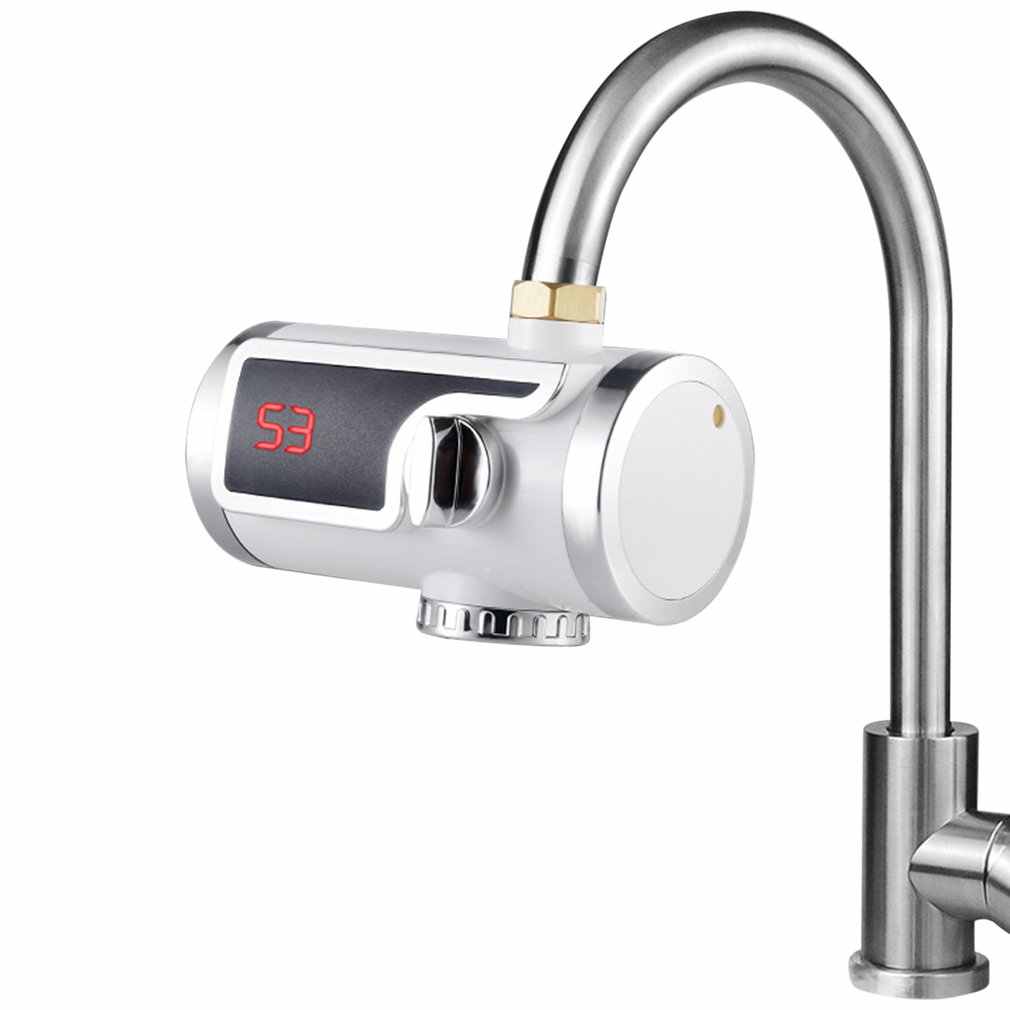
Water heater flow faucet with LCD display screen and temperature sensors
Today, hybrid technology is also being produced - flow-storage water heaters. These units are capable of rapidly heating water (which characterizes flowing varieties) and storing it in a tank. However, devices of this type are not so often found on sale due to low consumer interest. This is due to their high cost and complexity of design.
When choosing a water heater in an apartment, as a rule, flow models are installed
A flowing water heater powered by an electrical network and installed on a tap is one of the most popular devices today. It is especially convenient to use a device that instantly heats water during periods of planned shutdowns. This device is the most compact of the range of electric water heaters. The expediency of its installation is determined by the conditions and intensity of use.
Rating of the best manufacturers of water heaters
How to choose the right water heater for an apartment or cottage? Below is a rating of the most popular models in three price categories.
Budget models
| Timberk WHEL-3 OSC is an electric instantaneous water heater designed to heat water at one point of consumption. Equipment: faucet and flexible hose with shower head. Power - 3.5 kW. Productivity — 2 l/min. Advantages:
A great option for outdoor installation. Flaws: The device is designed for one point of water intake. | |
| Ariston ABS BLU R 80V (Italy). Boiler with one heating element and steel storage tank, capacity 80 l. The power of the heating element is 1.5 kW, which makes this model economical in operation. To protect the consumer from electric shock, the device provides a protective power off in the event of a “breakdown” of the heating element or a short circuit in the circuit. Height 760 mm. Weight - 22 kg. Advantages:
The disadvantage is the presence of only one heating element, as a result of which it takes about 5 hours to initially heat the water. |
Middle price segment
| Bosch 13-2G is a geyser with an atmospheric burner from a well-known German manufacturer. Ignition - hydrodynamic. Automation provides control of draft, flame, water and gas pressure. Power 22.6 kW. Productivity — 13 l/min. Advantages:
Flaws:
| |
| Gorenje OTG 80 SLB6. An electric storage boiler equipped with an enamelled steel tank with a volume of 80 liters. Two “dry” heating elements with a power of 2 kW are responsible for heating the water. Height 950 mm; weight - 31 kg. Equipped with a safety valve, protection against overheating and freezing. Heating rate up to 75°C - 3 hours. Advantages:
As the only drawback, users note an indistinct instruction manual. |
Premium Models
| Atlantic Vertigo Steatite 100 MP 080 F220-2-EC is a reliable, economical and efficient premium boiler, made in a flat rectangular design. The design feature of this model is the presence of two enameled tanks for 80 liters. and the use of two "dry" ceramic heating elements, with a power of 2.25 kW. Management is electronic. The functionality includes two modes of operation: "Boost" - for quick heating of water for a shower; Smart mode, uses user settings. Advantages:
The disadvantage is a rather meager range. | |
| Fagor CB-100 ECO (Spain). Storage boiler. Features: steel tank with titanium coating, capacity 100 l; two "dry" heating elements, with a power of 1.8 kW. Functionality: Three modes of operation, sound and light indication, double electrical protection, protection against leakage and water hammer. Height 1300 mm. Weight 38 kg. Advantages:
The disadvantage is the high cost. |
This is interesting: Features of repairing an apartment in a new building
Types of instantaneous water heaters
All instantaneous water heaters presented to the attention of customers can be divided into two groups:
- non-pressure models installed at one point of water intake;
- pressure models capable of supplying hot water to several points at the same time.
Non-pressure instantaneous water heaters
In apartments, non-pressure instantaneous water heaters are most often installed, the power of which varies between 3-8 kW. The devices are plugged into ordinary sockets with a voltage of 220 V.
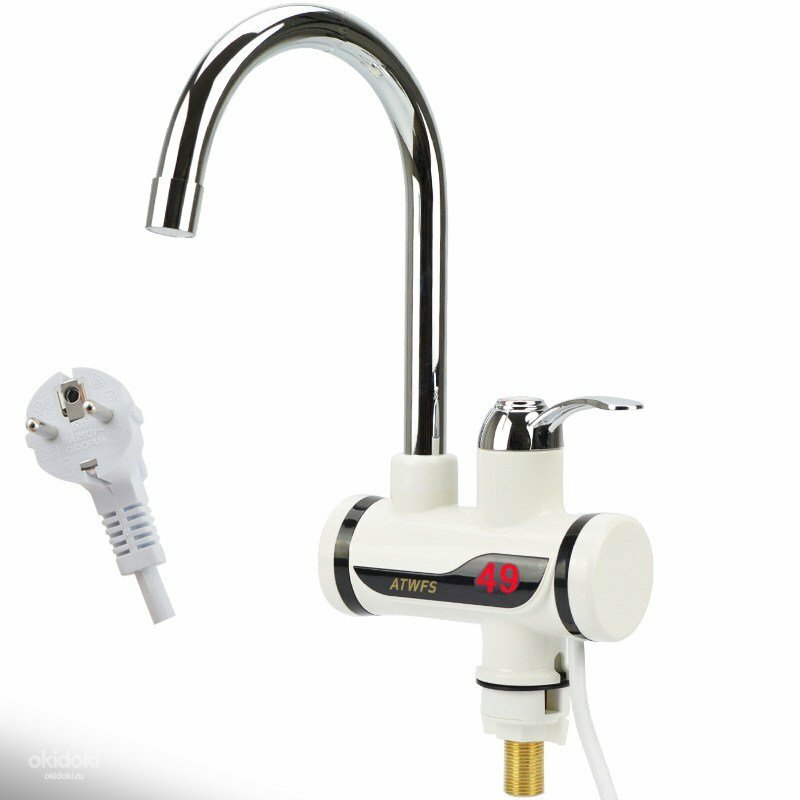
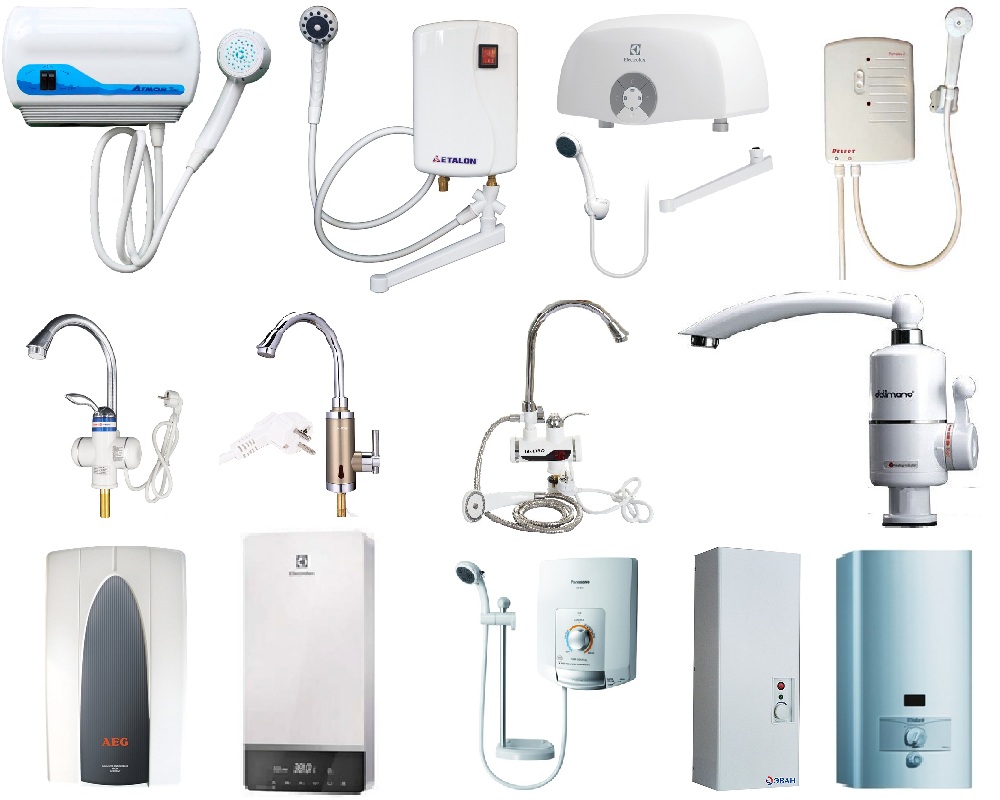

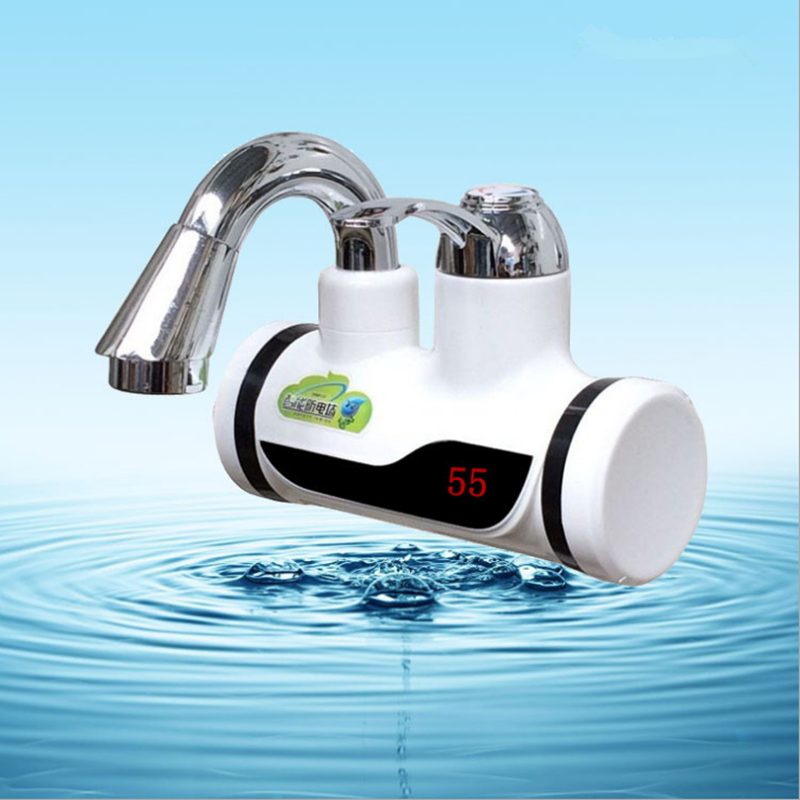
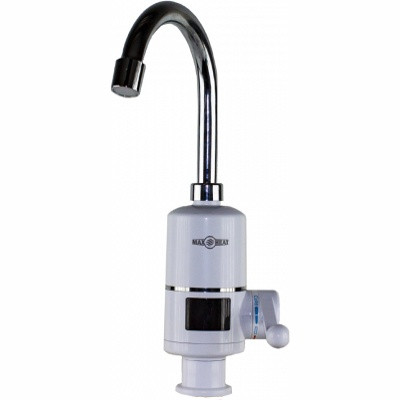
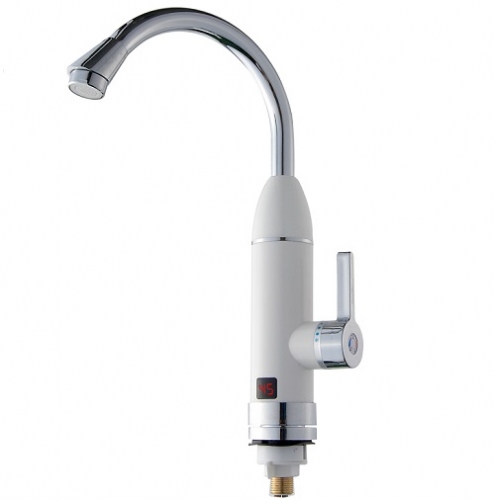
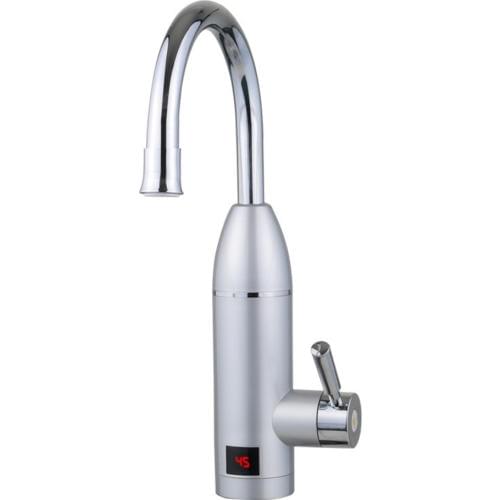

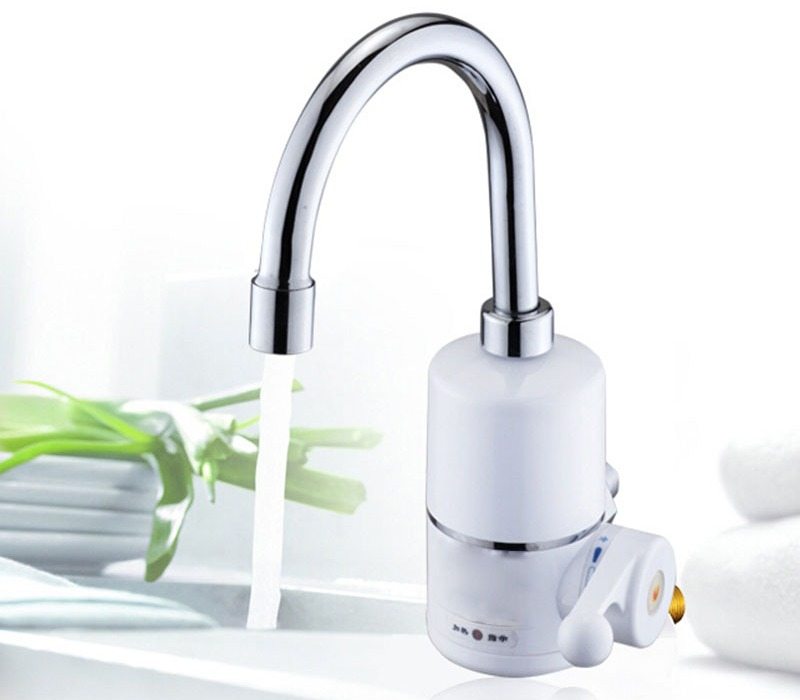

During installation, the equipment is connected directly to the cold water supply pipe or directly to the mixer. Non-pressure models are supplied with a faucet.
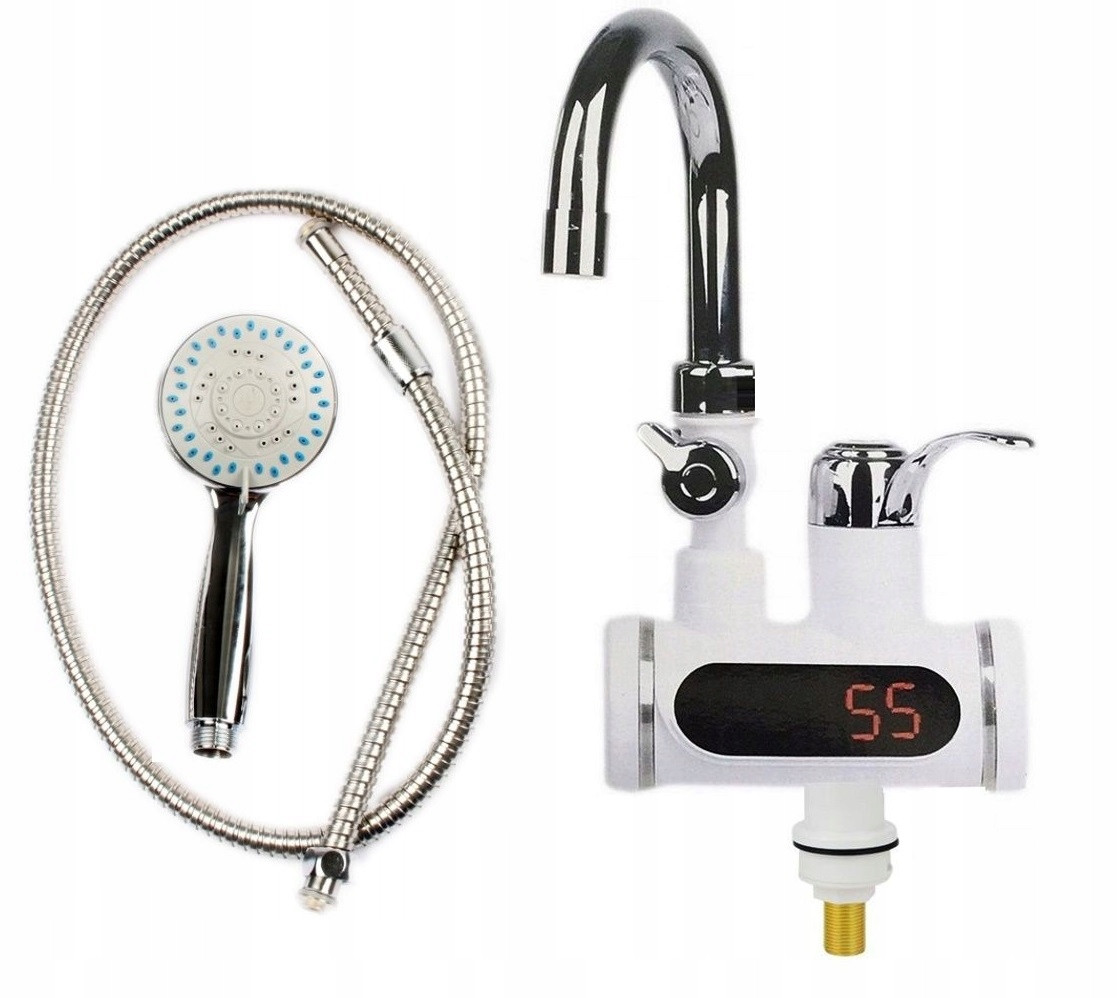
There are models equipped with a special shower head. It is possible to have both in the kit, and another, providing for the change of nozzles. This type of instantaneous water heater is designed to provide only one hot point.
The device does not require frequent and thorough maintenance. The equipment can be used for a long time. The term of use is several years.
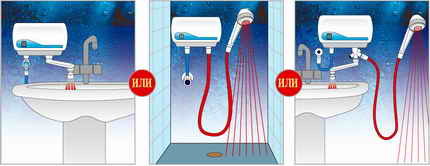 Instantaneous water heater configuration options: hot water flows only to the faucet, only to the shower head, to both devices
A hose with a shower head included in the kit is connected to the outlet in the body of the instantaneous water heater.
It is not recommended to replace this shower head with another similar device, as this will negatively affect the quality of water procedures.
The fact is that a conventional shower head has more holes, as well as a completely different order of their placement. There are very few holes in the shower head supplied with the water heater, and they are all located in the center of the part in a circle.
This arrangement of holes on the complete nozzle contributes to the creation of a water flow, the strength of which is sufficient for taking a shower.
Pressure flow water heaters
Pressure-type household appliances are distinguished by greater power, as well as the connection method. This equipment must be built into the water supply system.
They are designed to serve several points of water intake at once. Hot water will be not only in the bathroom, but also in the kitchen.
A person will not notice the absence of a central hot water supply at all until he looks at the receipt for paying for electricity.
Powerful water heaters can only be connected to a three-phase network, which is available in apartments with electric stoves.
Varieties of control systems
The water heater can be controlled using the following systems:
- hydraulic;
- electronic.
Hydraulic water heater control system
The principle of operation of the hydraulic system is simple. The hydraulic block with a diaphragm and a rod, located inside the device, acts on the switch lever. The switch itself can be in the following positions: turning on the first stage of power, turning off and turning on the second stage of power.
If the valve is opened, the membrane is displaced, as a result of which the stem pushes the switch. With a small pressure, the first stage is turned on, with an increase in flow, the second. Stopping the water supply moves the lever to the off position. There are also models up to 6 kW, in which there is only one power stage.
The control system is not very reliable, because with a low pressure it may not work at all. And what pressure is weak for a particular model can only be found out empirically. Models with such control do not have protection against air ingress, their power changes in jerks and they cannot maintain the desired temperature regime on their own. Experts do not recommend using such systems in the presence of several water intake points.
Electronic control system
Special microprocessors and sensors are responsible for the power and pressure in the heaters under the control of the electronic system. The heater is controlled automatically.The purpose of its work is to ensure that the water leaving the device has an optimal temperature. Particularly pleasant is the fact that the system allows significant energy savings.
There are two types of electronic control systems:
- models that are configured using keys and indicators so that they allow you to set the desired temperature of the consumed water;
- models that can not only maintain a given temperature, but also regulate the water flow itself.
By choosing the right control system, you can organize such a water supply in the house that will provide its owner with true comfort.
Electronically controlled devices can be installed in any type of housing. They cope with several points of water intake. The downside is the price of a device with such a device - of course, it costs more. And if it breaks, which happens very rarely, then the entire expensive unit will have to be changed. However, it still turns out that those who preferred a device with an electronic control system win.




Do-it-yourself boiler installation
You need to install a water heater with your own hands in accordance with existing rules and requirements, depending on its type. So, the features of installing a flow device will be somewhat different from installing a storage device. Let's consider both one and the second case.
How to install a tankless water heater
One of the key features of instantaneous water heaters is their compactness, which allows you to put them in the kitchen or bathroom right under the sink. The liquid in such devices is heated in a special metal pipe, which contains powerful heating elements.
Such design features of the device require that the electrical wiring in the house or apartment work properly and be able to withstand heavy loads. It is advisable to install a separate machine for a flow-type heater, and connect a wire with a large cross section to it.
After you finish working with the electrical connection, you can install the boiler itself. It is installed according to a temporary or stationary scheme.
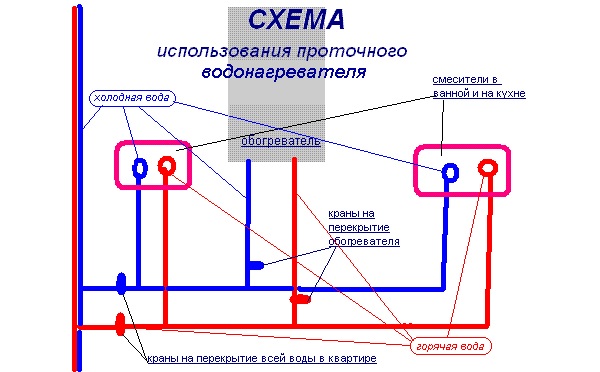
The temporary scheme provides that an additional tee is cut into the pipe with cold water, which will be connected to the water heater through a special valve. To do this, you need to apply voltage to the water heater and open the tap that supplies hot water.
But the stationary scheme assumes that the supply and intake of water in the pipes will be carried out in parallel with the general water supply system. To install the structure according to the stationary scheme, tees for hot and cold water cut into the pipes. Then you need to put stopcocks and seal them with a simple tow or fum tape.
The next steps are:
- connect the boiler inlet pipe to the pipe that supplies cold water;
- connect the outlet to the hot water tap ;
- supply water to the pipes and make sure that all connections are tight when turning on the water in the tap and shower;
- during normal operation of the system, you can supply electricity to the water heater, then hot water should flow from the desired tap;
- to increase the safety level of the entire plumbing system and the water heater, immediately install a safety valve with it.
You can see clearly the installation process of the flow apparatus in the video.
Rules for installing a storage boiler
If you plan to install a storage device with your own hands, then the requirements for the state of the wiring will not be as strict as in the previous case. And storage heaters are somewhat cheaper than flow heaters. In addition, their popularity is explained by the fact that very often they are covered by a scheme in which you can simultaneously supply water to the tap and shower.
You can install such a unit with tools and materials quickly, while the work itself will not seem too complicated, it consists of the following actions:
- eliminate faults in the electrical wiring or plumbing system, if any, check their condition;
- make markings on the wall for the structure and put the necessary fasteners for its installation;
- fix the water heater on the wall and attach the safety valve;
- after installing the boiler on the wall, connect it to the water supply;
- lead the pipes through the valve to the corresponding inlets and outlets on the body;
- first install and connect cold water, and the safety valve must be closed at this time;
- also, with the valve closed, install pipes for hot water;
- connect the structure to the electrical network and check how it works.
If all the steps have been performed correctly, then hot water should flow from the corresponding tap. At this time, all pipes and connections of the boiler must be well sealed, and the wires must not overheat.
Of course, if you are not confident in your abilities and even visual training material in video format cannot help you learn the features of a step-by-step installation of a boiler with your own hands, then do not risk it, but invite a specialist.Incorrect installation of the heater can cause it to fail prematurely and cause leaks and other problems. Therefore, take on an independent installation only when you are confident in your abilities and know that everything will be done efficiently and correctly.
Construction of electric cranes
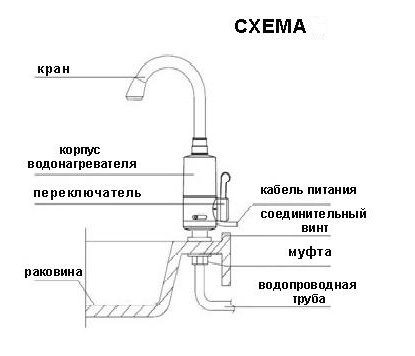
A classic faucet with a water heater powered by electricity has the same design for most models. Such devices are connected to a cold water supply channel and contain a heating element - a heating element. The latter automatically turns on after the valve is opened and within a few seconds heats up the liquid that then enters the spout. The safety of operation of taps with instantaneous water heaters is guaranteed by the reliable protection of the product, which consists of the following mandatory components:
- the case in which all other functional parts are placed;
- spout, which differs in its shape and size for various models;
- control lever and ceramic cartridge.
The body of the device is made of stainless steel or high-strength plastic. Bypass valve, thermocouple and silicone damper are used as additional modules and parts.
Varieties
Today, a very large selection of electric water heaters of various types and types with a different price range is presented on the domestic market of Russia, while the build quality and individual parts can vary greatly. The electric instantaneous water heater has long enjoyed well-deserved popularity among users from different regions of the Russian Federation due to its simple operation. They are divided into two main types:
- pressure or closed type;
- non-pressure - open type.
The first option is able to supply several points with hot water at once: a washbasin, a shower cabin, a kitchen, but for this it is necessary to ensure a fairly high pressure in the home water supply line.
The second option functions normally at any pressure in the line with a direct connection to the water intake point.
How much electricity does the nozzle use
For normal operation of a mixer with heating, a certain amount of electrical energy is required. When calculating the exact value, the condition of the electrical wiring in the apartment is taken into account, which, under certain conditions, is not able to cope with the increased loads. Most models have a power not exceeding 3 kilowatts, which allows you to get heated water with a temperature of up to 18 degrees.


When choosing a suitable model of an electric heater for a faucet, the following points deserve attention:
- how often the device will be used for its intended purpose;
- how many people live in the house permanently.
If the number of residents exceeds 3 people, you will need to purchase a more powerful device.
To save energy, the simplest trick is possible, which consists in refusing to use the nozzle in the bathroom, where its consumption for heating water is too high.
What the market has to offer
The choice of electric instantaneous water heaters is at least large ... You can easily get confused
What should you pay attention to besides power and performance? On the material from which the tank and the heating element are made. The tank can be copper, stainless and plastic.This information is not provided by all manufacturers, but if it is not available, most likely the filling is made of plastic
It is, of course, heat resistant, but not as reliable as metals.
This information is not provided by all manufacturers, but if it is not available, most likely the filling is made of plastic. It is, of course, heat-resistant, but not as reliable as metals.
Also pay attention to the minimum and maximum cold water pressure at which the unit can operate. There are capricious models, for the connection of which it is required to install a reducer on our networks
| Name | Power | Dimensions | Performance | Amount of points | Control type | Operating pressure | Price |
|---|---|---|---|---|---|---|---|
| Thermex System 800 | 8 kW | 270*95*170mm | 6 l/min | 1-3 | hydraulic | 0.5-6 bar | 73$ |
| Electrolux Smartfix 2.0 TS (6.5 kW) | 6.5 kW | 270*135*100mm | 3.7 l/min | 1 | hydraulic | 0.7-6 bar | 45$ |
| AEG RMC 75 | 7.5 kW | 200*106*360mm | 1-3 | electronic | 0.5-10 bar | 230$ | |
| Stiebel Eltron DHM3 | 3 kW | 190*82*143mm | 3.7 l/min | 1-3 | hydraulic | 6 bar | 290$ |
| Evan B1 - 9.45 | 9.45 kW | 260*190*705mm | 3.83 l/min | 1 | mechanical | 0.49-5.88 bar | 240$ |
| Electrolux NPX 8 Flow Active | 8.8 kW | 226*88*370mm | 4.2 l/min | 1-3 | electronic | 0.7-6 bar | 220$ |
Separately, it is worth talking about taps with electric water heating. They are also called faucet-water heater. They appeared not so long ago, but are quickly gaining popularity, as they are easy to use, just connect.
| Name | Control type | Heating range | Operating pressure | Connection size | Power / voltage | Housing material | Price |
|---|---|---|---|---|---|---|---|
| ATLANTA ATH-983 | auto | 30-85°C | from 0.05 to 0.5 MPa | 1/2″ | 3 kW / 220 V | ceramics | 40-45$ |
| Aquatherm KA-002 | mechanical | up to +60°C | from 0.04 to 0.7 MPa | 1/2″ | 3 kW / 220 V | composite plastic | 80$ |
| Aquatherm KA-26 | mechanical | up to +60°C | from 0.04 to 0.7 MPa | 1/2″ | 3 kW / 220 V | composite plastic | 95-100$ |
| Delimano | auto | up to +60°C | 0.04 - 0.6 MPa | 1/2″ | 3 kW/220-240 V | plastic, metal | 45$ |
| L.I.Z. (Delimano) | hydraulic | up to +60°C | 0.04-0.6 MPa | 1/2″ | 3 kW/220-240 V | heat resistant ABS plastic | 50$ |
The subtleties of choosing a flowing electric water heater
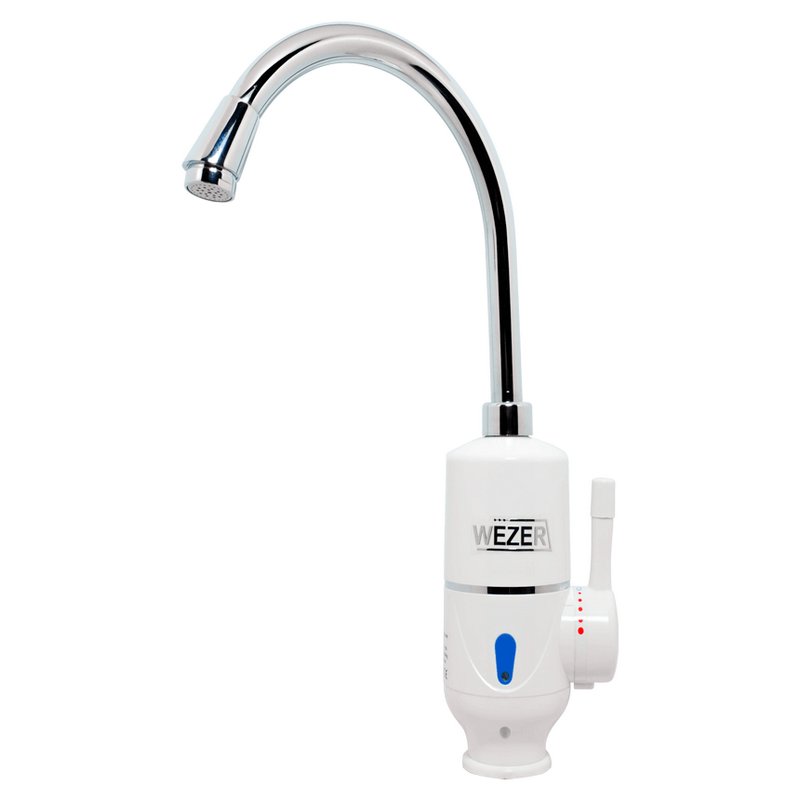
The flow boiler heats the water immediately after it is turned on. It features excellent performance. Such a device heats water in unlimited volumes to a temperature of about + 60 °. The essence of his work is simple. Cold water is supplied to the boiler, where there is a heating element (usually made of copper), which has a high power - from 3–4 to 20–24 kW. At the exit we get hot water.
Everything is simple. But if you decide to install a flow boiler at home, you should immediately replace the electric meter and wiring. The load on them will be high, old equipment may simply not withstand such power. It is also worth taking care of connecting a good circuit breaker.
Instantaneous electric water heater
The flow heater is mounted, as a rule, for one draw-off point. It is installed on the kitchen faucet, where you wash the dishes, or in the bathroom for a shower. If there is a desire to connect many points of water analysis to one device, it is necessary to purchase a unit with a maximum power (16–24 kW). A less powerful device will not be able to heat water for several taps to a comfortable temperature.
For a house or apartment with single-phase sockets (for 220 V), it is better to purchase a modest heating unit. Take a boiler with a power of no more than 8 kW. If the dwelling is equipped with sockets for 380-volt voltage (houses with electric stoves), heaters of higher power can be installed.



As you can see, choosing the right instantaneous water heater is not difficult at all.
It is only important to take into account the technical potential of the electrical wiring in the apartment and determine the volume of hot water that you plan to consume.
And one moment. Electric boilers differ in installation technology. They are:
- Non-pressure. Such units are mounted next to the tapping point.
- Pressure. These devices are installed directly in the water pipe.
In apartments, it is better to mount pressure units, and non-pressure units are more suitable for a private house.
Summarizing
As a conclusion, we can note such advantages of storage heaters as smooth heating and a small load on the electrical network. And also - the possibility of providing water to the entire apartment at once and instant hot water. The disadvantages of technology - if the tank is empty, it will take a long time to wait for heating, up to 2-3 hours. The boiler takes up more space and needs periodic maintenance to clean the walls from scale and dirt.
Flow heaters are easier to install and take up less space. They heat water faster, and bacteria do not develop inside due to fluid stagnation. The cost of running flow models is more profitable. Among the disadvantages of such models are lower water temperature, the need for good wiring, and even sometimes in a three-phase network. It is worth noting that most inexpensive flow heaters are non-pressure and serve 1-2 water intake points. To service the apartment, you will need a pressurized instantaneous water heater installed on the riser.
In addition to these pros and cons, when choosing, it is worth considering the frequency of using hot water and the availability of hot water supply.So, in a city apartment, where there is usually hot water supply, for temporary water heating it is enough to install a flow heater at 2-5.5 l / min. This is enough even for taking a shower, and for work you will need a 220V power supply. Also, an instantaneous water heater will be a good choice for seasonal housing - for example, summer cottages.
For a private house where there is no hot water supply, it is worth choosing a flow-through option with a high capacity (from 12 l / min for 2 taps, 14-16 l / min for 3-4 water points) or a storage water heater. The volume of the boiler depends on the number of residents and can range from 50 to 150 liters for 1-2 people and 300-400 liters for 5-6 people, respectively.