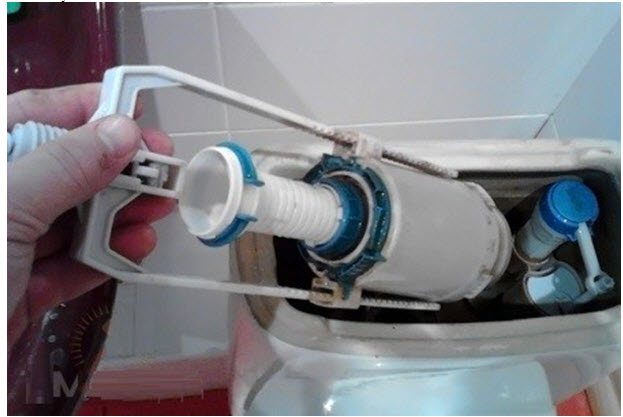
- Types of leaks and how to fix them
- toilet cistern leak
- Flush pipe connection leak
- Toilet cistern repair: causes of internal leaks and how to fix them
- Main reasons
- Why is the toilet cistern leaking?
- Water leaking in the toilet after filling the tank
- Incorrect adjustment of the float mechanism of the drain tank
- Float chamber failure
- Malfunction of the water supply valve membrane
- Escapement malfunction
- Poor water quality
- Tighten loose bolts
- New toilet
- Video
Types of leaks and how to fix them
At first glance, it may seem that finding where it follows is easy and simple, but this is not always the case, as you will now see.
toilet cistern leak
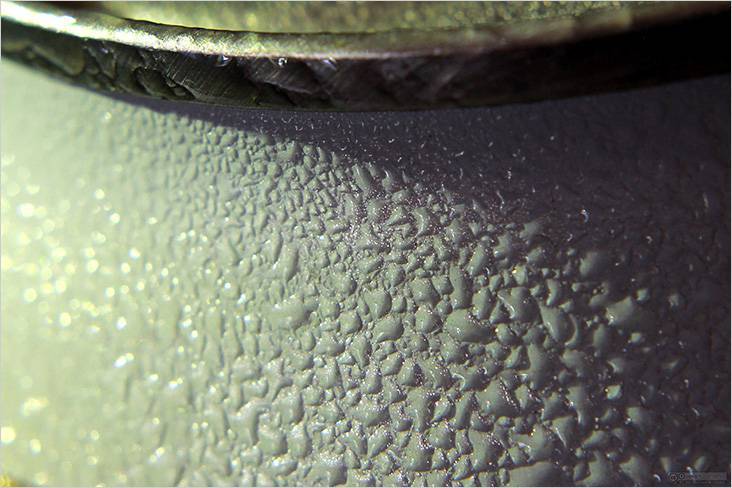 Condensation on the tank
The tank is different from the tank, so there can be no standard approach, but there is a common problem - an imaginary leak, when there is water on the floor, but the tank does not leak. It should be noted right away that this is possible only in cold weather. How does a puddle appear on the floor if nothing is leaking? The answer is simple. But many people, out of ignorance, going through all the connections several times, spending a lot of time and sealant on it, could not figure out the reason. The fact is that in winter the water is very cold, and when it enters the tank, condensate collects on it, which drains to the floor, forming a puddle.If the problem is not dealt with, then a fungus may soon start up or you will have to make repairs from the neighbors below.
There are several ways to fix the problem, or at least to reduce the amount of condensate:
- Place a cloth on the floor and then wring it out periodically. Not very convenient, but effective, because while no one uses the toilet, condensate does not form. Therefore, you don’t have to worry that when you come home from work, you will again have to wipe the puddle. The fact is that the water in the tank gradually heats up, so condensation ceases to appear on it. How much this will change the design of the room is up to you.
- You can install a drain tank with a built-in plastic water tank. This design feature completely eliminates the appearance of condensate on the outside of the tank. The solution is good, but the implementation requires a significant outlay of material resources for the purchase of this expensive plumbing fixture.
- A good, but also costly way, is to install a heat exchanger, so that the water entering the tank is slightly warmed up.
- Good ventilation will help reduce condensation as the air will be drier.
- Another way to deal with condensate is to stick heat-insulating material inside the tank. You can learn more about this technology by watching the video.
Now let's talk about the real reasons for the formation of puddles on the floor.
Flush pipe connection leak
The flush pipe can leak at the exit from the tank or at the junction with the toilet.
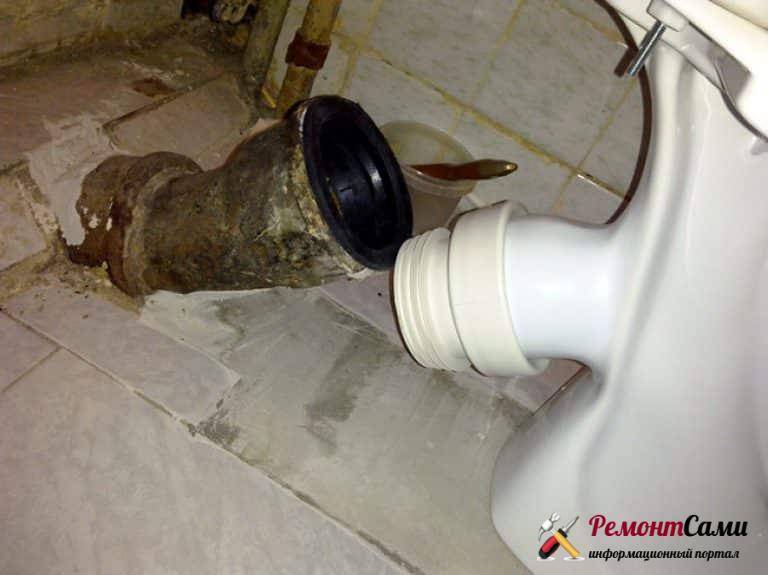
• When a leak is in place pipe exit from the tank
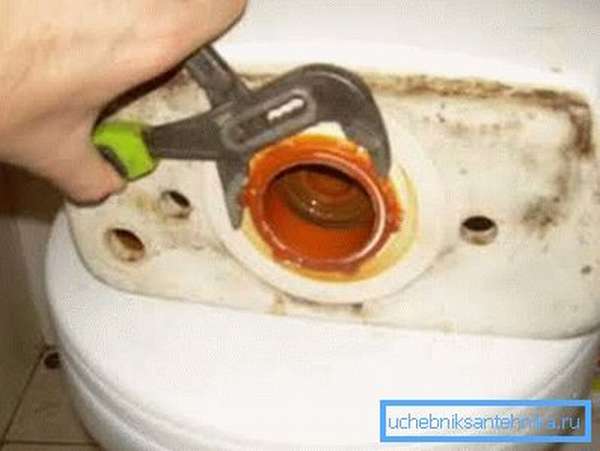
one.The first and easiest thing to do is to try to tighten the large nut (clockwise) that secures the flush pipe to the siphon threaded connection at the exit from the base of the tank. If there are two nuts, do not twist the large nut holding the siphon in the tank. If the tightening does not help, you will have to unscrew it and inspect the connection under it. Water will not flow out, as there is only water there during the flushing operation.
2. After unscrewing the nut, you can usually see a rubber ring pressed against the connection and filling the space between the flush pipe and the siphon. In most cases, it is possible to make several turns of PTFE tape around the existing ring, increasing its volume to fill the gap. Do not wrap tape around the threads of the siphon, as this will do nothing and may actually interfere with making a proper connection. This connection is created when the connecting material is pushed tightly into the gap.
• When a leak occurs at the junction of the flush pipe and the toilet
1. In this case, you will probably need a new flush pipe cuff (adapter connector). To replace it, it may be necessary to unmount the end of the flush pipe that connects to the cistern as described above to gain additional maneuver, or simply pull the pipe out of the cistern by turning it to the side if room space is limited. It is simply a sliding joint, although there are different designs.


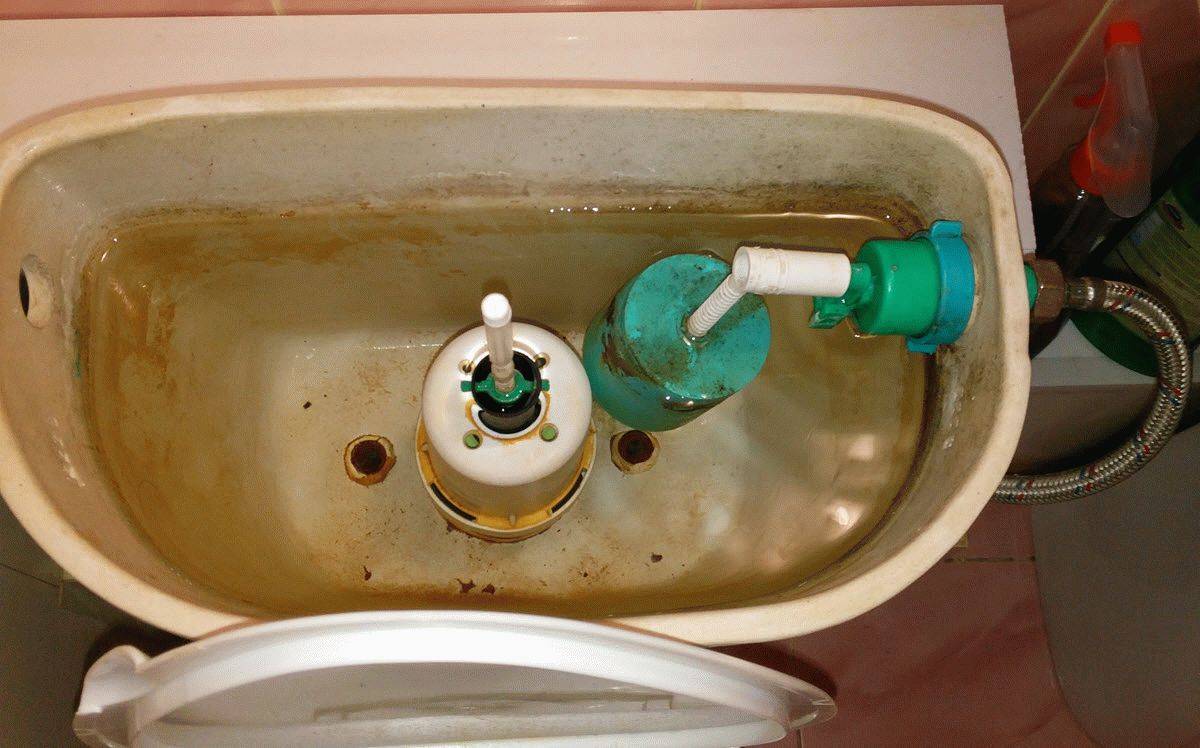


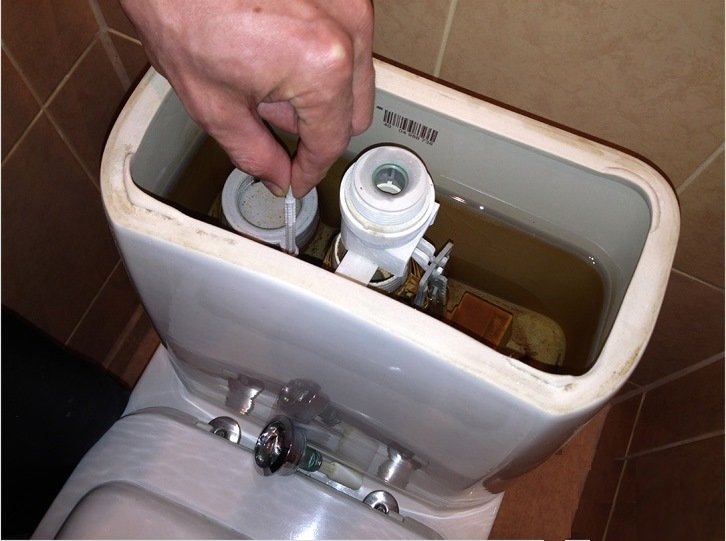
2 After removing the old connection sealing material or connector, it can be replaced with a new flush pipe collar, proceeding in reverse order.If you have difficulty getting the flush pipe back into the joint when using a conical collar, apply some lubricant in the form of liquid detergent to ease the process. The procedure for this type of connection is to first insert the cone inside the toilet inlet and then insert the flush pipe into the cone.
• When there is a leak at the cistern connection to the compact toilet
• When water oozes from the space between the tank and the toilet during flushing, this indicates that the sealing collar located on the siphon clamping nut has deteriorated. The only way out is to replace the cuff. Remove the reservoir (as described earlier) to verify the problem and resolve it.
• When a leak occurs at the junction of the toilet bowl with the sewer pipe
For more than 35 years, the connection between the toilet and the sewer has been made using flexible plastic connectors, which are part of a plastic sewer pipe or are an outlet adapter.
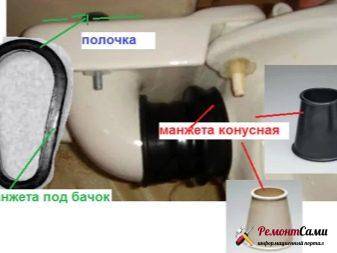
These flexible connections are very strong, but, like everything else, they can be damaged. When such a connection leaks, it is probably best to replace the sealing collar with a new one. To do this, you have to disassemble the toilet. In the case of a cistern with a flush pipe, there is no need to turn off the water and dismantle the cistern, but for a compact design, a lot will have to be disassembled in order to redo the connection.
If the structure is old, for example, the toilet is glued to the floor with cement or the outlet is organized using some kind of adhesive, it may turn out that the toilet cannot be dismantled, one can only hope that it will be possible to close the crack with some kind of sealant, such as silicone, but In truth, the days of the toilet are numbered.
Video: Toilet cistern repair:
Toilet cistern repair: causes of internal leaks and how to fix them
What is meant by the concept of internal leakage of the toilet bowl? This is when water does not flow out of it and does not fall on the floor, but flows into the toilet in a constant stream or stream. Such a malfunction does not threaten the flood, but it affects the water bills. A trickle of water, continuously draining into the toilet, for a month, as a rule, pours into cubic meters, which you will have to pay extra. How to deal with such leaks? How to eliminate them?
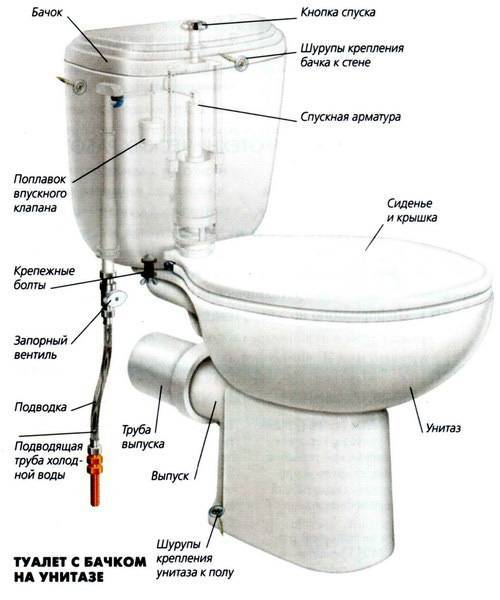
It's all about the faulty water supply valve - in the float, or rather in the blocking mechanism itself. It does not completely shut off the water - this happens in most cases, but sometimes the cause of this phenomenon may be an incorrectly adjusted overflow pipe of the toilet bowl. Also, this behavior of the shut-off valves of the drain tank can be caused by a malfunction of the drain mechanism itself. You need to start repairing and troubleshooting these problems with the simplest thing - by checking the correct adjustment of the overflow tube. Try to raise it a centimeter higher and observe the behavior of the valves - if the water rises again and overflows into the tube, then the point here is in the float valve.




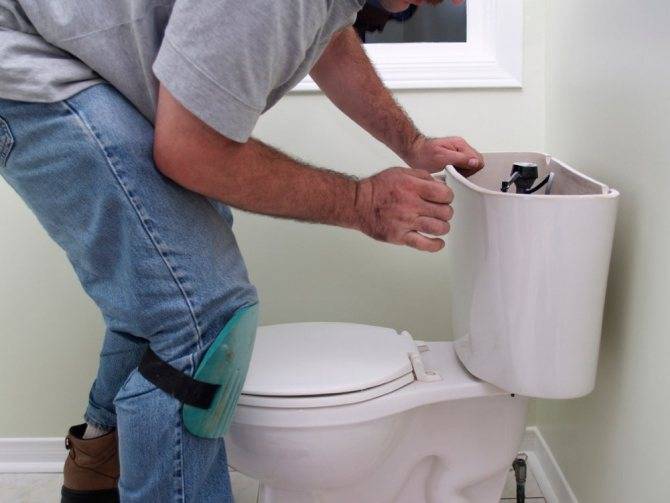
What to do if the toilet cistern is leaking
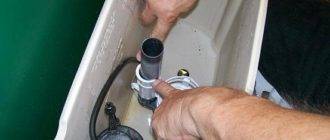
You need to find a plastic nut, which is located at the base of the float attachment to the toilet bowl, and unscrew it - this is where the rubber band is located, which is responsible for blocking the water. Take it out and rinse it well under running water. We do the same with that part of the float where she stood - we remove all the garbage from there. After that, put the gum in place and twist everything, as it was.Should help - if not, you will have to purchase a new gum and install it in place of the old one.
Toilet cistern repair with photo button
And the third reason why the tank can constantly pass water into the toilet is the incontinence of the drain mechanism. Simply put, the drain valve does not completely close. The reason may be hidden both in the debris that has fallen under the valve, and in the valve itself, which over time, like all rubber, dries up and ceases to fit snugly against the drain hole. In the first case, the edges of the drain hole will have to be thoroughly cleaned, and in the second case, the valve rubber should be replaced.
In conclusion, I want to remind you that after repairing the shutoff valves of the toilet bowl, it will not be superfluous to perform a high-quality adjustment of the float and overflow - only by adjusting their coordinated work, you can sleep peacefully and no longer wonder why the toilet bowl is flowing?
Main reasons
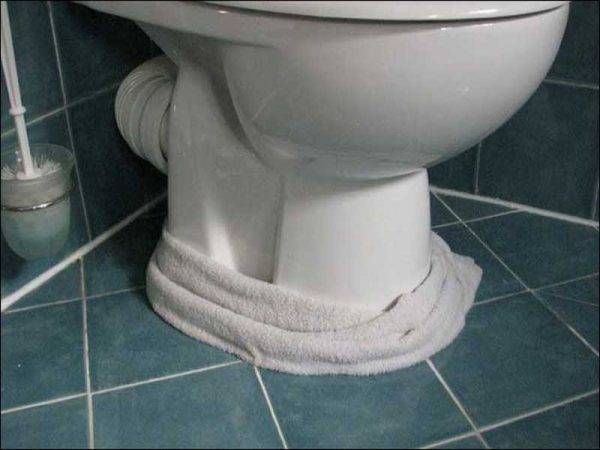 If the leak is not eliminated for a long time, a dark smudge will form at the junction
To quickly eliminate the leak, you should identify the real cause of its occurrence. There may be several of them:
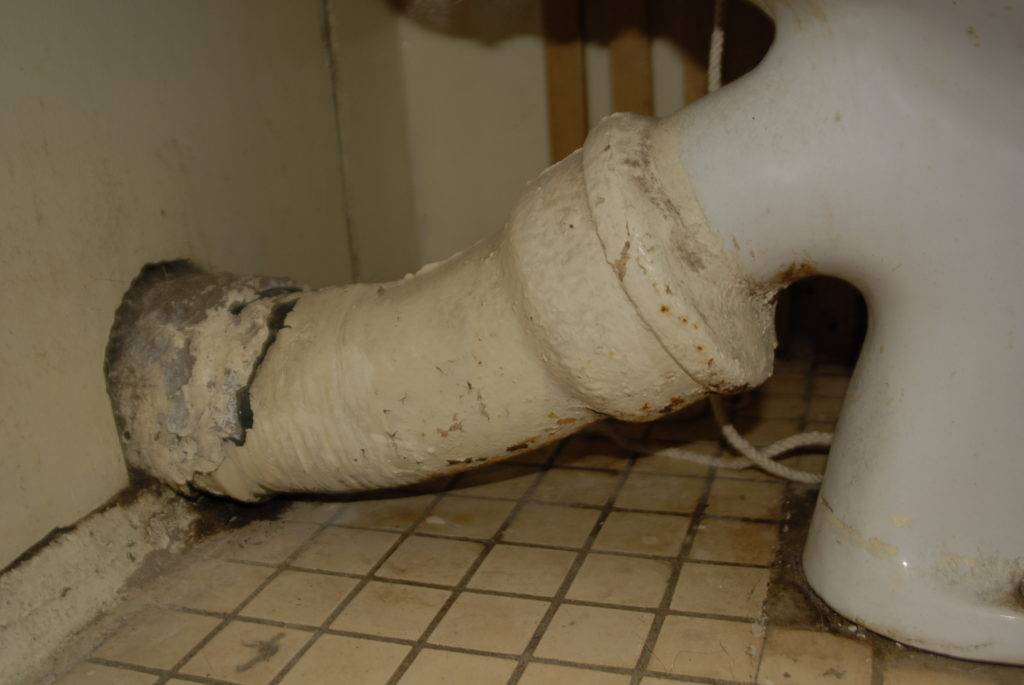
The tightness of the joint where the toilet bowl is connected to the sewer pipe is broken - the putty in the cast-iron socket has exfoliated. Often this happens when plumbing is installed on cement mortar.
Worn cuff or corrugation. The tightness of the connection is ensured by rubber membrane gaskets. Rubber is a material that eventually loses its elasticity and shrinks. Therefore, gaps occur between the outlet of the toilet bowl and the sealing joint.
A crack formed in the toilet bowl.
Toilet base cracked
The cause of the crack is inadvertently poured hot water, faience does not withstand a sharp temperature difference, it can crack.
The anchors are loosely screwed to the floor.
Why is the toilet cistern leaking?
Consider the problems that cause the tank to leak when it passes water into the toilet.
The usual overflow of the tank, occurs most often. Here, the excess volume of liquid simply merges into the overflow opening. A malfunction may occur in the following cases:

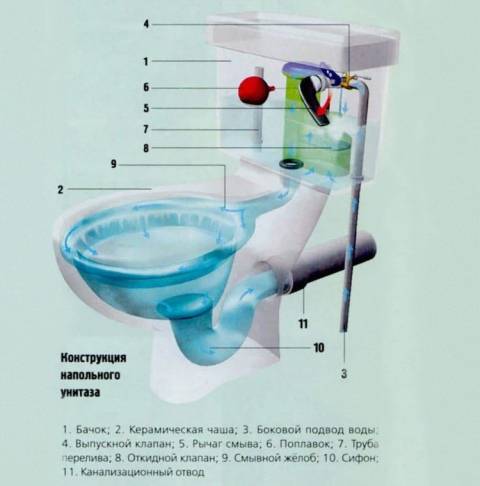
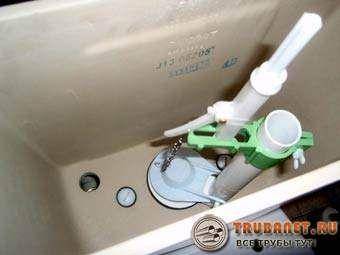

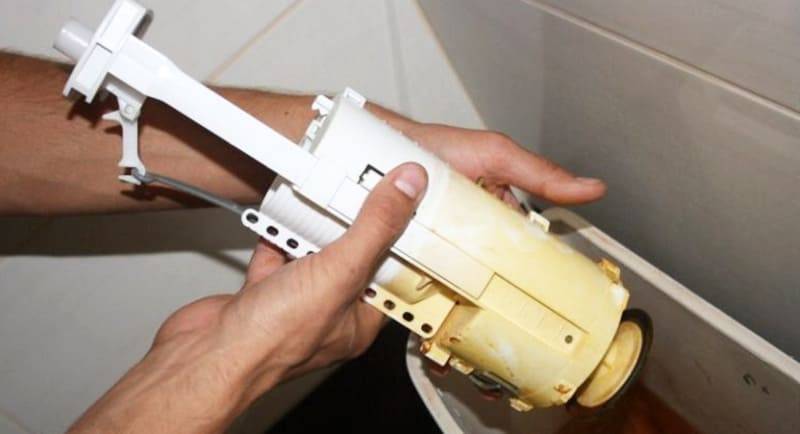
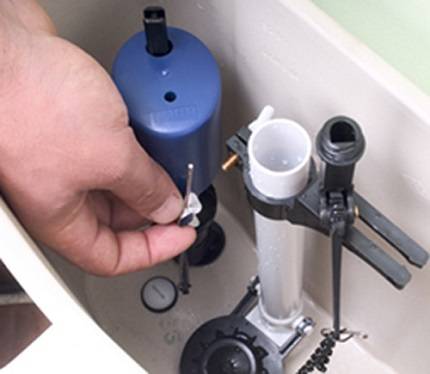

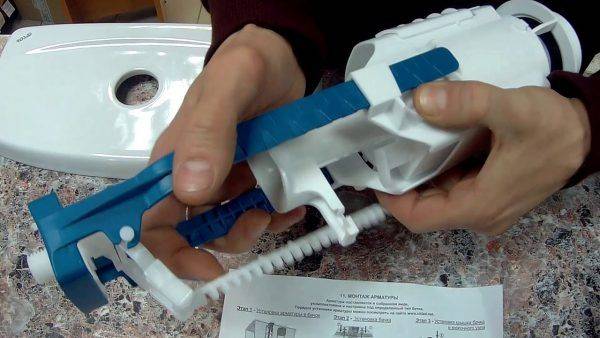

- the float is in the wrong position;
- the valve pin holding the displacer failed after a long service life due to corrosion;
- the valve body is cracked - water seeps through this damage;
- the gasket has lost its elasticity and deformed during operation;
- the seal is of high quality, retained its properties, but there is a small gap between it and the outlet due to loose contact.
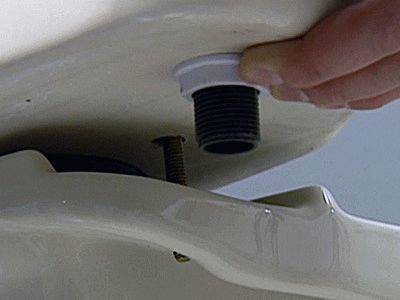
The second source of trouble is the bolts that secure the tank to the toilet. Metal clips rust over time, plastic counterparts can burst. A loose contact could be an option.
The third case is associated with a pear that has lost its elasticity. As a result, it has an irregular shape after a long service life.
The fourth situation is a skew or a noticeable displacement of the lever associated with the displacer. The part could move after long-term operation, or the reason lies in the low quality of the float: sometimes a gap forms in it through which water oozes.
The fifth type of problem occurs between the toilet and the tank. It indicates a loss of tightness of the cuff.
The sixth fault lies in the shut-off valve.
The seventh defect is formed due to cracks on the sides or at the bottom of the container.
Water leaking in the toilet after filling the tank
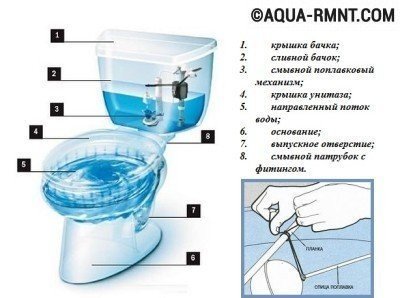
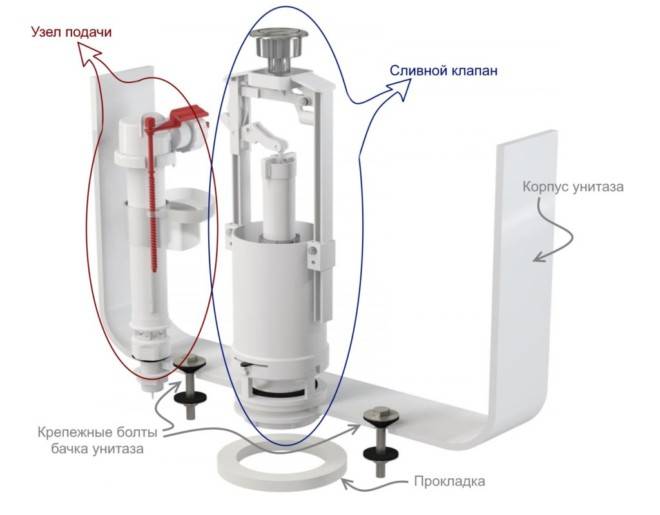
The device of drain tanks for the toilet bowl is based on the principle of filling the vessel with tap water until the water supply valve is activated, which blocks its flow into the tank.
One of the safety devices in this system is the overflow mechanism: when the tank is filled, if the shut-off valve does not work and water continues to flow into the cavity, the excess volume of water goes by gravity into the toilet bowl. The situation when for some reason the inlet valve does not close is not the most critical, if you do not take into account that even with the toilet bowl not working, water consumption increases to an average of 100 liters per day.
The reasons for overflowing water can be:
Incorrect adjustment of the float mechanism of the drain tank
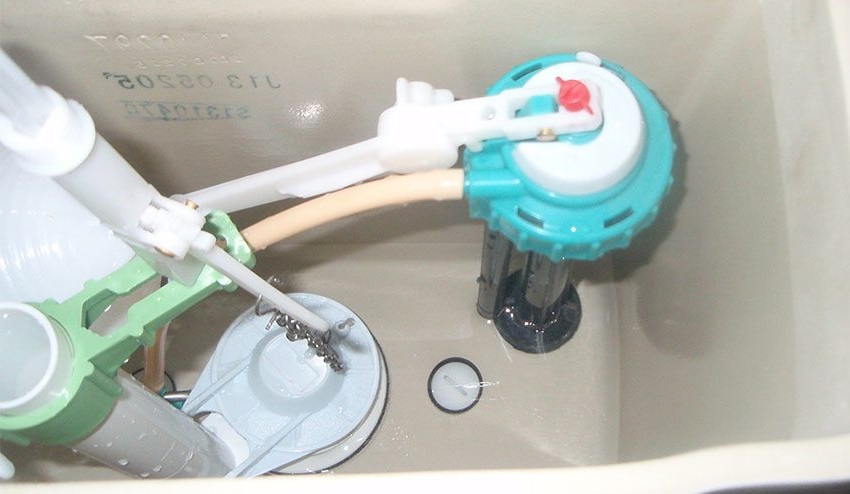
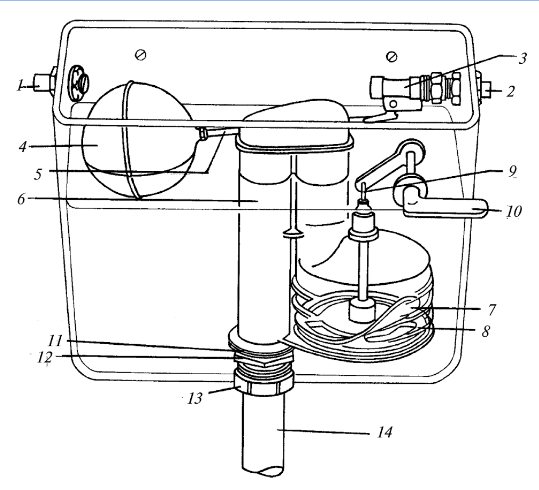
Overflow due to incorrect adjustment of the float mechanism is the most common problem in drain tanks. The float chamber, pushed out by the volume of water through a metal rod or a plastic guide, presses on the valve and thus shuts off the flow of liquid into the tank. If the metal guide is bent or the adjustment screw on the plastic guide is unclenched, then the float chamber is displaced and the supply valve simply does not shut off the flow.
The solution to the problem is simple: remove the tank cap and adjust the position of the float relative to the upper water level. For most toilets, the float is adjusted so that the water level does not reach the overflow neck by 1-1.5 cm.
Float chamber failure
If the float is damaged, the supply valve simply does not close. The float filled with water does not float and thus the supply valve is simply constantly in the open position.


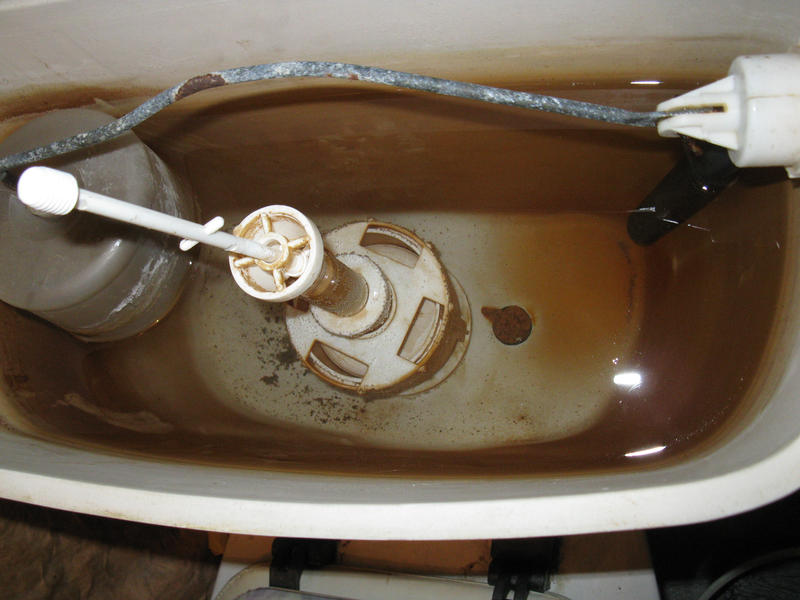


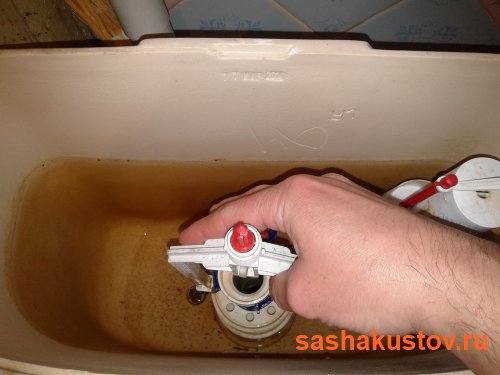


The easiest repair method is to replace the float or drain the water from it and seal the gust.
Malfunction of the water supply valve membrane
For membrane water supply valves, the supply is closed by pressing the plastic stem on the rubber membrane, while the supply hole on the reverse side is tightly covered with rubber. Over time, at the site of the inlet, a working is formed on the rubber, through which water first simply begins to seep, and after a while it simply flows freely into the tank. The repair method is membrane replacement.
Escapement malfunction
This problem begins to manifest itself gradually, when the tank itself, after a certain time, begins to draw water on its own. In this case, it is necessary to disassemble the trigger mechanism, clean it from plaque and change the rubber seals.
Poor water quality
The reason for overfilling the tank is often associated with poor-quality tap water - a large amount of iron oxide, lime or mechanical inclusions form plaque on the walls and mechanisms, which eventually acts on rubber seals as an abrasive, literally eating away the surface. In this case, it is necessary to install a filter system and replace rubber gaskets, membranes and seals.
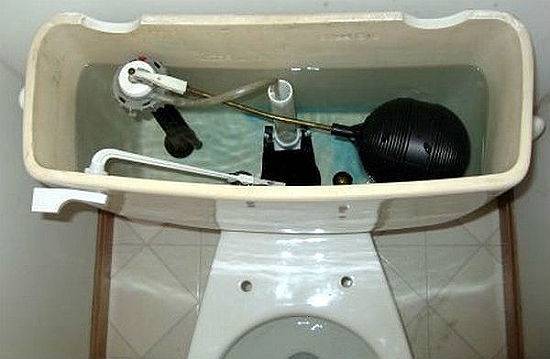
Tighten loose bolts
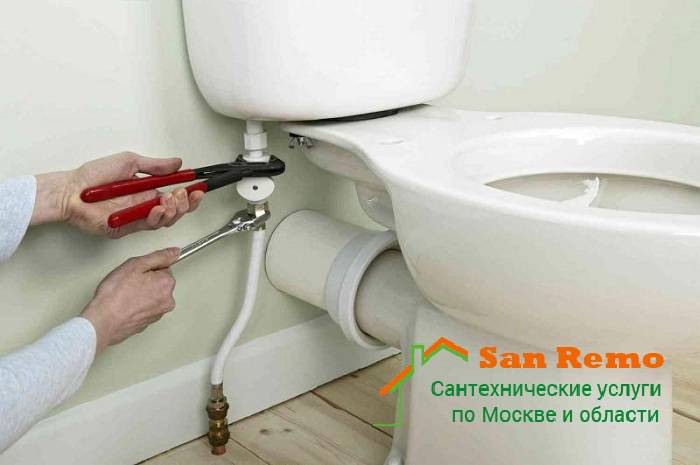
Another reason why the toilet is leaking at the junction is the loosening of the cistern mounting bolts. They are usually metal or plastic.If the former can rust and break, then the latter simply burst over time due to static load or if someone rests on the tank.
The problem is solved by replacing the bolts with new ones, and for this you need to act like this:
- turn off the water supply to the tank and empty it;
- unscrew the flexible supply hose;
- dismantle the bolts (if they are rusted, this will not be easy, but be careful not to damage the fragile tank);
- insert new bolts with gaskets into the holes and tighten (just do not overdo it).
If it's still leaking at the joint, tighten the bolts a little more to seal the toilet. The main thing is not to pinch, so that nothing bursts or cracks.
New toilet
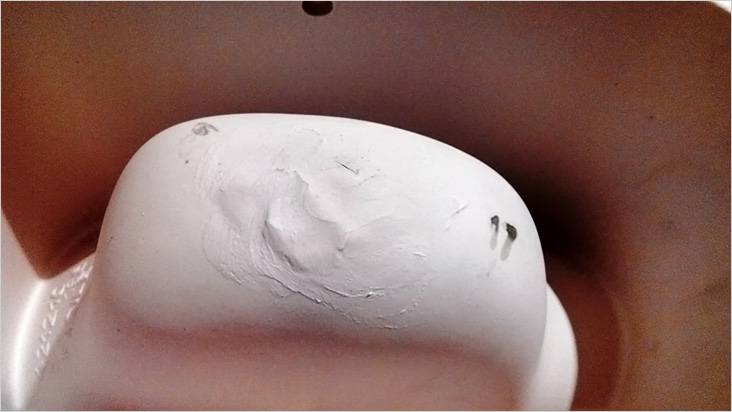 Toilet bowl with marriage
In addition to the above possible leaks, after installing a new toilet, you may encounter a problem - the plumbing fixture itself is leaking. Here is an episode that one master told us.
The hostess asked him to buy a toilet bowl with her, which was done. The next day after installation, the woman called the master, saying that there was water on the floor. The master arrived and saw that she was flowing from under the toilet. Having removed the product, the man could not understand for a long time what the reason was, but then, using a mobile phone, he filmed the inside of the product - there was a place that was not filled with enamel.





They made a replacement, but the next day the hostess called again and said that when flushing, a puddle was again gathering around. Without long descriptions of the search for the cause, let's say that this time the leak was on the outside of the rim - the seam was not filled with enamel there either.
This toilet was also replaced, but a product from another manufacturer was taken instead, and no more problems were observed.
Video
As you can see, when looking for a source of water leakage, a possible marriage cannot be ruled out.