- Installation of plumbing in the country
- Preparatory work for laying the pipeline
- Installation rules
- Most Common Mistakes in Underground Pipe Laying
- Types of garden aqueduct
- Summer option
- Scheme
- capital system
- Warming
- How to choose?
- Peculiarities
- What determines the depth of laying sewer pipes
- Providing hot water
- Features of HDPE pipes
- Advantages and disadvantages
- Trenchless pipe laying methods
- Hydraulic test of the water system
- Creation and walkthrough
- Plumbing schemes
- Scheme #1. Serial (tee) connection
- Scheme #2. Parallel (collector) connection
Installation of plumbing in the country
It is most expedient to use polyethylene pipes for low-pressure irrigation with a diameter of 20.0 - 40.0 mm with a wall thickness of up to 2.0 mm. For branch branches, products with a diameter of 25.0 mm will suffice. Such pipes fully cope with their task and will not require replacement for a long time. They are also able to withstand mechanical stress, even such as hitting garden equipment.
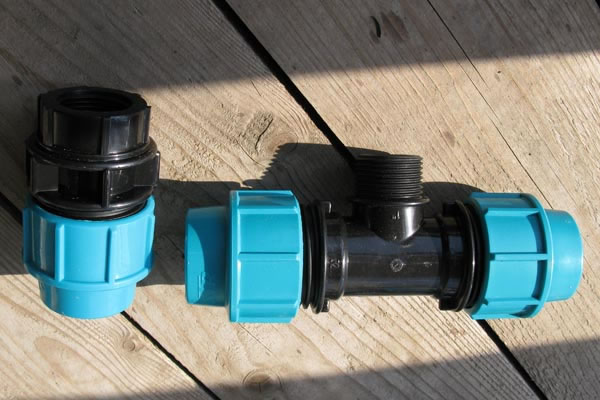
Compression fittings for connecting PE pipes
Laying your own garden water supply from polyethylene pipes is quite simple. From the tool it is necessary to prepare only an adjustable wrench.The connection of pipe products will be carried out using compression fittings, they are the most practical and effective for country conditions.
The laying of the pipeline is carried out in several stages:
- First, as with the installation of any other water supply system, a detailed laying diagram is drawn up, including the future irrigation system. It allows you to more accurately navigate the number of pipe products and compression fittings.
- Two methods are used for laying the pipeline:
- open on the ground. With this method, the installation and dismantling of PE pipes is greatly facilitated, but at the same time, the likelihood of product damage increases;
-
at shallow depths in the ground. In this case, the HDPE pipe for giving is more protected, and it will not be difficult to dismantle it.
Laying PE pipes on the ground
- The second method is preferable. The main HDPE pipe in the country is laid in the ground. In this case, you can not be afraid for its accidental damage.
- Branches can be laid on the ground, and even better mounted on special holders for more convenient connection to sprinklers.
When laying the pipeline, it is necessary to ensure a slight slope of the system in order to drain water from the pipes at the end of the season. To do this, it is enough to mount a conventional valve at the lowest point of the line.
- It is recommended to install valves at branch points. Then you can precisely control the water supply exactly to the right places of the summer cottage.
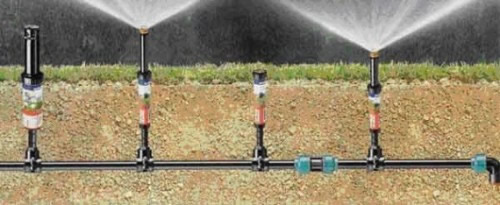
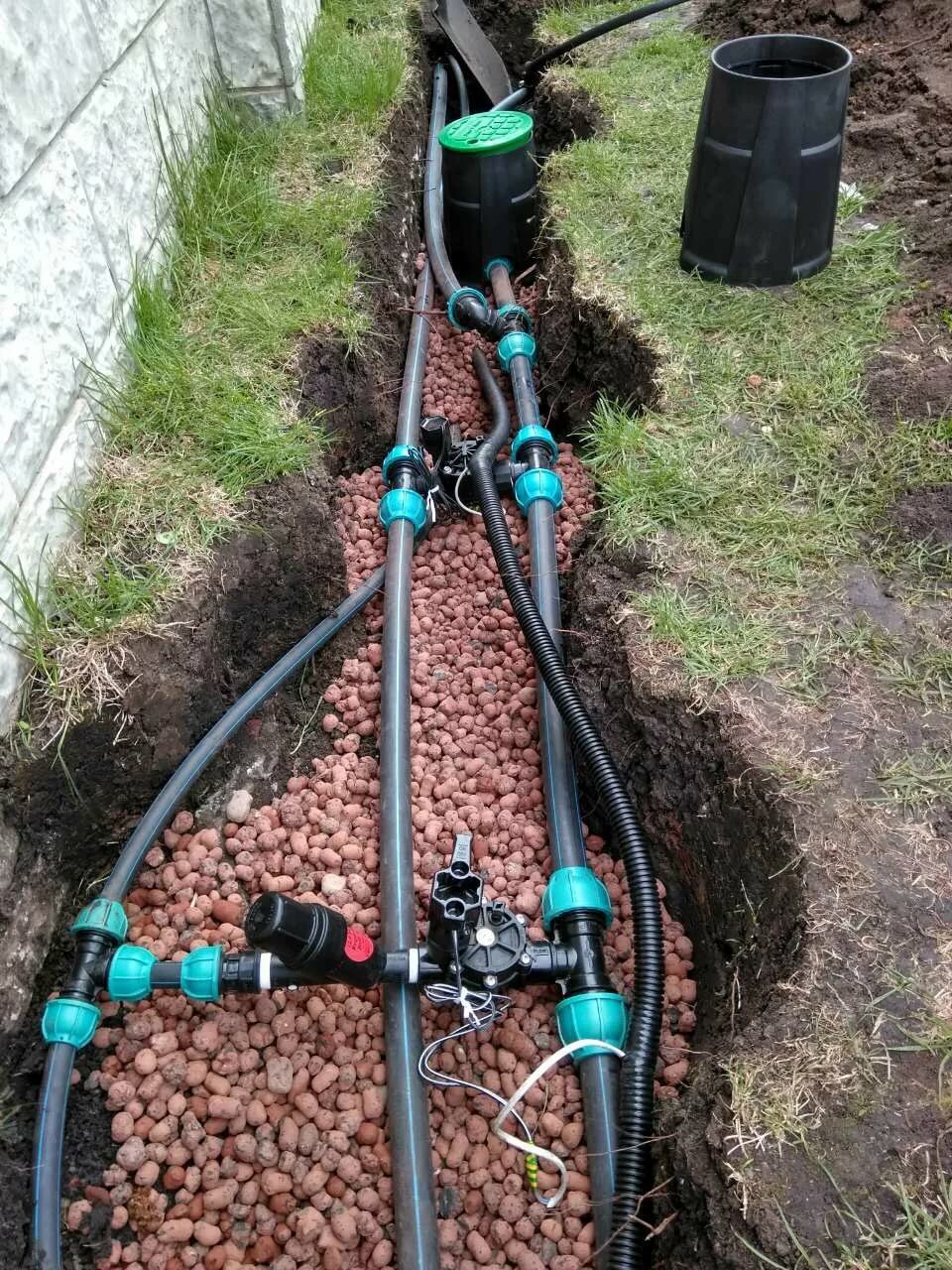
Buried piping
- Buried piping.
- The necessary pipe sections must be securely connected using compression fittings.
- For connection, the ends of the products must be cleaned of dirt and it is desirable to remove the end chamfer.Loosen the union nut of the fitting a couple of turns.
- On the pipe itself, mark the depth to which the coupling should enter the pipe.
- Applying a certain force, the fitting is inserted into the pipe and the union nut is tightened.
When tightening the fittings, the recommended tightening torque of the nut must be obtained. Otherwise, if the connection is not tightened sufficiently, the tightness of the connection is not guaranteed. If you apply more force, then there is a chance of damaging the pipe.
It can be concluded that self-mounted country water supply from HDPE pipes is an effective way to provide water supply to a country house for domestic needs, as well as organize a practical and reliable watering system for a summer cottage, while you can significantly save money and time.
Preparatory work for laying the pipeline
The popularity of HDPE pipes is due to:
- suitability for cold water supply;
- low cost;
- ease of installation;
- a wide range of products;
- long service life (up to 50 years).
Work on laying external networks must be carried out in accordance with the provisions of SNiP 2.04.02-84 and SNiP 3.05.04-85 *. These codes and regulations stipulate 2 installation methods:
- elevated - implies the use of supports and overpasses, as well as pipe insulation;
- underground - the use of trenches.
For laying sewer and plumbing systems in a private house, the second option is more reasonable. In small areas, trenching is done manually, and when servicing large areas, it is better to use special equipment.
Digging trenches and preparing them for the subsequent laying of pipes is carried out in the following order:
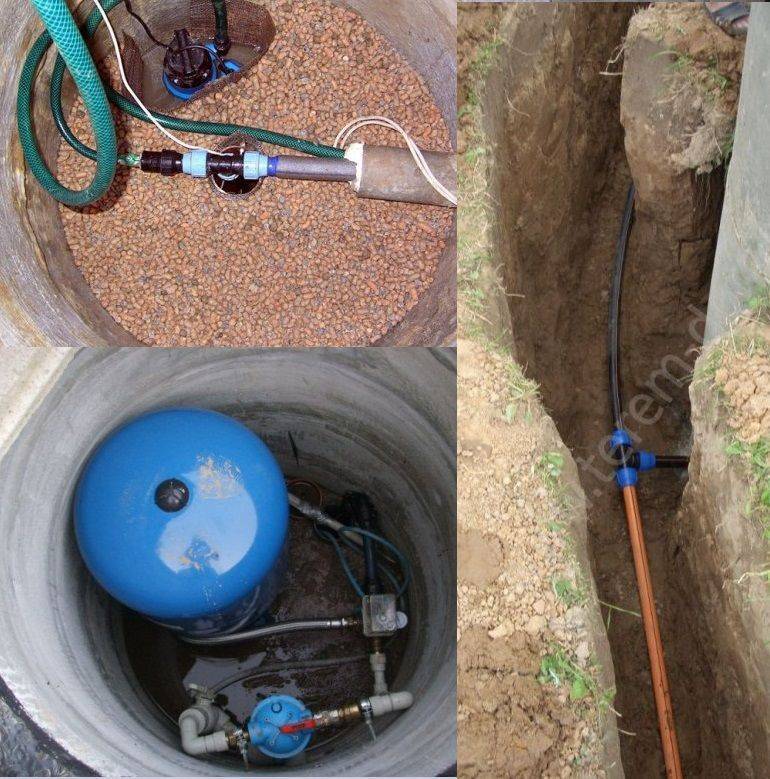
- Throughout the site where installation work is being carried out, the marking of the future pipeline is being carried out. It is used as a marker when digging a trench. At the same time, the degree of deepening depends on the climatic conditions of the area (you need to know how much the soil can freeze in winter). The average trench depth is about 1.6 m. Freezing can be affected by factors such as soil density, moisture levels and the average duration of the coldest temperature regime. The trench should be 5 cm wider than the pipe to be laid.
- The bottom of the ditch is being leveled. Loose soil is compacted and strengthened, after which a pillow is arranged. It can be sand or gravel, which is poured onto the bottom and compacted. The thickness of the formed layer should not exceed 10-15 cm.
- Pipes are laid on the prepared bottom. At the same time, pits are necessarily made at the junctions.
After installation and subsequent insulation, they proceed to sprinkling. The pipes are also covered with sand or gravel, creating a layer up to 15 cm thick. The soil that was excavated before is laid on top.

Installation rules
Before starting work, you need to draw up a diagram, mark on it all the necessary fittings and elements of the system (meters, filters, taps, etc.), put down the dimensions of the pipe sections between them. According to this scheme, we then consider what and how much is needed.
When purchasing a pipe, take it with some margin (a meter or two), fittings can be taken exactly according to the list. It does not hurt to agree on the possibility of a return or exchange. This may be necessary, since often in the process, installation polypropylene plumbing pipes throws up some surprises.They are mainly due to lack of experience, not to the material itself, and happen quite often even with masters.
Plastic clips take the same color
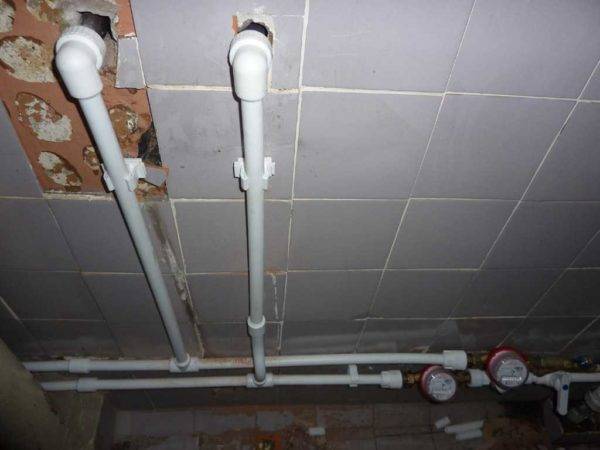
In addition to pipes and fittings, you will also need clips that attach everything to the walls. They are installed on the pipeline after 50 cm, as well as near the end of each branch. These clips are plastic, there are metal - staples and clamps with a rubber gasket.
For open laying of pipelines in technical rooms it is more convenient to use brackets, for better aesthetics - for open laying of pipes in the bathroom or in the kitchen - they use plastic clips of the same color as the pipes themselves.
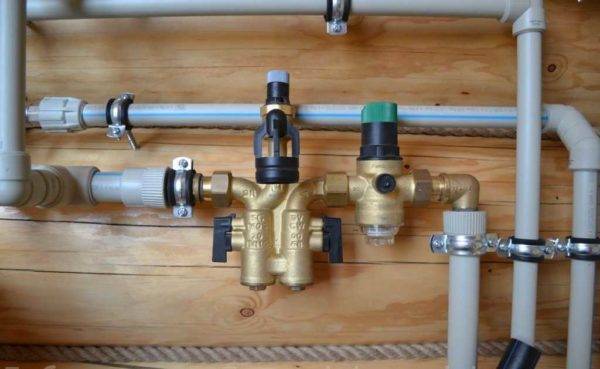
Metal clamps are good in technical rooms
Now a little about assembly rules. The system itself can be assembled immediately by cutting pipe sections of the required length, constantly referring to the diagram. So it is more convenient to solder. But, with a lack of experience, this is fraught with errors - you must accurately measure and do not forget to add 15-18 millimeters (depending on the diameter of the pipes) that go into the fitting.
Therefore, it is more rational to draw a system on the wall, designate all fittings and elements. You can even attach them and trace the contours. This will make it easier to evaluate the system itself and identify shortcomings and errors, if any. This approach is more correct, as it gives greater accuracy.
Next, the pipes are cut as needed, fragments of several elements are connected on the floor or desktop. Then the finished fragment is set in place. This sequence of actions is the most rational.
And about how to quickly and correctly cut pipe sections of the desired length and not be mistaken.
Most Common Mistakes in Underground Pipe Laying
Underground laying of communications, of course, largely depends on the type of soil in a particular place. And, often, a lot of difficulties arise with it during work, since the composition of the soil may simply not make it possible to deepen the pipes to the distance laid down in the SNiP. In particular, the ground can be very dense, rocky, or swampy, so that you simply cannot get to the desired depth. In this case, many difficulties can arise in winter.
However, this method is not at all cheap and involves significant financial and labor costs. But still it is considered the most reliable. Of course, doing all the work yourself, you can save a little, and even gain some experience that may come in handy in the future.
Types of garden aqueduct
There are two ways to lay a pipeline in a country house - summer and seasonal (capital). Each of them has its own advantages and disadvantages.
Summer option
The method of ground installation of a water supply system in summer cottages is used to organize the irrigation of vegetable beds, berry bushes, and fruit trees. Ground water supply is used to supply a bathhouse, a summer kitchen, a garden house.
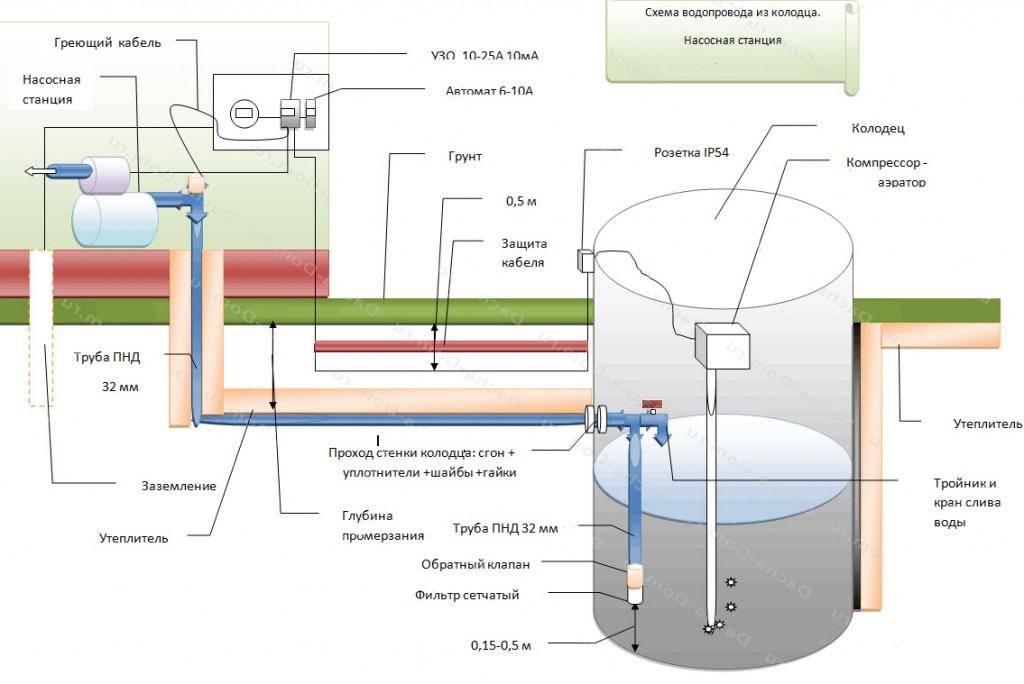


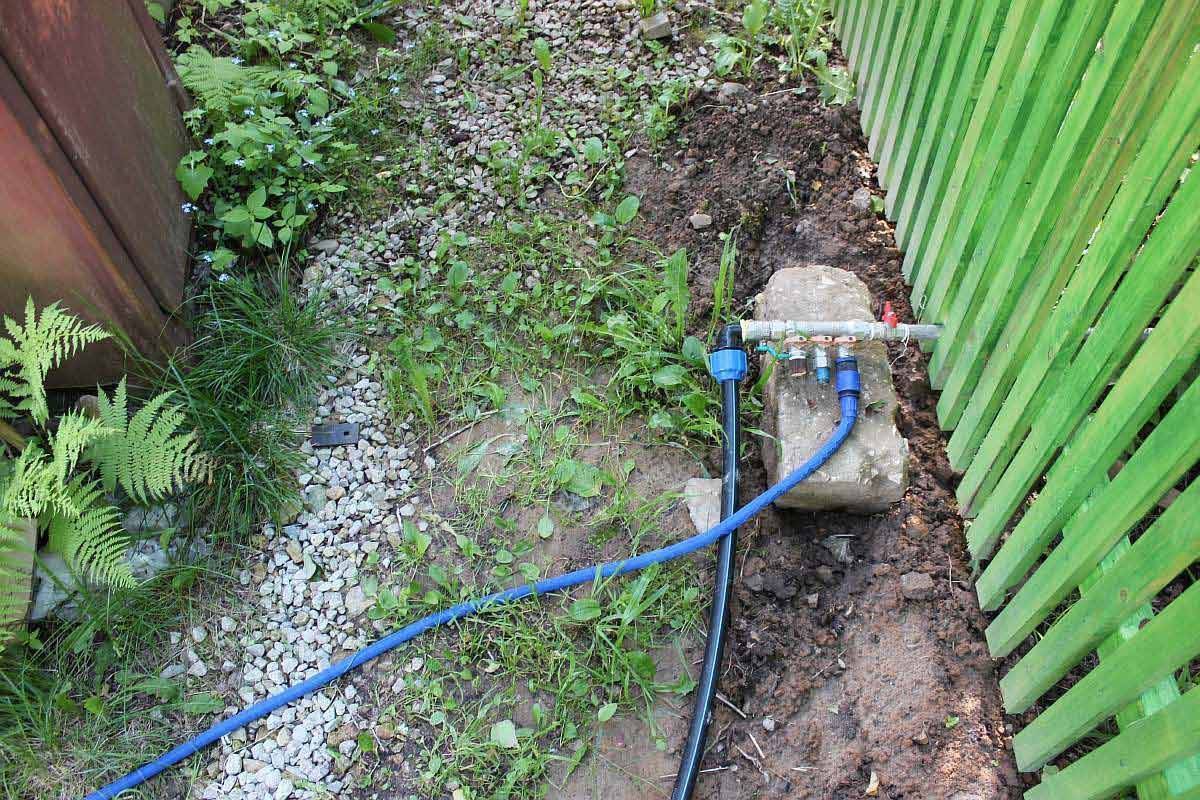
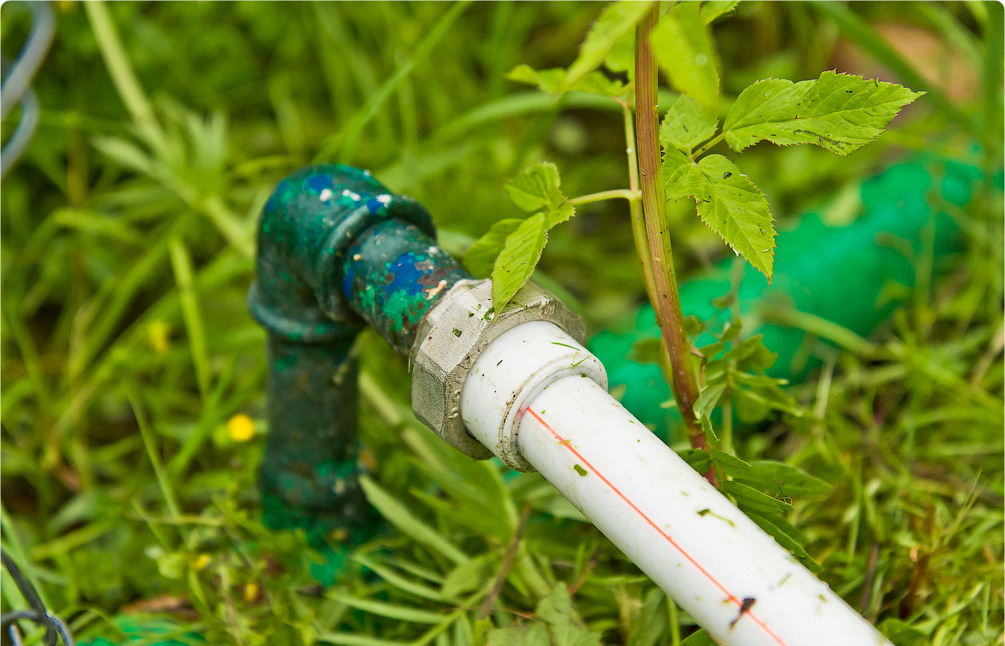
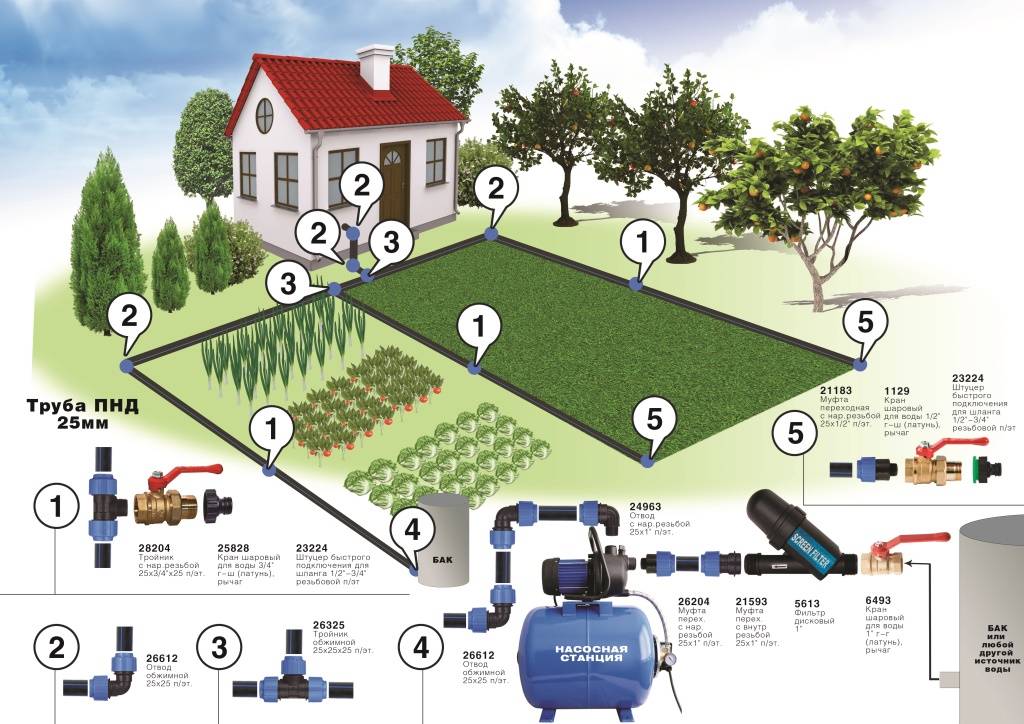
The seasonal plumbing system is a ground loop with long fittings at the branching point. If the site is used exclusively during the warm period, it is reasonable to lay pipes on the surface. Such a system is easy to dismantle for the winter to prevent theft of materials in the off-season.
On a note! To avoid damage to communications by agricultural equipment, summer water supply is laid on special supports.
The main convenience of seasonal polyethylene plumbing is its mobility. If necessary, the configuration can be changed in 10-15 minutes. It is enough to add or remove a few meters of pipe or run it in a different direction.
Irrigation system
Scheme
Temporary summer plumbing in the country do-it-yourself HDPE pipes are assembled and disassembled according to the principle of a children's designer.
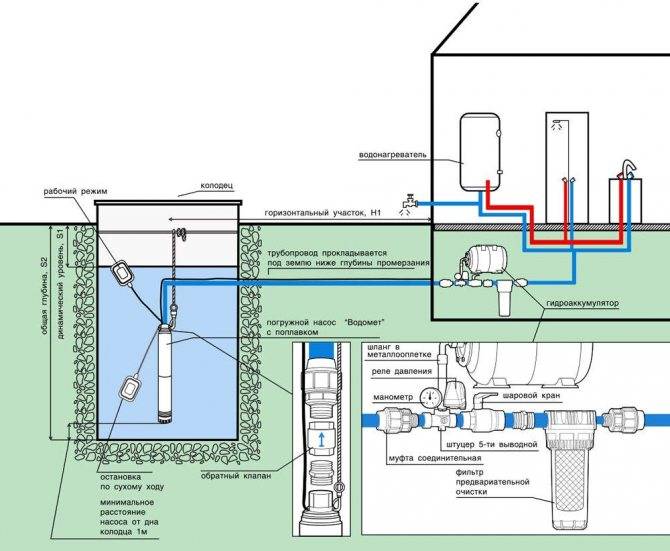
Typical scheme of country water supply
The network diagram is drawn up with reference to a detailed site plan. The drawing marks the location of green spaces, water intake points, a house, a shower, a washbasin.
Important! Pipes are laid with a slope towards the water intake point. At the lowest point of the system provide for the installation of a drain valve
capital system
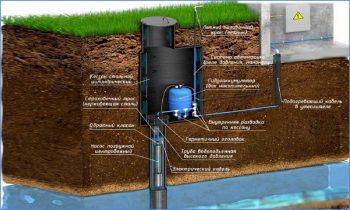
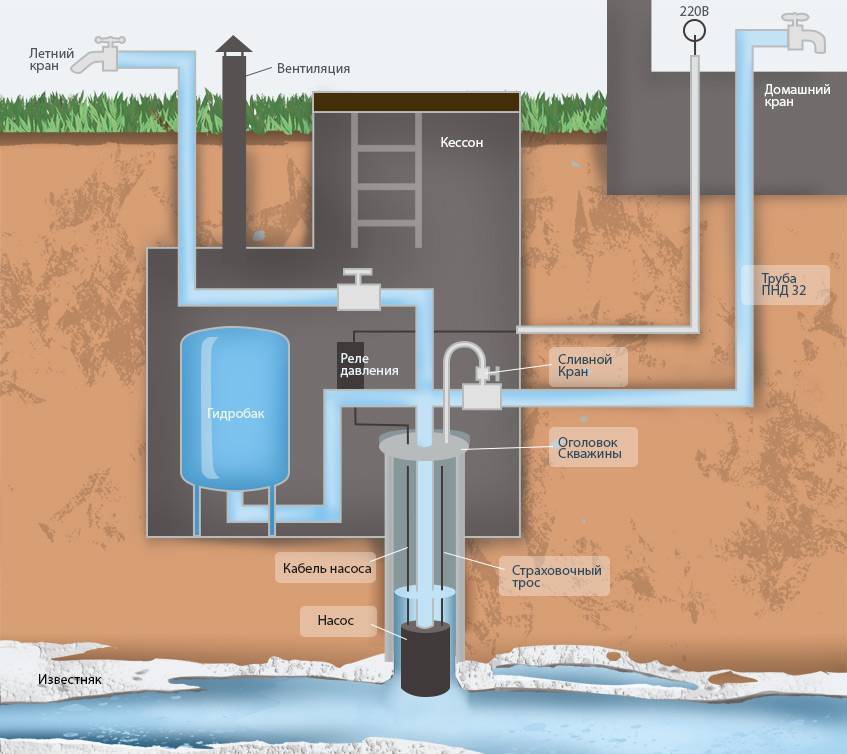
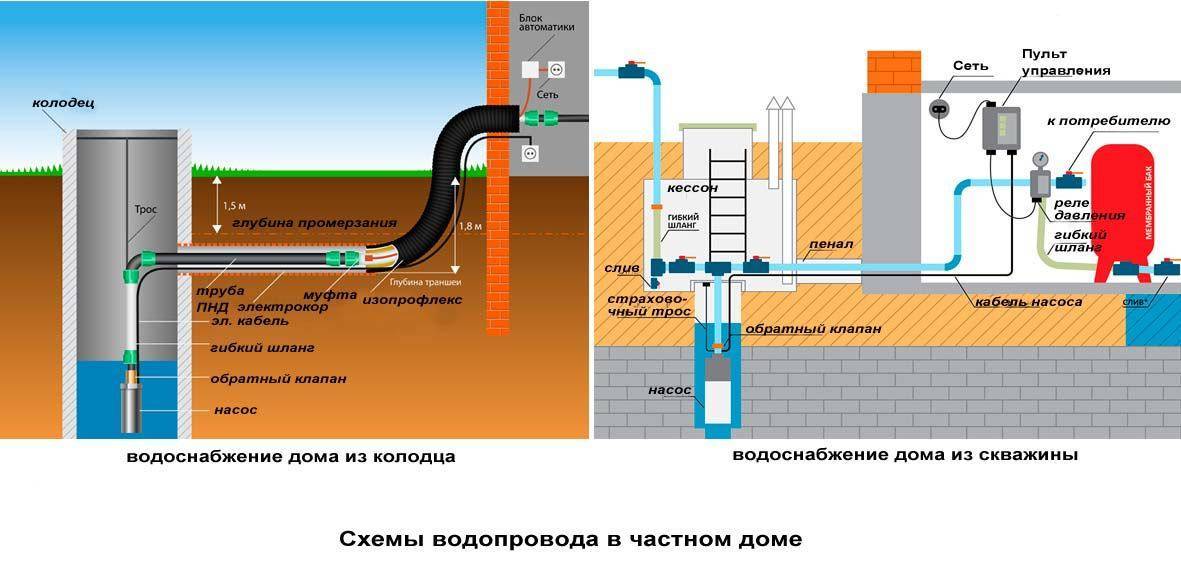
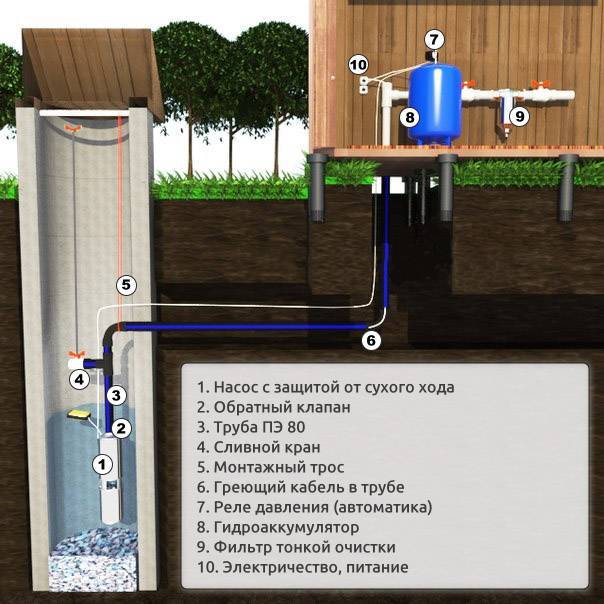
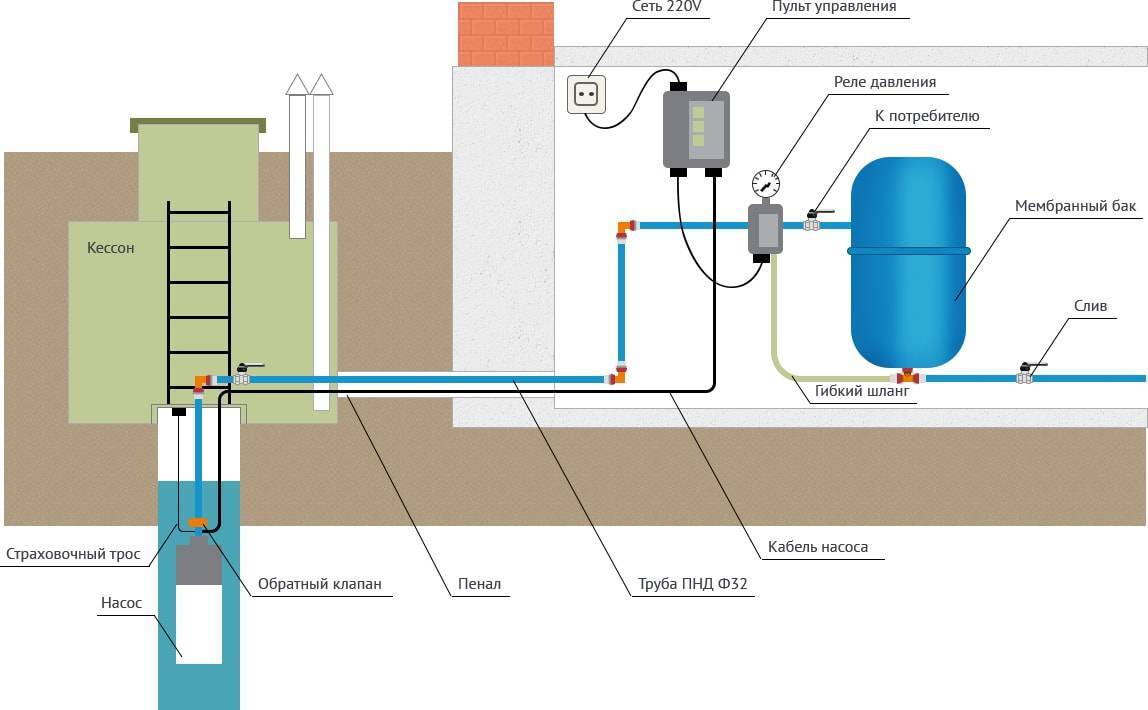
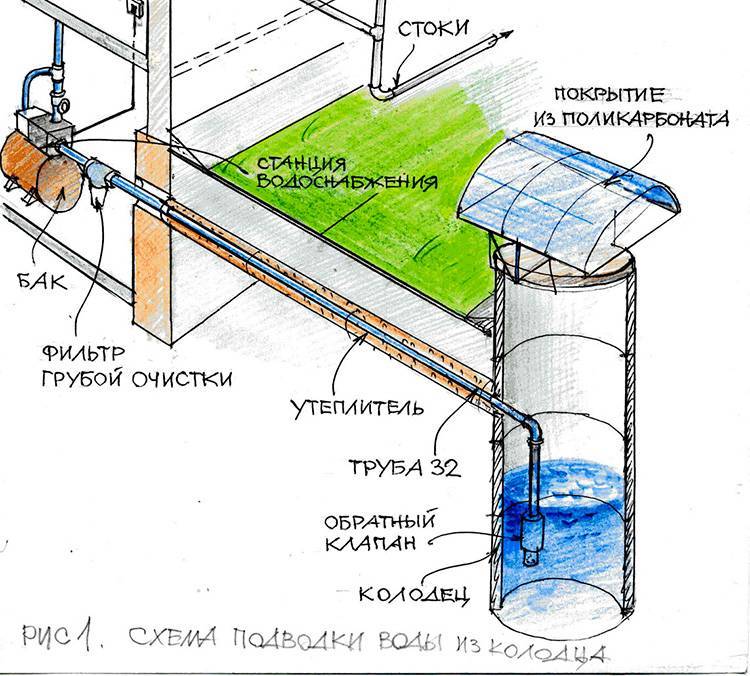
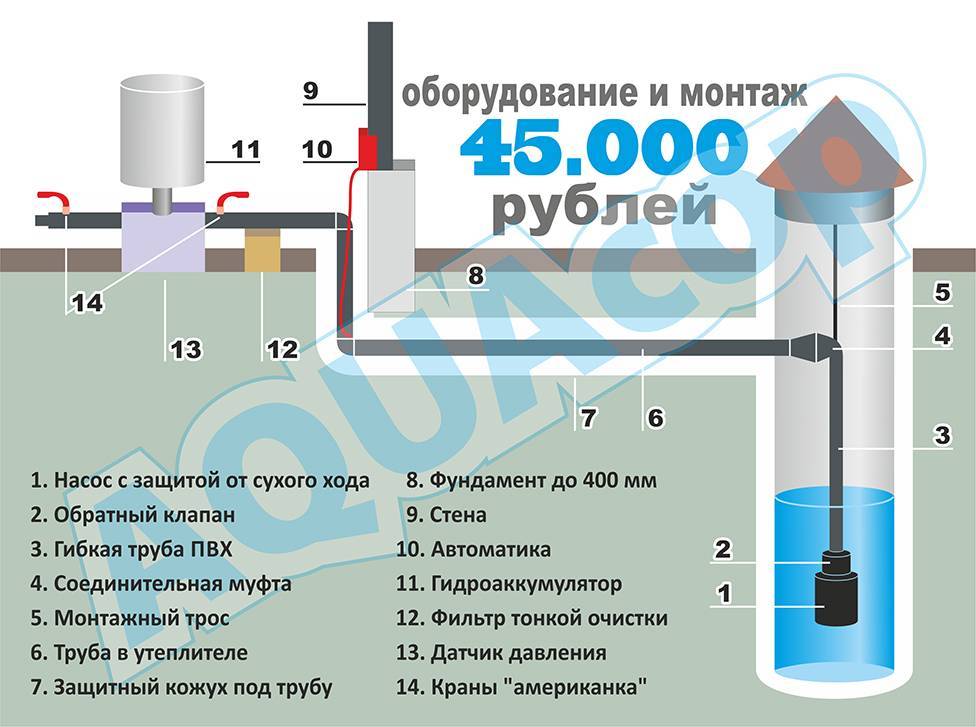
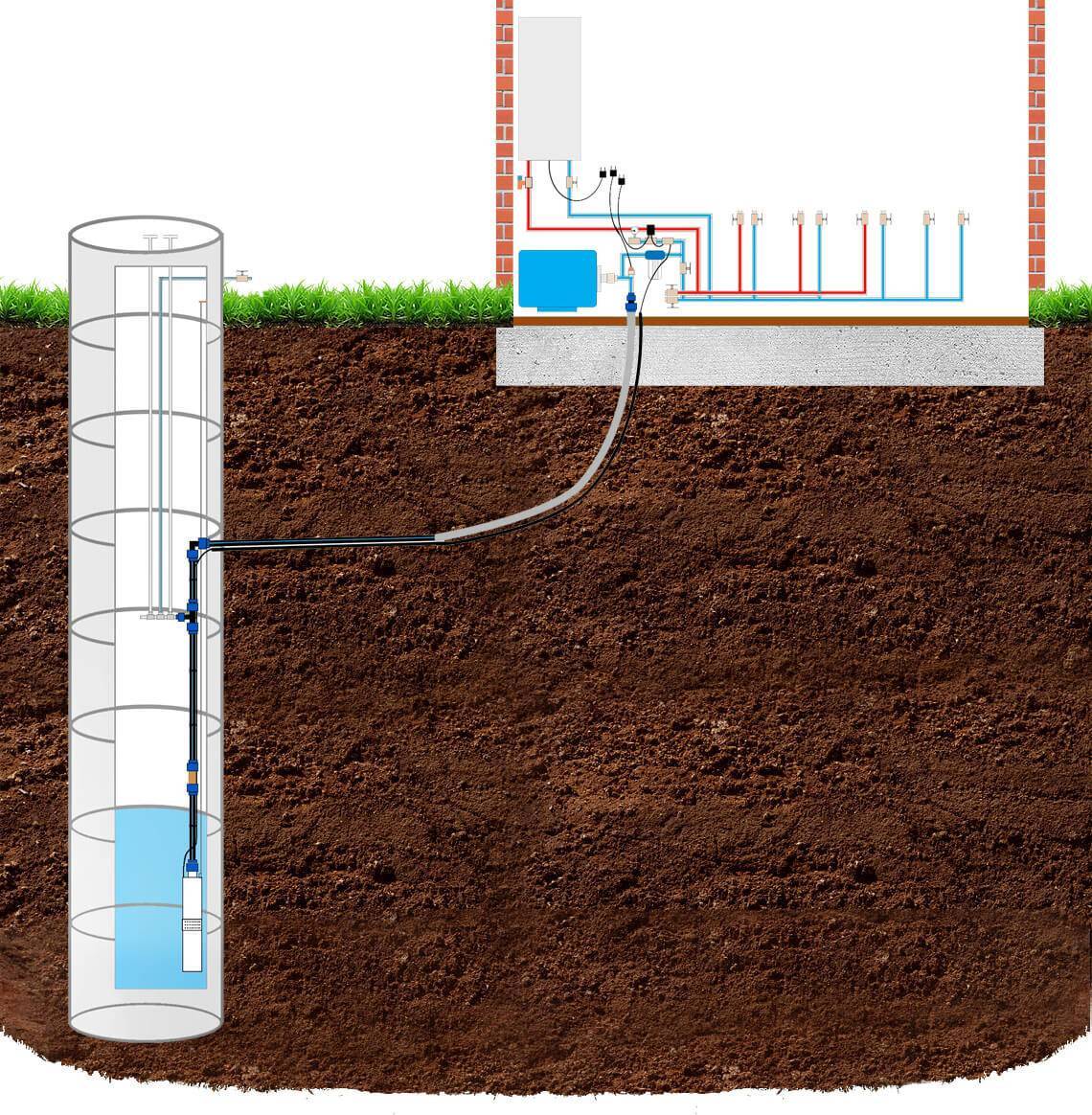
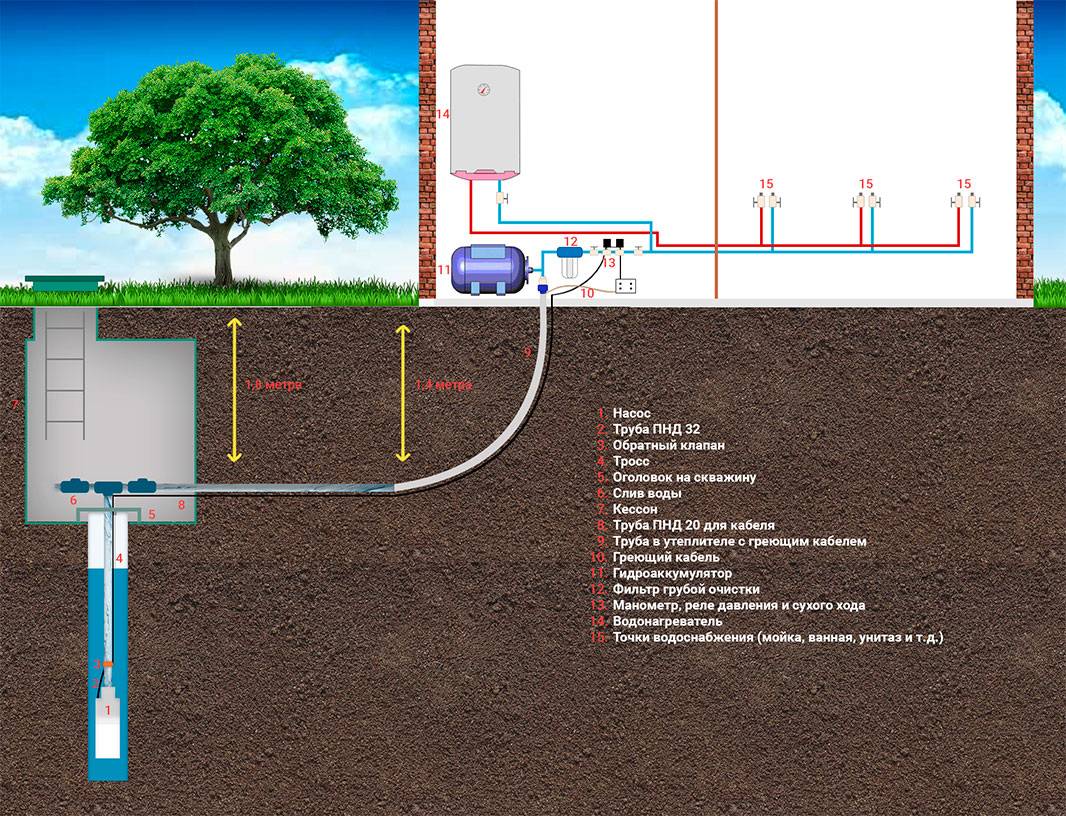
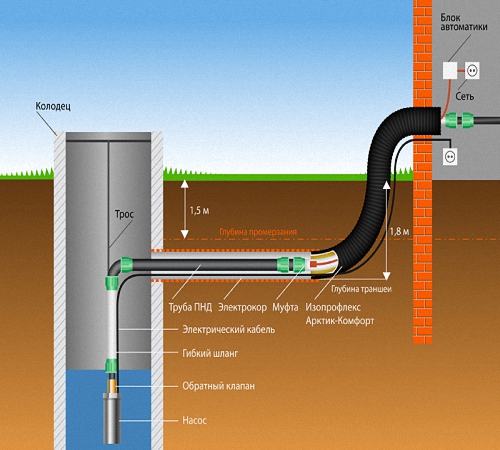
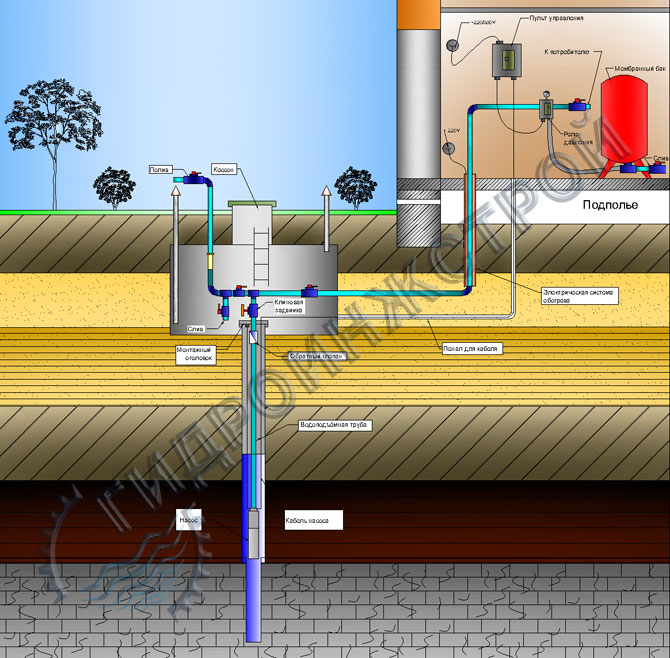
If the site is capitally equipped and used all year round, it is wise to spend time and money on installing a capital plumbing system. The principle of connecting elements in this case does not change. The difference lies in the additional installation of compressor equipment and the closed location. To equip a permanent water supply, communications are laid in trenches below the freezing depth of the soil.
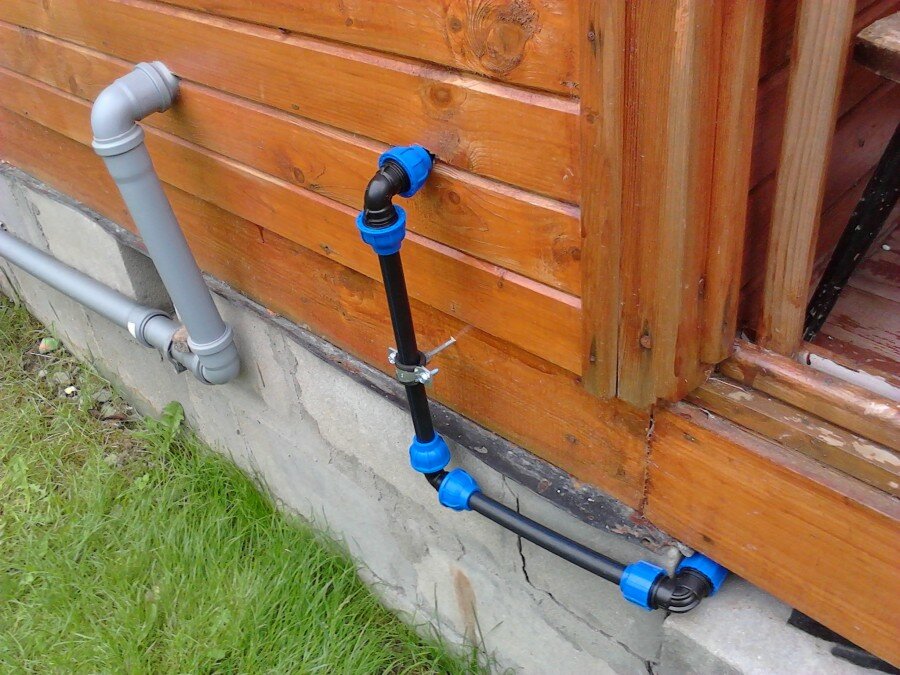
Entering HDPE pipes into the house
Warming
The depth of soil freezing in different regions of the Russian Federation differs significantly. To avoid breaking communications at the time of sudden temperature fluctuations, it is recommended to insulate them.
For the insulation of a capital water supply system from HDPE in a summer cottage, the following materials are used:
- Basalt insulation in the form of finished cylindrical modules.
- Fiberglass cloth in rolls. You will need to buy roofing felt to protect the warm layer from getting wet.
- Styrofoam.Reusable folding modules from two halves, which are used repeatedly, are mounted simply and quickly.
Insulation for pipes made of foamed polyethylene According to statistics, the depth of soil freezing in winter in Russia exceeds 1 meter. For clay and loam of Moscow and the region, this is ...
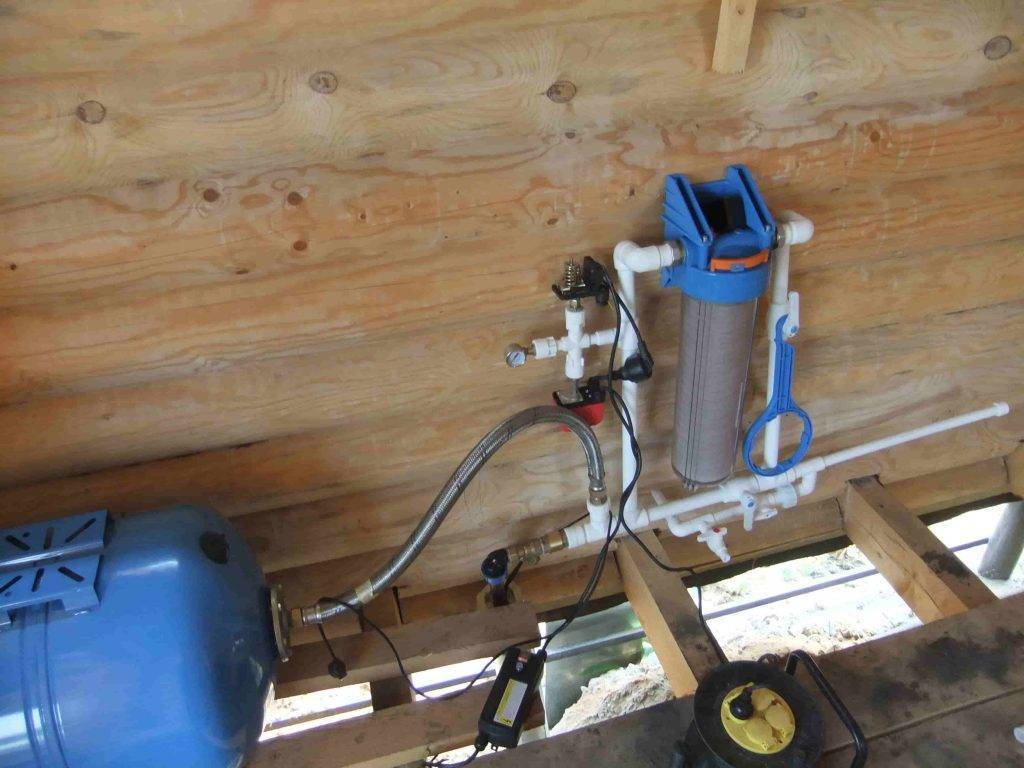
On a note! Water under high pressure does not freeze. If a receiver is installed in the system, there is no need for additional thermal insulation of the water supply.
In capital construction, when laying a pipeline to a shallow depth, a heating cable is laid parallel to the system and connected to a grounded power source.
Defrosting water and sewer pipes Russia is located in a harsh climatic region, so in winter and early spring there is a risk ...
How to choose?
Manufacturers offer several types of polyethylene pipes to choose from. First of all, products are distinguished by the type of transported medium.

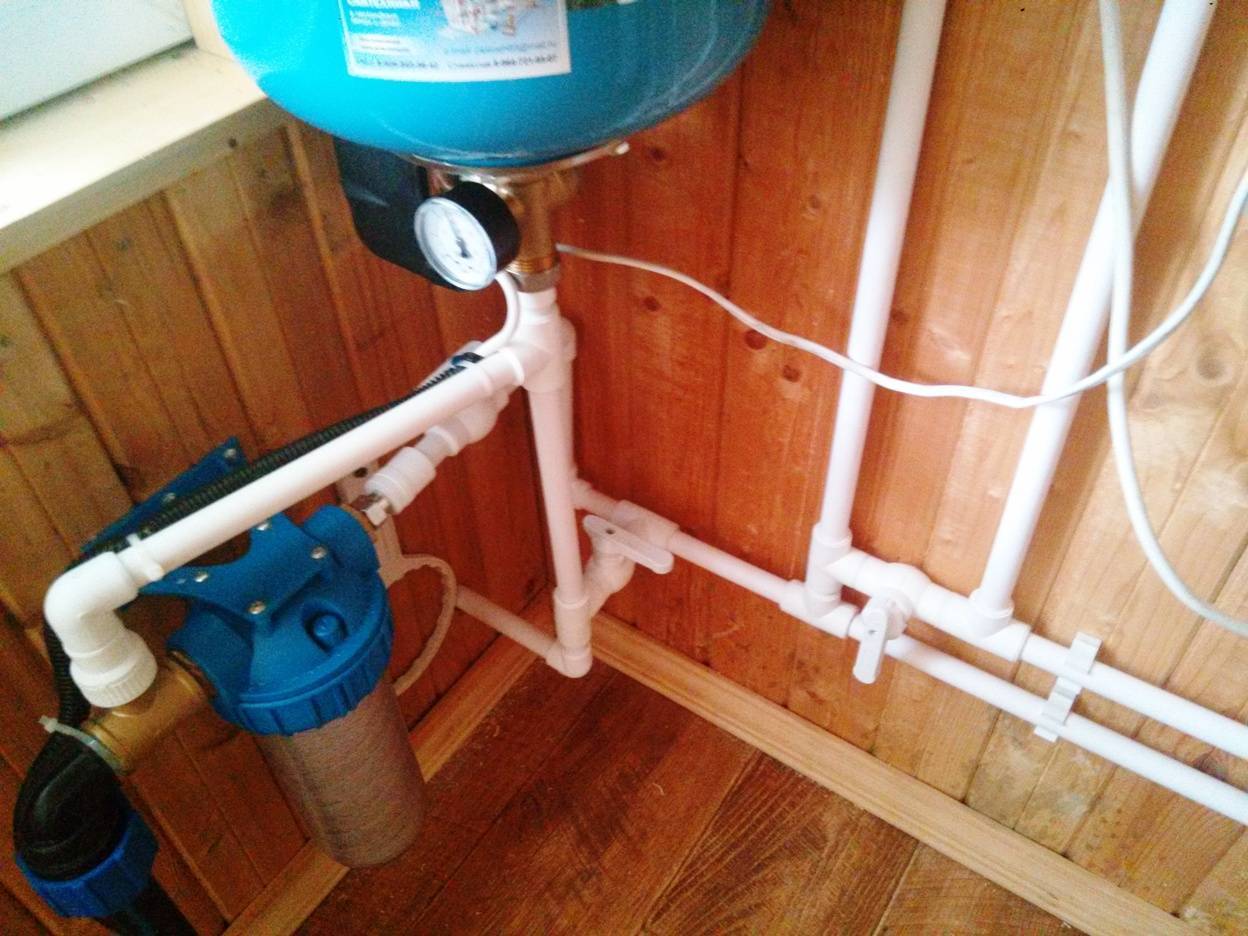
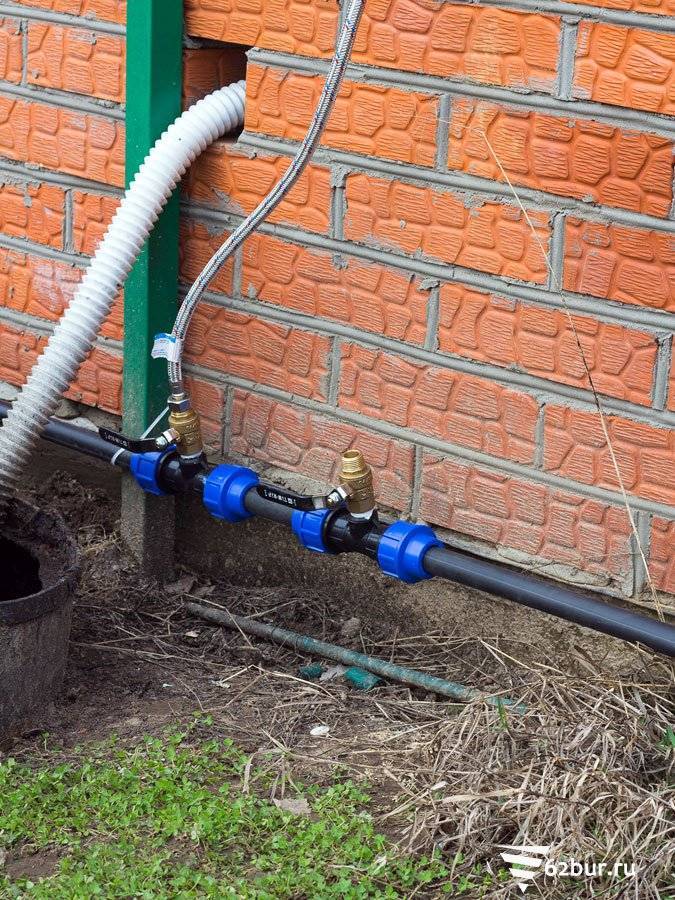
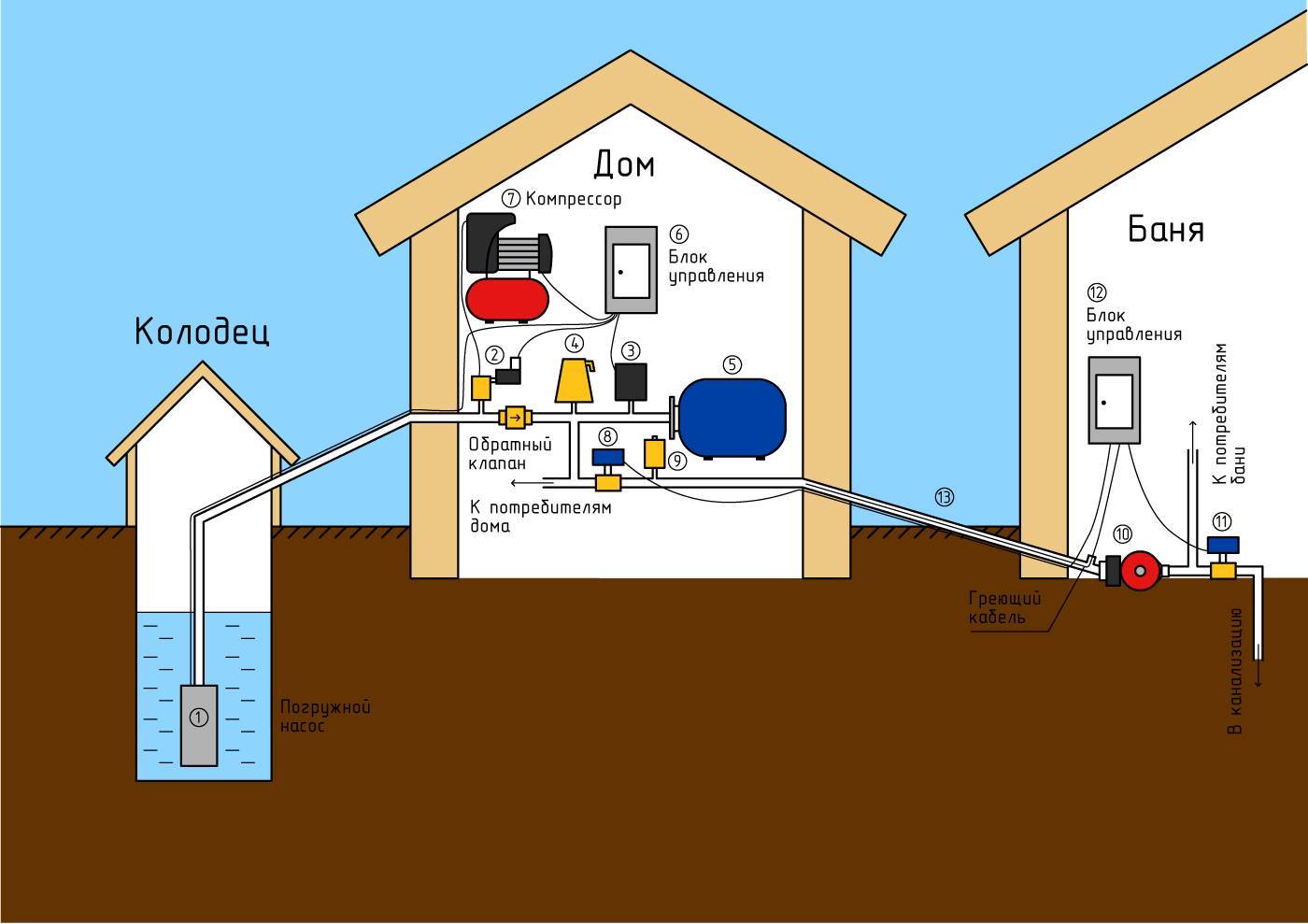
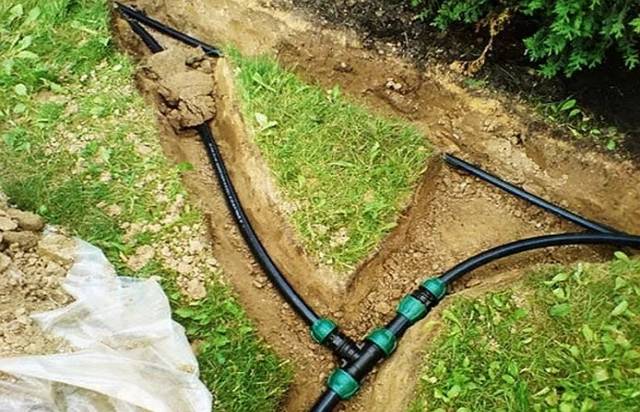
For the production of gas pipes, special additives are used that change the composition of water. It is strictly forbidden to use gas pipes with yellow markings for the plumbing system!
To assemble the pipeline underground, two types of polyethylene are used:
- HDPE PE 100, manufactured in accordance with GOST 18599-2001. Product diameter — 20 to 1200 mm. Such pipes are made black with a longitudinal blue stripe along the entire length.
- HDPE PE PROSAFE, produced in accordance with GOST 18599-2001, TU 2248-012-54432486-2013, PAS 1075. Such pipes have an additional mineral protective sheath, 2 mm thick.
For the main line, blanks with a diameter of 40 mm are selected. For secondary - 20 mm or 25 mm.
This is interesting: Rimless toilets - pros and cons, owner reviews
Peculiarities
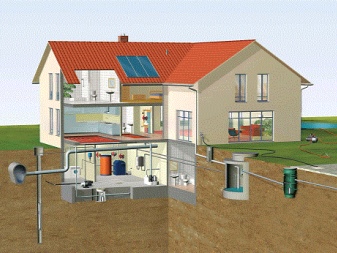
The water supply of a private house is the provision of a building of the specified type with water. There are various solutions to provide residents with water, depending on what water sources are near the building. It should be noted that one can talk about a normal water supply only if the inhabitants who live in it do not experience any problems in the provision of water resources.
The regulation of this issue should be carried out according to the main regulatory act - SNiP 2.04.01-85 called "The rate of water consumption by consumers." Regulation of water consumption according to this norm is from 80 to 230 liters per person per day. Such a large spread depends on whether the house has a sewerage system, a shower or bath, a water heater, and centralized water supply.
It is clear that in high-rise buildings this issue is practically not at all due to the presence of most of the above benefits. And in a country house or a residential cottage, you will have to provide water supply on your own.
What determines the depth of laying sewer pipes

To properly lay sewer pipes, it is enough to know these parameters:
Depth of soil freezing. As mentioned above, the definition of this parameter is not difficult.
Depth of the installed septic tank
It is very important, since the whole system will depend on this figure.
Pipeline slope. It is determined after the two parameters described above.
Depth at which groundwater begins.All these parameters will help determine the depth of the pipeline, which under normal conditions and not too severe winters is 80 cm from the ground
But for better confidence, you need to dig 10 cm deeper
All these parameters will help determine the depth of the pipeline, which under normal conditions and not too severe winters is 80 cm from the surface of the earth. But for better confidence, you need to dig 10 cm deeper
Also, when laying the pipeline, special attention should be paid to insulation
When installing a septic tank, you should know that this element must be at the lowest point so that it has quick access to sewage. A septic tank, according to modern standards, cannot be buried deeper than 3 m. It can be made of metal or plastic, now some manufacturers are engaged in the manufacture and sale of finished products. Most often, septic tanks are laid out of brick or other similar materials.
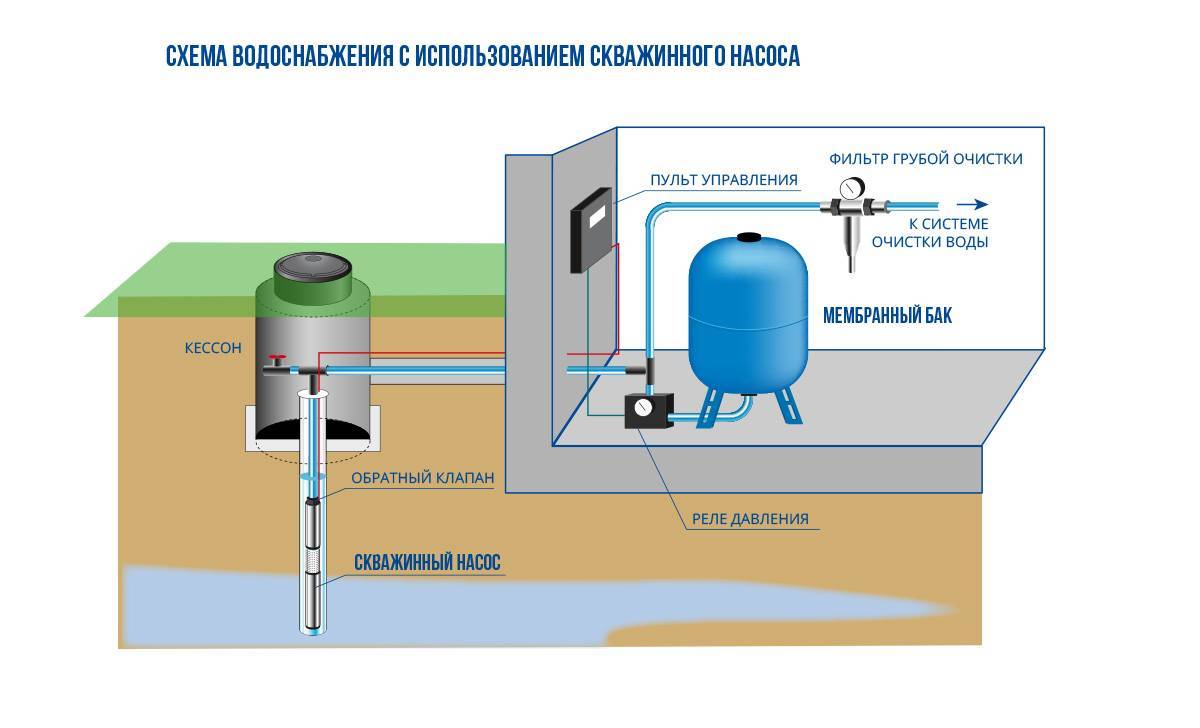

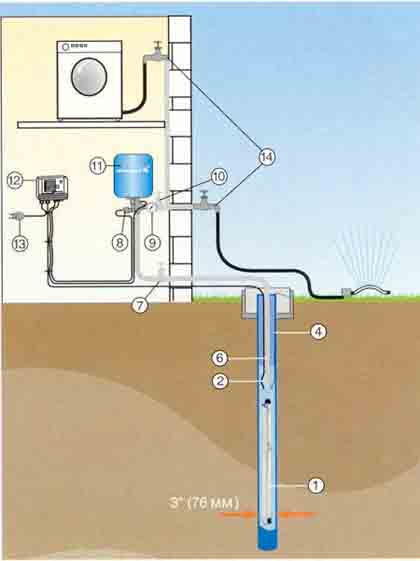
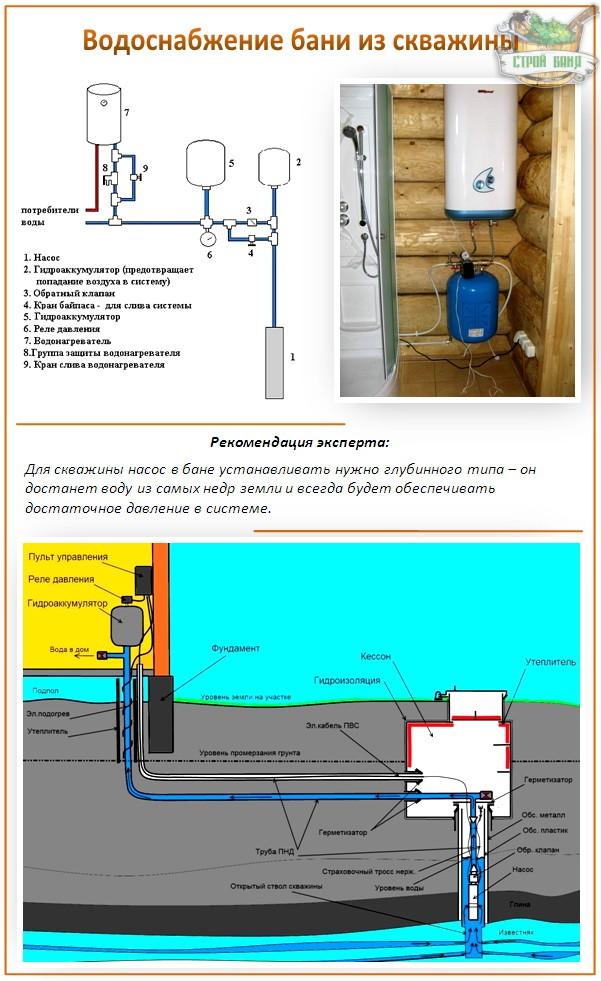
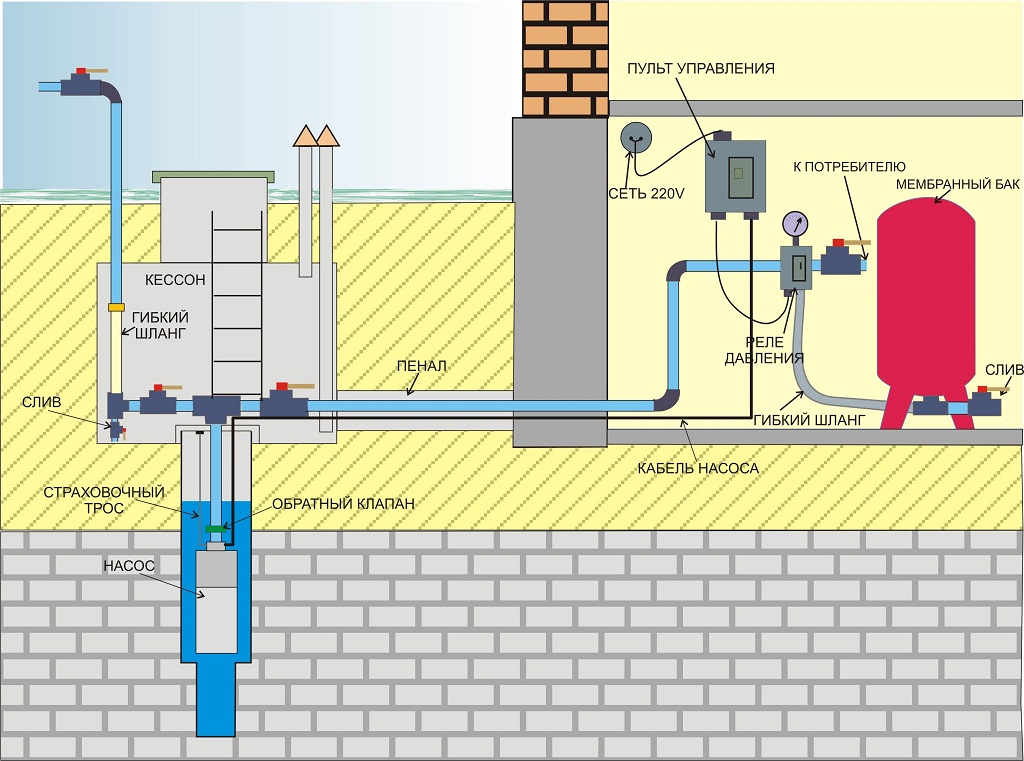

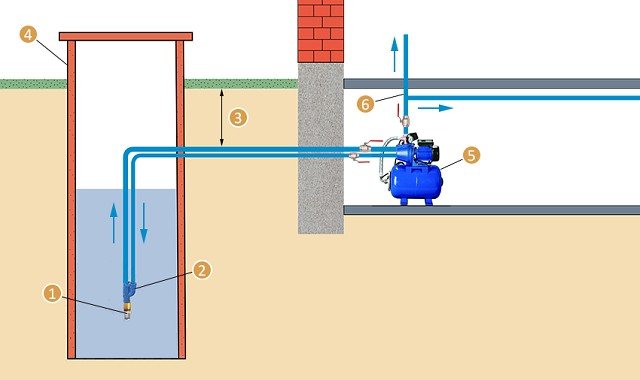


The depth of laying the pipeline greatly affects the final cost of construction work. For laying sewers for a private house, serious equipment is very rarely used; all trenches and pits are most often dug by hand. If you lay pipes to a serious depth, then the cost can increase several times, so you should correctly calculate all parameters.
Providing hot water
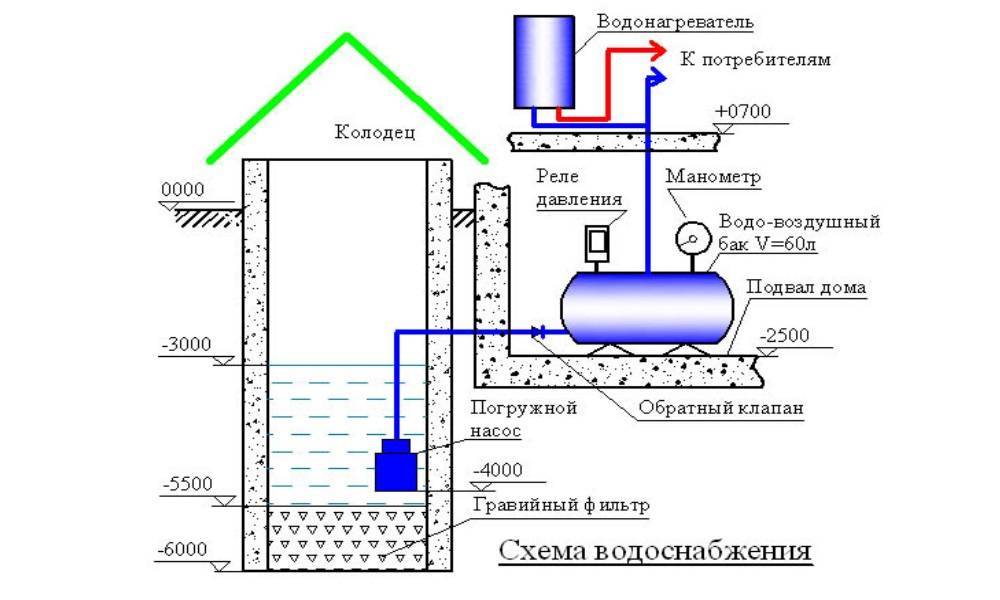
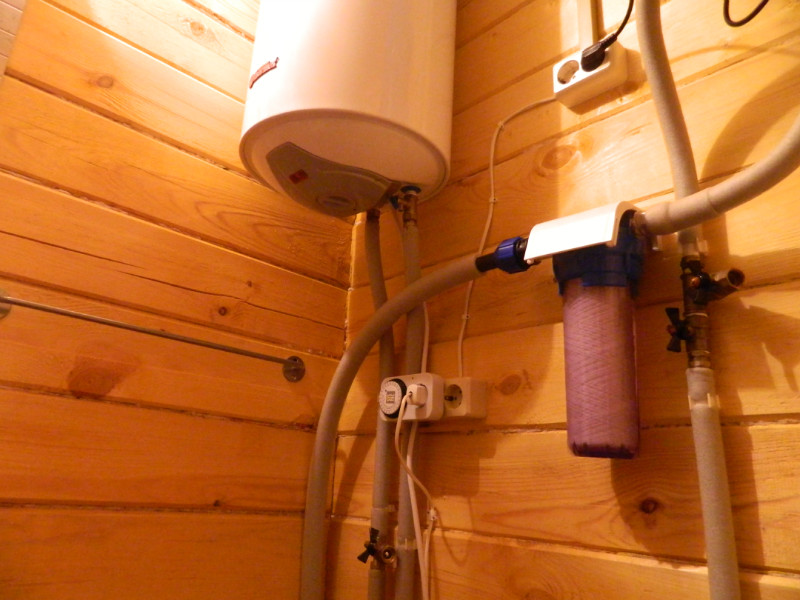
If you need to provide hot water, you can complete your plumbing system with a water heater. There are accumulative and flowing varieties of such equipment. In summer cottages, it is most convenient to use storage tanks.
The installation of the water heater is carried out according to the standard scheme for such equipment.
Now you know in what order the plumbing system is installed and what to consider for the success of all related activities. Do everything in accordance with the provisions of the above guide, and your plumbing will work properly for many years.
Successful work!
Features of HDPE pipes
If you are planning to lay a cold water supply system on the adjacent plot, I recommend using HDPE pipes. Low-pressure polyethylene pipes have a number of unique properties that are not available to analogues made of metal or concrete.
Advantages and disadvantages
The main quality of HDPE for outdoor systems is ease of installation. Laying and assembling a water pipe does not require special knowledge. In any hardware store you will find low-density polyethylene pipes of various diameters, sizes and wall thicknesses. In addition, HDPE products have the following features:
- Polyethylene does not enter into a chemical reaction with water transported through the water supply system. That is, the liquid entering the house will not contain impurities.
- HDPE pipes are 7 times lighter than metal products. This facilitates transportation and installation. When laying a water pipe in a trench, it is not necessary to fix the network with additional supports.
- The smooth inner surface prevents blockages and growths from forming.
- HDPE products absorb noise, such pipes are convenient for sewerage as risers.
- The cost of the product is lower, installation and transportation are cheaper than metal or concrete pipes.
- Service life of HDPE up to 50 years.
Polyethylene pipes withstand high pressure, temperature changes and are resistant to cracking: if the water in the pipe freezes and increases in volume, this will not affect the integrity of the surface. The disadvantages of HDPE products include low resistance to high ambient temperatures. Therefore, it is desirable to use them for the installation of underground water supply pipelines.
Trenchless pipe laying methods
This method has become widespread in Europe. This comes with many benefits:
- Profitability. Unlike classical earthworks, trenchless laying is several times cheaper.
- The speed of work. According to this indicator, the classical method loses twice.
- Depth. The pipeline can be laid at a depth of up to 25 meters.
- The use of this method does not require road closures, does not prevent residents from moving freely around the yard area, and does not destroy the microclimate in the soil.
Either method also depends on the type of soil, the diameter of the pipe being laid, and where it needs to be laid. There are several basic options for performing such work:
- Ground breaking. When pipes need to be laid on clay or loamy soil, this method is chosen. With it, you can lay a pipeline with a diameter of up to 15 cm.
- Sanation. This method can be divided into renovation and relining. Relining is a method of installing a new plastic pipe into an old metal one. Therefore, polypropylene should be smaller in diameter than the old one. It is used in cases of minor damage to the pipeline.If its certain section is completely out of order, the renovation method is used. It involves the complete replacement of a node or section. When there are no other solutions than replacing part of the pipeline, renovation is carried out.
- Soil extrusion. This method is used on sandy and loose soils. With it, you can lay pipes of large diameter.
- Horizontal directional drilling. Universal method. Used on all types of soil. It is carried out with the help of drilling machines.
Hydraulic test of the water system
In order to identify possible shortcomings made during the installation of the plumbing system, and to check the quality of the pipeline layout, it is necessary to carry out an inspection, which consists of the following:
- For 2 hours, the pipeline is filled with water without using pressure.
- The required pressure is maintained for 30 minutes.
- Carefully inspect the entire system.
Before putting the water supply system into operation, it is imperative to pump the pipes with clean water until a liquid that meets the established sanitary and hygienic standards flows from the system.
The arrangement of an external water supply system involves the use of various technological methods and operations. Careful control and strict observance of all conditions will create an effective system for supplying drinking water to the house, which will function for a long time without additional repairs.
Creation and walkthrough
It will be easier to equip water supply in the country with your own hands if you adhere to a certain plan, which boils down to the following points:
- before starting work, it is necessary to obtain all permits, as well as conduct a soil analysis and determine the depth of groundwater;
- after the source for water intake has been determined, one should begin to draw up a plan for laying pipes on the site and a water supply scheme inside the room;
- it is necessary to mark the territory of the land plot, taking into account the drawn up plan;
- next, you should mark the paths of the pipes inside the room;
- in conclusion, it is necessary to dig trenches, the depth of which will be indicated in the project.
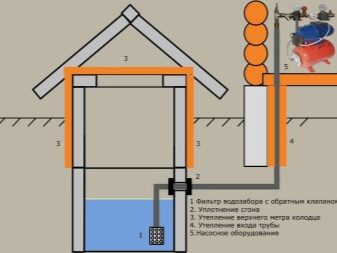
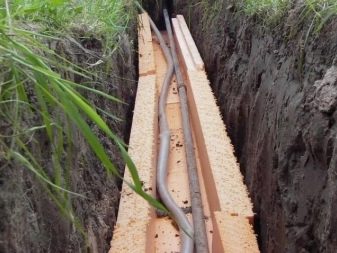
Plumbing schemes
Plumbing can be carried out in two ways - with serial and parallel connection. The choice of water supply scheme depends on the number of residents, periodic or permanent stay in the house or on the intensity of use of tap water.
There is also a mixed type of wiring, in which the faucets are connected to the plumbing system through a manifold, and the rest of the plumbing points and household appliances are connected using the serial connection method.
Scheme #1. Serial (tee) connection
It is an alternate supply of pipes from a riser or water heater to plumbing fixtures. First, common pipes are diverted, and then, with the help of tees, branches are led to places of consumption.

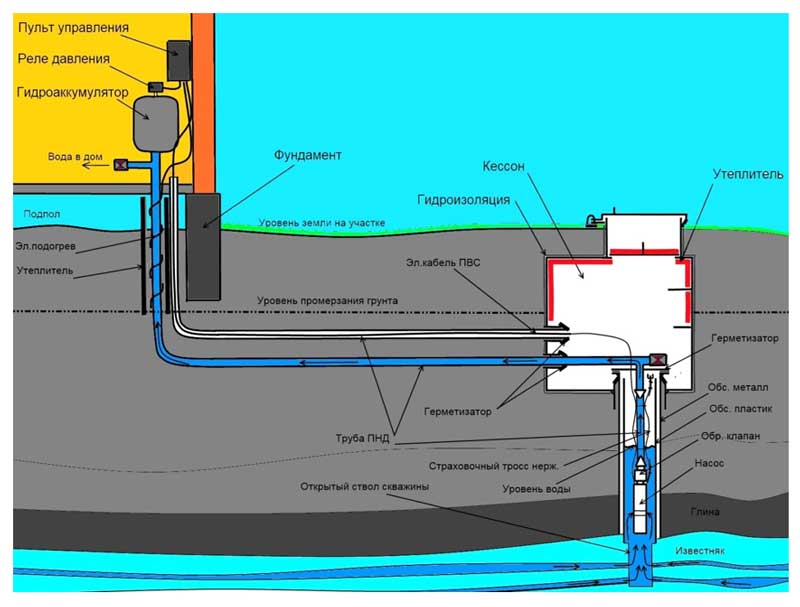




This method of connection is more economical, it requires fewer pipes, fittings, it is easy to install. Pipe routing with a tee system is more compact, it is easier to hide it under finishing materials.
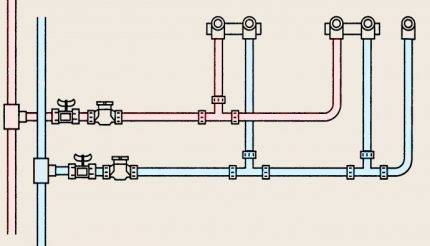
With a sequential scheme for connecting a pipeline with hot water, discomfort is especially noticeable - the water temperature changes dramatically if several people use the water supply at once
But a series connection is more suitable for municipal apartments, for houses with periodic residence or with a small number of residents. It cannot provide uniform pressure in the system when it is used by several users at the same time - at the most remote point, the water pressure will change dramatically.
In addition, if it is necessary to carry out repairs or connect a plumbing fixture, you will have to disconnect the entire house from the water supply. Therefore, for private houses with high water consumption and permanent residence it is better to choose a scheme with parallel plumbing.
Scheme #2. Parallel (collector) connection
Parallel connection is based on the supply of individual pipes from the main collector to the water intake points. For cold and hot mains, their collector nodes are installed.
This method requires laying a large number of pipes and, accordingly, creates difficulties in masking them. But on the other hand, each draw-off point will have a stable water pressure, and with the simultaneous use of several plumbing fixtures, changes in water pressure will be insignificant.
A collector is a device with one water inlet and several outlets, the number of which depends on the number of plumbing units, household appliances that use tap water for operation.
The collector for cold water is mounted closer to the pipe entering the house, and for hot water - at the outlet of the water heater.A cleaning filter and a pressure regulating reducer are installed in front of the collector.
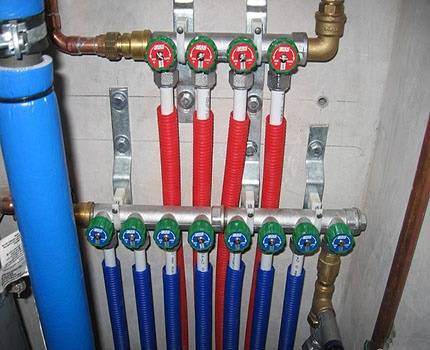
Each output from the collector is equipped with a shut-off valve, which allows you to turn off a specific water intake point, while other outputs will work in normal mode. In addition, each of them can be equipped with a regulator to maintain a certain pressure for individual devices.