- Types of filters for ventilation systems
- How else can you ventilate living rooms
- How to install ventilation
- Necessary components of a type-setting inflow
- Ventilation supply with air recirculation
- The need for ventilation with heating
- System power calculation
- Supply and exhaust ventilation for an apartment with air conditioning
- The specifics of the channel hood
- Types of ventilation ducts
- What is a deflector?
- Equipment for the installation of a ventilation system
- Design features of the device
- Passive ventilation systems.
- On the wall
- Active ventilation systems
- Water heater
- Electric heater.
- breather
- Air purification system for an apartment - Tion installation
- The choice of air filters for the apartment
Types of filters for ventilation systems
Modern supply ventilation systems operate on the principle of stepped filtration and can be equipped with various types of filters:
- Coarse cleaning - used to purify the air from large particles.
- Coal - are made on the basis of activated carbon, which effectively absorbs gas molecules. With their help, air flows are cleared of organic compounds. The cleaning speed depends on the size of the cleaning filter granules.Due to the corrugated surface, the performance of such devices increases several times.
- Electrostatic - plate-type electrodes are used for manufacturing. Devices of this type are effective only at low air flow rates. Their disadvantage lies in the release of ozone, which in certain quantities can be hazardous to health.
- Fine cleaning - the main element of such filters is fiberglass cloth. The efficiency of such devices is determined by the thickness of the filter material and the diameter of the fibers. Some manufacturers use antiseptic impregnation during the manufacturing process, which prevents the formation of negative microflora in case of surface contamination.
- Photocatalytic - eliminates toxic impurities and odors through exposure to ultraviolet radiation. Maximum efficiency is achieved with high UV power and enhanced photocatalyst performance.

How else can you ventilate living rooms
It happens that at some point in the living rooms it can become too hot or too damp, in which case air conditioning will come to the rescue. It is better to install split systems, they have many advantages:
- Low cost;
- A large assortment;
- Ease of installation;
- Noiselessness;
- Possibility of economical mode of operation;
- Ease of control with the remote control.
With the help of an air conditioner, it is easy to ventilate, dry and cool the room. Heavy, exhausted air is discharged outside, and fresh and purified air enters the rooms. If the split system is installed with suitable parameters, then it will be easy to ventilate a small apartment.
How to install ventilation
Necessary components of a type-setting inflow
Any inflow scheme, whether it is a compact product or a full-fledged device, involves the installation of a filter, a fan and a cut-off housing. Also arm yourself with a temperature sensor and corrector, air ducts, a pressure control sensor, and clamps.
In order to stably fix the supply ventilation in the apartment, it is necessary to make a steel case-frame, fixed to the wall structure with screws with your own hands. It is possible to facilitate the installation process by installing a mixed or combined ventilation system, which will ensure the simultaneous inflow of air flows into the room and the exit of exhaust air through natural recesses for the hood.
If you live in a private house, refer to the installation of a full-fledged supply system.
Ventilation supply with air recirculation
Such a model of supply ventilation is always equipped with heating, therefore it is forbidden to install it in country cottages and cottages where sources of explosive gas are located.

The system with air heating is not complete without the formation of a hole in the wall plane at the initial stage, above or below the window opening, or in place of the window. The size of the recess must exceed the dimensions of the duct. So that further insulation and sound insulation do not have difficulties, it is better to place the air ducts focusing on a horizontal straight line passing from the main room to the adjacent ones.
An approximate installation diagram is as follows:
- Fix a valve in front of the air duct, which will work when air enters the room from the outside through a fan.
- Fix the manual control valve in case you need to forcibly shut off the air flow.
- Put the filter responsible for the main cleaning in its place.
- Place a fan and a sensor that determines the level of air pressure, then a carbon filter and a filter designed to deep clean the flows.
- At the final stage, connect the heating element.

When the structure is already assembled, the wires should be laid in a special frame.
The need for ventilation with heating
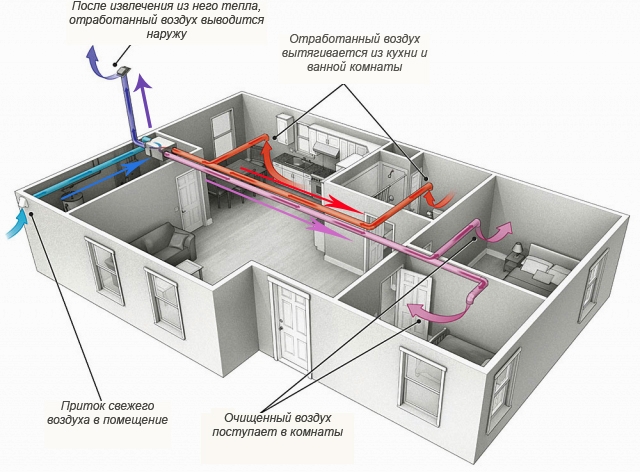
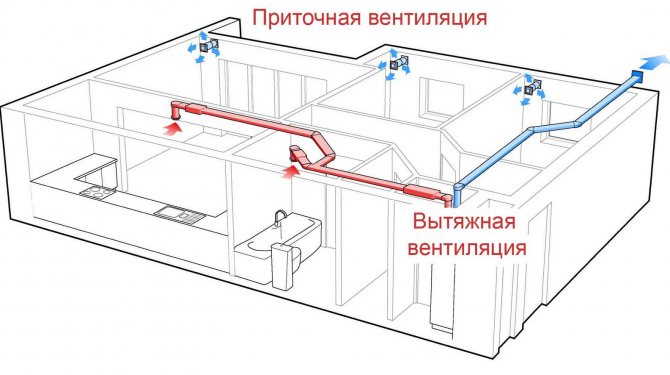
Supply ventilation is a proven way to ensure normal air exchange in the apartment. It is necessary to replace heavy stale air not only in the kitchen or in the bathroom: in all rooms where residents spend most of their time, you need to take care in advance about supplying fresh air from the street.



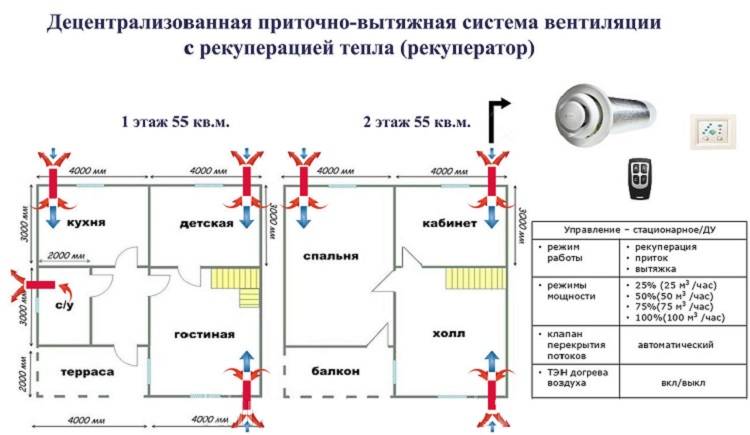


According to the old norms adopted back in Soviet times, for each person permanently staying in a living room, a minimum of 60 cubic meters is required. m of fresh air per hour. A similar indicator is relevant for the bedroom or children's room.
For a zone with periodic stay of tenants, for example, a living room, the minimum threshold for the amount of supply air is 30 cubic meters. m/h Modern European air supply system performance standards are lower and offer 30 and 20 cubic meters. m/h per person for rooms with permanent and occasional stay, respectively.
However, even a reduced influx of fresh air from the street can significantly affect the temperature in the entire apartment. Cold air masses increase the load on the heating system, reducing its efficiency. As a result, the energy that is wasted for warming up cooled air.
Additionally, staying in a room with a low air temperature can cause hypothermia and provoke the occurrence of certain diseases.
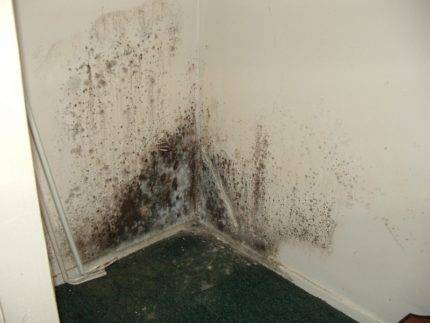 A cold room and high humidity due to poor ventilation are an ideal environment for the development of mold, which not only spoils the repair, but also causes significant damage to health.
These problems can be solved with the help of an air heater, which is installed on the supply ventilation of the apartment. For the domestic climate, such a node in the ventilation system is an urgent need. With a noticeable decrease in temperature outside the window, the air heating element will become the only effective way to prevent drafts and keep the heat in the house.
The ventilation system with an air heater allows you to simultaneously compensate for heat losses and saturate the internal climate with the necessary volume of fresh air masses.
System power calculation
The amount of air exchange can be tied to the volume of residential premises (the frequency of exchange), their area or the number of people. In order not to get confused, you can focus on the rate of 30 cubic meters per hour per tenant or 3 cubic meters per square meter for apartments up to 20 square meters.
However, the relevant regulations, as well as wiring diagrams, are being revised and even in European countries different standards are used. And if we take into account that there is usually no one in residential premises during working hours, then during this period the system heats the street
The nature of the residents is also not taken into account - children in active games burn much more oxygen than calm elderly people. You can also add air ozonization with some equipment (printer, computer, etc.), the amount of which may differ in apartments with the same population
In general, it is necessary to present the basic principles of the future system as clearly as possible, but not to focus on the details, since great variability is allowed during planning and installation. The power of the exhaust fans and the diameter of the supply valves are selected so as to ensure the supply of fresh air close to the norms, and the type of execution and the manufacturer are selected individually.
Supply and exhaust ventilation for an apartment with air conditioning
Modern air conditioning systems do not just cool indoor air, but supply fresh air from outside. Designs with an admixture of atmospheric flow are distinguished by the presence of an air duct and a special membrane that controls the operation of the valve. The peculiarity of the membrane is that its material allows molecular oxygen to pass through, while retaining the rest of the gases. But the price of duct ventilation for an apartment and its installation is high, within 50 thousand rubles. Therefore, not every consumer can buy such a device.
The solution exists in the acquisition of a modular system. It consists of a heat exchanger with an air channel in the form of a separate unit and an air conditioner. But this is the negative side of the equipment, since you have to install two boxes on the wall. Another drawback is the limited volume of gas passage - about 20 m3 per hour. This amount of air is not enough even for one person to breathe normally.
To solve the problem of increasing the flow, the external unit was improved by combining the ventilation and cooling systems. The ventilation chamber is connected by means of an air channel to the interior of the refrigerator through which air passes. Due to this, the productivity of the device has increased to 32 m3/h. Split-system with forced ventilation for an apartment costs even more than a simple ducted air conditioner. Its price starts from 140 thousand rubles.





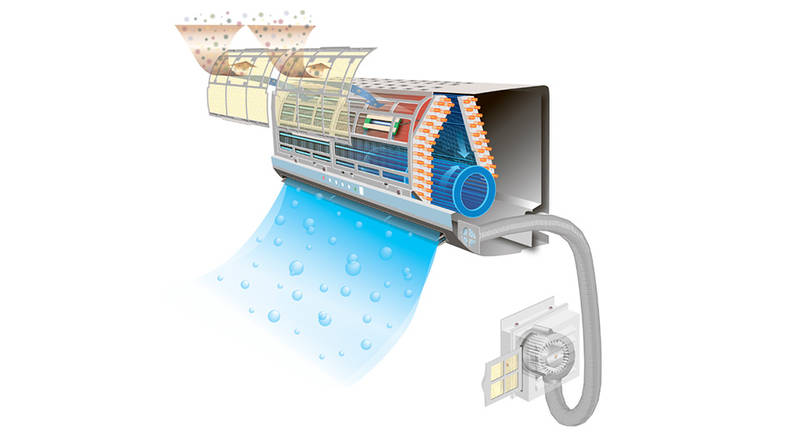
The disadvantage of split systems is the minimum rate of atmospheric air inflow, which does not reach up to 10% of the total amount of gas. High-quality equipment passes through itself up to 160 cubic meters per hour of fresh street air, while retaining dust, unpleasant odors, and allergens. The most modern air conditioners are equipped with humidifiers and an ultraviolet emitter, which neutralizes dangerous microflora, bacteria.
The price of installing fresh air ventilation in an apartment depends on the type of equipment, the quality of the filtration system. Classification of filters according to the method of cleaning: • coarse - particles of 5-10 microns in size are retained; • medium - does not pass flour aerosol dust, soot; • fine - filters more than 90% of contaminants smaller than 0.5 microns. Dry filters are cassettes with different fillers.
Craftsmen learned how to make recuperators with their own means. This will require 4 m2 of galvanized sheet metal. It is cut into plates, which are stacked with a layer of 4 mm. The cross section of the heat exchanger is selected in such a way as to achieve a flow velocity value of slightly more than 1 m/s.
The cracks must be filled with a hermetic compound.Then the plates are placed in a tin box with holes for the flanges, the flow section of which must correspond to the diameter of the air channels. The box is also sealed with silicone and insulated with mineral fiber. With a total plate area of just over 3 m2, the amount of air passed through is up to 150 m3/h. Excessive humidity is eliminated using a warm gas bypass line.
Installation of supply ventilation in the apartment can be done independently. But it's better to call a professional. The selling organization often assumes the functions of maintaining the equipment.
The specifics of the channel hood
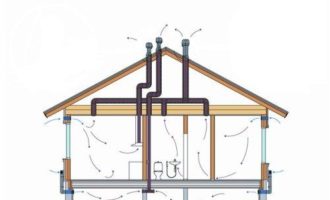
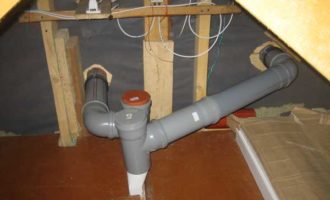
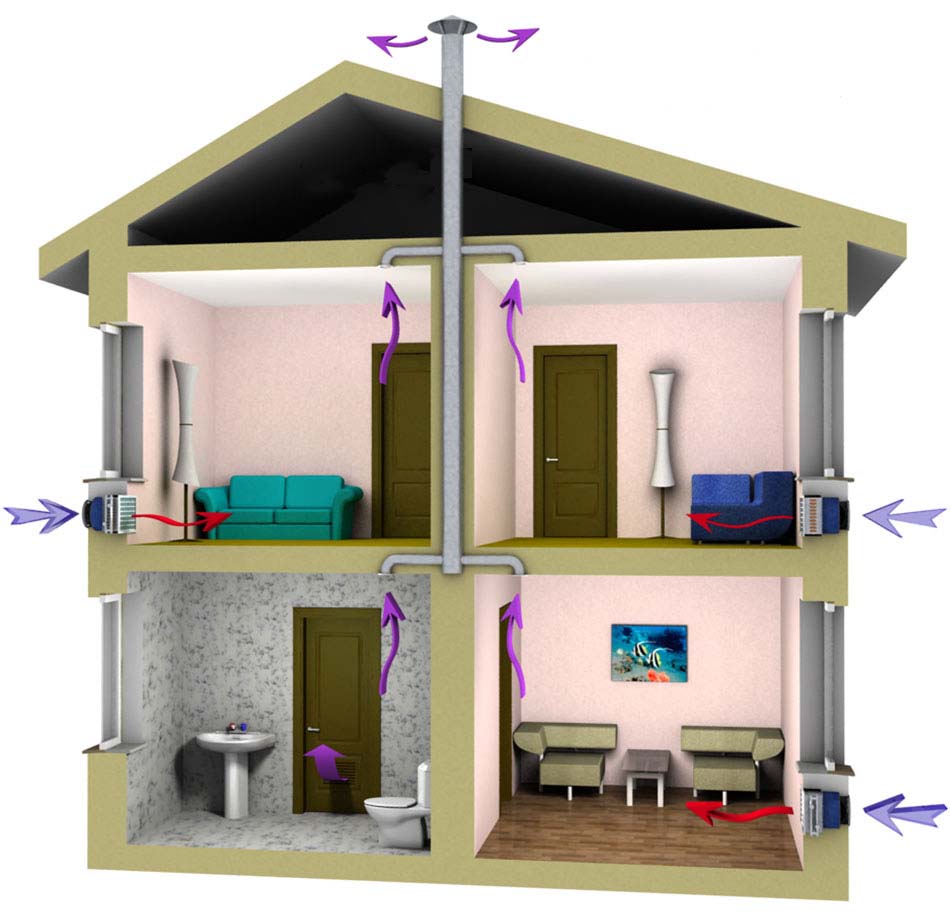
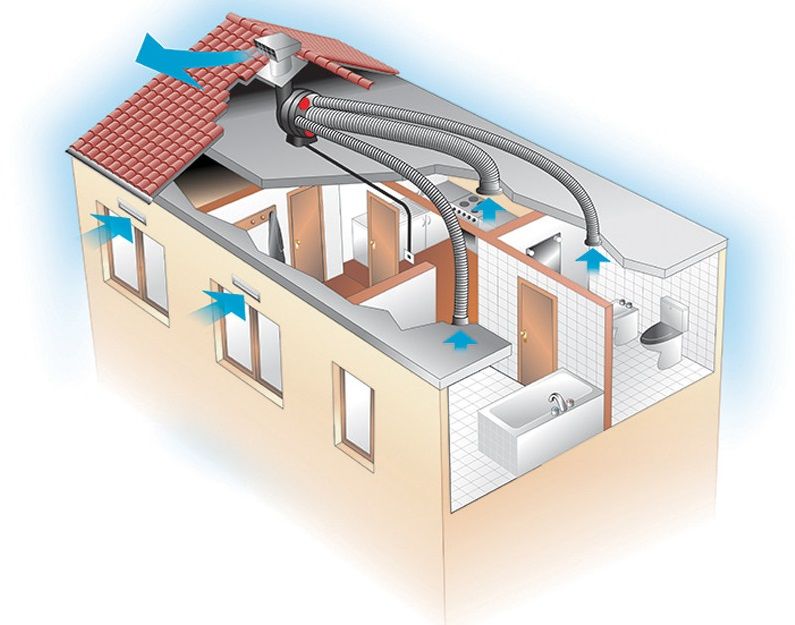
The exhaust air leaves the house through vents, ventilation shafts or air ducts. Ventilation ducts are usually brought to the attic or connected to a ventilation shaft located in the center of the house.
Ventilation ducts in the device and organization of natural ventilation of a private house are used mainly in the installation of the exhaust part of the system. Natural inflow through air ducts is most often impossible or ineffective. In order for it to work at least somehow, it would be necessary to mount a duct fan.
In natural ventilation schemes, channels provide the exhaust part of the system. Exhaust ducts in private homes are often combined into mines
To the hood of gravity ventilation, air masses are pushed by fresh portions of air drawn in through the window, the PVC window inlet or the open front door. The cross section of the air ducts is selected taking into account the air exchange standards for certain types of premises, which are given in the collection of SNiP 41-01-2003.
In addition to residential and utility rooms in a private house, ventilation systems require a basement and a storage facility built in it, a foundation without a basement, a cold attic or an equipped attic. In natural schemes, they are provided with air vents, gable and dormers.
Types of ventilation ducts
By location they distinguish:
- Embedded. They are constructed from hollow concrete or ceramic blocks, bricks. Such exhaust ducts are usually erected at the construction stage.
- Suspended. Made of galvanized steel or reinforced plastic. Installing hanging channels is quite easy, even after the house is already built.
Air ducts are divided into round and rectangular cross-sectional shapes. Each type has its own advantages:
- Round duct. Easy installation, better air exchange, less weight;
- Rectangular duct. It occupies less space, it is easier to mask boxes, false ceilings and walls.
In turn, pipes for a round duct are rigid and flexible, i.e. corrugated.


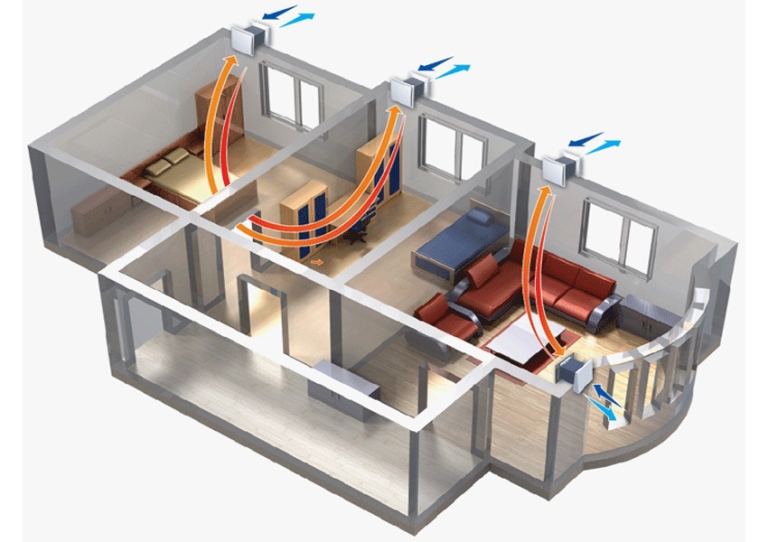
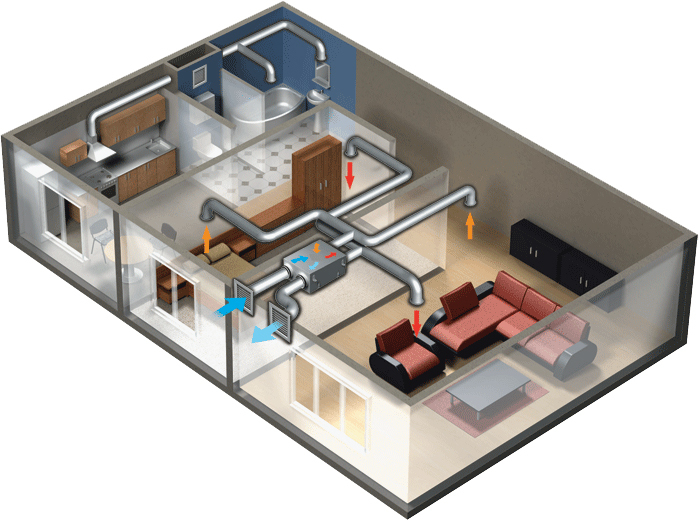
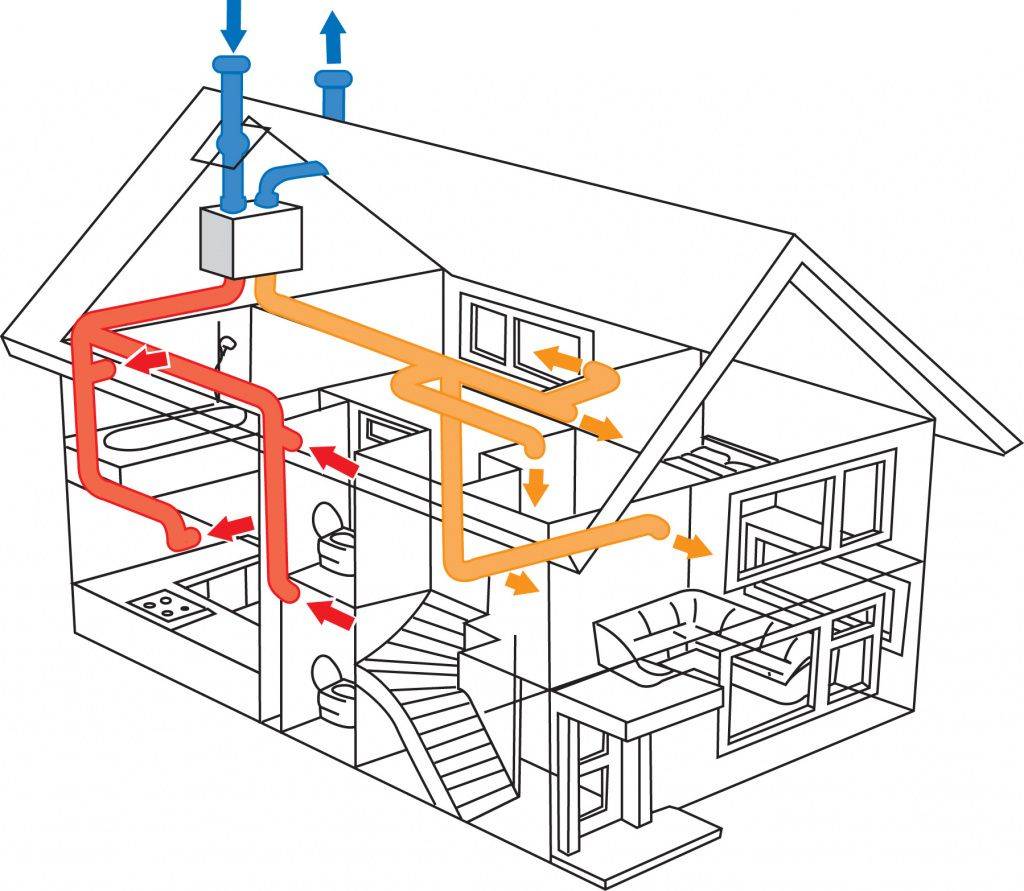


Corrugated ventilation pipes are easier to install, but their installation is possible only on horizontal surfaces and on small sections of vertical walls
Rigid pipes move air without any obstacles, so they provide the least resistance and minimum noise. However, with the help of corrugated pipes, installation is faster and easier.
What is a deflector?
The deflector is a special cap that is installed on the mouth of the exhaust pipe of the ventilation system. It cuts through the wind flow, due to which a low pressure zone is formed, while the thrust force can increase up to 20%.
Also, the ventilation deflector prevents atmospheric water from entering the ventilation system and prevents wind from blowing into the ventilation duct.
The deflector is installed at the mouth of the exhaust pipe. This device performs two important functions: increases traction + protects against atmospheric precipitation
There are the following types of deflectors:
- Cylindrical or Volper's umbrella. It is a curved cylinder covered with a plate. It has an average efficiency, well protects the ventilation ducts from wind blowing;
- H-shaped deflector. The body is made of pipes in the form of the letter H. It is distinguished by increased protection against wind blowing, moisture entering the channel and reverse thrust, but due to the design features it has a low performance;
- TsAGI type deflector. The design includes a glass with an extension at the end, an umbrella cover and a cylindrical shell. Recognized as one of the most effective. It protects well from wind, snowfalls, rains, has the lowest coefficient of resistance;
- Turbo deflector. It is a rotating ball with blades, it is characterized by increased efficiency, but usually costs a little more;
- Vane. Reminds me of a wing. The principle of operation is similar to a turbo deflector.
The choice of deflector model depends on local conditions. In regions with high wind load, ordinary fungi are preferred. In areas with low wind activity, it is better to install a deflector with a turbine, it will provide traction even with a light breath.
Equipment for the installation of a ventilation system
Installing a supply and exhaust ventilation system is a complex process. Due to the large number of complex elements in the installation, installation is carried out only using professional equipment.Its choice depends on the type of room in which the ventilation system is supposed to be installed.
To install the ventilation system, the following equipment is required:
- perforator for drilling holes with a diameter of 60 mm;
- insulation for thermal insulation of the system;
- mounting foam;
- dowels and screws are required to fix the case;
- ventilation equipment, including grilles, air filters, a check valve, fans, a housing, a generator, an air duct and an electric heater (a device due to which the air is heated). The design is sold ready-made in different variations. The choice depends on the area of the dwelling, the number of floors and the volume of air that must pass through the ventilation system;
- automatic control is a remote control with a temperature sensor, a timer and buttons for setting parameters;
- the operation of the system is improved thanks to control elements, such as gates or throttle valves;
- steel, plastic or aluminum pipes for the installation of air ducts;
- stainless cap. Serves to protect the structure from moisture.
First, the materials are checked for defects, then a test run of the device is carried out. After checking and adjusting the ventilation, devices for air intake and distribution are connected.
In conclusion, full tests are carried out, after which the exhaust units are put into operation.
Design features of the device
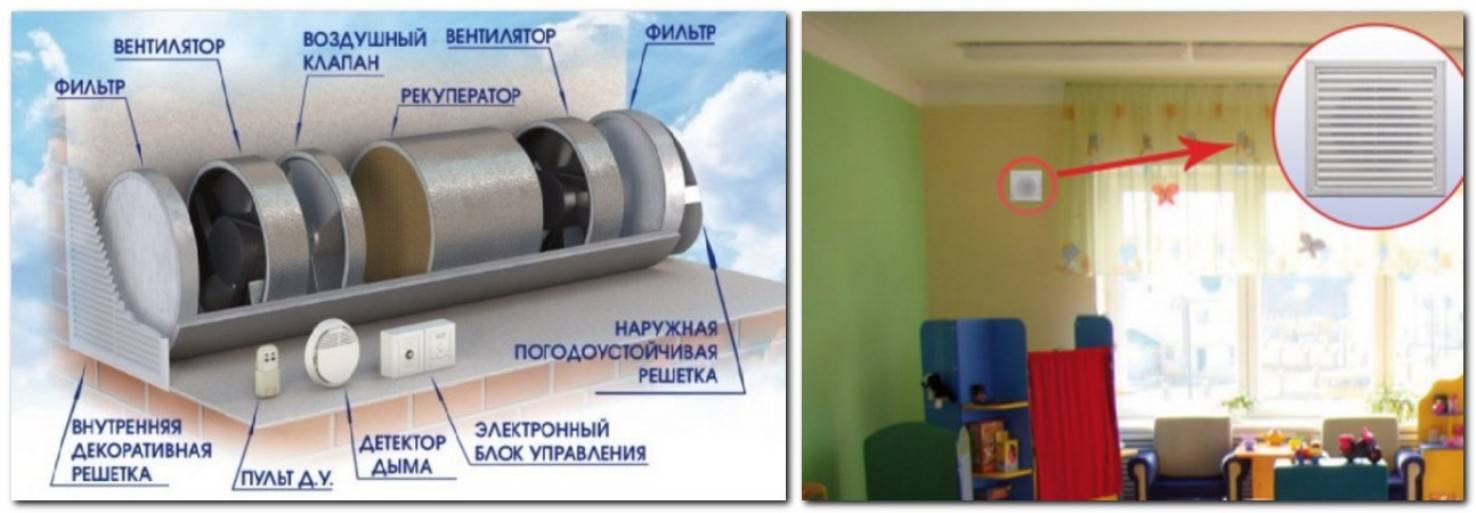
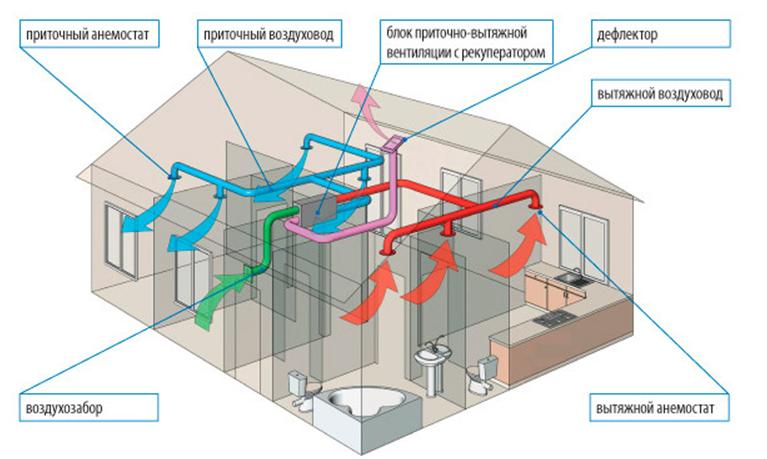
The main elements of supply ventilation
- Air intake grill. Acts as an aesthetic design, and a barrier that protects debris particles in the supply air masses.
- Supply ventilation valve.Its purpose is to block the passage of cold air from the outside in winter and hot air in summer. You can make it work automatically using an electric drive.
- Filters. Their purpose is to purify the incoming air. I need a replacement every 6 months.
- Water heater, electric heaters - designed to heat the incoming air masses.
- For rooms with a small area, it is recommended to use ventilation systems with electric heating elements, for large spaces - a water heater.
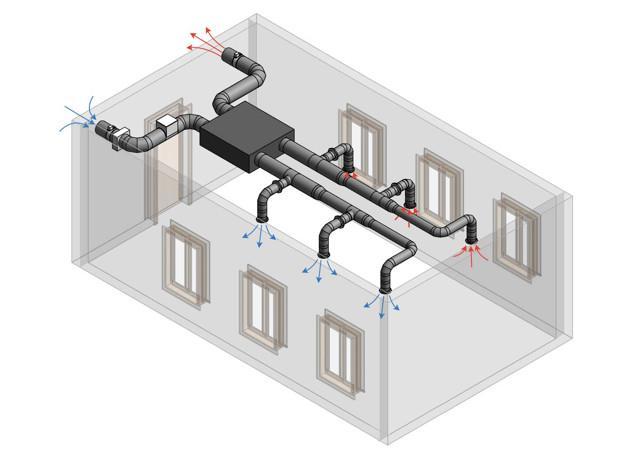
Elements of supply and exhaust ventilation
Additional elements
- Fans.
- Diffusers (contribute to the distribution of air masses).
- Noise suppressor.
- Recuperator.
The design of ventilation directly depends on the type and method of fixing the system. They are passive and active.



Passive ventilation systems.
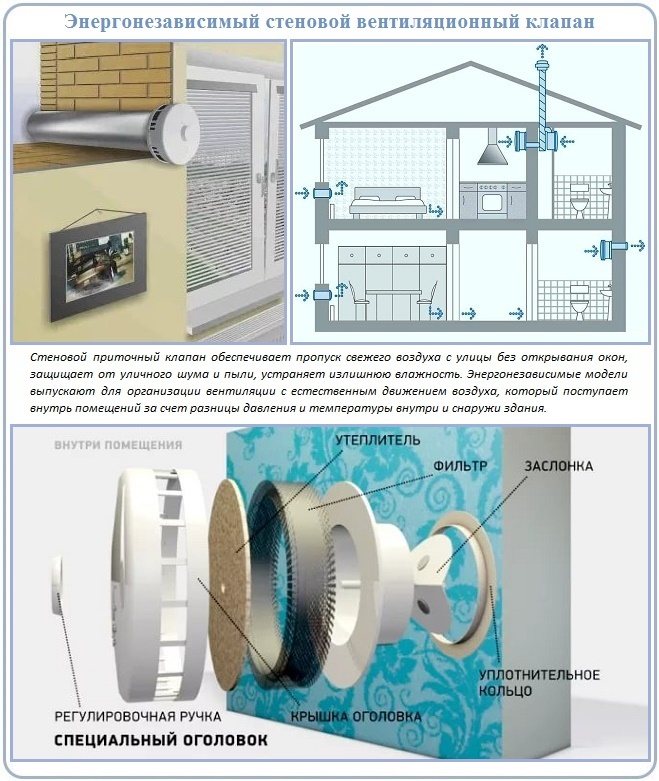
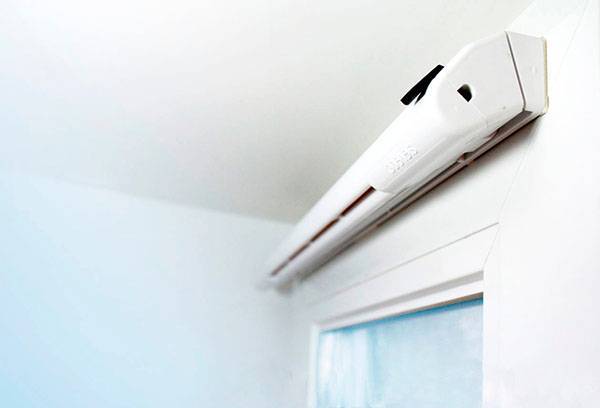
Such a device is a supply ventilation valve. The scooping of street air masses occurs due to the pressure drop. In cold weather, the temperature difference contributes to the injection, in the warm period - the exhaust fan. The regulation of such ventilation can be automatic and manual.
Automated regulation directly depends on:
- the flow rate of air masses passing through the ventilation;
- air humidity in the space.
The disadvantage of the system is that in the winter season such ventilation is not effective for heating the house, since a large temperature difference is created.
On the wall
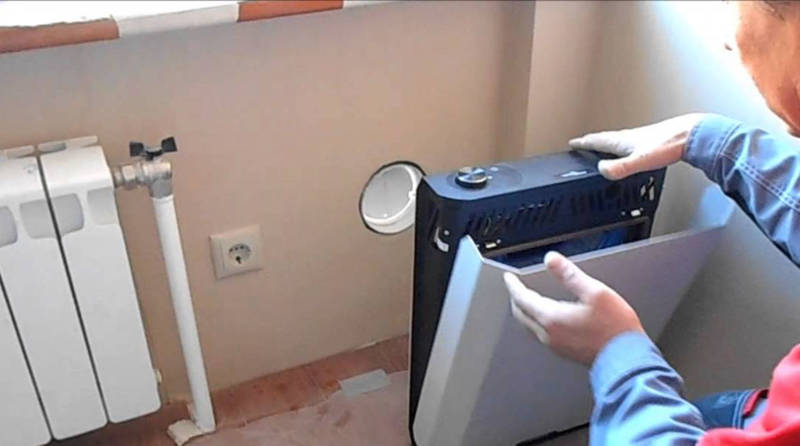
Refers to the passive type of supply ventilation. Such an installation has a compact box that is mounted on the wall.To control the heating, it is equipped with an LCD display and a control panel. The principle of operation is to recuperate internal and external air masses. To heat the room, this device is placed near the heating radiator.
Active ventilation systems
Since in such systems it is possible to regulate the intensity of fresh air supply, such ventilation for heating and space heating is more in demand.
According to the principle of heating, such a supply heater can be water and electric.
Water heater
Powered by heating system. The principle of operation of this ventilation system is to circulate air through a system of channels and tubes, inside which there is hot water or a special liquid. In this case, heating takes place in a heat exchanger built into the centralized heating system.
Electric heater.
The principle of operation of the system is to convert electrical energy into thermal energy using an electric heating element.
breather
This is a compact device, small size for forced ventilation, heated. To supply fresh air, this device is attached to the wall of the room.
Breather Tion o2
Breezer construction o2:
- Channel consisting of an air intake and an air duct. This is a sealed and insulated tube, due to which the device draws air from outside.
- Air retention valve. This element is an air gap. It is designed to prevent the outflow of warm air while the device is turned off.
- Filtration system. It consists of three filters, which are installed in a certain sequence. The first two filters clean the air flow from visible contaminants.The third filter - deep cleaning - from bacteria and allergens. It cleans the incoming air from various odors and exhaust gases.
- Fan for air supply from the street.
- Ceramic heater, which is equipped with climate control. Responsible for heating the inflow of air flows and automatic temperature control.
Air purification system for an apartment - Tion installation
The supply ventilation unit must necessarily be provided with a cleaning system, because the air entering from the outside is primarily dust. Various filtration materials are used for this. Consider how the incoming air is cleaned using the example of the Tion Breezer 02 supply unit. The photo below shows what filters this device consists of.
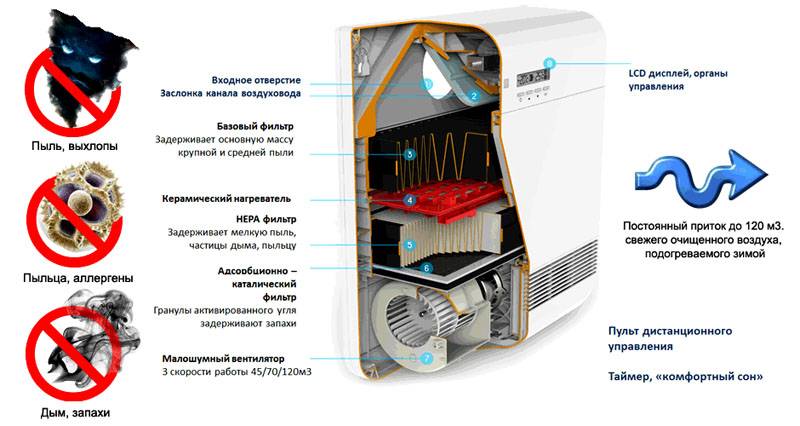 Supply ventilation installation Tion Breezer 02
The unit uses a three-stage filtration layer consisting of different filtration materials:
- The first stage traps large solid impurities.
- The second traps small particles, pollen and smoke. This is an accordion-shaped filter made of fibrous material.
- The third is an adsorption-catalytic filter that traps microbes and odors. The device is based on activated carbon with small granules.
The Tion ventilation units themselves are classified according to their performance, which depends on the size and speed of the fan. Today, the manufacturer offers three positions with a capacity of 45, 70 and 120 m³ of air per hour.


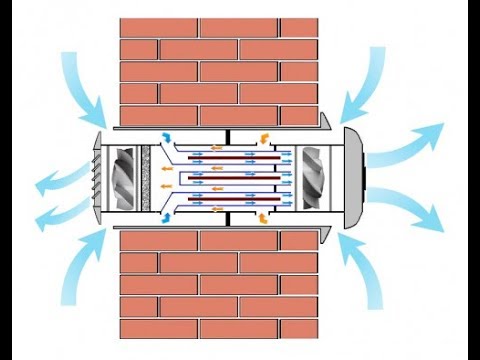


As for ordinary wall valves, inside them there is a filter for air into the apartment in the form of material rolled into a cylinder.Here, manufacturers use materials that are different in structure, the main requirement for which is the maximum purification of the supplied air. The filter can be installed either inside the valve pipe, or in an outdoor unit installed on the inner wall of a room in an apartment.
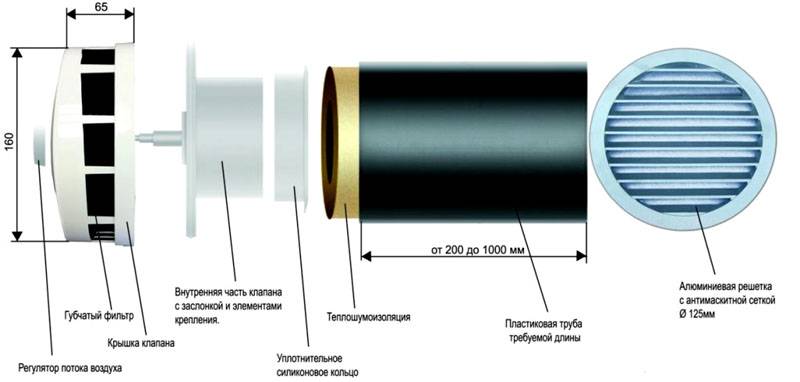 Air valve with filter located inside the cover
The choice of air filters for the apartment
The choice of filtration material must be approached from a two-sided position. The denser it is, the cleaner the air at the outlet, but at the same time the speed of passage of air masses decreases, and, accordingly, the performance of the valve itself. Therefore, filters are divided according to the degree of purification:
- Mesh filters that trap contaminants with sizes within 10 microns. They belong to the category of coarse filters marked G3 and G
- Medium cleaning materials, referred to as G5, which trap particles in the size range of 1 µm.
- Absolute cleaning. These are materials through which only the smallest particles with sizes less than 0.1 microns pass. Their marking is G7.