- Combined ventilation: step-by-step instructions for installing a duct fan
- Calculation and ventilation device
- When is a regular hood not enough?
- Calculation of air exchange taking into account heat and moisture
- Recommendations for choosing ventilation
- Installation nuances
- Video description
- Conclusion
- Device and circuit
- Types of cellar ventilation systems
- Features of natural air circulation
- Forced air exchange systems
- Basement ventilation systems
- Dual channel ventilation device
- Single channel ventilation
- Each cellar has its own ventilation
- Basement ventilation duct scheme
- Scheme
- basement building requirements
Combined ventilation: step-by-step instructions for installing a duct fan
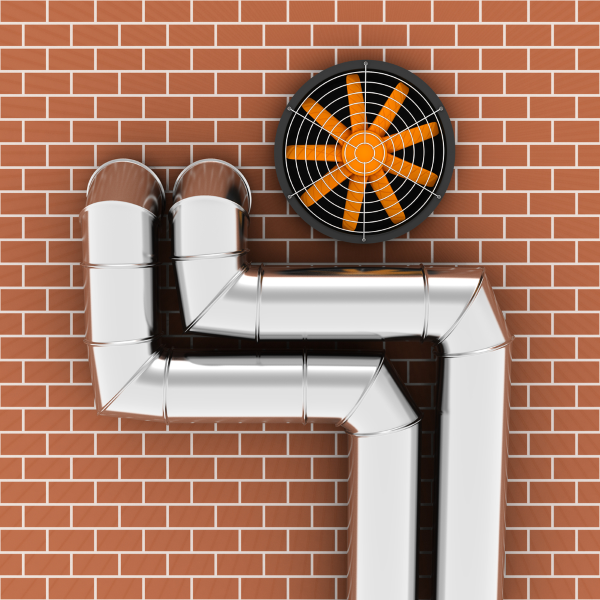
To make the system work more efficiently, a duct fan is mounted in the pipe or at its end. Its installation is simple, it is carried out without problems with your own hands. You will need the fan itself, mounting hardware, which is usually included in the kit, and fasteners suitable for this type of wall. It is not recommended to use the device without strong fixation to the wall. During the operation of the engine and the movement of air in the channel, vibrations occur, which can lead to the weakening of all components of the system.
First, a gap must be made in the duct, equal in length to the dimensions of the fan.If the installation is carried out in series, the section of pipe adjacent to the equipment is not rigidly fixed to the wall so that further manipulations can be done.
Couplings or clamps are used to connect the fan to the duct. The nodes must be as tight as possible so that there is no air access from the outside, except for the channel. Then the efficiency of the device is maximum.
It is necessary to follow the direction of the air supply. If the fan is installed incorrectly, instead of the hood, pressure will follow, that is, the system will not work.
Holes are drilled in the wall, anchors are installed. Mounting perforation is provided on the fan housing, with which the device can be fixed.
Pipes are brought to the supply and outlet and connected to the equipment with clamps.
This is what the finished assembly looks like
If the diameters do not match, adapters are used. The power connection is made according to the instructions for the device. During electrical work, safety precautions must be strictly observed.
Calculation and ventilation device
 Various cellar ventilation schemes
The type of ventilation installed is largely determined by the size of the basement. If it is small, you can simply drill a few holes in the walls.
But the ventilation scheme in a larger cellar will look a little more complicated. The best way to ventilate large rooms is to use the supply and exhaust type of ventilation, which provides efficient air exchange in the room, maintaining the optimal temperature for food storage at any time of the year.
If we are talking about industrial premises, special fans are installed in them for a constant flow of air.However, for domestic use, such ventilation of the cellar is too expensive and impractical.
To understand how to properly ventilate the cellar, it is necessary to carry out a series of calculations. The first thing to do is to calculate the area of the basement.
To supply sufficient air, the area of the ventilation ducts should be 26 cm2 for every 1 m2 of room area. Based on this, determine the total area of the exhaust pipes.
For example, a basement of 6 m2 of area will need 156 cm2 of ventilation pipes. To calculate the diameter, the square root is taken from the resulting sum and divided by π (3.14). Thus, the diameter of the pipe will be 14 cm.
However, in order to ensure unhindered inflow and removal of air masses from the basement, ventilation is arranged with a pipe diameter 10-15% larger than the value obtained.
When is a regular hood not enough?
In a number of situations, you can get by with the usual natural supply ventilation, which is so popular with suburban homeowners. It will not require serious costs for the arrangement and operation, however, one can argue about the effectiveness of its work (especially in the summer). A natural hood does not need additional fans in the cellar, so the installation costs are really minimal (you only need to buy pipes and protective caps).
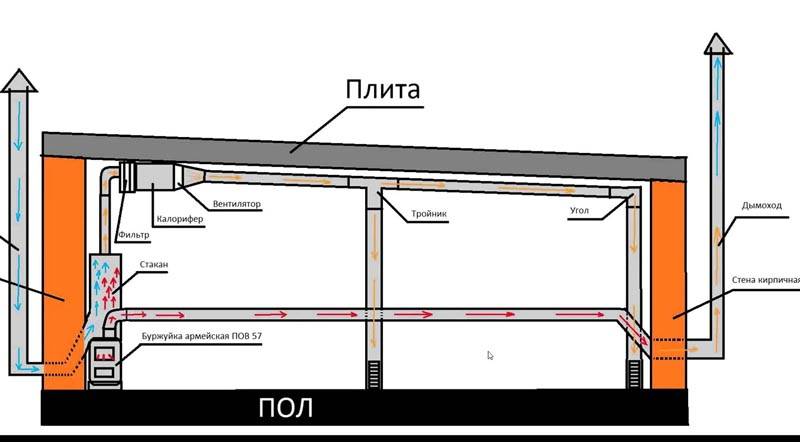
Air ducts fixed on the wall of the cottage.
However, natural ventilation will not give the desired effect if:
- The basement has an area of 40 sq.m. and more. In large storage facilities, in the absence of good ventilation during the winter months, the warm air inside is saturated with moisture.In the chimney, moisture condenses and remains on its walls (this happens according to the laws of physics, due to the temperature difference). Drops of condensate quickly accumulate, and due to the negative temperature they soon turn into frost. When frosts last for several days, frost closes the exhaust pipe with a dense layer, which excludes the normal movement of air outside. This moisture can be eliminated only with the help of fans in the cellar, which are placed inside the supply and exhaust pipes. An exception is the situation when the basement is divided into several rooms and natural ventilation pipes are installed in each. Then a forced ventilation device in the basement is not required.
- Natural ventilation is indispensable in those basements where it is planned to make living rooms, or rooms in which people will stay for a long time (workshop, bathhouse, gym, etc.). Only an extractor hood based on the operation of a cellar fan will be able to supply oxygen in sufficient quantity for a comfortable stay of people.
- Also, good fans in the cellar are needed if there is a large amount of food in the storage. In the case of a vegetable cellar, the hood will fight not only with humidity, but also with unpleasant odors.
Calculation of air exchange taking into account heat and moisture
If it is necessary to calculate the air exchange, taking into account the elimination of excess heat, the formula is used:
L=Q/(p•Cр•(tat-tP))
Wherein:
- p is the air density (at t 20°C it is equal to 1.205 kg/m3);
- CR – heat capacity of air (at t 20оС is equal to 1.005 kJ/(kg•K));
- Q - the amount of heat released into the basement, kW;
- tat – temperature of the air removed from the room, °C;
- tP – supply air temperature, oC.
The need to take into account the heat removed during ventilation is necessary to maintain a certain temperature balance in the basement atmosphere.
In the basements of private houses, gyms are often arranged. In this option of using the basement, full air exchange is especially important.
Simultaneously with the elimination of air in the process of air exchange, the moisture released into it by various moisture-containing objects (including people) is removed. The formula for calculating air exchange, taking into account the release of moisture:




L=D/((dat-dP)•p)
Wherein:
- D is the amount of moisture released during air exchange, g/h;
- dat – moisture content in the removed air, g water/kg air;
- dP – moisture content in supply air, g water/kg air;
- p – air density (at t 20оС it is 1.205 kg/m3).
Air exchange, including the release of moisture, is calculated for objects of high humidity (for example, swimming pools). Also, the release of moisture is taken into account for basements visited by people for the purpose of physical exercise (for example, a gym).
Consistently high air humidity will greatly complicate the work of forced ventilation of the basement. Add-on required ventilation filters for collection of condensed moisture.
Recommendations for choosing ventilation
In order for basement ventilation to be effective, it is important to consider a number of factors when designing a project. The climate of the area, the temperature conditions in the region and the specifics of using the basement have a significant impact on the operation of the ventilation system.
The natural ventilation system works best in winter, when there is a big temperature difference inside the basement and outside. Due to this, air circulation occurs.
In winter, it is necessary to ensure a minimum air exchange in order to avoid too much freezing of the room and spoiling the food that is there. To maintain the desired temperature in severe frosts, it is recommended to close the vents.
The only true solution for air conditioning the basement during the hot season is the installation of a forced or combined air exchange system, since due to the minimum temperature difference, the natural movement of air practically stops.
If the cellar is small in size, then one pipe is enough for high-quality air conditioning. However, it must be divided into two parts by a vertical partition.
In this case, one channel will serve for the flow of air into the basement, and the second - for its removal from the room. Each of the channels must be equipped with valves that regulate the intensity of the air supply.
If you attach a sheet of paper to each of the holes, you can check whether air is moving through them.
Installation nuances
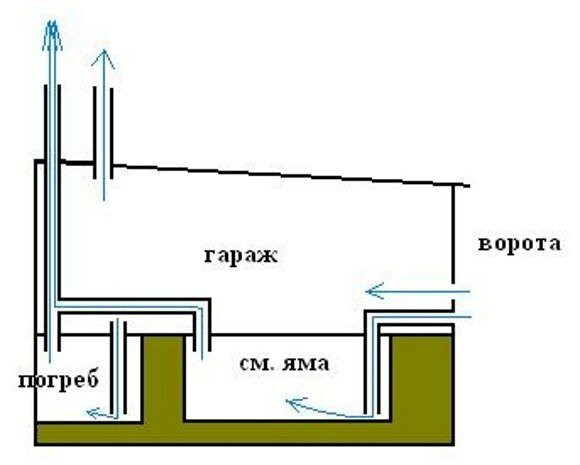
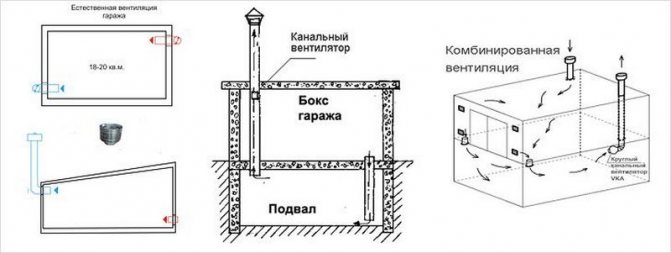
It is not always possible to provide air flow from the street, for example, in the box of a cooperative garage or built into the house. In such cases, the upper end of the supply pipe is led directly to the garage not far from the gate, and ventilation grilles are installed in them.

Scheme of natural ventilation without the outlet of the supply pipe to the street
Before making an vent in the cellar, it is necessary to determine the diameter of the pipes, which is especially important when arranging natural ventilation.The easiest way to calculate it is by the formula, according to which the cross-sectional area of \u200b\u200bthe pipe should be equal to 26 cm2 per square meter of the room .. For example, if the cellar area is 5 m2, then the cross section should be 130 cm2
Using the formula for the area of a circle, we find the diameter: 12 cm. If the pipes of the desired section are not found, products of a larger diameter are taken.
For example, if the cellar area is 5 m2, then the cross section should be 130 cm2. Using the formula for the area of a circle, we find the diameter: 12 cm. If the pipes of the desired section are not found, products of a larger diameter are taken.
In such rooms that are not demanding on aesthetics, such as basements, cellars and garages, you can install any pipes - asbestos-cement, sewer, special ventilation ducts. The latter have an antistatic layer on the inner surface, which does not allow dust to settle on the walls and gradually narrow the working lumen of the channel. But they are not cheap either.

Plastic air ducts are round and rectangular sections
Therefore, the most popular option is polypropylene sewer pipes, which are attractive for their low price and ease of installation when using couplings, angles and tees with sealing rubber rings that ensure the tightness of the joints. But they do not differ in a wide variety of diameters. And this is one of the reasons why a mixed type of ventilation is preferred. In this case, the diameter of the duct is not so important, because the flow of air passing through it is accelerated due to artificially created traction.



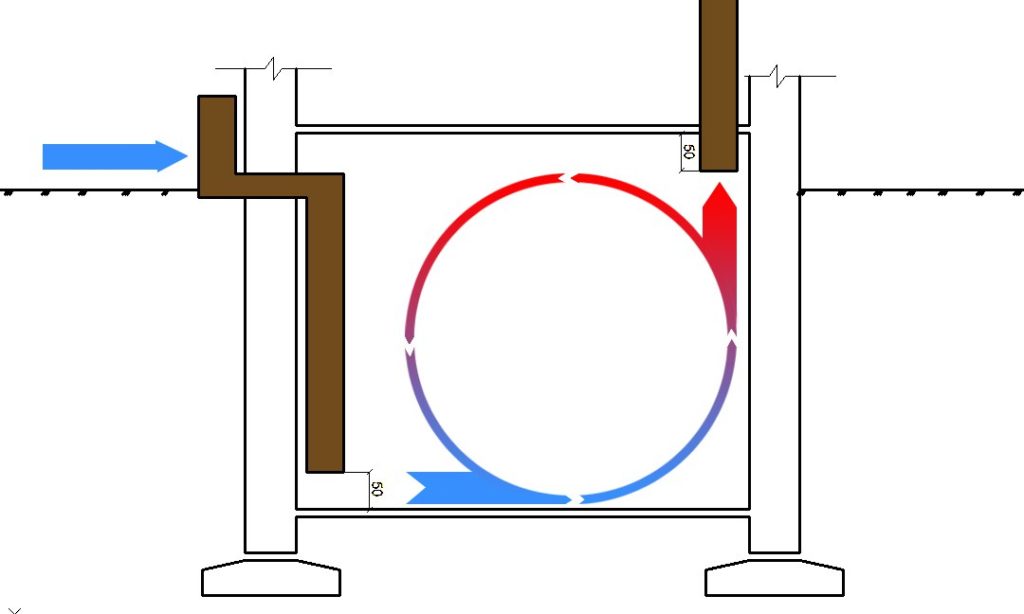


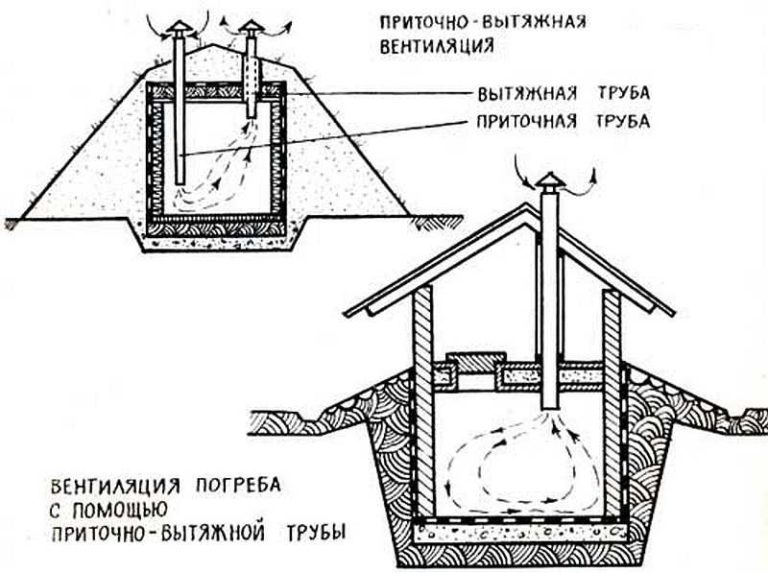
During installation, you need to remember the following rules:
- the fewer turns the air duct has, the better it provides fresh air;
- diameter throughout should not change;
- the places where pipes pass through walls and ceilings must be sealed with mounting foam or cement mortar.
Video description
The installation option for a ventilation system made of asbestos-cement pipes is described in the video:
Conclusion
Knowing the physical principles of air movement, it is easy to understand how to make ventilation in the cellar of the garage. The circulation of air masses is provided by only two pipes installed at different levels. This is enough for small storages. By supplying the system with fans, it is possible to maintain a normal microclimate in large damp basements, thereby not only preserving the crop, but also not exposing the car to the risk of rusting ahead of time.
Device and circuit
- Straight exhaust pipe.
- A pipe for insulation of a larger diameter than an exhaust pipe.
- Warming material.
- Container and faucet for removing condensate.
- Supply pipe with bends.
- Grid from rodents and insects.
- Special valves for pipes.
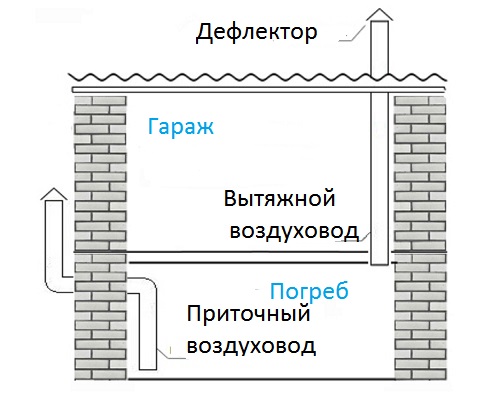
Ventilation device in the cellar of the garage:
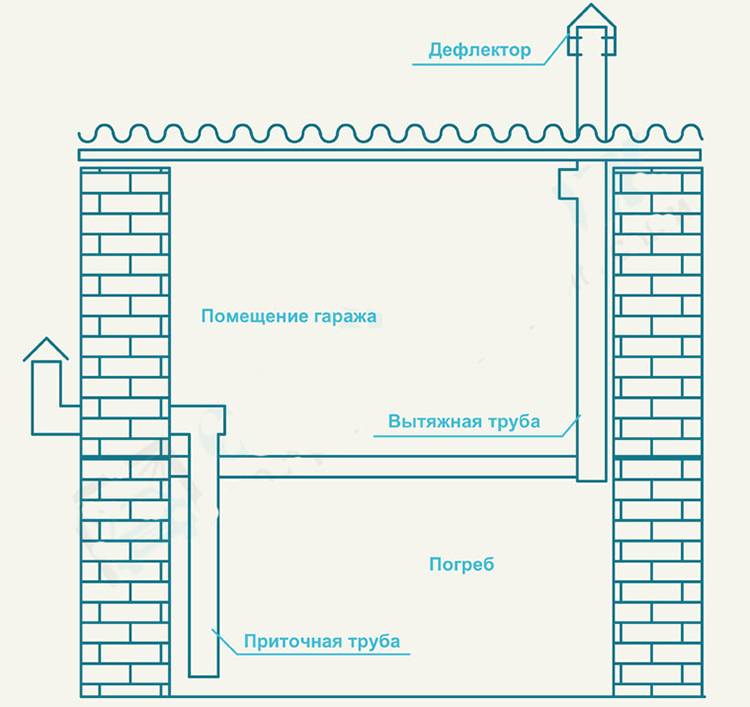
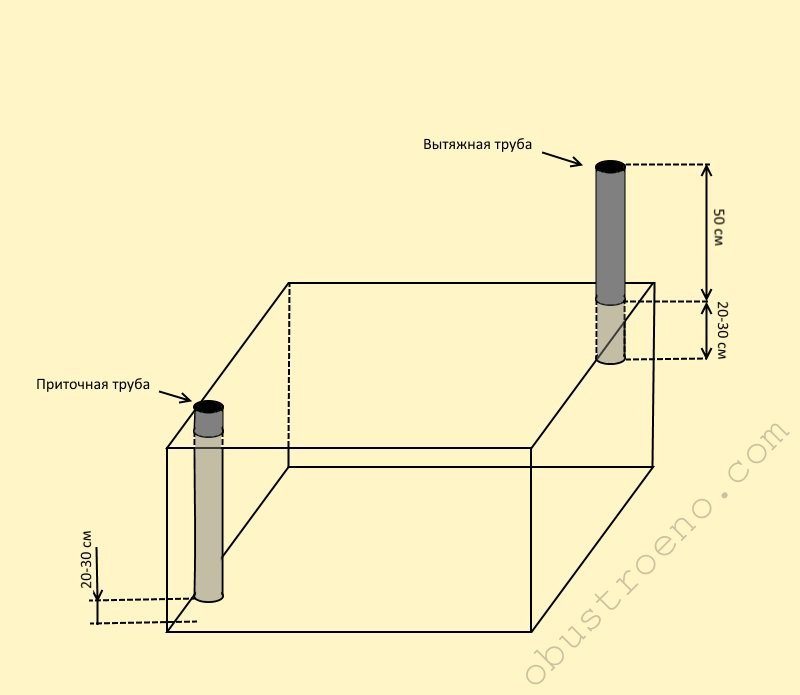
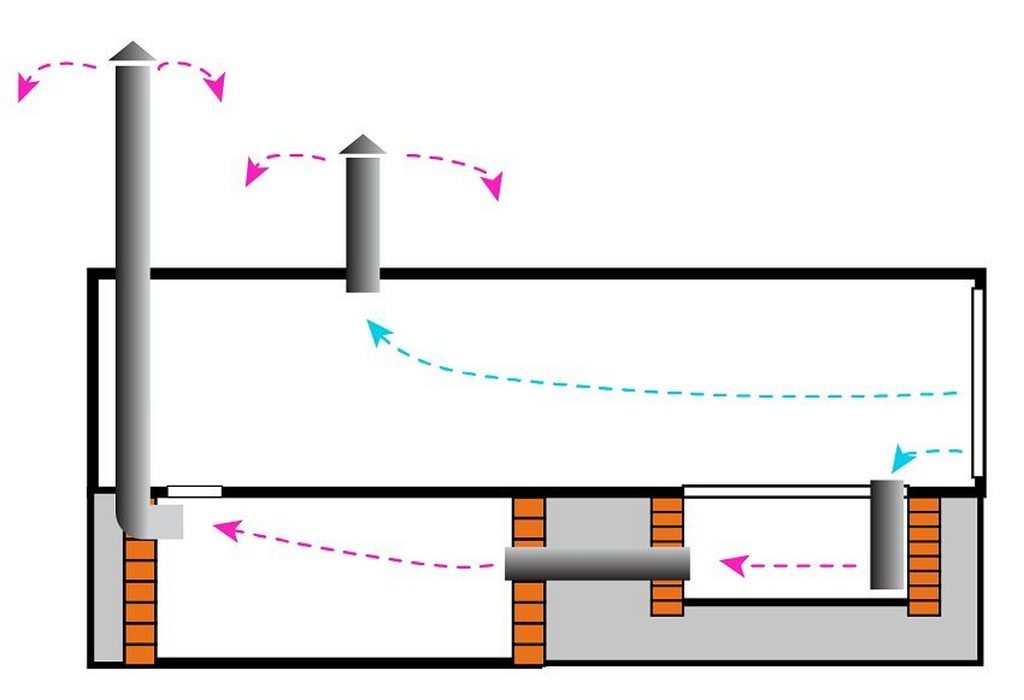
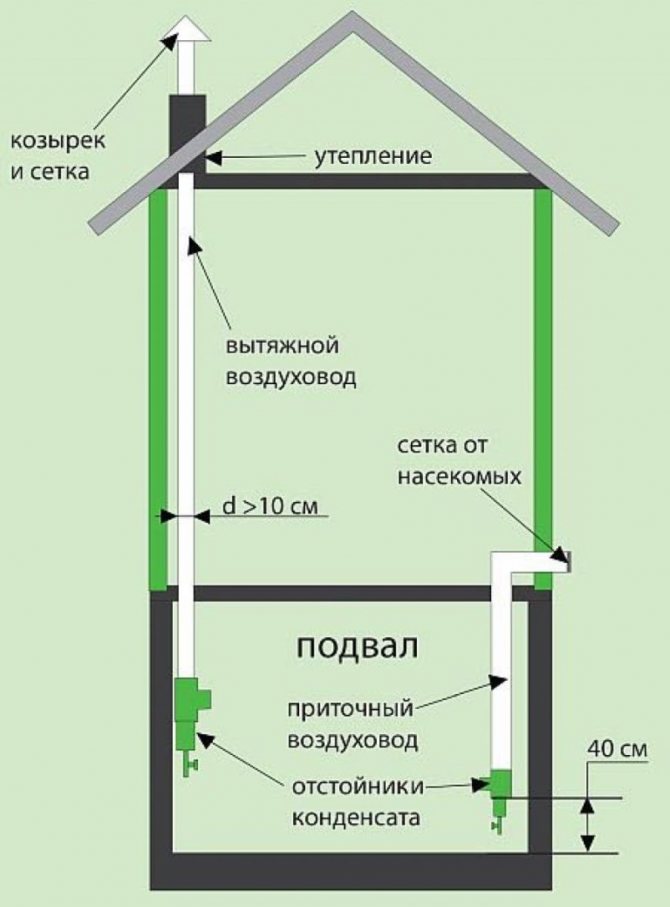
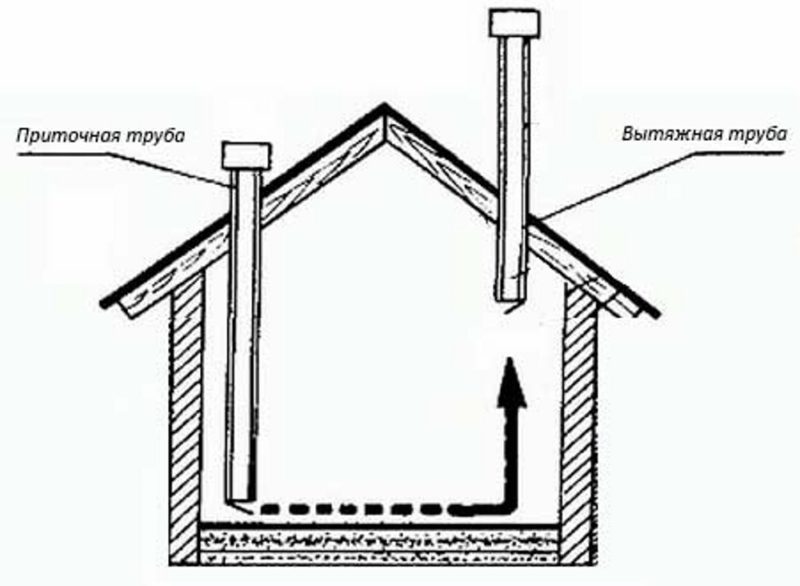
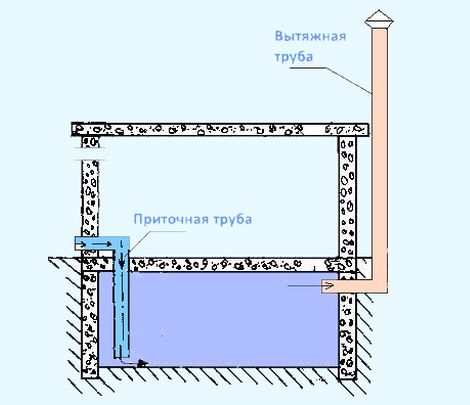
- The exhaust air duct is installed vertically through the ceiling and leads to the roof of the garage. It is best to equip it in one of the corners of the room. The pipe must exit in such a way that its upper end rises above the roof ridge by at least 50 cm.
- The lower edge of the exhaust pipe is located under the ceiling, above the level of the supply air duct.
- The exhaust air duct is equipped with a tap that is used to drain the condensate.
- To reduce the level of formation of condensate and frost in winter, the exhaust duct is insulated.
- The supply pipe is installed in the opposite corner from the hood. In the basement, it should end at a distance of 50-80 cm from the floor.
- The upper end is brought out through the ceiling and goes into the side wall of the garage. It rises above the ground by 50-80 cm. To protect against rodents and insects, the inlet of the "inflow" is equipped with a special protective mesh. You can buy it or choose from the available options. The main thing is that the cross section is small, and the material is strong and stable.
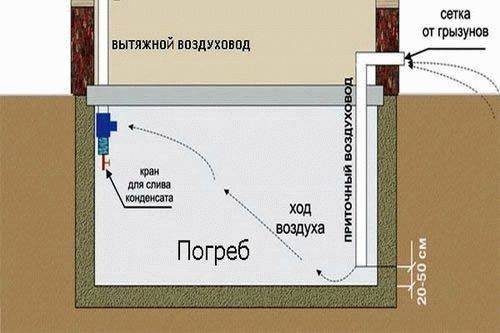
Exhaust duct scheme
To insulate the exhaust system, a system is perfect in which the pipe is placed in another pipe of a larger diameter, and the space between them is filled with insulation (mineral wool or other similar material). The thickness of the insulation should not be less than 50 mm.
With the help of such a supply and exhaust system, the air in the room is constantly updated. The movement of masses is carried out independently due to the difference in the specific gravity of cold and warm gases. The difference in the height of the pipe inlets allows the air masses to move freely.
In a natural system, a large difference in temperature, characteristic of winter, should not be allowed. Otherwise, drafts with a high speed of movement of air masses will occur. This will lead to freezing of the room and everything that is there. To solve this problem, it is recommended to equip pipes with special valves, with the help of which, if necessary, block the inlet or outlet of air masses.
With a forced ventilation system, the circuit is supplemented by fans that are mounted on the exhaust and supply lines. Here, a competent calculation of the electrical networks of the garage and the adjacent cellar plays an important role.
Requirements for electrical networks in the basement:
- the capabilities of cables and equipment must meet the planned loads;
- switches, sockets must be protected from moisture and condensation.
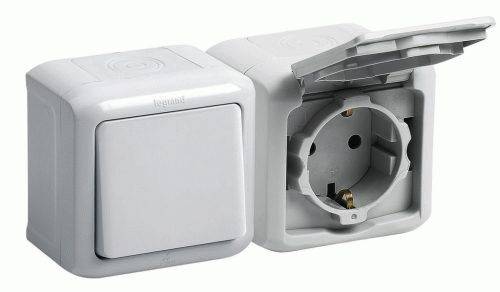
One of the main requirements for electrical networks in the basement is the use of sockets with moisture protection.
Large basement area.
Storage of a large number of products, vegetables and root crops.
The importance of maintaining a certain level of microclimate.
High humidity level.
Types of cellar ventilation systems
Several methods have been developed for arranging the ventilation system in the cellar: it is possible to install ready-made fans or you can organize air exchange on your own.
Home-made ventilation in the basement is used in domestic conditions, but factory-made fans are installed in large storage facilities.
Ventilation in a private house or a large storage facility is of two types:
- forced system - consists in the installation of fans. They are used to ensure air circulation in large rooms;
- with a natural type of ventilation, air exchange occurs without the help of devices. The owners of the basement can only occasionally turn on the fans to dry the room.
How the ventilation system works, we will consider further.
Features of natural air circulation

Correct and incorrect system of natural ventilation of the cellar
Natural ventilation of the cellar is provided due to the temperature difference in the room itself and outside it. There are processes in which fresh air from the outside begins to move through the pipes, displacing stagnant moist air from the cellar.


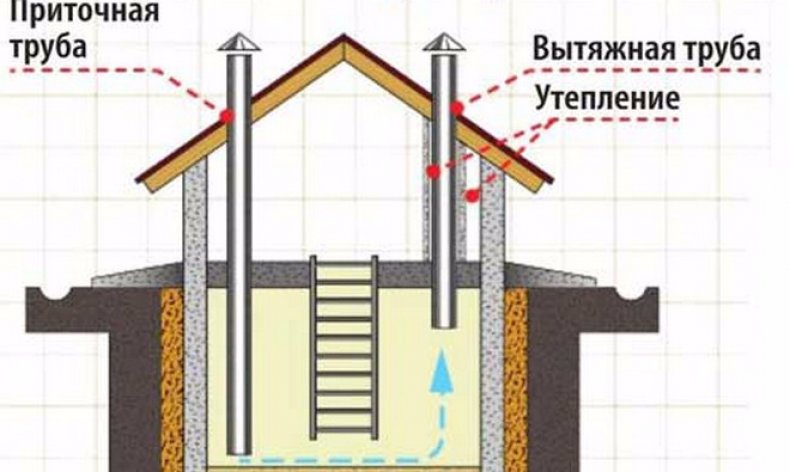
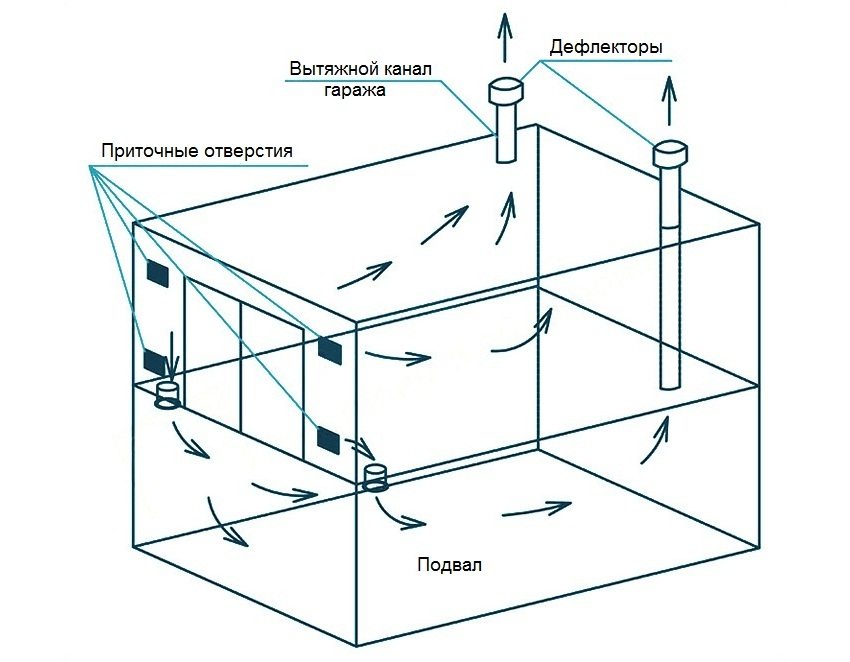
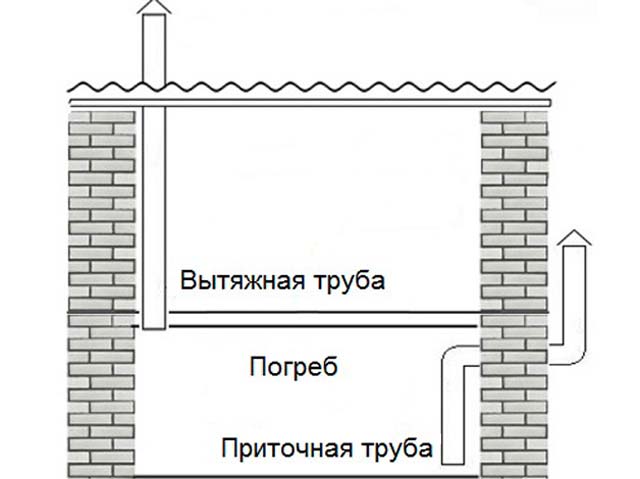
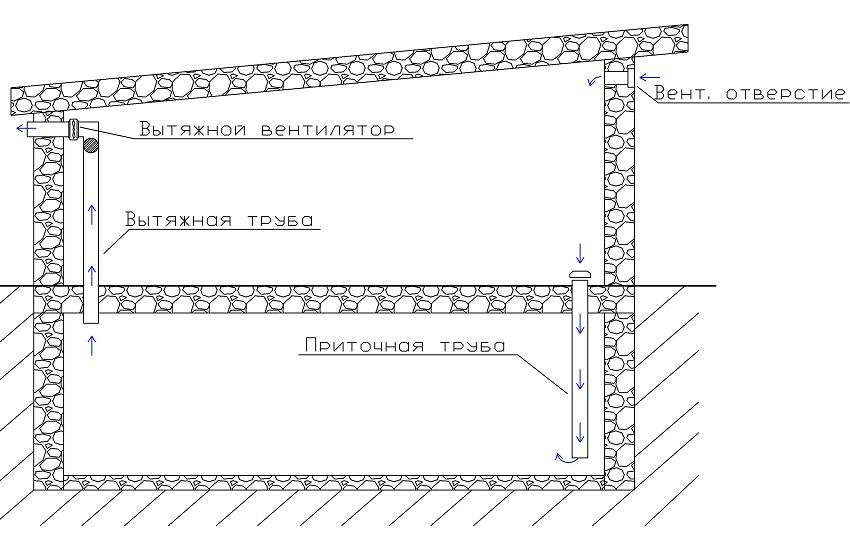

The main elements of the natural ventilation of the cellar are:
- The supply line, which has a special protective mesh at the inlet.
- An exhaust duct designed to remove air from the basement, and having a visor at the outlet, and in the basement itself - a device for accumulating condensed moisture.
- Air vents in the plinth area to ensure air exchange.
- This ventilation system is quite simple, but has some drawbacks. Firstly, it cannot provide a sufficiently efficient circulation of air flows. Secondly, the intensity of air movement largely depends on weather conditions.
The installation method of the future ventilation system must be considered at the design stage so that unforeseen complications do not arise. After carrying out all the calculations, the throughput of the highways is calculated taking into account the parameters of the basement.
It is most appropriate to install the exhaust duct in the ceiling, and the outlet of the line should be at a height of at least 0.6 m from the roof of the building.
Forced air exchange systems
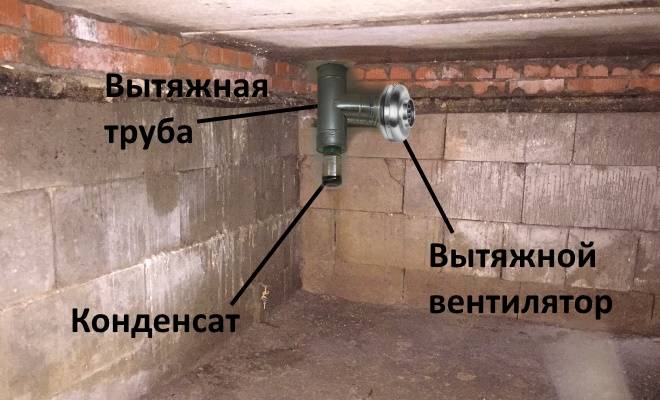
Extraction in the cellar with forced air supply involves the use of auxiliary exhaust fans. Such devices can be equipped with filters, heaters and temperature controllers.
Forced ventilation in the cellar includes the following main elements:
- highways for transporting air flows;
- a special installation that serves to pump air and allows you to control the rate of air exchange;
- temperature control sensors during operation of the ventilation system;
- ventilation outlets;
- air intakes;
- diffusers;
- tees.
The forced-air ventilation system has the following advantages:
- stable operation in all weather conditions;
- automation that allows you to control the temperature and intensity of air flows;
- Ability to operate in large areas.
Such systems are not in great demand, since they require significant costs for the installation of special equipment. In addition, their installation is quite difficult for non-professionals.
Installation of the forced ventilation system must be carried out in accordance with a pre-developed plan. At the same time, it will be necessary to calculate the intensity of air exchange and the cyclical switching on / off of ventilation.
Basement ventilation systems
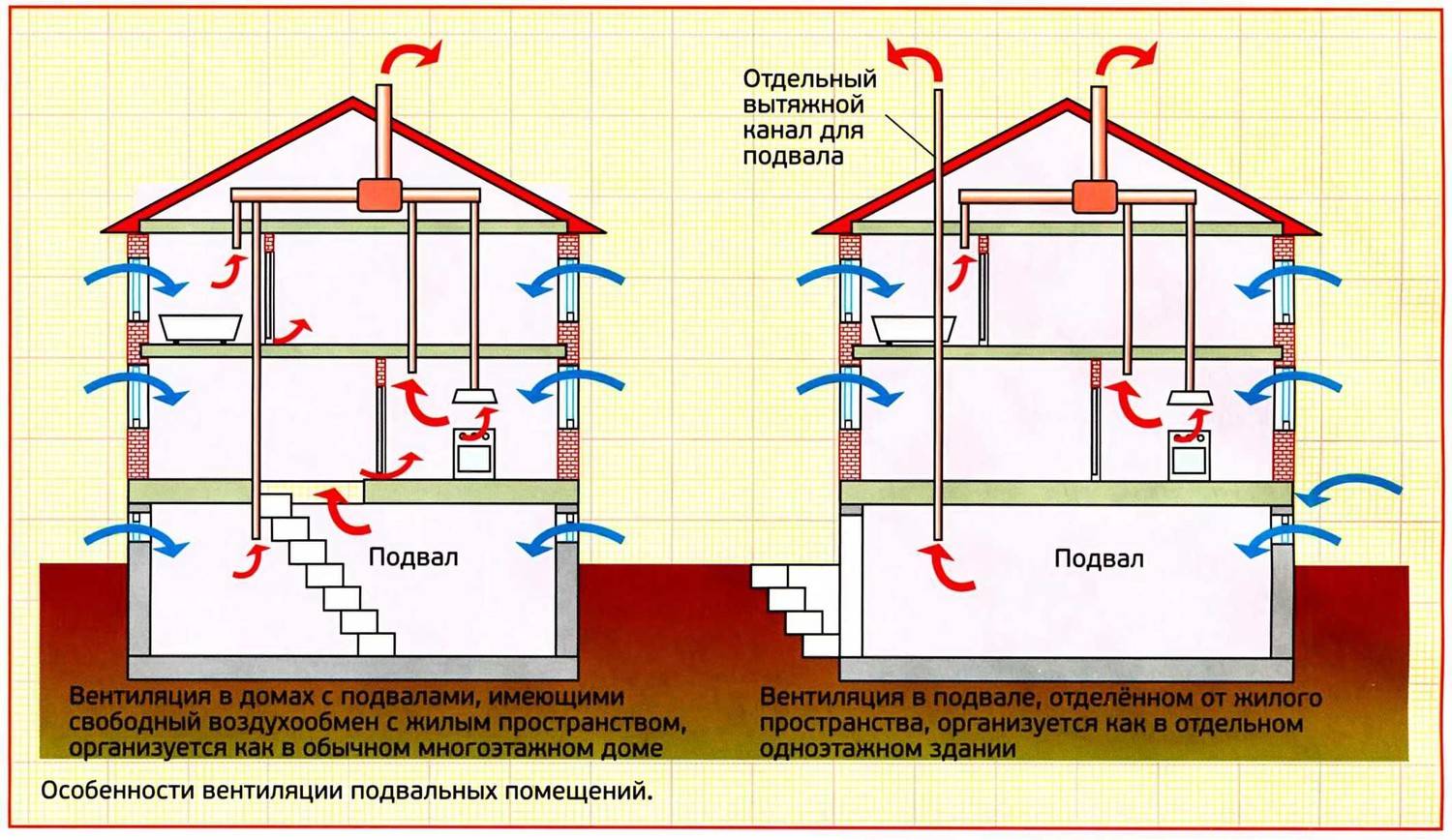
The most common version of the basement arrangement involves the location of the cellar under the main rooms of a private house. In this case, two options for the exhaust device are used:
- dual channel;
- single channel.
The first one is used most often. It has a number of advantages in terms of servicing a larger cellar room.
Dual channel ventilation device
The ventilation technology with two points of inflow and outflow does not have any difficulties in installing air ducts.
Basement ventilation, with the ideal development of the building process at home, should be calculated at the start of construction. So you will manage less financial and labor costs.
Air supply pipe.
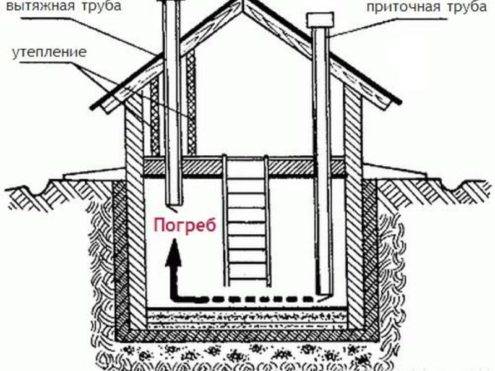
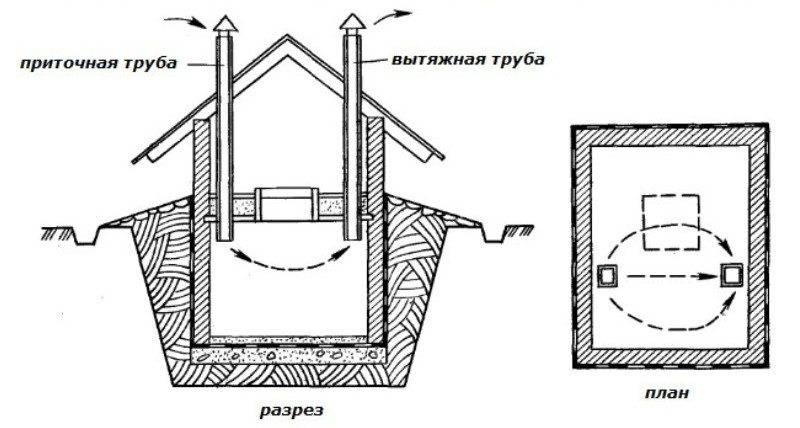
The inflow device ensures the supply of air masses from the environment by means of air intake through the inlet (vent). The air is most often located near the side wall of the main building - the elevation above the level of the house blind area should be 20-30 cm.
The hole in the pipe itself is closed with a ventilation grill. If necessary, the grate can be equipped with an axial fan.The air duct is laid through the base of the house, the basement floor and is introduced into the basement. The ventilation outlet is pulled almost to the cellar floor, retreating 15-20 cm. Due to this arrangement of the ventilation duct, cool air from the street enters the duct, passes through it and enters the basement near the floor. After that, it gradually heats up and the upper layers of warm and humidified air are forced out of the basement through the exhaust pipe.
System of outflow of the polluted masses.
It is located in the opposite corner of the cellar, diagonally relative to the supply pipe. The main principle is the need to capture heated air. This is achieved by placing the pipe entrance under the very ceiling of the basement (10-15 cm from it). Further, the exhaust channel passes through the ceiling of the main building, through the attic to the roof.
Depending on the shape of the roof and the prevailing wind rose, it is necessary to achieve conditions under which the wind is directed to the pre-installed deflector above the chimney. A deflector is needed in any case, as it protects the pipe from atmospheric precipitation entering it. It also additionally creates negative pressure under the cover, due to which the air flow in the pipe increases.
The exhaust channel should be equipped in several layers to create the necessary insulation. To do this, at the stage of planning premises and engineering networks at home:
- mount a brick or wooden well for the cellar ventilation pipe;
- choose a place for laying insulation between the well and the pipe;
- wrap the pipe itself with a special insulation that will not absorb moisture.
It is necessary to insulate the exhaust duct so that during the cold period of time air condensation does not occur due to sudden cooling.
Single channel ventilation
In rare cases, when the cellar area is less than 5 sq.m., it is possible to combine the oxygen inflow and outflow channels in one pipe. This is the basic principle of operation of this system and the main difference from the two-channel arrangement. The pipe is separated by a partition, through which two circulation channels are obtained: one for the inflow, the second for the exhaust.



Each cellar has its own ventilation
For a buried vegetable store located under a private house, forced, i.e. mechanical ventilation is not required.
Vegetables stored in the cellar in winter cannot be heavily ventilated by natural methods. They will simply freeze - frost on the street
According to the design standards for vegetable stores NTP APK 1.10.12.001-02, ventilation, for example, potatoes and root crops should occur in the amount of 50-70 m3 / h per ton of vegetables. Moreover, in the winter months, the intensity of ventilation should be halved so as not to freeze the root crops. Those. in the cold season, the ventilation of the home cellar should be in the format of 0.3-0.5 air volume of the room per hour.
The need for forced ventilation in the cellar arises if the scheme with the natural movement of air flows does not work. However, the elimination of sources of waterlogging of the air will also be required.
Image gallery
Photo from
A forced ventilation device is necessary if, for technical reasons, the natural movement of air is difficult or impossible
Forced ventilation will ensure stable removal of moisture from basements and semi-basements, prevent the development and resettlement of fungi
Regardless of whether the cellar is organized in a basement, garage or in a separate building, it must be equipped with supply and exhaust openings.
Forced ventilation is required to remove carbon dioxide and toxic volatile substances, often formed during storage of products, thereby extending their shelf life.
Fan for forced ventilation
Removing excess moisture from the cellar
Air inlet in the basement of the house
Conditions for storage of blanks
Basement ventilation duct scheme
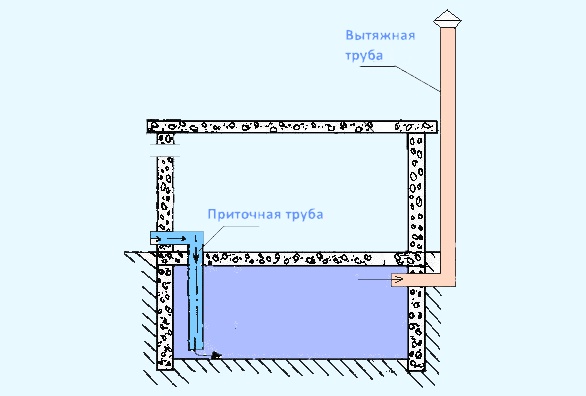
The supply channel is led out of the basement facade, arranged with a mesh fence. Its return outlet, through which air enters, descends to the floor at a distance of half a meter from the latter. To minimize the formation of condensate, the supply channel must be thermally insulated from the outside, especially its "street" part.
To find out the pressure loss in a straight duct system, you need to know the air velocity and use this graph (+)
The air intake of the hood is located near the ceiling, at the opposite end of the room from the point where the air inlet is located. It makes no sense to place the exhaust and supply channels on the same side of the basement and at the same level.
Since housing construction standards do not allow the use of vertical natural exhaust ducts for forced ventilation, it is impossible to start air ducts on them. It happens when it is impossible to locate the supply and exhaust air intake and exhaust channels on different sides of the cellar (there is only one facade wall).Then it is necessary to separate the air intake and discharge points vertically by 3 meters or more.
Scheme
To create comfortable conditions in the house, a forced ventilation scheme is selected, which can be of several types:
- Supply with cooling function, which is mounted complete with air conditioning. Cons - high price, the need for constant service.
- Forced with air heating, provides for the presence of a heat exchanger (find out how to make ventilation heating here).
- Combined, combining both ventilation schemes. Easy to install, low maintenance.
- A recirculation system is a design, the installation of which requires knowledge and complex devices that mix outgoing exhaust air flows with the outdoor atmosphere and return them to the house.
Supply ventilation with cooling function:
Forced ventilation with air heating:
Combined ventilation:
Air recirculation system:
Advice
Please note that a massive installation for general ventilation of the house should be located away from living rooms, because the device will create noise even with insulation.
When choosing a ventilation scheme, the basic rule must be observed - air flows must circulate from living rooms (bedroom, living room) to non-residential ones (bathroom, kitchen). It is not worth saving on the quality of construction, because well-installed ventilation helps prevent the appearance of fungus and bacteria in the room, prevents the accumulation of dust, provides a good microclimate in the house, preserving the health of its owners.




basement building requirements

Here are some recommendations for creating the necessary conditions in the cellar:
it is important to prevent sunlight from entering the basement. There should be no windows here, but short-term switching on of artificial lighting is allowed;
another feature is the creation of an optimal temperature regime
To make the room warmer, one of the sides must be in contact with the house;
proper air exchange in the basement must be ensured - for this a ventilation system is equipped;
humidity should also be at the required level - within 90%. This indicator is also affected by the presence of ventilation;
it will be necessary to lay high-quality moisture insulation in order to exclude the possible ingress of groundwater into the cellar.
In addition, ventilation of the cellar in winter is impossible without installing a high-quality exhaust system. However, in order for such an air transportation system to work as efficiently as possible, all the rules for its installation must be observed.