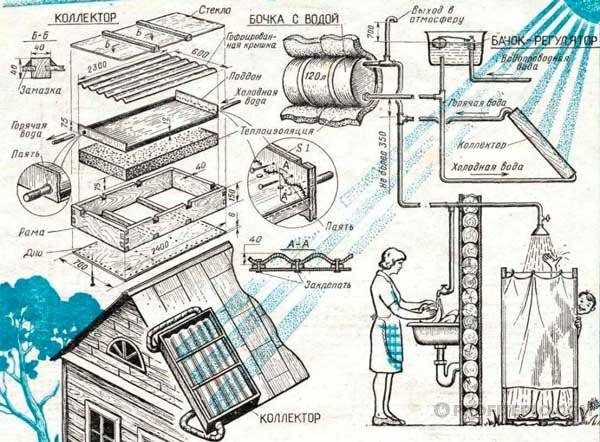
- How to assemble an air manifold
- What will be required in the work
- Assembly technology
- Collector selection criteria
- Polycarbonate manifold
- Types of vacuum tubes
- Thermosiphon (open) vacuum tubes
- Coaxial tube (Heat Pipe)
- Twin coaxial tubes
- Feather vacuum tubes
- U-shaped vacuum tubes (U-type)
- What types of solar collectors exist
- flat
- vacuum
- Types of heat-removable elements (absorbers), out of 5
- Systems with flow heaters or thermosyphon
- Creating a vacuum-type solar collector with your own hands
- Is it profitable
- Vacuum solar collector working principle
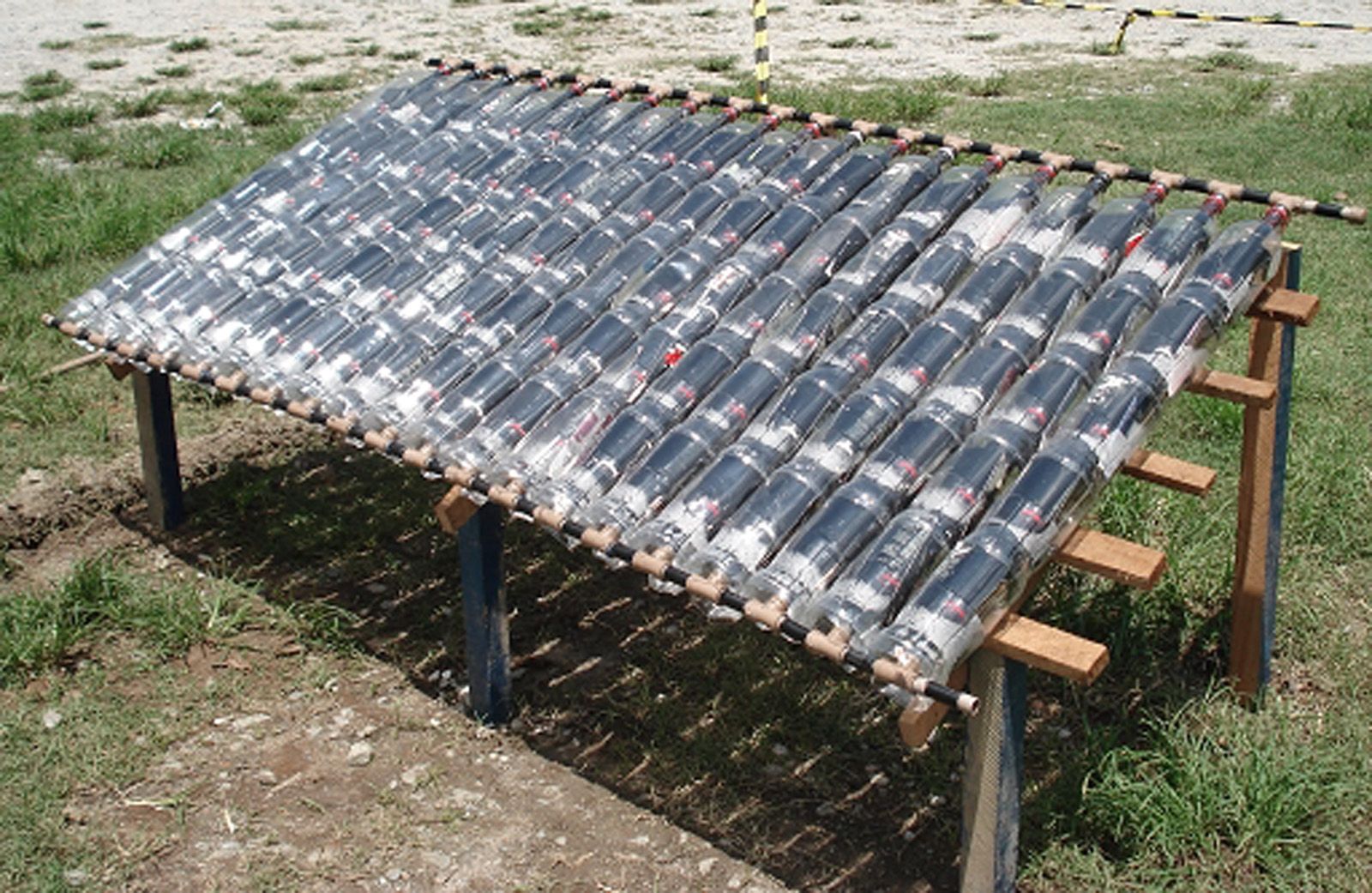
How to assemble an air manifold
If you decide to assemble the solar system with your own hands, first take care of all the necessary tools.
What will be required in the work
1. Screwdriver.
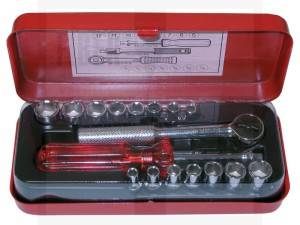
2. Adjustable, pipe and socket wrenches.
3. Welding for plastic pipes.
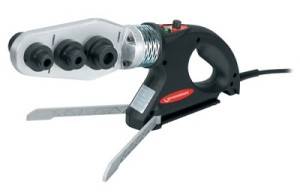
Welding for plastic pipes
4. Perforator.
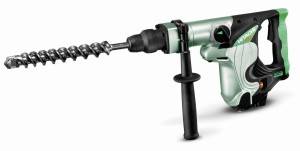
Perforator
Assembly technology
For assembly, it is desirable to acquire at least one assistant. The process itself can be divided into several stages.
First stage. First, assemble the frame, preferably immediately in the place where it will be installed. The best option is the roof, where you can separately transfer all the details of the structure.The very procedure for mounting the frame depends on the specific model and is prescribed in the instructions.
Second phase. Fasten the frame firmly to the roof. If the roof is slate, then use a sheathing beam and thick screws; if it is concrete, then use ordinary anchors.
Typically, frames are designed to mount on flat surfaces (maximum 20-degree slope). Seal the frame attachment points to the roof surface, otherwise they will leak.
Third stage. Perhaps the most difficult, because you have to lift a heavy and dimensional storage tank onto the roof. If it is not possible to use special equipment, wrap the tank in a thick cloth (to avoid possible damage) and lift it on a cable. Then attach the tank to the frame with screws.
Fourth stage. Next, you have to mount the auxiliary nodes. This may include:
- heating element;
- temperature sensor;
- automated air duct.
Install each of the parts on a special softening gasket (these are also included).
Fifth stage. Bring on the plumbing. To do this, you can use pipes made of any material, as long as it can withstand a temperature of 95 ° C heat. In addition, the pipes must be resistant to low temperatures. From this point of view, polypropylene is most suitable.
Sixth stage. After connecting the water supply, fill the storage tank with water and check for leaks. See if the pipeline is leaking - leave the filled tank for several hours, then carefully inspect everything and, if necessary, fix the problem.
Seventh stage. After making sure that the tightness of all connections is normal, proceed with the installation of the heating elements.To do this, wrap a copper tube with an aluminum sheet and place it in a glass vacuum tube. Place a retaining cup and a rubber boot on the bottom of the glass flask. Insert the copper tip at the other end of the tube all the way into the brass condenser.
It remains only to snap the cup-lock onto the bracket. Install the rest of the tubes in the same way.


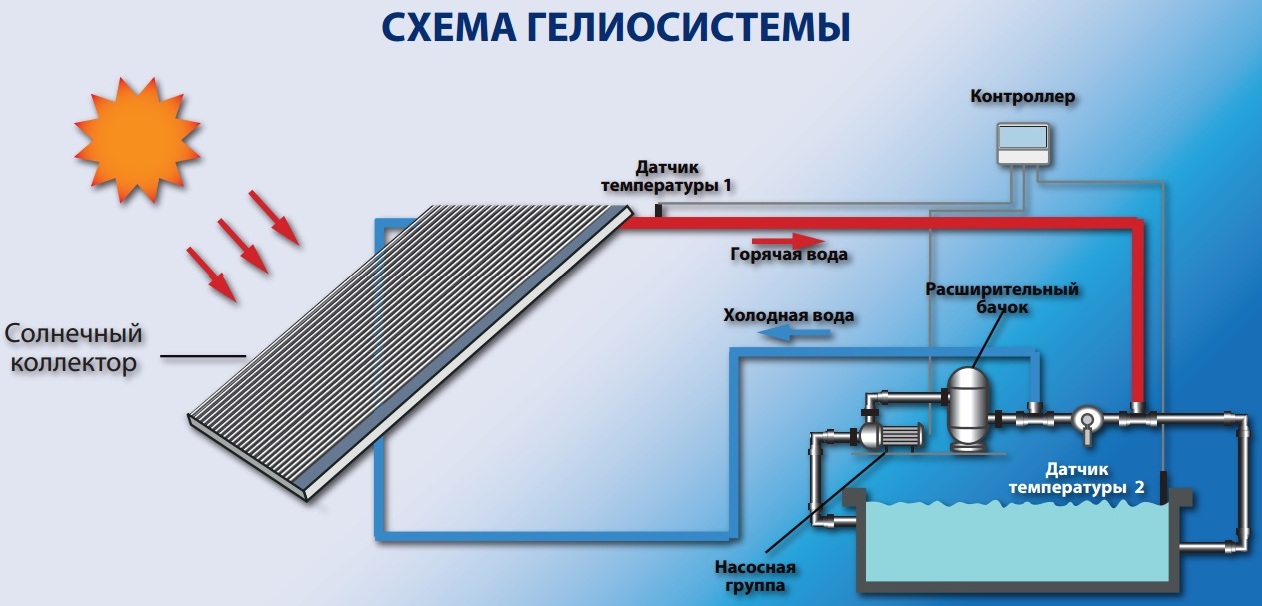


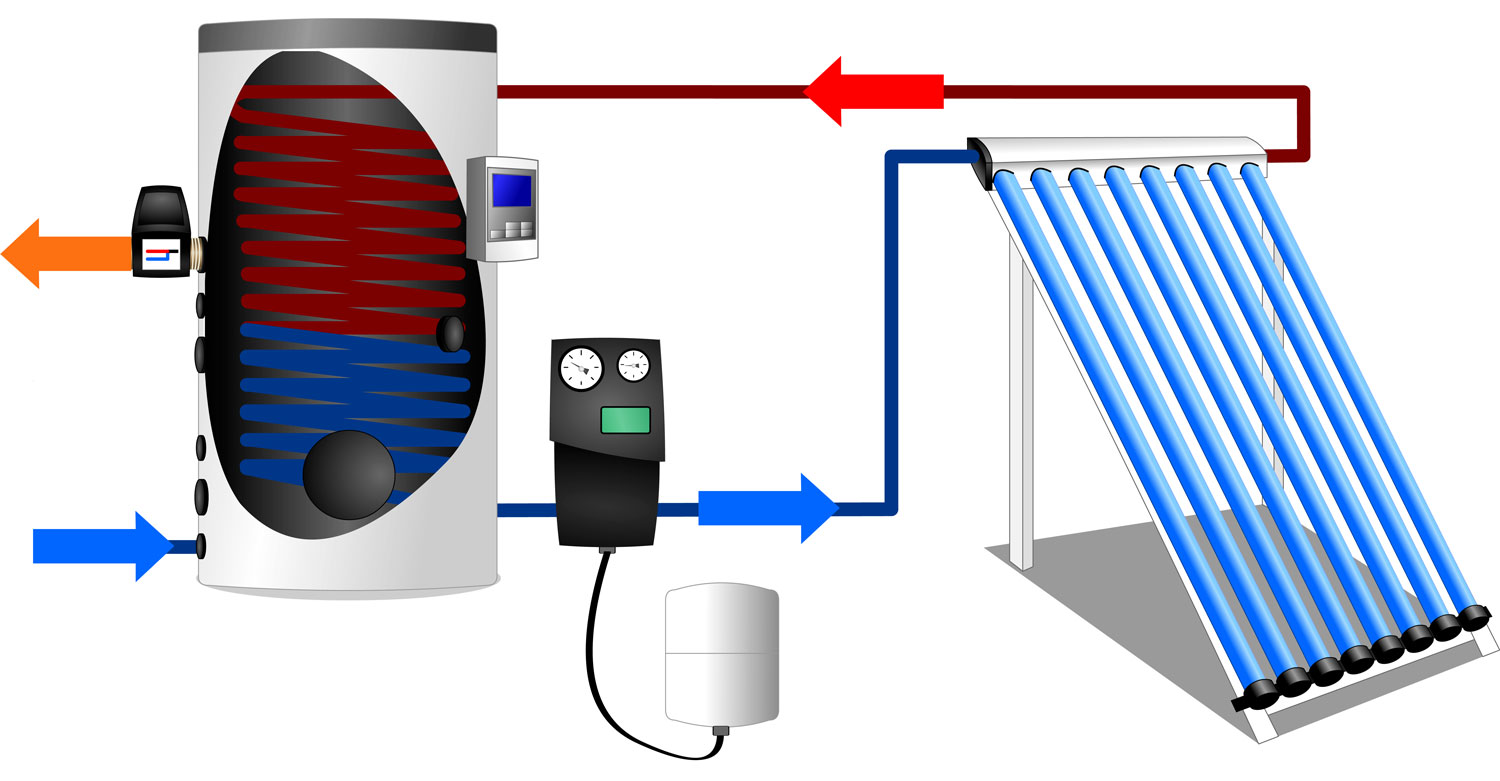
Eighth stage. Install a mounting block on the structure and supply 220 volt power to it. Then connect three auxiliary nodes to this block (you installed them in the fourth stage of work). Despite the fact that the mounting block is waterproof, try to cover it with a visor or some other protection from atmospheric precipitation. Then connect the controller to the unit - it will allow you to monitor and regulate the operation of the system. Install the controller in any convenient place.
This completes the installation of the vacuum manifold. Enter all the necessary parameters in the controller and start the system.
Collector selection criteria
If the plans include buying a vacuum manifold for heating, you should pay attention to a number of nuances that will help you decide on the model:
1. A tubular solar system is suitable for a flat roof. With a large windage, it will hold firmly and stably.
2. Studying the technical characteristics, you need to take into account the number of tubes, their type, dimensions, equipment area.
3
It is also important to know the volume of liquid, the dimensions of the device, the surface of the absorber, the quality of the glass of the flasks and the thickness of the insulator.
4. To calculate the real performance, it is necessary to find out the heating area, the amount of heat loss, climate features, hot water consumption per day.
5.When purchasing a collector, you also need to take into account the additional costs for installing components: a tank, a battery and an exchanger.
Despite the rather high cost, solar installations have received great interest, as evidenced by the feedback from the owners who used such heating systems:
“In order to save money, I had to pay attention to solar collectors for use in a private boarding house. During the season, the consumption of hot water is quite large, it was necessary to choose an alternative method of supplying hot water and heating
The Chinese manufacturer Shentai offers to buy equipment at an affordable price, so I settled on their products, especially since the reviews are mostly positive. According to the calculations, I was recommended the necessary power, they delivered and installed all the equipment quickly. Compared to the cost of a boiler in each room, the savings were enormous. There were no shortcomings or problems in the work.
Evgeny Gonchar, Krasnodar.
“Now all people are trying to switch to a more profitable source of heating. Trusting the reviews, we also ordered a Paradigma collector for our cottage. At first they used it as a backup option, a year later they were convinced of the effectiveness and completely switched to providing the house with a solar system. We were worried that the tubes could be damaged by bad weather or wind, but they are durable, not even afraid of a hurricane. Thanks to the accumulation system, you can not worry about the termination of work. We did not find any shortcomings, we are satisfied with our choice, although the price is rather high.”
“We installed a collector from Andi Group brand SCH-18, as the reviews about the company are good.I'm not very versed in technical features, my husband chose the device. But I like that it has worked only a season, and the savings are already being felt. True, this year there was a lot of sun, so the accumulation of energy was practically not interrupted. The only drawback is that there is not always enough power, the heating works well, and you have to be more restrained with hot water consumption, since the family is large. Let's see how the collector will show itself in the future."
“I work in a private kindergarten. The owner installed a Micoe solar system on the roof two years ago. The consumption of hot water is constantly required and the rooms must have the optimum temperature, and these are decent costs. With the new equipment, it turns out to fully service the heating, supply hot water without interruption, and also heat the pool. Even at night, all systems function perfectly. Since I didn’t see any shortcomings, I’m thinking of buying the same device for my home, especially since the price is reasonable. You just need to read the reviews to choose the right model.
All companies have their own price range for vacuum-type solar collectors.
When laying the budget for a solar heating system, it is important to make preliminary calculations and decide on the appropriate option. The approximate cost is shown in the table:
Company, manufacturer, model
Home heating with a solar collector is gaining more and more popularity due to its versatility and efficiency. Manufacturers are developing new technologies to improve performance, reliability and safety of use. Owners who have installed systems in their homes have already appreciated their quality, savings and high performance.





Rehau has been specializing in the production of underfloor heating for many years.
Flushing and pressure testing of the heating system is a procedure aimed at checking.
More and more people are thinking about such an organization for heating their homes.
Indirect heating boilers
Overview of Thermex water heaters
Do-it-yourself water-heated floor
Circulation pump for heating systems
Overview of thermal insulation brand Techno-Nicole
Copying site materials is possible if you set an active indexed link to.
PG "Obogrevguru" Moscow, Volgogradsky prospect 47, office 511b (499) 611-34-45
obogrevguru 2017
Polycarbonate manifold
Made from honeycomb panels with good thermal insulation properties. Thickness of sheets from 4 to 30 mm. The choice of polycarbonate thickness depends on the required heat transfer. The thicker the sheet and the cells in it, the more water the unit will be able to heat.
To make a solar system yourself, in particular a homemade polycarbonate solar water heater, you will need the following materials:
- two threaded rods;
- propylene corners, the fittings must have an external threaded connection;
- PVC plastic pipes: 2 pcs, length 1.5 m, diameter 32;
- 2 plugs.
Pipes are laid in the body in parallel. Connect to DHW through shut-off valves. A thin incision is made along the pipe into which a polycarbonate sheet can be inserted. Thanks to the thermosiphon principle, water will independently enter the grooves (cells) of the sheet, heat up and go into the storage tank located at the top of the entire heating system. Heat-resistant silicone is used to seal and fix the sheets inserted into the pipe.
To increase the thermal efficiency of a honeycomb polycarbonate collector, the sheet is coated with any selective paint. Heating of water after applying a selective coating is accelerated by approximately two times.
Types of vacuum tubes
There are five types of vacuum tubes for solar collectors. They differ in internal structure and design. In addition, each of them can be supplemented with a metal (usually aluminum) absorber, which is placed inside a glass flask in the form of a tube.
Important!
Most manufacturers fill the lower gap between the glass walls with barium - it absorbs gas impurities and improves thermal insulation properties. Its absence can reduce the efficiency of the collector up to 15%.
Thermosiphon (open) vacuum tubes
This type of solar collector tubes is used in collectors with an external storage tank. they are filled with water and form one volume with the reservoir. The heated water from the flask rises into the tank, and the cooled water falls down.
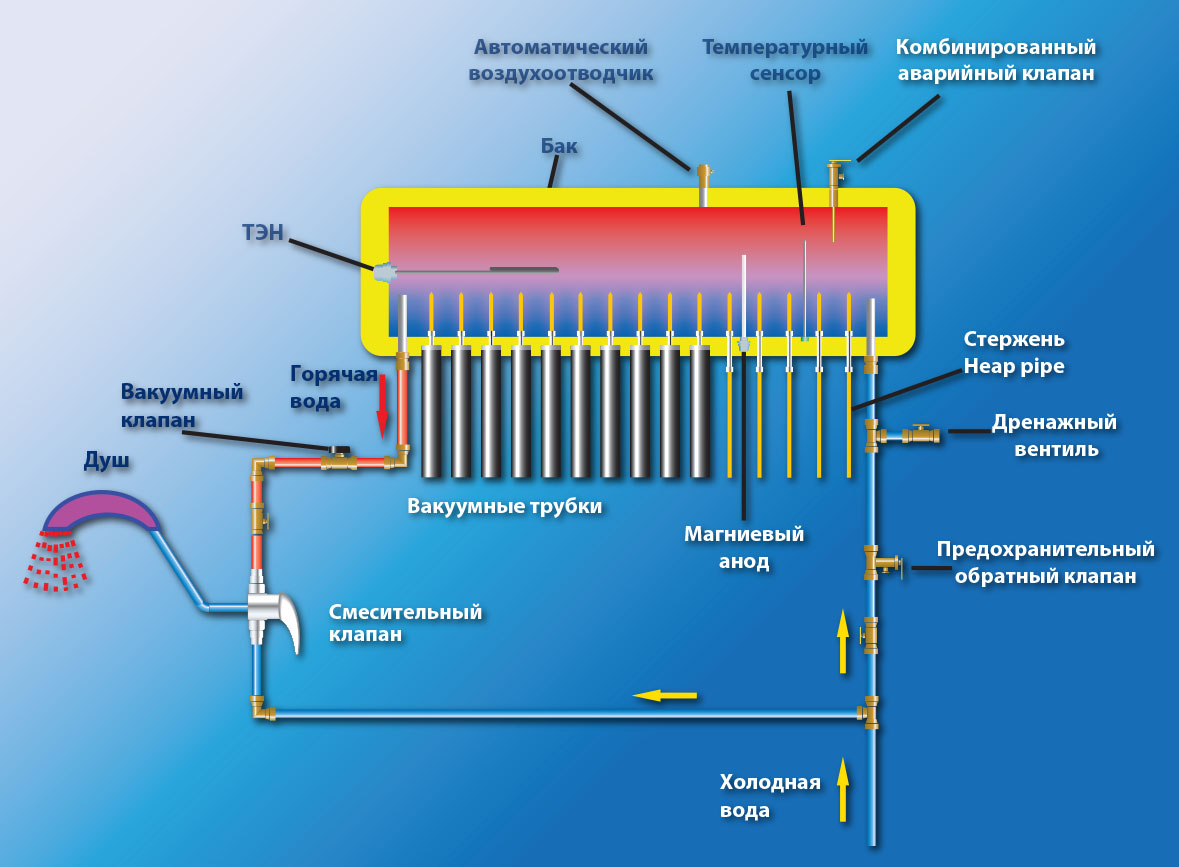





Thermosiphon vacuum manifolds are used in the following applications:
- For connection to the hot water supply system;
- In regions with a high level of insolation during the cold season;
- For seasonal use (spring, summer, autumn).
Coaxial tube (Heat Pipe)
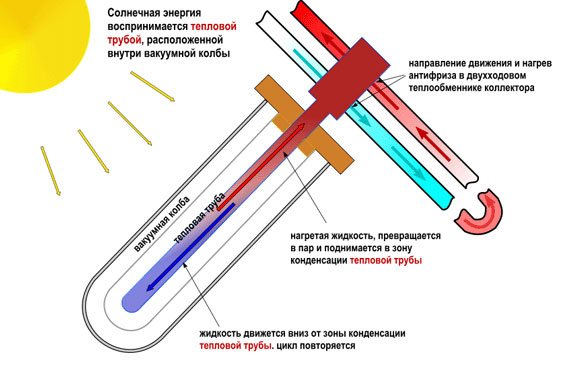
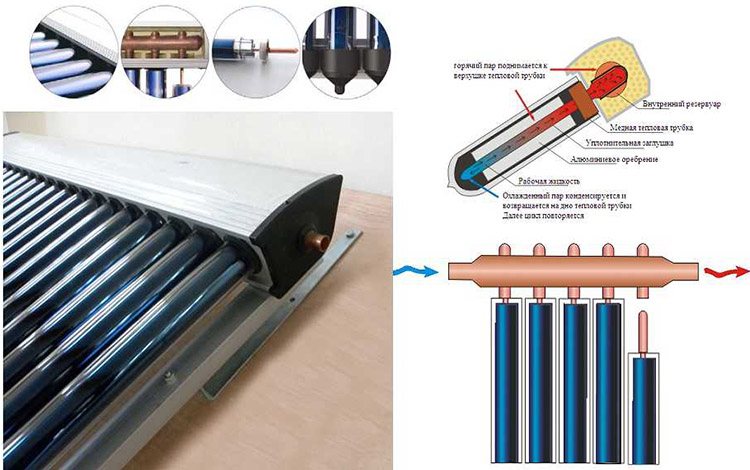
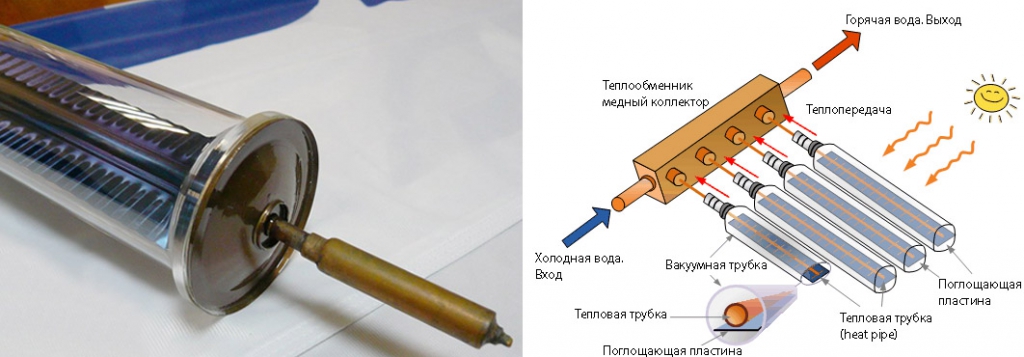
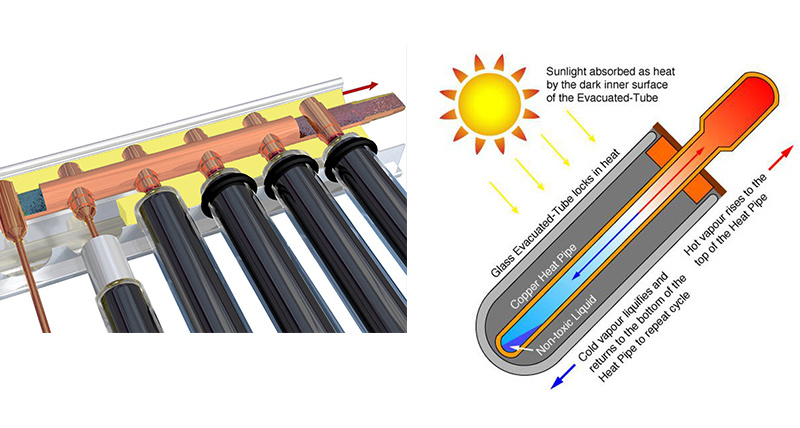
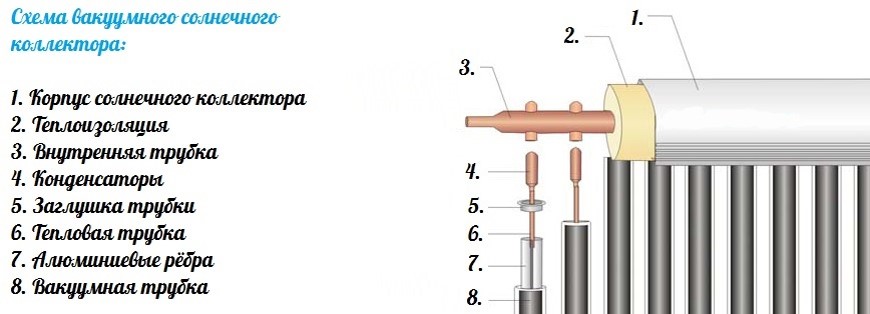
This is the most common type of vacuum tube. In it, inside a glass flask, there is a copper tube filled with a liquid with a low boiling point or water under low pressure.
When heated, the liquid or water begins to boil, the steam rises, simultaneously heating up from the copper walls.In the upper part, it enters the heat exchanger - an extension at the end, in which it gives off heat through the walls to the water that circulates around it.
After cooling, the steam condenses on the walls of the heat exchanger and flows down. The cycle is repeated anew.
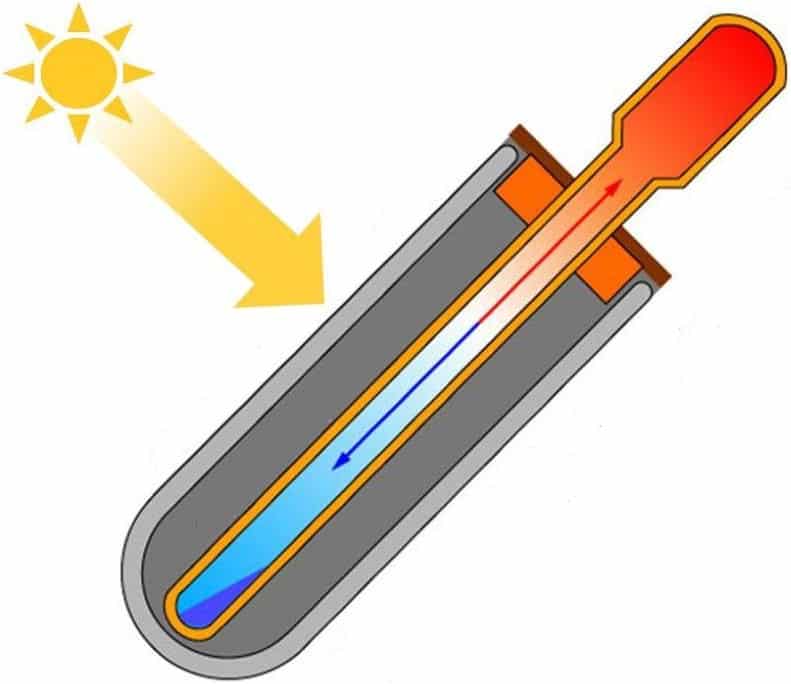
Schematic internal structure of a coaxial tube and a heat exchanger.
Twin coaxial tubes
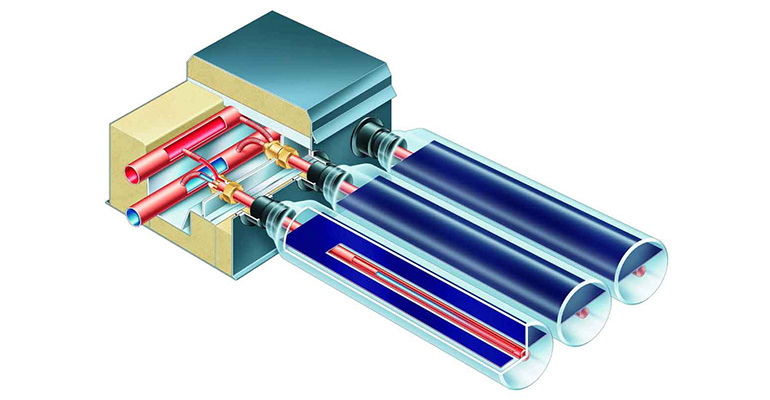
The principle of operation of such a heat receiver is the same as that of the previous one, with one exception - two copper tubes with liquid are connected to one heat exchanger. The twin system allows for more efficient heat removal, and the large capacity and area of the heat exchanger walls quickly heat the water.
Vacuum manifolds with a twin coaxial system are installed where necessary:
- Provide a small heating of large volumes of water;
- There is a need for thermal energy during a sunny day;
- High average level of insolation;
- There is a rapid pumping of water through the system.
Feather vacuum tubes
Their design has an additional heat exchanger, which allows more efficient removal of heat from the inside of the glass bulb. Usually it is made in the form of two longitudinal plates located on the sides of a copper heat sink.
Otherwise, the principle of operation is exactly the same as that of a coaxial tube.
U-shaped vacuum tubes (U-type)
This system is fundamentally different from the previous ones. It uses two lines - for cold and heated water.
A heat exchanger in the form of an English letter U is installed in a glass flask, through which water passes.From the line with cold water, it enters it, heats up and returns to the pipe with heated water.
The U-tube manifold is the most efficient, but installation is more difficult. The flow lines during assembly are fastened by welding with copper tubes inside the glass bulb. It turns out a single integral system with great energy efficiency, but low maintainability.
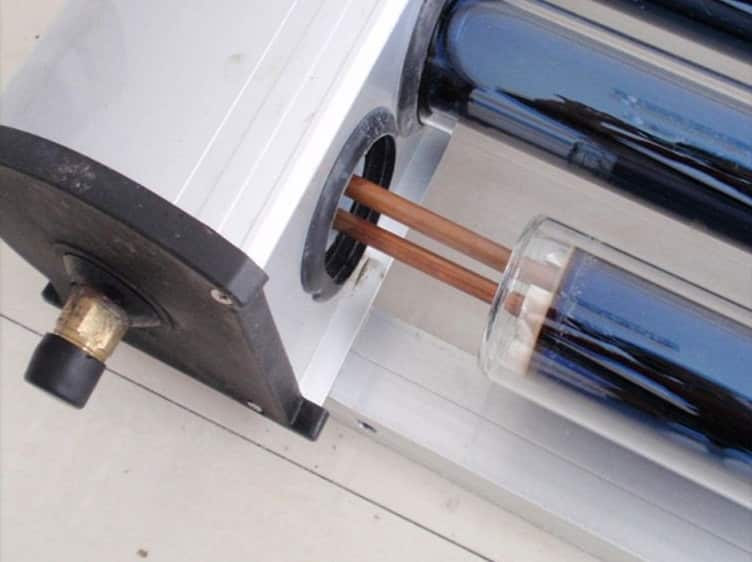 Installing the flask on a U-shaped copper tube.
What types of solar collectors exist
Such systems are of two types: flat and vacuum. But, in essence, their principle of operation is similar. They use the sun's heat to heat water. They differ only in the device. Let's look at the principles of operation of these types of solar systems in more detail.
flat
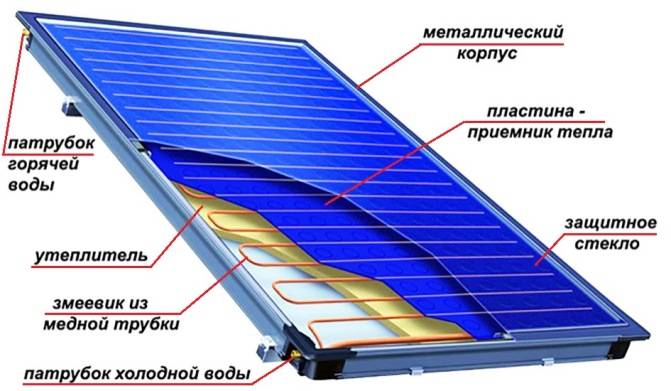 This is the simplest and cheapest type of collector. It works as follows: Copper tubes are located in the metal case, which is internally treated with a highly efficient feather absorber to absorb heat. A coolant (water or antifreeze) circulates through them, which absorbs heat. Further, this coolant passes through a heat exchanger in the storage tank, where I transfer heat directly to the water that we can use, for example, for heating a house.
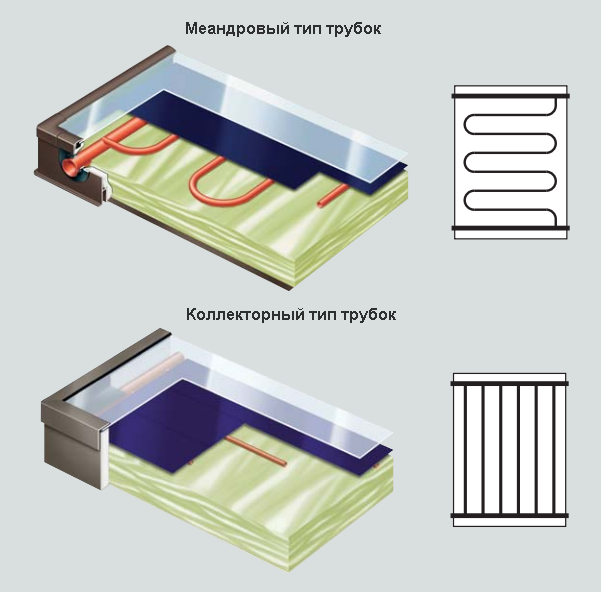 The upper part of the system is covered with high-strength glass. All other sides of the case are insulated with insulation to reduce heat loss.
| Advantages | Flaws |
| Low cost panels | Low efficiency, about 20% lower than vacuum |
| Simple design | Large amount of heat loss through the body |
Due to their ease of manufacture, such systems are often made even with their own hands. You can buy the necessary materials in construction stores.
vacuum
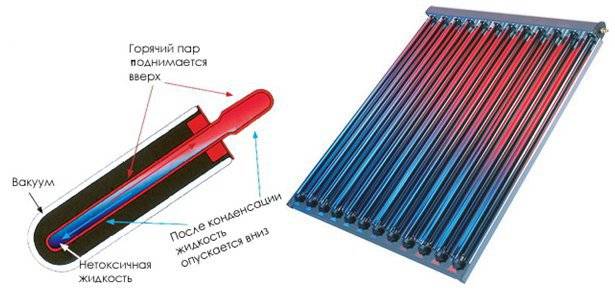 These systems work a little differently, this is due to their design. The panel consists of double tubes. The outer tube plays a protective role. They are made of high strength glass. The inner tube has a smaller diameter and is covered with an absorber that accumulates solar heat.


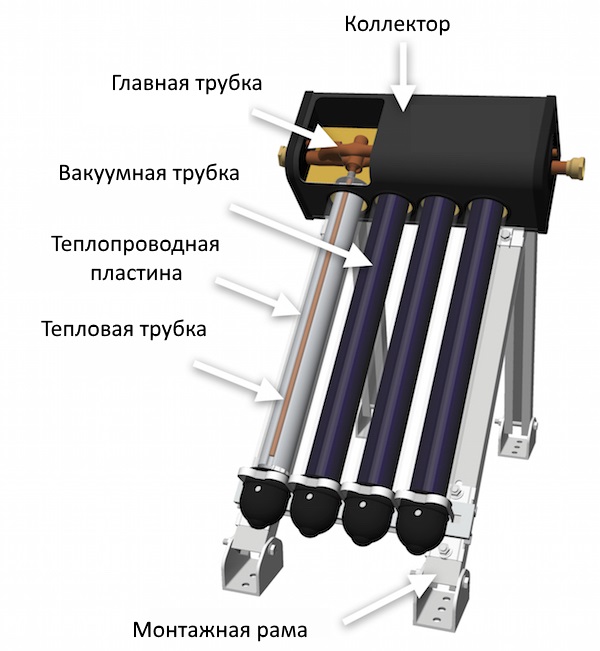

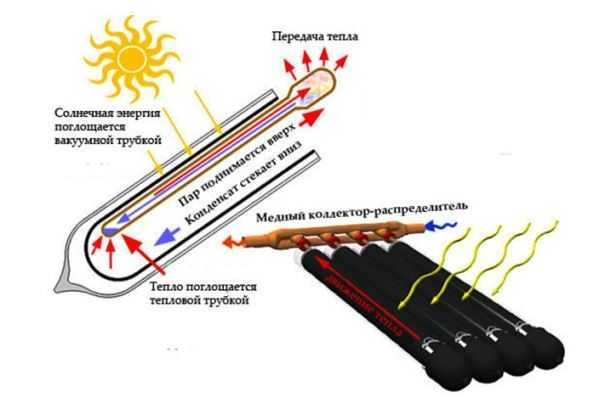


Further, this heat is transferred to heat by strippers or rods made of copper (they come in several types and have different efficiency, we will consider them a little later). Heat removers transfer heat with the help of a heat carrier to an accumulating tank.
There is a vacuum between the tubes, which reduces heat loss to zero and increases the efficiency of the system.
| Advantages | Flaws |
| High efficiency | Higher price relative to flat |
| Minimum heat loss | The impossibility of repairing the tubes themselves |
| Easy to repair, tubes can be changed one at a time | |
| Large selection of species |
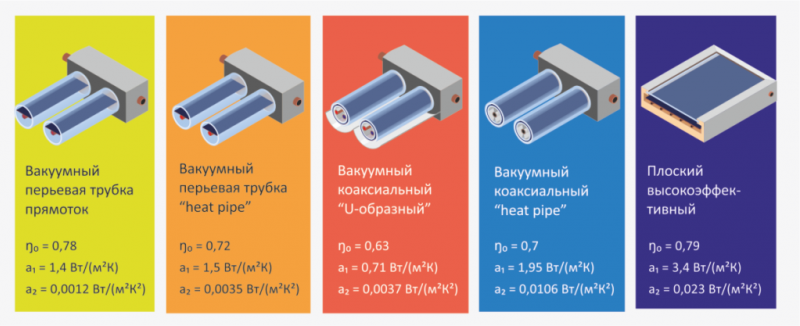 Types of heat-removable elements (absorbers), out of 5
 Types of heat-removable elements (absorbers), out of 5
- Feather absorber with direct-flow thermal channel.
- Feather absorber with heat pipe.
- U-shaped direct-flow vacuum manifold with coaxial bulb and reflector.
- System with a coaxial flask and a heat pipe "heat pipe".
- The fifth system is flat collectors.
Let's take a look at the efficiency of different absorbers, and also compare them with flat-plate collectors. Calculations are given for 1 m2 of the panel.
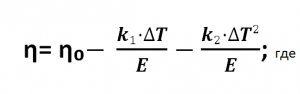 This formula uses the following values:
- η is the efficiency of the collector, which we calculate;
- η₀ - optical efficiency;
- k₁ - heat loss coefficient W/(m² K);
- k₂ - heat loss coefficient W/(m² K²);
- ∆T is the temperature difference between the collector and air K;
- E is the total intensity of solar radiation.
Using this formula, using the data above, you can do the calculations yourself.
Put simply, the efficiency depends on the amount of heat that the copper heat sinks absorb and the amount of heat loss in the system.
Systems with flow heaters or thermosyphon
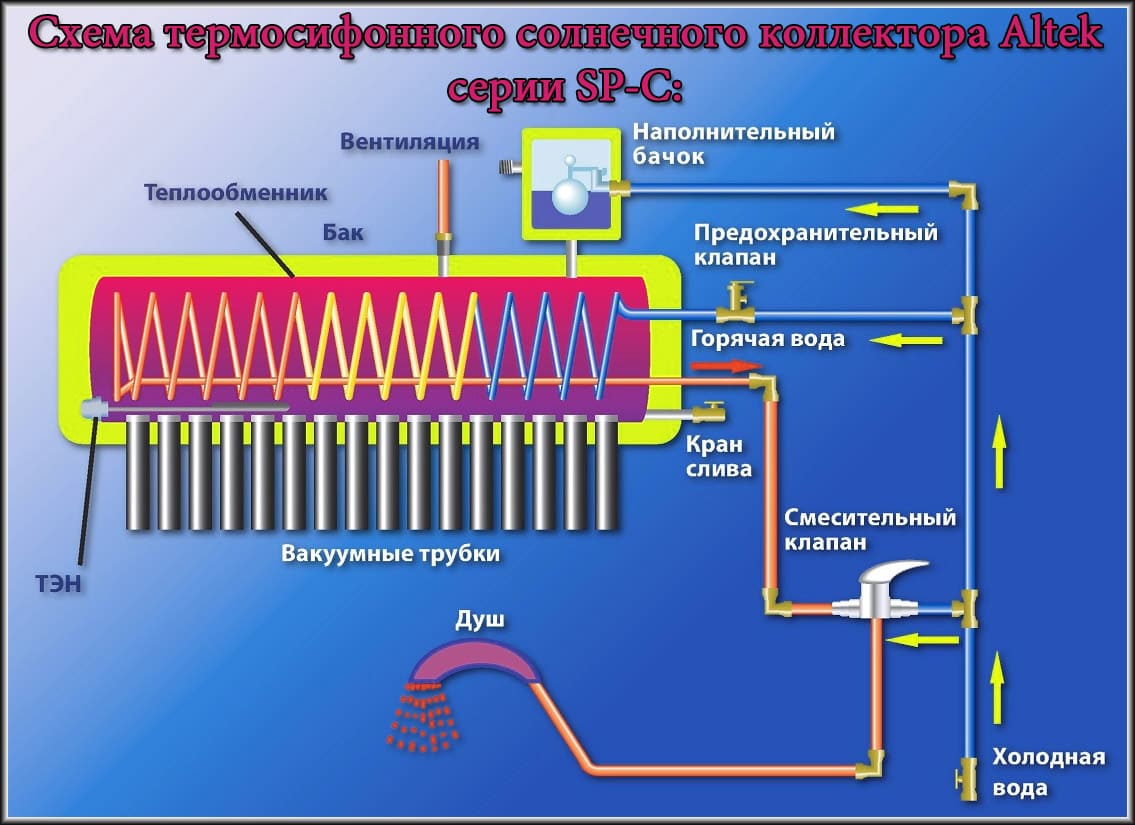
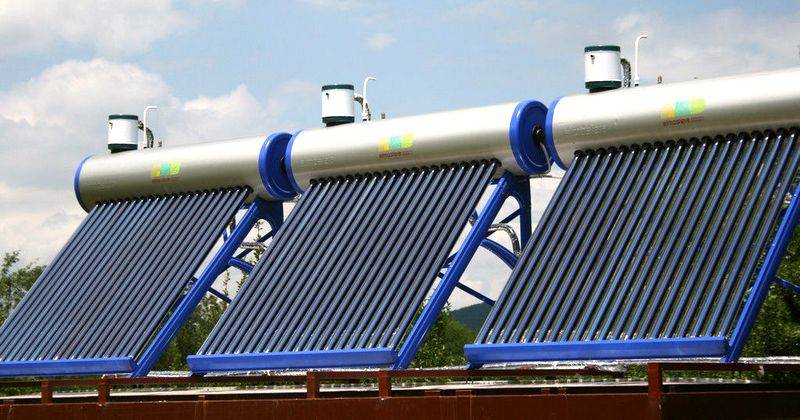 According to their structure, they can be both flat and vacuum. The same operating principles are used. However, they have one significant difference in the technical device.
This system can operate without an additional backup storage tank and pump group.
The principle of operation is the following. The heated coolant is accumulated in the base tank, which is located in the upper part of the system, usually 300 liters. A coil passes through it, through which water circulates from the pressure of the house's plumbing system itself. It warms up and goes to the consumer.
| Advantages | Flaws |
| Low cost due to the absence of part of the equipment. | Low system efficiency in the winter season and at night |
| Ease of installation, minimum effort is required, as the system is equipped with everything necessary |
Creating a vacuum-type solar collector with your own hands
Creating such a design at home is a rather complicated process and requires a high degree of preparation. The main difficulty in the construction of such a unit lies in the creation of an external unit.
 Vacuuming the flask and the heat sink is impossible without sophisticated equipment, so it’s easier to buy them in the factory
High-quality evacuation of the flask, which also contains a heat sink inside, requires not only skill, but also sophisticated equipment.It is impossible to perform such an operation in artisanal conditions, therefore, the following instructions will describe a method using factory-made flasks. But even here there are difficulties. Work on their installation requires the highest degree of accuracy.


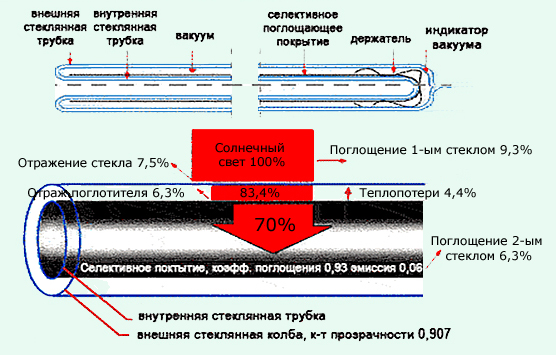


The assembly technology itself can be divided into several stages:
- First of all, you need to build a frame on which external structural elements will be attached. It is best to assemble directly at the place of the planned installation of the structure. As a rule, they are placed on the roof.
- After assembling the frame, it must be securely fastened. The features of the method of fastening used will depend on the characteristics of the roof structure itself. An important step, common to all types of roofs, is the sealing of the holes made to secure the frame.
- At the next stage, it is necessary to install a storage tank, which will perform the task of accumulating heat. For this purpose, a volumetric tank is needed and its installation will require the use of special equipment, or the involvement of additional labor. Also at this stage, a pumping station is installed.
- Next, it is necessary to carry out the installation of auxiliary units and assemblies, such as a heating element, a temperature control sensor and an air duct.
- Now it is necessary to lay the pipes through which the coolant will circulate. Pipes must be made of material resistant to both high and low temperatures. The best option would be to use polypropylene channels.
- After the installation of the pipeline, it is necessary to check it for tightness in combination with the storage tank.If leaks are found, they should be eliminated and re-checked before continuing work.
- Next, the heat sink tubes are installed. Since factory products are used, it is necessary to carefully read the installation instructions attached to them. At this stage, you need to try to calculate all the possible nuances, because making a mistake will lead to large economic costs. These items are quite expensive.
- The next step is to install the mounting block and connect it to the mains. Then auxiliary units and assemblies installed earlier are connected to it. Next, a block controller is connected to the mounting block, which is necessary for monitoring the state of the entire system.
- The final stage of the installation of a solar collector of a vacuum type will be commissioning. With their help, all flaws made during installation are identified and eliminated.
Completing the installation of the collector does not mean that you need to forget about it once and for all. For a long and efficient service life of the unit, it is necessary to regularly check and service it.
Is it profitable
To determine whether it is profitable to use solar collectors, everyone determines for himself individually, depending on the region of residence, the need for thermal energy and depending on financial capabilities.
The region of residence is an important criterion in determining the efficiency of using devices that convert solar energy into other types of energy. Solar activity (sunshine duration) is different in different regions of our country, as can be seen in the diagram below. 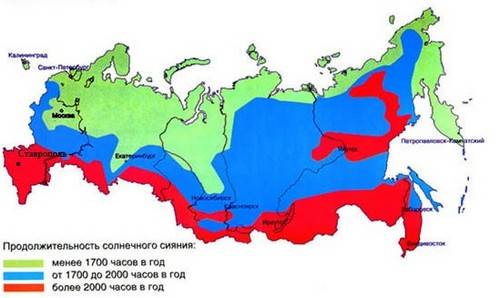
From this scheme it can be seen that the most favorable regions for the use of solar energy, with a duration of solar activity of more than 2000.0 hours per year, are located in the southern regions of the country. In these areas, there are also no cold and long winters, which determines the possibility of successful use of solar collectors in heating and hot water supply systems, in these regions of Russia.
If it is necessary to create an absolutely autonomous system, from external, traditional suppliers of thermal energy, it should be remembered that by installing only a collector, it will not be possible to create such a system, because electric energy is needed to create the circulation of the coolant, the operation of the automation system. Therefore, for complete autonomy, it is necessary to work out the issue of independent power supply of the connected object. Therefore, in order to make an absolutely independent system, additional financial costs will be required, which will increase the payback period of the equipment.
Vacuum solar collector working principle
Solar vacuum collectors are the most efficient devices for processing solar energy. In order to achieve an efficiency of 85%, the device uses only 15% of the received solar energy. Vacuum collectors are more efficient than solar panels, as they can not only convert solar energy into electricity, but are also used for heating. This feature allows not only to save on electricity, but also not spent on heating equipment.
Due to their high efficiency, solar collectors are widely used in fields such as:
- Private houses, apartments, cottages.
- Office rooms.
- Agricultural enterprise.
- Industrial complexes of any scale.
- Health care institutions.
- Educational institutions: schools, universities.
- Children's institutions.
- Trading institutions.
- Public catering points.
- Railway stations, ports and many other institutions of various kinds.
Solar collectors can be effectively used almost anywhere where electricity and hot water are needed.
Features of the operation of solar collectors:
- During the cold winter period, especially in January and December, solar collectors cannot produce more than 30%-50% of heat. So in this period will have to resort to the help of traditional energy sources.
- The better the thermal insulation of the building, the more efficient the heating system works.
- A water-based underfloor heating system can also be heated using solar collectors. It is recommended to use this feature to improve system efficiency.
- Cloudy weather is the main obstacle for solar collectors. With increased cloudiness, you will have to use traditional heat sources more often.