
- The principle of operation of septic tanks "Topas"
- Installation work
- Do-it-yourself installation of a Topas septic tank
- Device advantages
- Device and principle of operation
- Varieties of designs and model range
- The principle of operation of the equipment
- The best qualities of the septic tank of the Topas model
- Installation features and do-it-yourself installation rules
- Summing up
- Technical parameters of the sewer complex Topas
- Advantages
- Flaws
- Breakdowns of the treatment plant and methods for their correction
- Flooding by sewage treatment plant
- Tripping of the RCD and problems with the power supply
- Change in water level in a non-working station
- Instructions for use of septic tanks Topas
The principle of operation of septic tanks "Topas"
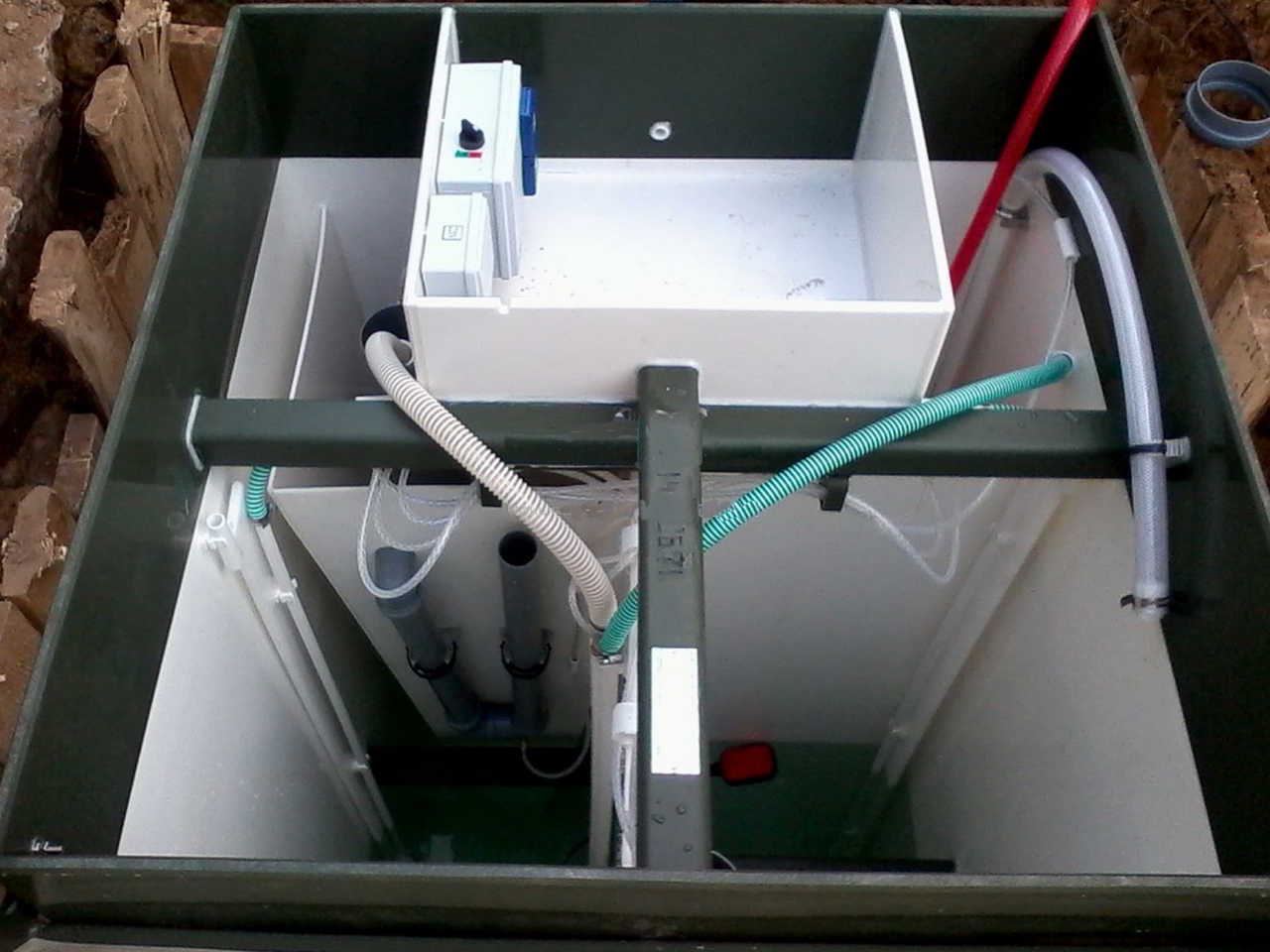
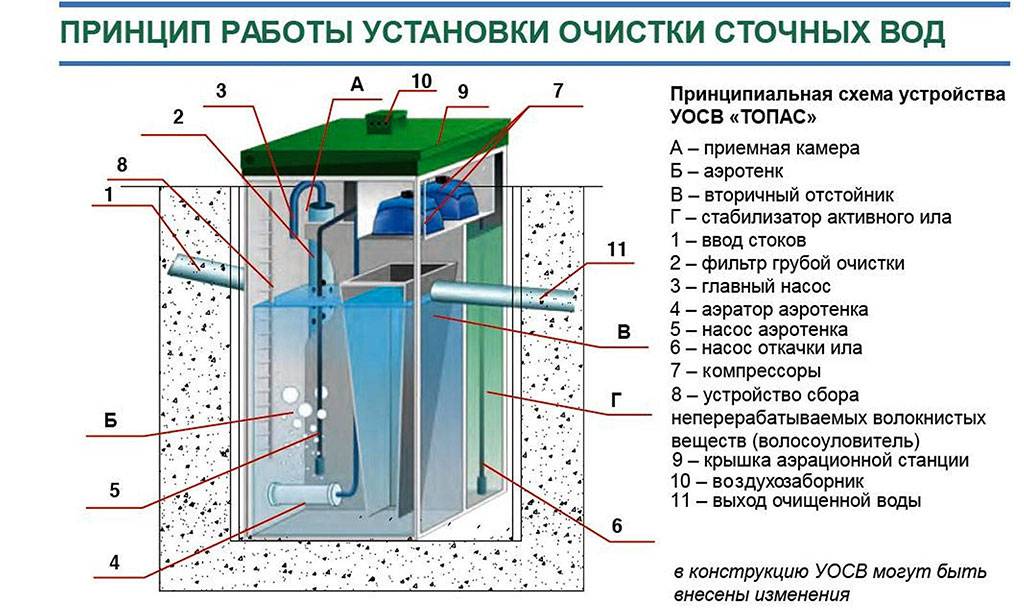
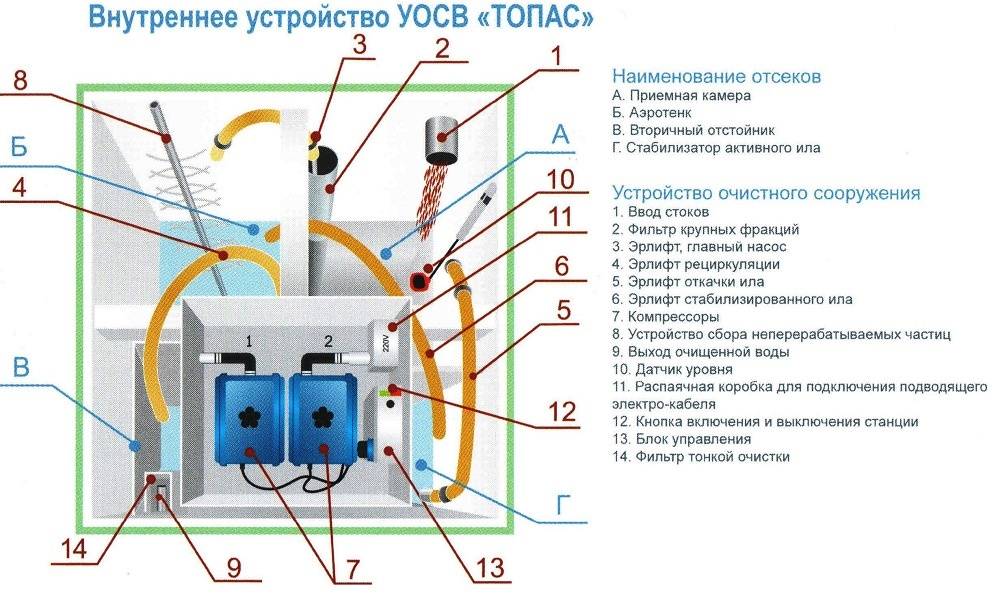
Through the sewer pipe, effluents enter the first receiving chamber. Here, sewage masses are fermented with the active participation of anaerobic bacteria.
When the level of effluents in the receiver reaches a predetermined level, the waste is pumped into the second chamber using an airlift.
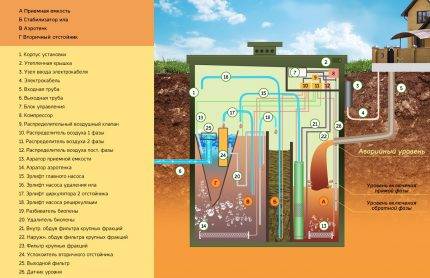 Wastewater enters the receiving chamber, in the second it is saturated with oxygen and processed by aerobic bacteria, in the third it is settled, and in the fourth it decomposes into sludge and 98% purified water
In the second section of the septic tank, aeration of drains is performed, i.e.their saturation with air, which is necessary in order to activate the work of aerobic microorganisms digesting sewer organics.
Bacteria actively process the contents of the sewer, turning it into a mixture of partially clarified and purified water and activated sludge.
After processing in the second chamber everything moves to the sludge stabilizer section - biomass, which is actively involved in cleaning the liquid component of the sewer mass. Here the sludge settles, and the water released as a result moves to the sump.
To improve the quality of treatment, part of the water and mobile sludge from the stabilizer enters the primary chamber so that secondary wastewater treatment can be carried out.
Thus, the scheme of operation of the topas septic tank provides for the circulation of wastewater through various compartments of the septic tank until the level of purification reaches the required quality level. This ensures the high safety of the treated wastewater for the environment.
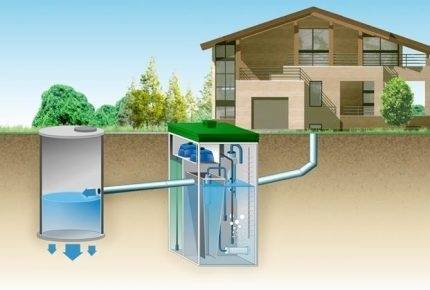
If the section of the site is composed of sandy soil, then it is better to arrange an absorption well to discharge wastewater. Its construction is possible only if there is at least 1 meter between the conditional bottom of the filtering well and the groundwater table.
Upon completion of the multi-stage processing, the purified water is discharged to the filtration fields or the absorption (filtering) well, where the waste mass is further treated and discharged into the ground.
In the absence of an opportunity to arrange filter well or drainage system, the clarified and disinfected liquid can be discharged into the gutter.
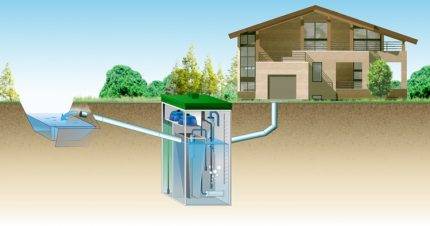
If the septic tank is installed in clay soil, the disposal of treated and disinfected effluents is carried out into the sewer ditch
In an absorption well or in filtration fields, additional treatment is carried out by passing effluents through filter soils. In the first case, the post-treatment structure is a pit with a permeable bottom, on which a meter-long layer of crushed stone or gravel with sand filler is placed.
The filtration field is a kind of drainage system, arranged from perforated pipes - drains. Flowing through the drains, the liquid component of the wastewater is additionally cleaned and seeps through the perforations of the pipes into the surrounding soil.
We also recommend that you familiarize yourself with the features of laying the drainage pipe.
When laying all types of sewer pipelines, including the drain system, the level of soil freezing in winter should be taken into account so that the sewage does not freeze and create plugs in the channel intended for their flow.
If there is unused land near the site or a country estate has an impressive area, the waste disposal system can be made in the form of drains that carry out post-treatment and discharge of water into the ground
Installation work

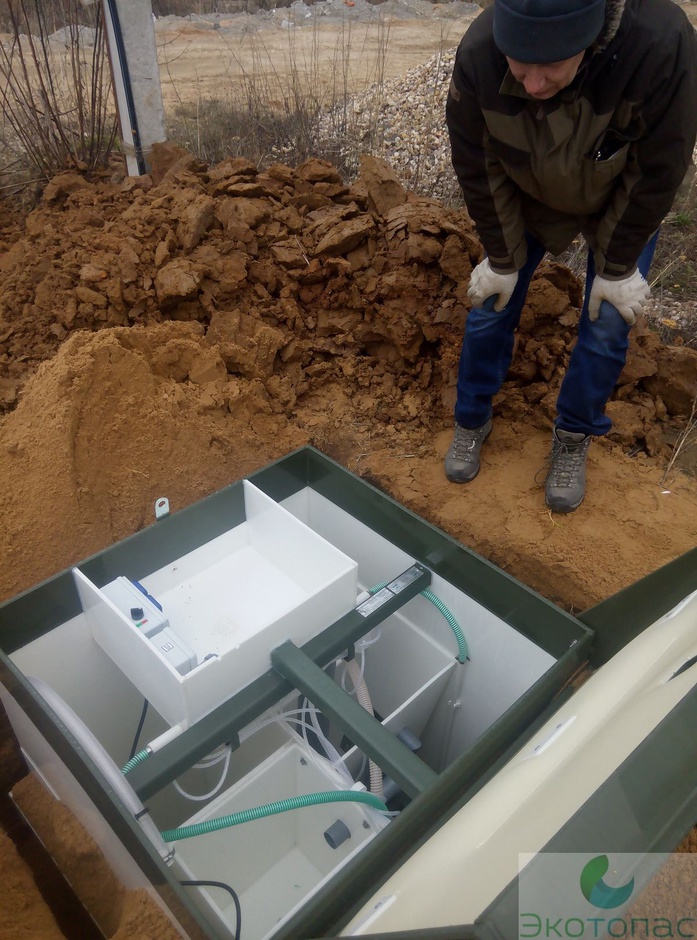
Topas 8 - autonomous biological wastewater treatment system
Before the preparatory and installation work themselves, it is necessary to correctly select the location of the septic tank in accordance with certain conditions:
- the distance to the treatment plant from residential buildings should be at least 5 m, but not exceed the threshold of 10-15 m;
- if the conditions of the area force you to install a septic tank further from the house, then it is recommended to install an inspection well on the external sewer pipeline;
- an inspection well will be required if the supply pipe has bends of more than 30 degrees, so it is better that the pipeline does not have turns.
Having decided on the place, you can proceed to the installation work.
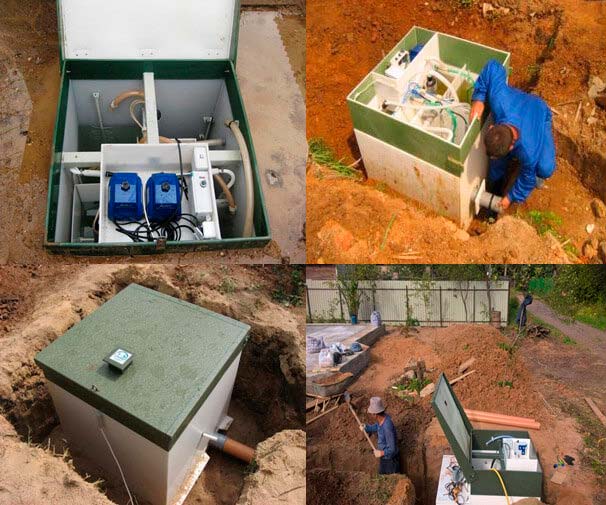
Step 1. Dig a pit using equipment or manually. The width and length of the pit for the container should be approximately 50-60 cm larger than the corresponding dimensions of the septic tank. The depth of the pit is made equal to the height of the septic tank, even though a fifteen-centimeter sand layer will be poured at the bottom. After all, it is at 0.15 m that the septic tank should rise above the ground to facilitate its maintenance and prevent flooding of the station during the spring flood. If an additional concrete base is installed at the bottom, then its height must be taken into account, determining the depth of the pit.

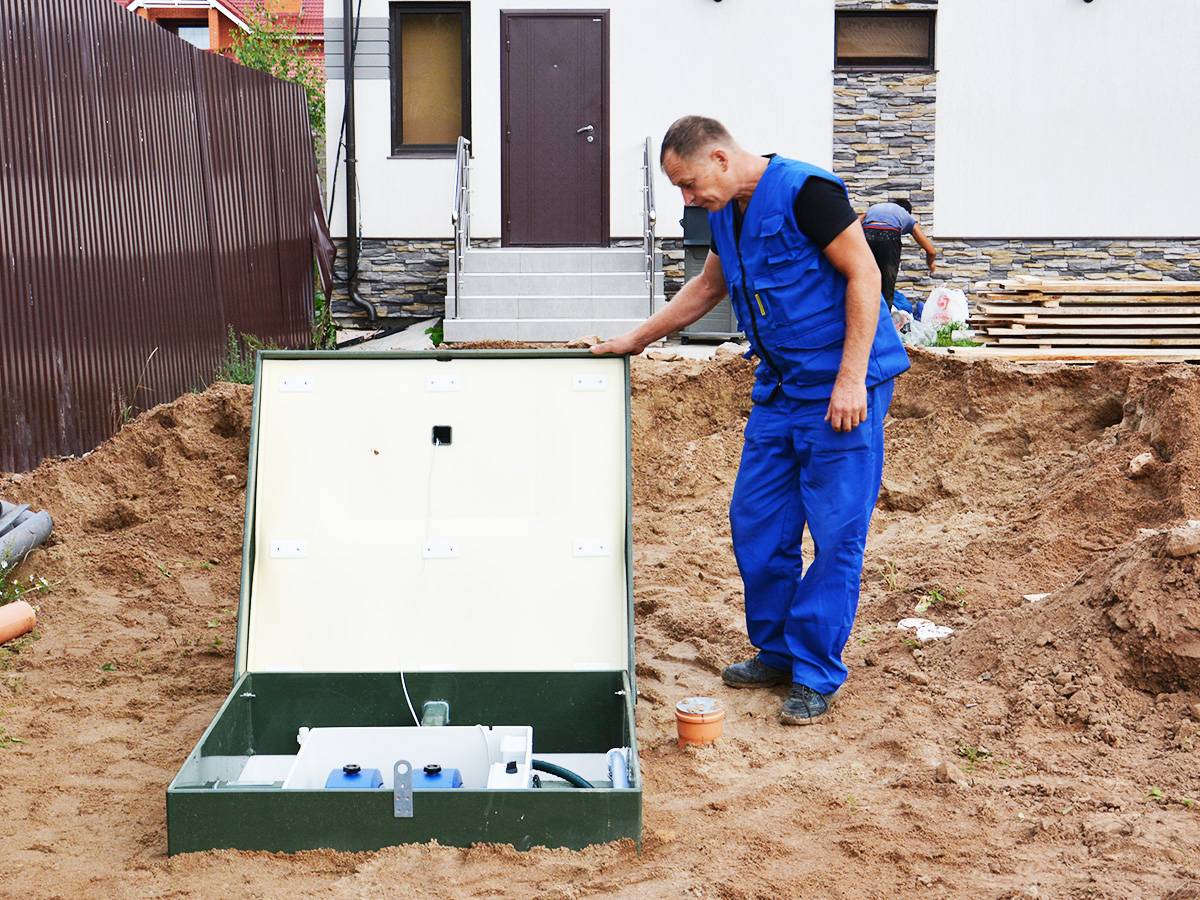
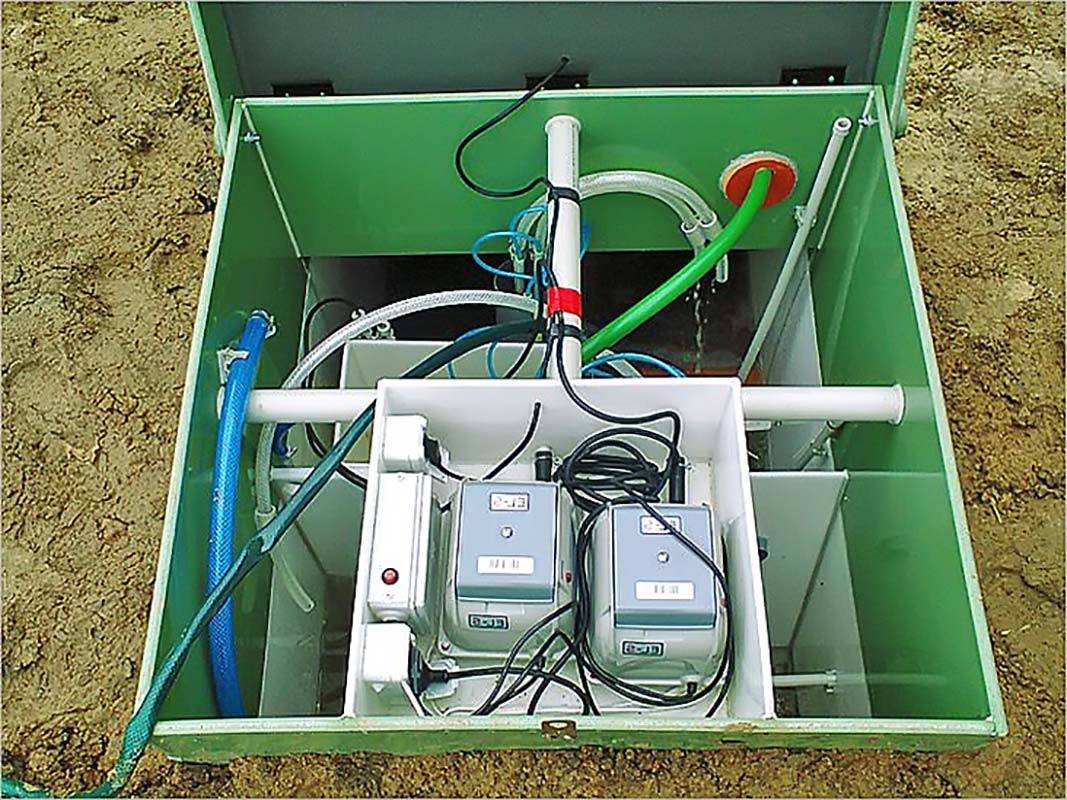
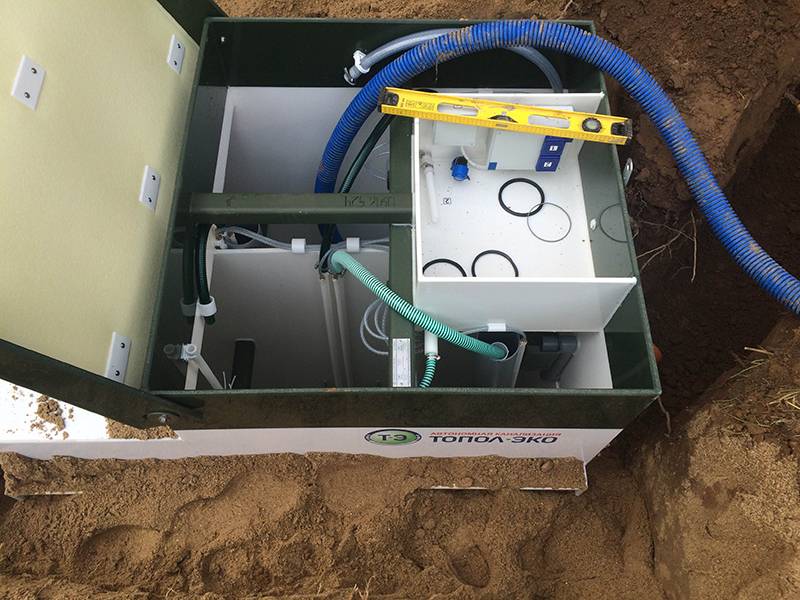


Step 2. To prevent shedding of the pit, its walls are reinforced with formwork.
Step 3. At the bottom of the pit for the Topas septic tank, a sandy backfill 15 cm thick is made, which must be leveled to the mounting level
If the septic tank is installed in places with water-saturated soil or with a seasonal rise in GWL, then it is important to additionally fill or install a ready-made concrete base at the bottom of the pit. The septic tank is further attached to it
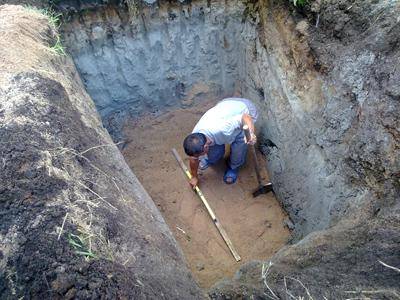
Sand pad alignment
Step 4 Holes for pipelines are made in the wall of the tank.
Step 5. A septic tank is released into the prepared pit. If we are talking about 5 or 8 models, then no more than 4 people should be involved to carry out all the work. To do this, they thread slings through the eyes on the stiffening ribs of the container, holding them for letting the septic tank go into the pit.
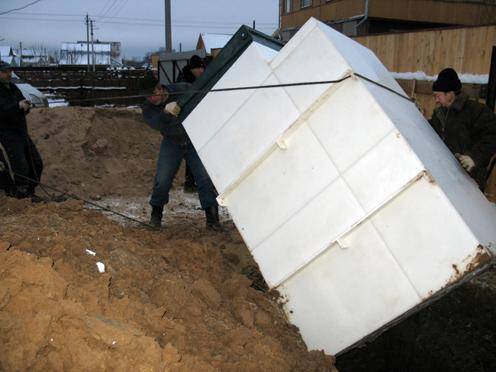
The process of releasing the septic tank into the pit
Step 6 Prepare a trench for laying a pipe from the house to the septic tank. The depth of the ditch must ensure that the pipeline passes below the zero ground temperature point typical for the winter period.If this fails, then the pipe will need to be insulated. A sand backfill is also made at the bottom of the trench, which is leveled in such a way that the laid pipe runs at a slope of 5-10 mm per linear meter.
Septic tank leveling
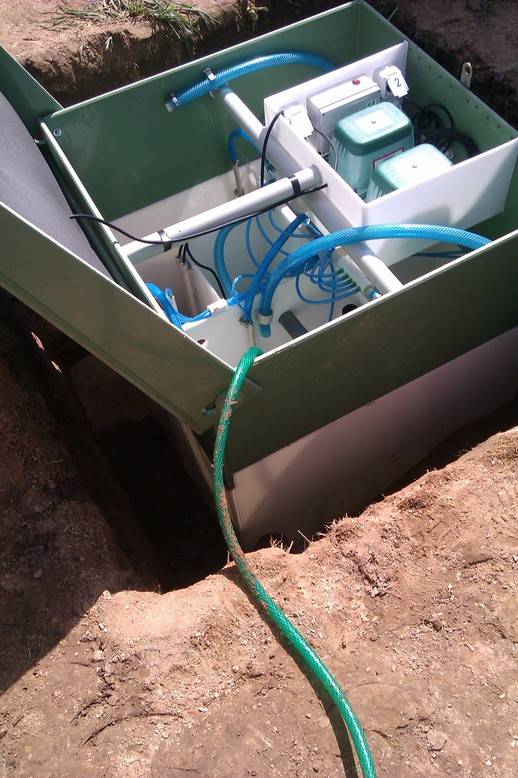
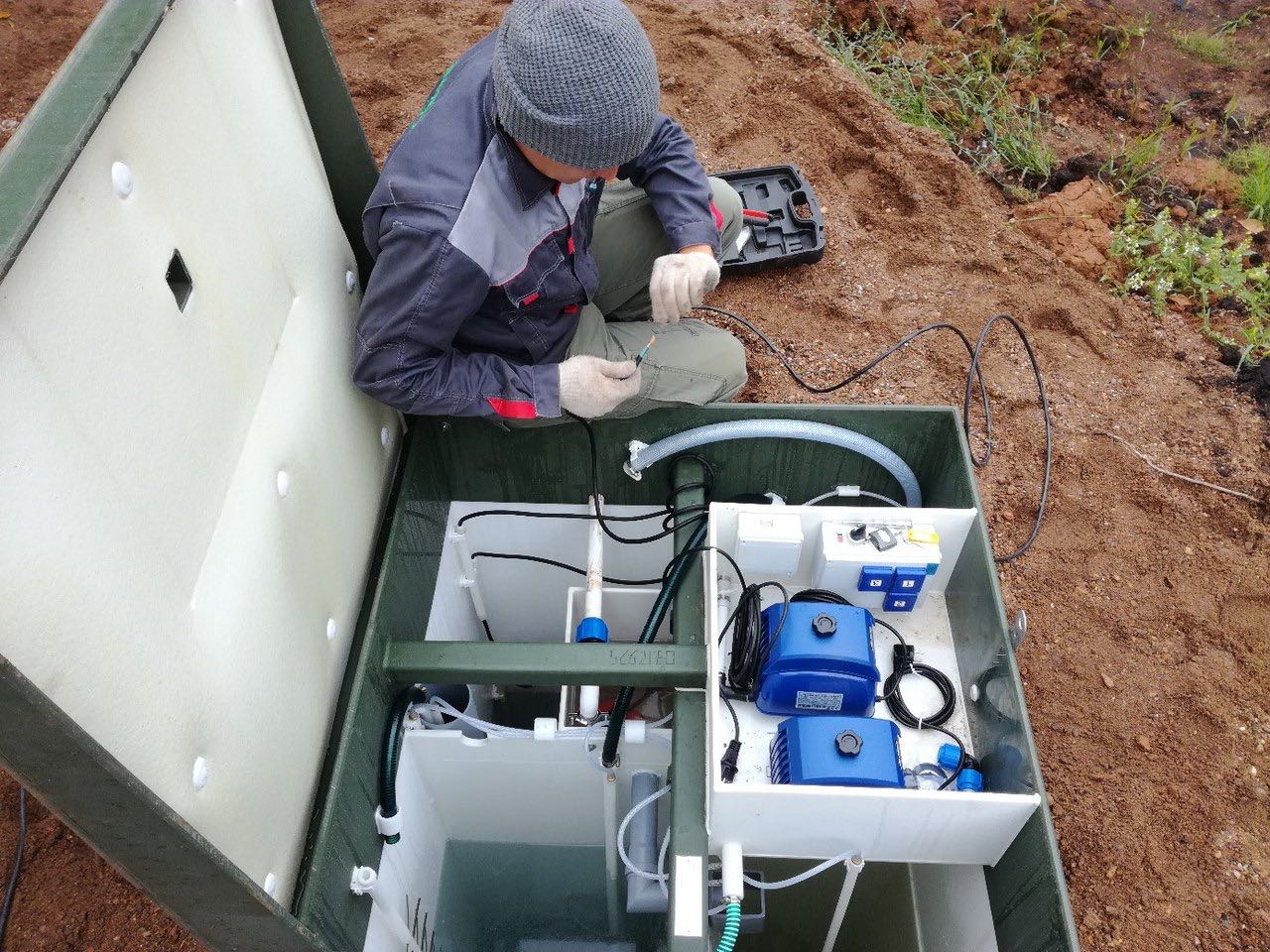
Step 7 Lay the supply pipe and connect it to the septic tank through the pipe inserted into the prepared hole in the wall of the container. All connections are additionally sealed with a special plastic cord that comes with the station. To do this, use a building hair dryer. At the same stage, the septic tank is connected to the power cable and compressor equipment is installed.
Step 8. Prepare a ditch for a pipe that already drains waste after cleaning into a receiving tank, pond, filtration well and other discharge points. A pipe is laid at an angle in it, if the removal of water is planned to be carried out by gravity. For forced evacuation of the liquid in the slope is not necessary. The outlet pipeline is connected to the septic tank, all connections must be tight.
Step 9. Fill the septic tank with sand or a mixture of cement and sand. At the same time, clean water is poured into the tank itself, its level should be 15-20 cm higher than the backfill level. Every 20-30 cm, the backfill is carefully rammed manually. The space between the upper 30 cm of the septic tank and the foundation pit is filled with fertile soil and the turf is laid back around to restore the landscape.
Step 10. Fall asleep ditches with laid in them inlet and outlet pipes.
Do-it-yourself installation of a Topas septic tank
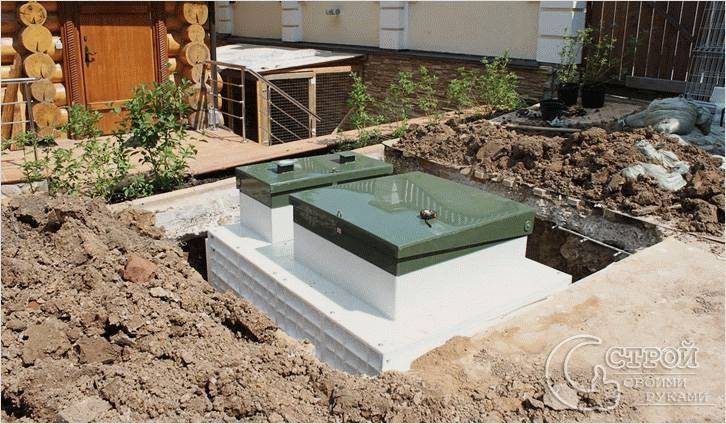
Until recently, biological wastewater treatment was considered an unacceptable luxury for an ordinary owner of a suburban subsidiary plot. And only in recent decades, the situation has changed dramatically, which is associated with the advent of septic tanks, in particular, treatment systems called Topas.
Devices of this type provide high quality wastewater treatment due to their decomposition under the influence of microorganisms (bacteria), which is not accompanied by the formation of waste that pollutes the environment.
Installation do-it-yourself septic tank Topas from a technical point of view, it is quite simple and can be performed by any user who at least once had to deal with such equipment. However, before installing it, or better before buying it, it is advisable to familiarize yourself with all the advantages of a septic tank and the principle of operation of the device.


Device advantages
The main advantages of the Topas septic tank include:
- high efficiency of cleaning procedures;
- low power consumption;
- excellent tightness and low noise level generated by the device during operation;
- compactness and ease of maintenance.
We also note that when purchasing cleaning equipment, you are given the opportunity to individually select a septic tank for the needs of the family (depending on its quantitative composition). So, the Topas-8 model, for example, is designed to serve a family of eight people, and the Topas-5 is suitable for a family of five members.
Device and principle of operation
The main cleaning processes occurring in the settling tanks of the septic tank are the result of the vital activity of special bacteria that feed on organic matter and decompose it into elements ready for disposal.
A distinctive feature of the device we are considering is that its entire design is made in the form of a compact module, due to which the installation of a septic tank is noticeably simplified.
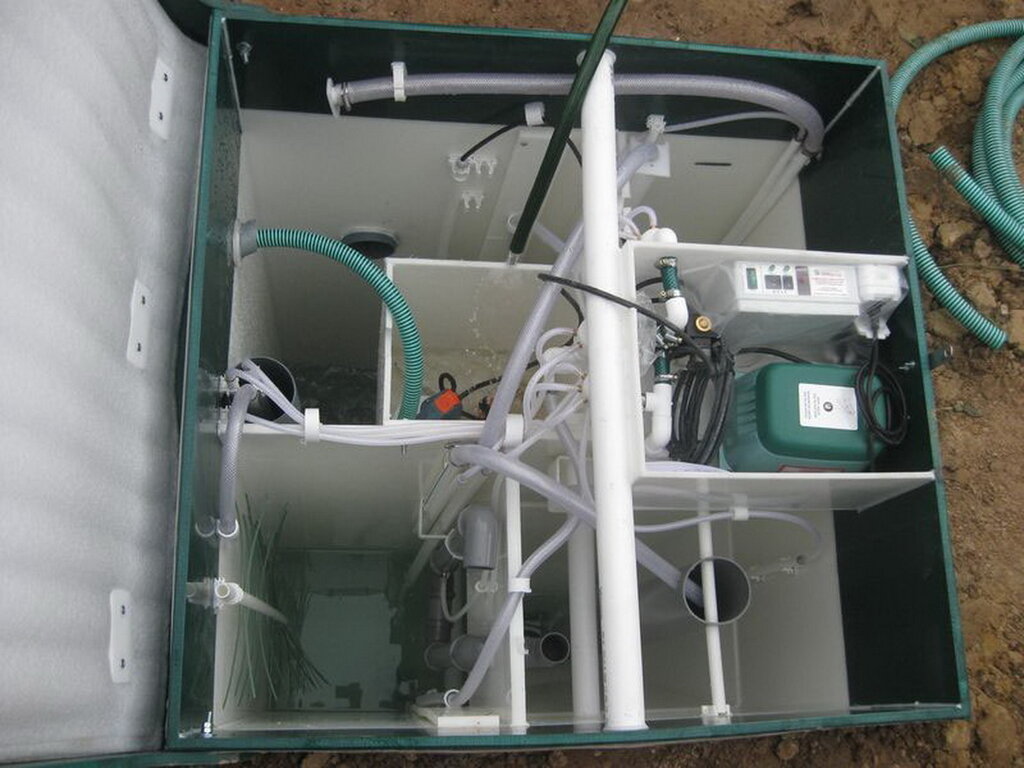
The device has four chambers and two built-in compressors that serve to keep the bacteria working, so that the decomposition process is accelerated.
The first chamber, equipped with a special float switch, serves to collect wastewater and settle it (with large particles of dirt falling to the bottom). When the chamber is filled to a certain level, the relay turns on the compressor, after which the drains are forcibly moved to the second chamber.
After passing through a coarse filter installed at the inlet of the second compartment, liquid waste enters the zone of influence of microorganisms and is cleaned of organic components. To speed up the fermentation process, oxygen is pumped into the chamber with the help of a compressor, which contributes to the mixing of wastewater with activated sludge, which acts as a kind of filter.
Sewage saturated with bacteria and oxygen then enters the third compartment, which is used as a secondary sump. In the fourth chamber, the final purification of water is carried out, which leaves the septic tank through a special channel.
When choosing a place for the arrangement of the device, you should follow the recommendations below:
- The septic tank should be located in a pit, at least five meters away from residential buildings.
- The dimensions of the pit are selected depending on the model of the septic tank, and its walls are closed with formwork or laid out with bricks.
- At the bottom of the pit, a sand cushion with a thickness of about 150 mm is prepared.
Installation of a septic tank (its descent) is carried out using a system of cables pulled through special holes available on the stiffeners of the product.
After installing the septic tank in the pit, all the necessary communications are brought to it and, first of all, a sewer pipe. The insertion depth of the inlet pipe is usually 70-80 cm below ground level and depends on the distance of the station from your home. At a distance of 10 m from the pit to the house, the pipe is inserted at a depth of about 70 cm (at the same time, in the house itself, a sewer outlet is made at a depth of 50 cm).
After installation, complete sealing and thermal insulation of the device case is carried out. These activities must be carried out in accordance with the instructions supplied with the product.
To supply electricity, it will be possible to use a cable of the PVS brand with a section of 3 × 1.5, laid in a corrugated pipe along the same trench as the sewer pipe.
And at the last, most important stage of arranging the device, it is backfilled with the previously selected soil, which is accompanied by pressure equalization on its walls. To this end, as the earth is added, the septic tank chambers are gradually filled with water, which compensates for the excess pressure of the soil on the walls of the device.
Varieties of designs and model range
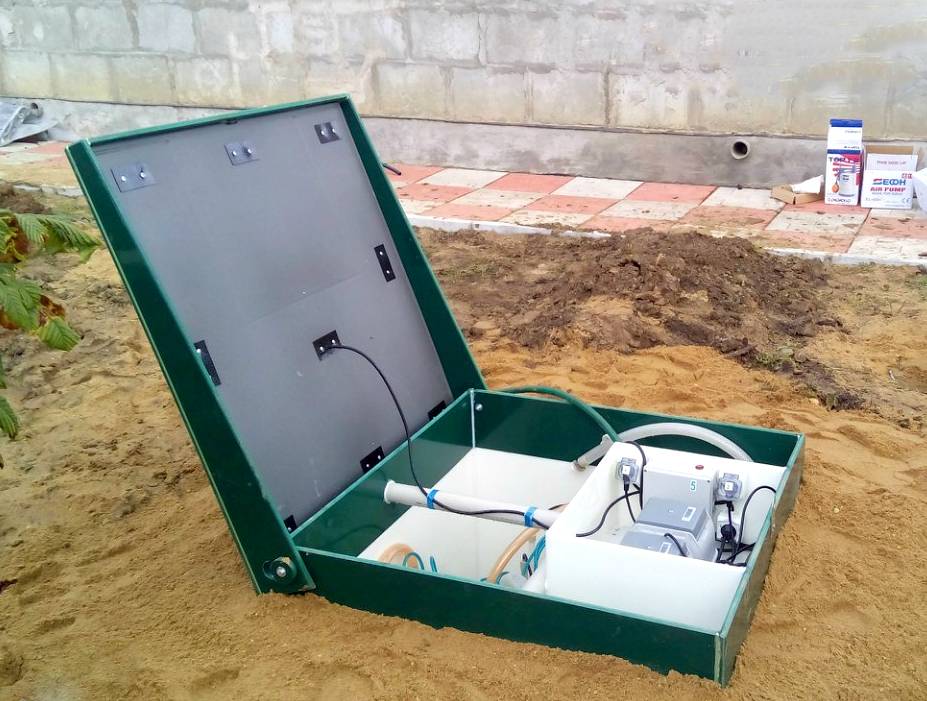
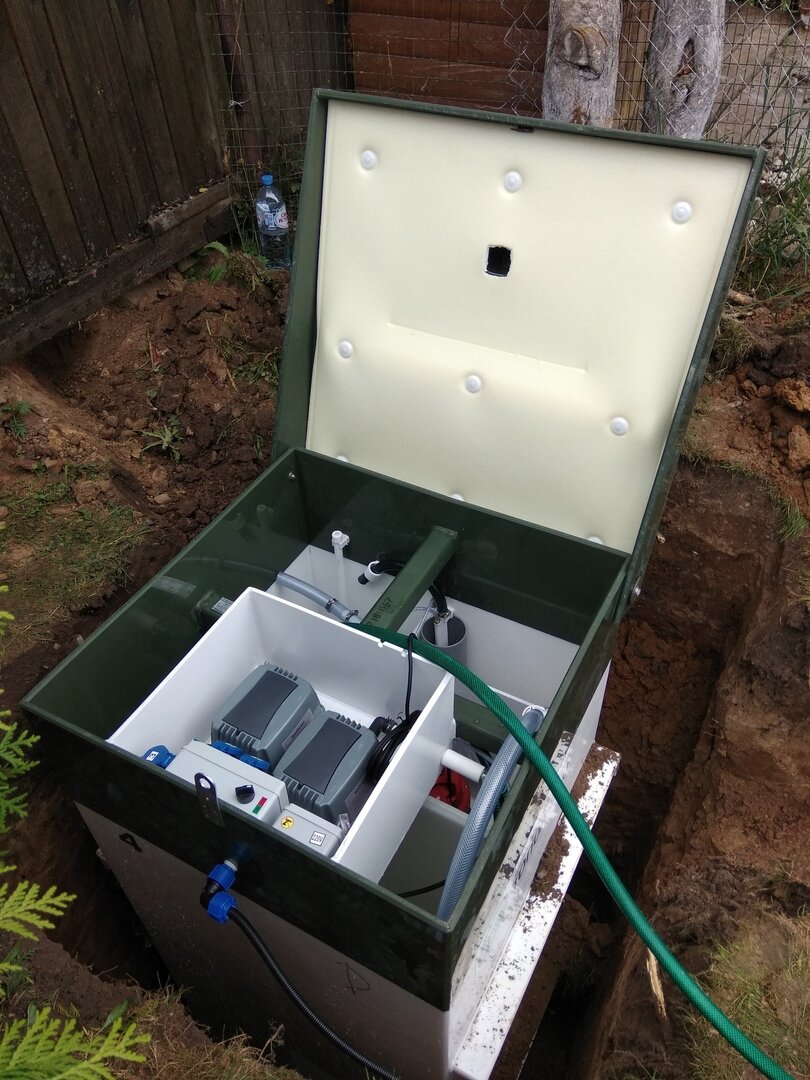
To understand the principles of operation of a Topas-type septic tank, you should study its design. Externally, this device is a large cube-shaped container with a large square lid.
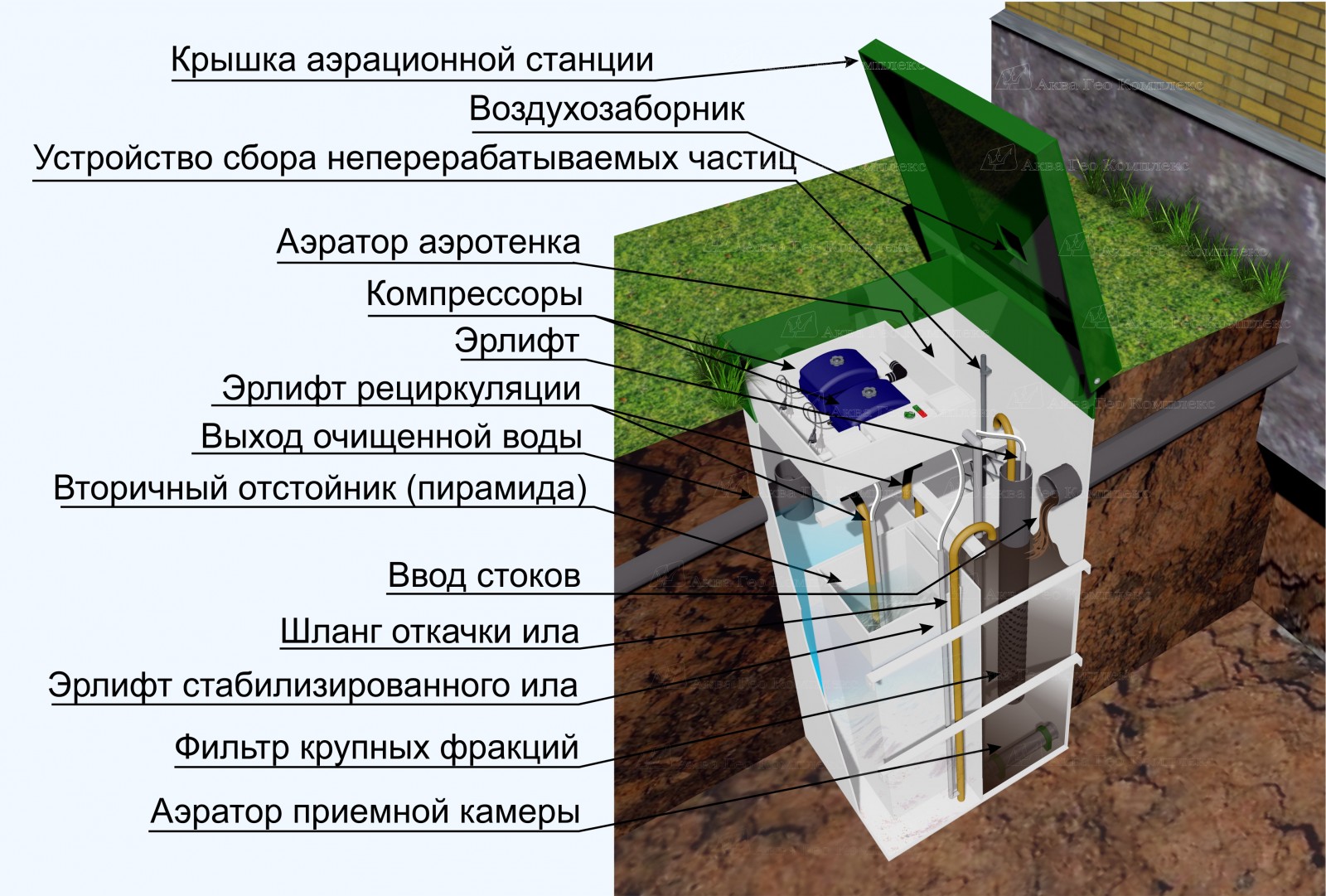
Inside, it is divided into four functional sections. There is a built-in device for air intake from the surface to ensure the saturation of the effluent with oxygen.
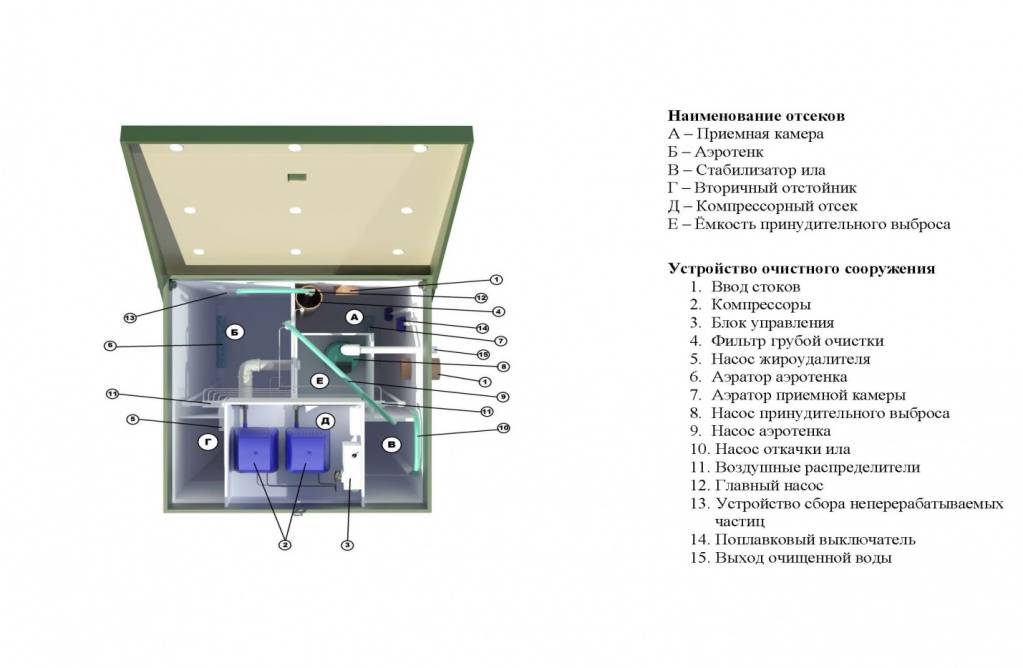
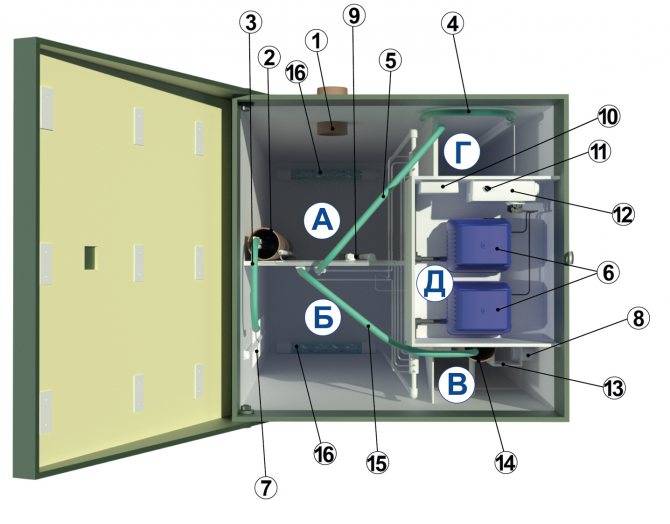
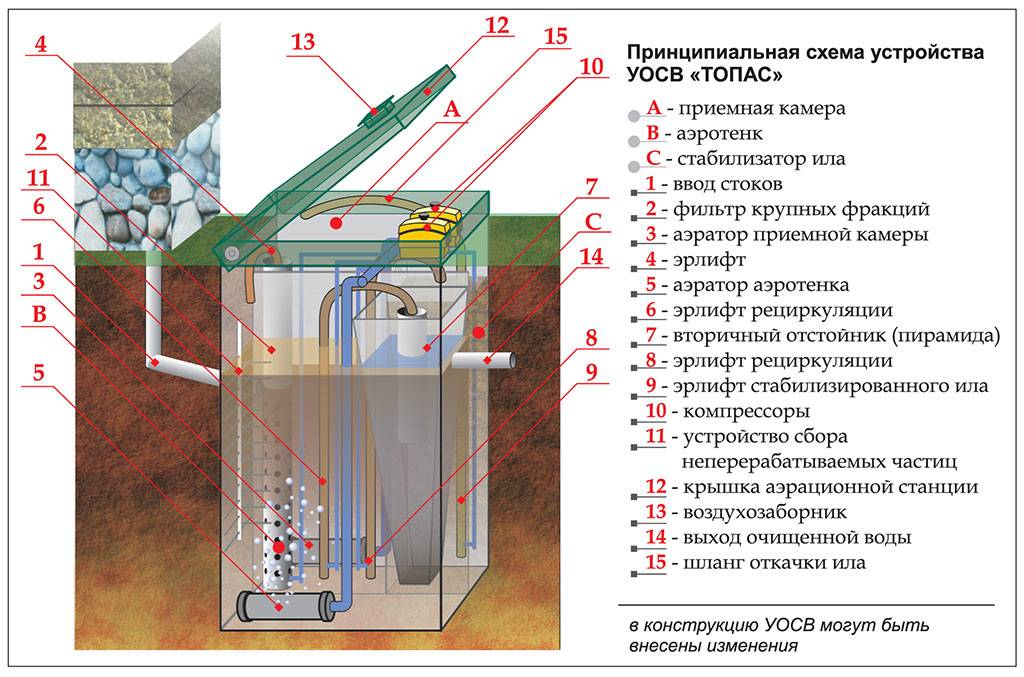
The Topas septic tank consists of four interconnected chambers providing multi-stage cleaning. Flowing from one compartment to another, the effluents are settled, processed by bacteria, disinfected and clarified
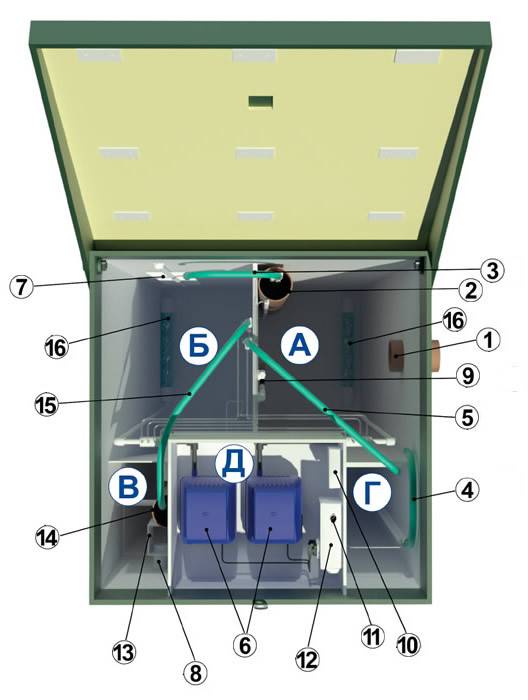
Inside the cleaning system are the following elements:
- the receiving chamber, into which the effluents initially enter;
- airlift with pumping equipment, which ensures the movement of wastewater between different departments of the device;
- aeration tank - a department in which the secondary stage of cleaning is performed;
- pyramidal chamber, where the final treatment of wastewater takes place;
- post-treatment chamber, here the water purified during the operation of the septic tank accumulates;
- air compressor;
- sludge removal hose;
- device for the removal of purified water.
The range of septic tanks of this brand is quite wide. There are models for plots and houses of various sizes, devices designed to service gas stations, and even powerful sewage treatment plants that can meet the needs of a small village.
This diagram clearly shows the device of the Topas septic tank. It consists of four different departments, through which the waste that has entered the sewer pipe is moved.
In private housing construction, Topas-5 and Topas-8 septic tanks are most often used. The number next to the name indicates the approximate number of residents that the device is designed to serve.

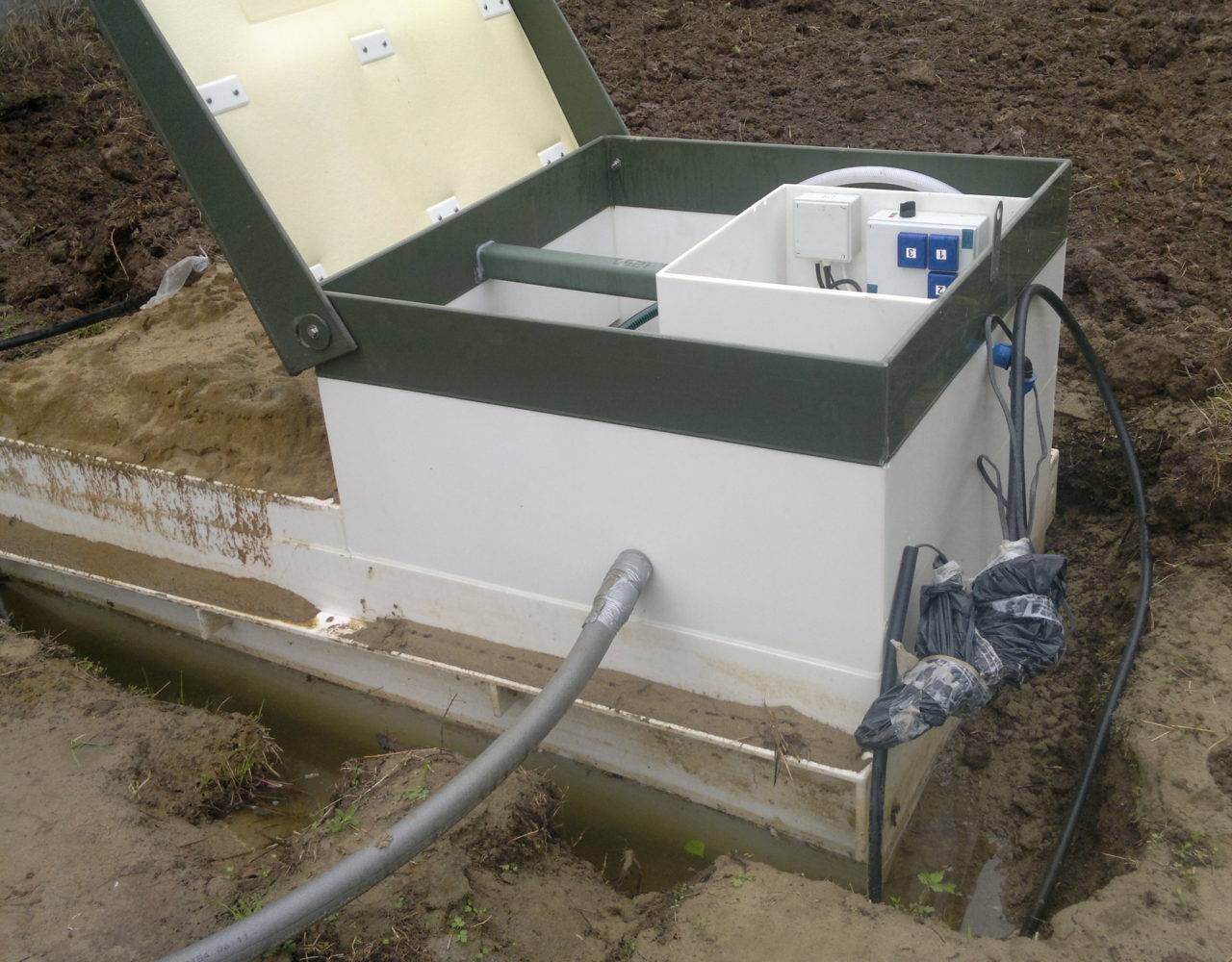

"Topas-5" has a more compact size and lower productivity, it is able to easily meet the needs of a family of five in sewerage services.
This model is considered an ideal choice for a relatively small cottage.Such a device can process about 1000 liters of wastewater per day, and the simultaneous discharge of waste within 220 liters will not cause any harm to the septic tank.
The dimensions of Topas-5 are 2500X1100X1200 mm, and the weight is 230 kg. The power consumption of the device is 1.5 kW per day.
But for a large cottage, it’s better to take Topas-8. The dimensions and ability to process wastewater from this model are much higher. Such a septic tank is able to serve even the areas where the pool is located, although in such a situation, Topas-10 may be more appropriate.
The performance of such models varies between 1500-2000 liters of wastewater per day.
The numbers next to the name of the septic tank indicate the number of people that this device can serve with simultaneous use. Buyers are guided by these indicators, choosing the right model.
There is also a letter marking that describes the special operating conditions for which a particular device is designed.
For example, the designation “Long” indicates the possibility of using this septic tank with a connection depth that exceeds 80 cm. The “Pr” marking indicates models with the option of forced pumping of partially treated water.
Such designs are additionally equipped with a pump. Models marked "Pr" are used in areas with a high level of groundwater.
Models of Topas septic tanks may vary depending on the volume of wastewater being processed, as well as on operating conditions. For example, for areas with an elevated groundwater level, it is recommended to choose a septic tank marked “Pr”
The presence of a pump in the device of this model of the Topas septic tank is designed for installation on a site with clay soils that do not filter well or do not absorb purified water at all. Marking "Us" stands for simply - "reinforced".
These are more powerful models that should be used if the installation depth of the septic tank exceeds the level of the sewer pipe by 1.4 m or more.
The higher the performance of the pump, its power and the more options it has, the more expensive it will be to purchase it, and the more difficult it is to install it. Therefore, you should not choose a treatment plant “for growth”, if in the near future the number of residents in the house should not increase sharply.
More detailed recommendations on choosing a septic tank for a summer residence are discussed in our other article.
The principle of operation of the equipment
The principle of operation of the structure is based on the use of microorganisms. At the same time, organic compounds decompose, causing the mineralization of contaminants and the deposition of impurities on the walls of the structure, which makes it possible to carry out maintenance much less frequently than in other similar devices.
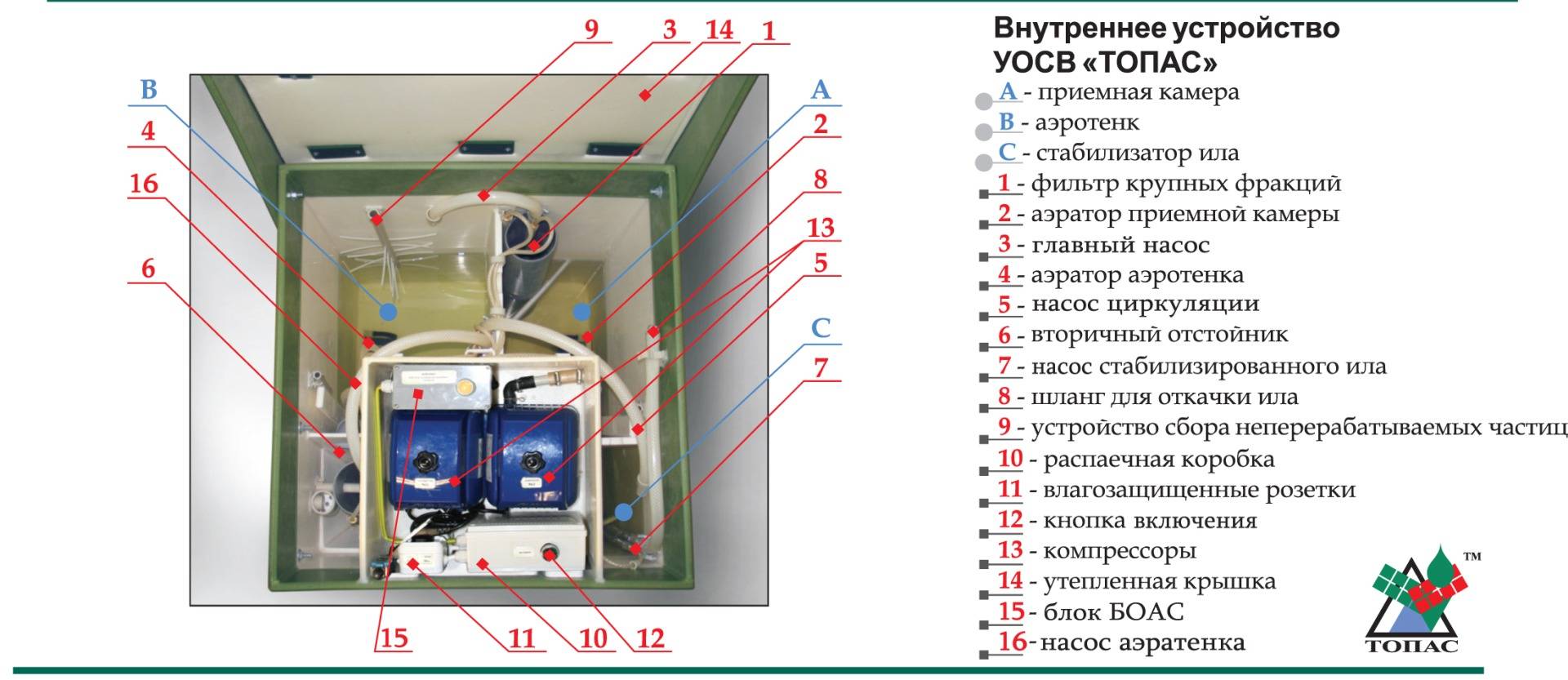
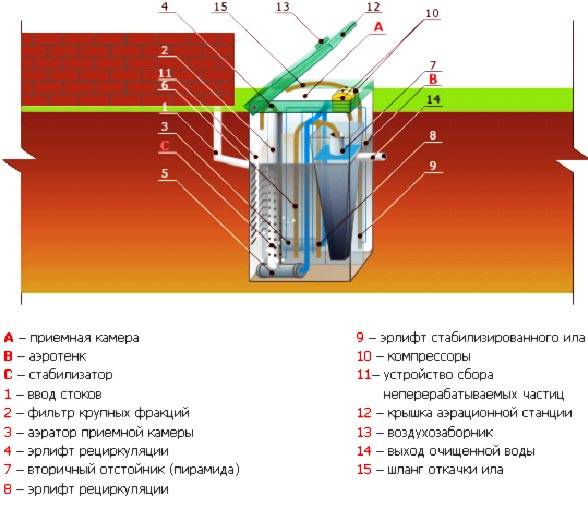
Cleaning begins from the receiving chamber where drains flow by gravity. It undergoes a preliminary stage after which partly purified water is pumped through pump in the aerotank. This process, which takes place in the Topas septic tank, is best seen in the scheme of work.How does a septic tank work Topas, here the destruction of organic compounds occurs due to the use of activated sludge.
Then the mixture moves to the secondary settling tank, where the solid fractions settle to the bottom, and the water flows out. After that, the sludge is moved back to the aeration tank for further use.You can see in more detail the principle of operation of the Topas septic tank in the video below.
The best qualities of the septic tank of the Topas model
Topol-Eco equipment differs from similar devices not only in its design features, but also in unique characteristics, among which are:
- High efficiency wastewater treatment
- Compact dimensions
- Small power consumption
- Work without excessive noise
- Absolute tightness
- The ability to install a septic tank with your own hands
- Ease of maintenance.
In addition, it should be noted a wide range of models, allowing you to choose a model in accordance with your needs.
Installation features and do-it-yourself installation rules
Installation of equipment is conditionally divided into several main stages:
- Site preparation
- Equipment installation
- Sealing
- Connecting to a power source
- Normalization of pressure.
However, no matter how excellent the installation is, it is not worth placing it next to the foundation of the house. The distance from it to the building should be at least 5 m. The pit for the device will perform the following dimensions: 1800x1800x2400 mm. After it, formwork should be arranged.


Watch the video, installation:
After the pit is ready, a sand cushion up to 15 cm thick is organized at its bottom. This will avoid flooding the station during the spring flood and the Topas septic tank is being installed, its main stages can be viewed on the video. Experts recommend choosing a model in accordance with the level of groundwater. If it is located near the surface, then it is worth giving preference to models marked PR.
When sealing the installation, it should be leveled in advance using the building level. But it is better to entrust this work to specialists. Moreover, the average price for a Topas septic tank is quite low, even if it is purchased with subsequent installation.
Summing up
The main advantage of the Topas septic tank, most users call undemanding maintenance and an efficient principle of operation. But at the same time, full-fledged work depends on the power supply, so in case of power outages, you will need to install a generator or you will have to stop using a septic tank.
In the reviews you can often read questions about the full purification of water. Since not every house has the possibility of draining into a roadside ditch. Therefore, you should equip the filtration site in advance before proceeding with the installation of the Topas septic tank with your own hands.
Technical parameters of the sewer complex Topas
 It is worth noting that in recent years Topas has gained high popularity among consumers. The reason for this is that it has a large number of significant characteristics:
- small dimensions - when placing the complex, it is necessary to allocate no more than one square meter for it;
- during the installation of the septic tank, the owner has the opportunity to choose a place for him at will. The main thing is that it is possible to equip sewer drains there;
- no difficulty in removing water that is suitable for use as irrigation or other needs;
- ease of operation and maintenance of the system. If the need arises to perform such work, the owner can cope with this task on his own.
Advantages
A distinctive feature of the Topas septic tank is the presence of a set of certain advantages, due to which it compares favorably with competitors.
- the cover is above ground level, due to which the owner does not have problems with access to the internal structure of the septic tank;
- the design provides for a reliable case that effectively copes with the task of retaining heat;
- the system provides for the possibility of discharging purified water in a natural way, which eliminates the need to use a pump;
- due to the presence of water in the septic tank, the system remains in place, which eliminates sharp displacements and its rise above the surface.
Flaws
At the same time, the Topas sewer installation is not without certain disadvantages that every buyer who decides to install it in his country house should take into account. Among them, the most significant disadvantages are the following:
- The system can only work if there is current in the mains. In the event of a power outage, the unit shuts down. The vast majority of autonomous sewer systems have a similar minus;
- high cost, the reason for which is due to the high costs of aseptic production.
Breakdowns of the treatment plant and methods for their correction
Almost all breakdowns of the pumping station are manifested by an increase in the level of effluents in the receiving compartment. The rise in level actuates the emergency float, due to which an alarm is triggered - a bell or a light signal.In this way, the user is made aware of the risk of flooding the system and the discharge of raw sewage outside the device.
Flooding by sewage treatment plant
First of all, it is necessary to check whether the channel for removing treated effluents from the device may be clogged or frozen. If not, then you need to look for the cause of the flooding of the station based on the type of equipment. It can be with a gravity outlet system or with forced pumping.
In models of installations with forced pumping, the problem may be a breakdown of the drain pump or a sticky float switch. To check the operation of the pump, it is removed and connected to another outlet. If the pump is in order, but after connecting to the station it does not turn on, then most likely the matter is in the float switch - it is necessary to replace it.
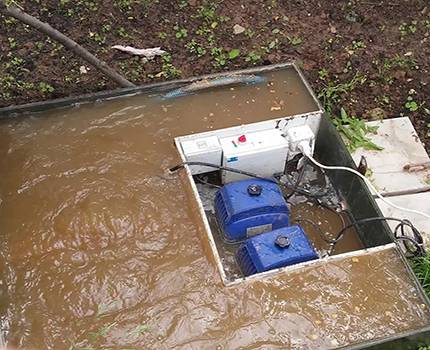
Flooding of the TOPAS septic tank often requires serious repairs and this is the most common malfunction. If a problem is detected, the first thing to do is to disconnect the equipment from the network, remove the compressors, dry them, as well as all the electrical elements of the station during the day
The following issues may be common to gravity and forced models. Check whether the liquid is pumped from the receiving compartment to the aerotank. If not, then the airlift malfunction is the culprit.
The reasons for the breakdown can be the following:
- damaged airlift tube;
- the airlift of the main pump is clogged;
- float switch defective;
- the membrane of the compressor that supplies air to the airlift is damaged.
Breakdowns are eliminated by replacing damaged elements or cleaning clogged areas.
Tripping of the RCD and problems with the power supply
If the RCD (residual current device) is triggered when the station is started, the cause may be damage to the compressor or drain pump, float switch. It is also necessary to check the wiring, sockets.
Plant malfunctions can also be caused by a prolonged power outage, and then there is a possibility of overfilling the tanks and creating an unpleasant odor due to the start of the development of anaerobic microorganisms. If the voltage fluctuations in the network are within 3% of the nominal, it is necessary to install a stabilizer.

Change in water level in a non-working station
It is undesirable to leave the TOPAS treatment system unused for a long time.
But if this nevertheless happened, and it was found that the water level in the tank is changing, then possible malfunctions may be as follows:
- Breakage of plumbing fixtures, which leads to water leakage. You need to find the source of the leak and repair or replace it.
- The body of the device is damaged. If the problems are small, then you can try to solder the case, if not, you need to turn to professionals for help, and they will replace the damaged area. And it’s good if you can get by with repairs, because replacing the entire body will cost a lot.
- Incorrect installation and, as a result, flooding with rain or flood water.
- The station tank must be installed so that the lid rises 15 cm above the ground.
A problem can also be a poorly organized exit of purified water from the system. The situation of poor outflow can be aggravated by the poor carrying capacity of the soil.
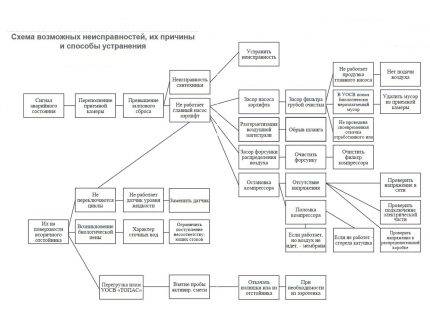 Guided by the scheme, it is necessary to exclude less probable causes of breakdowns and trace possible malfunctions and methods for their elimination
Instructions for use of septic tanks Topas
Now that you have learned how water is treated at the station, it will be easier for you to understand how to use it correctly. Most of the instructions for use are aimed at ensuring that the bacteria in the septic tank feel good and do their job. Also, do not allow clogging of the Topas septic tank. Some of the instructions should be observed not only when using the SBO, but also when using the city sewer.
- The Topas septic tank must always be connected to the network. Without this, the compressors will not work and supply air to airlifts and aerators. In the event of a power outage, the unit can stand without electricity for about six hours. However, it cannot be used, as there may be a risk of flooding.
- During the operation of the Topas septic tank, chlorine-containing preparations must not be washed into the sewer. They are found, as a rule, in some products for earthenware, bleach for clothes, tablets for dishwashers. Be careful what household chemicals you buy and replace chlorine-containing products with chlorine-free counterparts. Shower gels, soaps and shampoos are completely safe for bacteria.
- Non-degradable items, such as cigarette butts, feminine hygiene products, condoms, wet wipes, candy wrappers, and so on, cannot be dumped into the Topas station. They can clog airlifts or filters and create an emergency.
- Non-degradable items also include animal hair and hair. It is difficult to completely eliminate their entry into the sewer, but it can be reduced to a minimum. For example, if you do not flush the water down the toilet after washing the floors, and install strainers in the sink and shower.
- Also, during the operation of the Topas septic tank, water must not be drained into the sewer after washing the mushrooms. Fungal spores multiply rapidly on activated sludge, and the unit begins to smell unpleasant.
If you follow all these simple instructions, then you will not have any problems with the Topas station. The output water will be clean, odorless, and it can be used to water non-fruiting plants. If cloudy outlet water
, there may be several reasons for this:
- Insufficient amount of sludge is generated in the installation. This can happen in the first weeks of using the station immediately after installation or depreservation.
- Chemical contamination due to the use of chlorine-containing agents.
- Overloading the station or exceeding the volley discharge.



