
- Can't you do without a photorelay at home?
- How to set up a photo relay for street lighting
- Selection of photorelay for outdoor lighting
- Specifications - what to look for
- Are additional features important?
- Advantages and disadvantages
- Video: selection principle and photorelay operation
- Varieties of light sensors
- Photorelay manufacturers: countries and prices
- Comparative table of photo relays from different manufacturers
- Photorelay IEK
- Characteristics table for IEK brand photosensors
- Selecting an installation site
Can't you do without a photorelay at home?

An illiterate question about the need to use a photorelay can be asked by a person who does not care about the convenience of his home and the arrangement of the adjacent territory. The work of the device is aimed not only at creating beautiful light accents. The photorelay is used for the convenience of lighting control, as well as energy savings.
Let's look at a few arguments in favor of the device:
- Let's start with convenience. The lighting system is controlled by a switch. It is usually placed at the door near the room. Indoors is fine. And take, for example, your yard. To turn on the light you have to get through the darkness to the switch. And if the barn is located in the far yard? A long journey begins in the dark with a flashlight.The photo sensor will allow you to adjust the illumination of frequently visited places, which will save the owner from wandering in the dark.
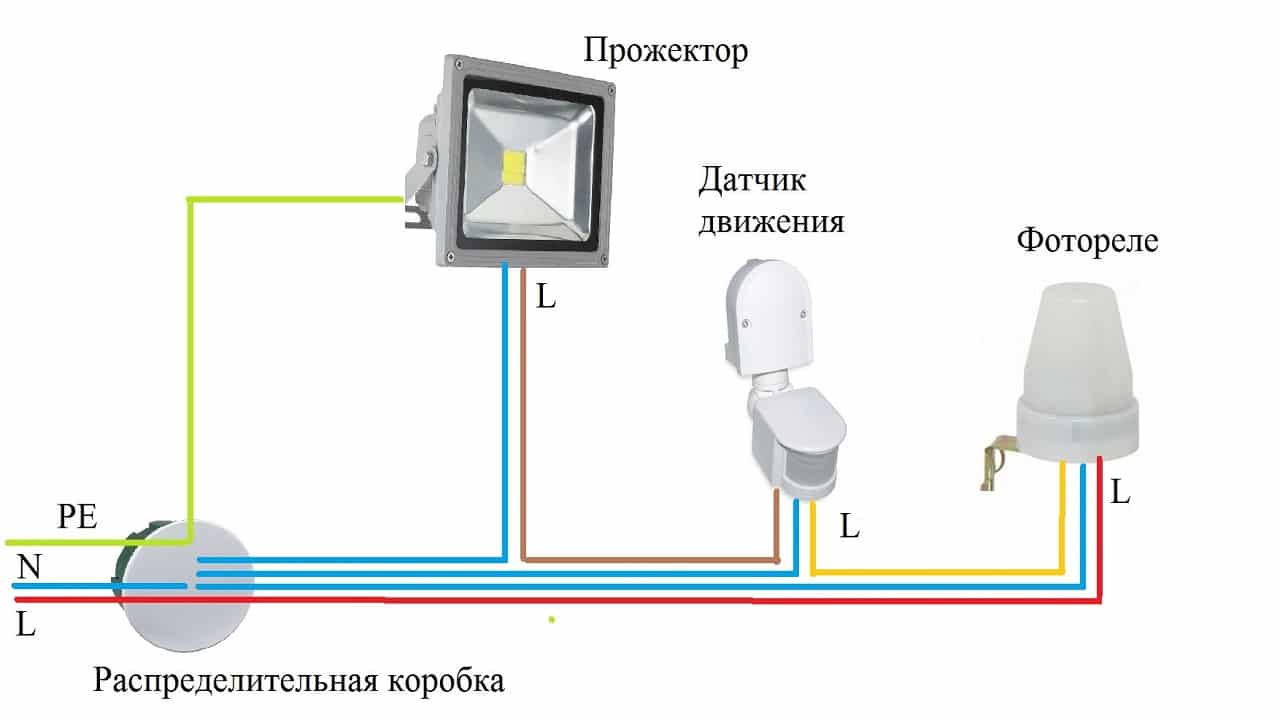
- Now about saving. Owners of large private plots install many lighting fixtures to illuminate the garage, recreation area, entrance to the house and other places. For the convenience of controlling the entire system, you can use one switch, but what will be the power consumption. The light will burn even in unnecessary places. And in the morning after a stormy rest, it’s too lazy to get up early to turn off the lighting. A device with a photo sensor will do everything by itself with the onset of dawn. And if you still use a motion sensor, in general, the lighting will turn on only where there are people.
- The photorelay is primitive, but at least some kind of protection against thieves. The light turned on at night in the absence of the owners in the country creates an imitation of presence. Not every petty hooligan will dare to enter the yard.
If the above arguments are unconvincing, you can do without a photo relay. But is it necessary to save on your own comfort, if the device costs not so much money. Moreover, the photorelay can be connected without problems with your own hands.
How to set up a photo relay for street lighting
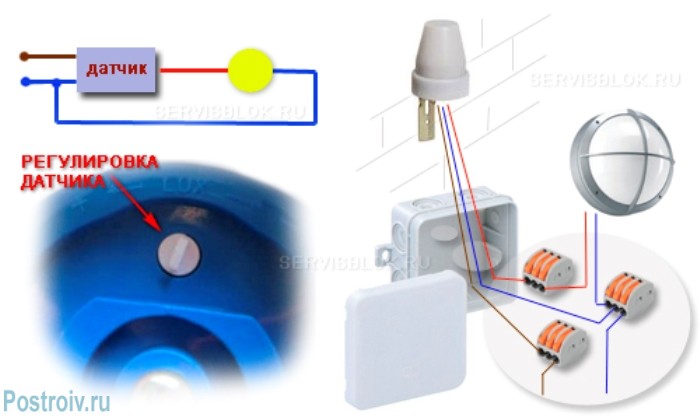
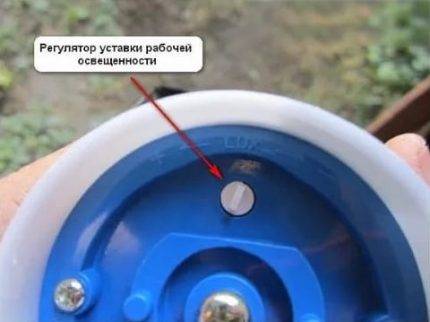
It is necessary to configure the light sensor after installation and connection to the network. There is a small plastic rotary dial in the lower part of the case to adjust the operation limits. Its rotation sets the sensitivity.
Find a similar regulator on the case - it adjusts the sensitivity of the photo relay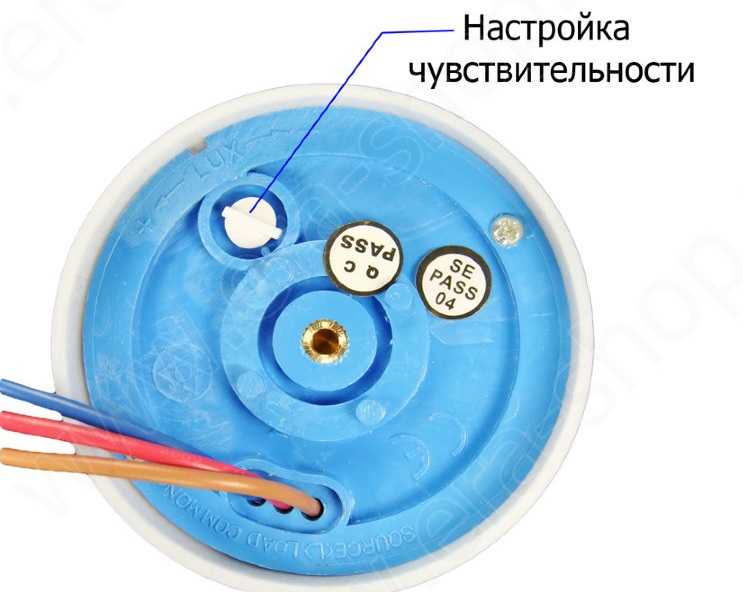
A little higher on the case there are arrows that indicate which way to turn to increase and decrease the sensitivity of the photorelay (left - decrease, right - increase).
To begin with, set the lowest sensitivity - drive the regulator to the extreme right position. In the evening, when the illumination is such that you decide that you should already turn on the light, start the adjustment. It is necessary to smoothly turn the knob to the left until the light turns on. On this we can assume that the setting of the photo relay for street lighting is completed.
Selection of photorelay for outdoor lighting
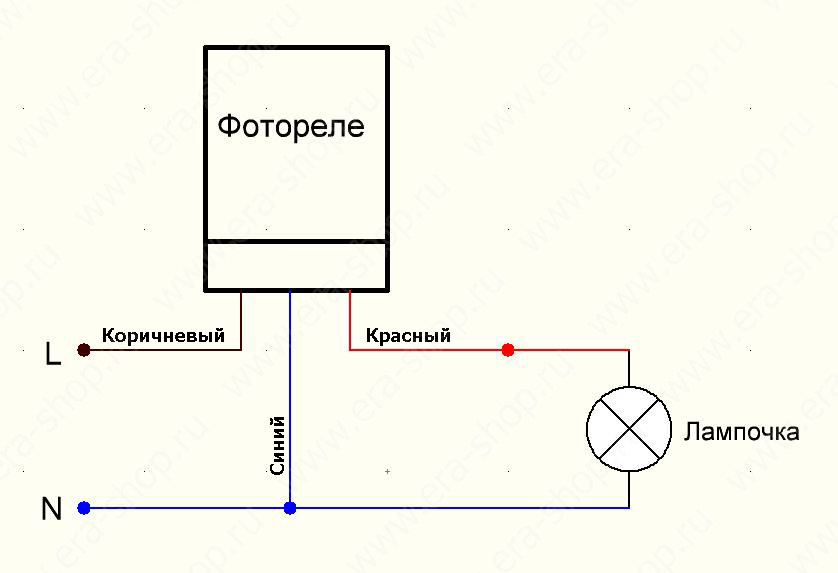
Before going to the store to purchase a photo sensor to adjust the street lighting system, you should decide on the number and type of connected lamps. For one or two lamps, a relay is enough, lighting electrical appliances to which will be connected directly.
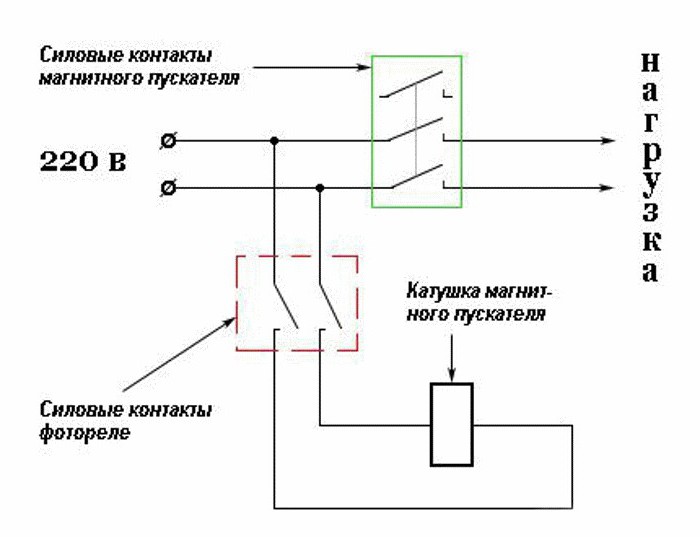
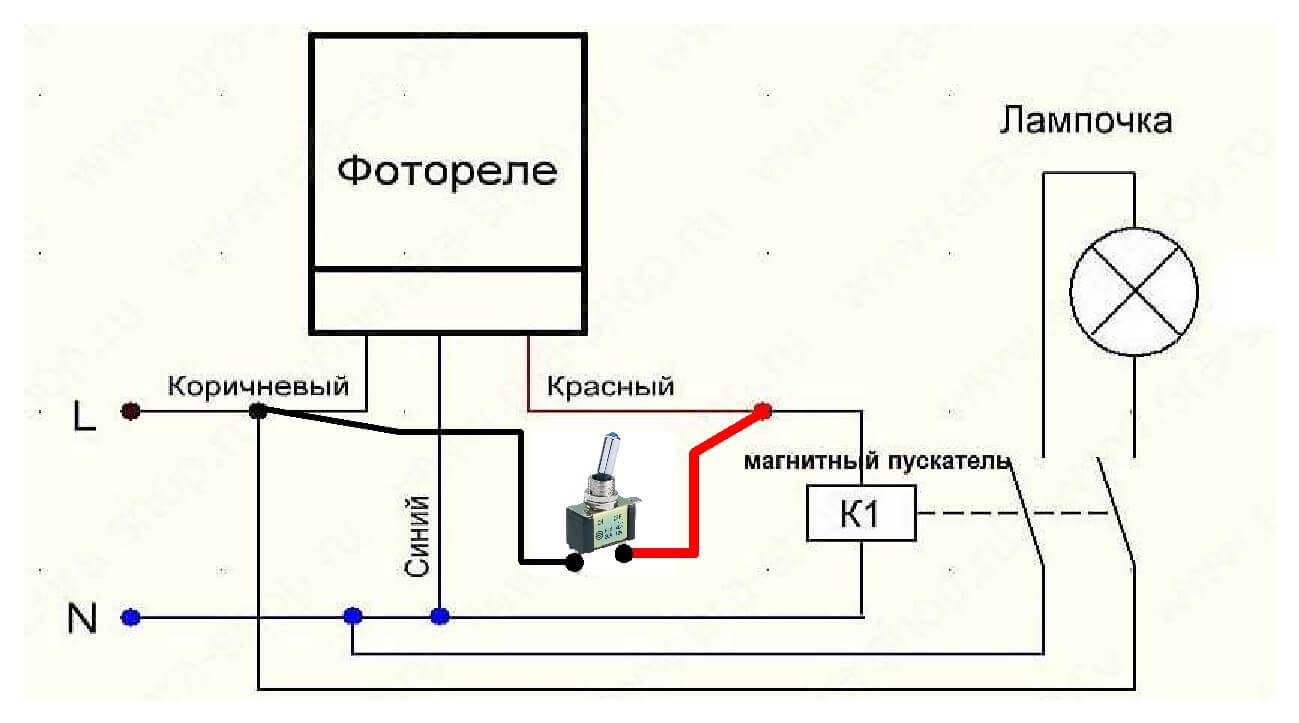
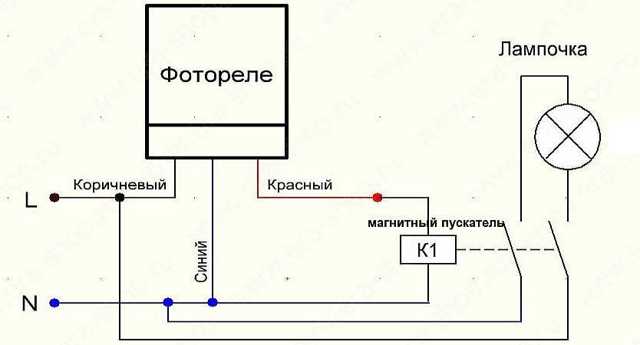
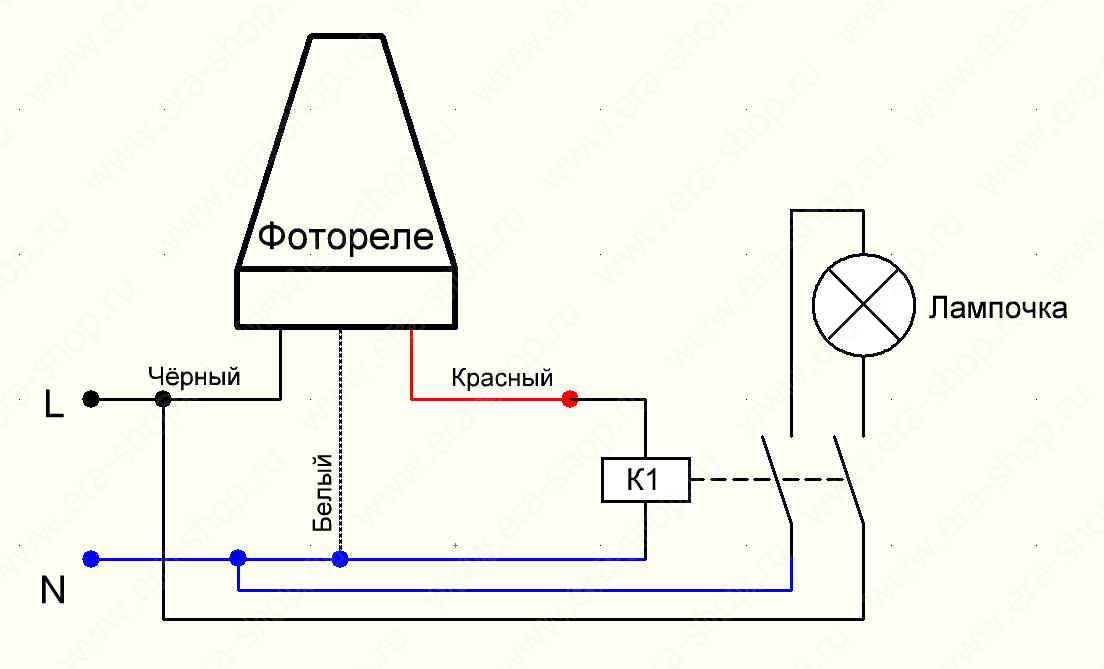
If there are a lot of light bulbs, then the photo relay will not be able to withstand the current passing through it. In this case, equipment with a magnetic starter is required.


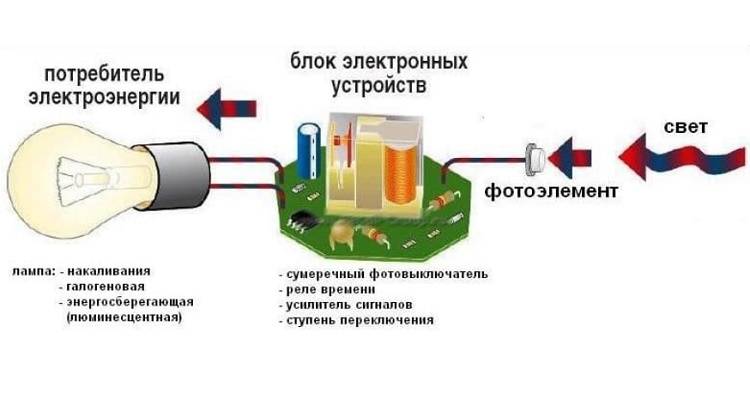


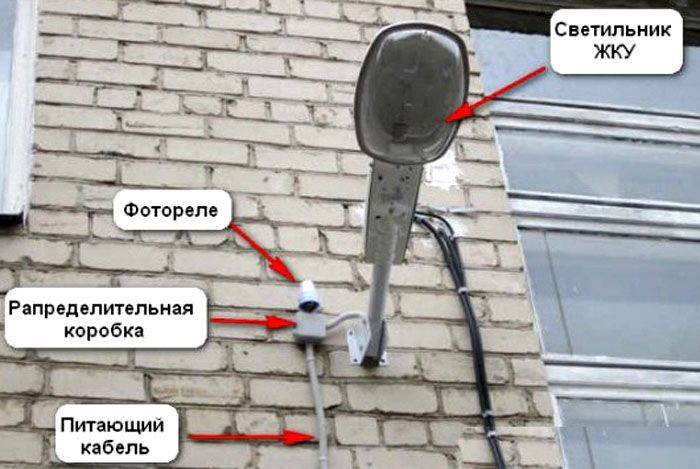

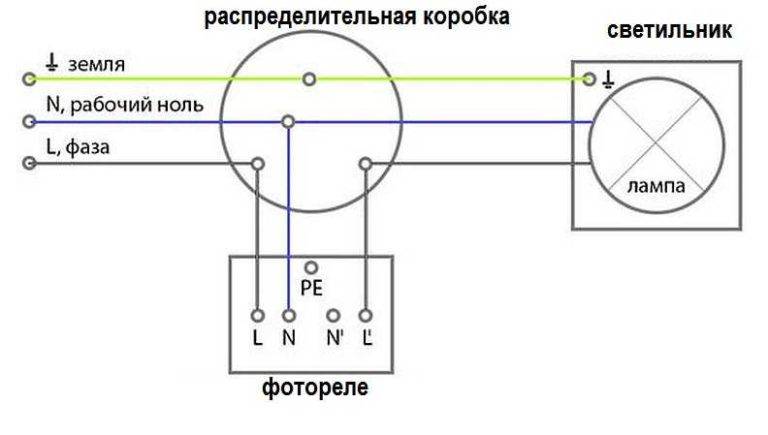

Here, the photosensitive switch starts a special device, through which the lighting equipment is already powered. Those. a lot in choosing a photo sensor model depends on the power of the circuit of lamps connected to it.
A special approach and the obligatory performance of preliminary calculations require the selection of a photorelay for a solar-powered street lighting system. Its power and the number of connected devices directly depends on the average annual number of sunny days in the region, as well as on the number of solar panels in the circuit.
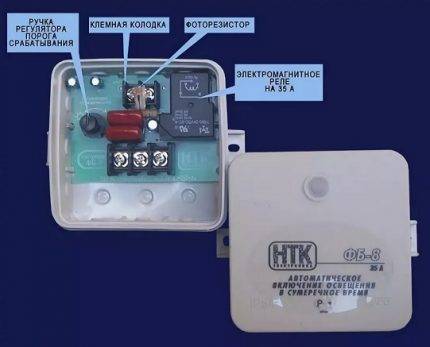 The more light bulbs are planned to be connected to the photorelay, the higher the parameters of the switched current must be - devices with a current rating in the range of 6–63 Amperes are now on the market, there are plenty to choose from
According to the type of connection to the mains, light control relays for street lighting are divided into:
- single-phase (household, under a network of 220 V);
- three-phase (for 380 V networks).
However, the switching relay itself and the entire circuit with a photo sensor are powered by a voltage of 12 V, which comes from a step-down transformer. The choice in favor of a single-phase or three-phase device depends solely on the network of light bulbs connected to it and the power it consumes.
To install a photorelay control for street lighting in private houses, it is best to choose ordinary household models for 220 V. They will be more than enough, especially if economical LED lamps are connected to them.
Specifications - what to look for
Some imported electrical appliances are designed for networks of 110 or 127 V. Rarely, but they can be found in lighting stores. Just like that, in Russian networks for 220 V, they will not be able to work. For them, you will need to install an additional transformer. It is better to immediately take the equipment, with the connection of which there will be fewer problems.
The first and main indicator is the degree of protection. For outdoor installations, select models with sealed enclosures of IP65 or higher. And for installation under a roof or in a protected shield, a device with IP44 is quite suitable.
The second parameter is the response threshold, which is expressed in Lux. Usually this range is from 2 to 50 Lx. The photo relay has an adjustment of this indicator so that the user can adjust it to his personal preferences. It is worth purchasing a device with an unregulated threshold only as a last resort.
The third indicator is the type of connected lamps.Often, the photorelay is designed exclusively to work with incandescent bulbs that create an active load.
To connect fluorescent devices with an already reactive load, it is required to take a different type of twilight switches. And to connect mercury or sodium lamps, you need equipment with an additional protective circuit, designed for inrush current surges.

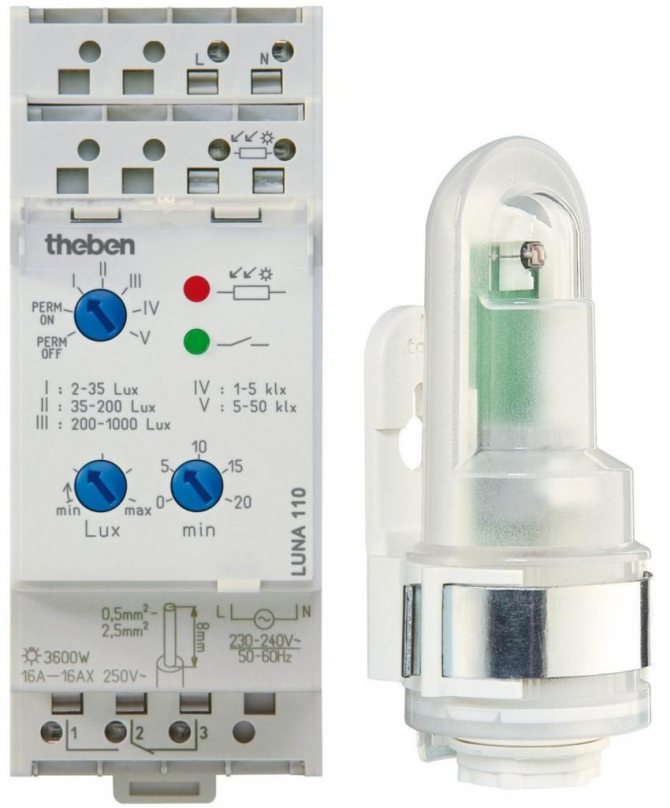

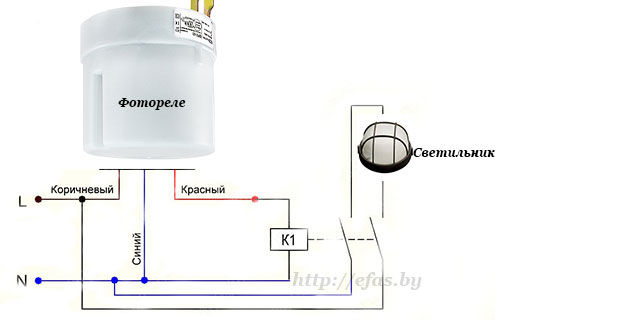

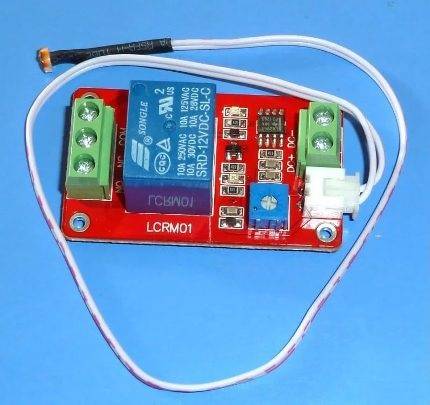
When choosing a relay with a remote photocell, it is necessary to take into account the length of the cable between them - it has certain limitations, it cannot be changed to a larger one
And the last parameters are dimensions and weight. The largest part of the photorelay is the power supply with a step-down transformer inside. The photo sensor itself (LED) has very small dimensions.
Much more space is occupied by a contactor or a magnetic starter, through which lighting devices are connected. All this should fit in the electrical panel or near the lamp.
Are additional features important?
Many models of light control relays are complemented by a motion sensor and a timer. The first guarantees the inclusion of lighting only when moving through the controlled area of a person, and the second allows you to completely turn off the device during the day, regardless of the level of natural light.
In fact, all photo sensors are configured at the factory so that they simply do not work when the headlights of a passing car are briefly illuminated.
The most expensive models are photo relays with an electronic display and a programmable controller. These devices allow you to lay down your own program of work for each season and occasion.
For example, in winter, lighting will turn on earlier, and later in summer. You can also provide for turning off the relay itself, along with street lamps after one in the morning, so that they do not burn energy in vain.
Advantages and disadvantages
The photorelay is practical for various objects that require lighting control. The device allows you to save energy costs by turning off the lamps at the right time. This is the main advantage of the element. It is also worth considering easy installation, the ability to connect several lamps to one sensor and simple operation. The presence of a timer and a motion sensor makes the device more functional. During use, the sensor does not require constant attention
To get all the benefits, it is important to install the photo relay correctly and choose a quality element.
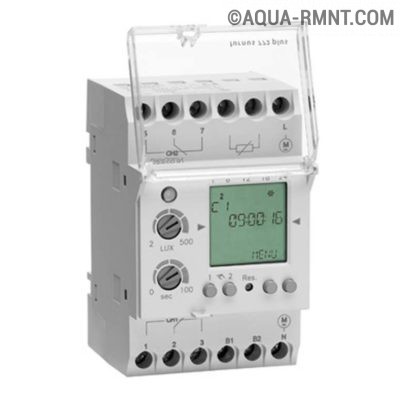
The timer is very handy.
The photorelay is an element of the electrical circuit for lighting on the street. Therefore, correct installation is mandatory when connecting. Otherwise, malfunctions, breakdowns and malfunctions will occur, which will lead to additional costs.


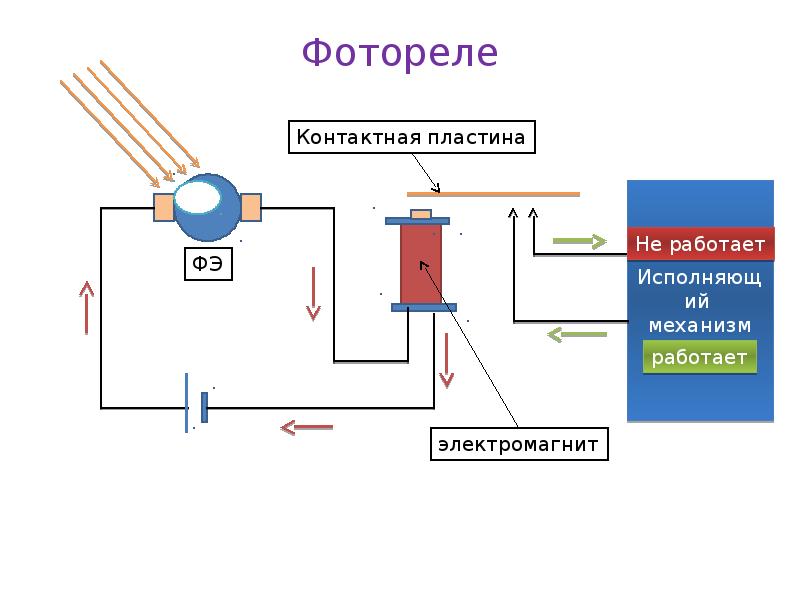
And it is also important to choose a photo sensor that matches the characteristics of the lamps and the required level of functionality.
Video recommendations allow you to more effectively master the features of the choice and operation of the photorelay. The following video presents a simple device that is effective for private use.
Video: selection principle and photorelay operation
Lighting control using a photorelay is an effective way to reduce energy costs for lighting a street or other objects. A sensor that is sized to suit your needs is easy to install and has a number of advantages. And knowing the principle of operation of the device will allow you to make the right choice.
Varieties of light sensors
Conventional inexpensive light sensors allow you to automate lighting and adjust it to the length of daylight hours. But since the light stays on all night in this case, manufacturers have begun to create models with more features.
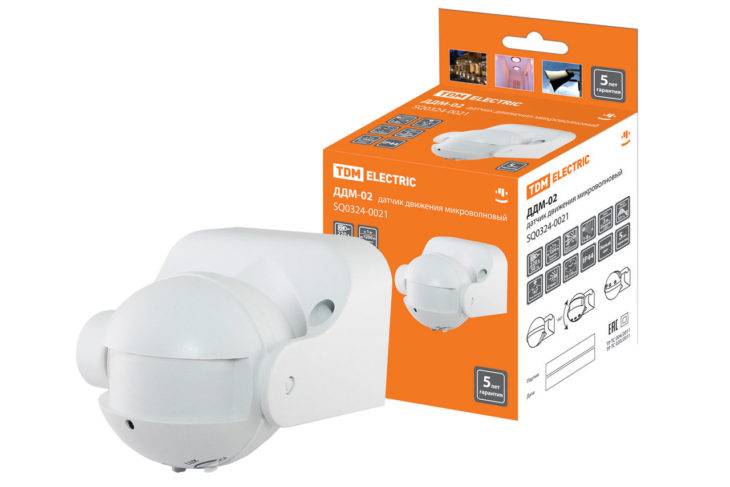 An example of a photo relay with a motion sensor
Among them:
- Photocell with motion sensor. They turn on the light when something starts to move in the controlled area. Thanks to the photo sensor, the signal to turn on only works in the dark period. The device is inexpensive, reliable and compact. But if there are pets running around the area, or there are plant branches in the field of view of the sensor, there is a high probability of false triggering of the sensor.
- Photo relay equipped with both a motion sensor and a timer. The device can be fine-tuned so that it only works when needed. For example, from 20.00 to 22.00, when a guest approaches the gate or the owner returns.
- Photo relay with timer. The device makes it possible to save electricity by turning off the light at unused time. If the habits of the family are established and tied to a certain time, this option can be very convenient. Many people prefer this type of device, since they do not have to be mounted on the street, the timer can signal to turn it on right from home.
- Programmable photorelays. Devices of this type are the most expensive, but surpass other types in terms of functionality. They make it possible to set the lighting on / off depending on the natural light, time period, day of the week, season.
Another approach to the classification of photosensors is the type of execution. Distinguish:
- Photocell for outdoor installation. The device is installed on the street, most often - on the wall of the house.Such a photo sensor should have a hermetic housing and be made of heat- and UV-resistant plastic.
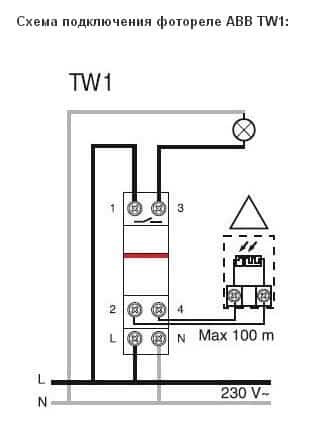
- Photorelay for indoor installation. The device is mounted in the main electrical panel of the house on a DIN rail. An external sensor is attached to it, which must be fixed on the facade and connected to the unit with two wires. In this case, the requirements for protecting the main body are reduced, but the photosensor must be protected from moisture and accidental impacts. Since the walls will have to be ditched to lay the wires, it is better to install the interior photo relay at the repair stage.
If you have little experience in installing electrical appliances, or you are afraid of damaging the new wallpaper, it is better to prefer an outdoor-mounted photo relay.
Photorelay manufacturers: countries and prices
The manufacture of such devices does not require unique equipment or complex technological processes, therefore, along with Western products, the market offers many domestic photo sensors. At the same time, each country has both budget and inexpensive models with varying degrees of protection.
Comparative table of photo relays from different manufacturers
| Name | Switching current, A | Operating voltage in the network, V | Degree of protection, IP | Manufacturer | price, rub. |
|---|---|---|---|---|---|
| FR-6 | 10 | 240 | 54 | Ukraine | 150 |
| PS-1 | 6 | 220 | 44 | Uzbekistan | 200 |
| HOROZ HL 472 | 25 | 230 | 44 | Turkey | 210 |
| FERON SEN 27 | 25 | 220 | 54 | China | 250 |
| FR-601 | 5 | 230 | 44 | Russia | 420 |
| SOU-1 | 16 | 230 | 56 | Czech | 650 |
| Lux-2 | 8 | 230 | 44 | Russia | 800 |
| Luna 126 Star Theben | 16 | 230 | 55 | Germany | 2500 |
If you have found a model with a suitable switching current, degree of protection and other parameters among the products of Russian manufacturers, you should not overpay for the German counterpart. But you should not save too much, as this will affect the durability of the sensor.



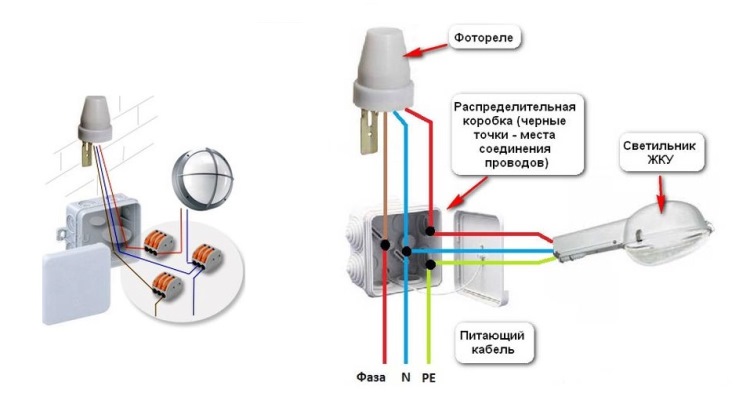
Photorelay IEK
In our country, photorelays of the Russian manufacturer IEK are very popular.
In appearance, the IEK FR 601 and FR 602 photo relays are the same, pay attention to the marking
Characteristics table for IEK brand photosensors
| Options | FR-600 | FR-601 | FR-602 |
|---|---|---|---|
| Maximum load when used with incandescent lamps, W | 1300 | 1100 | 2500 |
| Maximum load when used with fluorescent lamps, W | 780 | 600 | 1500 |
| Power in the on state, W | 0,45–6,6 | 0,45–6,6 | 0,45–6,6 |
| Maximum load current, A | 3–6 | 10 | 20 |
| Working level of illumination, Lux | 5–15 (no adjustment) | 5–50 | 5–50 |
| Delay period, s | — | 16 | 16 |
| Protection level according to GOST 14254 | IP44 | IP44 | IP44 |
| Degree of protection against electric shock | — | II | II |
| Operating temperature range, °C | -25 … +40 | -25 … +40 | -25 … +40 |
All models of sensors of this brand are made of non-combustible plastic (polycarbonate), which protects the house from accidental fire. According to their technical characteristics, the devices are suitable for Europe and central Russia, with the exception of very hot regions and the Far North.
Selecting an installation site
For the correct operation of the photorelay, it is important to choose its location correctly. Several factors must be taken into account:
- Sunlight should fall on it, that is, it should be in the open air.
- The closest sources of artificial light (windows, lamps, lanterns, etc.) should be as far away as possible.
- It is not desirable that headlights fall on it.
- It is advisable to place it not very high - for ease of maintenance (it is necessary to periodically wipe the surface from dust and brush off the snow).
In order for light-sensitive automata to work correctly, you need to choose the right location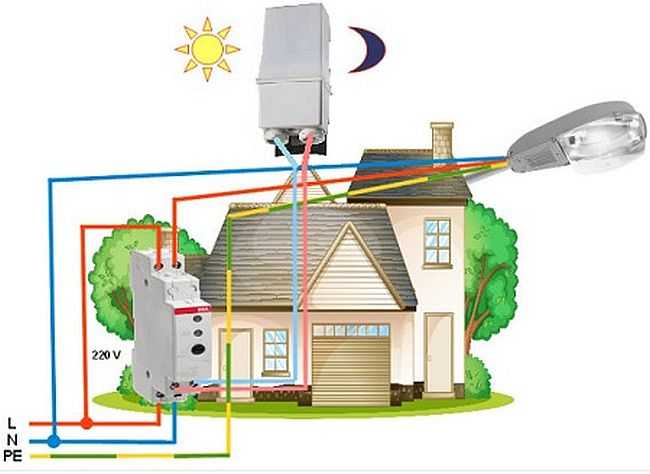
As you can see, when organizing automatic lighting on the street, choosing a place to install a photorelay is not an easy task.Sometimes you have to move it several times until you find an acceptable position. Often, if a light sensor is used to turn on a lamp on a pole, they try to place a photo relay in the same place. This is completely optional and very inconvenient - you have to clean off dust or snow quite often and climbing a pole every time is not very fun. The photorelay itself can be placed on the wall of the house, for example, and the power cable can be pulled to the lamp. This is the most convenient option.



