- Septic tank wastewater treatment
- Cleaning process
- Bio-treatment station
- Arrangement of sewerage systems
- 7 High-quality laying of internal pipes - comfort of living
- Planning and preparation of works
- Principles of laying the sewer system
- Do pipes need to be insulated?
- Features of septic tanks
- Basic properties
- Where to put drains
- Device
- Do-it-yourself sewerage arrangement in the bath: a step-by-step guide
- A step-by-step guide to building a sewer in a bath with your own hands
- Sewerage construction in a private house: ventilation scheme in the bath
- Rules for the construction of external sewerage
- Video - Laying sewer pipes
- Arrangement tips
- Mounting
- How to do
- Two-chamber septic tank
Septic tank wastewater treatment
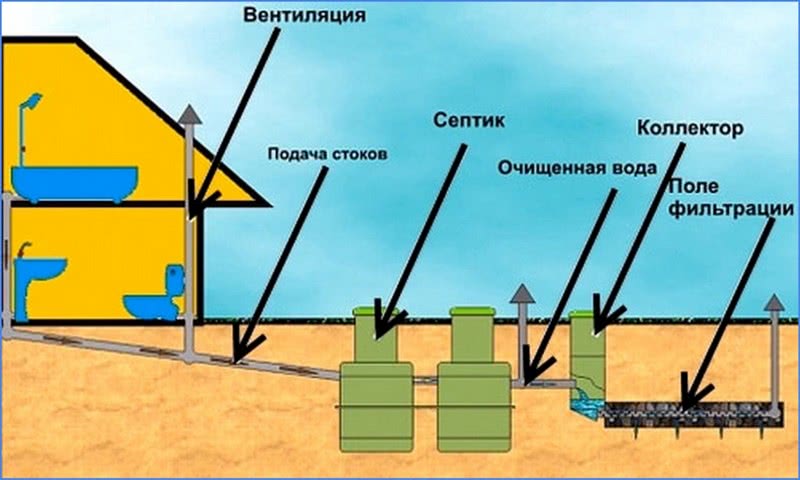
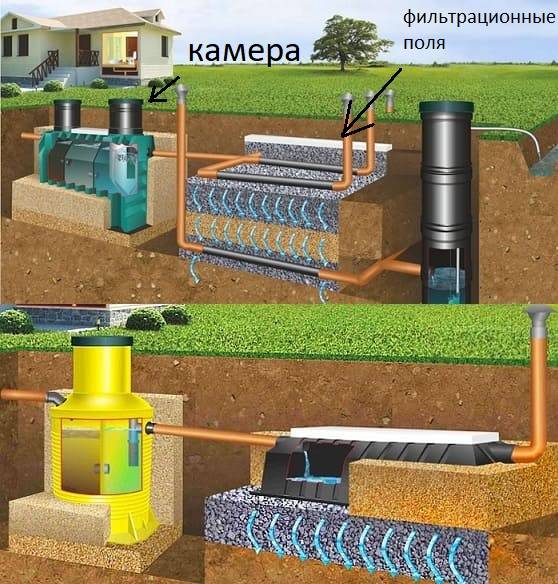
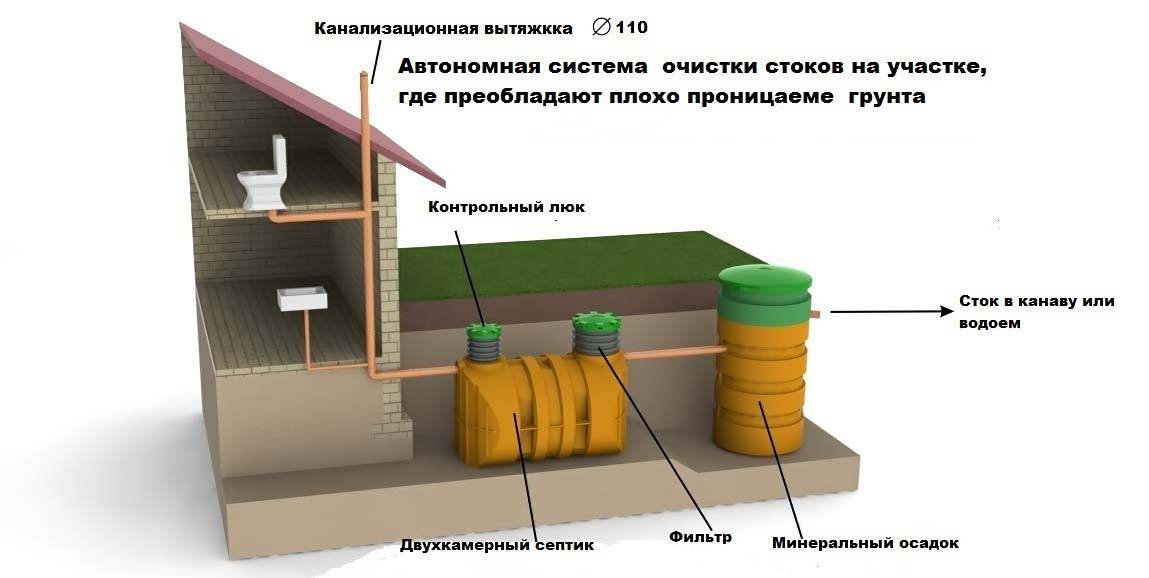
If connection to a centralized sewer system is not possible or practical, a septic tank is often chosen as an alternative. This is a local treatment plant operating on the principle of collecting wastewater and passing it through the treatment system. Such devices have two or more chambers, and the greater the number of chambers, the more thorough and deep cleaning can be achieved.
The compartments of the septic tank are separated from each other by walls. Between them under
branch pipes are arranged with a slope, through which wastewater passes from one
cameras to another.The liquid is introduced through the sewer pipe into the first compartment,
is cleaned and displayed on the filtration fields or, with thorough cleaning -
directly into the soil.
 Filtration fields
Cleaning process
The operation of a septic tank is based on a combination of the stages of gravity
settling and biological treatment. In the process of primary filtration received
in the first chamber of the septic tank, the waste is cleaned of large fractions, which are lowered
to the bottom of the tank. Light inclusions are filtered out and enter the second
camera. In the first chamber, the waste is decomposed into components
(biomass, water and carbon dioxide). Sediment accumulates at the bottom of the compartment, and
need to be removed periodically.
The operation of the second chamber provides further water purification.
The liquid purified here can be sent further to the barrel and used for
glaze. Otherwise, additional soil post-treatment is provided.
water.
Bio-treatment station
A separate type of septic tank is a bio-treatment station operating
thanks to the work of microorganisms. There are also several separate treatment plants operating here.
sections. Just as in the operation of the above-described analogue, the first section
used as a sump. Anaerobic bacteria found here
recycle biological waste with the formation of sludge.
The second chamber functions with the use of aerobic bacteria,
which decompose the incoming liquid into organic and inorganic
compounds in the presence of oxygen. For such a device to work
a special aerator is needed, which determines the volatility of such
biological stations. In the third section, a deeper cleaning takes place.
 Bio-treatment station
Arrangement of sewerage systems
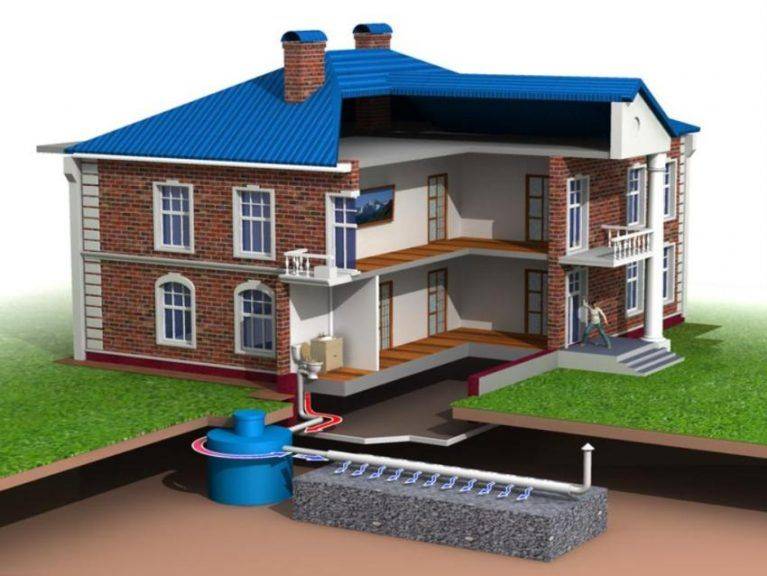
The composition of the general house sewerage system includes the following elements:
- Storage device for (with or without a treatment system) wastewater.
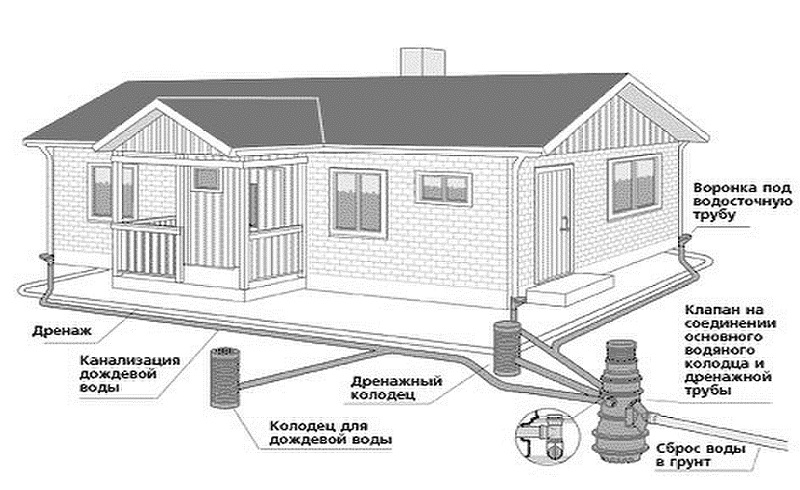
- External (external) sewer pipeline system.
- Internal sewerage system.
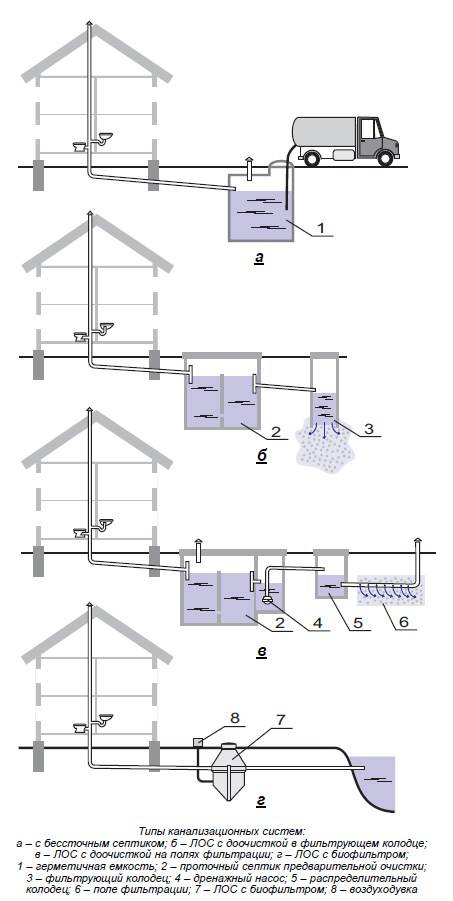
The storage system can be made in the form:
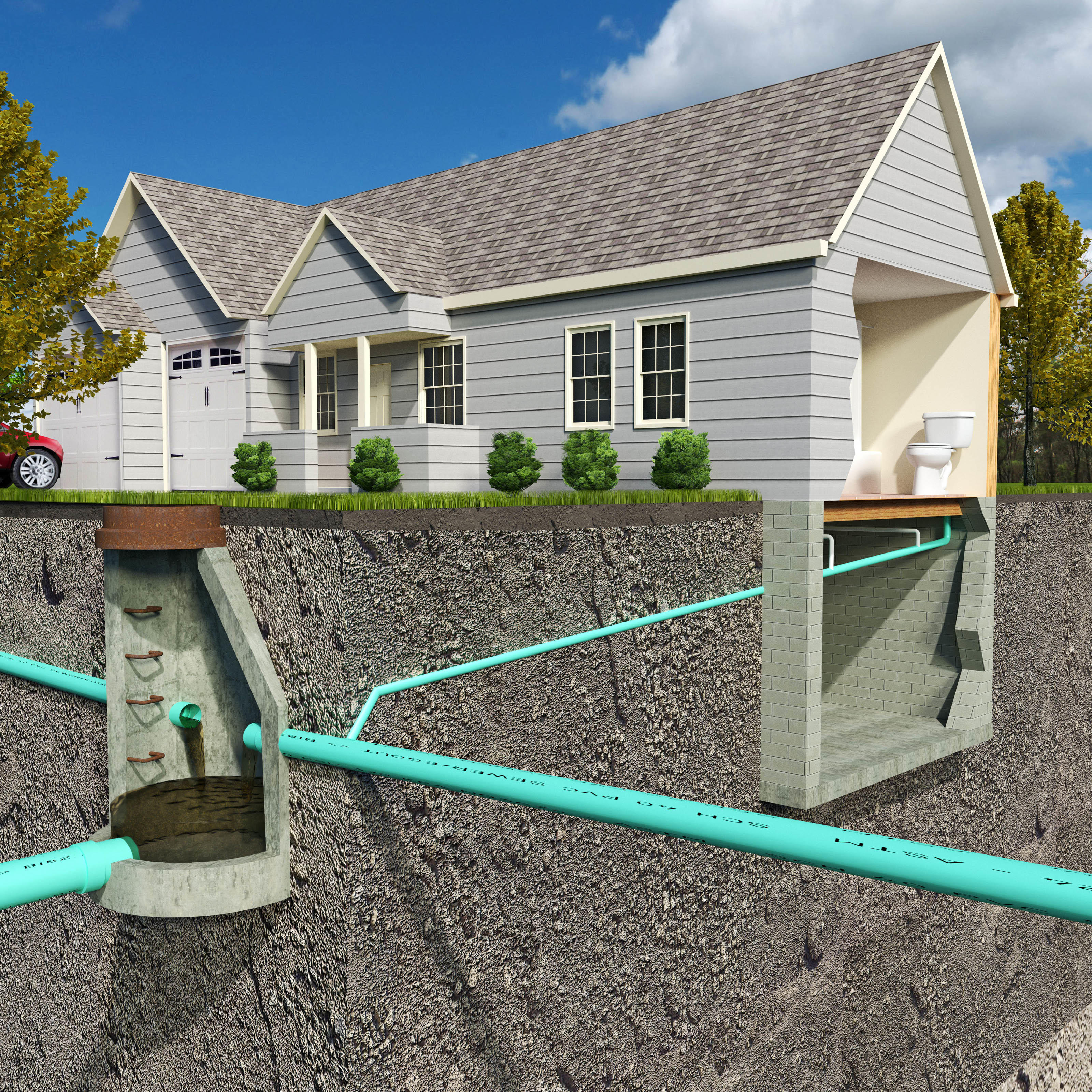
- A cesspool (without a bottom and with a bottom), in which wastewater is filtered by cleaning wastewater when passing through the ground and processing with the help of microflora living in the drive. To backfill the bottom, crushed stone or screenings are used. Designed for wastewater flow up to 1 cu. meters.
- A sealed tank - made of steel or plastic and having a given volume that allows you to collect wastewater for a certain period. The plastic tank is installed in a previously excavated pit and does not require additional sealing, it is not subject to corrosion.
- A septic tank in which wastewater is treated and after a certain period of time the waste is removed by pumping using a special vehicle equipped with a tank. In some areas, a two-chamber septic tank system is used to serve a larger number of residents. The first well is used as a sump, and the second one is used for sewage filtration. A septic tank is a container divided into 2-3 chambers, in which a phased sewage treatment is carried out. The septic tank "Purflo" (France) produces high-quality wastewater treatment and is designed for 2-10 people.
- Local treatment plants are systems capable of removing up to 98% of solids from wastewater, converting them into fertilizers. Such stations are designed for the processing of wastewater in the amount of 1 to 10 cubic meters.meters per day, which meets the needs of consumers in the amount of 4 to 50 people. An example is the Biosepter-Super-Filter installation (Russia). The station has a robust body made of durable steel 5 mm thick, designed to operate for 30 years and consisting of several compartments for staged wastewater treatment. At the initial stage, fat-containing components are separated, and the largest fractions are settled. In the second chamber, medium-sized fractions are separated, and the third chamber is filtered using special filters and microbiologically cleaned.
For pumping fecal water, in addition to the gravity flow method, a special pump Wilo TMW30 EM -30 (Germany) can be used, capable of pumping up to 72 l / min., providing a pressure of up to 30 m and operating from a 220 V network, with a power of 700 W.
7 High-quality laying of internal pipes - comfort of living
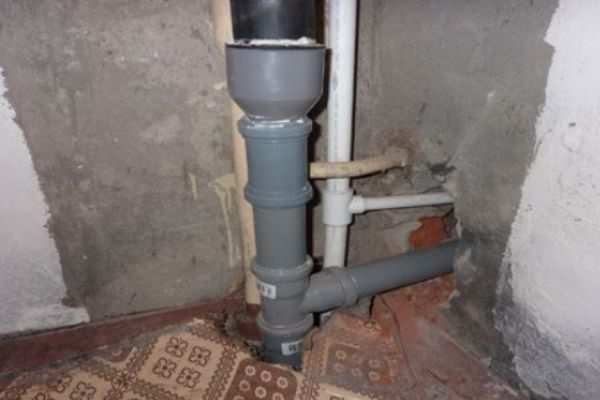
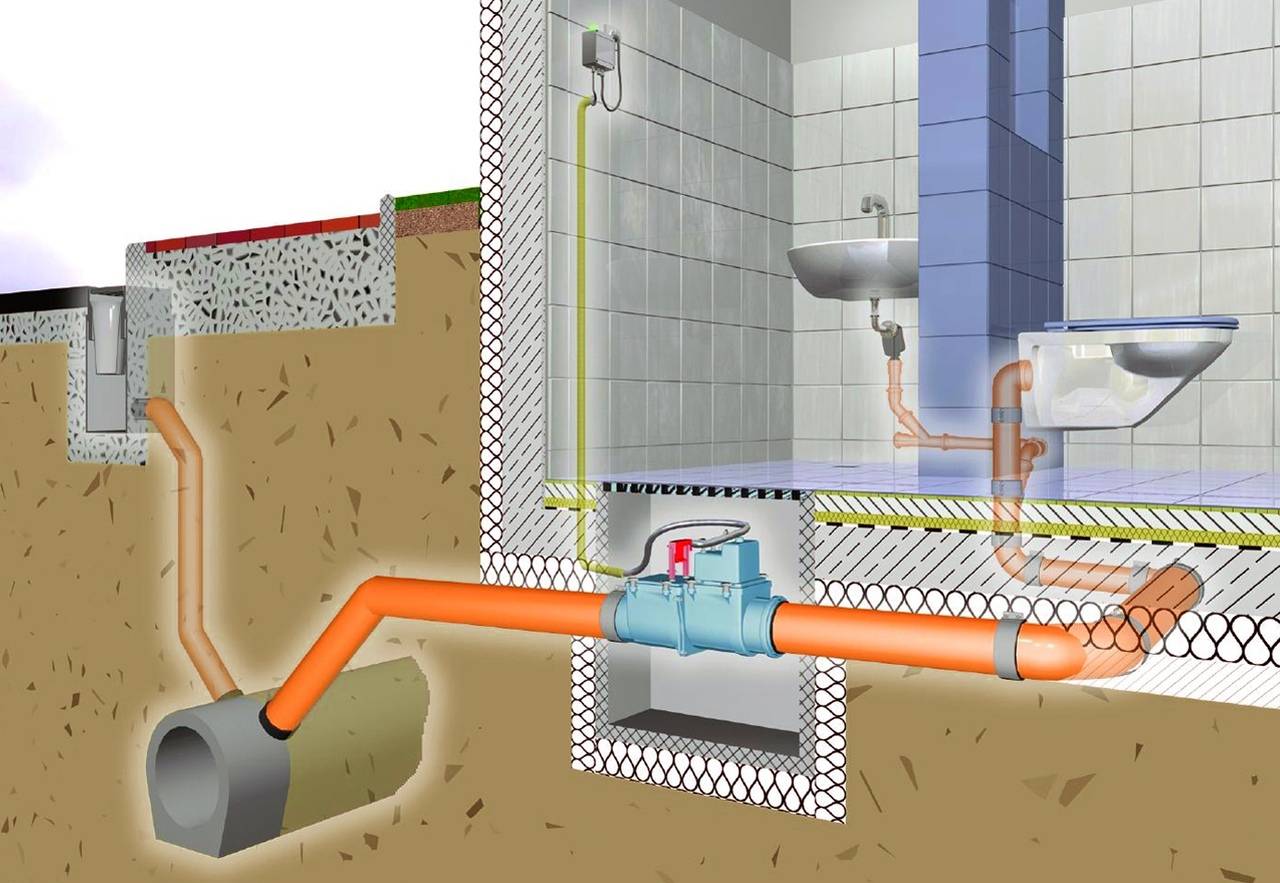
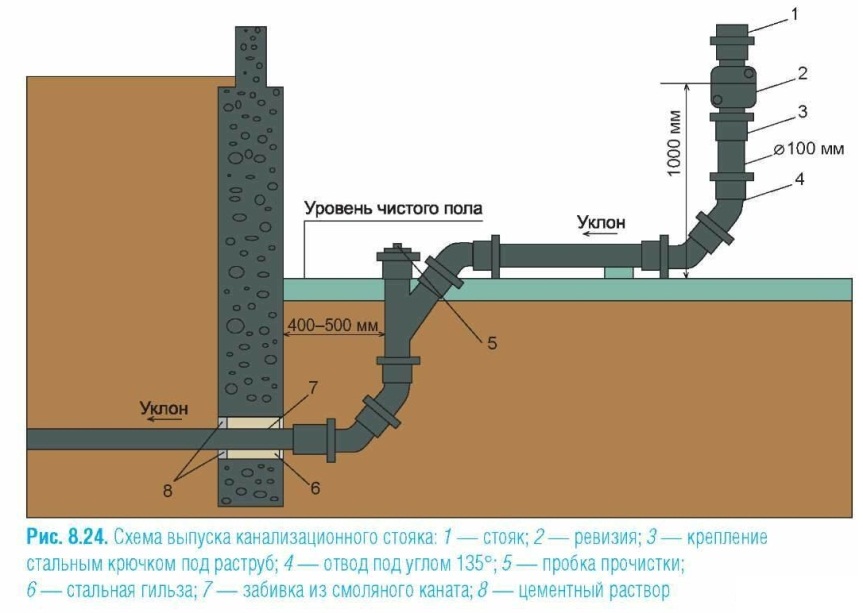
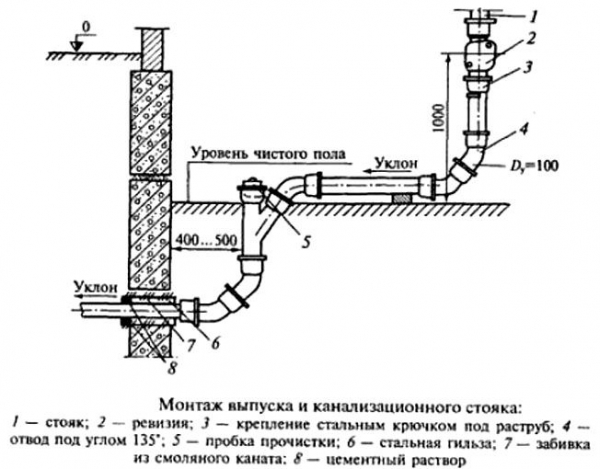
The boundary zone between the internal and external sewerage is the outlet - the junction of the riser with a pipe that is connected to a reservoir for storing and processing human waste products. We mount the outlet through the foundation: using a perforator, we make a hole corresponding to the diameter of the riser pipe. The laying depth should be below the freezing depth of the soil in order to avoid problems in winter. We mount the pipe placed in the sleeve. The length of the sleeve must exceed the length of the hole, on each side it must protrude by at least 15 cm. We cover all the cracks with a solution.
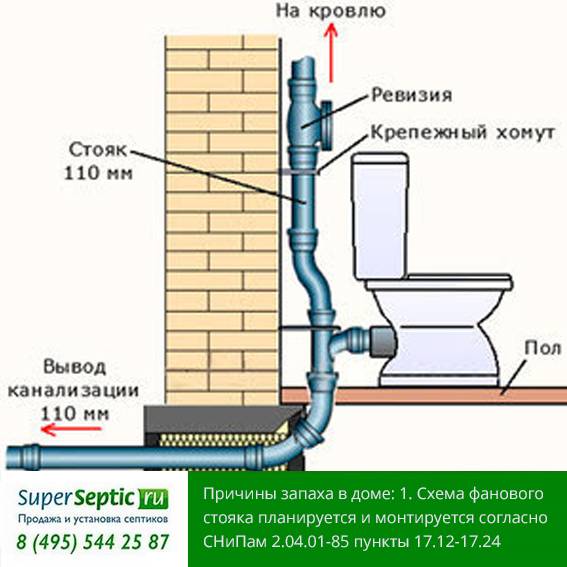
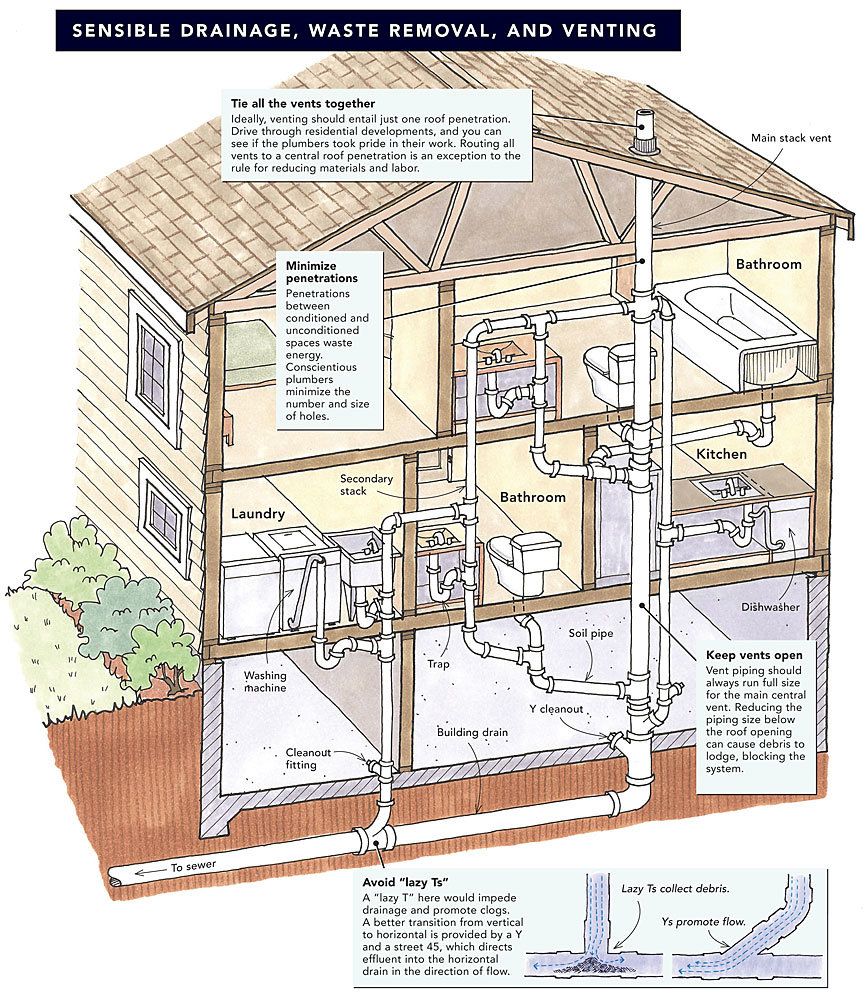
We start laying the internal sewerage from the riser. If there are no specially prepared shafts for communications in the house, we place the riser in the corner of the bathroom, close to the wall.The place of cutting for laying pipes should be laid with mortar. We assemble the riser from the bottom up, while making sure that the socket of the pipes is directed upwards. We install an audit on each floor, to clean the pipesif they are clogged. She must be on more than a meter from the floor.
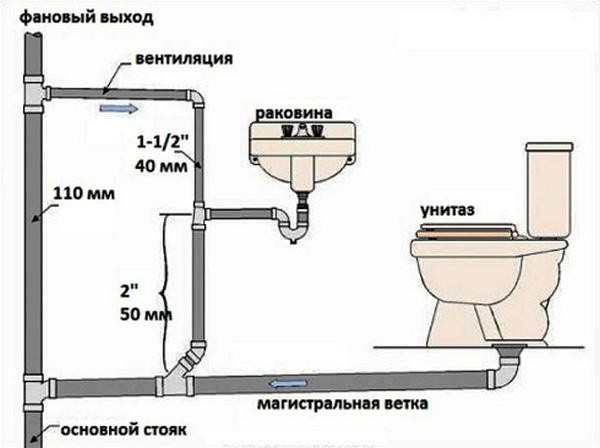
It is impossible to assemble a riser from nozzles of different diameters, it must be strictly vertical, without slopes. After installation, the riser can be overlaid with soundproofing material and give it an aesthetic appearance. It can be mounted in a niche, channel or box. If the riser is located in an unheated room, it is necessary to carry out work on its thermal insulation. If it is necessary to install an additional riser, an oblique tee with an angle of 45 degrees is mounted and an additional outlet is installed.
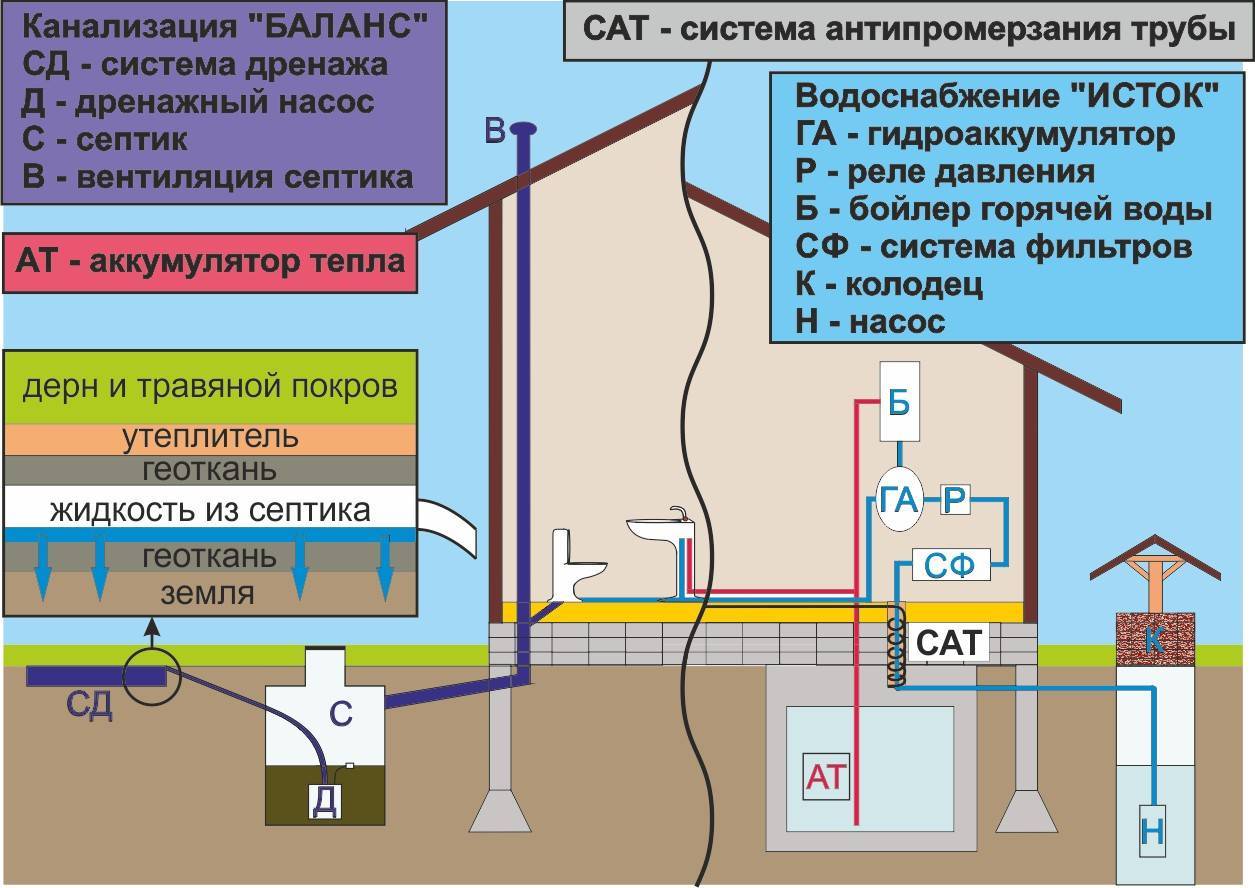
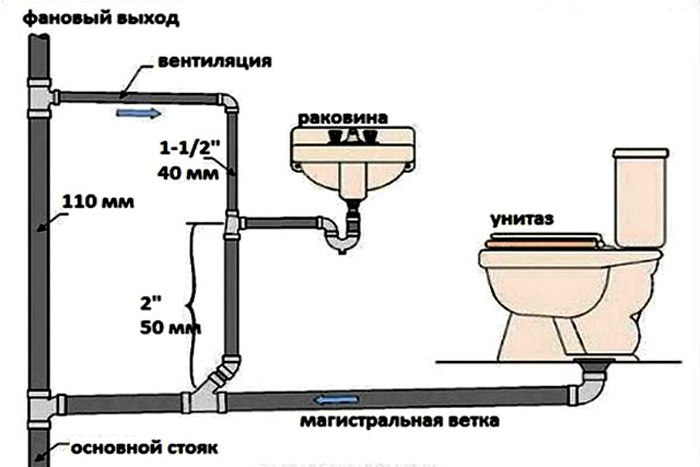
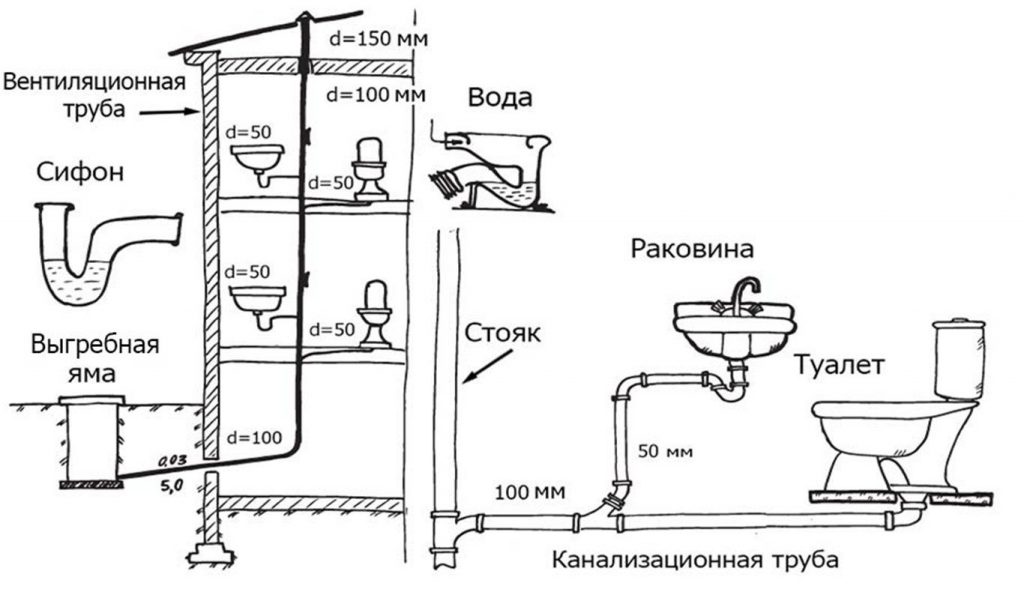
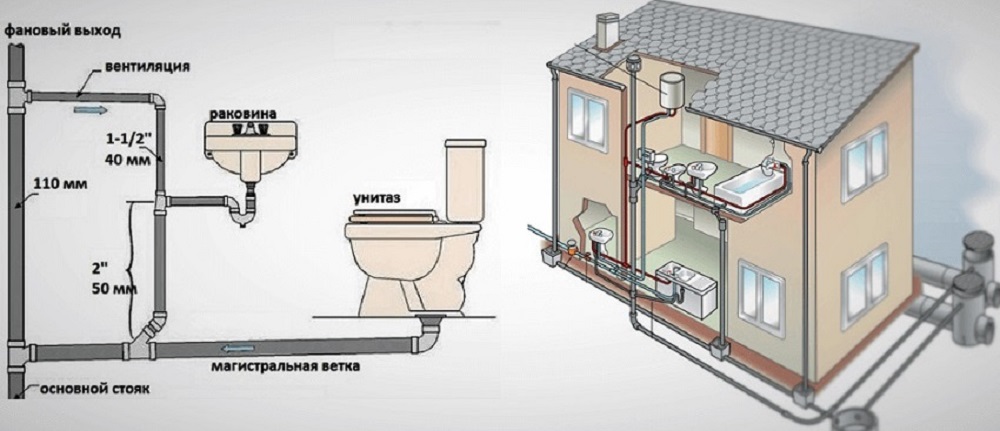
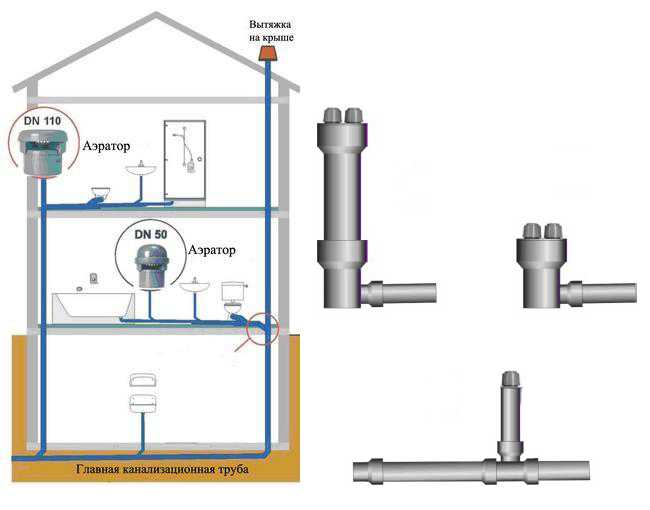
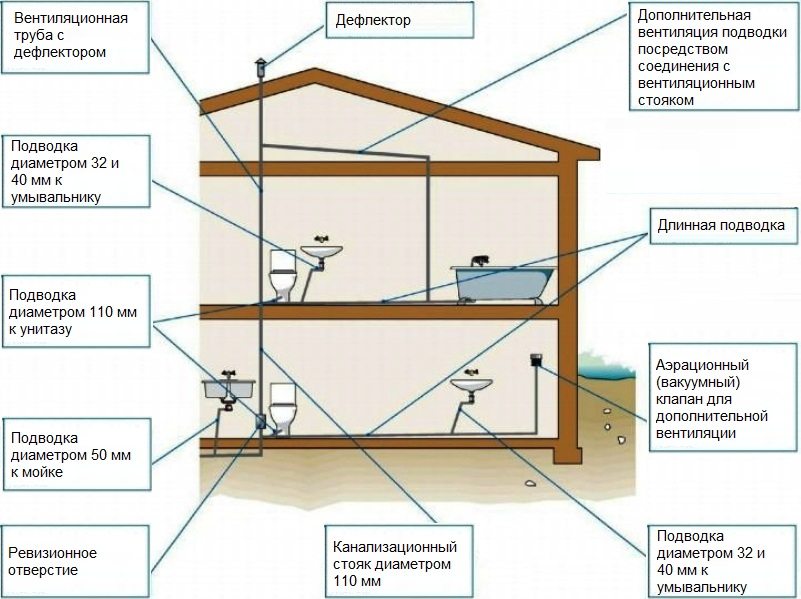
In addition to the riser pipe, it is necessary to install a fan pipe - a continuation that leads to the roof. It is installed on the riser, at the junction you need to mount a revision. The fan pipe is brought to the attic under a slope. It should be located at a distance of more than 4 meters from windows and doors, at different levels with a chimney and ventilation pipes. Ventilation pipes for sewerage should protrude at least 70 cm above the roof. The organization of ventilation for the sewer system allows you to get rid of unpleasant odors that are possible with the accumulation of gas and polluted air.
To switch from a vertical to a horizontal drain, we install connections with an angle of 45 degrees, this will reduce the pressure of the water pressure on the pipes when draining. To drain water from bathtubs and sinks, we use pipes with a diameter of 50 mm. Pipes should be brought to the riser with a slope of 2-3 cm for each meter of length.We fix the pipes with special clamps of the appropriate size.
At the intersection of the elements that come from the shower, sinks and bathtubs, we mount a collector pipe with a diameter of 10-11 cm. We install water seals along the entire pipeline to prevent the penetration of unpleasant odors into the living quarters. His device has a similar design, differs in size. Water acts as a stopper for the penetration of odors. If the sewer system is idle for a long time, the water evaporates and the water seal loses its performance.
Planning and preparation of works
The sewer system, which is located in a private or apartment building, is non-pressure and is designed to divert wastewater to a common riser. This is achieved by performing a certain slope of the pipes. The quality of the installation of sewer pipes in a private or apartment building depends on the effectiveness of work planning, which involves:
- choosing a place for plumbing fixtures;
- preparation or inspection of the existing sewerage system;
- determination of the quantity and types of materials;
- purchase of the necessary parts;
- test assembly and sewer inspection;
- dismantling the old or preparing for the installation of a new system;
- installation of sewer pipes, installation of equipment, sealing of the system;
- connecting and checking plumbing.
Before you start installing sewer pipes with your own hands, you should make sure that they are clean, that there is a chamfer at the end of the pipe and a sealing cuff in it, and that there are no burrs.
Even small inaccuracies in planning the installation of sewer pipes with your own hands can lead to big problems in the operation of the finished system.
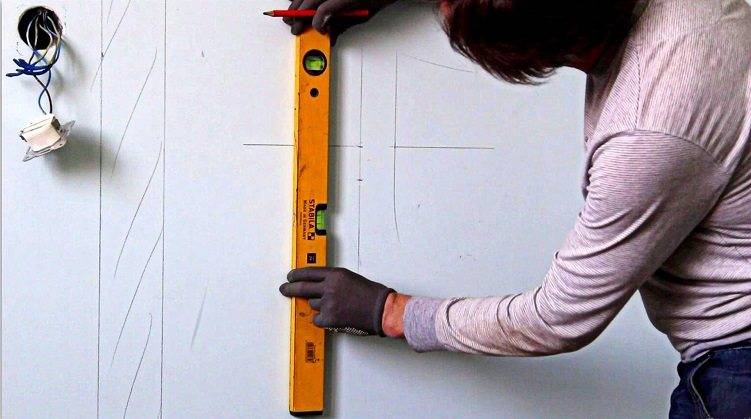
First you need to mark the location of pipes and plumbing fixtures
Principles of laying the sewer system
The drainage system is equipped in various ways:
- the simplest, when the waste is drained directly into the cesspool;
- two wells - one for solid particles with a sealed bottom, the second without a bottom for filtering and draining water into the ground, the wells are installed in series;
- an option with a pumping station, if the site is low and the wastewater needs to be raised higher - this principle is suitable if the sewer truck cannot enter the site.
If sewerage is being done for the first time, then it is better to invite a specialist who is familiar with the type of soil in the region and can advise which principle of arranging sewer drains will work best. It happens that on clay soil, the sanitary and epidemiological station does not allow the installation of double wells due to the poor filtration capacity of the soil. Therefore, there will be one way out, it is also the simplest - a common cesspool.




Do pipes need to be insulated?
There are some recommendations on how to operate the system in winter. If you do not allow the container to be filled to the full, then freezing can be avoided. When the septic tank is full, the drains partially exit into the sewer. The diameter of the inlet pipe is relatively small, and in this place the liquid can freeze.
Features of septic tanks
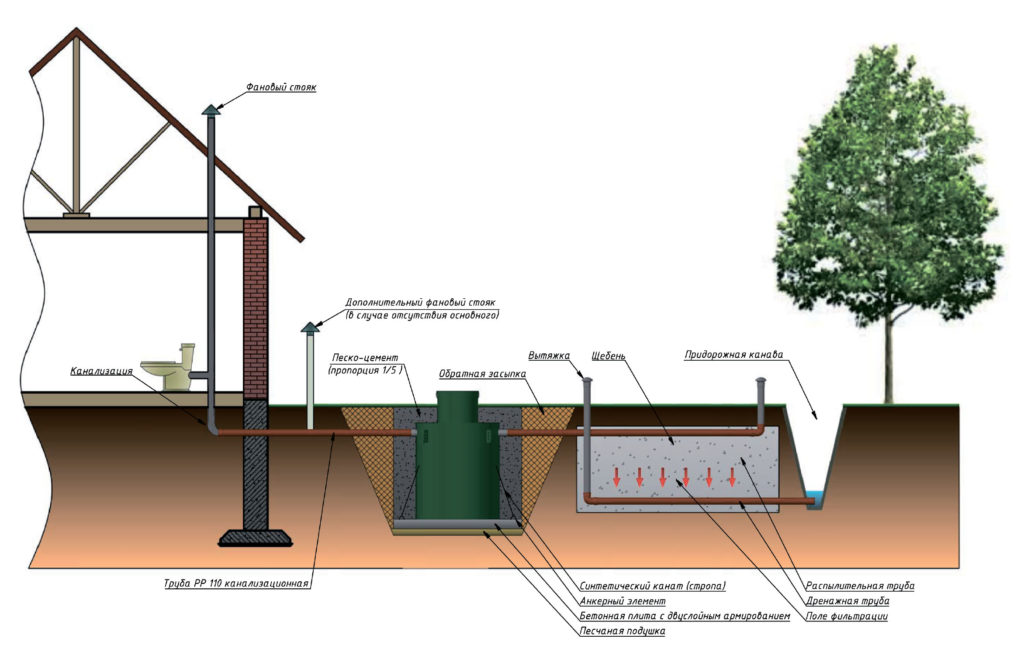
Septic tanks are several reservoirs-chambers interconnected by overflow pipes. Each of the chambers has its own cleaning stage.Its basis is fermentation and decomposition by anaerobic bacteria (they can live without oxygen), which are contained in waste. The more chambers in the septic tank, the more purification steps, the cleaner the output water is. But more than 50-60% without additional filtration measures can be obtained very rarely.
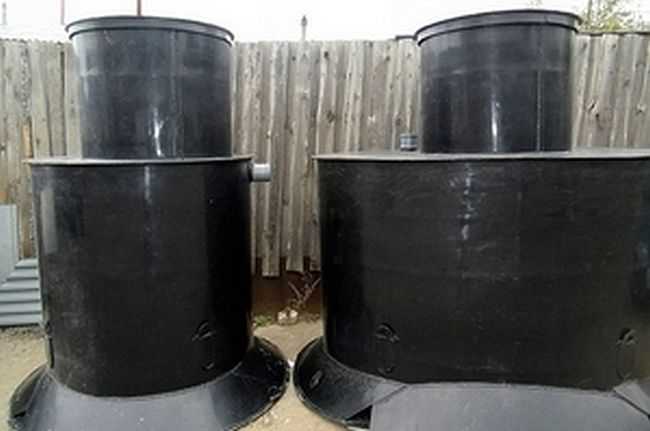
Septic tanks are made of plastic, fiberglass, concrete, very rarely - stainless steel. The cameras can be implemented in one housing, or they can be separate. To save money, they often build septic tanks with their own hands. Most often, they will make a septic tank from concrete rings, but they are also built from brick or reinforced concrete.
Please note that the container must be absolutely sealed.
This is very important when building your own.
Basic properties
We will deal with the features of the work of septic tanks. They are:
- At the exit from the septic tank, the drains are cleaned by 50-75%. It is impossible to dump them on the terrain, into water bodies or use them for technical needs (watering the lawn, washing the car, etc.) without additional cleaning. Therefore, from the outlet of the septic tank, effluents are fed to filtration fields / ditches, to filtration wells.
- In addition to the presence of drains, a septic tank does not require anything to work. It is energy-independent, they do not need to be populated with bacteria. They are contained in sufficient quantities in the waste that enters the tank. In the septic tank, they still actively multiply, since an optimal environment has been created for them here.

- Bacteria living in a septic tank do not need daily feeding. This is an ideal option for temporary residence - for summer cottages or country houses with a "ragged" mode of activity. They will safely continue their life activity "without feeding" for a long time.
- With the correct calculation of the volume, the septic tank is not afraid of the increased salvo discharge of wastewater. That is, when flushing the bathroom, you can not worry and flush the toilet, use taps, etc.
- The presence of a large number of disinfectants and detergents is not very good for bacteria. Since the volume of the chambers is large, it is difficult for them to cause tangible harm. When such active chemistry is dumped, some of the bacteria will die, but most will remain. So one-time powerful receipts of chemistry will not affect the quality of cleaning.
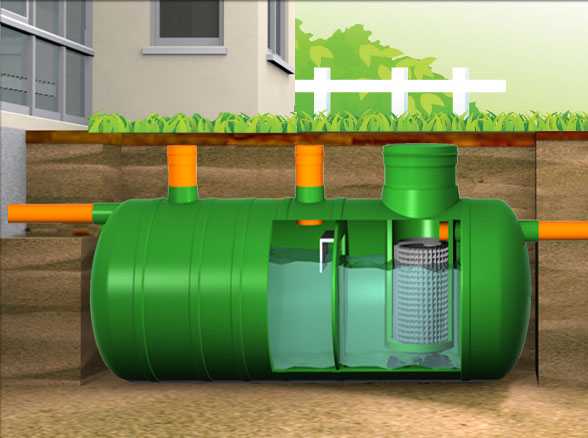
The main disadvantage of this method of cleaning wastewater from a private house is the need for post-treatment. More funds are needed for the installation of additional structures, but without them, the sewerage system for a private house will not be correct. It is impossible to dump semi-treated effluents on the ground. They will very quickly fall into the water and return to your and neighboring wells and wells. This will not bring you joy and health, and you also need to endure the “gratitude” of your neighbors. So let's figure out how to clean up drains after a septic tank.
Where to put drains
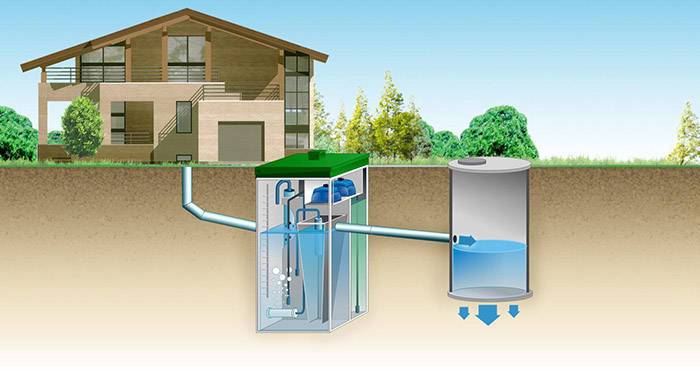
Please note that paired with a septic tank, you must have an aftertreatment device. Depending on the soil, this can be a filtration well, a filtration ditch or a field (underground or bulk)
Only in this case can cleaning be considered complete. Which type of filter elements to make depends on the type of soil and the level of groundwater.

Device
The entire sewage disposal system of a private house is divided into
two main parts:
- The internal network includes plumbing and pipes that drain fluid from all appliances in the house.
- The components of the external system are a pipeline, a tank for the accumulation or treatment of waste liquid, and treatment facilities.
Depending on the design features, there are two
types of containers:
- Cesspool - a structure made of concrete or bricks, without a bottom. Requires regular cleaning from debris.
- Caisson - a container in which sewage is accumulated before pumping. Installation of a caisson does not require large expenses. However, constant pumping entails additional costs.
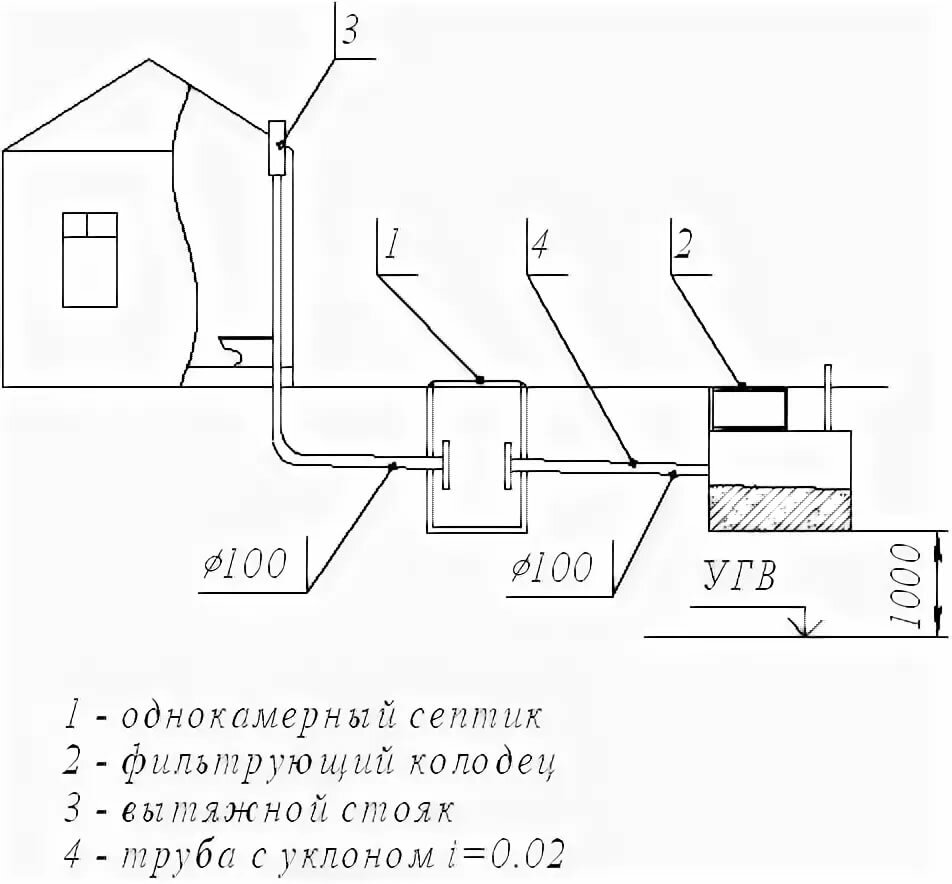
- A single-chamber drainage septic tank has walls made of polypropylene, reinforced concrete rings, brick or concrete. Wastewater treatment is carried out when passing into the ground through a layer of sand and gravel.
- Multi-chamber septic tank - several containers in which the liquid passes through several stages of purification. The construction of a septic tank will cost more, but it does not need to be constantly emptied.
Pipe sections of the sewer can be made of different materials. Most often, the individual sewerage of a private house is assembled from PVC or HDPE pipes with a diameter of 110 mm. Older systems used cast iron or asbestos pipes.
Do-it-yourself sewerage arrangement in the bath: a step-by-step guide
As in the case of a residential building, the sewerage of a bath includes an internal and external system. Even if the building has a dry steam room, it will be necessary to drain the liquid from the shower. The water collection system depends on how the floors are installed. The sewerage scheme is entered into the bath project at the development stage and is laid at the initial stage of construction even before the floors are equipped.
If it is planned to install wooden floors from boards, then the elements can be laid closely or with small gaps. If the coating is installed tightly, the floors are formed with a slope from one wall to another.Next, you should find the lowest point near the wall and leave a gap in this place, where the gutter will be subsequently installed (also with a slope). At the lowest point of its placement, a connection is made to the sewer outlet pipe.


If the wooden flooring will be made with slots, small gaps (5 mm) should be left between the boards. A concrete base is made under the floor with a slope towards the central part of the room. A gutter and a sewer pipe will be installed in this area. Instead of a concrete base, metal pallets can be laid on top of the insulated floor under a wooden deck. If the floors are self-leveling or tiled, a water intake ladder is installed at the lower point of the slope, which drains the drains into the pipe.
Using septic tanks for drains from the bath
A step-by-step guide to building a sewer in a bath with your own hands
For the installation of sewer pipes, it is necessary to form ditches with a slope of 2 cm per 1 m. Their depth is 50-60 cm. A pillow should be made at the bottom of these trenches. To do this, a layer of sand 15 cm thick is poured and carefully compacted. In this case, do not forget about the slope.
Next, the installation of the sewer line is carried out. Polypropylene pipes with a diameter of 100 mm are laid in trenches. If necessary, a sewer riser is equipped. It must be fixed to the wall with clamps. Be sure to organize ventilation. When the system is ready, the flooring is installed using one of the previously discussed methods.
Upon completion of all work, the ladders and gratings provided for by the project are connected to the system at the designated locations.In the area where the water intake is connected to the outlet pipe, it is desirable to install a siphon. It will prevent the penetration of odors from the sewer back into the room. Most often, ladders are equipped with built-in water seals.
Sewer pipes in the bath
On sale you can find gutters made of asbestos cement, plastic or cast iron. It is not recommended to use products made of wood and steel, because. they quickly break down under the influence of moisture. The minimum allowable diameter of the gutter is 5 cm. If the project provides for the presence of a toilet bowl or other sanitary equipment, it is installed and connected. This completes the work on the organization of internal sewage. The external system is carried out in the manner described earlier, and may be a septic tank or a drainage well.
Sewerage construction in a private house: ventilation scheme in the bath
Air exchange in the bath can be organized in various ways. Each of them has its own characteristics and advantages. Having studied the specifics of each method, you can choose the best option for a bath.
The first method involves creating an opening designed to supply fresh air. It should be placed behind the stove-heater at a height of 0.5 m from the floor level. The exhaust air will be discharged through the opening on the opposite side. It must be placed at a height of 0.3 m from the floor. To increase the movement of air flow at the outlet, you need to install an exhaust fan. All openings are closed with gratings.
Sewerage scheme for a toilet in a bath with a septic tank and ventilation
The second method involves placing both holes in the same plane.In this case, the work will affect the wall opposite to the one where the furnace is located. The inlet duct is placed at a height of 0.3 m from the floor level, at a similar distance from the ceiling, an exhaust hole must be made and a fan installed in it. Channels are closed with gratings.
The third method is suitable for flooring where the boards are laid with gaps to drain liquid. The inlet is made at a height of 0.3 m from the floor on the wall behind the stove. In this case, installation of an outlet duct is not required, since the exhaust air will exit through the gaps between the boards.
Rules for the construction of external sewerage
All rules are based on the requirements of construction (SNiP 02.04.03-85 "Sewerage. External networks and structures") and environmental standards that guarantee a safe and reliable external sewer system.
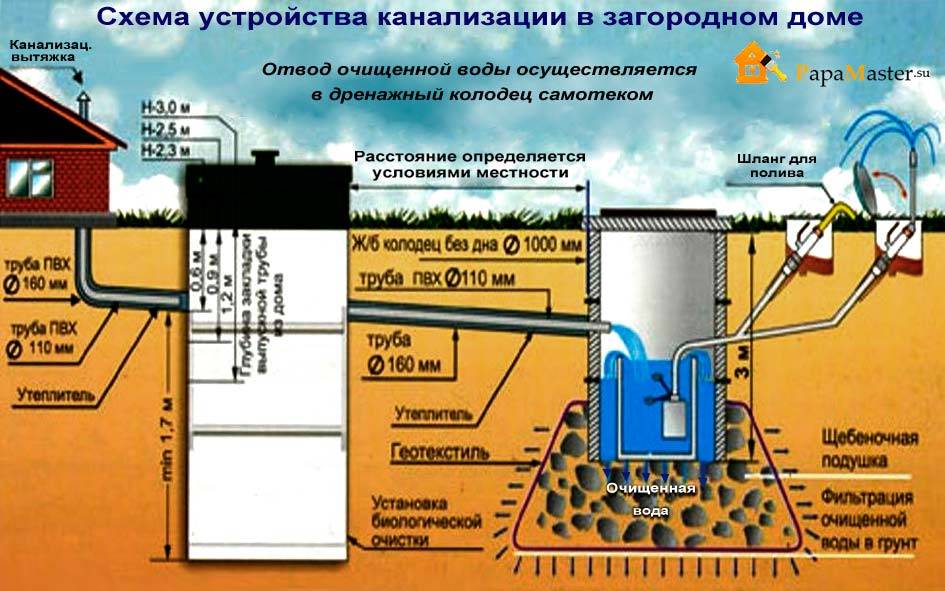
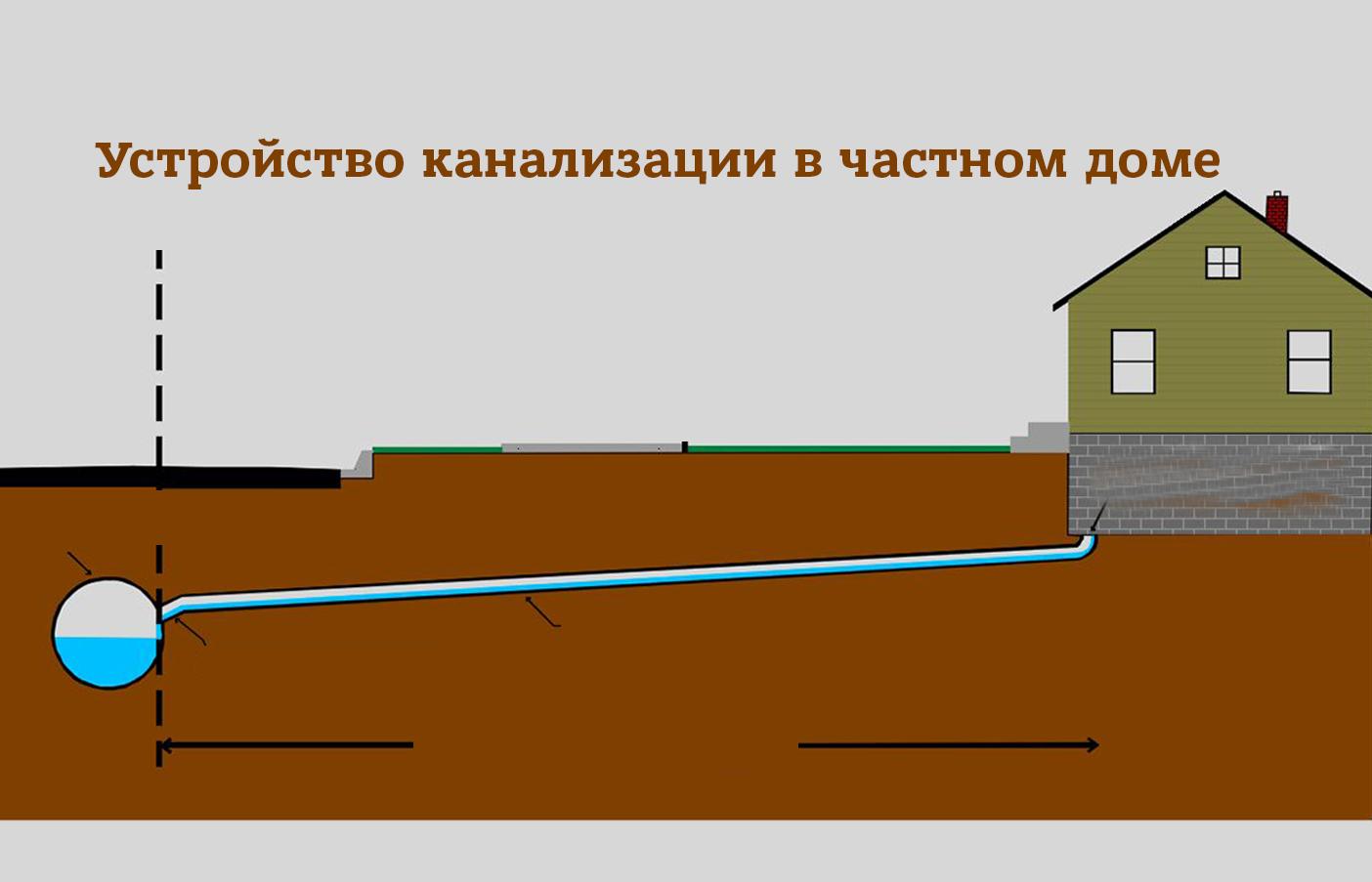
- The exit from the building of the house and the occurrence of the external pipeline should be 30-50 cm below the level at which the soil can freeze, since even additional insulation does not guarantee that the pipes will not be damaged as a result of freezing.
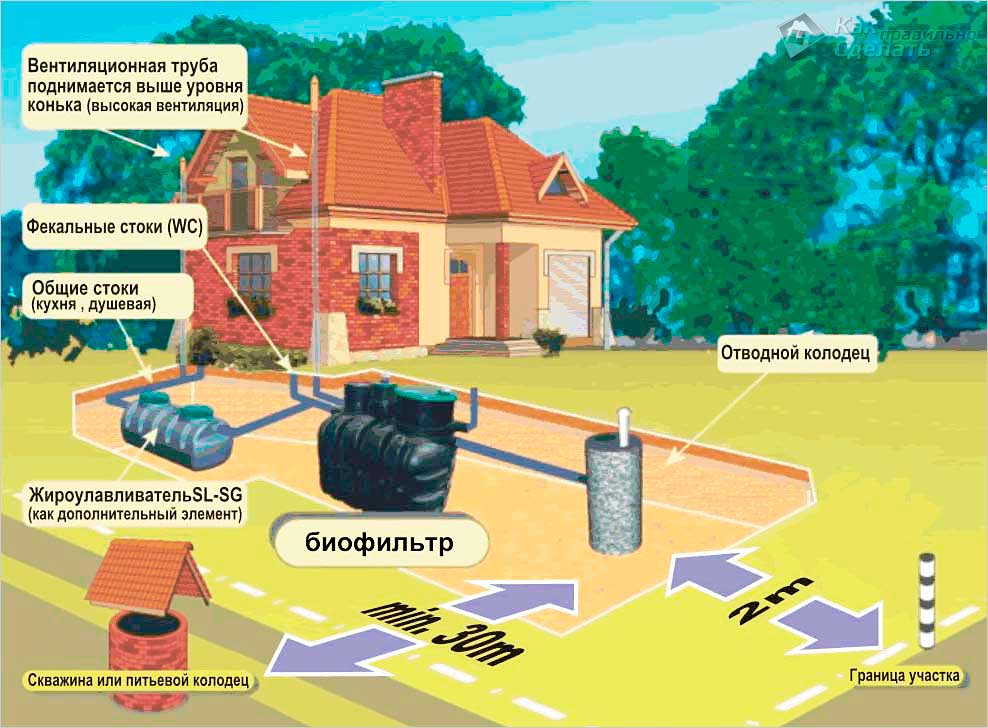
- The location on the site of autonomous sewage tanks is strictly standardized on the location of the residential building, sources of drinking water and the neighboring site, and on the type of treatment system. From the house, the minimum distance to the treatment systems should be as follows:
- for a cesspool - 15 m;
- for an overflow well - 12 m;
- for a septic tank - 5 m;
- for a biological treatment station - 3 m.
Location of autonomous sewerage
From the well or drinking well, the drain well must be at least 20 m away, and from the central water supply - 10 m.
In addition, for biological treatment systems, it is important that the distance from the house to them is not too large in order to avoid cooling the drains. After all, cold water can adversely affect the performance of activated sludge.
- The pipe leading from the house to the tank must also pass at an inclination, the value of which is calculated according to the same principle as for internal wiring. However, in practice, another 20-25% is added. In addition, the pipe, if possible, should not have bends and turns.
- Of particular importance is the strength of the material from which the outer pipes are made, as they must withstand the pressure of the soil. The best option is a corrugated plastic metallized pipe. At the same time, its inner surface must be smooth in order to avoid overgrowing of pipes with suspensions.
At the stage of planning an external drainage system, it is also necessary to calculate at what depth the pipe leading the drains out of the house will enter the autonomous sewage tank.
To do this, use the formula h2=h1+l*k+g, where:
- h1 - the depth of the entry point into the well;
- h2 - the depth of the place where the pipe exits from the house;
- l is the distance between the house and the drive;
- k - coefficient showing the slope of the pipe;
- d is the difference between the level of the inlet and outlet of the pipe, taking into account the degree of inclination of the section.
These are generally accepted rules for different types of autonomous sewage. To date, there is a huge variety of designs for local treatment of domestic wastewater, before the installation of which a separate project is being developed.

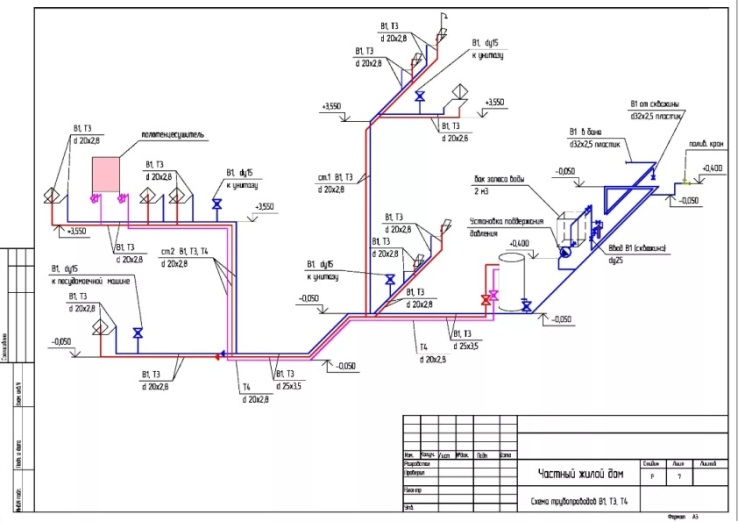





Scheme of the sewer network
Thus, the entire process of designing a sewerage system for a private house includes:
- determining the quantity, location of plumbing equipment;
- the choice of a place for the central riser and the exit of the house sewer;
- determination of the method of wastewater evacuation: a central drainage system or house shedding;
- choice of installation location and type of autonomous sewerage, if required;
- development of a diagram of all intra-house wiring, indicating the dimensions, the angle of inclination of the pipes, or the installation location of the circulation pump, the type and area of \u200b\u200bconnections of pipes and equipment;
- indication in the diagram of the location of the riser and the outlet of the fan pipe;
- drawing up an external sewerage scheme indicating the angle of inclination of the outlet pipe, the depth of its occurrence and the junction with the central or adjacent sewer system;
- an indication in the project of the installation site and type of an autonomous wastewater collection and treatment system.
Video - Laying sewer pipes
fan pipe
Slope angle of sewer pipes
Scheme of the sewer network
Location of autonomous sewerage
Laying sewerage in a private house
Sewerage design option in a private house
Water seal example
sewerage project
Sewerage project in a private house
Arrangement tips
After joining all segments of the sewer structure, they begin to insulate the pipeline. Thermal insulation is necessary in cases where the depth of pipe laying is at the level of soil freezing during winter frosts.





After the installation of the external sewer line is completed, it is necessary to fill the trench with a mandatory check of the slope of the pipeline, since this parameter could change during the connection process.
If it is planned to use the soil collected during the digging of the ditch when backfilling, it must be crushed to get rid of large clods.
In the absence of knowledge on how to properly lay a sewer in a private house, some home craftsmen pay insufficient attention to this issue. But the arrangement of the sewer system must be carried out in compliance with a number of requirements.
The main one is as follows: the trench must be filled with earth in layers having a thickness of about 5 centimeters. Compact the soil only on the sides of the pipe so as not to deform or damage it.
Approaches to laying pipes for sewerage in a private house and in an apartment are the same, since drains and sewage are formed in residential and utility rooms and only after that they are brought out.
Therefore, when distributing the sewer system in a modern high-rise building and in a country cottage, it is advisable to adhere to a number of requirements:
- be sure to observe the slope of the pipeline;
- minimize the number of bends and turns throughout the entire highway.
Since domestic sewage is created according to a non-pressure type, the simplest socket connection can be used when assembling pipelines. Rubber cuffs are used to seal it. This element is placed in the inner groove of the socket before the start of the connection process.
The main difference in the arrangement of the design for the disposal of wastewater and sewage in the house and in the apartment is that in the first case there is an outer part of the system laid in the ground, which leads to a septic tank or to a centralized sewer line.
You can do the above work yourself. Subject to the recommendations given by professionals, the reliability of the sewage system will be high, and the service life will be long.
Mounting
Before starting work, a plan is developed. The level of the ventilation riser must be above the outlets of consumers in the sewer. In addition, the location of the valve and the slope of the branches are calculated separately.
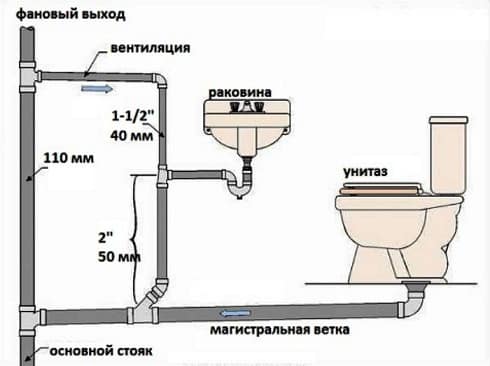 The principle of installation of the riser
Let's see how to do it yourself:
The ventilation pipe is connected to the sewer. A welded joint is installed at the coupling point
If a thread is used, then special attention should be paid to sealing communications;
Several consumers can be connected to the fan pipe at the same time. This is convenient if the house is small, and there are a lot of taps.
Then you need to seal each pipe separately. It should be noted that a large number of welds can violate the rigidity of the branch;
During installation, the riser is fixed to the wall with metal clamps. There are various options: plastic, rubber, but steel are the most reliable and tough;
It is necessary to sew up the fan pipe on the roof only using hydro and thermal insulation. Also, the height of the outlet on the roof must be higher than 50 cm.
This is very important to ensure there are no odors in the attic;
Experts say that the installation of various additional exhaust devices on the surface of the pipe can interfere with the operation of the entire ventilation system. But protective grilles still have to be mounted
This will protect the pipe from clogging;
During operation, the fan pipe can make an unpleasant noise - often an echo is heard throughout a private house. To avoid this, communication is wrapped with a soundproof film. It is made of a layer of foil and soft membrane fabric. When the sewer works, it absorbs noise. At the same time, this coating acts as a heat insulator.
Video: Features of installing a fan riser.
Periodically, the ventilation fan outlet will have to be cleaned. To do this, you can call specialists, or do all the work yourself. For cleaning, you will need a flexible rubber brush or a regular plumbing cable with a brush at the end. This procedure must be carried out every year.
How to do
Before starting the construction of a sewerage system in a private house, it is required to calculate the consumption and drainage. In order to calculate everything correctly, it is necessary to use special GOSTs and SNiPs.
Calculation example
First of all, you need to find out what is the rate of water consumption per day. It is believed that for residents of villages, megacities and small towns, these parameters differ. For example, for a small city, about 200 liters per day per adult is considered the norm, while more than 700 liters per inhabitant of a metropolis. Accordingly, the requirements for the diameter and slopes of pipelines change.
Video: Drainage systems for a private house.



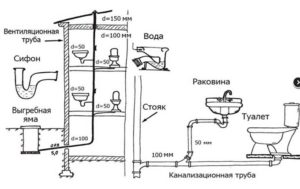

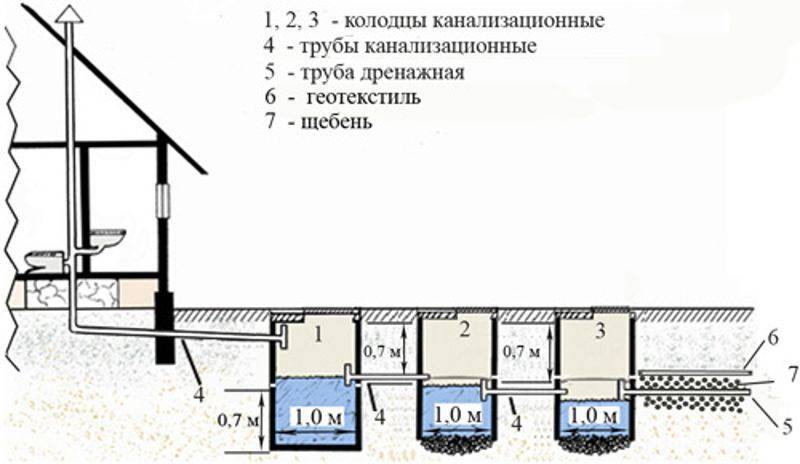

The diameter of the pipes is selected taking into account the use of specific receivers. For example, a toilet bowl is necessary to remove a large amount of waste, so a pipe with a diameter of at least 100 mm should go from it. Washbasins, washing machines, bathrooms, dishwashers need a smaller diameter - pipes up to 50 mm are connected to them.
An equally important parameter is the slope of the pipes that provide drainage in a country private house. It is also calculated individually, for this there is a special formula:
 Slope calculation
Where V is the approximate flow rate, H is the boundary fill, D is the full diameter.The result should be a number that is less than a certain factor for a given pipeline diameter. The coefficient itself is taken from reference books for plumbing installations.
Do-it-yourself sewerage device in a private house:
A pipe of a certain diameter is connected to each inlet. Sewerage can be carried out both externally and internally. The first one does not require any special effort, but it is not always ergonomic, so basically home craftsmen prefer to place pipes in the walls. To do this, their surfaces are ditched, and communications are laid inside the ditches;
As mentioned above, the specifications require that a shut-off valve crashes into each branch. To do this, threads are cut on the pipes (for metal) or a coupling is installed (when using plastic bends);
To obtain a closed network, all taps are interconnected according to a special scheme.
It is very important to ensure that drains cannot flow in the wrong direction. In order to prevent this, it is necessary to contact specialists.
Pay attention, a is water supply, b is water disposal;
After that, it remains only to carry out external sewage
Why is it necessary to dig trenches and a pit for a sewage treatment plant
Their walls are strengthened, pipes are laid in the ground. in advance, if necessary. They are insulated with textile fiber or a casing (made of clay, concrete);
External outlets are connected to the outer outlets. All joints must be sealed, checked for strength. The scheme can be of any kind, the main thing is that it allows for efficient drainage and prevents overflow of pipelines;
The last stage is to install a treatment plant and bring drains to it (into which rainwater is drained from the roof, drainage installations) and sewer pipes from the house.
Two-chamber septic tank
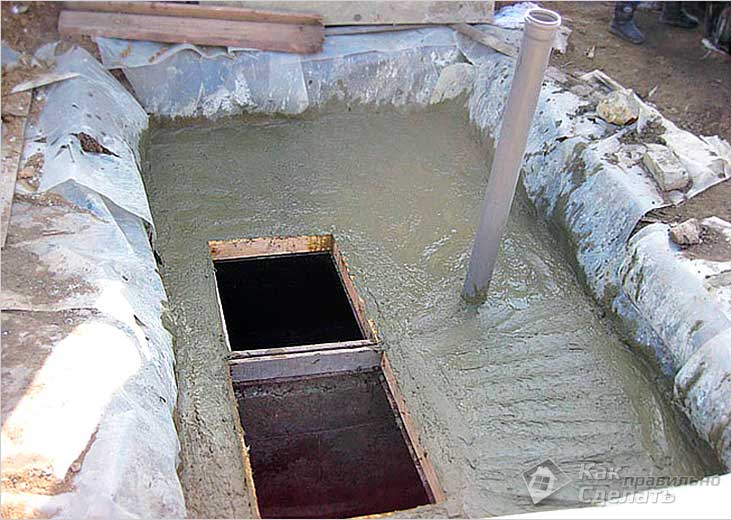 Concrete construction of a septic tank
The most convenient is the installation of a collector of two chambers connected by an overflow pipe. Let's find out how to arrange it yourself.
- Work begins with digging a pit in a place chosen taking into account all sanitary requirements. The volume of the structure depends on the number of people living in the country. You can dig a pit manually or with an excavator.
- At the bottom of the pit, a sand cushion up to 15 cm high is formed. The depth of the pit is 3 meters.
- It is necessary to install formwork from boards or chipboard. The design must be reliable. Next, a reinforcing belt is formed from metal rods tied with steel wire.
- It is necessary to make two holes in the formwork and insert pipe trimmings. These will be places for the entrance of the sewer line and the overflow pipe between the sections.
- The formwork is poured with concrete, which is distributed throughout the entire volume with the help of a vibrating tool. The design of the septic tank must be monolithic, so it is advisable to fill the entire formwork at a time.
- In the first compartment, the bottom is poured with concrete, a sealed section is formed, it will serve as a sump. Here, wastewater will be divided into solid coarse fractions that sink to the bottom, and clarified water that overflows into the adjacent section. For better decomposition of solid residues, aerobic bacteria can be purchased.
- The second compartment is made without a bottom, it can be made not only from monolithic walls, but also using concrete rings with a diameter of 1–1.5 meters, stacked on top of each other.The bottom of the well is covered with a thick layer of sedimentary rock (crushed stone, pebbles, gravel) to filter wastewater.
- An overflow pipe is laid between the two sections. It is installed at an inclination of 30 mm per linear meter. In height, the pipe is located in the upper third of the wells. The number of sections is not necessarily limited to two; a four-section septic tank can be made to provide better cleaning.
- The overlap of the septic tank is made independently, using formwork and concrete, or ready-made reinforced concrete slabs are used. Be sure to arrange a hatch that allows you to control the filling of sections and exhaust. The pit is filled with sand and selected soil. The sump of such a system will be cleaned every 2-3 years.
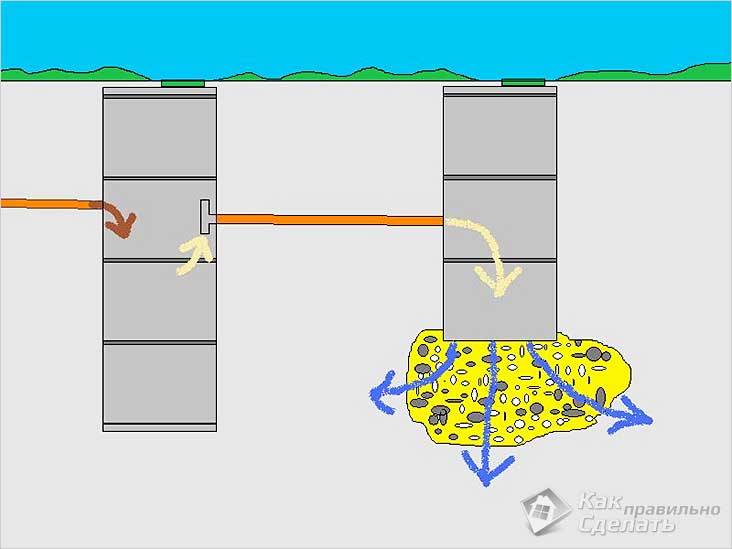 The device of a two-chamber septic tank from concrete rings
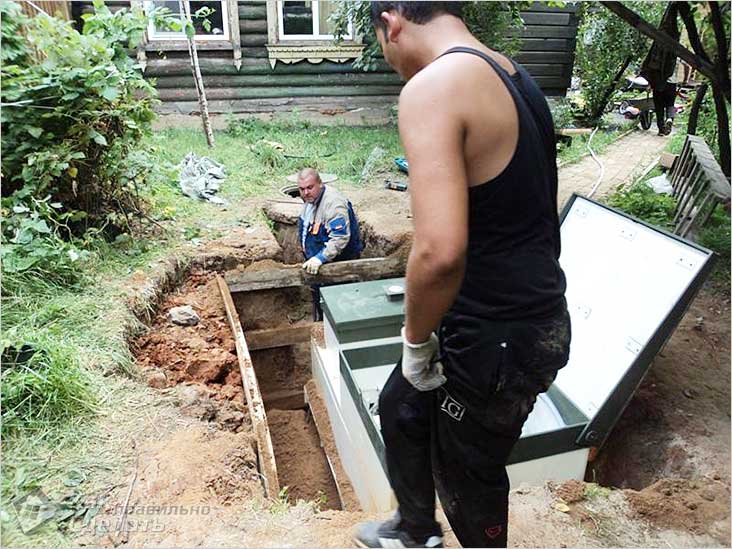 Installation of an autonomous septic tank Topas
Another option is a biological treatment plant. Local stations are convenient and efficient, they are indispensable for suburban buildings of a large area. Specialists are engaged in the installation and launch of the device, the cost of such a station is acceptable for a narrow circle of summer residents.