- What does the law say?
- What are the manufacturers saying?
- If we discard discontent, is THAT justified?
- When is maintenance carried out and how long does it take?
- How to save on maintenance?
- Required Rules
- Related:
- Normative base
- Rules for using a gas stove
- Symptoms of carbon monoxide poisoning
- List of works
- Rules for the use of individual gas cylinders
- Building regulations
- Obligations when using gas at home
- Rules for storing empty containers
- Checking gas cylinders
- External signs of faulty equipment
- What is included in maintenance
- Who should carry out the work
- Basic rules for gasification in an apartment
What does the law say?
To date, all owners who have entered into a gas supply agreement are required to annually carry out maintenance of gas equipment. The consumer must provide the gas service with documents confirming the conclusion of a maintenance contract with the relevant company.
It is noteworthy that in Europe there is no practice of maintenance of boilers - this is an exclusively Russian norm.
Who can carry out maintenance?
Both legal entities and individual entrepreneurs can provide services. The list of approved organizations is published in the register of the State Housing Inspectorate for your region.Specialists of authorized companies and firms are trained at special plants, in our case - UKK Mosoblgaz.
What happens if maintenance is not carried out?
Everything that is in the apartment (house) is the responsibility of the consumer. That is, it is the consumer who is obliged to find an organization for maintenance, conclude an agreement with it and send the necessary documents to Mosoblgaz or Mosgaz.
If the regulatory authorities do not receive the necessary papers from you, then you may face a fine, and in the future - turning off the gas supply. Cut off the pipe and put a plug on it.
What are the manufacturers saying?
Some manufacturers recommend maintenance, others say nothing about it.
Will the boiler be removed from the warranty if a service company gets into it?
If the service is carried out by specialists, the guarantee will not be removed - according to the law. Moreover, some manufacturers can increase its duration if you carry out maintenance in a timely manner. Information about this is contained in the warranty card, carefully study it.
I want to install a new boiler in the house - which one to choose?
If we discard discontent, is THAT justified?
If the customer and contractor do not treat the need for service as a mere formality, then it definitely makes sense.
First of all, it is the diagnosis of possible problems. You can assess the condition of the boiler and other components before the heating season so that you do not find yourself without heat at an unexpected moment.
Over time, the operation of the heating system may deteriorate:
- The boiler often turns on and off.
- Everything works, but the batteries are cold.
- The pressure drops in the system.
- The extractor doesn't work.
During maintenance, the operation of all boiler components is checked and scheduled work is carried out:
- Testing the wiring.
- Clean internal parts, filter.
- Set up the burner.
- Check the pump.
Regular maintenance helps to play it safe and identify possible problems in advance.
If something happened to the boiler, then quickly replacing it during the heating season will be problematic.
If problems arise in the winter, you will have to urgently look for specialists. Winter is a “hot” season for companies, queues for orders are long and prices are high. The heating operation will stop until the boiler is repaired or replaced. If you have carried out maintenance, you are calm for the entire heating season.
The question is rather how you feel more comfortable: play it safe and feel calm, or hope that the boiler will work as long as possible without intervention, and the gas services will not remember you.
When is maintenance carried out and how long does it take?
By law, maintenance of a gas boiler is carried out at least once a year. In the contract with the contractor, a list of services is indicated, and after maintenance, an act is issued. The procedure lasts from 2 to 4 hours - everything is done within one working day. Work can be carried out at any time of the year, but it is better to do it in advance, before the start of the heating season.

During maintenance, the boiler is disassembled. If it is in operation, then it is advisable to turn it off a few hours before the arrival of the master - so that the system has time to cool down.
Energobyt Service → Services:Maintenance of boilers
How to save on maintenance?
It is best to wait for the period of special offers. From April to June, service companies have the lowest workload, so prices may be lower at this time.
Once again the most important:
Required Rules
Safety in the house is provided by the rules for using gas in everyday life.86-P (the law that entered into force on April 26, 1990) contains the basic rules that allow you to correctly operate the equipment. Inspection and repair of gas pipelines, according to this document, should be performed only by specialists who have presented a certificate. When the installation of cylinders takes place, the room must be vacated. The fire should only be lit if there is no smell of gas.
It is the responsibility of tenants to pay for services on time, the cost of which is set by the provider. In winter, the heads should be checked regularly to ensure they are not frozen or clogged. These elementary rules for using gas in everyday life will prevent many adverse situations.
Related:
Rules for the safe use of gas in everyday lifeResponsibility for the safe operation of gas-using equipment in apartment buildings and households, for their maintenance ...
Lecture on the initial briefing of consumers on the rules of safe ... Rules are carried by owners and persons using gas
Therefore, an important place in the system of safe use of gas in everyday life is occupied by this ...
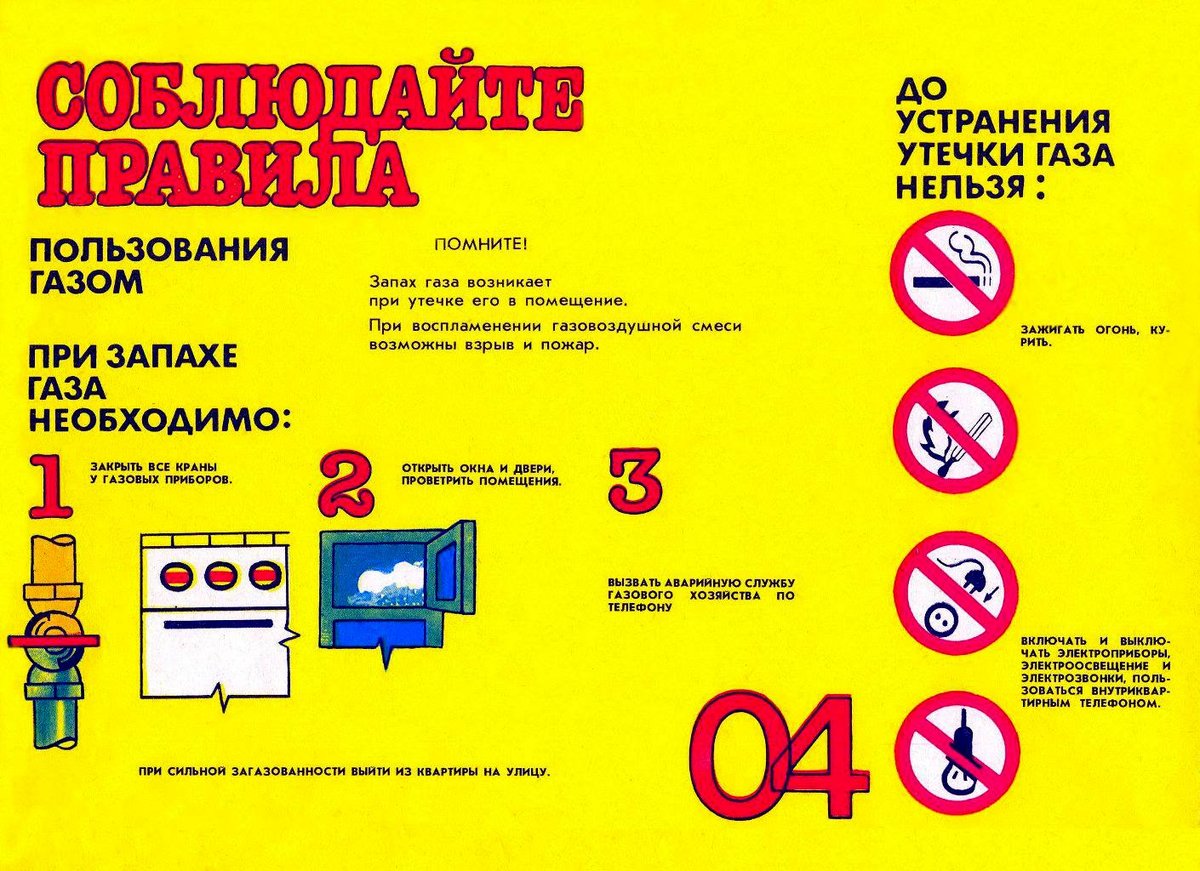
Memo on the rules for the use of gas in everyday life. Responsibility for... Citizens, remember! Gas mixed with air is an explosive mixture.
By violating the rules for using a gas stove, you expose ...
Memo on the rules for the use of gas in everyday life. Responsibility for... Citizens, remember! Gas mixed with air is an explosive mixture. By violating the rules for using a gas stove, you expose ...
Rules for the use of gas in everyday life The population using gas in everyday life is obliged to be instructed on the safe use of gas in the operating organization of the gas economy, to have operating instructions ...
Rules for the use of gas in everyday life The population using gas in everyday life is obliged to be instructed on the safe use of gas in the operating organization of the gas economy, to have operating instructions ...
Recommendations (Rules) for the use of gas in everyday life The population using gas in everyday life is obliged to be instructed on the safe use of gas in the operating organization of the gas economy, to have operating instructions ...
Memo on the rules for the use of gas in everyday life Represents an explosive mixture. By violating the rules for using a gas stove, you expose
Rules for the use of gas in everyday lifeThe rules are mandatory for officials of departments and organizations responsible for the safe operation of gas facilities in residential ...
Rules for the use of gas in everyday life of the Lezhnevsky municipal district, the department for civil, emergency and mr of the administration of the Lezhnevsky municipal district appeals to residents ...
Rules for the use of gas in everyday life approved. By order of Rosstroygazifikatsiya, the Rules are obligatory for officials of departments and organizations responsible for the safe operation of the gas facilities of residential ...
Rules for the use of gas in everyday lifeResponsibility for the quality of maintenance and repair of gas equipment in residential buildings lies with the operational ...
Instructions for the use of gas in everyday life Periodically undergo instruction on the safe use of gas from the Contractor, have instructions for operating a gas-using…
Rules for the use of gasThe rules are mandatory for officials of departments and organizations responsible for the safe operation of the gas facilities of residential ...
Memo safety of operation of in-house gas equipment When using natural gas in everyday life, it is necessary: to be instructed on the safe use of gas in the operating organization ...
Rules for the use of gas in everyday life gas stoves ...
Instructions, instructions for use
Normative base
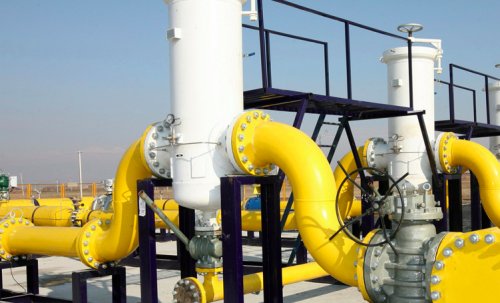 The fundamental legal acts in this matter are the law "On gas supply in the Russian Federation" dated March 31, 1999. and “On gasification”, which entered into force on March 1, 2014. But besides it, other laws are also used: “On Industrial Safety”, “On Architectural, Urban Planning and Construction Activities”, and so on.
Attention! If you have any questions, you can chat with a lawyer for free at the bottom of the screen or call: +7 (499) 938-53-75 Moscow; +7 (812) 425-62-06 St. Petersburg; +7 (800) 350-31-96 Free call for all Russia. In addition to laws, there are a number of legal acts that regulate the rules of gas supply
These include the following:
In addition to laws, there are a number of legal acts that regulate the rules of gas supply. These include the following:
- building codes and regulations (SNiP 2.04.08-87);
- gas supply safety rules;
- rules for the use and provision of gas supply.
Rules for using a gas stove
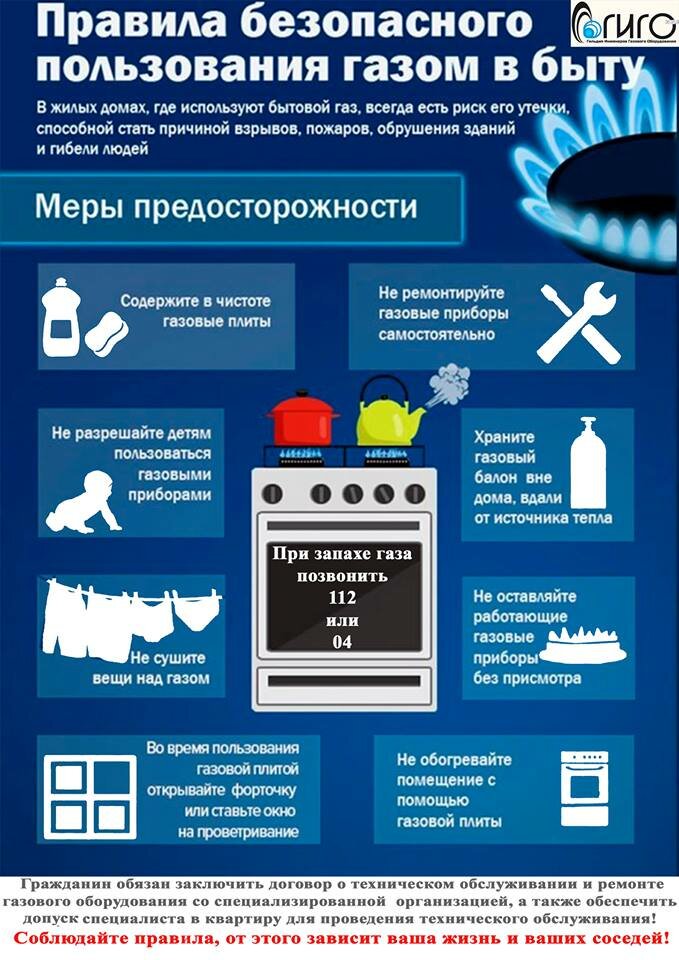
Based on Decree of the Government of the Russian Federation No. 549, the population that uses gas must sign an agreement on the maintenance of in-house gas equipment and emergency dispatch support with a specialized service.
The room in which the gas stove is located must be well ventilated. Those. it should not be installed in a room without windows.
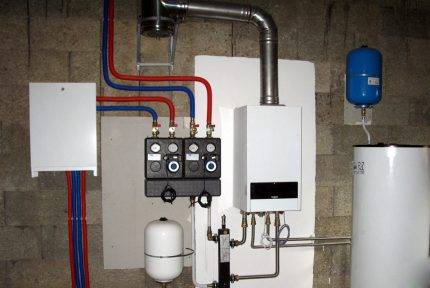 The installation of any gas equipment in a room without window openings and a ventilation system is contrary to the basic safety requirements
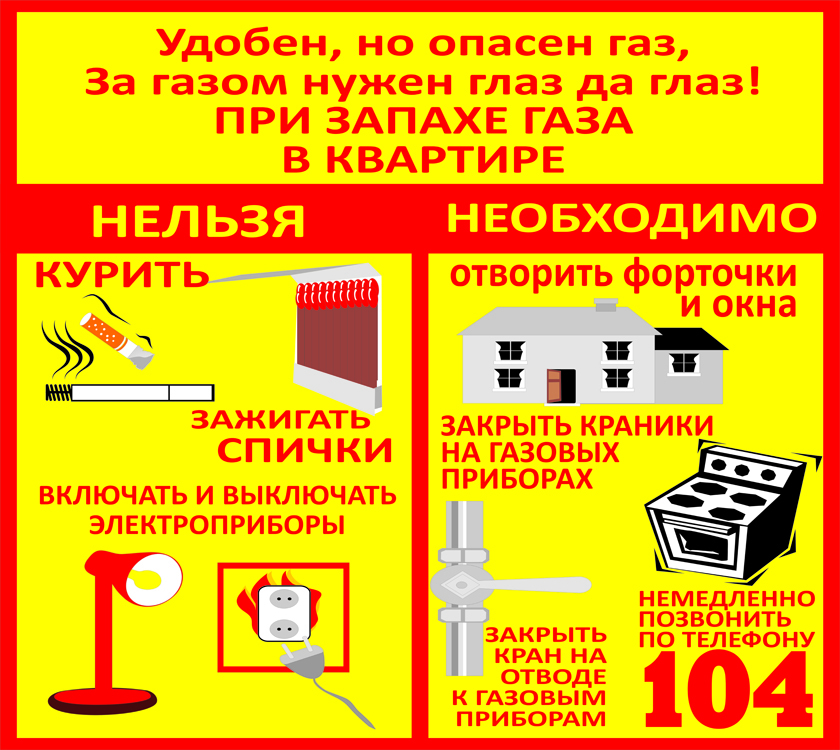
Before using the gas stove, it is recommended to ventilate the room and make sure that all burner taps of the burners and the oven are closed. After that, you can turn the valve on the gas pipeline to the stove. If the tap flag is parallel to the gas pipeline, then this indicates that the gas supply is open.



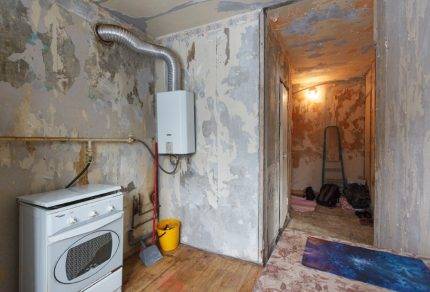 Pipes of the gas pipeline, which are located in the apartment, cannot be covered with panels during repairs, because. they are necessary for the full shutdown of the gas
Then you need to light the gas. If we are talking about an ordinary stove, you need to take a lit match and bring it to the burner, and then open the tap of this burner. When operating stoves with electric ignition, it is this ignition that performs the function of a match.
Before turning on the oven, air it for 3-5 minutes by opening the door. Do not leave the burner and oven taps open for more than 5 seconds without a flame.
 If the burner tap has been open for a long time, it is urgent to close it and immediately open the windows in the room
Fire should appear in all burner holes. If this does not happen, you need to turn off the gas and check the condition of the burner.Gas burning is normal if the flame is calm and has a bluish or purple hue. If the color of the flame differs from the specified, you must immediately turn off the tile.
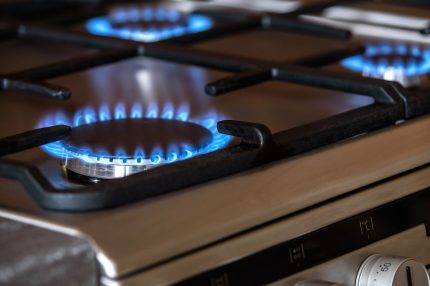 After turning on the gas, you need to watch the flame, because. its burning pattern may indicate a malfunction of the equipment
According to the rules for the use of gas in private houses and apartments, the flame should not be knocked out from under pots, pans or cauldrons. If the fire is knocked out from under the dishes, it must be reduced. At the end of the operation of the gas stove, close all gas valves.
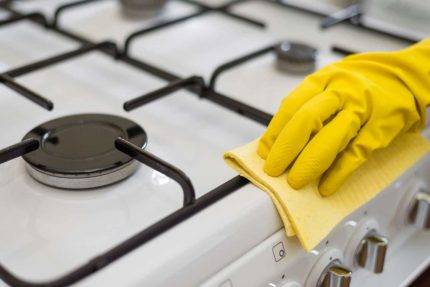 To clean the gas stove, use only special substances and napkins with a special pile so as not to damage the surface of the device
The gas stove should be cleaned regularly, carefully removing some parts (burners, handles, baking sheets in the oven). The use of additional products for dismantling parts of the equipment is prohibited.
This can lead to serious damage and the inability to continue to use the stove for its intended purpose. When a person leaves the apartment for a long time, it is recommended to call a public utility employee to shut off the gas pipeline.
Symptoms of carbon monoxide poisoning
Symptoms include:
pain in the temples;
noise in ears;
discomfort in the frontal part of the head;
darkening in the eyes;
development of muscle weakness, especially in the legs;
the person cannot get up;
colic in the head intensifies, labored breathing sets in, followed by nausea and vomiting;
the last stage may be a stunned state and loss of consciousness.
Be vigilant, there are fatal cases of poisoning of entire families as a result of the premature closing of a valve on a pipe.
However, it is worth remembering that the severity of the lesion is directly related to factors such as physical activity at the time the substance enters the body, duration of exposure, health status and characteristics of human physiology.
There are three stages:
- Easy degree. It is characterized by general weakness, tachycardia, nausea, dizziness, blurred vision. Tearing and increased blood pressure may also occur.
- Average. It starts with hallucinations. A person has intermittent breathing and uncoordinated movements. Consciousness is already in a state of nebula. In general, all signs from the first stage begin to occur in complex forms.
- The last stage is the hardest. The pupils dilate, the pulse quickens as much as possible. A coma or long-term loss of reason is possible. Some people experience paralysis, convulsions, and involuntary bowel movements. Cyanosis appears on the skin.
Knowing all the symptoms of poisoning, you can prematurely suspect what causes certain ailments.
List of works
Watch infomercials
For gas stove:
- Adjustment of the combustion process of the gas-air mixture in all modes of operation of household gas-using equipment (removal of burners, lifting of the stove table, adjustment of the air supply damper, fixing with a clamping bolt);
- Stove faucet lubrication (raising the slab table, removing the slab faucet handles, removing the front panel of the slab, removing the flange with the stem, lubricating the slab faucet plug, lapping the faucet, assembling the nodes and putting them in place.Each valve is lubricated separately and disassembled separately, gas communications of apparatuses and devices to the burner nozzles are checked for leaks using a soap emulsion);
- Cleaning the gas supply burners from contamination (fixing the nozzle hole with a special awl, opening the stove valve, circular movements with the awl, removing the awl from the nozzle hole, closing the valve. In case of severe clogging, unscrewing the nozzle, cleaning with an awl, blowing the burner tube by opening the stove valve, place, check combustion if necessary, repeat);
- Checking the safety automation (checking the performance, adjusting and adjusting the devices provided by the manufacturer in the design of household gas-using equipment, which make it possible to automatically turn off the gas supply when the controlled parameters deviate beyond acceptable limits).
- Checking the gas stove oven with a leak detector and cleaning the oven burner mechanically.
- Visual inspection of the integrity and compliance with regulatory requirements (inspection) of in-house gas equipment.
- Visual check of the availability of free access (inspection) to the in-house gas equipment.
- Visual inspection of the state of painting and fastenings of the gas pipeline, the presence and integrity of the cases in the places of laying through the external and internal structures of apartment buildings and households (inspection).
- Checking the tightness of connections and disconnecting devices in equipment (pressure testing, instrumental method, soaping).
- Instructing gas consumers on the safe use of gas to meet household needs.
- Implementation of round-the-clock emergency dispatch support.
For instantaneous gas water heaters (HSV):
- Checking the tightness of the coil to the walls of the fire chamber, the absence of drops or water leaks in the heat exchanger, the horizontal installation of the fire surface of the main burner, as well as the absence of displacement of the main and pilot burners, the absence of gaps between the links of the connecting pipe, the sufficiency of the vertical section of the pipe and the absence of sharply curved turns.
- Checking the condition of the pilot burner (igniter), if any.
- Checking the smoothness of switching on at the start of water heating (at start-up there should be no popping and flame delay).
- Checking the operation of the main burner (the flame must be blue, burning over the entire area of the burner), if it does not comply, the burner is cleaned (removal of the VPG casing, removal of the main burner, the burner is cleaned by flushing, assembled in the reverse order).
- Lubrication of the crane (block crane) VPG (if necessary).
- Checking the safety automation (checking the performance, adjusting and adjusting the devices provided by the manufacturer in the design of household gas-using equipment, which make it possible to automatically turn off the gas supply when the controlled parameters deviate beyond acceptable limits).
- Checking the gas block and nozzle bar with a leak detector.
- Visual inspection of the integrity and compliance with regulatory requirements (inspection) of the in-house gas equipment, the availability of free access to the in-house gas equipment, the painting and fastening of the gas pipeline, the presence and integrity of the cases in places where they are laid through the external and internal structures of apartment buildings.
- Checking the tightness of connections and disconnecting devices in equipment (pressure testing, instrumental method, soaping).
- Instructing gas consumers on the safe use of gas to meet household needs.
- Implementation of round-the-clock emergency dispatch support.
When a contract for maintenance of VKGO is concluded with Project-Service Group LLC, our gas service specialists will come to you at any signal, regardless of the number of applications.
Rules for the use of individual gas cylinders
- The installation distance from the gas stove is at least 0.5 meters, and from the heaters at least 1 meter, while if the heater works on an open fire, the distance increases and becomes at least 2 meters;
- If the owner of the premises is not able to install a gas cylinder inside, then this must be done outside, in a metal cabinet with ventilation holes;
- When an empty cylinder is replaced by a full one, it is forbidden to use sources of fire, as well as electrical appliances in the room;
- Installation of defective cylinders and gas equipment is prohibited.
The full article on this topic is here:
It is forbidden to store cylinders with combustible gases in individual residential buildings, apartments and living rooms, as well as in kitchens, escape routes, stairwells, basement floors, basements and attics, on balconies and loggias (clause 91).

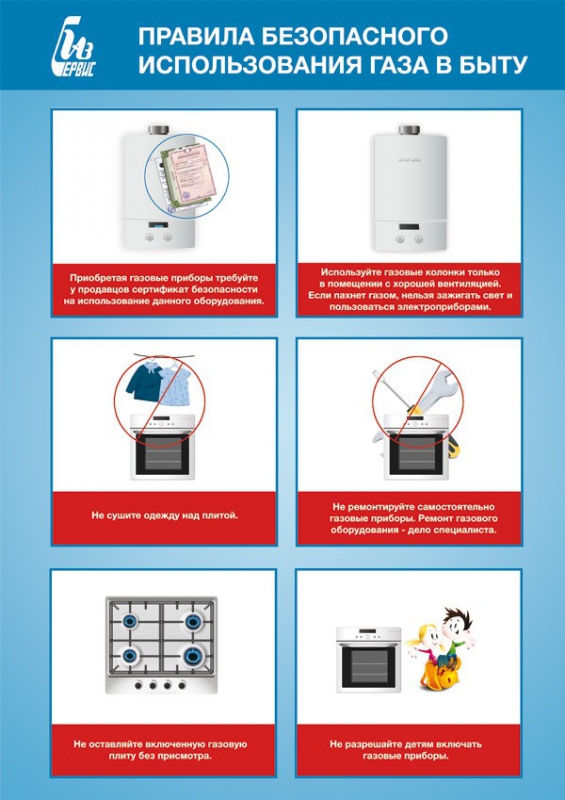
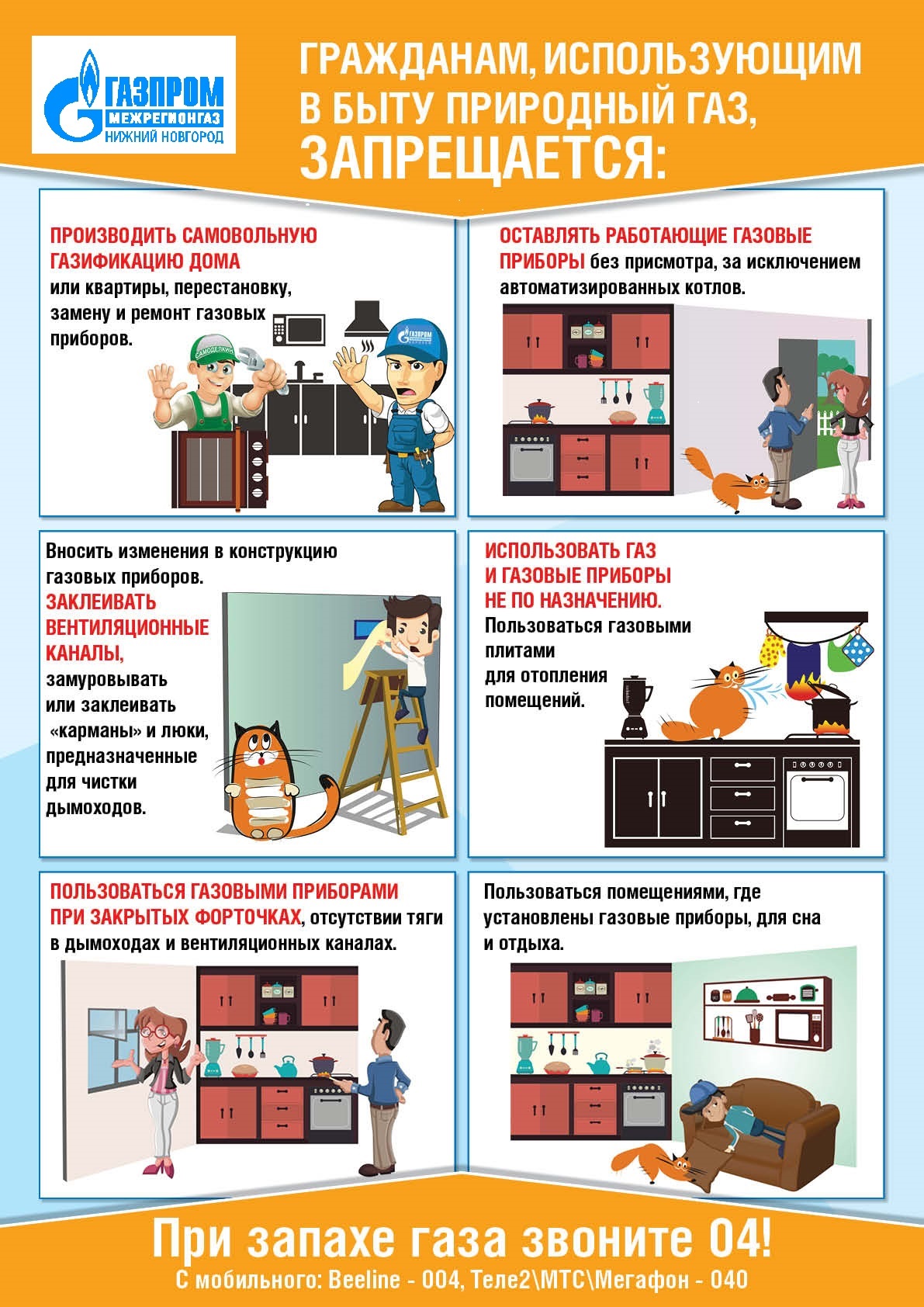
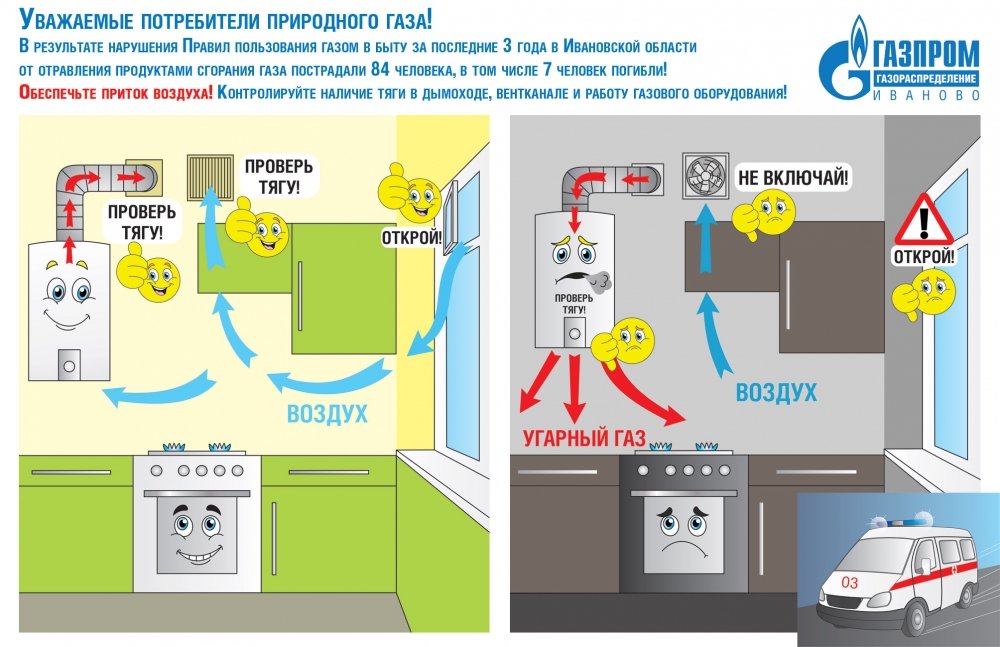
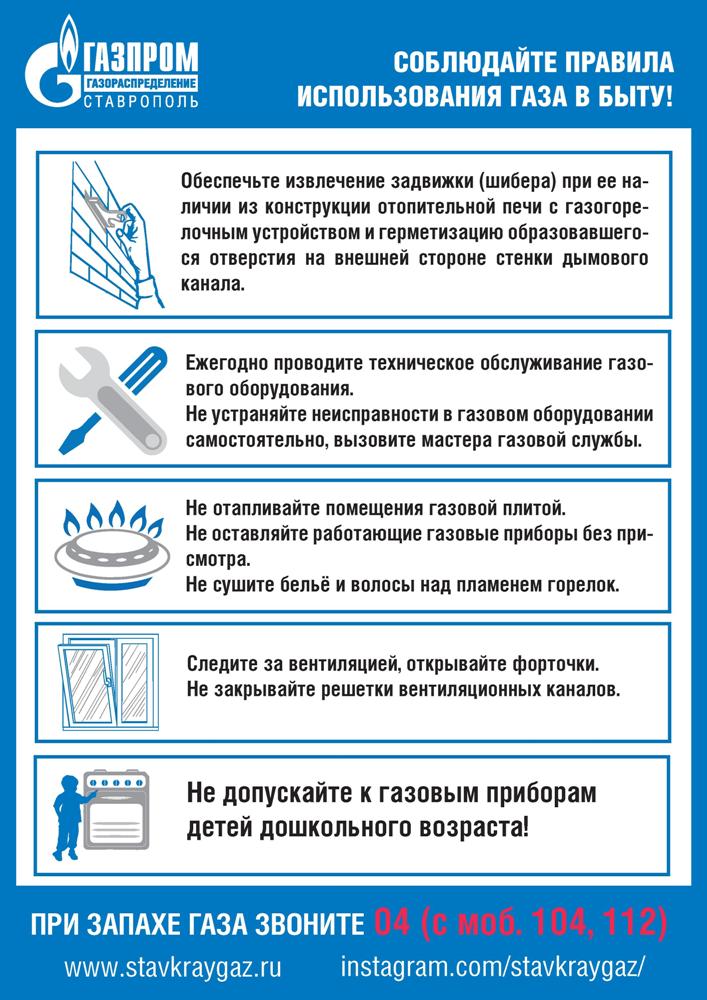

Gas cylinders for household gas appliances (including cookers, hot water boilers, gas water heaters), with the exception of 1 cylinder with a volume of not more than 5 liters connected to a factory-made gas stove, are located outside buildings in annexes (cabinets or under casings covering the top part of the cylinders and a reducer) made of non-combustible materials near a blank wall at a distance of at least 5 meters from the entrances to the building, basement and basement floors (p. 92).
Annexes and cabinets for gas cylinders must be locked and have shutters for ventilation, as well as warning signs “Flammable. Gas” (p. 93).
At the entrance to single-family residential buildings, including residential buildings in block-built buildings, as well as to the premises of buildings and structures in which gas cylinders are used, a fire safety warning sign with the inscription “Flammable. Cylinders with gas” (p. 94).
In accordance with clause 34 “e” of Decree of the Government of the Russian Federation of May 6, 2011 No. 354, owners and users of premises in residential buildings are required to allow representatives of the contractor (including emergency workers), representatives of state control and supervision bodies to the occupied residential premises for inspection of the technical and sanitary condition of the in-house equipment at a time agreed in advance with the contractor in the manner specified in paragraph 85 of these Rules, but not more than 1 time in 3 months, to verify the elimination of shortcomings in the provision of public services and the performance of necessary repairs - as necessary, and to eliminate accidents - at any time.
Building regulations
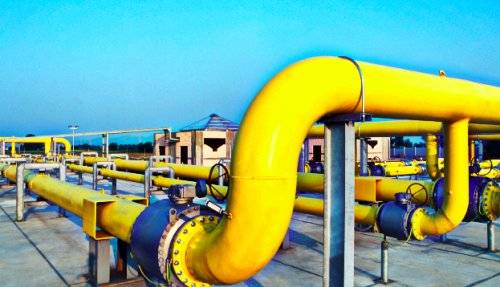 The gas supply must be secure.This is ensured by complying with the established building codes and gas supply rules (in short, SNiP). So, there is a separate document for single-family houses. The requirements are as follows:
- When consuming gas for cooking, it is allowed to use 0.5 cubic meters per day; for hot water, which is produced by a gas heater - the same standard; for heating - from 7 to 12 cubic meters per day.
- The pressure must be applied within 0.003 MPa.
- Gas pipelines located above the ground are allowed to be laid in places where vehicles and people cannot pass. At the same time, the height above ground level is not less than 0.35 meters.
- Inside the house, the pipe is equipped with a device that turns off the gas.
- The distance between the pipes to the gas line must be sufficient to carry out repairs if necessary.
- Storages should be located in the ground at a depth of 60 cm from the surface in places of freezing in winter, and 20 cm - in the absence of freezing.
- Inside the house, the pipes must be open or located near special ventilation, and be covered with shields.
- At the intersections of structures, the gas pipe is placed in a case, and the pipes should not come into contact with it (the gap is 5 cm, it is closed with a special material).
- Devices that turn off the gas are located in front of the meters.
Obligations when using gas at home
The safe use of gas is the responsibility of residents of high-rise buildings and owners of private mansions. This is due to the fact that the spread of fuel and carbon monoxide through the general ventilation is fraught with mass poisoning, a major fire and a destructive explosion.The same applies to individual houses. Fire can spread to neighboring buildings, and fragments and a blast wave can cause serious damage to the health of neighbors and their property.
Rules for handling gas in everyday life:
- There should be no combustible objects near the stove, or substances that emit toxic smoke when heated. This applies to kitchen towels, gloves, plastic utensils, furniture and other household utensils. The area around the hob should be cleaned regularly to prevent fires.
- First you need to light a fire and bring it to the burner, only then open the gas supply. When using the oven, you should wait until the relay, which is responsible for supplying fuel, heats up.
- The combustion process must be constantly monitored. The flame should be even, stable, with a characteristic blue color. If it is intermittent, red or there is a strong soot, the device must be turned off.
- The condition of the equipment must be checked regularly. The terms of the revision are indicated in the user manual. For a stove, the recommended frequency is once every three years, and for a boiler and a column, annually.
- You should immediately contact the emergency service if you find the smell of odorant in the apartment or entrance, malfunction of appliances and communications, or a sudden stoppage of gas supply.
- When using a flexible hose, use products whose length does not exceed 500 cm. When connecting, make sure that there are no twists and creases.
Rules for storing empty containers
The attitude to an empty container should be exactly the same as to a freshly filled one.Store empty containers tightly closed in a separate room. Therefore, an apartment for storing gas cylinders, even if already used, is not suitable.
The old tank must not:
- open, cut, cut;
- heat;
- use for the manufacture of explosive devices, including for peaceful domestic or construction purposes;
- independently dispose of the remaining gas;
- to be scrapped without proper treatment.
Used equipment should be handed over to a collection point of a specialized service for inspection or replacement.
Checking gas cylinders
Each container is equipped with a stamp or a metal "passport", which indicates the expiration date, storage and crimping. Pressurization is a validation test. During such a check, specialists unscrew the valve and inspect the inner surface.
On the stamp of a standard propane cylinder, you can find information about the working and test pressure, volume, initial mass of empty containers and weight filled to capacity. The serial number, dates of manufacture and the next certification are also indicated there.
If the walls are in order, there are no visible damages on them, the tank is filled with water and subjected to pressure testing: a pressure is applied that is one and a half times higher than the working values.
The container that remains intact after such an event is “awarded” with an updated brand and is allowed for further operation.
External signs of faulty equipment
Any user can independently determine the unsuitability of the container by external signs:
- the presence of rust - products are not subject to further operation, more than a third of the surface of which is occupied by corrosion;
- the presence of traces from the effects of fire - a damaged layer of paint;
- swelling - barrel-shaped specimens with a distorted shape;
- the presence of dents.
All these signs are the reason for the speedy disposal. Another good reason is the expiration of the storage period, information about which is displayed on the stamp.
What is included in maintenance
To prevent and prevent emergencies in the house related to gas, VDGO checks are necessary. They are carried out by gas services, whose employees inspect the intra-house civil defense in the MKD and private housing. List of incoming equipment:
- a gas pipeline that is connected to the fuel distribution network;
- system riser;
- shut-off valves that are located on the wiring to individual equipment;
- general counters;
- devices that operate on gas;
- systems for monitoring the gas content of living space;
- technical devices.
All equipment that is located from the gas distribution network to the dwelling is included in the list of regular scheduled inspections of in-house gas equipment (VDGO). In its course, specialists determine the condition of the installed gas equipment and the possibility of its further operation. Checking gas equipment is regulated by an agreement that the management company concludes with the executive body.

Inspection of intra-apartment equipment (VGKO) is carried out by specialized companies on the basis of an agreement that is concluded directly by the owner of the housing with the organization performing the work. The VKGO list includes only those devices that are inside the apartment:
- household stoves;
- heating boilers;
- water heaters;
- part of the wiring;
- other constipation devices;
- individual metering devices installed in the living area.
The homeowner is obliged to monitor the condition of the in-house gas appliances on his own. If the apartment is not the property of the tenant, he, nevertheless, being a tenant of the living space near the municipality, is responsible for its safety, including for the equipment installed inside the apartment.
Who should carry out the work
Please note! By Government Decree No. 410 of May 14, 2013, all gas equipment used by homeowners is divided into:
- in-house gas equipment;
- domestic gas equipment.
This division required the conclusion of two different maintenance contracts. At the same time, the document contains a list of requirements that the supplier of "blue fuel" must comply with.
It:
- the company, regardless of the legal form of ownership, must have an appropriate permit for the transportation and distribution of gas to the place of connection of the in-house gas system;
- have a valid agreement with a gas supplier;
- employees of the company must pass the appropriate certification;
- availability of an emergency dispatch service equipped with all necessary means.
Government Decree obliges owners to conclude contracts for the maintenance of gas equipment. This means that the management company, homeowners' association, housing cooperative must initiate the conclusion of a contract for the maintenance of in-house gas equipment, and homeowners and tenants - for in-house equipment.
Watch the video. Checking gas equipment in apartments:
Basic rules for gasification in an apartment
In the process of drawing up individual technical conditions, the purposes of gas use by the owner of the apartment are taken into account, including the number of gas appliances installed. It is on the basis of this information that a list of requirements is compiled.
Employees of GorGaz do not always include mandatory rules for the installation of gas equipment in the technical specifications, therefore, due to their failure to comply, an employee of the Ministry of Emergency Situations will be forced to postpone the date of gas connection
You can get acquainted with the established rules for the installation of gas equipment inside the apartment in the document SP 42-101-2003 “General provisions for the design and construction of gas distribution systems from metal and polyethylene pipes”.
According to the document, there are a number of minimum requirements established for all gas consumers:
- painting the gas pipe white;
- ensuring the sealing of the chimney installation site with cement mortar;
- installing a grate on a ventilation duct;
- installation of a kitchen door with a 3 cm undercut from the floor, and installation of a decorative grille at a distance of 10 cm from the floor;
- installation of electrical outlets next to the boiler, and an alarm located in the area of \u200b\u200bthe gas meter;
- purchase of a voltage stabilizer for the boiler;
- obligatory purchase of a gas stove until the inspection is carried out by the inspector;
- connection of gas-using equipment with stainless steel hoses, no more than 1.5 m long;
- purchase of a gas stove equipped with a “gas-control” system;
- availability of all necessary technical documentation for the gas equipment used.
Non-compliance of gas-using equipment with elementary technical requirements is already the basis for refusal to conclude an agreement by the gas supply service.
In order not to slow down the process of connecting gas in the apartment, it is important to fulfill all the established requirements in advance, and only after that call a specialist for an inspection. For all residents of an apartment building, the installation of indoor gas monitoring sensors is mandatory from June 6, 2019
For all residents of an apartment building, the installation of indoor gas monitoring sensors is mandatory from June 6, 2019
Another prerequisite is the installation in the kitchen of a residential building of "easy" glass, while in an apartment building you will also need to install gas sensors.
Of course, such devices will require additional costs, but this will ensure safety not only for the owner of the apartment, but also for the residents of the entire apartment building.