- Functions of ventilation systems
- Norms and requirements
- Fire safety requirements for ventilation systems equipment and its location
- Fire safety measures for ventilation systems
- Who can check the ventilation in the house
- Control of ventilation and smoke removal systems of MKD was removed from licensing
- Extinguish the ventilation chamber or not
- fire safety requirements
- Construction requirements for ventilation chambers
- Temperature and air exchange in the ventilation chamber
- Placement of ventilation chambers
- Floors and ladder in the ventilation chamber
- Requirements for walls in the ventilation chamber
- Requirements for ventilation chamber doors
- Calculation of ventilation systems
- Escape routes
- Supply valves
- Fire-fighting engineering support
- Alarm in the ventilation chamber
Functions of ventilation systems
So, the main function of such structures is to ensure the normal process of air exchange. Ventilation and air conditioning of the premises allows not only to supply air from outside, but also to remove already exhausted air, that is, to circulate it. Ventilation includes two processes - air supply and air exhaust.
The next function of ventilation is to prepare the air that enters the room, to create the conditions necessary for full-fledged life.To do this, you need to filter, heat or humidify the air. Air conditioning involves lowering the air temperature, however, the air conditioner is the device that automatically starts and cools the air.
Norms and requirements
Ensuring the fire safety of administrative facilities is impossible without strict compliance with the fire safety requirements of official regulatory documents both at the stage of design, construction, and during long-term operation; internal redevelopment of floors, premises; current, capital repairs, reconstruction of buildings:
- SNiP 31-05-2003 (SP 117.13330.2011) - on public administrative buildings.
- SP 118.13330.2012* – on public facilities, which is an updated edition of SNiP 31-06-2009.
- SNiP 21-01-97*, which establishes fire safety requirements for buildings, structures of any kind, purpose.
- SP 12.13130.2009, which gives methods for determining the category for the explosion and fire hazard of premises of objects, including in administrative buildings.
- SP 7.13130.2013, which establishes PB requirements for building ventilation systems, including in terms of creating smoke protection systems for facilities.
- SP 31.13330.2012, which is the current version of SNiP 2.04.02-84, in terms of providing external fire-fighting water supply to administrative buildings.
- SP 10.13130.2009 - on the internal fire water supply of buildings, which is one of the main elements of the internal fire water supply of administrative facilities.
- SP 1.13130.2020 - on evacuation routes, exits.
- SP 3.13130.2009 - on PB requirements for warning systems, management of evacuation from buildings (SOUE).
- SP 5.13130.2009 - on the design of fire extinguishing and signaling installations.
- SP 113.13330.2016, which serves as the current edition of SNiP 21-02-99 * - about car parking, which is not uncommon in modern administrative buildings.
- PUE, which establish, among other things, fire safety rules for the placement, operation of electrical installations, electrical equipment in public buildings.
- NPB 240-97 - on acceptance, periodic tests of smoke protection of objects, including smoke exhaust systems, fresh air supply to rooms on the way of evacuation from buildings.
- NPB 245-2001 - on the requirements, tests of all types of fire escapes, as well as the external type of evacuation stairs.
- GOST R 51844-2009 - on the requirements for fire cabinets, in which not only sets of fire hoses, trunks with connecting heads are placed in administrative buildings; but also water, air-foam, powder fire extinguishers.
- GOST 12.4.026-2015, which establishes the requirements for signal colors, shape, size of PB signs required for placement in administrative buildings.
The document mandatory for study, a guide for conducting fire safety briefings, for fire safety training programs for administrative facilities responsible for fire safety are the NPB "Training fire safety measures for employees of organizations", which are approved by Order of the Ministry of Emergency Situations of the Russian Federation No. 645 dated 26.12.2007.
Do you need instructions on fire safety measures and their samples?
Move on to the next article:
Fire safety requirements for ventilation systems equipment and its location
The list of ventilation equipment includes:
- fans;
- dust collectors;
- filters;
- flaps;
- valves;
- air heaters.
There are general principles for their location. So, for premises of fire hazard categories A and B, only protected elements of the system should be used. It is impossible to install in one place systems for work in an explosive zone and rooms of general purpose.
It is strictly forbidden to install equipment in warehouses and basements of any hazard class. Exceptions are air and thermal curtains. This rule is due to the fact that such premises are not characterized by the constant presence of people, so a fire in them may not be noticed in time. It is also impossible to bring devices for collecting and cleaning explosive mixtures into the basements, since an explosion in such a room can cause irreparable damage to the building.
Fire safety measures for ventilation systems
Let's consider three main stages of creating ventilation and measures to ensure its fire safety.
At the design stage. The explosion hazard category of the room is determined by the equipment designer. The task of the one who creates the project of the ventilation system is to take into account all the requirements for specific areas and apply the appropriate devices. You should not forget about installing backup systems, ensuring automatic activation of fire ventilation in the event of an emergency, and checking electrical appliances for compliance with the system parameters.
At the stage of installation. All work must be carried out by specialists. They are required to securely mount all elements of the system, and connect the electrical parts in accordance with the PPB standards for electrical wiring and electrical appliances and recommendations for a particular class of premises.One of the most important tasks is to ensure the tightness of the connections of the system elements (especially when it comes to systems for rooms of classes A and B) and their entry into partitions and load-bearing walls.
At the operational stage. Proper use of equipment is essential to maintaining its safety. It is worth carrying out scheduled inspections of electrical and mechanical components, checking the strength of the sealing of the joints. The units may only be used strictly in accordance with the operating instructions. It is forbidden to leave switched on devices that are not intended to work in automatic mode.
Alliance "Integrated Safety" is able to provide a full range of services to ensure the safety of ventilation systems. We have extensive experience in this field and provide the highest quality service. The company's team consists of highly qualified designers, installers and auditors. They are able to competently carry out the development of the system, its installation and introduce measures for safe operation through regular monitoring of equipment and training of personnel in the basic requirements.
Who can check the ventilation in the house
Work on testing and adjustment of ventilation systems is carried out by organizations that have a permit for this type of work, established by national legislation *.
_______________
* In the Russian Federation, Order of the Ministry of Regional Development of the Russian Federation dated December 30, 2009 No.N 624 "On approval of the list of types of work on engineering surveys, on the preparation of project documentation, on the construction, reconstruction, overhaul of capital construction projects that affect the safety of capital construction projects." (clause 5.1 GOST 34060-2017)
The contractor must have (clause 5.2 GOST 34060-2017):
-
- the category of a specialist or adjustment worker for ventilation and air conditioning systems of a category corresponding to the technical complexity of the installed systems;
- necessary equipment, measuring instruments, tools and personal protective equipment.
Control of ventilation and smoke removal systems of MKD was removed from licensing
Until 10/17/2017, the managing organization (HOA), in order to comply with the requirements of the Minimum List ( RF GD dated 04/03/2013 No. 290) and the Rules for the Use of Gas ( RF GD dated 05/14/2013 No. 410), it was necessary to choose one of the options:
-
- obtain a license for the installation, maintenance and repair of fire safety equipment for buildings and structures and carry out the work specified in the Minimum List independently;
- conclude an agreement with an organization that already had a license for the installation, maintenance and repair of fire safety equipment for buildings and structures.
Decree of the Government of the Russian Federation No. 1219 dated October 06, 2017 “On Amendments to Certain Acts of the Government of the Russian Federation on Licensing Certain Types of Activities” (hereinafter referred to as the RF GD No. 1219) amended the Rules for the Use of Gas. Clause 11 of the Rules for the use of gas is set out in a new edition.Clause 14 of the Rules for the use of gas, which indicated the obligation to have a license to check ventilation and smoke ducts in apartment buildings equipped with gas, was declared invalid. This means that the managing organization or HOA can independently carry out an inspection of ventilation and smoke ducts in a serviced MKD with the help of its employees.
Extinguish the ventilation chamber or not
Let's move on to the normative part.
The main document regulating fire extinguishing issues at various facilities is SP 5.13130.2009.



It describes SS, PT and fire protection systems.
In accordance with the requirements of this Code of Rules, fire extinguishing is used when it is necessary to ensure fire safety:
- property;
- of people;
- property and people.
 That is, you are obliged to extinguish the fire in those premises where personnel or material assets are present.
Our ventilation chamber does not imply the constant stay of employees there.
It contains only equipment.
But it can also be attributed to valuable property.
Farther.
The article of the technical regulation on the requirements of PB No. 61 FZ No. 123-FZ of 07/22/2008 tells us the following:
Let's now take a look at this application and find out where you need PT, and where you can do without it.
 Item A.4 tells us the following.
All buildings indicated in the following list must be equipped with automatic fire extinguishing systems, regardless of their area, except for objects:
- fire hazard categories D and B4;
- stairwells;
- with a large amount of moisture (washing, sanitary facilities, showers, etc.);
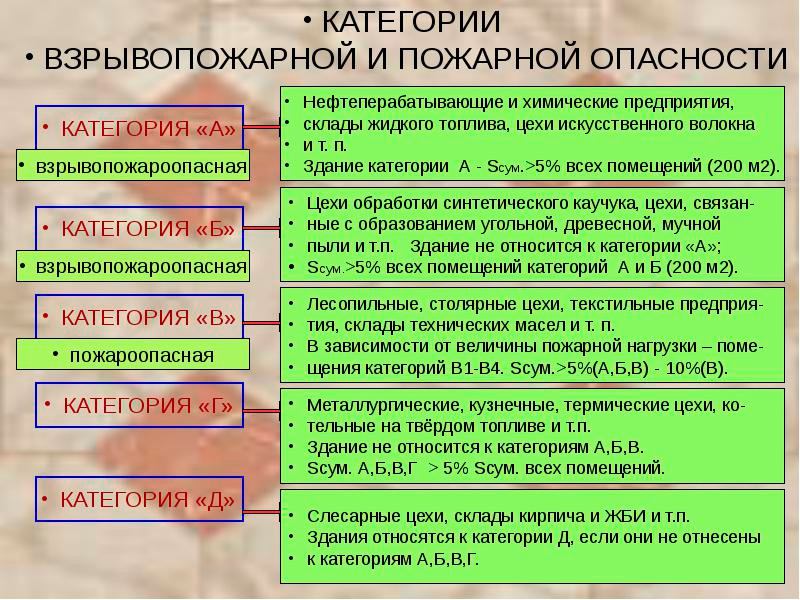
- ventilation chambers (exhaust and supply, which do not serve industrial facilities of categories B and A of fire hazard), boilers, water supply pumping stations and other engineering areas where there are no combustible substances.
What happens?
 The smoke exhaust and ventilation chamber is equipped with automatic fire extinguishing equipment only if the room it serves belongs to category A or B for fire hazard.
We will separately designate how to power the smoke exhaust and ventilation system.
Certainly not an ordinary cable.
And fire resistant.
This is how the cable for smoke exhaust and ventilation systems should be, according to clause 4.1 of SP 6.13130.2009:

fire safety requirements
Administrative objects include both the buildings of the federal, regional (regional), local municipal administration, as well as state, corporate, private enterprises; public, economic organizations and other institutions of a cabinet, office type that are not connected in these buildings with the production of any kind of marketable products, material assets, or the provision of services to the population.
Typical layout of administrative buildings:
- Cellular, in which cabinets (offices) are located on one or both sides of the corridor.
- The corridor, as a rule, ends at both ends of the building with one of the types of evacuation stairs - internal, located in the stairwell, or external, leading down the stairs to the territory adjacent to the building.
- On the ground floor there is usually a vestibule, a wardrobe is located.
- Meeting/meeting rooms are usually located on the first or top floor of an administrative building, with a minimum of 2 emergency exits, including an exit to the outside, made in accordance with the norms.
- Technical, utility, auxiliary premises - from switchboards, ventilation chambers, fire extinguishing pumping stations to warehouses, workshops, as a rule, are located in the basement, basement floor of an administrative building.
- To service multi-storey buildings, freight, passenger, including fire elevators are installed.
Such a layout, the arrangement of administrative buildings allows for a quick evacuation of people in case of fire, especially since employees of organizations located in administrative buildings most often work there for years, they are well aware of the layout, the features of their place of work, and are able to help visitors who find themselves there for the first time.
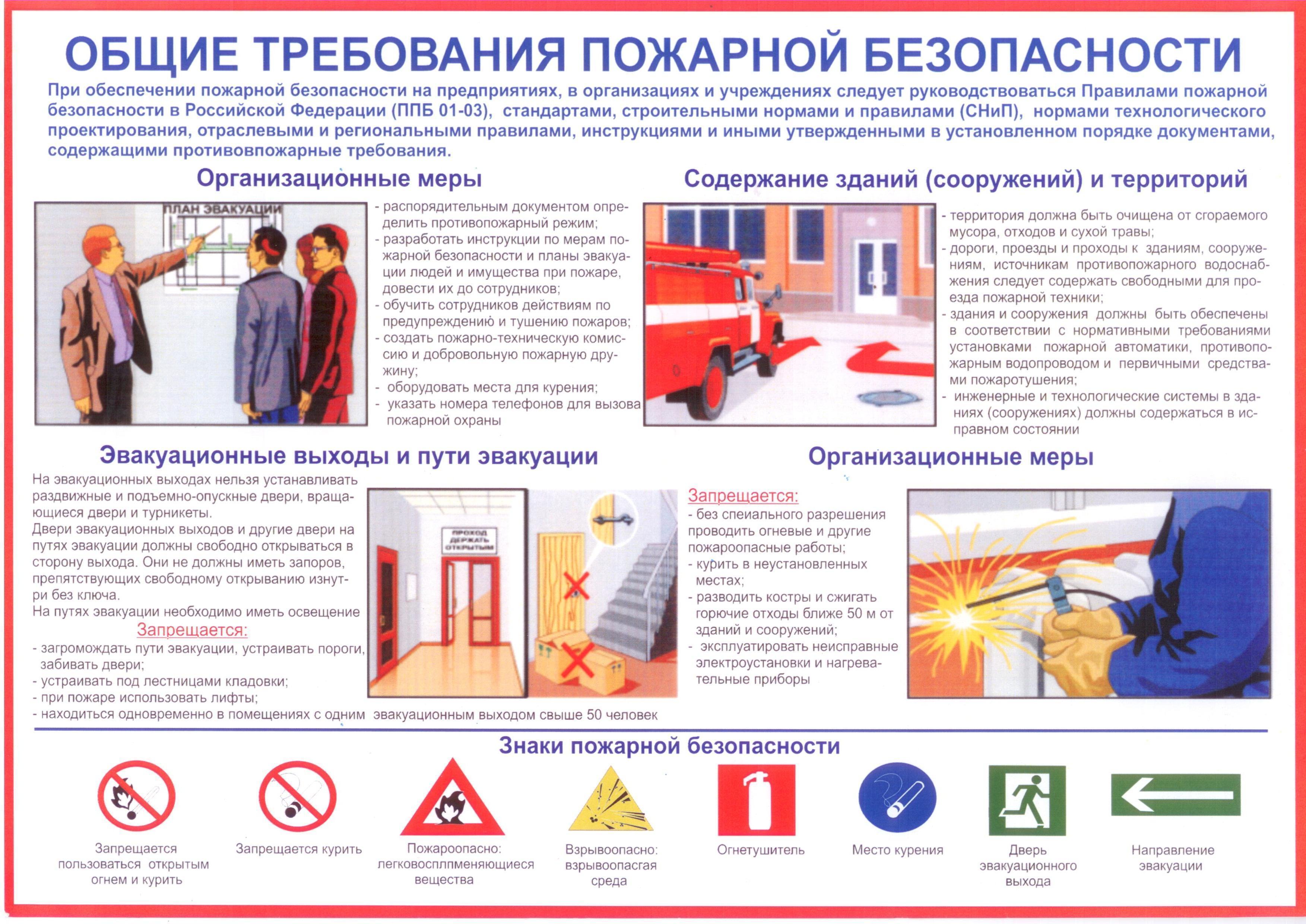
But, for this, it is necessary to strictly comply with the fire safety measures set forth in the Federal Law of the Russian Federation No. 123-FZ "Technical Regulations on the Requirements of PB" and PPR-2012, namely:
- The owner or head of the organization that owns the administrative building must develop a fire safety declaration, which is a form of assessing the fire condition of the facility.
- A complete set of fire safety documents for the facility should be developed and produced, including a general safety instruction, in which, taking into account the specifics of the building, the operating mode of the organization, both the requirements for the organization of the fire regime and the actions of employees in case of fire should be reflected. fire, properly evacuate.
- It is necessary to carry out an accurate calculation of the required number of fire extinguishers, including carbon dioxide extinguishers for extinguishing fires in electrical switchboard rooms, computers, and office equipment.
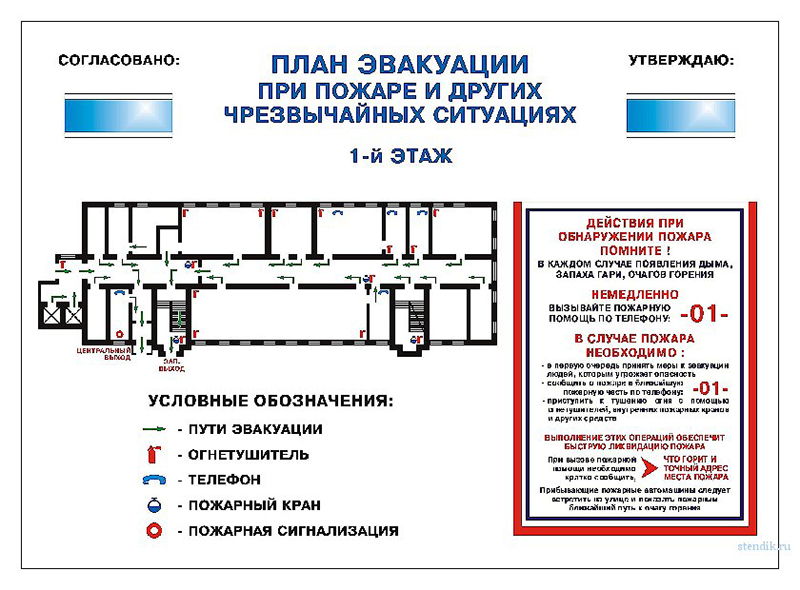
- It is necessary to conduct regular - at least twice a year - training for the practical evacuation of all employees, technical personnel from the administrative building, organized on the basis of instructions for actions in case of fire; existing fire evacuation plans hung on all floors.

Primary fire fighting equipment
Violations of fire safety requirements in administrative buildings are typical, as a rule:
- smoking outside designated areas;
- leaving included in the network after the end of the work of various electrical equipment - from computer office equipment to heating appliances;
- redevelopment of premises, which complicates evacuation, narrowing the standard width of passages; or completely cutting off the opportunity to use two exits;
- blockage, littering of passages, stairwells of emergency evacuation exits from the building, furniture, office equipment that have served their time; stacks of documentation that could not find a place in the archive;
- closed exit doors, without equipping them with fire-fighting fittings, including fire-fighting door handles, which allow them to be opened from the inside without the presence of keys, as they say, with one movement.
However, with proper performance by those responsible for the fire safety of the administrative building of their duties, timely informing the management, these problems can be solved, and without significant costs.If the building complies with the basic requirements of the standards, then neither the check of the Russian Emergencies Ministry, nor the fire that has arisen, most likely, will not be able to lead to significant unpleasant consequences.




Construction requirements for ventilation chambers
For convenience, we will divide the construction requirements for ventilation chambers into requirements for the microclimate, for the placement of these rooms in the building, as well as requirements for walls, floors and doors.
Temperature and air exchange in the ventilation chamber
According to table 11 of SNB 3.02.03-03 "Administrative and domestic buildings", the temperature during the cold period of time:
- in the supply ventilation chamber +16°С
- in the exhaust ventilation chamber +16°C or not standardized.
Modern ventilation chambers do not require the constant presence of a person, so maintaining comfortable conditions for a person in them is not necessary. However, in such rooms, automation panels are installed that have a certain operating temperature range. In addition, there is water in the supply ventilation chambers, so there should not be negative temperatures in the room.
As for the ventilation of ventilation chambers, in the now obsolete SNiP 2.04.05-91 * in the section "Premises for equipment" there was a requirement to ensure air exchange:
- In the supply ventilation chambers: the air exchange rate for the inflow is at least 2
- In exhaust ventilation chambers: the air exchange rate in the exhaust hood is at least 1.
Placement of ventilation chambers
Ventilation chambers are among the technical rooms inside which equipment is installed that emits such harmful factors as noise and vibration. That is why ventilation chambers must not be installed in rooms adjacent to residential, hotel and hospital premises.
It is not recommended to arrange them in rooms adjacent to office premises.There is no direct ban on this, but there is an indirect ban - through limiting the noise level. Thus, adjacent placement is possible with appropriate sound insulation of the common wall. In practice, this solution is recommended to be avoided.
Floors and ladder in the ventilation chamber
The floors in the ventilation chamber are made of concrete with horizontal alignment. Additional requirements for floor evenness may be provided for in the installation instructions for ventilation equipment.
When designing ventilation units, their weight should be taken into account. However, ventilation engineers do not perform the calculation of the bearing capacity of floors. As part of the project, they prepare a construction task, where they indicate the installation location of the ventilation units, their weight and give references to the support points. On the basis of such a task, the architects conclude that it is necessary to strengthen the floors.
Ventilation chambers with ventilation units, which provide sections for water heating or cooling, humidification or dehumidification, must have non-slip floors and drainage grates built into them, the so-called ladder (see Figure 2), with a slope of the floor surface towards these gratings.
Figure 2. The device of the ladder in the floor of the ventilation chamber
Requirements for walls in the ventilation chamber
A number of requirements for the walls of the ventilation chamber are contained in SNiP 41-01-2003 "Heating, ventilation and air conditioning" (section 13), but it was not included in the updated version of this standard (SP 60.13330.2012). However, these provisions can be followed as a recommendation.
In particular, the fire resistance of walls ventilation chambers should be:
- not lower than REI45 when the ventilation chamber is located in the same fire compartment as the serviced premises
- not lower than REI150 when the ventilation chamber is located in a different fire compartment than the serviced premises
Walls must be load-bearing and not partitions. If the room adjacent to the ventilation chamber is an office or another with a permanent stay of people (which is not recommended), then the walls of the ventilation chamber must be covered with noise protection.
Requirements for ventilation chamber doors
Fire resistance of doors in ventilation chambers must be at least EI30. Doors are recommended to be used with self-closing devices and seals to protect external rooms from noise (see figure 3). The entrance to the ventilation chamber should be limited to a narrow circle of people - engineers for the operation of engineering systems.
Figure 3. An example of a door to a ventilation chamber.
The height of the premises is not less than 2.2 meters, the width of the passages is not less than 0.7 meters. The bearing capacity of the ceiling must withstand the weight of all installed ventilation equipment with a margin. In the enclosing structures, installation openings should be provided for bringing in and taking out large-sized equipment in accordance with the dimensions of this equipment. In this regard, the doors to the ventilation chambers often provide double doors with an opening width of at least 1200 millimeters.




Calculation of ventilation systems
The calculation of the ventilation of the room at the first stage requires the correct choice of equipment that will have the necessary performance characteristics regarding the amount of air driven (cubic meters / hour).
It is also considered very important to consider such a parameter as the frequency of air exchange. It characterizes the number of complete air changes during one hour inside the building.
In order to correctly determine this parameter, it is necessary to take into account the norms and rules of construction. The multiplicity depends on the purpose of using the premises, what is in it, how many people, etc.Calculation of ventilation of industrial premises for this indicator also involves taking into account the equipment, as well as the features of its operation and the amount of heat or moisture that it emits.
For premises intended for human habitation, the air exchange rate is 1, and for industrial premises up to 3
The calculation of the ventilation of industrial premises for this indicator also involves taking into account the equipment, as well as the features of its operation and the amount of heat or moisture that it emits. For premises intended for human habitation, the air exchange rate is 1, and for industrial premises up to 3.
The brevity measures form a performance value, which can be as follows:
- from 100 to 800 m³/h (apartment);
- from 1000 to 2000 m³/h (house);
- from 1000-10000 m³/h (office).
Also, it is necessary to properly design and install air distributors. These include special air distributors, air ducts, turns, adapters, and so on.
Ensuring reliable and proper ventilation is an extremely important and necessary system in any building.
Escape routes
Let's start with fire safety requirements for evacuation routes for public buildings and industrial facilities
They are designated in the Federal Law of 2008 under number 123, where three main requirements are most often paid attention to:
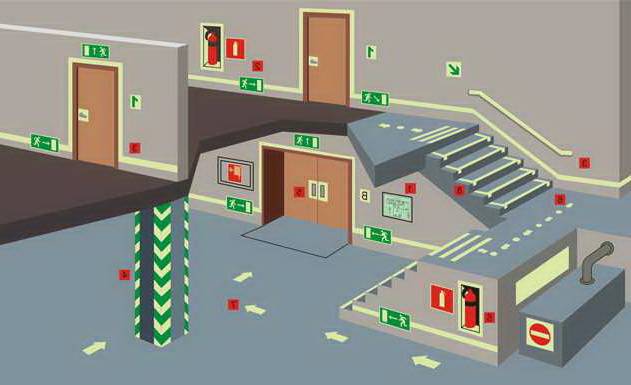
- Evacuation routes and exits from buildings should ensure the unhindered and quick exit of people in the process of a fire.
- Their design is not associated with the installation of fire extinguishing equipment.
- Evacuation exits are considered to be those that are directly connected to the street.
The last requirement applies to the first floors of any buildings.This takes into account exits directly to the street or through the corridor, through stairs, halls and lobbies. If these are rooms not on the first floor, then the exits include any doors leading to the corridor leading to the first floor, doors on located along the outer walls of the building. This also includes exits to the roof, lobbies and halls.
The fire safety rules stipulate another option that is related to production shops. It says that evacuation routes can be laid through adjacent workshops if they have direct access to the street. That is, the evacuation route is laid along the minimum path to the street, regardless of the location of the premises. In this case, the path must always be free.
But there is one remark that concerns the doors. If hinged doors are installed on the passage openings, then they are not an obstacle. This applies not only to doors through which people pass, but also to openings for road and rail transport. Only in this case we are not talking about doors, but about gates.
There are certain prohibitions, they are categorical, which concern the doors at the exits. This is the question of what is prohibited on the tracks.
The structures of doors and gates belonging to the category of retractable, sliding, sectional and roll-up are restrictive elements. That is, they limit the permeability
Therefore, it is very important that such structures can be easily dismantled if it becomes necessary to increase the permeability through them. This is not specified in the above rules (No. 123)
But this must be taken into account.
Elevators and escalators should not be considered elements of escape routes. A separate position is the subway escalators or mine elevators, operating both in operating mode and in emergency. About the latest equipment are supplied with special monitoring and control systems.
Rooftop routes cannot be designed unless they are operational.


Much attention in the fire safety rules is given to the evacuation of people from underground floors and structures. There are two main positions that you need to pay attention to when organizing exits from such premises.
- Exits from the underground or basement floors to the street should be separate from the entrance door to the entrance of the building. In some special cases, output merging is allowed.
- You can organize one common vestibule, but it will have to be divided by a fire wall, the main purpose of which is to divide the human flow from the building and from the basement into two parts so that they do not mix and interfere with each other when leaving.
Supply valves
The installation of window openings is relevant only in cases where oxygen is provided to a room or apartment. If the need for clean air is of a higher order (as is the case with an office, kitchen or a large country cottage), it is more efficient to use wall supply valves. Modern models are equipped with integrated heaters for heating the supply masses entering the apartment.
Efficient ventilation for the apartment is provided by installing flexible angle valves. For rooms with a high load, direct-flow channels and products are best suited. Often they are combined with filters and even oxygen humidifiers. They operate around the clock.
Fire-fighting engineering support
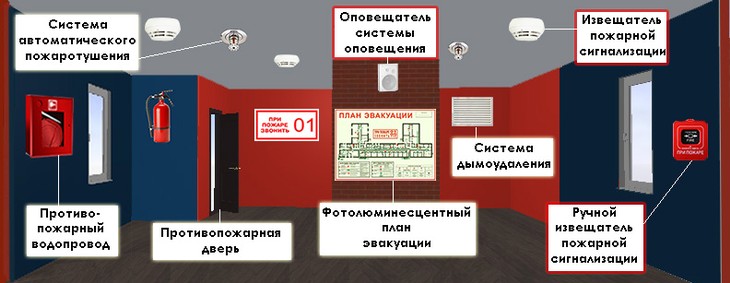
Any operated administrative building, as well as each of its fire compartments, when dividing objects of a large area with fire partitions, walls with fire doors, curtains, windows, hatches installed in their openings, according to the requirements of the standards, must be protected by a complex of engineering and technical equipment for automatic fire protection:
Alarm installations, mainly using smoke detectors, which effectively detect fires of all types of fire load, typical for the main compartments of administrative buildings, but for individual rooms it is also permissible to use heat fire detectors of the maximum or maximum differential type.
Stationary fire extinguishing systems. Most of the premises are protected by water fire extinguishing installations, with sprinklers installed on the distributing pipelines, less often deluge sprinklers
To protect server rooms, archives with especially important documentation, information carriers, gas or powder fire extinguishing systems are also used, which practically do not harm the protected values.
As part of the smoke protection of the building, which is extremely important for the organization of safe evacuation, in addition to fire barriers and filling their openings, smoke exhaust systems, clean air supply, fire dampers, fire ventilation grilles installed on the ventilation system ducts of the building are also used.
And also, depending on the architectural, volumetric solutions of the administrative building, smoke exhaust skylights, fire transoms are used, which allow in a short time to remove from the premises a huge amount of volatile toxic combustion products of organic finishing materials, furnishings, property.
To notify employees, visitors, manage evacuation flows of people, the administrative building must be equipped with light panels, signs; speech, sound fire detectors; as well as a microphone console, means of recording, reproducing alarm messages installed in the premises of the fire post, security or control room.
In order for all equipment, components of fire-fighting systems, installations of the administrative building to be constantly in working condition, and if necessary, they are promptly repaired, it is necessary to conclude contracts with specialized enterprises that provide technical services on the basis of licenses issued by the Russian Emergencies Ministry.
Alarm in the ventilation chamber
I must say right away that here, again, everything will depend on the fire hazard category of the type of object served by the ventilation chamber.
Let's turn again to SP 5.13130.2009, Appendix A of this SP and paragraph A.10, which lists in Table A.3 the buildings and technical devices that need to be protected by substation installations.
According to column 13 of this table, ventilation chambers are equipped with a fire alarm, regardless of their area.
In addition to cameras, this list includes telephone, television stations, communication centers, transformer substations, etc.  It turns out that a fire alarm in the ventilation chamber is necessary.
All right.
But for what types of premises?
Only for such facilities, according to this provision, you are required to install the PS system.
If the room served by the ventilation chamber has a different appearance, then you do not need to protect the ventilation chamber with a fire alarm.
As for the installation location of the alarm system, the control device is usually placed in the control room or security room.
 It is recommended that fire alarm control devices be located in such a way that access to them is provided even in fire conditions.