- Stages of wastewater filtration
- Project preparation
- How the filter fields should be placed
- Example of calculating the length of irrigation pipes
- How to make a filtration well
- Option number 1 - brick structure
- Option number 2 - construction of concrete rings
- Option number 3 - a well from old tires
- Option number 4 - plastic filter containers
- Are there other solutions
- How to arrange a filter field
- Features of installation of a treatment plant
- Arrangement of filtration fields with infiltrators (drainage tunnels)
- What is a filter field and how to organize it correctly
- What is a filter field
- Basic requirements for the organization of the drainage system
- Types of infiltrators for a septic tank
- Filtration field (example for loam)
- Underground drain for septic tank
- Filter fields - dimensions
- Distance from underground filtration fields to residential buildings, wells, wells, etc.
- Wastewater Filtration Field Installation System
Stages of wastewater filtration
Wastewater filtration is carried out in stages. Consider these processes:
- First, the liquid settles (in the first section). The membrane partition of the septic tank does not allow foam and accumulated gases to penetrate further into the system.
- The effluent that continues to flow leads to pressure on the already existing liquid, as a result of which that part of it that has undergone primary treatment is poured into the second zone of the septic tank. Under the influence of reagents, impurities are split.
- Further, in the following zones, suspended impurities obtained after a chemical reaction with reagents precipitate, and purified water then goes through pipes to a distribution well.
 Bacteria for a septic tank
To increase the efficiency of the septic tank, agents containing anaerobic bacteria are added to it. The essence of their action is that they split the thick drains contained in the septic tank and prevent them from forming sludge.
Without fail, the septic tank must have a hatch. Since anaerobic bacteria are not 100% effective, undissolved particles will remain inside the septic tank anyway, and a manhole will be needed in order to pump these particles through it. It is necessary that the hatch has the possibility of a safe access to the sewer. At the same time, the hatch must be tightly closed, otherwise, if large insoluble residues or a large amount of water after heavy rains, as well as toxic impurities get into it, the life of the septic tank and drainage can be significantly reduced, as a result of which the causes of clogging can become more serious .
Project preparation
How the filter fields should be placed
When drafting filter fields, there are a number of important points to consider:
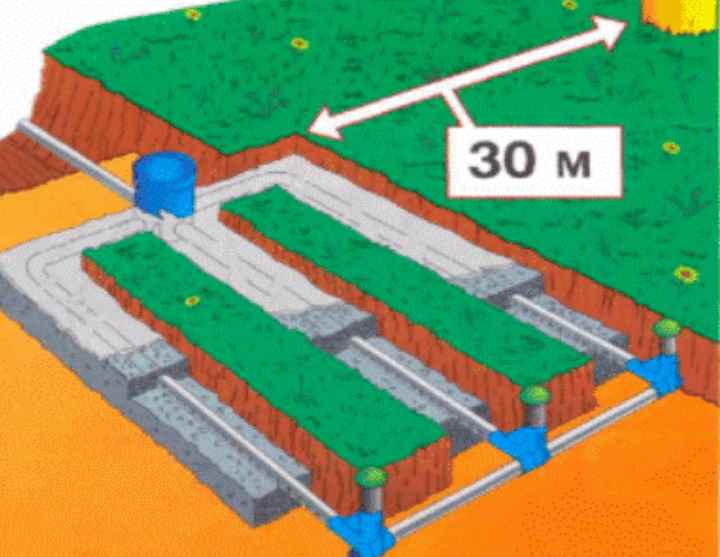
Particular attention is paid to the choice of the place where the filtration fields will be: it should be located at the maximum possible distance from the place of water intake and the placement of fruit-bearing trees and shrubs.Otherwise, harmful substances from which the filtration field is cleaned may end up in the soil and have a dangerous effect on the quality of water, fruits and berries.
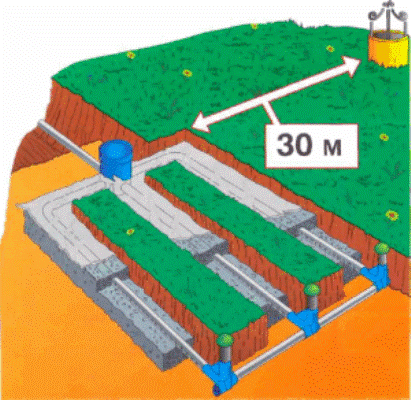
The distance from the filtration field to the water intake point is at least 30 m
- The drainage system functions normally for no more than 7 years, therefore, after the expiration of this period, it must be dug up to carry out cleaning, as well as a complete replacement of the layer of rubble, sand and soil that act as a filter layer.
- The calculation of the filtration field must necessarily be accompanied by the fact that the sand layer must lie at a depth to which freezing does not reach. Otherwise, at low sub-zero temperatures in winter, the filtration fields will not perform their functions properly.
Example of calculating the length of irrigation pipes
For example, we can consider the features of the filtration field, which is necessary for a septic tank, in the arrangement of which concrete rings are used.
Condition:
- soil is sandy
- septic tank performance -1 cu. m/day,
- groundwater lies at a depth of 2 meters.
Task: calculate how long irrigation pipes are required for a septic tank under these conditions.
Solution:
- In addition to determining the type of soil, as well as the level of groundwater, it is necessary to find out the average annual temperature in the area. Using statistical data, determine the average annual temperature in a particular area. For example, for the Moscow region, this figure is approximately 3ºC.
- According to the table compiled by specialists, it is determined that with a 2-meter occurrence of groundwater and an average annual temperature of less than 6ºC, the load that will be carried out per 1 m of the pipe will be equal to 20.
- Therefore, for a septic tank that consumes 1 cubic meter. m (1 thousand sq.k) liquid, filtration field equipment with an irrigation pipe length of 50 m (1000:20) will be required.
- The load on the pipe, taking into account the soil bedding, is taken with a coefficient from 1.2 to 1.5.
Conclusion:
The length of irrigation pipes in the presence of bedding under such conditions should be 41.7 m (50:1.2).
How to make a filtration well
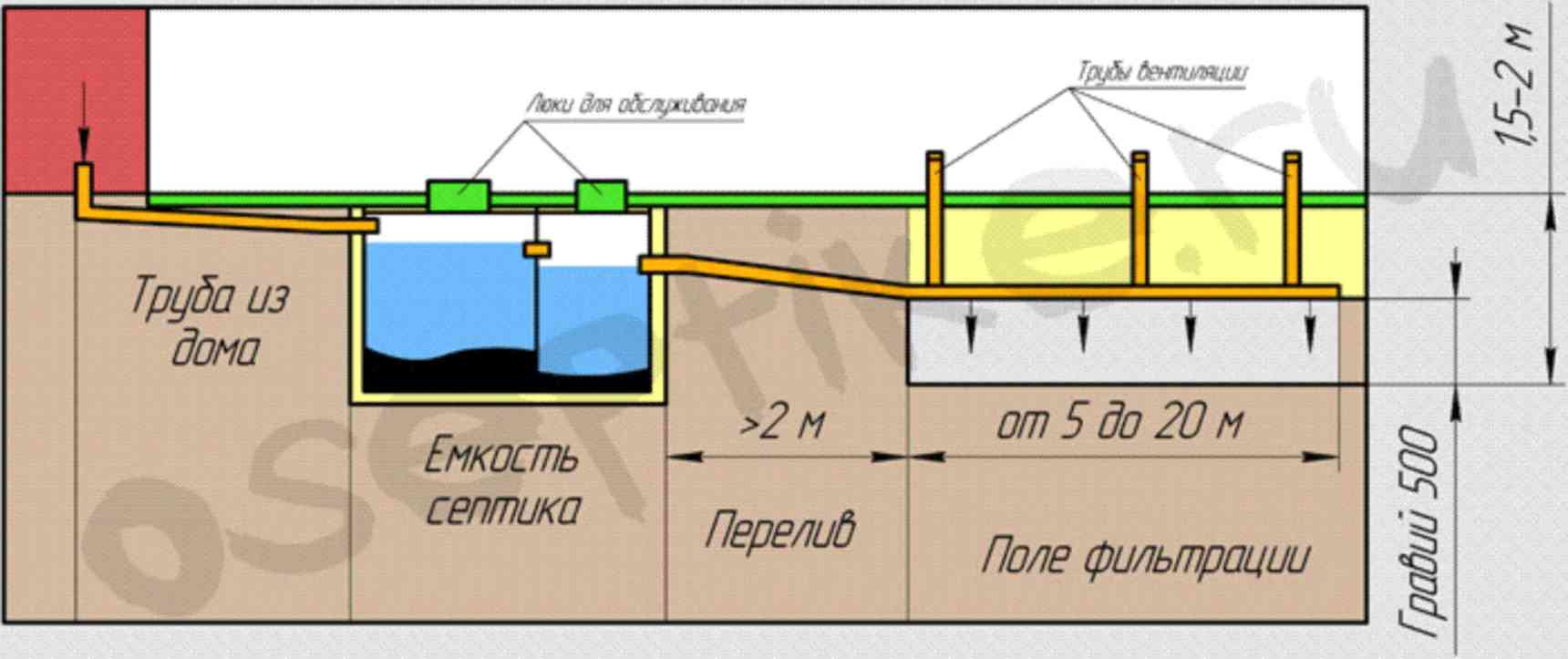
Absorption wells can be built from baked bricks or rubble, but their construction requires considerable effort. Therefore, more often the walls of the well are made of reinforced concrete rings. Today, plastic structures are also widely used. You can make them yourself from plastic pipes or buy ready-made ones.



Option number 1 - brick structure
The brick structure can be either round or square. Usually round wells are built, which are most convenient to use. The structure for filtering sewage should be deepened into the ground by 2.5 meters, with a diameter of not more than 2 x 2 meters.
The pit is dug in such a way that between the ground and the outer walls of the well there will be a layer of crushed stone, gravel or broken bricks up to 40 cm thick. The height of the backfill is one meter. The walls at the level of the filter must be water-permeable.
To do this, at a height of one meter, the masonry is not made solid, but with small holes ranging in size from 2 to 5 cm. They must be staggered. After the construction of the structure, crushed stone or gravel is poured into the crack.
During the construction of the well, it is necessary to make slots in the masonry for the exit of purified water into the ground
At the bottom of the structure, a filter layer of crushed stone or gravel is backfilled to a height of one meter. In this case, large fractions of the material are placed below, small ones - above.The hole for the pipe through which the effluents from the septic tank will flow is made in such a way that water flows in a stream from a height of 40-60 cm.
A plastic sheet must be laid in the place where water flows to prevent the filter from washing out. From above, the structure is closed with a lid or hatch with a diameter of 70 cm. It is also necessary to make a ventilation pipe with a cross section of 10 cm in the well. It should rise 50-70 cm above the ground.
You will find step-by-step instructions for building a brick drain pit in this material.
Option number 2 - construction of concrete rings
For the installation of a filtration well, three reinforced concrete rings will be needed. One of them should have holes with a diameter of about 5 cm. You can buy a perforated ring or make holes with a concrete crown. You also need to make a hole for the intake pipe.
The photo shows and describes in detail the process of installing concrete rings for arranging a well
It is necessary to dig a pit, the width of which is 40 cm larger than the diameter of the ring. The perforated ring is installed at the bottom of the structure. You can not dig a hole, but only slightly deepen the site on which it is supposed to make a well.
Put the first ring on the ground and choose the ground from the inside. Gradually, it will sink under the weight of its weight. The two upper rings are installed in the same way.
After that, you need to make a bottom filter from crushed stone or gravel up to one meter high and fill the outer walls of the well with the same material to the level of the filter layer. The hatch and ventilation pipe are installed in the same way as in a brick well.
Another option for arranging a septic tank from concrete rings can be read here.
Option number 3 - a well from old tires
The most inexpensive way to make a filter well is to make one from used tires. This design can filter the sewage of a family of three. Basically, such a well is made in suburban areas, since in winter the rubber freezes and the vital activity of bacteria slows down, and at very low temperatures it stops altogether.
The well is made very simply - the tires are installed one on top of the other and fastened together with plastic clamps. Joints are coated with sealant. All other structural elements are made in the same order as in wells made of other materials.
Scheme of installation of an absorption well from old car tires. The number of tires is calculated based on their size and the required depth of the well
Option number 4 - plastic filter containers
For example, the Russian company POLEX-FC, whose products received good consumer ratings. Filter wells are produced in different volumes (from 1200x1500 to 2000x3000 mm), which allows you to choose a product based on the daily water consumption in an individual household.
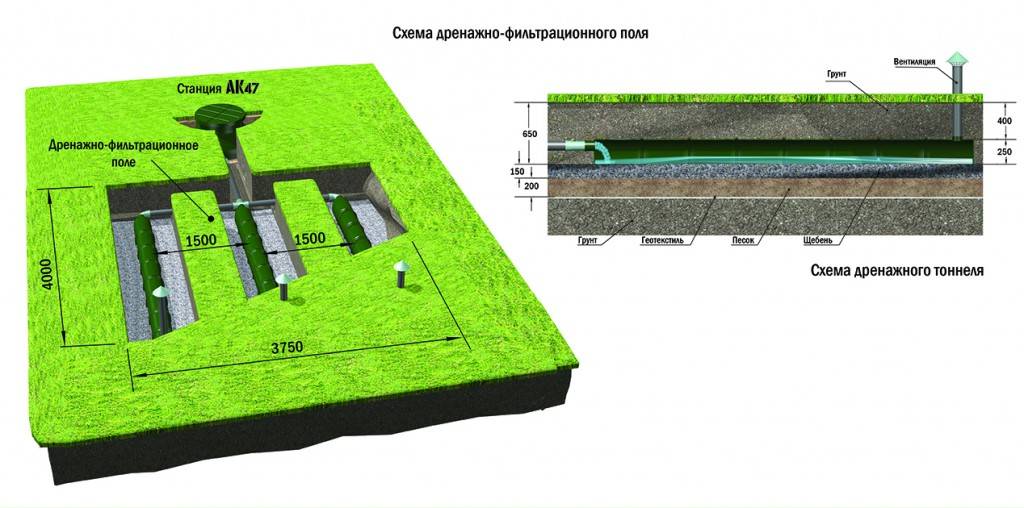


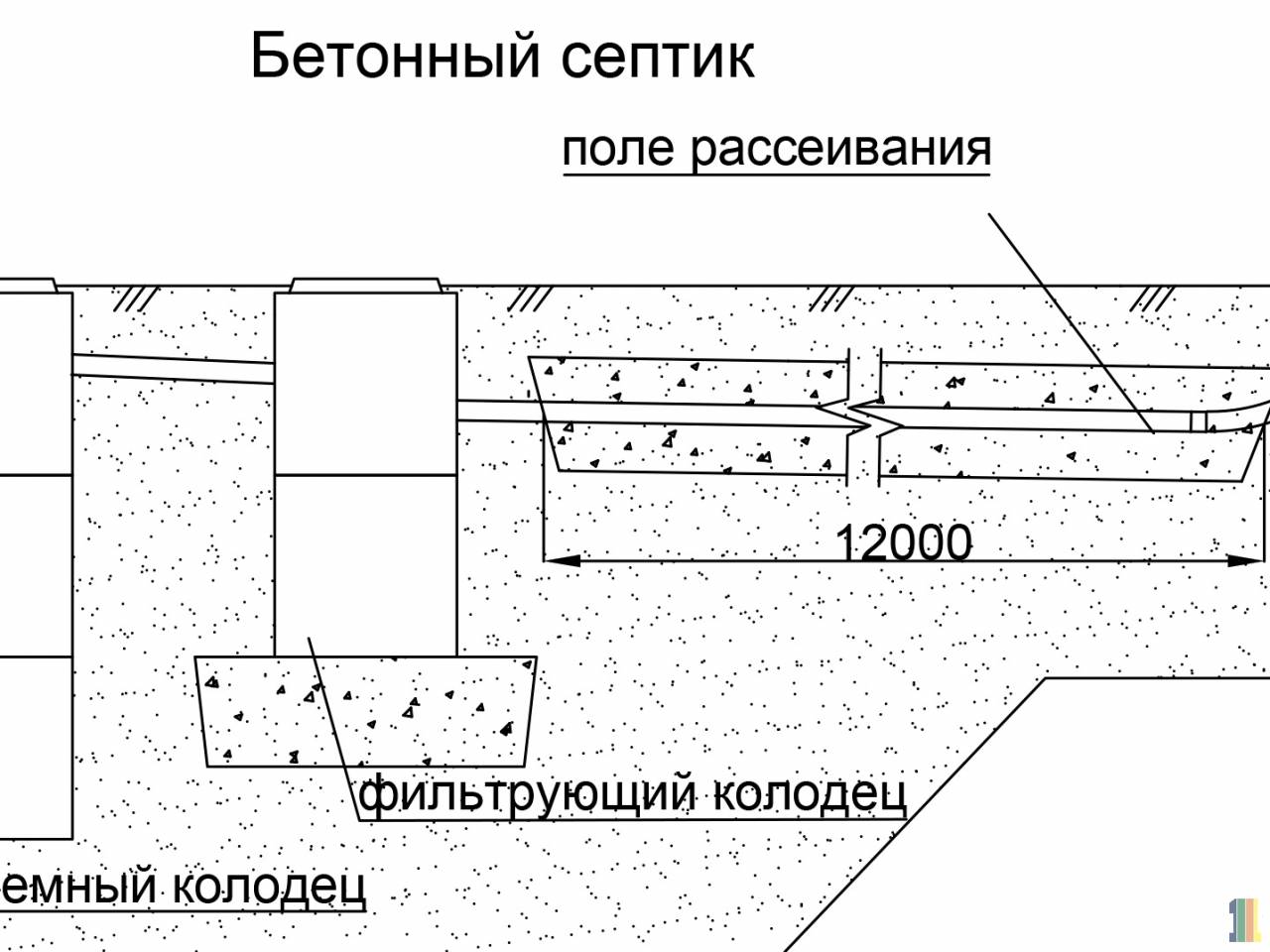
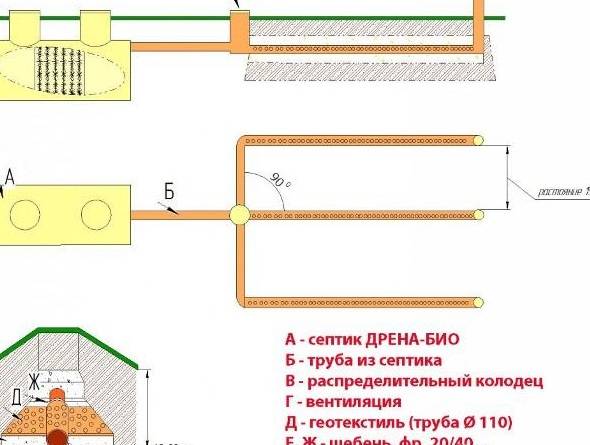

Tanks are made of corrosion-resistant durable plastic, shaft walls are made of primary polyethylene. The lower compartment of the tank is covered with biofilm and filled with a filter layer of crushed stone, gravel and slag.
A plastic filter well with a three-stage filtration system provides effective water purification from impurities
Are there other solutions
Not everyone can use the filtration field as a way of post-treatment of sewage.What should those who own a piece of clay soil or build a house in an area with a high level of groundwater do?
The most effective way is to purchase SBO, which does not require further processing of the liquid.
Scheme of the biological treatment plant. After passing through several tanks equipped with aerators, airlifts and filters, the water becomes 98% pure. The main function of waste processing, as in septic tanks, is performed by anaerobic and aerobic bacteria (+)
The second way out is to create a sewer system with a filter well, but a number of conditions are also required for its installation (for example, non-clay soil and the location of groundwater a meter below the conditional bottom of the well). If you simply install a septic tank without additional treatment, insufficiently clarified and disinfected water will enter the soil and an unpleasant odor may appear.
How to arrange a filter field
The parameters for arranging the filtration field should be determined depending on the type of soil and how suitable it is for self-cleaning. The sequence for arranging a filtration field for a septic tank will be as follows:
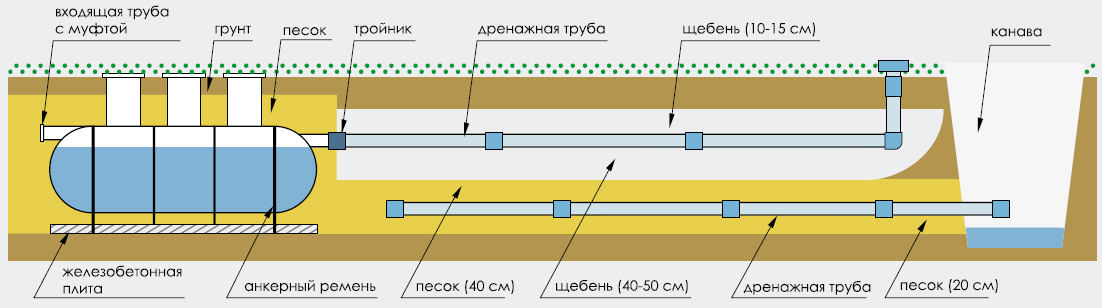
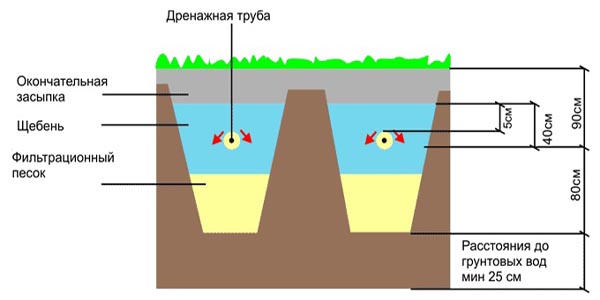
- Dig a trench and fill the bottom with clean sand. The layer thickness should be approximately 10 cm.
- A layer of crushed stone with a fraction of 20-40 mm should be poured on top of the arranged sand cushion. The crushed stone layer should have a thickness of about 35 cm.
- Now a drain is laid on the crushed stone layer and again it is covered with crushed stone from above. Geotextiles are laid on top of a layer of crushed stone 10 cm thick - this will protect the system from silting.
- After that, the trench is covered with a layer of soil.
Filtration field in the drainage system for a septic tank
Features of installation of a treatment plant
Do-it-yourself installation of a septic tank is quite easy.However, there are individual features of the installation of equipment. They must be taken into account when designing an autonomous sewage system for a private house. These nuances include:
- distance to a residential building, water source, green spaces;
- type of soil;
- ground water level;
- territory landscape.
During the installation of the cleaning system, it is necessary to comply with the general sanitary standards and building regulations reflected in the relevant documents. Soil post-treatment is used to achieve 100% effluent utilization. This process is carried out by passing 75% purified wastewater in a septic tank through a layer of rubble. In connection with this feature of the installation, the following common installation schemes exist:
- Installation of a septic tank with pipes for drainage. This is a classic version of the wiring diagram. It is used when the soil on the site is characterized by normal absorbency. When implementing this option, a filtration field is arranged on a private territory. Its area must be at least 30 m2. Therefore, filtration fields are arranged exclusively in large areas.
- Installation of a septic tank with an infiltrator. This is an alternative to drainage pipes. You can implement such a wiring diagram in a small area. In most cases, together with the Tank septic tank, an infiltrator is installed, which has the same volume as the local treatment tank. For example, if the Triton 400 is being installed, which is a tank without a bottom with a capacity of 400 liters, then it is not necessary to lay drainage pipes with a length of approximately 36 m.
- Installation of a septic tank with a filtration well. This wiring diagram is usually used on sandy soils with low water levels in the soil.In some cases, the filtration well is able to fully replace the filtration field. Its arrangement allows to significantly reduce the area of the treatment system.
- The device of a septic tank with an infiltration tank and an intermediate well, which is created in areas with high groundwater. Purified up to 75% wastewater moves by gravity into the well. Then, by using a pump unit with a float, they are pumped into the infiltrator. From the tank, wastewater is gradually absorbed into the soil.
Do-it-yourself installation of a local treatment tank is more convenient to perform with an industrially manufactured infiltrator. The use of structures without a bottom on the site allows you to quickly equip an autonomous sewage system. The design feature of the infiltrator is strong walls with stiffeners. At the end of the elongated tank there is an outlet pipe. It uses to connect the ventilation pipe or the required number of other similar modules. On the site, you can also use a septic tank model without an outlet pipe. This version of the device is equipped with a ventilation hole in the upper part. In addition, there is also an inlet pipe at the end of the tank. With its help, the tank is connected to the septic tank "Tank".
Effluent is filtered through a special layer, which consists of sand and gravel. It is on such a pillow that the container is mounted. The filter layer allows you to remove the remaining particles of contaminants from the drains. Impurities settle on it, and already purified water enters the soil. It can even be used for technical needs.
Arrangement of filtration fields with infiltrators (drainage tunnels)
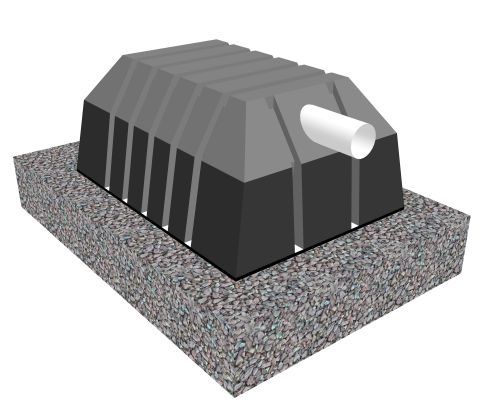
Also, to supply wastewater to crushed stone, you can use infiltrators, or as they are also called drainage tunnels. The use of these structures is due to the following advantages:
- Reducing labor costs and material consumption
- Reducing the volume of earthworks
- Reducing the area of the filter field
Infiltrators. also installed on a base of crushed stone, at least 20 cm thick. And then they are covered with soil or sand. When using drainage blocks in filtration fields, when calculating the load of wastewater on structures, a multiplying factor of 1.5 - 1.6 is applied, that is, the area of the filtration field becomes smaller than when using irrigation pipes.
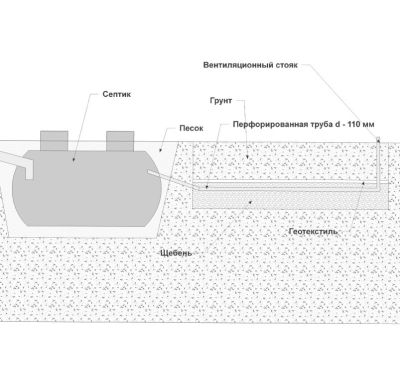
For the inflow of oxygen to underground filtration facilities, it is necessary to make ventilation risers, from a pipe d - 110 mm, rising 0.5 meters above the ground.
The sanitary protection zone from the filtration field is 15 meters.
What is a filter field and how to organize it correctly
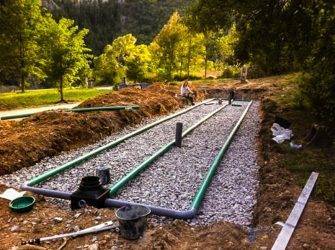
Even at the stage of planning the purchase and installation of a septic tank, it is worth thinking about creating a wastewater treatment system, one of which is a filtration field.
What is a filter field
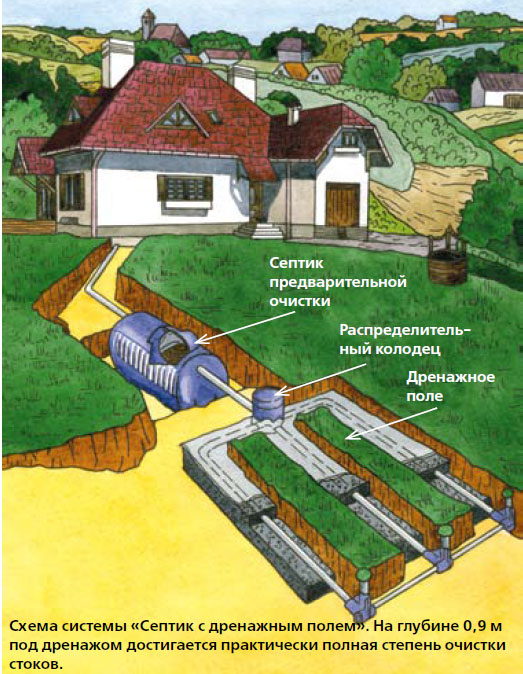
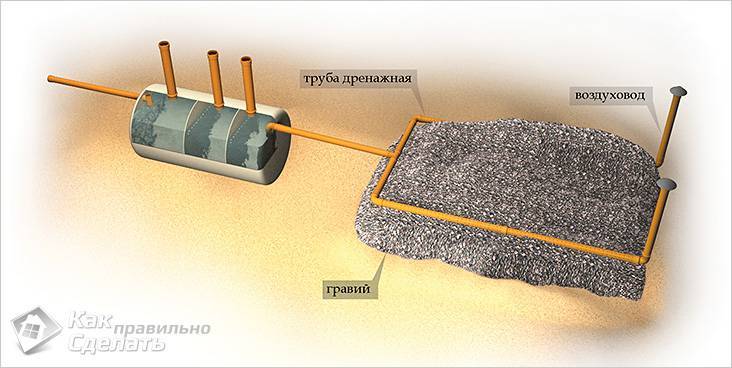
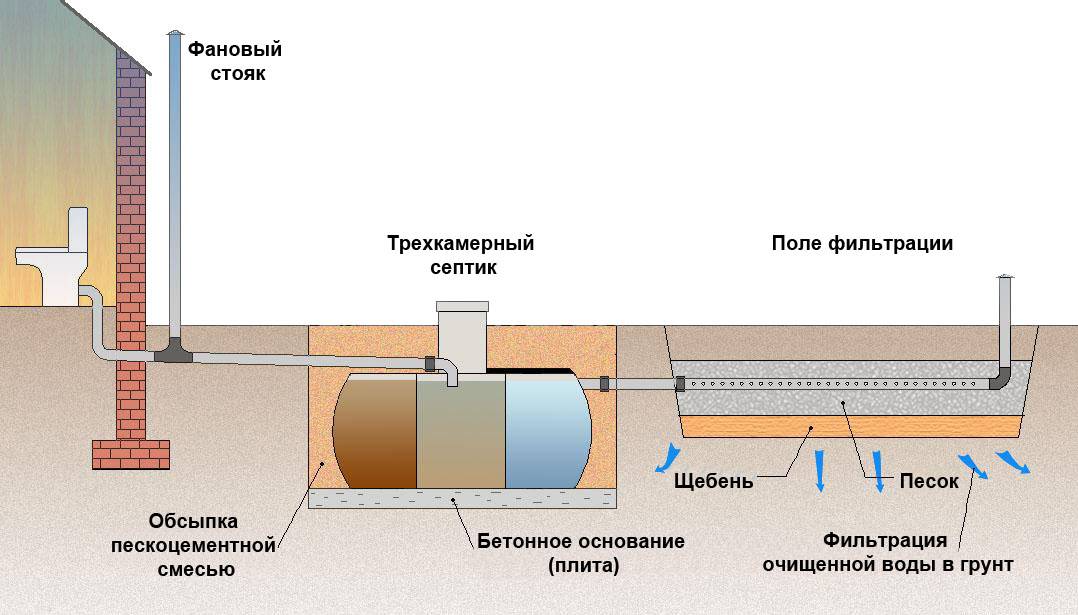
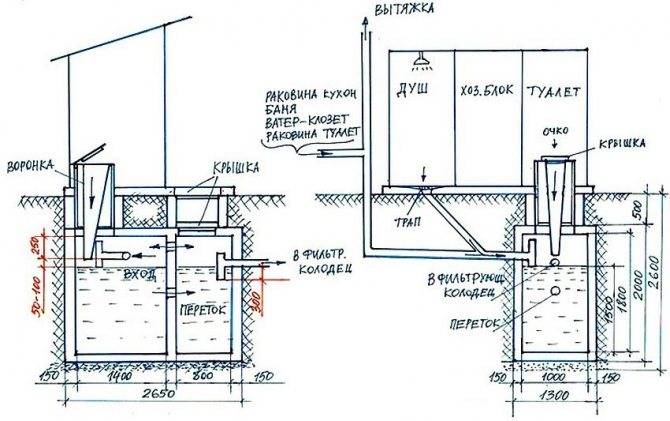
Filtration field (underground drainage, dispersion field) is a type of water treatment facility, a specially allocated and equipped piece of land on which biological wastewater treatment is carried out by filtering it through a layer of soil. Here is a picture that clearly shows this drainage country septic tank.


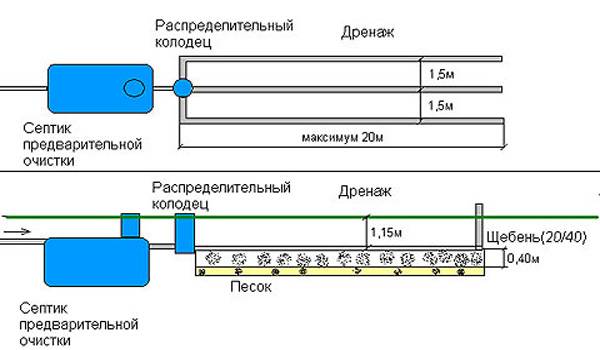


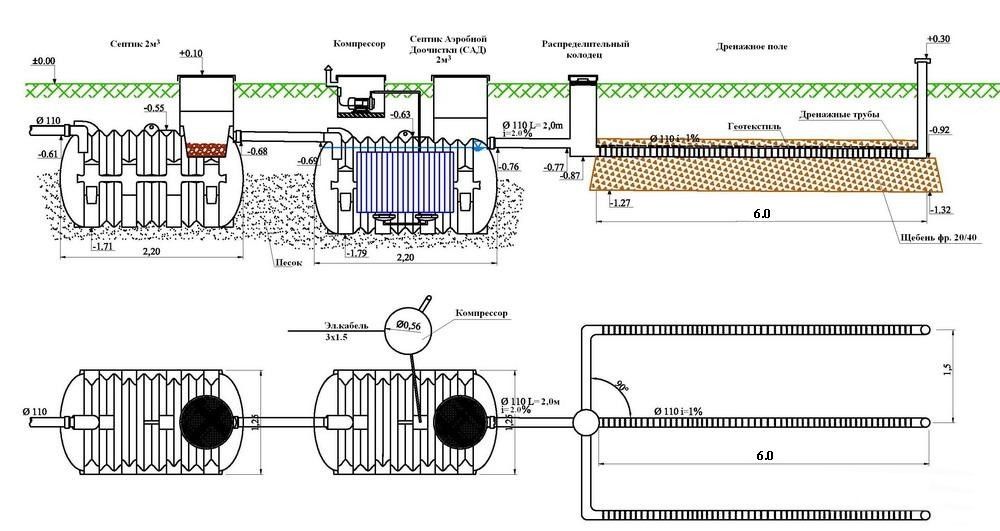
In a nutshell, such an infiltrator for a country septic tank is a system of irrigation spray pipes and drainage ditches that are placed underground.Here is the diagram of the filtration field: 1-inlet pipe, 2-septic tank, 3-distribution pipe, 4-dispersion pipe.
Basic requirements for the organization of the drainage system
For the effective functioning of the infiltrator for a septic tank, it is necessary to know and take into account the following nuances:
- Ground water level (GWL): high (0.5 meters from ground level), low (3 m from ground level) or variable, which fluctuates depending on the season.
- Also, when choosing a filtration system, the composition of the soil is determined - sand, clay, loam or peat.
The combination of these two factors for Moscow and the Moscow region mainly gives the following result - a high groundwater level (80% of the territory) and various types of soil. In this case, as well as with low GWL and clay or loamy soils, as practice shows, the field of closed filtration has become the best solution.
- With a daily volume of wastewater up to 0.3 cubic meters, filtering wells are usually used, in other cases - a filtration field.
- The recommended sanitary protection zone from the house to the ground filtration fields is 5-10 meters.
- The size of the filtration field is determined by dividing the daily volume of clarified water by the water absorption of 1 m² of soil.
- Irrigation pipes are laid slightly above the groundwater level, according to clause 3.44 of MDS 40-2.2000, the distance from the ground surface to the upper part of the pipeline is 0.3-0.6 m.
- The drainage pipeline Ø100 mm is supplemented with holes Ø 5 mm, which are drilled in a checkerboard pattern at an angle of 60 ° to the vertical every 50 mm. (clause 3.36 MDS 40-2.2000)
Types of infiltrators for a septic tank
There are many options for clarified water treatment systems:
For sandy or peat soil, as well as variable GWL - a plastic well 400 mm, with which wastewater will be drained,
With high and variable GWL, sand, peat or loam - a well made of concrete rings,
For low GWL and soil types such as sand and peat - buried drainage under a septic tank,
With low and variable GWL, sand, loam or peat - a well made of concrete rings for drainage by gravity.
Filtration field (example for loam)
A trench is dug, which is filled with a filter layer of gravel or expanded clay.
Next, a polypropylene fabric is laid - pipes with holes are placed in it (placement depth - no more than 60 cm),
Drainage pipes are laid at a slope of 1-2° from the distribution pipe
A layer of gravel (and preferably expanded clay, which protects pipes from freezing and is not compressed) is wrapped with a polypropylene cloth - it protects the system from clogging and prevents expanded clay from mixing with the soil.
The finished field is covered with soil previously excavated from the pit.
Often, drainage installation also implies the presence of a pump to drain fluid outside the site.
Underground drain for septic tank
An additional 300 mm is dug to the main depth of the pit for the septic tank,
The bottom of the pit, its walls are lined with geotextiles,
The drainage pipe connected to the tee is laid on the bottom and covered with crushed stone or expanded clay.
From above, the pipe is wrapped with geotextile, after which a ventilation pipe is connected to the tee.
The filtration field is a natural drainage filter capable of treating large volumes of wastewater and is not demanding on the environment.In addition, such wastewater treatment does not require the use of household chemicals, but for effective operation it is recommended to replace the filter layers every 10-15 years (the frequency depends on the intensity of use).

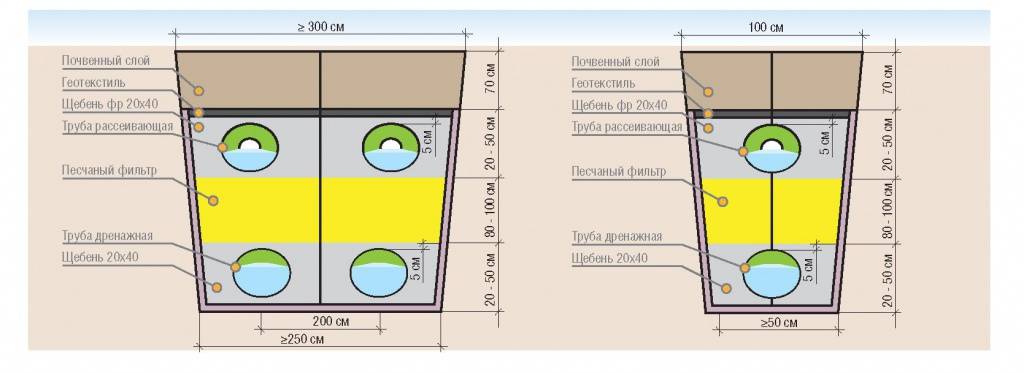
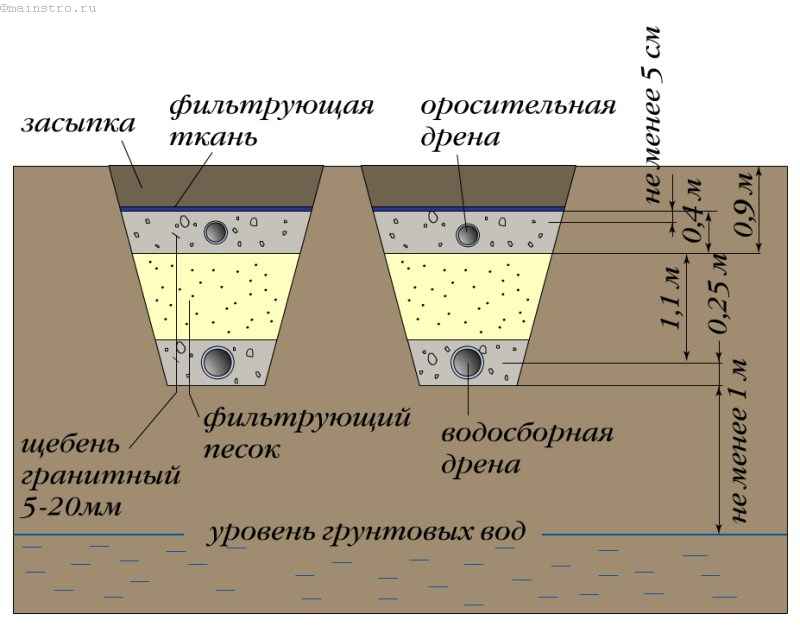




Filter fields - dimensions
The sizes of underground filtration fields depend on:
- soil type;
- daily volume of effluents;
- average annual temperature;
- the amount of precipitation.
The table contains data on the permissible load on the filtration fields for regions with an average annual temperature of 6 ... 11 degrees and an average annual rainfall of 300 ... 500 mm. The load indicators in the table are already given taking into account the coefficient for filtration underground fields equal to 0.5.
Table. Permissible load on the filtration fields.
| Breed name | Filtration coefficient, m3/day | Permissible daily load |
| Clay | Less than 0.01 | Less than 10 |
| heavy loam | 0,01..0,05 | 10…15 |
| Medium and light loam | 0,05…0,4 | 15…20 |
| The sandy loam is dense | 0,01…0,1 | 12,5…17,5 |
| Loose sandy loam | 0,5…1 | 22,5…27,5 |
| Silty clayey sands with a predominant fraction of 0.01 ... 0.05 mm | 0,1…1 | 17,5…27,5 |
| Homogeneous silty sands with a predominant fraction of 0.01 ... 0.05 mm | 1,5…5.0 | 30…40 |
| Fine-grained clayey sands with a predominant fraction of 0.1 ... 0.25 mm | 10…15 | 40…50 |
| Fine-grained homogeneous sands with a predominant fraction of 0.1 ... 0.25 mm | 20…25 | 52,5…55 |
| Medium-grained clayey sands with a predominant fraction of 0.25 ... 0.5 mm | 35…50 | 57,5…65 |
| Medium-grained homogeneous sands with a predominant fraction of 0.25 ... 0.5 mm | 35…40 | 57,5…60 |
| Coarse-grained, slightly clayey sands with a predominant fraction of 0.5 ... 1 mm | 35…40 | 57,5…60 |
| Medium-grained homogeneous sands with a predominant fraction of 0.5 ... 1 mm | 60…75 | 65…80 |
| Pebble with sand | 20…100 | _ |
| Sorted gravel | over 100 | _ |
| Pure gravel | 100-200 | _ |
| clean gravel | 100-200 | _ |
| gravel with sand | 75-150 | _ |
| Gravel-pebble soils with a significant content of fine particles | 20…60 | 57,5…65 |
| Slightly decomposed peat | 1.0…4,5 | 27,5…37,5 |
| medium decomposed peat | 0,15…1,0 | 17,5…27,5 |
| Heavily decomposed peat | 0,01…0,15 | 12,5…17.5 |
Explanations. The data are given from the conditions that the fields receive clarified wastewater with a concentration of suspended solids of 80 ... 100 mg / l
Correction factors:
- for climatic regions I and IIIA, the load should be reduced by 15%;
- for areas with an average annual rainfall of more than 500 mm with clay soils, the load should be reduced by 20%, with sandy soils - by 10%;
- at average annual temperatures below 6%, the load should be reduced by 3…5%;
- when effluents with a concentration of suspensions of 30 ... 50 mg / l enter the filtration fields, the load should be increased by 25% for sandy soils, and by 15% for clay soils;
- if the distance between the highest groundwater level and the lower edge of the crushed stone base is more than 2 meters, the load can be increased by 10 ... 15%, more than 3 meters - by 15 ... 20%;
- at average annual temperatures above 11 degrees, the load should be increased by 3 ... 5%.
The wastewater consumption per person is approximately 200 liters per day. Thus, for a house in which 4 people live, you will need a filtration field with an area of at least 10 m2 (with ideal soil), and most likely much more.
Please note: the area of the filtration field should be taken not as the area limited by the extreme irrigation pipes, but as the area of the gravel or crushed stone base.
Distance from underground filtration fields to residential buildings, wells, wells, etc.
The size of the sanitary protection zone around underground filtration fields with a capacity of less than 15 cubic meters per day should be at least 50 meters.
Wastewater Filtration Field Installation System
For the construction of a wastewater filtration field, it is first necessary to choose a suitable location.The site should not be closer than 15 meters from a residential building, a well, a well. And also no closer than 5 meters to the garden and orchards of fruit trees. Although already purified liquid enters the field, it still continues to carry harmful substances that enter the ground and are subsequently absorbed by fruit trees, bushes, and vegetables.
The field itself is dug in the form of a foundation pit or a trench, this is a choice at the discretion of the owners. Granular sand is laid at the bottom of the working, then gravel or crushed stone, the total thickness of the layer should not be less than 1 meter, since in the future it will perform filtering work.
Spray pipes - the so-called drains - are laid on the crushed stone surface. Along the entire length of the drain there are holes through which compost flows out, passes through crushed stone filtration and, already completely cleaned, enters the soil. Pipes are located at an inclination of 2-3 degrees so that the liquid can flow out by gravity. The recommended depth should not exceed 2 meters and be less than 50 cm so that the drainage system is protected from freezing. From groundwater, drains are located at a distance of at least 1 meter, this helps to avoid water pollution.
Irrigation pipes are recommended to be wrapped with geotextiles. A dense canvas that passes water well, but does not allow small fractions to pass through. Or the technical material spreads on a layer of sand, while the quality of the filtration does not change.
Vertical risers are mounted to the extreme cut of the pipes, one for each branch. This is the so-called exhaust system, through which unpleasant odors come out or, in warm weather, part of the moisture evaporates through them.
Upon completion, the wastewater filtration field is covered with ordinary soil, most often dug earth from a pit or ditch. The warehouse of this layer does not matter and does not affect the quality of the system.
Such a drainage filter is capable of treating large volumes of wastewater. Cleaning is carried out naturally and does not require the use of chemicals. But the period of effective functioning of the filter layer is 7-10 years, then it should be replaced or a new filtration field built. If the second option is chosen, it is necessary to select a new location for the wastewater filtration field. On the old site, it is recommended to completely renew the soil, otherwise nothing will grow on it.