
- Features and arrangement of the drainage field
- Main types
- Characteristics and types
- drainage tunnels
- Advantages of the drainage tunnel system
- Drainage tunnels for a country septic tank: installation recommendations
- How to place a septic tank on the site?
- Lead pipe to septic tank
- drainage tunnels
- Video description
- Conclusion
- Structural features of the PF
- Scheme and principle of arrangement of the filtration field
- Primary treatment of biological waste
- Purpose and principle of operation of the filter well
- Installing a filter well
- We make such a well from improvised means: from bricks and tires
- Filtration steps
- Are there other solutions?
Features and arrangement of the drainage field
In the photo, the design of the drainage field
In dachas and suburban areas that are not connected to the central sewer, special devices are often installed for the disposal of liquid sewage. The most popular are multi-chamber septic tanks, in which effluents are cleaned by 55-60%, and then discharged into the ground. When using such a system there is a high probability of contamination of soil and groundwater. In order not to create problems on their site, the effluents after the drive are sent for post-treatment.One of such additional devices for filtration is a drainage field, in which the degree of water purification reaches 95-98%.
The drainage field is one of the options for clarifying wastewater along with a filter well and an infiltrator. Such a system is built under certain conditions: if there is enough free space for its location (otherwise, a compact infiltrator is installed), when groundwater is located close to the surface (if the water is deep, a filter well is built).
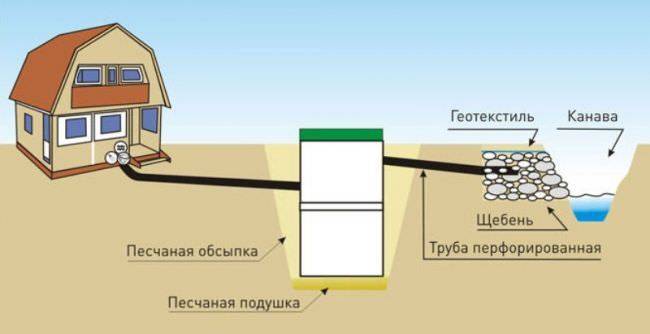
The drainage field forms one or several rows of pipes with holes and slots located in a pit on a loose base. Water moves along them to the bulk mass and passes through it, leaving dirt on the filter particles. Effluent brings microorganisms to the drainage field of the sewer, which feed on organic matter in the presence of air. They partially decompose sewage, turning them into non-hazardous substances. Ignoring after-cleaners leads to disastrous consequences: pollution of the territory, cessation of the functioning of the sewerage system, and a decrease in the level of living comfort.
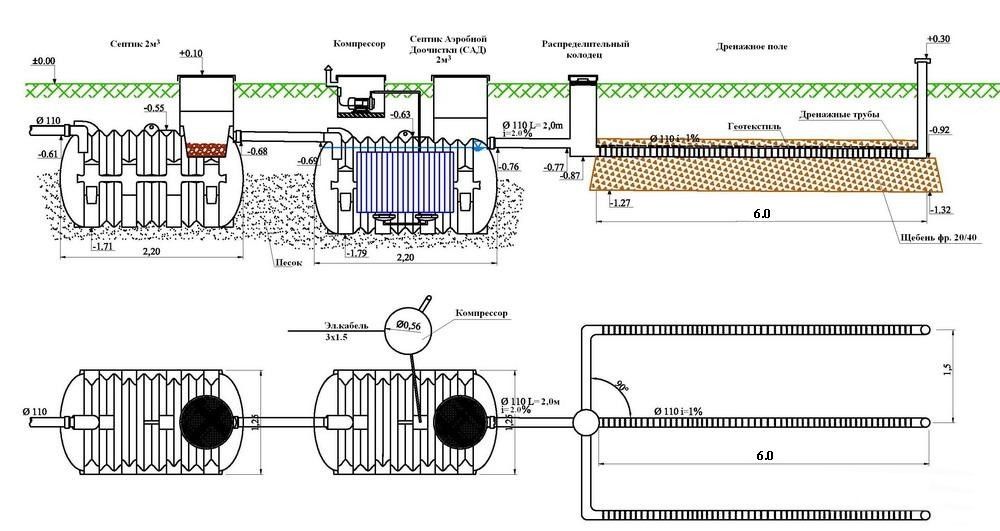
The drainage field for sewerage consists of the following elements:
- filter layer. A pit, partially or completely covered with loose mass (rubble, sand, gravel), which retains sewage.
- Drains. Pipes with holes and slots for moving wastewater to the filter.
- Sewer pipes. Used to supply water from the septic tank to the filter field.
- Distribution well. A container between the septic tank and the drainage field for distributing fluid between the branches of the system.
- Ventilation pipes. Needed to supply air to the system to ensure the vital activity of microorganisms.
- Closing well.A container at the end of the drains, which is installed to facilitate the process of flushing the system. In this case, the ventilation pipe is passed through the well cover. With the help of the closing well, it is possible to connect all the branches into one and ensure the flow of fluid from one outlet to another. The capacity allows you to control the functioning of the system. Dry wells indicate the normal operation of the drainage field. The presence of water in them indicates that the drains do not fulfill their functions. Perhaps they are clogged or you need to increase their number.
The sewage treatment system in the drainage field functions as follows: sewage flows from the house to the septic tank through the external sewage system, where it stays for several days, during which time heavy elements will settle to the bottom, and light organic substances will partially decompose by microorganisms. The mixture formed in the septic tank is removed from the septic tank to the soil filter, seeps through the bulk material and gets rid of the dirt, which is then processed by microorganisms. After 10-12 years, crushed stone, sand and other elements of the soil filter, in which a large amount of sewage unprocessed by microorganisms has accumulated, must be replaced.
Main types
There are several types of sewer filtering structures that work on a similar principle, but differ by area of application.
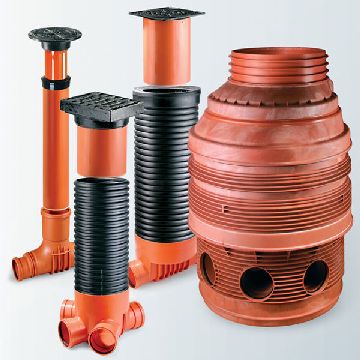
- The drainage type of the well is used as an addition to a complex drain system - an underground perforated pipeline. The well serves to drain water from buildings and land, and also filters silt and sand, allowing the water to be purified for draining, for example, into a reservoir.
- To clean the septic tank, an additional filtration well is used, which has a thick filtration cushion (at least 60 cm, preferably 1 meter) from several layers: sand, crushed stone, broken brick, waste slag.
- For open sewers. Such wells are also called viewing wells. The owners get the opportunity to visually control the degree of filling of the well. The filter material is located at the bottom. In the case of a rapid filling of the well, its contents can be pumped out with a pump.
Characteristics and types
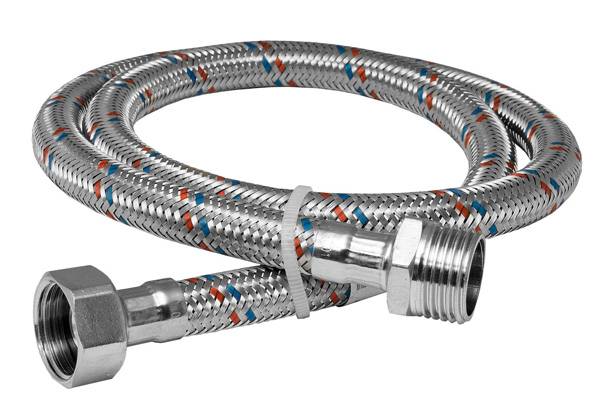
Flexible connection line plumbing is a hose of different lengths, made of non-toxic synthetic rubber. Due to the elasticity and softness of the material, it easily takes the desired position and allows installation in hard-to-reach places. To protect the flexible hose, the upper reinforcing layer is designed in the form of a braid, which is made of the following materials:
- aluminum. Such models withstand no more than +80 ° C and retain functionality for 3 years. In high humidity, aluminum braid is prone to rust.
- Of stainless steel. Thanks to this reinforcing layer, the service life of the flexible water supply is at least 10 years, and the maximum temperature of the transported medium is +95 °C.
- Nylon. Such a braid is used for the manufacture of reinforced models that can withstand temperatures up to +110 ° C and are designed for intensive use for 15 years.
Nut-nut and nut-nipple pairs are used as fasteners, which are made of brass or stainless steel. Devices with different indicators of permissible temperature differ in the color of the braid.The blue ones are used for cold water connections, and the red ones for hot water.
At choice of eyeliner water, you need to pay attention to its elasticity, reliability of fasteners and purpose. It is also mandatory to have a certificate that excludes the release of toxic components by rubber during operation.
drainage tunnels
Drainage tunnels or blocks are already a newer and more modern system, which is designed for cottages and recreation areas with a larger format. The thing is that for this replacement, the filtering fields no longer need a separate place with mandatory requirements.
Due to the characteristics of the prefabricated system, over the drainage tunnels, you can even install a gazebo, a parking lot in the country, deploy an original landscape structure, the same rockery.
But it is immediately worth noting that along with the advantages of the system in terms of quality of work, strength and durability, its cost should also be considered immediately. It seems average and acceptable, but for many it can also be a serious cut from the budget.
Therefore, when studying the possibility of installing filtration tunnels in the country, immediately pay attention to the price.
Advantages of the drainage tunnel system
- We can say that this is a fairly durable system that is installed once and for many years.
- The overall design has increased strength, due to which the territory on top of the system can be used to good use.
- Truly improved performance so you don't have to worry about the number of resets.
Drainage tunnels for a country septic tank: installation recommendations
Few have worked with drainage tunnels, as this system is not suitable for everyone in terms of costs. More often, drainage wells or even just cesspools are installed instead of a septic tank. But if you want to install just such a system on the site, then we will give you some advice:

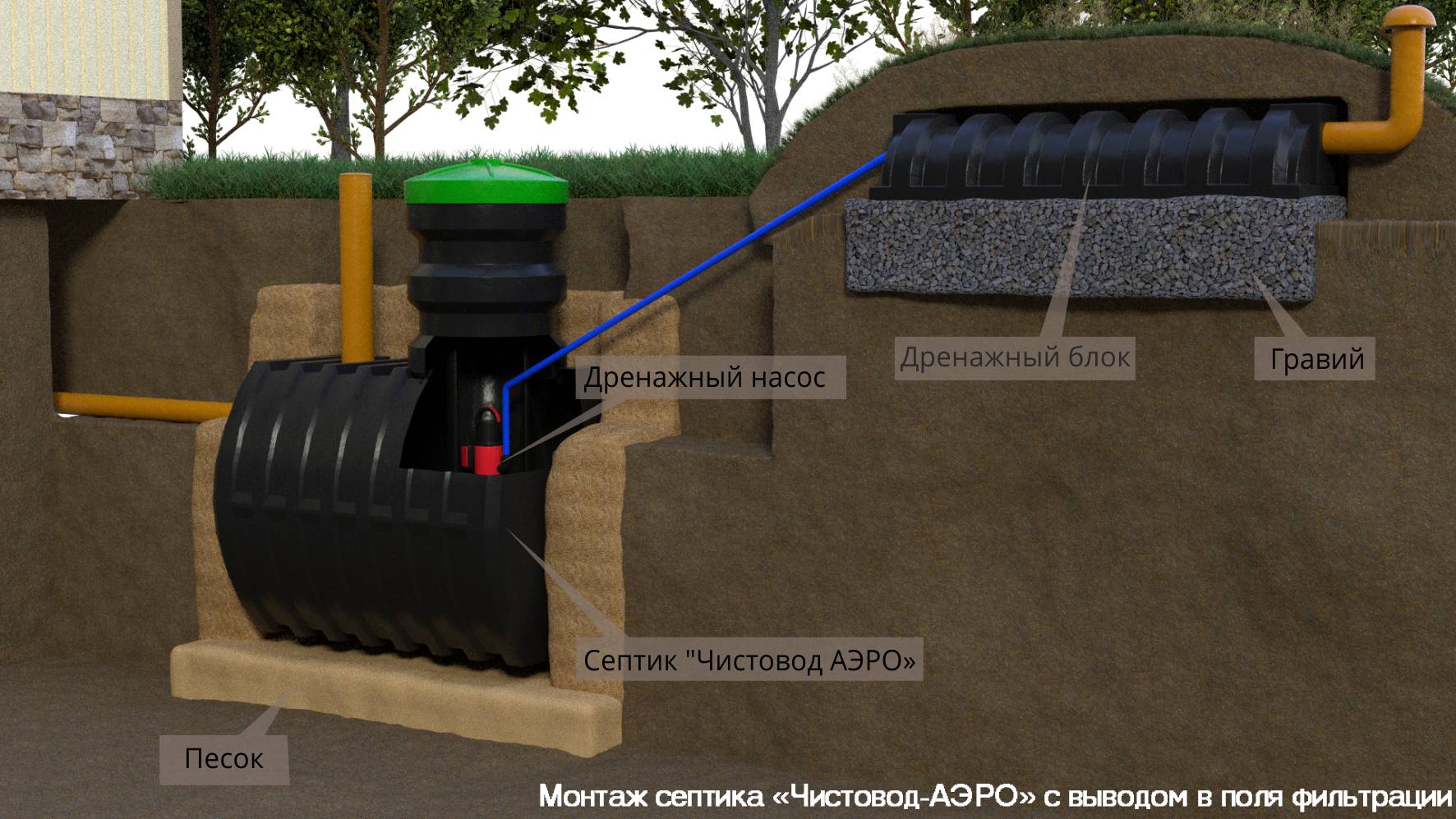
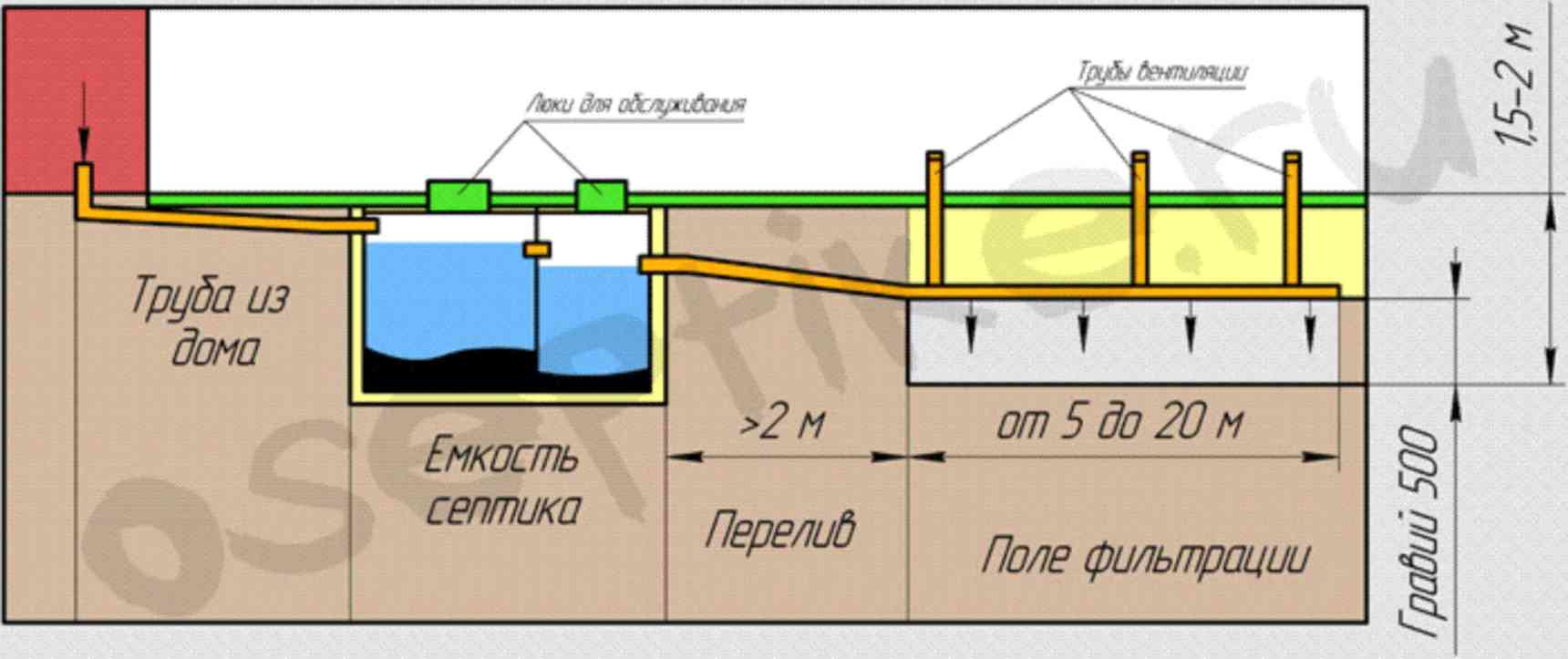


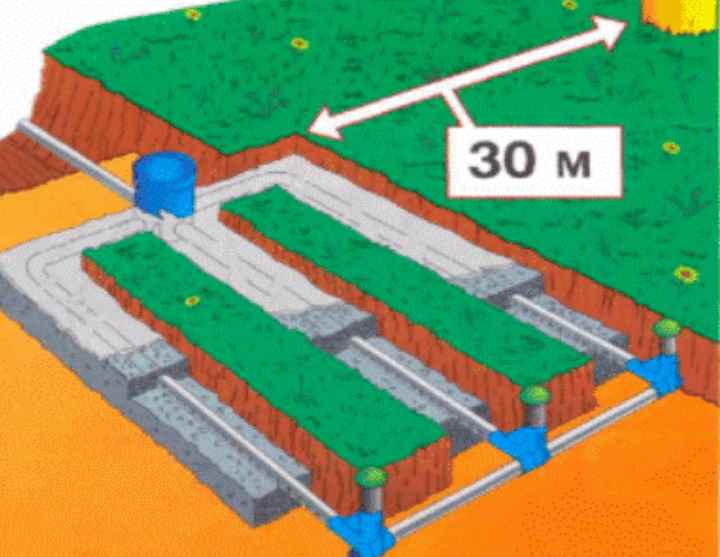

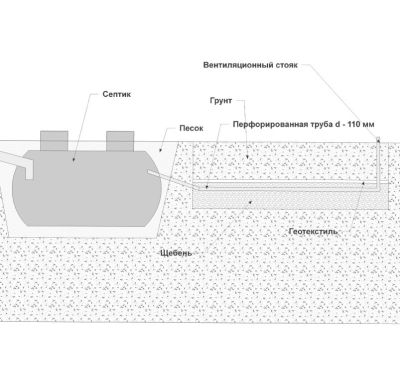
- It is highly desirable to install drainage tunnels to a greater depth. Often this happens as follows - a trench is dug with dimensions for the module, plus 40-50 cm on each side. The depth of the pit is about 2 m. 50 cm of sand are laid on its bottom, then 30 cm of rubble, and only then the module is installed, preferably on an already compacted surface.
- The modules are installed on a ready-made pillow and connected both to each other and to the conclusions from the septic tank.
- To prevent perforation from silting up, the modules are covered with geotextiles.
- Further, the system is sprinkled with rubble, and ventilation outlets are installed in special holes.
- It remains only to add a layer to the level of the soil. This is done with a mixture of earth and sand. Also, in many cases, in order to make the surface exploitable, a geogrid is laid, which we discussed in several articles on the site.
We would like to note the fact that this information is general and may partially change when choosing a particular system, as well as in combination with a septic tank installed in the country. It is highly desirable to consult on the choice of drainage for a septic tank and with specialists at the place of purchase of VOCs, because each treatment plant has its own characteristics.
Drainage for a septic tank with their own hands can be done by almost each of us, one has only to approach the issue seriously and with all responsibility.And we can only wish you success in your work and invite you to share your opinion about the material in the comments column.
How to place a septic tank on the site?
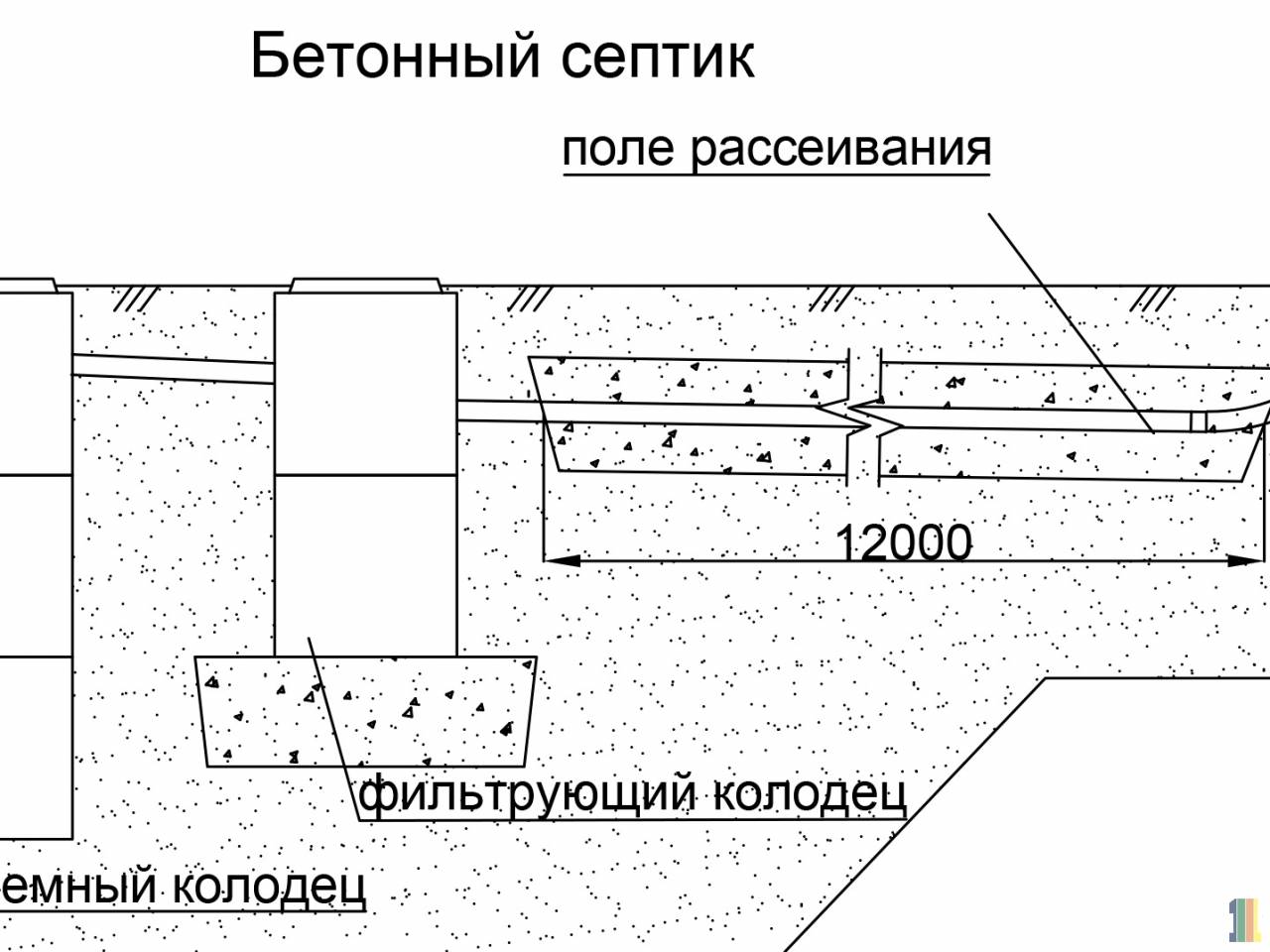
Concrete rings are a good material for making sewers in a private household. If the territory does not belong to nature protection zones, then you can save on sewage, since the cost of such a septic tank is half the price of buying a treatment station.
Before starting work, it is necessary to determine the type of soil on the site. The choice of a filtration system depends on its characteristics, since the design of a septic tank made of concrete rings involves several containers. According to sanitary standards, water must be subjected to three or more days of settling before it is discharged into the ground.
The type of soil can be determined by digging a hole, by interviewing neighbors who own a well or a well, by requesting information from an organization conducting construction or drilling near the site.
The filtration coefficient is slightly higher for loams, slightly higher for sandy loams. However, their filtration properties are still not enough for the installation of ground wastewater treatment systems on the listed clay soils.
In addition, almost all clay soils are characterized by heaving - the ability to increase in size during freezing and decrease during thawing. These soil movements can easily push concrete containers out, completely destroy them, or simply squeeze them until cracks appear.
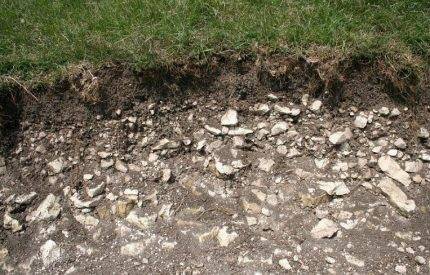
If the site is located in a hilly area, with a high degree of probability it has a rock type soil. In this case, you need to make a choice in favor of ground purification stations or storage tanks.
Sandy, gravel, pebble and rubble sedimentary rocks have good absorbing properties. They freely pass water into their thickness, do not prevent its movement to the underlying layers.
True, coarse-grained deposits, such as gravel and pebbles, occur mainly in floodplains, and crushed stone at the foot of mountain formations.
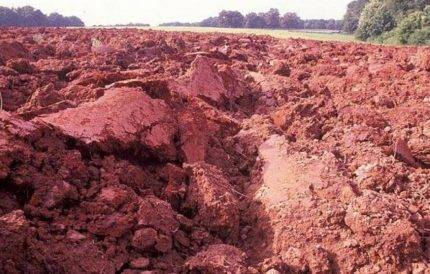
The throughput of clay is practically zero. Soil of this type belongs to the category of impervious rocks - water-repellent rocks that do not absorb and do not pass water through their thickness.
On river and mountain slopes, filtering facilities are not suitable, because. part of the draining liquid will not be able to pass a post-treatment cycle sufficient for disposal into the soil.
Therefore, the normal conditions for the construction of filtration fields, absorption wells and the installation of infiltrators are sandy soils of all degrees of fineness and density of addition, except for dusty.
In addition to geological conditions, it is necessary to observe the norms of its location from residential buildings and water sources.
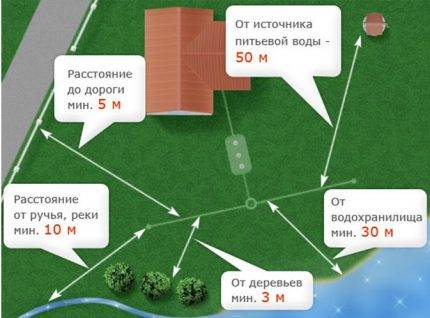
This information is written in sanitary standards and must be observed. It is worth avoiding the location of the septic tank close to the place the growth of trees, as their root system can harm the structure
If hygiene standards are neglected, biological contamination of water may occur. Dangerous pathogens of infectious diseases develop in sewage. These include E. coli, which causes severe poisoning. It easily gets to the source of drinking water through groundwater.
Lead pipe to septic tank
Household sewage flows from the house to the septic tank through the supply pipe into the septic tank.This pipe should be a special sewer for outdoor use, most often 110 mm, less often 160 mm. This pipe should not have angles of 90 degrees, the length should not exceed 15 m (according to SNIP, an inspection well must be installed every 15 m), a slope of 1.5-2 cm per 1 m of the pipe.


All septic tanks have such a parameter as the depth of the supply pipe. This parameter is not taken from the ceiling, but calculated by engineers producing septic tanks and deviation from this parameter is not just a violation of the requirements, but also violates the efficiency of the septic tank. Usually the depth of the supply pipe varies from 400-1000 mm, 800-1500 midi, 1400-2000 mm long.
The supply pipe must be insulated with a foamed substrate (energoflex, tilit, etc.), it can also be insulated with a special polyurethane foam shell. Insulation is not a panacea, in principle, there are objects in which nothing freezes even without insulation.
If you wondered if the water in the pipe would freeze because the freezing depth is 1.8 meters, then we want to reassure you that the freezing depth according to SNIP is really 1.8 m, but it is designed for a pressure pipeline. There is no water under pressure in the sewer pipe, the water does not stand there, it flows down with the correct slope of the pipe, which means there is nothing to freeze. You can safely bury a pipe up to 1 meter.
Heating with a heating cable can be done only if necessary if you have severe frosts. It can be mounted in advance, but only included in peak cold weather.
drainage tunnels
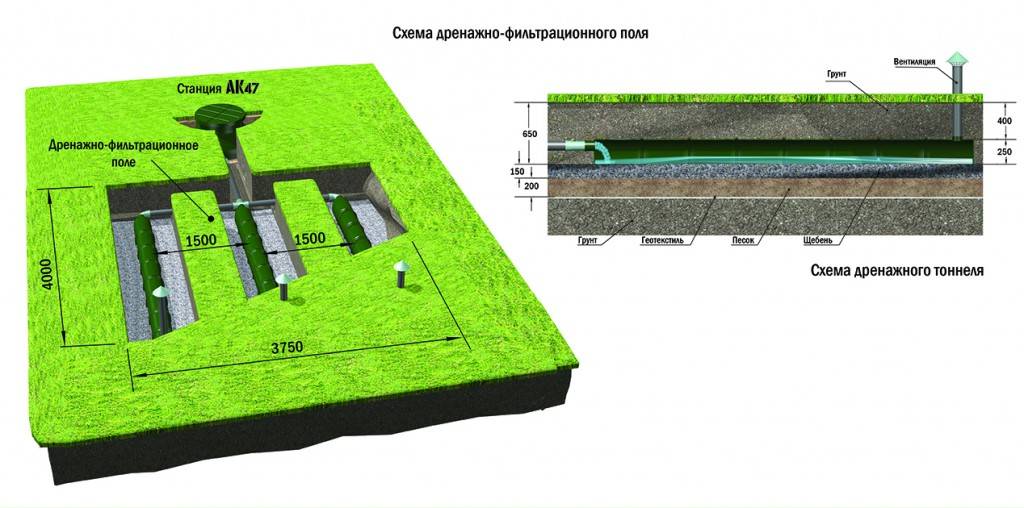
Drainage tunnels are a kind of filtration fields. This design is chosen if a huge amount of water is being discharged.A distinctive feature of the device is an increased cross section, which provides a high cleaning speed. The advantage of drainage tunnels is a high level of mechanical stability, which makes it possible to install a post-treatment field, which can even be located under a car park.
Construction installation algorithm:
Digging trenches up to two meters. At the bottom of the excavation, a sandy "cushion" is created, having a thickness of 50 centimeters. From the top there will be a layer of rubble 30 centimeters thick.

Arrangement of drainage tunnels
- Modules are being installed. Before installation, the surface must be leveled and compacted. The outer walls of the modules are covered with geosynthetics.
- Elements are connected. The outlets of the structures are connected to the outlets from the septic tank.
- Installation of ventilation. Ventilation outlets are installed in the openings of the structures.
Geogrids are also installed to evenly distribute loads over structures.
Video description
An example of a drainage field device:
The mounting technology is practically no different from the design of a standard filtration field, which consists of perforated pipes.
Conclusion
An autonomous sewerage system, consisting of a septic tank and a drainage field, is an efficient and budgetary system that has sufficient efficiency to process wastewater. But we must remember that in a new place the septic tank must be equipped with special care - if you do not follow the technology, it can negate all the work done, so you need to trust the installation of septic tanks only to experienced specialists who give a guarantee for their work.
Structural features of the PF
The filtration field is a relatively large piece of land on which the secondary purification of the liquid takes place. This cleaning method is exclusively biological, natural in nature, and its value is in saving money (no need to buy additional devices or filters).
The dimensions of the PF depend on the area of the free territory and the landscape features of the garden plot. If there is not enough space, instead of PF, an absorbing well is arranged, which also filters the liquid before it enters the ground
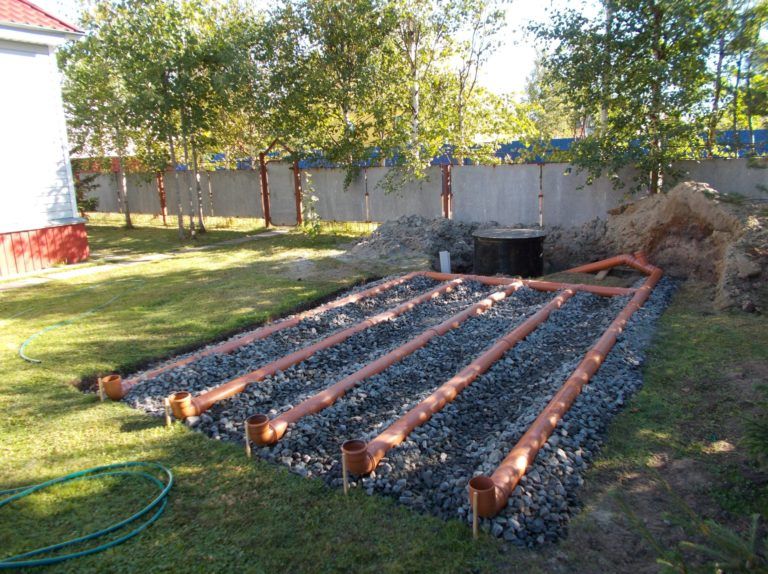
A typical filtration field device is a system of parallel-laid drainage pipes (drains) that extend from the collector and are placed at regular intervals in ditches with a thick sand and gravel layer. Previously, asbestos-cement pipes were used, now there is a more reliable and economical option - plastic drains. A prerequisite is the presence of ventilation (vertically installed risers that provide oxygen access to the pipes).
The design of the system is aimed at ensuring that the liquid is evenly distributed over the allocated area and has the maximum degree of purification, so there are several important points:
- distance between drains - 1.5 m;
- length of drainage pipes - no more than 20 m;
- pipe diameter - 0.11 m;
- intervals between ventilation risers - no more than 4 m;
- the height of the risers above ground level is not less than 0.5 m.
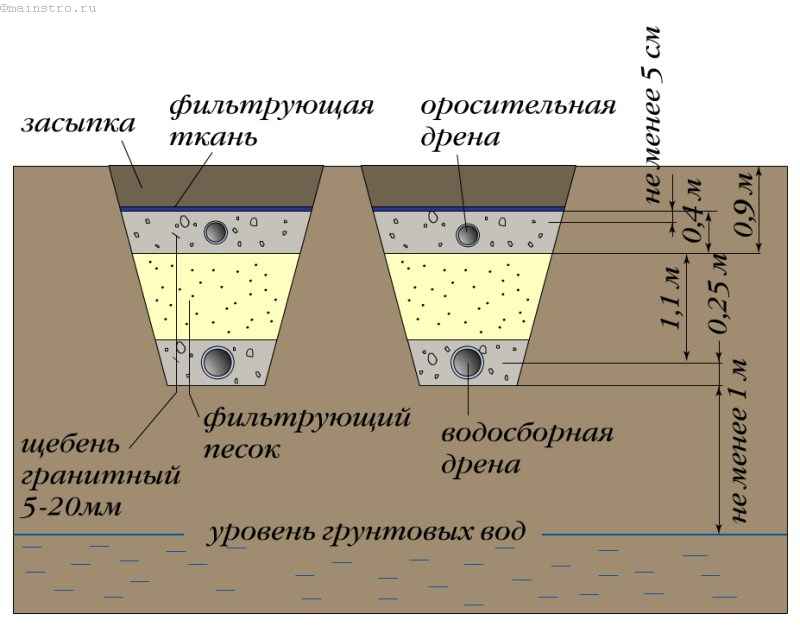
In order for the natural movement of the liquid to take place, the pipes have a slope of 2 cm / m. Each drain is surrounded by a filtering "cushion" of sand and pebbles (crushed stone, gravel), and is also protected from the ground by a geotextile.
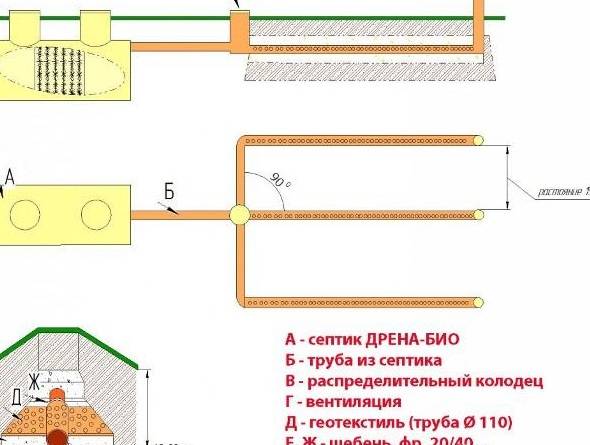


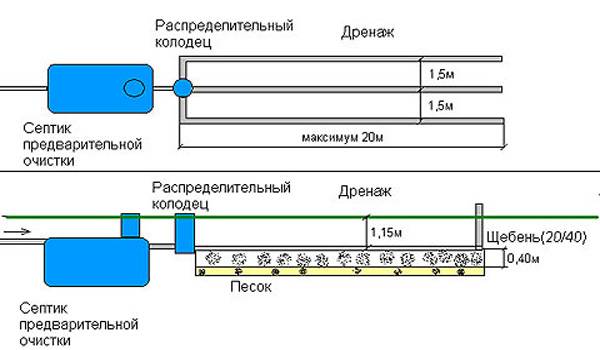


One of the complex device options: after cleaning on the water filtration field enters the storage well, from where it is pumped out using a pump.Its further path is to a pond or ditch, as well as to the surface - for irrigation and technical needs.
There is one condition, without which the installation of a septic tank with a filtration field is impractical. Special permeability properties of the soil are required, that is, on loose coarse and fine clastic soils that do not have a connection between particles, it is possible to build a post-treatment system, and dense clay soils, the particles of which are connected in a consolidated manner, are not suitable for this.
Scheme and principle of arrangement of the filtration field
Sewerage with a system of underground wastewater dispersion, as a rule, works according to the following scheme:
- Wastewater flows through the inlet pipe into the septic tank.
- Leaving part of the waste in the septic tank, the effluents enter through the outlet pipe into the distribution pipe.
- Through the scattering tubes, the liquid is evenly distributed over the field, passing through the cleaning layer.
- Gaseous waste products are discharged through ventilation pipes, which are installed on the dispersing system.
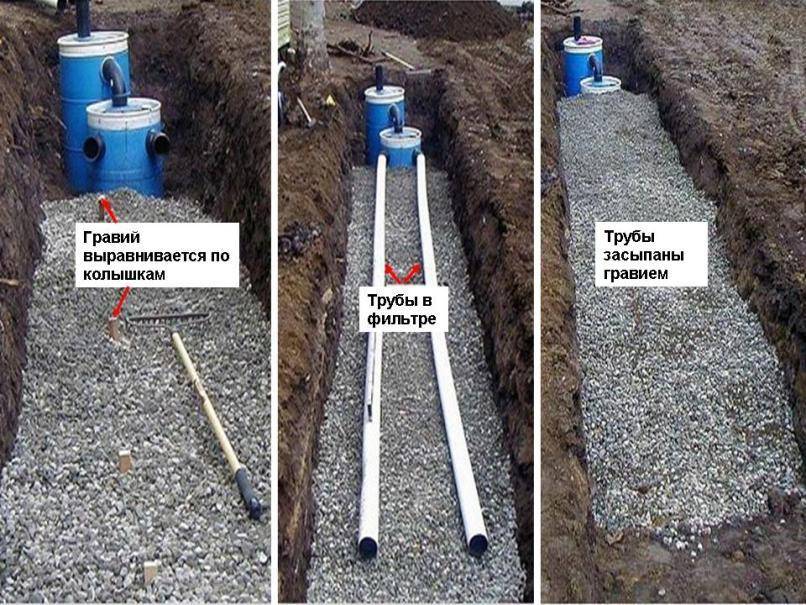
Diffusers are placed in 3-4 trenches. It is best to use drainage or perforated sewer pipes. Before placing on the bottom, a mixture of sand and gravel with a thickness of 1 m or more should be poured. This is the main filter of the design.
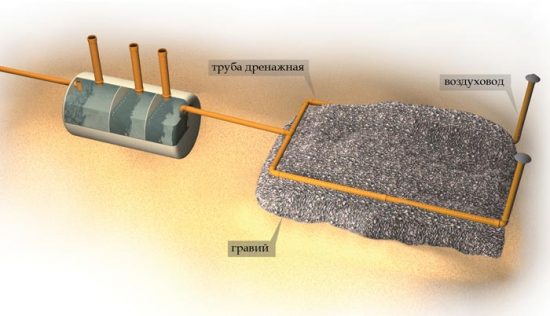 Filtration field scheme
Another layer is placed on top, from crushed stone of a fraction of 20-40 mm. Pipes should be located in its thickness: below them - 30 cm, above them - from 10 cm of material. On top of the "filling" you need to lay geotextiles. It will protect the structure from the ingress of litter from the outside.
Attention! The pipe must be at a 1° slope from the distributor.
Primary treatment of biological waste
High-quality and reliable wastewater disposal is an integrated approach to the organization of wastewater disposal. The initial stage of processing sewage is a septic tank or cesspool. They are the first processing of human waste.
Live anaerobic microorganisms are added to the masses collected in the septic tank - bacteria specially grown artificially. They develop and process biological waste into ecological compost. In the process, solid particles settle to the bottom of the tank, and the top layer becomes a clear liquid without a pungent odor.
Purpose and principle of operation of the filter well
The filter well is used as a natural wastewater purifier. It is used in the absence of sewerage and the ability to bring domestic water into a reservoir intended for such waste.
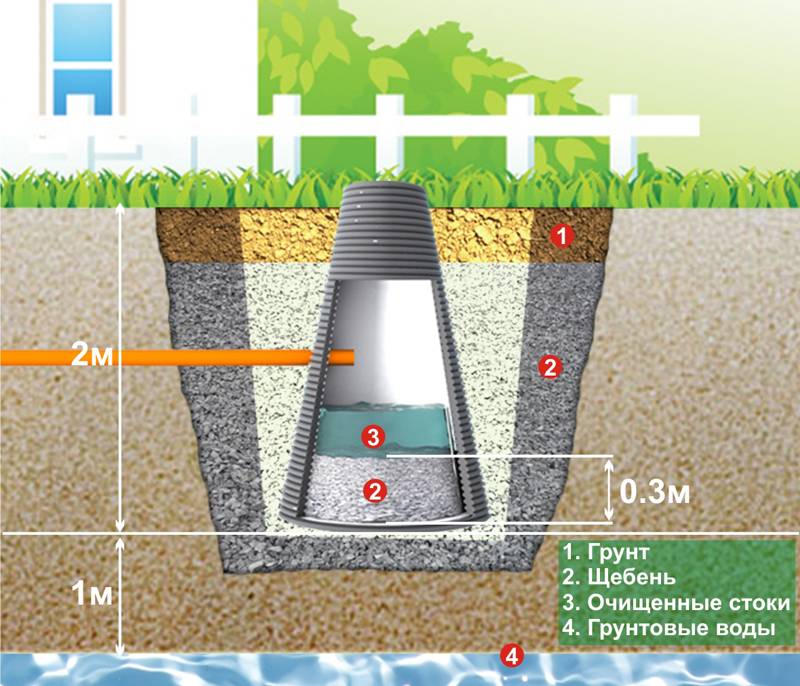
The picture explains the operation of such a well
The domestic water treatment system is quite simple.
Water from the house enters the septic tank or sump, where some of the heavy particles settle. Partially purified water is discharged through a pipe into a container.
A filter well for a septic tank is used not only as a place for water drainage, but also as an additional filter, where the last stage of cleaning ends and the liquid is sucked into the ground. If the volume of household waste is not more than 1 cubic meter per day, then a cleaning tank is mounted on the site as an independent structure. Otherwise, it performs the function of water treatment.
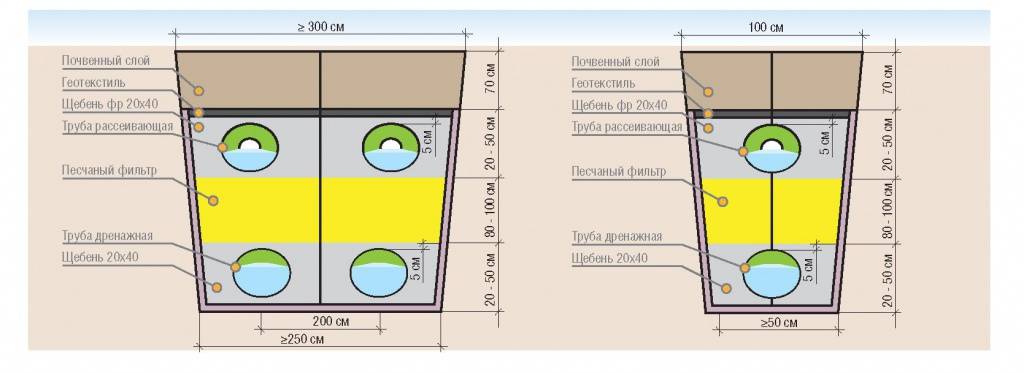





The structure is mounted at a distance of 30 meters from the source of drinking water.
Installing a filter well
First of all, it should be noted that the cleaning well is only suitable for certain types of soil.
Sandy soil, peat, loose rock soil, which contain some clay, are an excellent place for the full functioning of the natural filter. A filter well in clay will not fully fulfill its functions, since clay, by its very nature, does not pass water very well. For soils that poorly cleanse and absorb liquid, there are other water purification methods.
In addition, the soil also affects the area of \u200b\u200bthe structure and its service life. The efficiency of the filter is achieved due to the depth of groundwater, which should be half a meter lower than the well bottom.
Advice. A filter well with a high level of groundwater should not be installed, since the water will not be able to be absorbed into the ground. It is also worth considering the depth of soil freezing in winter.
The filter well consists of:
- overlaps;
- walls (concrete, brick, tires, plastic barrels);
- bottom filter (crushed stone, brick, slag, gravel);
Under the bottom filter is meant a mound at the bottom with a height of about a meter. Large particles are placed in the middle, and small ones along the perimeter.
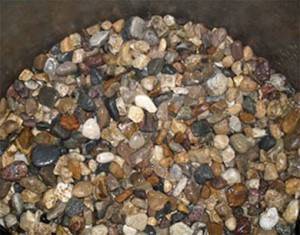
An example of a stone bottom filter
Waste water is in a septic tank before it enters the treatment tank. Then it moves through the pipe to the well.
The distance between the septic tank and the filter well should be 20 cm.
The walls for the well can be a barrel, brick, stone, standard concrete rings and tires. The main thing is that they have holes with a diameter of up to 10 cm and are staggered.
The filter container must be equipped with a ventilation pipe with a diameter of 10 cm.Above ground level, the pipe should be at a height of about a meter.
The standard dimensions of modern filter tanks are 2 meters in diameter and 3 meters deep. They are built square or round in shape. A few years after the start of operation of the sewage filter and the appearance of the first problems, everyone asks himself the question of how to restore the filtration of the filter well.
And stops letting water into the ground. To slow down this process, experts recommend installing several water septic tanks. And in case of strong silting, call the car a vacuum cleaner.
We make such a well from improvised means: from bricks and tires
To install a filter well, a large pit is dug out of brick. The formwork is installed and lined with bricks. The stone lies at a short distance. A drainage layer is poured at the bottom of the tank. And the top is closed with a wooden or plastic lid.
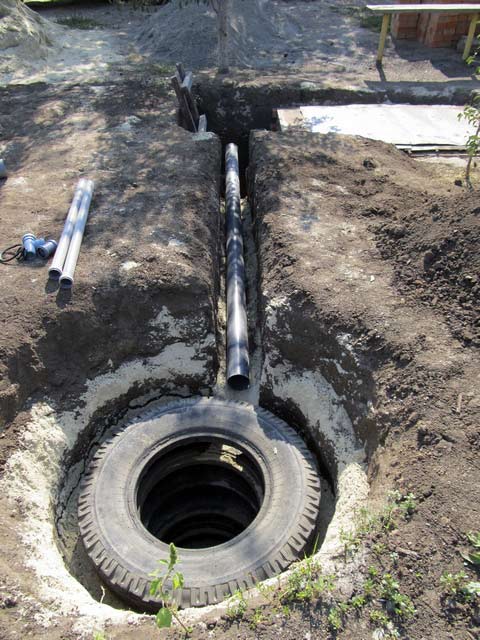
Example of a well from used tires
A cheap and affordable option is to create a filter well from tires. Most often, automobile and tractor tires are selected for this purpose. Such a structure is not durable, but it can serve for more than 10 years for the benefit of the environment.





The process of arranging the container is quite simple.
At the beginning, a hole is dug along the diameter of the tires and covered with rubble about 30 cm thick. The remains of brick and slag are also suitable. In addition, the space between the tires is filled with rubble. A hole for the pipe is cut in the top tire. To ensure waterproofing from the outside, tires are wrapped in dense polyethylene or roofing material.
The installation of a filter well is a must for any country house where there is no central sewerage system. This will help protect groundwater from contamination by hazardous chemical particles.
The video shows the process of building a filter well. Be sure to check it out.
Filtration steps
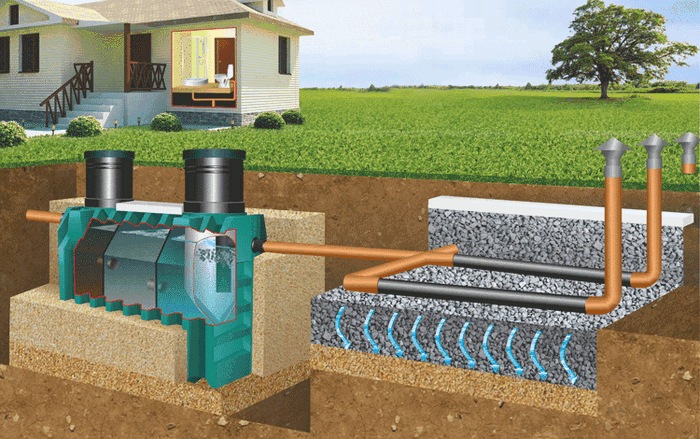
So that you can understand how an autonomous sewerage system with a septic tank and a filtration field works, we will describe the steps for filtering wastewater:
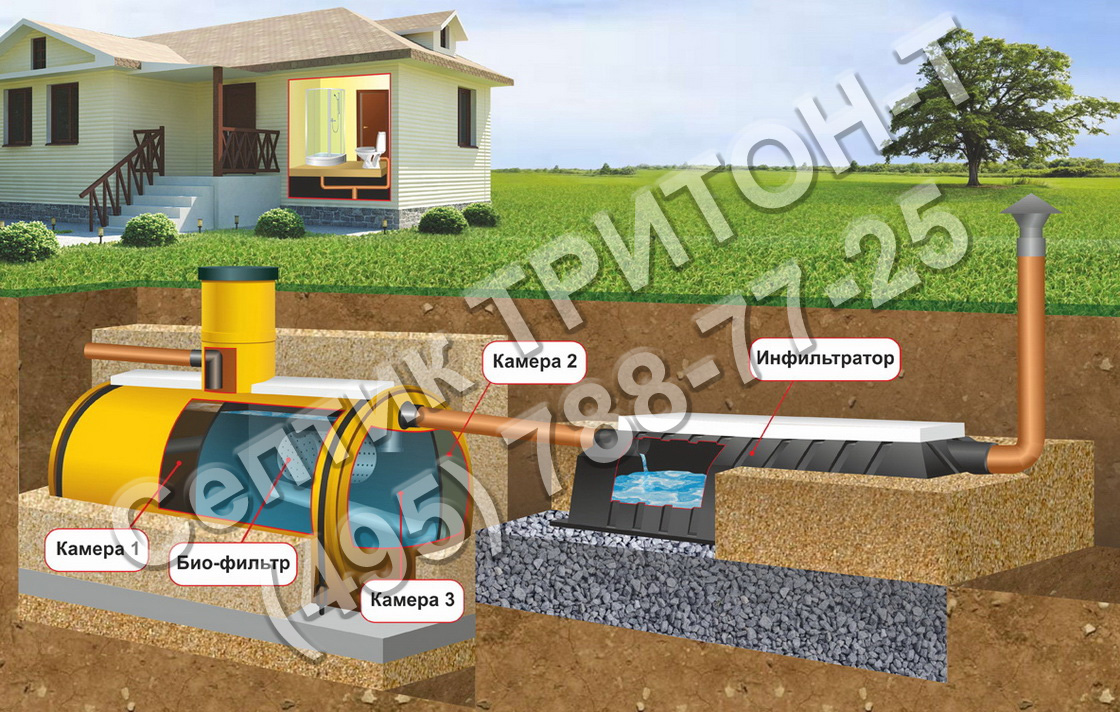
- First, sewage through the sewer system enters the first chamber of the septic tank from the house. Here, at the bottom of the compartment, sediment from the solid components of the wastewater is collected and primary processing takes place.
- When the height of liquid effluents in the first chamber reaches the overflow, the previously purified and clarified waters overflow into the second chamber, where they undergo biological processing by bacteria that break down organic compounds.
- Then the effluents enter the third chamber, at the bottom of which a sediment of suspended particles (activated sludge) falls. After that, the purified water enters the distribution well, and from there to the filtration fields.
Are there other solutions?
Not everyone can use the filtration field as a way of post-treatment of sewage. What should those who own a piece of clay soil or build a house in an area with a high level of groundwater do?
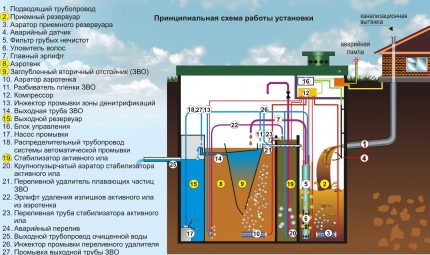 Scheme of the biological treatment plant. After passing through several tanks equipped with aerators, airlifts and filters, the water becomes 98% pure. The main function of waste processing, as in septic tanks, is performed by anaerobic and aerobic bacteria.
It is also possible to create a sewer system with a filter well, but a number of conditions are also required for its installation (for example, non-clay soil and the location of groundwater a meter below the conditional bottom of the well).
If you simply install a septic tank without additional treatment, insufficiently clarified and disinfected water will enter the soil and an unpleasant odor may appear.



