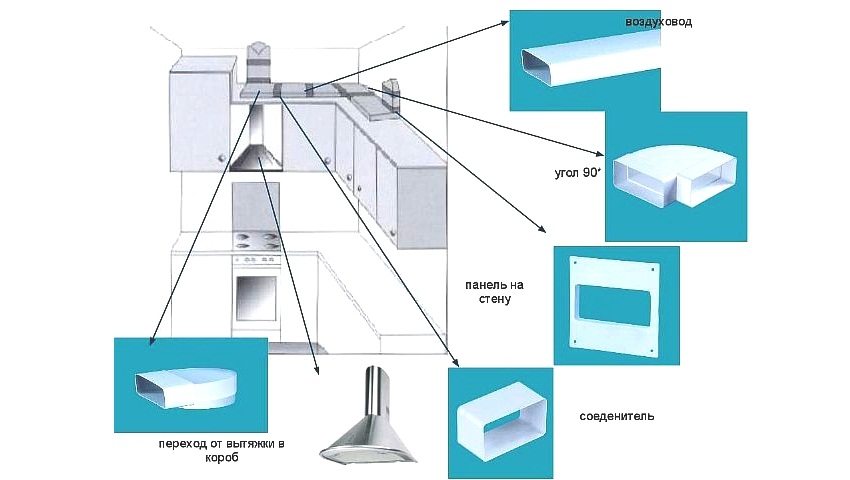
- Typical kitchen ventilation schemes
- Mounting the hood with your own hands. Work order
- Types of hoods for the kitchen
- suspended
- Embedded
- Dome
- corner
- Island hoods and T-shaped
- Standard type, aka flow
- Recirculation type
- Combined type
- The structure of the wall device
- Why does the smell from your apartment penetrate to the neighbors?
- Duct selection
- How to choose the right hood for the kitchen without venting to the kitchen design
- At what height from the stove should it be installed?
- Operation and care of the hood
- Varieties of exhaust valves
- Varieties of exhaust devices
- Codes and requirements for kitchen exhaust systems and installation
Typical kitchen ventilation schemes
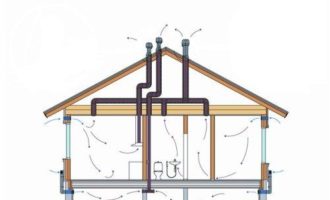
There are two main schemes for kitchen ventilation: natural and forced. In the first case, ventilation is carried out using holes in the walls and open vents, on the one hand, and common house ventilation ducts, on the other.
In the second case, the change of air is carried out mechanically, using the installation of volatile devices. The most successful is the third, combined option, in which the natural supply scheme is simultaneously used, according to which air spontaneously enters the room, and forced exhaust through kitchen hoods.
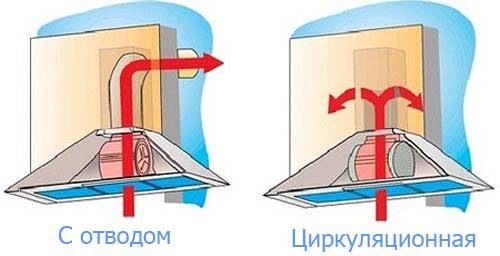
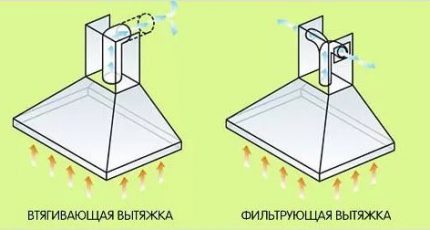 According to the method of air purification, all hoods can be divided into 2 types - exhaust (retractor) and recirculation. The latter are not connected to the ventilation ducts through pipes and ducts, they function offline
There is a third type - combined devices, which are equipped with double filters and an air duct, can work both with connection to the ventilation shaft and independently.
Natural ventilation has the only advantage: to ensure a comfortable microclimate in the kitchen (as in other rooms), no additional material investments are required.
But it has low efficiency. When cooking on an electric or gas stove, heavy odors quickly spread due to slow air exchange.
Devices for providing forced ventilation are much more productive, however, the equipment necessary for the implementation of the mechanical scheme is dependent on the supply of electricity.
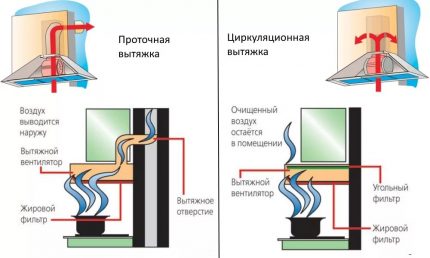
Extractor hoods and recirculating appliances do a great job of cleaning polluted air and removing unpleasant odors, but they do not cover the area under the ceiling, where fumes and grease particles also get into
Taking into account these features, a combined scheme is used that combines the operation of exhaust devices and a natural ventilation system.
With typical diagrams and device options ventilation in the kitchen will be introduced by the article, which we recommend reading.
Mounting the hood with your own hands. Work order
After the hood is selected and the place for it is determined, you can proceed to the preparatory and installation work.
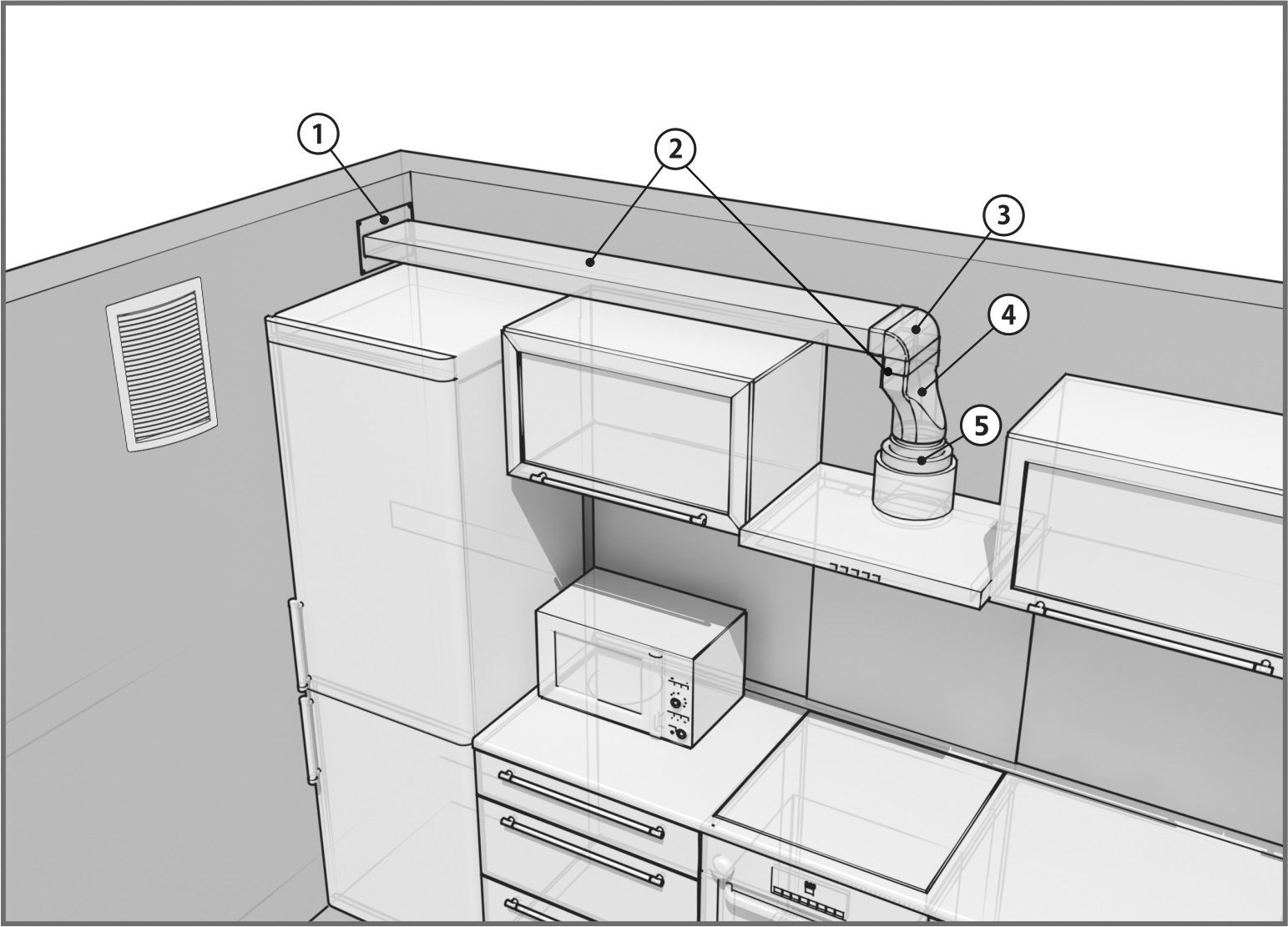
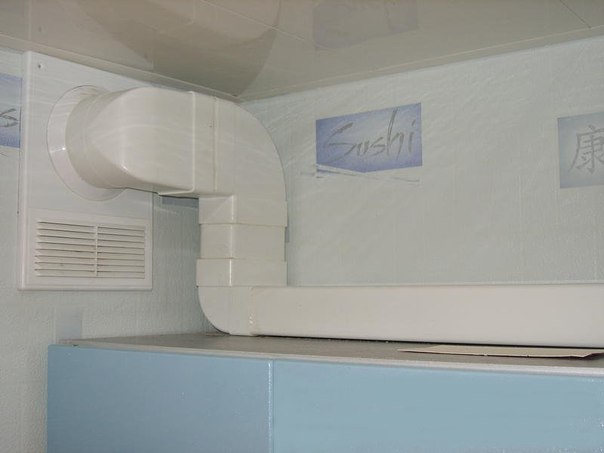
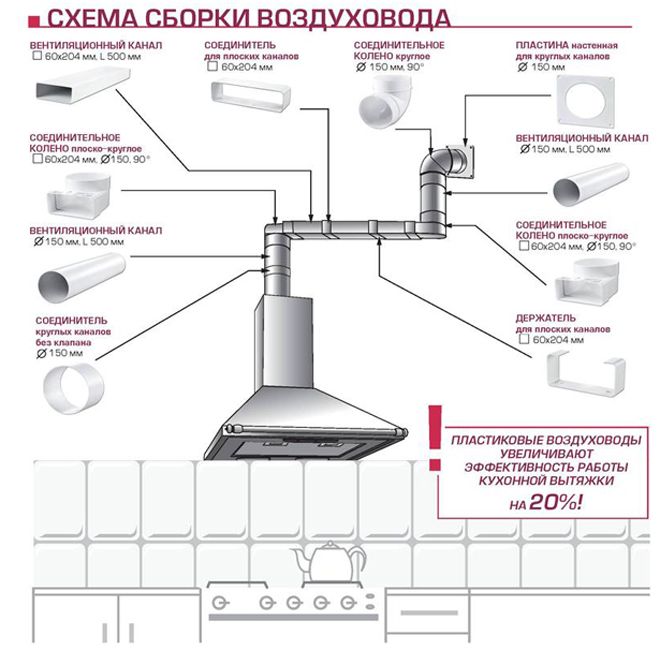
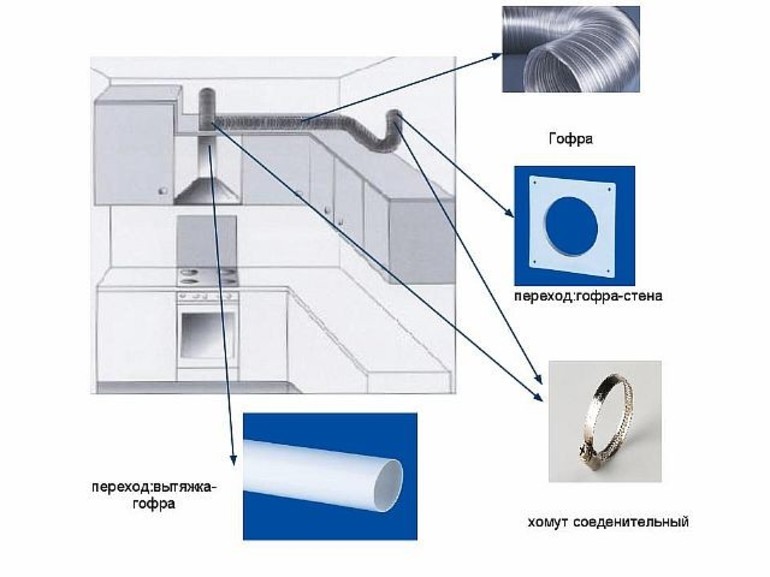
To install the hood, you need to purchase pipes.Experts recommend opting for plastic round sections with a diameter of 125 mm
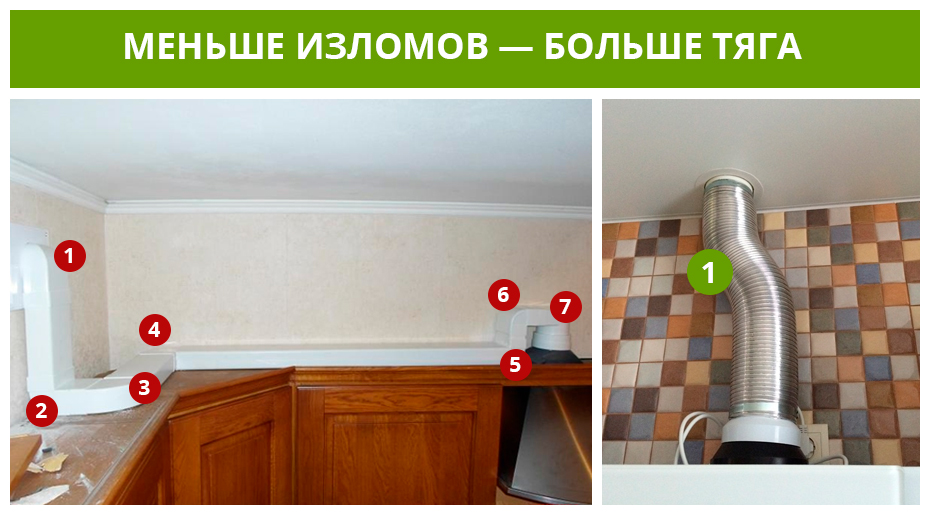
It is important to understand that square and rectangular ones look more attractive and are easier to install, but the most important thing for which work is being done is a good exhaust air outlet, and the best draft will be in a round pipe. You can also purchase metal pipes, but they are:
- Will cost more.
- They will be more difficult to install.
- Will be noisier during ventilation operation.
Be careful with corrugated pipes. They are noisy and unattractive.
You should not choose sewer pipes either - they do not meet the requirements for an exhaust system in diameter.
In addition to pipes, you will need:
- Platform with grating, elbows, adapters and couplings, as well as holders.
- Means of soundproofing: heaters made of isolon, penofol, ultraflex.
- The outer grille for the air duct is plastic or metal.
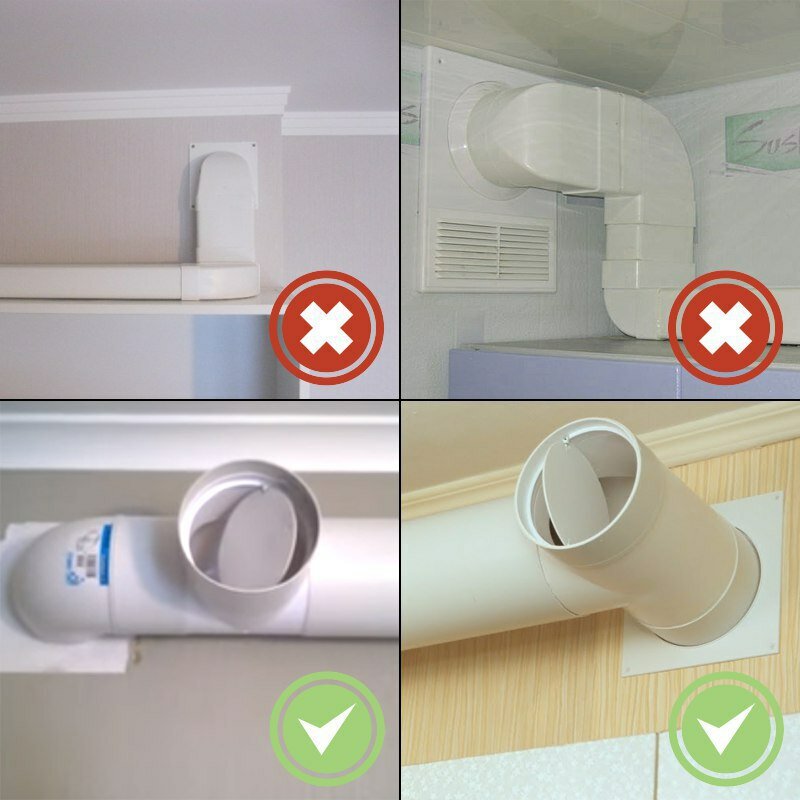
- 3 check valves to prevent back draft. Choose from the same material as the pipes.
- Fasteners (dowels with self-tapping screws).
Also prepare the following tools:
- Roulette and level.
- Perforator.
- Bulgarian or hacksaw to cut pipes.
- Screwdriver.
- Cement mortar for filling the hole after pipe installation.
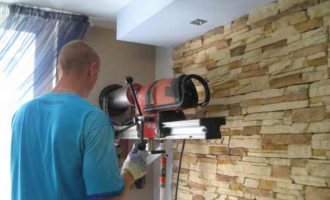
- Please note that reinforced concrete panels can only be drilled with diamond drilling.
Getting ready to install. First of all, we determine where the electrical wiring is, and make sure that the cable does not pass where we planned to install the hood. There is usually a wiring diagram in the house where you can see where the cable is routed. If the circuit is not found, use a hidden wiring detector.
Before starting work, cover the furniture so that less dust gets on it.
First, let's do the markup. The diameter of the hole for the air duct should be 132 mm if the pipe is 125 mm in diameter. The gap that remains will be covered by the outer grille.


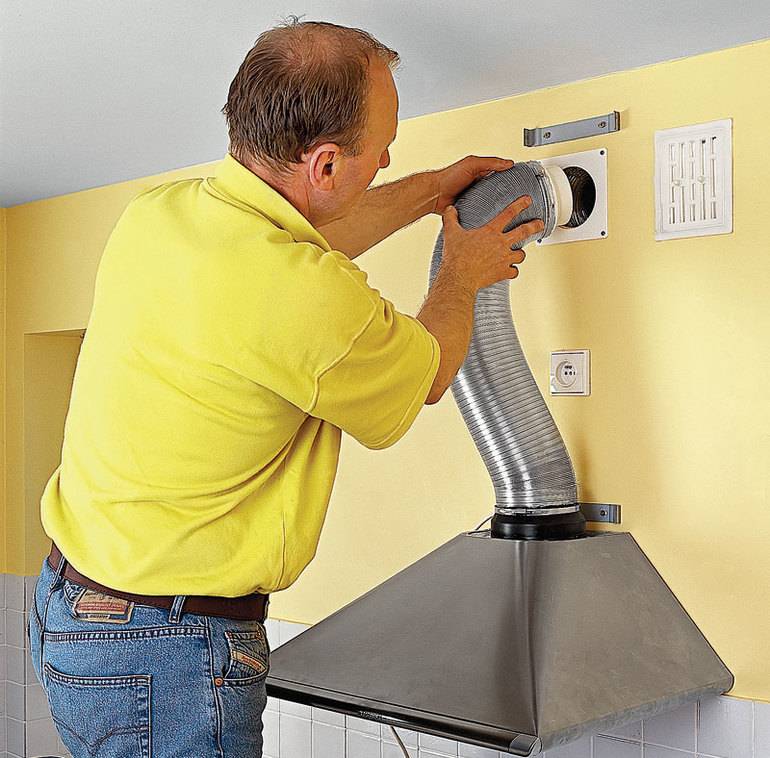


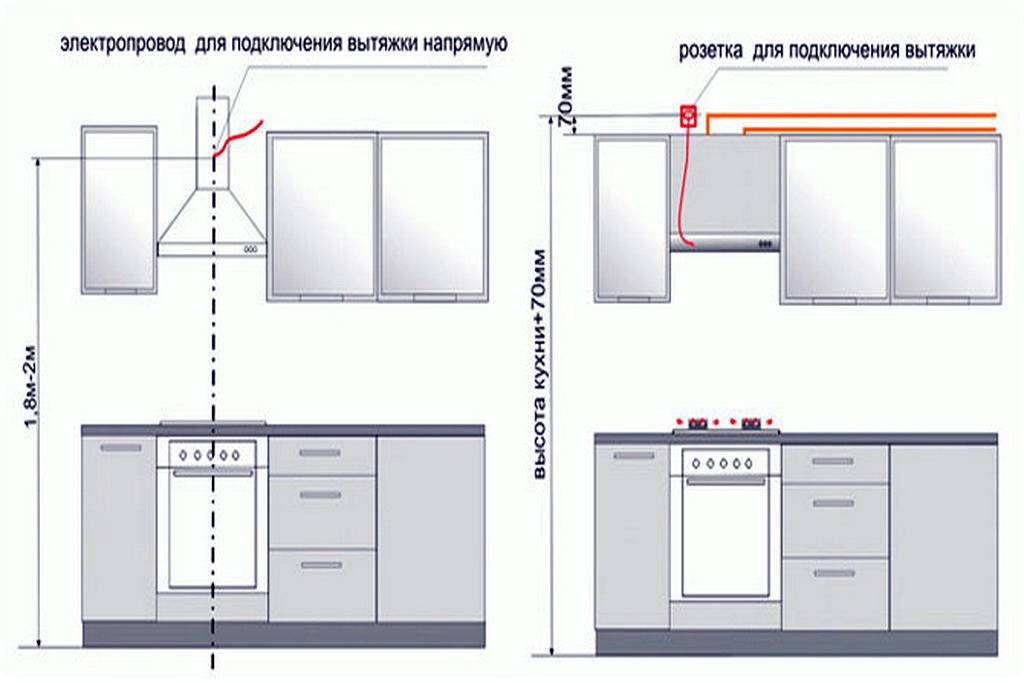
The hood must be located strictly above the stove. Follow the requirements of the distance from the stove to the hood, depending on the type of stove and hood. When marking, consider the height of the hood itself.
Installation can begin with drilling the wall according to the markings.
If it is important to keep cleanliness right during drilling, you will need an assistant who can collect dust directly from the hammer with a vacuum cleaner. If the house is wooden:
If the house is wooden:
- In the center of the hole marking, we drill a hole with an ordinary thin drill bit for wood.
- Outside, draw a circle of the desired diameter around the hole.
- Cut out a hole with a jigsaw.
- We clean the resulting hole from construction debris, align the edges.
- We install inside the pipe and check valves.
- Outside, we install a grill.
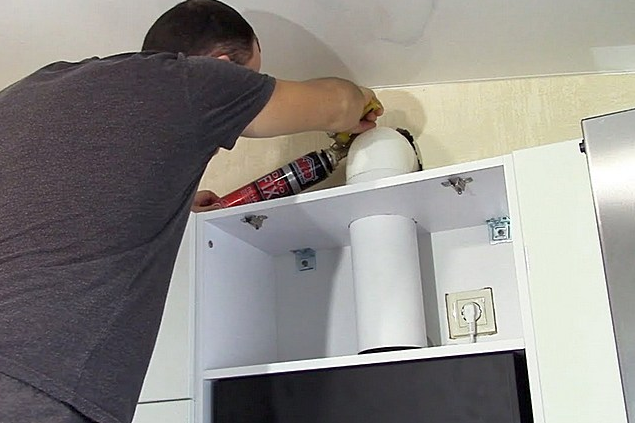
The following steps are aimed at installing the hood and connecting pipes to it. These tasks can be done in any convenient order.
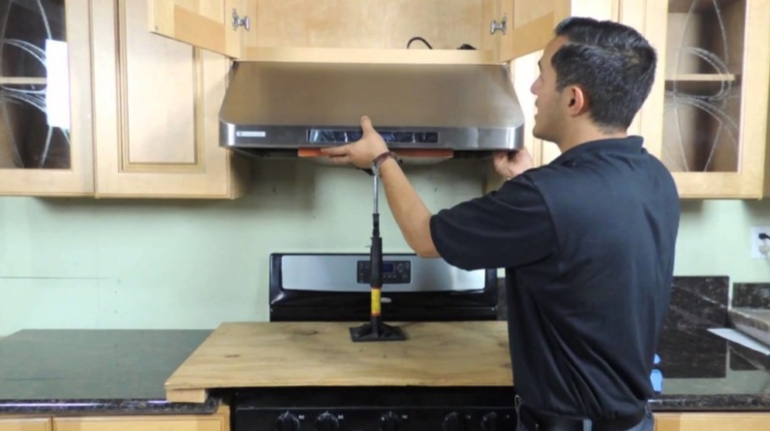
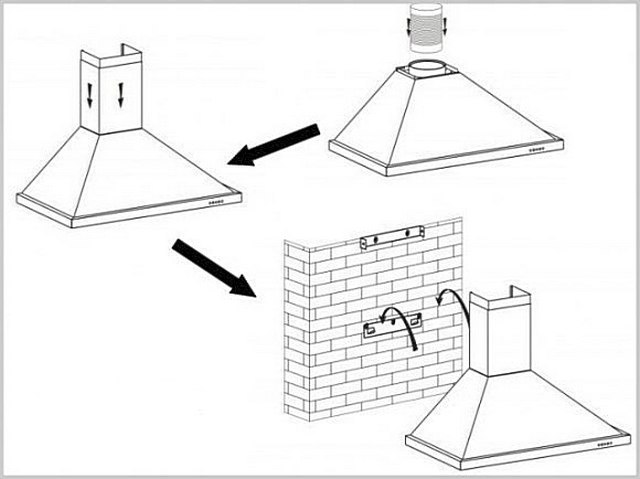
Fixing the hood itself is carried out strictly according to the instructions for it.
Typically, the hood is attached in one of two ways - to the wall or by mounting in a wall cabinet.
If the installation is carried out inside the furniture, then the connection is organized inside the cabinet, and the electricity for it is supplied to a common terminal, from where the lighting above the table is connected, and, if necessary, a socket. Thus wiring, switches and sockets are hidden. If wiring for other tasks is not provided, an autonomous installation of the socket is implemented.
Types of hoods for the kitchen
Modern manufacturers keep up with the times. There are many options for ventilation systems with different functionality. A high-quality assistant can not only quickly eliminate unwanted odors, but also prevent the appearance of soot and sticky greasy deposits on your favorite furniture.
Given the characteristics of the parameters of the room and our style preferences, you can choose certain designs.
suspended
Inexpensive and common option. Installation takes place directly above the stove. The package includes the presence of a motor, fan and filters. The mechanism sucks in air, purifies it and releases it into the environment. Filters need to be changed as they get dirty. The design is compact and has no connection to the ventilation system. Fits even in the smallest kitchen.
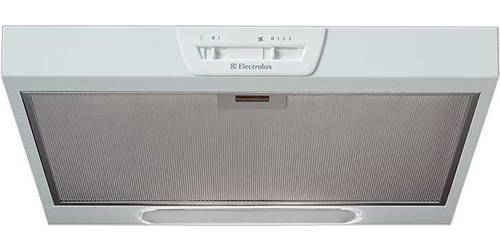 It is quite possible to use this simplest option
Embedded
The laconic design is mounted together with a cabinet, which is located above the stove. It has a telescopic fragment, which allows you to significantly increase the area of the working surface of the unit with one movement of the hand. It can be used with a connection to ventilation, or it can be used with cleaning filters.
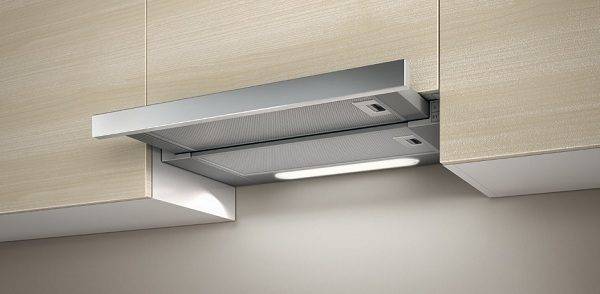
For lovers of built-in technology will be indispensable
Dome
They are one of the powerful units. They should be used in the arrangement of large kitchens. They have a wide range of design solutions for every taste. They work most efficiently by venting.
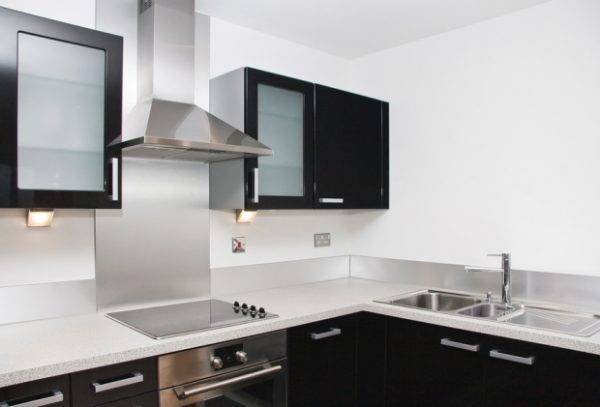
Dome system is good for air purification
corner
Allows you to apply non-standard planning solutions in the design of the kitchen space.Now important equipment can be placed in any corner and provide a comfortable atmosphere without compromising the decor. Such a hood can even be built-in and domed.
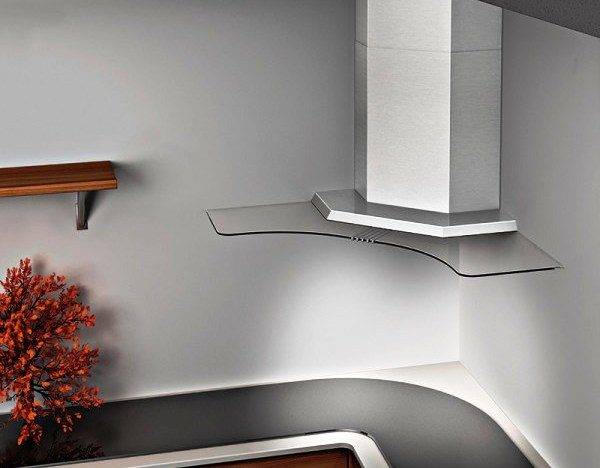 Design solution for air purification in high-tech style
Island hoods and T-shaped
Effectively work on large areas. Technical features allow you to mount the unit on the wall, on the ceiling, near the stove or above the stove. They are high power systems.




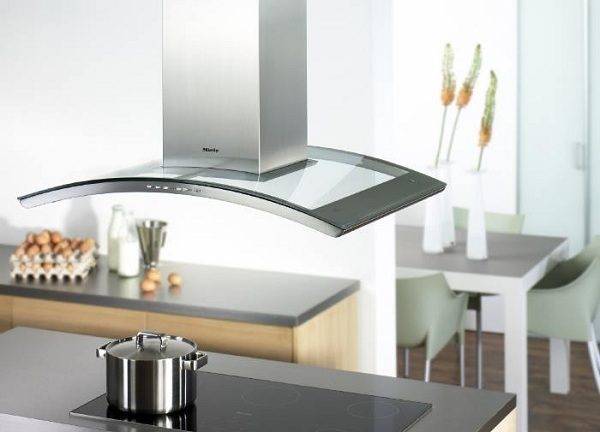 Properly selected design not only cleans the air, but also gives the room a complete look.
Hoods are distinguished by the principle of operation.
Standard type, aka flow
Requires mandatory connection to the general house ventilation system or installation of a separate output to the street. The latter is especially relevant when working in old houses.
A heavily polluted or narrow air shaft will not allow even the most advanced design to work at full capacity. Accordingly, one cannot expect a more or less qualitative result without dedicated ventilation.
The problem is not so significant when it comes to the kitchen in a new house. If the ventilation is working, just connect a new device to it.
More common in dome hoods.
Recirculation type
It is used in hinged and built-in units. The device filters the air, absorbing steam and odors. In the most advanced models, cleaning involves two stages. At the first stage, the air passes through the filter, entering the internal reservoir. This is how heavy particles are captured, such as grease, fumes and soot. Next, a fine carbon filter is included in the work. It is responsible for removing unpleasant odors.
Combined type
Such progressive devices make it possible to use one of two types of work according to the situation. Switching makes the hood universal, convenient for frequent moving.
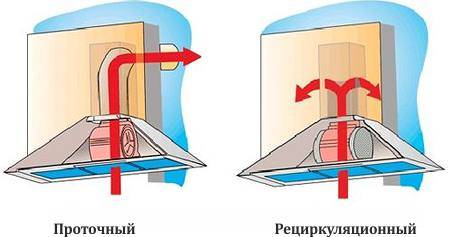 Be aware of the necessary regular replacement or cleaning of the filters.
The structure of the wall device
A typical exhaust valve consists of three main parts:
- flange;
- flaps;
- decorative lattice.
The round flange is a connecting element that allows you to connect the valve to the ventilation duct. The grate is a decorative element that simply masks a hole in the wall, and also prevents large debris from accidentally getting inside. The basis of the design is the damper.
This is a movable petal, round or square configuration, mounted on an axis. It can only open in one direction, ensuring the correct movement of the air flow. The design may also include a plumb bob that allows the valve to remain closed if the fan is turned off.
Axial exhaust fan consists of such elements as power cable (1), air intake grille (2), switch (3), switch cable (4), impeller (5), blinds (6)
For industrial applications, it is generally recommended to select a valve with good explosion-proof characteristics, but for residential applications, other features are important. For example, it would be useful to have a rubber gasket that allows you to reduce the amount of noise.
One of the common options for the exhaust valve is the "butterfly" design. It consists of two blades fixed on the central axis.Another popular design of such devices is called petal, it includes a number of parallel blades that move on the principle of blinds.
Installation of an axial fan for an exhaust type of ventilation is carried out according to a single scheme for all systems:
Such a fan is often mounted in bathrooms, bathrooms.
Why does the smell from your apartment penetrate to the neighbors?
• If a neighbor has broken his ventilation!
And because of this, he constantly enjoys the neighbor's aromas, scolding them, but he should have himself. He violated it in the most banal way - he completely blocked the flow of air into the apartment, clogging all his plastic windows and hermetic doors like in a submarine. And if there is no constant air flow in the volume of at least 150 m3 / h, then there will be nothing to go into the ventilation very soon, because the ventilation in the apartment will not create a vacuum! And when in a sealed apartment, nevertheless, part of the warm air comes out into the ventilation, then a slight reduced pressure will be created in its channel and in the whole apartment compared to the street and neighboring apartments, and the draft balance will come and the ventilation will simply stand up in its channel. And at this time, my hood was added in the common channel and the pressure slightly increased, but there was no draft in its channel, but on the contrary, air was sucked from the common one. And immediately the air from the common channel begins to easily pass into the area of lower pressure into the neighbor's channel, and exit into his sealed kitchen with a lower pressure than everyone else with open windows. Now this murderous neighbor, suffocating in stuffiness, receives a portion of the general air until his new pressure in the kitchen is equal to the pressure in the common channel.Then someone will turn off the hood and the neighbor will slightly pull it into the channel and until the next hood ...
But as soon as he opens the windows in the apartment in any weather, even with the smallest cracks, then a rhinestone will appear towards him in the ventilation and in his channel will trample up 100 - 150 m3 / h of his air at a speed of up to 1.5 m / s and no other hood neighbor will no longer crawl into his channel towards his stream.
If many neighbors clog up their apartments, then as punishment for such a gas chamber, they will have to smell my culinary delights. But that's their fault, not my problem.
• If in the attic or roof the outlet of the common channel is seriously clogged with something, like a dead dog in the channel, a stuck or forgotten jersey of a sober responsible Soviet construction worker .. Then any hood increases the pressure in the channel and it is easier for air to get out from the neighbors than to break through the dog or a bunch of fallen bricks with a sweatshirt. But this, as they say, is a warranty case, and you need to go where you need to clean the channel.
• If at the same time turn on the hoods for a maximum of several kitchens on the riser at once, then reverse draft is possible for those, for all the others, except for the last floor, because. on the last channel and does not connect with anyone. But this is extremely unlikely due to the fact that the hoods work no more than 5% of the time and not everyone cooks food at the same time, and one working hood, and even at the minimum speed, in general, will add almost nothing to the common channel. 10% is not an additive at all ...
• If the outside temperature is noticeably higher than room temperature.In this case, often, but not always, the so-called VENTILATION ROVERAGE occurs, and all at once, and this should not be confused with a local BACKDRAW from a separate neighbor-destroyer, with tightly closed windows. Here, everyone will already be blowing from the ventilation hole and everyone is saved from this as best they can, but it is better with a check valve on the ventilation. The inclusion of one hood can either exacerbate problems in the entire riser, or vice versa, turn all the ventilation in the right direction if the common channel is properly heated with hot air from the hood.
• If a strong wind is added to the summer heat in the direction from the windows of the riser kitchens. Then it will not blow into the windows, but will be drawn from the windows, and the ventilation will become supply air instead of exhaust!
Illegal installation of the hood
However, if your house was originally designed only for a natural draft hood, and you got harmful neighbors, then any installation of powerful devices with mechanical forced circulation may turn out to be illegal.
Neighbors can refer to Decree of the Government of Moscow dated November 2, 2004 N 758-PP "On approval of standards for the operation of the housing stock." There is such a double point 3.4:
You can turn it in any direction. Surely there are similar regulations in other regions. There is also another article:
So be careful with the installation of exhaust hoods over the stoves.
Although the same rules recommend installing check valves on all ventilation grilles, in all apartments. That is, as it were, it is said that it is not forbidden for you to install a hood, but for everyone else you need to take care of yourself just in case.



But here the question is how lucky anyone will be with their neighbors.
Duct selection
There are several types of kitchen ducts for household ventilation:
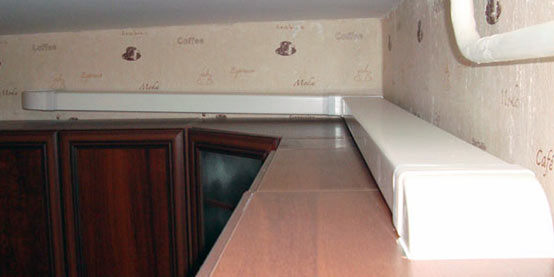 Plastic air duct is more compact and inconspicuous
- PVC plastic air ducts are strong, light and silent, as they create almost no air resistance due to their smooth surface. There are both rigid narrow plastic boxes and flexible pipes.
- Corrugated aluminum pipe is a fairly simple material for do-it-yourself installation, it can be freely bent to the desired size. Another quality of corrugations is the absence of hum or vibration, unlike hard boxes. However, an important drawback of such an air duct is an ugly appearance, so figure out where to hide the ventilation, for example, in a plasterboard ceiling.
How to choose the right hood for the kitchen without venting to the kitchen design
Choose kitchen hoods without a connected duct according to different criteria. For many customers, harmonious design and small, compact appliances are important.
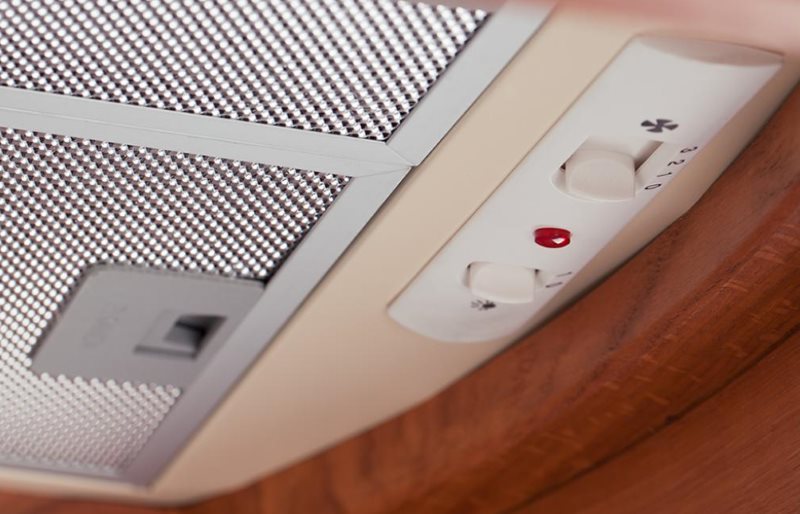
Buttons at the bottom are not the most practical option, models with a side control panel are much more convenient
From a technical point of view, it is recommended to pay attention to the following parameters:
- Dimensions. The device should not be smaller than the stove. It is optimal if the contour goes beyond the boundaries of the stove (cooking plane).
- Performance. It is worth buying a device with high performance, then it will cope with large volumes of air in 1 working hour. According to the standards for this period of time, the renewal of the air composition should occur at least 12 times. You can calculate the level of performance by calculations.The area of the room is multiplied by the height of the ceiling, the final number will be the minimum required power. It is better to choose a device with a performance higher by 30%. And if another room is attached to the kitchen, it is worth summing up both areas.
- Possibility to adjust the speed. The panel must include at least 3 regulators to set different evaporation rates.
- The presence of illumination. Cooktop lighting makes cooking easier. LEDs are the most efficient.
- Filtration system. The design usually includes an external grease trap and carbon filters. The fat catcher mesh is made of metal or acrylic fibers - these are reusable filters. There are disposable ones made of synthetic winterizer, paper or non-woven fabric. More economical reusable options.
- Other features. The presence of an electronic display, indicators of the status of the device will help to remove dirty air in a timely manner, fix the level of contamination of the filters, and clarify the performance. Also useful are sensors responsible for automatically turning off the hood in the absence of the owners. The machine can turn itself on at the set time and maintain freshness by timer.
There are a few things to keep in mind when looking after your hood.
In addition to regular filter replacement, you should pay attention to the following recommendations:
Avoid harsh chemicals and abrasive powders
Chlorine compounds are especially harmful - they cannot be used to wash the case or filters.
For cleaning, be sure to unplug the device from the network.
And if there is a long absence, it is worth connecting a voltage stabilizer.
When removing the filter, it is important to be careful not to damage the fragile parts inside the hood.
When buying filters, you should pay attention to the authenticity of coal components. Otherwise, the air will be cleaned much worse after replacing the filter.
If there are glass planes in the configuration, they can be cleaned with glass cleaner or diluted vinegar.
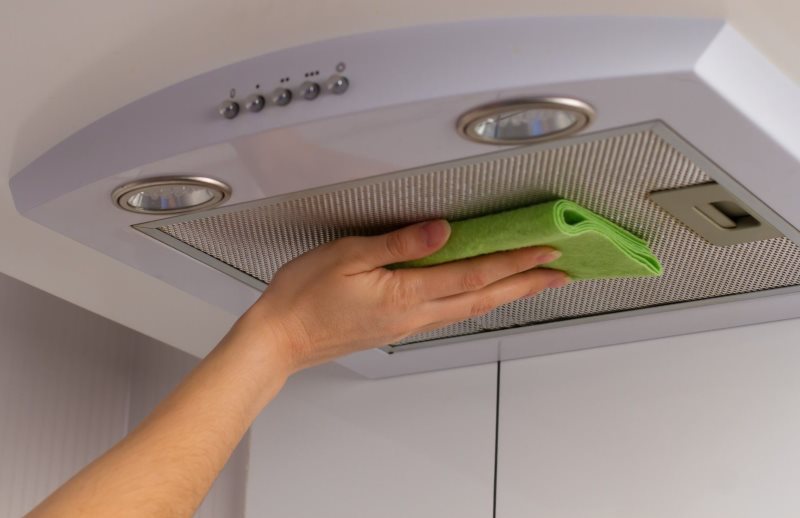
Clean the hood more often - removing a light coating is much easier than fiddling with a thick layer of soot and grease
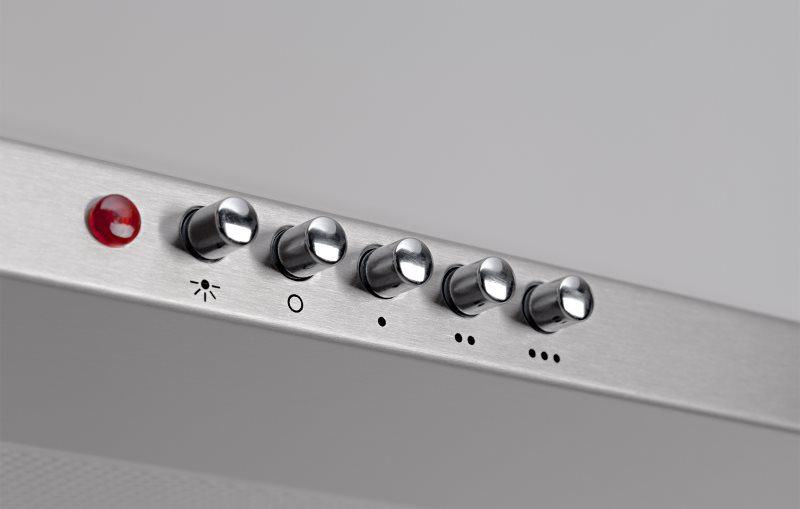
Mechanical control buttons tend to become clogged over time, and their cleaning requires considerable effort.
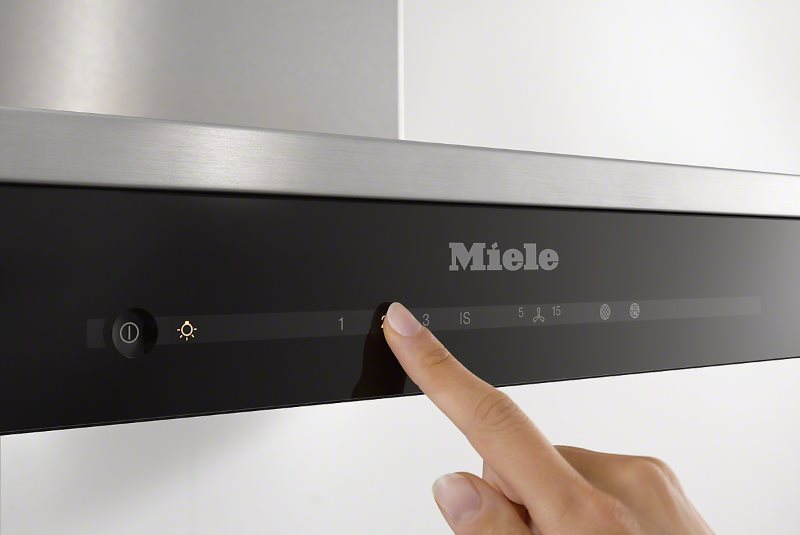
The touch panel is much more practical in terms of cleaning, you just need to wipe the surface more often with a soft cloth
At what height from the stove should it be installed?
This will depend on the hood model you have chosen.
Each of them has an instruction that says at what distance to mount the device.
Usually install the hood between 65 and 90 centimeters from the stove.
It is categorically not recommended to exceed the lower threshold, since the hood itself, or its individual parts, may begin to melt.
The upper threshold can be optimized for your height, or rather, for the height of the hostess who will cook.
Consider how to install the exhaust device, depending on the option chosen.
IMPORTANT! For an electric stove, the threshold is even lower, 65–70 centimeters, and for gas stoves, it is 75–90 centimeters higher.
Operation and care of the hood
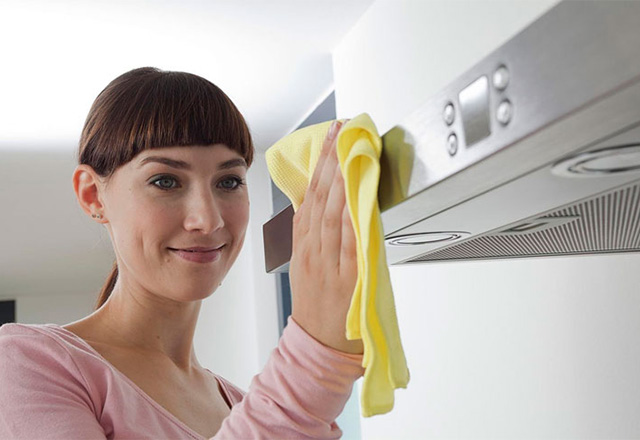
The operation of the kitchen hood should be carried out only for domestic purposes, in compliance with safety regulations. It is strictly forbidden to cover the openings on the case and restrict the air flow when the device is turned on.
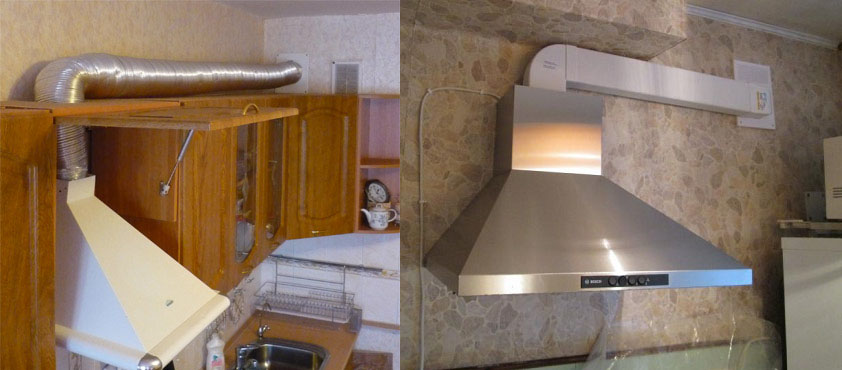


The air duct sleeve must not be connected to chimneys.
Service work during the warranty period must only be carried out by specialists. This will significantly increase the life of the hood.
You can do this yourself, periodically removing dirt and soot from the outside and inside the case, from the fan blades, etc.
It is necessary not to forget to wash the grease filters in time and change the carbon filters at least twice a year if the device works according to the recirculation scheme.
Varieties of exhaust valves
The low efficiency of exhaust ventilation is most often due to various reasons, for example, a violation of the patency of the channels or their tightness.
In multi-storey buildings, such situations often arise due to flaws during repairs, and it is not always possible to eliminate the consequences of errors and restore the normal state of the ventilation ducts.
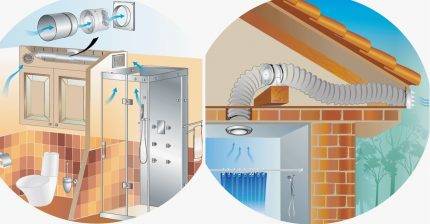 Depending on the location of the exhaust ventilation, a horizontal or vertical valve model and a fan with a sufficiently high performance are used (+)
In this case, exhaust valves may be more than appropriate. The design of these devices is very simple, their main purpose is to allow air flows to the outside and not allow them to penetrate back. According to the type of installation, such valves are divided into horizontal and vertical, it all depends on the direction of air flow.
If the exhaust flow must move vertically, choose a valve with a horizontal installation. A vertical valve is needed to vent air horizontally. Typically, models of exhaust valves are equipped with a fan. They are used where the removal of air from the room must be carried out forcibly.
Another significant point is the noise level that the device emits. The lower the sound effects from the flapping valve blades and/or rotating fan, the better. A lot of useful information can be found in the product data sheet.
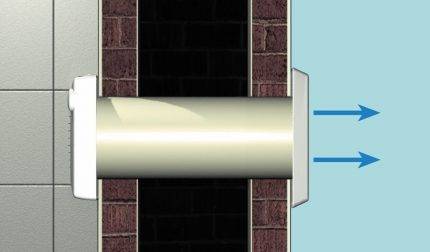
When choosing an exhaust valve that will be installed in a wall, you should consider the thickness of this wall, as well as the material in which you have to make a hole
Varieties of exhaust devices
To improve the microclimate and rid the room of odors, soot and burning, a kitchen hood is used. Depending on the internal device, it can remove the exhaust air, purify it, or work alternately in each of these two modes.
In the first case, the equipment evacuates air masses from the room into the atmosphere. To do this, a special pipe is used - an air duct.
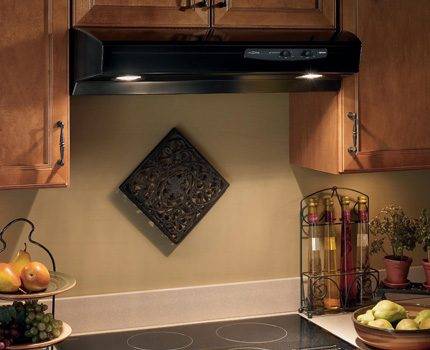
Models that draw in exhaust air and discharge it into the atmosphere are easy to use and maintain. They do not require the regular purchase of expensive filters.
Models of the second type are recirculation. For their full functioning, inclusion in the ventilation system is not required.
They need electricity to draw in the exhaust air that accumulates, for example, over a frying pan frying potatoes. Particles of fat, soot and the smell of cooking food get inside the device.
The grease filter is the first to take the hit, then it is the turn of the carbon filter. It is he who absorbs all the impurities and gives out the purified air back into the room, releasing it through the small holes in the case.
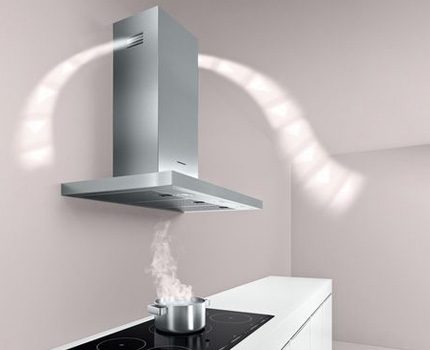
A variant of kitchen appliances that does not require inclusion in the ventilation system is characterized by large requests - for the operation of the equipment, you will need to periodically buy filtering devices, usually coal
The third type is combined models. They can work both in the mode of removal, and cleaning. In the first case, to ensure the efficiency of the kitchen hood, you will need to connect it to the ventilation. And in the second - the installation of a cleaning filter.
You will have to choose the right option during use. Moreover, depending on the model of the device, its settings may differ.
For example, for hoods with cleaning mode from LEX, the manufacturer recommends installing carbon filters first. Then take the plugs that come with the exhaust equipment and close the side and top opening, which is designed to be connected to the ventilation system.
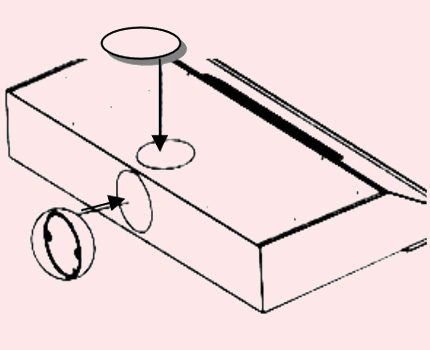
Plugs allow you to prevent uncontrolled escape of air from inside the device - at first it will be fully filtered, and only then it will come out through the holes designed for this purpose
In addition to the principle of operation, the hoods differ in the installation option - there are built-in and open.
And they all differ in shape, on which the possible location of the exhaust equipment depends.
Kitchen appliances differ in price, which depends on the popularity of the brand, the sophistication of the design idea, the materials used in the production and the functionality of the exhaust equipment.
The consumer can easily pick up a hood in the right price category - even in the inexpensive segment there are many worthy models. True, the more complex the processes the device can perform, the more expensive the final cost will be.


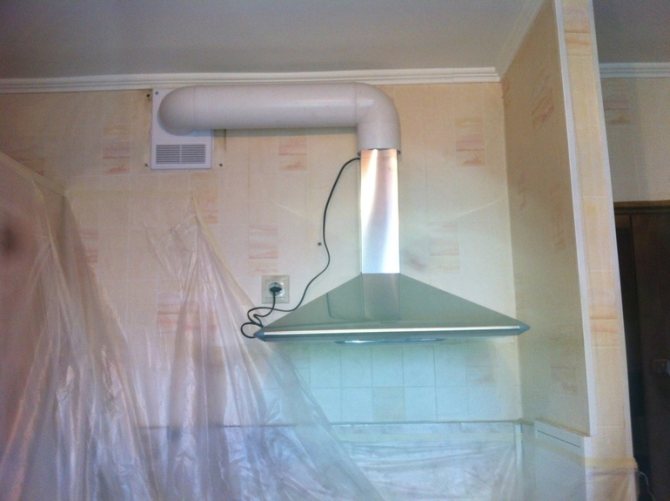
Codes and requirements for kitchen exhaust systems and installation
Exhaust systems, like any other equipment, are subject to installation requirements and technical characteristics:
- Matching the dimensions of the exhaust system and the gas stove below it for maximum efficiency in removing odors.
- It is necessary to mount the hood no less than 50-60 cm from the stove. This is done for the sake of convenience. In addition, if the hood is lowered too low, there is a high probability of ignition of the accumulated fat on it.
- The extraction capacity must replace the air at least 10 times per hour. To calculate how much the exhaust system should process, you need to take into account the area and height of the ceilings in the kitchen. Calculate by the formula: V \u003d S * h * 10 * 1.3, where S and h are the area and height of the room, respectively, 12 is the minimum air processing rate for 60 minutes, 1.3 is the correction factor.
- If there is no veterinary duct in the kitchen, then it is better to install the hood with the ability to adjust the performance, recirculation. If you connect a flow hood to natural ventilation, this will lead to disruption of the latter. Also, do not turn on such devices for a long time.
- Masters must strictly follow the instructions of the equipment passport.
- The hood is leveled.
- Turns at an obtuse angle are not allowed, any turns should be as small as possible.
- If the length of the route exceeds 300 cm, then a second exhaust fan is required.
- It is not necessary to choose equipment with high power, it makes a lot of noise, and it is not intended for living quarters.