- The main types of repair work with gas stoves
- Basic steps
- Common electric ignition problems
- How to fix the problem?
- What to do if the pie constantly clicks by itself
- How to fix a problem without resorting to the help of a specialist
- Problems with burner knobs
- Handle is hard to push and turn
- Checkbox scrolls or pops off
- Handle turns hard
- How to remove handles from gas stoves of different models
- How to remove the handles from the Hephaestus gas stove
- How to remove the handles from the Darina gas stove
- How to remove handles from a Hans gas stove
- Share on social networks:
- Other causes of problems
- Breakage of candles
- Common electric ignition problems
- Reasons for auto-ignition
- Reason #1 - moisture inside the control button
- Reason #2 - Junction Formation
- Reason # 3 - mechanical connection of the contact group
- Gas hob repair
- Electric ignition button does not work (no spark)
- After ignition, the flame goes out on the burner
- What it is?
- Conclusions and useful video on the topic
- Conclusions and useful video on the topic
The main types of repair work with gas stoves
There are several problems that are most commonly encountered with these devices. Therefore, repairs are usually required the same.Some of the most common gas stove repairs include:
Burner repair
. It is these items of equipment that most often fail, so it is necessary to carry out certain repairs with them. As a rule, the flame begins to weaken, after which it appears only on one or two sides of the burner, and then disappears altogether. The reason for this deterioration in the operation of the burner is the clogging of the burners or dividers. Some people in the process of cooking with a gas stove allow food to get on the burners, which lead to clogging of the elements. Even when cleaning the stove from dirt, a small amount of detergent can get into the burners, so the elements become clogged. This problem is solved quite simply, since it is necessary to remove the burner, after which it is disassembled into its component parts. The nozzle and divider are thoroughly cleaned, which ensures that the cause of the blockage is eliminated. You can clean them with various specialized tools or improvised means, which include a regular needle or knitting needle.
Oven door repair
. Another popular problem with a gas stove is certain obstacles that arise when opening the oven door of the appliance. The door begins to jam or does not close tightly. This problem usually occurs after several years of operation of the equipment. It does not make it possible to fully use the oven, so there is an urgent need to carry out repairs. To repair the element, the door is removed, for which the screws are unscrewed with which it is attached. You should not unscrew them completely, as it is enough to just let them go a little.Next, the door swings slightly in different directions, which will ensure that the door fits on the hinges. Such an adjustment will lead to a solution to the gaps with the opening or closing of the door.
Valve thermocouple repair
. This element belongs to the gas leakage control system, therefore it is considered an important and complex product that must work without interruptions and problems. It is the thermocouple of the solenoid valve that prevents the possibility of gas leakage if the flame is accidentally extinguished. The safety of using the gas stove itself, as well as the safety of living in the house in which this equipment is located, depends on it. Often, problems with this element arise when, after igniting the burner and releasing the button, the flame goes out. A thermocouple is a special metal pin with one side pointed. This element is located next to the burner and acts as a temperature sensor. As soon as the flame dies out, the temperature near the burner drops, so the gas control cuts off its flow. Therefore, even if the burner is turned on, the gas will not enter the room. If there is a problem with the constant extinction of the burner unnecessarily, then the thermocouple should simply be cleaned of adhering deposits from fat and food residues. Standard sandpaper works great for this. If even this process did not lead to the desired result, then you will have to disassemble the device and replace it with a new element.
Thus, simple repairs associated with a gas stove are allowed to be carried out on their own.However, they should not concern the direct connection of the device to the gas line. In these cases, you should definitely resort to the help of specialists, since there is a high probability of making irreparable mistakes. This endangers not only the owners of the apartment, but also other residents of the apartment building.
Basic steps
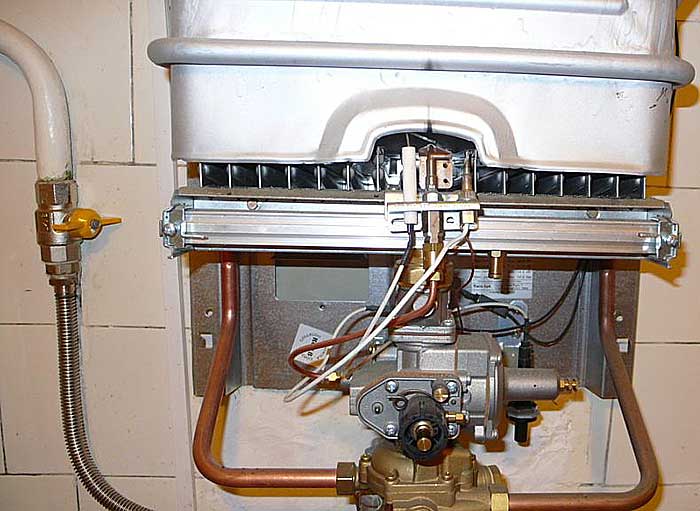
What to do if the geyser whistles? The first step is to determine the source of the sound. Shut off the gas. Open the faucet to the hot water position. If the problem is not serious, the gas unit immediately stops whistling.
If the whistle only gets louder, pay special attention to the water path. Study its components: pipes and maintenance, and its components. They could get dirty
A particularly common situation is accumulations of scale on them.
They could get dirty. A particularly common situation is the accumulation of scale on them.
And scale often accumulates if the set temperature parameters of the water constantly exceed the value of 60 degrees.
The measures here are simple - carefully clean these components. How to do it effectively? Start the reverse flow of water. He will drive out all the blockage from the pipes.
Backpressure should be done only after turning off the gas and water. It is also required to unscrew the eyeliner at the inlet.
The easiest way to carry out this operation is to use a faucet in the bathroom. The shower switch must be set to the neutral position. The taps should be slightly open.
To remove lime deposits, use a descaling agent. You can work with folk remedies: acetic or citric acid. They are bred in the correct proportions. The resulting composition is poured slowly into the water path. By the degree of attenuation of the sound, it is added.Then repeat this procedure three more times.
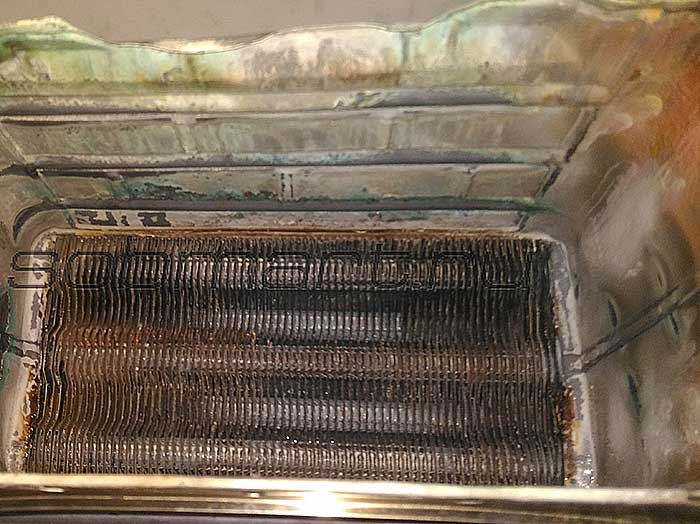
This is a good method when the geyser whistles due to a clogged path.
And when you open the tap, and there is no whistle, the problem could be hiding in the gas path. This means that there is a possible damage to the valve for adjusting the power of the flame.
This is the most common answer why the unit does not stop whistling. The problem manifests itself especially clearly when the optimal ratio of gas flow dynamics and valve clearance width is reached. This ratio in different columns can have different values.
If the geyser whistles when operating in enhanced mode, it is necessary to adjust the regulator until the opposite sound disappears completely. Turn it smoothly, then in one direction, then in the other. The dynamics of the gas flow will decrease. It is not enough to produce sound. If it is increased, the valve clearance will expand, and the unit may start whistling again.
If these measures do not give the desired effect, then the gas path is clogged. The device will whistle even louder. It is urgently required to disassemble, calculate the problem area and thoroughly clean it.
If your geyser is still under warranty, contact the service immediately. You will have to go there if the warranty period has expired, and you cannot solve the problem on your own.
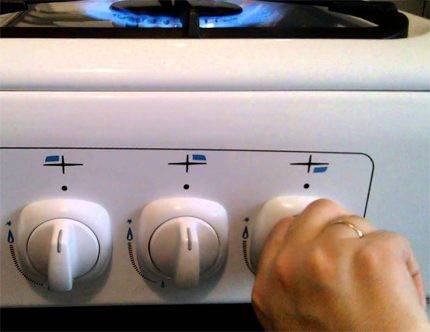
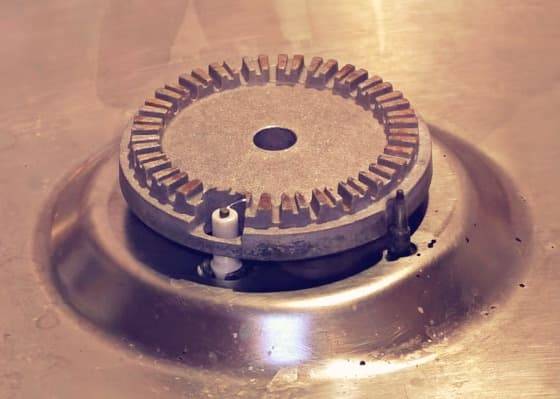
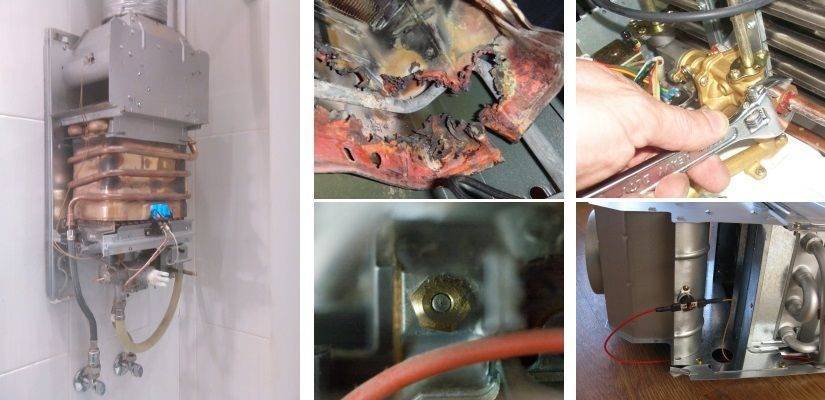


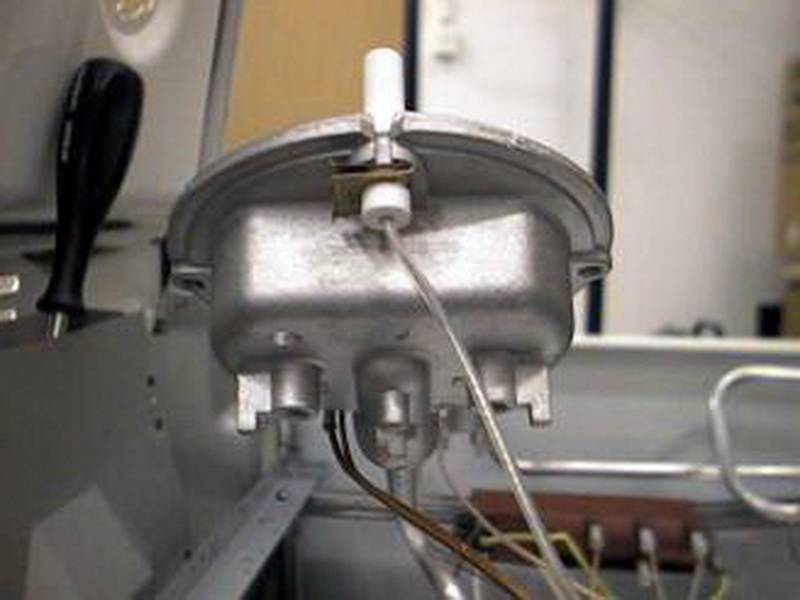


An independent solution to the dilemma is possible when you have the necessary knowledge and skills. The task is to clear this tract. Scale or winding elements could be stuck in it. If so, the speaker will start to whistle very powerfully.
Common electric ignition problems
A typical electric ignition circuit consists of wires, contacts, an electric candle and a start key. All of them require careful handling and maintenance.Here are the most common breakdowns to look for when the stove clicks:
- Contacts are oxidized. This often happens when water gets in or just in a damp room. Usually, when oxidized, the module is turned off. But sometimes on the contrary, if the circuit closes, it will work indefinitely. This failure is indicated by sparking in all burners.
- The button is broken. The key is the weakest point because it is mobile. If you press it too hard or sharply, or turn the handle at an angle, the button may mechanically break. It can't be fixed, it needs to be replaced.
- The ignition unit is broken. This fault is diagnosed by elimination. If all the previous reasons did not help to correct the situation, you will have to install a spare part. Some elements in it are damaged due to a power surge or natural causes and cannot be repaired. Most often, owners of Gorenje, Indesit, Gefest devices apply for this service.
How to fix the problem?
The first step is to disconnect the device from the mains and close the gas valve. After that, you can proceed to the following actions:
- remove excess moisture outside and inside the plate;
- if there is a lot of liquid, remove the button and blow it with a hairdryer;
- carefully disassemble the parts and dry the button.
It is worth inspecting the internal parts of the structure and, if necessary, cleaning them.

If none of the above options work, contact an appliance repair specialist for help. Self-interference often leads to even more serious consequences.
If crackling or clicking sounds are periodically heard from the gas stove, it means that the auto-ignition system has broken down.It is not difficult to fix the problem, you just need to follow simple recommendations or, if necessary, replace the failed part.
The most important advice that will help to avoid such a disaster is the proper care of the burners. Timely cleaning and accuracy will allow the device to serve for a very long time.
What to do if the pie constantly clicks by itself
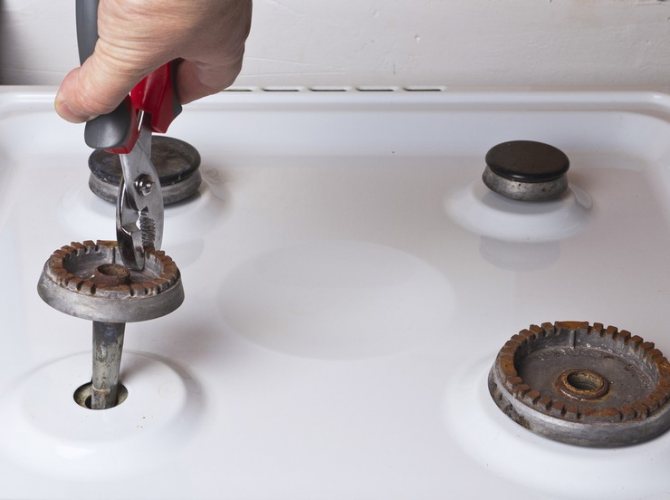
The most important thing in such a situation is to find the source of the malfunction, and then simply follow the instructions to fix it. Having found a breakdown, do not panic and strictly observing all safety rules, try to make repairs, guided by our advice. Remember - most of the causes of the problem, in this case, are absolutely safe and can be completely eliminated on your own without resorting to the services of specialists.
How to fix a problem without resorting to the help of a specialist
The following steps may help you troubleshoot the problem:
- If the cause of the breakdown is water, and its constant contact with the stove, then there is only one way out - dry it thoroughly, after turning off the auto-ignition from the outlet. Let the stove stand unplugged for several days - during this time it should dry thoroughly and the clicks will stop on their own. If such a “repair” did not help, it’s time to call the master and entrust the repair to him. When drying, one important point must be taken into account - it is impossible to dry the stove with a working oven - so moisture, on the contrary, will collect in huge quantities in the device and the situation will only worsen. Therefore, be patient and let the device dry naturally.
- If the ignition button does not work well, then the reason is the accumulation of dirt, dust or solidified fat under it. Clean it up.For the best cleaning effect, use a brush dipped in soapy water. Let the board dry after cleaning. It should be noted that this method is not always able to return the button to its previous performance. There is always a chance that due to the low landing, it will not fully press. If cleaning does not help, consider changing the auto-ignition button or its entire mechanism.
In the process of prolonged use, the auto-ignition unit may fail. If only one burner does not work, then the reason is very likely to be the damage to the wire located in the block channel. But do not forget that the burner itself may be faulty, and in this situation, self-repair is not only unacceptable, but dangerous to life. For an accurate diagnosis of the cause of a non-working burner, you should contact a specialist who can not only identify the real cause of the malfunction, but also replace the damaged element.
The main thing is that whatever happens to your favorite stove, do not panic and act deliberately. Remember, a well-thought-out repair can eliminate almost any damage.
Home Appliances Stove
Problems with burner knobs
The handles for supplying gas to the burner are one of the most necessary parts; without them, it is impossible to use the stove. Behind the outer flag with a skirt, which you turn, is a gas cock, which can be equipped with a gas control sensor.
Electric ignition built into the handle is rare for Hephaestus stoves - usually it is carried out with a separate button.
Over time, the handles may stop turning, start to stick or scroll. What to do with it, we will tell further.
Handle is hard to push and turn
Such a problem is not uncommon, if you run it, the handle may completely stop turning. The cause is usually grease that has accumulated between the flag, the skirt and the front panel of the stove.
Hot, it splashes during cooking and easily flows into all the cracks, and then cools down, thickens and turns into a kind of glue.
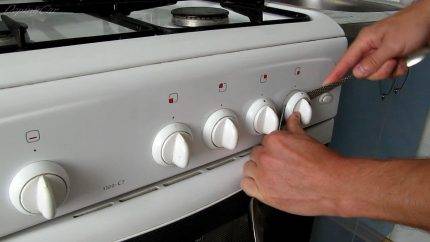 Gently pry off the skirt and handle with a knife, screwdriver, or other flat object. Don't use too much force - you can damage the enamel or plastic
To get rid of the problem, the flag with the skirt must be removed from the stock and washed thoroughly. The handle needs to be pulled towards you - it is simply tightly mounted on the stem, without latches or other latches. For convenience, you can grab it with pliers, preferably through a non-slip rag, one of those sold for cleaning.
The skirt usually flies off on its own after removing the handle, but if it does not turn with a flag, it can be secured with a latch. In any case, it can be tucked with a knife. Remember its position so that during assembly the latches close to the panel or to the flag.
Many models have a reinforcing metal plate in the handle, do not lose it. After washing all the parts, as well as the front panel under the handle, assemble everything in place. Don't forget to insert the spring if you have one.


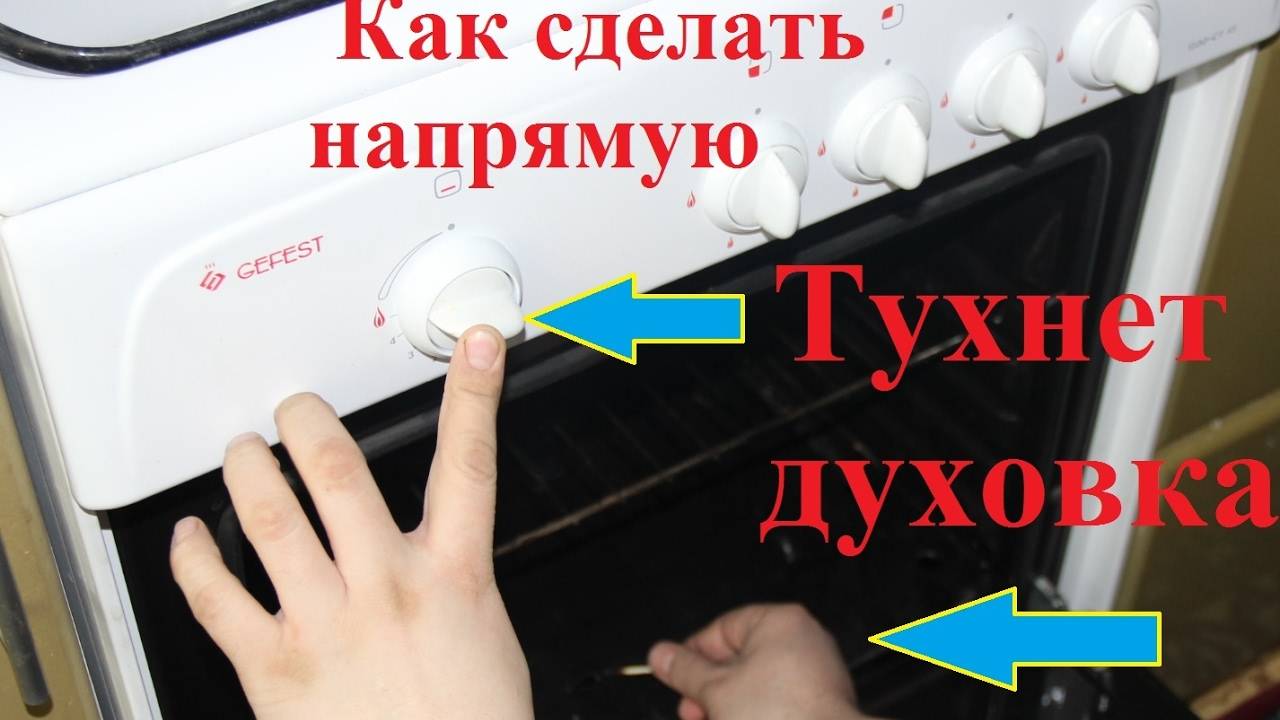
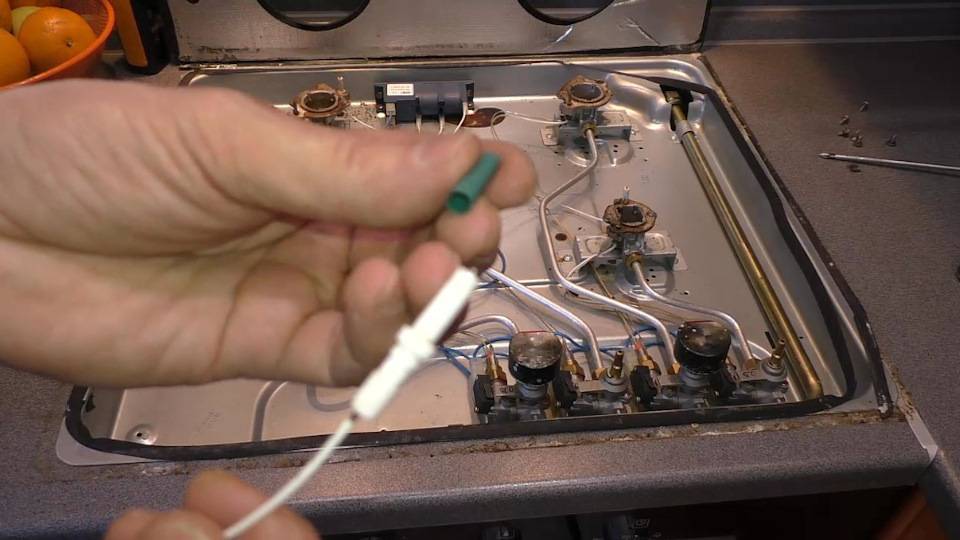


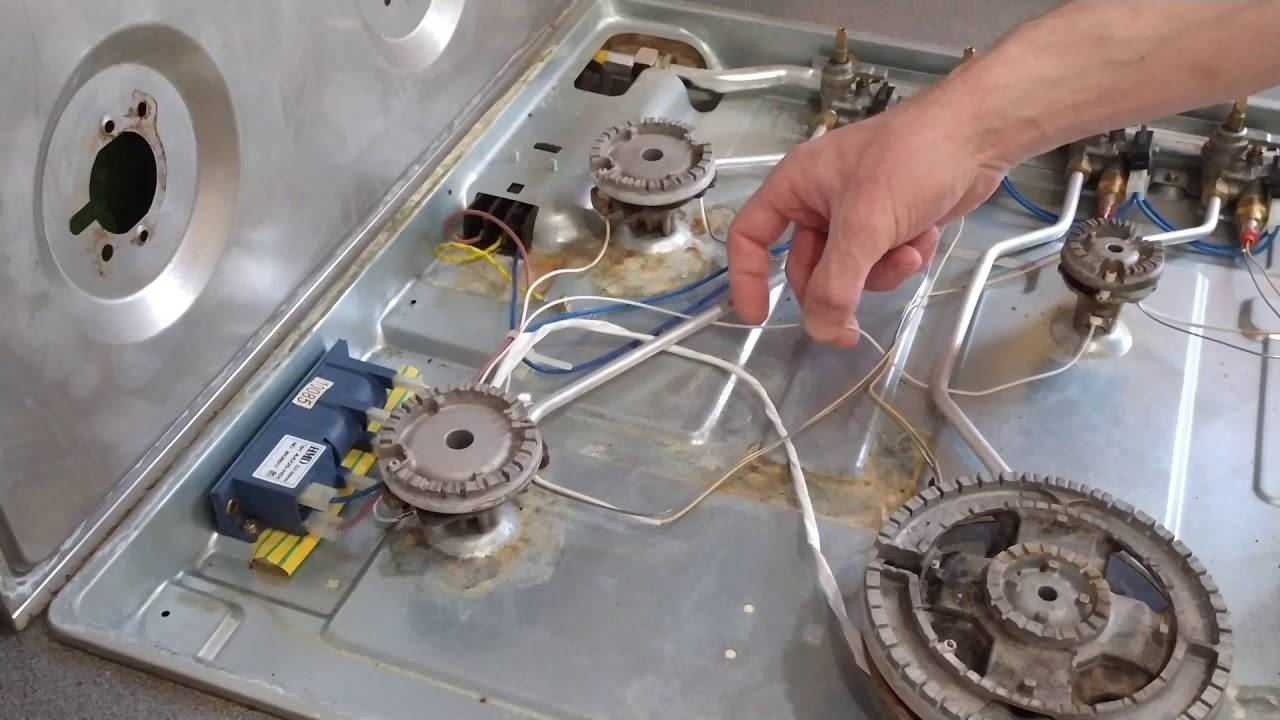
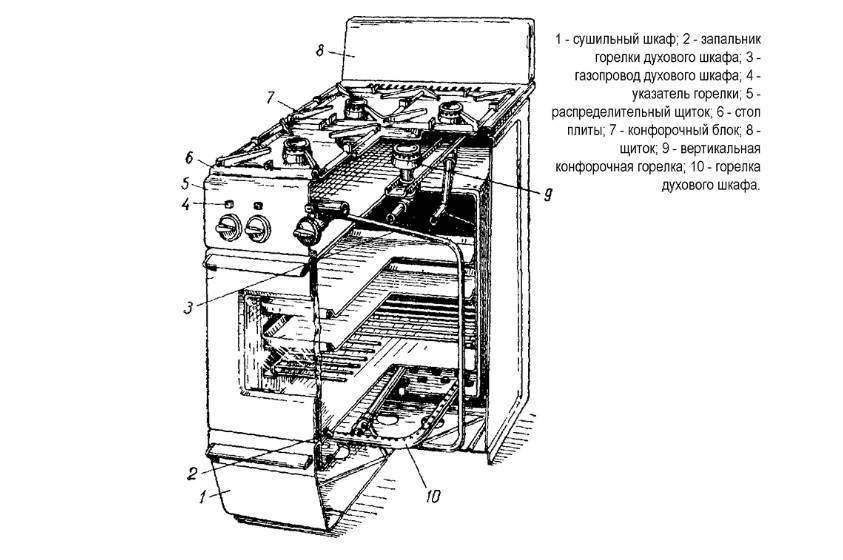
Checkbox scrolls or pops off
Such a problem with Hephaestus plates is rare, but still happens. The reason is usually that the metal plate fell out of the flag and was lost, which clings to the notch on the stem.
You can cut such a plate from a metal cover for conservation and insert it into a special groove, or buy a new flag. If on your model the handle is completely plastic and its inside is licked, only buying a new one will help.
Handle turns hard
It happens that even after the flag with the skirt is perfectly washed, the handle still turns tight. The reason is that grease has developed on the gas taps.
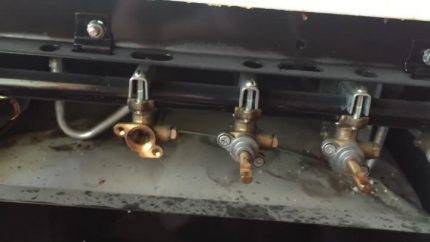 It is better to invite a specialist for prevention, because errors in such repairs threaten to leak or clog gas supply pipes
If you decide to lubricate the gas taps yourself, buy a special graphite grease for this. Shut off the gas supply to the stove. Then remove the handles and the front panel - we described above how to do this.
In Hephaestus plates, the stem is fixed in the valve with a flange connection; in order to remove it, it is enough to unscrew 2 bolts on the sides. Wash the stem immediately from grease and dust.
Then the spring and the tap plug are removed - the latter needs to be lubricated. This is a cylindrical part with a through hole and a cut on the side, through which gas is supplied to the burner. You need to lubricate the cork quite a bit, the layer should be invisible, but noticeable to the touch. It is more convenient to collect a little grease on your finger and rub the cork.
After assembling the faucet, do not rush to reinstall the front panel. First, put the flag on the stem without it, open the gas and apply a soapy solution to the tap. If no bubbles appear anywhere, wipe everything dry and reassemble the stove.
How to remove handles from gas stoves of different models
The principle of operation of this technique is almost the same. Popular among users are plates of such well-known manufacturers as:
Each device is equipped with gas supply power regulators. On some models, removing them is very easy. It is enough to use only the tip of the knife and pry the element.Other models of plates require disassembly of almost half of the surface of the structure and the presence of tools such as:
- pliers;
- multi-format screwdrivers;
- kitchen knife.
Removing handles on such devices as Hephaestus, Darina, Hansa does not require the intervention of specialists and contacting service centers. They are simply removable, they can be easily cleaned and even replaced by new ones. There are gas and electric stoves on which the regulators are welded to the internal parts. Such devices are called stationary, on which it is impossible to remove the handles at home. In this case, you need to contact professionals.
Stove regulators
How to remove the handles from the Hephaestus gas stove
Many housewives do not know how to remove all handles from the gas plates of Hephaestus to wash its surface. The Hephaestus device contains several types of handles responsible for activation:
- burners of the main surface;
- ovens;
- mechanical timer.
Regulators on the plate Hephaestus
To light the burner, the valve on the Hephaestus must be pressed down and turned. As practice shows, removing such regulators is not at all difficult. But at the same time, you should not forget about the safety rules:
Shut off the gas valve.
Make sure all knobs are off, turned all the way.
Take a knife and pry off the handle
It is very important to do this together with the circle on which the marks are drawn.
Apply force and pull up. If the applied efforts are not enough and difficulties arise, experts recommend using WD-40 (liquid key)
Now you can clean these parts from grease and other contaminants.
How to remove the handles from the Darina gas stove
The regulators of the Darin model are very similar to Hephaestus, in which the ignition of the burners requires pressure. The instructions for dismantling parts of this brand are as follows:
Turn off the gas first.
Next, disconnect the hose that is connected to the device.
Check all control valves
Please note that they are disabled, otherwise it may harm the plastic parts (may burst).
Wrap the regulator with a piece of cloth, pry off the edges with a knife and remove it with pliers. Instead of pliers, you can use two knives, where one of them will act as a lifting lever
It is necessary to remove the rotary handle on the devices very carefully so as not to damage fragile components: springs, nozzle washers, cylinder
Instead of pliers, you can use two knives, where one of them will act as a lifting lever. It is necessary to remove the rotary handle on the devices very carefully so as not to damage fragile components: springs, nozzle washers, cylinder.
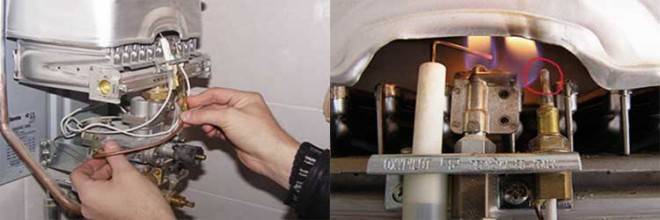
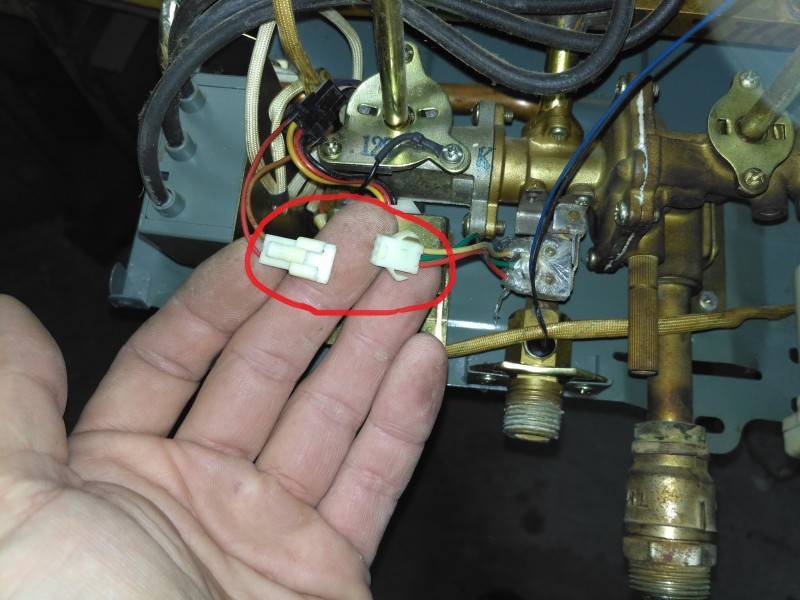
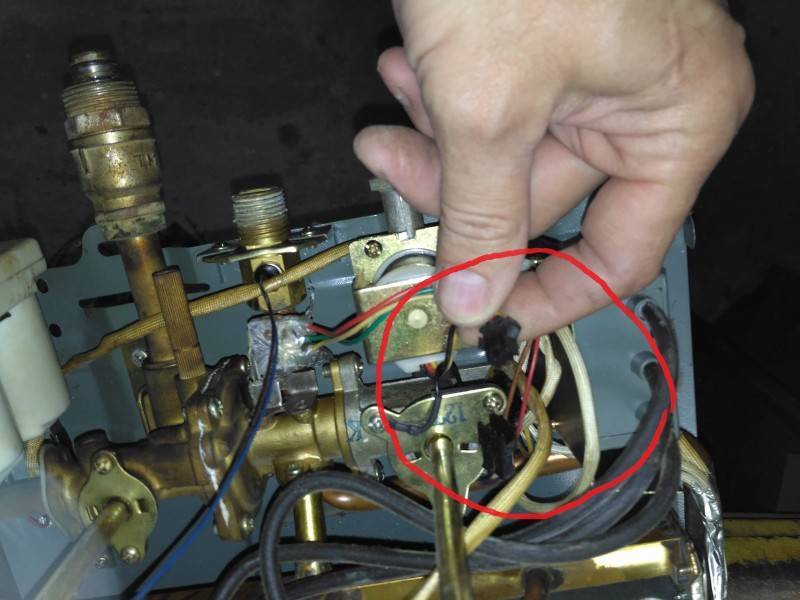


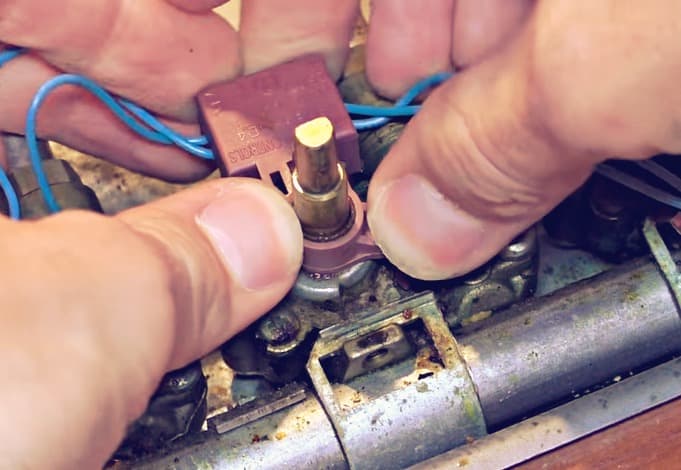

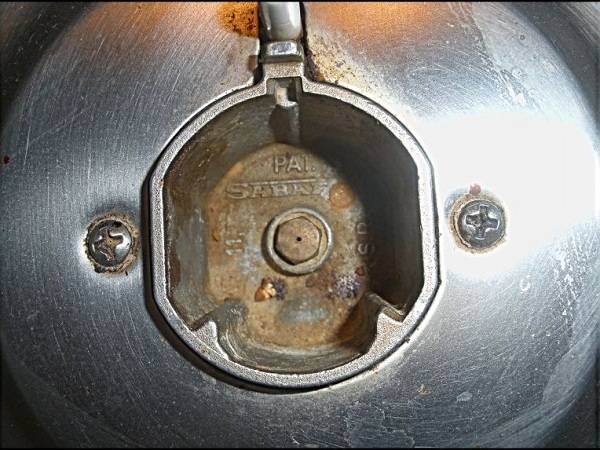
Removing the rotary control
How to remove handles from a Hans gas stove
The Hans model is characterized by ease of operation and good performance. As with the previous two kitchen appliances, the handles on the Hans are detachable and require little effort. The main thing is to be careful, do not forget about safety. Before work, be sure to turn off the gas. The regulators are removed with a small thin screwdriver, which you need to pry off the washer with the adjustment marks and pull it towards you.
Hans gas stove
Usually the process of removing the handles goes without difficulty, but sometimes the fat under the adjusting elements can slow down the process.In such cases, housewives use a variety of soap solutions, which first moisten the parts, and only then begin to remove the parts. As practice shows, control valves lend themselves well to removal after processing with a liquid key. But do not get carried away with this tool, otherwise it reduces the performance of the rotary mechanism of the handles.
Share on social networks:
One of the most common problematic issues for housewives is how to clean the handles of the stove from old fat, because this is not the easiest task, although there are enough cleaning products on the modern market. And also, initially you need to learn how to remove the handles from the Hephaestus gas stove or any other brand. You will find general rules and useful tips on cleaning this part of the hob in this article.
Other causes of problems
In addition to electronics, other components become the cause of the malfunction.
If the oven operates on mechanical ignition, it is advisable to pay attention to the state of the button located on the control panel. It is she who starts the process of spark formation and is powered by the voltage of the central network
Most often, the contacts melt due to a short circuit. The performance of the node is checked with a multimeter.
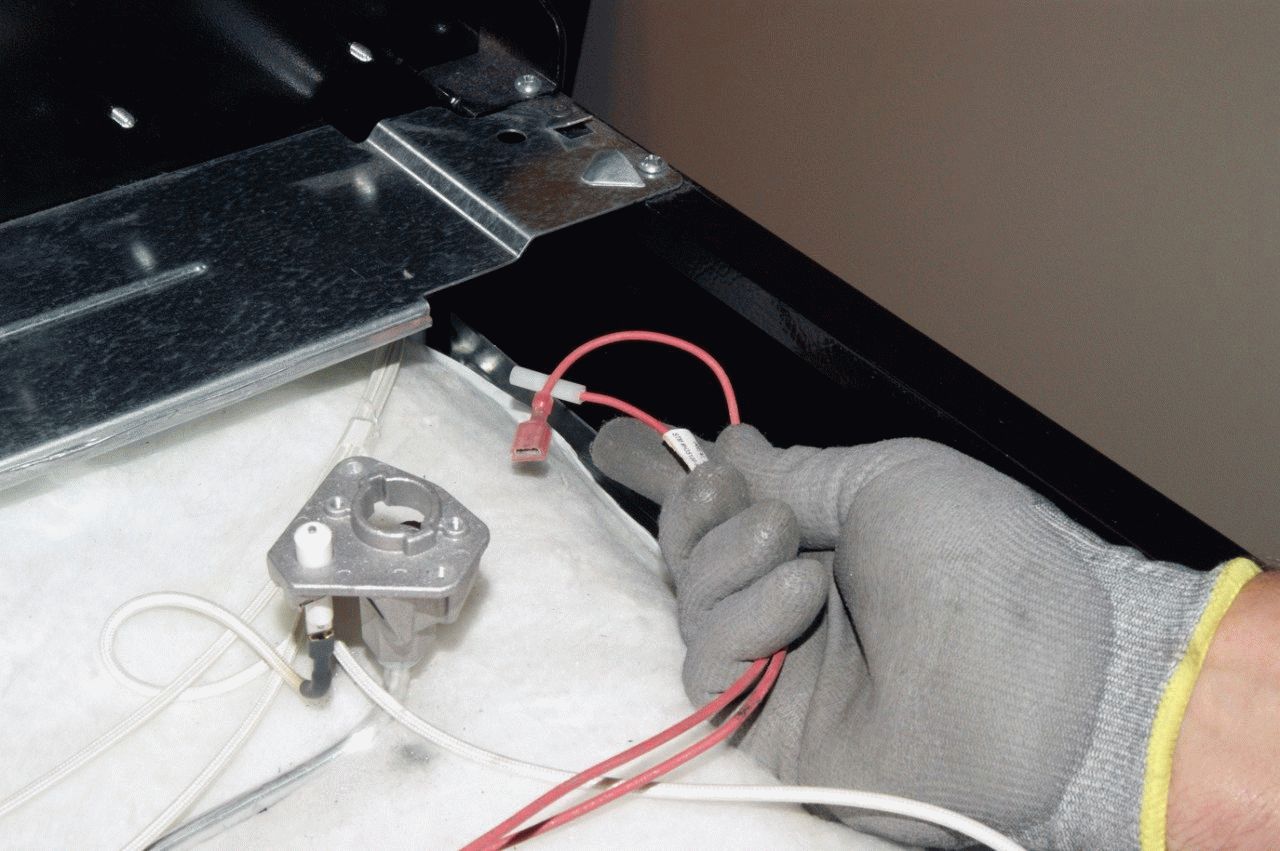
Breakage of candles
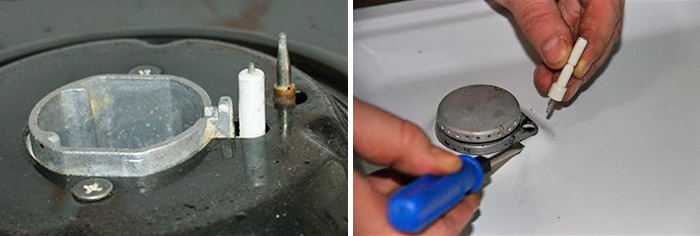
Another reason for the breakdown lies in the breakdown of the burner candle. If you want to check the performance, turn off the gas and press the ignition. If there is no spark, the spark plug is faulty. The cause of failure may be contamination of the candle with grease, oxidation of the steel rod, and leakage. Interruptions in work will appear if a crack appears on the element and a spark strikes to the side in the area of violation.It is impossible to isolate or repair candles; the only correct way out is replacement.
Common electric ignition problems
A typical electric ignition circuit consists of wires, contacts, an electric candle and a start key. All of them require careful handling and maintenance. Here are the most common breakdowns to look for when the stove clicks:
- Contacts are oxidized. This often happens when water gets in or just in a damp room. Usually, when oxidized, the module is turned off. But sometimes on the contrary, if the circuit closes, it will work indefinitely. This failure is indicated by sparking in all burners.
- The button is broken. The key is the weakest point because it is mobile. If you press it too hard or sharply, or turn the handle at an angle, the button may mechanically break. It can't be fixed, it needs to be replaced.
- The ignition unit is broken. This fault is diagnosed by elimination. If all the previous reasons did not help to correct the situation, you will have to install a spare part. Some elements in it are damaged due to a power surge or natural causes and cannot be repaired. Most often, owners of Gorenje, Indesit, Gefest devices apply for this service.
Reasons for auto-ignition
As it turns out, taking into account practical experience, the spontaneous clicks of a gas stove lighter in most cases are not connected in any way with the electronic circuit of the ignition unit.
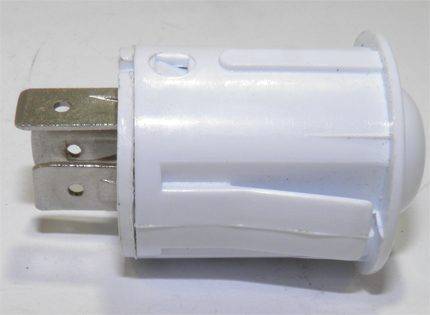
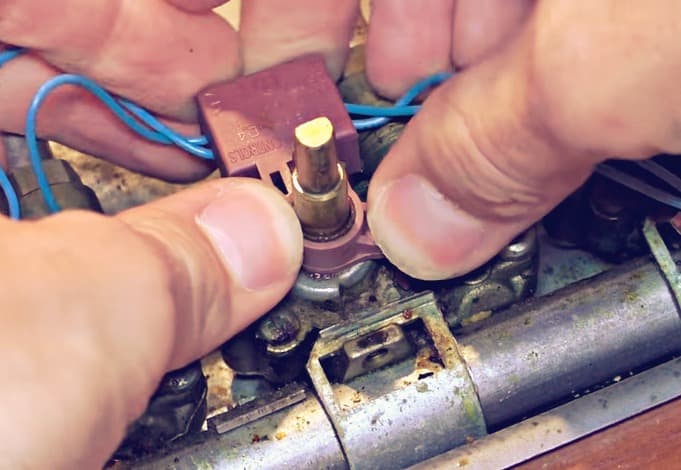
One of the many designs of button-lighters for gas stoves. Traditionally, a plastic case and a metallized contact group are ideal conditions for the formation of oxide junctions. However, there are better, but more expensive designs.
The reasons for the appearance of an uncontrolled spark lie elsewhere. Often the place of formation of such a defect is the inner area of the ignition control button.
Reason #1 - moisture inside the control button
Surely the owners of gas stoves had to deal with uncontrolled ignition clicks on the gas stove after washing and cleaning household appliances.
Most likely, during the washing process, some water got on the ignition control button, as a result, part of the moisture penetrated inside.
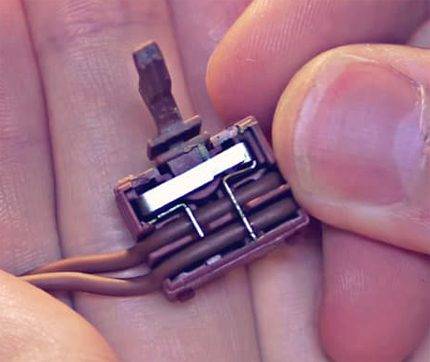
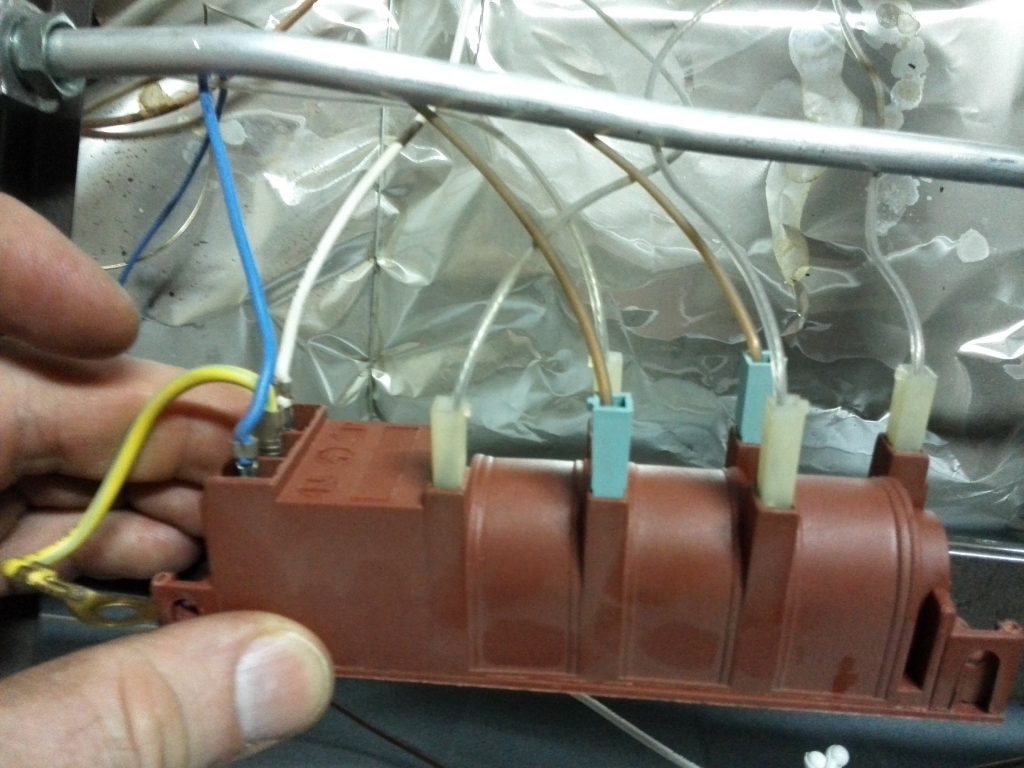
View of one of the designs of the lighter button from the inside. With such an arrangement of conductors, even a small amount of moisture, soot, soot, etc. enough to form a short circuit between the contacts
Given that a high discharge voltage is applied through the ignition button circuit, a small amount of moisture is enough to cause an uncontrolled spark to appear on the gas stove spark gap.
Usually, the defect of an uncontrolled spark of a lighter in such cases disappears after some time. The moisture inside the button dries up, the short circuit factor disappears, respectively, spontaneous clicks stop.

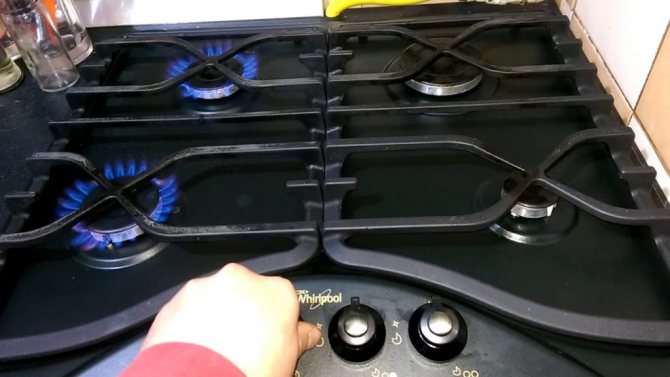
The picture shows a simple way to get rid of the defect of spontaneous sparking of the ignition system, obtained due to moisture ingress. Warming up the device for some time with all the burners helps to get rid of uncontrolled clicks.
Often, the correction of a short circuit defect due to “water trapped after washing” is helped by lighting all the burners of the gas stove for about 15-30 minutes.
Reason #2 - Junction Formation
The junctions formed inside the ignition button can have different shapes.The formation of a junction can be facilitated by the same moisture that got inside the button after washing. Usually such a "water" junction is formed due to the periodic penetration of water.
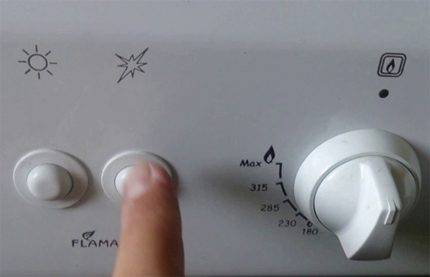

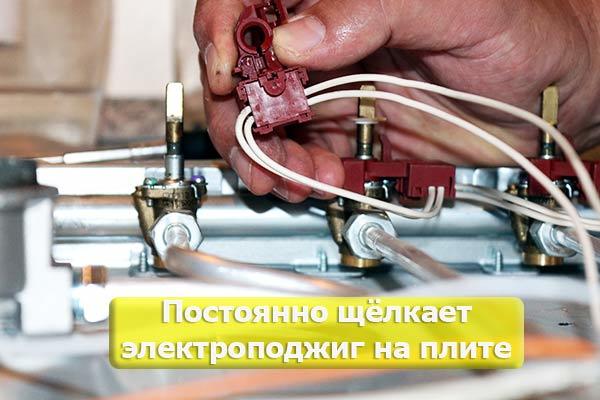
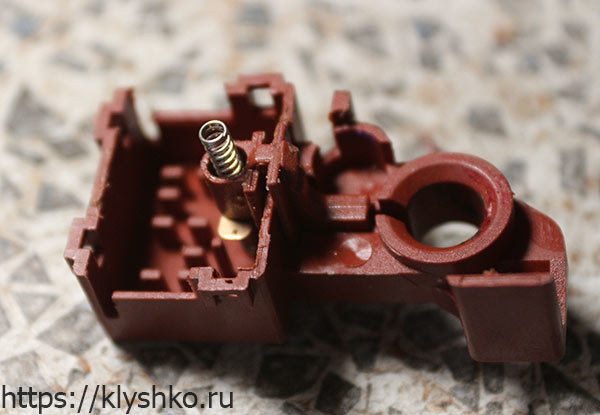

Time after time, deposits build up, and eventually an oxide junction forms. In addition, grease, soot, dust can accumulate inside the button case. All these are also harbingers of a short circuit between the contacts.
With this development of events, you will have to disassemble the gas stove:
- remove the top panel
- open the front subpanel;
- remove the ignition button(s).
Or, in the case of more modern designs of gas stoves, it is necessary to get to the designs of disk control devices that simultaneously perform the functions of a button and a regulator of gas supply to the burners.

A version of the mechanism for switching on auto-ignition and adjusting the level of the burner flame, where two functions are combined in one design. It is more difficult to remove such systems for cleaning or repair than a separate button.
After removing the part from the body of the gas stove, deposits are cleaned, after which everything is assembled in the reverse order. However, this work is the prerogative of the specialists of the gas company. It is not recommended for an inexperienced user of a gas stove to disassemble the device on their own.
Reason # 3 - mechanical connection of the contact group
The mechanical connection of the contact group of the gas stove ignition button should also be attributed to the category of causes associated with a short circuit. Such a defect, as a rule, can occur on plates that have been in operation for a sufficiently long time. True, the same malfunction is not ruled out on new devices, where the quality of components leaves much to be desired.
A mechanical connection is formed by any of the contacts of the button, which simply breaks off, for example, due to physical wear. The broken part is displaced from the attachment point and forms an electrical connection with another contact. In fact, the effect of the switched on ignition button is created - that is, the spontaneous operation of the electric ignition on the burners of the gas stove.
With such a malfunction, the only way out is to completely replace the component.
Gas hob repair
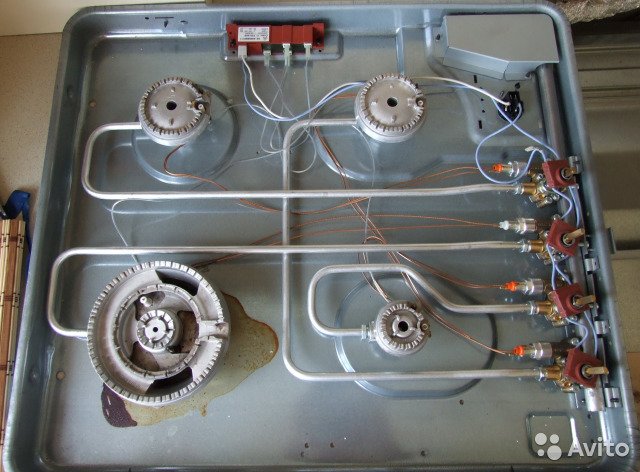
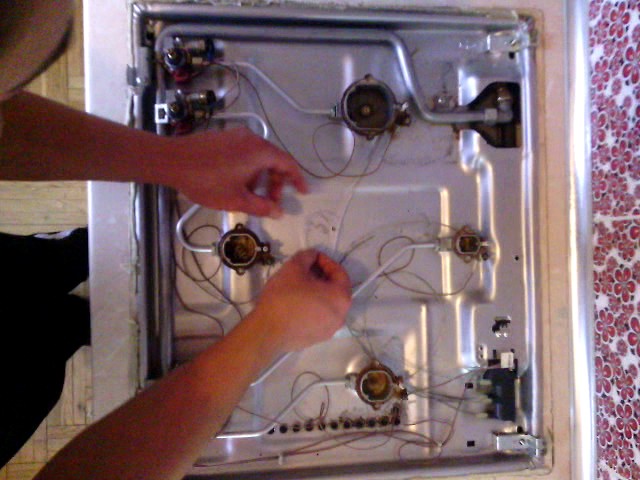
In a gas hob, you can only repair the electric ignition and the gas control system on your own. With them, in principle, the main problems arise. Since the gas hob with electric ignition is also connected to electricity, in case of general problems with the electrical part (piezo ignition does not work at all), first check the power supply at the outlet, inspect the integrity of the wire. If everything is fine here, you can go deeper.
You can repair the gas hob yourself
Electric ignition button does not work (no spark)
Electric ignition is a convenient thing, but from time to time the spark stops “jumping” and the fire on some burner does not light up. You can light it by pressing the button of another burner. They are connected in parallel and when you press one, there is a spark on all burners. But this situation is abnormal and the spark must be restored. Repair of the hob in this case is not very difficult. There are several reasons:
- The candle is clogged with grease, dirt, detergent residues. It must be thoroughly cleaned and dried.
-
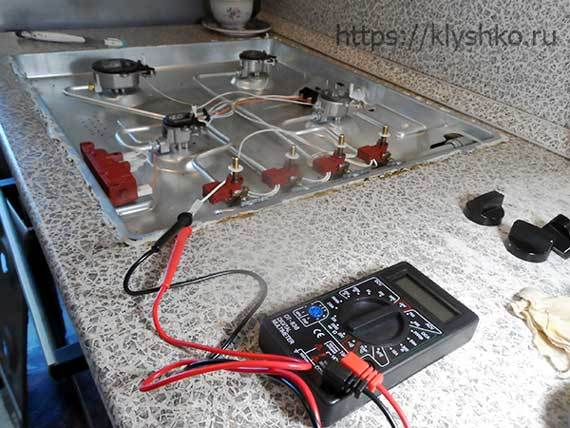
Check the power wires that go to this candle. To do this, remove the burners, the top panel.If it is glass-ceramic, it can be planted on a sealant, we cut it and remove the front panel. If it is metal, unscrew the fixing bolts. Under the front panel, we are interested in power wires. It is necessary to check for insulation breakdown to ground (ground). To do this, you can press the ignition button several times, if there is a breakdown, a spark will jump in that place. If there is no visible damage, we call the wires with a multimeter for integrity and for a breakdown with the ground. We replace the found faulty conductors with similar cross-sections.
- If the conductors are intact, the contacts are normal everywhere, the problem may be in the button. We disassemble it, clean it, put everything in its place.
- Another reason is problems with the electric ignition transformer. O has two windings, each of which feeds two burners. If you measure the resistance between two opposite burners, it should be about 600 ohms - this is the resistance of the transformer windings. If it is lower, most likely the cause is a stuck (dirty) button. We take them apart, clean them, put them in place.
What else can be done is to check the contacts and soldering. Contacts, if necessary, tighten or clean from dirt, soldering, if cold is found, solder. How can you tell if a solder is cold? If you pry the tin with something hard (the end of a multimeter probe, for example), it moves or flies off, there may be cracks in it. In this case, warm up the soldering iron, re-melt the solder.
After ignition, the flame goes out on the burner
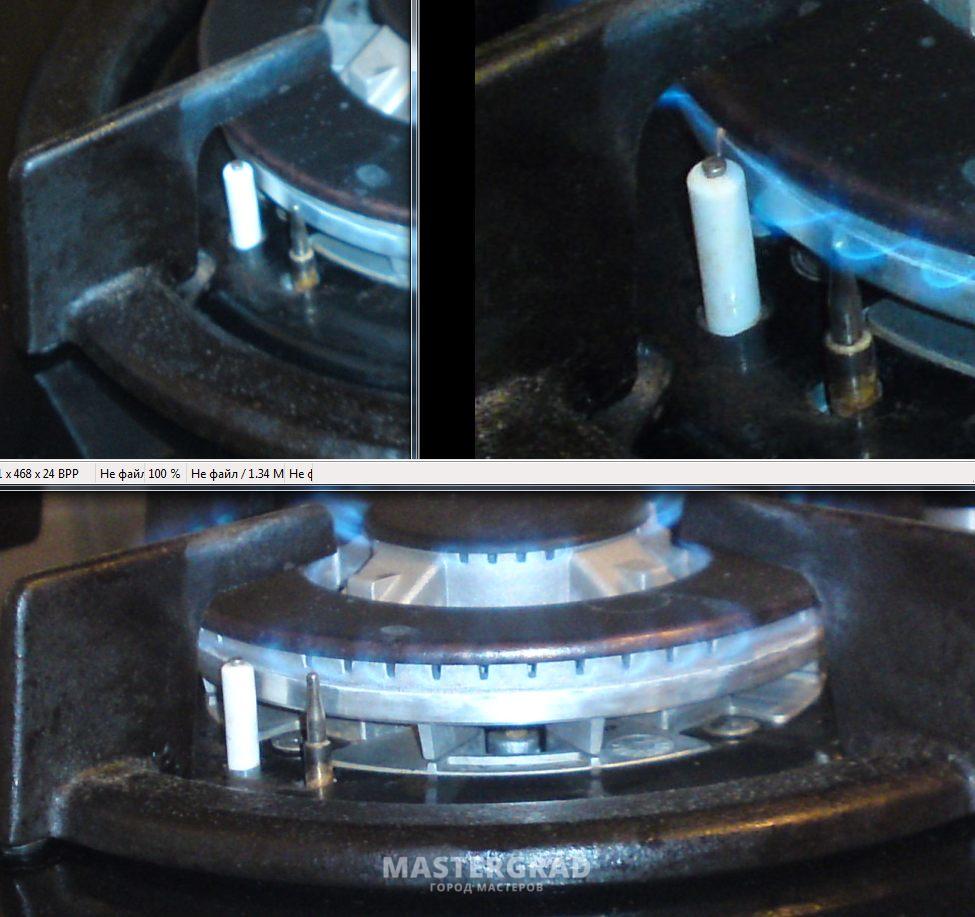
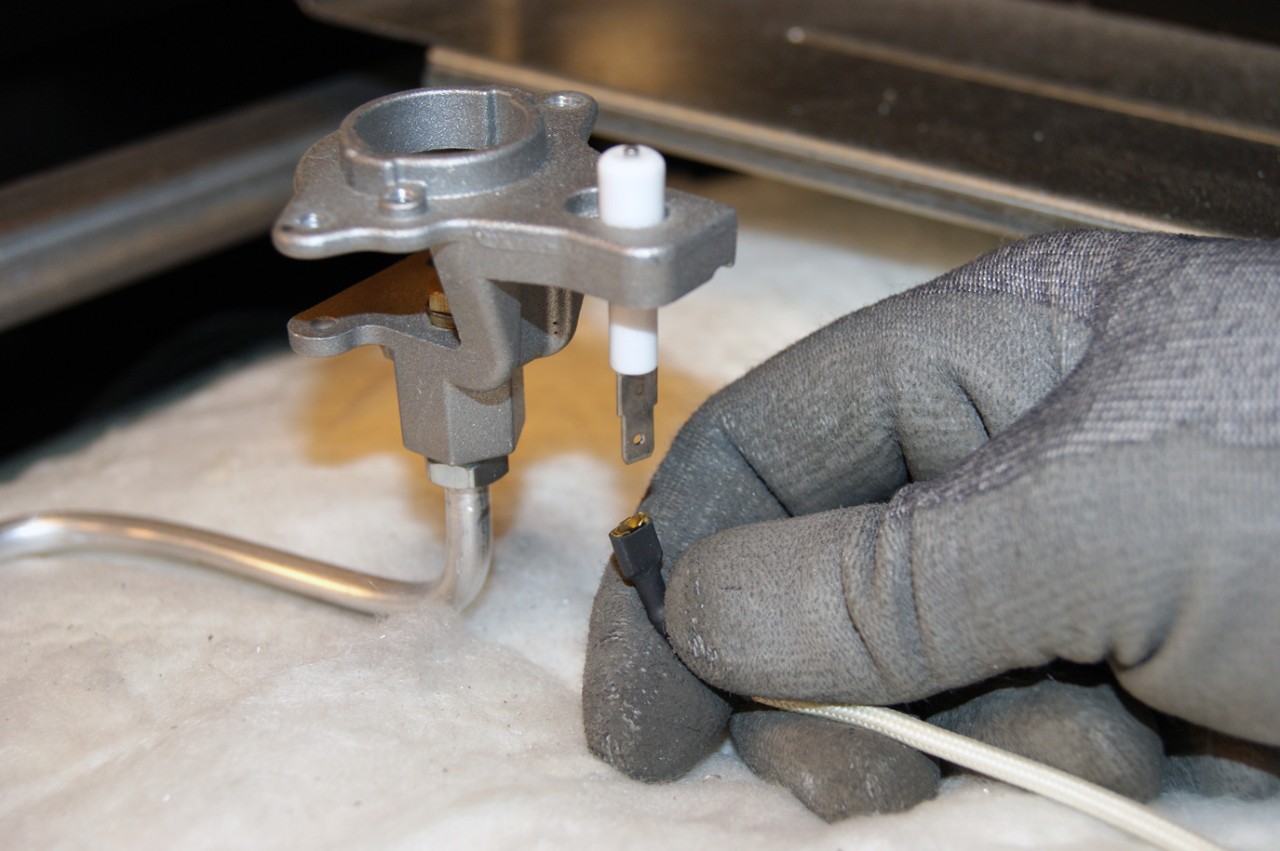
Many modern gas stoves or hobs have a gas control function. Near each burner there is a sensor that monitors the presence of a flame. If there is no flame, the gas supply stops.The function is useful, but sometimes problems begin - after ignition, when you release the on/off knob, the flame goes out. The fact is that the sensor - a thermocouple - is dirty or out of order and "does not see" the flame.
Where is the thermocouple located in a gas stove
First you need to try to clean all the sensors. They quickly become overgrown with grease during operation, so they require periodic cleaning. First, turn off the power, remove the burners, remove the handles, unscrew the front panel. We find a thermocouple on a non-working burner. This is a small metal pin located close to the gas burner. In some models of gas hobs, it can simply be inserted, in others there is a latch. It is necessary to get the sensor out of the socket and clean it from contamination. Use regular kitchen dishwashing chemicals or something stronger
It's important to get results. We wash the sensors, dry them, put them in place. You can check your work
You can check your work.
Sometimes it happens that even after cleaning, some burners do not work. This means that the thermocouple has failed. In this case, the repair of the gas-powered hob is the replacement of the thermocouple. You already know how to get to it, but it turns off simply: you need to remove the corresponding wires from the block. Take out the old sensor and put in the new one. We put the cover back in place, check the work. That, in fact, is all.
One important point: if your equipment is under warranty, you should not repair it yourself, otherwise you will be denied warranty repairs.
What it is?
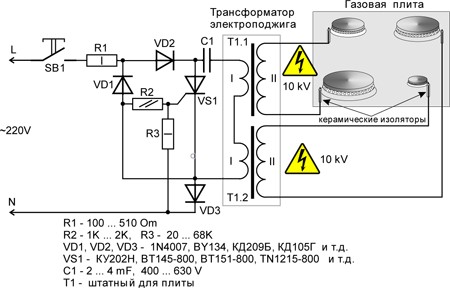
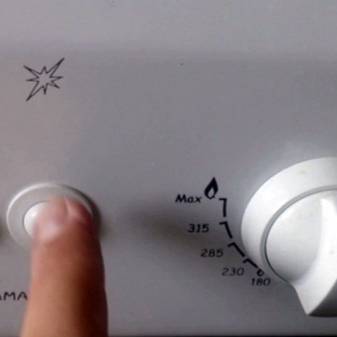
Electric ignition of a gas stove is a convenient innovation that can be seen on most modern stoves.Outwardly, this is a regular button, which is located on the front panel, near the handles that turn the burners on and off. Its task is to set fire to the burners without using additional means in the form of matches, electric or gas lighters. Electric ignition can be of two types.



- Automatic. The essence of the auto-ignition is that by means of special piezoelectric elements, the burner is ignited when the corresponding knob is turned.
- Mechanical. In the mechanical version, a button is used that triggers the same reaction.
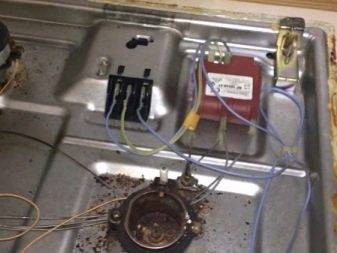
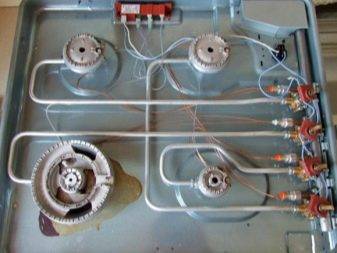
In order to understand the essence of what is happening well, it is necessary to understand the intricacies of the principle of operation of electric ignition, which will look like this:
- pressing the button causes a reaction in the form of a voltage that is applied to the capacitor area;
- next includes charging the capacitor;
- the next action will be to increase the level on the thyristor;
- upon reaching the desired limit, the process of discharging the capacitor starts;
- at the output, you can observe the voltage that triggers the spark gap;
- the resulting spark will be the factor that makes it possible to ignite the burner.
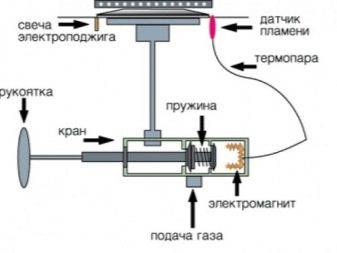
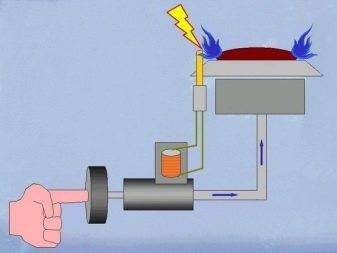
All stages occur instantly, so you can turn on the stove in just 1-2 seconds. A feature of modern stoves is that voltage is applied to the burner that turns on. Whereas in the old modifications the discharge went to all burners, and the one to which gas access was opened turned on.A purely gas stove cannot have mechanical electric ignition, as it is powered by electricity, so modern kidneys have a cord on the back that must be plugged into the outlet to create conditions for using the corresponding function. Having such an assistant seems like a blessing, but each device always has its advantages and disadvantages.
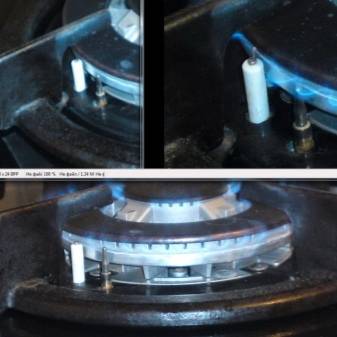
Conclusions and useful video on the topic
Video on how to troubleshoot a gas column. A detailed overview of disassembling and repairing a gas water heater at home:
In the event of any type of malfunction, as a result of which the geyser will buzz and crack, you can try to fix the breakdown yourself. However, there is no guarantee that you will not damage the device. Therefore, the best option would be to contact the masters for service maintenance of the geyser.
.
Do you want to supplement our material with useful information on eliminating the causes of excessive noise and crackling of the geyser? Or do you want to clarify a couple of points on diagnostics? Ask your questions to our experts, leave comments, participate in the discussion - the feedback form is located below.
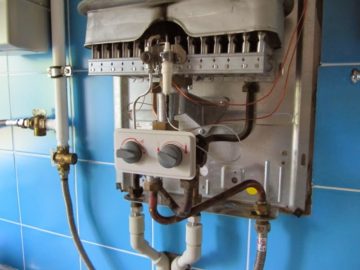
The operation of the gas column is always accompanied by certain sounds. Usually it is the sound of water running through pipes, or the burning of a fire. But it happens that the device starts to make non-standard sounds: whistling, pops, clicks, and so on. If this began to happen, you need to quickly figure out why the geyser is making noise. The reasons may be different.
Conclusions and useful video on the topic
The first video contains information that will allow you to understand some of the causes of current leakage and understand how to deal with them:
The following video shows how you can identify the presence of a current leak yourself:
The presence of a discharge on the body of the gas stove indicates that it is faulty or there are problems in the electrical network. The situation is complicated by the fact that "blue" fuel is flammable and explosive. Therefore, the operation of the stove should be stopped immediately after the first signs of a malfunction are detected. This will help prevent accidents.
Your stove has also recently been electrocuted, but have you successfully dealt with this problem? Share your experience with other users, tell us what the breakdown was and how you managed to fix it - the comment form is located below this publication.