- What are baseboard heating convectors
- Features of baseboard heating
- How is the installation of baseboard heating
- Preparatory stage
- Installation work
- Advantages and disadvantages: expert opinion
- Types of baseboard heating
- Water systems
- Electrical systems
- Design, scope, price
- 5 Applications and design variety
- Self installation
- Set of tools
- Preparing for installation
- Mounting sequence
- Minuses
What are baseboard heating convectors
A convector is a heating device that works on the principle of natural convection. A heating element (or metal radiator) located inside heats the air, causing it to rise upwards, forcing colder air masses downwards. A kind of air circulation is formed, which leads to its gradual heating. Literally in an hour or two (depending on the volume of the room) after turning on the device, the rooms become noticeably warmer.
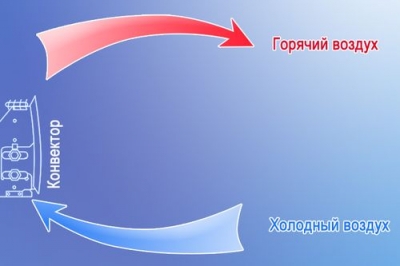
The principle of operation of convector heaters.
Skirting heating convectors are a product of technical progress in the field of heating technology. Initially, convector heaters are wall-mounted appliances, whether they are water or electric modifications.They very effectively warm the air in the premises, creating a pleasant and comfortable atmosphere. But they are quite large - the thickness and dimensions of some devices are extremely large, which does not allow them to be used in rooms with designer renovation.
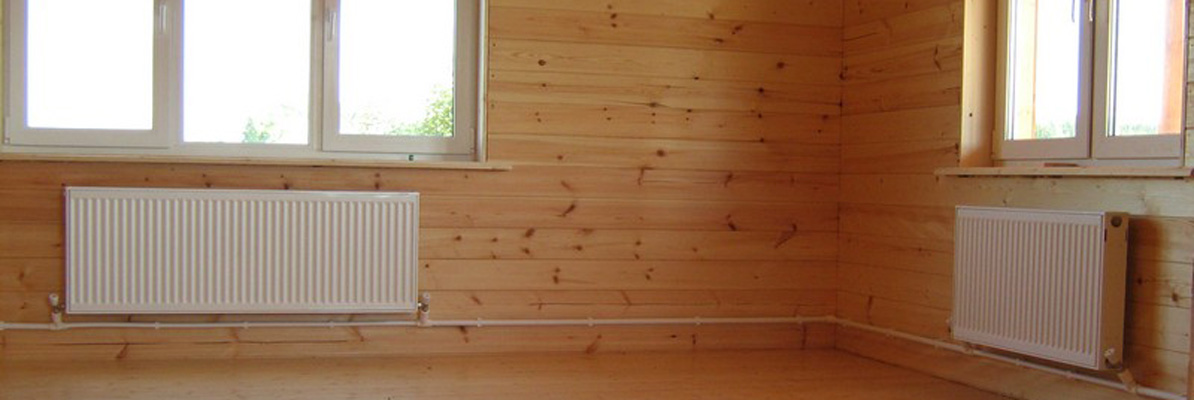
The plinth heating convectors that appeared on sale made it possible to solve the problem with bulky heating equipment. They are characterized by miniaturization, which allows them to be mounted where skirting boards are usually located - in close proximity to the floor. As a result, we have at our disposal the so-called baseboard heating, which is distinguished by its efficiency and excellent external data.
We have already said that baseboard heating convectors are characterized by small dimensions:
- Height - from 60-70 to 240-250 mm. Subsequently, the devices are closed with special decorative plinths, which allows them to be masked;
- Thickness - up to 90-100 mm. Also on sale are very thin units that practically do not stand out from the walls.
As we can see, the choice of equipment is very, very large.
Not only their power, but also the price depends on the size of the baseboard heating convectors - the most compact models can be insanely expensive.
As a rule, these devices are already endowed with decorative cases that repeat the shape of skirting boards. Here we can see special slotted openings through which cold air masses are taken in and heated air is released. Thanks to such cases, the equipment does not spoil the appearance of the premises - today it is used both in residential and commercial premises.
Features of baseboard heating
Heating from the moment of its invention to the present day is divided into two types - convection and panel-radiant. In the first case, the air is first heated from the hot surface of the heating device (radiator battery, convector), after which it circulates in the room and gradually heats it up.
In the second case, objects in the room are initially heated, and the air is heated from them by useful infrared radiation, which does not dry out the air, does not remove oxygen from it, and this process is secondary.
Among the old examples are stoves in village houses, tiled stoves in old mansions, in a modern interpretation - heated floors, but what about baseboard heating and what type of heating is it?
Heating the room with the use of a warm baseboard allows for a uniform supply of heat along the height and area of the treated room
Let us turn again to the opinion of manufacturers. They unanimously claim that the heat radiated along the perimeter rises from the floor to the ceiling along the walls, warms them evenly and creates a kind of curtain from the cold penetrating from the outside. Once warmed up enough, they themselves begin to give off heat.
In fact, the temperature of the walls at different heights fluctuates in the range of 26-30 ºС, and in order for heat to be transferred from them, the surface must be heated much more strongly. Therefore, talk about the desired infrared heat emanating from the walls is not so much true as a marketing ploy.
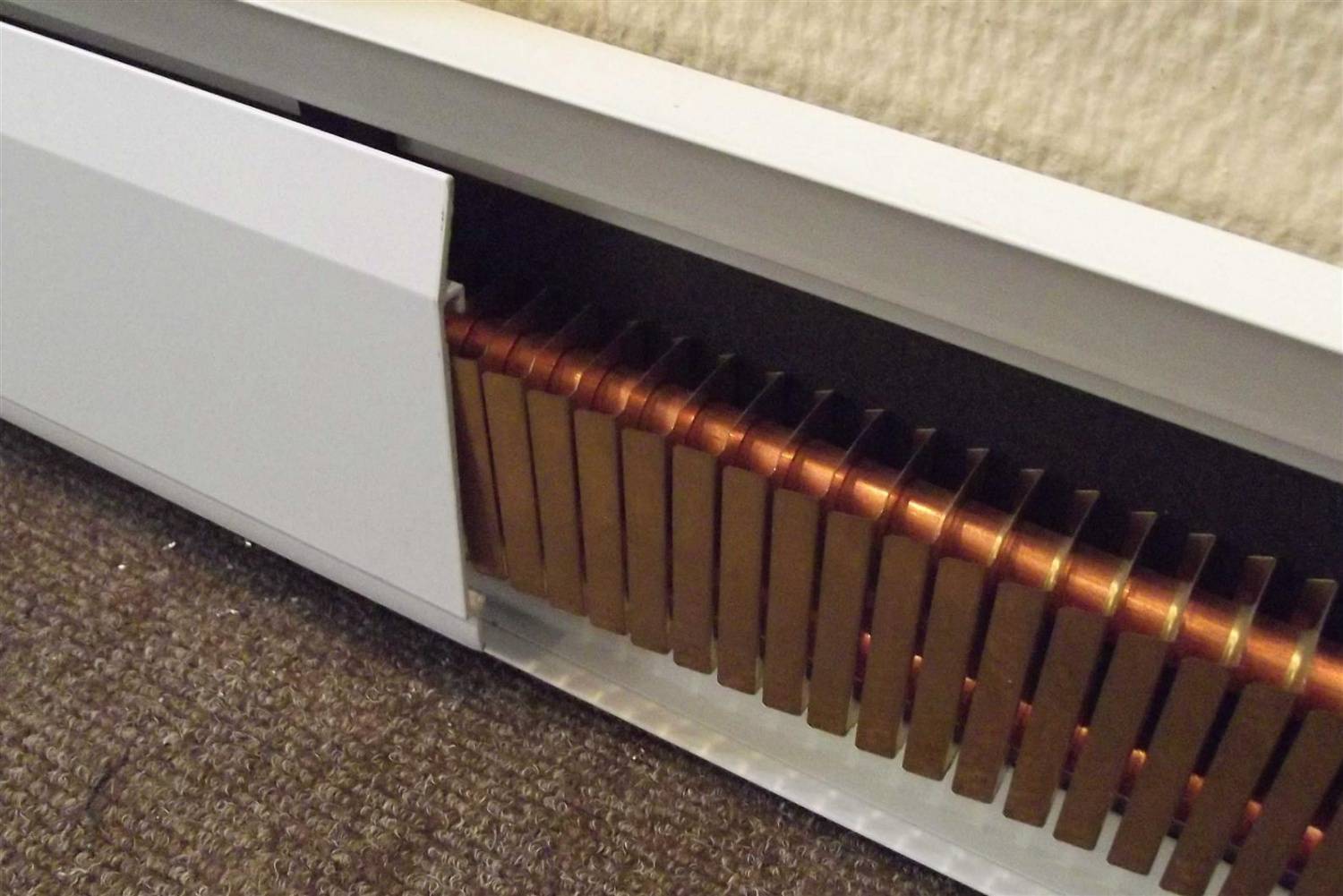

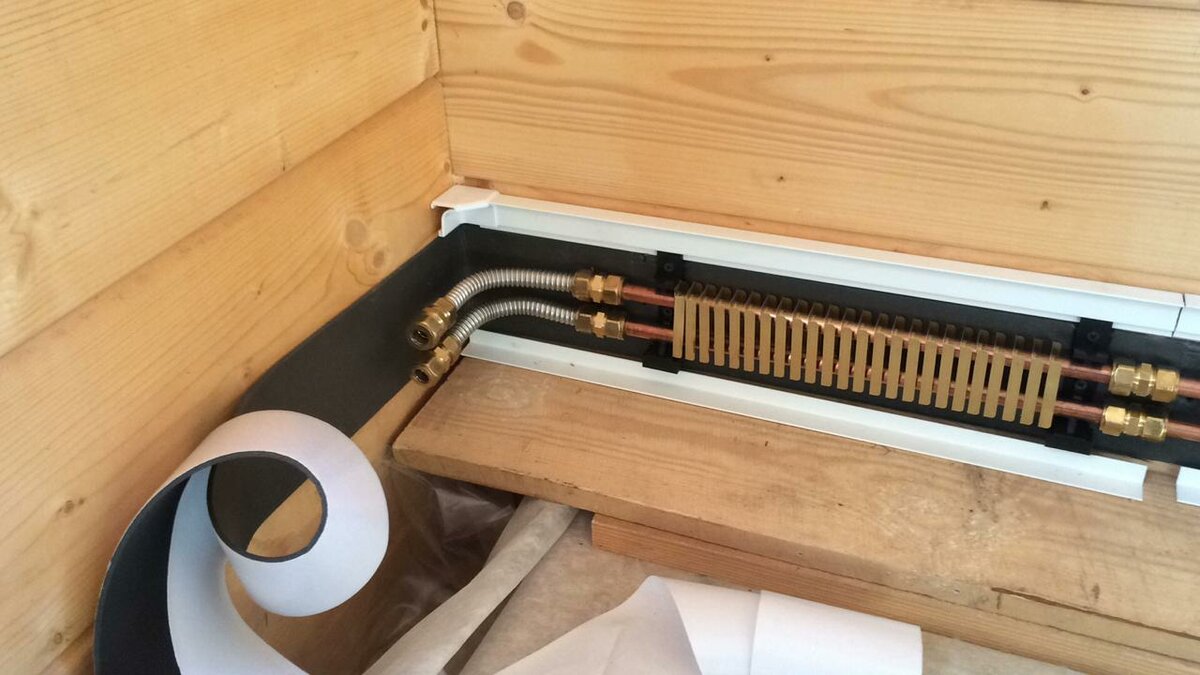
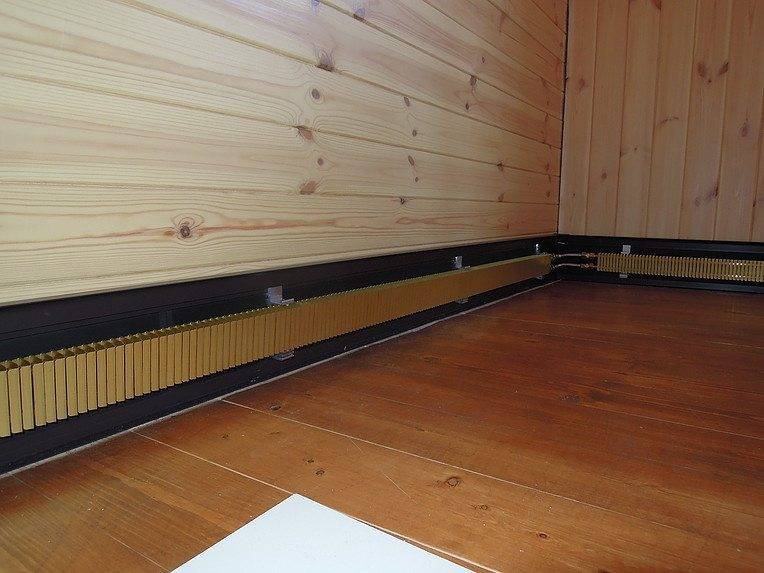


The planes of thermal plinths radiate maximum heat at the level of the feet. It is not only pleasant, but also optimal for well-being and health (+)
It is more correct to say that thermal plinths are also convectors with a high surface temperature.It's just that the room warms up more evenly from warm air currents, both going deep into the room directly, and rising along the walls. Heated walls are a guarantee that you will not find dampness or mold anywhere on them.
It is also fair to note that as you move up, the amount of heat decreases, and this is good. It is evenly distributed in the room in the lower and middle zones, reaching the ceiling to a lesser extent. For people, such a microclimate is considered the most comfortable - they do not freeze and do not chill, but they breathe fresh and cool air at the same time.
How is the installation of baseboard heating
Heating elements and skirting boards for heating pipes can be installed on almost any surface, whether it is masonry, plasterboard walls or log cabins. Installation is carried out around the perimeter of the room and in many ways resembles the installation of a conventional skirting board. (see also the article How to stick skirting boards on the floor with your own hands)
If desired, all installation work can be done with your own hands, but it is better to entrust the design of the system to professionals, because non-compliance or ignorance of certain requirements can reduce all efforts to zero.
Preparatory stage
At this stage, it is necessary to decide on what principle the system will be built - radiators can be both electric and water.
If electric heaters are installed, then under them it is necessary to pre-install electrical wiring that meets the requirements for power and safety.
For water heating, it is necessary to decide on the connection scheme: central heating or a separate boiler.
Selection according to the principle of operation
For an accurate calculation of all components, it is necessary to know the heating power of the system. Each individual room will have its own indicators, depending on the area and volume, wall materials and the effectiveness of insulation. On average, it is considered that 100 W of thermal energy is needed per square meter for heating.
Installation work
Skirting boards for heating pipes must be installed in accordance with the previously drawn up project. They are installed in one row at a height of 10 mm from the floor and fastened with special stops.
The finished system is filled with a coolant, which is usually water. If the house is not intended for permanent residence and is heated periodically, then the use of antifreeze will be optimal.
Advice!
When filling the system, it is imperative to remove all air from it with the help of fittings specially provided for this.
Advantages and disadvantages: expert opinion
One of the advantages, of course, is a neat, almost decorative appearance. Radiators, even in their size not much different from ordinary skirting boards, take up very little space and are located where they do not interfere with anyone - on the floor, near the wall itself. This means that there are more options for arranging furniture, and the curtains can hang freely without clinging to the ribs of traditional batteries.


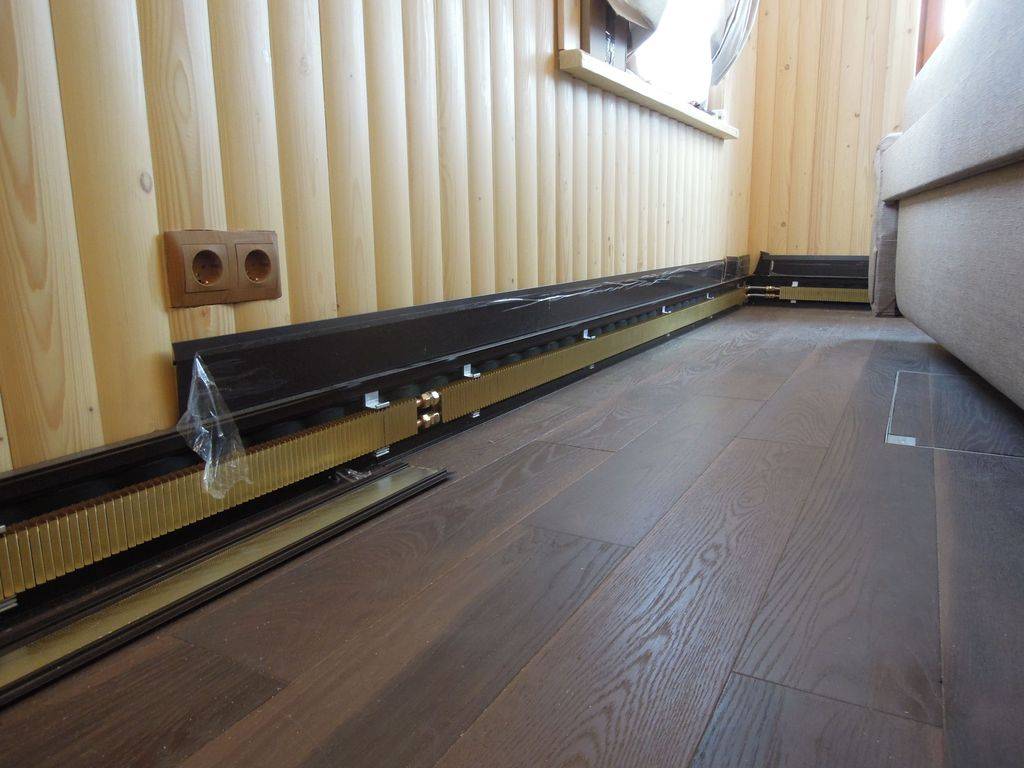

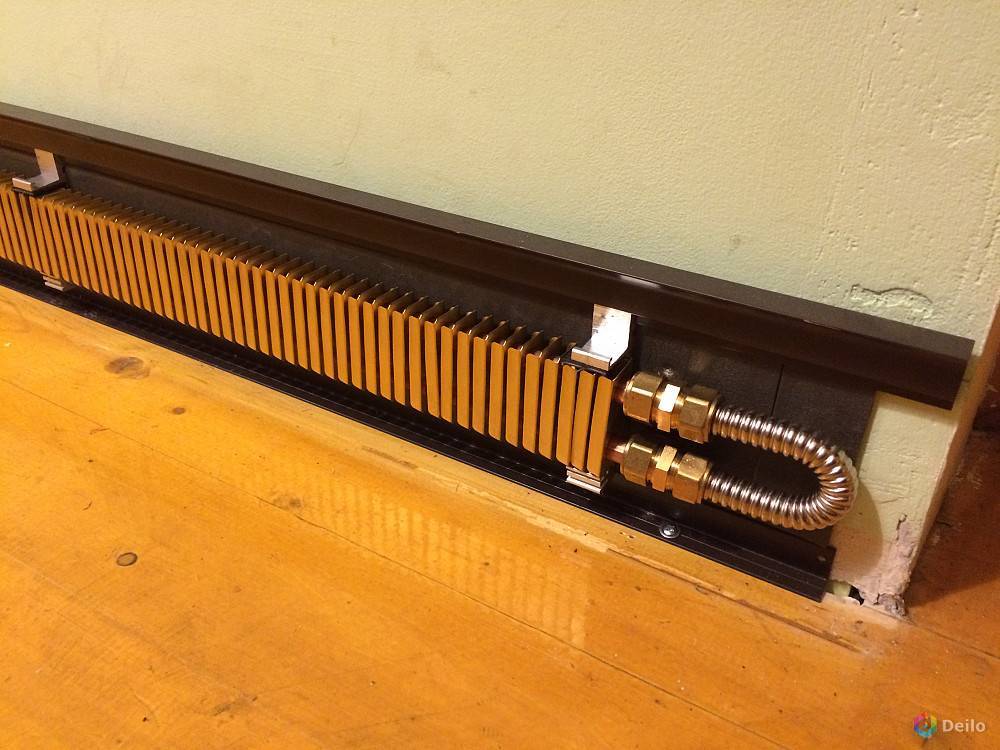
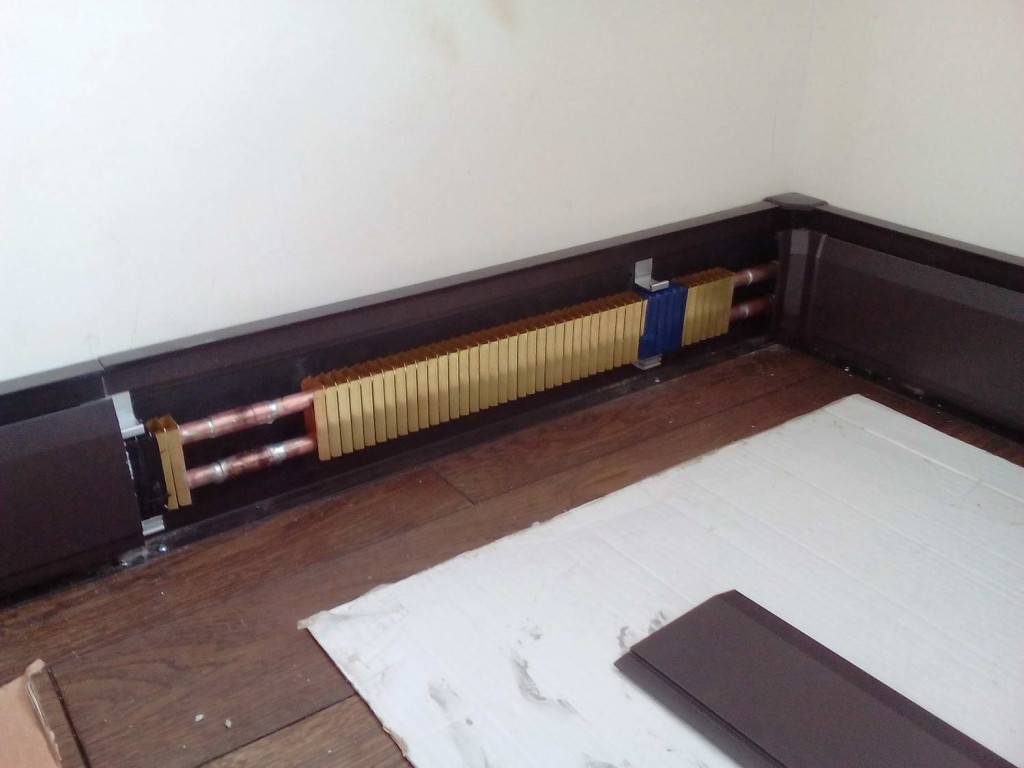
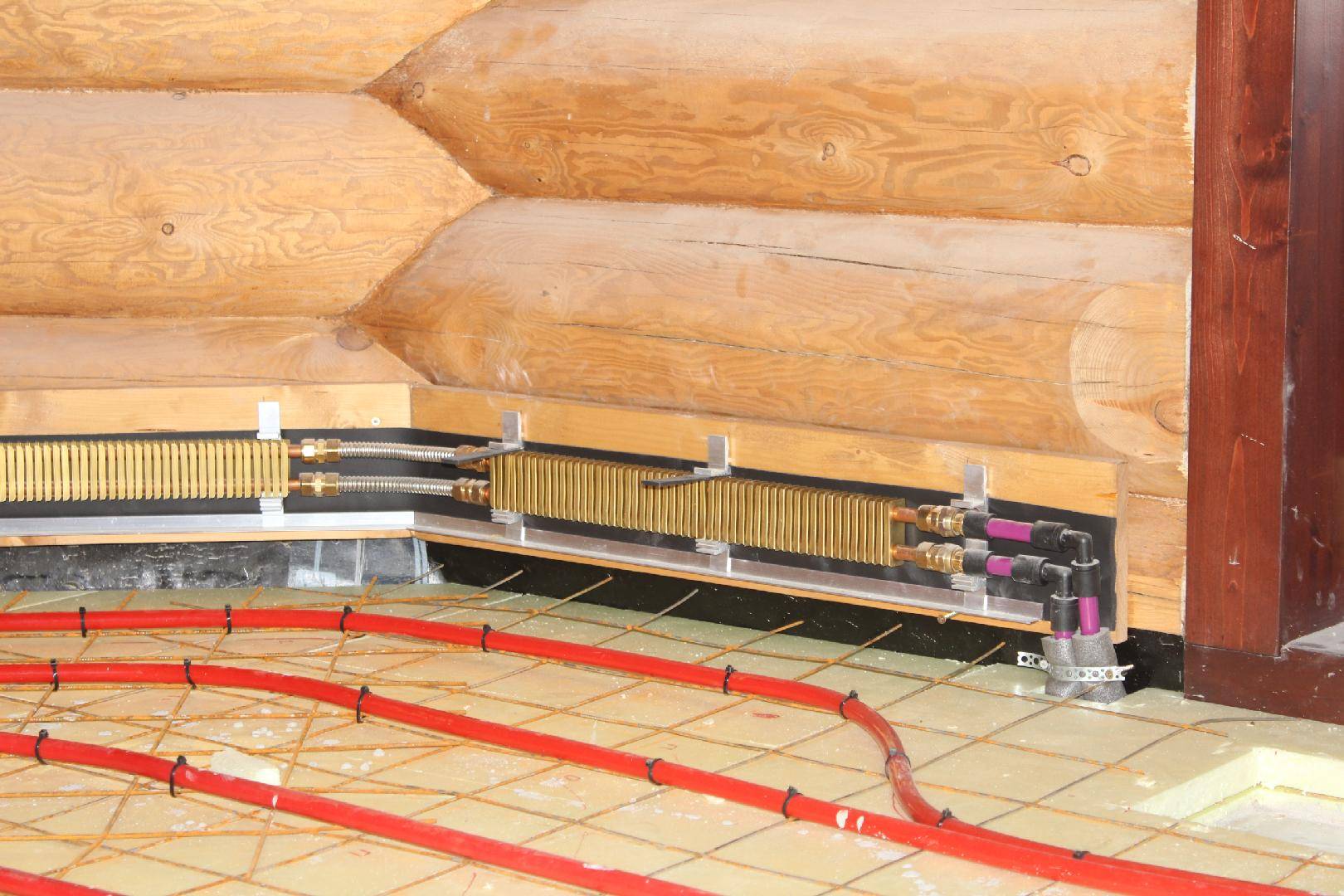
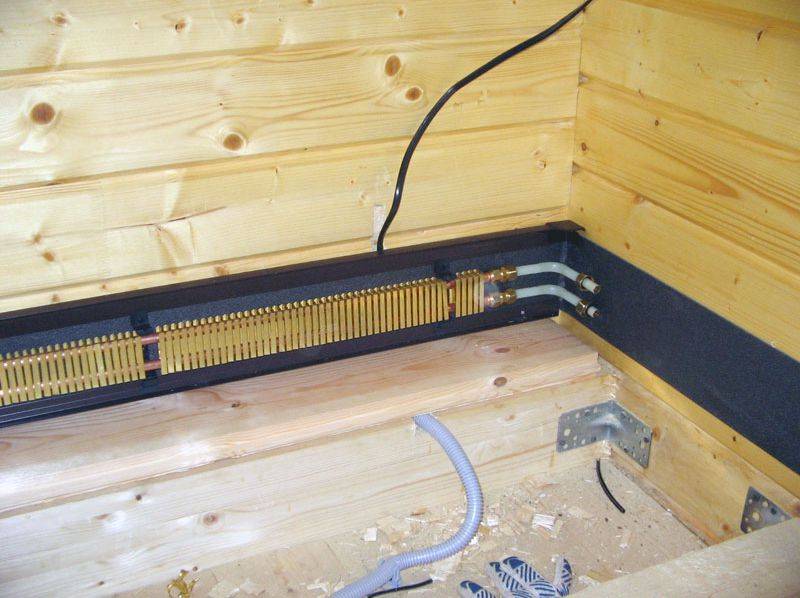
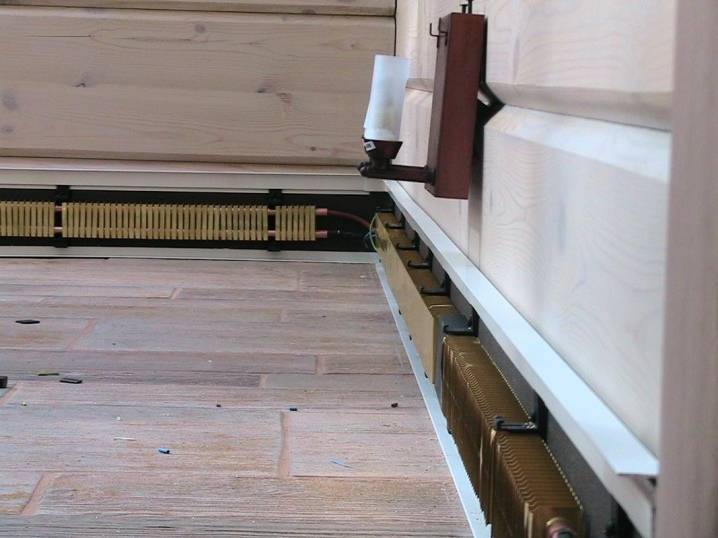

The warm skirting board has a modern look, takes up little space and fits into the interior, arranged in almost any style: from country to modern
Another plus of the plinth heating system is the uniform heating of the entire space of the room.There are no zones of warmer or cooler air as there is no convection. Consequently, the temperature of the air gap under the ceiling and near the floor will be the same, and this has a beneficial effect on both people's health and the state of finishing materials.
Don't forget about savings. Fuel consumption is noticeably reduced due to the low heating temperature, by an average of 35-40%. In addition, the installation of skirting equipment is fast, as well as its repair. It is possible to install a separate thermostat in each room and use it to control heating: in the children's room, set the temperature a little higher, in the bedroom - a couple of degrees lower.
It is not recommended to create elements of a warm plinth with your own hands, since there are no guarantees of its proper and efficient operation. It is better to purchase expensive, but high-quality equipment from a well-known manufacturer.
The disadvantages include the high cost of equipment - about 3 thousand rubles for each meter. This amount includes special materials and installation of the system. The installation of the equipment must be carried out by competent specialists who have permission from the manufacturer. By installing the system yourself, you can miss a number of important points, which will lead to rapid equipment wear and constant repairs.
It is desirable that the plinth radiators are not covered by anything: neither decorative overlays, nor pieces of furniture. The heat transfer is sharply reduced, and the heating of the room becomes inferior.
Despite some shortcomings, the warm baseboard is becoming increasingly popular, and the time is not far off when it will completely replace the traditional convection-type systems for today.
There is the convenience of a warm plinth and its efficiency, uniform distribution. But. God forbid what happens, you can't do without opening the floor. This means that plus to the high cost of installing the skirting board, you still need to immediately add the cost of repairs. And the likelihood of damage is not so small. The battery can be removed and replaced with a new one, a bit of a hassle. Still, installing batteries is much less troublesome. They are now beautiful, rather flat, curtains will not interfere with them. As well as they curtains.
I have never come across this type of heating before. In principle, it is possible, but in practice it needs to be improved. The fact that it is necessary to heat not the air in the room, but the walls is correct. The bottom position is correct. But this raises the problem of circulation of the coolant. Without a pump, the system will not work. As the coolant passes, its temperature will decrease. In batteries, you can regulate the uniform distribution of heat. In this system, the first meters will heat up much more than the last. Go am I wrong? It seems that with the right calculation, such a system can save fuel.
To make everything work, it makes sense to do a not very complicated calculation of hydrodynamic characteristics. Install the pump a little more powerful, limit the linear length of each individual circuit. And everything will work. It also happens with radiators - the first sections are warmer than the last ones. With regards to savings, a warm baseboard gives off heat not by convection, but by radiation. This means that there is no movement of warm air to rise, which means that there is no “warm pillow” under the ceiling - heat that we pay for, but do not use it. Here's your savings.
The system is not bad, there are many pluses. Of the minuses, only the price.But everything new is well forgotten old. Previously, we did such heating in private houses from a steel pipe weaving or more in diameter and the coolant went on its own and there was uniform heat in the house, but the pipes were visible and it did not look beautiful. Summary. If you need high comfort, and you can afford it, then choose!
Site navigator
Types of baseboard heating
Baseboard heating is divided into water and electric. Accordingly, water systems operate on the basis of gas or any other boilers. Electrical systems are built on the basis of electric skirting convectors.
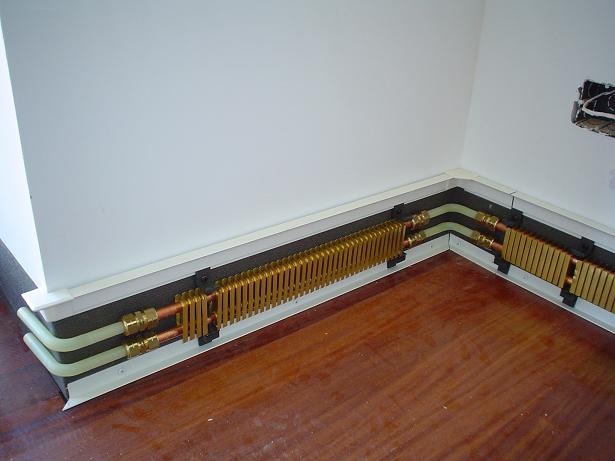
Water systems
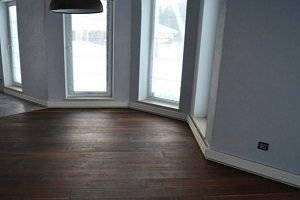
Water heating systems are built on the basis of the radiators described above, made of non-ferrous metals. Hot coolant circulates through them, prepared by a heating boiler or obtained from a central heating system. Water plinth heating can be used to heat rooms for any purpose - it can be halls, corridors, kitchens, children's rooms, living rooms, trading floors and much more. In addition, it is well suited for use in rooms with panoramic glazing - baseboard radiators will prevent the penetration of cold, protect against condensation.


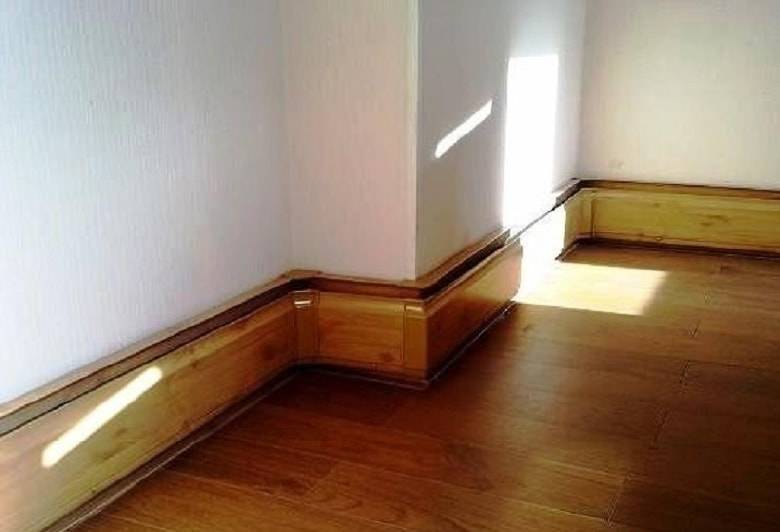


The "warm plinth" heating system is recommended for installation in individual households. But its use with a centralized supply of coolant can lead to an accident - skirting heating does not tolerate water hammer. Some experts recommend using an intermediate heat exchanger, but in this case, certain heat losses will be observed.
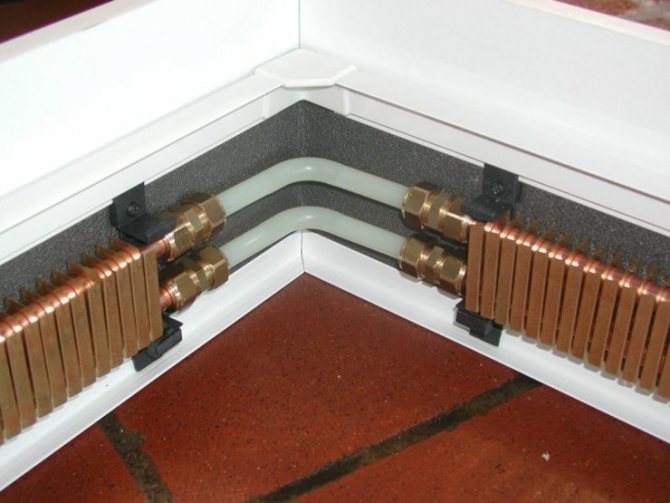
The water plinth heating system consists of the following parts:
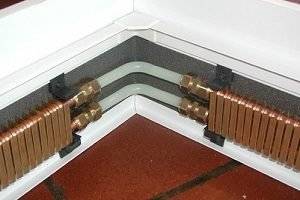
- Radiators - they are miniature convectors made of non-ferrous metal. They are the sources of heat for heating rooms;
- Protective boxes - they close the radiators and pipes themselves;
- Pipes - in most cases, metal-plastic pipes are used here, as they are more resistant to pressure and high temperature.
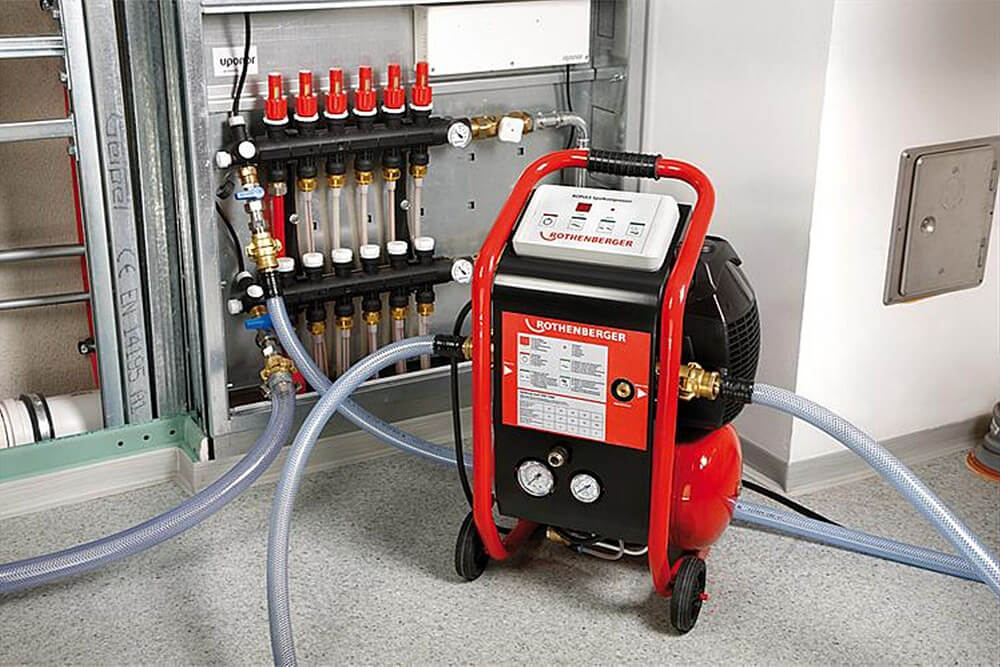
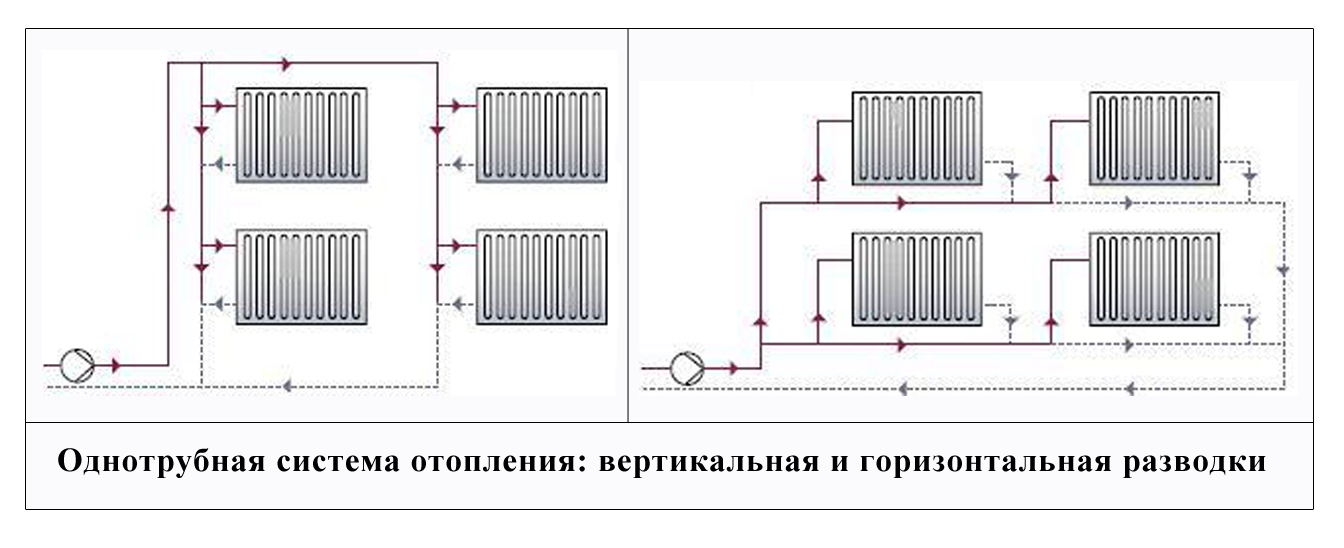
The installation of a water baseboard heating system is carried out in such a way that it does not form a complete ring around the entire house - this would cause uneven heating. Therefore, it is most often practiced to create separate directions for each room. To do this, distribution manifolds are mounted in the heating system, to which the coolant from the boiler is supplied.
The main advantage of using a distribution manifold is the ease of repair work in the event of an accident. It also allows you to adjust the temperature in each direction separately.
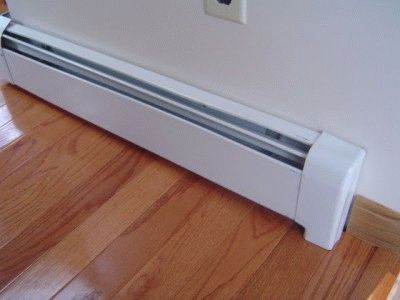
Electrical systems
Electric baseboard heating is designed for use in buildings that are not connected to gas mains. It involves the use of small-sized convectors, which are powered from the mains. By their design, they are similar to water radiators, only instead of tubes with a hot coolant, powerful heating elements are used here. Electricity in our country is quite expensive, so the use of electric heating can lead to high costs. But in many cases, it remains the only available heating method.
As with water systems, it is desirable to use a circuit with several separate directions in electric heating.That is, each room is powered by a separate electrical cable. A special electrical panel is installed in the building, in which circuit breakers are mounted. From here, the cables diverge throughout the premises. If a room is not in use, it can be turned off - thereby saving energy.
Electric convectors work on the same principle as water convectors - they produce heated air, which, as it were, "sticks" to the walls and goes up. At the same time, cold air masses are sucked into the equipment, passing through the next stage of heating. After a while, the room will become noticeably warmer.
The main advantages of electric baseboard heating over water systems:
- Increased reliability - the use of modern heating elements makes it possible to guarantee a service life of up to 20-25 years, while for water appliances this period is about 10 years;
- There is no coolant - which means there is no risk of flooding the neighbors;
- Easier installation - laying the cable is much easier than fiddling with pipes.
The main disadvantage of any electric heating is its gluttony in terms of electricity consumption - in combination with electricity tariffs, the costs will be high.
Design, scope, price
Thin, elegant, in harmony with the overall environment, heaters allow you to implement the most non-standard design ideas. The peculiarity of the plinth heating system is that it does not take free space from the room at all, and it can be placed next to furniture, antiques, household appliances, musical instruments.
The material from which the flooring and walls are made also does not matter - there will be no damage and harm.
A palette of hundreds of colors and shades allows you to choose the appearance of the case to your liking. By texture, it can be a flat and smooth surface or imitation of granite stone, marble, wood.
A plinth radiator equalizes the temperature in colder corner and end rooms; owners of cottages and country houses are interested in this technology, seeking to create an exquisite interior in their homes. Yes, and in high-rise buildings, many want to make heating loggias, balconies, and this problem is also easily solved using a similar heating scheme.
Wherever plinth heating is used - in greenhouses and winter gardens, swimming pools and gyms, in museum buildings, concert halls, etc. Panoramic construction is in vogue, but you cannot put ordinary radiators along a wall that is solid glass.


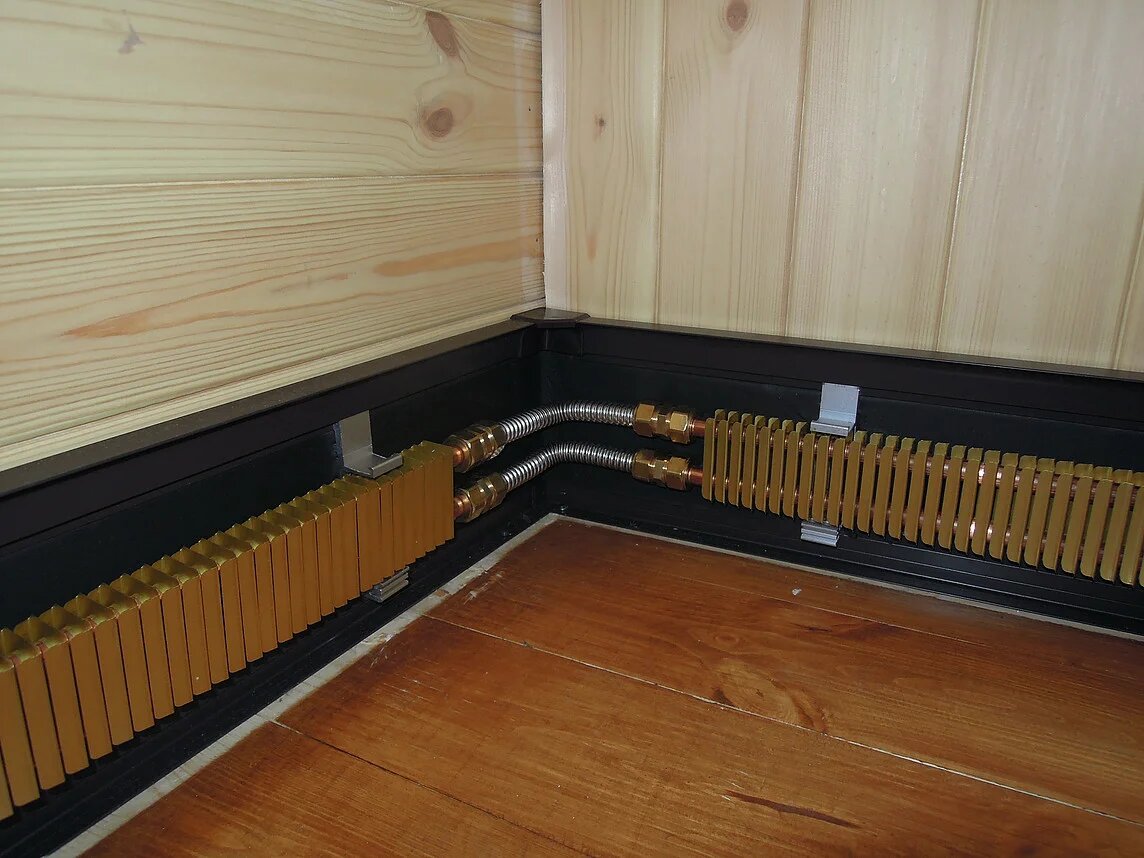

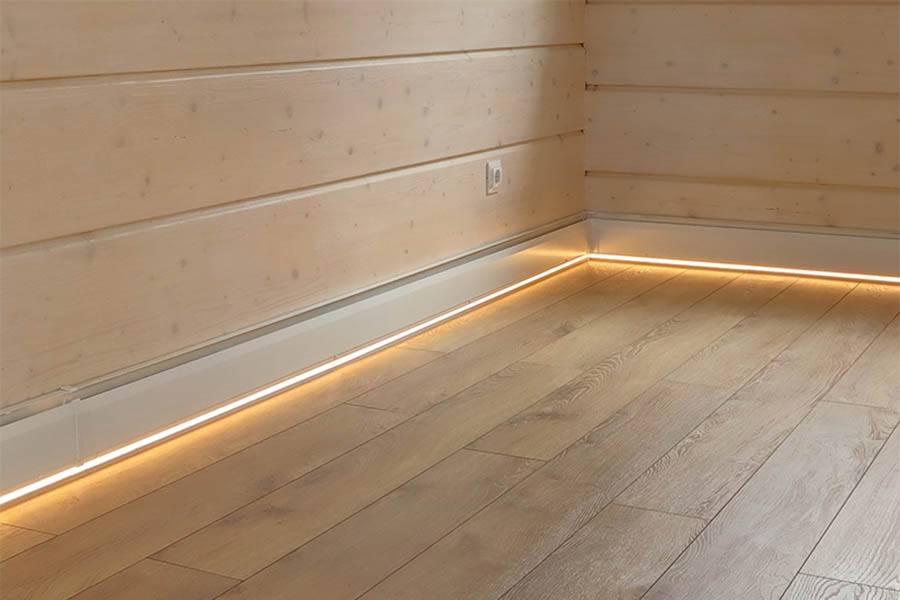

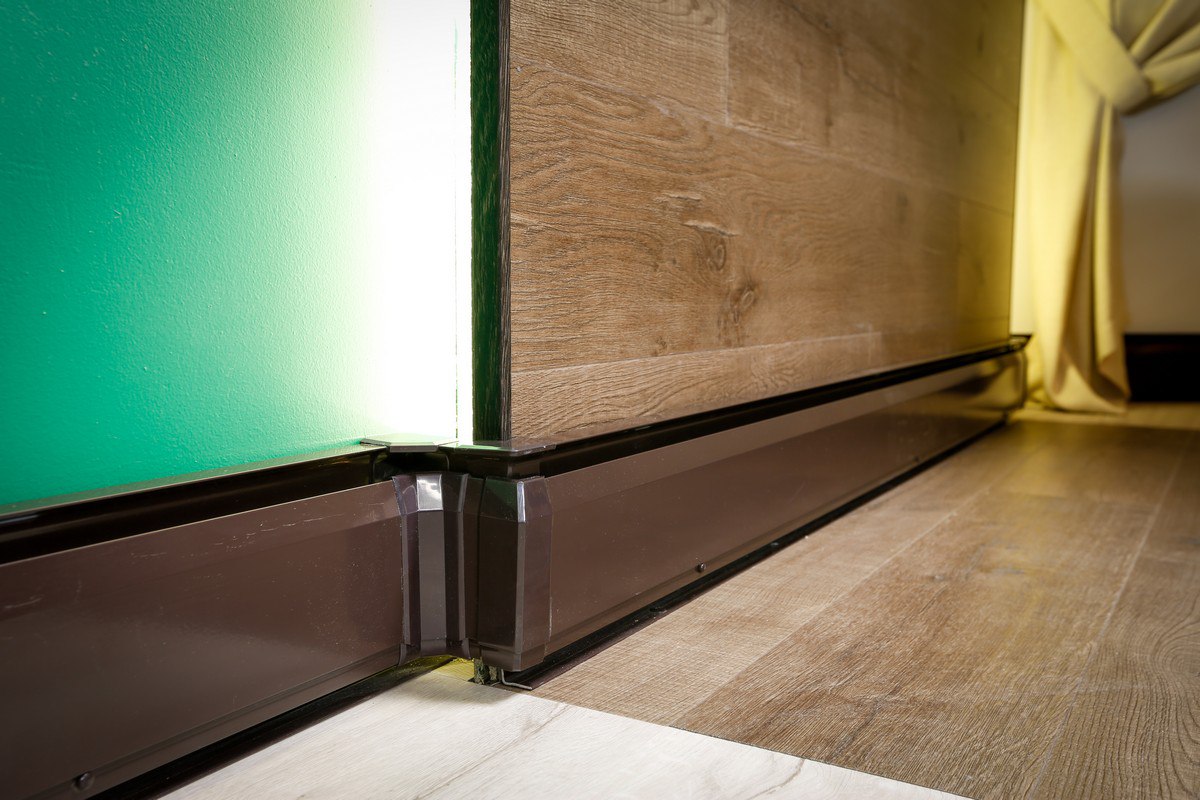


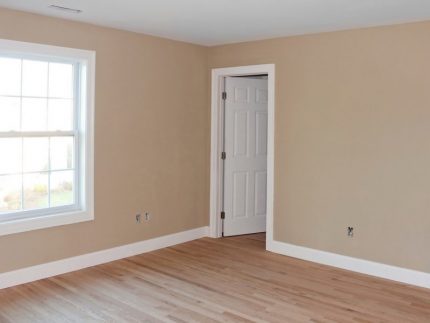
An extensive range of textures and shades of the body of a warm plinth allows you to use it as a decorative element. In this case, it merged into a single whole with the door trim
Traditional heating also loses in rooms with high ceilings. No matter how much you heat them with batteries, warm air will still tend to rise up to the ceiling, leaving the lower zone cool, and with the help of a thermal skirting board, the situation is easy to fix.
As for the price, the purchase and installation of a warm baseboard is comparable to the cost of underfloor heating. Both will not cost less than installing a classic heating system with batteries. Unfortunately, all energy-efficient devices cannot be called cheap, but the costs pay off.In order not to overpay too much, you need to complete the system in advance - each of its elements has its own price. Only a specialist can do this correctly.
5 Applications and design variety
This type of heating is not used very often, but quite widely. It can be used in greenhouses, and winter halls, and in crowded places - for example, in swimming pools, concert halls, gyms, museums.
This technology is also suitable for use in private homes. It is indispensable for owners of corner and end rooms, especially those prone to wind blows. You can install it in high-rise buildings on loggias or balconies.
Best of all, it manifests itself in rooms where the ceiling is very high. If you use a traditional heating system, then all the hot air will go upstairs, and it will be cool downstairs. This is easy to fix with the help of heating in the baseboard.
Self installation
The owner can install the purchased equipment himself, for this it is not necessary to have the skills of professional work, just a modest set of tools, attentiveness and accuracy are enough.
Installing a warm plinth with your own hands is very simple. The design does not have a coolant, is easy to install and does not require work with pipes.
Set of tools
For self-assembly of the structure, the master will need the following tools:
- Perforator for attaching the plinth to the bearing walls;
- Screwdriver;
- Drill;
- Roulette, ruler and pencil;
- Connecting wires;
- Level;
- Hacksaw for metal;
- Pliers;
- Box for internal socket.
Preparing for installation
First of all, it is necessary to select the cross-section of the wire connecting the electrical network of the house with a warm baseboard. The power of the heater is indicated on its packaging, depending on this value, the necessary wire is selected. The minimum section of the wiring in the house and the wire going from it to the equipment is 1.5 mm². With a smaller wiring size, the electrical network at home may not be able to withstand the load. To prevent a short circuit, it is necessary to mount the baseboard only in houses with a high-quality new electrical network.
If you want to connect a whole block of high-power heating devices, then the diameter of the wires must exceed 2.5 cm².
It is necessary to make sure that the machines installed in the house are able to cope with the load from electric heating. The documents for the plinth indicate the number of amperes for which the device is designed. This value must match the one specified on the machine.
At the connection point, it is necessary to install a box under the internal socket and find the power cable to which the plinth is connected.
Mounting sequence
After completing the preparatory work, the installation of a warm skirting board begins:
- First of all, guides are attached to the wall. They are made of plastic, fastened with self-tapping screws or anchors, depending on the material of the wall. For even fastening on a small elevation above the floor, use a level;
- After that, a material that reflects heat is attached to the wall. It comes with a skirting board, so it matches its size and does not require cutting;
- The master measures the length of the mounting bracket and at this distance fastens the upper rails in the same way as the lower ones are already fixed;
- Mounting brackets are attached between the guide brackets. The distance between them is indicated by the manufacturer on the instructions for the plinth. They bear the main load;
- It is possible to proceed with the installation of heating elements only after preparing the entire perimeter of the room. The main element of the plinth is hung on the brackets;
- First you need to measure the length of the heating element and cut off the excess with a hacksaw. After that, the edges are processed with sandpaper;
- For ease of fastening, 2 or 3 extreme plates are removed with pliers;
- Brass threads are mounted on the pipe;
- A closing loop is screwed onto the threads;
- All bolted connections are additionally stretched;
- The electric plinth is connected to the home network like a regular outlet;
- After connecting, you need to check the operation of the equipment by performing a test run;
- The cladding panel is attached with clips.
It is very important to be able to regulate the temperature separately in each room. It is mounted between the first panel and the power supply. First, a thermostat is attached to the wall at a convenient height, then the wires are connected, after which a test run of the system is carried out
During verification, the skirting boards are checked in all the provided modes of operation, and the uniformity of heating of the panels is checked. After checking, cladding boxes are installed, the places where the equipment is connected to electricity are sealed.
First, a thermostat is attached to the wall at a convenient height, then the wires are connected, after which a test run of the system is carried out. During verification, the skirting boards are checked in all the provided modes of operation, and the uniformity of heating of the panels is checked.After checking, cladding boxes are installed, the places where the equipment is connected to electricity are sealed.


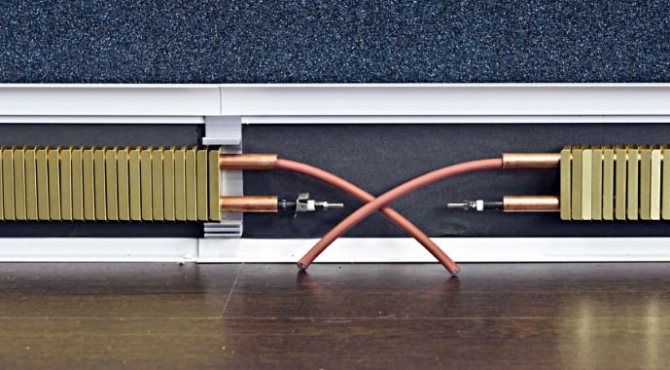
It is convenient to equip each room with its own baseboard and equipment for adjusting its power. This will allow, if necessary, to turn off part of the thermal equipment or reduce its power. Such a system will save energy and reduce heat loss at home.
Minuses
Therefore, when the installation is carried out with one's own hands, it is advisable to get expert advice so as not to disturb the uniformity of heat transfer.
And due to the fact that this heating system, when installed, is tightly attached to both vertical and horizontal surfaces - this can cause defects on them. It will look approximately like when installing conventional heating radiators.
At water warm plinth there is a certain temperature regime in which it can be operated. And if in the central heating the temperature reaches a critical drop, then this can provoke not only a breakdown, but also a failure of the equipment.
Therefore, in those rooms that have a perimeter greater than the indicated values, it is necessary to install several such autonomous circuits, making wiring from the main heat supply. It is not recommended to install various decorative overlays on the box to decorate the plinth, as they have a very negative effect on the efficiency of heat transfer produced.
It is advisable to use only those components that are recommended for installation by the manufacturer. And due to the fact that electric warm plinth uses a large amount of electricity - its use is far from affordable for everyone.