
- How to connect a two-gang pass-through switch
- How to make a two-gang pass-through switch
- Comments: 16
- Scheme of installation of the control line from three or more places
- Analysis of the schematics of the contact groups of the device
- The difference between a pass-through switch and a conventional one
- Scheme of connecting a pass-through switch from 2 places
- Installation procedure for 2-point walk-through switches: wiring diagram
- Flaws
- Well-known manufacturers of pass-through switches
- Popular range of feed-through switches
- Connection with three control points
- 3 point switch types
- checkpoint
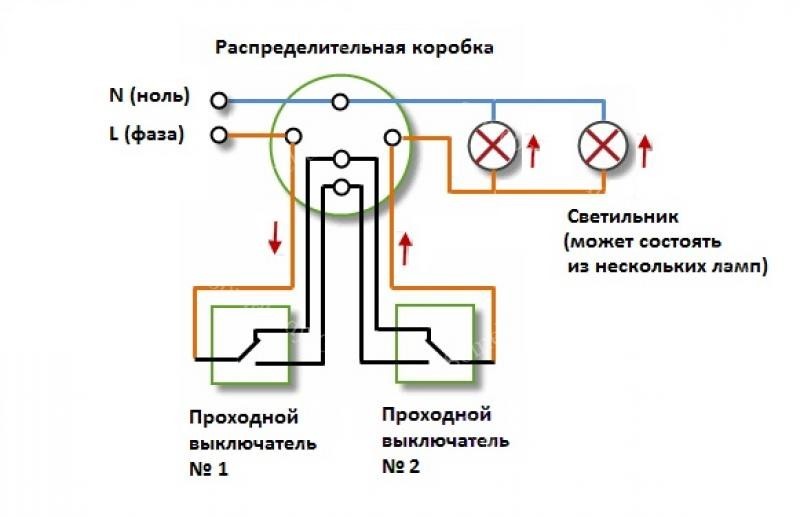
- Scheme of connecting the wires of the pass-through switch in the junction box
- Cross
- Working principle of the cross disconnector
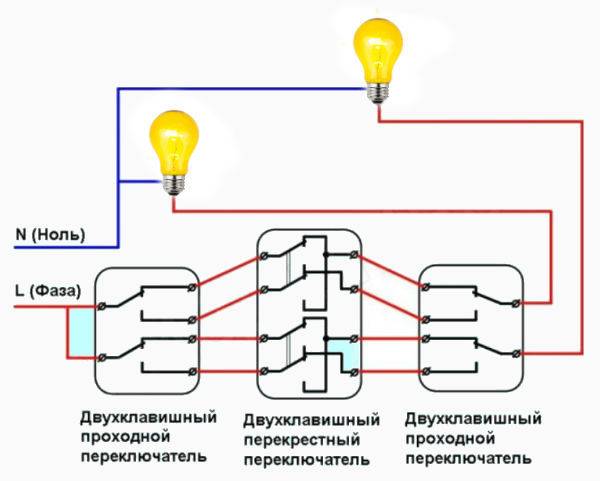
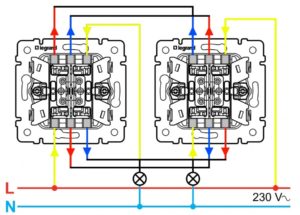
How to connect a two-gang pass-through switch
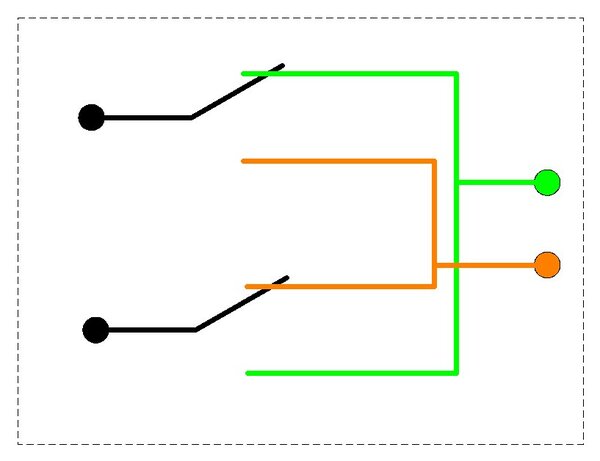
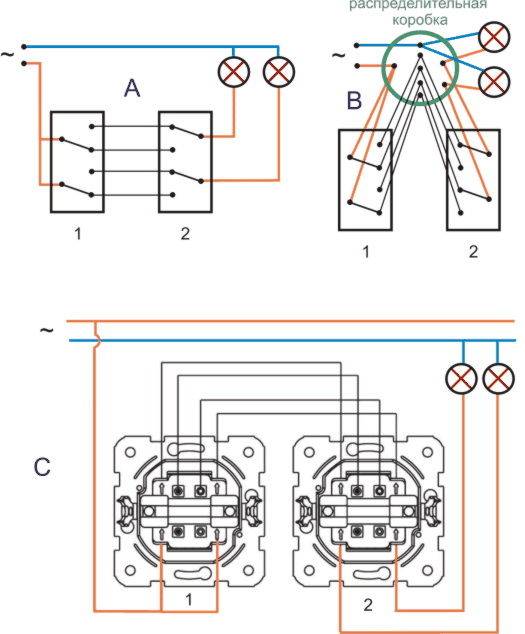
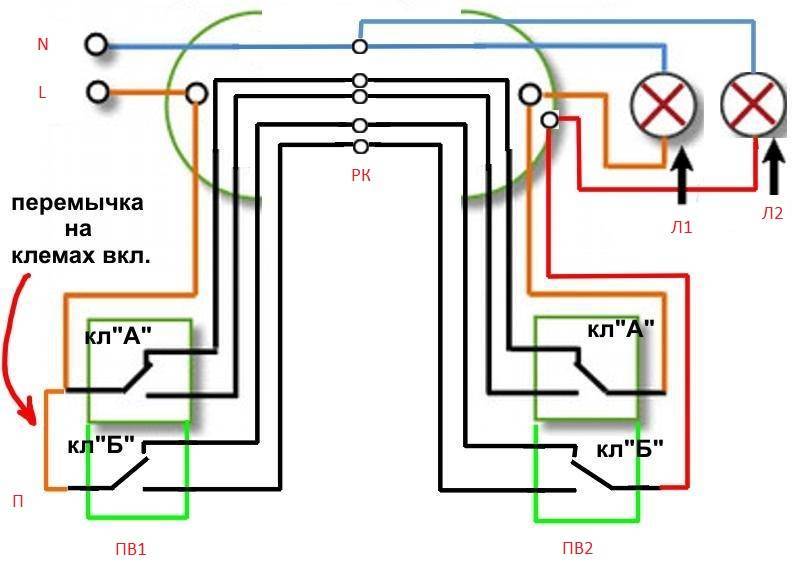
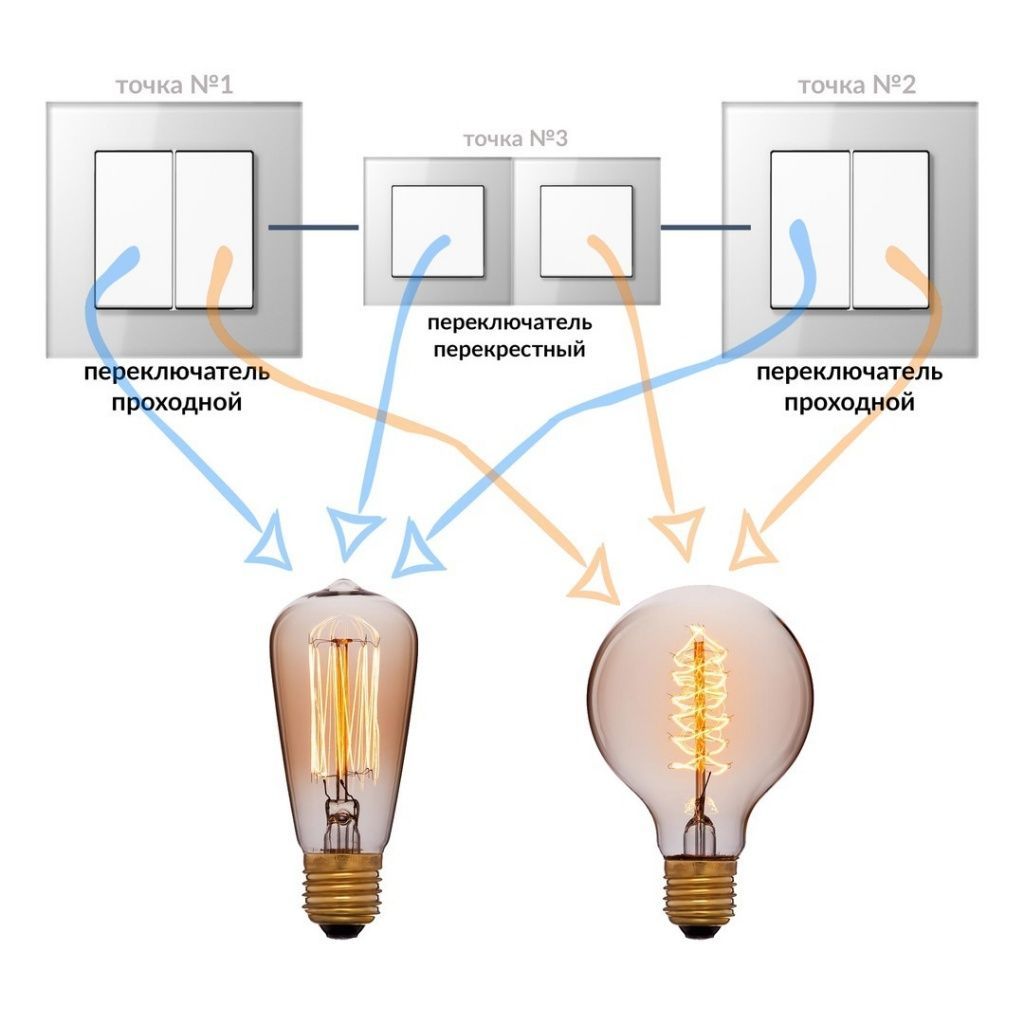
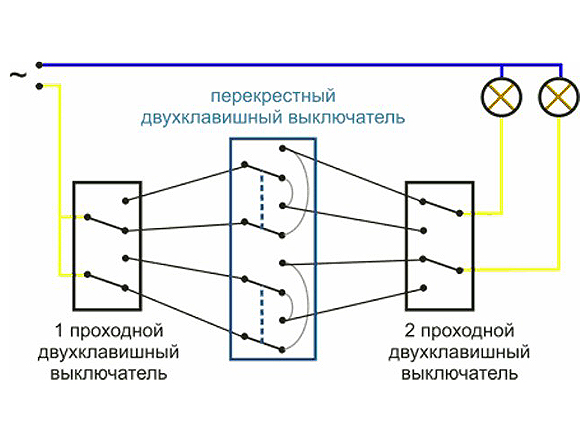
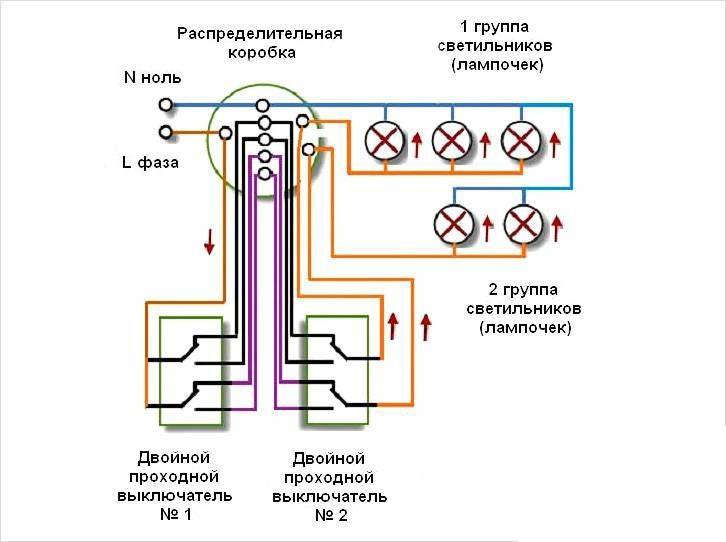
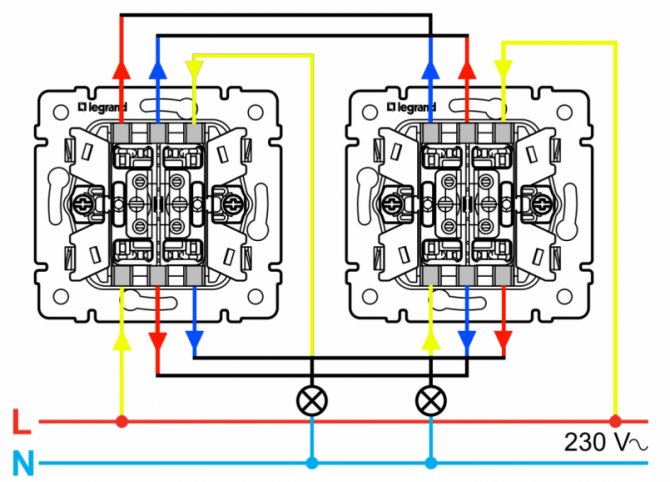
Connection two-gang pass-through switch in fact, it differs only in the number of keys and wires, the circuit remains the same. There are already 6 wires in the circuit of switches. Four of them are outputs and two are inputs, two outputs to the switch keys.
How to make a two-gang pass-through switch
The neutral wire passes through the junction box to the lamps.
The phase wire is connected to the first switch (dispersed to each key).
The two ends of the phase wire are connected to their pair of outputs of the first switch.
Sometimes it is necessary to make pass-through switches. What it is? This is when the light can be turned on in one place and turned off in another. Or vice versa.
Here are examples of real situations where you need to turn on and off the light from different places. I encountered some of them in practice, some I observed in different places.
- In the hotel, the light can be turned on at the entrance to the room, and turned off by the switch at the headboard, already lying in bed.
- On the balcony, which has two exits (from the kitchen and the room). When you exit through one door, the light on the balcony turns on, when you exit through another, it turns off.
- In the country, you can place two switches: from the bottom of the stairs to the second floor, and from above.
This scheme can be implemented in two main ways:
- using pass-through switches;
- using special relays.
A through switch is a changeover contact device. Outwardly, it looks exactly like a normal one. The circuit on such switches is as follows.
The disadvantage of such a scheme is the not very clear position of the switch when the light is off. The switch key can be in the up or down position. That is the position keys of both switches when the light is off - in antiphase.
The second drawback is that you cannot turn on / off at three points. For example, in the bedroom, I would like to make light on both sides of the bed and near the entrance. Then you need to use a special relay.
In my practice, I used the MR-41 relay manufactured by the Czech company Elko. It is quite expensive, about 1400 rubles. But it solves the problem to the fullest.
The relay is installed in the electrical panel in the same way as a normal one. A lot of buttons (seemingly up to 80) are connected to it without fixing. And a lamp is connected to the power contacts of the relay.
Both Legrand and ABB have similar devices, but they are much more expensive.
When choosing such devices, it is important to make sure that there are two functions
- ensuring that the backlight of the switch key is on (not everyone does this);
- restoration of the current state after a power outage.
Elko implements both of these functions. Another problematic issue is the search for a non-latching switch. I managed to find such switches in the popular Legrand Valena series. However, an attempt to order showed that you can buy such switches right away, without pre-ordering, even in Moscow in just a few places.
Related materials:
How to make walk-through switches?
Comments: 16
seriously
tell me if anyone knows)
The issue is solved by buying a P2K type key switch or a 2-position toggle switch in a radio parts store for a few rubles.
P2K low-current low-voltage switch, when switching the lighting in the house, it burns out after a dozen switches.
Dec. 28 saw these switches in OBI and Leroy Merlin stores. price from 72r? and 240 rubles. This is in Moscow. On Altufevsky sh. and on Borovsky. I don’t know about others. Yes, I heard that there is in Voronezh.



All switches and switches serve one thing - at the right time to close or open the electrical circuit (turn on or off the lighting). These devices are of various types and differ in execution. In this article, we will understand what switches and switches are and how they differ from each other.
Scheme of installation of the control line from three or more places
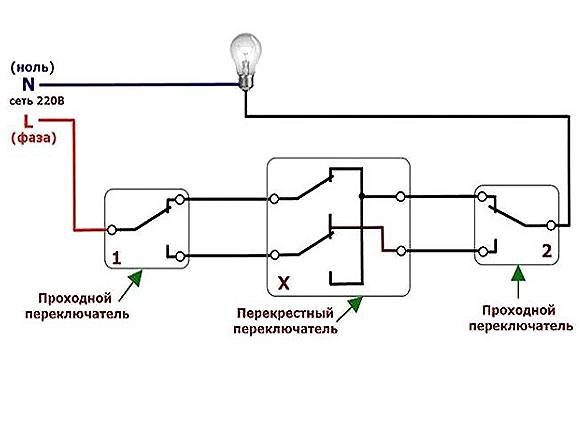
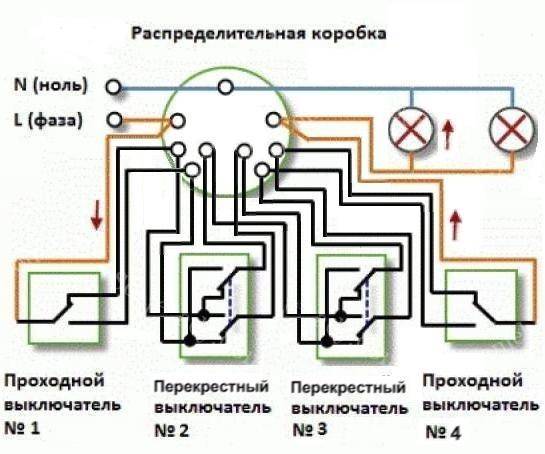
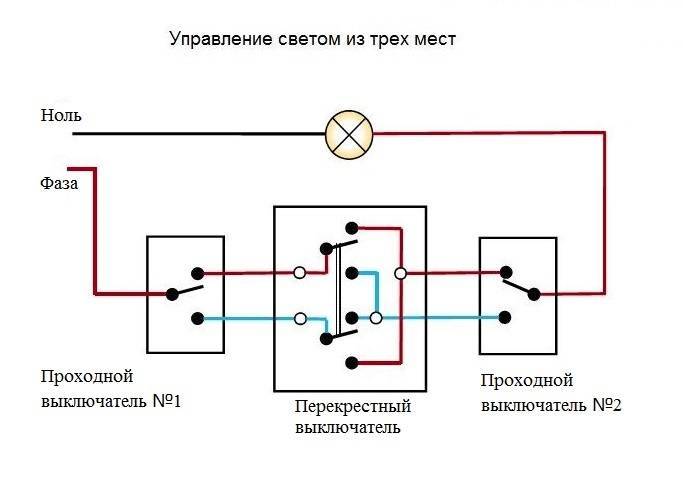
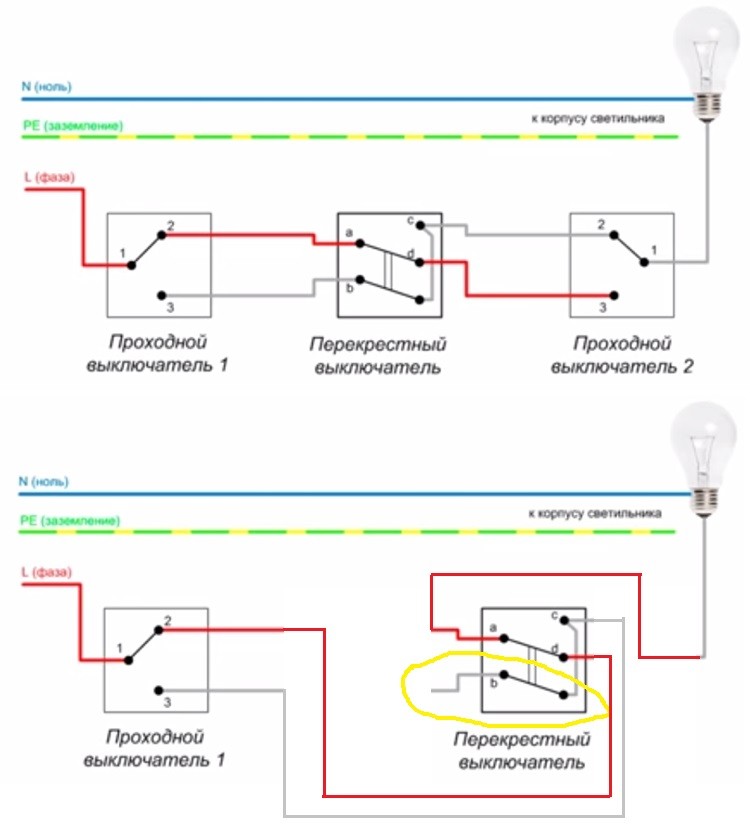
Universal option - regulation of light sources from 3 points. At its base the number of switches can be increased to 10 or more. The creation of an electrical circuit is carried out by 3 elements: two through and one cross devices.
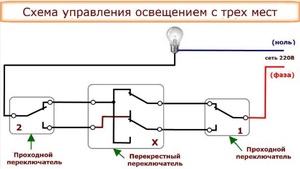 Pass-through devices are mounted at the ends of the switching line, a cross device is installed in the area between these elements. When the first switch is turned on, the phase current passes through the base circuit, the lighting device lights up. When the cross switch button is pressed, the circuit is opened. When turned on, current flows through the input wire. In this position, one of the contacts is permanently in phase. On the third switch, the procedure for closing and opening the circuit is similar to the first device.
If you want to control lighting from a large number of places, the required number of cross devices is installed between the passage products.
This scheme assumes 7 connections in the junction box.
Since there will be three circuits in the circuit for any options, three single and cross switches are used. However, paired through-through and cross products are more often used (2 double and one single). Pass-through products at the ends of the lines can be replaced with three-key elements. The consumer independently decides which option is preferable for him.
Connecting from multiple locations is common in high-rise buildings. Usually one switch is designed to control the lighting of three floors. It also spreads in private households, where there are many outdoor lamps (garden paths, gazebos, gates, garages).
Analysis of the schematics of the contact groups of the device
If we take the classic (single-key) design of the device, manufactured, for example, by ABB, and turn the back to the user, the following picture will open.
There are 4 pairs of terminals on the base board, each of which is marked with the corresponding symbols - in this case, "arrows". With a technical designation of this kind, the manufacturer gives the user information about the correct connection of the device.
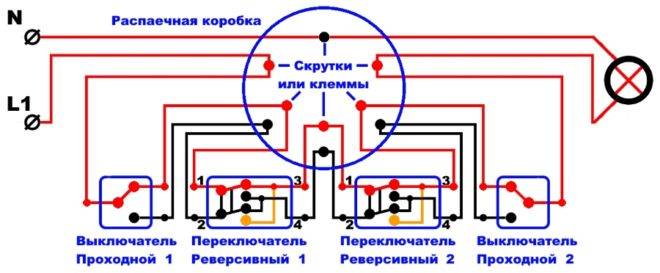
This is how the terminal wiring of the device with the reverse blocking function looks like. Differences from the design shown above are obvious. On these grounds, they usually choose the desired configuration of the device.
The incoming "arrows" indicate the common (changeover) contact group. Outgoing "arrows" mark a permanent contact group.
Schematically, the interaction of groups looks like the following figure:
Colored lines conventionally show how the contact groups are located inside the intermediate switching device. Each pair of working terminals is marked with symbols indicating the input and output groups
Conductors come to the terminals of the common (changeover) group of the contactor from the first pass-through switch involved in the electrical circuit. Accordingly, conductors come out from the terminals of the second (permanent) group of the contactor, which are connected to the pass-through switch number two, also prudently included in the circuit.
This is a classic variation using two through and one reversing devices.
Scheme for the introduction of one cross device in a circuit between two devices of through action. Typically, this solution is typical for circuitry used in domestic premises.
A device designed to play the role of a reversing switch can actually be used in one of two modes of switching an electric circuit:
- Direct switching is an analogue of two pass-through devices.
- Cross switching is the main purpose.
The configuration of the first option, in fact, is represented by the functionality of a direct connection with the possibility of communication or disconnection.
The second configuration method (by setting jumpers) puts the device in operating mode by switching circuit with inversion.
The reversing device supports configuration (by jumpers) for one of two possible mode functions. Thus, the cross-type switch acts as a kind of universal device.
Thus, intermediate switches look functionally not just like switches for artificial light sources, but like switches of universal action. This factor expands the functionality of such devices, making them convenient for use in various mounting options.




The difference between a pass-through switch and a conventional one
 It is convenient to use pass-through switches (what it is - we have already figured it out on the pages of the site) to control one lighting device from different places. Therefore, it is necessary to install several lighting source controls in the electrical circuit, i.e. several walk-through or mid-flight switches.
Such switches are very convenient in long passage rooms: corridors, stairs, passages. Now they are often installed in the bedroom - one at the entrance ("went in - turned on"), the other - by the bed ("lay down - turned off"). The convenience of using them is that you do not need to return in order to turn off the light.
To control separate light sources in apartments and offices, apply
wiring diagrams switch
. In this case, you can turn the lighting on and off from two, three or more places.
Pass-through switches can be connected together with a dimmer. You can learn more about this scheme here.
If you went into the office - turned on the light, and then sat down at the desktop, turned on the table lamp, then you can turn off the overhead light without getting up from the table.
In private houses combined with outbuildings, it is also very convenient to install a pass-through switch: before leaving the house in the utility room, he turned on the light, and when leaving this room through the door leading to the street, you can turn off the light without returning back to the house. And such switches can be installed several for one light source.
On the backyard for lamps installed in gazebos, near the paths, it is convenient to have at least two switches, one for turning it on and off in the house, the second directly near the lighting fixture. From two independent points, current is transferred from one circuit to another. Very convenient and no need to waste time returning to the original position.
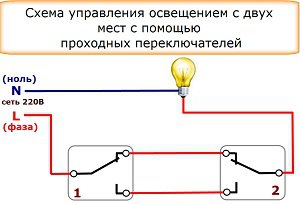
Scheme of connecting a pass-through switch from 2 places
The circuit of the pass-through switch from two places is carried out using two pass-through single-key devices that work only in pairs. Each of them has one contact at the entry point, and a pair at the exit point.
Before how to connect passthrough switch, the connection diagram clearly displays all the stages, it is necessary to de-energize the room using the appropriate switch located in the control panel.After that, it is necessary to additionally check the absence of voltage in all the wires of the switch. To do this, use a special screwdriver.
To perform the work you will need: flat, Phillips and indicator screwdrivers, a knife, side cutters, a level, a tape measure and a puncher. To install switches and lay wires in the walls of the room, it is necessary to make the appropriate holes and gates, according to the layout plan of the devices.

Unlike conventional switches, pass-through switches have not two, but three contacts and can switch the “phase” from the first contact to the second or third
It is necessary to lay wires at a distance not less than 15 cm from ceiling. They can be located not only in a hidden way, but also be stacked in trays or boxes. Such installation makes it possible to quickly perform repairs in case of damage to the cable. The ends of the wires must be brought into the junction boxes, in which all connections are also made using contactors.
Installation procedure for 2-point walk-through switches: wiring diagram
All actions for installing switching devices are carried out on the basis of a connection diagram of 2 places of pass-through switches, which can be found on the Internet. It differs from the installation of conventional switches, since there are three wires here instead of the usual two. In this case, two wires are used as a jumper between two switches located in different places in the room, and the third one is used to supply the phase.

Any type of lamps can be used as a light source in such a scheme - from conventional incandescent lamps to fluorescent, energy-saving and LED
Five wires should be connected to the junction box: power supply from the machine, three cables, going to the switches, and a plug-in wire directed to the lighting fixture. When constructing a connection diagram for a single-gang pass-through switch, three-core cables are used. The zero wire and ground are led directly to the light source. Brown phase wire that supplies current, goes through the switches, according to the diagram, and output to the lighting lamp.
The switches are connected at the break of the phase wire, and zero, having passed the junction box, is directed to the lighting fixture. Passing the phase through the switch will ensure safety during repair and maintenance of the luminaire.
Installing the pass switch consists of the following sequence of actions:
- the ends of the wires are stripped of insulation;
- using the indicator, it is necessary to determine the phase wire;
- using twisting, the phase wire should be connected to one of the wires on the first switch (white or red wires are used here);
- the wires are connected to each other by the zero terminals of the switches;
- connecting a separate wire of the second switch to the lamp;
- in the junction box, the wire from the lamp is connected to the neutral wire;

When installing walk-through switches yourself, you need to take care of safety
Flaws
1
If your light bulb has burned out and needs to be replaced, with this scheme it is not immediately possible to understand whether the light is on or off.
It will be unpleasant when, when replacing, the lamp can simply explode before your eyes. In this case, the easiest and most reliable way to turn off the light switch in the dashboard.2


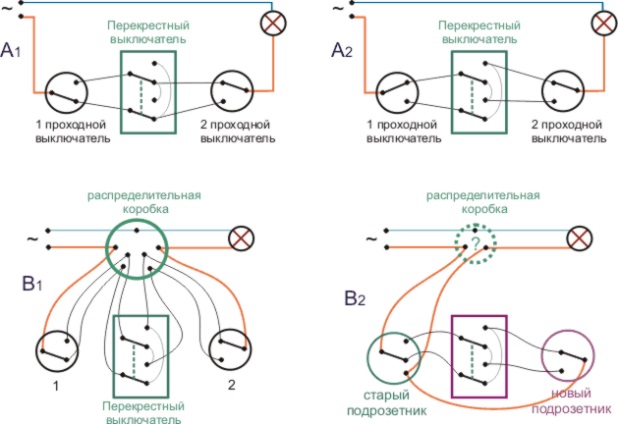



And the more light points you have, the more of them will be in the junction boxes. Connecting the cable directly according to diagrams without junction boxes reduces the number of connections, but at times can increase either the cable consumption or the number of its cores.
If your wiring goes under the ceiling, then you will have to lower the wire from there to each switch, and then lift it back up. The best option here is the use of impulse relays.
Well-known manufacturers of pass-through switches
Legrand is a leader in the electrical goods market. The demand for Legrand walk-through switches is due to the high quality of products, ease of installation, convenience in further operation, stylish design and flexible pricing. The only drawback is the need to adjust the mounting location. If it does not match the product, difficulties may arise during its installation, which is carried out according to the connection diagram of the Legrand feed-through switch.

Feed-through switches from Legrand
A subsidiary of Legrand is the Chinese company Lezard. However, only a stylish design remained from the native brand. The build quality is much lower, due to the low cost of production.
One of the leading domestic manufacturers of electrical goods is the Wessen company, which is part of the Schneider Electric company. All products are manufactured according to the latest technologies on modern foreign equipment and comply with European quality standards.Models have a universal stylish design that allows you to fit each element into any interior space. A distinctive feature of Wessen switches is the ability to replace the decorative frame without dismantling the device.
Another equally well-known manufacturer is the Turkish company Viko. Products are characterized by high workmanship, reliability and durability, meet the requirements of electrical safety and European quality standards. When making the hull The device uses fireproof durable plastic, which is designed for a large number of work cycles.

The pass-through switch, unlike the usual one, has three conductive wires
The Turkish brand Makel offers quality, reliable, safe and stylish products. Thanks to the possibility of connecting a loop without the need to use a junction box, the installation of switches becomes easier, and further operation is comfortable and safe.
Popular range of feed-through switches
Passage switches Legrand from the Velena series are distinguished by a stylish design and a variety of color variations. Here are presented one and two-key products that have a dust and moisture protective layer. You can buy a switch from 300 rubles.
The Celiane series includes products in which the circular keys are inscribed in a square. They can be non-contact with levers or silent. The cost of switches starts from 700 rubles. The Exclusive Celiane range features a limited number of hand-crafted switches in marble, bamboo, porcelain, gold, myrtle and other materials. Frames are made to order. The price for the product starts from 5.9 thousand rubles.

Color solutions for switches from the Celiane series
The most popular series of switches from Lezard are Demet, Mira and Deriy. Here are products made of non-flammable polycarbonate, which meets the requirements of electrical safety. Conductive elements are made of phosphor bronze, which is characterized by high conductivity and low heating. You can buy a single-key switch through passage from 125 rubles.
The W 59 Frame series from Wessen uses a modular principle that allows you to install from 1 to 4 devices in one frame horizontally or vertically. The price of the product is 140 rubles. Single and double switches from the Asfora series are distinguished by a simple design, but high quality workmanship, which can be bought for 450 rubles.
Among the popular Makel series are Defne and Makel Mimoza. The body of the devices is made of high quality plastic, equipped with an internal reliable mechanism. The cost of products starts from 150 rubles.

When the on / off button is pressed, the moving contact of the feed-through switch is transferred from one contact to another, thus creating conditions for a new circuit in the future
The principle of operation and installation of switching devices do not present significant difficulties. Need to study first wiring diagram and follow recommendations of electrical safety rules, which will make it possible to carry out reliable and safe installation of devices, thereby ensuring convenient and comfortable control of lighting fixtures in the house.
How to connect a pass switch: wiring diagram video
Connection with three control points
If the number of points of the pass-through switch exceeds two, in addition to simple switching elements, a cross type of control devices will also be required.

This type is distinguished by the fact that it has two pairs of input and output contacts, therefore a four-core cable is pulled to it. To implement the chain, ordinary passage structures are in the first and last positions, and cross ones in the middle.
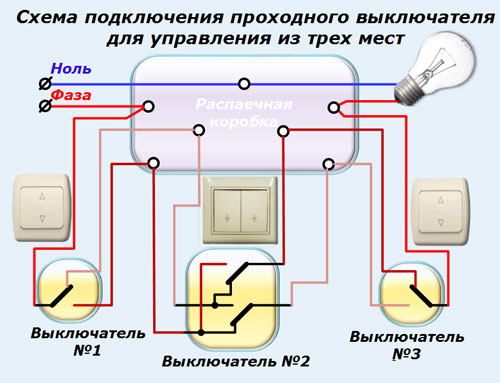


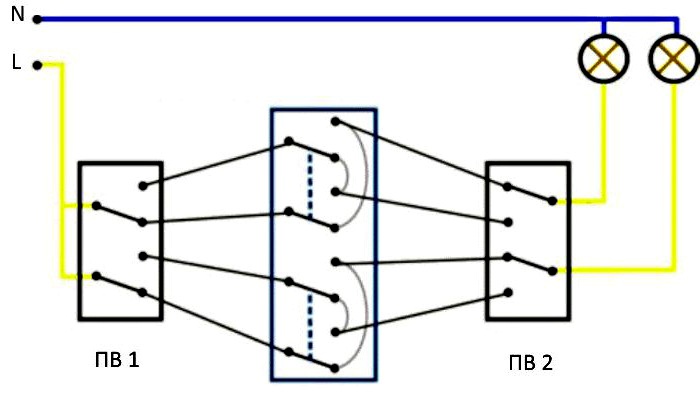


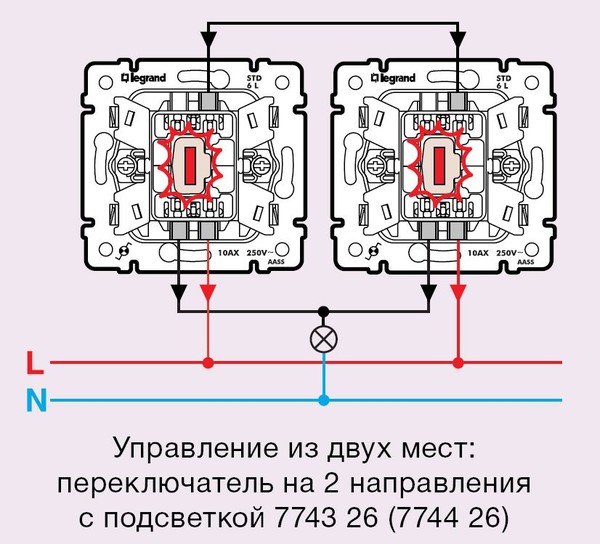
The combined schema is created like this:
- the common contact of the first switch is combined with the box phase;
- the output contacts of the first device are connected to a pair of input contacts from the cross device;
- the output contacts of the cross type design are combined with the input contacts of the next cross or last (conventional) circuit breaker;
- the common contact of the last in the chain conventional control element is connected to the input contact of the electrical device;
- the output from the electrical appliance is connected to the phase contact of the junction box.

It should be noted that the number of control points in this scheme is not limited. While maintaining the principle of placing conventional structures at the ends of the chain, and cross ones in its middle.


3 point switch types
Switches with three places are represented by two type of products: through passage and cross. The latter cannot be used without the former. According to the principle of operation, cross-sections are divided into:
- Keyboards.
- Swivel. A rotary mechanism is used to close the contacts. They are presented in a variety of designs and will cost more than usual.
Taking into account the installation, the cross ones are divided into:
- Overhead. Mounting is carried out on top of the wall, does not require a recess in the wall to install the unit.If the decoration of the room is not planned, then this option is ideal. But such models are not reliable enough, because they are subject to external factors;
- Embedded. Installed in the wall, suitable for wiring work in all types of buildings. A hole in the wall is pre-prepared according to the size of the switch box.
checkpoint
Unlike the classical model, the pass-through switch has three contacts and a mechanism that combines their work. The main advantage of the product is the ability to switch on or off from two, three or more points. The second name of such a switch is "toggle" or "duplicate".
The design of the two-key pass-through switch resembles two single-gang switches independent of each other, but with six contacts. Outwardly, a walk-through switch cannot be distinguished from a conventional switch if it were not for a special designation on it.
Scheme of connecting the wires of the pass-through switch in the junction box
Circuit without a ground conductor. Now the most important thing is to correctly assemble the circuit in the junction box. Four 3-core cables should go into it:
power cable from the switchboard lighting machine
cable to switch #1
cable to switch #2
cable for lamp or chandelier
When connecting wires, it is most convenient to orient by color. If you use a three-core VVG cable, then it has two most common color markings:
white (gray) - phase
blue - zero
yellow green - earth
or the second option:
White gray)
brown
black
To choose a more correct phasing in the second case, refer to the tips from the article “Color marking of wires. GOSTs and rules.”




The assembly begins with zero conductors. Connect the zero core from the cable of the introductory machine and the outgoing zero on the lamp at one point through the car terminals.
Next, you need to connect all the ground wires if you have a ground conductor. Similarly to the neutral wires, you combine the “ground” from the input cable with the “ground” of the outgoing cable for lighting. This wire is connected to the body of the lamp.
It remains to connect the phase conductors correctly and without errors. The phase from the input cable must be connected to the phase of the outgoing wire to the common terminal of the feed-through switch No. 1. And connect the common wire from the feed-through switch No. 2 with a separate wago clamp to the phase conductor of the cable for lighting. Having completed all these connections, it remains only to connect the secondary (outgoing) cores from the switch No. 1 and No. 2 to each other
And it doesn't matter how you connect them.
You can even mix up the colors. But it is better to stick to the colors, so as not to get confused in the future. On this, you can consider the circuit fully assembled, apply voltage and check the lighting.
The basic connection rules in this scheme that you need to remember:
- The phase from the machine must come to the common conductor of the first switch
- The same phase should go from the common conductor of the second switch to the light bulb
- The other two auxiliary conductors are interconnected in the junction box
- Zero and earth are fed directly without switches directly to the light bulbs
Cross
Cross models with 4 pins, which allows you to connect two pins at the same time. Unlike walk-through models, cross models cannot be used on their own. They are installed complete with walk-throughs, they are designated identically on the diagrams.
These models are reminiscent of two soldered single-gang switches. Contacts are connected by special metal jumpers. Only one switch button is responsible for the operation of the contact system. If necessary, cross model you can do it yourself.
Working principle of the cross disconnector
The pass-through device for turning on and off the light inside has four terminals - it looks the same as ordinary switches. Such an internal device is necessary for the cross-connection of the two lines that the switch will regulate. The disconnector at one moment can make the opening of the two remaining switches, after which they are connected together. The result is turning the light on and off.



