
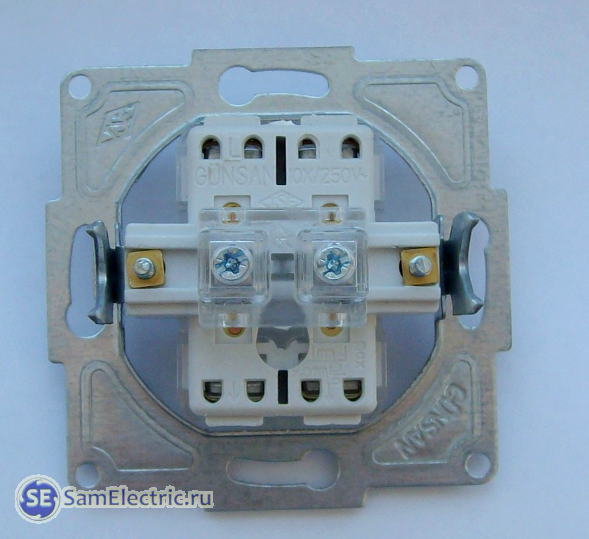
- What does a switch look like and how does it work?
- Types of switches
- Single-pole switches
- Bipolar modifications
- Dual Capacitor Circuit Breakers
- Well-known manufacturers of pass-through switches
- Popular range of feed-through switches
- Lighting control from three or more places
- The principle of operation of the cross switch (switch)
- Wiring diagram for three switches
- Wiring diagram for four switches
- Change-over type circuit breaker
- What is a toggle switch
- Device specifics
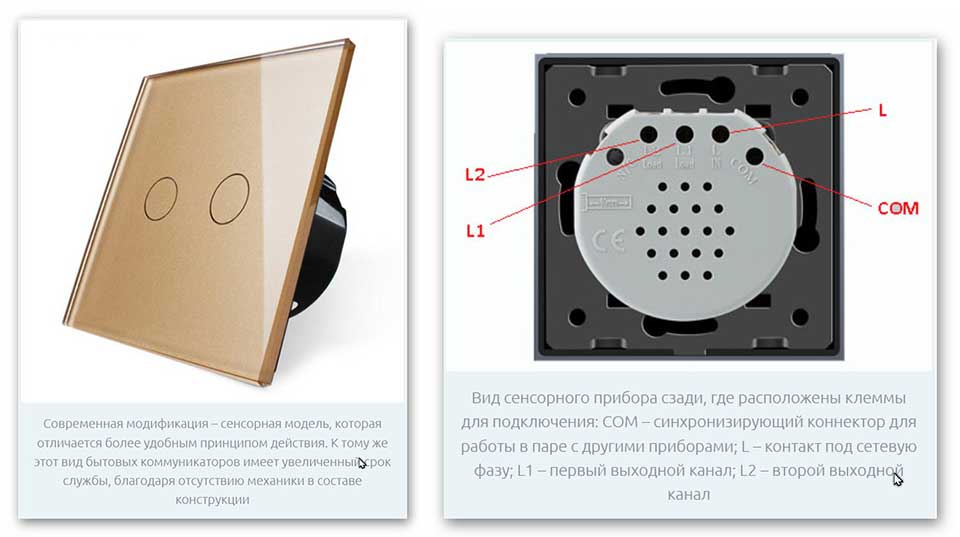
- How does a two-button switch work?
- Scheme of three-key equipment
- Features of using a pass-through switch
- Correct connection of the toggle switch for organizing three lighting control points
- Changeover switches
- Installation Recommendations
- Wiring diagram
- Conclusions and useful video on the topic
What does a switch look like and how does it work?
If we talk about the front side, then the only difference is a barely noticeable arrow on the up and down key.
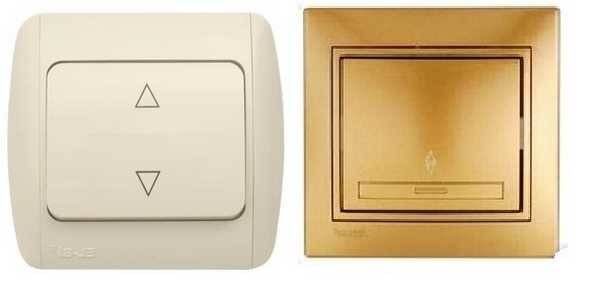
What does a single-gang switch look like? See, there are double arrows
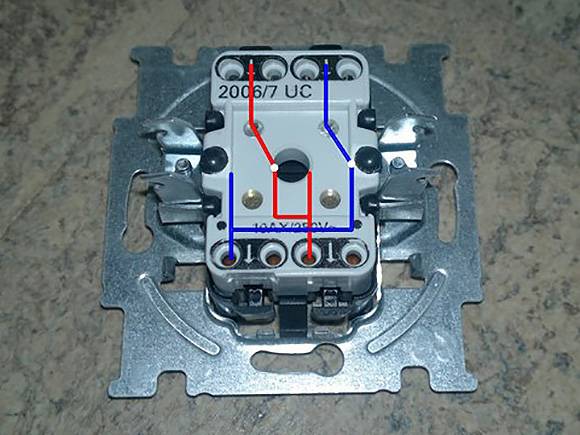
If we talk about the electrical circuit, everything is also simple: in ordinary switches there are only two contacts, in the feed-through (also called changeover) three contacts, two of which are common.There are always two or more such devices in the circuit, and with the help of these common wires they are switched.
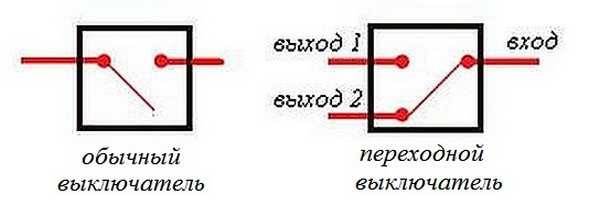
The difference is in the number of contacts
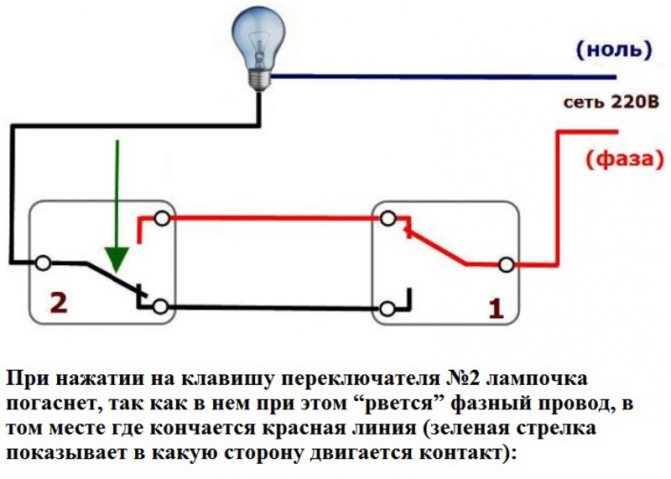
The principle of operation is simple. By changing the position of the key, the input is connected to one of the outputs. That is, these devices have only two working positions:
- input connected to output 1;
- input connected to output 2.
There are no other intermediate provisions. Thanks to this, everything works. Since the contact switches from one position to another, electricians believe that it is more correct to call them "switches". So the pass switch is also this device.
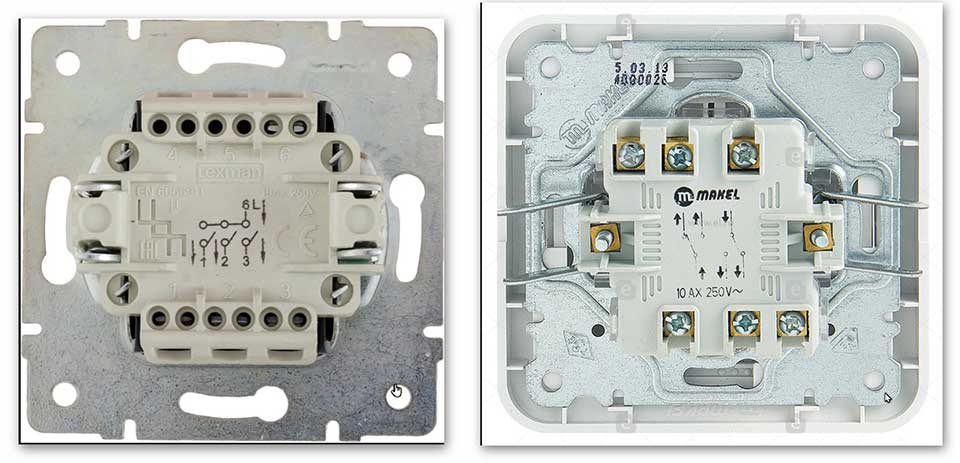
In order not to rely on the presence or absence of arrows on the keys, you need to inspect the contact part. Branded products should have a diagram that allows you to understand what type of equipment you have in your hands. It is definitely on the products of Lezard (Lezard), Legrand (Legrand), Viko (Viko). They are often absent on Chinese copies.
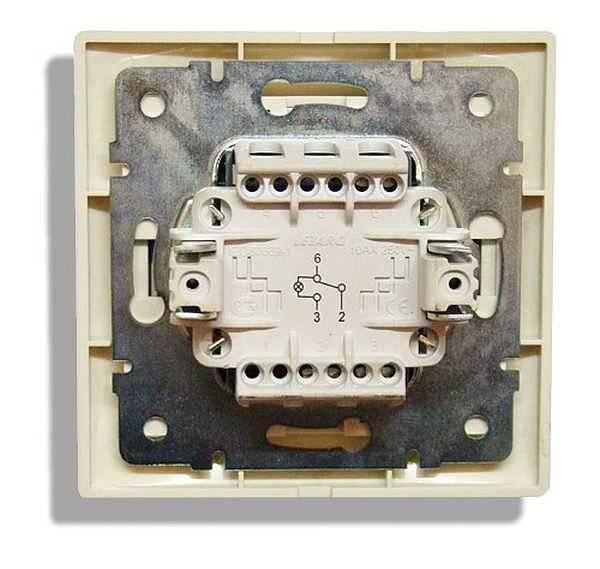
This is what the toggle switch looks like from the rear
If there is no such circuit, look at the terminals (copper contacts in the holes): there should be three of them. But not always on inexpensive specimens, the terminal that costs one is the entrance. Often they are confused. To find where the common contact is located, you need to ring the contacts among themselves at different key positions. This must be done, otherwise nothing will work, and the device itself may burn out.
You will need a tester or multimeter. If you have a multimeter, set it to sound mode - it beeps when there is a contact. If you have a pointer tester, call for a short circuit.Put the probe on one of the contacts, find which of the two it rings with (the device beeps or the arrow shows a short circuit - it deviates to the right until it stops). Without changing the position of the probes, change the position of the key. If the short circuit is missing, one of these two is common. Now it remains to check which. Without switching the key, move one of the probes to another contact. If there is a short circuit, then the contact from which the probe was not moved is the common one (this is the input).
It may become clearer if you watch a video on how to find the input (common contact) for the pass-through switch.
How to connect the hob the panel is written here, and about installing and turning on the water heater - in this article.
Types of switches
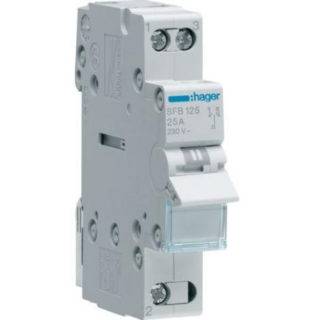
Single-pole changeover switch
Connecting devices according to various schemes and differences in operating parameters imply the division of circuit breakers into types.
Single-pole switches
The devices have one module and copper conductors. Differs in low, about 200 V, output voltage. The main application of the toggle circuit breaker is to service a generator with an operating frequency of up to 20 Hz.
The modular device is not placed in a residential building that consumes a lot of energy. The maximum load of the device should not exceed 200 A.
Bipolar modifications
The purpose of the changeover switches in two directions is the maintenance of high-rise buildings, equipment connected to a two-phase or single-phase network. The device has an average value of negative resistance - 60 ohms. The type of output voltage depends on the modification of the switch.
The switch is suitable for connection to a two-phase network. Equipped with blockers, has a high sensitivity limit. Available with two or three modules.For generators, models with a voltage of 350 V, designed for a load of 30 A, are suitable. The installation is carried out together with a power supply unit for 200-300 A with a load limit of 3 A.
Dual Capacitor Circuit Breakers
The toggle switch is designed for single-phase circuit type only. The devices are produced with two capacitors and two modules, they work together with 300 V power supplies. The average voltage is 30 A.
The devices are installed using two copper jumpers. Dual capacitor models are only compatible with expansion switches.
Devices can be combined with counters.
Well-known manufacturers of pass-through switches
Legrand is a leader in the electrical goods market. The demand for Legrand walk-through switches is due to the high quality of products, ease of installation, convenience in further operation, stylish design and flexible pricing. The only drawback is the need to adjust the mounting location. If it does not match the product, difficulties may arise during its installation, which is carried out according to the connection diagram of the Legrand feed-through switch.




Feed-through switches from Legrand
A subsidiary of Legrand is the Chinese company Lezard. However, only a stylish design remained from the native brand. The build quality is much lower, due to the low cost of production.
One of the leading domestic manufacturers of electrical goods is the Wessen company, which is part of the Schneider Electric company. All products are manufactured according to the latest technologies on modern foreign equipment and comply with European quality standards.Models have a universal stylish design that allows you to fit each element into any interior space. A distinctive feature of Wessen switches is the ability to replace the decorative frame without dismantling the device.
Another equally well-known manufacturer is the Turkish company Viko. Products are characterized by high workmanship, reliability and durability, meet the requirements of electrical safety and European quality standards. In the manufacture of the device case, fireproof durable plastic is used, which is designed for a large number of work cycles.
The pass-through switch, unlike the usual one, has three conductive wires
The Turkish brand Makel offers quality, reliable, safe and stylish products. Thanks to the possibility of connecting a loop without the need to use a junction box, the installation of switches becomes easier, and further operation is comfortable and safe.
Popular range of feed-through switches
Passage switches Legrand from the Velena series are distinguished by a stylish design and a variety of color variations. Here are presented one and two-key products that have a dust and moisture protective layer. You can buy a switch from 300 rubles.
The Celiane series includes products in which the circular keys are inscribed in a square. They can be non-contact with levers or silent. The cost of switches starts from 700 rubles.The Exclusive Celiane range features a limited number of hand-crafted switches in marble, bamboo, porcelain, gold, myrtle and other materials. Frames are made to order. The price for the product starts from 5.9 thousand rubles.
Color solutions for switches from the Celiane series
The most popular series of switches from Lezard are Demet, Mira and Deriy. Here are products made of non-flammable polycarbonate, which meets the requirements of electrical safety. Conductive elements are made of phosphor bronze, which is characterized by high conductivity and low heating. You can buy a single-key switch through passage from 125 rubles.
The W 59 Frame series from Wessen uses a modular principle that allows you to install from 1 to 4 devices in one frame horizontally or vertically. The price of the product is 140 rubles. Single and double switches from the Asfora series are distinguished by a simple design, but high quality workmanship, which can be bought for 450 rubles.
Among the popular Makel series are Defne and Makel Mimoza. The body of the devices is made of high quality plastic, equipped with an internal reliable mechanism. The cost of products starts from 150 rubles.
When the on / off button is pressed, the moving contact of the feed-through switch is transferred from one contact to another, thus creating conditions for a new circuit in the future
The principle of operation and installation of switching devices do not present significant difficulties.It is necessary to first study the connection diagram and follow the recommendations of the electrical safety rules, which will make it possible to carry out reliable and safe installation of devices, thereby ensuring convenient and comfortable control of lighting fixtures in the house.
How to connect a pass switch: video connection diagrams
Lighting control from three or more places
It is not uncommon for situations when in residential premises of a large area there is a need to control lighting from several points at once. To create a multi-point control system that allows you to turn on and off the light from 3 places at the same time, installing one pass-through switches is usually not enough.
For these purposes, it will be necessary to integrate another element into the circuit - a cross switch, which is connected in a break in a two-wire wire (that is, between pass-through devices).
If in former times the admissibility of the installation of such schemes was determined mainly by the layout of the premises, today they are found almost everywhere. Installation of this type of walk-through switches is a very difficult task. First of all, you need to familiarize yourself with the principle of its work.
The principle of operation of the cross switch (switch)
The design of the switch provides for the presence of four contacts, of which two are connected to the terminals of one switch and two more to the second device.
These devices, when switched on, perform special (transit) functions, since they are to a certain extent transitional.
You can visually see the principle of operation of the cross switch on the Gif-picture below.
Wiring diagram for three switches
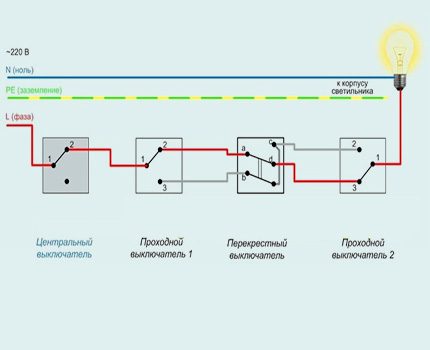
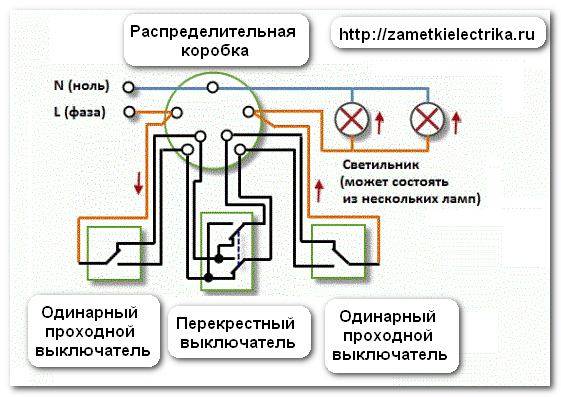
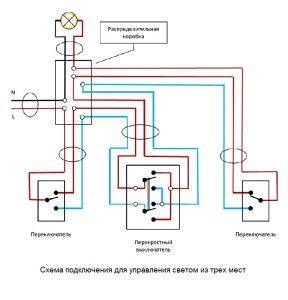
A schematic representation of the connection of a 2-way and one cross switch is shown in the figure.
It clearly shows that a cross switch is installed between two pass-through switches, acting as a kind of transit node.
Below we give a diagram of the connection of all elements of the electrical lighting control circuit in the junction box.
The video that we have posted below will undoubtedly help you assemble a wiring diagram for three switches in a junction box.
Wiring diagram for four switches
For four control points, you will need to apply the complex wiring diagram shown in the figure below. In such a kit, not only two pass-through, but also a pair of cross-type switches are used.



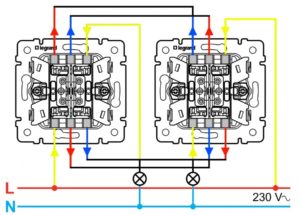

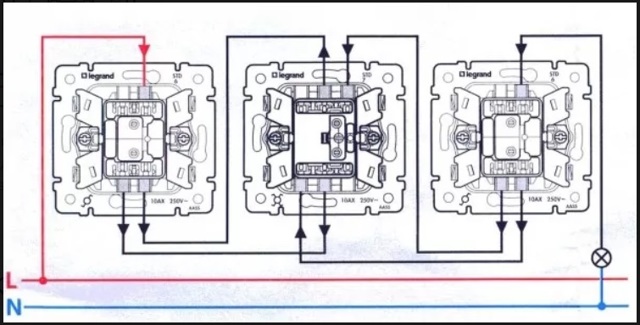

When considering the option of controlling a luminaire from 4 places at once, two cross switching devices will be required.
If there are several lighting groups in this room, preference should be given to two-key cross-type switches. The walk-through systems installed in this way significantly simplify the lighting control procedure.
These systems of many switched devices (with all the seeming convenience) even more question their reliability. Even with proper inclusion and careful handling, they are characterized by the following disadvantages:
- relatively high cost;
- relatively low reliability;
- the possibility of false positives;
- complexity of maintenance and repair.
That is why connecting walk-through switches and cross switches to control lighting from several places is the best option for using the principle of multi-point control.
Change-over type circuit breaker
All the toggle switches presented above have one drawback - they require the presence of a person to carry out manipulations with switching circuits. This is inconvenient, especially when the central power supply fails frequently and unpredictably. Therefore, a toggle circuit breaker was developed. More precisely, this is a whole block called automatic reserve transfer (ATS).
ATS is a complex design, but craftsmen assemble such systems from relatively inexpensive relay devices (contactors). For this, models with normally closed and open contacts are used.
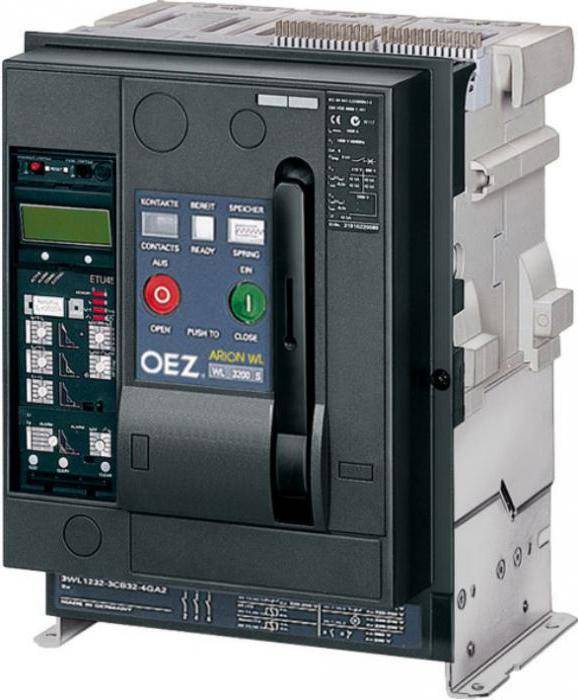
When a homemade toggle switch is used, the wiring diagram works according to a certain principle. For example, if there is central supply electricity in the line, then a relay with normally open contacts closes the circuit with the load. The relay with normally closed contacts, where the generator is connected, is open in this case. As soon as the current disappears, the combination is reversed, and the network begins to feed the generator.
What is a toggle switch
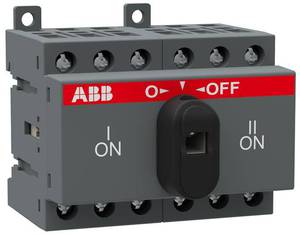
Reversing toggle switch
The purpose of a toggle switch is to transfer voltage between two lines or to connect several networks. Using a switch, you can eliminate current leakage in case of accidents and quickly switch to the entire line. Switching of the device is made by means of the lever on the front panel which is given in 1-2 provisions.
The equipment is installed in the switchboard room or near the input shield.
Device specifics
A toggle switch is similar to a two-position switch in terms of the principle of operation, but it is distinguished by increased power and a smooth knife drive. The second difference is the process of switching with a line break and operation in three positions:
- apartment / home network;
- shutdown;
- power supply from the generator.
How does a two-button switch work?
The equipment has a total of 12 pins, 6 for each double switch (2 inputs, 4 outputs), therefore, to connect equipment of this type, you need to take 3 wires for each key of the device.
Switch Diagram:
Switch circuit
- the device consists of a pair of independent contacts;
- the upper contacts of the device N1 and N2 are switched to the lower ones by pressing the keys. The elements are connected by a jumper;
- the second contact of the right switch, shown in the diagram, is aligned with the phase;
- the contacts of the left mechanism do not intersect with each other, joining two different sources;
- The 4 cross contacts are combined in pairs.
The installation of a two-gang switch is carried out as follows:
- A pair of double mechanisms is installed in the sockets in selected areas.
- For each light source, a separate three-core cable is placed in the socket, the cores of which are cleaned of insulation by about 1 centimeter.
- In the diagram, the cable cores are designated as L (phase), N (working zero), ground (protective).
- The device is equipped with markings, which simplifies the task of connecting wires to the switch terminals. The wires are connected to the terminals in pairs.
- The bundle of wires is neatly placed in the socket, after which the switch mechanism, frame and cover of the protective housing are installed.
What the marking looks like:
Two-key switch marking
Connection diagram example:
Connection diagrams
To facilitate the work process, it is recommended to select wires of a certain light. There is a color marking of wires for Russia and other CIS countries. Also on it, a beginner can learn to distinguish between cables. According to the Russian marking for the “earth”, yellow and green colors are used, the neutral cable is usually marked in blue. The phase can be red, black or grey.
Scheme of three-key equipment
When installing a triple device, intermediate (cross) switches are used, which are connected between the two side elements.
Scheme of three-key equipment
This switch has two inputs and outputs. The cross element can translate both contacts at the same time.




Triple equipment assembly process:
- Ground and zero are connected to a light source.
- The phase is connected to the input of one of a pair of through structures (with three inputs).
- A free wire of the light source is connected to the input of another switch.
- Two outputs of one element having three contacts are combined with the input of a cross device (with two pairs of outputs).
- Two outputs of the pair mechanism (with three contacts) are combined with another pair of terminals of the next switch (with four inputs).
Features of using a pass-through switch
It can be difficult for ordinary users and home craftsmen to determine which of the switching devices to choose.Pass-through switches outwardly practically do not differ from standard ones - these electrical installation products also allow you to control lighting, but their connection scheme is completely different.
The key difference is that a conventional switch can only close or break the circuit, while a pass-through switch provides the direction of voltage from one contact to another - switching.
We recommend that you familiarize yourself with the intricacies of choosing a pass-through switch.
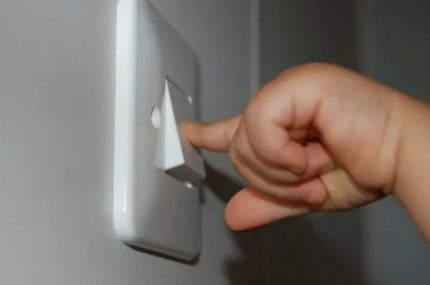 The pass-through model of the switch is a convenient switching device that allows you to turn the lamp on and off from several places. This solution ensures the comfort of lighting equipment operation.
The use of such devices is advisable in the following situations:
- In the corridor. The two-point connection scheme makes it possible to install one product at the beginning of the corridor, and the second one at the end, which will eliminate the need to go along the dark corridor after the lamp is turned off.
- On the stairs. This is an excellent solution for apartment buildings, private cottages with several floors. You can place such switches on all or several floors. The user can turn on the light on the site when entering the house and turn it off before entering the apartment on his floor.
- In the bedroom. The principle of operation does not differ from previous situations, it allows you to turn on the light when entering the room, turn it off at the head of the bed.
Above are the main uses for walk-through switches. In practice, devices can be installed in any premises, including not only residential, but also technical, industrial.This solution provides convenience in controlling the light, reduces the cost of paying for electricity.
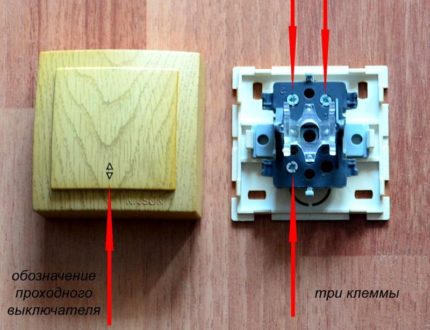 The appearance of the pass switch is not much different from the usual one. On its front side there are arrows down, up
The design of a simple switch assumes the presence of one input, one output, while a walk-through switch has two outputs. Due to this, the current flow can not only be interrupted, but also redirected. Although experienced electricians are able to determine the type of device by external signs, many manufacturers put a connection diagram on the product, which simplifies the choice of switching device.
You can make sure that you are purchasing a single pass-through switch if you carefully examine the terminals. There should be three. It, in fact, performs the function of a switch that directs voltage from one contact to another.
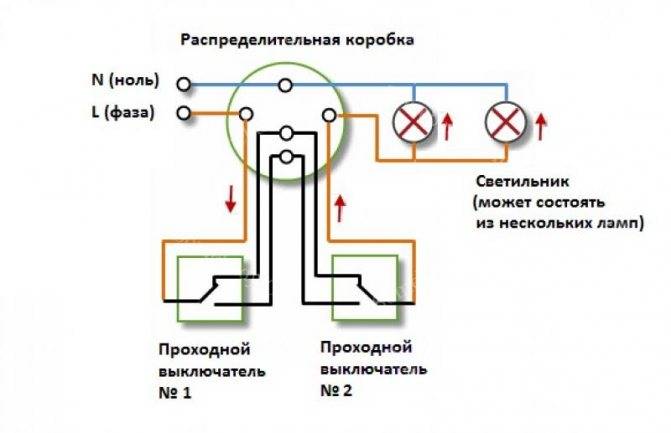
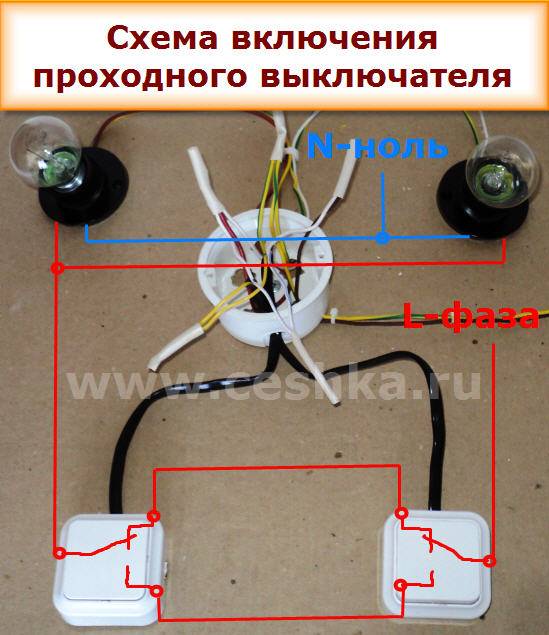
At least two switches are used to control one light fixture from different points in the room. When the position of the key changes, the circuit closes, the light turns on. When either of the two switches is turned off, the circuit opens, the lamp goes out. Thus, when the keys of the pass-through switches are in the same position, the light is on, when in a different position, it goes out.
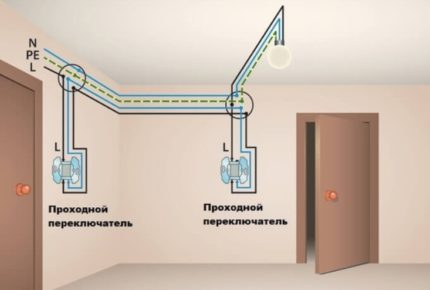 The design features of the walk-through switch eliminate the need to move around a dark room, which reduces injuries and helps save energy
Using such a switch, it is easy to control the lighting from three, four, six points. To do this, just add the required number of switches to the existing circuit.
Correct connection of the toggle switch for organizing three lighting control points
In this case, a one-button walk-through switch in the amount of two pieces is combined with a toggle switch. And that's what it gives. As before, in the figure we applied two colors. Imagine that the phase is now on blue. As shown in the picture. Now it's time to go visit. And we turn off the light with one movement of the toggle switch. Really, great?
All other options work the same way. Now the light in the corridor can be turned on and off from any of the three points. Whether it's the front door, the threshold of the kitchen or the exit from the bedroom. Moreover, toggle switches can be garlanded. But they all turn on towards each other.
Thus, we get the second rule. It applies to both toggle and walk-through switches: the switches are switched on towards.
We believe that there is no need to explain these words. They can be clearly traced in the first figure, where the switches are located side by side to each other. The second one looks outward, that is, towards the power supply and the light bulb in the chandelier.
Changeover switches
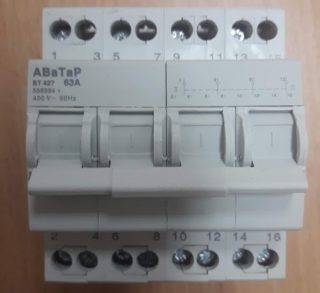
Changeover knife switch 4-pole 63A AVatar
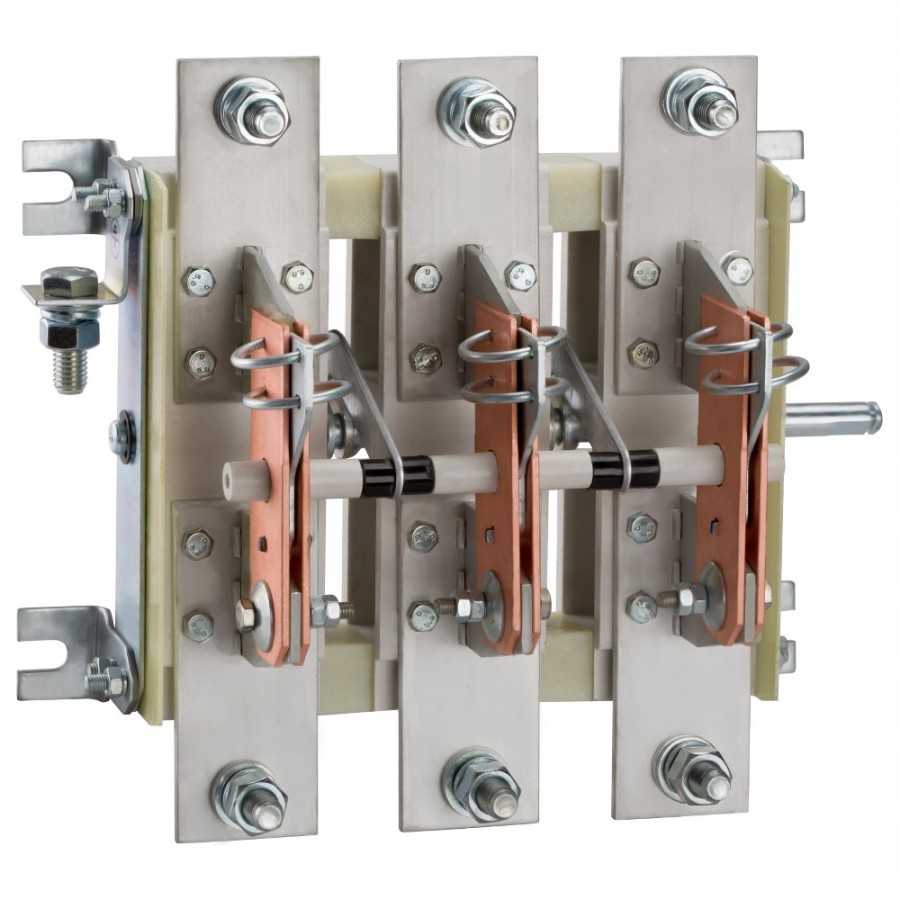
The electric switch provides disconnection of the network from one energy source and connection to another. The presence of a midpoint explains the name "cross over". The devices are produced with arc extinguishers that provide switching when the voltage is connected. Models without arcing mechanisms switch when the load is turned off. The switch works only in manual mode - switching is carried out using an isolated control lever.
The design of the device is presented:
- hermetic case;
- movable knife contacts with two working positions and one intermediate;
- arc chute, but there are circuit breakers without it;
- terminals for connecting to the network.
Connection to one load line is carried out according to the principle:
- The main power supply is connected to contact No. 1.
- A diesel or electric generator is connected to contact No. 2.
If input into the building with three-phase voltage is required, a three-phase switch with 4 poles is used. The device is connected like this:
- You need to enter the mains through 4 terminals.
- The generator is thrown on 4 terminals.
- The load is connected to 4 terminals.
Installation Recommendations
For safe and correct use of the device, the following recommendations must be observed:
- it is necessary to install the device indoors;
- the device must be protected from moisture, as well as from bad climatic conditions;
- the required temperature of the operating environment of the device ranges from -40 to +55 degrees;
- in case of burning of the upper part of the contact knife, it is necessary to clean it with a file;
- the appliance must be securely and firmly installed.
If the changeover switch is installed outdoors, it must be protected from environmental influences. It is also necessary to ensure the operation of the device within the permissible temperature range - that is, if outdoors, then it is necessary to ensure the heating of the cabinet where this switch is installed.Installation, maintenance and repair of the device should be carried out only by a specialist, and only when the mains is completely de-energized.




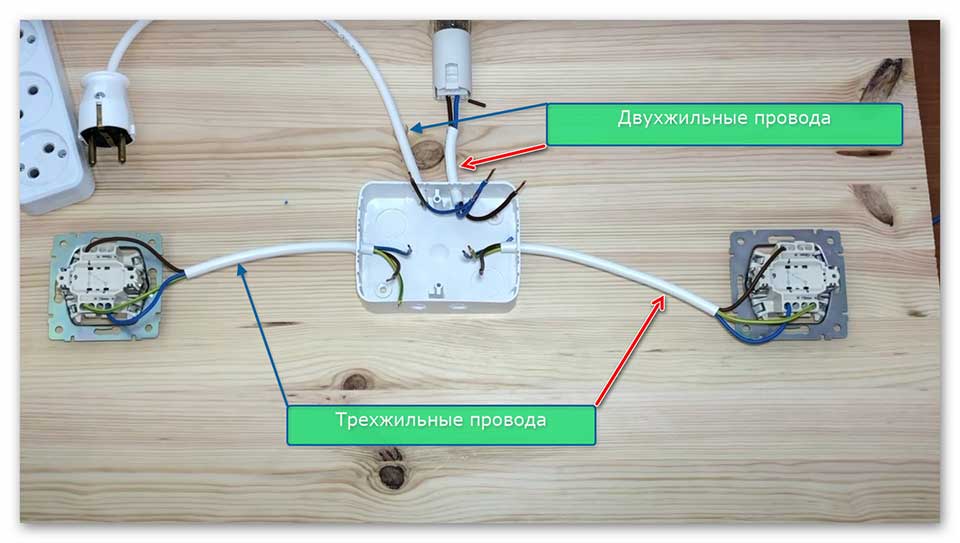

Finally, we recommend watching the video, which tells in more detail how to connect the changeover switch to the network:
It will be useful to read:
- How to install a diesel generator
- How to connect a three-phase voltage regulator
- Connecting the generator to the network at home
- What is a load switch for?
A toggle switch is a special device designed to switch electricity to the necessary devices, operating using a manual drive. Manufacturers offer a wide range of such devices, differing among themselves in various technical characteristics.
It is important to remember that there are various options for connecting changeover switches - the choice depends on the characteristics of the electrical network. The most popular switch type switches in residential buildings. To change the performance of such devices, control units are used.
To change the performance of such devices, control units are used.
In addition, these devices have found application in industry during the operation of backup generators. When choosing a changeover switch for a generator, you need to take into account its configuration and the specifics of the existing grounding.
The quality of the device is ensured by equipping it with a ground electrode. Its marking indicates the degree of protection. It is optimal if it is IP30.
Wiring diagram
Changeover switches come in different types: single-pole, two-pole, three-pole and four-pole.The first two versions are used in a single-phase network, the other two - in a three-phase network.
These devices are connected to the generator based on the type of electrical network to which the breaker will be connected. For a single-phase network, a two-pole device is used, which simultaneously switches the zero and phase of the wiring, excluding the combination of the generator output voltage and the voltage that is supplied from the mains. A single-pole changeover switch can only be used to switch power between two phases of the same electrical network, where the neutral conductor is common and there is no need to switch it with switching devices.
If the generator and the mains supplying the house are three-phase, then in this case a four-pole switch is used, which switches three phases and zero between the main network and the backup network from the generator. Three-pole switching devices are used in circuits supplying a three-phase load without a neutral wire. Also, a three-pole device can be used in a single-phase network - in this case, only two poles will be used at the input and output of the switching device.
Changeover switches are installed in switchboards, the type of which depends on the design of the switch. There are modular type devices that are installed on a standard DIN rail. In the premises, plastic shields (boxes) or metal housings of shields, designed for the required number of modular places, can be used.
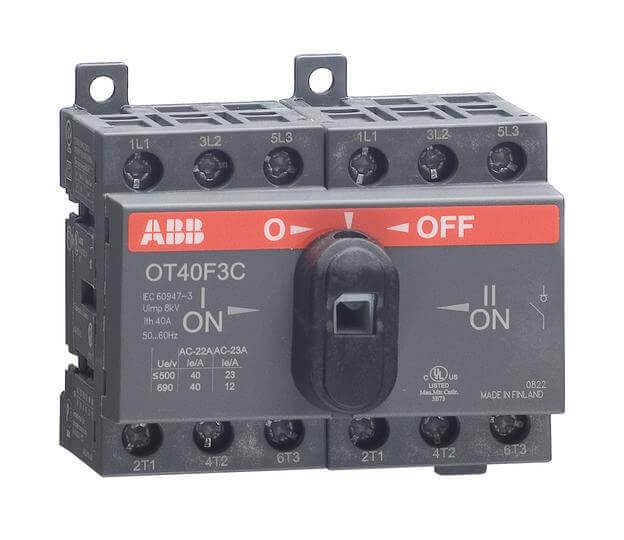

Outdoors, metal shields are used that have a degree of protection of the case sufficient for installation on the street.Change-over knife switches of the usual design are mounted in shields, completed with a mounting panel.
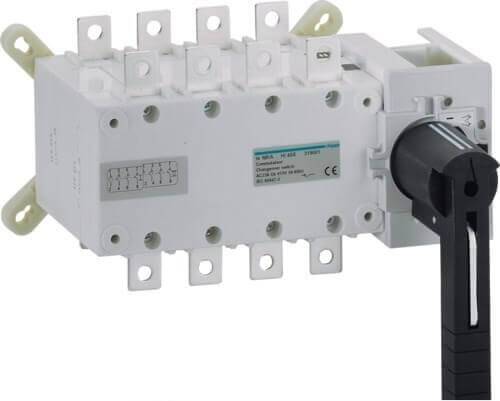

A standard DIN-rail can also be mounted on the mounting plate of such a shield to install the necessary modular protective devices.
A cable coming from the metering board is connected to one input of the changeover switch - this is the main network. A backup network is connected to the second input - a cable from the generator. If the switch has one output, then the cable from the switchboard is connected to it. Modular versions, as a rule, have two inputs and two outputs, so the two outputs are interconnected in parallel with jumpers and connected to the switchboard. Below is a diagram of a single-phase connection of a three-pole changeover switch to the generator and the electrical network:
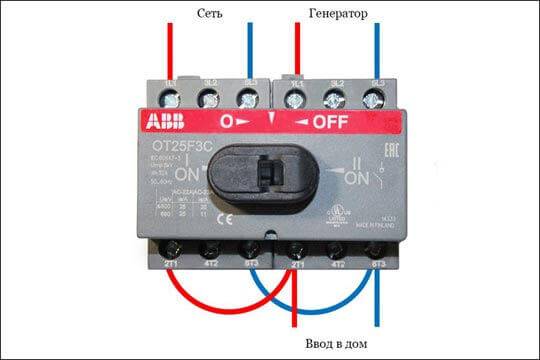
In order to connect a changeover switch from two three-phase power sources, you need to use the following diagram:
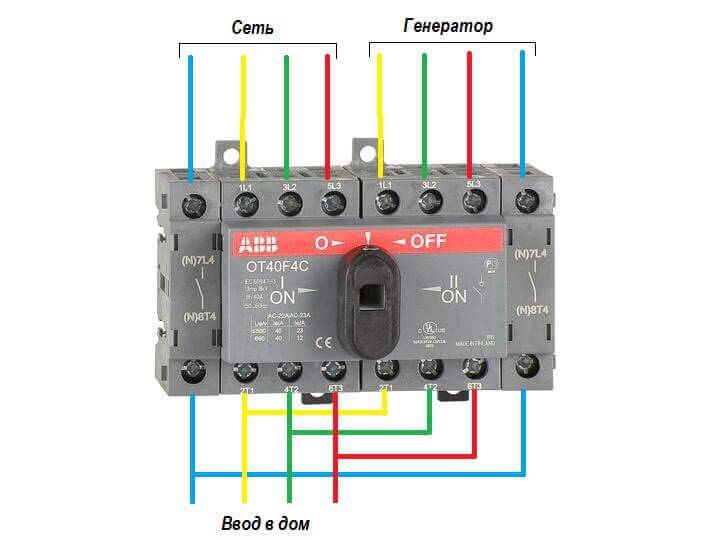
For industrial plants, devices are mounted only if the input power is low. And this is how switchboards are mainly installed - an automatic switch is installed in them for each input. Depending on the scheme, ATS operation or manual switching on of the reserve by the corresponding machine can be implemented. If at the same time changeover switches are used, then, as a rule, only for control without load - the load is removed by automatic switches.


If there is an arc-suppressing device in the design of the apparatus, the load can be switched with a changeover switch, but in any case, each of the supply lines must be additionally protected by an automatic device or fuses, since the changeover switch does not protect against emergency operation of the electrical network (overload and short circuit).
Conclusions and useful video on the topic
There are few nuances of connecting switches so that the lighting can be controlled from several points. But they are. And it is impossible to miss them out of ignorance of their type when performing installation. To make it easier for you to understand all the intricacies of the schemes described above, we recommend that you definitely watch the videos below.
All about walk-through switches - principles of operation and installation:
How to connect a two-gang switch:
Scheme of connecting through (toggle) switches through a junction box:
The use of walk-through switches greatly simplifies lighting control in a large room, making this process more convenient. It is not difficult to mount such a system of several switches and wires on your own. It is only necessary to choose the right set of necessary switching devices.



