- Tips for installing a house heating system
- Tips for choosing an oven
- The choice of coolant
- Mounting
- Features of furnaces with a water circuit
- Furnace heating with air system
- What is the difference between solid fuel boilers
- How to build a water oven at home?
- How to make such an oven yourself
- Manufacturing options and recommendations
- System installation
- What is the heating circuit for?
- 7 Helpful Hints
- Benefits of hot water heating
Tips for installing a house heating system
The heating device begins with the installation of batteries in pre-prepared places under the windows or on the corner outer walls. Devices are hung on special hooks attached to the structure itself or plasterboard finish. The unused lower outlet of the radiator is closed with a cork, a Mayevsky tap is screwed in from above.
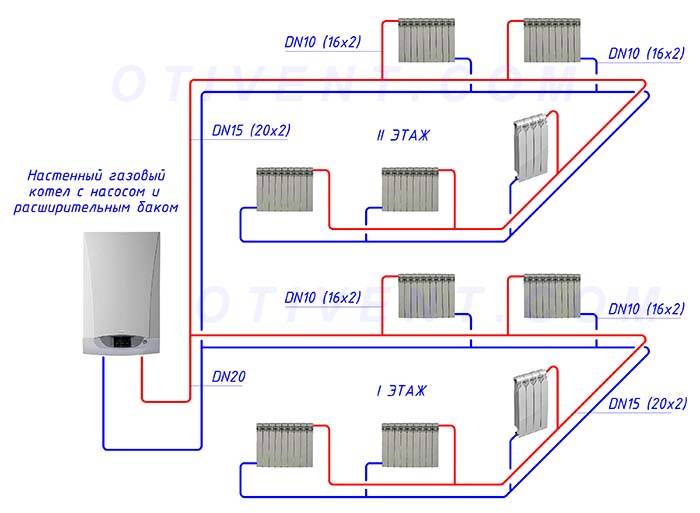
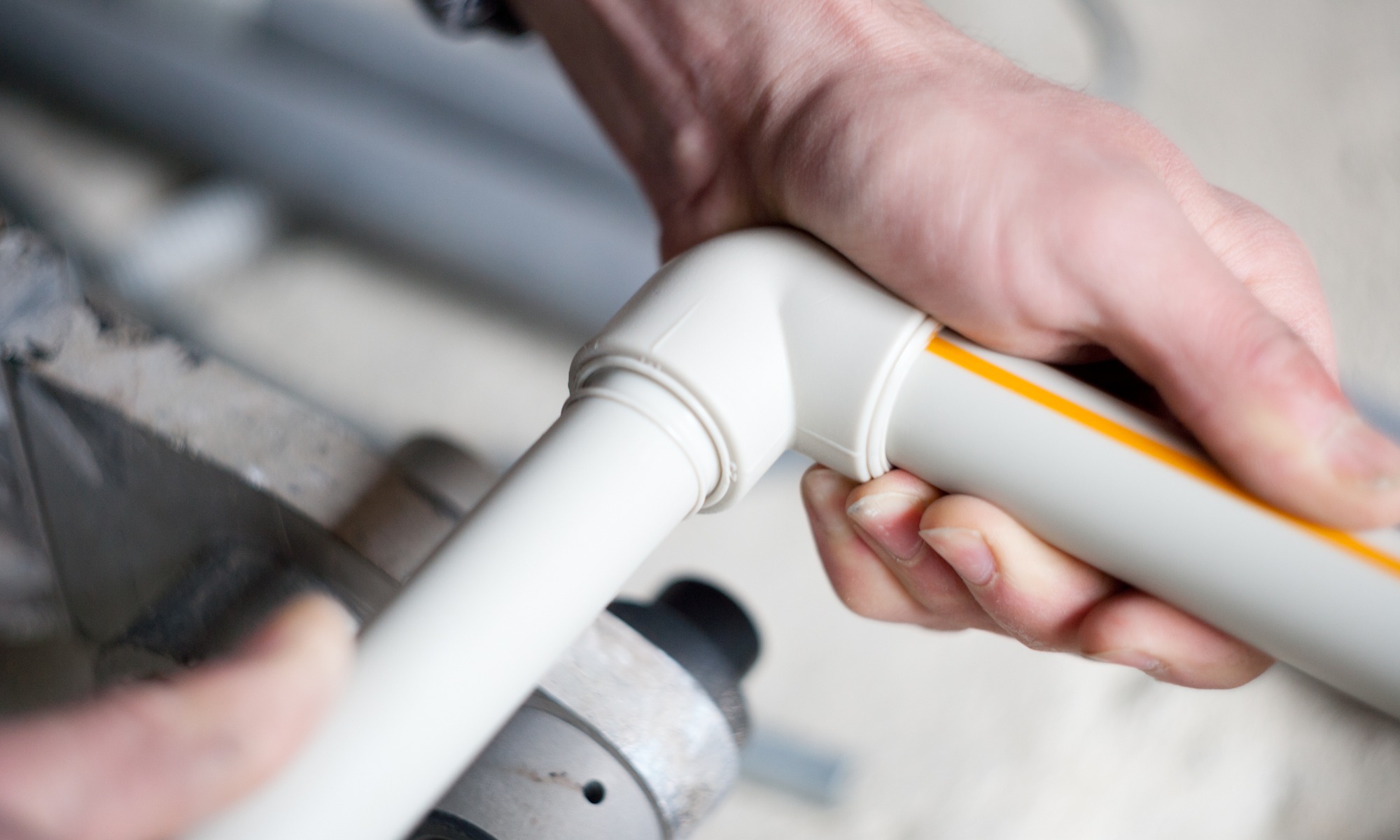
The pipeline network is mounted according to the assembly technology of certain plastic pipes. To save you from mistakes, we will give some general recommendations:
- When installing polypropylene, consider the thermal elongation of the pipes. When turning, the knee should not rest against the wall, otherwise, after starting the heating, the line will bend like a saber.
- It is better to lay the wiring in an open way (excluding collector circuits).Try not to hide the joints behind the sheathing or embed them in the screed, use the factory "clips" to fasten the pipes.
- Lines and connections inside the cement screed must be protected with a layer of thermal insulation.
- If for any reason an upward loop has formed on the piping, install an automatic air vent on it.
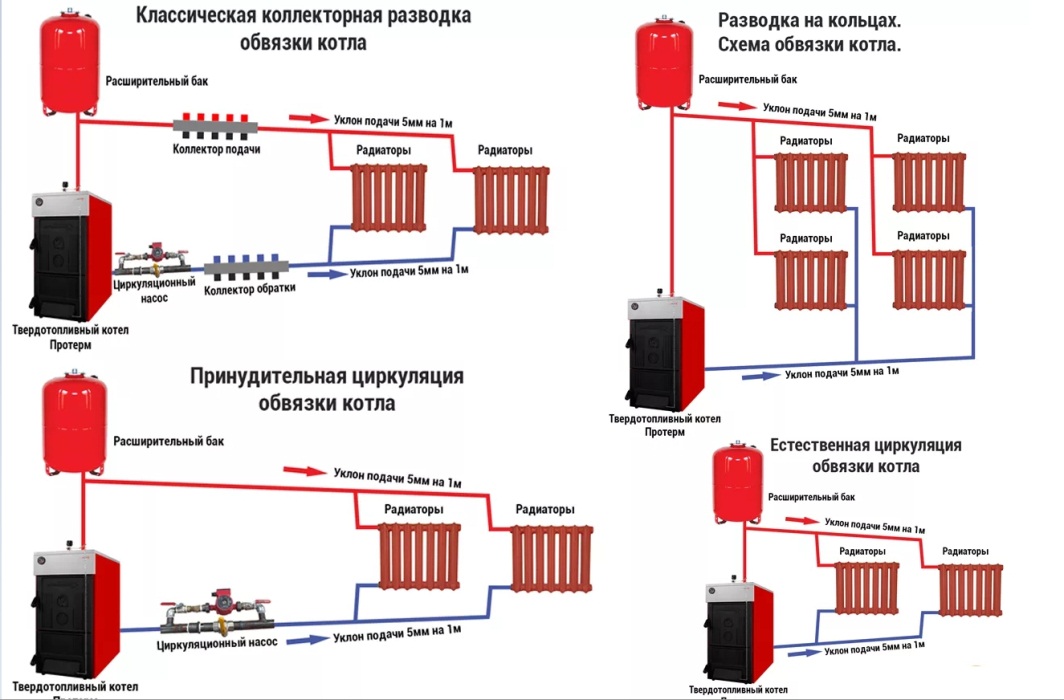
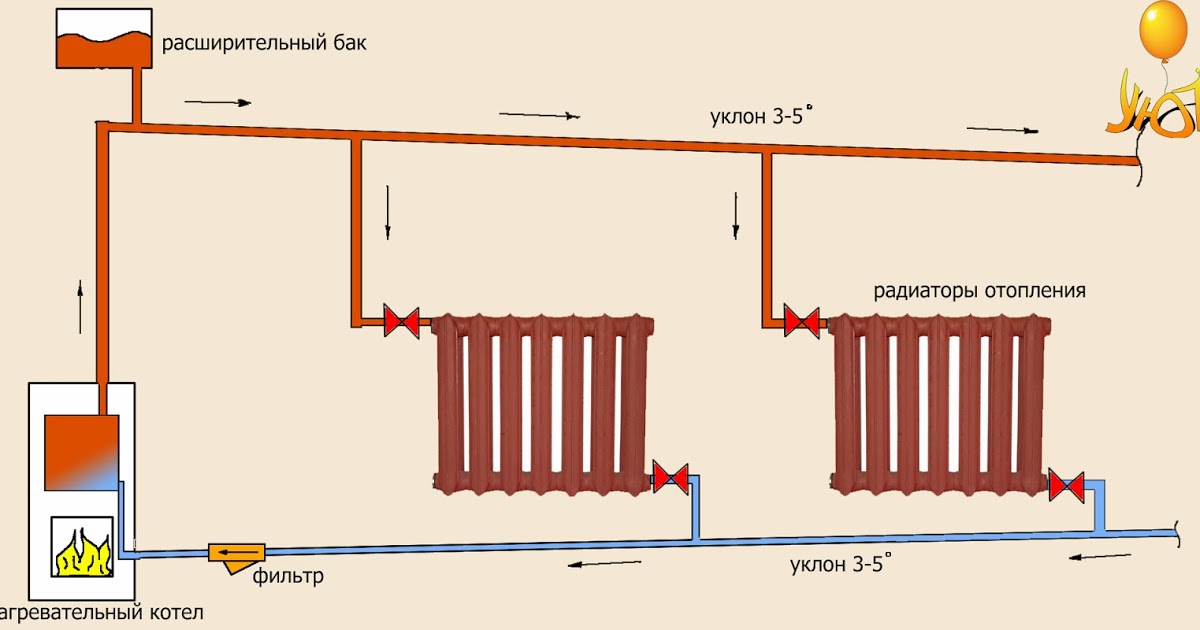
- It is desirable to mount horizontal sections with a slight slope (1-2 mm per linear meter) for better emptying and removal of air bubbles. Gravity schemes provide slopes from 3 to 10 mm per 1 meter.
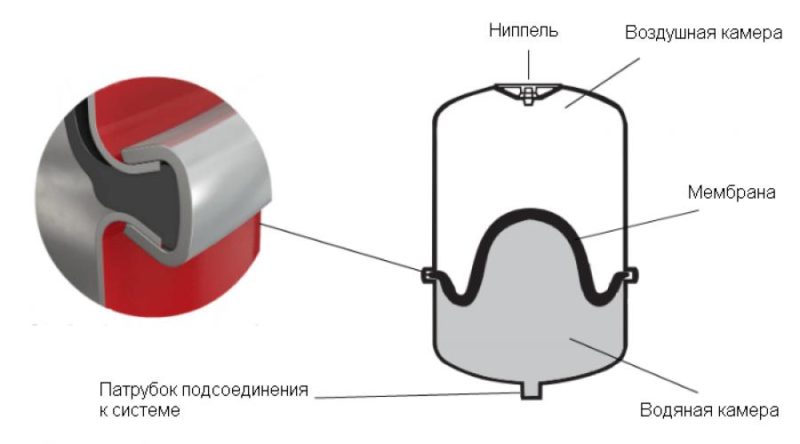
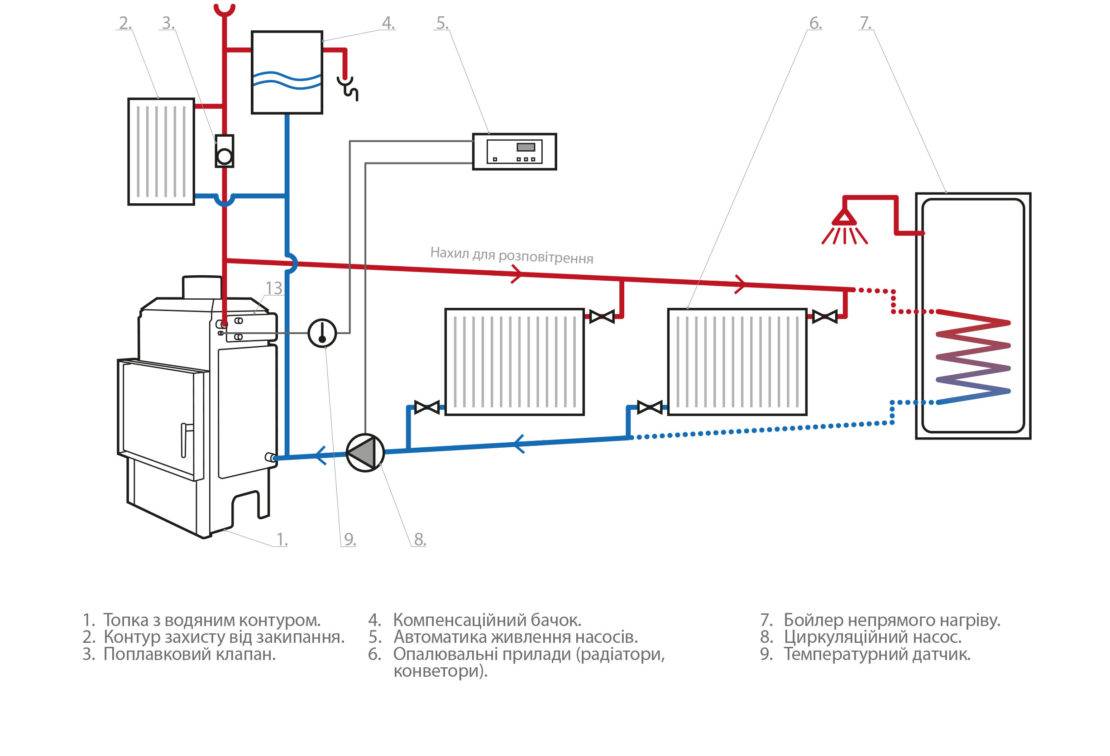
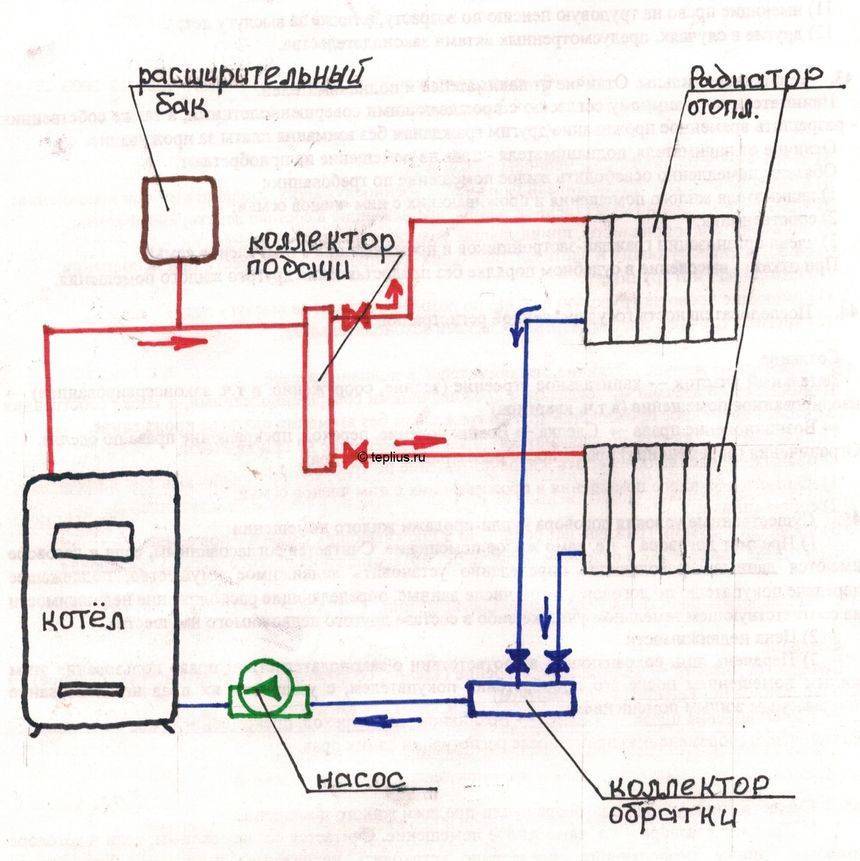
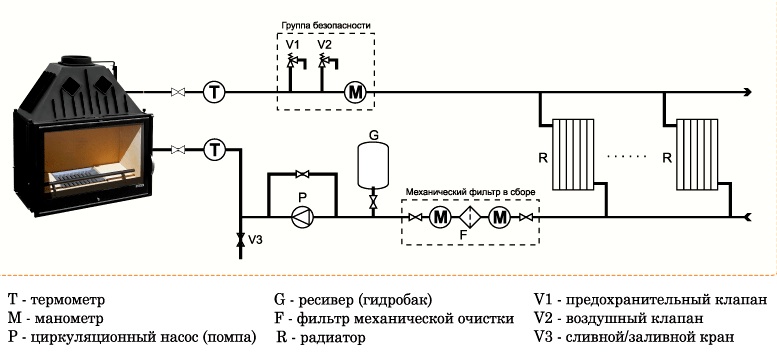
- Place the diaphragm expansion tank on the return line near the boiler. Provide a valve to cut off the tank in case of malfunction.
Tips for choosing an oven
Recommendation number one: use a solid fuel boiler to heat the coolant in the water heating network. If necessary, buy a long burning model with a loading chamber capacity of more than 100 liters. Modern TT-boilers direct 75-80% of the combustion energy to water heating and almost do not raise the ambient air temperature.
If for various reasons you want to install a furnace with a heat exchanger, heed the following tips:
- A cast-iron or steel potbelly stove is well suited for a small cottage with an area of 40-80 m². The heater is enough for convection heating of the central room, place batteries in neighboring rooms.
- A fireplace insert or an iron stove equipped with panoramic glass will be a good decoration for the living room. One condition: use the product as an additional source of heat, and place the main load on a gas or wood-burning heat generator. Then it will be possible to maintain cleanliness and order near the potbelly stove.
- At the stage of building a house, definitely lay a brick oven. This is the best option compared to iron heaters.
- Theoretically, the power of the fireplace insert is enough to heat a square of 100-120 m². Practice shows: without the help of a second heat generator, it will have to be loaded with firewood at intervals of 3-4 hours. Therefore, count on a smaller heating area.
How to choose a design and calculate the area of \u200b\u200ba heat exchanger in a brick version of the furnace:
- If the register is located inside the firebox, 1 m² of its area is able to transfer up to 10 kW of heat to water. Example: you need to heat rooms of 80 square meters - you need about 8 kW of energy and a heat exchange surface of 0.8 m².
- The coil in the chimney channel is not as efficient. Count on heat transfer of 400-500 W from 1 m² of register.
- For ease of cleaning, it is better to make the boiler flat - in the form of a tank with inlet pipes. Ribbed structures made of round pipelines are harder to clean. For installation inside the flue, weld the register from shaped pipes.
- The material of the heat exchanger is low-carbon steel grade St10…St20 with a thickness of 4-5 mm. It is allowed to use heat-resistant and stainless steel 2-4 mm, but it must be cooked in an inert gas environment - argon.
- It is strongly not recommended to use ready-made cast-iron batteries. Reasons: the metal cracks from temperature shock, and the seal between the sections will burn out over time, a leak will appear.
Home craftsmen constantly put forward various ideas for improving heaters. Noteworthy is the option with steel flat batteries used as furnace water heaters. See the video for an overview of the wizard:
The choice of coolant
When choosing one or another heating system with a water circuit, it is important to consider which coolant will be used. In winter, country houses and country houses are not often visited, and heating in them is necessary only at the time of the owners' arrival.
Therefore, owners prefer non-freezing liquids, the consistency of which does not change with the onset of severe frosts. Such fluids eliminate the possible problem of pipe bursting. If water is used as the heating medium, then before leaving it must be drained and refilled before use. Also as a coolant can be used:
antifreeze is a special liquid that prevents freezing. The heating system uses 2 types of antifreeze - propylene glycol and ethylene glycol
When choosing this method, it is important to know that ethylene glycol is extremely toxic, so its handling must be appropriate.
coolant on glycerin. Considered more efficient and safer (not explosive or flammable)
Glycerine liquid is expensive, but since the oven is only filled with it once, it makes sense to invest in the purchase. In addition, glycerin freezes only if the temperature drops below -30 degrees.
saline solution or a solution of the natural mineral bischofite. The standard ratio is 1:0.4. Such a water-salt solution does not freeze up to -20 degrees.
How to choose a coolant
Detailed instructions for choosing a coolant for heating systems and technical specifications can be found here.
Mounting
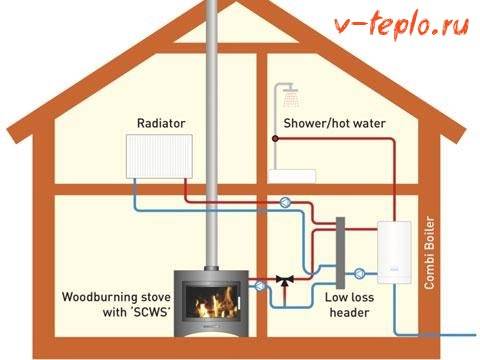
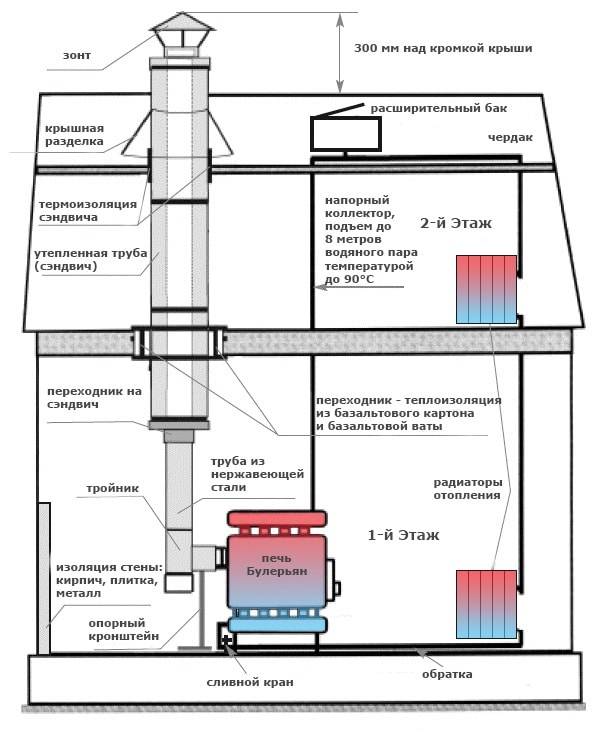
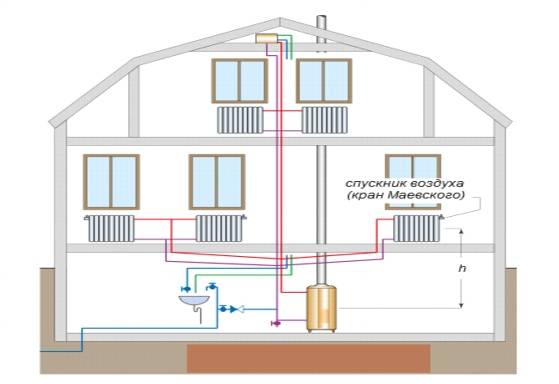
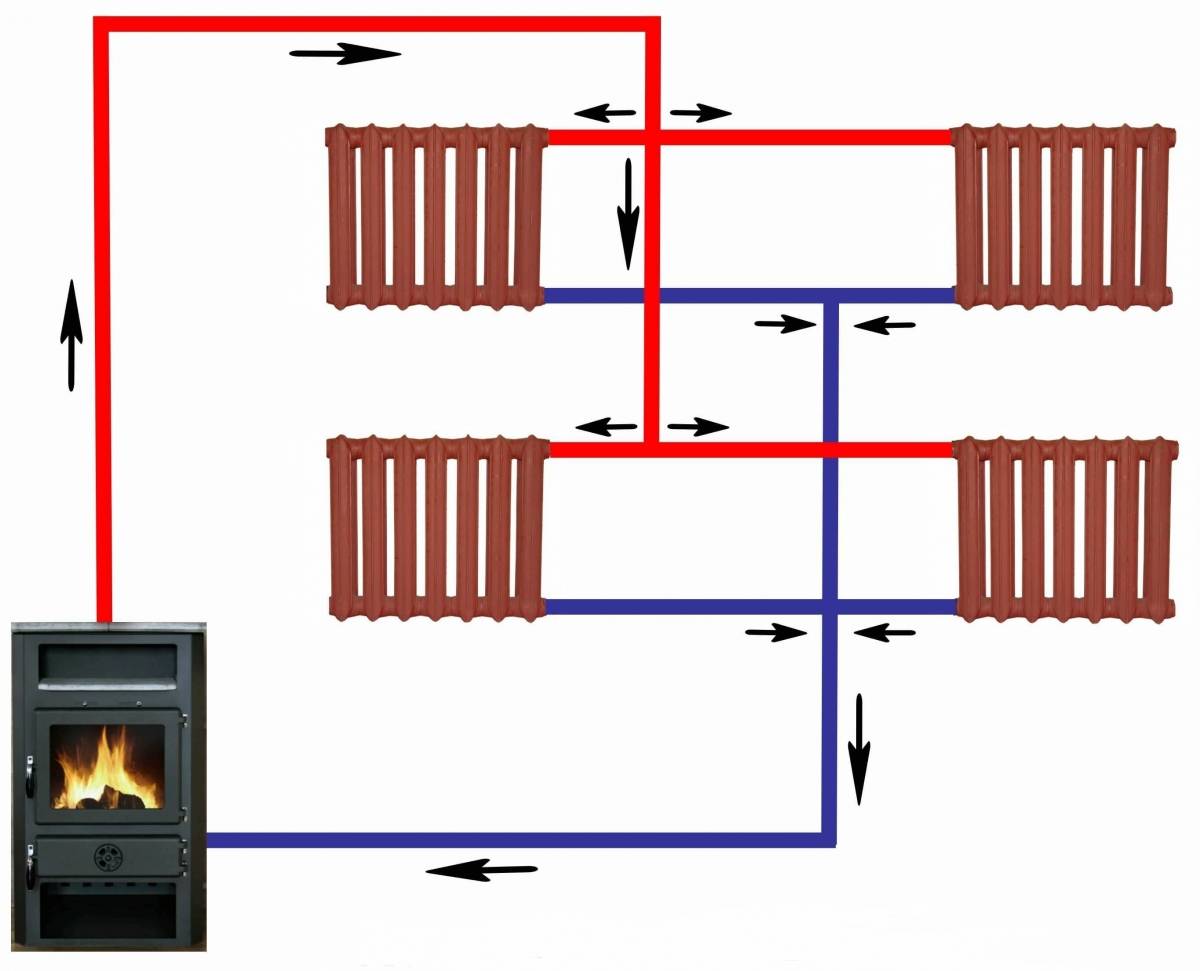
Installation of a furnace with a water circuit can be carried out according to two schemes.The first scenario involves the circulation of the liquid in this way: cold water goes down, and warm water rises
Then, when installing the furnace, it is important not to violate the correct height difference
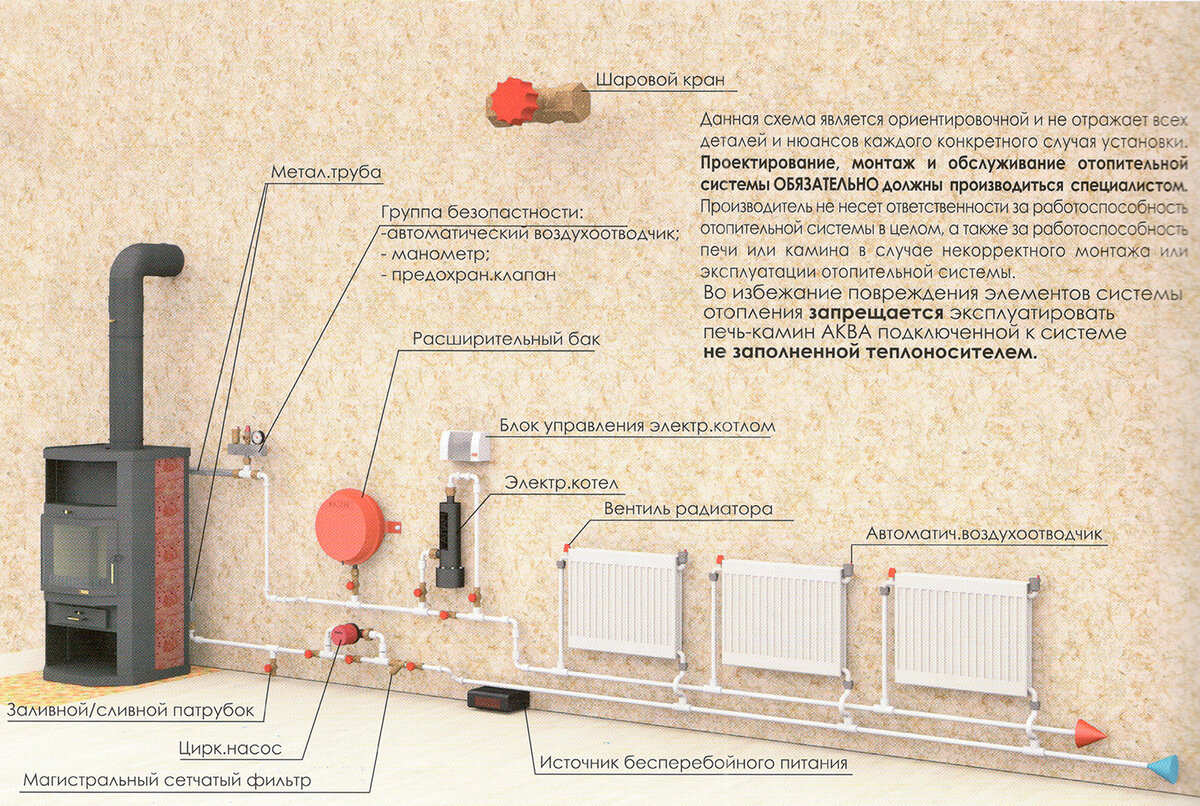
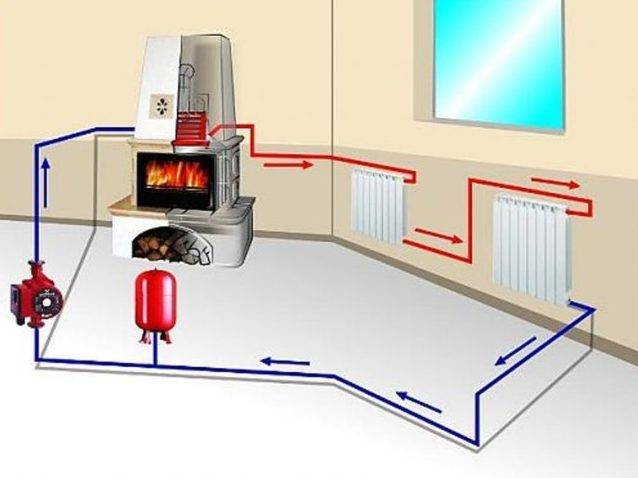
The second scenario is used when fluid circulation is not naturally possible. Then pumps are mounted, providing an artificial circulation of water.
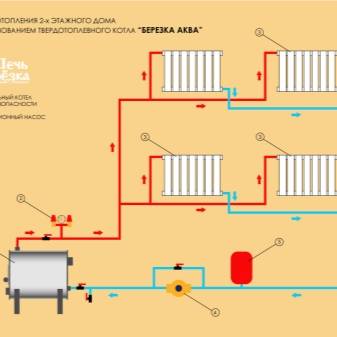

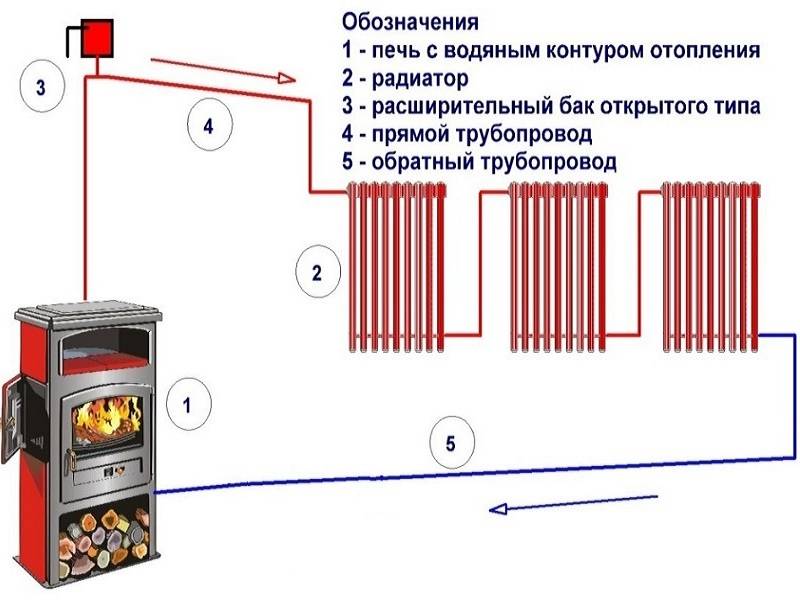
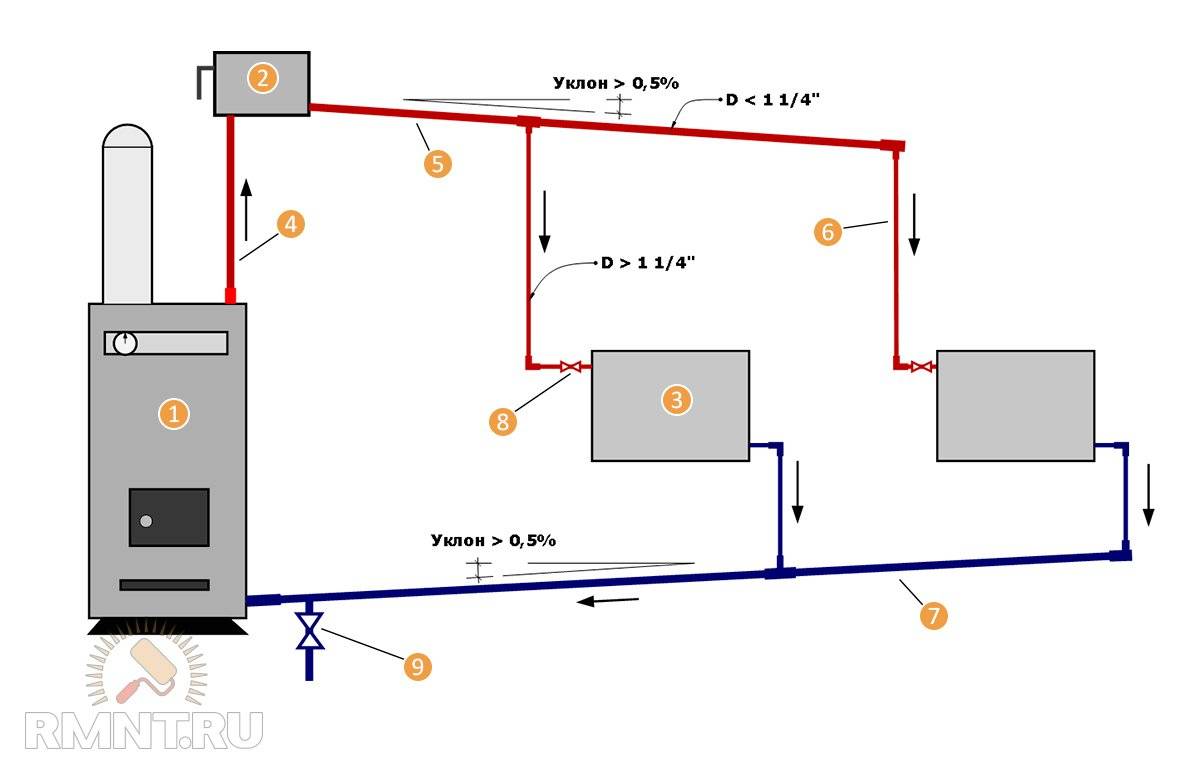

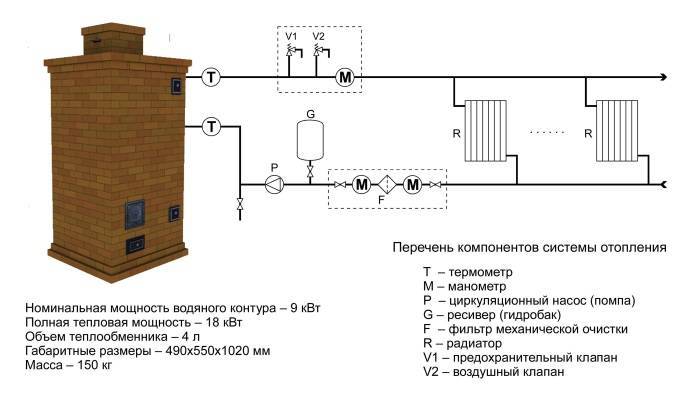
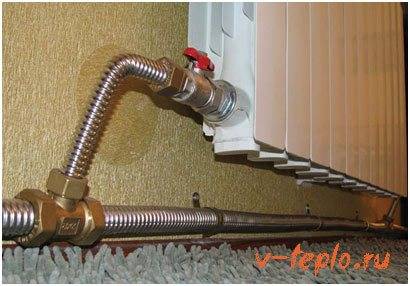
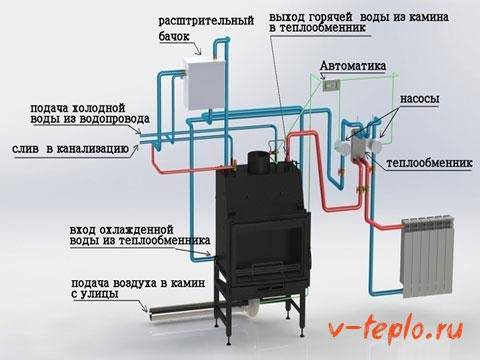
For convenience, the installation of the heating system takes place in several approaches. First, a wood-burning stove or fireplace is mounted, chimneys are removed, observing fire safety rules. Later - a water circuit is bred throughout the house.
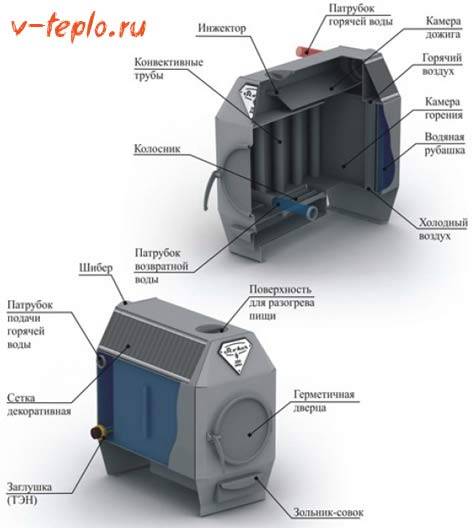
Features of furnaces with a water circuit
Before rushing to purchase equipment, it is important to familiarize yourself with the features of the heating system. Advantages:
Advantages:
- The ability to efficiently heat several rooms with a large area.
- Uniform distribution of heat.
- Safety of use.
- They can be autonomous heat sources or work together with a centralized heating system.
- Using a temperature sensor that allows you to control the operation of the device.
- Autonomy (independence from sources of electricity and gas communications).
- Relatively low maintenance cost.
- The furnace functions on coal, peat, wood and coke coal.
- Economy and environmental friendliness of the heating system.
- Modern design and matching to any style and interior.
Flaws:
The boiler reduces the useful volume of the firebox
To eliminate this fact, it is important in the process of laying the firebox to think over the mandatory width of the boiler and the furnace itself. Long burning stoves can also be used.
Low level of automation
Only manual control is possible.
The thermal energy received as a result of burning wood is spent on heating the boiler and the liquid in it, and the walls of the firebox heat up more slowly and to a lesser extent.
In severe frosts, the coolant can freeze. There is a risk of freezing if the house is not intended to be permanently occupied. In order to prevent this, special additives should be added to the purified water to protect the system. Also, experts recommend using antifreeze - a universal coolant that freezes only at very low temperatures.
The use and maintenance of heating furnaces with a water circuit is not particularly difficult. Attached is a video for further explanation.
Having decided to purchase a heating furnace with a water circuit, study in advance the models offered by foreign and domestic companies. They are distinguished by size, design, cost and accessories. For a small country house, a brick stove with water heating, low power and no designer frills is quite enough. The owner of a large mansion is unlikely to be satisfied with such a model. A spacious living room can be decorated with a stylish foreign-made stove.
Furnace heating with air system
The reason for the steady preference that the owners of private houses give to the stove heating option is the cost-effectiveness of operation - the availability of firewood, fuel briquettes or coal.
The disadvantage is the limited space to be cultivated, which can be eliminated by installing a water and air system based on a brick aggregate.
Due to the relatively short path, he does not have time to lose temperature. The result is an even distribution of heat throughout the house.



An air heating chamber is arranged above the firebox so that the hot upper surface of the firebox and the chimney transfer the maximum amount of heat to it. Air circulation occurs naturally or with the help of fans.
Natural circulation occurs as a result of the density difference between cold and hot air. Cold air entering the heating chamber displaces hot air into the ducts.
This method does not require electricity, however, if the air does not move quickly enough through the heating chamber, it becomes very hot, which can cause problems.
Air heating with natural movement of heated air involves the installation of air ducts for directional movement. In forced versions, the movement of air is stimulated by a fan (+)
Forced circulation occurs with the use of fans or pumps. However, the heating of the premises occurs more quickly and evenly. With forced ventilation, by adjusting its mode, you can easily control the volume of air supplied to various rooms, thereby determining the microclimate of individual rooms in the house.
According to the type of cold air supply, systems are divided into two types:
- With full recirculation. Heated air masses alternate with cooled ones within the same room. The disadvantage of the scheme is that air quality drops with each heating / cooling cycle.
- With partial restoration. Part of the fresh air is taken from the street, which is mixed with part of the air from the room.After heating, the mixture of two air portions is supplied to the consumer. Advantage in stable air quality, disadvantage in energy dependence.
It is clear that the first group includes channel systems with natural movement of the air coolant. The second includes options with forced air movement, for the movement of which it is not necessary to arrange a network of air ducts.
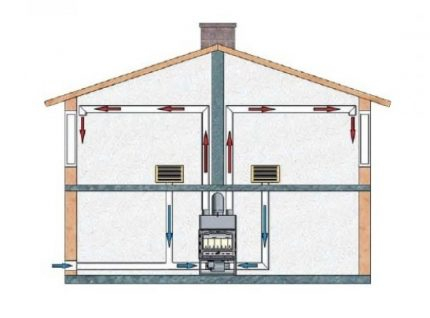
The intake of air from the street gives the system with natural circulation an additional boost, which eliminates the need for fans
The main advantages of air heating compared to water:
- high efficiency;
- accident-free;
- lack of radiators in the rooms.
The device of the circuit with forced movement allows you to do without the construction of an air duct system. In addition, this variety can be combined with air conditioning, humidification and air ionization.
The main disadvantages of air heating compared to water heating:
- when using a furnace, the temperature of the supplied air has a significant range, in contrast to the use of other means of heating;
- air ducts have a large diameter, so installation must be carried out at the construction stage;
- the location of the furnace in the basement is desirable, otherwise it is necessary to use fans that make noise.
The movement of air in the room has a negative side - it raises dust, however, the use of filters at the outlet of the duct allows you to effectively catch this dust, thus reducing the total amount of dust in the house.
Another feature of air heating, which has positive and negative sides, is the rate of heat transfer.On the one hand, the premises heat up faster than when heated with a water circuit, on the other hand, there is no thermal inertia - as soon as the stove or fireplace goes out, the room immediately begins to cool.
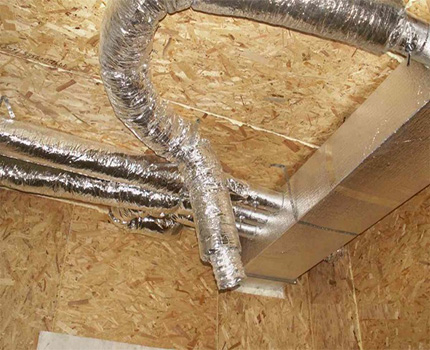
To ensure uniform pressure in the side branches of the air duct, it is necessary to exclude their insertion into the last half meter of the main air duct
Unlike water heating, installation of an air heating system is not difficult. All elements (pipes, bends, ventilation grilles) can be easily connected without welding. There are flexible air ducts that can take any shape, depending on the geometry of the premises.
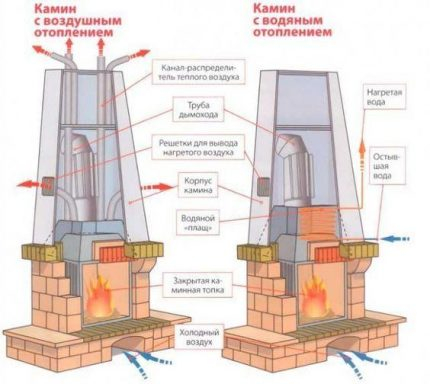
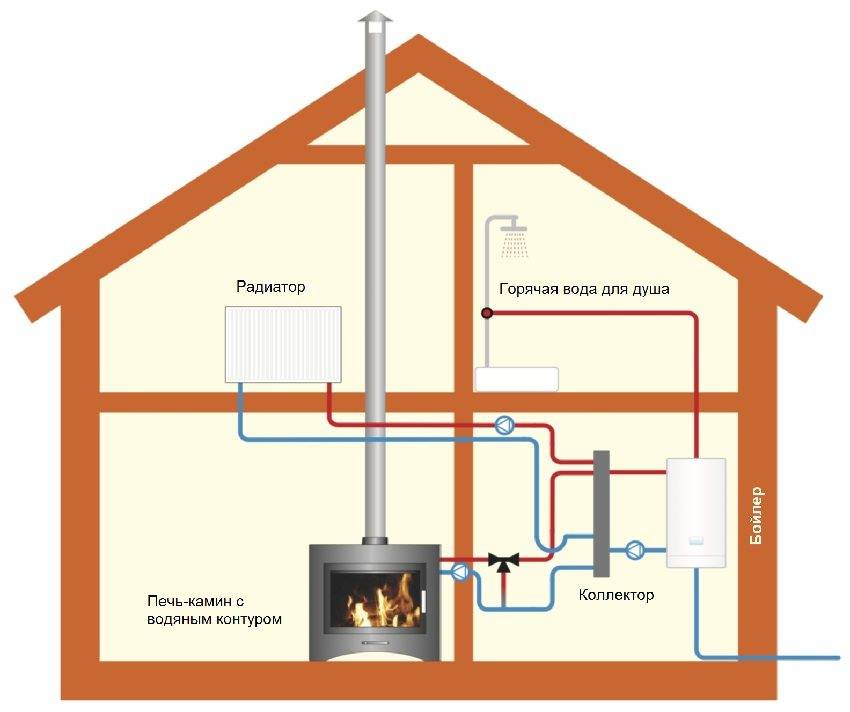
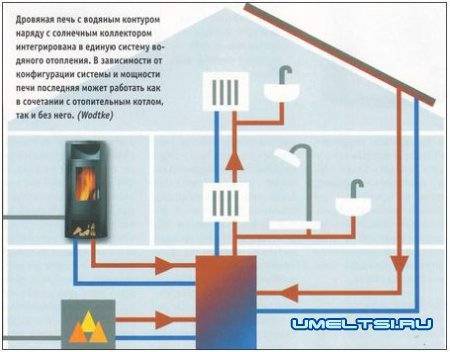
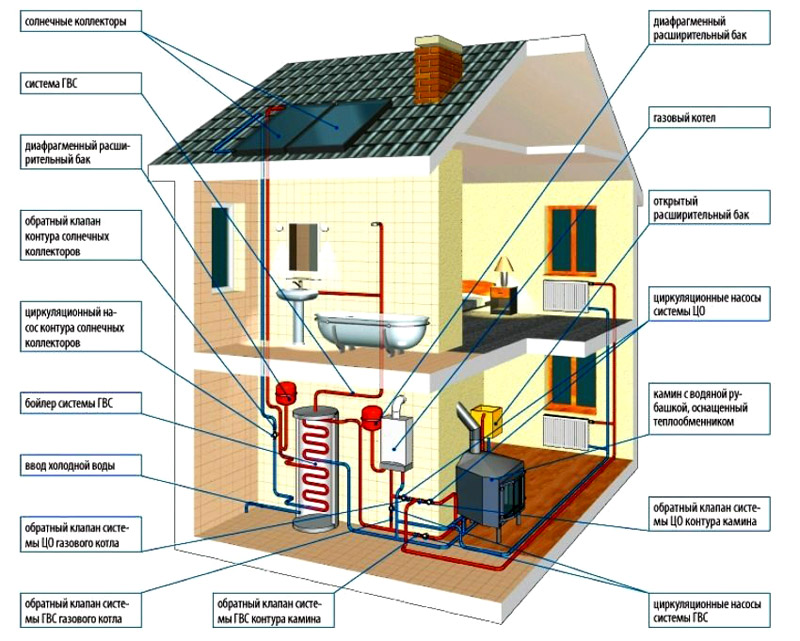
On the basis of a stove or fireplace with a brick or steel firebox, both air and water heating can be arranged.
What is the difference between solid fuel boilers
In addition to the fact that these heat sources produce heat energy by burning various types of solid fuels, they have a number of other differences from other heat generators. These differences are precisely the result of burning wood, they must be taken for granted and always taken into account when connecting the boiler to a water heating system. Features are as follows:
- High inertia. At the moment, there are no ways to abruptly extinguish a burning solid fuel in a combustion chamber.
- Formation of condensate in the firebox. The peculiarity manifests itself when a heat carrier with a low temperature (below 50 °C) enters the boiler tank.
Note. The phenomenon of inertia is absent only in one type of solid fuel units - pellet boilers.They have a burner, where wood pellets are dosed, after the supply is stopped, the flame goes out almost immediately.


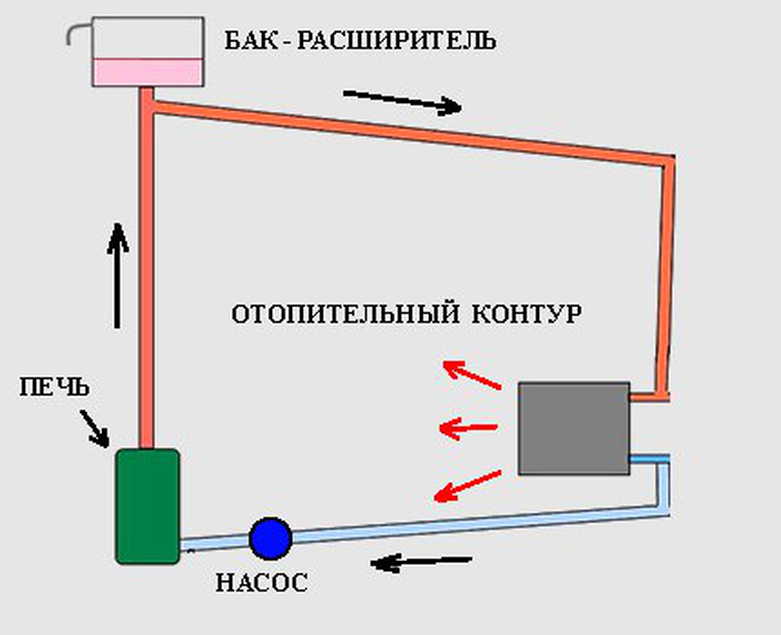

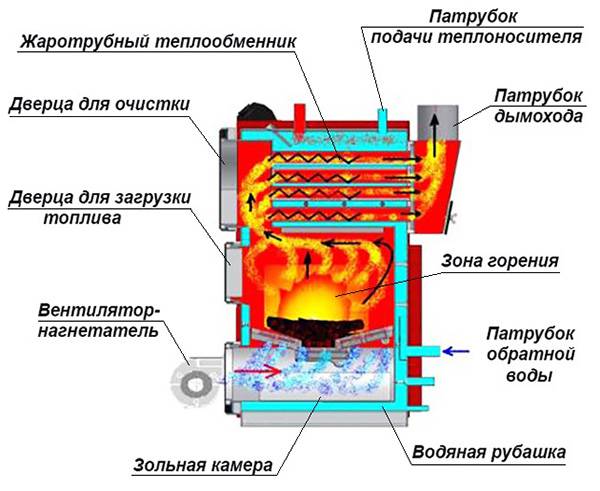
The danger of inertia lies in the possible overheating of the water jacket of the heater, as a result of which the coolant boils in it. Steam is formed, which creates high pressure, tearing the body of the unit and part of the supply pipeline. As a result, there is a lot of water in the furnace room, a lot of steam and a solid fuel boiler unsuitable for further operation.
A similar situation may arise when the heat generator is connected incorrectly. After all, in fact, the normal mode of operation of wood-burning boilers is the maximum, it is at this time that the unit reaches its passport efficiency. When the thermostat responds to the heat carrier reaching a temperature of 85 ° C and closes the air damper, combustion and smoldering in the furnace still continues. The temperature of the water rises by another 2-4°C, or even more, before its growth stops.
In order to avoid excess pressure and a subsequent accident, an important element is always involved in the piping of a solid fuel boiler - a safety group, more about it will be discussed below.
Another unpleasant feature of the operation of the unit on wood is the appearance of condensate on the inner walls of the firebox due to the passage of an unheated coolant through the water jacket. This condensate is not God's dew at all, since it is an aggressive liquid, from which the steel walls of the combustion chamber quickly corrode. Then, having mixed with the ash, the condensate turns into a sticky substance, it is not so easy to tear it off the surface. The problem is solved by installing a mixing unit in the piping circuit of a solid fuel boiler.
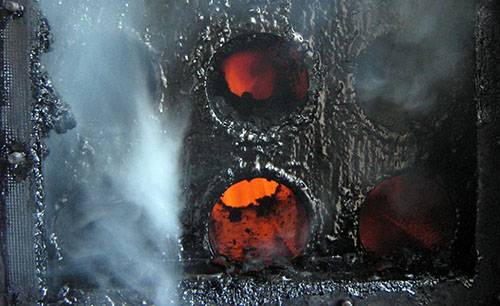
Such a deposit serves as a heat insulator and reduces the efficiency of a solid fuel boiler.
It is too early for owners of heat generators with cast-iron heat exchangers that are not afraid of corrosion to breathe a sigh of relief. They can expect another misfortune - the possibility of destruction of cast iron from temperature shock. Imagine that in a private house the electricity was turned off for 20-30 minutes and the circulation pump, which drives water through a solid fuel boiler, stopped. During this time, the water in the radiators has time to cool down, and in the heat exchanger - to heat up (due to the same inertia).
Electricity appears, the pump turns on and sends the cooled coolant from the closed heating system to the heated boiler. From a sharp temperature drop, a temperature shock occurs at the heat exchanger, the cast-iron section cracks, water runs to the floor. It is very difficult to repair, it is not always possible to replace the section. So even in this scenario, the mixing unit will prevent an accident, which will be discussed later.
Emergencies and their consequences are not described in order to scare users of solid fuel boilers or encourage them to purchase unnecessary elements of piping circuits. The description is based on practical experience, which must always be taken into account. With the correct connection of the thermal unit, the likelihood of such consequences is extremely low, almost the same as for heat generators using other types of fuel.
How to build a water oven at home?
- There are three ways to carry out stove heating with a water circuit with your own hands:
- buy a steel furnace from a manufacturer whose services include installation of the system;
- hire a craftsman - a specialist will select the material, make the device, lay out the furnace and install the boiler;
- do it yourself.
How to make such an oven yourself
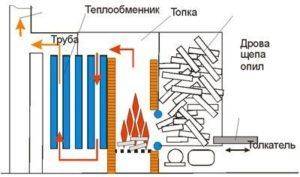
The principle of the boiler for water heating
Can you make such a system yourself? Quite, just enough experience in welding and in laying bricks during the construction of the furnace. First you need to prepare the boiler (register, coil, heat exchanger).
Such a device can be bought or made independently using sheet metal and pipes. Since the complete process of manufacturing and installing a water circuit cannot be put into a short overview, the following are the main recommendations.
Manufacturing options and recommendations
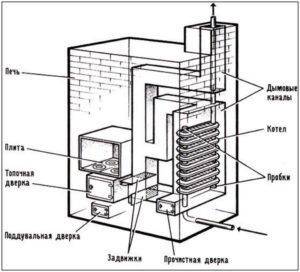
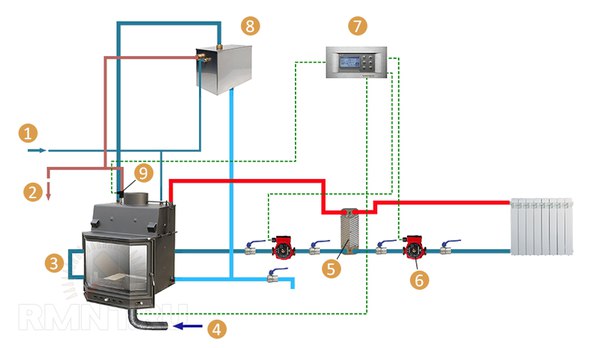
Water heating from a wood-burning stove - scheme
For the boiler, a sheet of metal with a thickness of at least 5 mm is used, and its design is made such that there is maximum heating of the water for further circulation. The boiler, welded from sheet steel, is easy to manufacture and operate - it is easy to clean.
But such a heat exchanger has a smaller heating area, in contrast to the pipe register. It is difficult to make a pipe register at home on your own - you need an accurate calculation and suitable working conditions, usually such boilers are made to order by specialists who install the system on site themselves.



The easiest way to use a solid fuel heat exchanger is an ordinary potbelly stove with a built-in water system. Here you can take a thick pipe as a basis, then there will be much less welding work.
Attention! All welds must be doubled, since the temperature in the furnace is not lower than 1000 degrees. If you boil ordinary seams, then there is a chance that this place will quickly burn out.
The layout of the rooms of the house and the location of the furniture also need to be considered.Here it is necessary to pay attention that it is better to choose a scheme with sheet boilers - they do not have pipe bends connected into one inseparable circuit. Such a structure is not so troublesome to build. It is also convenient because after installation you can use the hob without problems, which cannot be said about some tube boilers
Follow the drawings of the register in accordance with the dimensions of the furnace at home. The layout of the rooms of the house and the location of the furniture also need to be considered.
Here it is necessary to pay attention that it is better to choose a scheme with sheet boilers - they do not have pipe bends connected into one inseparable circuit. Such a structure is not so troublesome to build.
It is also convenient because after installation it is possible to use the hob without problems, which cannot be said about some tube boilers.

Register of smooth pipes - drawing
When the coolant moves by gravity, then you need to raise the expansion tank higher, and use pipes of large diameters. If the pipes are of insufficient size, then a pump cannot be dispensed with, since there will be no good circulation.
Boilers equipped with pumps have their pros and cons: you can save money by installing pipes of smaller diameter and not raising the system so high, but there is one significant disadvantage - when the electricity is turned off or the circulation pump burns out, the heated boiler can simply explode.
It is better to assemble the structure at home, on site, since the device, like individual parts, has a very large weight and dimensions.
System installation
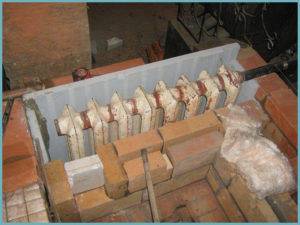
Cast iron battery heat exchanger
- Before installation, a solid foundation is poured, on top of which it is better to lay a layer of bricks.
- You can lay the grate at different stages: before the boiler, if the double structure, the lower part of which can be equal to or higher than the upper part of the grate, when the stove is low and the system is placed a little higher, then the grate, doors, corner on the stove are usually placed after the boiler is installed .
- A housing is installed - usually it consists of two containers connected by pipes.
- The entire heat exchange system is welded to the boiler: the outlet pipe goes to the expander, goes in a circle, through the radiators and, on the other side, the return pipe is welded to the boiler from the bottom.
Stove heating with a water circuit allows, firstly, to use firewood much more rationally, and secondly, to evenly distribute warm air throughout the heated room.
Having decided to independently make a heating system at home with a wood-fired water circuit, think through all the stages of work, and if there is any doubt about the successful outcome, then it is better to contact specialists.
What is the heating circuit for?
A brick oven perfectly heats a private village house up to 50 m2. In a traditional rustic log house, it is located in the middle of one common room, divided by partitions into a kitchen and rooms. In each room there is a heated wall of the furnace, which allows them to be evenly heated.
Modern private houses have a completely different layout, and rooms can be located at a considerable distance and even on different floors. In this case, it will be necessary to install additional heating sources, for example, electric heaters. But the price of electricity is now high, so it is more practical to install water heating radiators.


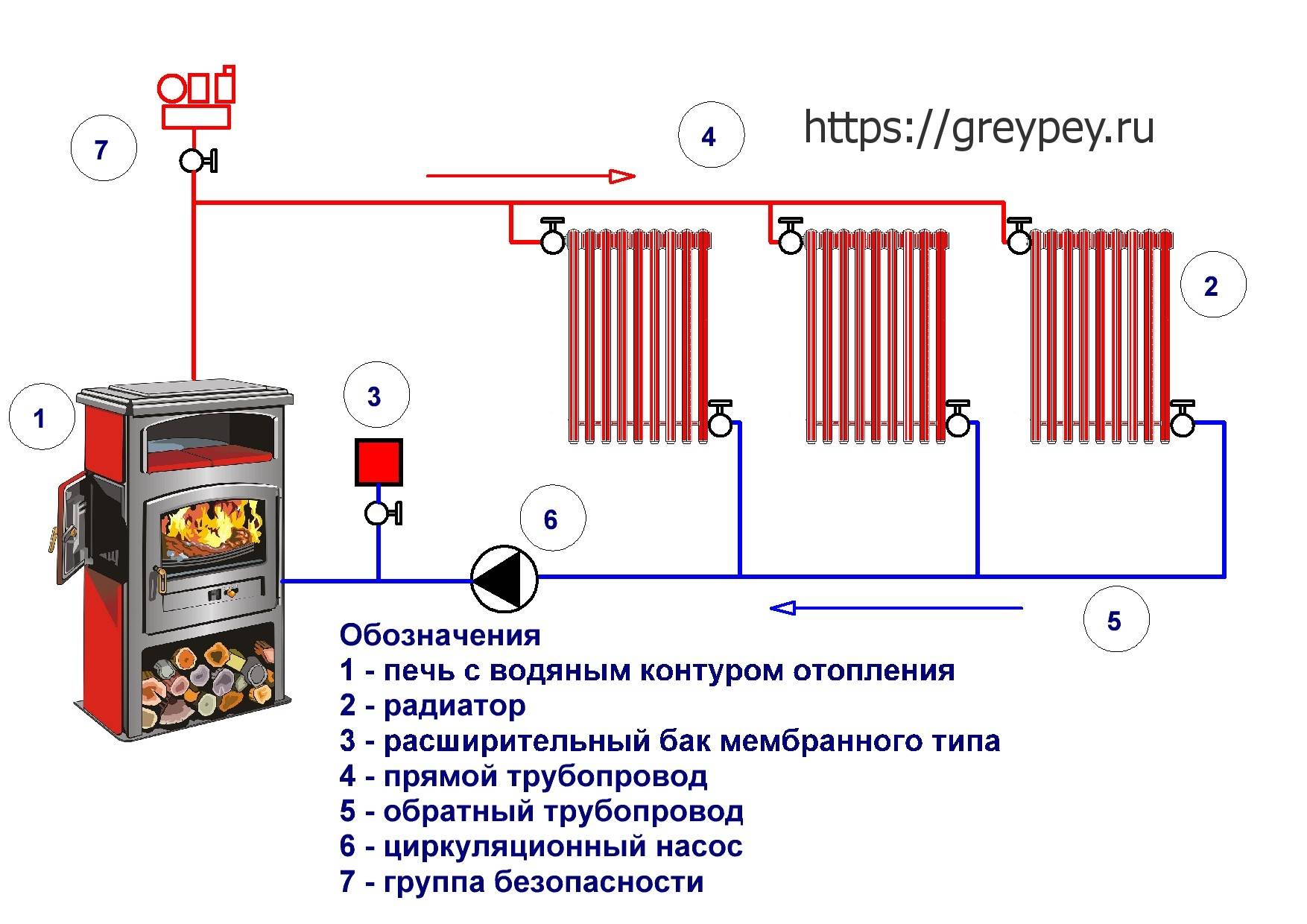


Hot coolant enters them through pipes - water, which enters the boiler, mounted in a brick oven. When burning firewood in such a stove, not only its walls are heated, but also the coolant, and a comfortable temperature is set in all rooms of the house. The coefficient of heat capacity of water is high, and the heating system remains hot for quite a long time, even if the stove is fired only once a day, while significant savings are achieved, because the price of such heating is low.
7 Helpful Hints
To avoid problems, it is necessary to follow some rules for arranging a furnace for water heating in a private house. If you want to remake an old Russian stove in a year-round home, you don’t have to worry about the freezing of the coolant during the cold season, because the installation is constantly working. Modern boilers have an automated function to maintain the optimum temperature, which is +5 degrees Celsius.
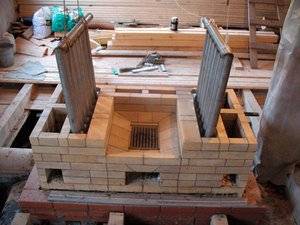
It is quite possible to equip highly efficient heating on a Russian stove, and such a modernization of the old design can justify itself. But before you make heating from the stove, you need to make sure that it is worth it, and the efficiency of the future system will be really high. Otherwise, your efforts will be in vain.
Stove heating is a very good alternative for modern heating systems, but due to the mass of shortcomings, such designs are significantly inferior to advanced heating methods. For arranging heating in a country house, this option is quite suitable, but for permanent residence, you need to look for other solutions.
Benefits of hot water heating
The addition of the oven with convection air channels is a clear plus.Such a system allows transporting warm air to other rooms that are not connected to the structure by a wall.
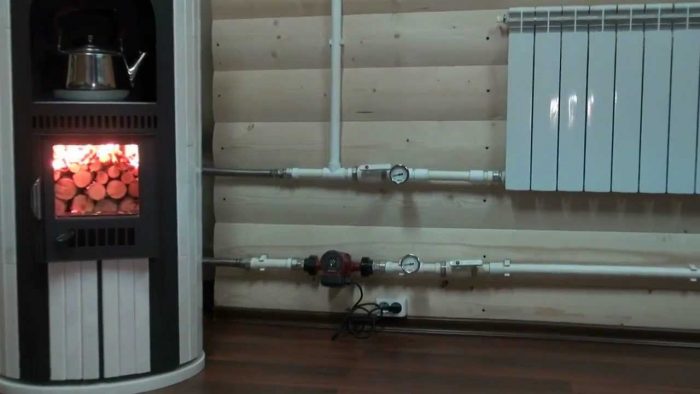
Air acts as a coolant, but requires the construction of air ducts, and here you can find several disadvantages:
- Air ducts are large in size, which is not always convenient for rooms with a small area.
- The pipeline can provide great resistance to the movement of flows. This occurs in the presence of rotary elements in the ducts.
- Air has a low heat capacity, in order to heat a room located quite far from the stove, you need to spend a significant amount of fuel.
- In the process of heating, soot and dust are released, which will settle on the inner walls of the air ducts and sooner or later lead to clogging.
The best option for heating a private house is a stove with a water heating boiler. Water is the best alternative to other coolants. The liquid has a high specific heat capacity, therefore it can receive and give off much more thermal energy. In addition, water can be transported through pipes of small diameter; water does not burn, does not emit toxic substances, is available and its cost is low.
There is only one drawback - the water freezes quickly. At -0 C, water turns into ice, which can destroy all heating systems. In combination with oxygen, water becomes corrosive, negatively affecting metal elements. An additional disadvantage of using hard water is the formation of scale, which will settle on the inner walls of pipelines.
You will have to take measures to reduce the risk of damage to the elements:
- If the stove is used year-round (in permanent residences), then the heating circuit will not suffer.Modern boilers fire at +5 C, giving a signal that it is time to raise the temperature.
- In seasonal residences, it is better to drain the water from the system so as not to defrost all structural elements.
- An electric boiler can be installed to meet irregular heat needs. Thus, when arriving at the dacha or returning from work, the owners first start the electric boiler, which gives time to kindle the stove and circulate the water coolant. The electric boiler then turns off, and the stove heats the rooms as usual.
- To reduce corrosion, special additives are added to the water. It is possible to make a closed system of the water circuit, in which case oxygen does not enter the water and the risk of damage to the pipeline is reduced.