- The device and principle of operation of the electric screw chuck
- How to change the cartridge in the chandelier
- Reasons for replacement
- Necessary materials and tools
- Step by step replacement guide
- Kinds
- E5 and E10
- E14
- E27
- E40
- Types of e27 bulbs and their parameters
- incandescent lamp
- Halogen
- energy saving
- LED
- Cartridge installation
- e27 plinth features
- Design
- Size and specifications
- Product marking
- Advantages of using the E14 cartridge
- Marking of electrical cartridges
- Connecting wires in a ceramic cartridge
- 3 light bulb socket
- Kinds
- General purpose lamps
- Projector lamps
- mirror lamps
- Halogen lamps
- Ways of fastening electric cartridges in chandeliers and lamps
- Fastening an electric cartridge in a lamp for a current-carrying wire
- Fixing an electric cartridge in a chandelier on a tube
- Mounting the electric chuck with a sleeve
- Fixing an electric socket in a chandelier with screwless terminals
- Types of cartridges
- Repair of electric chucks
- Repair of a collapsible electric cartridge E27
- The process of replacing the cartridge in the chandelier
- Switching off the light on the dashboard
- Disconnecting wires
- Removing the chandelier from the ceiling
- Lamp disassembly
- Cartridge dismantling
- Installing a new cartridge
- Advantages and disadvantages of different types of cartridges
The device and principle of operation of the electric screw chuck
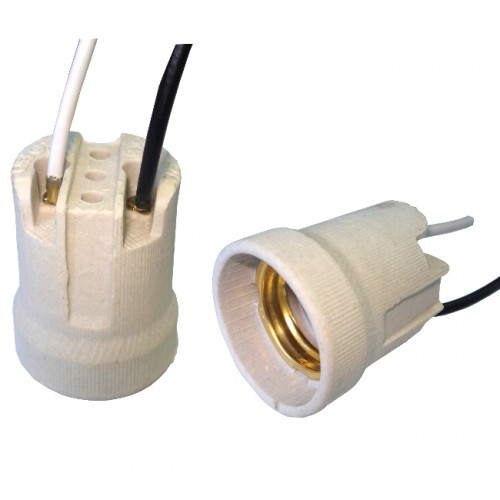
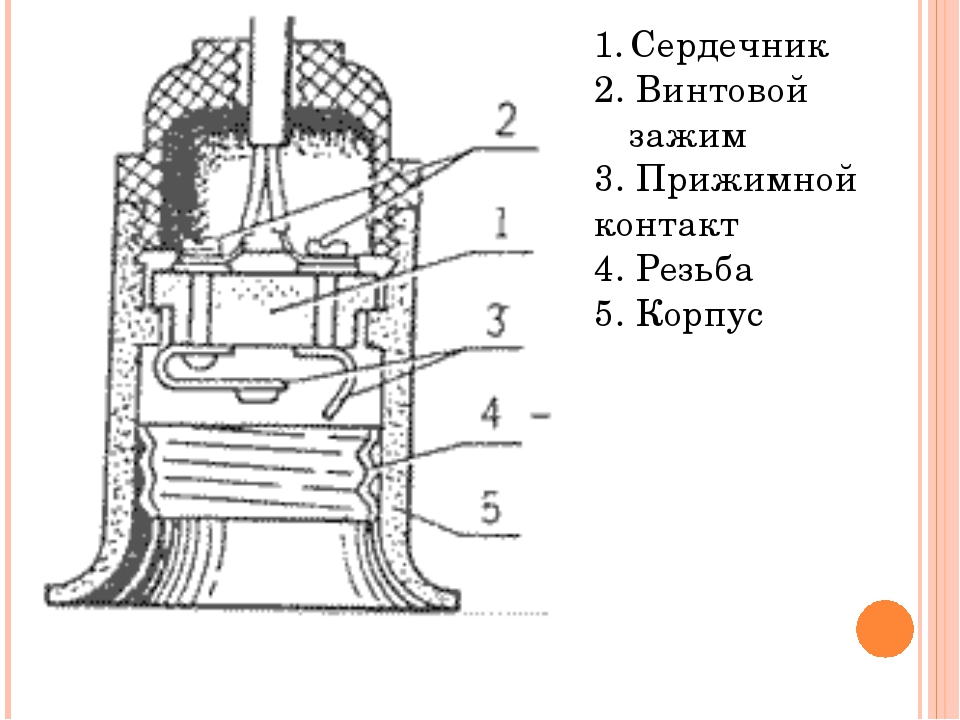
The device of this cartridge is quite simple: it consists of three elements - a body, a cylindrical shape, where the Edison threaded sleeve is located, a ceramic insert and two copper or brass contacts for supplying electric current to the lamp. The connection of wires to the cartridge itself can be carried out in three ways: by screwing to a ceramic insert with brass contacts mounted on it, using terminal blocks and in a screwless way (for plastic cartridges).
Important! When connecting the wires to the cartridge, the phase must be connected to the center contact of the light bulb base. With this connection, when screwing in and out of the light bulb, the probability of electric shock is minimal.
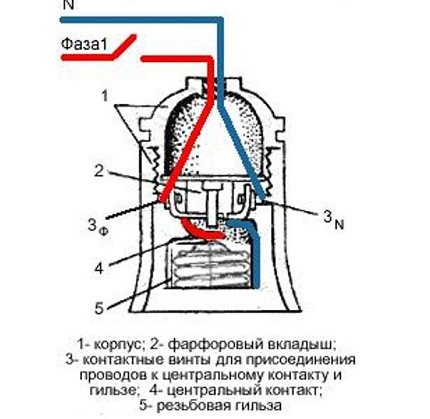
Figure 2. Diagram of a threaded chuck
Socket for lamps with E14 base, the second most common socket after E27. Especially often it is used for miniature incandescent lamps, which are popularly called minions. Lamps for this cartridge come in a variety of shapes - spherical, candle-shaped, drops, pear-shaped. According to the type of surface, they can be transparent, mirror, matte. Lamp power for such cartridges is usually limited to 60 watts.
The E27 screw chuck is the most common of all screw chucks. It should be noted that in addition to incandescent lamps, this cartridge can also be used with other types of lamps, such as LED, halogen, compact fluorescent, gas discharge and others.Such omnivorousness of this cartridge allows you to painlessly switch, for example, from an incandescent lamp to an economical and durable LED, just by unscrewing one lamp and screwing in another.
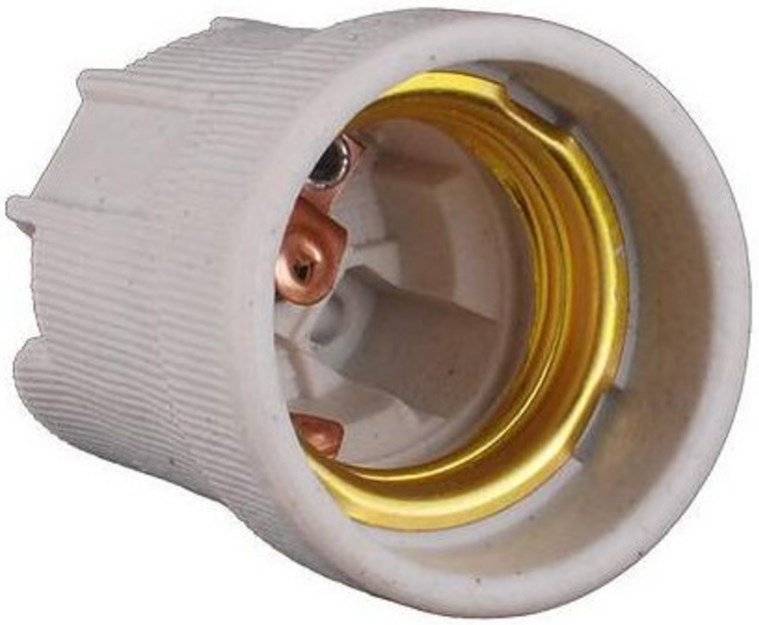
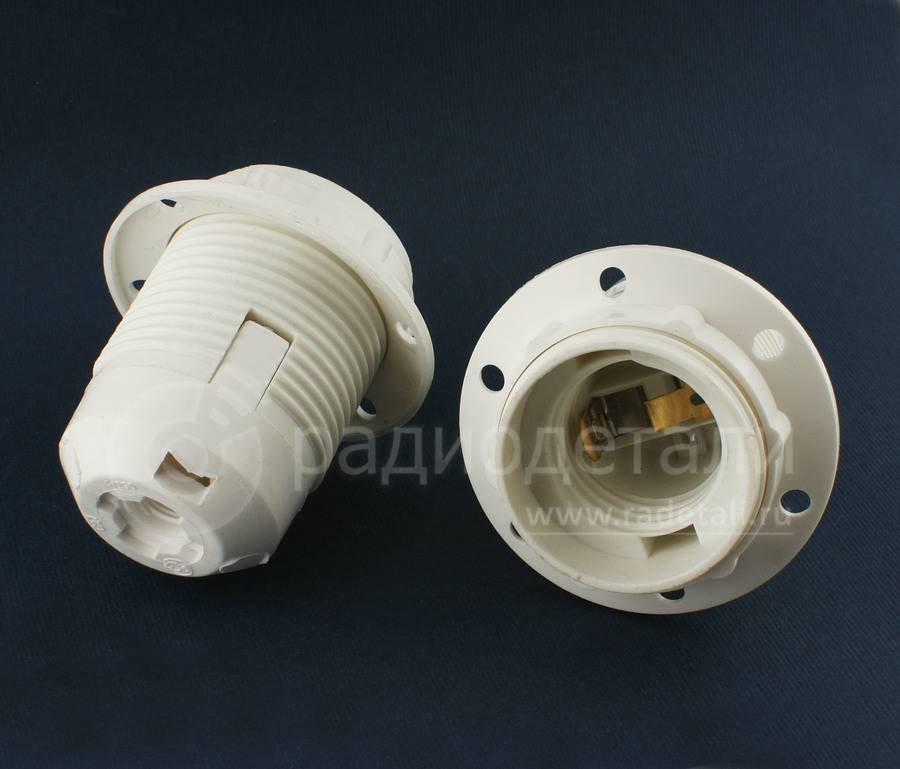
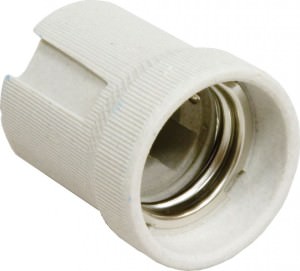
There are three types of screw cartridges for E14 and E27 socles according to the material from which they are made: ceramic, plastic and carbolite.
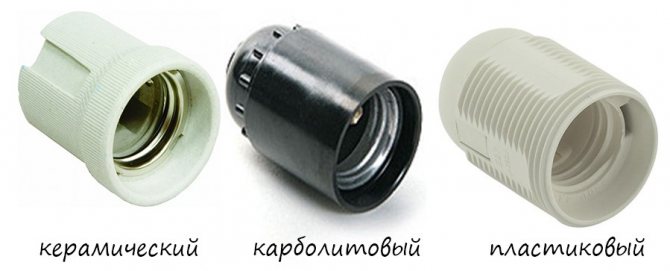
Figure 3. Types of threaded cartridges
How to change the cartridge in the chandelier
Replacing the product is not difficult and does not require experience in the field of electrics, however, it requires caution and compliance with all rules and recommendations.
Reasons for replacement
First of all, the need to change the product is indicated by the fact that the lamp does not glow when the switch is activated. This is due to rusting of the sleeve or center contact. As a rule, cleaning does not give a positive effect.
Replacement is required if:
- The presence of cracks and other defects on the outer part of the body;
- When the internal elements come into contact, a short circuit occurs.
- Exit from the operating state of the terminals.
- The service life is 5 years.
Necessary materials and tools
In the process of work you will need:
- replacement item;
- terminal blocks for connecting electrical wires;
- indicator mini-tester (screwdriver);
- insulating tape;
- construction knife with replaceable blades.

Step by step replacement guide
Replacing the cartridge in the ceiling lamp is performed in the following sequence:
- Turn off the introductory machine in the apartment or access electrical panel to de-energize the room. This work must be done during the daytime.
- Turn off the chandelier switch if turning off the introductory machine is unjustified.
- Using a mini-tester, they check the absence of voltage at the terminal block, through which the wiring of the lighting device is connected to the power line inside the apartment. This is necessary due to the fact that the switch is mounted on the phase line to the chandelier. In this way, the presence or absence of potential on all terminals is checked.
- Unscrew the fasteners that secure the lighting device. If it is fixed on a hanging hook, they are removed from it.
- Using a screwdriver, disconnect the terminal fasteners and remove the electrical wires from them.
- They place the chandelier on a table or other convenient plane, disassemble it, removing all the shades and unscrewing the bulbs so as not to break it.
- Unscrew the cartridge from the ceiling lamp housing. To do this, first unscrew it, then disconnect the wires from the ceramic insert. After that, remove the lower part of it. It should be noted that fastening is carried out in various ways, depending on the design features of the chandelier.
- A new one is placed in place of the dismantled cartridge, after which it is clamped.
- The lighting device is set to its original position, and a wire is pulled from the ceiling through the opening of the housing, supplying current.
- Before connecting the chandelier, strip the wires. To do this, a layer of insulation 5-7 mm long is removed with a knife.
- To tie the conductors, first unscrew the clamping parts of the terminals on the ceramic insert, then place them inside and firmly fix them with a screwdriver.
- The insert is placed in the inner recesses and fixed with a cylindrical body.
- The final step is to fix the ceiling lamp in its original place.

They place the chandelier on a table or other convenient plane, disassemble it by removing all the shades and unscrewing the light bulbs so as not to break
Kinds
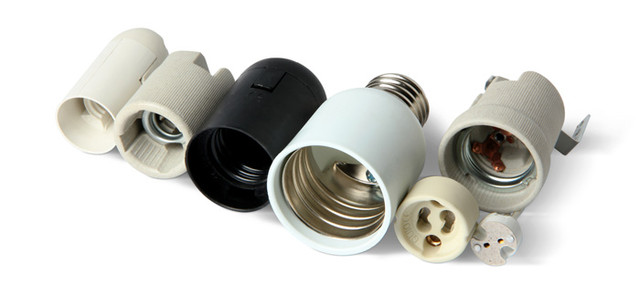
Despite the identical principle of operation of all cartridges, they are produced in two types, which allows you to mount light bulbs in different ways. Most often, devices with internal threads for standard incandescent lamps are used in everyday life, but cartridges with sleeves for a fluorescent or halogen pin base are often found.
The material for the production of the case can be both heat-resistant plastic and ceramics.
The main technical feature of a product with a sleeve is its diameter. Each species is different and is measured in millimeters. A value in the form Exx is used to indicate the type, where xx is the diameter (for example, E14, E40).
There are such types: E5, E10, E14, E26, E27, E40. E14 and E27 are the most popular among the population.
Each of them has its own characteristics, namely:
E5 and E10
They were not widely used due to the consumption of suitable light bulbs of a significant amount of current, but the low return of light energy.
E14
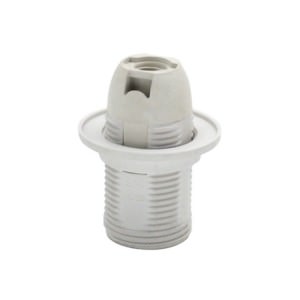
A small cartridge, most often designed for decorative light bulbs of the appropriate diameter. Since their power does not exceed 60W, the chandelier is often equipped with additional devices to provide full illumination of the entire room.






E27
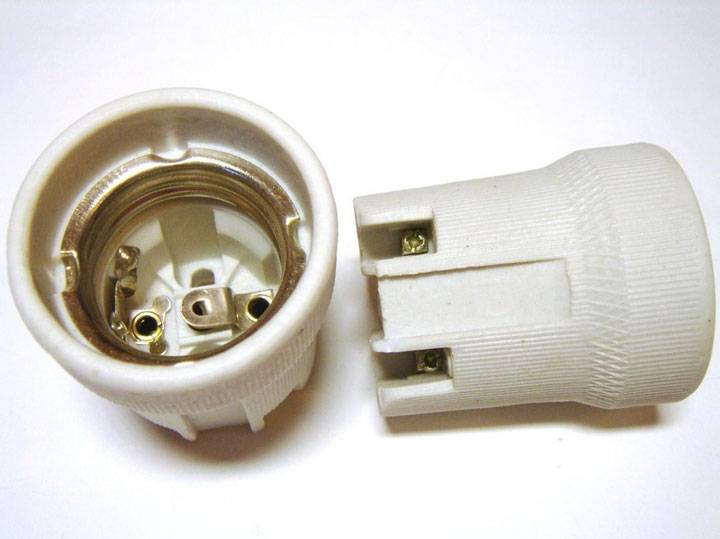
Universal screw socket, can be used to screw in conventional, energy-saving fluorescent and halogen lamps. In this case, it is not necessary to take into account all the nuances with accuracy.
E40
This type is used for overall powerful lamps that can illuminate a fairly large area of the room.
A chandelier running on halogen or LED lamps must be equipped with special pin sockets. There are a lot of types of them and it is very difficult to find the right light bulb.
It is recommended to buy a new one (instead of a burned out one), only using the example of the old one. One nuance of a low-voltage chandelier is the presence of a built-in transformer that supplies (converts 220V to 12V) current to a lamp holder (s). This fact gives the lighting device additional weight.
Types of e27 bulbs and their parameters
The E27 base is used in all spheres of life and in production, as well as on mining equipment. Gradually, incandescent lamps are being replaced by LED and energy-saving ones. However, the principle of fastening remains the same.
incandescent lamp
An incandescent lamp is a source of illumination. It has been most actively used since the invention of electric lamps and up to the 21st century.
In an incandescent lamp, light is produced by heating carbon filament or tungsten to very high temperatures. Heating is carried out by electricity passing through the cartridge to the base.
A glass bulb over the filament is needed so that the hot metal does not oxidize in the air. All air is evacuated from the flask until a vacuum is formed, or add inert gases.
The device emits light with a flux of 10 Lm/W. Its power range is defined by the boundaries of 25-150 watts. Frequent switching on and off causes the tungsten filament to wear out and burn out.
Halogen
A halogen lamp is an incandescent lamp filled with halogen vapor from the inside. The device emits a stream of light of 17–20 lm/W.Halogen lamps last up to 5000 hours, which significantly exceeds the life of conventional incandescent lamps. Often there are halogen bulbs with pins, linear type.
energy saving
Compact lamps that emit fluorescent light. Energy-saving devices, as the name suggests, consume less energy.
At the same time, they give off 5 times more light than conventional lamps. Their light power is 50–70 Lm/W. The current power level in a 20W twisted fluorescent lamp corresponds to a power of 100W on a standard incandescent lamp.
Twisted, or spiral shape, provides a compact product. Energy-saving devices give even "daylight" light, which has a beneficial effect on a person.
LED
LED-type lamps began to disperse en masse after 2010. The power range lies in the range from 4 to 15 watts. The luminous flux from LEDs is on average 80-120 Lm / W. As you can see from these numbers, LED lamps have taken another step towards lower energy consumption with more output.
LED devices can be used in rooms with high levels of humidity, as they are relatively safe. On sale there are models designed for low voltage of 12-24 watts.
Cartridge installation
To begin with, it should be noted that the fastening of the cartridge without auxiliary fixation is impossible for reasons of reliability and safety. The simplest installation schemes involve the use of a plastic sleeve with a hole in the central part through which the electrical wire is passed. But the fixation itself will be implemented not through a cable, but through a plastic screw provided as part of the sleeve kit.The method of fastening on a metal pipe is also common. It is the most reliable, therefore it is suitable for installing heavy ceiling lamps and chandeliers. In the usual configuration, the bulb holder is mounted to the tube by screwing, but before that it is necessary to pass the wire through the hole in the cylinder and make the connection. Next, the physical installation of the pipe in the ceiling niche is performed. This method is not only laborious, but also sins with a distortion of the stylistic effect at the installation site. Therefore, it is recommended to use additional decorative overlays and masking components whenever possible.
e27 plinth features
To choose the right light bulb for the lighting fixture, you must consider the type of base. A plinth of the wrong size cannot be mounted in the chuck without the appropriate adapter.
In the name "E27", the numerical designation means the diameter of the external thread. "E" in this case stands for Edison. Socles E27 are available in a wide range. Varieties of light bulbs with standard thread:
- the small standard E14 is 14 millimeters in diameter;
- diameter E27, as already mentioned, reaches 27 millimeters;
- in the E40 device, the thread diameter is 40 millimeters.
Conventional light bulbs of the E27 standard are used everywhere in everyday life. They are placed in ceiling lamps, table lamps and chandeliers. The power supply of such a device is possible through a network of 220V (AC).
Design
The E27 base is a cylinder with a large encircling thread. The base is attached to the counterpart. The counterpart is the inner surface of the cartridge in contact with the base. The screw method of attaching the base to the cartridge allows you to safely and quickly replace the desired lamp.
There are many types of threaded light bulbs. E27 is the most common base type in Europe, Russia and North America.
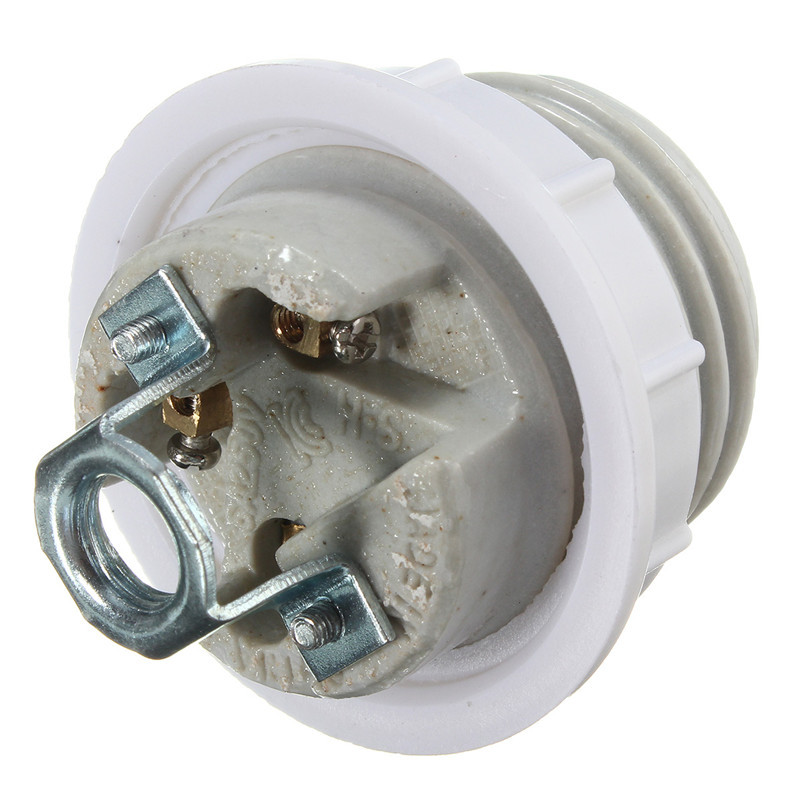
The counterpart is made of ceramic or metal. At the bottom of the cartridge there are contact plates through which electricity is transmitted to the light bulb. Energy from one contact goes through the central part of the very bottom of the base. The other two contacts (in some cases only 1 contact) conduct electricity to the threaded part.


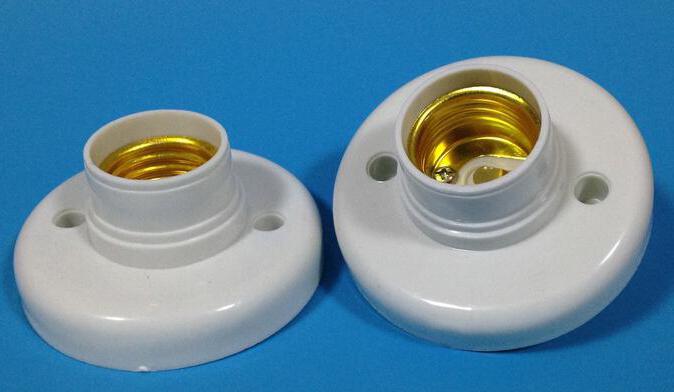


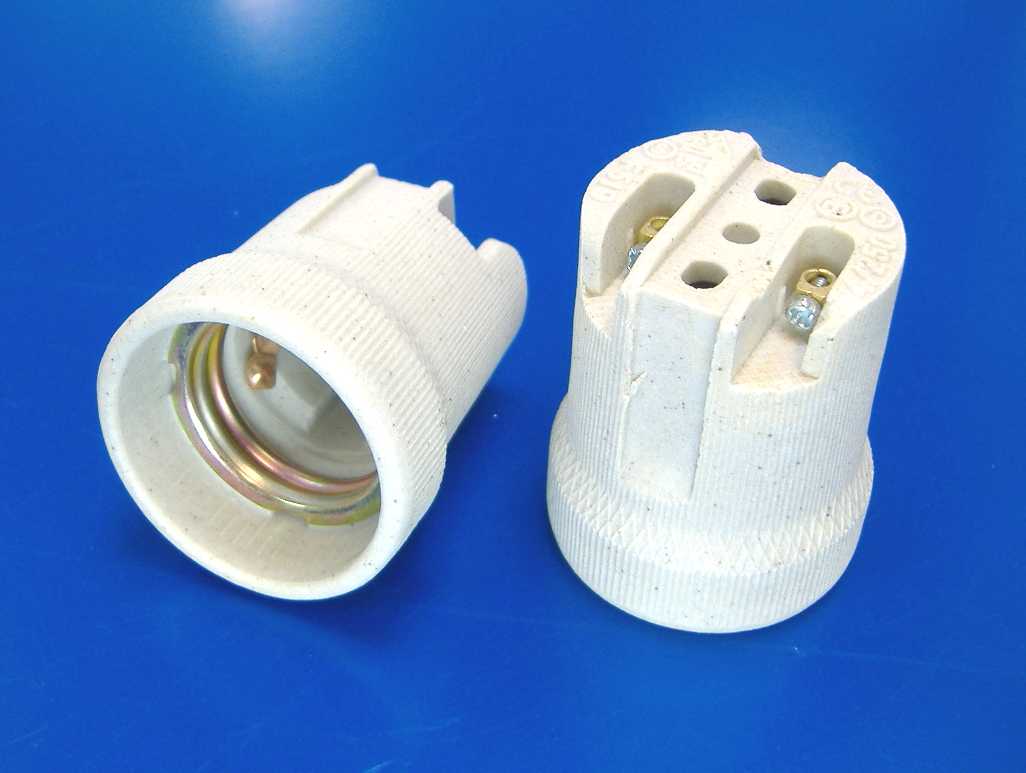
The electrodes at the bottom of the base receive electrical voltage and apply it through wires to the board or filaments. The supply wires run inside the base housing. The black wire is connected to the base body, the red wire is connected to the center terminal. Also, inside the base of a conventional incandescent light bulb, a stem is designed to pump air out of the bulb.
220V on E27 is the standard for Russia. In many other countries, E26 threaded luminaires powered by 110V are more common.
Size and specifications
On the E27 base, the length of the lamp can be, for example, from 73 to 181 millimeters, the bulb diameter can be in the range of 45-80 millimeters. The shapes of the glass "cap" also differ. "Cap" can be pear-shaped, spherical or spiral. There are products made in the form of the letter U or reminiscent of a bazooka.
Product marking
E27 - this is one of the types of base marking. Plinth marking is a symbol that indicates the characteristic properties of an object.
As already mentioned, in the E27 marking, the number means the diameter of the thread, and the letter indicates belonging to the Edison patent collection.
Light bulbs marked E27 base can vary in power:
Advantages of using the E14 cartridge
Most often, an electric cartridge is attached to metal tubes. The connection in this way has become widespread because, thanks to it, the possibility of using a design solution is greatly expanded. Such a cartridge has the ability to hold heavy structures.
However, the entire load does not go to the cartridge, but to the metal pipe. Often, additional nuts are screwed onto it to give greater stability. This allows you to securely attach any heavy ceiling to the cartridge or decorate the room with a variety of decorative caps.
It is necessary to pass the wire to the cartridge through the inner surface of the tube. In the case of a rather old old electrical wiring, there may be doubt that it is still reliable. Then the wiring needs to be replaced. In this case, you need to remove the old wire from the tube, stretching a new one through it, consisting of two cores.
Marking of electrical cartridges
According to GOST R IEC 60238-99, there are three types of threaded cartridges with different diameters - E14, E27 and E40. Their principle of operation is the same, only the design and dimensions differ.
Each product has a label. It lists the characteristics. For example, E14 can be installed in places with a current strength of not more than 2A and a power of 450 W, E27 are designed for current up to 4 A and a load of 880 W, and E40 models - up to 16 A and 3500 W. The operating voltage for all devices is 250V.
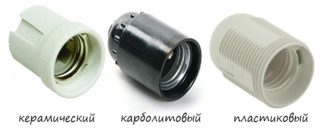 Types of threaded cartridges
The most common electric cartridge is E27. There are three standard devices with this marking:
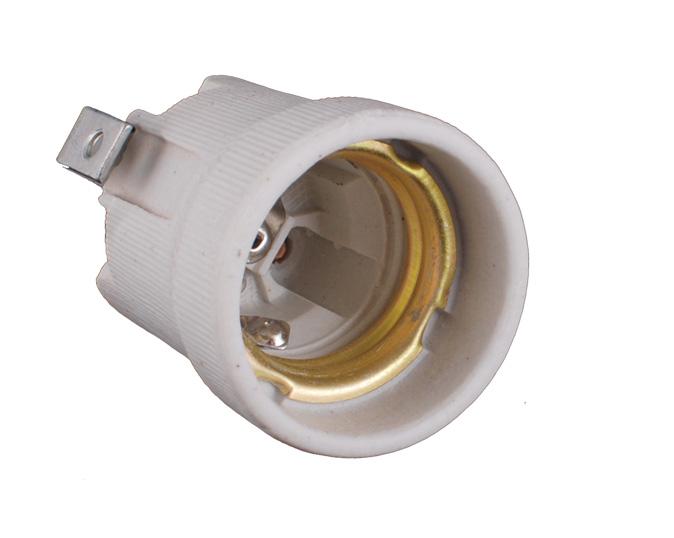
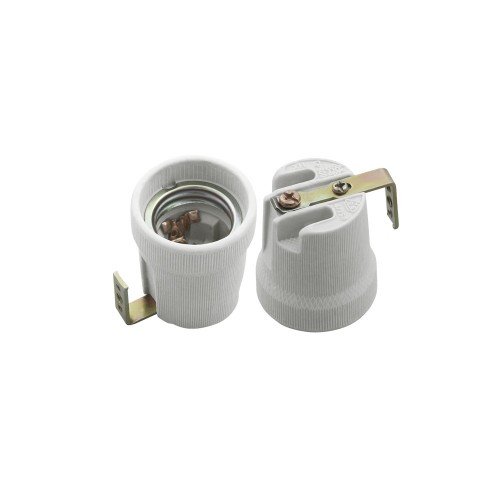
- Ceramic. It has a monolithic body, non-separable. Easy and quick to connect, compatible with almost all spotlights. Fragile, often broken.
- Carbolite.Collapsible, consists of three parts - a body, an insert with contacts, a skirt. Reliable, the contact skirt practically does not fall out, resistant to overloads. It has a complex connection and requires improvements.
- Plastic. Also collapsible, but has two parts - the underskirt and the body. It has a reliable case, good performance and quick connection. Requires careful connection so as not to damage the plastic latches.
Connecting wires in a ceramic cartridge
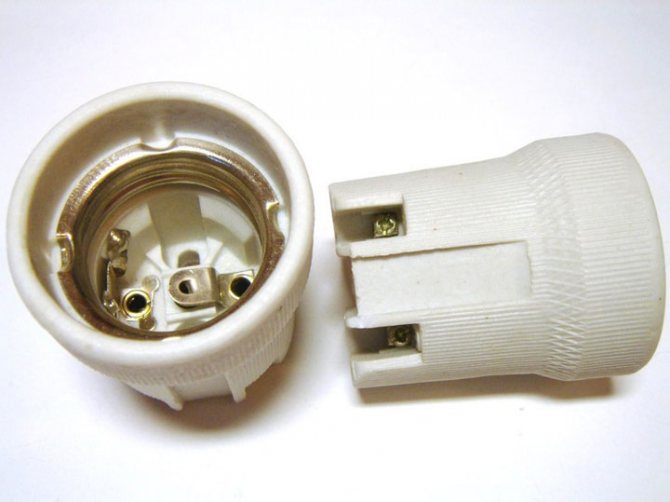
A ceramic device is not a collapsible product, like its contacts. This is where the main disadvantages come from.
These contacts are rolled and eventually weaken sooner or later. As a result, heating occurs, followed by burnout or too frequent failure of the light bulbs themselves.
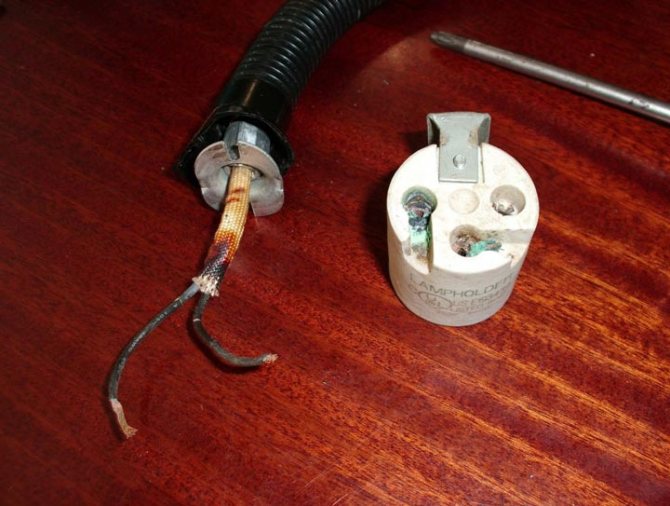
Still such cartridges sin by twisting the skirt itself along with the light bulb. After such a defect, it is already better to replace it entirely.
Of course, you can initially solder the contacts in the places of rolling or compress a newly twisted skirt, but the vast majority do not bother with this, but simply buy a new one.
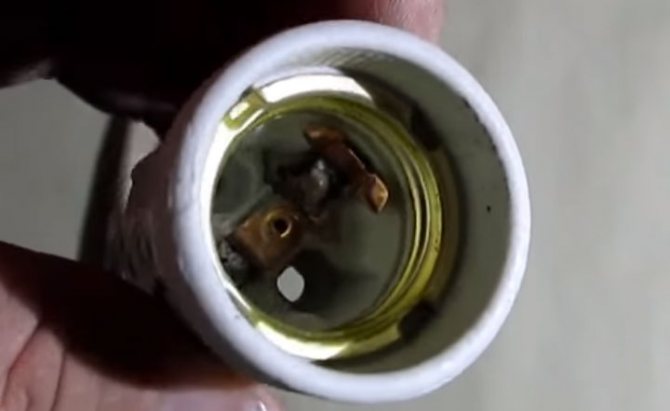
The main advantage of the ceramic cartridge is the simplified connection system. Here everything happens much faster.
Firstly, you do not need to disassemble the device itself into three parts. Secondly, completely unscrew the screws.
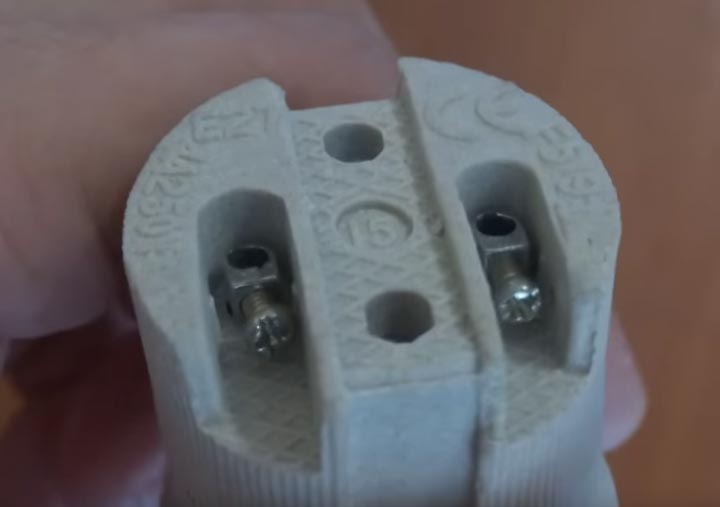
It is enough to loosen them slightly and insert a stripped wire core into the contact space.
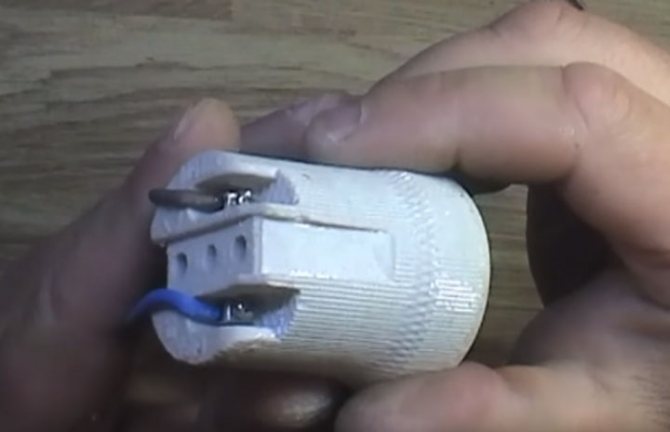
Then tighten the screw with maximum force.
3 light bulb socket
One day I received a letter from Vladimir in the mail. It contained photographs of a non-standard E27 cartridge. It is designed to install three lamps.When he dismantled the cartridge to connect the wires, the contacts fell out of it. It was difficult for Vladimir to understand where to install them. I helped solve this problem. I do not have such a cartridge, so I processed the photo that Vladimir sent.

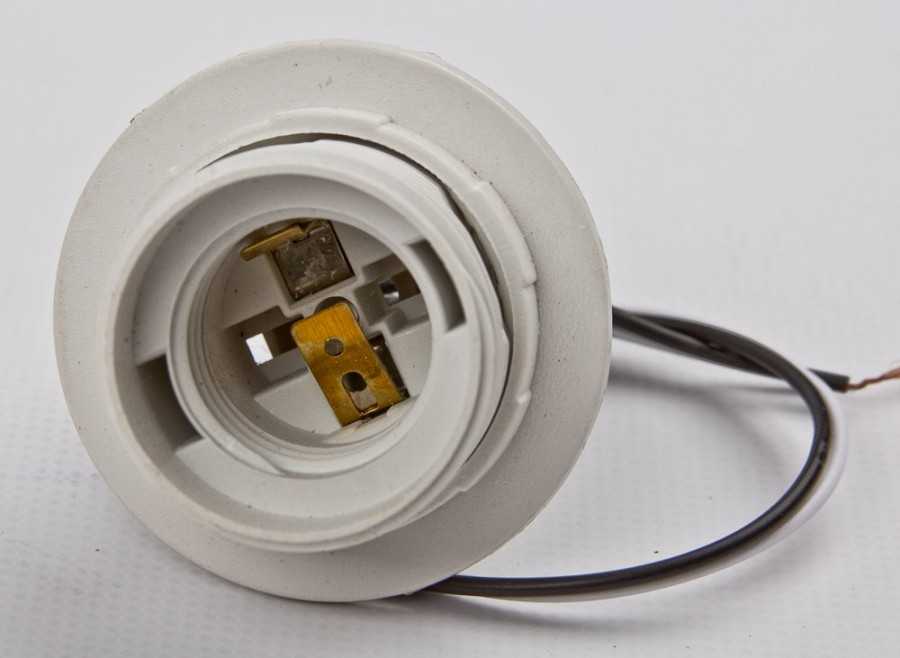


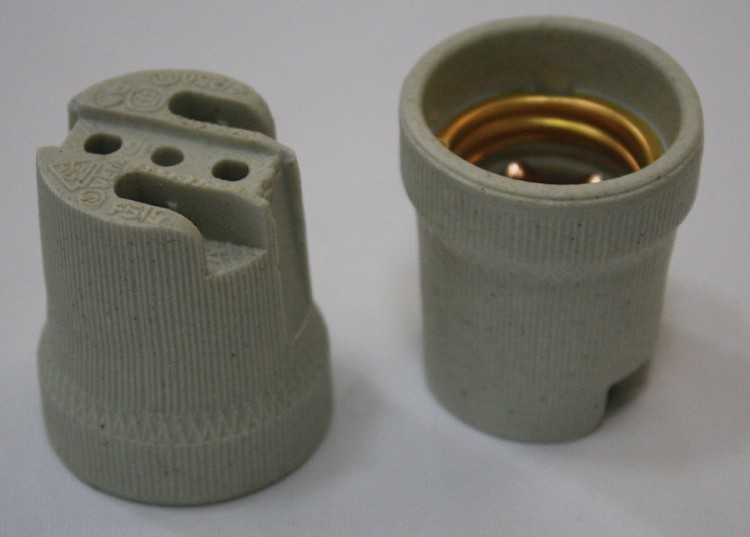
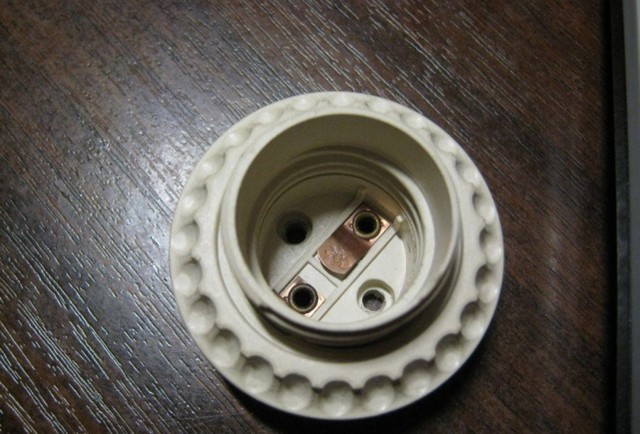


Contact plates have holes. Wires are connected to them using screws with M3 nuts. If you have a soldering iron, the plates can be soldered. The red arrow indicates the plate to which the phase wire should be connected. "Zero" is connected to the area indicated by the blue arrow. The dotted blue line shows the pin connection. It is not necessary to make this jumper, because the plates will be connected through the lamp base. Shown in green in the photo. But if you do not screw in the right lamp, there will be no voltage on the left.
Kinds
Today there are a large number of different lamps, which are divided according to the shape and coating of the bulb, purpose and filler. It happens spherical, cylindrical, tubular and spherical; transparent, mirror and matte. There are also light sources for general, local and quartz-halogen purposes. In addition, there are vacuum, argon, xenon, krypton and halogen models.
Transparent are common options. Such elements are considered the cheapest and most efficient, have an uneven light flux. Mirror models are the most effective in terms of lighting, since the coating forms a directional light flux. Matte are able to create soft and diffuse lighting for favorable working and leisure conditions. Products with local lighting operate at twelve volts, which is necessary to create a safe working environment.
Note! Such lamps are needed to illuminate inspection pits at the time of installation of electrical garage wiring. Table of types of incandescent lamps. Table of types of incandescent lamps
Table of types of incandescent lamps
General purpose lamps
General purpose sources, the most popular light sources that are used to illuminate an apartment or a factory in a network with alternating current of 220 volts and a frequency of up to 50 hertz. There are vacuum, argon and krypton. The same group is neodymium and krypton. Essentially, these are ordinary lighting lamps. It is worth pointing out that at the time of manufacture of neodymium sources, neodymium oxide is used, which absorbs the light spectrum. This improves the light quality.
Widespread use of general purpose luminaires
Projector lamps
Searchlight sources are placed on ship, railway, theater and other searchlights. They differ in that they have an increased light flux, can be supplemented with reflectors to improve the concentration of the light beam.
Spotlights as one of the types
mirror lamps
Mirror light sources are distinguished by the fact that they have the usual shape of a bulb and a special inner coating of the balloon part. This helps to collect the entire light stream, which is directed in the right direction. They are used in industry, videography, farming and bathroom ceiling lighting.
Halogen lamps
Halogen lamps are powered by an inert gas to which bromine and iodine are added to protect the filament and increase life. Such light sources have a small size for use as a filler of expensive inert gas.Differ in brightness of a luminescence, a natural color rendition, good service life and the considerable light return having the smaller sizes.
Note! The only negative is the sensitivity and significant drops in mains voltage. Halogen lamps as one of the types. Halogen lamps as one of the types
Halogen lamps as one of the types
Ways of fastening electric cartridges in chandeliers and lamps
When replacing or repairing faulty electrical cartridges in chandeliers and lamps, they have to be removed. To do this, you need to know how to attach the cartridge to the base of the chandelier.
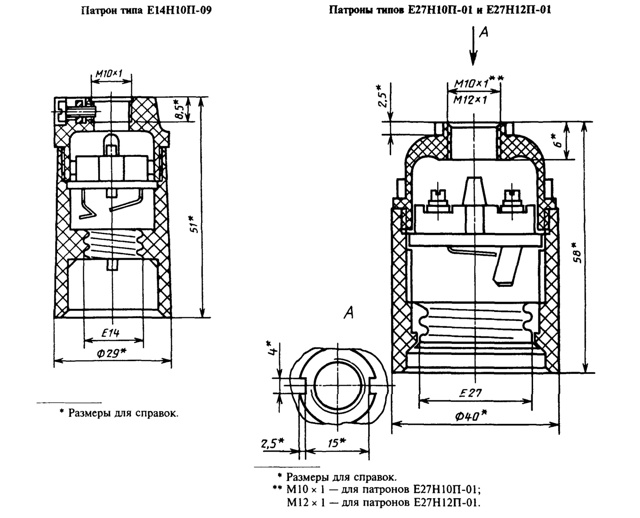
The cartridge is fastened in chandeliers and lamps, as a rule, by the bottom. There is a thread in the hole for entering the wire into the cartridge. E14 has M10 × 1. E27 can have one of three: M10x1, M13x1 or M16x1. Luminaires are suspended directly on the electric wire and on a metal tube of any length and shape with a threaded end.
Fastening an electric cartridge in a lamp for a current-carrying wire
Mounting the cartridge on the current-carrying wire without its additional fastening is not allowed. A plastic sleeve is screwed into the bottom with a hole in the center for the passage of an electric wire, in which a fixing plastic screw is provided.
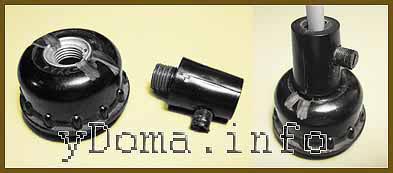
After connecting the wires to the contacts of the cartridge and assembling it, the wire is clamped with a plastic screw. Often, decorative elements of lamps and parts for attaching the ceiling are also fixed with a sleeve. Thus, the reliability of the connection of the electric cartridge, the suspension of the lamp and the fastening of the ceiling is ensured. Photo report on how I attached the cartridge to the lead wire when making a wall lamp for the hallway.The wire is used special with increased mechanical strength.
Fixing an electric cartridge in a chandelier on a tube
Mounting an electric cartridge on a metal tube is the most common, as it allows you to hang heavy ceiling lamps and gives scope for design imagination. He often screws additional nuts onto the tube and with the help of them, any chandelier fittings, decorative caps, and ceiling lamps themselves are attached directly to the tube. The entire load is already carried not by an electric cartridge, but by a metal tube. The wire for connecting the cartridge is passed inside the tube.
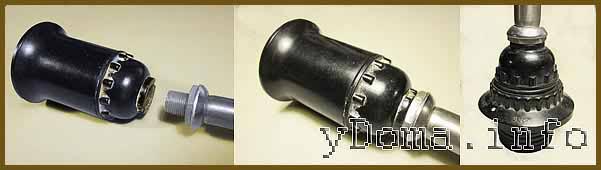
There are electric cartridges, which have a thread on the outer part of the cylindrical body, on which you can screw the lampshade ring and use it to fix the ceiling or other design element and the direction of the light flux.
Mounting the electric chuck with a sleeve
In table lamps and wall lights, electrical sockets are often secured with metal or plastic tubular grommets to sheet metal parts. This method of fastening expands the possibilities of luminaire designers, since it is enough to drill a hole in any place of a part made of sheet material and fix the cartridge with a sleeve.

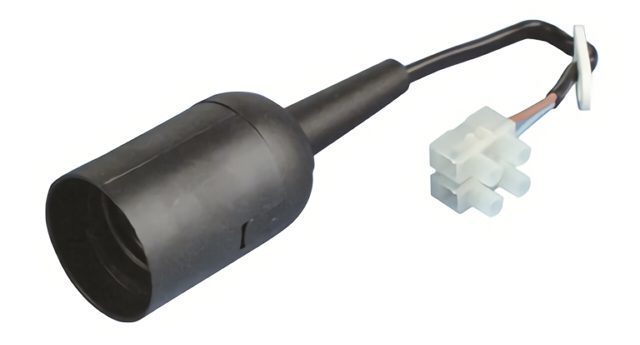



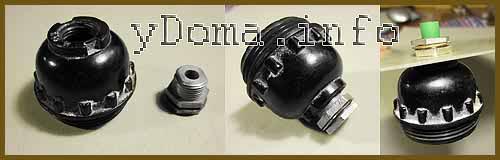
More than once it was necessary to repair lamps with such an attachment of an electric cartridge with plastic bushings due to its deformation. From heating with an incandescent bulb, the plastic was deformed, and the electric cartridge began to hang out.
Replaced the melted metal bushing. I took from a variable resistor type SP1, SP3. They have M12×1 mounting thread
Please note that the thread may be different.The fact is that the connecting thread of the E27 cartridges is not standardized, and each cartridge manufacturer made the thread at his own discretion. If you decide to use a sleeve from a resistor, then before breaking the resistor, be sure to check whether the thread fits the cartridge
The resistor is completely disassembled and the sleeve is removed from the plastic base
If you decide to use a sleeve from a resistor, then before breaking the resistor, be sure to check whether the thread fits the cartridge. The resistor is completely disassembled and the sleeve is removed from the plastic base.
Fixing an electric socket in a chandelier with screwless terminals
The fastening of an electric cartridge with screwless contact clamps is somewhat different from the traditional fastening due to the fact that the connection of the case with the bottom is carried out using two latches, and not a thread.
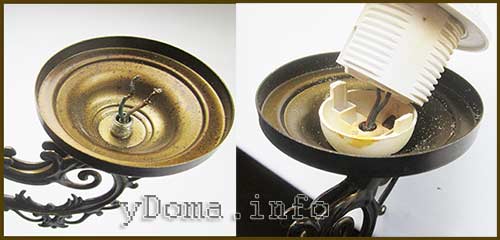
First, the bottom is screwed onto the threaded tube in the chandelier, then the wires are threaded into the cartridge, and finally the cylindrical body snaps into the bottom. In the photo, the latches at the bottom are broken off; with such a malfunction, the chandelier came to me for repair. Such a cartridge can be repaired, the repair technology is described in the article below.
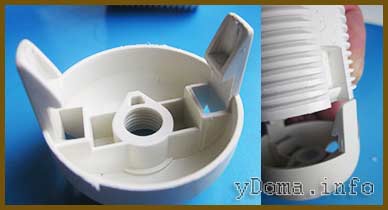
Therefore, if you have to change such a cartridge in a chandelier, then in order not to damage the wires, first take the latches to the sides with a screwdriver, thereby freeing the body from the bottom.
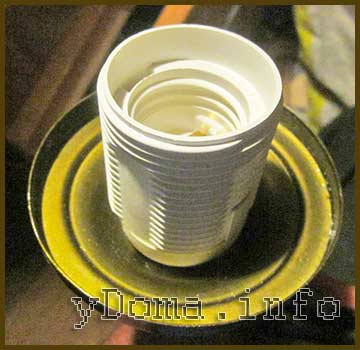
This photo shows a cartridge with screwless terminals, installed during the repair of a chandelier to replace a cartridge that failed.In this chandelier, the cartridge also performs a fastening function, fixes a decorative metal cup, to which a glass shade is attached in the assembled chandelier.
Types of cartridges
Lampholders are divided according to the method of installation in the lighting device:
- Pin. Attached to the plinth with pins.
- Threaded. Attached by twisting. The connection of the light bulb with the wire will occur when the base sleeve rests against the contacts in the cartridge.
- Rotary threaded (combined). Fixed with a special lock. They are used in places where lighting fixtures can be subjected to vibration, mechanical stress.
Cartridges are also classified according to the type of base. Socles are indicated by a special marking, under which the desired cartridge is selected. The choice is also made depending on the type of lamp.
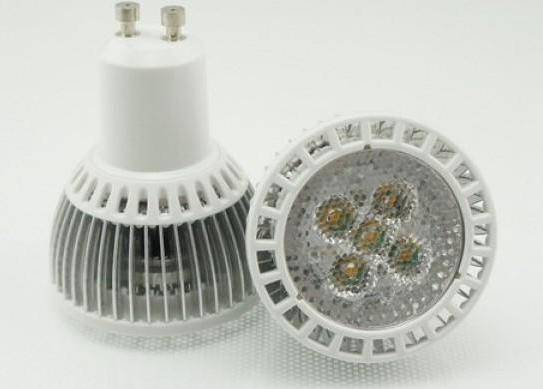
For ordinary incandescent lamps, energy-saving light bulbs, some LED, halogen lamps, ordinary E27 threaded cartridges are suitable. Small minion bulbs are fixed in E14 cartridges. It is designed for a base with a diameter of 14 mm. To install pin halogen, fluorescent lamps for low-voltage power supply, lampholders marked G are required.
You can also find adapter cartridges on sale. They make it possible to connect elements of different formats. If you use the E27-E14 adapter, you can screw the minion lamp into a classic cartridge.
There are branching cartridges, they allow you to form a structure with several plinths. In one lamp with one socket, several bulbs will be connected. This will increase the power of the device.
Repair of electric chucks
Electric chucks E and G series differ from each other in terms of maintenance. If the former are being repaired, in most cases, if the latter breaks, a replacement of the cartridge in the chandelier is required.
Repair of a collapsible electric cartridge E27
The reason for the frequent burnout of light bulbs, changes in brightness during the operation of lighting devices may be a breakdown of the electric cartridge. This is also indicated by extraneous sounds heard when the product is turned on.
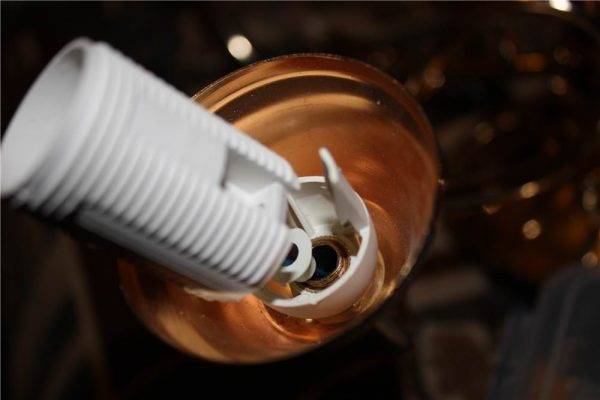
Unscrew the light bulb from the base and inspect the internal cavity of the element. If blackened contacts are found, they need not only to be cleaned, but also to understand the root cause. Often the formation of blackening is preceded by poor contact at the point of contact between the cartridge and electrical wires.
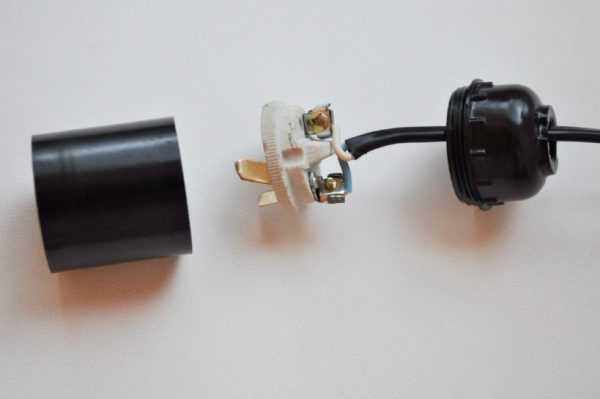
Disassemble the cartridge, inspect the wire connections (pull lightly on the cable to make sure it is secure) and clean the contact plates. In some cases, for better contact, the plates need to be bent towards the bulb base.
There are frequent cases when, when trying to unscrew the light bulb from the cartridge, the bulb peels off the metal base and the latter remains inside. If this happens, disassemble the housing and bottom to pull out the bulb base. Another option is to take pliers with insulated handles, try to grab the edge of the plinth and turn it counterclockwise
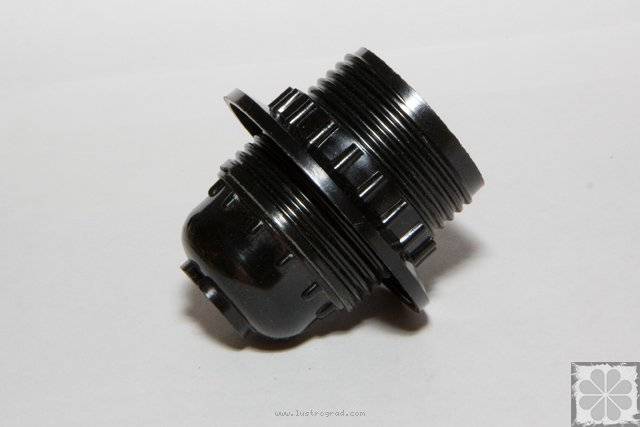




Be careful not to damage the internal thread of the chuck
The process of replacing the cartridge in the chandelier
To replace the cartridge in the chandelier, you must perform the following steps:
- turn off the power supply at the panel;
- disconnect the electrical wiring;
- remove the chandelier from the ceiling;
- disassemble the lamp;
- remove the defective cartridge;
- set whole;
- after replacement, install the chandelier.
Switching off the light on the dashboard
Before replacing the cartridge, you need to turn off the power supply to the room. To do this, the automata on the shield, which provide power to the ceiling chandelier, should be switched to an inactive state.
Disconnecting wires
All wires that supply power to the lamp are insulated and bred to the sides so that a short circuit does not occur.
Removing the chandelier from the ceiling
To remove the chandelier, you need to take an indicator screwdriver and a stepladder. First you need to check the switch to make sure there is no electricity. Then do the following:
- remove from the chandelier such fragile details as the ceiling, decorating elements, lamps;
- unscrew the fixing screw and the cap that closes the wire connection under the ceiling;
- if there is a hook under the cap, the wires are disconnected and bred to prevent a short circuit;
- if there is a strap, loosen the clamping bolt or, if necessary, remove it.
Fixing the chandelier on stretch ceilings is carried out using disposable butterfly fasteners. Therefore, it is advisable not to remove them. Otherwise, you should purchase a new mount in advance.
Lamp disassembly
Most of the chandeliers have 3 or 5 seats for lamps directed in different directions. If the chandelier worked before dismantling, you need to wait for the temperature inside the luminaire to drop. First remove the plafonds. In old-style chandeliers, they are fixed by means of threads. Others are held on by special latches or small bolts.
A threaded plastic ring is most often used to secure this element.It is screwed onto the outer thread of the holder, so you need to be careful not to break the insulating part of the element.
Cartridge dismantling
The method of dismantling depends on the type of construction and the method of fastening in the housing of the lighting fixture. Most often, fixation occurs with several bolts. The part is removed immediately or it is disassembled, removing the core. In this case, the cartridge latch is removed, the middle part is taken out and the wires are disconnected. The last to unscrew the nut that secures the housing.
When a screw terminal cartridge needs to be replaced, loosen the bolts and pull out the wires. Some E14 holders have terminal blocks. In most cases, they are disposable, so they need to be replaced.
The ceramic cartridge is dismantled as follows:
- the plates are pressed from the central contact;
- unscrew the bolts from the plate, which is opposite the ceramic base;
- the central terminals are bent to the level of the side contacts.
Sometimes it is enough to clean and tighten the terminals of ceramic products to ensure the quality of the cartridge.
Installing a new cartridge
To replace the cartridge in the lamp, you need to connect all the wires. They wind up through the bottom of the product, and form rings from the stripped ends. They are mounted on screws, fixed with plates and clamped. If fastening is carried out using terminals, the bare ends of the wires are twisted so that the hairs do not bristle. Then they are inserted into the clamps and clamped with pliers.
The phase is brought to the central contact.
Additionally, they check whether the cross section of the wires corresponds to the power consumption of the chandelier.At the end of the replacement, the lamp is assembled and installed in the reverse order.
Advantages and disadvantages of different types of cartridges
Let's try to figure out the pros and cons of cartridges made from various materials. And you should start with the most common products - from carbolite and ceramics.
Among the advantages of the material can be noted:
- low cost;
- resistance to high temperatures;
- prevalence (there will be no problems if replacement is necessary).
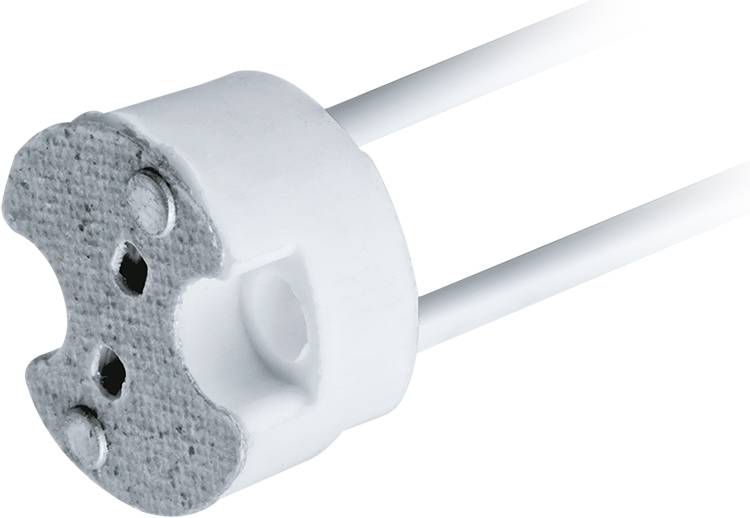 Ceramic G4 for connecting LED or halogen spotlights
But in addition to the advantages, such products also have sensitive disadvantages:
- the quality of such cartridges leaves much to be desired;
- the material is extremely fragile, which, coupled with the first point, contributes to frequent breakdowns with the need for replacement;
- contacts (more and more often lately) are made of a simple metal subject to corrosion, which leads to deterioration of the connection, its heating and burning off, or simply disappearing. So, you need to be prepared for the fact that you will have to clean such contacts often.
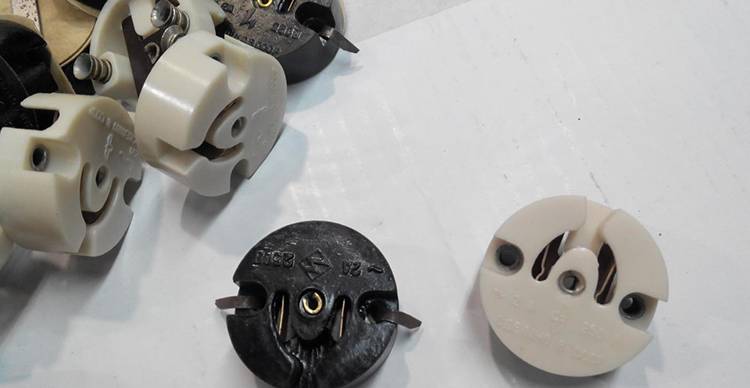 This is also one of the varieties of the cartridge for the pin base