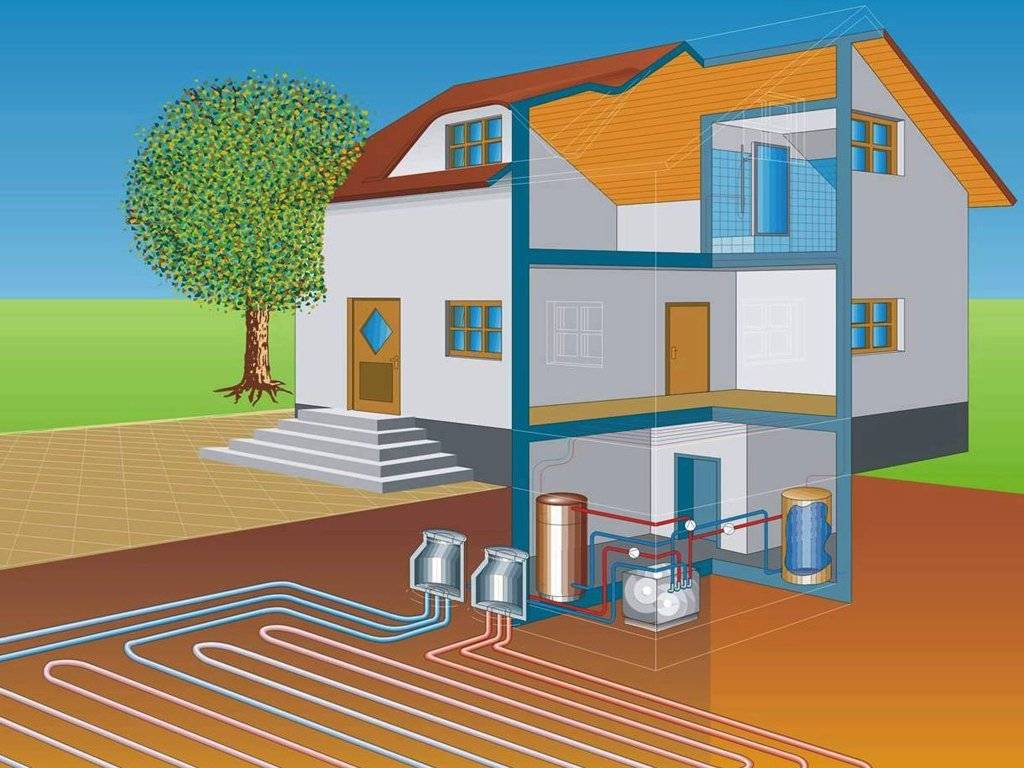
- Modern heating technologies
- Warm floor
- Water solar collectors
- solar systems
- infrared heating
- Skirting heating technology
- Air heating system
- Heat accumulators
- Use of computer modules and the heat generated by them
- Heat pump
- Economical gas boilers
- Not using gas and electricity
- Without pipes and boilers
- Heating without fuel
- Heat without heating
- Electric heating
- Underfloor heating system
- Mistakes during installation
- Additional aspects of choice
- Heat carrier - water or air?
- Energy dependence is an important point
- Gas consumption
- Heating with liquefied gas
- Efficient boilers for space heating
- Condensing gas
- Pyrolysis
- solid fuel
- Electric boiler
- Metal ovens
- folk fantasy
- The heat pump as a newfangled alternative
- What to do to stay warm when the main power source is off
- Antifreeze
- Additional source of energy (boiler of lower power on other fuel)
- Video description
- Biofuel boilers
- Conclusions and useful video on the topic
Modern heating technologies
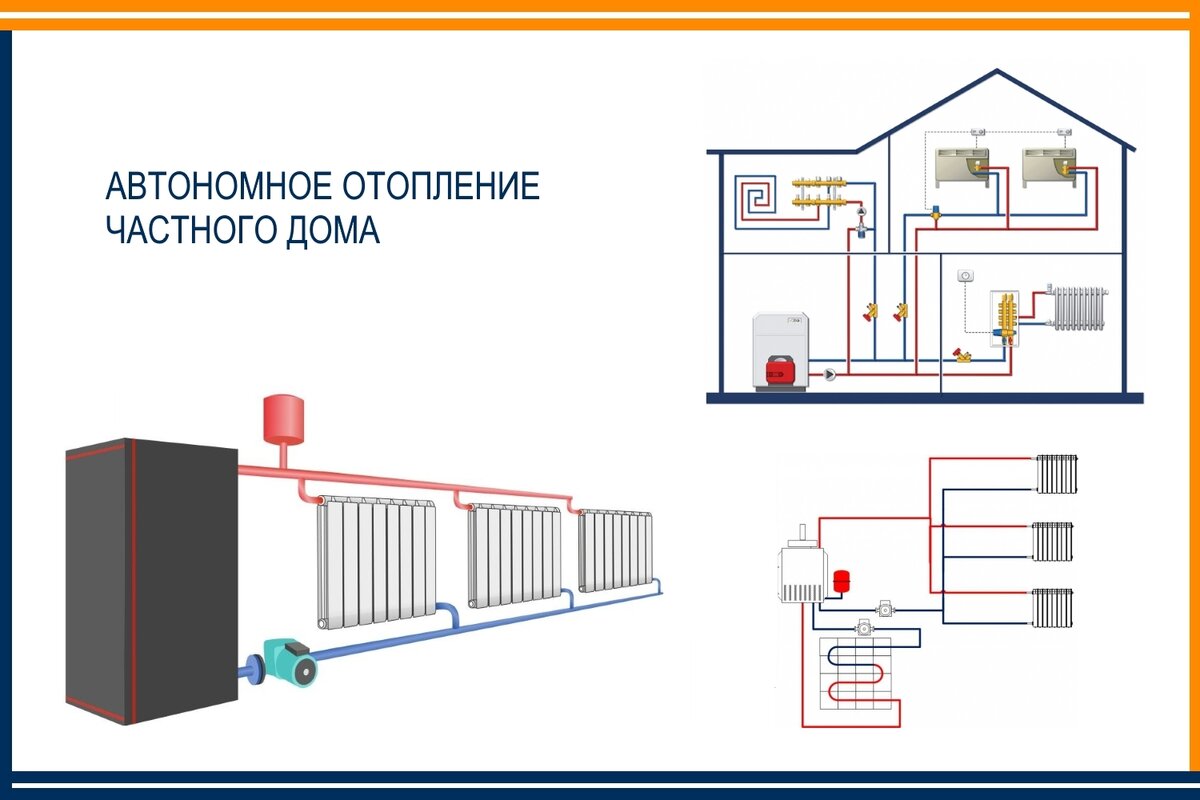
Heating options for a private house:
- Traditional heating system. The heat source is a boiler. Thermal energy is distributed by the heat carrier (water, air).It can be improved by increasing the heat transfer of the boiler.
- Energy-saving equipment that is used in new heating technologies. Electricity (solar system, various types of electric heating and solar collectors) acts as an energy carrier for heating housing.
New technologies in heating should help in solving the following issues:
- Cost reduction;
- Respect for natural resources.
Warm floor
Infrared floor (IR) is a modern heating technology. The main material is an unusual film. Positive qualities - flexibility, increased strength, moisture resistance, fire resistance. Can be laid under any floor material. The radiation of the infrared floor has a good effect on well-being, identical to the effect of sunlight on the human body. Cash costs for laying an infrared floor are 30-40% less than the cost of installing floors with electric heating elements. Energy savings when using a film floor of 15-20%. The control panel regulates the temperature in each room. No noise, no smell, no dust.
With the water method of supplying heat, a metal-plastic pipe lies in the floor screed. The heating temperature is limited to 40 degrees.
Water solar collectors
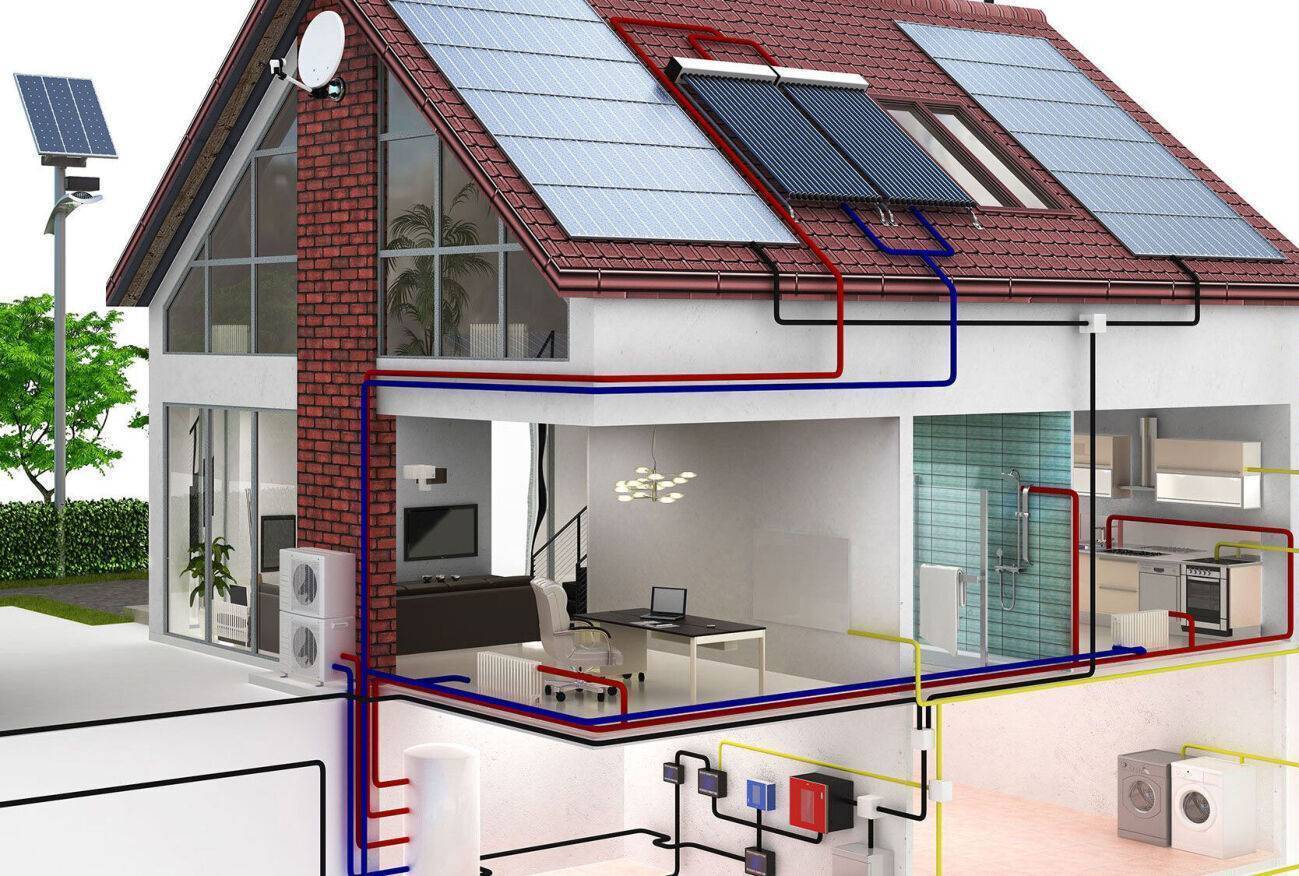
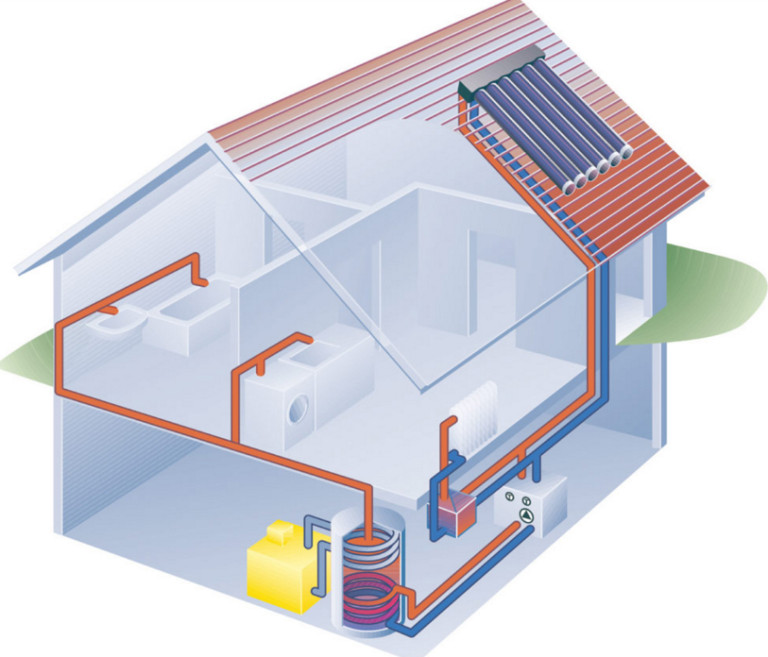
Innovative heating technology is used in places with high solar activity. Water solar collectors are located in places open to the sun. Usually this is the roof of the building. From the sun's rays, the water is heated and sent inside the house.
The negative point is the inability to use the collector at night. It makes no sense to apply in areas of the northern direction. The big advantage of using this principle of heat generation will be the general availability of solar energy.Does not harm nature. Does not take up usable space in the yard of the house.
solar systems
Heat pumps are used. With a total electricity consumption of 3-5 kW, pumps pump 5-10 times more energy from natural sources. The source is natural resources. The resulting thermal energy is supplied to the coolant with the help of heat pumps.
infrared heating
Infrared heaters have found application in the form of primary and secondary heating in any room. With low power consumption, we get a large heat transfer. The air in the room does not dry out.
The installation is easy to mount, no additional permits are needed for this type of heating. The secret of savings is that heat accumulates in objects and walls. Apply ceiling and wall systems. They have a long service life, more than 20 years.
Skirting heating technology
The scheme of operation of the skirting technology for heating a room resembles the operation of IR heaters. The wall is heating up. Then she starts to give off heat. Infrared heat is well tolerated by humans. The walls will not be susceptible to fungus and mold, as they will always be dry.
Easy to install. The heat supply in each room is regulated. In summer, the system can be used to cool the walls. The principle of operation is the same as for heating.
Air heating system
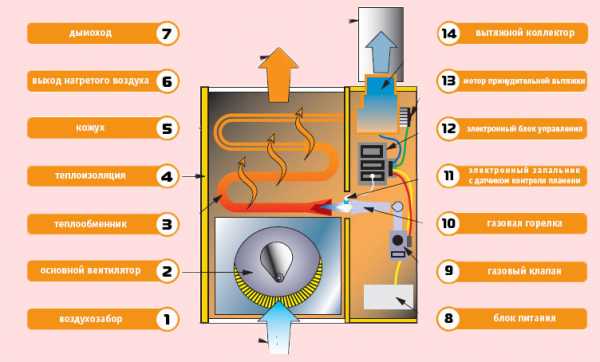
The heating system is built on the principle of thermoregulation. Hot or cold air is supplied directly to the room. The main element is an oven with a gas burner. The combusted gas gives off heat to the heat exchanger. From there, the heated air enters the room. Does not require water pipes, radiators. Solves three issues - space heating, ventilation.
The advantage is that the heating can be started gradually. In this case, the existing heating will not be affected.
Heat accumulators
The coolant is heated at night in order to save money on electricity costs. A thermally insulated tank, a large capacity is a battery. At night it heats up, during the day there is a return of thermal energy for heating.
Use of computer modules and the heat generated by them
To start the heating system, you need to connect the Internet and electricity. Principle of operation: the heat that the processor releases during operation is used.
They use compact and inexpensive ASIC chips. Several hundred chips are assembled into one device. At cost, this installation comes out like a regular computer.
Heat pump
Solving the problem of how to heat a house without gas, sometimes they resort to a very unusual method that does not require any fuel.
This is a heat pump consisting of the following elements:
- Tubes filled with freon.
- Heat exchanger.
- Throttle chamber.
- compressor.
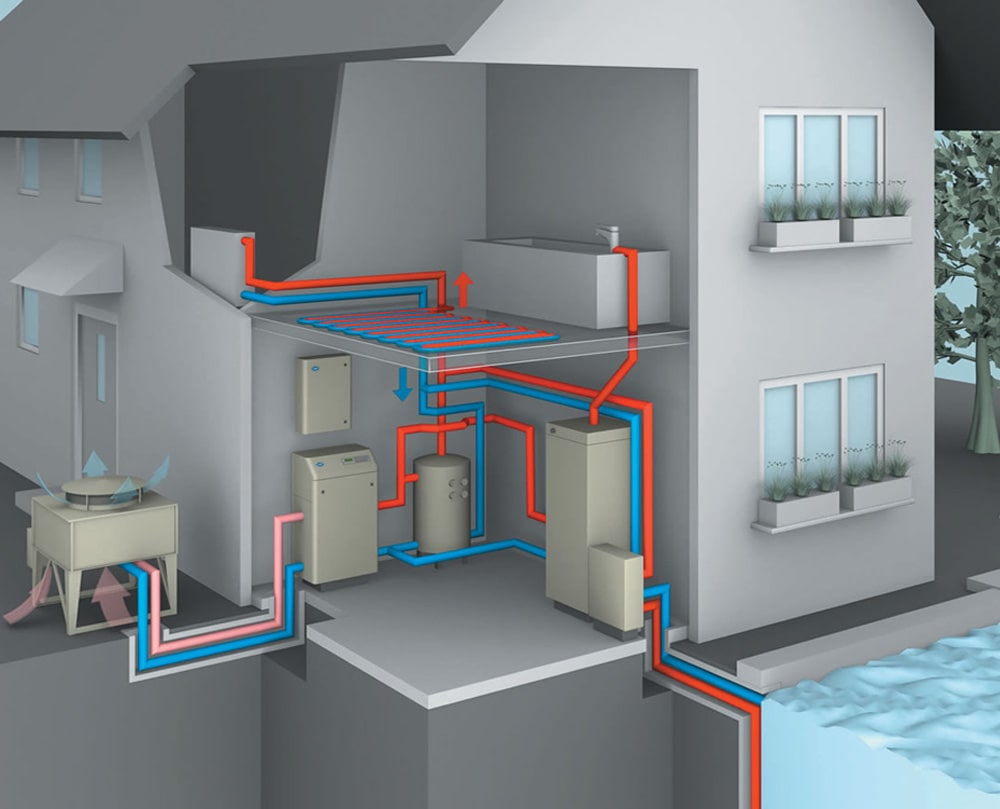
The device is based on the principle of operation of the refrigerator. Tubes with freon inside descend into the ground or the nearest body of water: as a rule, this environment, even in winter, never cools below +8 degrees. Considering the fact that freon boils at a temperature of +3 degrees, this is quite enough for the substance to be constantly in a gaseous state. Rising up, the gas enters the compressor, where it undergoes significant compression. Any substance in such conditions sharply increases its temperature: in the case of freon, it warms up to +80 degrees.
The energy released in this way is used by means of a heat exchanger to heat the coolant in the heating system. The final cooling of freon (as well as the reduction of its pressure) occurs in the throttle chamber, after which it passes into a liquid state. Then the cycle repeats - the liquid is sent through pipes deep into the earth or a reservoir, where it heats up again. For the functioning of this scheme for generating heat for the house, electrical energy will also be required: its consumption here is much less than when using electric boilers or heaters.
Economical gas boilers
If you want to get the highest degree of savings, then it is important to understand the varieties of existing gas boilers. They can be floor, hinged and condensing. The first are installed on the floor, the others are mounted on the wall
While others can be wall-mounted or floor-mounted, a distinctive feature of such equipment is high efficiency, which can reach 100% or more. The most economical heating boilers belong to this type
The first are installed on the floor, others are mounted on the wall. While others can be wall-mounted or floor-mounted, a distinctive feature of such equipment is high efficiency, which can reach 100% or more. The most economical heating boilers are of this type.


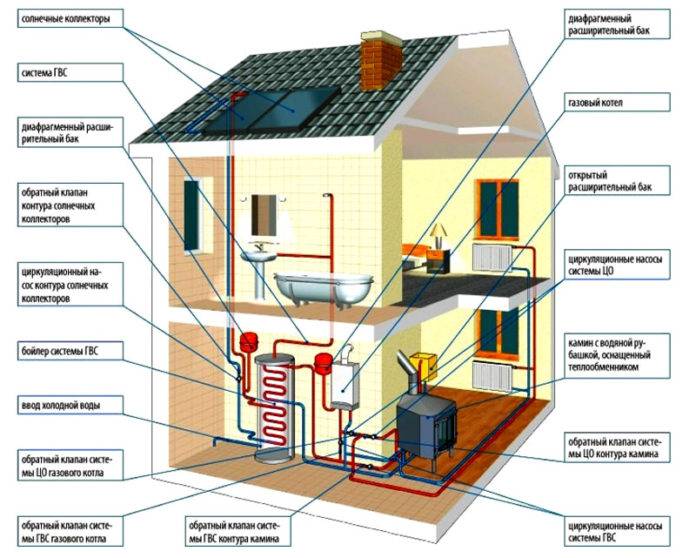


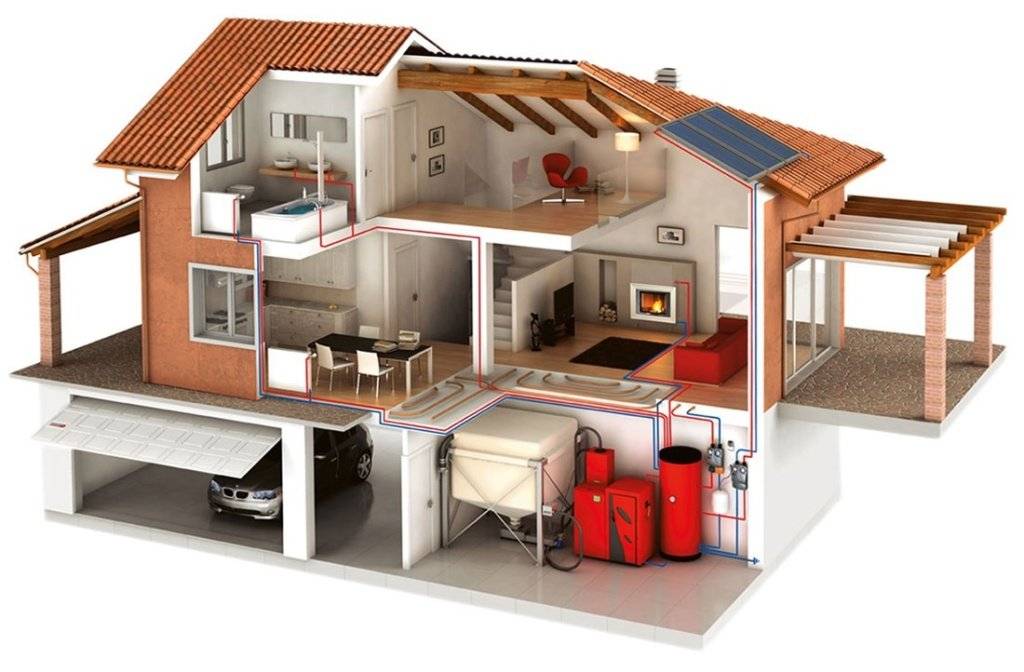
Such a high efficiency is due to the fact that such units use two sources of energy, the first is gas combustion, but the second is the energy that is released during the condensation of steam.If you choose a mounted boiler, you will be able to save even when purchasing, since such equipment is cheaper compared to other gas boilers.
Not using gas and electricity
To date, there are several alternative options for space heating, which does not require electricity or gas supply. Such heating from pipes without batteries would save. Heating system options are as follows:
- ovens and fireplaces. They heat the room using the energy of burning wood or coal. If you decide and choose this option, you will need to build a furnace or purchase ready-made communications, which you only need to install correctly. At the same time, as a result, the family receives an environmentally friendly and economical method of heating, and if the stove is equipped with a frying surface, then it will completely cope with cooking;
- autonomous heating system from a personal source of electricity, which can be obtained in two ways:
- with the help of sunlight. Here you will have to spend money on special solar collectors that can convert solar energy into thermal energy and thus work as a heater. Naturally, you will have to invest in the purchase of equipment, but the expenses will be one-time, and the receipt of electricity will be permanent;
- using the power and energy of the wind. To do this, you will have to build a special apparatus, which consists of a turntable, a generator and a battery. If you can’t assemble it yourself, you can purchase a ready-made structure that converts wind power into electricity.
Video 2. Heating without gas and wood. New!
Without pipes and boilers
An autonomous heating system is often equipped with a boiler to which pipe-radiator communications are connected, which allow heating several rooms at once. However, properly selected heating without pipes and batteries, which operates from a single heat source, can work just as efficiently. Most often it is:
- a stove made of brick or metal, which will be ideal for supplying heat to one room or two adjacent rooms;
- a fireplace, which was used in ancient times to heat castles;
- heater of electric type reflex or oil-based;
- air conditioners, etc.
Remember that for a country house, which is built according to the ancient principle of "five-walls", it is quite enough for high-quality heating of one stove, which is located in the middle of the house. Even today, in such structures, heating is carried out without pipes, batteries and boilers.
Heating without fuel
It consists of pipes that are filled with freon, as well as throttle, compressor and heat exchange chambers. The device works according to the refrigerator scheme and is based on simple physical laws.
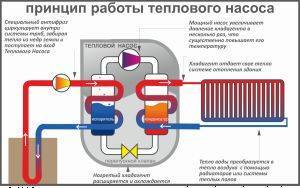
The pipes are located deep underground or in a lake at a decent depth so that the ambient temperature does not rise above 8 0C even on the hottest day.
Already at 3 0C, freon boils and rises through them into the compressor, where it can be compressed and thus heated up to 80 0C.
In this form, it goes back to the highway underground, repeating the cycle in a circle.
Heat without heating
Even without a heating system, without pipes, radiators and boilers, it is possible to warm up in the room.
There are several methods that are used both together and separately. These include:
- maximum insulation of your home. To keep the particles of heat that come after cooking food, breathing residents, etc. it is enough to insulate the walls, add warm floor coverings to the interior, heavy curtains on the windows so that they block the access of cold air and do not allow heat to leave the room, etc. Even if the heating system works as it should, such nuances will save energy and not consume more heat than necessary;
- warming home wardrobe. Wear a warm sweater and slippers. While watching TV, cover yourself with a warm blanket or use a warm cape, a heating pad in bed and warm drinks (tea, milk);
- psychological warming. We change the design of the room, its color scheme to a warmer one (peach, yellow), add knitted decorative elements and wooden accessories. Use scented candles and photos of warm countries in the interior. Thus, there is an impact in two directions: on the eyes and touch. So you can deceive the body and make you feel warm.
In any case, you can find an opportunity and a suitable method and warm your home. Heating without pipes and boilers can be an effective solution to this problem even in severe frosts. Using the above methods, it will be possible to warm your home even in the most unusual situations.
Electric heating
Electric heating involves the conversion of electrical energy into thermal energy. For this purpose, various boilers are used that run on electricity. The following are the most common methods of electric heating:
- Electric boilers. In such units, a heating element is built in. There may be one or more.If there are several of them, then the user himself can activate only one of them or all at once. It is a system of pipes through which the coolant moves and is heated by the flowing electric current. Powerful units are connected to a three-phase network. There is no heating element in some electric boilers. Instead, electrodes are provided. Electric current passes from one electrode to another through water. So he warms her up. Typically, in such systems, not water, but antifreeze is used as a coolant.
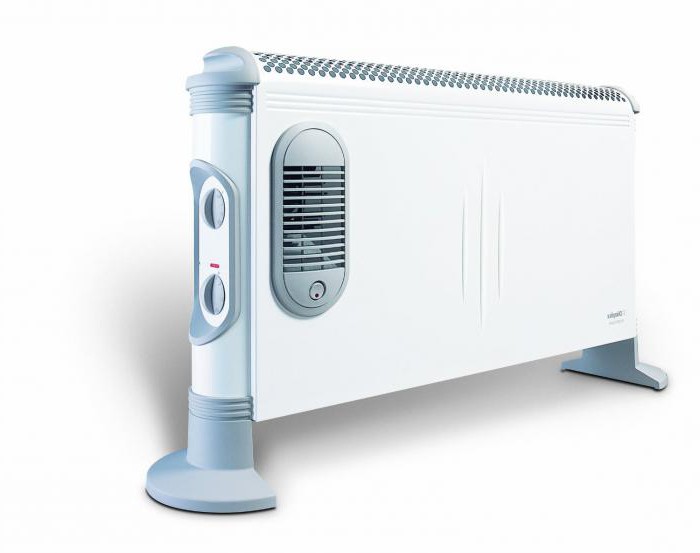
- Heating electric convectors. In appearance, they resemble ordinary radiators, only now they are connected to the electrical network. Also, they do not use a coolant. The heating element is enclosed in a special insulator. A current passes through it, it heats up, as a result of which the surrounding air also heats up, which immediately rises.
- Infrared heaters. They have a special device that converts electrical energy into infrared rays. These infrared rays travel in a straight line and only heat objects that are in their path. For full heating, you will have to install several such units. Thanks to this device, you can create zones with high and low temperatures in the room.
- Electric floor. It is a system of current conductors with high resistance. They are mounted in the floor, and heat up as a result of the passage of current through them. This heat then heats the floor surface, the heat from which is transferred to the air in the room.

These types of electric heating exist at the moment. Now you should consider all the pros and cons of this heating method.
So, the advantages of electric heating are as follows:
- The efficiency of electric boilers is high. According to various sources, approximately 99% of electricity is converted into thermal energy.
- Environmental friendliness. When using electricity, no emissions of harmful substances into the atmosphere occur.
- Automatic. Most electric boilers operate in automatic mode, that is, a person only needs to adjust accordingly.
- Safety. Unlike gas, where there is a risk of leakage, electricity is less dangerous.
And now for the cons:
- The first and most important disadvantage is electricity tariffs. Most boilers that are connected to a three-phase network operate at high power, so the electricity consumption is high.
- Dependence on an uninterrupted supply of electricity. If suddenly for some reason there is a power outage, the devices stop their work. But this problem can be solved by installing additional automation.
Underfloor heating system
Underfloor heating technology is a convenient and economical space heating system. Modern installations use progressive materials. For the manufacture of pipelines lightweight and durable polymer materials are used.
The basis of a warm electric floor is a heating cable. The main thing in this type of heating is the quality of the cable, on which the efficiency of the system and the duration of its service depend.
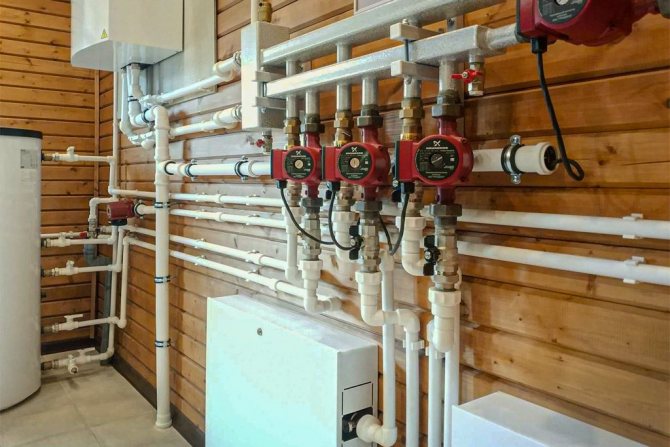
Warm floors using water do not emit harmful substances, electromagnetic radiation. Water is a cheap and heat-intensive heat carrier. A network of pipelines is installed, through which the liquid flows, between the base and the floor covering.Compared to the electrical system "warm floor", this type of heating is much cheaper.
The energy supply policy pursued in recent years involves the transition to renewable energy sources. Increasingly, for the production of electricity, not gas and coal are used, but the sun, wind, water energy. These are environmentally friendly energy sources that do not pollute the environment with emissions and discharges.
Mistakes during installation
The most common mistakes when performing calculations or installing heating are:
- Incorrect determination of the required boiler power;
- Wrong binding;
- Illiterate choice of the heating scheme itself;
- Incorrect installation of all elements.
Insufficient boiler power indicators are the most common mistake. It is done when, during the selection of a heat generator for heating and hot water supply, the necessary additional power for heating water is not taken into account.


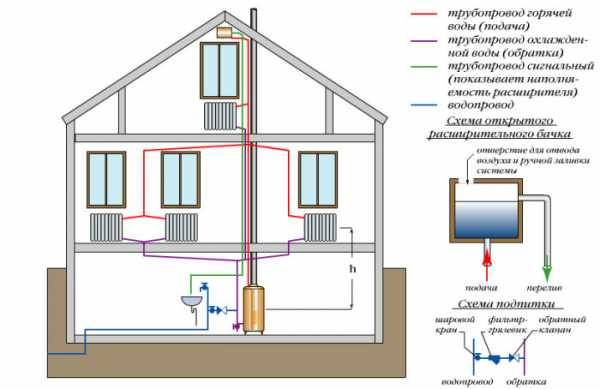
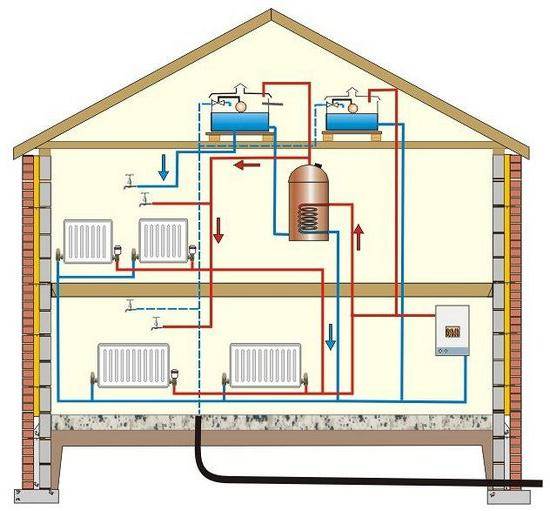

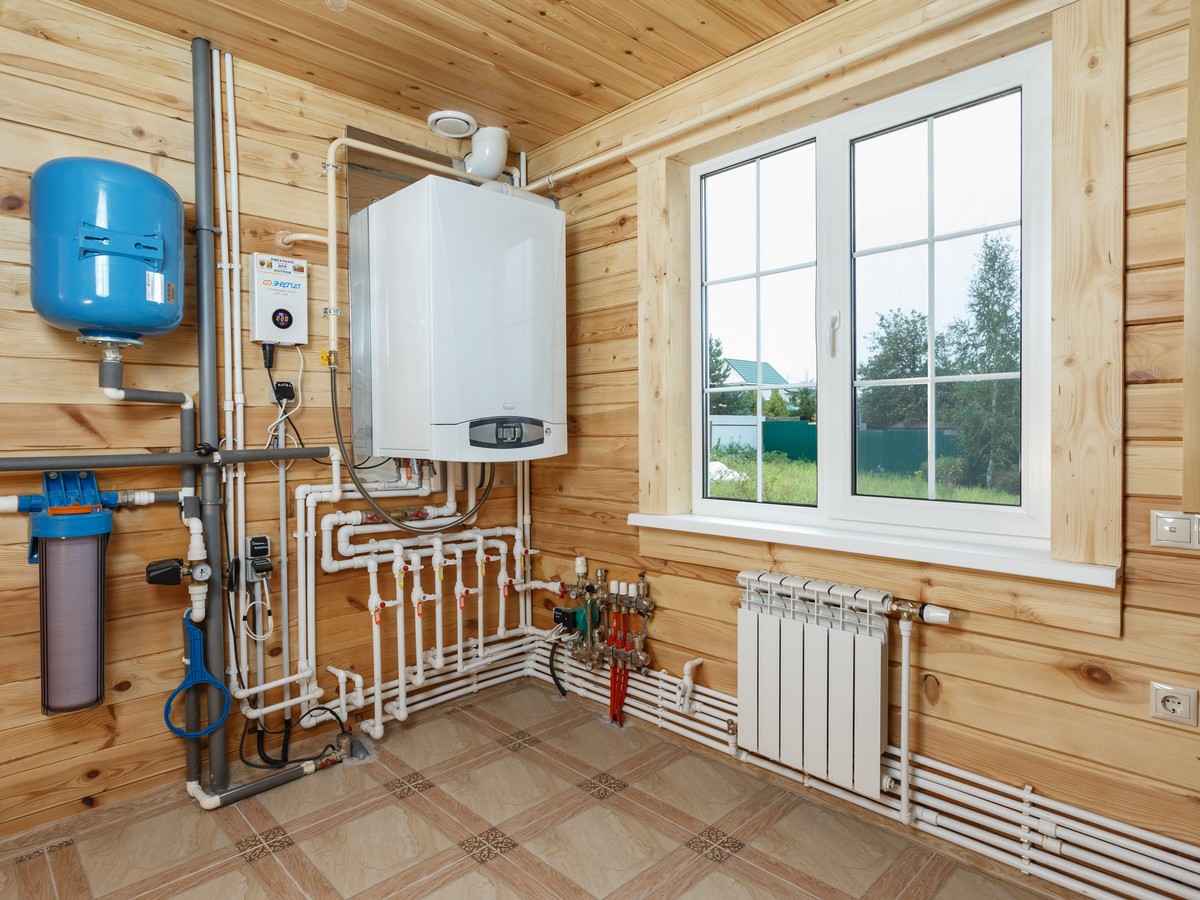


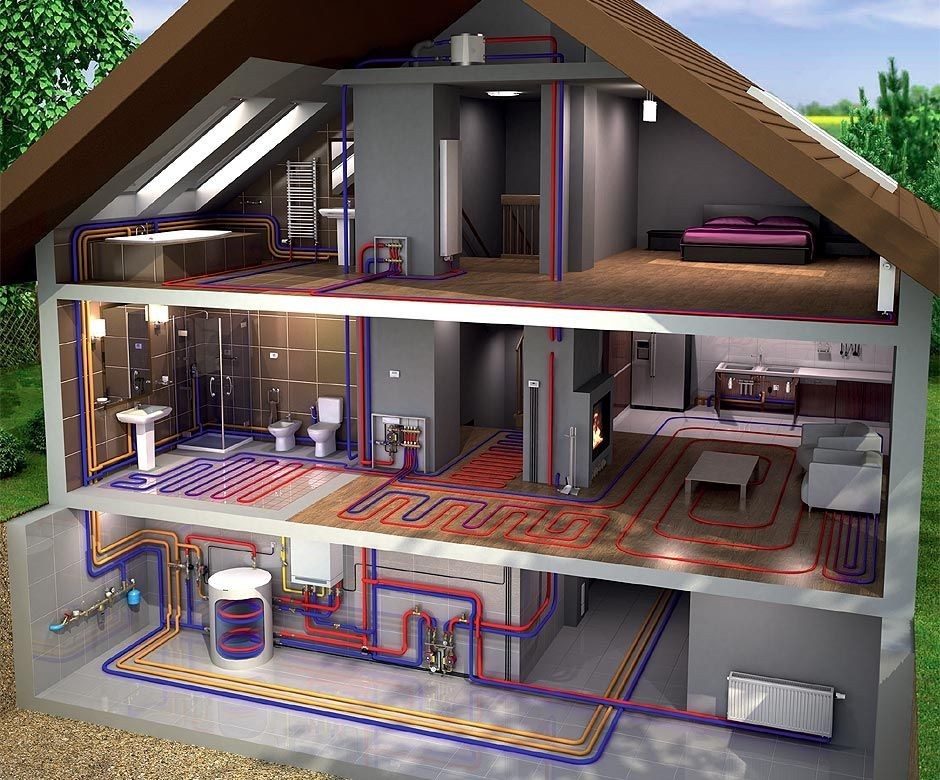
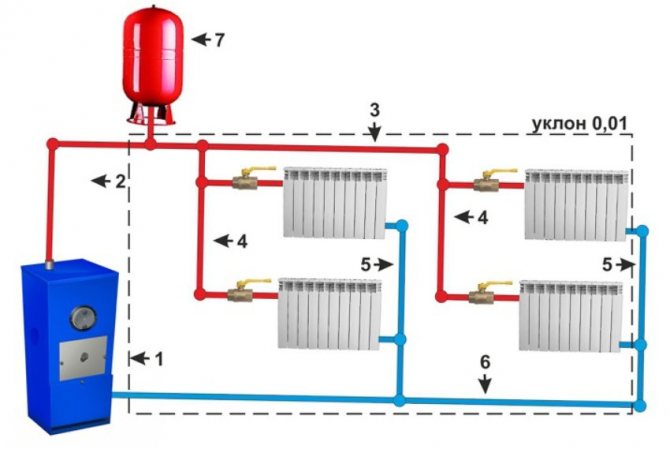
Incorrect selection of the heating scheme leads to additional costs for reworking the entire structure. Such an error is allowed when a single-pipe wiring is installed with more than 6 radiators. A large number of batteries does not allow them to warm up.
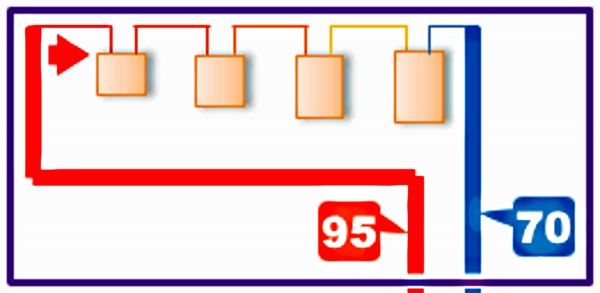
The last heating elements in the chain will always remain cold
Also, during installation, pipeline slopes are not respected, poor quality pipes are connected and unsuitable additional equipment is installed.
When installing underfloor heating, the pipes are insulated without fail, in order to avoid heat loss on the way to the heating "snail".
A common mistake during the connection of pipelines is the excess of the time required for a reliable joint to be reached by the soldering iron on the pipes. As a result, their inner diameter decreases and a bottleneck is formed.
Additional aspects of choice
Heat carrier - water or air?
By type of coolant for suburban houses usually choose water heating, but often stop in the air.
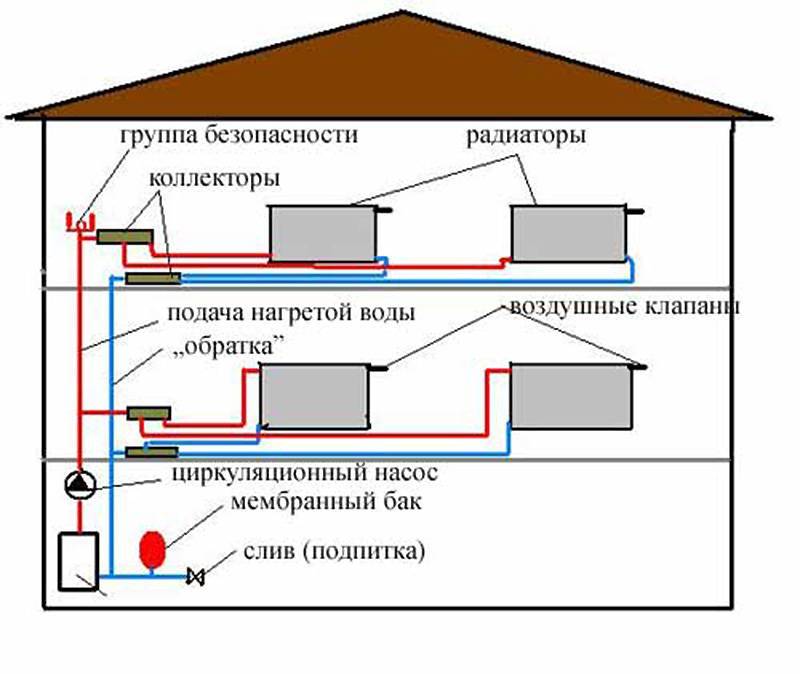
Water heating functions in this way: the water heated by the boiler passes through pipes and through radiators (or “warm floor”) gives off heat to the premises. This "classic" has the following advantages:
- the possibility of combining with the DHW system;
- trouble-free installation in an already finished house (although this is associated with a number of inconveniences, but still);
- relatively inexpensive operation.
Among the disadvantages of water heating, it is worth noting the risk of freezing of the coolant in the cold season and the need for periodic preventive maintenance and maintenance of the system.
The air system heats the house according to the following principle: the air heated by the heat generator enters the premises through specially equipped channels through air ducts. The advantages of this type of heating is the possibility of combining it with a ventilation and ducted air conditioning system, filtered and humidified air, as well as the absence of the risk of freezing or leakage of the coolant.
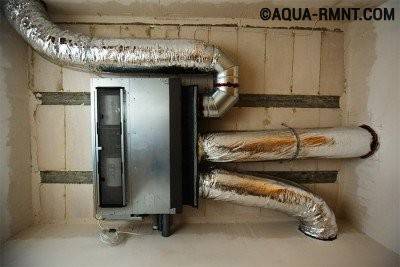
Air heating is an excellent additional measure for country houses with panoramic windows. It can create powerful thermal curtains.
Unfortunately, this solution also has a lot of disadvantages, among them:
- complexity and high cost of installation;
- the need to design and install the system exclusively at the stage of building a house;
- "incompatibility" with thick stone walls;
- huge difficulties with making changes to an already finished system.
Air heating is expensive any arrangements. In the installation of such, it makes sense only when erecting a building with a large number of hollow partition walls. As an independent system, it is rather weak, except for a mild climate.
Therefore, water heating in most cases is a more rational choice.
Energy dependence is an important point
When deciding on a heating system, it is very important to decide how you want to see it - volatile or not. Electricity is independent of the system with natural circulation of the coolant (gravity)
This is the main and probably the only plus. The disadvantages of the gravity system are much greater - this is the need to install with large diameter pipes, which often violate the aesthetics of the interior, and a small "radius" (houses with an area of \u200b\u200bno more than 150 sq. M), and the inability to automatically regulate its operation
A system with natural circulation of the coolant (gravitational) is independent of electricity. This is the main and probably the only plus. The disadvantages of the gravity system are much greater - this is the need to install with large diameter pipes, which often violate the aesthetics of the interior, and a small "range" (houses with an area of \u200b\u200bnot more than 150 sq. M), and the inability to automatically regulate its operation.
System heating with forced circulation is volatile, however, it does not take advantages. It can be controlled both manually and automatically - up to each individual radiator. This contributes to significant fuel economy, which is good news. In addition to the heating circuit, it is possible to “introduce” a water supply circuit, a heated floor, a snowmelt system into a system with forced circulation, which cannot be said about gravity. At the same time, the “range of action” of the system is not limited.
Gas consumption
When choosing economical heating for a summer residence, consumers most often pay attention to gas. If you also decide to follow the experience of the majority, then you should know what is the fuel consumption for a certain area of \u200b\u200bthe house. As practice shows, for a dwelling with an area of approximately 140 square meters, about 13 kilograms of gas per day will be needed.
This statement is true if the windows in the house are well insulated, there are no cracks and crevices, and the temperature outside the window varies from -18 to -23 degrees. Indoor temperatures will vary from 21 to 23 degrees. The mentioned gas consumption for heating is approximately half of the cylinder
As practice shows, for a dwelling with an area of approximately 140 square meters, about 13 kilograms of gas per day will be needed. This statement is true if the windows in the house are well insulated, there are no cracks and crevices, and the temperature outside the window varies from -18 to -23 degrees. Indoor temperatures will vary from 21 to 23 degrees. The mentioned gas consumption for heating is approximately half of the cylinder.
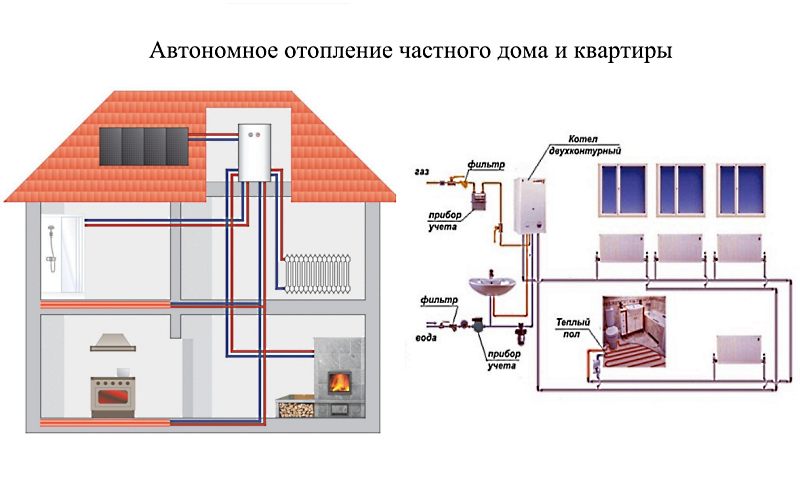

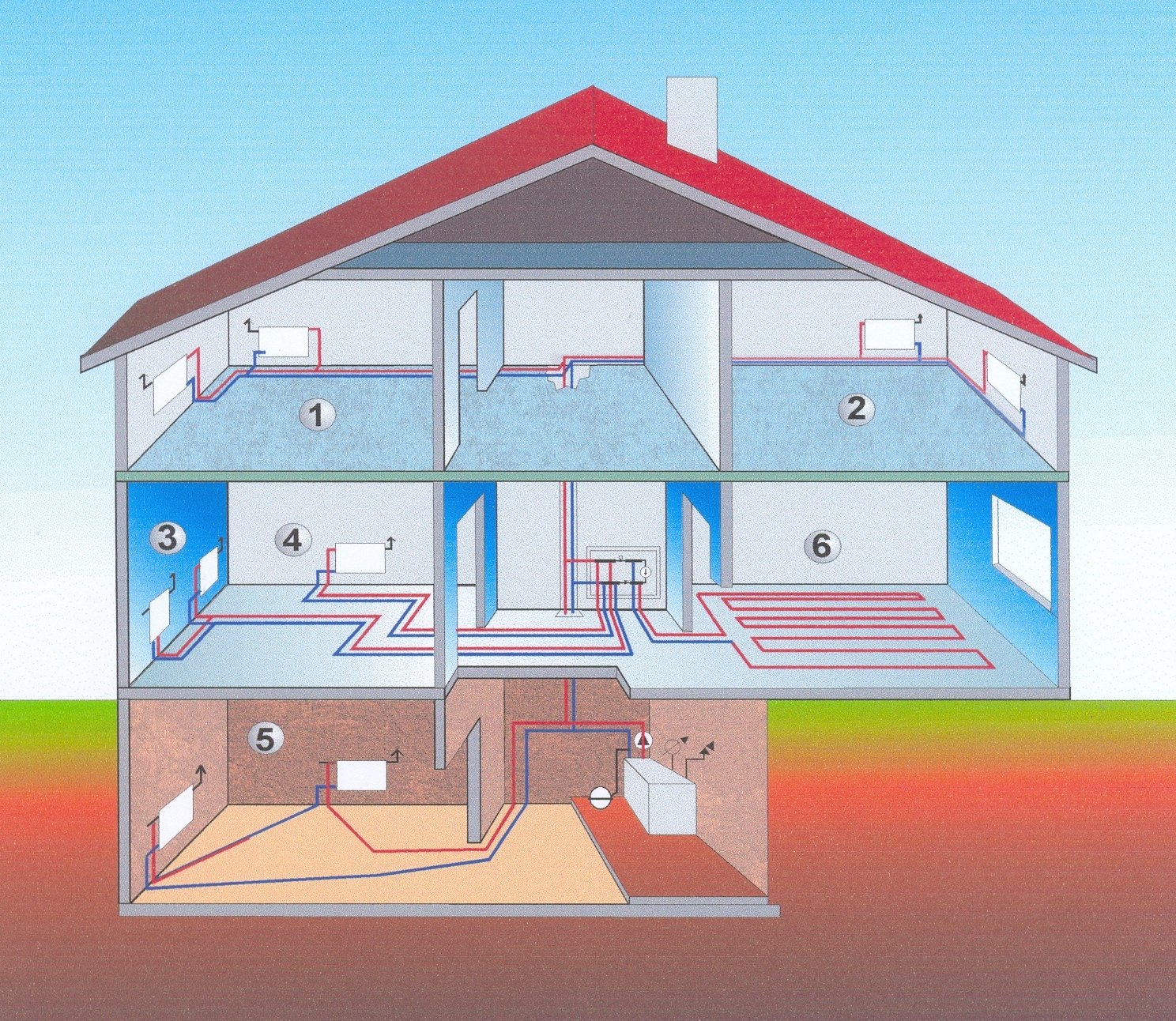


Heating with liquefied gas
When the country house is rarely used by the owners, small liquefied gas cylinders up to 50 liters will be an excellent replacement for gas heating or a massive gas tank.
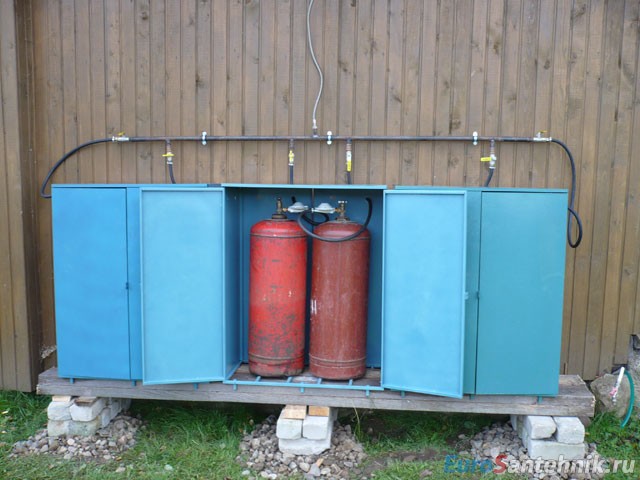
The principle of operation is standard: you need a boiler and low-power convectors. However, for security purposes, there are many installation requirements:
- the distance from the cylinder to the heat source is not less than 1 meter;
- the cylinder is connected to the convector with a steel pipe;
- it is necessary to provide free access to the gas cylinder (it is forbidden to install it in the basement);
- store in a standing position.
Most owners are worried about excessive LPG consumption. When the area of \u200b\u200bthe house does not exceed 50 m², you will need 2 - 3 cylinders of 50 liters each for heating in the winter. Of course, the lower the temperature in a particular area drops, the more expense.
Efficient boilers for space heating
For every type of fuel, there is equipment that works best.
Condensing gas
Cheap heating in the presence of a gas main can be performed using condensing-type boilers.
Fuel economy in such a boiler is 30-35%. This is due to the double heat extraction in the heat exchanger and condenser.
We produce boilers of the following types:
- wall-mounted - for small areas of apartments, houses and cottages;
- floor - heat apartment buildings, industrial facilities, large offices;
- single-circuit - only for heating;
- double-circuit - heating and hot water.
In addition to all the advantages, the installations also have disadvantages:
- Higher price compared to equipment of outdated designs.
- The boiler must be connected to a sewerage system to drain condensate.
- The device is sensitive to air quality.
- Energy dependence.
Pyrolysis
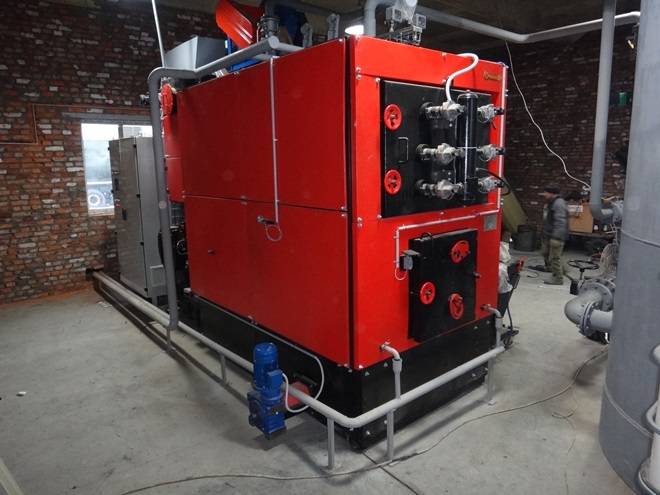
Pyrolysis heat generators operate on solid fuel. These are relatively economical boilers for a private house.
The principle of their operation is based on the process of pyrolysis - the release of gas from wood during its smoldering. The coolant is heated by the combustion of gas that enters the chamber from the loading compartment, and the subsequent afterburning of charcoal.
Pyrolysis-type systems are made with forced ventilation, powered by an electrical network, or natural, created by a high chimney.
Before starting such a boiler, it must be preheated to + 500 ... + 800 ° C. After that, fuel is loaded, the pyrolysis mode starts, and the smoke exhauster turns on.
Black coal burns the longest in the installation - 10 hours, after it brown coal - 8 hours, hard wood - 6, soft wood - 5 hours.
solid fuel
In addition to pyrolysis systems, which cost 2-3 times more than classic ones, do not operate on damp fuel, have ash-contaminated smoke to heat the house, and use automated versions of standard solid fuel boilers.
For the correct choice of equipment, you need to determine which type of fuel is most available in the region of residence.
If there are nightly electricity tariffs, then combined systems can be used, for example, wood and electricity, coal and electricity.
To obtain hot water, you will have to purchase a double-circuit boiler or use indirect heating of a boiler connected to single-circuit equipment.
Electric boiler
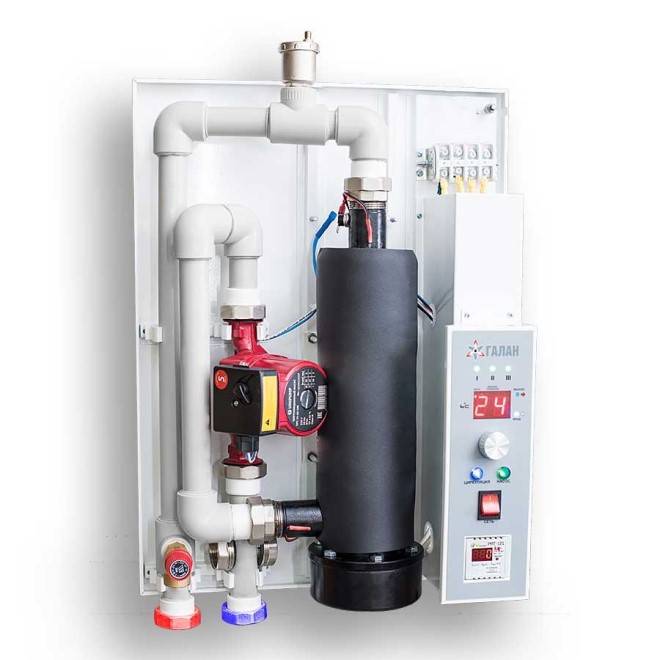
Economic heating private house without gas at the lowest cost can be made using boilers that run on electricity.
If the power of the device is up to 9 kW, then there is no need to coordinate with electricity suppliers.
Budget equipment, which uses heating elements as a heating element, occupies 90% of the market, but is less economical and easy to use.
Modern induction-type boilers do not have a number of disadvantages (the heating element does not come into contact with water), but at the same time they take up a lot of space and have a high price.
You can save on electricity if:
- monitor the condition of the coolant;
- periodically clean the heating elements;
- use night tariffs for the cost of electricity;
- install a boiler with multi-stage power control, which works depending on weather conditions.
Metal ovens
Once they were called potbelly stoves. This name originates from the distant times of the civil war and subsequent devastation, when the simplest joys of life were associated with great wealth.



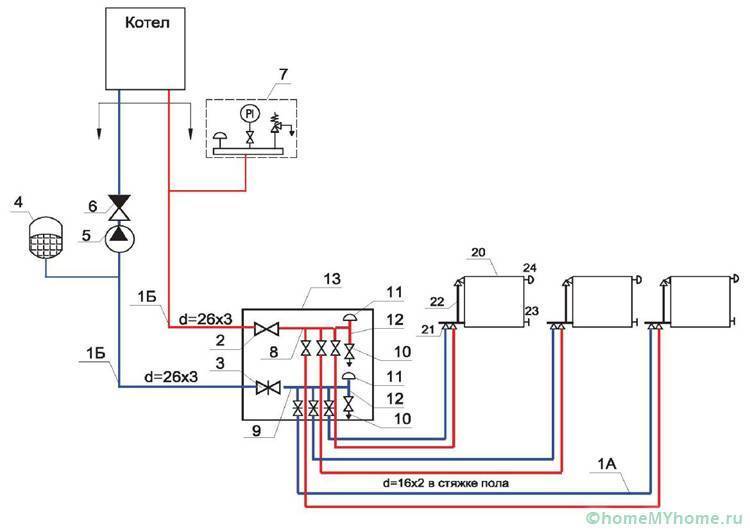
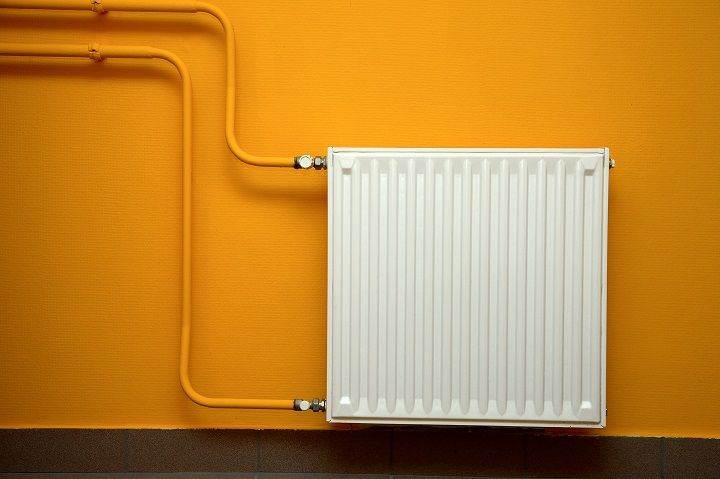
Much has changed since then, but the iron stove is still called a potbelly stove. Now they look different. Many of them are equipped with fire-resistant glass windows, but their essence has not changed - they heat up quickly and cool down just as quickly.
Maybe that's also why this stove was called a potbelly stove, because to maintain a constantly high temperature, a lot of firewood is required in a bourgeois way.
folk fantasy
In the Siberian taiga huts, where it is possible to bring a cast-iron stove, but it is difficult to deliver a brick, a potbelly stove is lined on three sides with large stones run in by a river. It turns out beautifully and functionally - the stones heat up and slowly give off heat to the air.
This technique is quite applicable in the conditions of a country house - when the house is built, and the heating is not yet ready. To some extent, the stones perform fire-fighting functions, absorbing random sparks and excessive heat. Stone structures can serve as a reason for the designer's imagination to fly.
The efficiency of a metal furnace will increase if it is equipped with a coil for heating water and heating batteries are connected to it.
The heat pump as a newfangled alternative
The heating device with the help of heat pumps is one of the latest “fashion trends” in the world of engineering communications. What is the highlight of this method? The heat pump is able to extract the heat accumulated in the bowels of the earth, draw it from the air, water.
pros
- high efficiency of the installation: spending one kilowatt in the pump drive, you can get up to five or six;
- absolute environmental friendliness.
Minuses
the impressive cost of installing the system, especially the vertical earth loop. Even an average installation without "bells and whistles" will pull about half a million rubles;
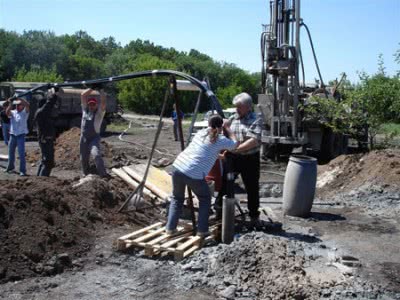 Heat pump - an efficient heating system for a country house
What to do to stay warm when the main power source is off
The natural answer is to turn on the heating with another, spare energy source. For example, if the gas is turned off, turn on the electric heater or fireplace. But this is good only for local heating. The system in other, distant places of the house may freeze, the pipes will burst, and the repair costs will be very high.
There are two options to resolve this issue.
Antifreeze
Pros:
- Antifreeze does not freeze up to -55–65 0С, depending on the manufacturer.It is convenient to use it if in winter the house is heated not constantly, but periodically.
- Does not oxidize the metal of the radiator and metal pipes, therefore, does not lead to the formation of rust.
- Does not create scale and does not settle on the inner walls of the heating system.
- Heats up 10% faster than water and cools down 10% longer.

Antifreeze, although more expensive than water, will help save energy during operation.
Minuses:
- Antifreeze is significantly more expensive than water.
- Antifreeze is 1.5 times more fluid than water, especially at low temperatures, which means that the joints of the entire system must be perfect; antifreeze is toxic, and if it leaks, it will form poorly washed off stains and a sharp unpleasant odor will appear.
- The heat capacity of antifreeze is lower than that of water by 10–15%, which means that you need to buy a boiler with a larger capacity.
- The viscosity and density of antifreeze is higher than that of water (density by 10–20%, viscosity by 30–50%), which means that you need to buy a more powerful circulation pump.
- In the event of an accident, a container must be provided where the antifreeze can be drained for the duration of the repair, as well as additional taps through which this can be done.
- The expansion tank should be 50-60% larger than the volume calculated for water, because the volumetric expansion coefficient of antifreeze is 1.3-1.4 times greater.
- Antifreeze can only be used in a closed heating system, that is, it will be impossible to combine hot water supply and heating.
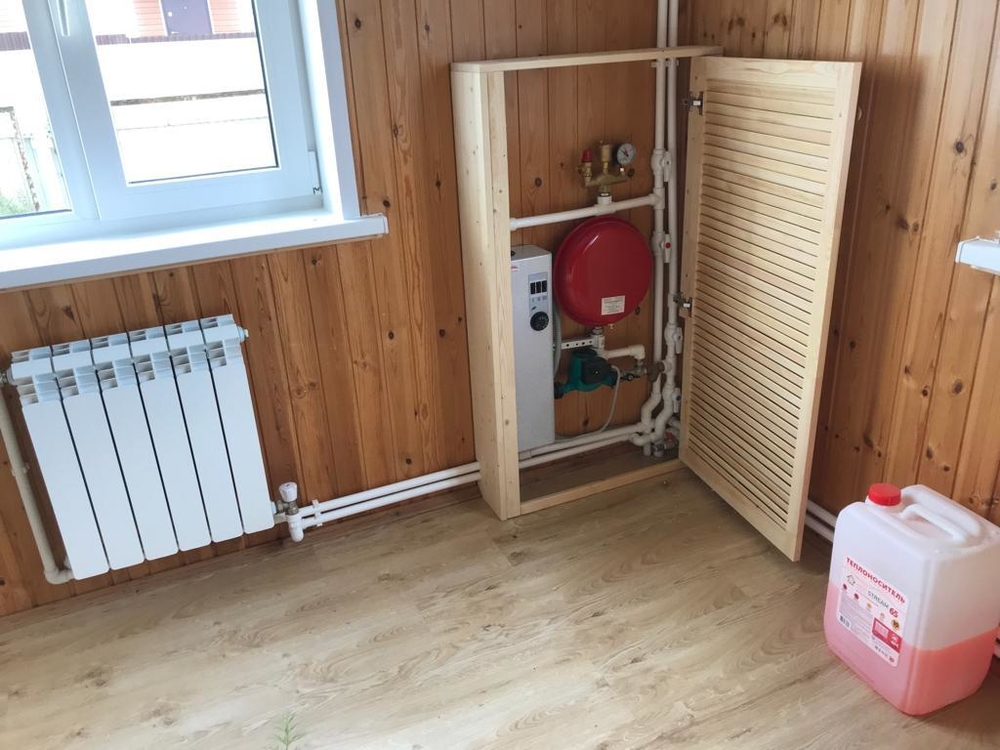
Finished heating system
Additional source of energy (boiler of lower power on other fuel)
Pros:
- the system will not freeze;
- Now many solid fuel boilers have a gas or oil burner with low fuel consumption already built in at the factory.
Minuses:
- he will not be able to heat the house - there will not be enough boiler power;
- will only work when the circulation pump is on, that is, if there is electricity in the house.
Video description
What to consider when choosing a heating radiator is clearly described in the following video:
Installation of a heating system in a country house results in lengthy chores and tangible cash costs. However, in our country it is impossible to build capital households without heating. That is why it is worth considering in advance all the issues of the heating system long before the end of construction.
Biofuel boilers
If you intend to change the gas heating system to alternative heating of a private house, then there is no need to organize it from scratch. Very often, only the replacement of the boiler is required. The most popular are those boilers that run on solid fuel or electric boilers. Such boilers are not always profitable in terms of coolant costs.
Particular attention should be paid to such boilers that operate on fuels of biological origin. For heating system operation, in the center of which there is a biofuel boiler, special pellets or briquettes are required
However, other materials can also be used, such as:
- granulated peat;
- chips and wood pellets;
- straw pellets.
The main disadvantage is the fact that such alternative heating of a country house can cost much more than a gas boiler and, moreover, briquettes are quite expensive material.
Wood briquettes for heating
A fireplace can be a great alternative solution for organizing such a system as an alternative home heating system.By means of a fireplace, you can heat a house with a small area, but the quality of heating will largely depend on how well the fireplace was arranged.

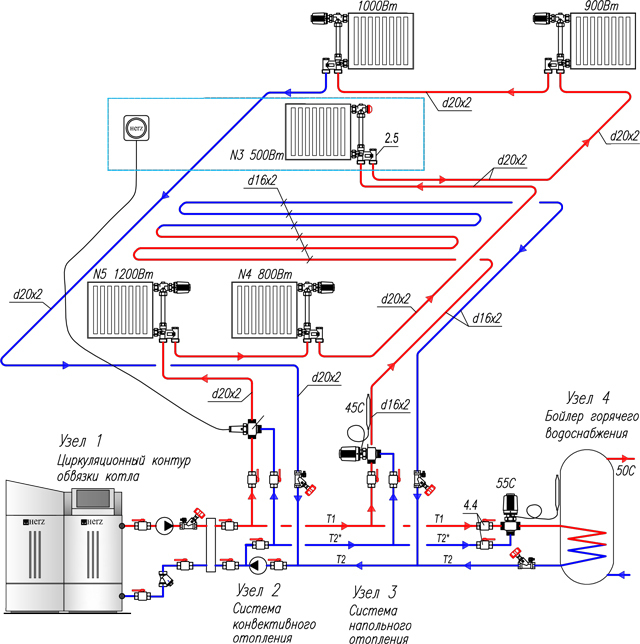


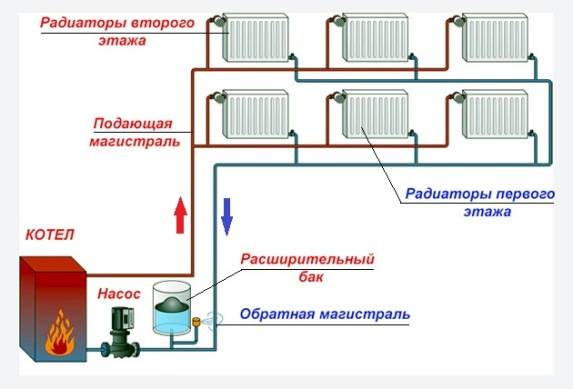


With geothermal type pumps, even a large house can be heated. For functioning, such alternative methods of heating a private house use the energy of water or earth. Such a system can perform not only a heating function, but also work as an air conditioner. This will be most relevant in the hot months, when the house does not need to be heated, but cooled. This type of heating system is environmentally friendly and does not harm the environment.
Geothermal heating of a private house
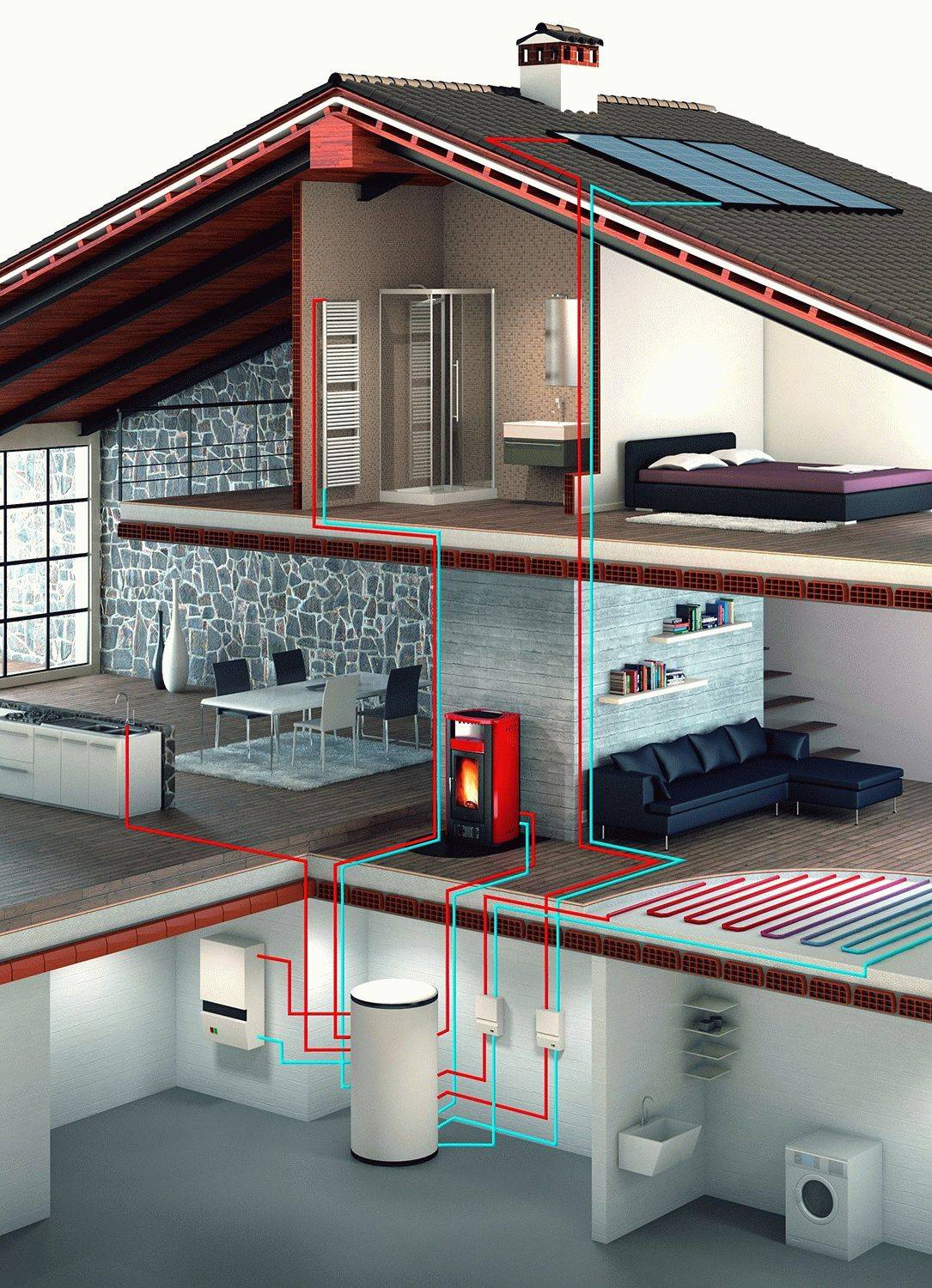
Solar alternative heating sources of a country house - collectors, are plates installed on the roof of a building. They collect solar heat and transfer the accumulated energy to the boiler room by means of a heat carrier. A heat exchanger is installed in the storage tank, into which heat enters. After this process, water is heated, which can be used not only for heating the house, but also for various household needs. Modern technologies have made it possible for such alternative types of heating a private house to collect heat even in wet or cloudy weather.
Solar collectors
However, the best effect of such heating systems can only be obtained in warmer and southern areas. In the northern regions, such alternative heating systems for a country house are suitable for organizing an additional heating system, but not the main one.
Of course, this is not the most affordable method, but every year its popularity is only growing.Alternative heating of a cottage in this way is the simplest from the point of view of such a science as physics. Solar panels stand out in an expensive price category because the manufacturing processes for photovoltaic cells are expensive.
Conclusions and useful video on the topic
Economical option for autonomous heating:
Having enough information about the different ways of heating a country house, you can choose the most suitable option. In addition, a combination of different types is acceptable in one building. A good solution is a multi-fuel boiler, which allows the most efficient use of the available fuels.
Are you looking for the right heating option based on the most affordable type of fuel in your area? Do you have any questions after reading our article? Or do you want to supplement the material with useful information? Ask questions, write your advice and comments - your opinion is important to us