- Greenhouse heating options
- Gas heating of greenhouses
- We warm ourselves with electricity
- Electric way of heating a greenhouse
- Heating system "warm floor"
- Infrared greenhouse heating
- Installation of heating systems
- water system
- Air system
- Heating with solar batteries
- Furnace system
- Furnace heating of the greenhouse
- Recommendations
- Solid fuel systems
- Systems with an external heat source
- Creation of a separate heating circuit
- Heating with exhaust air
- Furnace, steam and gas
Greenhouse heating options
There are various ways of heating a winter greenhouse: gas, air, water, stove, electric.
All of these methods have certain advantages and disadvantages, so you need to consider all systems.
For example, there is no need to install complex expensive heating systems suitable for industrial premises in small greenhouses.
Video:
Only the correct calculation will allow to obtain the correct distribution of heat.
As already mentioned, only the correct calculation will ensure high-quality heating of the winter greenhouse. The calculation is necessary to determine the volume of the heating system, the power of the boilers and the number of radiators.
Heating a polycarbonate greenhouse requires making calculations in advance and carefully.
The calculation is made on the basis of indicators such as design parameters, ambient temperature. Having made the calculation, you can choose the desired method of heating.
The result is a heated greenhouse even in winter, when the earth and plants need warmth.
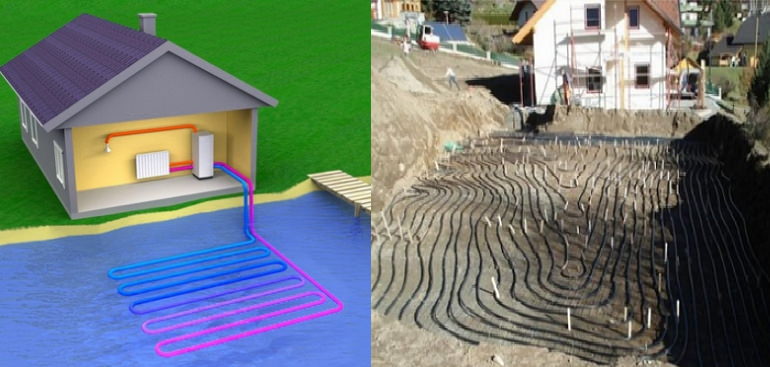
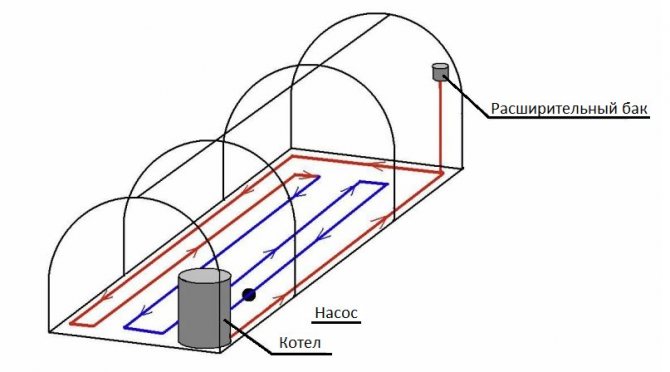
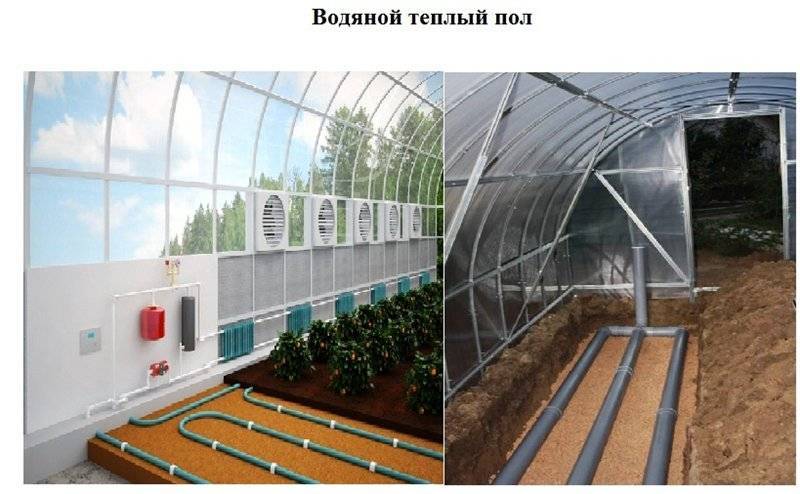
Heating is provided by hot water flowing through a pipeline located in the ground.
This heating system is a closed arrangement of pipes in which water circulates until it cools, and then enters the boilers for heating.
The cycle with the boiler is repeated until the system is turned off.
The water method has its drawbacks: slow heating of pipes, expensive boilers, constant monitoring.
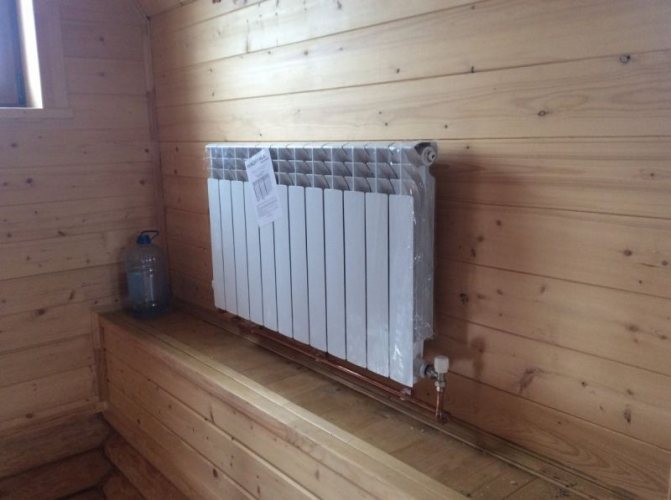
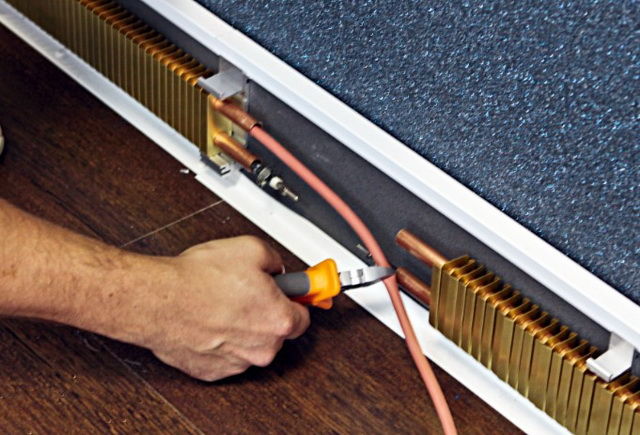
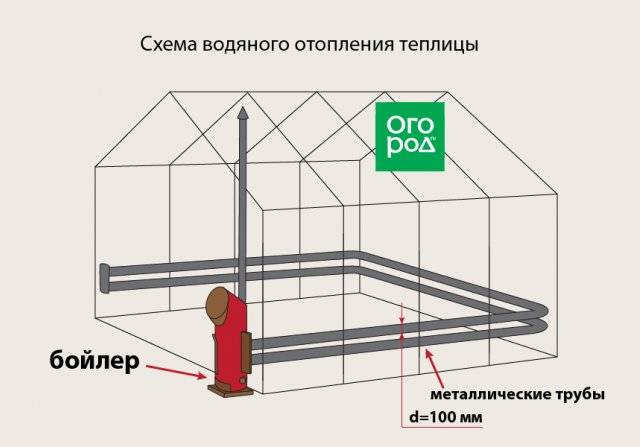
The main component of the water system is the boiler, in which water is heated and then fed into the pipes using a pump. Pipes are installed plastic, copper and steel.
Plastic pipes are ideal for ground heating.
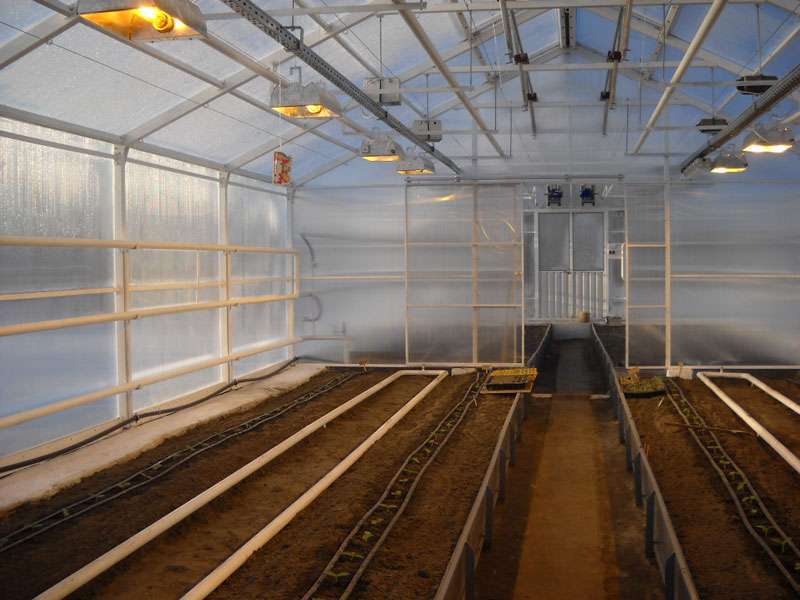
With infrared heating of a winter greenhouse, heating can be carried out by an infrared lamp and an infrared heater.
Greenhouse heating infrared heater has the following advantages:
- High intensity of heat transfer;
- Only the soil and plants are heated, while the air is not heated;
- Profitability, since the heater does not work constantly - it turns on at the moment when it is necessary to maintain a certain temperature. To do this, you can install a thermostat that will control the desired temperature.
An additional plus is the safety of infrared rays for people and plants, as natural climatic conditions are created for growing plants.
In this case, an important point is the competent calculation of the required heating power.
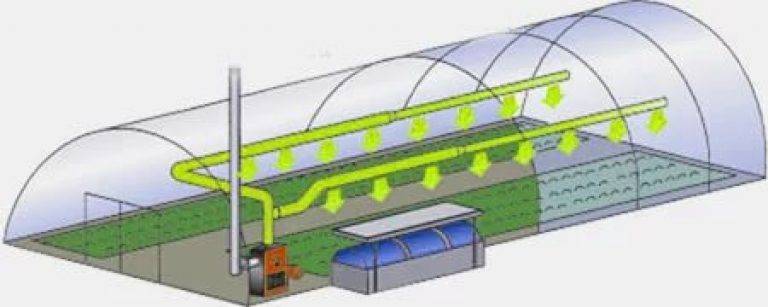
The next type of heating is air, which is based on boilers. The heat carrier here is air.
The work is carried out according to the following principle: the air is heated between the boiler and the furnace and then distributed through the air ducts. such heating is also suitable for industrial scale.
The heating of the soil is carried out by warm air, which comes from polyethylene sleeves laid out along the perimeter of the greenhouse structure.
This type of heating has a high heating rate, regardless of the area.
Heating with wood in a winter greenhouse is considered one of the inexpensive options.
Heating a greenhouse with wood has the following advantages: rapid heating of the room, maintaining the temperature at the required level for a long time, cost-effectiveness.
Solar heating is often used, in which the accumulation of solar energy that can maintain the required temperature occurs.
Video:





The gas heating system has a stable supply, but the disadvantage is the production of hydrocarbons, which harms plants, so it is recommended to ventilate the greenhouse.
The device of the gas heating system depends on the frequency of use.
So, for example, if the heating will be turned on for a short time, then cylinders can be used without pipelines.
To eliminate combustion waste, an exhaust hood is installed, which also prevents the release of gas into the air.
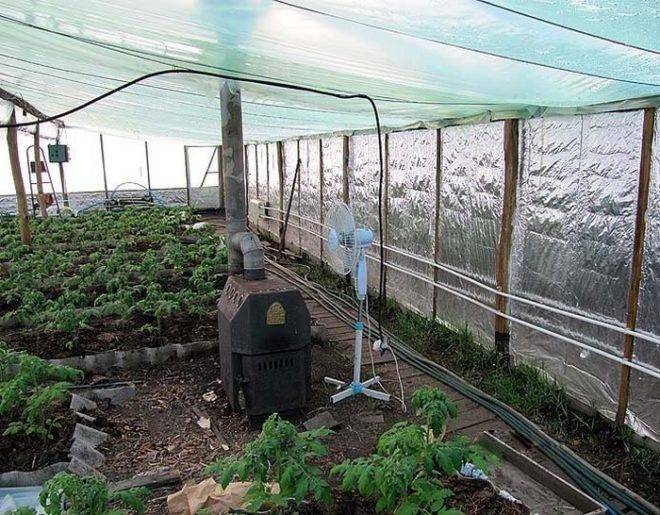
It is possible to organize furnace heating of a winter greenhouse, which is more economical than electric heating. Using a stove is great for heating a polycarbonate greenhouse.
The furnace can be fired with wood. The construction of the furnace can be done by hand without significant financial costs. The choice of furnace should be carried out based on the scale of the greenhouse.
With a pyrolysis boiler, the heating system will be more perfect.
Gas heating of greenhouses
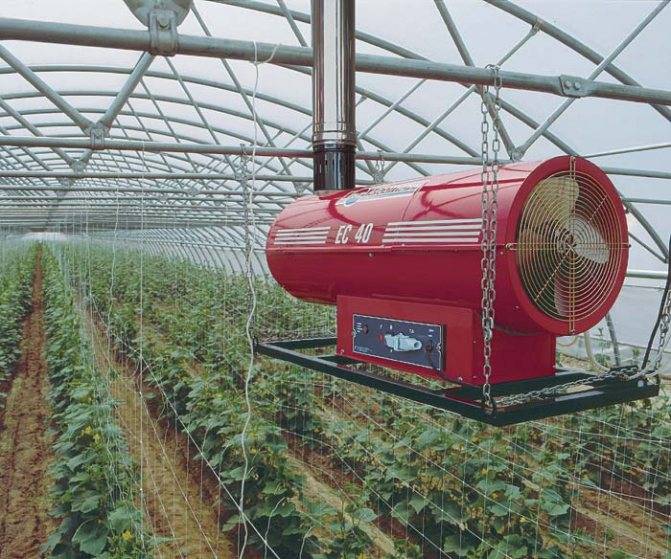
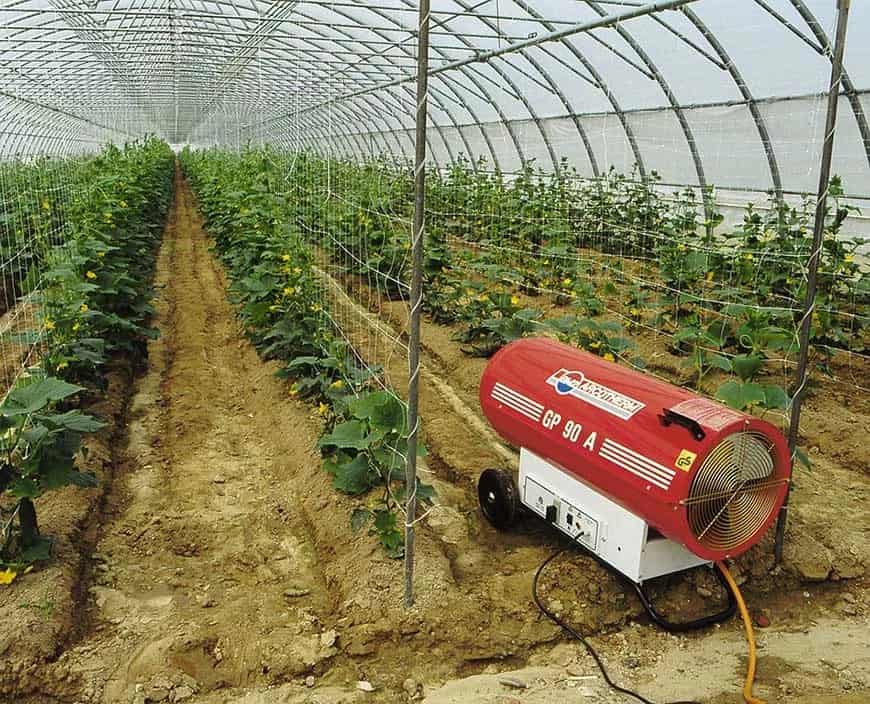
A similar method using gas heaters with direct combustion of gas inside the greenhouse. Burners of such installations can be infrared and injection.
Air in gas systems, pre-mixed with the external or recirculation flow, enters by concentrated supply to the places of heating. It can be supplied by separate gas burners, or, like greenhouse air heating systems, through special hoses. For the most rational heating, several systems or a complex of gas burners are used, which are distributed throughout the territory.
During the operation of gas generators, carbon dioxide and steam are released into space, which are necessary for plants, but it is also possible to burn the air and burn out oxygen, which is quite dangerous for crops. Therefore, during the operation of these systems, the ventilation or air supply systems must also operate at the same time.
For small greenhouses, it is possible to use gas cylinders, while in greenhouses with a larger area, it is necessary to connect to the general gas pipeline network, which is necessarily accompanied by the work of specialists and the legalization of connecting this system.
The payback for heating greenhouses with gas is easily calculated by specialists for each individual case, but one thing can be said: gas heating is quite profitable.
We warm ourselves with electricity
Electricity is now available in almost every corner of the country.Its cost may be higher than the cost of other energy sources, but ease of use, high efficiency, and the possibility of using economical heat sources speak in its favor.
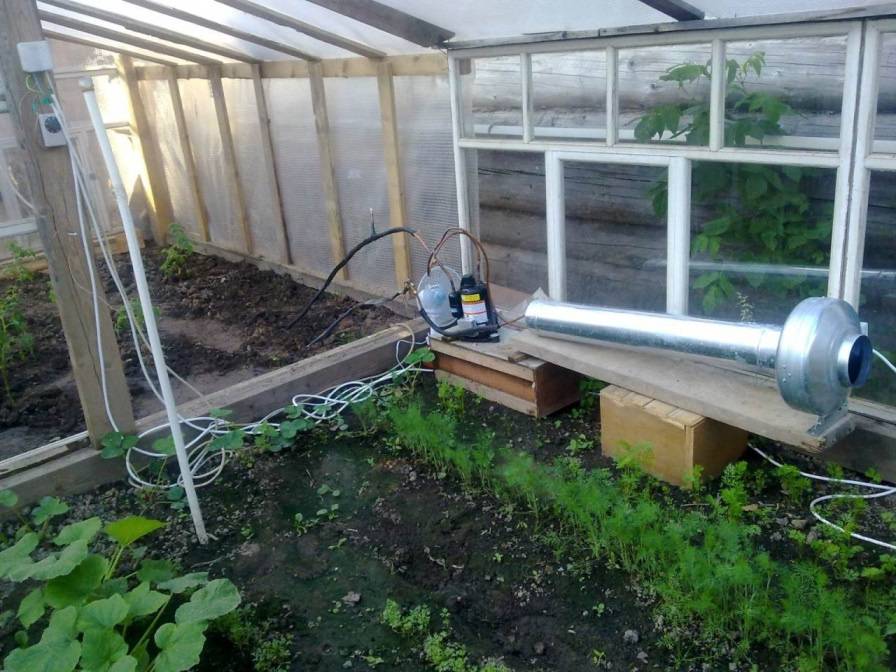
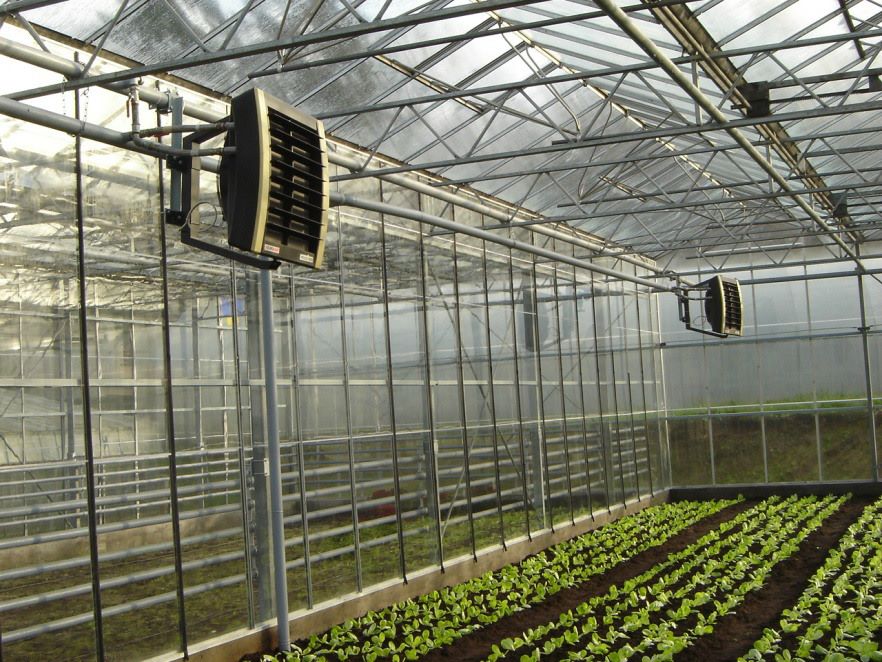
- The easiest way to heat a greenhouse with electricity is to use a fan heater. Convenience, simplicity and low cost speak in its favor. It does not require any re-equipment of the greenhouse - it is enough to connect the electrical cable and put the heating device in the optimal place. At the same time, the movement of air does not allow moisture to accumulate on the walls, and the heat itself is distributed evenly.
Such heating is easy to do with your own hands. As a minus, it should be noted the harmful effect on plants that will be in the immediate vicinity of the fan.
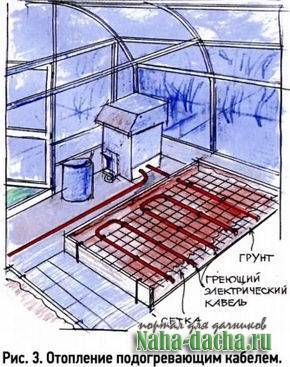
- Cable heating with electricity is also easy to use and has good heat distribution, combined with the possibility of automatic temperature control. However, its installation is far from being a simple enterprise and only the owner, who has certain special knowledge and skills, can cope with it on his own. Or you will have to use hired labor.
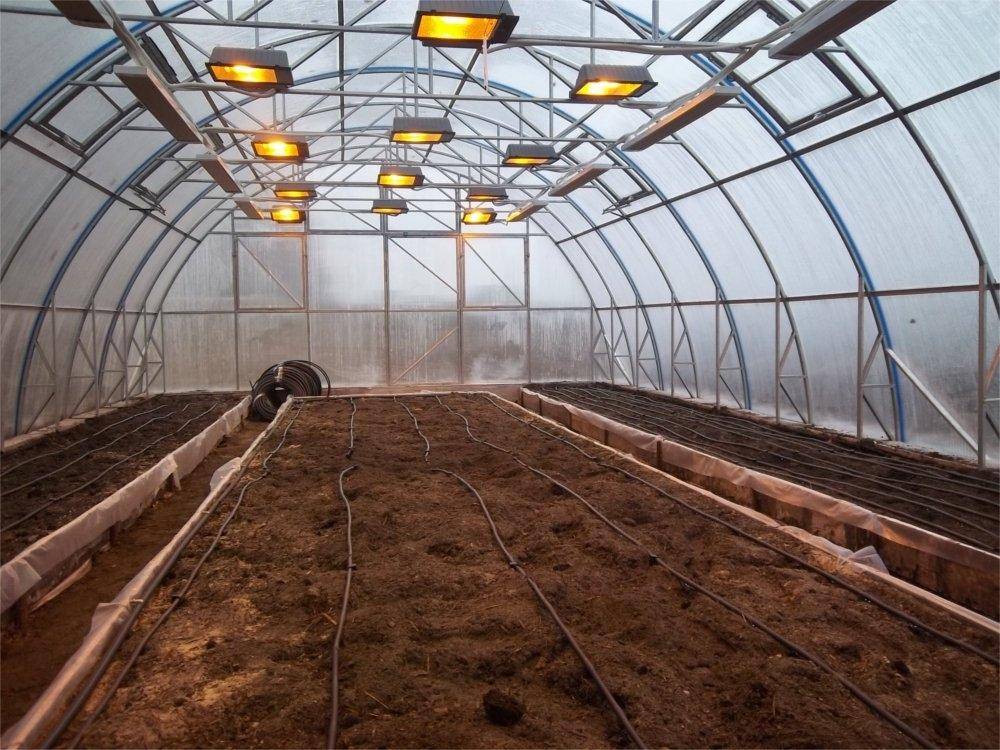
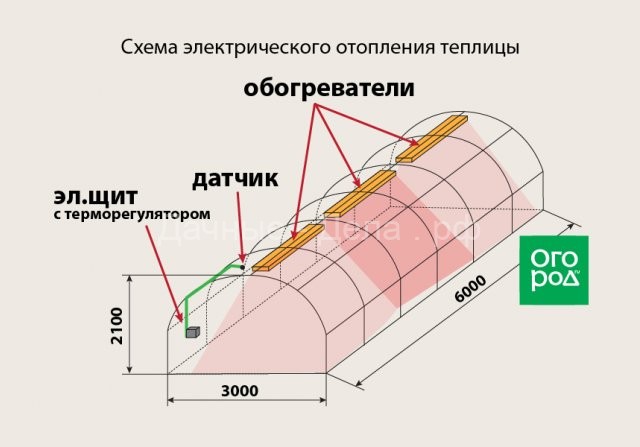
- A warm greenhouse using infrared panels is quite simple to organize, and it will significantly reduce costs due to the high efficiency of these devices. In addition, the popularity of IR panels contributes to the research-proven ability to increase the percentage of plant germination. The long service life of such heat sources is also important - up to 10 years.
Important: When using IR panels, they should be arranged in such a way that their radiation covers the entire area of the greenhouse.This is due to the fact that infrared rays do not heat the air, but the soil, and then the heat spreads throughout the room.
Most often, a checkerboard arrangement of panels is used.
Electric way of heating a greenhouse
This heating option is suitable for small, well-made greenhouses. If the structure occupies a significant area or there are unsealed gaps through which cold air enters, equipping the greenhouse with electric heating can significantly hit your wallet.
Among the many electric heating systems most often used in winter greenhouses:
| heat gun | |
| There are suspended and floor heat guns. This equipment is based on a high power fan and a heating element. During operation of the heat gun, heated air is blown out under high pressure, contributing to the distant spread of heat in the greenhouse. The disadvantages of this method of heating are a significant consumption of electricity and very hot air at the outlet, which requires careful selection of a place for installing an electrical appliance. |
| Electric convector | |
| At the heart of this heating unit (like a heat gun) is a thermostat and a heating element. However, the electric convector differs from the latter, first of all, in the principle of operation. Air enters it from below, heats up and exits through the holes provided at the top. Of course, the heat gun will provide faster heating of the air in the greenhouse, but the convector helps to preserve oxygen during heating. Usually such equipment is installed on the floor or walls, in some cases - on the ceiling. Convectors can be used in tandem with other heating equipment.It must be remembered that electric convectors consume a lot of electricity. |
The advantages of the above devices are efficiency and mobility. True, there are also enough shortcomings here: with a small number of heaters or their insufficient power, the air will heat up unevenly. Yes, and for warming up the soil when choosing this method of heating, there will be few opportunities.
Heating system "warm floor"
One of the easiest ways to maintain the desired temperature in a greenhouse is to have a “warm floor”, which is used to heat the soil. It is not difficult to arrange such a winter heating of a greenhouse with your own hands, even a novice summer resident can handle it.
The design is quite simple. The most popular system is the waterproof heating mat. To create a “warm floor”, up to 40 cm of soil is removed in the greenhouse, and pre-sifted sand is poured into the bottom of the recess with a layer of 5-10 cm. Next, a heater (polystyrene foam, polyethylene foam, etc.) is laid in the recess. Materials must be moisture resistant. The next layer is laid waterproofing material (in most cases it is a plastic film). Sand is poured on top with a layer of 5 cm. Everything is moistened with water and rammed.
The wire of the “warm floor” is laid with a snake over the compacted sand in increments of 15 cm. The finished heating system is again covered with a 5-10 cm layer of sand, on which a chain-link mesh is laid. Next, the “pie” is covered with previously removed soil.
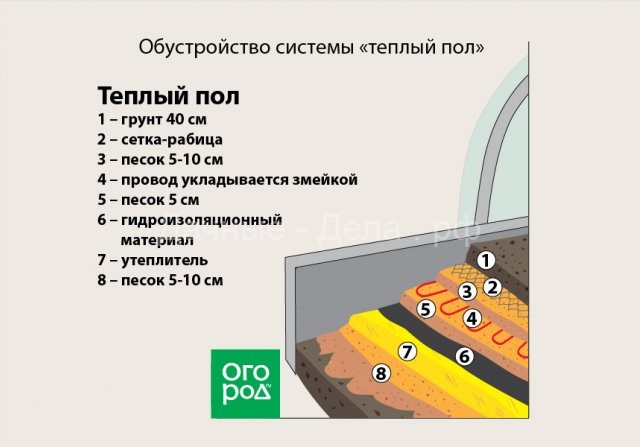
Such a soil heating system in a greenhouse does not require special costs both at the installation stage and during operation. Another plus is the ability to automatically regulate heating and evenly distribute heat throughout the greenhouse.
The most energy efficient way is to heat the greenhouse from below. In this case, warm air does not have to cycle through the entire volume of the greenhouse, as with other heating devices.



Infrared greenhouse heating
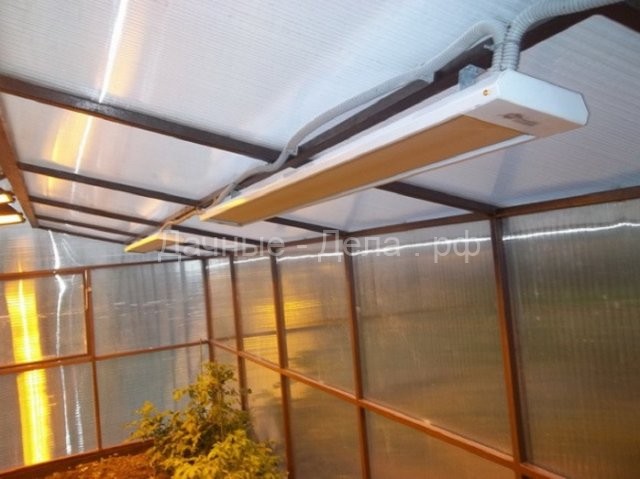
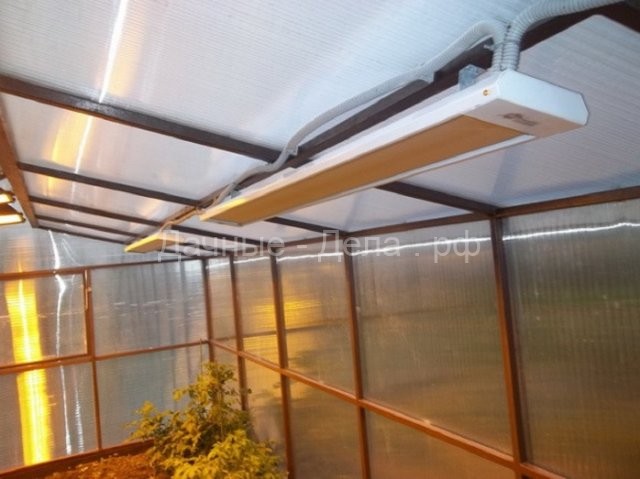
Infrared heating is considered one of the relatively inexpensive types of greenhouse heating in winter. Many gardeners have already abandoned electric heaters in favor of infrared lamps. Similar lamps are ideal for heating polycarbonate greenhouses. In addition, they do not shine, but warm the room, and this makes them cheaper compared to other devices of this kind.
Using infrared lamps in one greenhouse, you can organize different climatic zones. When heated, the soil releases heat into the air. The regulator built into the lamp allows you to create the right temperature for each particular crop.
It is important that infrared lamps are easy to install anywhere in the greenhouse.
The indisputable advantage of such equipment is energy savings of up to 60%.
All of these heaters have a different mechanism of action, but in the end they fulfill their main purpose - they create the microclimate necessary for plants in the greenhouse in winter. If you arrange electric heaters correctly, they will contribute to uniform heating of the air and improve plant growth.
Installation of heating systems
Having decided on the choice of heating system, you can proceed to the installation work. Below we will consider how to make heating in a greenhouse.
water system
Water heating can be done in two ways. Let's consider the first one.
As a heater, you can use an old fire extinguisher, in which the upper part is cut off.At the bottom you need to install an electric heater with a power of 1 kW, for example, from an electric samovar.
Then the electric heater is filled with water, and two water pipes are attached to the fire extinguisher using nuts and rubber seals.
Now consider the second method, for which you need a 40-liter boiler and a 2 kW electric heater.
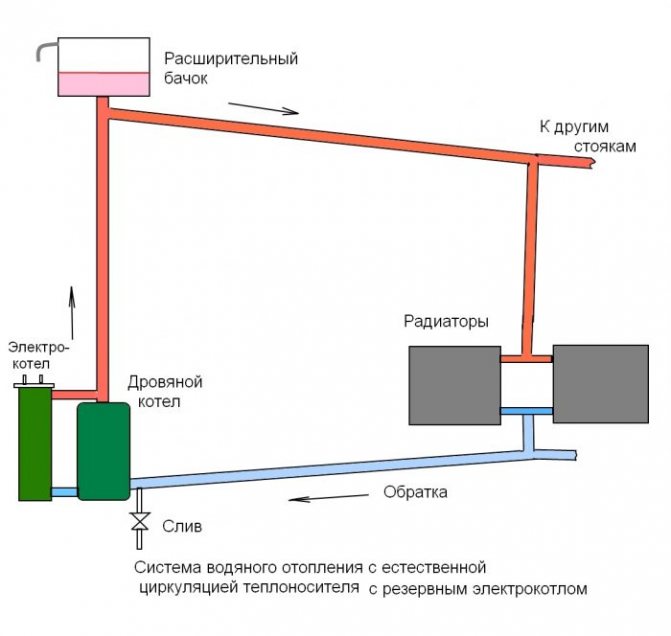
The principle of operation is as follows: water, gradually heating up, rises through a pipe into an expansion tank, then passes through a pipeline located along the perimeter of the greenhouse structure under a slope.
The boiler can be a large-diameter pipe, to the end of which the bottom must be welded.
The expansion tank can be made from pipe scraps. Tank volume - no more than 30 l. In order to connect the boiler and the riser, it is necessary to weld the couplings on both sides of the tank.
Also in the tank you need to make a hole through which water will be added.
The boiler must be grounded, for which a three-wire wire of at least 500 V is used. Two wires are intended for the heater phase, one for the boiler.
The key point of water heating is the ability to use solid fuel boilers, which can be located both in the greenhouse and in another separate room.
Video:
If the boilers are placed separately, then a significant part of the heat coming directly from the boiler is lost.
Such boilers are economical and fireproof, they are often used in industrial greenhouses.
Air system
It is not difficult to organize air heating for a greenhouse.
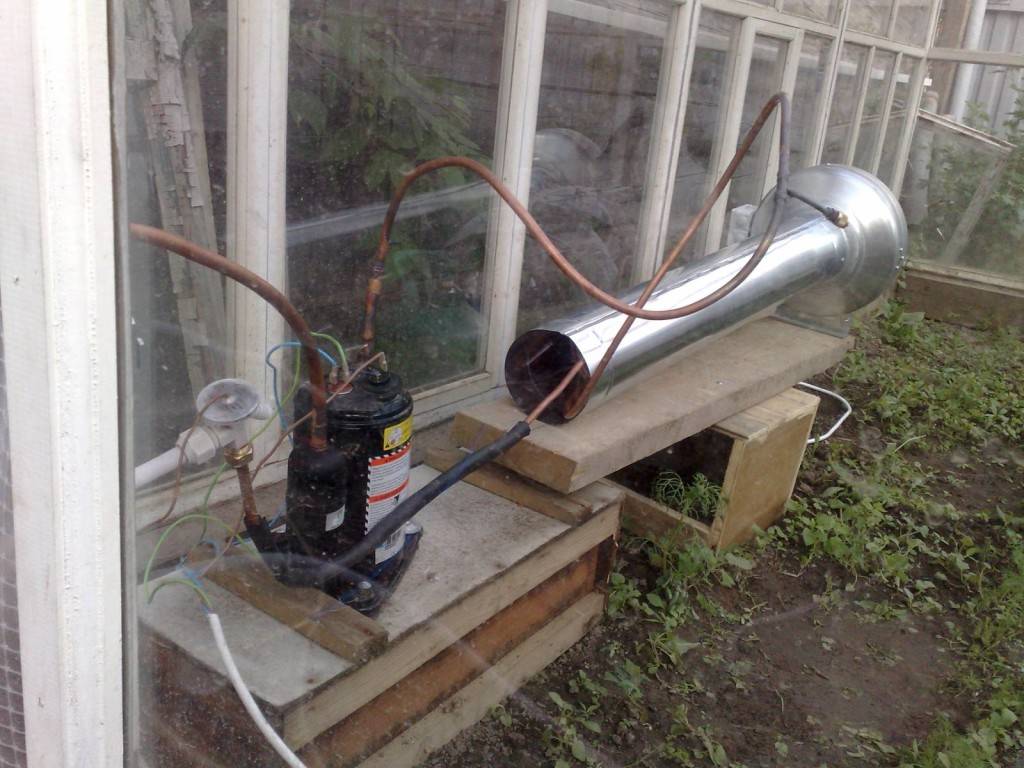
To do this, you need a metal pipe with a diameter of 55 cm and a length of 2 m, one end of which is inserted into the greenhouse, and a fire is made under the other.
It is the constant maintenance of the burning of a fire that is a big disadvantage.
Due to the fire, the air in the pipe is rapidly heated, which penetrates the structure.
Heating with solar batteries
For this system, you need to make a solar battery, the calculation of the power of which is carried out in advance.
To do this, you need to dig a hole in the greenhouse with a depth of 13-14 cm and cover it with a heat-insulating material, for example, polystyrene or other material with good heat-insulating properties.
Then you need to lay polyethylene for waterproofing, and fill it with wet sand on top. At the end, the pit is filled up on the ground.




Video:
Such a system will provide round-the-clock heating of the greenhouse, but still cannot be the main heating method due to the small number of sunny days.
Furnace system
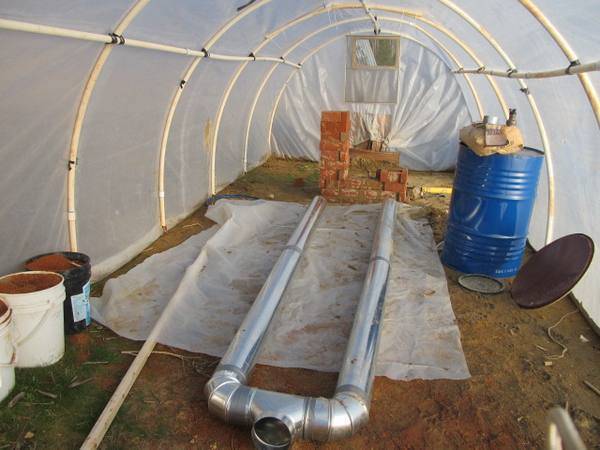
For the construction of the furnace, the vestibule of the greenhouse must be laid out with bricks, and the chimney must be laid along the entire length of the structure. The location of the furnace should be at a distance of 30 cm from the end of the greenhouse.
There is another way to build a furnace. The calculation for it is as follows: you need a barrel with a volume of at least 3 cubic meters, in which you need to make holes for the chimney and stove. Then the base of the furnace is inserted into the hole.
Now you need to remove the chimney from the tank and put a 5.5 m high pipe on it outside the greenhouse.
Video:
Then an expansion tank is installed on the barrel, and it is necessary to make heating from the profile pipe by welding and lay the pipes on the ground in increments of one meter.
If you follow the instructions, then there will be no difficulties during the installation of the furnace.
Thus, you can do any greenhouse heating with your own hands, having before your eyes projects for work. The main thing is to strictly follow the instructions and observe safety precautions.
Furnace heating of the greenhouse
Furnace heating of the greenhouse
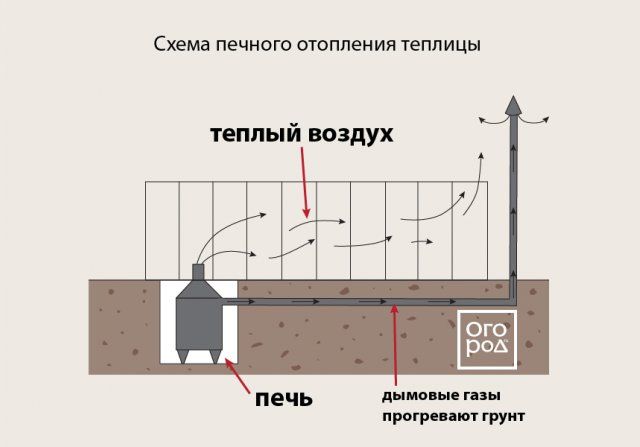
Traditional stove heating is characterized by high efficiency and relatively simple arrangement. For example, you can build a stove with a horizontal chimney without any special financial investments.
First step. Lay out the firebox of the stove in the vestibule of your greenhouse. Performed traditional brickwork.
Second step. Lay a chimney under the beds or along the length of the greenhouse. It can also be laid under the racks.
Third step. Lead the chimney through the greenhouse wall. Consider the placement of the pipe so that it can effectively remove the products of combustion of the fuel, while passing over areas that need heating.
Stove heating system in the greenhouse
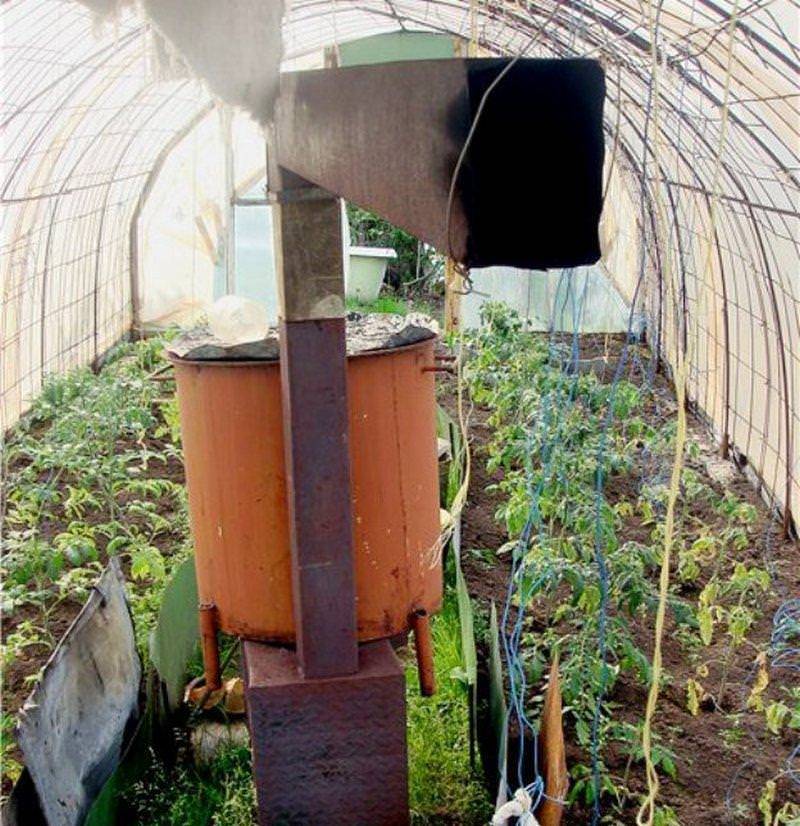
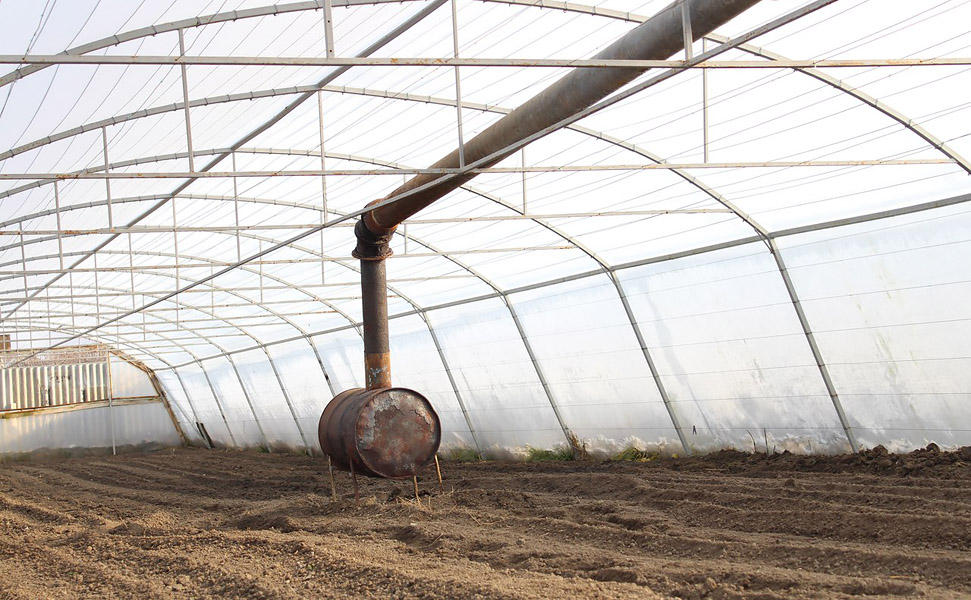
You can also make a furnace from a metal barrel.
The principle of operation of a potbelly stove for a greenhouse
First step. Prepare a metal barrel with a volume of about 250 liters. Cover the inner walls of the container with two layers of paint so that the material does not rust.
Second step. Mark and cut holes for the stove, chimney, drain cock (installed at the bottom) and expansion tank (placed at the top).
Third step. Weld the stove (usually they make a rectangular structure of sheet steel in accordance with the dimensions of the barrel) and install it in a container.
Fourth step. Remove the chimney from the barrel. The length of the "street" part of the pipe must be at least 500 cm.
Fifth step. Attach the expansion tank to the top of the barrel. You can buy a ready-made container or weld it yourself from sheet metal.A tank of 20-25 liters will suffice.
Sixth step. Weld heating units of suitable length from profile pipes with dimensions of 400x200x15 (focus on the dimensions of the greenhouse). The pipes themselves must be laid on the ground with a step of about 120-150 cm.
How to make greenhouse heating with your own hands
Seventh step. Buy and install a hydraulic pump. The system will be heated using water, so it will not be possible to do without a pump.




With a heated greenhouse, even in winter, full and calm
Recommendations
When choosing an infrared heater, it is important to pay attention to its power. Devices should be selected taking into account the size of the room. Usually, for heating 10 m2, a device with a power of 1000 W is required, but it is better to purchase units with a margin
Usually, for heating 10 m2, a device with a power of 1000 W is required, but it is better to purchase units with a margin
If a wall-mounted heater is chosen, it is important to find out the thickness of the radiator foil layer. Its performance must be at least 120 microns
Otherwise, a significant part of the energy will be spent on heating the ceiling.
Usually, for heating 10 m2, a device with a power of 1000 W is required, but it is better to purchase units with a margin
If a wall-mounted heater is chosen, it is important to find out the thickness of the radiator foil layer. Its performance should not be lower than 120 microns. Otherwise, a significant part of the energy will be spent on heating the ceiling.
Otherwise, a significant part of the energy will be spent on heating the ceiling.
Manufacturers produce models of heaters with various functions. It is necessary to think in advance whether they will be used during operation, otherwise there are great risks of overpaying for something that will not be useful in the future.
Devices can have the following options:
- regulation of temperature parameters;
- automatic shutdown of the device when it is turned over (mobile variations);
- shutdown of equipment in case of its possible overheating;
- turning the unit on or off at the right time.

Before buying a device, you should carefully inspect its case. It can be made from steel or aluminium. The first options are more durable, the second - stylish design. On any of the cases there should be no traces of mechanical stress or rust. Corrosion can reduce the life of the device, declared by the manufacturer.

Solid fuel systems
The relevance of burning solid fuels for energy production does not decrease over time. This also applies to the use of solid fuel systems for heating greenhouses, which is due to a number of advantages:
- the price of fuel is at an affordable level;
- the autonomy of the system becomes possible due to the absence of the need for gas and electricity supply. This circumstance allows the construction of heated greenhouses in remote locations;
- efficiency of heating units.
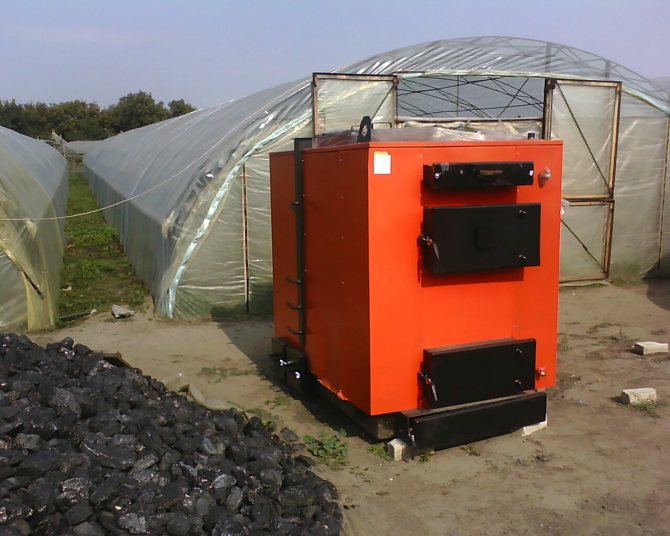
Solid fuel systems for heating The following solid fuel systems are most widely used:
- infrared. In fact, this is a well-known potbelly stove, which is installed in the central part of the greenhouse. The cost-effectiveness of the design is achieved by the low cost of the heater itself and low energy consumption.
- Water.All the advantages of heating systems running on gas or electricity fully apply to solid fuel water heating. At the same time, when using the latter, significant savings are achieved by reducing operating costs.
It should be noted that such systems are imperfect and have certain disadvantages:
- at all stages of the construction of the heating system, it is necessary to provide reliable fire protection;
- the cost of equipment increases with the organization of the system operating in automatic mode.
Systems with an external heat source
Heating of the greenhouse is possible due to the proximity of the house or other heated building. This simplifies the whole procedure, as there is no need to install an independent heat source. Using wired or wi-fi relays, you can remotely receive information about the temperature in the greenhouse and adjust its microclimate from home.
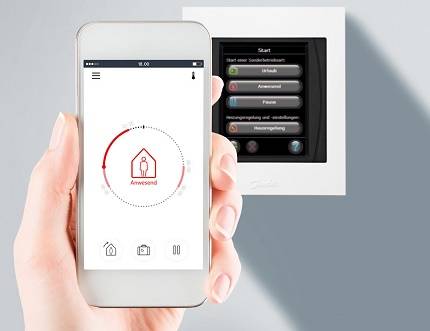
An ordinary wi-fi temperature complex of a sensor and a relay costs about 2 thousand rubles. When the temperature goes out of range, it transmits its values to devices running Windows or Android
Creation of a separate heating circuit
If the house uses water or steam heating, then it is possible to create a separate circuit leading to the greenhouse. It must be provided with a separate pump, since the total horizontal extent of the new segment will be large.
Also in the greenhouse you need to install an open-type expansion tank to remove air from the system. The open water area of the tank must be minimized to prevent intense evaporation of hot water into the room.
Radiators are rarely installed in the greenhouse, since the design of its premises plays a secondary role. With a lack of heat, it is better to lengthen the pipe contour, as this is cheaper and reduces the risk of leaks and breakages.


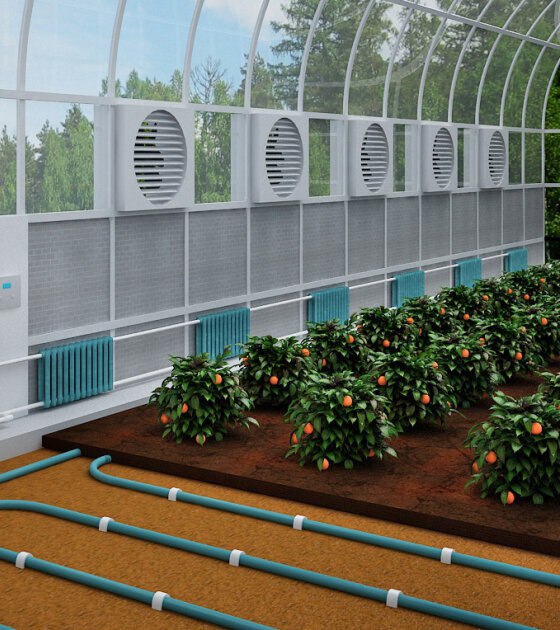


The outdoor segment of the circuit must be insulated to avoid heat loss and minimize the risk of freezing. The underground option for placing pipes is best suited for these purposes.
The connection of the greenhouse heating segment to the general circuit can be performed using a three- or four-way valve.
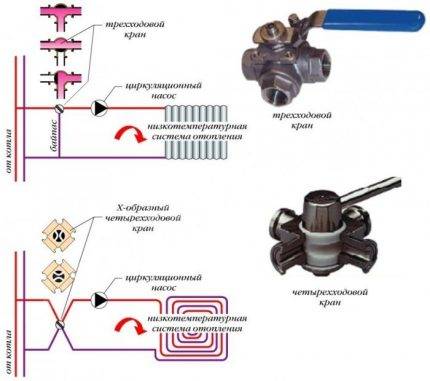 Standard scheme for connecting an additional heating circuit. The location of the taps in the house allows you to remotely control the air temperature in the greenhouse (+)
It is also possible to create an automatic temperature control system.
This can be done in the following ways:
- Change in the volume of hot water passed, depending on the readings of temperature sensors. In this case, it is necessary to purchase a pump with power control.
- Switching the greenhouse heating circuit on and off. To do this, use automatic control systems for cranes.
Instead of manually changing the position of a three- or four-way valve, servo-based devices can be used. Its electronic control unit is tuned to the readings of temperature sensors placed in the greenhouse.
If it is necessary to change the heating mode, a control signal is sent to the engine, which turns the stem, setting a different position of the valve.
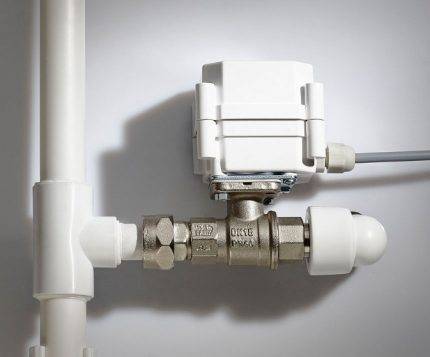 The servomotor for automatic adjustment is large in relation to the valve. Therefore, to install it, it is necessary to take the heating pipe away from the wall
Heating with exhaust air
Good heating can be obtained by using the warm air of the exhaust ventilation of a residential building. By directing the insulated ventilation duct inside the greenhouse, you can get a constant incoming flow with a temperature of 20-25°C.
The only condition is that the air does not contain excess moisture and impurities that are typical for kitchens and bathrooms.
The outflow of air from the greenhouse can be organized in two ways:
- Local exhaust opening to the street in the form of a tube without a fan. It must be of small section to create a high flow rate. In this case, at a negative outdoor temperature, the condensate formation zone will be at some distance from the tube, which will prevent the formation of ice.
- Returning the flow back using an additional duct and its mandatory connection to a common house hood. Otherwise, the smells from the greenhouse will spread throughout the house.
This method is the most economical in terms of one-time system installation costs and recurring fuel costs. The only question remains the sufficiency of the extract volume to maintain the required temperature. It is better to check it experimentally.
If sometimes, during extreme cold snaps, the air temperature in the greenhouse drops below the permissible level, then a small heater can be built into the duct, or an additional electrical device can be installed at the facility itself.
Furnace, steam and gas
Half a century ago, the owners built a solid fuel stove made of brick or stone on their own and, as necessary, heated it with firewood, peat or coal. The chimney was sealed outside. This type of heating is still relevant today. There are a lot of stove drawings on the net.
Manufacturers produce portable models of long-burning metal boilers. Even an ordinary potbelly stove will do. Install the oven not only inside the greenhouse. Another option is to build a sealed vestibule extension.
In the greenhouse you can carry out steam heating from the stove, which is located in the house. The efficiency of such a system will be positive if the distance between the supplier and the heat receiver is no more than 10 m. Otherwise, the energy will be lost along the way.
The gas heating system consists of heaters (burners) placed around the perimeter of the greenhouse. During combustion, the gas abundantly produces heat. Between themselves heaters are connected by flexible tubes. The system allows you to evenly distribute the gas throughout the structure. But she also has disadvantages:
- expensive raw materials;
- first of all, the air warms up, and then the soil;
- oxygen valuable for plants burns out.
Without effective ventilation, such a greenhouse will not do. Therefore, it is equipped with a protection mechanism. If there is little oxygen, it will replace the burned-out air masses with fresh ones from the street.
There is various heating options greenhouses in the cold. Before using one of them, insulate the building with high quality.