- 1 Types of heating - the pros and cons of different systems
- Heating system installation
- Types of systems
- Gas autonomous heating system
- Choosing an energy carrier
- Feature of the horizontal pipe laying scheme
- Central horizontal heating
- Autonomous horizontal heating
- Security group
- Basic schemes
- Single pipe line
- Two-pipe line
- Two-pipe parallel manifold
- Solar panels. Working principle of solar heating system
- Design of the heating system of a country house
1 Types of heating - the pros and cons of different systems
Despite periodically appearing new types of heating, such as solar heating, the vast majority of country house owners use classic heating methods that have been proven for decades. The most common of them:
- 1. Heating with solid fuel.
- 2. Gas heating.
- 3. Electric heating.
In addition, at the moment there is a large selection of solutions that use combined fuel, that is, they can heat the building both by electricity and by burning various types of fuel.
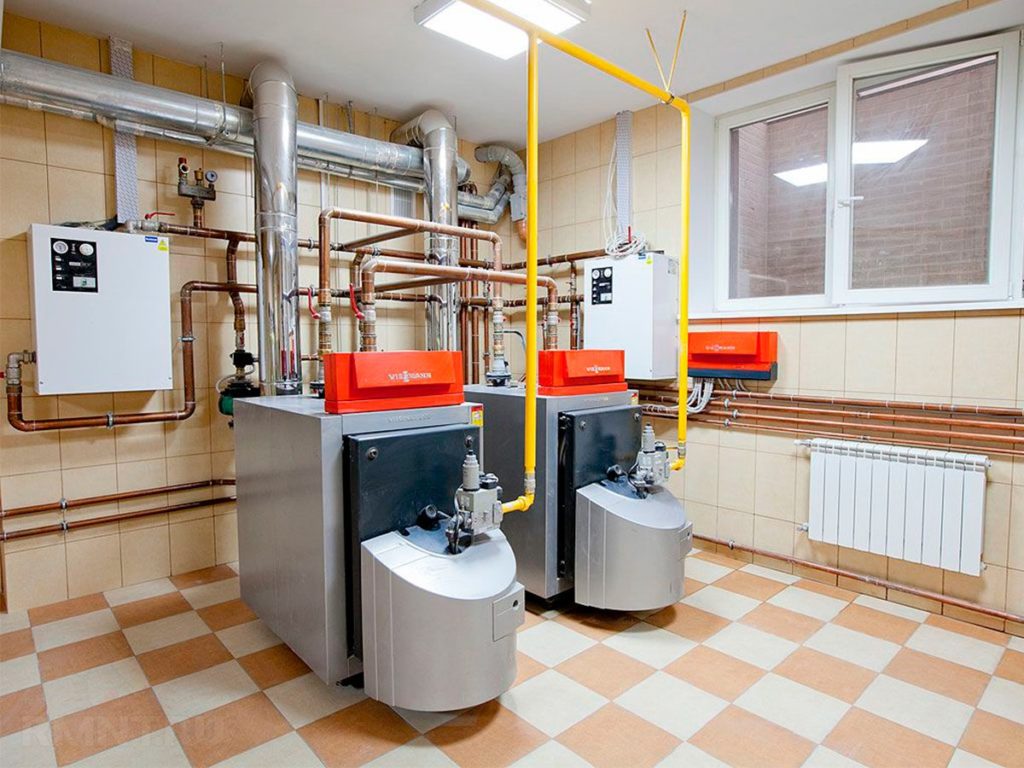
Each option has its own advantages and disadvantages.The easiest and cheapest way to heat a country house is to use a gas-fired boiler. Its advantages are obvious - low cost of fuel, heating on the principle of "turn on and forget", the ability to adjust the required temperature in the premises, safety of operation due to modern equipment. There is only one drawback to gas heating - in the absence of a centralized gas main next to a country house, you will have to supply a separate pipe at your own expense. The cost of such work is comparable to the cost of building a house.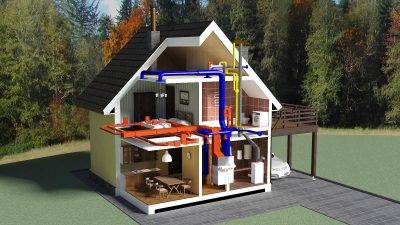
Boilers running on solid or liquid fuels will cost less, but their feature is an increased fire hazard. It is also necessary to constantly monitor the availability of the fuel necessary for generating heat, so this option cannot be called autonomous. Such solutions are perfect for those cases, when the country house is used periodically, upon arrival the boiler is flooded and throughout the entire period of stay in a country house, fuel is added to maintain the optimum temperature in the premises. The operation of heating systems running on wood, coal or fuel oil will cost more than using gas equipment, but much cheaper than electricity.
Heating systems using electricity are the most convenient and safe to use. The advantages of this solution are its complete autonomy, no need for fuel procurement, the ability to automatically adjust the temperature in the room without outside interference.Modern electric heating systems even have the ability to control remotely from a smartphone, if there is a cellular connection in a suburban area. The disadvantages include the high cost of electricity and equipment when using individual appliances in each room.
Also, for each specific country house, the choice of heating system will depend on the area and duration of operation:
- 1. A small country house up to 30 m², used in the summer. It is most preferable to use solid fuel convection boilers that do not require connection to coolant lines, or gas boilers that operate autonomously from a liquefied gas cylinder.
- 2. One- or two-story house up to 100 m², used for year-round use. In this case, it is advisable to use a centralized heating system with the supply of coolant through pipes to heating radiators. In this case, you can use a gas, electric, solid fuel or combined type of boiler, depending on the availability of energy resources.
- 3. Country house with an area of 100 m². Buildings of this type, as a rule, are built in summer cottages, where there are centralized boiler houses, or a gas main runs throughout the village. It is recommended to use central heating or gas, however, in the absence of such an option, it is also possible to use boilers of any type with the arrangement of a circulating system with a heat carrier.
Heating system installation
Installation of the heating system of a country house is carried out in several stages:
- project development, obtaining permits from the relevant authorities;
- procurement of materials, equipment and preparation of tools;
- tie-in to the gas pipeline, which runs along the street and through which gas is supplied to residential buildings;
- preparation of a place for a gas boiler, piping;
Installation of gas equipment
boiler installation;
filling the system with coolant;
diagnostics.
The main criterion by which the amount of materials is calculated, the choice of the model of heating equipment is carried out, is the area of \u200b\u200bthe house. The larger it is, the more powerful the device will need. For a small house, a small-sized boiler is suitable, which can be installed in the bathroom or in the kitchen. For a cottage or a two-story mansion, it is better to choose a large, powerful device.
The heating system of a private house installed in accordance with all the rules will function for a long period. Before starting installation work, you should familiarize yourself with the heating scheme and the rules for installing heating equipment.
Types of systems
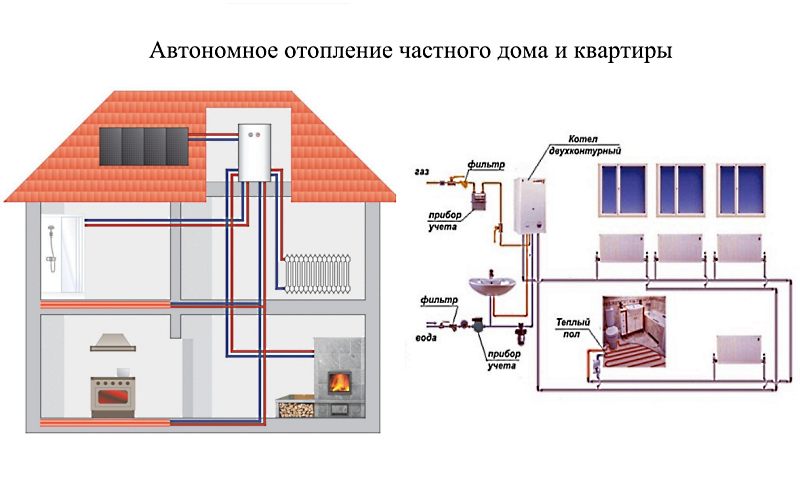
To date, two systems are most often used for individual heating of apartments - gas and electric.
Gas autonomous heating system
The layout of the autonomous heating system largely depends on what kind of effect you want from its implementation in your apartment, as well as on the size of the rooms that need to be heated. To install an individual system, you will certainly need a clear plan for the future system. It should be borne in mind that, since you are planning to install a new heating system in the apartment, it should meet all the requirements as much as possible. That is, no original approach or the introduction of unusual ideas - only strict adherence to the rules.To create a system diagram and its further installation, specialists should be invited. Do-it-yourself self-made autonomous heating of an apartment often causes tragedies - so it's better not to risk it.
Gas boiler in a new building
In no case should you start installing the system without collecting the necessary documentation. There are cases when people installed individual heating systems without securing the approval of utilities. As a result - huge fines and forced dismantling of the system.
Many craftsmen involved in the installation of gas equipment for heating apartments note that the most suitable for such purposes is the installation of autonomous heating in an apartment using a wall-mounted boiler. It has a separate combustion chamber and multi-stage protection. In addition, these boilers are equipped with a high-quality smoke exhaust system - it includes a small horizontally directed pipe through which smoke is removed to the street without causing inconvenience to the residents of the apartment.
Modern gas boiler in the kitchen of the apartment
Consider the main advantages of a gas autonomous heating system:
- affordable cost - the cost of the system, as well as its installation and operation, is quite low. Gas autonomous heating of an apartment can be afforded even by those families whose wealth is moderate.
- a large number of models - in fact, the modern market offers consumers a wide selection of boilers for space heating. You can choose it according to individual characteristics - cost, volume, power, heating area, amount of fuel consumed.
- ease of use - most modern models have the ability to automatically adjust. In addition, you can independently turn the system on and off when required. Also, some models allow you to set the optimal heating temperature and automatically maintain it.
Gas boiler
complete set - today it is easy to find a gas boiler, which is supplemented with all the elements necessary for installing the heating system
In particular, you do not have to invent anything to create ventilation.
compactness and noiselessness - despite its importance, a gas heating boiler is a rather small device that can be easily used even in a very small apartment. In addition, it works almost silently - and this is also an important advantage of the system for many.
As already mentioned, it is extremely important to trust the installation of the heating system to professionals. Contact a company specializing in this service, by all means conclude an agreement and get permission for autonomous heating of an apartment
Do not rely on your own strength - the visible simplicity of the installation process is very deceptive. The system requires compliance with all installation features that you may simply not know about. In addition, only a professional will be able to dismantle the elements of the old heating system so that it continues to work throughout the house.



Of course, many are upset by the fact that it is required to pay for the installation of the system - after all, everything can be done by hand
But, few people are able to install it actually correctly, and most importantly - quickly. In addition, a specialist who installs the system can guarantee its performance and safety.
And this is extremely important.
Choosing an energy carrier
The main selection criterion is the cost of energy carriers, depending on the country and region of residence. If natural gas is the undoubted leader in the Russian Federation, then in other states of the former USSR the picture is different - firewood, briquettes and coal occupy the first place. Don't forget about electricity supplied at half the night rate.
When choosing the right type of fuel, it is worth considering five factors (in addition to price):
- efficiency (efficiency) of the heating equipment using this energy carrier;
- ease of use;
- how often the units will have to be serviced, the prices for calling the master;
- storage requirements.
Below is a comparative table showing the prices of various energy carriers and how much a kilowatt of heat received in real conditions costs. Building area - 100 m², region - Moscow region.
According to the numbers given in the table, it is much easier to find a suitable option (or several). Just make an adjustment for the cost of energy in your region. For other selection criteria, we will give 4 tips:
- It is most convenient to use gas and electric heating equipment. No need to store anything, constantly maintain and mess around with cleaning water heaters.
- Burning coal and wood is the most economical way of heating. For saving money, you will have to pay with labor - sawing, carrying, loading the firebox, cleaning the chimney. Burning briquettes and pellets is more comfortable, but the price of the boiler plant and the fuel itself increases.Plus you will need storage for warehousing.
- Diesel fuel or liquefied gas is the best solution for arranging autonomous and at the same time comfortable heating when other energy sources are not available. Minus - a decent cost of fuel and installation of a fuel tank.
- A proven option is the combination of 2-3 energy carriers. A common example: solid fuel + electricity at a nightly rate.
Which fuel is better to use in specific conditions is described in detail in a separate material. We also recommend watching the video and listening to useful expert advice:
Feature of the horizontal pipe laying scheme
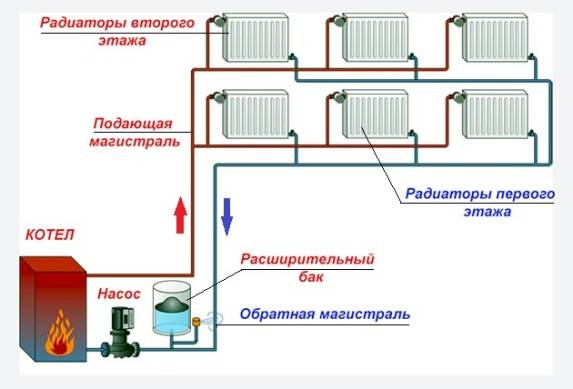
Scheme of horizontal heating in a two-story house
In the vast majority of cases, a horizontal two-pipe heating system with bottom wiring is installed in one or two-story private houses. But, besides this, it can be used to connect to centralized heating. A feature of such a system is the horizontal arrangement of the main and return (for a two-pipe) line.
When choosing this piping system, it is necessary to take into account the nuances of connecting to various types of heating.
Central horizontal heating
To draw up an engineering scheme, one should be guided by the norms of SNiP 41-01-2003. It says that the horizontal wiring of the heating system should ensure not only proper circulation of the coolant, but also ensure its accounting. To do this, two risers are equipped in apartment buildings - with hot water and for receiving cooled liquid. Be sure to calculate a horizontal two-pipe heating system, which includes the installation of a heat meter.It is installed on the inlet pipe immediately after connecting the pipe to the riser.
In addition, hydraulic resistance is taken into account in certain sections of the highway.
This is important, since the horizontal wiring of the heating system will only work effectively while maintaining the appropriate pressure of the coolant.
In most cases, a single-pipe horizontal heating system with a lower wiring is installed for apartment buildings. Therefore, when choosing the number of sections in radiators, one must take into account their distance from the central distribution riser. The further the battery is located, the larger its area should be.
Autonomous horizontal heating
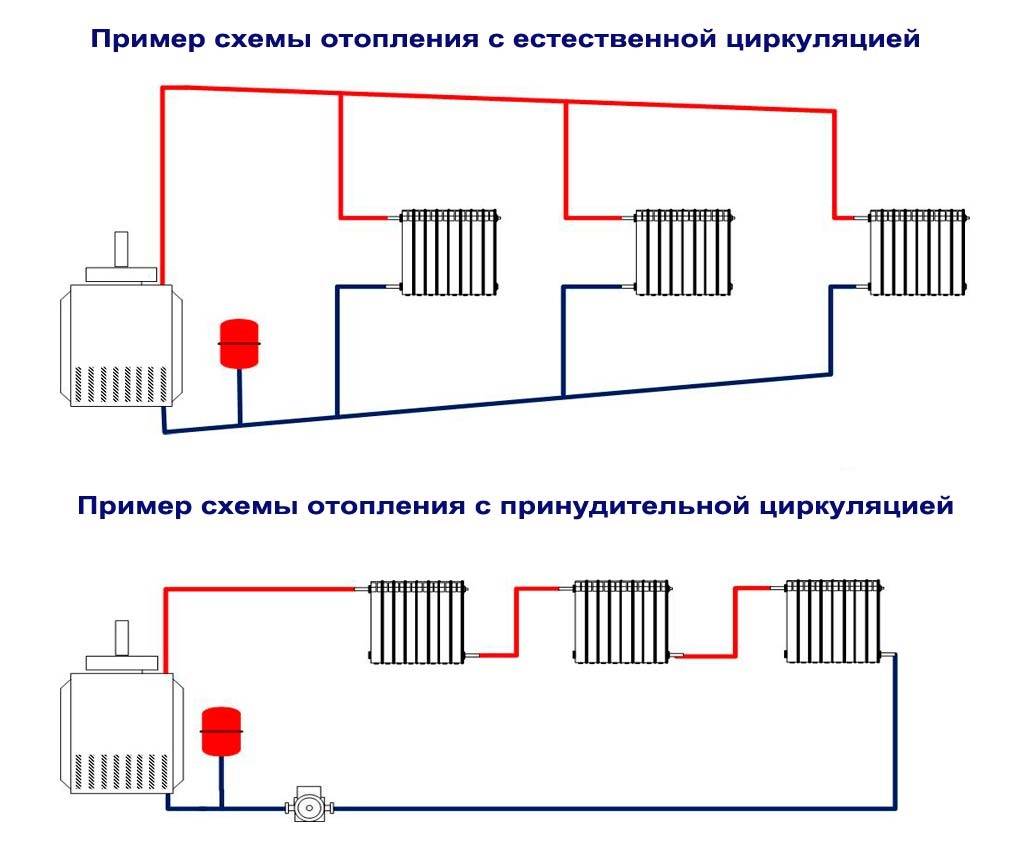
Heating with natural circulation
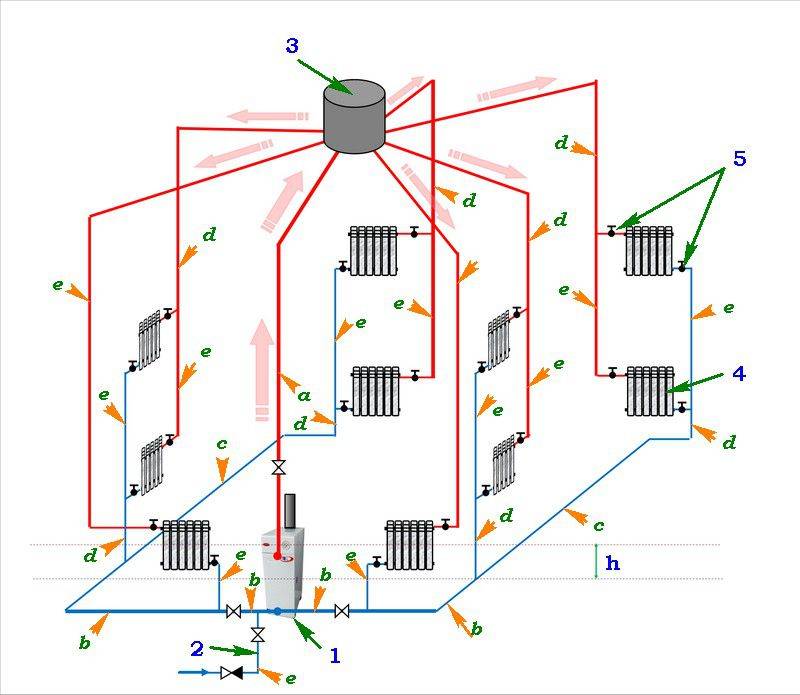
In a private house or in an apartment without a central heating connection, a horizontal heating system with a lower wiring is most often chosen. However, it is necessary to take into account the mode of operation - with natural circulation or forced under pressure. In the first case, immediately from the boiler, a vertical riser is mounted to which horizontal sections are connected.
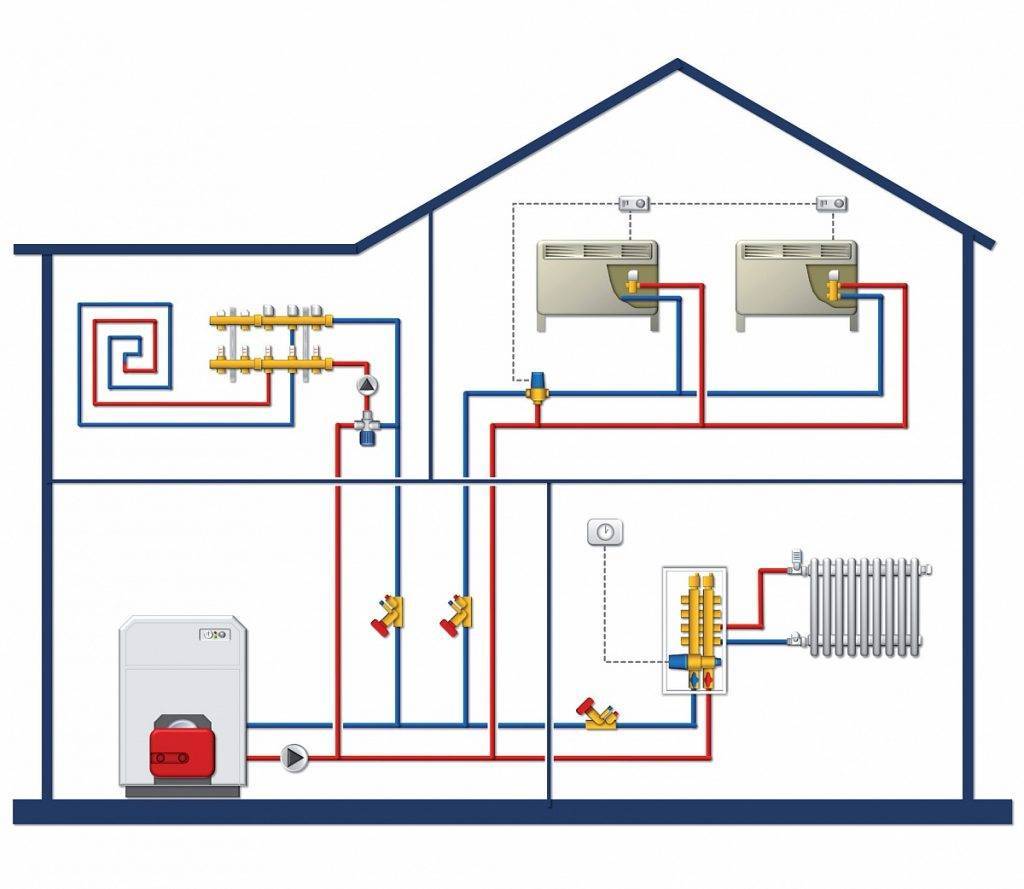
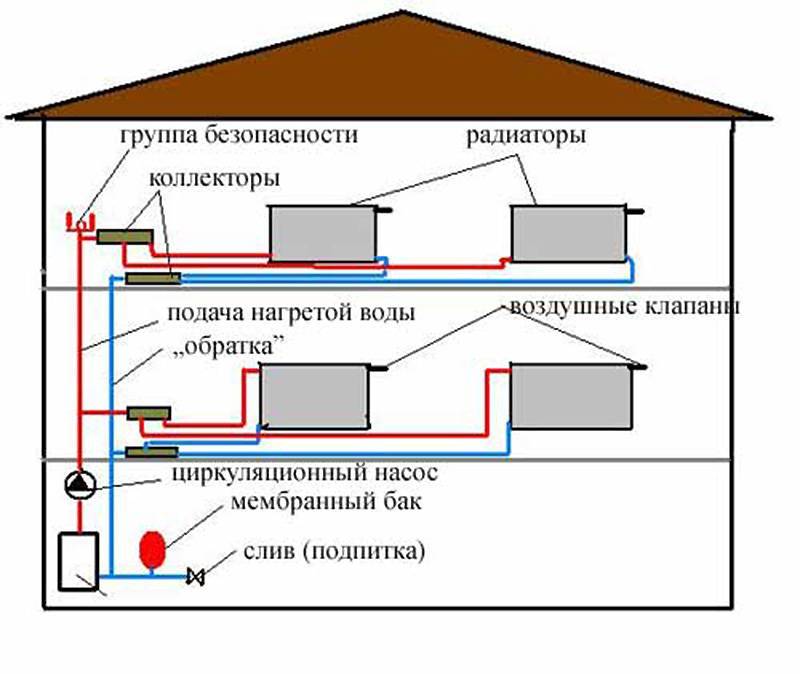


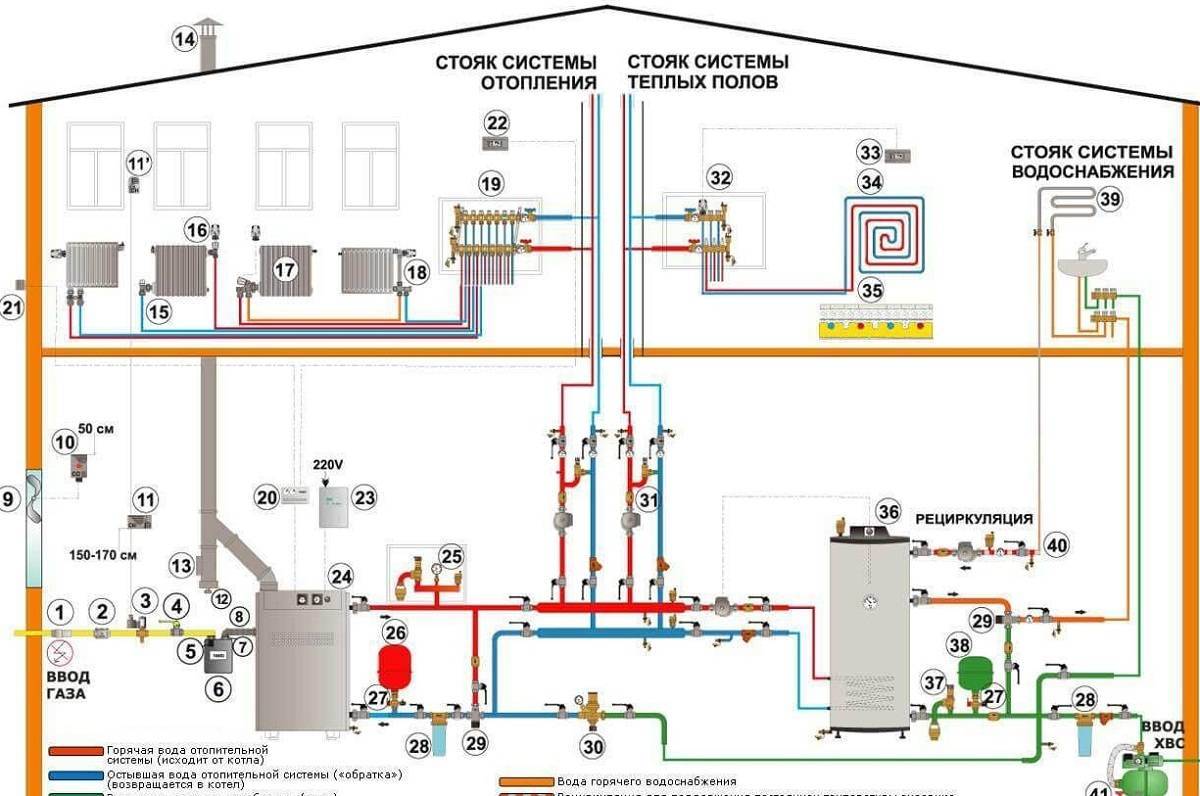


The advantages of this arrangement for maintaining a comfortable temperature level include the following:
- The minimum cost for the purchase of consumables. In particular, a horizontal single-pipe heating system with natural circulation does not include a circulation pump, a membrane expansion tank and protective fittings - air vents;
- Work reliability. Since the pressure in the pipes is equal to atmospheric pressure, the excess temperature is compensated with the help of an expansion tank.
But there are also disadvantages to be noted. The main one is the inertia of the system.Even a well-designed horizontal single-pipe heating system of a two-story house with natural circulation will not be able to provide rapid heating of the premises. This is due to the fact that the heating network begins its movement only after reaching a certain temperature. For houses with a large area (from 150 sq.m.) and with two floors or more, a horizontal heating system with lower wiring and forced circulation of the liquid is recommended.
Heating with forced circulation and horizontal pipes
Unlike the above scheme, for forced circulation, it is not necessary to make a riser. The pressure of the coolant in a horizontal two-pipe heating system with bottom wiring is created using a circulation pump. This is reflected in the improvement of performance:
- Rapid distribution of hot water throughout the line;
- The ability to control the volume of coolant for each radiator (only for a two-pipe system);
- Requires less space for installation as there is no distribution riser.
In turn, the horizontal wiring of the heating system can be combined with a collector. This is true for long pipelines. Thus, it is possible to achieve an even distribution of hot water throughout all rooms of the house.
When calculating a horizontal two-pipe heating system, it is necessary to take into account the rotary nodes, it is in these places that the greatest hydraulic pressure losses are.
Security group
A safety group is placed on the supply pipeline at the outlet of the boiler. It should control its operation and system parameters.It consists of a pressure gauge, an automatic air vent and a safety valve.
The boiler safety group is placed on the supply pipeline before the first branch
The manometer makes it possible to control the pressure in the system. According to the recommendations, it should be in the range of 1.5-3 Bar (in one-story houses it is 1.5-2 Bar, in two-story houses - up to 3 Bar). In case of deviation from these parameters, appropriate measures must be taken. If the pressure has dropped below normal, it is necessary to check if there are any leaks, and then add a certain amount of coolant to the system. At elevated pressure, everything is somewhat more complicated: it is necessary to check in what mode the boiler is operating, whether it has overheated the coolant. The operation of the circulation pump, the correct operation of the pressure gauge and the safety valve are also checked. It is he who should dump the excess coolant when the threshold pressure value is exceeded. A pipe / hose is connected to the free branch pipe of the safety valve, which is led into the sewer or drainage system. Here it is better to do it in such a way that it is possible to control whether the valve works - with frequent discharge of water, it is necessary to look for the causes and eliminate them.
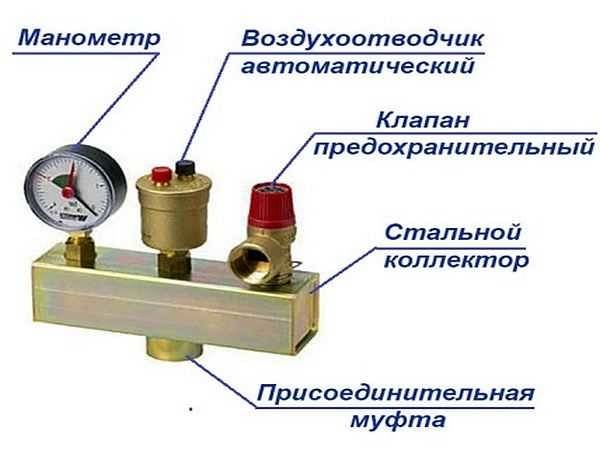
The composition of the security group
The third element of the group is an automatic air vent. Through it, the air that has entered the system is removed. A very convenient device that allows you to get rid of the problem of air jams in the system.
Security groups are sold assembled (pictured above), or you can buy all the devices separately and connect them using the same pipes that were used to wire the system.
Basic schemes
There are the following horizontal heating schemes.
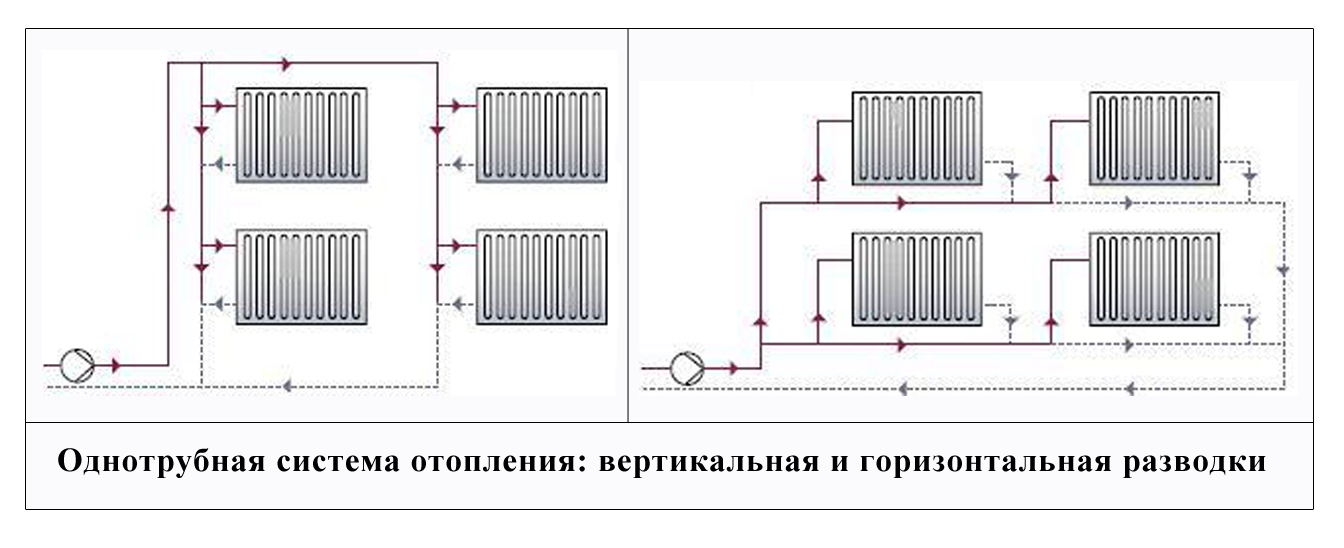
Single pipe line
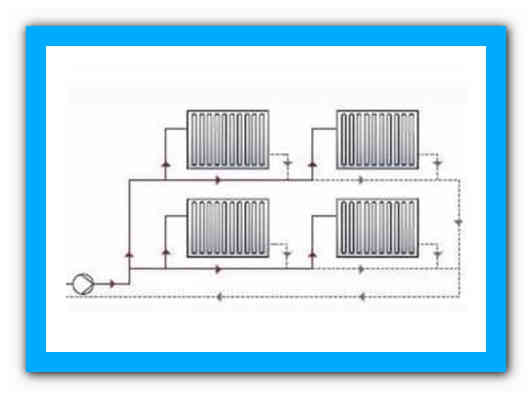
Constantly moving from source to source, the heating fluid maintains the set temperature. This heating system has excellent technical performance, combined with a low price.
Pros:
- minimum costs;
- ease of assembly;
- high level of wear resistance;
- suitable for heating a large area.
Minuses:
- limitations in temperature regulation in each individual heat source;
- brittleness with mechanical damage.
It is also worth considering the fact that in the chain each subsequent radiator must be larger than the previous one - this is provided so that the efficiency does not decrease. To heat a large area, it is necessary to install heating collectors more often so that the water passing through the pipes does not have time to cool.

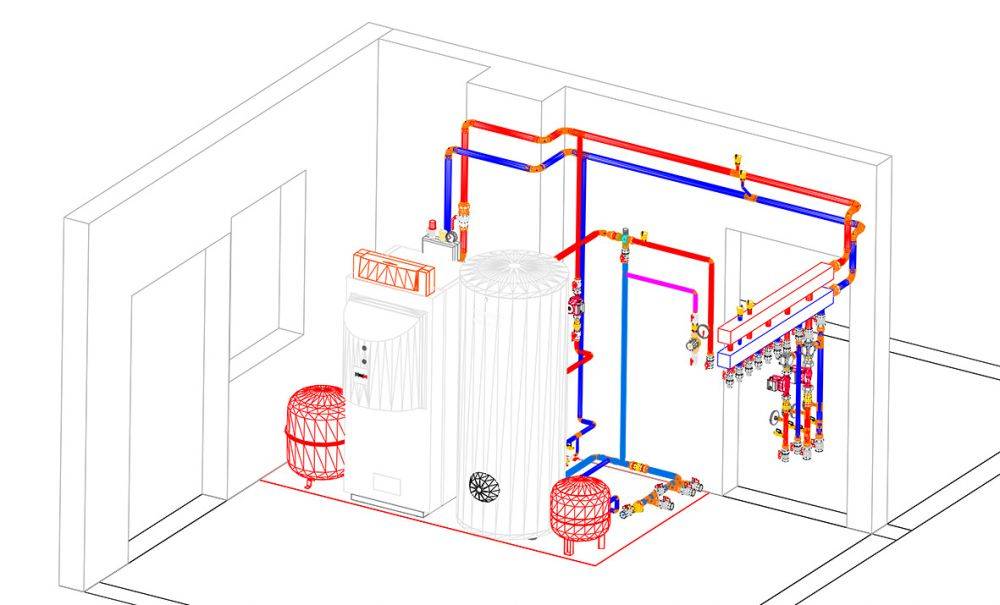
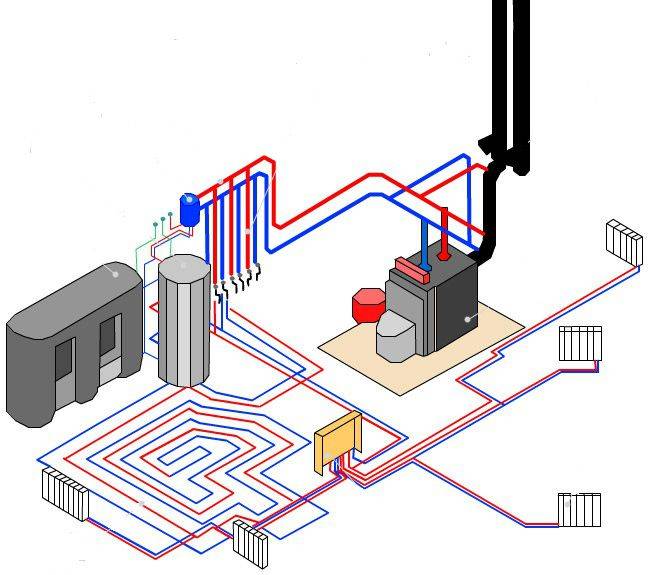
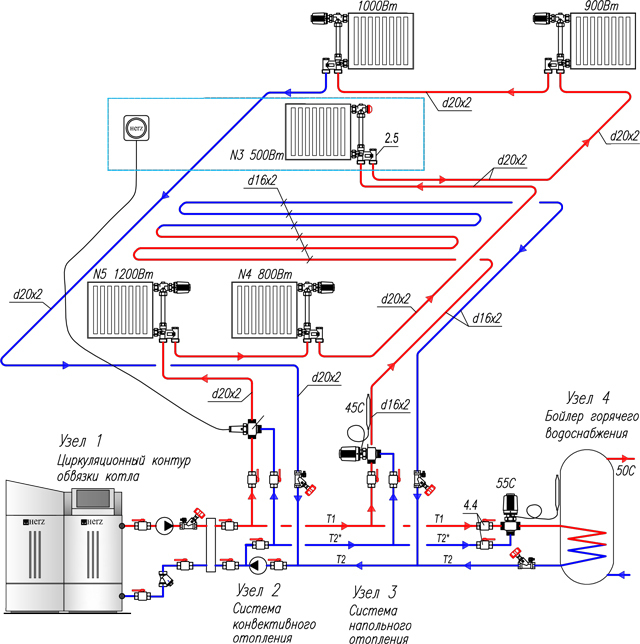
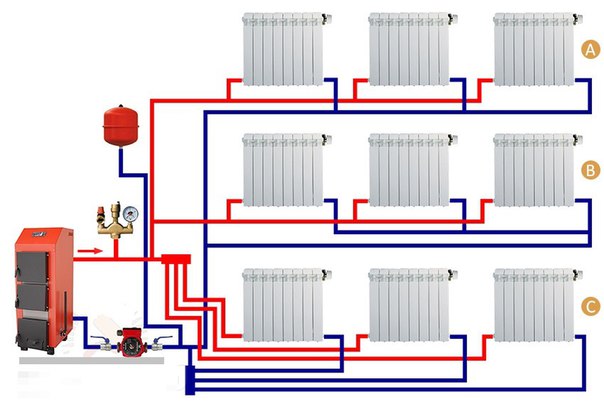
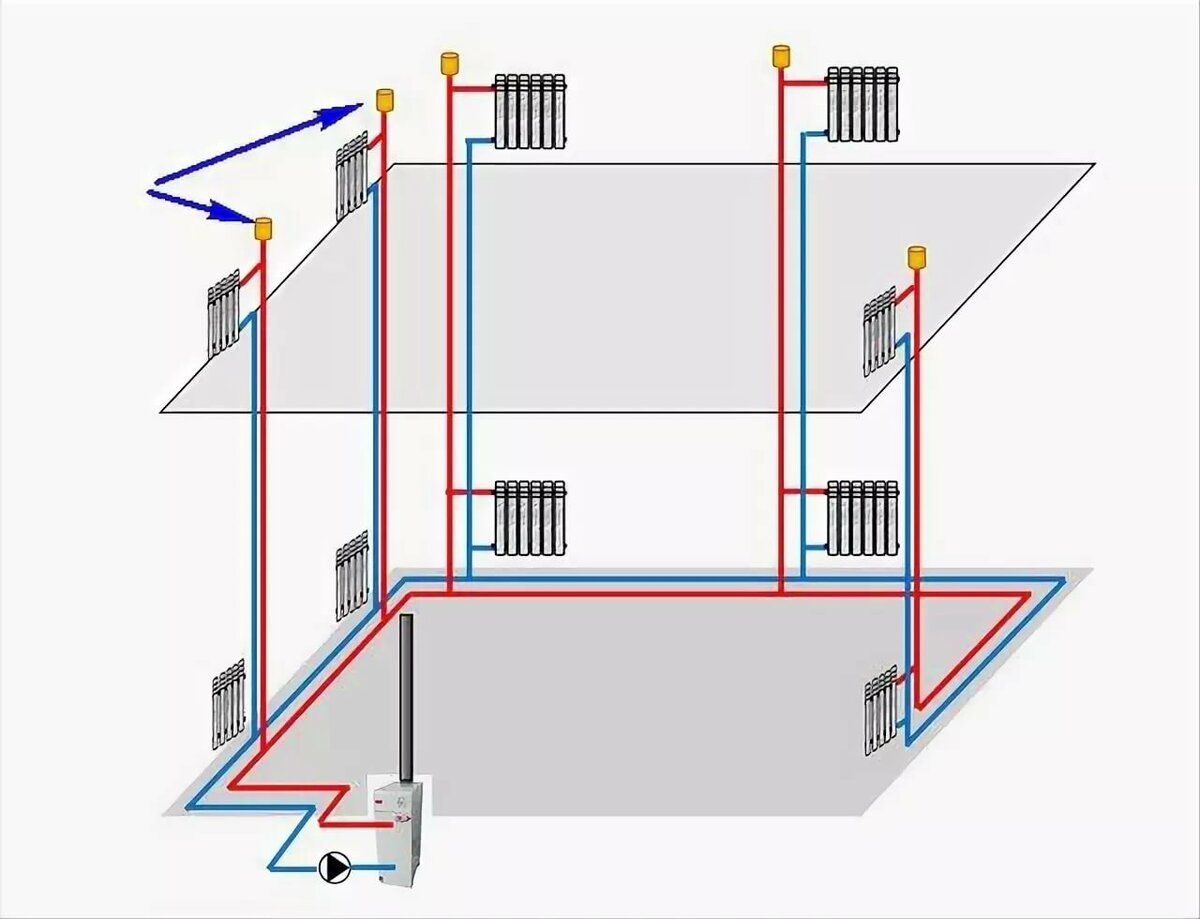
Two-pipe line
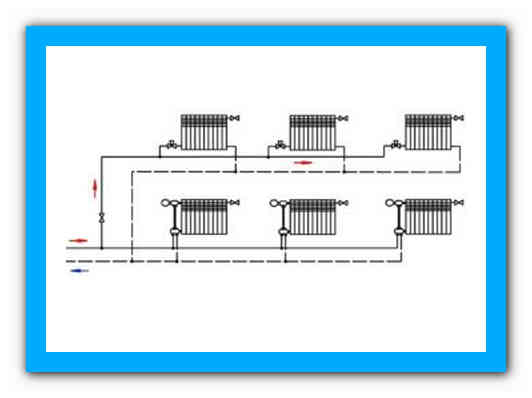
For greater efficiency, you need to install radiators. In a private house, they are usually installed under the window, but you can "heat" the north side, as it is the coldest.
Thus, in the event of a malfunction, you do not need to turn off the entire heating system at once, but only a specific “node”. The presence of compensators is mandatory, since pressure drops can lead to breakage. As practice has shown, radiators cope well with pressure drops, sudden water pressure and do not freeze even at sub-zero temperatures.
The apartment reversing system is closed and has a number of advantages:
- The same temperature at the outlet and inlet.
- Suitable for heating a multi-storey building, cottage, warehouse.
- The ability to disable / enable the system, specifically in a specific area. This is convenient, since this fact greatly simplifies the repair.
Minuses:
difficulty in controlling the temperature in a branched system.
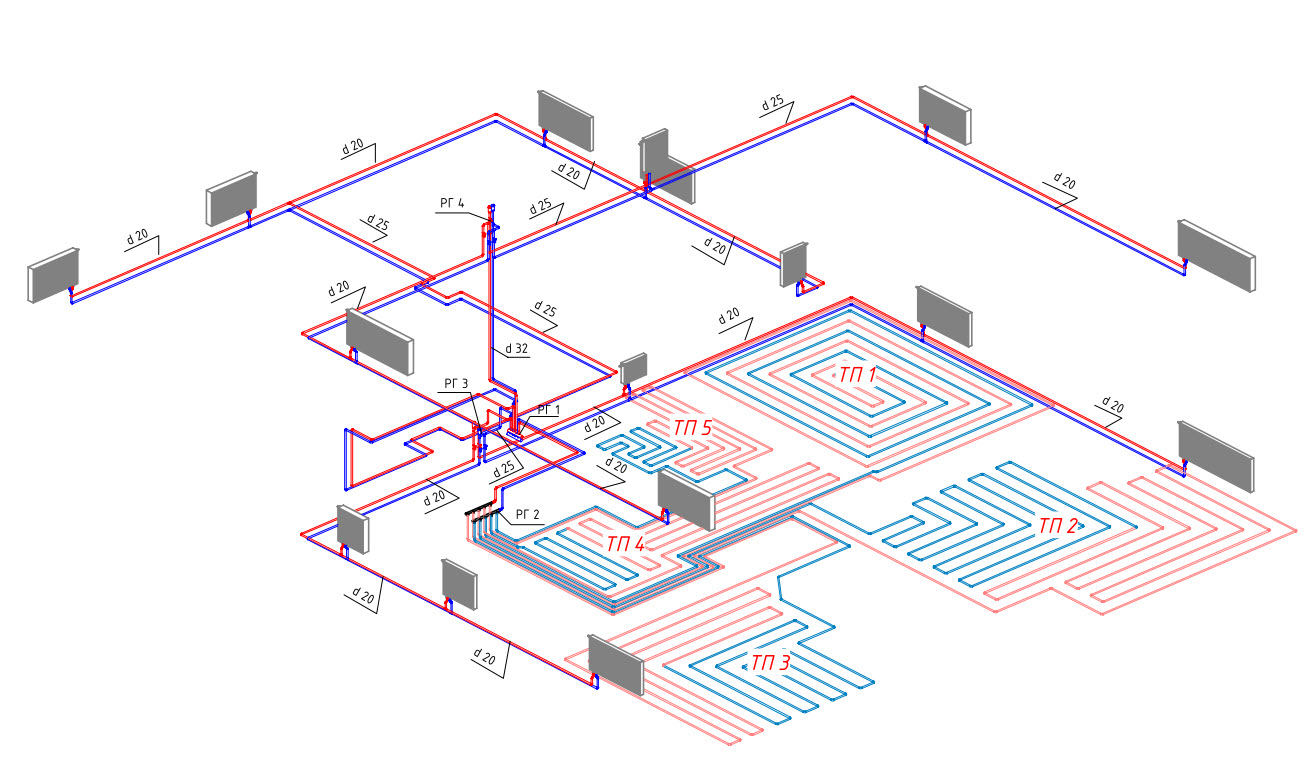
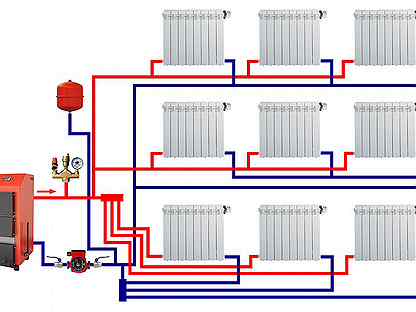
Two-pipe parallel manifold
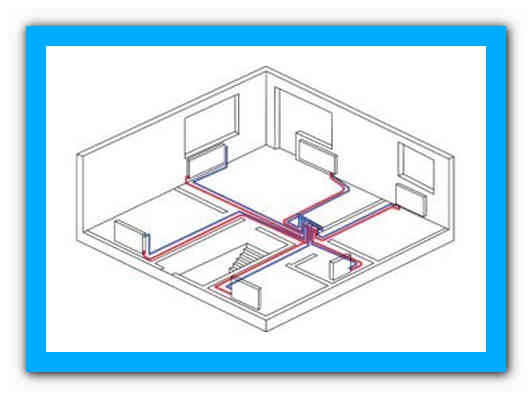
To reduce the cost of construction, polyethylene or polymer pipes are used, which are highly durable.
The system is connected directly to the collector, which evenly distributes the incoming heat over the entire coverage area.
Features of the structure of the collector heating system: the return and supply pipes work autonomously, then heat passes through the pipelines to the radiators, then returns. The cooled liquid heats up again and returns to the radiators. It turns out a closed cycle, regulated automatically.
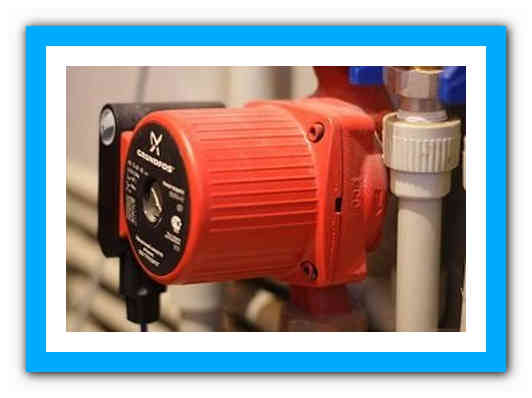
It is imperative to have a high-quality circulation pump, since the performance of the entire system will depend on it.
The shield containing all the equipment can be located in the corridor or bathroom. If this type of heating is installed in an apartment building, then the shield can be installed in the basement.
Pros:
- minimum costs for pipes;
- hidden installation, behind the wall (in the floor);
- the ability to link equipment into a single structure;
- low cost (no expensive fixation elements);
- installation is carried out even on large areas;
- Uniformity of heat supply eliminates the occurrence of water hammer.
Minuses:
- complexity in installation, since often the system is a whole network of small subsystems;
- use in a pipe system of the same diameter.
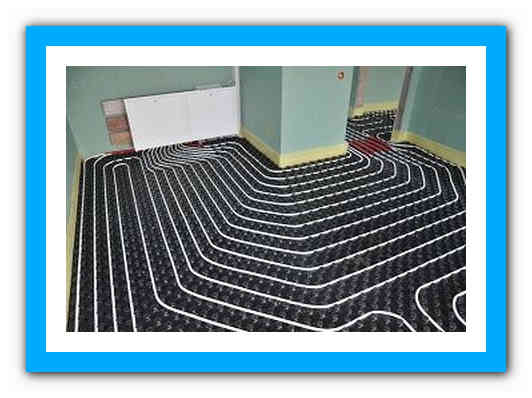
Plastic pipes are not subject to corrosion, they tolerate temperature extremes well and have proven themselves well at sub-zero temperatures.
Due to their design, two-pipe systems have more advantages, since the water does not cool down with constant movement. Heat is distributed evenly, which creates a pleasant climate in the apartment.
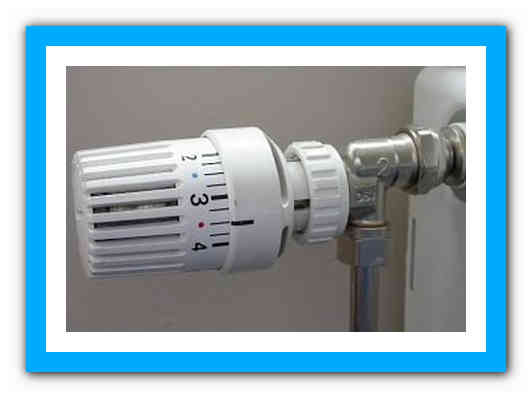
Periodically check the operation of the thermostat, it regulates heat and reflects indicators. Heat regulators maintain an acceptable temperature in the radiators around the clock: depending on the weather, the consumer's heating costs are reduced several times.
Professional engineers will help you draw up a plan for your home, taking into account all the features of the equipment and the area. Entrust the installation to highly qualified specialists with experience in this field. High efficiency at the lowest cost, will provide comfort and warmth in your home.
Watch the video in which the specialist explains how to make collector horizontal heating wiring:



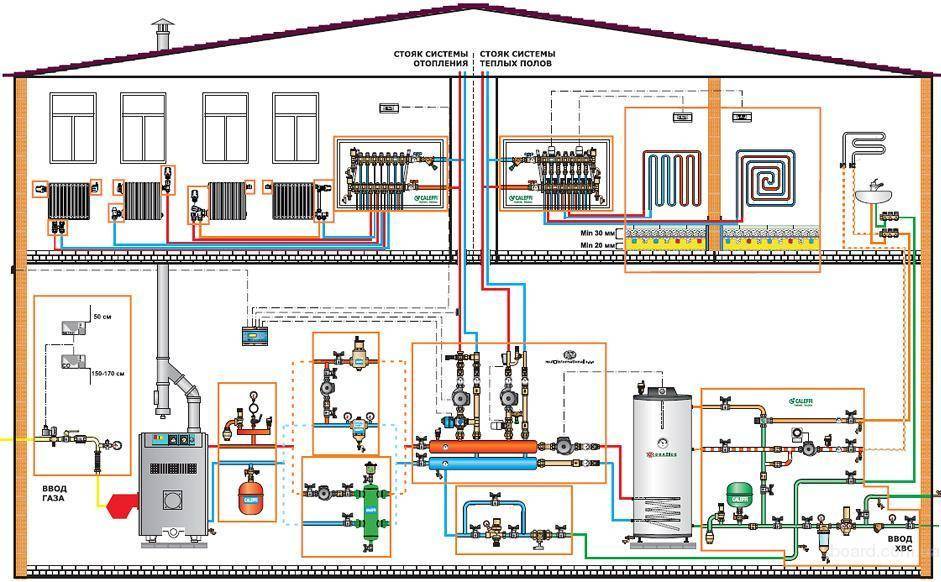

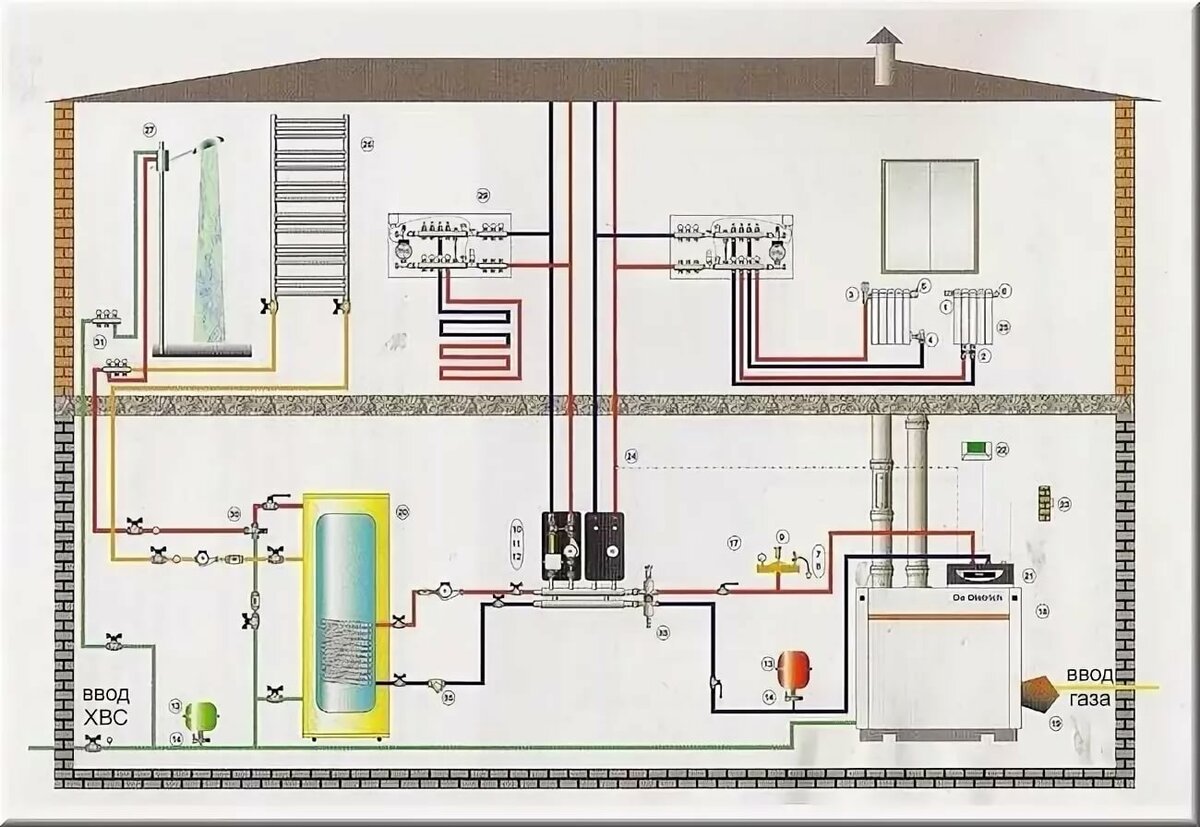

Solar panels. Working principle of solar heating system
Solar heating can also be included in the list where all the new technologies for home heating are present. In this case, not only photovoltaic panels, but also solar collectors can be used for heating. Photovoltaic panels have practically fallen out of use, since collector-type batteries have a much higher efficiency indicator.
Heating the latest heating systems for a private house, which are powered by solar energy, include components such as a collector - a device consisting of a series of tubes, these tubes are attached to a tank that is filled with coolant.
Heating scheme with solar collectors
According to their design features, solar collectors can be of the following varieties: vacuum, flat or air. Sometimes a component such as a pump can be included in such modern heating systems of a country house. It will be designed to provide mandatory circulation along the coolant circuit. This will contribute to more efficient heat transfer.
In order for solar heating technology to be the most efficient, some rules must be followed. Firstly, such new technologies for heating a country house can only be used in regions where it is sunny at least 15-20 days a year. If this indicator is lower, then additional new types of heating of a private house should be installed. The second rule dictates that the collectors be placed as high as possible. You need to orient them so that they absorb as much solar heat as possible.
The most optimal angle of the collector to the horizon is considered to be 30-45 0 .
To prevent unnecessary heat loss, it is necessary to insulate all pipes that connect the heat exchanger to the solar collectors.
Thus, we see that the development of technology does not stand still, and novelties in home heating are as much a necessity as the modernization of equipment that we use every day.
Innovations in the heating system use something completely new and unusual for us - thermal energy from different sources.
Modern types of heating a private house sometimes amaze the imagination, however, in modern times, each of us can already purchase or make such modern heating for a country house or a private one with our own hands. New in heating a private house are efficient systems that continue to develop the field of heating equipment, and we hope that all the most effective options are yet to come.
The heating system in a newly built house is the basis for many other activities in private homes. After all, it is heating that is the condition under which it is possible to carry out internal finishing work and the construction and installation of communications. This process is especially necessary when the construction of a house is delayed and all activities related to internal work fall on the cold season.
The scheme of heating the house with a gas boiler.
Many homeowners are forced to put them off due to the fact that the houses do not yet have an adequate heating system. Therefore, even at the stage of building a house, and even better before it, it is necessary to carefully consider all the options related to the organization of the heating system in the house. Depending on the style in which your house will be decorated and how often you intend to use the finished structure, it is necessary to select materials for construction and, accordingly, determine which heating system is suitable for these specific conditions. Both traditional and modern heating systems for private houses can be selected.
Design of the heating system of a country house
Scheme of the heating system of a two-story country house (cottage) based on a fireplace stove.
The final design involves the development of a working draft of the heating system of a private house. The drafting is carried out in the following order:
- pipeline route design;
- distribution units are placed: manifolds, shut-off valves, circuit servo drives that regulate thermal heads on radiators;
- performing a hydraulic calculation of the system to exclude temperature drops in the premises during operation, the occurrence of emergencies due to pressure drops in the heating system;
- selection of manufacturers of heating equipment;
- drawing up a specification, which indicates the cost of equipment and components used for the installation of the system;
- determination of the cost of installation work;
- execution of the drawn up project that meets the current requirements of regulatory authorities and SNiP;
- coordination of the drawn up documentation with state regulatory authorities.
The working draft of the heating system of a country house consists of an explanatory note and a graphic part. The explanatory note should include:
- description of the purpose and purpose of the completed design work;
- table of initial data;
- heat loss and temperature regimes;
- technological solution;
- list of used equipment;
- list of technical and economic indicators of the heating system;
- operating conditions;
- safety requirements.
The graphic part should include the following materials:
For owners of country houses and cottages, the issue of heating is the most important in the harsh Russian climate. As a rule, connection to the city or village heating network is not possible.The best option that will allow you to provide warmth and comfort in your country house throughout the year, even in severe frosts, will be the use of an autonomous heating system.


The heating system of a country house must be provided at the design and construction stages.
This will allow you to initially understand what power a source of heat supply will need (for example, a private boiler house), develop the most optimal heating scheme and provide for the conditions for installing a heating system during the construction of a country house or cottage (so that you do not have to resort to redevelopment and refinishing).
In an already constructed building, when wiring all the necessary communications, it will inevitably be necessary to make holes in the ceilings and walls. When choosing a floor heating boiler, a separate room should be provided - the boiler room. If the boiler room is not provided for by the project, then it is more convenient to use wall-mounted heating boilers. They can be installed in bathrooms or kitchens.
There are three main types of heating systems for a country house.
• Traditional country house heating system - a system in which the liquid heat carrier is heated in a heating boiler, after which, circulating through a system of pipelines and radiators, it gives off heat to the heated premises.
• Air heating system of a country house - in such systems air is used, which, after preheating, is supplied to the heated premises through air ducts.
• Electric heating system of a country house - heating of the premises is carried out by infrared emitters and other electrical appliances in which thermal energy is generated by electricity.These systems do not use coolant.
Air and electric heating in our country is not as in demand as in Western Europe and the USA. Therefore, we will dwell in more detail on the traditional heating system of country houses.
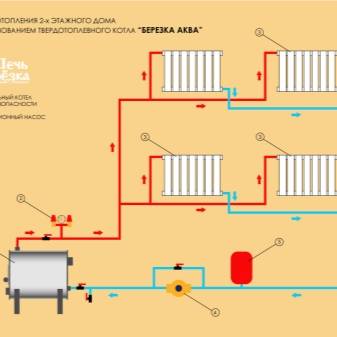
Traditional heating and hot water systems (hot water supply) include heating devices (heating boilers), control and shutoff valves, pipelines. The main source of heat in traditional systems are heating boilers that operate on various types of fuel. The boiler heats water (fluid coolant), which then flows through pipelines to radiators, after which the coolant gives off part of the heat to the room and returns to the boiler. The circulation of the coolant in the system is supported by circulation pumps.
According to the method of piping, the heating of a country house is divided into:
• one-pipe heating system
• two-pipe heating system
• radiant (collector) heating system