
- What to do if the apartment is too cold
- Permissible standards for temperature, relative humidity and air velocity in the premises of residential buildings
- Permissible levels of vibration in the premises of residential buildings from internal and external sources
- Permissible levels of infrasound for residential premises
- Temperature and humidity in the children's room
- What temperature should be in the apartment?
- Room temperature standards
- Factors that determine comfort conditions
- Independent measurement of deviations and adjustment
- Use of heaters
- Overheating of the body
- Danger of overheating
- Possible outcomes of a complaint
- How to make an application
- Warm or clean air?
- What is the ideal air temperature in summer?
- What is air humidity
What to do if the apartment is too cold
The beginning of the heating season in apartment buildings occurs when the outside air temperature drops below +8°C. Utilities compare average daily temperatures over five days. Apartments must be heated. The law allows minor interruptions in heating for 24 hours, while a one-time shutdown of heating cannot exceed 16 hours if the air temperature in residential premises is from 12 to 22 degrees.
If the apartment is too cold or hot, tenants have the right to file a written complaint and send it to the emergency dispatch service. The document is assigned a registration number. Further, utilities are required to inspect the premises and draw up an act on the basis of which it is possible to recalculate utility bills. If technical supervisors reveal gross violations, utilities are obliged to correct the situation within 2-7 days, otherwise, utility bills are recalculated per apartment according to the footage of apartments.
In our apartments, the microclimate is formed by several factors, and room temperature is the most significant part of it. The temperature comfort of households is individual, depending on their gender and age. However, the difference in heat needs among members of the same family is small and amounts to 2-3 ° C, allowed by SanPiN standards.
We will tell you how to determine the optimal temperature, how excessive cooling or overheating affects people's well-being. In addition, we will designate the parameters of a comfortable microclimate, as well as provide effective ways to maintain a normal temperature in the room.
The temperature regimes that ensure the comfort of households depend on the climatic location of the housing. In the southern regions and in the northern areas, as well as in the western and eastern latitudes, the norm of house temperature will be different.
As for the countries, their climate is also not the same. And since the climate components, in addition to temperature, are atmospheric pressure together with air humidity, the acceptable thermal range is set by them together.
It is not difficult to control the temperature regimes of the "warm floor" heating complex.Liquid systems are equipped with a thermostatic valve or an automatic pump-mixing group, equally capable of controlling the temperature of the coolant circulating through the circuit built into the floor.
In infrared and temperature control is carried out by digital, programmable or electromechanical thermostats. By constantly checking temperature changes against preset thresholds, they turn the system off or on.
Classic apartment heating systems, based on the circulation of hot water through pipes to radiators, also allow temperature control.
It will be necessary to equip the pipe at the coolant inlet to the radiator with an automatic (thermostat) that controls the intensity of hot water supply according to a given parameter.
Note that it is easier to complete the circulation-radiator heating system with battery thermostats in its two-pipe design
The need to establish and maintain optimal temperature regimes in living rooms is important, since the microclimate of an apartment significantly affects the health of households.
Temperature imbalance exacerbates chronic diseases and promotes the acquisition of new ones, and the normalization of the atmosphere by temperature, on the contrary, will strengthen the body.
Share with readers your personal observations regarding the parameters of a comfortable temperature at home. Tell us about ways to normalize the temperature regime. Please leave comments on the article, ask questions and participate in discussions. The contact form is located below.
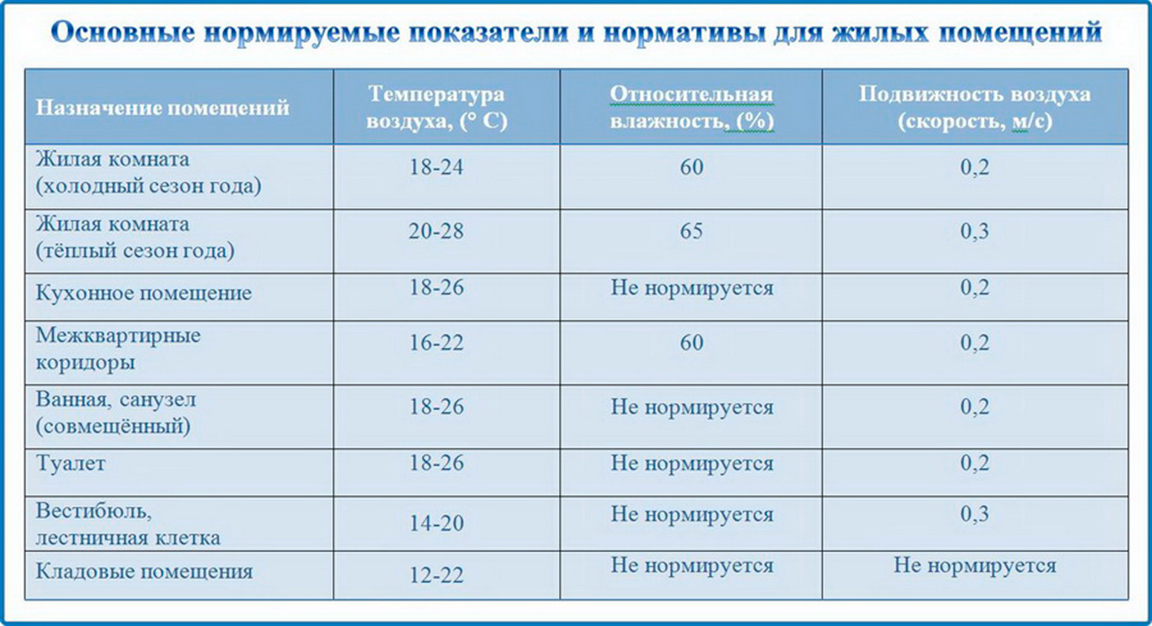
Permissible standards for temperature, relative humidity and air velocity in the premises of residential buildings
| Names of premises | Air temperature, ° С | Resulting temperature, ° С | Relative humidity, % | Air speed m/s |
|---|---|---|---|---|
| Cold period of the year | ||||
| Living room | 18-24 | 17-23 | 60 | 0,2 |
| The same, in areas of the coldest five-day period (minus 31 ° C and below) | 20-24 | 19-23 | 60 | 0,2 |
| Kitchen | 18-26 | 17-25 | N/N* | 0,2 |
| Toilet | 18-26 | 17-25 | N/N | 0,2 |
| Bathroom, combined bathroom | 18-26 | 17-25 | N/N | 0,2 |
| Inter-apartment corridor | 16-22 | 15-21 | 60 | 0,2 |
| lobby, stairwell | 14-20 | 13-19 | N/N | 0,3 |
| Storerooms | 12-22 | 11-21 | N/N | N/N |
| Warm period of the year | ||||
| Living room | 20-28 | 18-27 | 65 | 0,3 |
Permissible levels of vibration in the premises of residential buildings from internal and external sources
| Geometric mean frequencies of bands, Hz | Permissible values along the Xo, Yo, Zo axes | |||
|---|---|---|---|---|
| vibration acceleration | Vibration velocity | |||
| m / s 2x 10 (-3 degrees) | dB | m/s x 10(-4degrees) | dB | |
| 2 | 4,5 | 72 | 3,2 | 76 |
| 4 | 5,6 | 73 | 1,8 | 71 |
| 8 | 11 | 75 | 1,1 | 67 |
| 18 | 22 | 81 | 1,1 | 67 |
| 31,5 | 45 | 87 | 1,1 | 67 |
| 63 | 4 | 93 | 1,1 | 67 |
| Equivalent corrected values of vibration velocity or vibration acceleration and their logarithmic levels | 4 | 72 | 1,1 | 67 |
Permissible levels of infrasound for residential premises
| Name of premises | Sound pressure levels, dB, in octave bands with geometric mean frequencies, Hz | Total sound pressure level, dB Lin | |||
|---|---|---|---|---|---|
| 2 | 4 | 8 | 16 | ||
| Residential premises | 75 | 70 | 65 | 60 | 75 |
Temperature and humidity in the children's room
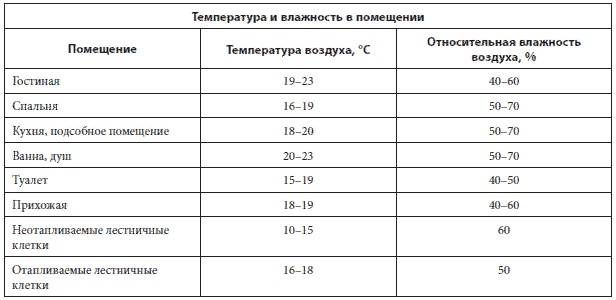
If the family has a newborn child, then parents need to pay close attention to controlling the microclimate in the children's room. The air temperature in maternity hospitals and perinatal centers does not exceed 22 degrees
For a children's room, the optimal temperature range is from 18 to 21 degrees.
Despite the fact that a newborn child is in a sedentary state, many biochemical processes take place in his body, which are accompanied by the release of thermal energy. If the room temperature is more than 22 degrees, then the baby is at risk of overheating. An equally important indicator is the percentage of moisture in the air.For a children's room, the optimal value is from 50 to 70%. If a newborn baby suffers from infectious and inflammatory diseases, then the humidity of the air should not fall below the bar of 60%.

Excessive air temperature in the children's room leads to the development of such conditions:
- Drying of the mucous membrane of the nasal passages, resulting in the formation of dry crusts that prevent normal breathing through the nose;
- Excessive dryness of the oral mucosa, which leads to the formation of a disease such as thrush;
- The formation of irritation and diaper rash of the skin in the area that is under the diaper and in the inguinal folds;
- An increase in the viscosity of gastric juice, which is caused by a lack of fluid in the body.
Increased sweating is dangerous for the child's body, as this condition is accompanied by a massive loss of fluid through the skin pores.
The condition in which the child's body is exposed to hypothermia is no less dangerous for the body of a newborn baby. You can recognize the symptoms of hypothermia in a child's body by the following signs:
- Paleness of the skin;
- Coldness of the upper and lower extremities of the child;
- Blueing of the skin in the region of the nasolabial triangle.
If high temperatures prevail in residential premises, then to prevent overheating of the child's body, you can use the following tips:
- Children's room is recommended to ventilate at least 3 times a day. During this procedure, it is recommended to take the baby to another room;
- If an air conditioner is installed in the living room, then its air flows should not be directed to the place where the newborn baby is located;
- If the air temperature in the children's room exceeds the permissible limits, then the child is recommended to undress, leaving one diaper on him;
- If central heating batteries supply too much heat, then parents are advised to cover them with blankets, blankets and other fabrics that can trap heat flows.
- To prevent overheating, it is recommended to resort to water procedures as often as possible. The frequency of bathing a newborn baby can reach 3-4 times a day;
- If a canopy is installed above the baby's crib, then it must be eliminated, since this product not only disrupts heat transfer, but is also a source of accumulation of household dust.
If there is a decrease in temperature indicators in the children's room, then parents need to take care of acquiring sources of heat generation. It is recommended to place a standard household heater at a distance from the place where the newborn baby is located. It is strictly forbidden to cover any kind of household heaters with fabric products.
What temperature should be in the apartment?
So, consider what room temperature should be in the apartment.
Often there is evidence that a temperature of +18 ° C. is considered universally optimal for apartments. This is not true.
At +18, people cannot be comfortable, because this is the minimum threshold.
Moreover, being in such conditions for a long time without outerwear is harmful to health.
Since no tables can replace personal feelings, you need to focus on them.
If it is cold all the time, a heater is purchased. In the heat - a fan or split system will save.
However, if we are talking about a gross violation of temperature regimes by utilities, then knowing the tabular data is still useful!
Room temperature standards
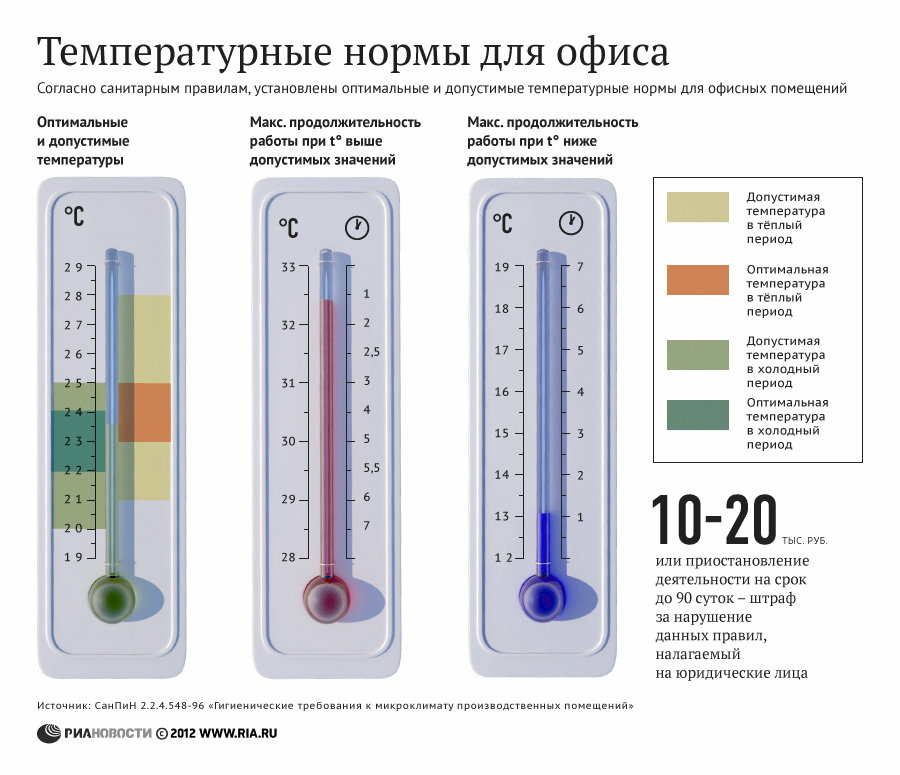
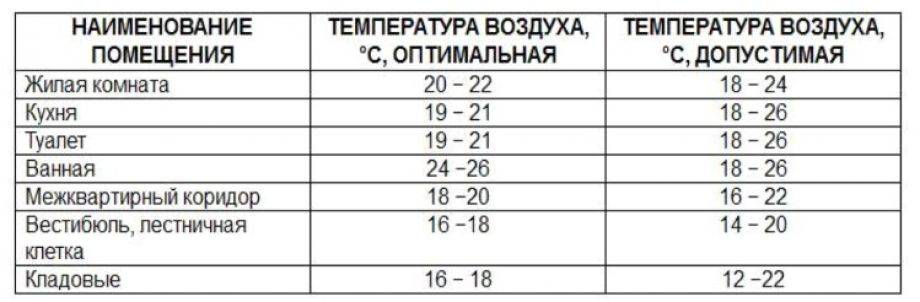
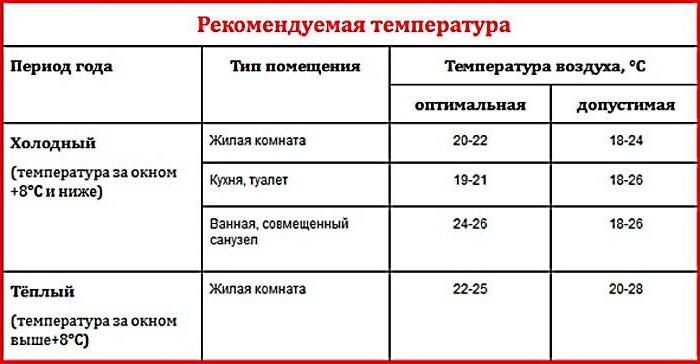
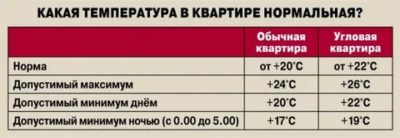
The optimal room temperature for a person largely depends on individual needs and other factors. At the state level, this value is regulated by the document GOST 30494-2011 and R 51617-2000. According to GOST, the standard parameters of the microclimate in the room are:
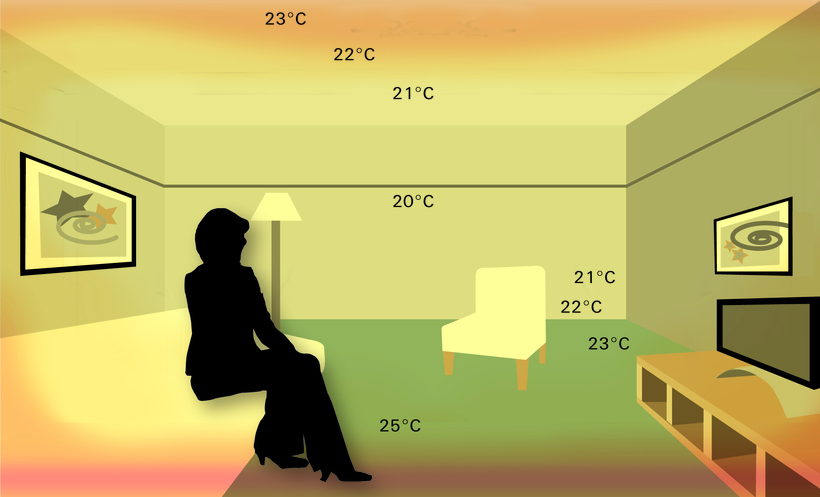
- living rooms - from +20 to 23 degrees. Celsius;
- kitchen and toilet - from +18 to 21 degrees. Celsius;
- bathroom - from +23 to 25 degrees. Celsius;
- corridor, pantry, stairwell - from +14 to 19 degrees. Celsius;
- in summer - from +24 to 28 degrees. Celsius;
- in winter - from +22 to 24 degrees. Celsius.
In winter, the temperature in the rooms should be 3-4 degrees higher than in summer
Depending on the purpose of the room, the average temperature conditions are determined. For example, it is better to sleep in a well-ventilated room with a temperature of about 22 degrees. In a hotter environment, it will be more difficult to fall asleep, and in a cold one, nightmares will occur.
If the question concerns a children's bedroom, then the temperature in the room should be adjusted depending on the age of the child. Thus, for the comfort of the baby, it is best to adhere to the maximum allowable temperature regime (+ 23 ... + 24 degrees). During maturation, the norm will decrease to the minimum levels that are comfortable for adults (+19 ... +20 degrees).


The bathroom has the highest humidity in the apartment, so following the standards of sanitary rules and regulations (SANPIN) in the bathroom is important for personal hygiene. If the indicator deviates from the norm, dampness occurs in the bathroom and mold begins to form.
The appropriate temperature in the kitchen is determined by the type of household appliances that are used in the kitchen, as well as the intensity of their use. Thus, if a kettle and stove are often used in the kitchen, the temperature in the room will be too hot, so you should lower the degree. However, when using electrical equipment, the temperature in the room will not change, since such devices have a lower level of heat transfer.
Factors that determine comfort conditions
Standards for human comfort in a room are based on ideal conditions where there are no significant seasonal fluctuations, no additional measures to increase or decrease the temperature are used, and all people have the same preferences. In life, determining the optimal conditions for a living room may depend on a number of factors:
- Various climatic zones.
- Significant temperature fluctuations outside.
- Features of the structure of the house (in brick, heat keeps better than in panel ones).
- Human factor. Some people enjoy being in a well-ventilated area, while others are more comfortable with conditioned air.
- Women like warmth more, and men the opposite. It is comfortable for children to be in a room where +21 ... +23 degrees.
Independent measurement of deviations and adjustment
In order to maintain a normal temperature regime, it is necessary to constantly monitor changes in the microclimate of the apartment.
To get detailed information about what the air temperature and humidity level is, you can use a conventional thermometer and hygrometer.
Measuring instruments should be placed at a distance of at least 1 meter from the outer walls and at a height of at least 1.4 meters. If there is a suspicion that the temperature balance in the room has been disturbed, it is recommended to carry out control measurements every hour during the day.
In case of deviation from the standard by 3 degrees during the day or 5 degrees at night, you can submit an act on the measurements taken, on the basis of which the payment for utilities is recalculated.
You can adjust the microclimate of the room yourself using one of the methods:
- airing rooms with a draft;
- the use of an air conditioner that can heat or cool the air, as well as ventilate, purify and humidify it;
- install traditional heat sources - convectors or electric fireplaces.
It is important to remember that in winter the average room temperature should not fall below 19 degrees Celsius. A significant decrease in temperature is a sign of poor quality heating services.
Use of heaters
In the cold season, various types of heaters are in demand to maintain the optimal temperature regime. The most effective are:
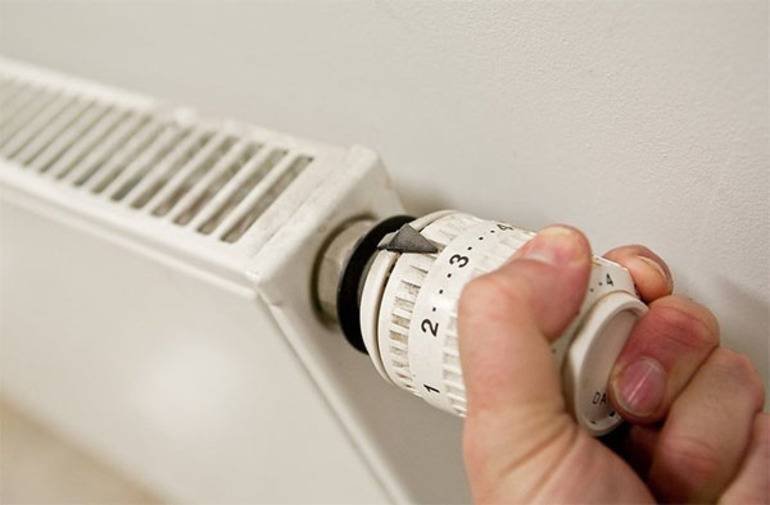
- Oil radiators are available and allow you to heat the room in case of poor quality central heating. There are different models with different number of sections depending on the needs of the person. Typically, the fixture is equipped with a thermostat to help regulate the temperature.The disadvantage is the impossibility of using the device in a room where there are small children, since its body is very hot.
- Convection devices are usually in the form of a panel, they can be wall-mounted, built-in and floor-standing. Everyone can choose the appropriate option. Radiators can also be water, electric and gas.
- Infrared heaters are popular and easy to use. They can be floor, wall and ceiling, making it easy to choose. Installation of the device is not difficult and is done by hand, even in the absence of professional skills. The devices are economical, operate silently, do not raise dust and evenly distribute heat throughout the room.
- The simplest option is a fan heater. Its cost is affordable, operation is simple, and maintenance is not required. In case of overheating, the device turns off due to the presence of a thermostat. The disadvantage of the device is that it greatly dries the air in the room, therefore, when using it, it is necessary to install a humidifier, especially in the children's room.
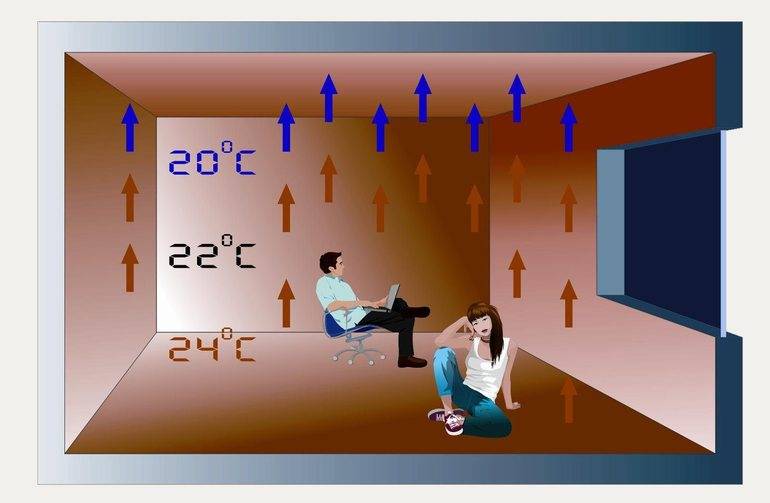
- Oil radiators are available and allow you to heat the room in case of poor quality central heating. There are different models with different number of sections depending on the needs of the person. Typically, the fixture is equipped with a thermostat to help regulate the temperature. The disadvantage is the impossibility of using the device in a room where there are small children, since its body is very hot.
- Convection devices are usually in the form of a panel, they can be wall-mounted, built-in and floor-standing. Everyone can choose the appropriate option.Radiators can also be water, electric and gas.
- Infrared heaters are popular and easy to use. They can be floor, wall and ceiling, making it easy to choose. Installation of the device is not difficult and is done by hand, even in the absence of professional skills. The devices are economical, operate silently, do not raise dust and evenly distribute heat throughout the room.
- The simplest option is a fan heater. Its cost is affordable, operation is simple, and maintenance is not required. In case of overheating, the device turns off due to the presence of a thermostat. The disadvantage of the device is that it greatly dries the air in the room, therefore, when using it, it is necessary to install a humidifier, especially in the children's room.
Any of the heaters will be a good option if it is impossible to increase the temperature in the room in other ways. The device can be turned on and off as needed, which is very convenient and will avoid hypothermia or overheating.


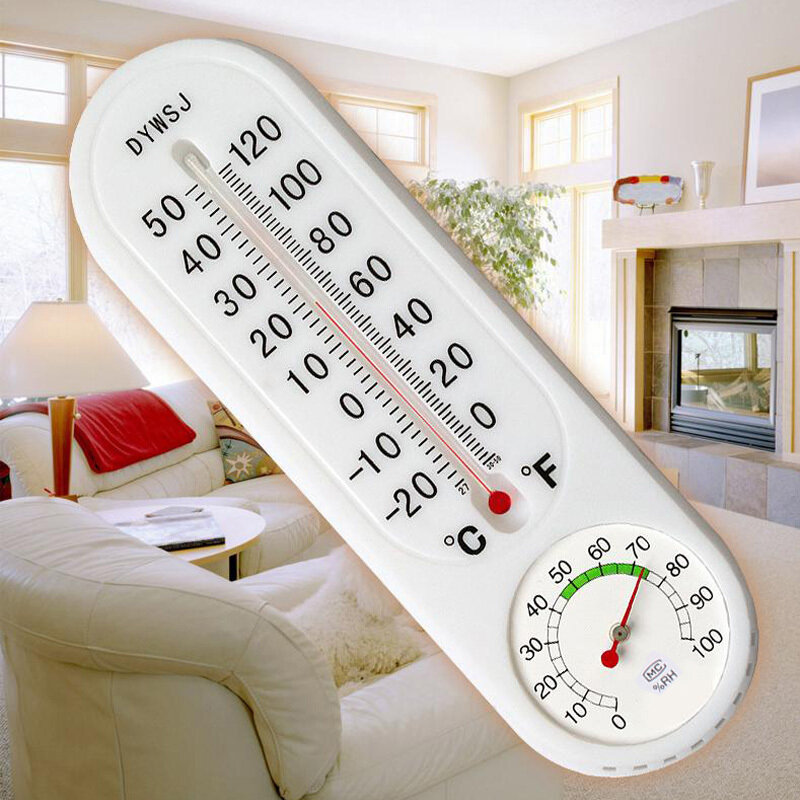

The temperature regime in the room is considered the main condition for creating the optimal microclimate necessary for a comfortable living for people. To maintain it at the right level, it is recommended to adhere to the standards established by GOST.
Overheating of the body
The body gives off heat (and thereby cools) in three ways:
- Radiation (45%).
- Convection (30%).
- Sweating (25%).
This is under normal conditions, but:
- If the ambient temperature exceeds our internal temperature (that is, it becomes higher than 34 - 36 ° C), then we lose the convection heat transfer.
- If the surroundings are humid, then it becomes impossible to cool by sweating.
- Well, if a person is surrounded by sources of radiant energy, then radiation becomes more difficult.
Our organism is subjected to the most severe test when a combination of several conditions occurs.
In the heat, in no case should you turn on humidifiers! This will cut your body's ability to self-cooling in half!
What are the consequences of overheating?
- The overall body temperature rises, which indicates that the body can no longer cope.
- The load on the cardiovascular system increases, the heartbeat quickens.
- From the organs there is an outflow of blood (it goes to the skin), the pressure decreases.
- The composition of the blood changes, it thickens, the water-salt metabolism is disturbed.
- Violated vitamin metabolism and digestion.
- The nervous system does not remain unaffected.
- In the worst cases, heat stroke.
But in a hot climate, bacteria and viruses feel great, which are given over to a tired, overheated human body.
Salvation in the heat - the movement of air and water! It is important to drink plain water as much as possible and organize good ventilation (the air conditioner must also be used carefully - colds, inflammations and otitis media are not uncommon among owners of split systems)!
Danger of overheating
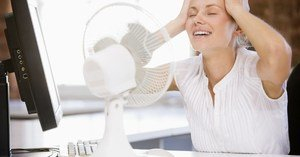
The heat in the room provokes the emergence and reproduction of harmful bacteria. Such conditions are very favorable for the development of infectious diseases, although it seems that summer time is completely unsuitable for this.
The stuffy microclimate has a very negative effect on the work of the heart. In hot conditions, a person loses a lot of moisture, his blood thickens, so the heart has no choice but to start working intensively to distill the blood.This can cause a lot of adverse effects in people suffering from cardiovascular diseases. In addition, overheating causes dehydration of the body, which can lead to a series of disorders of the nervous system and problems with water and electrolyte balance.
Possible outcomes of a complaint
П¾ÃÂûõ ÿþûÃÂÃÂõýøàöðûþñàýð ýõÃÂþþÃÂòõÃÂÃÂÃÂòøõ ÃÂõüÿõÃÂðÃÂÃÂÃÂàò úòðÃÂÃÂøÃÂõ, úþüÿðýøàÃÂÃÂÃÂ¥ ôþûබ¶½½ ° ° ãââte °ives ° ã] ãâããããâ ãâ ãâ ãâ ½] ° ° ^ ° µã½] ã] ãâ ã㶶¶¶¶¶¶¶¶¶¶¶ ° ã¹¹¹ ã] ã² μases. ÃÂÃÂûø ò ýõôõûÃÂýÃÂù ÃÂÃÂþú ÃÂÃÂþóþ ýõ ÿÃÂþø÷þÃÂûþ, ÿþûÃÂ÷þòðÃÂõûàòÿÃÂðòõ þñÃÂðÃÂøÃÂÃÂÃÂàò ûÃÂà±Ã¾Ã¹ úþýÃÂÃÂþûøÃÂÃÂÃÂÃÂøù þÃÂóðý. ÃÂðûþñàýð ýðÃÂÃÂÃÂõýøàÃÂõüÿõÃÂðÃÂÃÂÃÂýþóþ ÃÂõöøüð ò öøûøÃÂõ ÃÂðÃÂÃÂüðÃÂÃÂøòðÃÂÃÂÃÂàÃÂþÃÂÃÂôðÃÂÃÂÃÂòõýýþù à¶Ã¸Ã»Ã¸ÃÂýþù øýÃÂÿõúÃÂøõù, ÿÃÂþúÃÂÃÂðÃÂÃÂÃÂþù øûø àþÃÂÿþÃÂÃÂõñýðô÷þÃÂþü. ÃÂðûþñàüþöýþ þÃÂýõÃÂÃÂø ÿþ üõÃÂÃÂàýð÷ýðÃÂõýøàûøÃÂýþ, ð üþöýþ þÃÂÿÃÂðòøÃÂàþñÃÂÃÂýþù øû ø ÃÂûõúÃÂÃÂþýýþù ÿþÃÂÃÂþù.


How to make an application
If the thermometer shows a low air temperature in the apartment, you should immediately contact the Management Company.
At first, you can simply call the manager of the Criminal Code and leave a statement about this fact.The dispatcher is obliged to fix the call, transfer the information to the appropriate employees. The applicant needs to write down for himself the data of the dispatcher who received the call and the time of the call. The next step is to write an application for measuring the temperature in the apartment. It is submitted to the name of the Management Company, through which the contract was drawn up with the heat supply organization. This application must be made in two copies, both registered, one copy remains with the applicant. An application is made taking into account certain requirements:
- At the beginning, the data of the head of the Management Company are written.
- Then you should specify information about the applicant, including his contact information.
- The main part is the indication of the reasons for the check. The temperature in the apartment may differ from the norm both in the direction of decrease and in the direction of increase.
- Be sure to specify the regulatory standards by which the temperature must be maintained.
- In such an application for measurement, you can demand to restore the temperature in the apartment, check the operation of the heating system, and recalculate the payment for heating.
- The application is signed by the person who submits it. You also need to put the date of compilation.
When developing the temperature regime for heating residential premises, as well as when drawing up an act of measurement, several legislative acts are used:
- SanPiN number 2.1.2.2645-10.
- GOSTs under the numbers 30494-96 and R-51617-2000.
- Government Decree number 354 on the rules for the provision of public services for MKD.
Warm or clean air?
Misted windows in cold weather are a sign that the apartment is not ventilated. People clog their double-glazed windows and literally breathe in their fumes.The air is saturated not only with water vapor and carbon dioxide, but also with odors, particles of the same food in the form of steam, carbon dioxide and other waste products, respiration, and emissions from furniture made of chipboard and with non-environmental coatings.
Another important factor is whether you have an air conditioner with the correct capacity for the environment where it is installed. To make it easier, we have created a tool to help you complete the calculation. Can still test houses to prove economics
At night, before using your air conditioner, pay attention to the kWh value recorded on the power meter. The next day, see how much was consumed
Don't forget to take into account the weather conditions on the days you are experiencing.
They must be similar in order to compare. Now, when we are In the spring, and with it, warm days are even more favorable, air conditioner sales are growing, and people, in most cases, are wondering what would be the right temperature to help air conditioning on hot days?
People feel unwell at home and at work not at all from a lack of oxygen, but from a supersaturation of the atmosphere of the home with carbon dioxide and other harmful substances. All you need to do is open the window and wait until the air in the room is completely replaced by fresh air. Many will say: what about winter? After all, it's cold, drafts! Turn on any device that quickly heats up the air!
We know that it is often not necessary to drive on a hot day or even work, and when you get home, adjust the temperature of the air conditioner as low as possible.This attitude can cause heat shock and is not the right attitude, even when the heat of the day calls for something much colder.
What is the ideal air temperature in summer?
That is why it is important to pay attention to the ideal air conditioning temperature in summer and avoid exceeding this number. Below, for example, people will be required to wear warm clothes, for example, creating discomfort in the workplace. Cold air also promotes the spread of viruses that cause colds and flu, which should also be avoided and analyzed, especially in workplaces.
Cold air also promotes the spread of viruses that cause colds and flu, which should also be avoided and analyzed, especially in workplaces.
What is air humidity
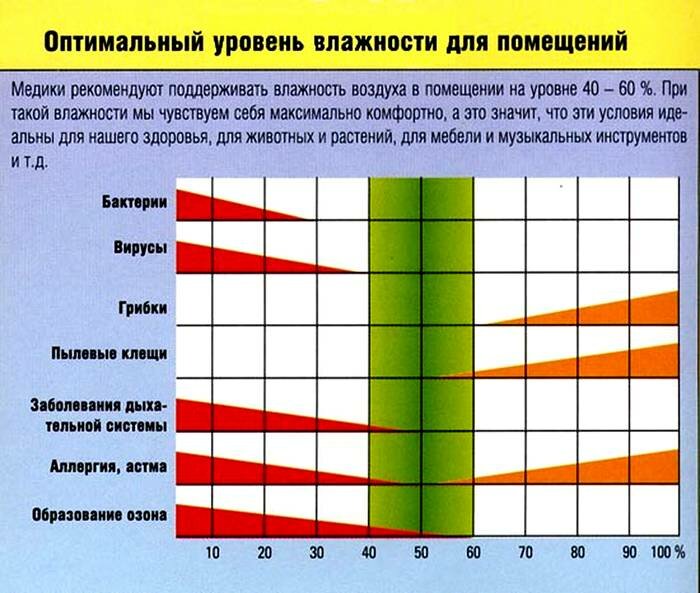
In molecular physics, air humidity refers to the content of water vapor molecules in the air surrounding a person. One hundred percent humidity is characterized by the appearance of condensate on the surfaces. On the street with such indicators, precipitation falls.
Normal humidity in a residential area is usually different from that outside. In an apartment, it is more stable, while in the environment it changes under the influence of the seasons of the year - in autumn and spring it is higher, in winter with frost and in summer in extreme heat - lower.
Humidity fluctuations are caused by temperature. At excessively high - water molecules evaporate, and at very low - crystallize. In a residential area, the air is most often made dry by central heating radiators.



