
- How can you solve the problem of inconsistency in the set temperature regime?
- Step-by-step instructions and required documents when filing a complaint
- How to correctly measure the temperature of the coolant?
- Standards according to GOST
- Humidity standards for the situation in the apartment
- How to normalize the level of humidity in the room
- If the humidity level is low
- If the air humidity is high
- What should be the temperature in the room?
- Room temperature
- Humidity in the apartment: the rate of water content for comfortable living conditions
- What are the consequences of a deviation from the norm of humidity in an apartment: dry air
- What are the consequences of exceeding the norm of humidity in the room
- Tips for normalizing the microclimate
- What is air humidity
- Humidity rate
- Humidity norm according to GOST
- Humidity in the children's room
- Deviations from the norm
- What determines the optimal temperature of the apartment
- Different opinions about comfortable temperature
How can you solve the problem of inconsistency in the set temperature regime?
How to solve the problem of compliance with the temperature regime in the apartment?
If the temperature in the apartment does not meet the standards, then measures must be taken to solve this problem.
First of all, the residents themselves can take certain actions.Check the thermal insulation of windows and walls, the operation of batteries and other parts of the heating system.
In part, the low temperature will help improve the thermal insulation of the apartment, replace batteries, and other similar actions.
You can use additional devices for heating. Or install an air conditioner that will solve the problem of low and high temperatures.
However, a consumer who regularly pays for heating should not incur additional costs due to the poor performance of public utilities.
Therefore, you should contact your management, service company to fix the problem. The master must make certain measurements, draw up an act and fix the problem.
Step-by-step instructions and required documents when filing a complaint
In order to competently draw up a claim, it is necessary to prepare a sample and follow the rules for the workflow of such papers. The claim consists of a header, the text of the document itself and the applicant's visa.
The complaint for non-compliance with the temperature norm in the apartment during the heating season in 2020-2021 includes the following information.
In the header:
- name of the addressee;
- applicant's data;
- details of the contract for the provision of public services;
- reference to microclimate standards in residential premises;
- information on the results of measurements and the act (with the application of the act);
- consequences of violations (compensation);
- requirement for the provision of good quality services.
In the center of the document, its type is indicated, that is, the claim.
At the beginning of the text, it is usually said about the grounds on which the company provides heating services and the requirements for their quality. First of all, reference should be made to the Decree of the Government of the Russian Federation.
After that, the violations identified during the measurements and noted in the act are described.
Next, you need to specify your requirements. Firstly, it is necessary to indicate the need to eliminate the problem as soon as possible, and secondly, to recalculate the payment for the provision of heat supply services.
The document is printed in two copies, which are signed by the owner of the premises and transferred to the housing and communal services authority. One copy remains with the secretary of the organization, and the incoming number and date are affixed on the second.
Download a sample complaint for non-compliance with the temperature in the apartment during the heating season in 2020-2021 can be downloaded here.
How to correctly measure the temperature of the coolant?
In the heating system, the heat carrier is hot water, heated to the required temperature. The current legislation has established temperature standards for the coolant in an apartment building. According to regulatory documents (SNiP 2.04.05), the following parameters are considered the norm:
If there are still controversial issues, you can also consult for free in the chat with a lawyer at the bottom of the screen or call Moscow; St. Petersburg; ext.480 Free call for all Russia.
To measure the coolant, an alcohol thermometer must be placed on the radiator. After a few minutes, check the result, to which one degree should be added. For a more accurate measurement, you can use a room infrared thermometer.

You can also take readings of the temperature of the coolant in the apartment using an electric meter, which is fixed on the battery using a thermocouple wire.
The easiest way is to measure the temperature of tap water poured into a glass.
Standards according to GOST
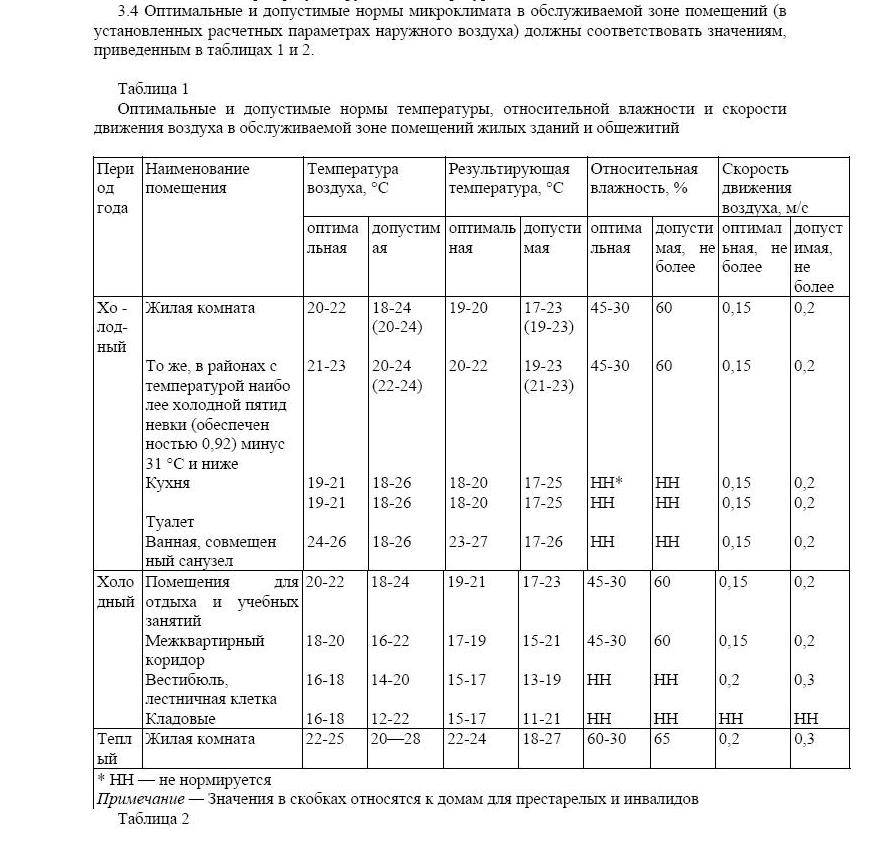
The temperature in the apartment can be regulated at the state level.In Russia, there is a very interesting document that regulates the normative values of indoor microclimate parameters, and it is called GOST 30494-2011.
However, in addition to GOST, you can be guided by common sense. Temperature standards in residential premises should also take into account the purpose of these rooms. Sleeping rooms should be ventilated and moderately cool, as a hot room is more difficult to fall asleep, and a cold one is more conducive to nightmares.
Comfortable temperature for children's rooms is adjusted according to the age of the child. The optimal temperature for the baby is at the top of the standard, as the child grows older, the mark of his thermometer approaches the lower limit of the norm, and then moves on to the standard of other living rooms.
The comfortable temperature in the bathroom is largely due to the humidity of this room. If the temperature norm is violated due to the high water content in the air, a feeling of dampness and dankness occurs.
Humidity standards for the situation in the apartment
The use of furniture and appliances should be made taking into account certain indicators. These standards are set by the manufacturers.
The following values are provided for:
- furniture and antiques, the optimal level is 40-60%;
- household appliances - 45-60%;
- books and paper products - 30-65%.

In relation to plants, separate indications are established, which depend on the variety of the flower. For example, for representatives of the tropics, it is necessary to maintain a humidity of 80-95%, otherwise the standard is 40-70%.
Thus, the norm of air humidity in the apartment is set by GOSTs and SanPiNs.Violation of these requirements leads to the formation of diseases of the respiratory system in citizens, systems in the house begin to collapse.
How to normalize the level of humidity in the room
For a comfortable microclimate in the apartment, you must:
- regularly do wet cleaning;
- ventilate the room;
- grow indoor plants.
If the humidity level is low
Most often, in the winter season in the apartment, the humidity index is lowered. To normalize it, you need to take measures:
- In winter, place water containers on radiators.
- Dry the washed clothes indoors by hanging them on radiators.
- Spray generously on houseplants.
- Hang wet towels on running radiators, wetting them as often as possible.
- Keep the bathroom door open.
- Install an aquarium or a small decorative fountain.
But the most modern way to increase the humidity in the air is a special humidifier, into which water is poured, which evaporates during operation of the device.
The traditional humidifier is equipped with a fan that drives the air through the water tank and at the same time cleans it from dust and moisturizes.
In a steam humidifier, water boils and steam comes out. You can even use hard or dirty water for it. Such a device can be sold with built-in nozzles and used as an inhaler.
An ultrasonic humidifier converts water into steam using a special membrane. With it, you can fight germs in the room. However, only distilled water should be used for it, or special cartridges should be installed that will soften and purify the water.
If the air humidity is high
If the indicator is above the norm, it is recommended to install an air dryer in the apartment. The principle of operation of the device:
- humid air is driven through the evaporator, in which the temperature is lower than in the room;
- due to the temperature difference, moisture turns into condensate, which flows into a special container;
- the air is heated and enters the room without excess moisture.
Dehumidifiers can be portable and stationary, which are mounted in the wall and have a high performance.
An oil cooler equipped with a fan can also be used as an air dryer.
Extractors must be installed in the kitchen and bathroom. They will help fight moisture and excess odors.



If the humidity index is increased, then it is not recommended to dry the washed laundry in the room, and the sink and bath should be wiped immediately after use.
But, with any indicators of air humidity, it is necessary to ventilate the room as often as possible. Oxygenated fresh air kills bacteria, fungi and neutralizes dust mites. And most importantly, it normalizes the humidity in the room, while establishing a comfortable microclimate for a person, which is so important for health and well-being.
What should be the temperature in the room?
In different countries and cities, the norm of a comfortable temperature regime is different, and this is due, first of all, to the climatic features of the area. In order to determine what air temperature is optimal for a particular room, one must also take into account how humid the air is in it.
In addition, it is worth noting that depending on the season, the microclimate also changes.For example, in winter, the apartment is heated with a battery and the temperature in it is slightly lower than in summer, when heating replaces the warm sun.
In the cold season, the air in the room should be warmed up to +22 degrees Celsius, and in the warm season - up to +25. At first glance, this difference may seem insignificant, but in fact it is not.
Room temperature
Perhaps it is no secret to anyone that the air in the apartment is heated unevenly. The temperature regime largely depends on what function the room performs:
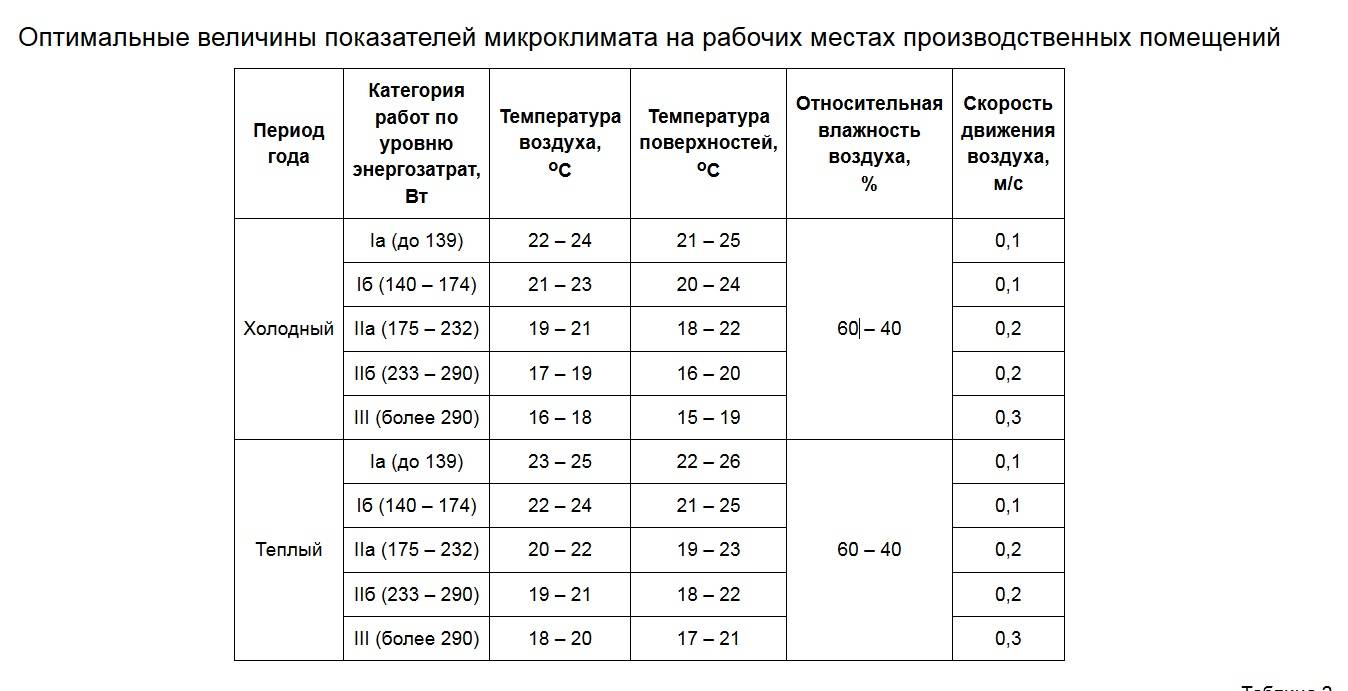
- In order not to suffer from headaches and not suffer from insomnia in the bedroom, it should fluctuate from 17 ° C to 18 ° C.
- Such a room as a kitchen itself contains many items that contribute to an increase in room temperature: an oven, an electric kettle, a stove, etc. Therefore, the air in it should be warmed up only to 19 ° C.
- The proper temperature for the bathroom is slightly higher than for other rooms. It should be 24-26 ° C, because, otherwise, this room will seem too damp.
- One of the most important rooms in the apartment is the children's room. The temperature in it depends on how old the child lives there. So, for example, a newborn baby feels most comfortable if the temperature is somewhere around 23-24 ° C, and an older child needs a lower temperature regime - 21-22 ° C.
- In other residential premises, the optimum air temperature can vary from 18 to 22 ° C.
In addition, it is worth noting that the proper temperature regime must be maintained in all rooms and at the same time try to ensure that when moving from one room to another, you do not feel too strong changes in air temperature. A normal and comfortable temperature regime for a person implies that by moving, for example, from the living room to the kitchen, you will not feel a significant difference, since the temperature will change by a maximum of 2 degrees in one direction or another.
Humidity in the apartment: the rate of water content for comfortable living conditions
The optimal level of air humidity is one of the components that provide comfortable climatic conditions for human habitation. Moreover, each of the rooms, depending on its purpose, has its own microclimate. Most often, people care about the temperature and quality of the air masses in the house, forgetting about this indicator. But it is the number of water (steam) molecules in the composition of air that affects the perception of temperature by the human body, the safety of the indoor environment and the condition of plants.
Humidifiers are household appliances for maintaining an optimal level of humidity.
Deviation from the norm is possible, both in the winter season and in the warm period. In both cases, a lack or excess of moisture leads to a deterioration in human health, the condition of plants and damage to furniture, finishes, etc.
What should be the humidity in the apartment (average figures for the main premises):
| Room type | Humidity level, % |
| Canteen | 40-60 |
| Bathroom, kitchen | 40-60 |
| Library and work area | 30-40 |
| Bedroom | 40-50 |
| Children's | 45-60 |
Rooms such as the kitchen, bathroom and lavatory will always have high levels of moisture, so the standard for these rooms is higher than for other rooms.
In a bathroom where there is direct contact with water, the humidity index is higher
What are the consequences of a deviation from the norm of humidity in an apartment: dry air
When the batteries turn on, the air in the rooms becomes dry. As a result, the residents irritate the mucous membrane of the throat and nasal cavity. Drying of hair and skin is observed. If the humidity norm is violated in a residential area, static electricity is generated, which raises dust particles into the air. This process can be the basis for the spread of germs and dust mites.
Excessive dryness of the room entails many negative consequences:
- decrease in the elasticity of the skin, nails and hair - as a result of this, dermatitis, peeling, microcracks and premature wrinkles appear;
- drying of the mucous membrane of the eyes - redness, unpleasant itching and sensation of foreign bodies ("sand");
- blood thickens - because of this, the circulation of blood flow slows down, a person develops weakness, headaches. There is a decrease in efficiency, the heart is subjected to increased stress and wears out faster;
- the viscosity of intestinal and gastric juice increases - the work of the digestive system slows down significantly;
The fact that the air in the apartment is dry will be prompted by the tips of the leaves of plants that begin to dry out.
- dryness of the respiratory tract - as a result, local immunity is weakened, the likelihood of colds and infectious diseases increases;
- air quality decreases - a large amount of allergens are concentrated in the composition of air masses, which, at the norm of indoor air humidity, are bound by water particles.
What are the consequences of exceeding the norm of humidity in the room
An excess of water can also be dangerous for humans, so many people wonder what air humidity is considered normal in an apartment and how to keep climatic conditions within this indicator. The increased content of water vapor in the room becomes an excellent breeding ground for fungi, mold and harmful bacteria.


With high humidity in the room, mold and dampness appear
In such conditions, many problems arise:
- The frequency and severity of respiratory diseases increase - diseases such as bronchitis, runny nose, allergies and asthma become chronic, difficult to treat.
- The microclimate in the rooms becomes unacceptable for life - people feel damp or stuffy in the rooms.
- The feeling of freshness is lost - the excretions of multiplying pathogenic organisms cause the appearance of unpleasant odors.
- Increases the drying time of washed laundry.
An increased indicator of air humidity in the apartment is also harmful to the situation. Plants begin to rot, mold appears on the ceiling and walls, wooden surfaces undergo deformation changes. Books and other paper products change structure.
An excess of moisture leads to damage to furniture and finishing materials.
Tips for normalizing the microclimate
To maintain the proper microclimate in the apartment, you can use the recommendations of specialists.
So, to deal with too dry air, apply:
- folk methods;
- special devices.
A decorative fountain, a spacious aquarium with colorful fish or flowerpots with home flowers are not only spectacular interior decorations, but also an effective way to maintain normal humidity in the atmosphere of a living space, such as a living room.
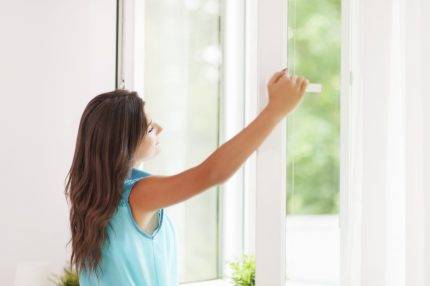
An elementary effective way to increase the content of water vapor is regular wet cleaning and ventilation of the room. They guarantee the maintenance of an optimal microclimate in the room.
A simple but quite effective remedy is to place water containers near heaters or on radiators. The liquid in the vessels must be added as it evaporates.
Alternatively, wet towels, napkins or other pieces of cloth are thrown over the batteries. You can also hang your laundry to dry in the room.
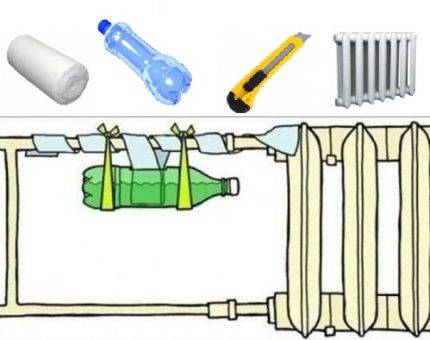 An elementary device made of a plastic bottle and a bandage can become an alternative to a complex device (+)
Special moisturizing devices will help to radically solve the problem with the level of humidity, the work of which is based on various methods:
- a mechanical humidifier with a fan, quite noisy, but not very efficient - 50-61%;
- a steam humidifier that functions similarly to an electric kettle. It is able to increase the rate of vapor content by 60%;
- ultrasonic humidifier, the method of operation of which is based on the spraying of water droplets using a piezoelectric emitter. The device, which quickly raises the humidity to 100%, is quiet and safe.
The first two options are distinguished by their affordable cost and the possibility of using tap water, while a more expensive ultrasonic device requires distilled liquid to operate.
To reduce the degree of humidity in the air, you can also use either traditional methods, or resort to the help of modern devices.
In a humid room, care should be taken to let in as much sunlight as possible. The windows do not need to be shaded with curtains, because the rays of the sun perfectly dry the air. Housing should be ventilated regularly to let in fresh air.
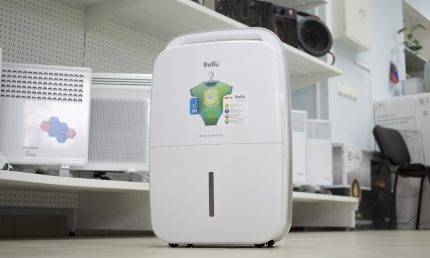 There are various models of air dryers. These household appliances are capable of removing daily from 12 to 50 liters of moisture.
Forced exhaust ventilation can be installed in all rooms, and it is better to cook in the kitchen by turning on a powerful hood
If an air conditioner is installed in the apartment, it is important to choose the optimal mode of its operation.
If the air temperature is insufficient, it is worth considering the use of additional heating devices. When performing construction and finishing works, it is desirable to prefer natural materials that absorb moisture well.


The best results can be achieved using special devices.
The two most commonly used devices are:
plastic containers filled with adsorbents - substances that actively absorb water vapor; it is important not to forget to change the filler as it is moistened;
household dehumidifiers, which are usually based on the principle of condensation of atmospheric water vapor on a plate, the temperature of which is below the dew point.
To normalize the microclimate in the room, it is important to pay attention to windows and window receptions.It is best to insert modern double-glazed windows made using new technologies that guarantee air circulation
What is air humidity
In molecular physics, air humidity refers to the content of water vapor molecules in the air surrounding a person. One hundred percent humidity is characterized by the appearance of condensate on the surfaces. On the street with such indicators, precipitation falls.
Normal humidity in a residential area is usually different from that outside. In an apartment, it is more stable, while in the environment it changes under the influence of the seasons of the year - in autumn and spring it is higher, in winter with frost and in summer in extreme heat - lower.
Humidity fluctuations are caused by temperature. At excessively high - water molecules evaporate, and at very low - crystallize. In a residential area, the air is most often made dry by central heating radiators.
Humidity rate
Humidity is a parameter that can be absolute or relative. Absolute humidity is the weight of moisture in one cubic meter of air.
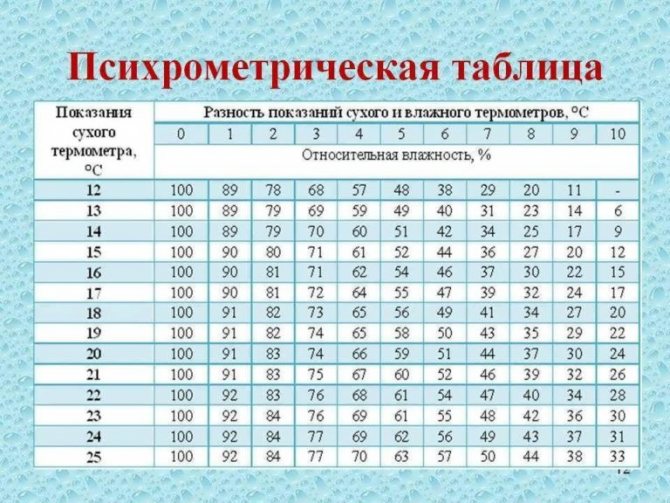
However, when determining the microclimate, not absolute, but relative humidity is used. This parameter depends on the maximum water-to-air content at the current temperature. To determine it, you need to divide the weight of real water vapor in the air by the maximum possible and multiply by one hundred percent.
Humidity norm according to GOST
Interstate standards determine the most comfortable indoor humidity for a person by the document GOST 30494–96.According to these settings, the optimal humidity in a residential building during the cold season is 30-45%, the maximum allowable is 60%. In summer, the most comfortable conditions are provided by relative humidity from 30 to 60%, but an indicator above 65% is considered unacceptable. These parameters are set for residential (bedroom, living room) and walk-through rooms (corridor).
GOST specifies that the optimal values of relative humidity are not standardized for the following premises:
- kitchen;
- bathroom, toilet or combined bathroom;
- pantry.
Humidity in the kitchen, bathroom and pantry is not regulated by GOST
Humidity in the children's room
The child's body needs a particularly gentle and delicate environment.
Children suffer more from a lack or excess of humidity, and therefore it is extremely important to regulate the microclimate in the children's room. Optimum humidity for a nursery is 50–60%
At lower humidity, even if it meets the GOST standards, the child's mucous membranes and nasopharynx begin to dry out. Such a norm should be maintained at any time of the year - both in winter and in summer.



Humidity in the children's room should be higher than in the "adult" living space
Pediatricians recommend maintaining 60% humidity in a healthy child's room and increasing it to 70% if he has a cold. This measure will improve the baby's well-being, reduce perspiration and itching, relieve unpleasant symptoms of the disease and speed up recovery. However, when increasing humidity, do not forget to monitor the air temperature - it should not be higher than 22 ° C. Otherwise, the child's room will have an unbearably stuffy "tropical" microclimate.
Deviations from the norm
If the indoor humidity is below 30%, the residents of the house may experience the following problems:
- Peeling of the skin.In people with the most sensitive and delicate skin, dry air quickly causes peeling and itching. Moisturizing creams and masks will only help temporarily if the bedroom or living room is set to low humidity.
- Constant dryness in the throat, perspiration. When the air we breathe is too dry, our mucous membranes are deprived of the moisture they need. Because of this, we constantly want to cough, there is an unpleasant feeling of itching in the throat. If after a glass of water this feeling does not go away, then it is necessary to increase the relative humidity in the room.
- Decreased immunity, susceptibility to infections. This consequence follows from the previous paragraph - due to insufficient moisture, the mucosa becomes vulnerable to harmful bacteria, and therefore a person who constantly lives in a room with low humidity easily becomes a victim of all kinds of seasonal viral diseases.
High humidity (more than 70%) leads to the following unpleasant consequences:
- Mold, fungus and other pests are actively growing in the house, which not only spoil the aesthetic appearance of the room, but are also the causative agents of allergic reactions. The spread of fungus in an apartment where a small child lives is especially dangerous - this can provoke the appearance of chronic respiratory diseases.
- Diseases of the musculoskeletal system, such as rheumatism. If a person living in such a room undergoes a course of treatment, then after a short relief, the disease will return again - if the humidity in the room is not reduced.
- Repair damage. High humidity has an extremely negative effect on the quality of your interior.Swollen parquet or laminate, peeling wallpaper, unsightly wooden furniture - all these are the consequences of high moisture content in the air.
What determines the optimal temperature of the apartment
The temperature regimes that ensure the comfort of households depend on the climatic location of the housing. In the southern regions and in the northern areas, as well as in the western and eastern latitudes, the norm of house temperature will be different.
As for the countries, their climate is also not the same. And since the climate components, in addition to temperature, are atmospheric pressure together with air humidity, the acceptable thermal range is set by them together.
Different opinions about comfortable temperature
Despite the logical arguments and experimentally verified recommendations of scientists regarding the most optimal air temperature, each person has his own preferences in this regard. Interestingly, the boundaries of comfortable indicators may differ depending on age, nation and region of residence. This is evidenced by studies conducted in a number of European countries.
Many Germans like to relax in tropical states, but at home they prefer more comfortable degrees of air heating. A YouGov survey showed that Germans feel most comfortable at 22.7°C. The survey also shows that with ambient values above 30°C, Germans are too hot. The feeling of optimal numbers is the same for all age groups.
Another situation of sensitivity to cold:
- people aged 18 to 24 find levels below 5°C too cold;
- Germans aged 25 to 34 already feel discomfort at 6°C;
- for residents of Germany over 55 years old, the figure is only 1 ° C.
By the way, 77% of Germans are happy with regular rainstorms in the summer, and 84% of respondents find sudden weather changes unpleasant.
There are also differences in the perception of optimal temperatures with other countries, moreover, located in the same region. The same survey as in Germany was conducted in the UK, and the results were interesting. So, the British consider 21 ° C to be optimal and most comfortable for themselves. And the weather is too hot for them already at 28 ° C.



