
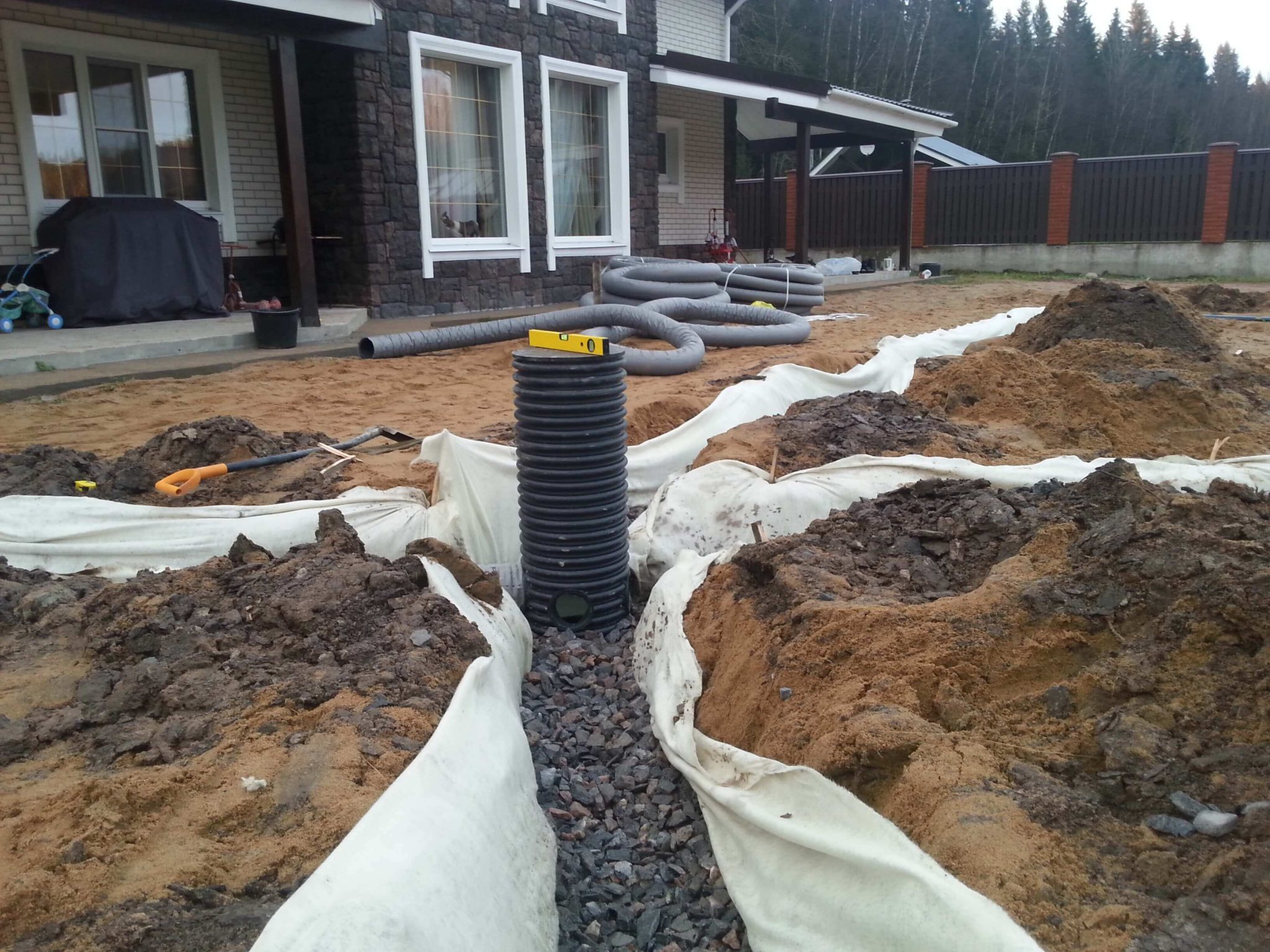
- The procedure for performing work during the construction of drainage systems
- How to build an open drainage system
- How is the construction of a closed drainage
- SNiP Rules for drainage, budgeting and design
- Mounting
- Features of the storm drainage system on the site: how to make a drainage system
- Types of drainage
- Surface drainage
- Deep
- How to calculate what drainage slope
- How to choose drainage pipes
- When is a drainage device necessary?
- How and why does drainage work?
- Design rules and nuances
- #1: Line Depth and Dimensions
- #2: Drainage Slope Standards
- Choosing the right dehumidification system.
- Surface drainage of water from the site.
- Underground site drainage.
- Lowering groundwater drainage.
- Intercepting drainage.
- Storm sewer.
- What is drainage
- When should drainage be provided?
- Where to start the construction of drainage
The procedure for performing work during the construction of drainage systems
In order to successfully build drainage in a summer cottage, you need to be guided by the following general considerations:
- The construction of a closed drainage system requires a large amount of earthwork. In this regard, it is necessary to build drainage even before trees are planted on the site, and even better - before the foundation of buildings is laid.
- Before work begins, a detailed system plan must be drawn up.To do this, it is necessary to study the terrain, determine the highest and lowest points on the site, set the value of the required slope.
- When designing a closed system, revision wells should be included in the plan to ensure the possibility of servicing the drainage system.
- When laying a drainage pipeline, the recommended slope is from two to ten millimeters per meter of pipe.
How to build an open drainage system
Building an open drainage system is a much easier task than laying a closed drainage system, as it does not require digging deep trenches. When laying a network of trenches, a plan for their location is first drawn up. Then trenches are dug. Usually, the main ditches are laid along the perimeter of the site, and the auxiliary ditches are laid from the places of the greatest accumulation of water. In this case, the depth of the trench should be from fifty to seventy centimeters, the width should be about half a meter. Auxiliary trenches should slope towards the main ditches, and main trenches should slope towards the catchment. The walls of the trench should not be vertical, but beveled. The angle of inclination in this case should be from twenty-five to thirty degrees.
The further course of work depends on which system is being built, filling or tray. During the construction of the backfill system, the ditch is first covered with rubble - 2-thirds of the depth is large, and then shallow. Sod is laid on top of the gravel. To prevent silting of crushed stone, it is desirable to cover it with geotextile.
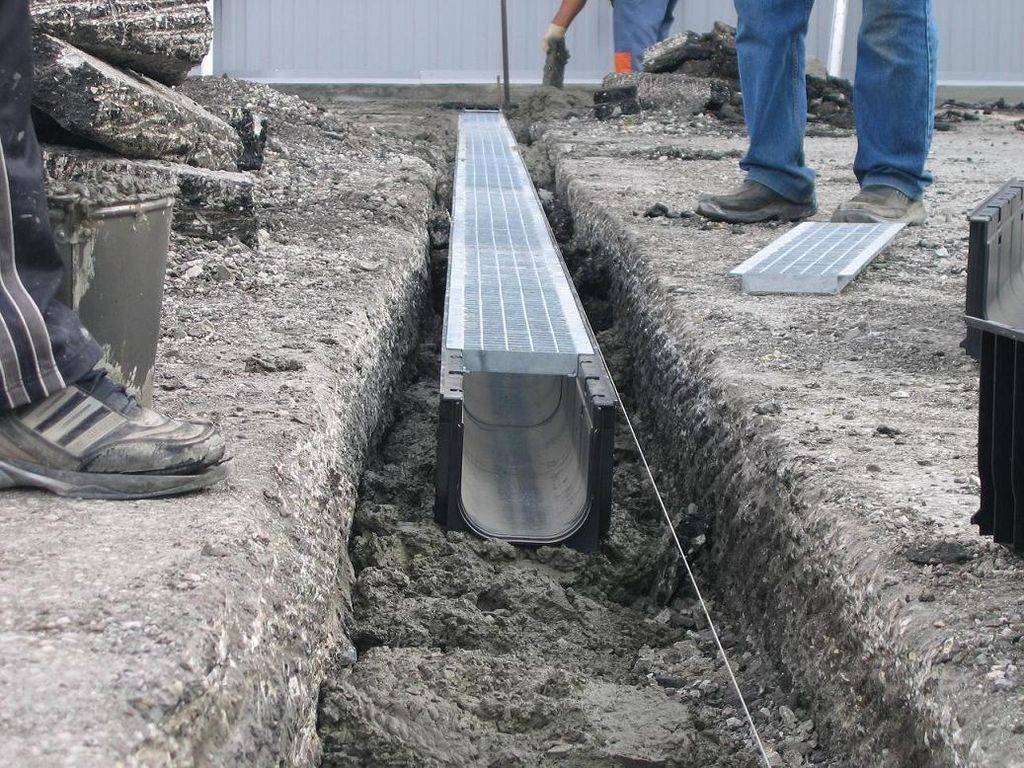
The construction of flume drainage includes the following steps:
- Laying trenches subject to the required slope.
- Filling the bottom of the ditches with a ten-centimeter layer of sand, which must then be compacted tightly.
- Installation of trays and sand traps, which are plastic parts that prevent sand and debris from entering the drainage, and thereby protecting the system from silting.
- Closing the ditches from above with gratings that prevent clogging of the trenches with fallen leaves and various debris, and also perform an aesthetic function.
How is the construction of a closed drainage
The construction of a closed-type drainage system consists of the following steps:
- Studying the relief of the territory of the site using a level and a laser rangefinder, and building a plan for the drainage network. If surveying instruments are not available, then you should wait for heavy rain and observe the movement of rainwater flows.
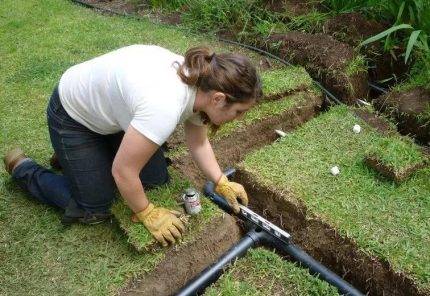
- Laying trenches under the drainage pipeline.
- Backfilling the bottom of the trenches with a layer of sand seven to ten centimeters thick, followed by tamping.
- Laying geotextiles in a trench, while the edges of the fabric should protrude beyond the sides of the ditch.
- Laying a twenty-centimeter layer of gravel on top of the geotextile, which serves as a filter. In this case, limestone gravel should not be used, since this can form a salt marsh.
- Laying pipes on a layer of gravel. In this case, their holes should be directed downwards.
- Filling gravel on top of the pipes and closing it on top with the edges of a geotextile that will filter water from suspended particles, thereby preventing silting of the system.
- Burying ditches with soil, on top of which sod can be laid.
The drainage system should end with a well for collecting water, which must be dug at the lowest point of the site.From this well, water can be discharged into a natural reservoir, into a ravine, or into a general storm drain, if there is one in this settlement.
A properly constructed drainage system will prevent problems associated with excessive dampness, which is why its construction is mandatory in areas with wet soil.
And those owners of summer cottages who are not sure that they can cope with the construction of drainage on their own should contact specialists and pay the required amount, but you should not try to save on such an important functional element of a summer cottage as drainage
Well, that's all guys - I hope I was able to give you an answer to the question: "How to make drainage on the site with your own hands". All success!
SNiP Rules for drainage, budgeting and design
The device and design of the drainage of the foundation of buildings should be carried out in accordance with the requirements of SNiP (Building Norms and Rules). Drainage, made in full compliance with all standards, will serve properly for many years and perform the proper functions.
Basic rules for drafting a drainage system.
measure the level of groundwater
calculate the average monthly rainfall
determine the composition of the soil
take into account the location of the nearest natural reservoirs
measure the level of soil freezing
carry out geodetic measurements of the landscape
At the second stage, the drafting of the project itself is carried out, which includes:
a schematic representation of the future drainage system is drawn up
the calculation of the parameters of the depth of the pipes, slope, section is performed, the features of the assembly are taken into account
components corresponding to the standard size are selected (drainage pipes, wells, fittings)
a list is compiled and the amount of necessary additional materials is calculated.
Properly drawn up project documentation will significantly reduce the installation time of the system, save money on building materials and equipment, and ensure reliable operation of the system.
What is the estimate of calculations for the arrangement of the drainage system
When drawing up the estimate, not only the cost of materials and equipment for laying the drainage system is taken into account, but also the cost of dismantling the coating or foundation pavement and the cost of the work itself, as well as restoring the coating and laying new soil for normal plant germination.
The main components of the estimate for the production of works on the installation of a drainage system are the costs of the following types of work:
dismantling of the old coating or blind area of the building
digging a trench for laying the system
backfilling of crushed stone under the pipe system
installation of inspection wells and a storage well
reinforcement of trench sides
flooring of a new coating or blind area
This is how the cost and quantity of the necessary materials are calculated:
paving slabs or asphalt pavement
new fertile soil
The estimated cost of work and materials will depend on the length of the pipeline and the depth of its immersion in the soil.
Rules for the installation of a drainage system
Drainage design is carried out in accordance with the rules and SNiP 2.06.15-85 and SNiP 2.02.01-83. The closed drainage system is mainly laid at a depth of 0.7 to two meters, with the exception of areas with deep freezing of the soil. The width of the drainage system should be in the range from 25 to 40 cm. It is necessary to take into account the slope of the system, as stated in the SNiP:
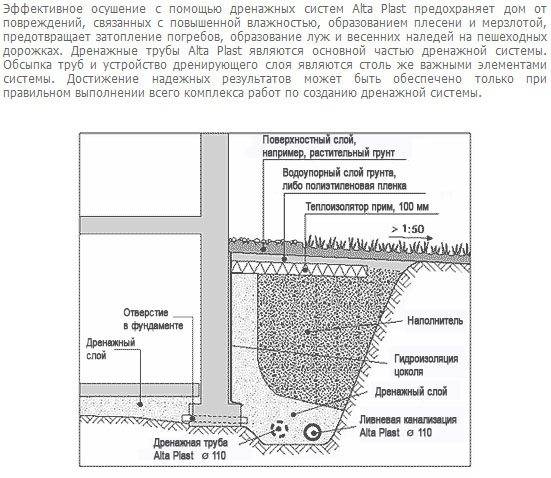




for clay soils, the slope value is calculated at the rate of 2 cm per linear meter of the pipeline
with sandy soils 3 cm per linear meter
The bottom of the trench is covered with a layer of crushed stone with a fraction of 5 to 15 mm, the thickness of the pillow is at least 15 cm. A pipeline system is laid on the crushed stone pillow, drainage wells are mounted, and soil is sprinkled. During the operation of the system, water passes through the drainage system, collects in a collector, and then drains into the nearest reservoir or ravine. The drain site must be cemented and located at an acute angle to the shore of the reservoir. Foundation drainage is controlled by revision wells made of reinforced concrete or plastic pipes. The groundwater level will not only not rise, but also fall, which will significantly increase soil fertility if the drainage system is installed and designed in accordance with the rules of SNiP.
All these rules and standards are known to professionals, so if you decide to do the drainage of the foundation or the entire site with your own hands, first read and study all the rules and regulations, and only then proceed to work. In case the learning process seems difficult to you, entrust the drainage device to specialists.
Mounting
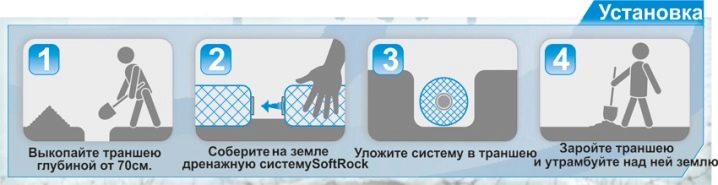
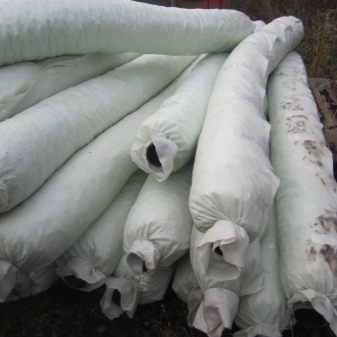
The manufacturer has developed a special installation manual for the SoftRock drainage system, thanks to which you can do it on your own. It is included with the purchase.
The main stages of the installation.
- trench system. Before laying, it is necessary to dig trenches into which drainage pipes will be laid.If the block diameter is thirty centimeters, then the depth and width of the trench should be 45 and 50 centimeters, respectively. Also, one should not forget that for every three meters of the pipe a slope of two and a half centimeters or more is required.
- It is necessary to install a barrier on the blocks; for it, you can take geotextiles or facing cardboard. For finished nozzles, this step is skipped, as they are already wrapped in special material.
- Branch pipes are mounted in places where the pressure on the soil does not exceed twenty-five tons. Otherwise, the depth of the drainage system must be more than sixty centimeters.
Features of the storm drainage system on the site: how to make a drainage system
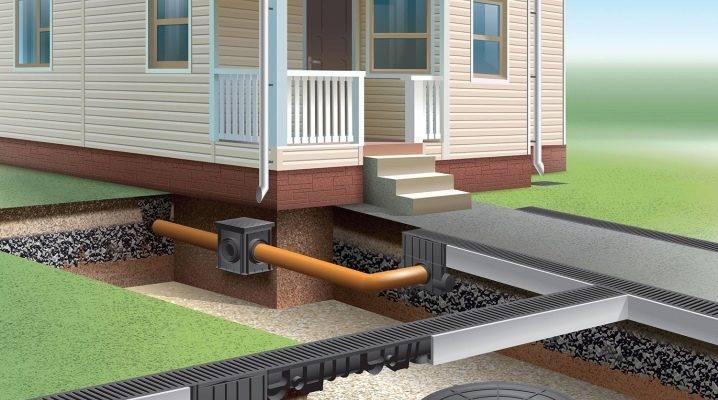
The linear type drainage system consists of gutters that are buried in the soil. These channels carry water from the site to the outside. When arranging such drainage in a summer cottage with your own hands, it should be remembered that the liquid is discharged by gravity.
On sale you can find gutters made of various materials:
- polymer concrete;
- plastic;
- concrete.

The drainage system will help to cope with excess moisture in the garden.
Above the gutters are gratings that perform a protective function. The material for their manufacture can be plastic or metal (cast iron, steel). These elements have a removable design.
On a note! Gutters made of plastic are lightweight and low cost. However, they are subject to deformation changes under the influence of pressure exerted by concrete and soil. To prevent damage to the material, it is recommended to fix the drainage grids “on the shore”.
- gutters are laid in pre-arranged trenches;
- sand traps are mounted in areas where drainage systems and other similar places are located;
- gratings are fixed on the gutters.
Do-it-yourself installation of a linear drainage system on the site is carried out if:
- the angle of inclination of the surface is more than 3 ° (in such conditions, water can be discharged by gravity, which, without drainage, can simply wash out the fertile soil layer);
- it is necessary to divert water from the base of the house in conditions of prolonged rainfall;
- it is necessary to divert water from the relief slopes of the territory;
- household structures are located in the same plane with the surface of the suburban area or below this level;
- there is a need to protect the territory of the summer cottage, as well as entrances and paved paths.
Types of drainage
It should be noted that the classification of drainage systems includes a fairly large number of varieties. And in different sources, this number can differ dramatically, plus the names of the systems will also differ. In this article we will talk about the simplest, but effective measures on how to lower the water level in a summer cottage.
Surface drainage
This is the simplest system, consisting of open ditches, which is called stormwater. That is, its main task is to collect and remove precipitation and water from melted snow. Ditches can be simply dug into the ground or assembled from concrete or plastic trays.
Ditches dug in the ground are covered with rubble or pebbles so that they do not litter. Or leave it open. So that the walls of the ditches do not crumble, they are decorated with pebbles or other durable and waterproof materials. As for the finished trays, they are covered with gratings: metal or plastic.
Typically, such a system is equipped along the tracks, around the perimeter of sites and buildings. Therefore, when the task of constructing drainage for paths in a garden plot is set, then it is the open variety that is used.

Open drainage ditch
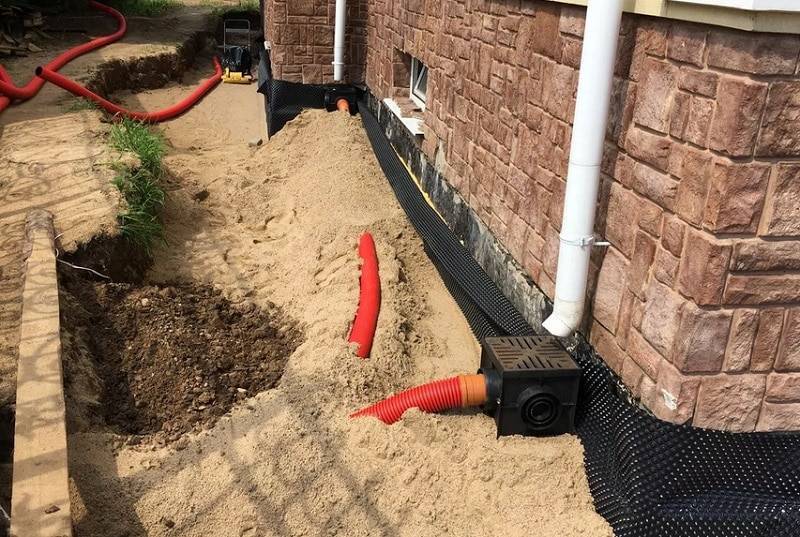
Storm sewers can be assembled from pipes that are laid in ditches to a shallow depth. At the same time, the piping is connected to receiving funnels, where water is drained from the street. Such funnels are usually installed under the risers of the drainage systems of the roofs of buildings and structures, as well as on the territory of a summer cottage, where intensive drainage is required.
Deep
This is a system of perforated pipes, which are called drains, installed at a certain depth. Usually below groundwater level. When they talk about the drainage of a garden plot, they mean exactly this type of drainage system. Its main task is to lower the groundwater level, that is, to partially drain the site.
We will talk about it further.

Preparation of ditches for deep drainage
How to calculate what drainage slope
The only effective solution to the problem is the installation of a drainage system. Owners of sloped sites may think that these concerns are not for them. The water flows off on its own.


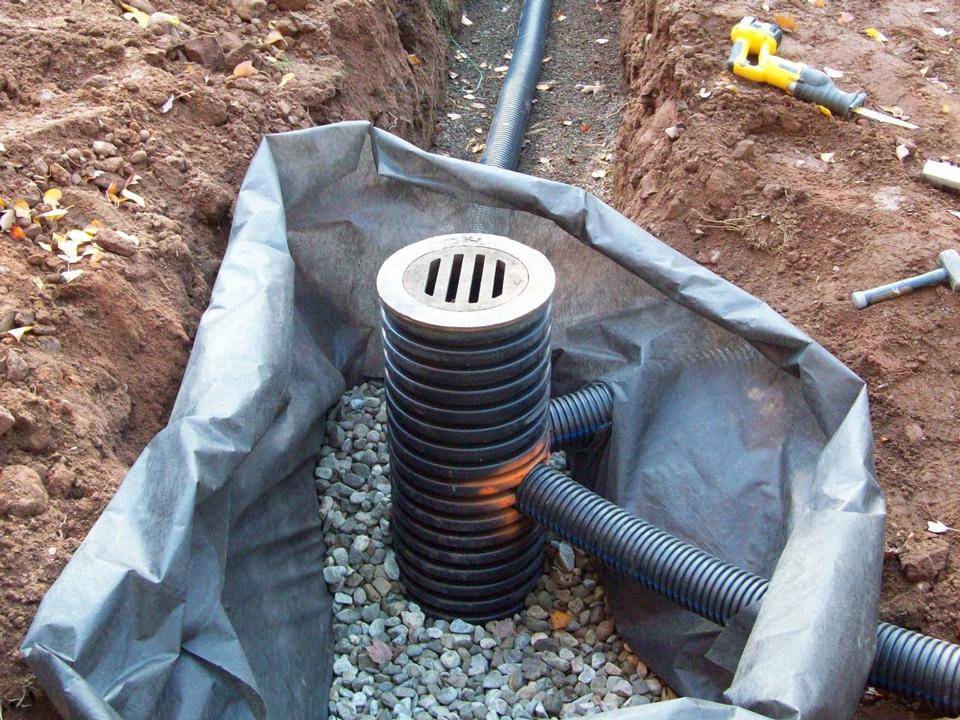
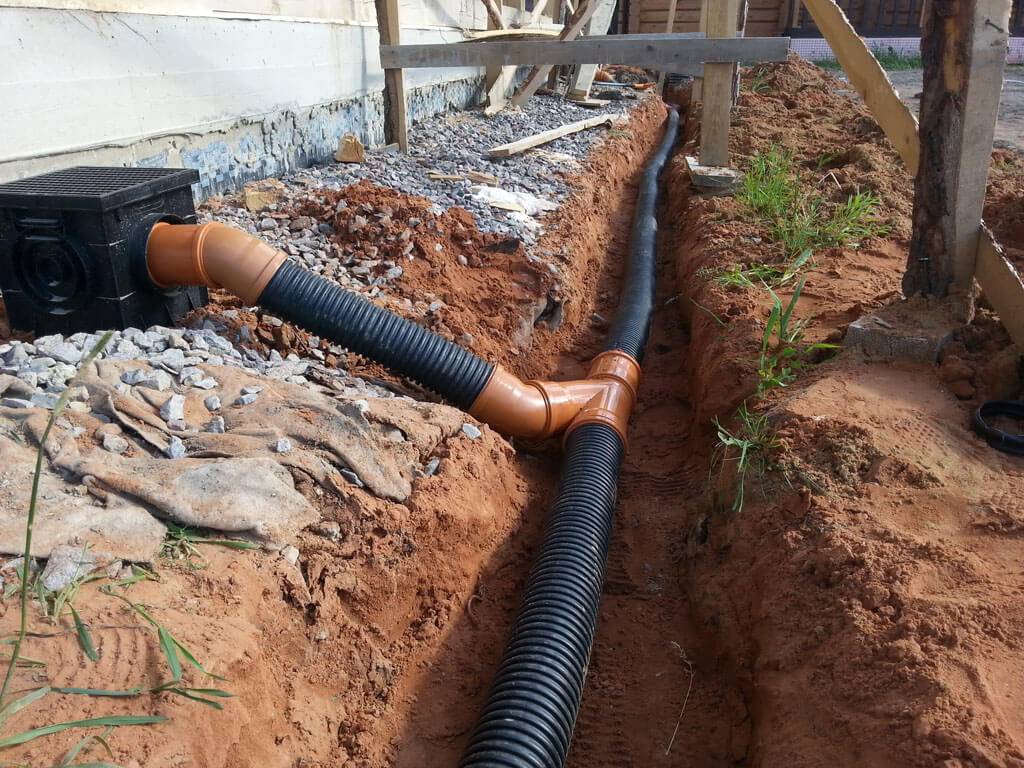


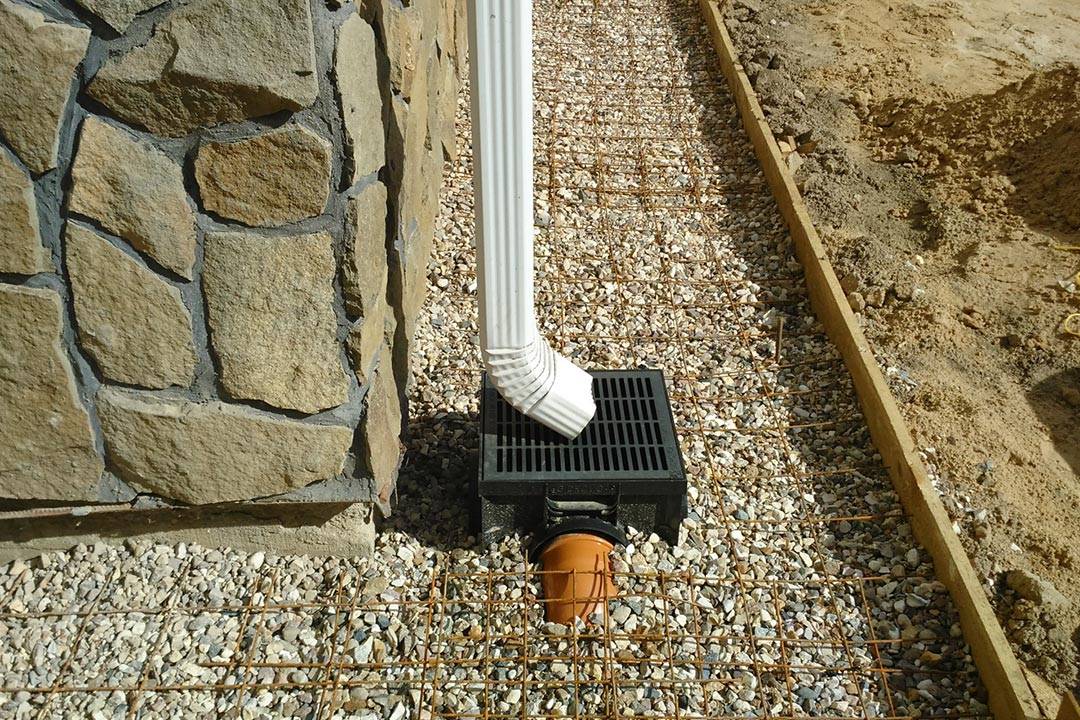


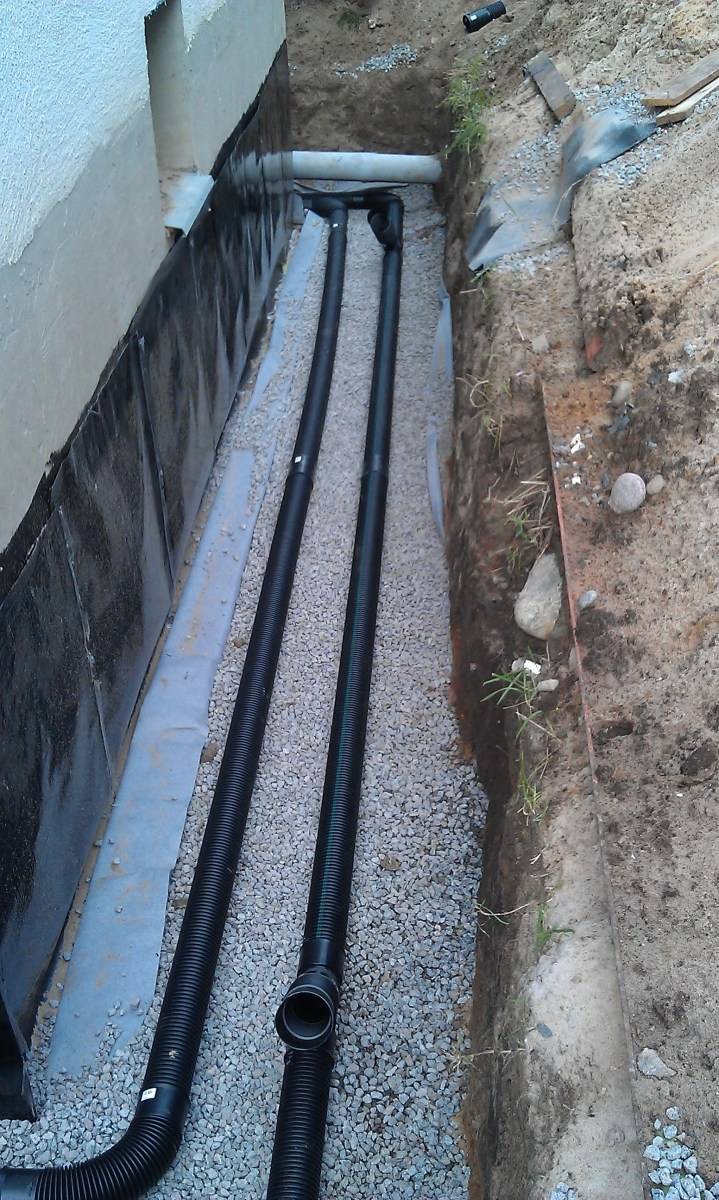
Dangerous delusion. If the slope horizon is less than 8%, the need for drainage is unconditional. As, however, with a steeper location of the land. However, in the latter version, manholes can be dispensed with. The standards allow.
 The slope of the drainage pipe is necessary for the spontaneous flow of groundwater outside the site.
In order for the collection and removal of water from the site to be carried out efficiently, it is necessary to first carry out hydraulic studies. According to their results, an algorithm of actions is built, the necessary materials and structures are selected.
How to choose drainage pipes
Before you install a drainage pipe, you need to decide on the products for work.
It is important to take into account such nuances:
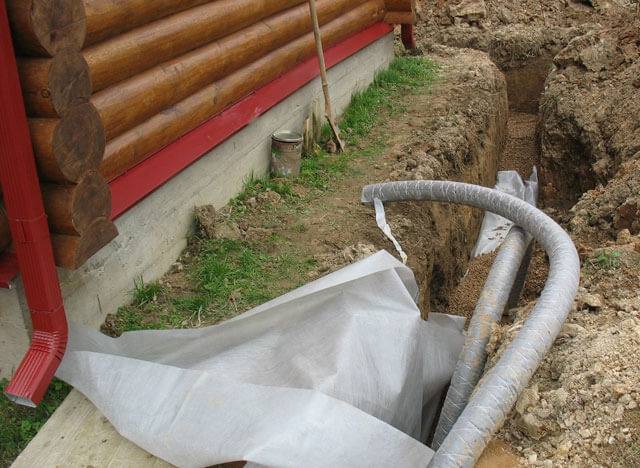
Today, the market for building materials is replete with pipe products from:
- ceramics;
- asbestos cement;
- polymers.
In the arrangement of the drainage system, drainage pipes made of polymers have reached the peak of popularity.
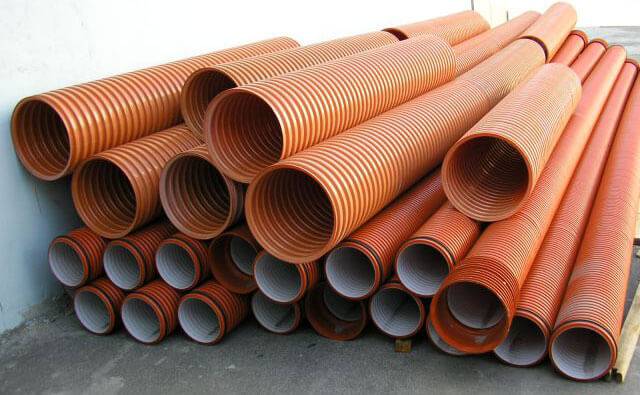
Their advantageous use in comparison with other types lies in the presence of excellent technical characteristics:
- excellent strength;
- duration of application - up to 70 years;
- resistance to silting;
- ease and, accordingly, simplification of the installation and transportation process;
- resistance to aggression of the chemical environment and corrosion processes;
- self-cleaning capabilities due to the smoothness of the pipe surface;
- in an advantageous combination: quality-price;
- ease of maintenance, because thanks to the geotextile filter included in the pipe kit, the drainage system does not need to be flushed.
According to the dimensions, drainage pipes are classified into small and large:
- up to 150 mm - for a system with a small bandwidth;
- up to 300 mm - with increased load.
If the drainage scheme has a branched view, then it is better to use tubular products of small (for branches) and large diameter (for the central branch of the system).
When is a drainage device necessary?
All of the above problems associated with high soil moisture can be eliminated or prevented with the help of a properly arranged drainage system that promptly removes excess moisture outside the site or into a special container. There are a number of signs that clearly indicate the need for a drainage device:
- after rain, puddles and mud remain on the site for a long time;
- for no apparent reason, garden trees and house plants die;
- intense mold growth in basements;
- the soil remains moist even during a brief drought;
- a large number of weeds that love moisture, such as nettles or cattails;
- the location of the site in a wetland or near a reservoir.
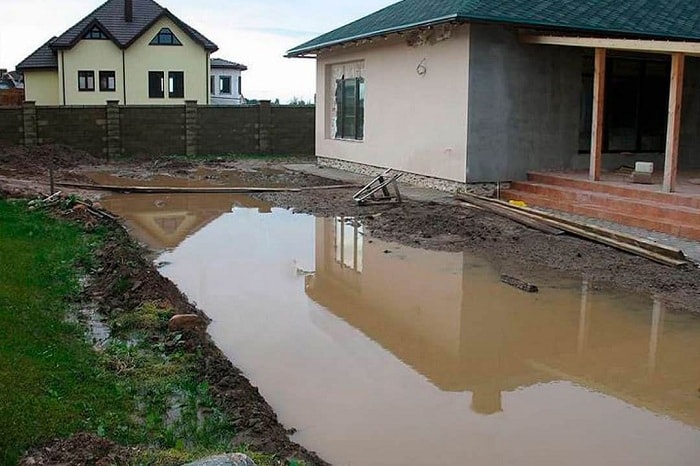
Important! There are signs by which it can be unambiguously determined that groundwater flows no more than 1.5 m from the soil surface. With such a depth of the aquifer, a mandatory drainage system is required.
How and why does drainage work?
An artificially constructed watercourse is a system of underground pipelines and surface channels for collecting water. Moisture enters special containers, and then is removed outside the site. Drainage can be made both in natural reservoirs, and city collectors.
It is possible to determine whether a site needs drainage by indirect signs. The high moisture content of the soil is evidenced by:
- the presence of moisture-loving plants (for example, nettles);
- flooding of cellars and cellars;
- long drying of the site after rain (large puddles remain, from which water does not drain well).
But even in the absence of such warning signs, buildings are not immune to water damage.For example, during heavy rains or during active snowmelt. For this reason, experts recommend, in any case, to mount drainage around the foundation and equip storm drains.
The complete system consists of:
- from drainage pipes;
- storm drains (gutters and storm water inlets);
- sand traps - special mechanical filters at the inlet to the system collector;
- common drainage wells;
- a collector with a check valve (from here the water is discharged into the ground or a reservoir).
Design rules and nuances
Many factors influence the choice of the type of drainage for a country house or the location of channels. For example, the terrain is of great importance. If the house is located on a hill, and the rest of the territory is located at a slight slope, then wall drainage is most likely not required, and groundwater can be removed from the site by creating a system of channels.
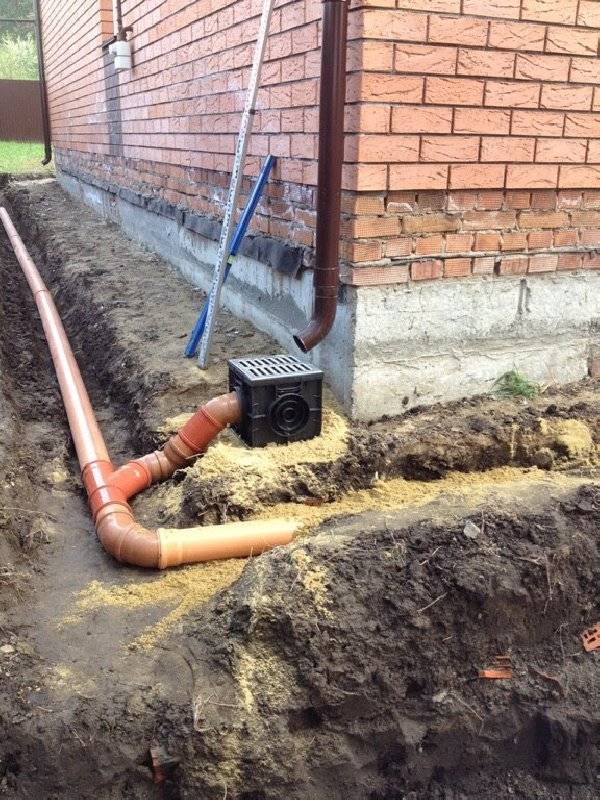

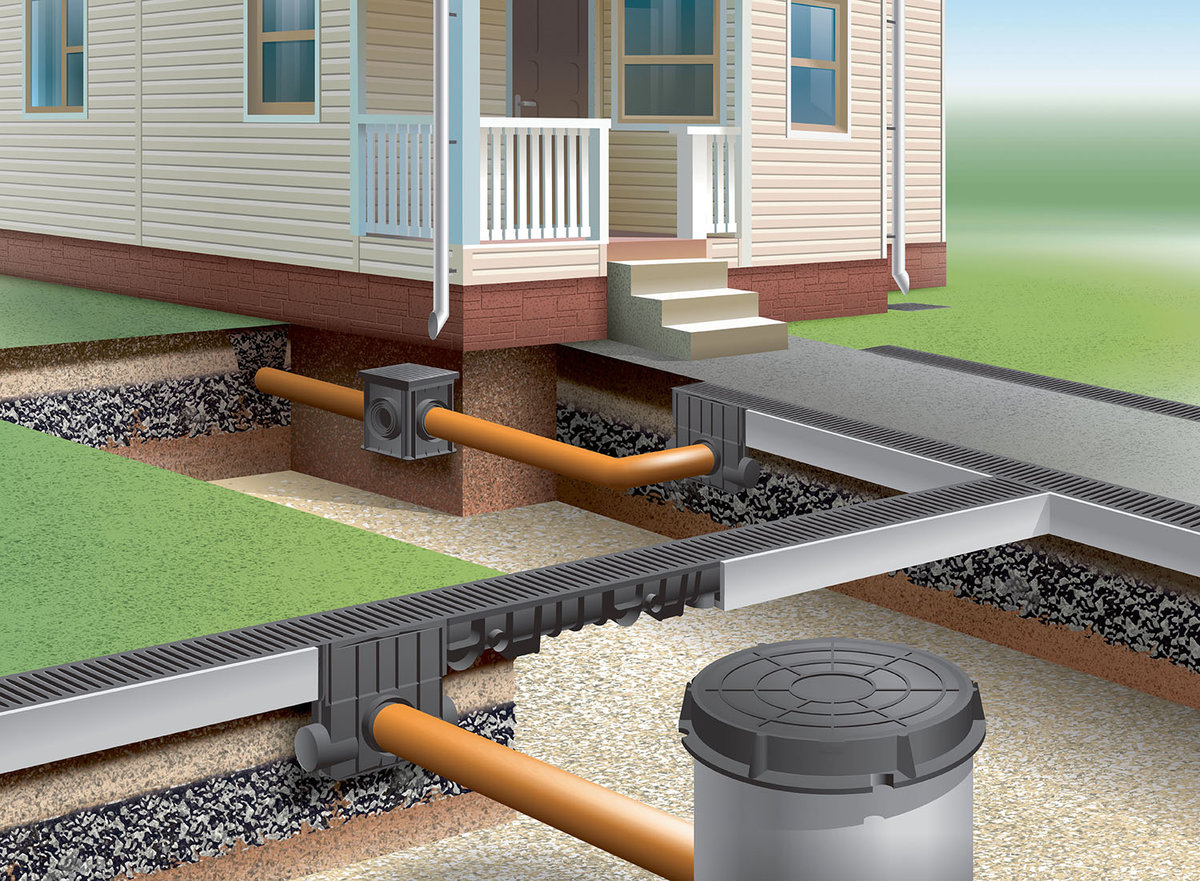
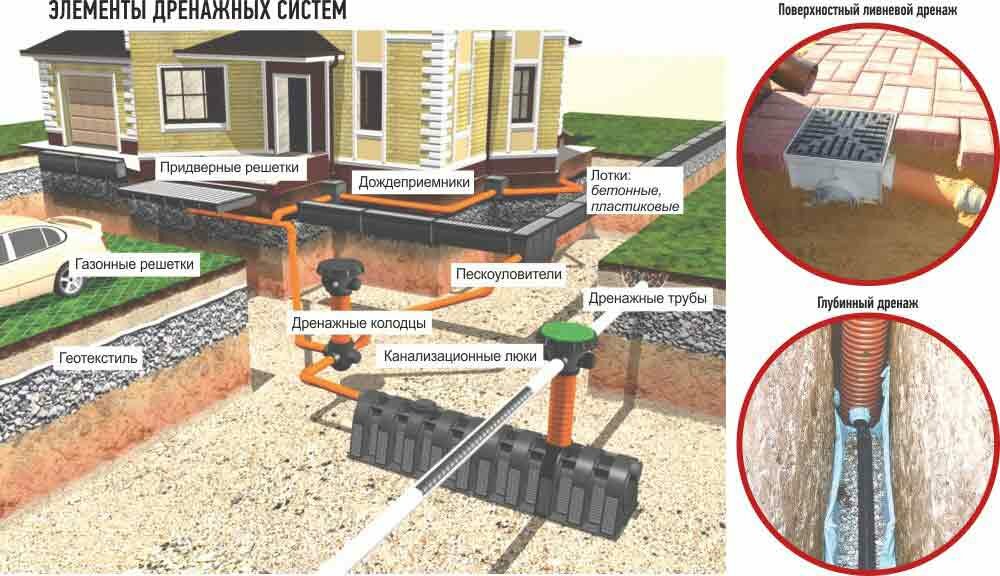
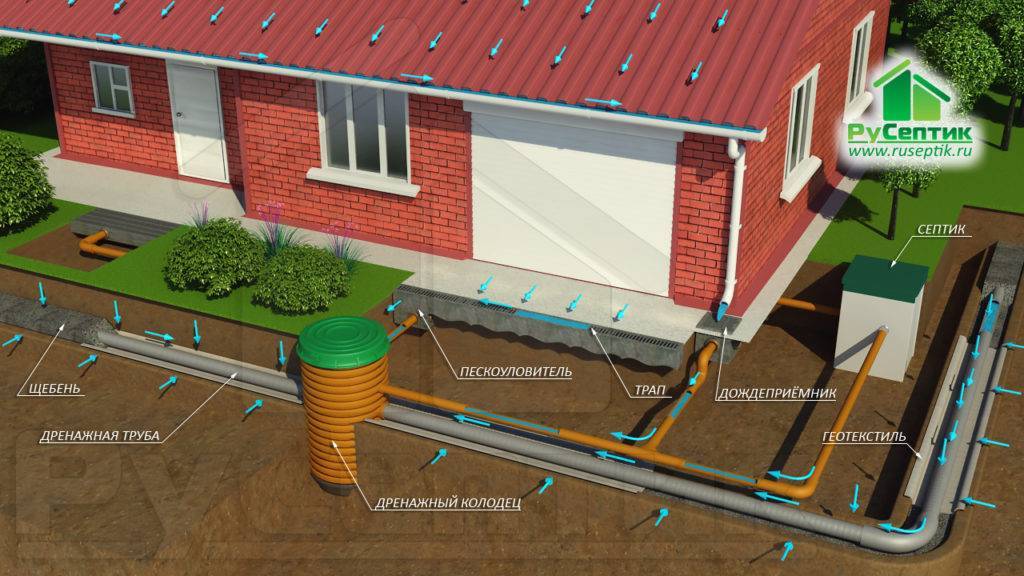
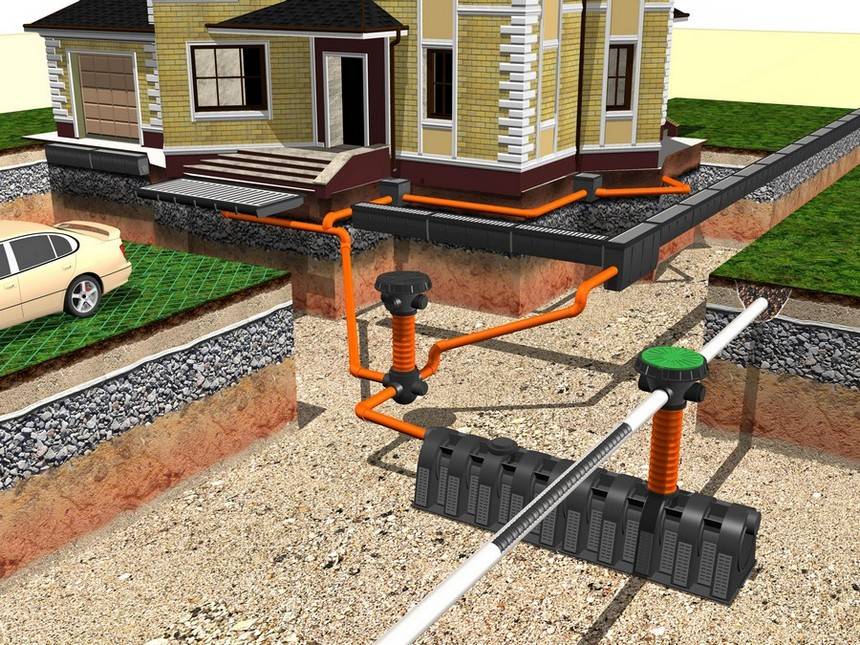

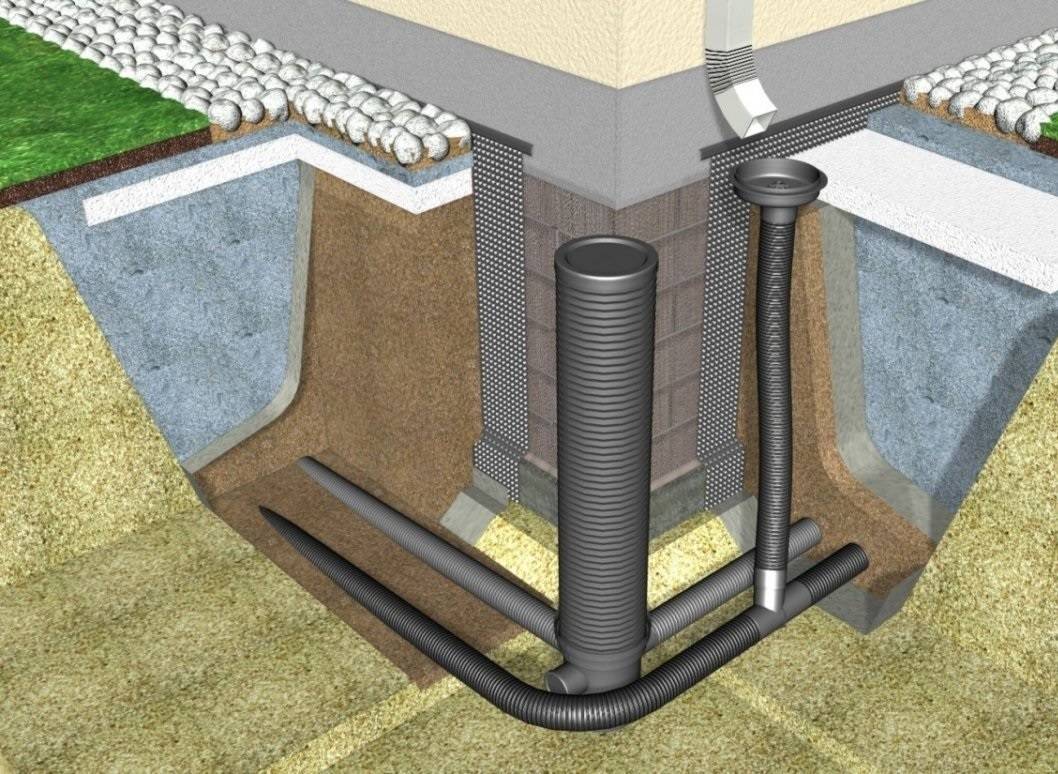
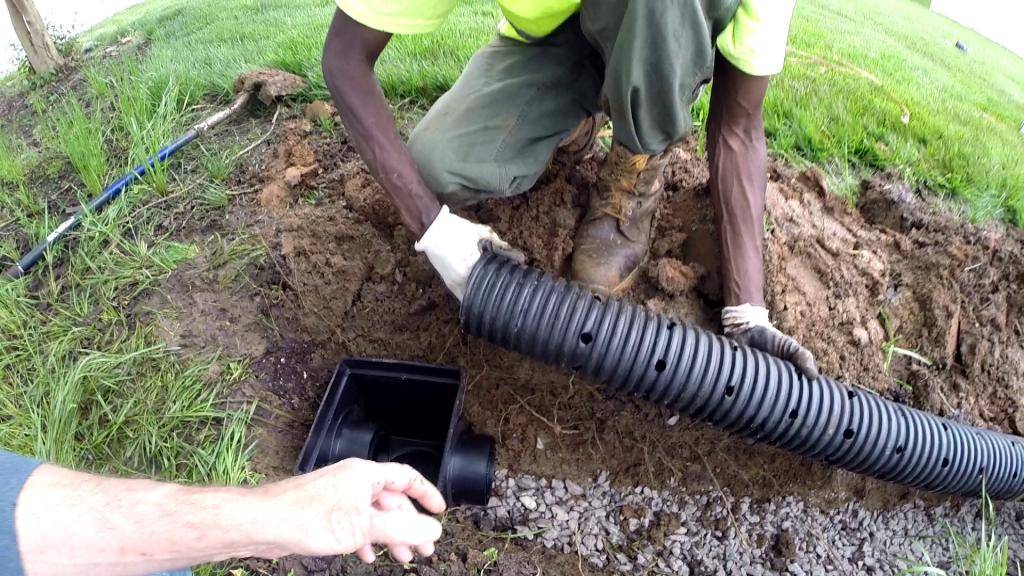
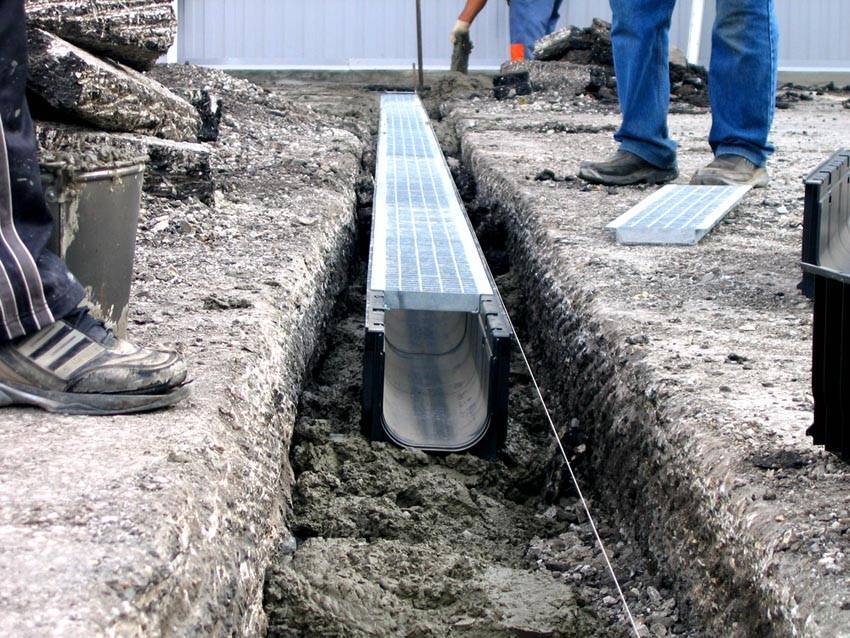
The location of groundwater is important. Difficulties with the installation of buried objects may arise if the level is high enough - from 1.5 m deep
With this arrangement, the installation of a drainage structure is necessary both to ensure the protection of buildings and for the safe development of the soil layer.
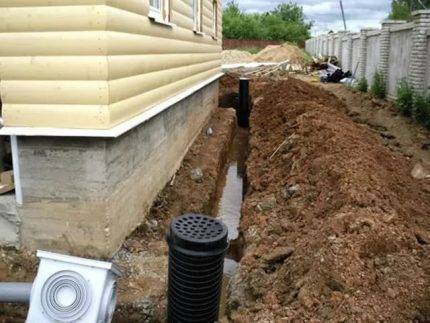
Difficulties with the installation of buried objects may arise if the level is high enough - from 1.5 m in depth. With this arrangement, the installation of a drainage structure is necessary both to ensure the protection of buildings and for the safe development of the soil layer.
The nature of the surrounding area should also be taken into account. If the area around the site is swampy or a river flows nearby, and it seems to be dry on the plot, then for the purpose of prevention it is also necessary to design a drainage system.
Let us consider in more detail the nuances that should also be taken into account when laying pipelines and trenches.
#1: Line Depth and Dimensions
The location of the pipes of the closed drainage system is chosen based on the design development, taking into account the slope towards the catchment area. The depth of laying the elements of the system depends on the level of groundwater. For a wall-mounted device, trenches are dug at the level of the base of the foundation, since its purpose is to strengthen the waterproofing qualities of the underground structure and protect the basement.
Pipes arranged in a ring pattern are located at a distance of up to 3 m from the foundation. The depth of the pipes is greater than that of the wall structure, and most often below the location of the foundation (+)
Ring drainage is chosen if the construction of the house has already been completed, respectively, all waterproofing and protective measures have been completed.
If the soil of the garden plot is constantly suffering from flooding by precipitation or groundwater seepage, systemic drainage throughout the territory is necessary. There are many options - from arranging a system around the perimeter to an extensive network, which involves all summer cottages (buildings, road surfaces, a garden plot).
The direction of channels and pipelines is strict - towards the catchment facilities or ditches located outside the territory of the personal plot. In this direction, drainage pipes are laid with a slope necessary for the free movement of groundwater collected by drains to the unloading facilities.
#2: Drainage Slope Standards
Water in horizontally located pipes will stagnate if the laying is carried out without a slope, the parameters of which are indicated in the regulatory documents.
For clay and sandy soils, which have different degrees of water permeability, the norms differ:
- loam and clay - from 0.003 and more;
- sand and sandy loam - from 0.002 and more.
If you convert the values \u200b\u200bto millimeters, you get 3 mm / linear. meter and 2 mm / running. meter respectively.
The minimum parameters are taken taking into account the fact that the lowest speed of water movement through channels and pipes is 1.0 m/s. This is possible if the drains are in working condition, that is, they are not silted or clogged with sand.
When calculating the maximum possible speed, the properties of the surrounding soil, as well as the quality of the backfill, are taken into account. Do not slope at intervals - it must be observed throughout the pipeline / channel
For hilly terrain, drainage options with drops are possible, with the installation of adapters in manholes.
Choosing the right dehumidification system.
Before starting work, you should decide on the type of drainage that is necessary in this particular case. From this will depend on the amount of work on its manufacture. The choice of a drainage system depends on several factors: what object needs to be protected from water (house, plot), what type of water needs to be drained (precipitation, groundwater), the landscape of the site, and others.
Drainage system and storm sewer.
Surface drainage of water from the site.
Let's imagine a situation. The land plot is sloping and water flows over the plot from the neighbor's plot located above. In this situation, the problem can be solved in two ways. You can do underground drainage of the entire site, spending a lot of time and money, or you can make a simple watershed at the border of the plots, forcing water to flow around the site.To do this, you will need to make a small embankment, decorating it with bushes and trees, or put artificial obstacles in the way of water, for example, make a fence with a blank foundation. You can make it even easier: dig an ordinary ditch in the path of water and bring it outside your site. The ditch can be covered with rubble.
Drainage ditch.
Drainage ditch filled with rubble.
Underground site drainage.
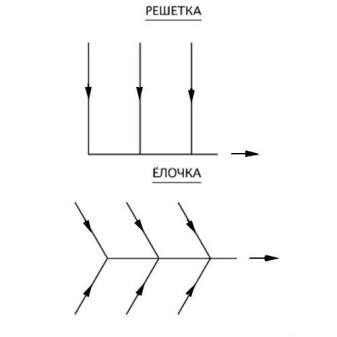
If it is not possible to organize surface drainage of water due to the characteristics of the landscape or for any other reason, then it is possible to drain a piece of land using underground drainage. For this, channels are dug, a central drainage pipe and drainage pipes with branches are laid in them. The distance between drains depends on the type of soil. If clay, then there should be a distance of about 20 m between the drainage pipes, if sand, then 50 m.

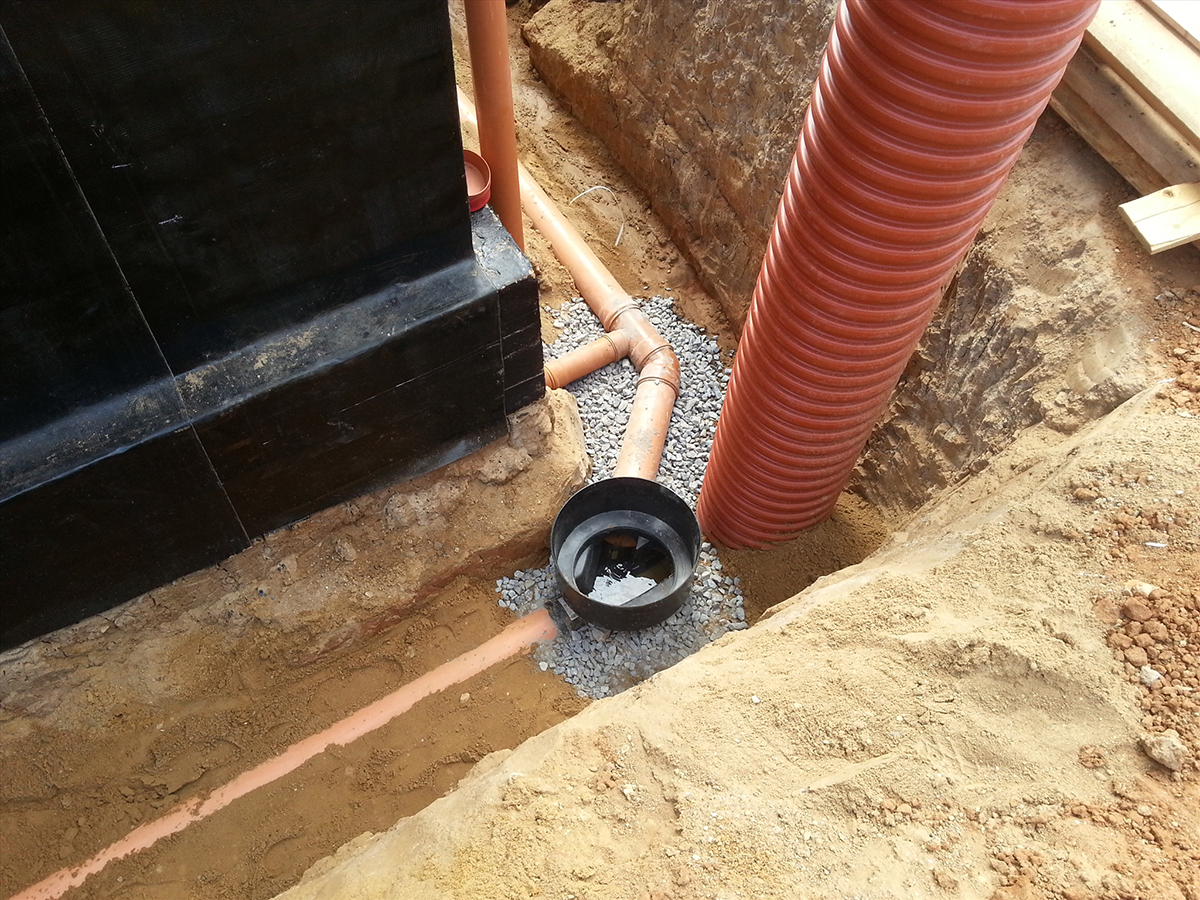
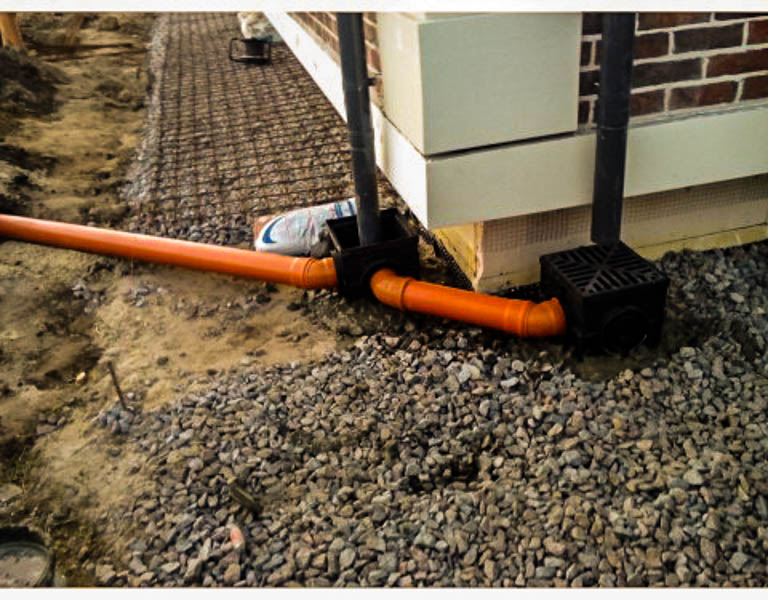

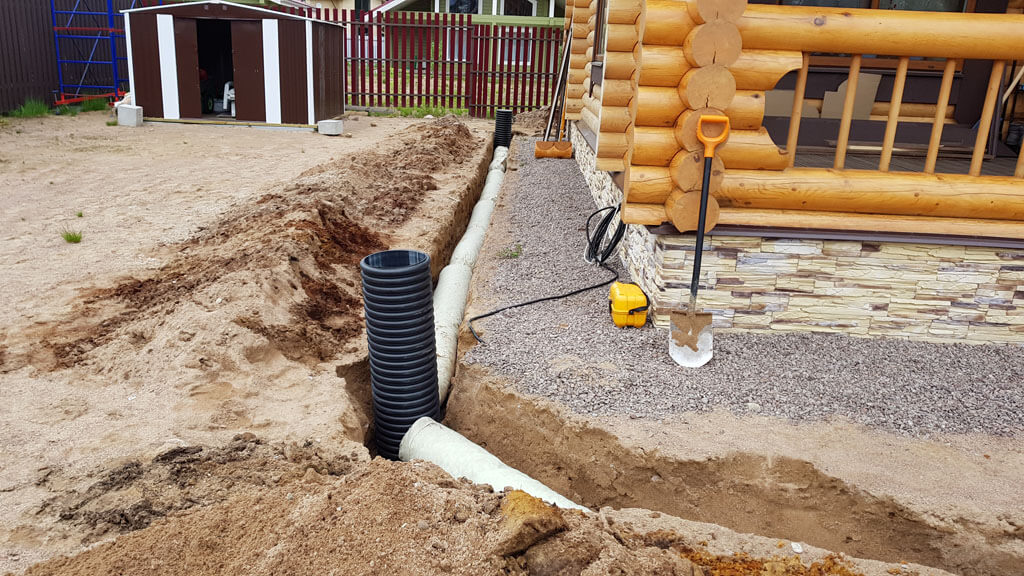


Site drainage plan.
Site drainage.
Lowering groundwater drainage.
If you are building a house and you want the house to have a basement, but the groundwater level is high on the site, then the drainage must be arranged below the level of the foundation of the house. The drainage pipe should be laid below the foundation level by 0.5-1m and away from the foundation at a distance of 1.5-2m. Why does the pipe need to be below the foundation level? The fact is that the groundwater level will never fall to the level of drainage pipes. There will always be water backwater, and the water between the drainage pipes will take the form of a curved lens
Therefore, it is important that the top of this water lens does not reach the foundation of the house.
Scheme of downward drainage of groundwater.
Also, the drainage pipe should not be in the stress zone under the foundation. If the pipe is laid in this stress zone, then the soil under the foundation will be washed away by water that flows through the drainage, and then the foundation may settle and be destroyed.
Intercepting drainage.
If water appears in the basement of the house after rain or melting snow, then an intercepting drainage is needed, which will intercept the water on the way to the house. This type of drainage can be arranged close to the foundation of the house or at a short distance from the house. The depth of such drainage should not be lower than the sole of the foundation of the house.
Drainage scheme.
Drainage scheme.
Storm sewer.
If you want to organize the drainage of storm water from the house, then you can make an underground water drainage with point water inlets or surface drainage using special trays with a grate. Drainage from trays can be more expensive due to material prices, but it allows you to intercept water along the entire length of the trays.
Not
storm sewers should be confused with drainage of water from the site or from the house. it
two different things.
When draining storm water from the house, drainage pipes with holes are not used. Water is discharged through conventional sewer or special corrugated pipes. Some people make a very big mistake when storm drains are connected to drain pipes. In other words, storm water is run into pipes with holes. According to their logic, the water that is collected from the roof of the house will be discharged through these pipes, and additionally, water from the ground will seep into the drainage pipes and leave through them.In fact, a large volume of storm water will not completely leave through such pipes, but on the contrary, it will seep out of them and soak the ground around. The consequences of such improper drainage can be very bad, for example, soaking the foundation of the house and its subsidence.
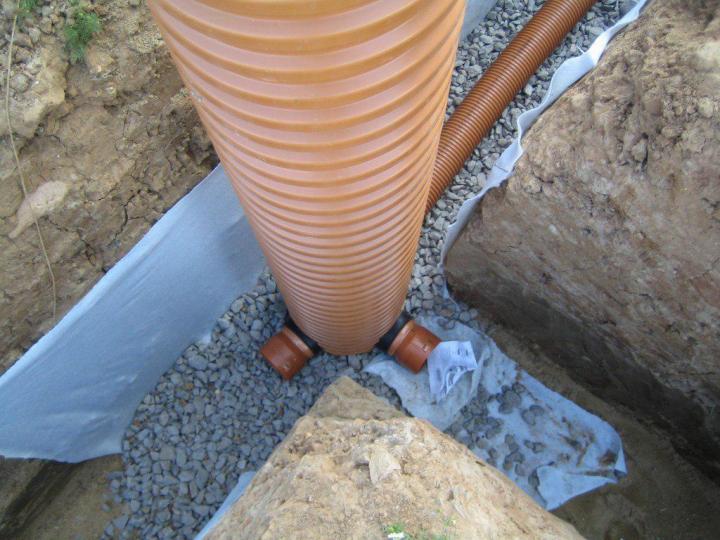
Installation of storm sewer with corrugated pipes.
Installation of underground storm sewers.
Installation of storm above-ground sewerage with trays.
Storm sewer from trays.
What is drainage
In fact, this is a system by which water is removed from the surface of the soil or from a certain depth. This is one of the drainage systems. It achieves the following:
Water and moisture are removed from the areas where the foundation structures are located. The thing is that excessive moisture, especially for clay soils, causes foundation movements. As the builders say, it will "float", that is, it will become unstable. If we add frosty heaving of the soil to this, then the earth will simply push the structure out.
Lack of drainage on the site - wet basements in houses
- Basements and basements are being drained. Many may note that modern waterproofing materials are able to withstand any exposure to water, in any quantity. Nobody is going to argue with this. It's just that each material has its own operational resource. In a few years, even the highest quality waterproofing material will dry up. That's when the problems begin. In addition, there is always a possibility that there is a defect in some section of the insulation through which moisture will penetrate into the basement.
- If an autonomous sewage system with a septic tank is used on a suburban area, then the drainage will help the latter to stay in the ground. Taking into account, if the dacha has an increased level of groundwater.
- It is clear that the drainage system does not allow waterlogging of the soil. So, we can say that plants planted in the ground will grow normally.
- If the summer cottage is a territory located on a slope, then during precipitation, rainwater will wash out the fertile layer. This can be avoided by arranging drainage in a sloped area into which water flows are redirected. That is, they will be removed according to an organized system, without affecting the soil.
On the slopes, fertile soil is washed away by rain
We must pay tribute to the fact that not all suburban areas require the creation of a drainage system. For example, if it is located on a hill. Basically, there is always a need for it. Let's look at situations in which drainage is indispensable.
When should drainage be provided?
That is, we will indicate those cases when the drainage system is necessary in any case.
- If the suburban area is located in the lowlands. All atmospheric precipitation will flow down the slope here. The laws of physics have not been repealed.
- If the site is located on a flat area, the soil is clayey, the groundwater level is high (not lower than 1 m).
- Drainage on a site with a slope (strong) is also necessary.
- If you plan to build buildings with a deep foundation.
- If, according to the project, the main part of the territory of the summer cottage will be covered with a waterproof layer: concrete or asphalt paths and platforms.
- If lawns, flower beds are equipped with an automatic irrigation system.
If automatic watering of lawns is organized at the dacha, then drainage must be built
Where to start the construction of drainage
It is necessary to start with studies of a suburban area for the type of soil, the level of groundwater and the type of relief. This can only be done by professionals by conducting geological and geodetic surveys. Usually they make a topographic survey of the site, where the cadastral boundaries of the cottage are determined. The terrain is determined (wavy or even, with a slope in which direction), the type of soil, making exploration by drilling, and the physical and chemical properties of the soil. Be sure to indicate the UGV in the reports.
Based on the data provided, recommendations are formed on the depth of foundations, the type of waterproofing and drainage system. Sometimes it happens that experts generally do not recommend building large houses with basements, as the owners of the suburban area intended. Which leads the latter into bewilderment. Disappointments appear, but there is no way out.
It is clear that all ongoing research costs money, sometimes a lot. But you should not avoid these expenses, because the information received will subsequently save much larger capital investments. Therefore, all these studies, only at first glance, are unnecessary procedures. In fact, they are useful and necessary.
Checking the level of groundwater occurrence by drilling



