
- Features of the choice of light bulbs for lighting an apartment
- Kitchen
- Hallway
- Bathroom
- Bedroom
- Living room
- Children's room
- Types of energy saving lamps
- Fluorescent
- continuous action
- Special color
- LED
- Rules for choosing the best lighting lamp
- Mercury discharge lamp
- Modern scientific development: cathodoluminescent lamps of Russian scientists
- Which lamp is better to choose
- Good lighting for eye health
- Environmental friendliness of lamps and safety of their operation
- Types of light bulbs for a house or apartment: names and features
- Classic incandescent lamps
- Halogen light bulb
- Fluorescent tubular light sources
- Energy saving models
- LED light bulbs
- LED lamps (LED)
- Color rendering and luminous flux
- plinths
- Threaded base E (Edison)
- Pin bases
Features of the choice of light bulbs for lighting an apartment
The choice of light bulbs for lighting depends on the functional purpose of the room. What is perfect for the kitchen may not be perfect for the bathroom or children's room. A well-planned arrangement of fixtures and their number will provide the highest quality light flow.
Kitchen
The light source in the kitchen space should perform several tasks.Therefore, the main goal of functional kitchen lighting is to create its multi-level. Each area (dining, work and eating area) must be properly lit.

The main rule is that there are separate lamps for each functional area.
The working area can be equipped with LED strip lighting or lighting fixtures located under the kitchen set of the upper tier. The dining area can be decorated with lamps on long pendants installed above the table.
It is important to consider the color scheme of the kitchen. Walls and facades made in light colors reflect up to 80% of the light flux, dark - up to 12%
Hallway
Since there are no windows in the hallway, natural light is limited in the room. The main requirements for the placement of fixtures: the light should not be too dim and excessively bright, the most suitable option is diffused light, achieved through matte shades.

Creating comfortable lighting in the hallway will not work with one lamp
Actual local lighting, equipped in the area of \u200b\u200bthe mirror, cabinet or shelf for small items.
The light source is recommended to be mounted at a height of 2 meters. This level is the most comfortable for the eyes.
Bathroom
The main requirement for lighting fixtures in the bathroom is to ensure safety. They must be low-voltage, have good protection against moisture, and provide comfortable conditions for performing various procedures.

The ideal option for a bathroom is the amount of light close to daylight.
The correct light flow should be bright, softly diffused, it is beneficial to emphasize the colors of finishing materials. The number of fixtures required will vary depending on the area of the room.
Bedroom
It is necessary to provide comfortable, uniform, diffused lighting to create an atmosphere of comfort. Not only basic lighting is taken into account, but also functional lighting near a mirror or bed.

Lighting in the bedroom should create an atmosphere that is pleasant for relaxation and customizable for sleep.
For the bedroom, decorative lighting in the form of spotlights on the ceiling, nightlights, candles, podium lighting is relevant.
Living room
In the largest room, the right lighting system can be provided with a chic chandelier.

Three types of lighting are usually used for the main room of an apartment: general, directional and decorative.
Before planning a design, it is important to consider not only the color scheme of the interior, but also some nuances:
- the presence of one chandelier in the center of the living room will create dark places in the corners of the ceiling;
- there should be several light sources (at least two);
- the light should be soft, preferably warm tones;
- spot lighting is ideal for a multi-level ceiling.
Children's room
It is recommended to give preference to the combined type of lighting. The main light should emit white natural light, decorative lighting can be done in warm colors. In the children's room, the light should be soft, uniform and without excessive radiance.




In a children's room, the central lamp is usually combined with several additional sconces, floor lamps or built-in lamps.
It is undesirable to use a lot of fluorescent lamps, as they contribute to rapid eye fatigue.
Types of energy saving lamps
Energy-saving lamps come in several types. Each of them has its own purpose. For example, halogen lamps are rarely installed in household appliances due to a number of disadvantages.So, they get very hot, which is not always satisfactory. At the same time, they have a number of advantages, and they are easy to pick up for any type of ceiling.
Fluorescent
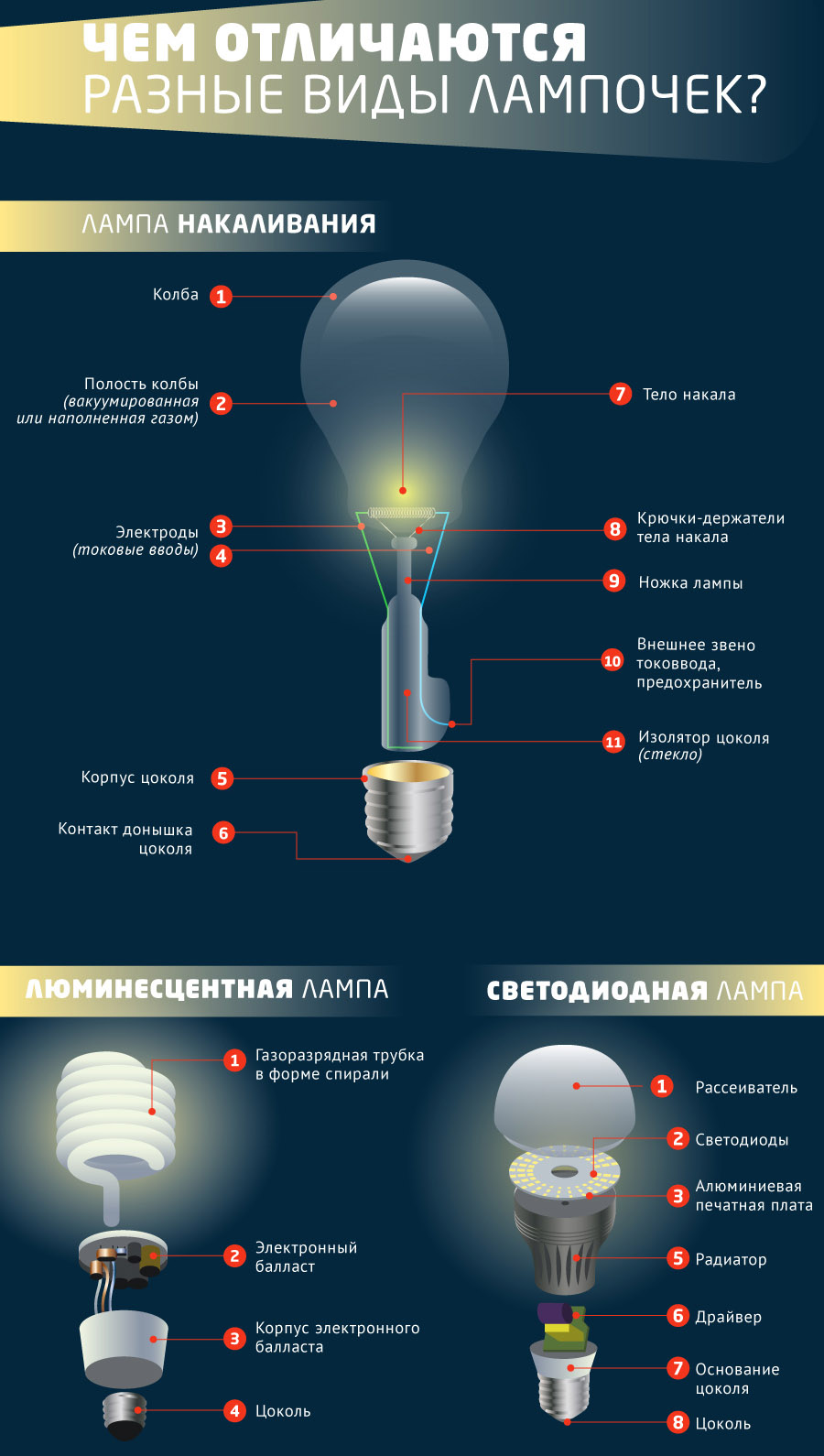
Energy-saving lamps are divided into 2 types - compact and standard (linear). Both devices have a lot in common. In both cases, the design includes a sealed glass flask with a gas (neon or argon) inside. There is also a small amount of mercury. The electrodes are supplied with the help of a regulating apparatus.
Fig. 2 - fluorescent lamps.
Mercury vapors, mixing with gases, emit ultraviolet radiation. To convert the UV spectrum to daylight, the inside of the flask is treated with a phosphor. The difference between a compact lamp and a fluorescent lamp is as follows:
- the size. U-shaped or spiral-shaped have the same functions, but a more complex, twisted shape to reduce size;
- installation. Linear analogues are mounted as separate elements, fixed in the lamp housing. Compact products are installed in a base or flask.
Fig. 3 - U-shaped lamp.
Since this type has the same functions as incandescent lamps, they can be installed without problems in any fixtures (chandeliers and sconces). Linear light bulbs are called because of the shape, since their base is a straight tube. In the people they are called "fluorescent lamps". On sale you can find products of different shapes - double, U-shaped and ring. They don't have a plinth. Metal rods are installed on the tubes, which are connected to the network with terminals.
continuous action
This type of energy-saving light bulbs is the least familiar to customers. Such lamps are characterized by better color reproduction, while having a lower light output. The main advantage is continuous spectrum radiation.Such models are among the safest.
Special color
Such energy-saving lamps are divided into:
- ultraviolet;
- with colored phosphor;
- with pink glow.
Fig. 4 - colored lamps.
This type of light bulbs is not used to illuminate rooms. Their main purpose is to create a festive atmosphere. Such lamps can be found in exhibition and concert halls, clubs, restaurants, light shows and playgrounds.
The glow surface of this type of lamp is larger than that of other LNs. This creates a more comfortable and uniform lighting. On the shelves of shops you can find light bulbs of blue, green, yellow and red colors. They work from a 220 V network, like ordinary ones. One of the advantages of such lamps is that even turned off, they decorate the room.
LED
Due to the energy-saving properties of LED crystals, they were previously used in radio engineering as indicators. Later, technology improved, and LEDs began to be used as super-bright components in backlight circuits. They have found application in almost all areas.
Fig. 5 - LED-bulb.
The design consists of a bulb, inside of which there are getinaks, a bar, LEDs and a driver. The body is elongated, "corn" or spot. The risk of mechanical damage is reduced due to the polycarbonate housing.
The lamps are connected to a 220 V network without the need for ballasts. The narrow shape of diode lamps allows them to be combined into small and large groups. According to the places of installation are classified into:
- office and household;
- industrial;
- for installation in street spotlights;
- automotive;
- phytolamps;
- for growing plants.
Linear devices are often used for backlighting in landscape design. Here it is better to choose lamps with a high degree of protection - IP67 or IP65. The shape can be tubular or in the form of a spotlight. If it is a room with a standard climate, an IP20 level will do.
Fig.6 - degrees of protection.
LED light bulbs are the best selling. Of all lamp types, they consume the least energy, require no special disposal, do not emit heat, and last up to 100,000 hours depending on the model. Quality devices can withstand voltage surges and sudden temperature changes. Almost the only disadvantage of these lamps is the high price.
Rules for choosing the best lighting lamp
When choosing models for organizing lighting in residential premises, one should take into account not only the type to which the light bulb belongs, but also a number of other factors, namely:
- plinth device;
- power;
- color rendering index;
- light output;
- luminous flux stability factor;
- terms of Use.
Devices intended for connection with a cartridge have a common part - a base, with the help of which fasteners with wires are carried out
In order for the lamp to be installed in the socket, it is important to pay attention to the marking of this element.
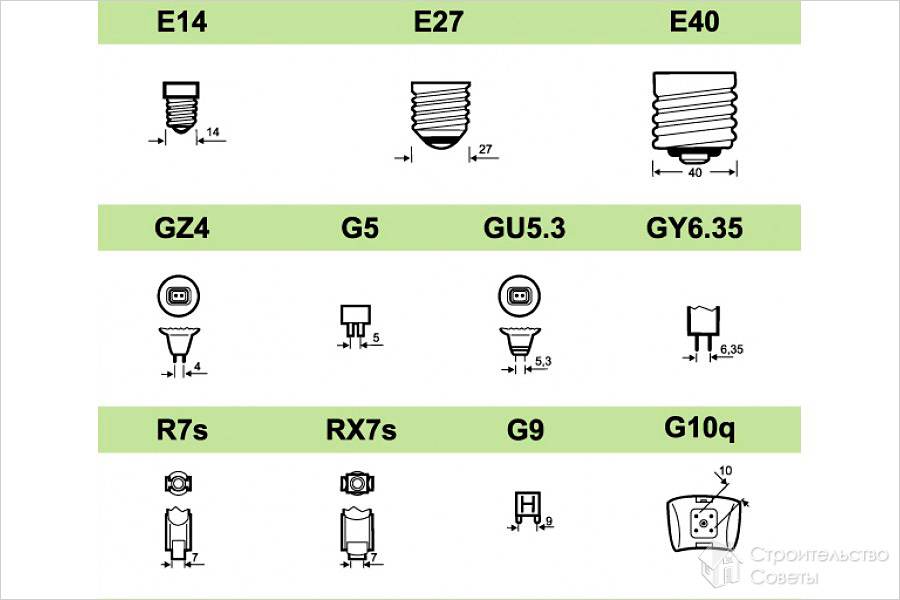
Among the threaded connections, the most popular are three types: the “minion” E14, the medium size E27 and the large E40. The second option is the most widely used, while the latter is usually used for street lighting.




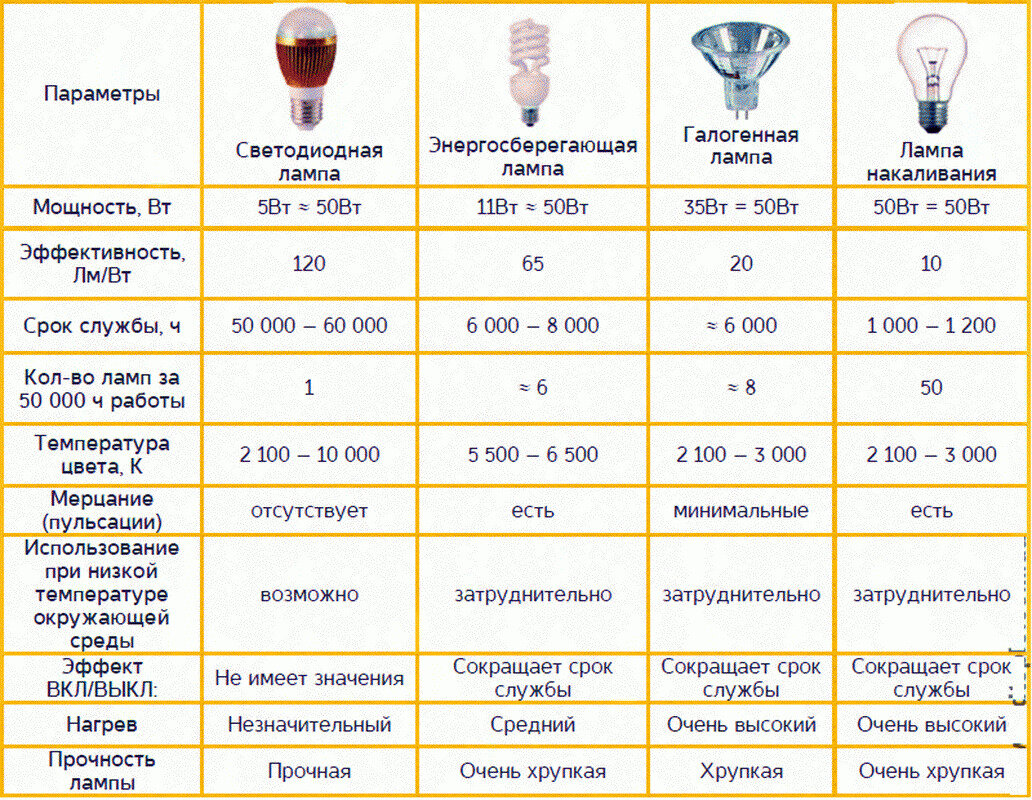
The summary table shows the main performance characteristics of the four most popular types of lamps used in domestic purposes
Miniature fluorescent and halogen lamps often have G bases, which are attached to sockets using 2-4 pins. There are many options for such devices of different sizes, of which modifications G5, G9, G23, 2G10, 2G11 are especially in demand.
An important criterion is the power of the lamp; this indicator is indicated on the cylinder or base. If we take the same type of devices, then the intensity of light depends on this value.
However, this rule does not work if we take devices of different types: the brightness of a 5-6 W LED is almost equal to the glow of a 60-watt incandescent lamp.
Lumen output measures the number of lumens of light that a 1 watt bulb produces.
This factor is closely related to the energy efficiency of the device: a fluorescent device produces 600 lm at a power of 10-11 W, whereas for a similar flux of light, an incandescent appliance will need approximately 60 watts.
The design of the luminaire and lamp also has an influence. Often, models of modern chandeliers or sconces are specially made for a certain type of fixture, for example, halogen ones. In this case, the manufacturer usually indicates in the instructions the characteristics of the required lamps.
To connect some types of lamps, you need to use additional equipment: power supplies, drivers, transformers. The figure shows the electronic ballast required for fluorescent lamps
Certain types of devices also demonstrate increased sensitivity to voltage drops, which must be taken into account when living in regions where there are problems with the power grid.
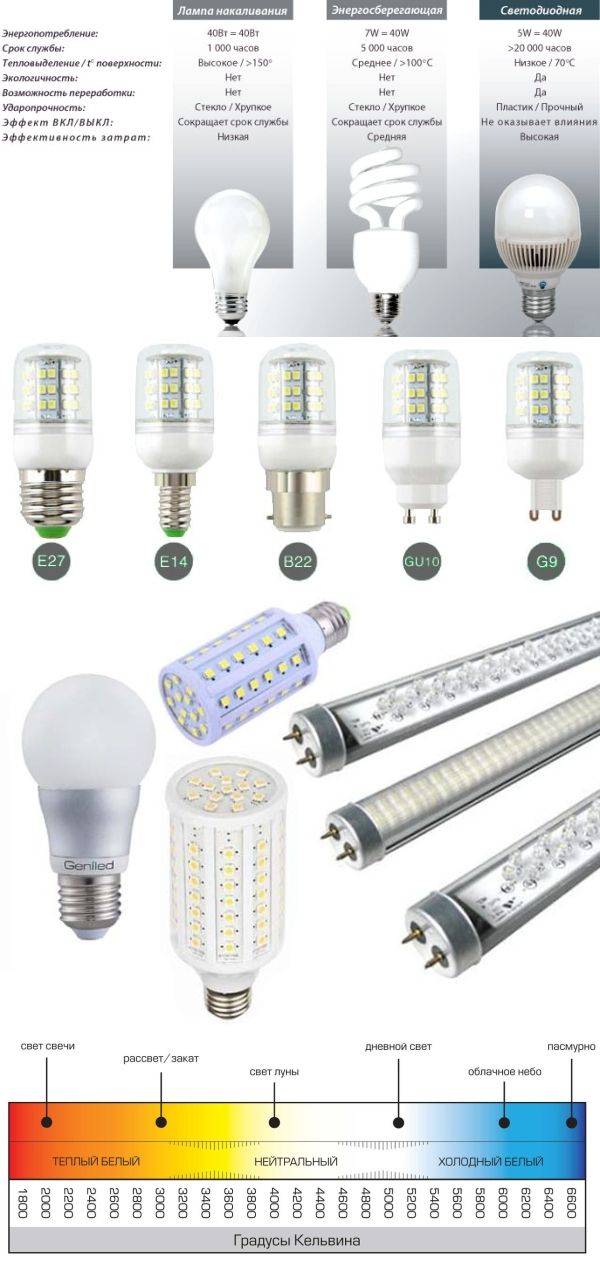
There is also a difference caused by color temperature. There are several standards for the most common markings:
- 2700K denotes a warm tone, similar to incandescent lamps;
- 4000 K - daylight neutral tone;
- 6500 K - cold version.
Color rendering index Ra displays the correct perception of the color of the environment when illuminated by this type of lamp. As a rule, this indicator is indicated on the packaging, for example, 80 Ra at the LEDs.
Coefficient of light flux stability. This factor manifests itself during the entire period of operation of the device, during which the brightness should decrease by no more than 30% of the nominal value.
This indicator is of particular relevance for LEDs that do not burn out, but gradually lose their light intensity.
So if at the beginning such a device emits light of 1000 lumens, then at the end of its service life this figure should be at least 70% of the original, that is, 700 lm.
Mercury discharge lamp
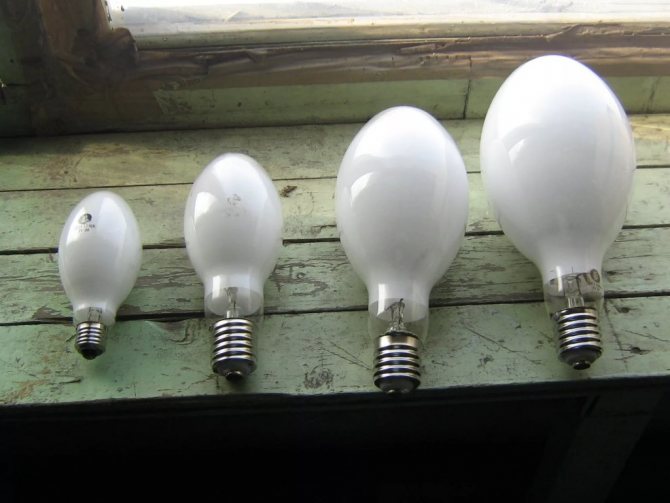
Mercury discharge lamp
She has several varieties that are united by one thing - the workflow. Light bulbs work because of the mercury vapor and the electrical discharge that occurs in the gas. The most famous variant is arc mercury lamp. It is she who is used to illuminate warehouses, factories, agricultural land and even open spaces. Known for its good light output. All other varieties are built on the addition of gas to the pressure inside the burner. Therefore, there are several light bulbs that have their own characteristics, but they are not so well known.
Modern scientific development: cathodoluminescent lamps of Russian scientists
The same light bulb of Ilyich was taken as the basis for the design of the appearance, but with a significant change in the internal components.
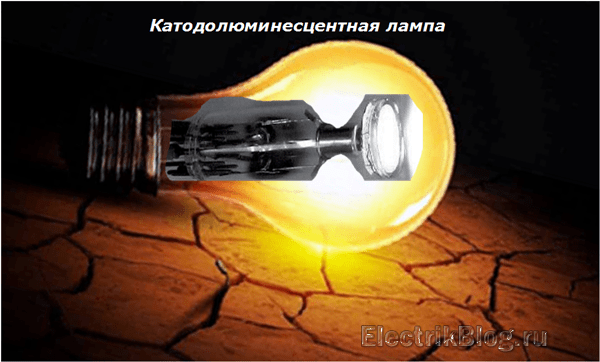
It came out on time and became relevant because the decision of the international Minamata Convention between states (more than 140 participants) created an agreement that limits anthropogenic emissions of mercury vapor and their compounds into the environment, leading to the poisoning of living organisms.
From the beginning of 2020, CFLs and fluorescent lamps, certain types of mercury-containing products, including electric batteries, relays and switches, fall under the ban.
And from this ban, the use of ultraviolet light sources, so necessary for medical institutions, as well as agricultural enterprises involved in growing plants in greenhouses, becomes questionable.
Russian scientists working at the Department of Vacuum Electronics of the Moscow Institute of Physics and Technology, in collaboration with colleagues from the Lebedev Physical Institute, managed to create, test and put into production a cathodoluminescent lamp that does not contain hazardous mercury components.
She has a rather original principle of operation, repeating the design of an old kinescope TV.
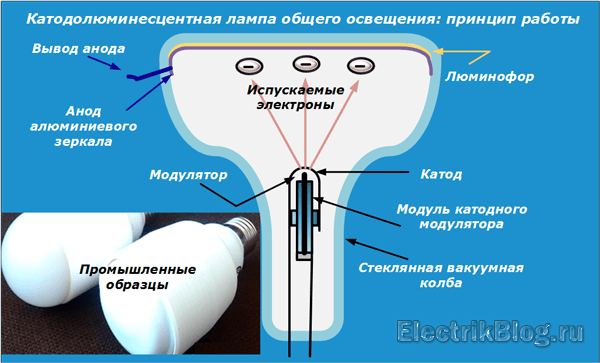
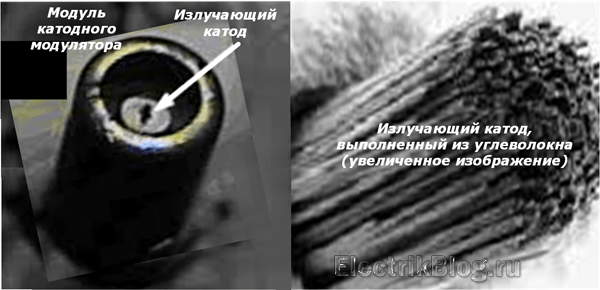
The anode is made of a thin aluminum mirror, which during operation is bombarded by a stream of electrons emitted from the cathode with a modulator.
The vacuum environment inside the sealed glass bulb body ensures reliable operation, as with all conventional electronic tubes.
Above the anode is a layer of phosphor. They can be given almost any color scheme created by the lighting. This is especially valuable for the ultraviolet spectrum, which previously required mercury vapor.



A particular difficulty in creating this design arose with the cathode radiation module.The fact is that they tried to make such light bulbs in many countries, including the USA. Pilot production and trial sales were even established there.
But it was not developed: their cathodoluminescent light sources warmed up for a long time and lit the illumination with a time delay, and the dimensions turned out to be cumbersome.
Russian scientists have successfully solved these issues by using tunnel effect technology and using carbon fiber as a material for the emitting cathode.
A few more scientific developments by scientists from the Physicotechnical Institute formed the basis for the autocad design of a cathodoluminescent lamp. It has unique electrical characteristics and is able to compete with a large mass of existing LED lamps.
During its operation, there is no need to take care of cooling and heat dissipation, as with conventional semiconductor devices. She is not afraid of overheating and will not lose her brightness.
Such a light bulb will work perfectly in closed ceiling lights without special cooling.
Mir 24's owner's video explains why the Russian bulb will compete with masterok's LEDs.
Finishing the presentation of the material on the topic “What are the light bulbs”, I draw your attention to the fact that now is your opportunity to ask a question or comment on the article for its joint discussion
Which lamp is better to choose
First you need to decide on the selection criteria. It may be the most economical option, the most eye-friendly, and superior in comfort. Based on the main task of lighting, you should decide on the required power of the lamp, and even more correctly - with the luminous flux. In addition, you need to decide on the size of the base.The usual size for most household lamps is the "Medium" E-27 base with a diameter of 27 mm and the "Mignon" base E-14 with a diameter of 14 mm. In addition, there are many other options available. The shape of the lamp bulb often matters.
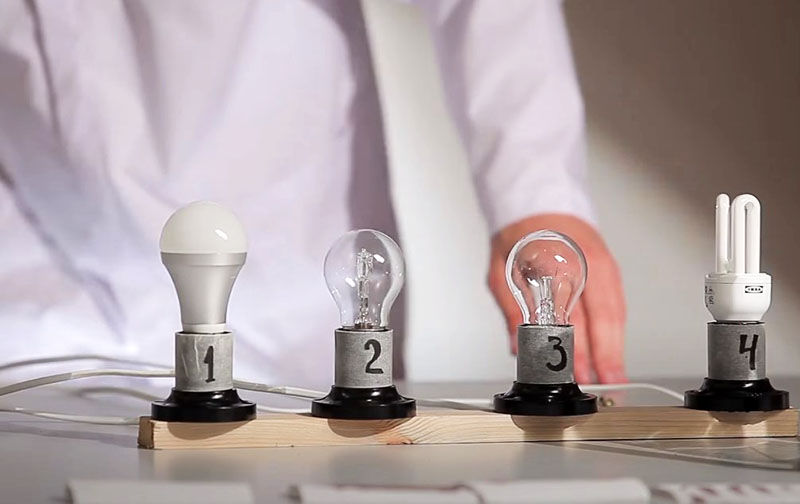 Types of modern lamps
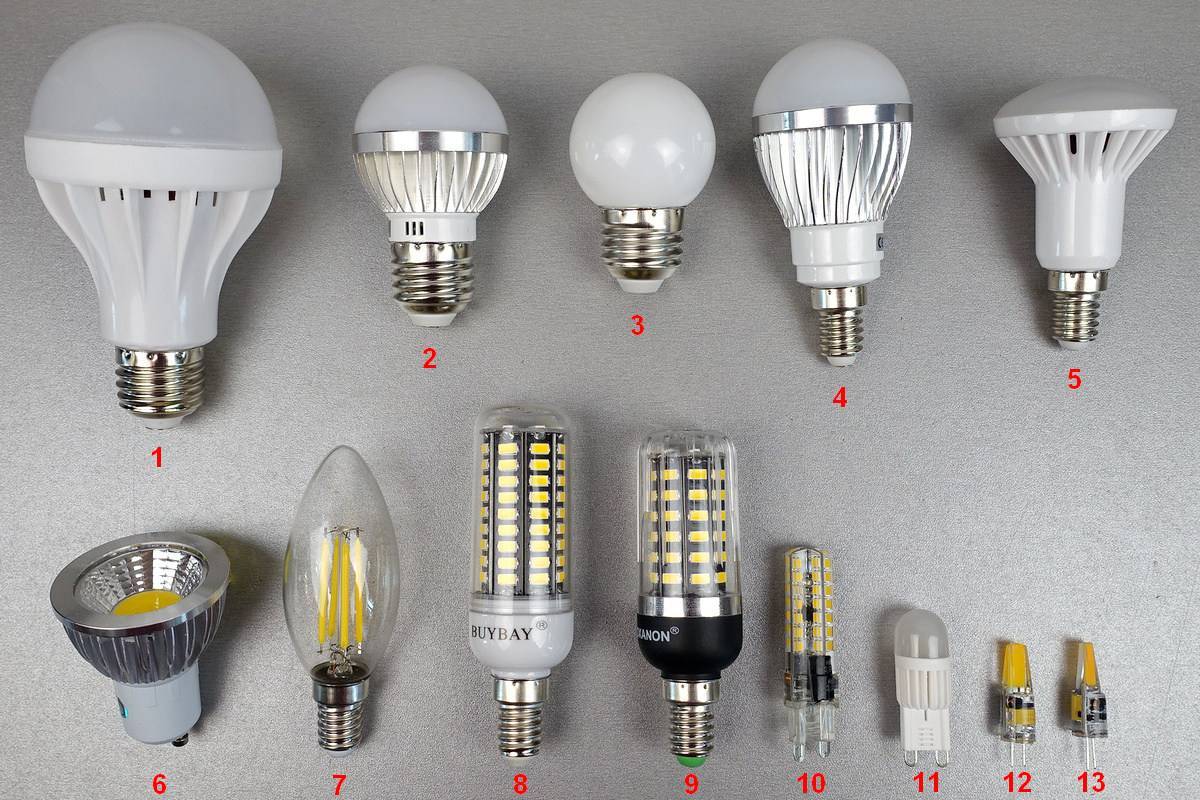
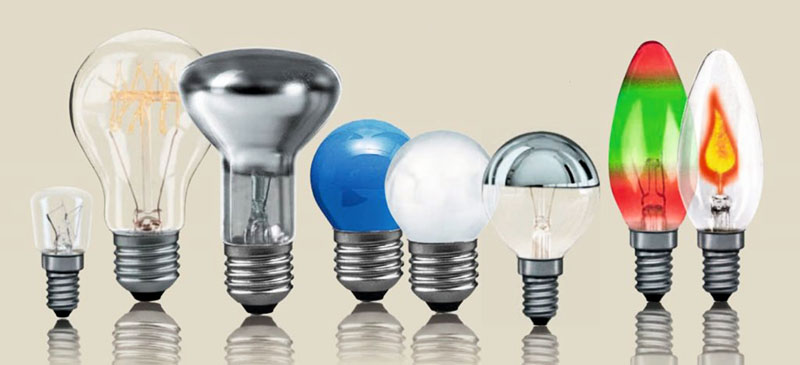 Options for the shape and color of the lamp bulb
Good lighting for eye health
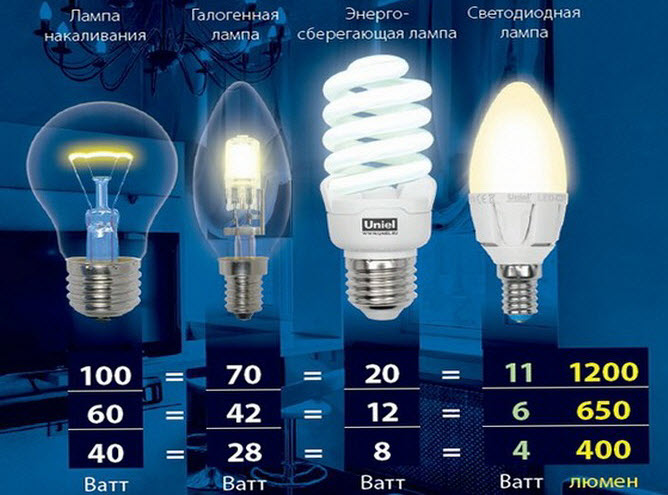
In accordance with the norms of healthy lighting, it is assumed that for every 10 m2 of room area with a ceiling height of 2.7 m, the required minimum illumination is the equivalent of 100 W of a conventional incandescent bulb. The power consumption of an LED light bulb is 8 times less than this one. You should buy light bulbs based on the required brightness of the glow, and each type will have its own power consumption.
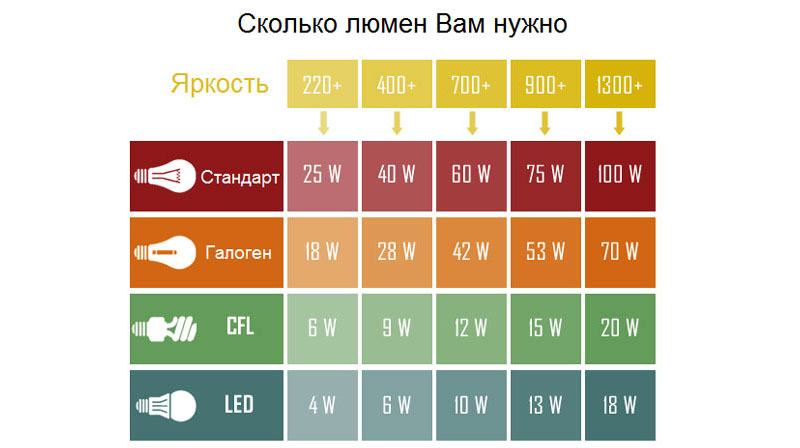 Comparative characteristics of power consumption at equal brightness for various types of lamps
Environmental friendliness of lamps and safety of their operation
Lamps heat up during operation, so touching the bulb should be avoided. This is especially true for halogen lamps.
Environmental issues are especially relevant for energy-saving lamps, which contain mercury vapor in the cylinder. They should not be thrown into the trash, they should be handed over to collection points.
Types of light bulbs for a house or apartment: names and features
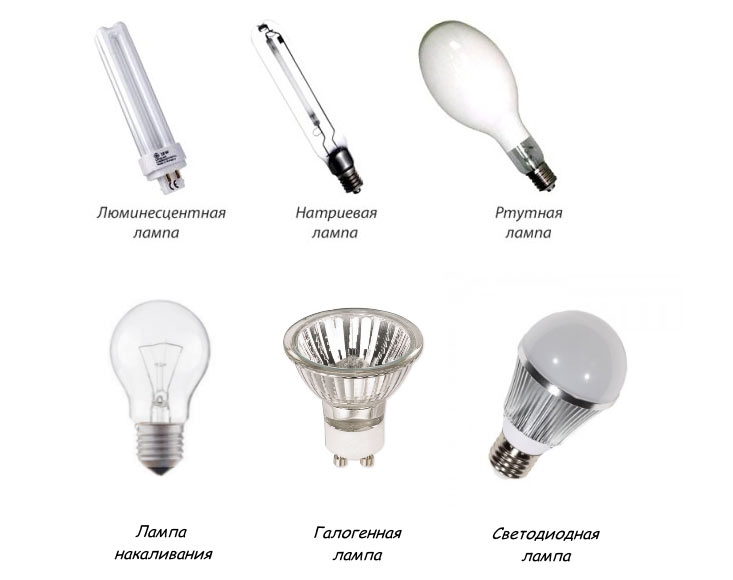
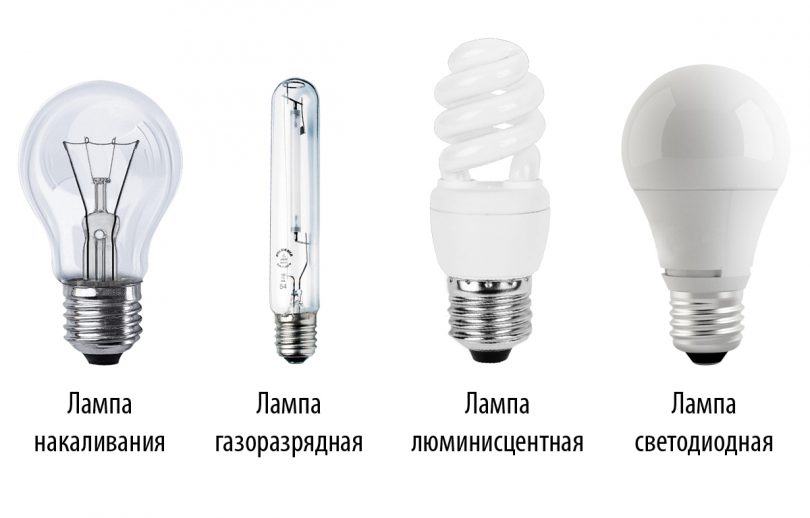
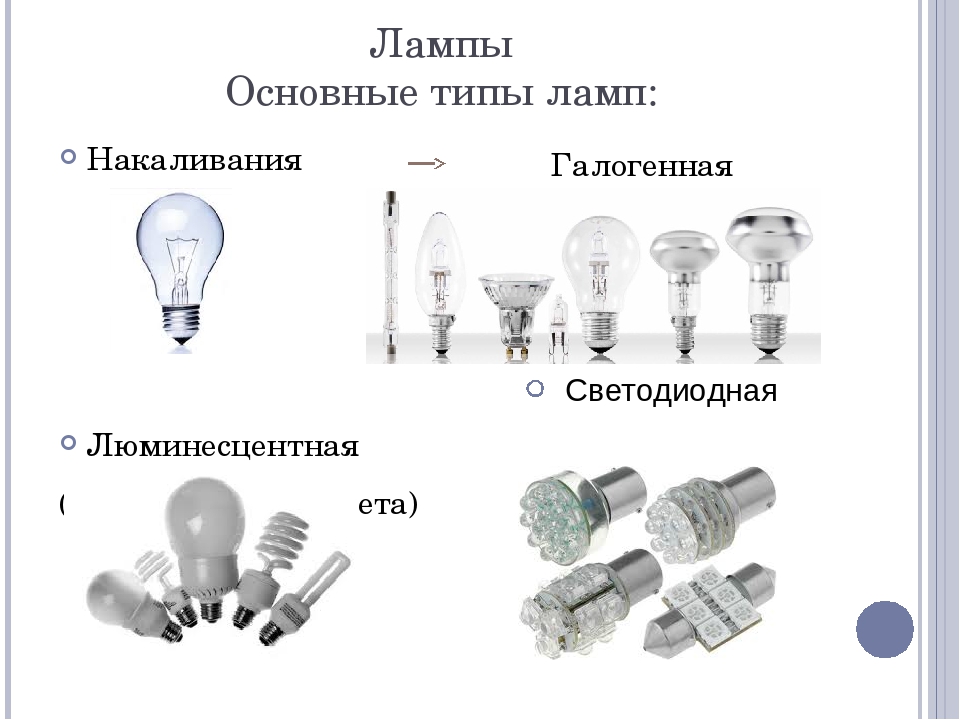
There are different types of light bulbs on the market. In the article we will consider the most popular ones that we use to illuminate residential premises. These include classic, fluorescent, halogen and LED models. Let's take a closer look at each type.
Classic incandescent lamps
Despite its considerable age, this is the most common option. It is known that the first incandescent lamp appeared more than 150 years ago.At the same time, during the entire period of operation, it has not undergone significant changes. Their popularity is due to their availability and ease of manufacture.
The design includes:
- glass flask;
- tungsten filament.
When an electric current begins to flow to the filament, it heats up and begins to emit light.
The "ancestors" of modern light bulbs are much inferior to them in terms of basic characteristics. So, their average service life does not exceed 1000 hours. Also, they can become cloudy over time. This is due to the fact that during operation, gas vapors accumulate in the flask.
Most classic lighting fixtures have an E14 or E27 base. Exceptions include miniature products that were previously installed in New Year's toys, garlands or lanterns.
In addition to the standard options, on sale you can find products with a matte coating. Such models allow you to get soft diffused light, close to sunlight. In addition, there are multi-colored options that are used to create color effects.
Halogen light bulb
This is a modified model of classical light sources. The flask is filled with iodine or bromine. This allows you to increase their service life: if you believe the assurances of manufacturers, it can reach 4 thousand hours. They also boast excellent color reproduction of 30 lumens.
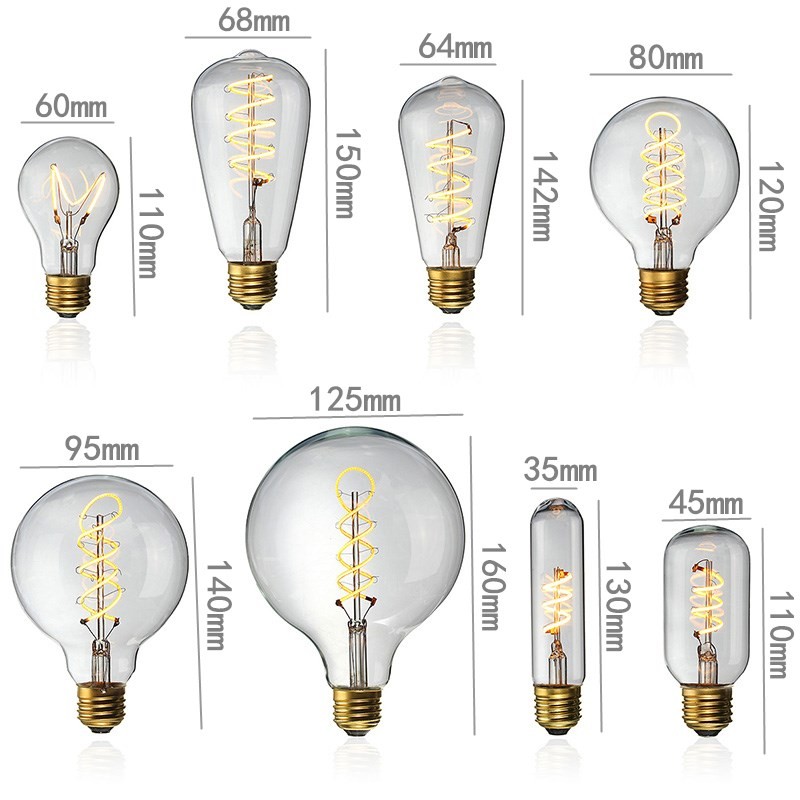
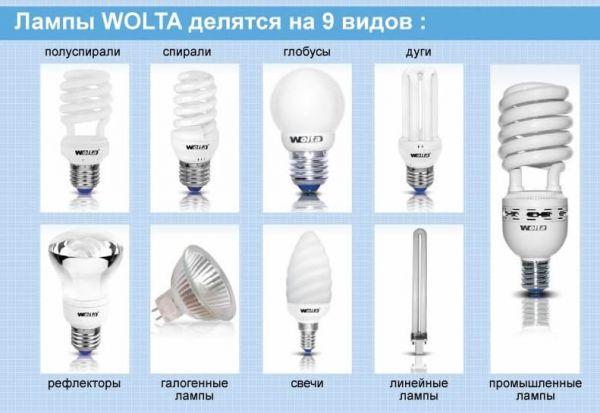





They are characterized by their small size, various shapes and various plinth options. But the “halogens” have a significant drawback - during operation they emit low-frequency noise. Therefore, they are most often used in the automotive industry. So, most modern vehicles are equipped with halogen headlights.
Fluorescent tubular light sources
Their main distinguishing feature is an elongated shape that looks like a narrow tube. It can be of any diameter and length. For convenience, the diameter is indicated by the letter T, which can be found on the body of the product.
Inside the flask is a special substance - a phosphor. Therefore, in order for the device to start emitting light, it must be installed in a luminaire equipped with a trigger. In addition, they do not have a filament, so they are characterized by high efficiency and low power consumption.

Energy saving models
This term refers to miniature fluorescent lighting fixtures. Since they can significantly reduce energy costs, "housekeepers" are in great demand among the population. You can buy them in any store, and thanks to the various options for plinths, they can be installed in most lighting fixtures.
Thanks to modern technologies, "housekeepers" can boast of compact size, a variety of shapes and colors, different power options. But their main advantage is a long service life. However, they do not like frequent switching on and off, and also require proper disposal, because they contain mercury vapor.

LED light bulbs
They can also be attributed to energy-saving varieties. But their main positive feature lies not in this. LED light bulbs are leaders in terms of service life, which can reach one hundred thousand hours. In addition, they have one hundred percent light output, they do not heat up, therefore they are completely safe from a fire point of view.And the absence of harmful substances makes them safe for all living things. Most models are equipped with a standard base, so they can be installed in all lighting fixtures.
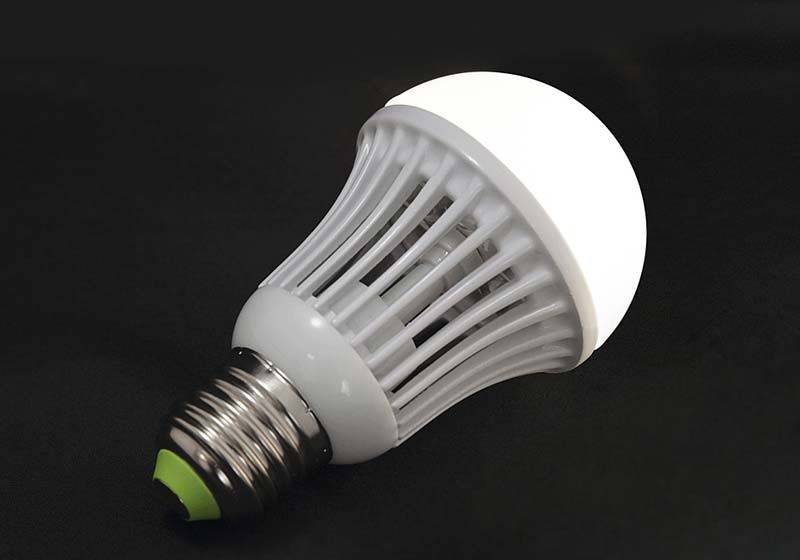
The disadvantages include the high cost. However, this more than compensates for the long service life.
LED lamps (LED)
The design of light bulbs on diodes is based on semiconductor crystals, which, as a result of the p-n junction, emit light rays.
As a rule, they involve at least five diodes that are connected to the installation board. Functioning occurs with the help of a driver that converts alternating current to direct current.
The lamps practically do not heat up during operation, since they have special parts - radiators - to remove heat. Depending on the modification, the devices are equipped with screw or pin bases.
With the help of LED elements, you can create attractive compositions on stretch/suspended ceilings. The design made of lamps of different colors looks especially impressive.
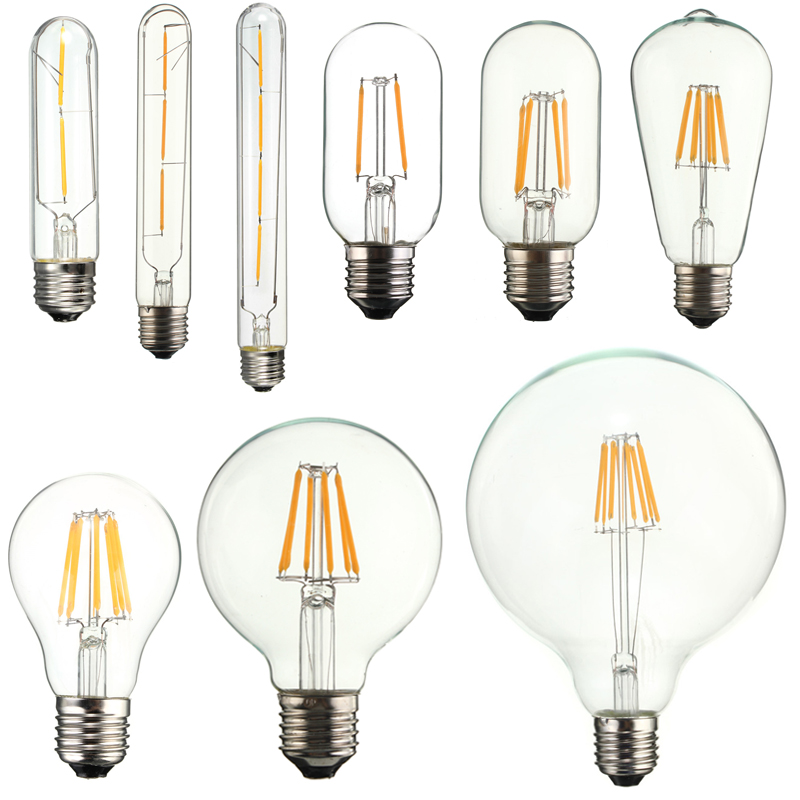
Filament devices can be attributed to the varieties of LEDs. Outwardly, they resemble ordinary incandescent lamps, but instead of a spiral, semiconductor elements are installed in them, strung on a rod, which is placed in a flask with an inert gas.
In order for such a device to be screwed into the cartridge, it is supplemented with a traditional threaded base. Such models allow you to combine retro design with higher technical characteristics, such as energy efficiency, durability, and environmental friendliness.
Self-contained LED lamps powered by solar panels are also gaining popularity.They charge during daylight hours and turn on automatically when it gets dark. Such models can operate in a wide temperature range from -30 to +50 ° C.
Technical characteristics of LED-lamps. The devices are characterized by the following properties:
- power - 3-30 W;
- service life - 30000-50000 hours;
- light output - 100-120 lm / w;
- light flux - 250-2500 lm.
LEDs can drastically reduce lighting costs by up to 85%, there is no thermal, ultraviolet and infrared radiation during their operation.
Since no harmful substances are used in their manufacture, they are considered environmentally friendly and do not require special disposal.
Filament lamps look great in retro style fixtures; they can be used for classic interior decoration or used for other purposes
Unlike fluorescent lamps, these devices light up instantly, in addition, most models are dimmable, which allows you to set the desired level of light intensity.
Among the shortcomings, an extremely high price can be noted, in addition, ordinary lamps have a directional flow of light; filament devices are deprived of this shortcoming. Lighting a room usually requires several sources at once.




Color rendering and luminous flux
The advantage of conventional incandescent lamps is a good color rendering index. What it is?
Roughly speaking, this is an indicator of how much light close to the sun is contained in the scattered flux.
For example, when sodium and mercury lamps illuminate the streets at night, it is not entirely clear what color people's cars and clothes are. Since these sources have a poor color rendering index - in the region of 30 or 40%.If we take an incandescent lamp, then here the index is already more than 90%.
Now the sale and production of incandescent lamps with power over 100W are not allowed in retail stores. This is done for reasons of conservation of natural resources and energy savings.
The main indicator here is the luminous flux, which is measured in lumens.
That is what you need to pay attention to when choosing
Since many of us previously focused on the popular power of 40-60-100W, manufacturers for modern economical lamps always indicate on the packaging or in the catalogs that their power corresponds to the power of a simple incandescent bulb. This is done solely for the convenience of your choice.
plinths
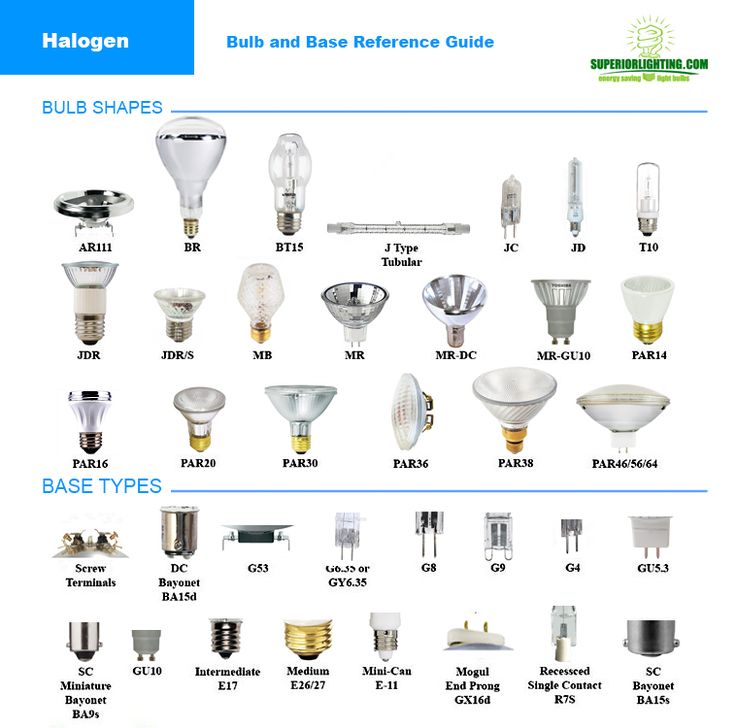
Plinths are different in type and design. To understand which one is which will help labeling.
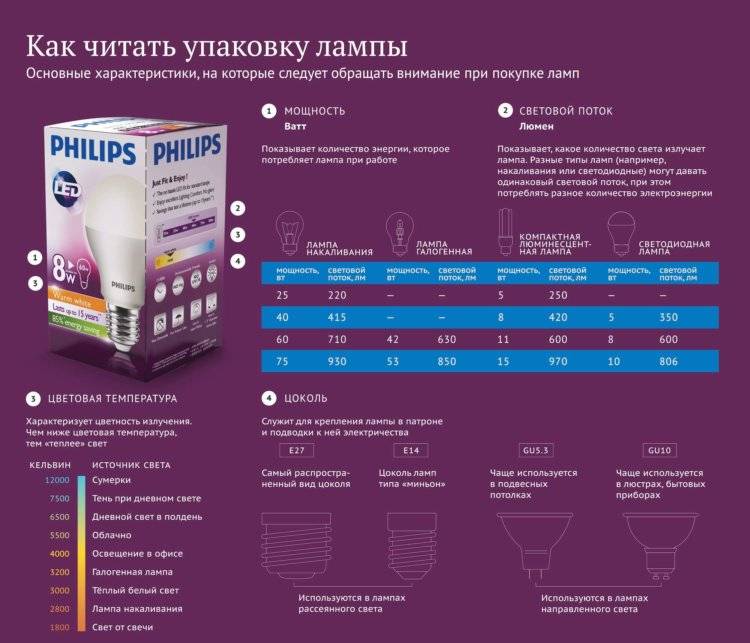
- E - threaded base (Edison)
- G - pin base
The number in the designation of the base indicates the diameter of the connecting part or the distance between the pins.
Lowercase letters at the end show the number of contact plates, pins or flexible connections (only for some types):
- s - one contact
- d - two contacts
Sometimes another clarifying letter U is added to the first letter, denoting an energy-saving lamp.
LED lamps for home lighting have standard bases that fit most household lampholders.
Threaded base E (Edison)
The E10 plinth is the smallest of the threaded plinths. They can be used in Christmas tree garlands or in flashlights.
E14 base - the so-called minions, are most often used in small lamps, sconces and chandeliers.Modern LED lamps are also made in such a base, they can replace any standard incandescent lamp, this will significantly save energy. Light bulbs for such a cartridge are distinguished by a wide variety of types: pear-shaped, candle-shaped, drop-shaped, spherical, mirror and others.
Base E27 - lighting fixtures with such a base are the most common, they fit standard cartridges that are installed in each room. LED lamps with such a base resemble standard and familiar incandescent lamps as much as possible; they will fit any lamp with a similar cartridge.
Pin bases
Base GU10 - has bulges at the ends of the contacts for a swivel connection with the cartridge. This type of base has standard ceiling lights.
GU5.3 base - most often found in MR16 halogen incandescent lamps. Such a base for accent lighting, in furniture lamps, in suspended and stretch ceilings. LED lamps with such a base are represented by a fairly wide range, so they can fully replace halogen lamps.



