
- Installation of a cesspool
- Cesspool, sanitary standards
- Filtration system
- Design features
- Distance from house to pit
- Distance from the water supply to the pit
- Types of cesspool device for a private house
- Design Options
- Permanent
- Choosing a place taking into account sanitary standards
- Types of modern cesspools
Installation of a cesspool
The arrangement of the cesspool is carried out in several stages:
- Pit preparation;
- Tank installation;
- Connecting sewer pipes;
- Drain backfill.
In the selected location of the site, a place is planned for the future cesspool. The pit is excavated with special construction equipment or manually. Its diameter should slightly exceed the dimensions of the tank for arranging a cesspool. This will allow you to more thoroughly seal the container and insulate it.
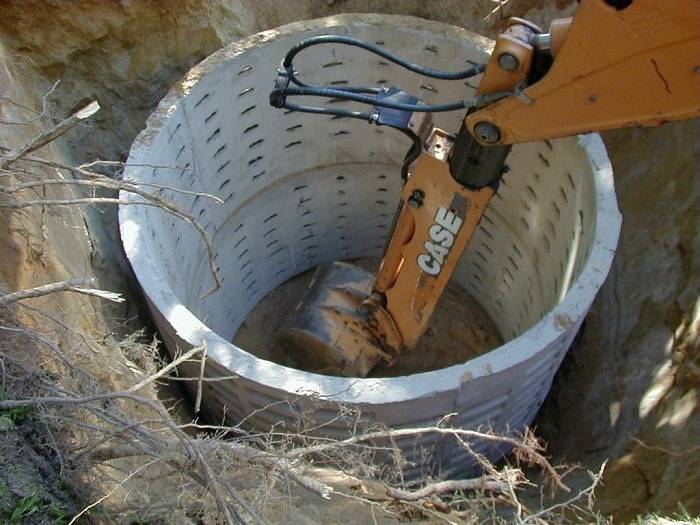 Excavation of a foundation pit
Regardless of the type of pit design chosen, the bottom of the pit must be reinforced with crushed stone and a sand cushion. The first layer of sifted river sand is poured, after it - fine gravel and then - stones of a coarse fraction. The walls of the pit are covered with waterproofing material. In cold regions, textiles or agrofibre are also installed on top of the waterproofing to protect against freezing of the soil.
Related video:
Installation of a cesspool in the yard of a private house.
as well as video:
Cesspool 13m3. Stages of construction.
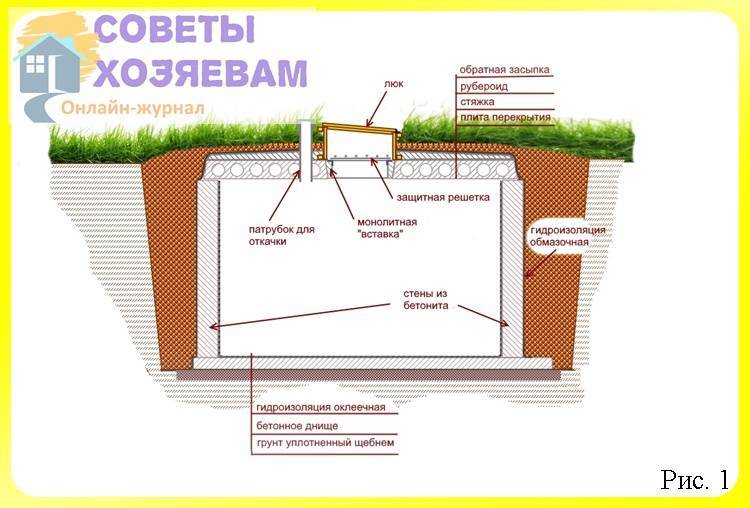
Next, the reservoir is installed. For the installation of concrete rings and a metal container, you need to call in specialists - it is difficult to equip such wells without lifting mechanisms. Brick and plastic pits are often mounted by hand. After the installation is completed, the tank is leveled, sewer pipes are connected to it. All joints must be sealed with resin or sealant.
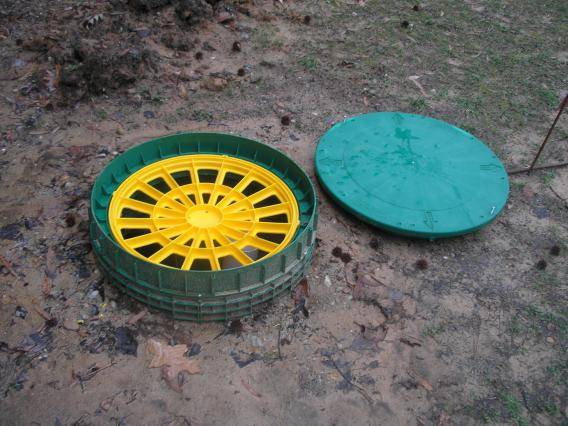 Plastic inspection hatch
After that, it remains only to mount the inspection hatch and fill the pit. Cast metal and concrete covers or plastic structures can be used as a hatch. The latter are the most expensive, but differ in efficiency. Plastic does not corrode, is additionally insulated with foam and perfectly restrains an unpleasant smell from the pit.
Cesspool, sanitary standards
Structural features provide wastewater treatment due to natural filters
When arranging such a pit, it is important to take into account sanitary standards (SanPiN) and building codes (SNiP), according to which the cesspool should be located at a distance:
- From residential buildings - 10-15 m;
- From the boundaries of your site - 2 m;
- From the well - 20 m;
- From the gas main - over 5 m;
- The depth of the cesspool depends on the level of groundwater and should be no more than 3 m.
If the relief of the site is complex, then it is better not to arrange a sewer pit in the lowland. During spring floods, there is a high probability of its flooding, which will cause contamination of groundwater.
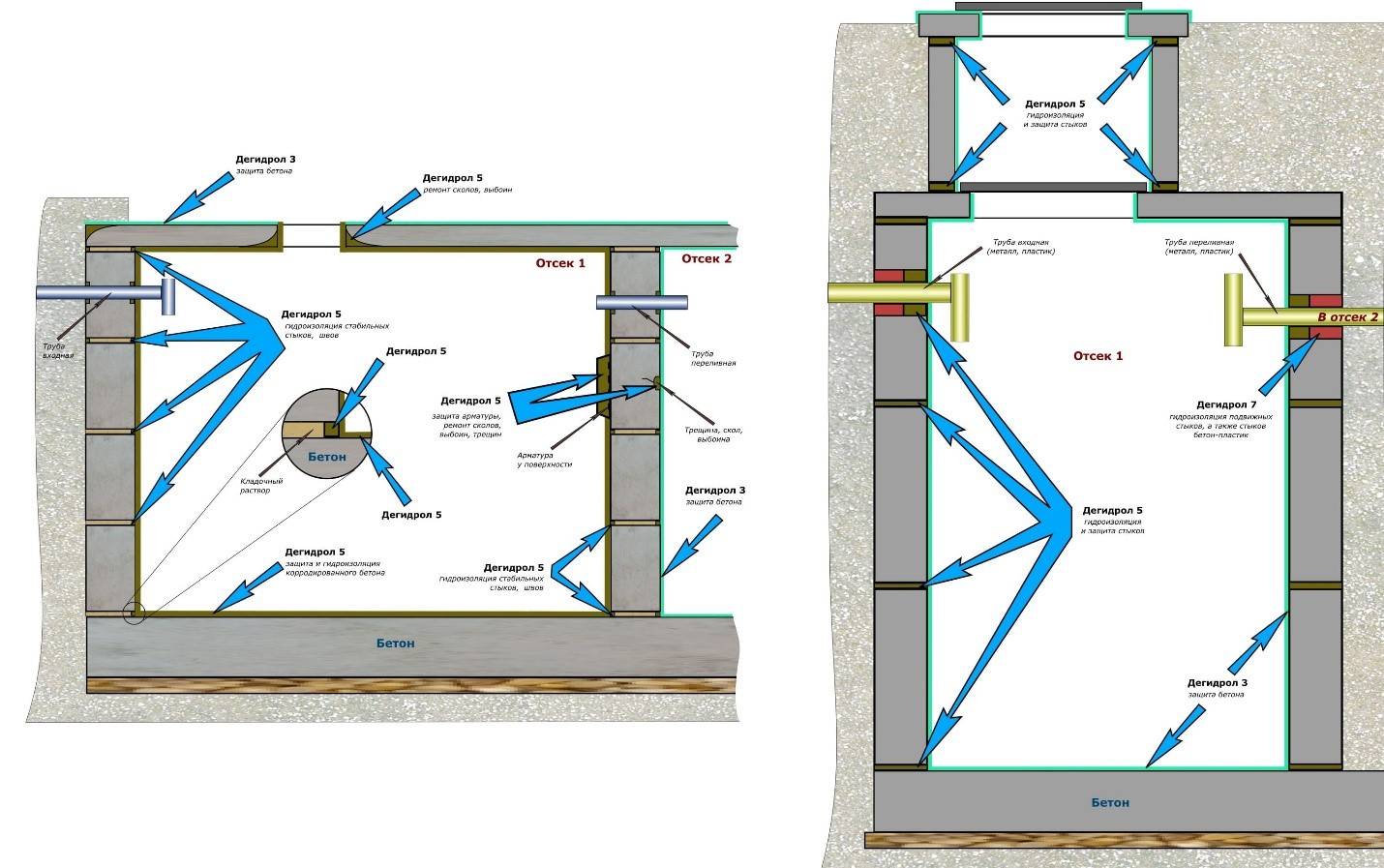



Filtration system
In areas without central sewerage, two main methods can be used to filter wastewater - mechanical and biological.The simplest option for a coarse filter is the formation of a drainage layer of gravel, broken bricks and sand inside the cesspool.
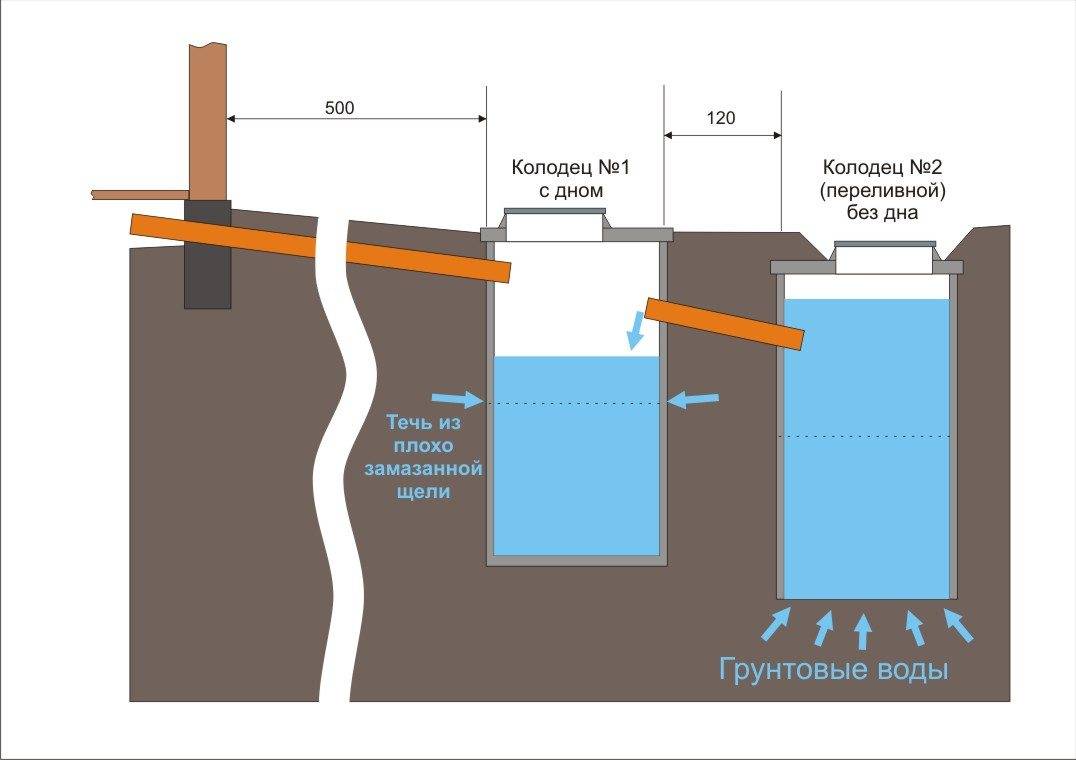
The organization of such filtration is not very difficult, but the type of initial soil should be taken into account. Ideally, these are sandy and peaty soils. The allowable volume of effluents will depend on the filtering capacity of the soil. Also, in accordance with sanitary standards, the bottom of the well for filtering waste liquids must be at least one meter above the groundwater level.
Design features
Strict requirements for the design of the cesspool are not provided. However, there are installation rules that must be followed. They are necessary to exclude the possibility of pollution of the environment, groundwater and the site. Compliance with the recommendations will avoid the inconvenience associated with subsequent operation.
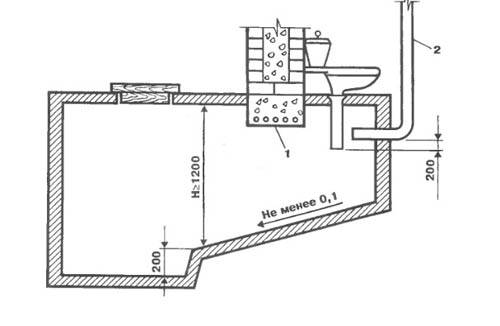
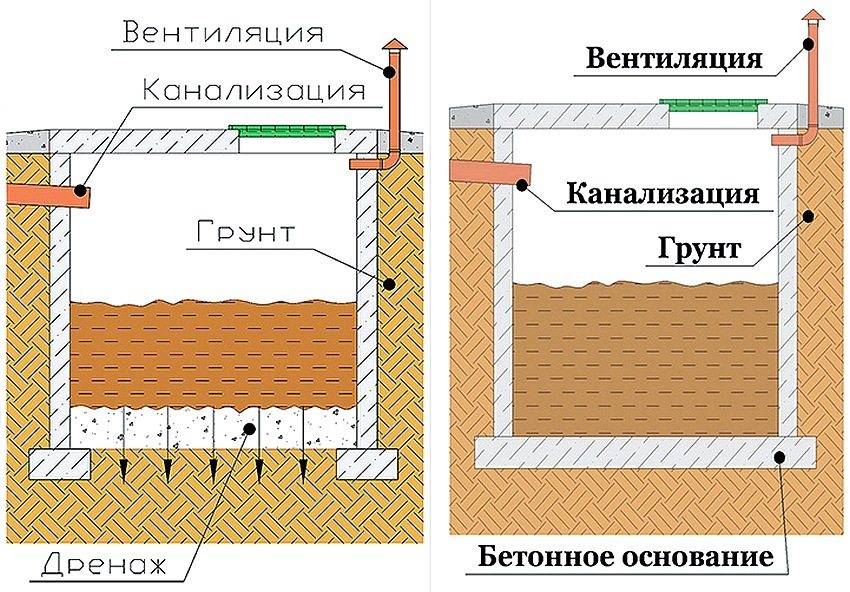
Consider the design features using the example of a do-it-yourself cesspool without a bottom. It makes sense to do such a cesspool in summer cottages, where people rarely live and the volume of sewage does not exceed one cubic meter per day. The design is a filter well with side walls without a bottom, to which a sewer pipe is connected.
It is important to control the slope of the drain so that the wastewater flows into the well by gravity.
At the last stage, the drainage of the bottom and the overlap are made, in which a hatch is provided for inspection and pumping out the liquid as needed. If there are voids between the dug hole and the walls of the well, it makes sense to also fill them with a drainage mixture.
Distance from house to pit
Before installing a septic tank at the selected site, you should familiarize yourself with the requirements reflected in SanPiN 42-128-4690-88, SNiP 2.04.03-85, SNiP 2.04.01-85 and SNiP 30-02-97, which determine the construction procedure and the location of the sewer . A permit for the installation of a cesspool is issued by the SES on the basis of the provided project and the scheme of the treatment plant.
If sewerage will be installed for a full-fledged housing, then its design must be agreed with the BTI.
In accordance with the regulations, the distance from the cesspool to nearby houses should not be less than 15 m. However, if the distance to the houses of neighboring sites is strictly defined, then there are discrepancies in relation to the distance from the autonomous sewer to your residential building located on the same site. In some editions of regulatory documents, a distance of 5 m is allowed.
Distance from the water supply to the pit
Scheme 1. An example of the location of a septic tank
When creating a cesspool on the site, it is important to take into account the distance from it to the water supply, prescribed by the regulatory documents of the SES service and Law No. 52-FZ of the Russian Federation. It is allowed to find a cesspool in relation to a well or a well at a distance of 20 m
The distance to the water supply is from 10 m.
The type of soil also matters. With clay soil, the distance of the cesspool from the well should be 20 meters or more. With loamy - 30 m. In the case of sandy soils - 50 m. If there is a reservoir near the site, then the distance from it should be from 3 m.



Types of cesspool device for a private house
Cesspools are classified according to the material from which they are made, design and principle of operation.
According to the material, the following types can be distinguished:
- Plastic.Equipped from professional plastic tanks. The volume of the pit is up to 1 cubic meter, then the use of a polypropylene barrel is allowed; Plastic cesspool
- Metal. Similar to plastic, they are built from ready-made metal tanks; Metal barrel
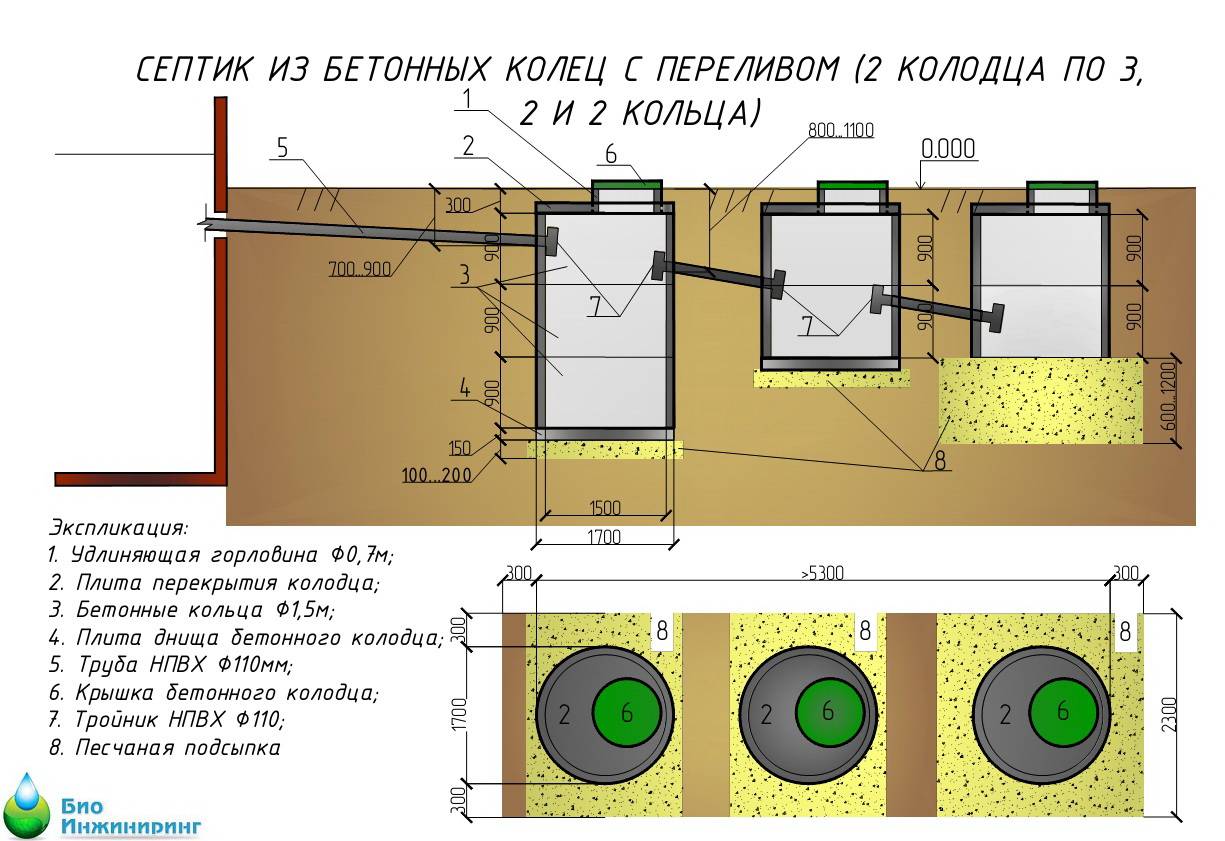
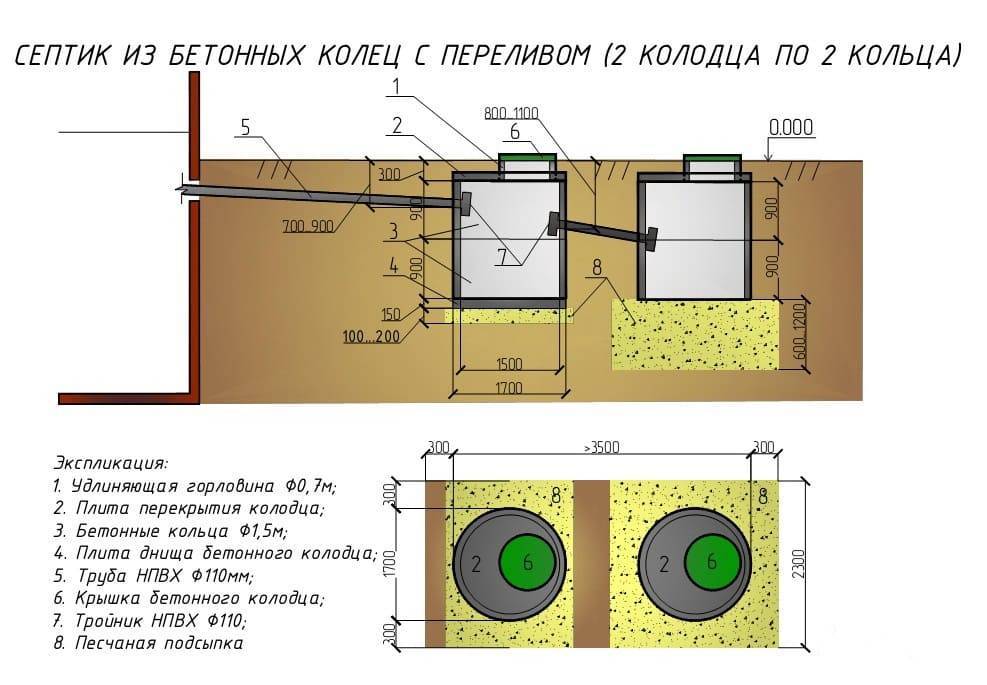
- Concrete. These are cesspools made of concrete rings. This design is durable and low maintenance. Concrete is resistant to fecal masses and aggressive liquids draining into the drain;Construction of concrete rings
- From tires. One of the "handicraft" ways of arranging a cesspool. To create a cesspool from car tires, tires from cars and trucks are used. They are interconnected with bolts; Preparation of a pit for a pit of tires
- Brick. Great for arranging large cesspools. Completely sealed. Ceramic building materials are well tolerated by prolonged contact with water and do not lend themselves to deformation under the influence of earthen masses. Brick cesspool
By design, cesspools are classified as:
- Closed. Fully sealed constructions. They consist of a closed bottom and strong walls. Such containers are environmentally friendly and suitable for installation in small areas;
- Open or leaky. According to the rules of Sanitary Control, such a device is allowed only if the total volume of waste per day does not exceed 1 cubic meter. These pits do not have a bottom and some of the waste goes into the soil and groundwater. This allows you to carry out sewage cleaning less often than with closed tanks, but threatens the environment.
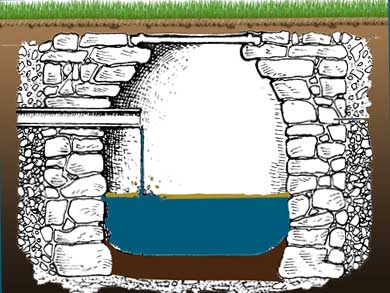
The principle of operation of an open sump
According to the principle of operation, all cesspools are divided into single-chamber, multi-chamber and septic tanks. Single-chamber - standard structures consisting of one compartment. It is both a draft drain and a sump. This is the easiest way to equip a drain, but it requires regular cleaning. In it, effluents are simply stored for a certain time before sewage cleaning.
Multi-chamber - cesspools, consisting of several compartments. The standard scheme is a connection of single-chamber tanks with branch pipes. Waste from the house or other consumer points is dumped into one, and pre-treated waste flows into the second. The effluents are in the sump for several days, after which they are additionally cleaned and drained outside the site.
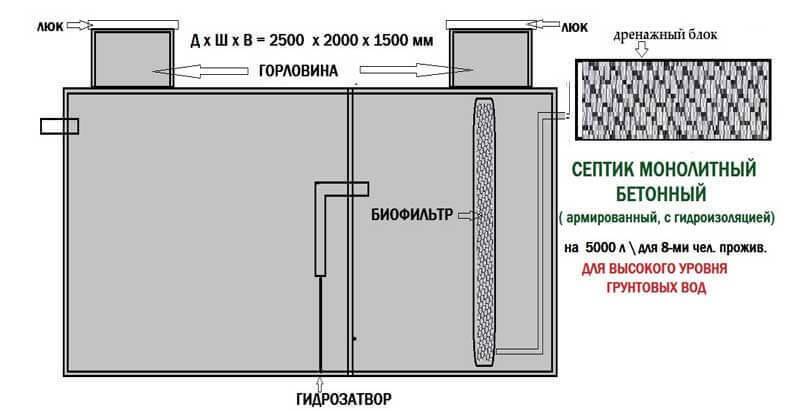
Septic tanks are professional multi-chamber devices. They consist of tanks separated by nozzles and filters, pumps that pump wastewater at a certain rate and treatment facilities (biological filters). The main advantage of using a septic tank for a cesspool is its efficiency. It is not just a liquid accumulator, but also a purifier. Many owners use settled water in the future for technical needs.
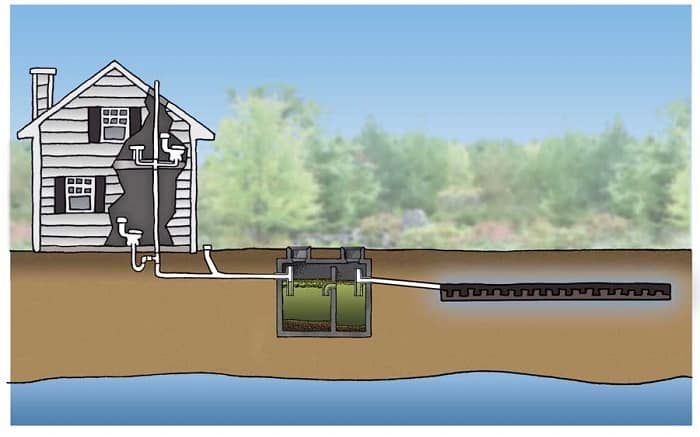
The scheme of the septic tank
Design Options
The device of the sewer system is a recess in the ground, the walls of which are reinforced with different materials, depending on the expected time of use. Based on this, 2 main types of structures can be distinguished:
permanent - concrete or brick;
temporary - wooden or from old tires.
Permanent
A concrete pit can be made from a solid screed or rings. The bottom of the structure of the rings must be poured with concrete mortar, and only after that the main part is mounted. The second option is convenient in that you can completely do it yourself. A big minus is the frequent cleaning of the structure, which depends on the number of people in the family.


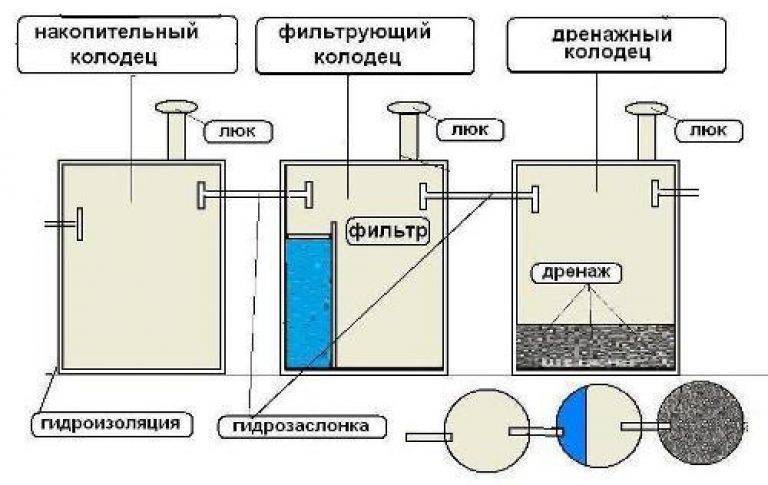




One-piece screed construction requires more funds and time to implement. Reinforcement is placed at the base of the floor, and then it is poured with a concrete mixture. Next, a form is erected, which is poured with the same solution. This sump will last for many decades, sewage will not be able to penetrate into the ground and during operation the volume will not decrease.
Less expensive compared to previous options, a concrete septic tank, consisting of two sections. A large hole is dug to divide it into two parts. Each of the finished compartments will be connected by a duct. All effluents fall into a larger container with precipitation, and into a smaller one without precipitation.
The most complex design of a septic tank consists of 3 parts. It will require the use of additional equipment - a compressor with a timer is placed in the second compartment and a drain pump in the third.
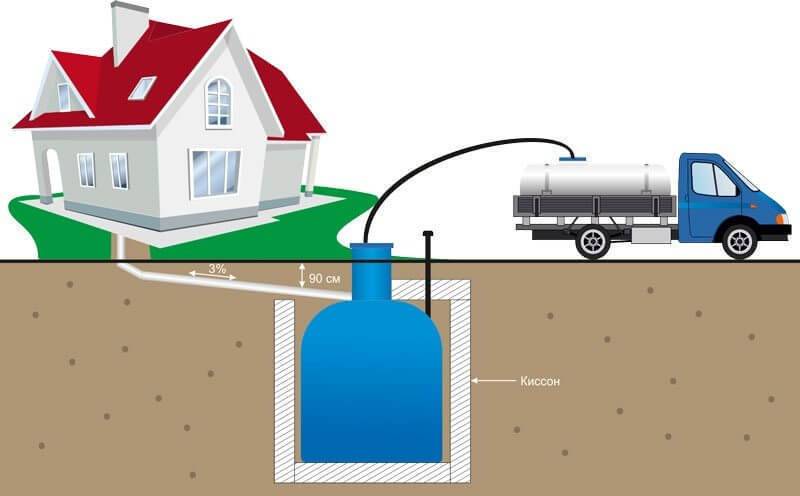
The most modern of the available options are plastic containers of different sizes. They are airtight, because of this, effluents will not fall into the ground, but it will require constant pumping of waste.
Temporary pits are made from wood or used tires. When used in the construction of boards, the material is treated with a protective solution. The walls are made in the same way as on the formwork.Such sedimentation tanks are good because of their low cost, quick construction and high degree of soil isolation from possible runoff. Service life - no more than 10 years.
The tire construction option does not require finishing, high costs and can last up to 25 years. But the big minus is the high level of throughput, due to which sewage will go into the ground, thereby polluting it.
Choosing a place taking into account sanitary standards
When constructing a new cesspool, one should be guided by the requirements set forth in SNiP
Of course, for ease of use, I would like to place it closer to the house, however, the distance from the foundation to the tank should be at least 10 m (force majeure circumstances related to the violation of the tightness of both the foundation and the storage tank are taken into account)
A diagram showing the minimum allowable distances from the cesspool to important objects. When drawing up a project, one should not forget about similar objects in neighboring areas.
When planning, also keep in mind that the fence outlining the boundaries of the site should be at a distance of no closer than 4 m, and the roadway - no closer than 5 m. The largest interval - to the water source (well or well) - at least 25 m, with loose sandy soil - up to 50 m. If there is a reservoir with stagnant water (pond or lake) nearby, then it must be taken into account - 30 m.
Types of modern cesspools
Today, the functional load of the drain pit has increased markedly, since the presence of home sewage and an elementary cold water supply system increases the volume of effluents several times.
In this regard, new modifications of sewer facilities have appeared, more voluminous and perfect in terms of waste processing.
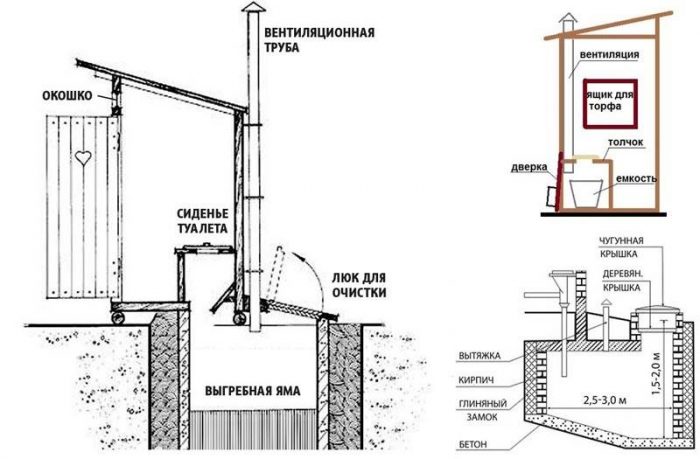
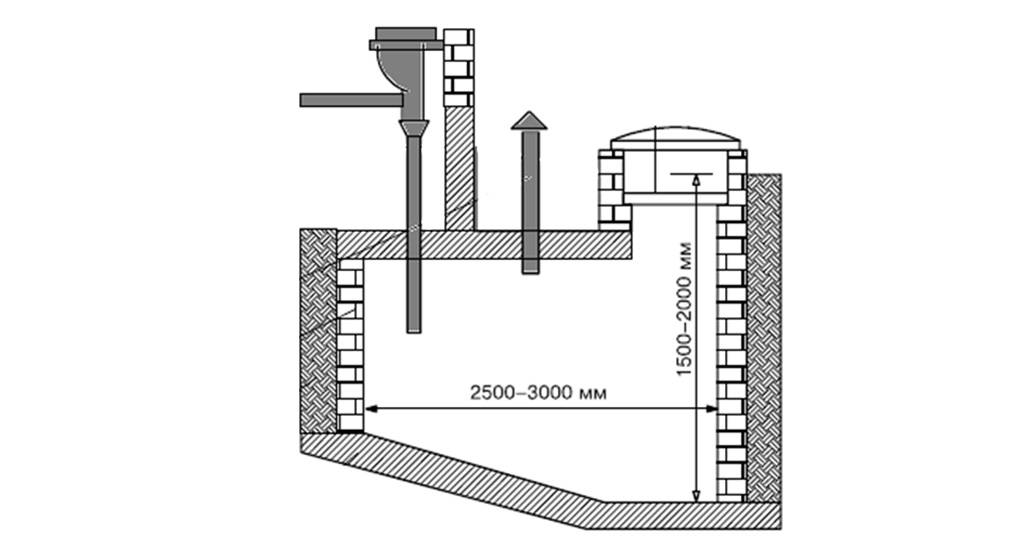
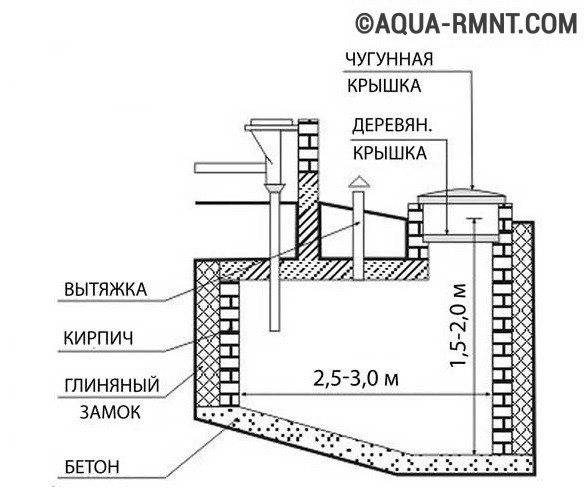
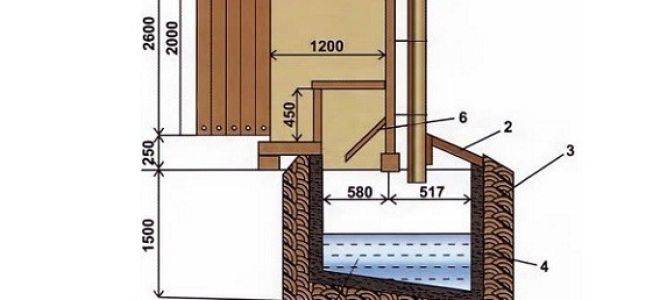
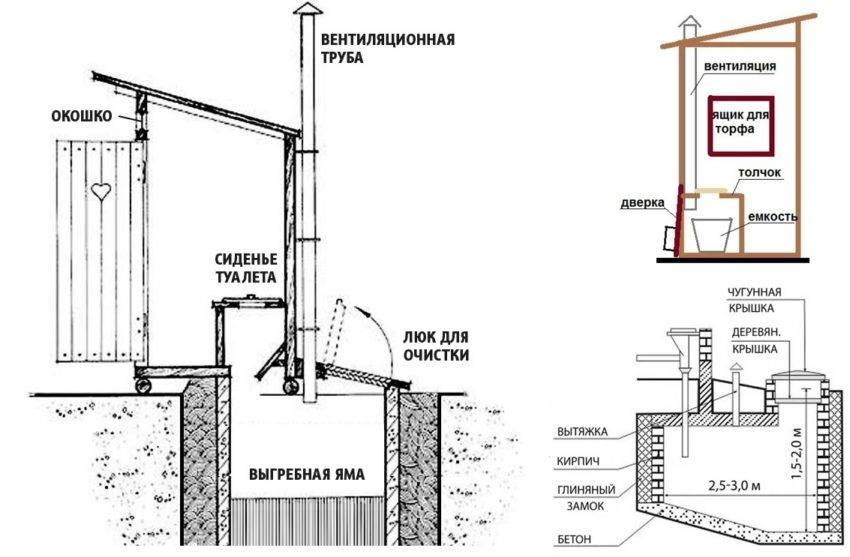
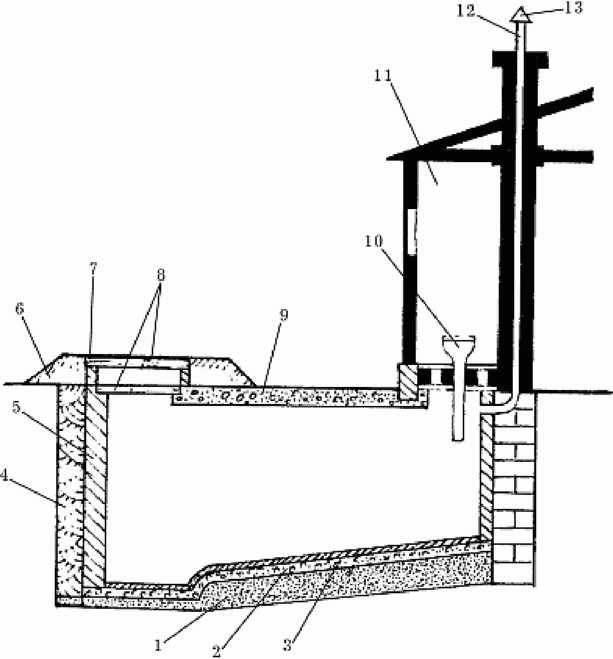
Scheme of a country toilet from the last century. The role of waterproofing protection is played by a simple clay castle, therefore, there is a risk of sewage waste penetrating into the soil
Remember how the drain pit used to look like - a small well into which all the waste was methodically poured until it was completely filled. The walls of the well were lined with boards, laid out with stones or reinforced with other improvised material. When the level of effluents reached its maximum, a sewage machine was called for pumping.

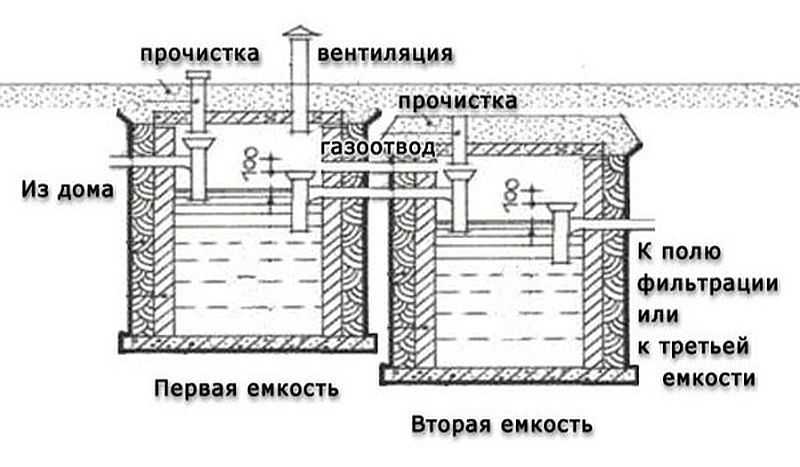
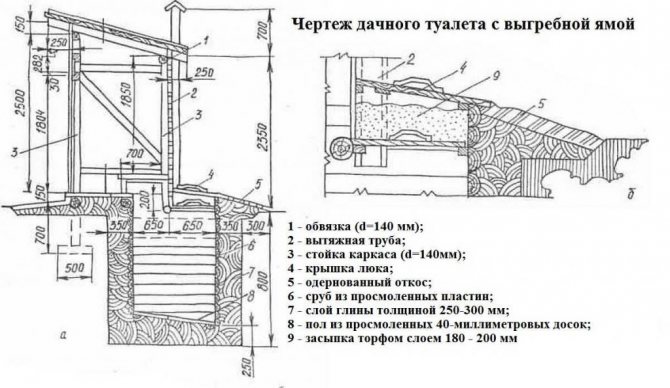

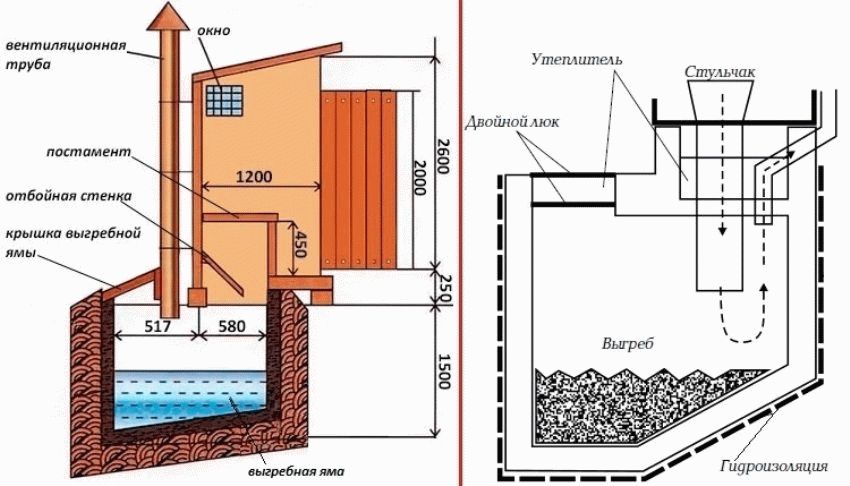

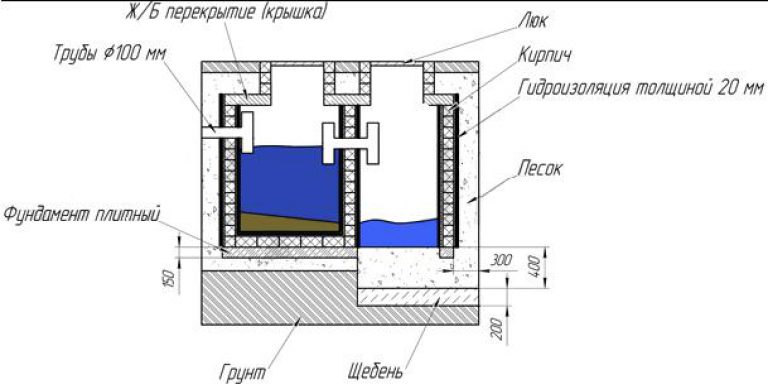
If a storage septic tank is installed - a sealed container that is periodically emptied with the help of vacuum trucks. An access road must be built to the place of its installation.
Of course, there was no talk of any kind of ecology or protection of the environment from pollution in those days. But today everyone wants to keep the soil clean on the site, so they strictly monitor the sealing of treatment facilities. Manufacturers choose materials that do not require long-term installation or special waterproofing. An example of modern models are volumetric polymer tanks.
A large plastic container is a kind of sump with one, two or more chambers for sewer drains. Processing of wastewater in them is carried out with the help of anaerobic microorganisms
Monolithic one- and two-section concrete structures, as well as installations from one, two or even three concrete wells, have not lost popularity. The choice is explained by the relative ease of installation (filling) and a decent (up to 30 years) service life.
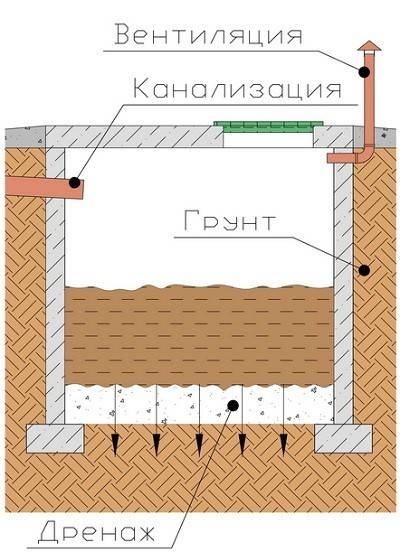
Scheme of the simplest septic tank for a summer residence - a filtering well made of concrete rings with a gravel-sandy bottom passing and cleaning drains, a ventilation pipe and a hatch for direct access
The point of laying out the shaft with bricks has disappeared, because it is much easier to install several rings than to create a solid brickwork. The main quality of the new devices is tightness, which protects the soil from pollution by sewage.



