
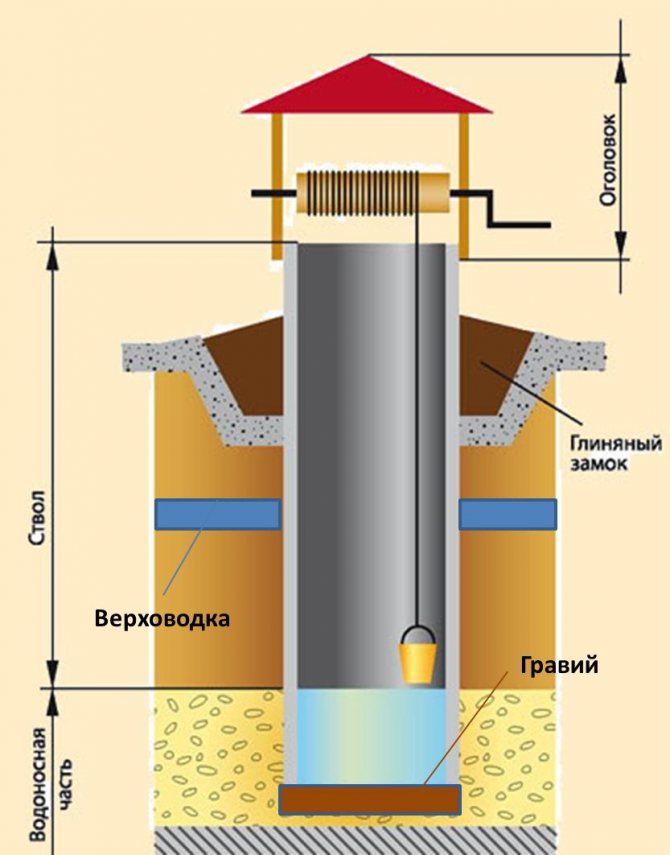
- Place for arranging a well
- Ensuring the tightness of the casing
- Well in the yard - to be or not to be
- The choice of the type of well depending on the remoteness of the water basin
- Prices for pumping stations
- Selection and installation of equipment for the supply of water
- Surface pump for shallow well
- Deep well submersible pump
- How to make a headband with your own hands?
- log building
- timber frame
- metal frame
- Yard highway conducting water supply from the well
- Types of well houses and their tasks
- open or closed
- What to do
- Well Construction Tips
- Conclusions and useful video on the topic
- Conclusions and useful video on the topic
Place for arranging a well
First of all, determine the optimal site for arranging the well. There are several methods.
Try to find a suitable place with the help of the simplest fixtures - frames made of brass wire. Take a wire with a diameter of about 3 mm, a length of 0.5 m. Bend the wire at a right angle so that the length of the short part is approximately 100 mm.
Make two such frames. Take them in both hands. You don't need to squeeze the frames too tightly - they should be able to rotate without too much difficulty.
Try to find a suitable place with the help of the simplest fixtures - frames made of brass wire
Go around the entire suburban area with such frames. Mark the places where the frames crossed - in these areas the aquifer is located closest to the surface of the earth. If there are several such places, choose the most convenient and suitable for current requirements.
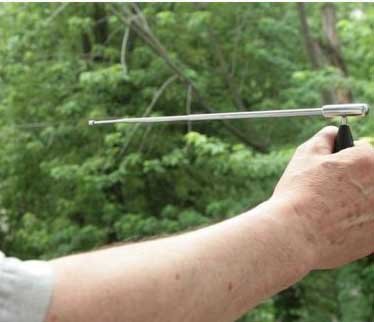
How to find water in a summer cottage
There is a more efficient, but also much more costly way to determine a suitable location for arranging a well. In accordance with this method, you need to dig a well. It will allow you to determine the depth of groundwater.
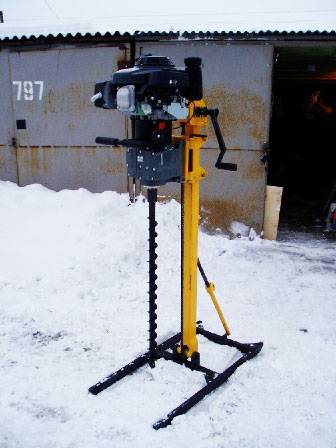
Exploration drilling
Ask your neighbors how deep their wells are beforehand. In neighboring areas, groundwater in most situations passes at the same level.
You can also determine that water passes at a short distance from the soil surface by the following features:
- during the period of spring snowmelt, the basement of a house or other building in a summer cottage is filled with water;
- rather dense fog is formed at the summer cottage even in the absence of any water bodies nearby;
- not far from the summer cottage there are natural reservoirs;
-
moss is present on the surface of the soil;
- after sunset, many different midges appear on the site;
-
even in very dry periods of the year, juicy dense grass quietly grows on the site.
Ensuring the tightness of the casing
Neither dust, nor condensate formed in the caisson, nor, moreover, rain and melt water should get into the well casing that supplies the house with drinking water.If this happens, harmful microorganisms from the surface can get into a clean underground source and it will be difficult and expensive to “treat” it.
To seal the well, fasten the submersible pump and pass communications, use the factory head: it is relatively inexpensive and makes installation of equipment very easy
To protect the source, a borehole head is used - a special steel cover equipped with technological holes for passing communications and a reliable hook for hanging the pump. The head is selected according to the diameter of the casing, it has a rubber crimp cuff that seals the casing. The water pipe and electric cable are also introduced through hermetic seals.
We do not recommend cutting the casing pipe close to the floor of the caisson. It is better to leave a section 25-40 cm high above the concrete surface. Firstly, it will be more convenient to mount a pump with a head. Secondly, with a slight flooding of the caisson, water will not enter the wellbore.
Well in the yard - to be or not to be
Drilling a well is a laborious and dirty business, and the desire of land owners to carry it out independently is dictated solely by the need to save money. There are, of course, specialized organizations that will do everything quickly and efficiently, but such a service will cost almost the same price as the material. Hence the desire - and sometimes unreasonable confidence in the expediency of an unprofessional approach to this action.
The drilling rig will easily pass even rocky ground
When can it be a waste of time? For example, when the water surface of the ground basin is far from the surface.In order to take on the extraction of underground water, you must be sure that it is there. And even when it is close (it happens that it is even one meter from the surface), it is not a fact that its quality will be drinkable.
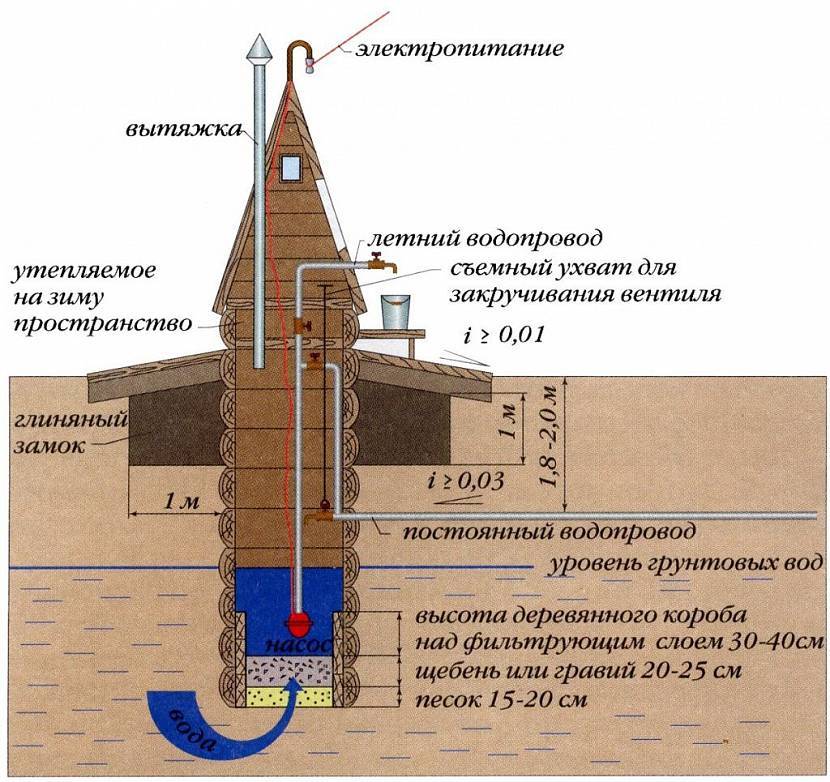


Most likely, this is perched water - a focal zone of loose soil, voids in which are filled with rain or melt water. She can only water the beds or wash the car. In addition, the top water is unstable, and in the summer the water can leave it completely. What is the water supply then?
Approximate scheme of water occurrence
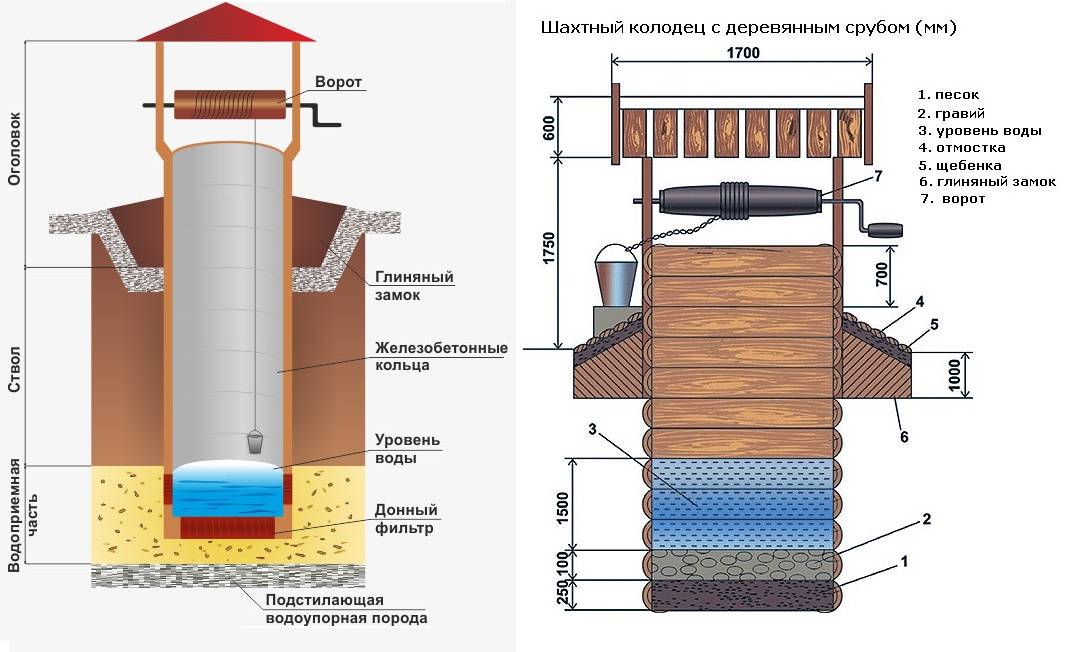
The water level is more stable in the ground basin, which lies below the perch, in the first sandy layer underlain by a clay aquiclude. It is in this horizon that water is taken for wells and ordinary wells (referred to as "on the sand"). By law, this can be done for free and without any permission, if you have not gone further than this layer.
However, extracting water from the sandy, water-saturated layer closest to the earth's surface can also be problematic. For example, because of its strong remoteness, which can be 30 or more meters. For professional drillers, this is just a trifle, but for a person with a homemade drill, it is a real hard labor.
The choice of the type of well depending on the remoteness of the water basin
By itself, the question arises: how to find out at what level the water is? The easiest way is when your neighbors already have a water intake - you can navigate by its depth. If this is not possible, contact your local geological party - they should have data, and annually updated.
An example of mapping with water depth data
If nothing worked out here either, you will have to rely on the old-fashioned ways of finding water. And they, by the way, also work: where water is closer, grass grows wildly - and L-shaped metal rods also cross. You still won’t get an answer to the question about the exact depth of its occurrence by such methods, and it depends on what type of well you need to drill. And in this case there can be only two of them.
Option number 1. Mini-well (Abyssinian, well-needle, tubular well)
Such a water intake has a diameter of less than 3 inches, and a depth of no more than 8 meters. Its advantage is that it can be located not on the site, but in the underground of the house, and not bother about the insulation of the mouth and surface equipment.
The depth limitation is due to the fact that no submersible pump will enter such a penetration, since their diameters, from these same 3 inches, are just starting. And surface pumps cannot get water from a greater depth than 7-8 m.
Extraction of water by a household pumping station from a mini-well
Prices for pumping stations
Pumping stations
Abyssinian well service
Option number 2. Well in the sand
It has a diameter of 80 mm or more, the depth can reach 40-50 m - in accordance with the level of the water table under the ground. You can also drill it yourself - provided that it is not too deep.
A full well has a larger diameter
Driving a length of 15-20 meters is quite real, but again, the complexity of the work depends on the diameter of the pit, and on the type of soil removed from it. If it is predominantly rocky, you will most likely regret taking on such a job.And it will be doubly insulting if it turns out that there is little water in the horizon found.
If everything works out, you can install the pump not on the surface, but in the wellbore, and the water in it will certainly be cleaner, as it has passed through thicker layers of soil.
The advantages of such water intake include the possibility of deepening the trunk in case of depletion of water reserves in the exploited horizon.
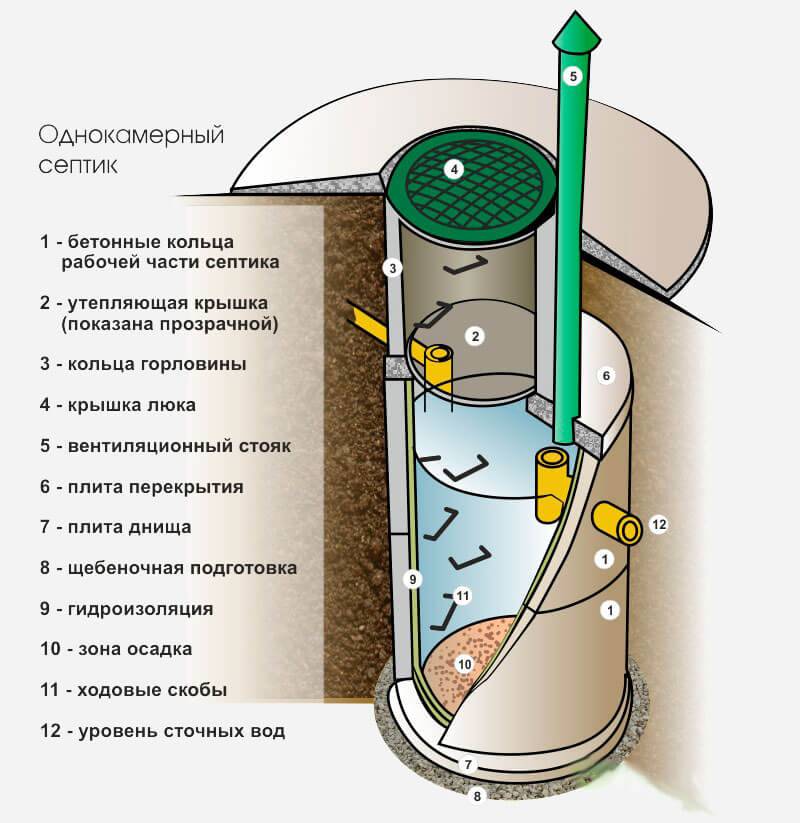
Well structure on sand
Selection and installation of equipment for the supply of water
Equipment for individual water supply consists of the following elements:
- Pump, it can be submersible or located on the surface.
- Automation that controls the operation of the pump and protects it from overloads.
- Hydraulic accumulator, open or closed (membrane tank). The latter is preferable, it provides stable pressure in the water supply.
An open water storage tank has to be installed at the top of the water supply, in the attic or under the ceiling of the upper floor. The closed container has no restrictions on the place of installation.


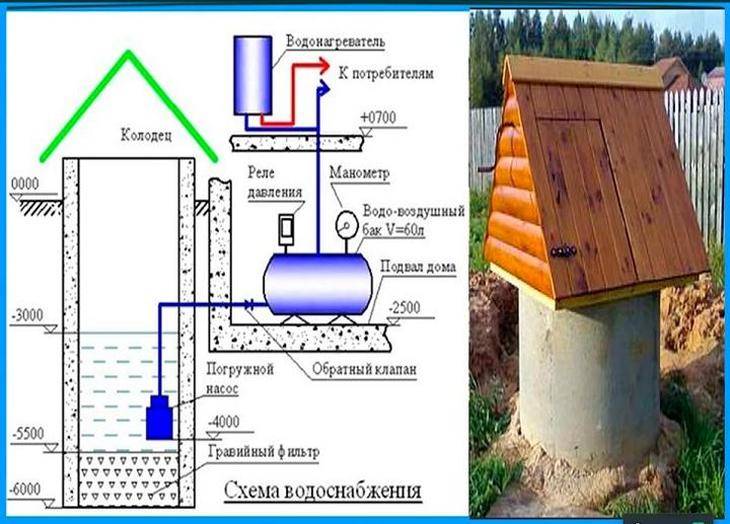


The main elements of the water supply equipment of a private house from a well: a pump, a hydraulic accumulator, automation
The nature of the well arrangement is largely determined by the type and location of the water supply equipment. Consider the main options for completing the source with equipment.
Surface pump for shallow well
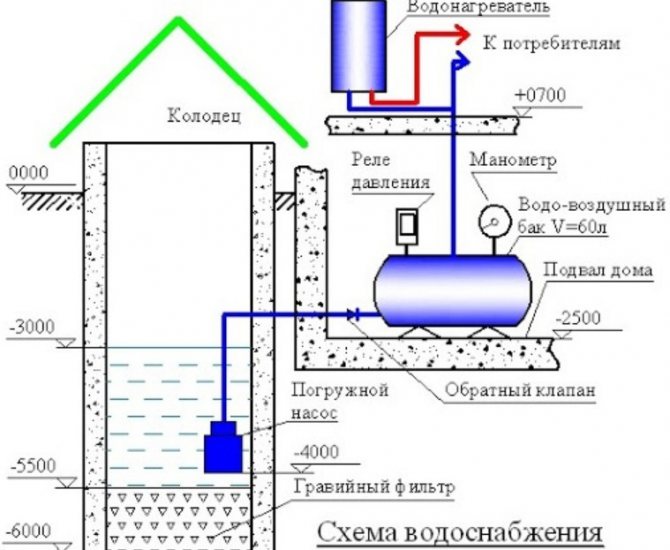
A surface pump is significantly cheaper, easier to install and maintain than a submersible one. The most rational and economically justified option is a three-in-one complete pumping station, which includes a surface pump, a relatively small (20-60 l) membrane tank and all the necessary automation.
Only the suction hose is lowered into the well. Thus, the arrangement of the well and the maintenance of the pump are simplified. In addition, the hose has a small diameter, which allows it to be used in the so-called "Norton wells" (Abyssinian wells), where the submersible pump simply does not fit.
Pumping stations have only one, but a very significant drawback. A surface pump is not able to lift water from a great depth, for most models the limit is 8-10 m. This limits the scope of pumping stations to wells and shallow wells.
Due to the low lifting height, pumping stations with a top-mounted pump often have to be installed as close to the wellhead as possible. Otherwise, you will have to additionally overcome the hydraulic resistance from the water source to the place in the house where the pump is installed.
Schematic diagram of water supply based on a complete pumping station with a surface pump. It is used for shallow wells due to the low height of the water rise
Deep well submersible pump
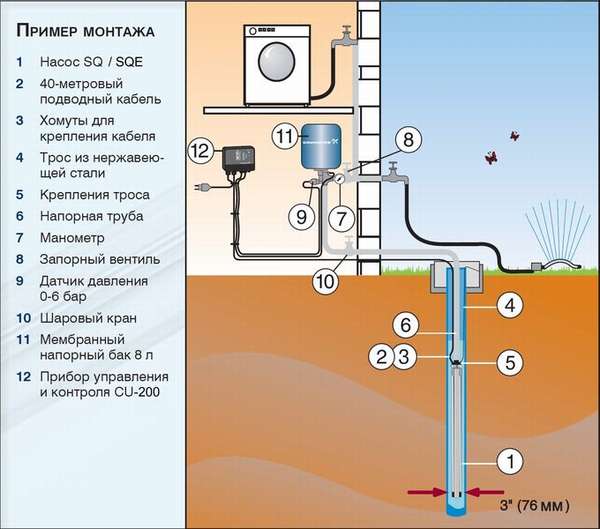
To lift water from wells with a depth of more than 10 m, submersible pumps have to be used. The correct choice of the pump and the determination of its suspension height in the casing is a separate and rather difficult issue.
As part of the topic of the article, we just need to understand what additional equipment the pump is equipped with, how it is mounted, connected.
As we have already mentioned, the mandatory elements of the water supply equipment of an individual house are a hydraulic accumulator and control automation. In the case of a submersible pump, the lifting height of which is several times greater than that of a surface pump, there are no restrictions on the installation location of a closed accumulator.
The membrane tank and control can be placed quite far from the wellhead, the distance to the source does not significantly affect the operation of the system. An excellent place to place equipment is a dry and clean technical room in the house, in the basement or ground floor.
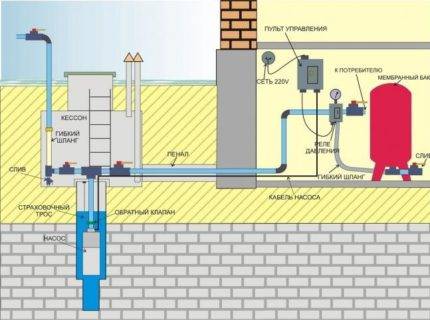 Scheme of autonomous water supply based on a submersible pump. The membrane tank can be located at a fairly large distance from the well
How to make a headband with your own hands?
We offer you to consider step-by-step instructions for construction. There will be 3 variations on how to build a house, namely a frame:
- from a log;
- timber;
- metal.
log building
In fact, a log structure is being built without a frame. It is necessary to have the required number of rounded logs. The design will have 4 walls and laid crosswise.
A gate, a gable roof and roofing will also be installed. The process of creating a frame from a log house is as follows:
- The lower part is formed. Side racks are installed immediately.
- After that, a log house is formed.
- Up to the top level, the logs on four sides will be equal.
- When forming the roof, the end parts are reduced according to the principle of nesting dolls.
- From the end side, a rod for the gate is necessarily mounted on the supporting pillars.
- At the end of the work, it remains to make a crate of timber for the roof and cover it with metal tiles.
timber frame
Having decided on the dimensions, it is necessary to assemble a frame from a bar with a section of 50 × 100 mm. The resulting base of the wooden house will later be sheathed. The work process is as follows:
- Having determined the side part of the structure, fix the beam (support pillar) on both sides.Its size will determine the height of the entire structure. Please note that the gate will be fixed on these supports.
- A frame is being assembled that will immediately outline the future shape of the structure. The simplest option is a square.
- On each side, a frame is made of timber. Between themselves, the beams are connected by metal corners and self-tapping screws.
- The cap may not overlap the visible part of the concrete ring. In this case, it is necessary to make a frame from a bar according to the type of gable roof.
- With this option, the beam will be fastened with anchors to the concrete ring.
- The frame must have elements to create rigidity.
- Rafters are also made from timber.
metal frame
The use of metal will make it possible to make a high-quality and durable head for a well. The basis will be used profile or round pipe. To form the base, you can use a stainless profile. The features of the work are as follows:
- Anchors fix two support posts from a profile pipe, which will determine the height of the frame on the well.
- Pipes are welded to the support pillars in a horizontal position. They must be laid on the top edge of the concrete ring.
- The top level will be square. On both sides it is attached to the vertical pillars of the support.
- The slope of the future roof is being formed. From the top of the support post, a pipe is lowered diagonally down and welded to the corner of the square section laid below. This is done on each side.
- Spacers must be welded to give rigidity to the structure.
- An opening is formed for the future installation of the door.
Yard highway conducting water supply from the well
tools and materials
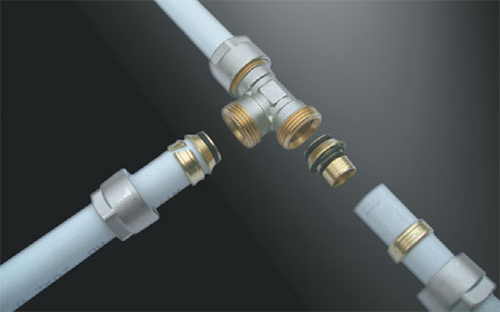
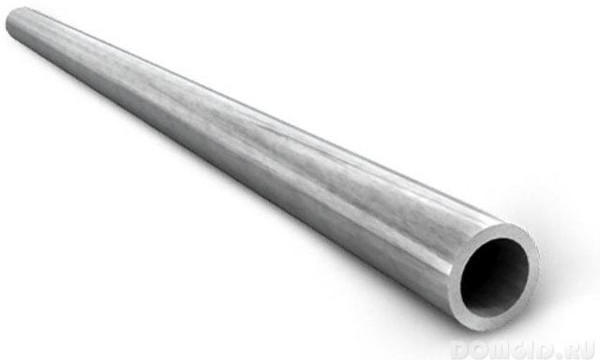
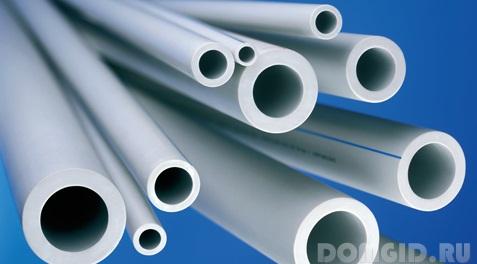
For conducting water supply on the site, you can use different types of pipes:
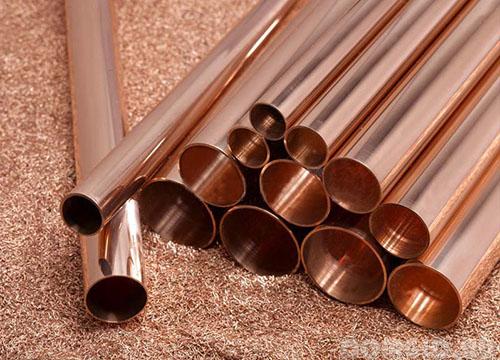
- Copper pipes are the most expensive, but also the most reliable pipes. The material is not susceptible to corrosion, aggressive biological environment and ultraviolet radiation, has good heat transfer.
❝Diameter of the pipeline from the well should be 32mm❞
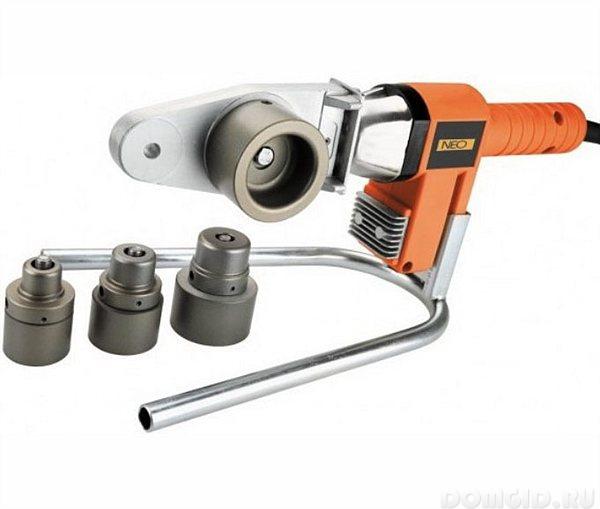
Piping tools:
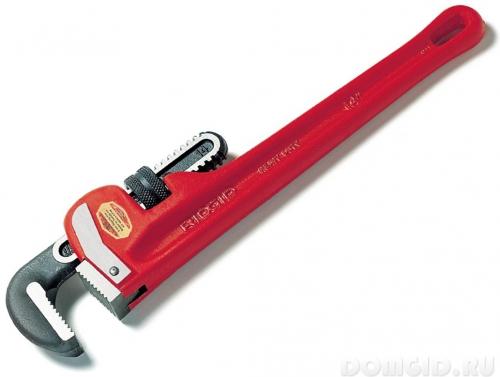
- For installation of steel or copper plumbing:
adjustable, gas and wrenches;
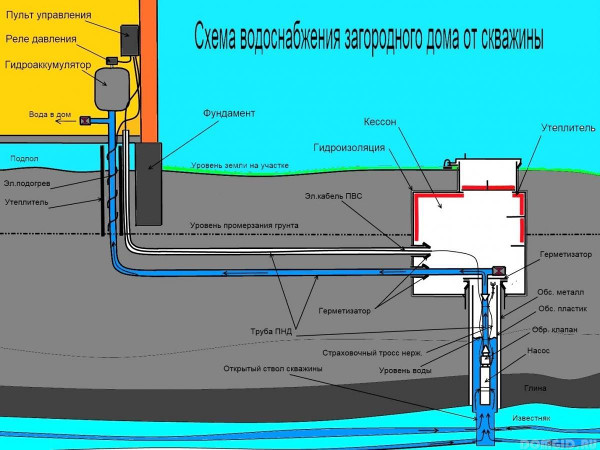
the sequence of laying and warming the water supply
The pipeline can be laid in two ways:
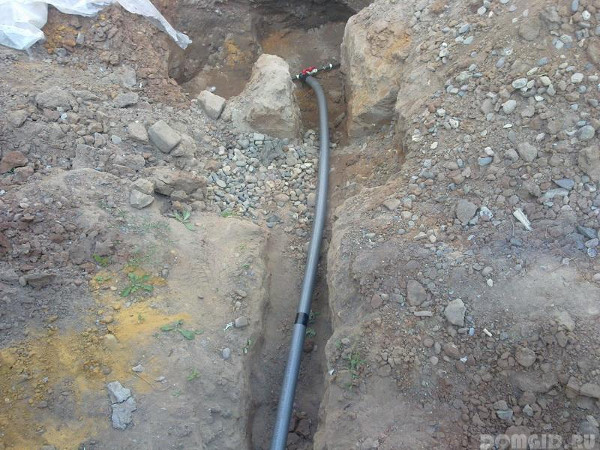
In the first case, a trench is dug at a depth of 2 meters and a pipeline is laid. The pipe in the lifting points must be insulated (especially near the foundation). This can be done with a self-regulating heating cable.





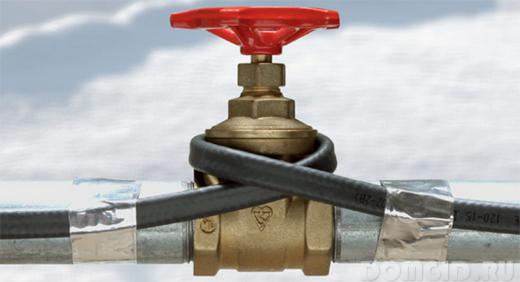
❝The foundation of the house to which the water supply is connected must be insulated at least to a depth of 1 meter❞
If the water supply is laid on top, then a heating cable (9 W / meter) must be connected to the pipe. In addition, the entire pipe is thoroughly insulated with heat-insulating material - a layer of insulation of at least 10 cm.
You can use energy flex and cotton wool. The joints between the heaters must be wrapped with reinforced tape - this will improve the sealing between the layers.
❝The pipe must be insulated along the entire length of the yard main: from the house to the well❞
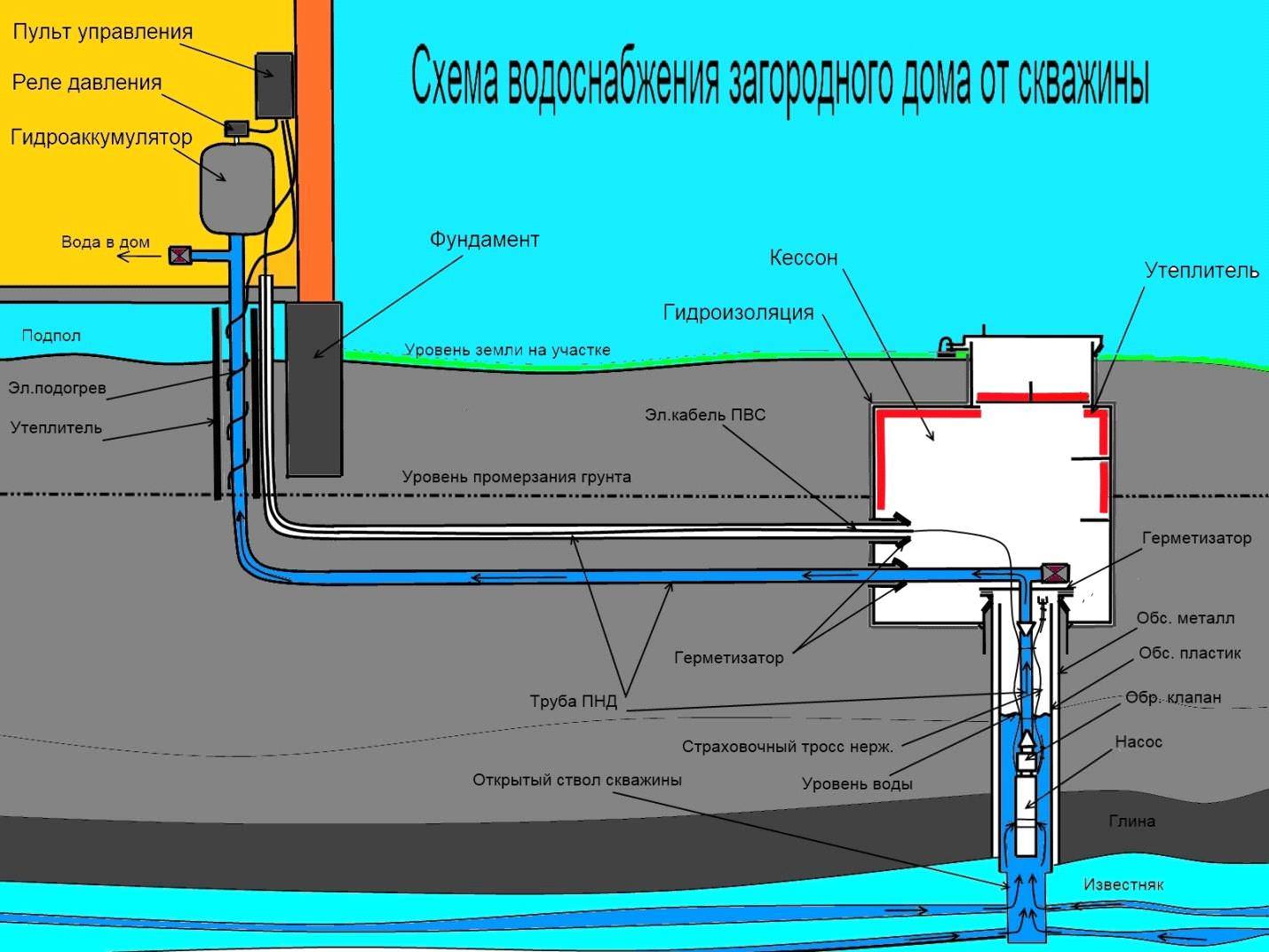
The entire "pie" of the water supply is placed in a large corrugated or sewer pipe. Such measures will avoid freezing of the water supply and use the well in winter.
Together with the pipe, the supply cable for the pump can also be laid at the same time. It is better to use a 4-core cable with a cross section of 2.5.
After installing the pump and laying the water supply to the house, it is necessary to assemble an automatic water supply system according to the scheme.
Types of well houses and their tasks
The primary task of the well house is to protect water from the ingress of various substances - dust, foliage and other similar contaminants. This requires a tight-fitting lid. Open wells are possible only for technical water - for irrigation. Water from them cannot be used for other purposes. So if you plan to at least wash the dishes, the well should close tightly.
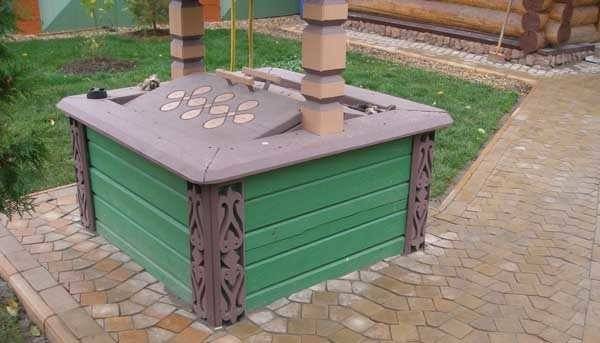
The lid on the well must be tight.
Protection from precipitation of any kind is also necessary: rain and melt waters carry very dirty water with fertilizers dissolved in it, animal waste, various garbage and impurities. Its entry into the well is fraught with serious pollution. To protect against precipitation, a canopy is made, most often a gable - it is easier to remove precipitation.
Another task of the well house is to protect from outsiders or, in any case, to ensure safety for children. To do this, hecks are made or locks are cut in.
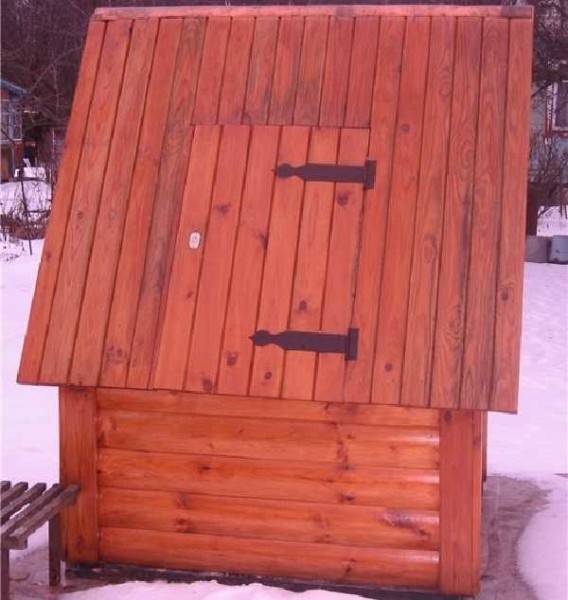
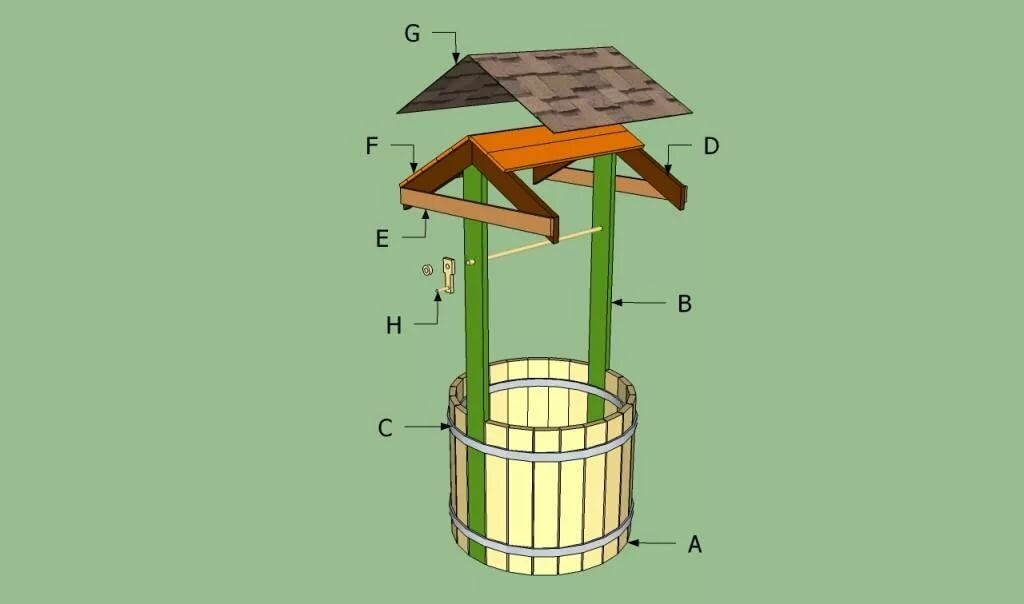
Option for a closed house for a well
To make it easier to raise water, racks and gates are installed - in the simplest case, a rotating log with a handle to which a chain is attached. And all this together should still please the eyes of the owners, but at the same time require minimal maintenance.
open or closed
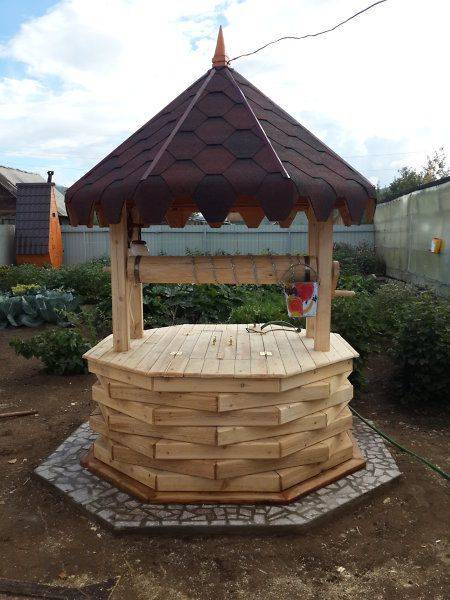
As you can see in the photo, the well house can be open and closed.It’s cheaper and easier to make it open: the well ring can be finished with stone or wood, the lid, racks and canopy - made of wood or metal - whichever costs less. Materials for such a structure require a minimum. There is only one “but” - in winter, water can freeze in such a well. If you do not plan to use it in cold weather, no problem.
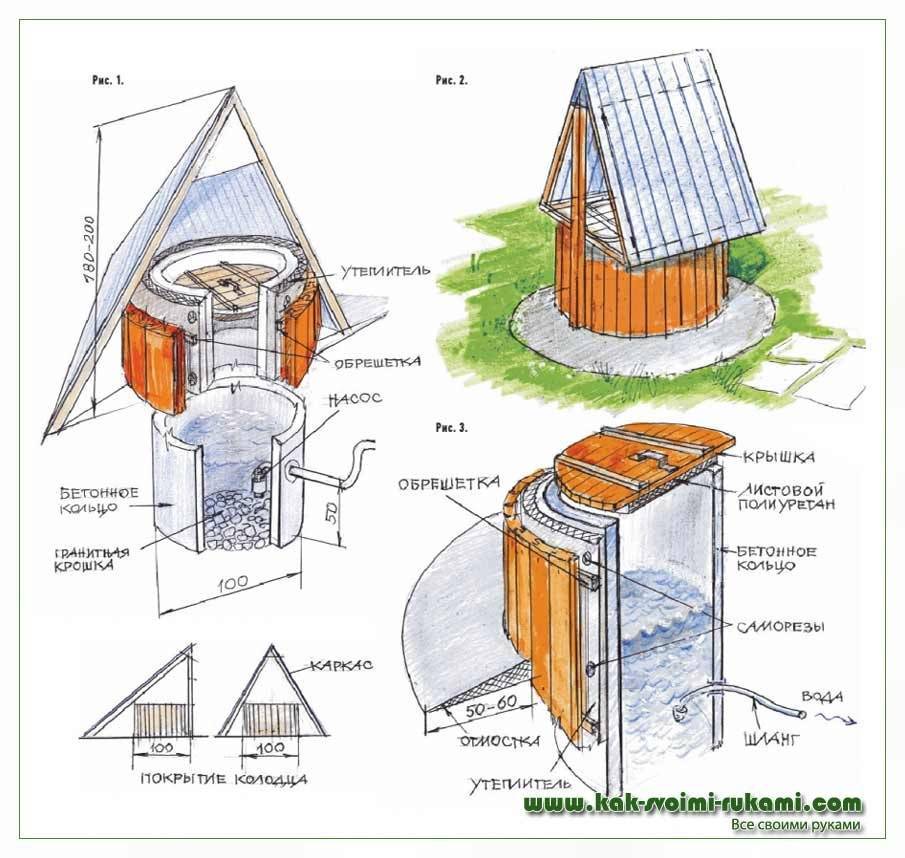
But for winter use, an insulated well house is required. But even then it can be made open:
- buy a polystyrene "shell" for the well - they are of the right size, fix it, and put the finish on top of it;
- make the overlap of the ring and the cover from several layers of wood, and lay the boards in different directions, blocking the joints.
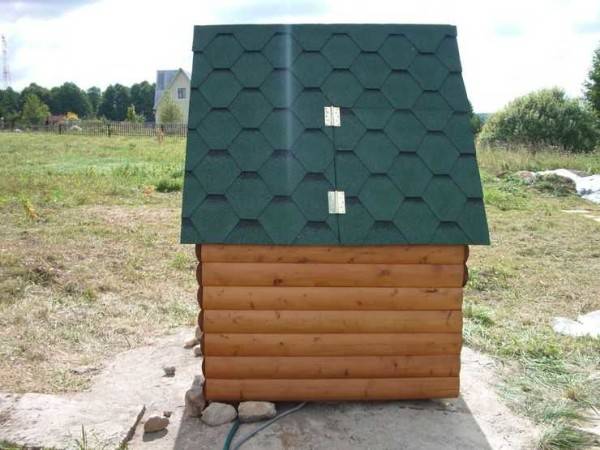
Closed house for a well
Another option is to make a closed house. It is slightly larger than the well ring in size. The existing air gap is already a good heat insulator, but protection can be further improved - by laying gaps with foam, for example.




What to do
The choice of appearance sometimes takes a long time. The beautiful half of humanity is especially “suffering” with the desire to decorate the well, going through numerous design options and spending a lot of time doing this. In fact, everything is simple: if there is a house, and a well is nearby, it is worth decorating it in the same style and, if possible, in the same color. Agree, it looks good.
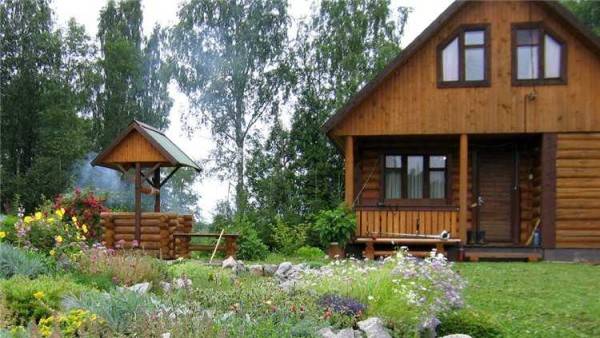
It is better to arrange a well in the same style as the house
What if the house is brick or plastered? Choose a finish that matches the style of the design of the site. If this is one of the first buildings on the site, just do it the way you like.
Often the question arises: to make of metal or wood. Wooden ones look really nice.But without proper care, they quickly lose all their attractiveness and become gray and ugly. If you are not afraid of the prospect regularly, at least once a year, renew the protective coating (remove old paint, then repaint), make it from wood. If this is not for you, make it out of metal. The whole structure or just the frame - your choice. What is a bad option: a frame made of galvanized metal profile, sheathed with siding. Especially if the house is finished in the same way.
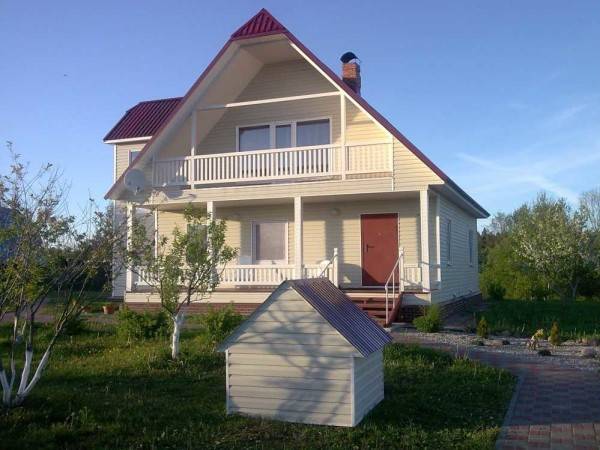
Siding well house
As you can see, there are a lot of options. First choose the type - open-closed, then the materials and finishes to your taste, understand the design, make a house for the well with your own hands.
Well Construction Tips
We hope that from the above, in general terms, it is clear how you can equip a well with your own hands.
Let me give our readers some useful tips:
- If the groundwater level in the area is high and located above the freezing depth of the soil, it is better to have a protective room on the surface, and not underground. Or use an adapter.
- In a year-round house, try to place the water supply equipment in the main building: plenty of space, warm and dry. Easy to maintain, equipment will last longer.
- Equipment for a house with seasonal living is best placed in an underground caisson. An unheated house will freeze, and a positive temperature will remain in the caisson. By the way, you need to remember to drain the water in the country house for the winter if they don’t live in it for more than a week.
- In problematic soils (heaving, with gravel inclusions with sharp ribs, in quicksand), it is advisable to lead a water pipe from the house to the caisson or adapter in a protective casing.Always place the power cable in a protective HDPE conduit.
- Connecting hydraulic equipment to the system is best done through shut-off valves with collapsible connections. If necessary, it will be easy to service or replace.
- Do not forget that, regardless of the type of equipment, the connection diagram should include a check valve after the pump and a coarse filter in front of the accumulator.
Among other things, during operation it is necessary to monitor the pressure level in the pneumatic element of the membrane tank. Check monthly, top up if necessary.
Conclusions and useful video on the topic
Finally, videos that clearly show the process of arranging an underground water source.
Video #1 The process of self-construction of an insulated caisson from concrete rings and the introduction of a water pipe into the house:
Video #1 Economical well construction - self-installation of a borehole adapter:
p> Proper arrangement of an individual water supply source guarantees excellent water quality and eliminates problems with the repair and periodic maintenance of downhole equipment.
Those who wish to talk about their personal experience in arranging a well outside a suburban area are invited to leave comments in the block below. Here you can share useful information on the topic and ask questions.
Conclusions and useful video on the topic
Those who would be interested in listening to expert advice in a slightly expanded and different version can watch the following video:
Work on the arrangement of a well mine is not as difficult as it is laborious. And it is not always necessary to dig the earth's surface, delving into it ten meters.
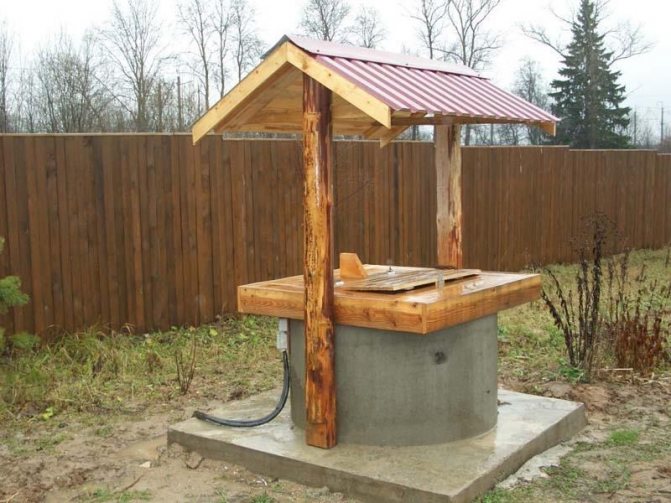


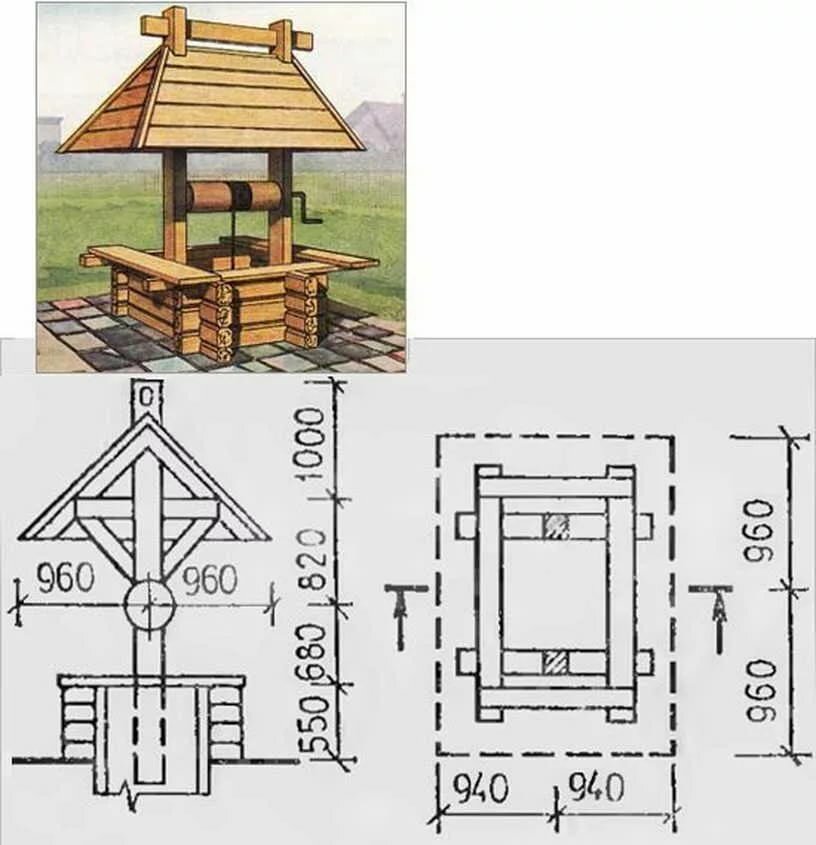


Much more often, the aquifer passes at a depth of 4 to 7 meters. Alternately changing, two strong guys are quite capable of digging such a mine in two days. The main thing is the desire and the tool!
Tell us about how you dug and equipped a well in your summer cottage with your own hands. Share technological subtleties that site visitors can use. Leave, post photos and ask questions in the block below.



