- Classification of common house heat meters
- Case No. А46-12324/2017
- Central common house meter for heating: who and why should install
- Purpose of the collective counter
- The legislative framework
- Who should install the device
- How much does it cost to install
- Maintenance of common house heat energy meters
- Nuances of payment for common house meters
- Calculation of non-residential premises
- Payment of receipts on the example of heating
- New rules for paying for common house needs at the ODPU meter
- Why do you need a heating meter
- Calculation of standards for heating
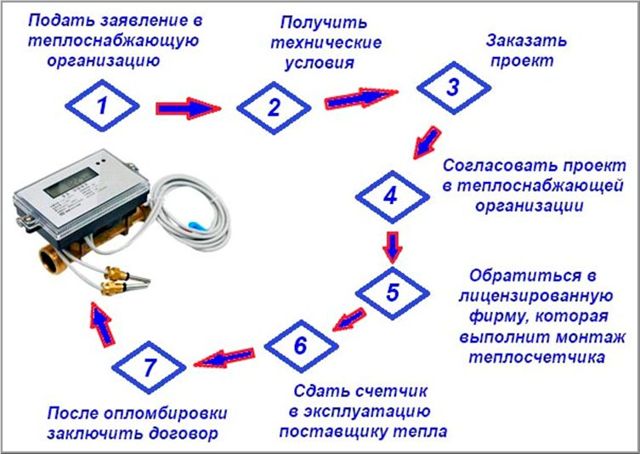
- Mounting order
- Payment order
- Against the "winter garden" you need a coefficient
- The need to install common house flow meters
- The principle of operation of the heat meter
- Accounting problems
- What types of counters exist
- Installation of common house heat meters
- Who should install and pay
- Is it possible to refuse
Classification of common house heat meters
Heat metering equipment, although it performs the same function, uses different principles of operation, has its own design features, and requires compliance with certain installation and maintenance specifics.
Therefore, you not only cannot, but also have no right to select a common house meter on your own.Only competent specialists of the relevant organizations will be able to accurately determine which type of devices is optimal in specific conditions, recommend a trusted supplier, and calculate the required amount of additional equipment.
It is useful to know that the following types of meters are used in housing and communal services:
- tachometric;
- electromagnetic;
- vortex;
- ultrasonic.
Tachometric counters are the simplest budget option. They are equipped with mechanical water meters and a heat meter. Their cost is significantly lower than other metering devices. The main disadvantage of such equipment is problematic operation in conditions of increased water hardness. The filter will often become clogged, and this will naturally weaken the pressure of the coolant: there is a dubious benefit. Therefore, tachometric meters are usually chosen for houses and apartments in the private sector. A huge advantage of mechanics is the absence of all kinds of electronic components, which allows the device to function even for a long time in adverse conditions (humidity, dampness).
The correct operation of a common house heat meter is influenced by such factors as the purity of the liquid in the system, uniformity of pressure, the microclimate of the room in which the measuring device is installed
Electromagnetic devices are an affordable solution that guarantees high measurement accuracy with high-quality installation and periodic qualified maintenance. Suitable for areas with good water quality, since metal impurities in it can distort the reliability of the device's indicators - upwards.
Vortex meters are easily mounted on both horizontal and vertical sections of the pipeline, display the correct readings under any conditions, have a radio interface that helps to detect malfunctions and take readings remotely - this is probably why service organizations speak of them very positively and recommend them, for the most part to install them.
Ultrasonic metering devices, although they are high-precision and modern, in practice they demonstrate not very high reliability - due to poor water quality, they often quickly fail. In addition, this equipment is very sensitive to welding currents.
Like any other measuring device, a general house heat meter is subject to mandatory periodic verification. Both the service life of the equipment and the objectivity of figures in utility bills depend on the quality of service.
Case No. А46-12324/2017
A similar situation was considered in this case, but the result is quite different.
The controversial apartment building was put into operation in two stages (in 2004 and 2006, respectively), made in different heights, from different materials. Based on this, the house is equipped with two thermal energy metering units admitted at different times, the heating systems of the house are independent (each of them has its own operating system) and represent different heat supply facilities.
The society believed that the MKD is a single house and the readings of two metering units should be summed up in the calculations as a single value.The GZhI decided otherwise: the payment for the utility service for heating should be determined on the basis of the separate volumes of consumed heat energy, determined according to the readings of each of the thermal energy statutory records available in the specified house in the first and second phases.
The judges supported the GZhI here too. When equipping a house with a thermal energy management system, the amount of payment for heating in a room is determined based on the meter readings (if there are several metering devices, based on the total data of these meters). However, this technique is possible only for a single multi-apartment residential building. In the situation under consideration, admissible and relevant evidence is presented that the first and second stages of MKD are different objects of civil legal relations. From the conclusion of the construction and technical expertise, it follows that:
-
capital construction objects of the first and second stages, which are part of the disputed MKD, are separate multi-apartment residential buildings, do not have signs of built-in and attached buildings that are part of a single residential complex of a house with a common address;
-
each of the facilities is equipped with individual engineering systems - a thermal control unit, a water meter for cold water supply, hot water supply units with individual communications wiring diagrams, main pipeline inlets, temperature charts and equipment adjustment modes, which indicates the autonomy of the heat supply system.
So, the first and second stages of the house are independent objects of heat supply, therefore, the amount of payment for thermal energy consumed by the owners of premises in these objects should have been calculated based on the volume of the communal resource consumed by each of these objects (see Decree of the AC ZSO dated 14.05. 2018 No. Ф04-998/2018).
* * *
Central common house meter for heating: who and why should install
The installation of common house meters is mandatory, which is fixed in the articles of legislation. Heating meters in apartment buildings will not be installed in the following cases:
- the building is classified as dilapidated or emergency;
- the cost of equipment and its installation exceeds the amount of utility bills at home (for heating) for six months.
The Housing Code of the Russian Federation establishes that all the property of the house is divided into personal and common. Personal property inside the apartments and its safety lies only on the shoulders of the homeowners. Common house material goods are located on shared areas (floors, elevators). Each owner and tenant of real estate (under a social or commercial lease agreement) undertakes to take care of the joint property and its safety.
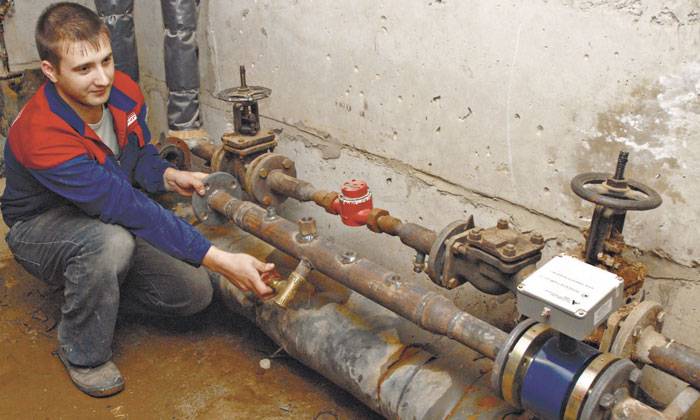
The operation of common house heat meters performs a number of important functions, but does not guarantee large savings on utility bills.
Reducing costs depends on the owners and users of real estate.
Purpose of the collective counter
Common house meters in the MKD are installed for the following purposes:
- management companies can control the real consumption of resources;
- setting fair pay based on the resources used;
- development among citizens of a sense of economy (the consumption of heat energy and future payment will depend on the serviceability of doors and windows in the entrances).
The legislative framework
Heating system device, the procedure for taking readings, the rules for paying money for utilities are established by the articles of the following regulatory legal acts:
- Housing Code (fixes the distribution of common and individual property, and also obliges citizens to equally maintain both types of property);
- Federal Law "On Energy Saving" No. 261 (establishes the mandatory arrangement of common house meters in MKD).

There are also local orders and acts by which utilities and managing organizations are guided by the forced installation of numerical devices.
Who should install the device
The procedure can be initiated by the owners of apartments in the house or the management company. Depending on the procedure, the algorithm will be as follows:
- organizing a general meeting of the owners and submitting for consideration the issue of installing heat meters;
- voting (to satisfy the decision, you will have to gain the required percentage of positive votes);
- calculation of cash flow (MC can take money from the account for major repairs);
- if the available financial reserves are not enough, then the meeting considers the issue of additional delivery of funds for the installation of meters;
- The management company attracts third companies to the events that have a license to carry out work on the installation of common house meters.
How much does it cost to install
The cost of common building meters for heating is compensated by the owners of the apartments themselves. It can be:
- individuals who have received property rights on the basis of a legal agreement (purchase, donation, inheritance);
- legal entities, if the premises are used for business activities;
- IP;
- municipality, when the property is transferred to the temporary use of the family on the basis of a social lease agreement.
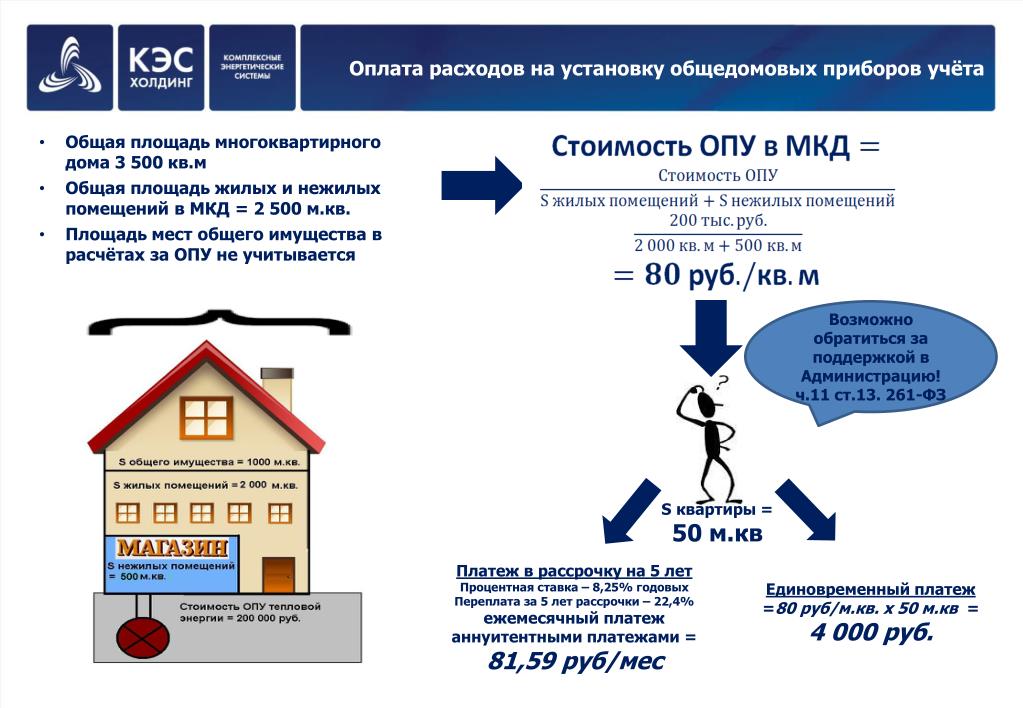
The cost of a common house device will vary between 50-500 thousand rubles per apartment building. The final price depends on the following factors:
- the locality in which the MKD is located;
- competition;
- building area divided into private and joint squares;
- complexity of installation work;
- the quality of the materials used.
Maintenance of common house heat energy meters
The control of the serviceability of common house heat energy meters is carried out:
- management company;
- housing and communal services inspector;
- representative of the company that installed the meters.
Expert opinion
Mironova Anna Sergeevna
Generalist lawyer. Specializes in family matters, civil, criminal and housing law
The transfer of a common house meter into operation is impossible without the presence of a provider of heating services in the house. A specialist from the provider must establish the health of the meter, as well as seal it, fixing the current readings. The utility provider makes independent regular checks of the meter.


Maintenance includes a list of the following functions:
- regular inspection of the device for mechanical damage;
- control of serviceability of mechanisms;
- lack of idling;
- fixing the readings of a common house meter.
Nuances of payment for common house meters
The payment amount is not distributed equally among all tenants. Each payment of indicators occurs on personal meters, depending on the size of the living space with surcharges for maintenance. Commercial organizations also pay their TCO in the receipts for the apartment separately from everyone else.
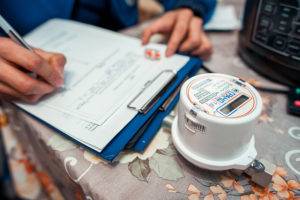
If the amount appears to be too high on the receipt, then you can submit a written application for a detailed explanation of the calculation formulas and the readings of general and personal counters. If the management company refuses to provide information, you must contact the prosecutor's office.
Calculation of non-residential premises
When calculating the consumption of resources, it is necessary to include in the cost of the area that belongs to all residents, regardless of personal meters.
Tariff calculation formula:
In order to encourage residents to purchase common house metering devices, the state uses tariff surcharges for persons who have refused to establish an ODPU.
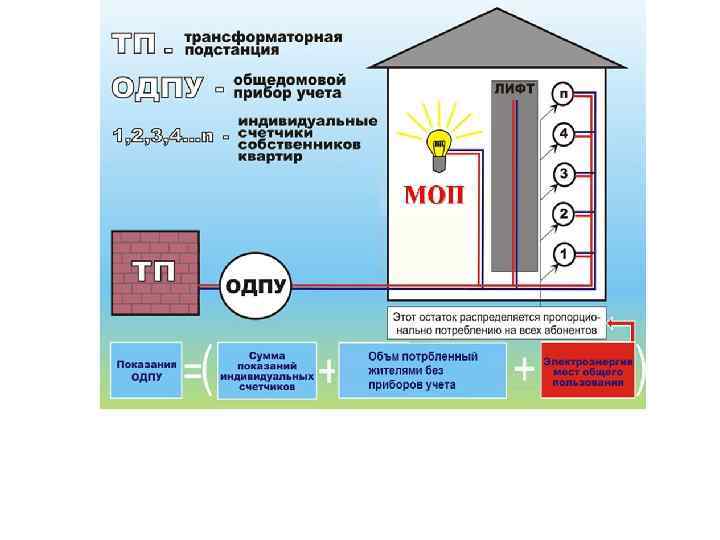
Please note: in addition to individual consumption of water, gas and electricity, the receipts include payment for general house consumption. This system is necessary to detect leaks in pipes from the organization supplying resources to the house
Payment of receipts on the example of heating
For the implementation of calculations, special formulas have been developed in accordance with the availability of metering devices.
| Availability of equipment | Calculation example | Formula |
| Only common metering device | Monthly, the value of the meter is divided by the total area of the entire building. Having received the money spent on 1 sq.m. calories multiply by the heating tariff with the sum of the areas of the apartment with the adjacent share | Pi \u003d Vd * x Si / Sb * T, where:
|
| General and individual metering devices | It is used when it is possible to separate the pipes horizontally (high-rise buildings). From the indications of the ODPU for heating, the total indication from all meters of apartments is deducted. Then the obtained value is increased by the share of each apartment and by the established tariff with the payment for heating. | Pi \u003d ( Vin + Vi one * Si / Sb ) * T), where:
|
| Lack of a personal meter in a separate apartment | ODPU readings are taken from all metering devices available in a particular apartment, minus the difference with the ratio of the common house meter, the result is divided by the area of \u200b\u200bthe entire house and multiplied by the amount of the area and the share of apartments without a meter. Only after that they multiply by the heating cost per 1 cubic meter. m. | Pi = ( Vi + Si * ( Vd - ∑Vi ) / Sb)xT, where:
|
The amount of the monthly deduction for the provision of the service is the result of the readings of the formulas.
Thus, despite a number of disadvantages of ODPU and the forced nature of the installation, it allows you to reduce the amount of resources consumed, thereby reducing the monthly costs of an apartment building.
New rules for paying for common house needs at the ODPU meter
From 2020 under the new rules It is customary to calculate the payment for common house needs using a common house metering device - ODPU. According to the legislator, the innovation will allow charging for real resources spent in regions such as the Moscow Region and others.
For apartment buildings, the minus is the difficulty of calculating the general house consumption using individual meters, for example, calculating cold water. Not all tenants are willing to spend a round sum for their installation. A good option would be to supplement personal ODPU counters. In this case, the presence of losses is monitored, and the house serviceability of communication networks is checked.
Houses exempted from the need to establish an ODPU:
- buildings that are in an emergency condition, or recognized as dilapidated;
- electricity consumption is less than 5 kW / h;
- consumption of natural gas is not more than 2 cubic meters. m/h;
- consumption of thermal energy is not more than 2 Gcal/h.
If the tenant does not have the technical capabilities to establish personal and ODPU (the criteria are prescribed in the order of the Ministry of Economic Development dated November 29, 2011 No. 967), then he needs to pay extra for utilities.
Why do you need a heating meter
An individual metering device (hereinafter referred to as IPU) is necessary to take into account the amount of resource consumed in one apartment. Almost every apartment has meters for electricity, hot and cold water. This is the standard. But heat meters are not installed everywhere.

The current legislation does not contain norms obliging tenants in apartment buildings to install IPU for heating. This is primarily due to the peculiarities of the construction of houses.
The utility company is obliged to install a general house metering device (hereinafter referred to as ODPU), which takes into account the amount of heat energy consumed in the entire house. But this rule does not apply to some old houses. Read a detailed article on the installation of a common house heat meter in an apartment building.
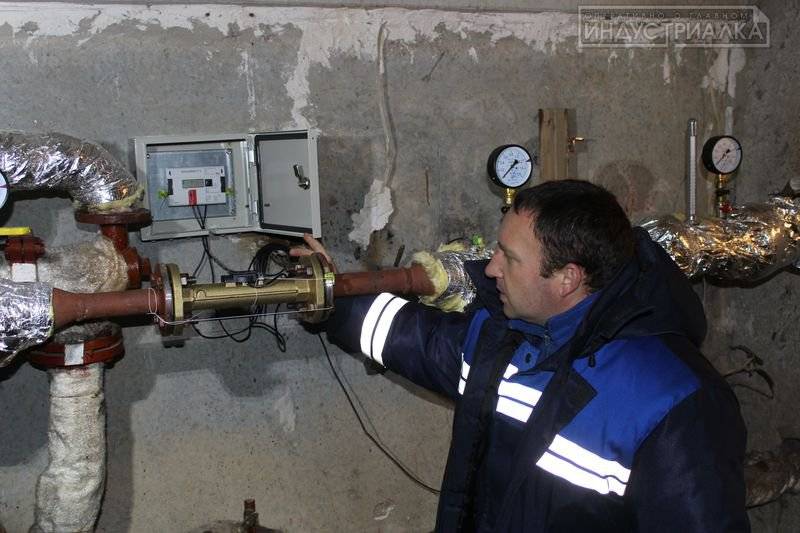
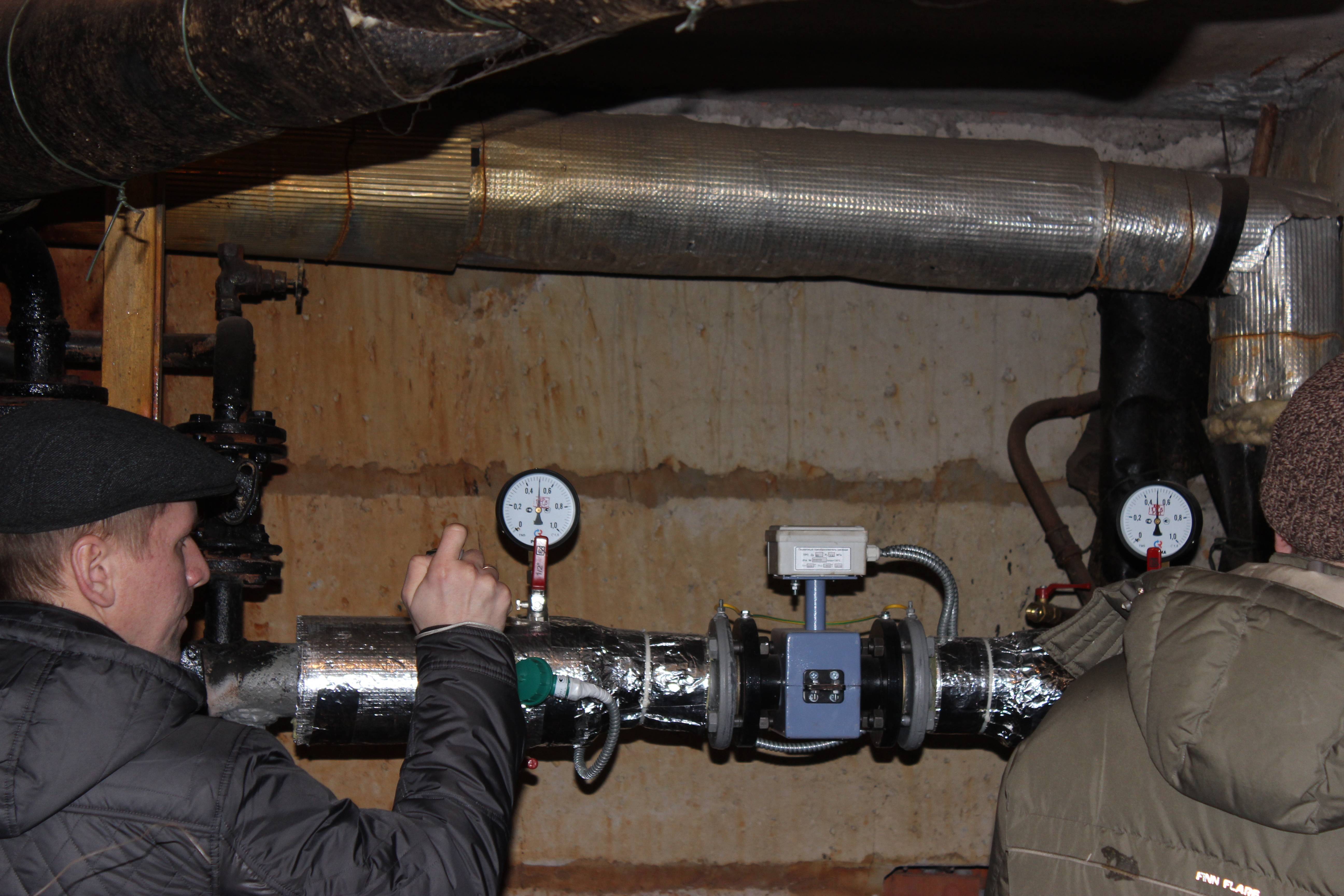
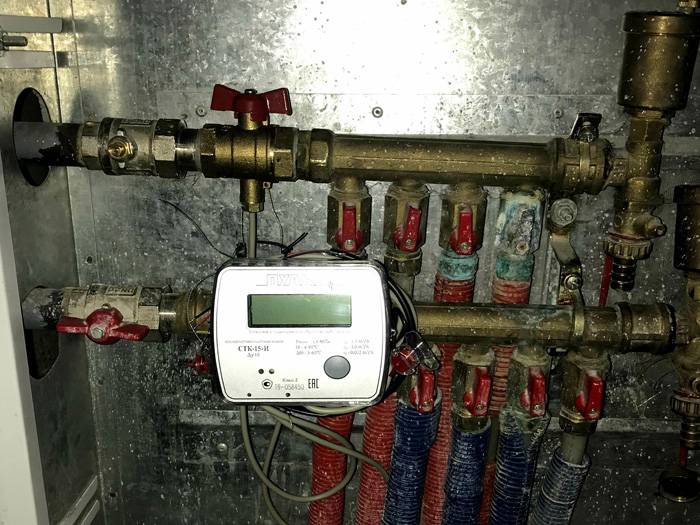


We list some features of installing the IPU on the battery:
- Acquisition, installation, as well as periodic repairs and verification - entirely at the expense of the owner of the apartment.
- The technical possibility of installing IPU on batteries does not exist in every apartment. For example, in houses of old construction, in which the heating system has a horizontal wiring, you will have to install the device on almost every pipe in the apartment. It is difficult, costly, and most often not economically feasible. And the utility company is unlikely to coordinate the receipt of information on the amount of resource consumed by different metering devices.
- Not all resource-supplying companies are ready to accept and keep records of heating according to IPI. This is especially true for old houses. Before installing meters on a battery, this issue must be agreed with the resource supplier.
Calculation of standards for heating
When developing norms for heat consumption, the following is taken into account:
The total consumption of heat energy, which is necessary for heating all premises during the heating season.
The total area of heated spaces in the building, as well as buildings connected to the heating system.
The duration of the heating season (including partial calendar months in which the measurements were taken are taken into account).
In addition, when making calculations, it is mandatory to take into account the average daily temperatures of heated air inside the room and cold outside (measurements are carried out during the heating season).
In the first case, the indicators specified in the regulatory documents for the provision of public services to the population are taken as a basis. In the second, the average value for the five previous heating periods is taken into account (data are provided by the regional hydrometeorological service).
An important parameter is also the average maximum temperature, which is calculated from the measurements of the five most frosty winter days following one after another.
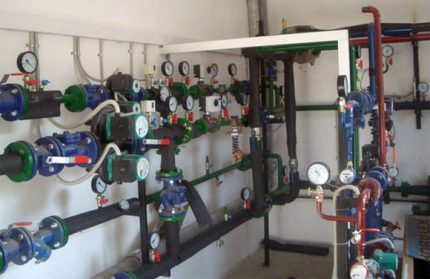
Homeowners must treat the supplied equipment with care, as they pay not only for its installation, but also for maintenance and repair of the device
In the temperate climate zone, district heating services are usually produced within 7-8 months - from September-October to April-May; in the first and last months, fees may be charged at a reduced consumption rate.
Mounting order
First, a meeting of all residents takes place, at which they make a decision and, in fact, are reset to the counter. Then people turn to a specialized company that sends its employees to you. These employees must perform the following tasks.
- Compose a project.
- Obtain consent from the management company.
- Install counter.
- Register it.
- Do the test, draw up the appropriate documentation.
Note! If the device has not been registered, then its information will not be taken into account when drawing up a receipt. The data is verified in the same way as in the case of other measuring devices.
As already mentioned, the difference must be indicated on the receipt, then go to the bank and pay the bill
The data is verified in the same way as in the case of other measuring devices. As already mentioned, the difference must be indicated on the receipt, then go to the bank and pay the bill.
Payment order
Since 2018, the cost of ODN is shown on receipts along with general house expenses. Owners pay utility bills according to the types of consumed resources and general house expenses. For the information of citizens, information about the area of the building and the common house area is printed in the bills.
In a house where meters are installed at the entrance to the house heating network, the actual consumption of heat energy has priority. Therefore, measures to save heat (insulation of facades, roofs, installation of double-glazed windows on stairwells, insulation of entrance doors) will allow residents to save on heating costs.
Against the "winter garden" you need a coefficient
As for complaints, Rustem Khabibullin is already tired of writing them, and the management company is tired of inspectors, which Elmira's accountant clearly hinted at. However, none of the numerous checks carried out by the State Housing Inspectorate and the prosecutor's office on the complaints of Khabibullin, according to him, was not aimed at finding an answer - where does the heat flow, for which he, an economical consumer, has to pay three times more than the meter knocked.
“The housing inspection does not work for us, and management companies do not fulfill their duties in managing houses,” concluded Zoya Kuklina, a lawyer, a member of the working group of the Civic Chamber of the Republic of Tatarstan on public control in the housing sector and the development of public self-government. - I myself have been in such apartments, where the balconies are turned into "winter gardens", it's terrible! People do not understand what they are doing - they are breaking the law and destroying their home!
Kuklina explained: with such intervention in the heating system, all the calculations of the designers go down the drain, the dew point in the house changes (a concept from the field of heat engineering, denoting the “meeting point” of warm air with cold inside the building envelope - the outer walls). As a result, modern multi-layer walls get wet, insulation and cladding fall off from them, mold appears in the apartments of the neighbors of the owners of "winter gardens". And since such redevelopment is illegal, management companies and supervisory authorities should first of all identify it and stop violations.
“But the tenants should not sit idly by,” Kuklina remarked. — Rustem Khabibullin is a good fellow, he fights for his rights. But have you seen many houses where active residents would create a house council and this council would work? The fact is that there are almost no such houses. Everyone hopes for a kind uncle who will do everything for them, so they get problems.



As for the new procedure for paying for heat, in her opinion, it is not ideal, but idealized:
- It is designed for conscientious tenants, and if no one steals, it works great. But after all, many of us are accustomed to reasoning like this: "The state robbed me, but I will speak and take it from him." But they do not take from the state - from a neighbor.
Under such conditions, Zoya Kuklina believes, urgent measures must be taken to eliminate the unfair leveling, in which Khabibullin and his ilk become hostages of the situation:
- It is urgent to introduce a multiplier for the payment of ODN for those who have the opportunity to install heat meters or have them, but do not take readings, but pay according to the standard. Moreover, the coefficient should be significant, only then will it encourage people to install meters and ensure a truly fair payment for heat. Remember, this is how the situation with the payment of ODN for electricity and water developed a few years ago - until those who did not count them were forced to pay for excessively consumed energy and water. And this is what I will talk about at the next round table in the Public Chamber, since the situation is already catastrophic.
Inna Serova
BusinessServices Tatarstan
The need to install common house flow meters
The Federal Law of the Russian Federation dated November 23, 2009 No. 261-FZ “On energy saving of energy resources and the use of metering devices for used energy resources when calculating for them” indicates the importance of installing common house meters designed to control heat consumption. According to Law No. 261, management companies can install heat metering devices without the consent of residents of multi-apartment buildings, charging payment according to the data received
According to Law No. 261, management companies can install heat metering devices without the consent of residents of multi-apartment buildings, charging payment according to the data received
The regulation obliges to install such devices in all apartment buildings, with the exception of emergency buildings.In addition, it is considered inappropriate to equip buildings with these devices if the amount of payment for the purchase and installation of the flow meter exceeds the amount of heating payments received within six months.
Legislators believe that this Decree will contribute to the achievement of the following goals:
- Fair distribution of payment for heat energy supplied to homes. Homeowners who care about reducing heat loss (for example, those involved in thermal insulation of an apartment or facade) should pay less than those who constantly leak heat through cracks or an open window.
- Motivation of residents to respect both residential and common premises. They should know that the payment for heating will automatically increase in case of an open door or broken glass not only in the apartment, but also in the entrance.
In addition, Law No. 261 officially transfers responsibility for common property to tenants. According to this legal act, public utilities are no longer responsible for the condition of entrances, basements and attics. All work in common areas must be carried out at the expense of the owners of apartments located in the same building.
The principle of operation of the heat meter
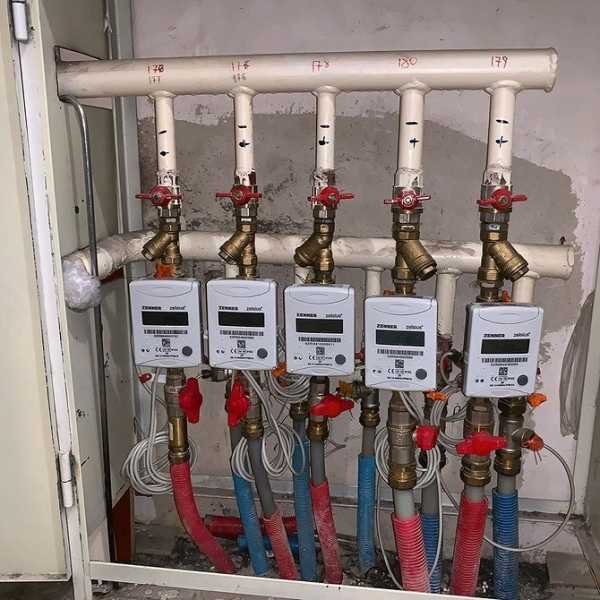
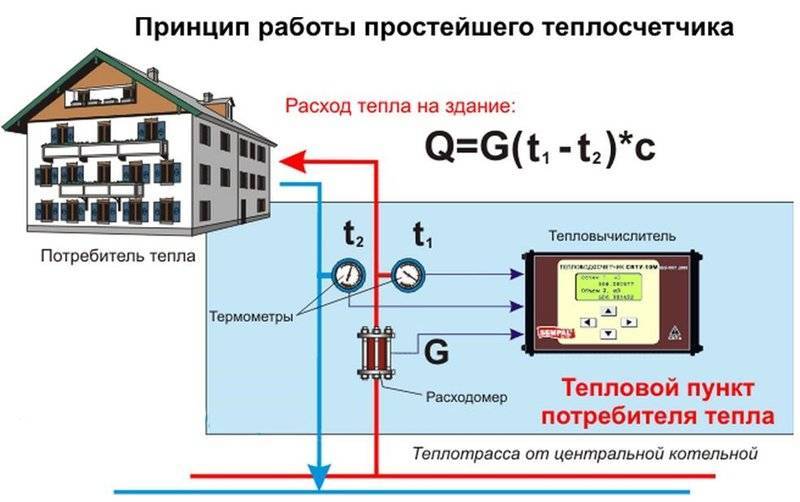
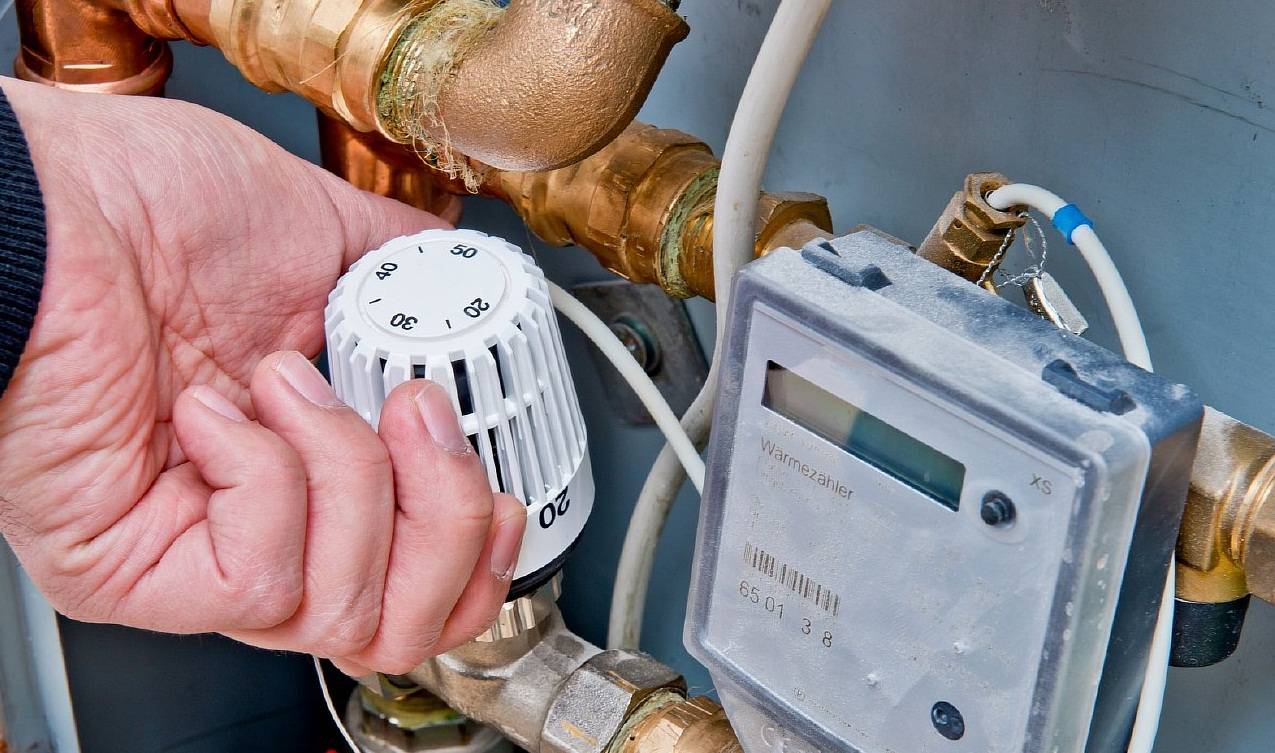
The heat meter has a wide range of functions. It allows you to determine the period of time for the operation of devices, which is indicated on a specific metering station. It also indicates the temperature of the coolant. But the main thing is fixing the amount of heat energy consumed.
The heat meter scheme includes:
- Thermal converters - temperature sensors;
- Calculator - calculates the amount of heat spent;
- Power supplies;
- A flow meter is a sensor for calculating volume.
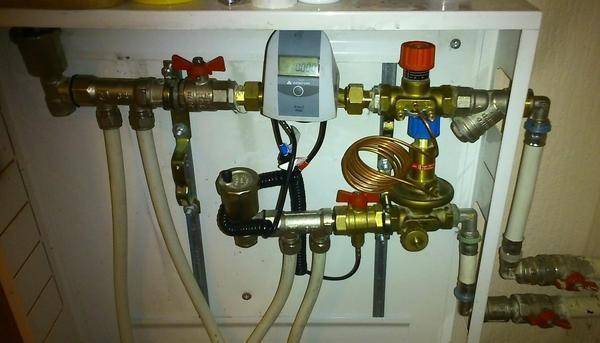
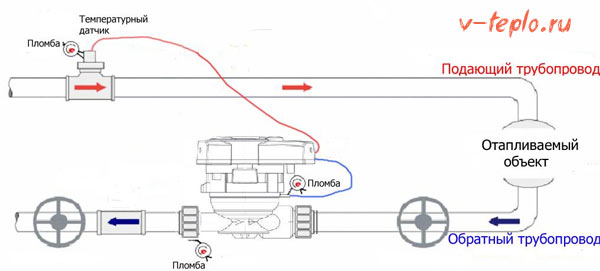
The heat meter is used to register the received heat, which comes with the coolant. The amount of energy that is used by the device per hour is determined, the temperature of the liquid at the inlet and outlet and into the system is taken into account. This is how the temperature difference is determined for a certain time. For this, a special calculator is provided in the counter.
The necessary data is supplied by flow and temperature sensors. One temperature sensor must be installed in the supply pipeline of the system, and the second - in the outgoing one. The calculator analyzes the received data and displays the exact consumption figure on the screen.
Accounting problems
As usual, any innovation brings with it a lot of new problems. What troubles should we expect from the next initiative of the government?
The first pitfall awaits us already at the stage of implementation of the legislation. You see, the initiative comes from the government. But the residents themselves must pay for the common house meters for heating, and their installation.
Sometimes we are talking about very significant amounts. The introduction of general house accounting will cost from 150 thousand rubles. Calculating the costs of each apartment for, say, a small 10-apartment two-story building is not difficult.
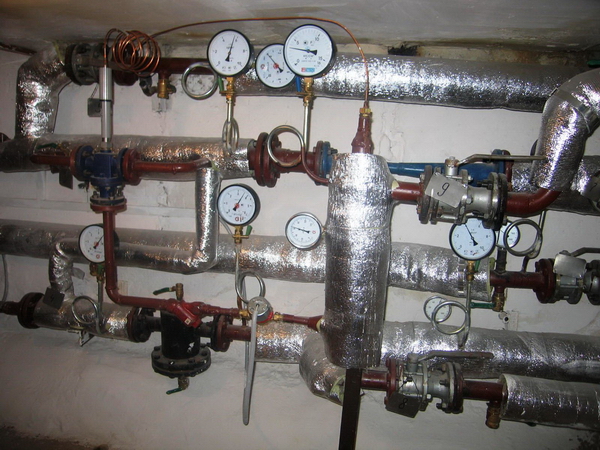
Heat metering systems are quite expensive. The fewer apartments in the house, the greater the amount that each tenant will pay.


It would seem that one can only rejoice; but the costs are significant! And the budget is not rubber. Municipal organizations will have to save on purchases for current repairs and maintenance of housing, which is not so happy.
Maintenance of the metering device includes periodic cleaning of filters, mud collectors, repair of valves in front of the meter and after it. In addition, after the end of the one-year warranty, all subsequent repairs of the device itself are paid by the tenants. Moreover, in a very curious way: under this item of expenditure, payment for the maintenance of housing increases.
That is, regardless of whether the meter is broken or serviceable, we pay for its repair.
The managing organization, after installing a house metering device, finds itself in a delicate position.
On the one hand, it must pay monthly for the consumed energy. In the absence of payment, the supplier can simply stop the heat supply by closing the valves in his well. What consequences this may have in severe frosts - I think it is not necessary to explain.
On the other hand, among tenants there is always a certain percentage of non-payers. Each organization deals with this problem in its own way; however, the management will have a very strong temptation to distribute the shortage among those apartments that regularly pay for heat. There were precedents.
Finally, the law lacks a clear instruction on what to do in the event of a device failure. Several incidents have been reported in the press where a technical malfunction resulted in tenants being billed three times their normal bill.
At the same time, the solution to the problem was, to put it mildly, strange: the authorities went to meet the inhabitants of the houses, giving them ... an installment plan to pay the full amount of the debt.
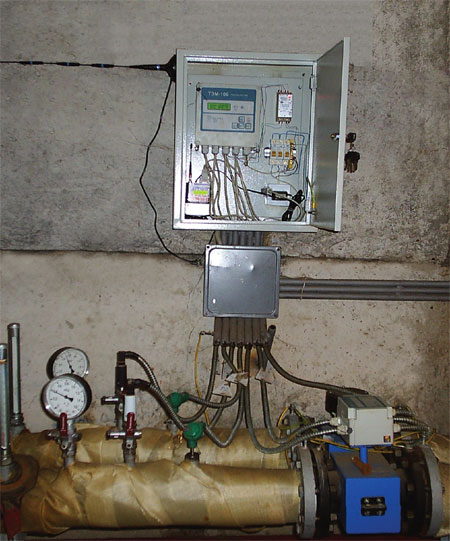
Like any complex device, a heat meter can fail. Without an additional control system, you should not blindly trust his testimony.
Unfortunately, the legislation ignored this point.
What types of counters exist
If it is decided to install a heat energy meter for the whole house, you should study the characteristics of such meters and choose the most suitable one.
To date, there are several types of metering devicesthat are recommended for use.
It:
- mechanical, which are the cheapest and easiest to use. Their principle of operation is to convert the movement of the coolant into the movement of a special measuring system due to a turbine, propeller or impeller. However, if the coolant contains hard water, then the devices become clogged with scale and other sedimentary substances. To avoid such an undesirable result, a special water purification filter is installed in front of the counter;
- electromagnetic, operating on the principle of excitation of electrical voltage as a result of the passage of the coolant through a magnetic field;
- vortex, operating on the principle of turbulence, which appears on the path of the coolant. This type of metering device can only be used with a clean coolant. If there are impurities in it, as well as sudden changes in temperature, air in the lines, then no one has faith in their testimony;
- ultrasonic. At the moment they are the most accurate and effective. The principle of their operation is based on the passage of a sound signal through the coolant. The indicator of the time required for the passage of the coolant from the source to the receiving device of the ultrasonic signal is measured.
Watch the video. Communal meters for heating:
Installation of common house heat meters
The process of installation of devices in apartment buildings is carried out in accordance with applicable law.
Who should install and pay
Thermal energy meters are an important tool that allows you to get real readings of the consumption of a communal resource. For greater effect, in multi-storey buildings with many owners, it is customary to install a set of appropriate equipment - a heat energy metering unit. The set of devices provides not only control over the amount of heat consumed, but also allows you to track the compliance of the carrier with the standard.
For apartment owners, the problem associated with paying for a common house meter and installing the device is quite important. According to the law, the following procedure applies:
- Based on the Federal Law of November 23, 2009 No. 261-FZ, the installation of heat meters is carried out exclusively at the expense of the owners of residential and commercial premises of a multi-storey building. A similar norm is prescribed by RF PP No. 354, which states that all costs for providing the facility with meters are borne by the owners.
- Decree of the Government of the Russian Federation of August 13, 2006 No. 491 (as amended for 2018) regulates that if the owners themselves did not decide to place the ODPU in the house, a common meter will be installed forcibly. In such a situation, each owner must pay a part of the designated amount by the due date. Exceptions apply if funds were provided for the installation, which were formed as earmarked contributions or other types of savings.
- Based on execution No. 261-FZ, residents can take advantage of the opportunity to install heat meters on the heating system, which involves receiving installments for up to 5 years.In such a situation, the meter and installation will eventually cost more, because an additional annual percentage is charged, which is calculated based on the refinancing rate of the Central Bank of the Russian Federation.
The installation of flow meters is carried out only by specialized organizations: commercial structures with the appropriate approval or heat supply companies, which most often provide the full range of paid and free services (placement, adjustment, testing, commissioning and sealing). When contacting private companies, the utility service provider must be informed about the work being carried out by issuing an appropriate permit.
Is it possible to refuse
Apartment owners cannot independently decide that a house connected to a centralized heating system will not be equipped with a common meter. But there are reasons why heat meters for heating cannot even be forced:
- Works cannot be performed without changing the structure of the object or the systems located inside.
- The house is recognized as dilapidated or emergency, subject to resettlement.
- It is impossible to ensure compliance with the standards that apply to the installation site and external factors: organize free access to the installation site of the meter, exclude the effects of humidity, temperature or electromagnetic interference.
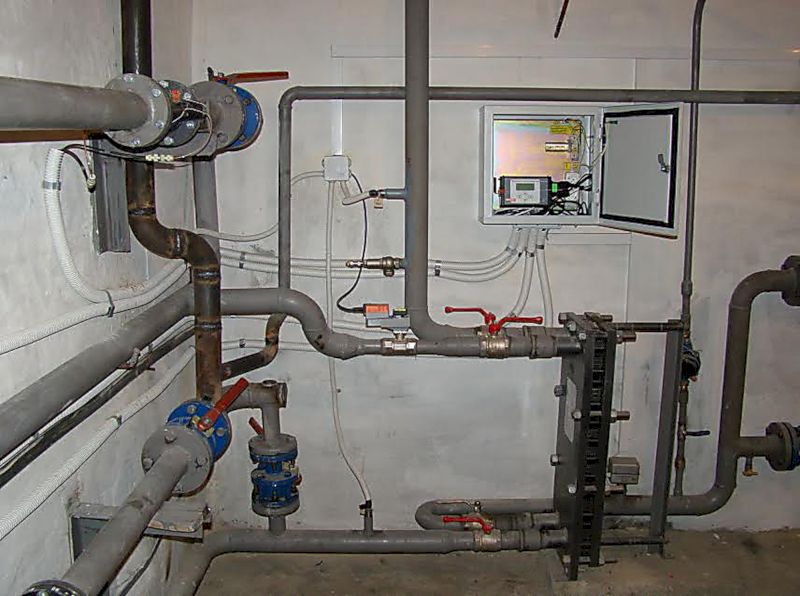
General building heat energy metering systems should be located in specially equipped, and most importantly, dry rooms, otherwise the installation of meters is prohibited.
The main factors are fixed in Order No. 627 dated December 29, 2011, which was approved by the Ministry of Regional Development of the Russian Federation.The UK or HOA, together with the heat supply organization, must draw up and confirm the impossibility of placing the device with the relevant act.