- Water pressure: standards and reality
- Regulations
- Why you need to know the pressure in the pipeline
- What is regulated
- In an apartment building
- In a private house
- Do I need a gearbox before the boiler?
- Direct Acting Flanged Valve Arrangement
- Threaded regulator device
- Why you need to know the pressure in the pipeline
- Zoom instruction
- Causes of weak and excessive pressure
- What is measured?
- Regulations
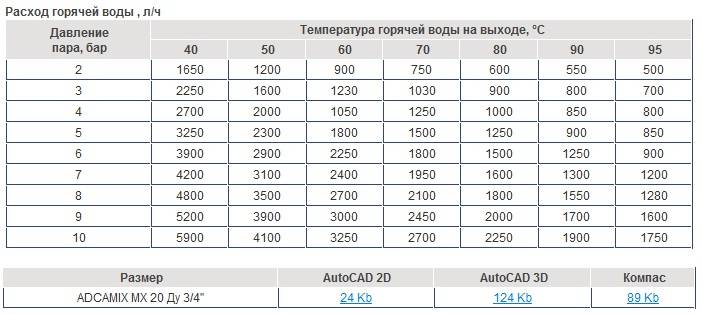
- Calculation of pressure through flow
- At what values does the equipment function normally
- Water pressure for full consumption
- Danger of overfeeding
- How to know the pressure?
- Portable pressure gauge
- Conclusions and useful video on the topic
Water pressure: standards and reality
In order for plumbing and household appliances to function normally, water supply with a certain pressure is required. This pressure is called water pressure. I must say that different types of equipment require different pressure. So the washing machine and dishwasher, shower, taps and faucets work normally at 2 atmospheres. For the operation of a jacuzzi or a shower cabin with hydromassage, at least 4 atm is required. So the optimal water pressure in the water supply is 4 atm or so.
For household appliances and plumbing equipment, there is also such an indicator as the maximum allowable pressure. This is the limit that this equipment can withstand. If we talk about a private house, then you can ignore this parameter: your personal equipment works here and above 4 atm, well, a maximum of 5-6 atm. Higher pressure simply does not happen in such systems.
Pressure Units - Conversion and Ratio
For centralized water supply networks, the standards set the operating water pressure in the water supply system of an apartment building - 4-6 atm. In reality, it ranges from 2 atm to 7-8 atm, sometimes there are jumps up to 10 atm. It rises very strongly after or during repair work, and this is done on purpose. There is a so-called pressure test - checking the reliability and tightness of the system with increased pressure. With the help of such a check, all weak points are revealed - leaks appear and they are eliminated. The downside is that some appliances may have a lower tensile strength, resulting in them being a "weak point" as well, and usually costing a lot to repair.
It happens in high-rise buildings and the opposite situation - the water pressure in the water supply is too low. In such a situation, household appliances simply do not turn on, and a thin stream of water flows from the tap. This situation can occur at times of peak loads - in the morning and in the evening, when most of the residents use the water supply. Approximately the same situation can occur in summer cottages or in private houses connected to a centralized water supply. There is a solution to this problem, and more than one.
Regulations
Here are the norms for water pressure in the water supply system contained in the current SNiP 2.04.01-85.
| Placement of the draw point | Pressure, MPa |
| Bottom in the building | Not more than 0.45 |
| Lower in a building erected in an area with dilapidated buildings | Not more than 0.6 |
| Top in the building | not less than 0.2 |
As it is easy to calculate, the water pressure in a municipal water supply can generally differ from its value on the top floor by only 0.25 MPa, which corresponds to a pressure of 25 meters. With a higher height of the building on the middle floors, an intermediate pumping must be installed.
In practice, typical pressure values in highways and routes are as follows:
- Cold water - 3 - 4 kgf / cm2.
- DHW - 3.5 - 6.5 kgf / cm2.
Why you need to know the pressure in the pipeline
The water supply system of a city, microdistrict, residential building is a complex engineering structure. It consists of many elements: pipelines, pumps, shut-off and control valves, measuring instruments and safety devices. As well as equipment using water for technological or domestic purposes.
For the convenience of designing, manufacturing elements and equipment, installation, operation and use of the water supply system, uniform standards have been developed. One of the standards is the magnitude of the water pressure in the water supply system at various stages of the technological chain.
Knowing these values is necessary for all participants in the process in order to properly design, adjust and operate the equipment. And manufacturers of plumbing and household equipment could produce goods with a sufficient margin of safety.
For ordinary consumers, this information is also necessary.
When purchasing various household appliances connected to the water supply, you should pay attention to the data on the pressure for which they are designed. This is especially true for imported goods.In addition, knowing the water pressure in the water supply in the apartment according to the standard, it is easier to defend your right to receive quality service.
In addition, knowing the water pressure in the water supply in the apartment according to the standard, it is easier to defend your right to receive quality services.
The main document that determines the amount of free pressure at the entrance to the building is the Code of Rules SP 31.13330.2012 “Water supply. External networks and structures. Updated version of SNiP 2.04.02-84*”. These requirements must be observed when designing outdoor water supply systems under construction and reconstruction.
"Rules for the provision of public services ..." (adopted by Decree of the Government of the Russian Federation No. 354 of 05/06/2011) determine the pressure for cold and hot water supply at the point of analysis at the end consumer.
Gas pressure in a gas pipeline: classification, types and categories of pipes
Natural gas is used in everyday life and in industrial enterprises. Pipelines are used to deliver it to its destination. The most important indicator for them is the gas pressure in the gas pipeline. This…
The pressure in the cold water pipeline according to GOST is not regulated and the source that determines the limit value is SP 30.13330.2012 “Internal water supply and sewerage of buildings. Updated version of SNiP 2.04.01-85*”.
What is regulated
The pressure in the water supply system is regulated by the provisions of SNiP No. 2.042 of 1984, and the amended SNiP of 1985.


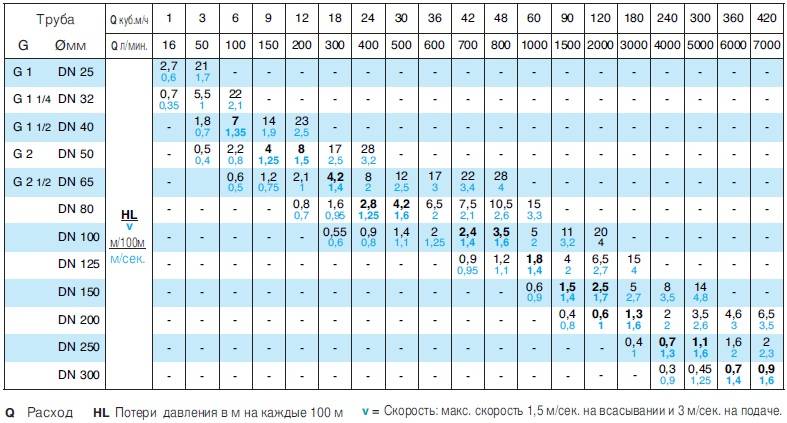


In accordance with this standard, the entire water distribution network of the building is designed, starting from the connection to the building and ending with water intake devices - mixing taps.
Today, several units of measurement are used to determine water pressure - bar, atmospheres, pascals, etc.All these designations can appear in the regulatory design documentation, in the marking of pressure gauge divisions, in the technical passports of household appliances.
Such a variety of designations often brings confusion to the heads of tenants who are uninitiated in the depths of the science of physics. Using the table below, you can easily convert indicators from one metric system to another without any problems.

In an apartment building
According to operating standards, the pressure in the water supply circuit for a 1-storey building should not fall below 1 bar. For multi-storey buildings, this inlet pressure must be increased by 0.4 bar for each upper storey.
The formula for calculating the required pressure in the water pipes in a five-story building is as follows:
1 bar + (0.4 bar x 5 floors) = 3 bar.
Here 1 bar is the minimum pressure for the 1st floor, 0.4 bar x 5 floor. - an increase in the indicator for each of the subsequent floors of the house.
As a result, we get the minimum pressure that must be provided at the entrance to the five-story building, 3 bar. Using the same formula, you can calculate what water pressure in the water supply of an apartment building should be, if it has 9, 12 ... 15 floors. To increase the pressure, you can put a booster pump.
In a private house
For a 1-storey building, SNiP regulates a technical minimum of 1 atmosphere. Such pressure allows shower and kitchen faucets, toilet bowls and other standard plumbing equipment to function smoothly.
However, it should be borne in mind that this standard was drawn up back in 1984, when residents did not yet have such a quantity of household appliances at their disposal.For their normal operation, a significantly higher water pressure is required - at least 2 atm. This should also be taken into account when designing the plumbing system of a private residential building.
Do I need a gearbox before the boiler?
Water hammer, or water hammer, appears due to an instantaneous change in the movement of water inside the water supply. A common consequence of water hammer is ruptured high-pressure adapter hoses. Its manifestation is also characterized by the destruction of pipes weakened by rust and the failure of weak plugs.
When the boiler is running, a water hammer is likely to lead to a rupture of the tank.
A conventional boiler is designed for incoming water pressure up to 4 atmospheres - then its service life will be higher. When the pressure in the pipes is over 7-8 atmospheres, a safety check valve is turned on, which drains water from the boiler into the sewer.
One of the reasons for the constantly dripping boiler safety check valve can be excessive water pressure (more than 8 atmospheres) at the inlet. Increased pressure in the pipes can occur not only due to the failure of the temperature sensor, but also due to the fault of the water utility, because water can be supplied to the apartment with a pressure of more than 10 atmospheres.
Especially often this is observed in multi-storey buildings on the lower floors at night.
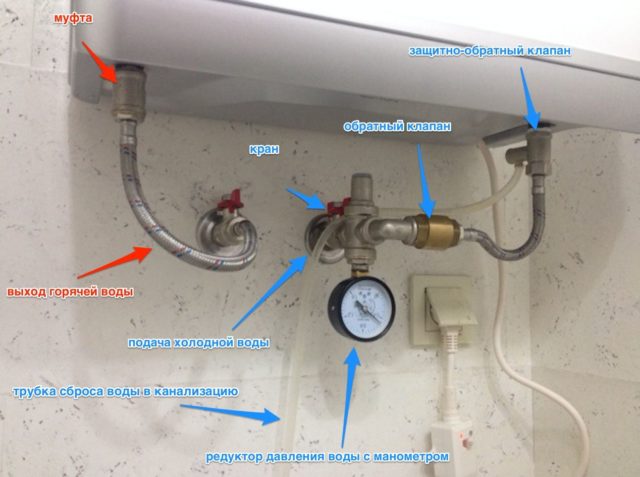
An analysis of boiler failure statistics showed that about 70% of all breakdowns were associated with a sharp pressure drop, water hammer and prolonged vibrations.
If the pressure reducer is not installed at the entrance to the apartment, it will be mandatory to install it in front of the boiler.
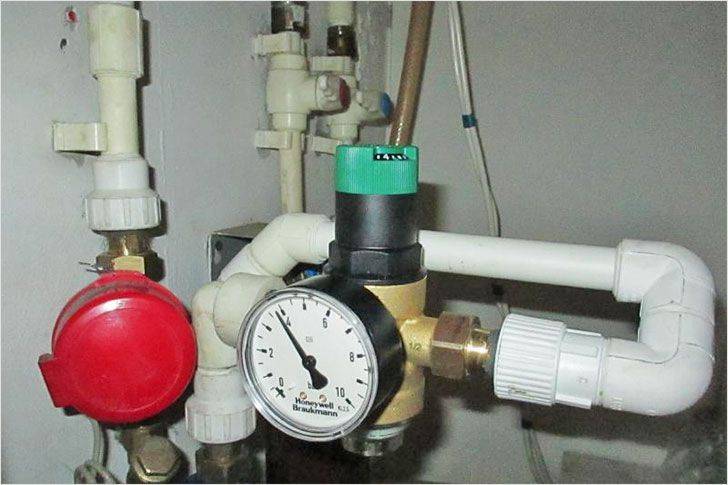
A pressure reducer connected at the inlet to the boiler will become a guarantor of protection against hydraulic shocks and a safety check valve leaking due to increased pressure.
For residential buildings, as a rule, direct-acting pressure regulators are used.
Direct Acting Flanged Valve Arrangement
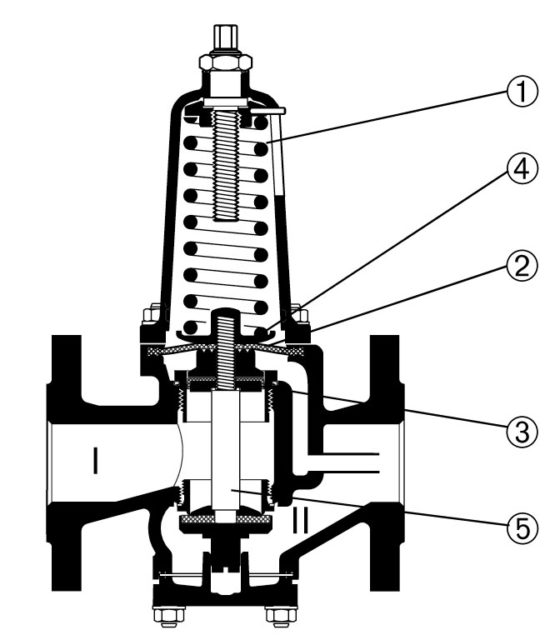
They work on the principle of balancing the forces (Newton's third law) acting on the membrane: on the one hand, the spring tension force, and on the other hand, the pressure force after reduction.
In the event of a change in inlet pressure, the movable stem of the regulator will be in a new equilibrium position for a given pressure setting and the amount of water consumed (inlet pressure compensation).
Thus, even in the case of strong fluctuations in the inlet pressure, it is quickly extinguished, and the pressure at the outlet of the regulator is kept at a constant level.
In the event of a stop in the drawdown, the regulator closes completely. Inlet pressure compensation ensures that the opening and closing of the valve is independent of the instantaneous pressure at the inlet to the regulator. Thus fluctuations in inlet pressure do not affect the regulated outlet pressure.


Such regulators contain a "diaphragm-spring" system (1-2), which opens or closes the regulator depending on the pressure at the outlet from it. The other parts of the regulator are the fixed seat (3) and the moving diaphragm (4). The inlet pressure acts on chamber I, and the outlet pressure is applied to chamber II.
When water is withdrawn, the outlet pressure, and, consequently, the force developed by the membrane, drops, and an imbalance in the forces of the membrane and spring occurs, forcing the valve to open.After that, the pressure at the outlet (in chamber II) increases until the forces of the diaphragm and the spring are equal.
Flanged pressure regulators are usually installed on branch pipelines at the entrance to the building. They use a balancing piston (5) whose area is equal to the area of the valve diaphragm (4). The forces created by the initial pressure on the valve diaphragm and on the balancing piston are equal. However, they are directed in opposite directions to each other and therefore are balanced.
Threaded regulator device
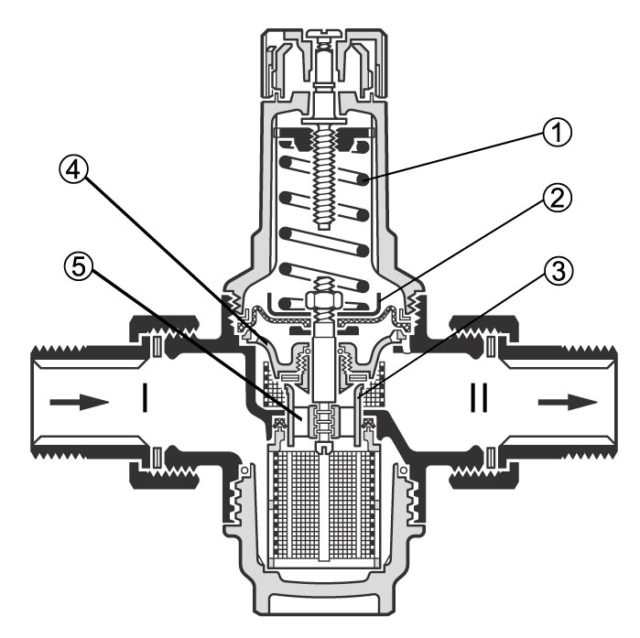
A similar design is in threaded valves used for individual control and on the floors of buildings. The task of balancing the pressure in them is solved by fixing the valve membrane (4) and mobilizing the valve seat in the control sleeve (6). In this case, the inlet pressure is equally applied to the upper and lower annular surfaces of the sleeve.
The factory setting of the valves is usually 2.5-3 bar. The pressure value is set by the consumer by turning the adjusting knob or screw.
Why you need to know the pressure in the pipeline
The water supply system of a city, microdistrict, residential building is a complex engineering structure. It consists of many elements: pipelines, pumps, shut-off and control valves, measuring instruments and safety devices. As well as equipment using water for technological or domestic purposes.
For the convenience of designing, manufacturing elements and equipment, installation, operation and use of the water supply system, uniform standards have been developed. One of the standards is the magnitude of the water pressure in the water supply system at various stages of the technological chain.
Knowing these values is necessary for all participants in the process in order to properly design, adjust and operate the equipment. And manufacturers of plumbing and household equipment could produce goods with a sufficient margin of safety.
For ordinary consumers, this information is also necessary.
When purchasing various household appliances connected to the water supply, you should pay attention to the data on the pressure for which they are designed. This is especially true for imported goods.
In addition, knowing the water pressure in the water supply in the apartment according to the standard, it is easier to defend your right to receive quality services.
The main document that determines the amount of free pressure at the entrance to the building is the Code of Rules SP 31.13330.2012 “Water supply. External networks and structures. Updated version of SNiP 2.04.02-84*”. These requirements must be observed when designing outdoor water supply systems under construction and reconstruction.
"Rules for the provision of public services ..." (adopted by Decree of the Government of the Russian Federation No. 354 of 05/06/2011) determine the pressure for cold and hot water supply at the point of analysis at the end consumer.
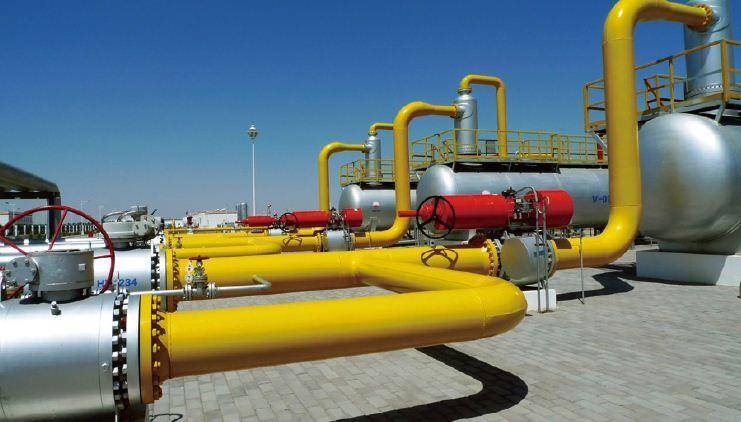
Gas pressure in a gas pipeline: classification, types and categories of pipes Natural gas is used in everyday life and in manufacturing enterprises. Pipelines are used to deliver it to its destination. The most important indicator for them is the gas pressure in the gas pipeline. This…
The pressure in the cold water pipeline according to GOST is not regulated and the source that determines the limit value is SP 30.13330.2012 “Internal water supply and sewerage of buildings.Updated version of SNiP 2.04.01-85*”.
Zoom instruction
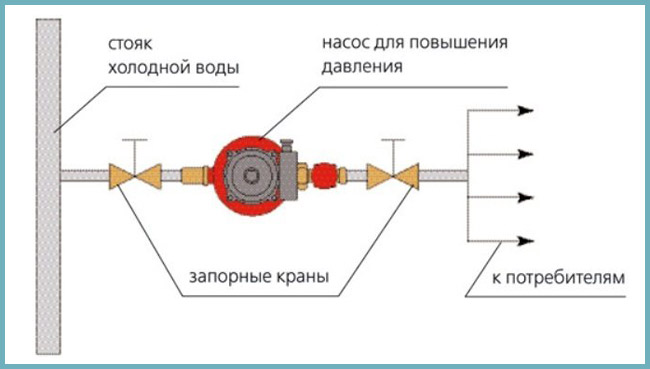
You can solve the problem by installing an in-house pump. At the same time, only special devices designed strictly for one apartment are suitable for installation.
You should not try to install pumping equipment intended for private houses in the apartments of the house.
The installation of the pump must be carried out according to the scheme:
- Notify the management company and the residents of the house in writing about the intention to install a pump in the apartment.
- After obtaining consent, purchase the device.
- Before installing the device, clean all pipes from lime, check the condition of mixers and filter elements. If necessary, clean them or completely replace them.
- Shut off the water.
- Cut out a section for the pump on the pipeline.
- Install ball valves on both sides of the pipes.
- Connect the pump to the system using the squeegee.
- Check the tightness of the mechanism.
- Carry out the electrical installation of the pump.
Installation of the pump in the apartment is carried out with special tools. The installation of the device may only be carried out by a specialist or a person with sufficient knowledge.
Causes of weak and excessive pressure
Most often, a decrease in water pressure occurs due to the natural wear of the pipeline. In addition, if metal pipes were used to lay it, then over time the pressure will decrease due to corrosion.
The problem may also be the presence of limescale on the walls of the pipes. It appears due to too hard water.
The reasons for low pressure are also:
- Pressure unit that does not correspond to the parameters of the system. Very often, in autonomous water supply systems, water has to be raised from deep enough aquifers.
Then bring it to consumers located at a great distance from the station, and even at different heights. If the power of the pumps does not correspond to this situation, the pressure will be weak.
-
- The low resource of the well itself, from which water is taken. Even if initially everything was normal, the source is gradually emptied, and the pressure decreases.
- The emergence of new water intake points that can work simultaneously - for example, they also purchase a dishwasher or a hot tub. If their appearance was not taken into account in the project, then now it will have to be redone, possibly buying additional equipment.




In case of excessive water pressure, two options are possible - either the equipment was selected with too much power reserve, or there is an air lock inside the system.
What is measured?
Before starting work, you need to figure out what and in what measurement system you will have to work with. From the school bench, everyone knows that in physics, pressure is the force with which a substance acts on the walls of a vessel. It is also written there that in SI it corresponds to pascals (Pa) or newtons per square meter (N / m2).
On the scale of equipment for measuring water pressure, you can find the following designations:
- Pa, Pa, KPa, MPa. Pascal is a measure of pressure adopted in the international system of units.
- kgf/cm2, kgf/cm2. Kilogram-force per square centimeter is an obsolete unit.
- Ata, atm. technical atmosphere. 1 ata \u003d 1 kgf / cm2.
- mm w.c. Art., mm H2O. millimeter of water column.
- Psi, psia, psig, lb/in2. Pound per square inch. Found on American, European devices.
- Bar, bar. A value approximately equal to one technical atmosphere.
In SNiP 2.04.02-84, pressure is given in megapascals (MPa).The value of the normal water pressure is also set there.
Head is the mechanical energy of the flow over an area. Measured in meters. Permissible values for residential areas are indicated in SNiP 2.04.01-85.
Regulations
In the Russian Federation, the sources of normal pressure values in the water supply system are the following regulatory legal acts:
- ;
- Code of Practice 30.13330.2016;
- SNiP 31-01-2003;
- SNiP 2.04.02-84;
- SNiP 2.04.01-85.
It is worth noting that the readings for cold (HVS) water supply differ from hot (DHW). At high temperatures, the pressure can change rapidly.
For stable operation of the distribution system, hot water is supplied at a lower pressure.
The regulation establishes:
- DHW = 0.03 - 0.45 MPa or 0.3 - 4.5 atmospheres;
- Cold water = 0.03 - 0.6 MPa or 0.3 - 6 atmospheres.
If the indicators do not correspond to those indicated above, then you can safely demand a recalculation from the service provider.
Even small deviations from the norm can be a reason for contacting the relevant authorities. You should not overpay for those services that were provided with obvious violations. You can find out the exact data using pressure gauges.
Calculation of pressure through flow
To make approximate calculations of the pressure in the pipeline, you need a two-meter transparent hose. We put one end of it on a water tap, after which we turn on the water for a short time. But before starting the experiment, we perform two actions:
- We plug the free end of the tube with any cork that is suitable in size.
- We install the hose so that the water level inside it coincides with the point of its exit from the water tap - with the so-called "zero level".
The unit assembled by us is a hydraulic pressure gauge.After that, turn on the water at full power. After a short time, a new water level indicator will be established inside the hermetically sealed hose. Then you need to write down the following indicators:
- The total distance from the zero level to the end plugged.
- The length of the hose between the pressurized water level and the plugged end.
After that, you can calculate the approximate value of the pressure in the tap using the following formula:
It is also possible to calculate the estimated pressure by performing a series of mathematical calculations. You will need to arm yourself with a three-liter jar and a stopwatch. We open the water at full power, after which we substitute a jar under the jet and turn on the countdown.
This method has significant errors, and is very approximate. However, we can confidently say that if a 3-liter container is filled in more than 10 seconds, then the pressure in the tap is much lower than normal. If the pressure corresponds to the established operational and technical standards, the bank should be completely filled in 5-7 seconds.
At what values does the equipment function normally
For the normal functioning of the washing machine, it is necessary that the pressure is not lower than one and a half atmospheres. The dishwasher also operates at 1.5 atmospheres. Concerning individual heating of apartments by using electric and gas boilers, then everything is purely individual.
Water pressure for full consumption
Are you wondering what water pressure in the water supply of an apartment building should be? The answer is simple, with regard to sinks, faucets, showers, toilets and bidets, here the pressure should be at least 0.3 atmospheres.Jacuzzi with hydromassage function have the greatest needs, here the pressure must be at least 4 atmospheres.
Danger of overfeeding
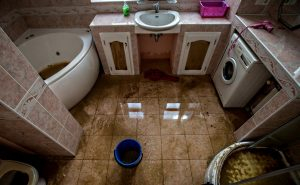
This is especially true of old multi-storey buildings, where the plumbing has not been repaired for a long time or has never been done. Here the pipes have already worn out, corrosion has partially corroded the metal during long operation. Therefore, excessive pressure can lead to leakage and flooding of neighbors. In this case, it is recommended to install a pressure regulator in front of the meters.
For ordinary plastic pipes, a pressure of about 10 atmospheres is recommended. That is, this limit cannot be exceeded.
Water hammer - a strong one-time increase in pressure at the moment the water supply is turned on. This can be after repair, when the pump immediately turns on at full power and a sharp push is obtained, which leads to the breakdown of taps, the failure of meters, the appearance of cracks on the body of brass fittings, and also to the breakage of flexible hoses.
How to know the pressure?
To understand how much the cold water pressure in your apartment deviates from the norm, you need to accurately determine its value. To do this, you need a special water pressure gauge. If it is already mounted at the entrance of the water pipe to the apartment, consider yourself lucky - it remains only during the day to monitor the pressure indicators and, based on them, derive an average. Take data four times a day: early morning, afternoon, evening and night. Then add up the scores and divide by four.


Water pressure gauge
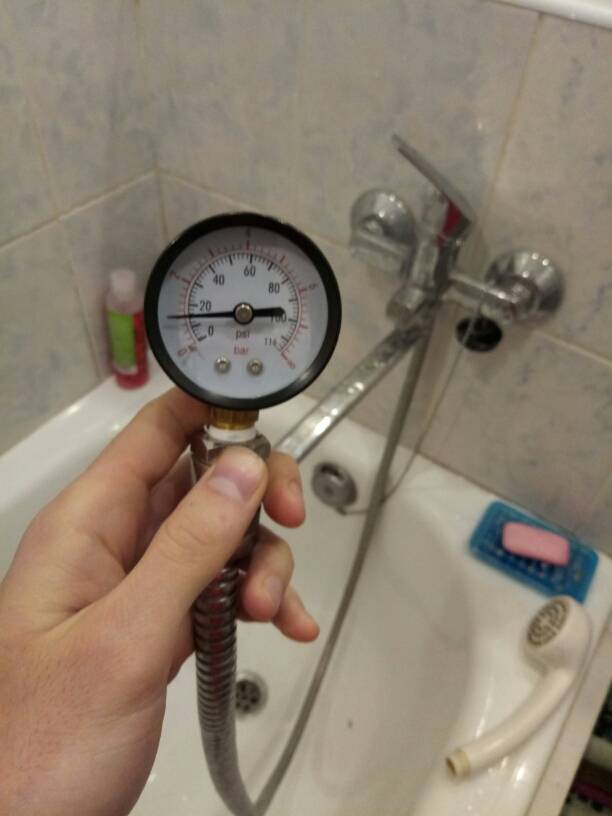
And if the base pressure gauge was not initially installed, you will have to make a measuring structure with your own hands.For this you will need:
- manometer;
- adapter - 0.5 inches;
- thread extension;
- fum tape.
The workflow is simple:
- Screw the thread extension onto the outlet of the pressure gauge and close it with fum-tape.
- Take a shower hose and unscrew its watering can.
- Switch the water from the main faucet to the shower to purge air from the hose.
- Screw the pressure gauge into place.
- Open the water supply and measure the pressure.
For the accuracy of measurements, it is recommended to check with a home-made device also four times a day. Using the measurement results, it will be easier for you to determine how much you need to increase the pressure and what methods can be used to do this.
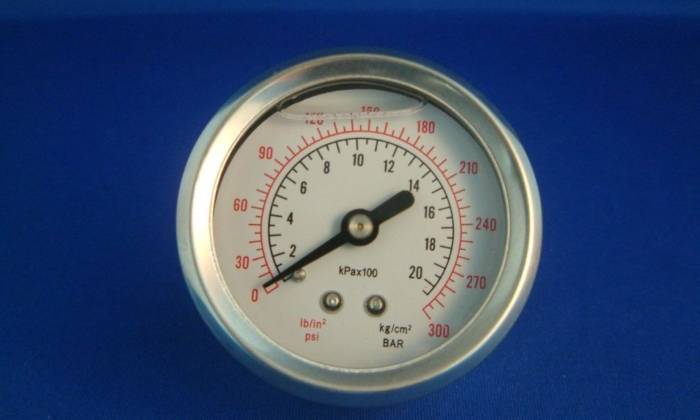
Portable pressure gauge
Another, more universal measurement method involves taking measurements of the characteristic of interest directly at the point of operation.
Diagram of a portable manometer.
To implement this method, you will need:
- pressure gauge, the scale of which allows measurements in the range of values typical for an apartment water supply;
- thread extension;
- a set of adapters for metric and inch threads for connecting a pressure gauge to a test point;
- fluoroplastic tape FUM.
A measurement that determines the water pressure in the network can be performed at any point of interest. To conduct the experiment, it is necessary to connect the pressure gauge to the water supply network.
The selected connection is depressurized:
- flexible hose to the kitchen faucet;
- supply hose to a washing machine or dishwasher;
- connection to the toilet bowl;
- shower faucet;
- main filter housing.
If necessary, you can even disassemble any of the connections of the internal water supply or embed a tee with a pressure gauge directly into the pipe. The option with a fixed pressure gauge insert will no longer puzzle over how to measure pressure.
When depressurizing the water supply, remember to close the valve for supplying water to the apartment.
Pressure switch diagram.
For ease of connection, a thread extension and an adapter necessary for connecting to the main line are screwed onto the inlet thread on the pressure gauge body. The resulting structure is installed at the selected connection point.
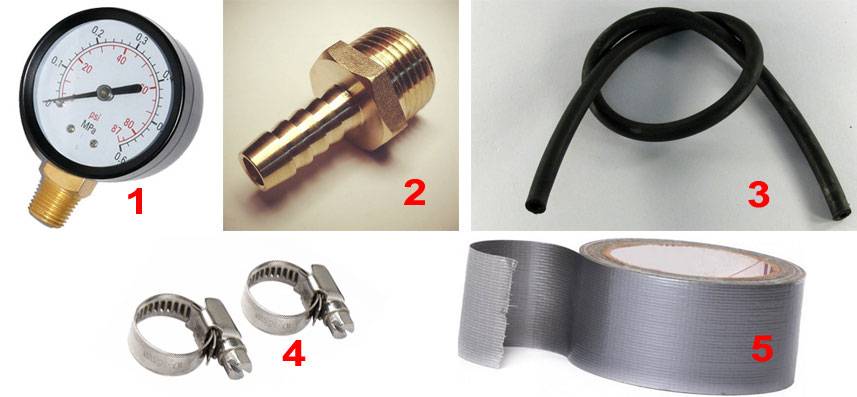
Sometimes a situation arises when it is not possible to find the appropriate adapters. The use of a rubber hose, which will be put on the pressure gauge and the measured point, will help to correct the situation. Sealing and additional fixation of the connection in this case can be provided with a pair of clamps.
To make life easier for yourself by eliminating water spills and their inevitable elimination, all threaded parts of the connections are additionally sealed. Several turns of the FUM tape will reliably keep all the water inside the system.
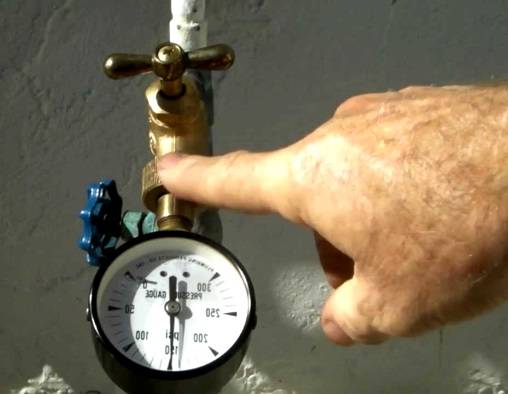
One of the most versatile ways to measure water pressure is to use a pressure gauge.
Most often, all manipulations with the connection of measuring equipment are carried out on the faucet in the bathroom.
This is quite understandable:
- in the bathroom there is enough convenient access to plumbing fixtures;
- when connecting a pressure gauge, there is no need to shut off the water supply to the apartment - just close the taps on the mixer;
- in case of loose sealing of internal connections, water will spill into the bathroom.
When assembling the entire measuring structure, some air is inevitably left in the pipeline section between the pressure gauge diaphragm and the shut-off valve. In order to more accurately measure the water pressure, you must first bleed it if possible.

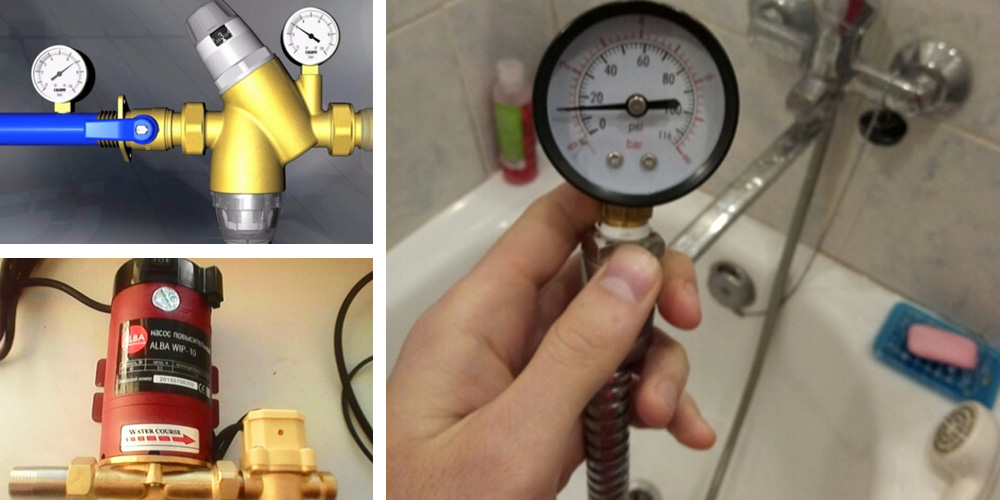


Scheme of connecting the tube to the manometer.
The air can be completely removed if a special bleed valve is additionally installed in front of the measuring device.
But since the measurement of pressure is an episodic operation and the residual amount does not introduce fatal errors in the result obtained, the effect of air can be neglected.
It will be enough to open any nearest tap and drain some water from the pipeline. The remaining air most often leaves with this water.
In the case of measuring the pressure in the shower mixer, it is even easier. It is enough to switch the shower-faucet water pressure regulator several times.
Conclusions and useful video on the topic
Video, the author of which shares advice on increasing water pressure in a private house using arranged by hand pumping station with storage tank:
Video about the nuances of connecting a hydraulic accumulator to the water supply system of a private house and setting the air pressure in it:
A video that tells about the advantages of a frequency converter in a water supply system with an instruction manual and a description of its operating modes:
Normal water pressure in an autonomous system is an essential condition for comfortable and reliable operation of the water supply system. Living in your own home or country house dictates the conditions under which the most ordinary person must be an expert in many matters.
Knowing the simple basics of the theory of water pressure in an independent water supply system and following the tips outlined on how to make it stable will only give positive results. This will help to avoid possible miscalculations at the planning stage and during work on the installation of an autonomous water supply system, and will help to correctly determine the purchase of the necessary equipment.
If you want to ask a question on the topic of the article or have valuable knowledge that will help normalize the water pressure in the system, please leave your comments in the block below.