- Method of calculation for natural gas
- We calculate the gas consumption by heat loss
- Heat loss calculation example
- Boiler power calculation
- Ways to save money when paying for water
- With counters
- Using special equipment
- Housing and communal services: what is included in the payment
- Determination of the gas tariff and the standard of gas consumption by the population
- Instruments for measuring the amount of gas
- Calculation of gas consumption for heating a house of 150 m2
- Consumption of natural gas at home
Method of calculation for natural gas
The approximate gas consumption for heating is calculated based on half the capacity of the installed boiler. The thing is that when determining the power of a gas boiler, the lowest temperature is laid. This is understandable - even when it is very cold outside, the house should be warm.
You can calculate the gas consumption for heating yourself
But it is completely wrong to calculate the gas consumption for heating according to this maximum figure - after all, in general, the temperature is much higher, which means that much less fuel is burned. Therefore, it is customary to consider the average fuel consumption for heating - about 50% of the heat loss or boiler power.
We calculate the gas consumption by heat loss
If there is no boiler yet, and you estimate the cost of heating in different ways, you can calculate from the total heat loss of the building.They are most likely familiar to you. The methodology here is as follows: they take 50% of the total heat loss, add 10% to provide hot water supply and 10% to heat outflow during ventilation. As a result, we get the average consumption in kilowatts per hour.
Then you can find out the fuel consumption per day (multiply by 24 hours), per month (by 30 days), if desired - for the entire heating season (multiply by the number of months during which the heating works). All these figures can be converted into cubic meters (knowing the specific heat of combustion of gas), and then multiply cubic meters by the price of gas and, thus, find out the cost of heating.
Specific heat of combustion in kcal
Heat loss calculation example
Let the heat loss of the house be 16 kW / h. Let's start counting:
- average heat demand per hour - 8 kW / h + 1.6 kW / h + 1.6 kW / h = 11.2 kW / h;
- per day - 11.2 kW * 24 hours = 268.8 kW;
- per month - 268.8 kW * 30 days = 8064 kW.
The actual gas consumption for heating still depends on the type of burner - modulated are the most economical
Convert to cubic meters. If we use natural gas, we divide the gas consumption for heating per hour: 11.2 kW / h / 9.3 kW = 1.2 m3 / h. In calculations, the figure 9.3 kW is the specific heat capacity of natural gas combustion (available in the table).
By the way, you can also calculate the required amount of fuel of any type - you just need to take the heat capacity for the required fuel.
Since the boiler has not 100% efficiency, but 88-92%, you will have to make more adjustments for this - add about 10% of the figure obtained. In total, we get the gas consumption for heating per hour - 1.32 cubic meters per hour. You can then calculate:
- consumption per day: 1.32 m3 * 24 hours = 28.8 m3/day
- demand per month: 28.8 m3 / day * 30 days = 864 m3 / month.
The average consumption for the heating season depends on its duration - we multiply it by the number of months that the heating season lasts.
This calculation is approximate. In some month, gas consumption will be much less, in the coldest - more, but on average the figure will be about the same.
Boiler power calculation
Calculations will be a little easier if there is a calculated boiler capacity - all the necessary reserves (for hot water supply and ventilation) are already taken into account. Therefore, we simply take 50% of the calculated capacity and then calculate the consumption per day, month, per season.
For example, the design capacity of the boiler is 24 kW. To calculate the gas consumption for heating, we take half: 12 k / W. This will be the average need for heat per hour. To determine the fuel consumption per hour, we divide by the calorific value, we get 12 kW / h / 9.3 k / W = 1.3 m3. Further, everything is considered as in the example above:


- per day: 12 kW / h * 24 hours = 288 kW in terms of the amount of gas - 1.3 m3 * 24 = 31.2 m3
- per month: 288 kW * 30 days = 8640 m3, consumption in cubic meters 31.2 m3 * 30 = 936 m3.
You can calculate gas consumption for heating a house according to the design capacity of the boiler
Next, we add 10% for the imperfection of the boiler, we get that for this case the flow rate will be slightly more than 1000 cubic meters per month (1029.3 cubic meters). As you can see, in this case everything is even simpler - fewer numbers, but the principle is the same.
Ways to save money when paying for water
Savings in payment for cold and hot water supply are achieved in two ways:
- installation of individual metering devices;
- the use of special equipment that reduces the consumption of resources;
- the flow also depends on the diameter of the pipe.
These methods are equally suitable for any consumer, including apartments in MKD and residents of the private sector.
With counters
The use of water meters allows you to achieve savings for the following reasons:
- tenants independently control the consumption of water and pay only for themselves;
- there is no need to pay taking into account the increasing coefficient;
- savings are achieved if resources are not used due to vacation or business travel.
Savings when installing a meter
When compared with the amount of payment according to the standards, after installing the meter, the size of the bills is almost halved.
Using special equipment
The possibility of additional savings is achieved by using the following technical means:
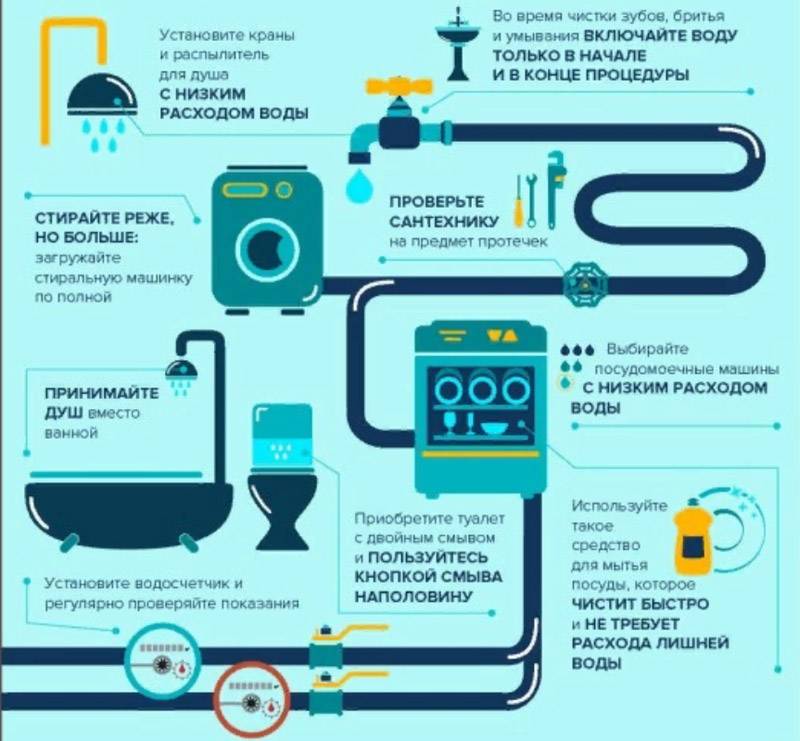
- installation of shower cabins instead of a bath - the cost of these hygiene procedures is reduced by more than half;
- separate purchase of water for cooking - up to 50 liters of water are saved monthly;
- dishwasher saves up to 20% of consumption per month;
- washing machines - rare washing of more things reduces water consumption by up to 10%;
- toilet cistern with two flush options and economical plumbing reduce consumption by up to 15%.
Not the last role is played by a thrifty attitude to energy resources - through an open tap when brushing your teeth, up to 15 liters of water go out every minute, most of which is wasted.
 Ways to not pay more
Spending:
It is not worth paying for water that was not used, or compensating utilities for losses at the expense of other consumers.Given the methodology for calculating monthly water supply rates, installing individual meters is the best way to reduce the amount of utility bills due to personal savings in consumption without reducing the level of comfort.
Housing and communal services: what is included in the payment
The main regulatory legal act containing the main provisions for making rent is the Housing Code of the Russian Federation (LC RF).
According to paragraph 2 of Art. 154 of the Housing Code of the Russian Federation for owners of housing in an apartment building, the following cost items are included in the rent:


- Fee for the maintenance of the premises - this includes the remuneration of the management company (for services in managing the MKD and maintaining its functioning), carrying out current repairs of the house, payment for utility resources consumed during the use of the common property of apartment owners.
- Contribution for major repairs - this can be repairing the foundation, sealing walls, replacing worn-out partitions, covering a new roof and other types of work.
- Payment of utilities - in accordance with paragraph 4 of Art. 154 of the Housing Code of the Russian Federation, this item of expenditure includes payment for cold and hot water supply, electricity, heat, gas, wastewater disposal, and the removal of household waste.
Determination of the gas tariff and the standard of gas consumption by the population
To sell gas to the population as a utility service, for domestic use, a tariff must be set. The tariff is set by the authorized bodies. In addition, you need to install gas consumption standard if there is no gas meter.
The procedure for determining the price of liquefied gas
Documents defining the procedure for calculating and approving the price of liquefied gas:
Consider the basic procedure for setting tariffs
four.The calculation of retail prices provides for their establishment at a level that provides the subject of regulation with the planned amount of revenue from the provision of services for the regulated type of activity in the amount necessary for:
a) reimbursement of economically justified expenses associated with the production, acquisition, transportation, storage, distribution and supply (sale) of gas;
b) ensuring the receipt of a reasonable rate of return on capital used in the regulated activity
a) sale of liquefied gas in cylinders without delivery to the consumer;
b) sale of liquefied gas in cylinders with delivery to the consumer;
c) sale of liquefied gas from group gas storage units;
16. When setting retail prices, a fixed price and (or) its maximum level may be set.
The procedure for determining the gas consumption standard
To determine the amount of funds collected from the population in the MKD, two options are possible:
1. Payment according to the established counter.
2. Payment according to consumption norm
The installed meter in the apartment today is exotic. Calculations, basically, occur according to the established consumption standards.
for cooking and (or) heating water in residential premises - cub. meter per person (for natural gas) or kilogram per person (for liquefied petroleum gas);
for heating residential premises - cub. meter per 1 sq. meter of the total area of residential premises (for natural gas) or kilogram per 1 sq. meter of the total area of residential premises (for liquefied petroleum gas);
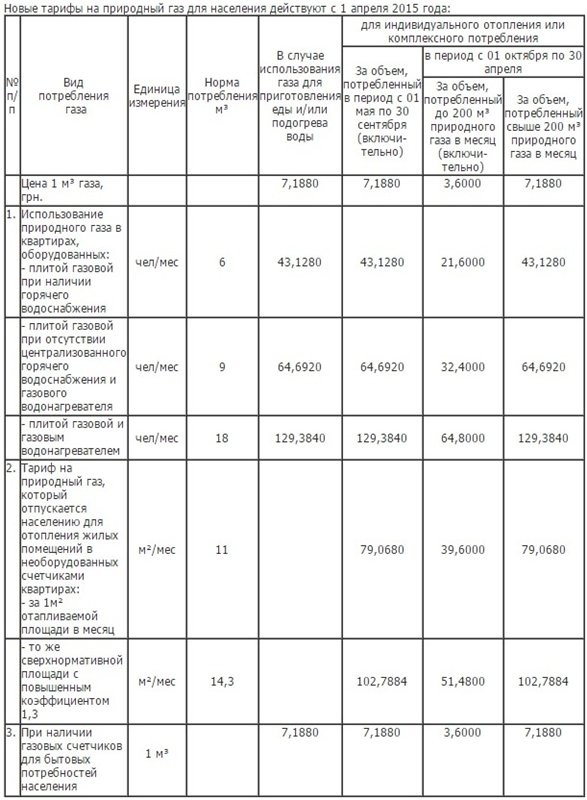
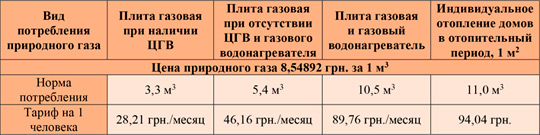


It is important to note that the REC may not set standards on its own without having requests from interested parties. Many regions do not have such regulations.
9. The establishment of utility consumption standards is carried out at the initiative of the authorized bodies, resource-supplying organizations, as well as managing organizations, homeowners associations, housing, housing construction or other specialized consumer cooperatives or their associations (hereinafter referred to as managing organizations).
Standards for various types of gas consumption are set separately.
46. The standard for consumption of utility services for gas supply in residential premises is determined based on the following areas of use:
a) cooking with gas stoves;
b) heating water for household and sanitary needs using a gas heater or gas stove (in the absence of a centralized hot water supply);
c) heating (in the absence of centralized heating).
47. When gas is used in residential premises of apartment buildings or residential buildings in several directions at the same time, the standard for the consumption of utility services for gas supply for consumers living in such houses is determined for each direction of gas use.
To determine the standards, special calculation methods have been developed.
for natural gas - in accordance with the methodology for calculating the norms of gas consumption by the population in the absence of gas meters, approved by the Ministry of Construction and Housing and Communal Services of the Russian Federation;
for liquefied hydrocarbon gas - in accordance with the methodology for calculating the norms for the consumption of liquefied hydrocarbon gas by the population in the absence of gas meters, approved by the Ministry of Construction and Housing and Communal Services of the Russian Federation.
Thus, in order to determine the amount of payment for the population of the supplied gas in the absence of metering devices, it is necessary to contact the regional authorized body and determine the consumption standard. At the same time, it should be taken into account that Decree of the Government of the Russian Federation of June 13, 2006 N 373 (as amended on March 26, 2014) “On the procedure for setting gas consumption standards for the population in the absence of gas meters” establishes the minimum allowable gas consumption rates. In the absence of regional standards, it is necessary to use federal ones.
Instruments for measuring the amount of gas
Devices for measuring gas flow according to the method of calculation are divided into several categories. High-speed are used to determine the volume number of the medium under study. These devices do not have measuring chambers. The sensitive part is the impeller (tangential or axial), which is driven into rotation by the flow of matter.
Volume meters are less dependent on the type of product. Their disadvantages include the complexity of the design, high price and impressive dimensions. The device consists of several measuring chambers and has a more complex design. This type of device is divided into several types - piston, bladed, gear.
Another classification of gas meters is also known, which includes three types of devices: rotary, drum and valve.
Rotary counters have a large throughput.Their action is based on the calculation of the number of revolutions of the blades inside the device, the indicator corresponds to the volume of gas. Their main advantages include durability, independence from electricity, increased resistance to short-term overloads.


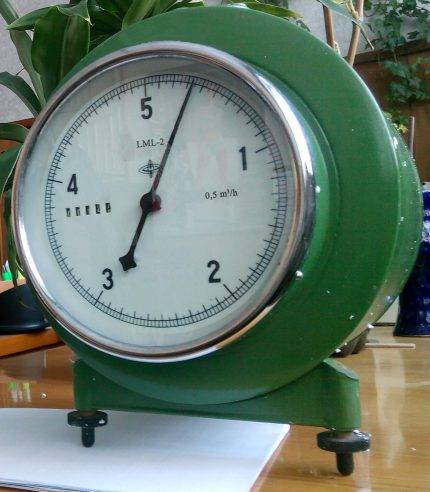 Drum-type gas meters operate on the principle of displacement. Correction factors such as temperature, gas composition and humidity level are not taken into account.
Drum counters consist of a housing, a counting mechanism and a drum with measuring chambers. The principle of operation of the device for measuring gas consumption is to determine the number of revolutions of the drum, which rotates due to the pressure difference. Despite the accuracy of the calculations, this type of instrument has not found wide application due to its bulky size.
The principle of operation of the last type of meters, known as valve meters, is based on the movement of a movable partition, which is affected by the pressure difference of the substance. The device consists of several parts - a counting and gas distribution mechanism, as well as a housing. It has large dimensions, so it is mainly used in everyday life.
Calculation of gas consumption for heating a house of 150 m2
When arranging the heating system and choosing an energy carrier, it is important to find out the future gas consumption for heating a house of 150 m2 or another area. Indeed, in recent years, a clear upward trend in natural gas prices has been established, the last rise in price by about 8.5% occurred recently, on July 1, 2016
This led to a direct increase in heating costs in apartments and cottages with individual heat sources using natural gas. That is why developers and homeowners who are just choosing a gas boiler for themselves should calculate heating costs in advance.
Consumption of natural gas at home
The owners of all apartments and houses, many enterprises need to calculate the volumes of gas consumed. Data on the need for fuel resources are included in the projects of individual houses and their parts. To pay according to real numbers, gas meters are used.
The level of consumption depends on the equipment, thermal insulation of the building, season. In apartments without centralized heating and hot water supply, the load goes to the water heater. The device consumes up to 3-8 times more gas than a stove.
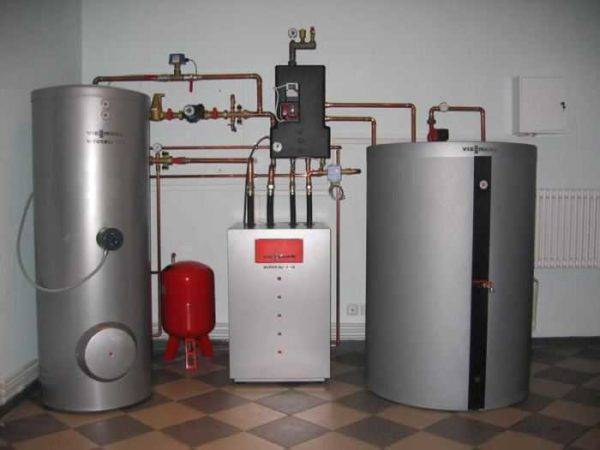
Gas water heaters (boilers, boilers) are wall-mounted and floor-standing: they are used simultaneously for heating and for heating water, and less functional models are mainly for heating only
The maximum consumption of the stove depends on the number of burners and the power of each of them:
- reduced - less than 0.6 kW;
- normal - about 1.7 kW;
- increased - more than 2.6 kW.
According to another classification, low power for burners corresponds to 0.21-1.05 kW, normal - 1.05-2.09, increased - 2.09-3.14, and high - more than 3.14 kW.
A typical modern stove uses at least 40 liters of gas per hour when turned on. Typically, the stove consumes about 4 m³ per month per 1 tenant, and the consumer will see approximately the same figure if he uses the meter. Compressed gas in cylinders in terms of volume requires much less. For a family of 3, a 50-liter container will last about 3 months.
In an apartment with a stove for 4 burners and without a water heater, you can put a counter marking G1.6. A device with a size G2.5 is used if there is also a boiler. To measure the gas flow, large gas meters are also installed, on G4, G6, G10 and G16. The meter with parameter G4 will cope with the calculation of the gas consumption of 2 stoves.
Water heaters are 1- and 2-circuit. For a boiler with 2 branches and a powerful gas stove, it makes sense to install 2 counters. One of the reasons is that household gas meters do not cope well with the large difference between the power of the equipment. A weak stove at minimum speed uses many times less fuel than a water heater at maximum.
The classic stove has 1 large burner, 2 medium and 1 small, using the largest one is the most cost-effective
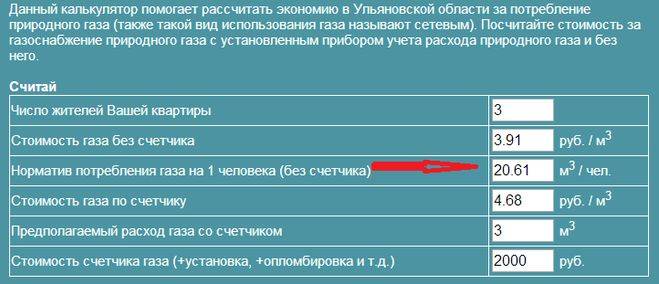
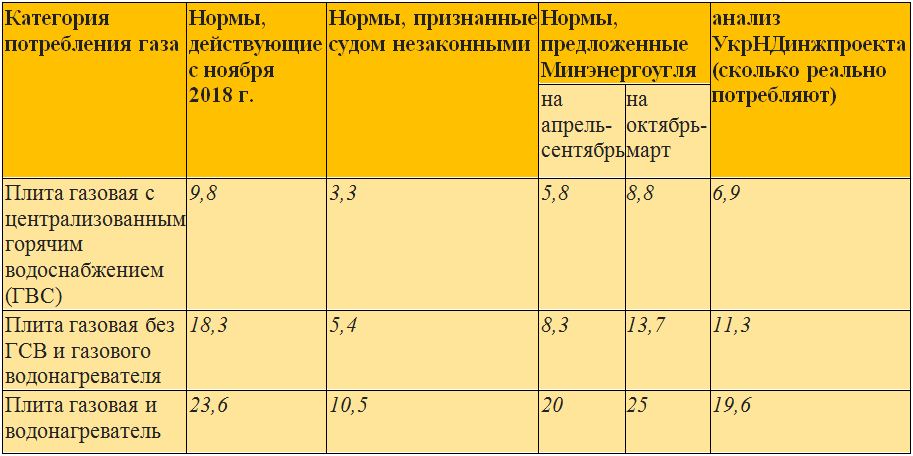
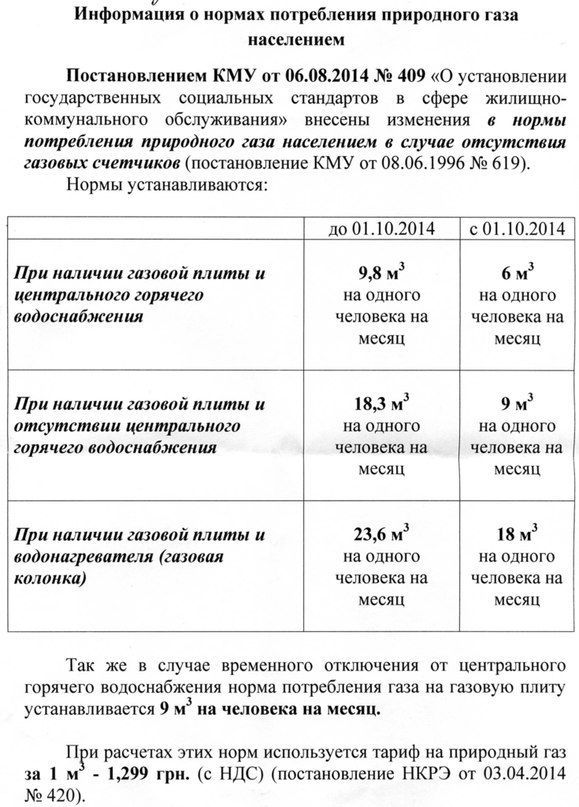
Subscribers without meters pay for volume based on consumption per inhabitant multiplied by their number and consumption per 1 m² multiplied by the heated area. The standards are valid all year round - they laid the average figure for different periods.


Norm for 1 person:
- Gas consumption for cooking and heating water using a stove in the presence of centralized hot water supply (DHW) and central heating is about 10 m³ / month per person.
- The use of only one stove without a boiler, centralized hot water supply and heating - approximately 11 m³ / month per person.
- The use of a stove and a water heater without centralized heating and hot water is about 23 m³/month per person.
- Heating water with a water heater - about 13 m³ / month per person.
In different regions, the exact consumption parameters do not match.Individual heating with a water heater costs about 7 m³/m² for heated living spaces and about 26 m³/m² for technical ones.
On the notice from the meter installation company, you can see how much the consumption figures differ with and without a gas meter
The dependence in gas consumption was indicated in SNiP 2.04.08-87. Proportions and indicators are different there:
- stove, central hot water supply - 660 thousand kcal per person per year;
- there is a stove, no hot water supply - 1100 thousand kcal per person per year;
- there is a stove, a water heater and no hot water supply - 1900 thousand kcal per person per year.
Consumption according to the standards is affected by the area, the number of residents, the level of well-being with household communications, the presence of livestock and its livestock.
The parameters are differentiated based on the year of construction (before 1985 and after), the involvement of energy-saving measures, including the insulation of facades and other external walls.
You can read more about the norms of gas consumption per person in this material.