
- Which machine to choose, B or C?
- Selection of the rating of the circuit breaker according to the wire section
- When can the rated power of the machine be reduced
- The purpose of the introductory machine
- Scheme and types of protection
- Parameters of circuit breakers
- Basic elements and markings
- Tripping time-current characteristics
- Deciding on a denomination
- Example
- Power calculation
- What should the machine protect against?
- The formula for calculating power by current and voltage
- Resistive load
- capacitive load
Which machine to choose, B or C?
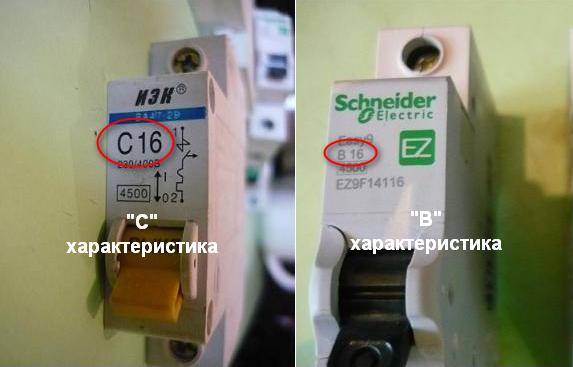 The type of time-current characteristic is indicated before the value of the rated current on the machine.
As we found out from all of the above, you need to be guided by a characteristic equal to one and a half
value from the face value of the machine. This will allow you to correctly select the machine for overload protection. For
protection against short circuit has the value "B" or "C", these letters are written before the current value on the machines. For example
“B16A” reads “automatic machine for 16 amperes with a characteristic of be” or “C25A” - “automatic machine for 25 amperes with
characteristic of ce". In machines with characteristic "B", the electromagnetic release is triggered
when the current is exceeded by 3-5 times from the nominal, in automatic machines with characteristic "C" - when
current 5-10 times of the nominal. Naturally, it is better to choose a device that will work at a lower current,
that is, with the characteristic "B". By the way, this characteristic is also valid in relation to differential automata.
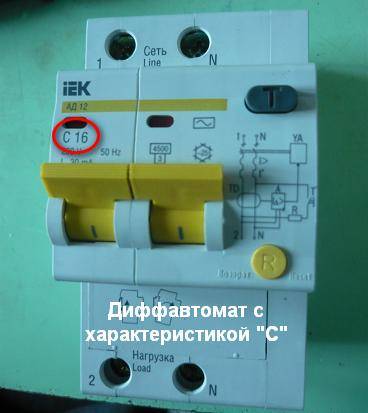 The difavtomat combines an RCD and an automaton, therefore, a characteristic is indicated for it in a similar way.
There is a misconception that C-eschki should be placed where there are devices with increased starting
currents such as refrigerators, heaters, etc. This is nothing more than speculation from ignorance
- the starting currents of these devices do not exceed 3 times the operating currents. This statement
refers to powerful asynchronous motors that are used in machine tools if you have one at home
machine - then yes, it is better to protect it with a C-eschka.
So, which feature should you choose? In most cases, both time-current characteristics
applicable for protection. Characteristic "C" shows its protective properties no worse where the current
short circuit is several times the nominal value multiplied by 10 (10 times the excess).
In simple words, where the network is not squandered and the voltage is close to 220 V, you don’t have to worry about the type of machine.
In suburban settlements, where the mains voltage can sometimes sag to 160 V and below, it is better to use "B".
It is worth noting that by applying the "B"-shku in any situation, you will not lose. If the above statements
you are not satisfied and you are used to operating with exact numbers - you need to measure prospective short current
closures, "goat", as it is called by electricians. And compare the tenfold current of the "C"-shki with the received
result. How to measure the "goat" we will consider in subsequent publications.
The use of both characteristics on the input (C) and branches (B) usually does not lead to protection selectivity when, during a short circuit
only the problematic branch is disabled, and the introductory automaton is enabled. If such cases do occur, then to a greater extent
this can be attributed to chance rather than selectivity.
Real, effective selectivity can be achieved only by installing expensive devices, in technical
descriptions of which the manufacturer indicates the type and class of current limiting input and group automata.
Selection of the rating of the circuit breaker according to the wire section
Having determined the rating of the machine, based on the power of the “suspended” load, it is necessary to make sure that the electrical wiring can withstand the corresponding current. As a guide, you can use the table below, compiled for a copper wire and a single-phase circuit (table 3):
| cross section conductors, sq. mm | Permissible current, A | Max. power load, kW | Current automatic, a | Possible consumers |
| 1,5 | 19 | 4,2 | 16 | Lighting, signaling |
| 2,5 | 27 | 6,0 | 25 | Socket group, underfloor heating |
| 4 | 38 | 8,4 | 32 | Air conditioning, water heater |
| 6 | 46 | 10,1 | 40 | Electric stove, oven |
As you can see, all three indicators (power, current strength and wire cross-section) are interconnected, so the nominal value of the machine can, in principle, be chosen according to any of them. At the same time, it is necessary to make sure that all parameters fit together and, if necessary, make the appropriate adjustment.
In any scenario, remember the following:
- Installing an excessively powerful machine can lead to the fact that before it operates, electrical equipment that is not protected by its own fuse will fail.
- An automatic machine with a low number of amperes can become a source of nervous stress, de-energizing a house or separate rooms when you turn on an electric kettle, iron or vacuum cleaner.
When can the rated power of the machine be reduced

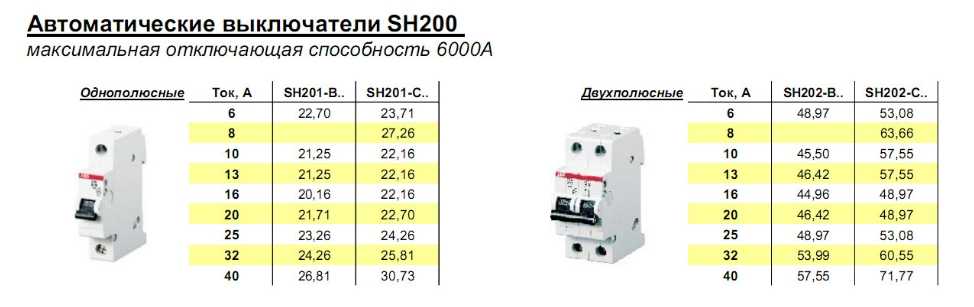
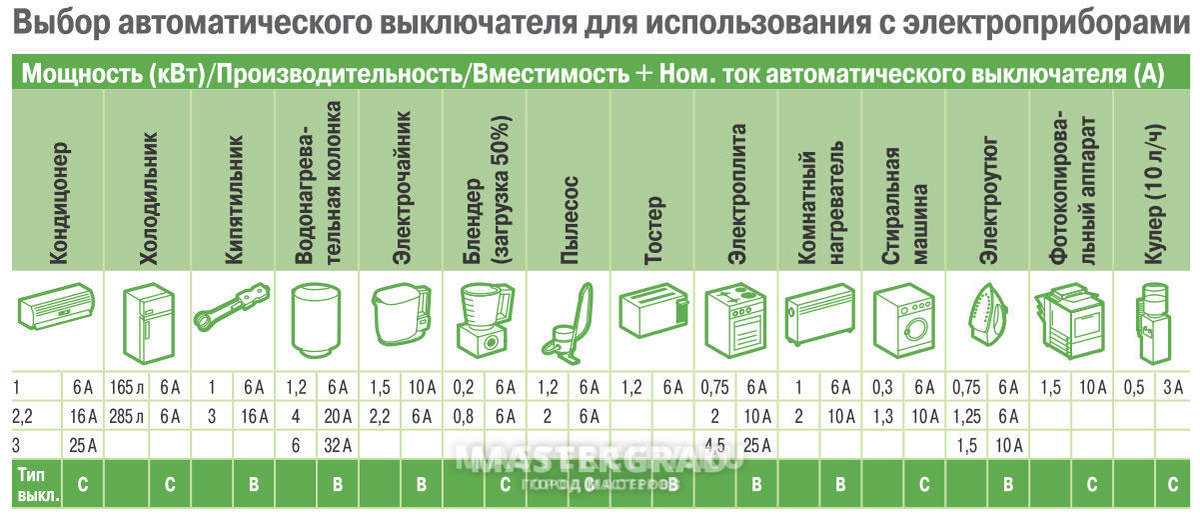

Sometimes an automatic machine is installed on the line with a rated power much lower than necessary to guarantee the operation of the electric cable. It is advisable to reduce the circuit breaker rating if the total power of all devices in the circuit is significantly less than the cable can withstand.
This happens if, for safety reasons, when some of the devices were removed from the line after wiring. Then the reduction of the rated power of the machine is justified from the standpoint of its faster response to emerging overloads.
They also use a denomination less than the calculated one for reasons of severe restrictions on each circuit. For example, for a single-phase network, a 32 A switch is installed at the entrance to an apartment with an electric stove, which gives 32 * 1.13 * 220 = 8.0 kW of permissible power. Let, when wiring around the apartment, 3 lines were organized with the installation of group automatic machines with a rating of 25 A.
Assume that one of the lines is slowly increasing the load. When the power consumption reaches a value equal to the guaranteed tripping of the group switch, only (32 - 25) * 1.45 * 220 = 2.2 kW will remain for the remaining two sections. This is very small relative to the total consumption.
With such a switchboard layout, the input machine will turn off more often than devices on the lines.Therefore, in order to maintain the principle of selectivity, it is necessary to put switches with a nominal value of 20 or 16 amperes on the sites. Then, with the same skew of power consumption, the other two links will have a total of 3.8 or 5.1 kW, which is acceptable.
Consider the possibility of installing a switch with a rating of 20A using the example of a separate line allocated for the kitchen.
- The following electrical appliances are connected to it and can be switched on at the same time:
- Refrigerator with a rated power of 400 W and a starting current of 1.2 kW;
- Two freezers, 200 W;
- Oven, power 3.5 kW;
When the electric oven is operating, it is allowed to additionally turn on only one appliance, the most powerful of which is an electric kettle that consumes 2.0 kW.
A twenty-amp machine allows you to pass current for more than an hour with a power of 20 * 220 * 1.13 \u003d 5.0 kW. A guaranteed shutdown in less than one hour will occur when a current of 20 * 220 * 1.45 = 6.4 kW is passed.
When the oven and electric kettle are turned on at the same time, the total power will be 5.5 kW or 1.25 parts of the nominal value of the machine. Since the kettle does not work for long, the shutdown will not occur. If at this moment the refrigerator and both freezers are turned on, then the power will be 6.3 kW or 1.43 parts of the nominal value.
This value is already close to the guaranteed trip parameter. However, the probability of such a situation occurring is extremely small and the duration of the period will be insignificant, since the operating time of the motors and the kettle is short.
The starting current that occurs when starting the refrigerator, even in total with all operating devices, will not be enough to trigger the electromagnetic release. Thus, under the given conditions, a 20 A machine can be used.
The purpose of the introductory machine
In order to understand why we still need an “introductory “machine”, we will briefly understand what a circuit breaker is in the general case and why it is needed.
Automatic protective switch - a contact switching device that is able to turn off electrical networks in the event of an emergency situation (overload or short circuit).
The introductory machine in appearance, mechanism of operation and design is no different from a conventional protective device that controls any electrical line
The only and most important difference is its rating, which is a certain (calculated) order higher, taking into account selectivity, than any linear protective switch in the electrical panel
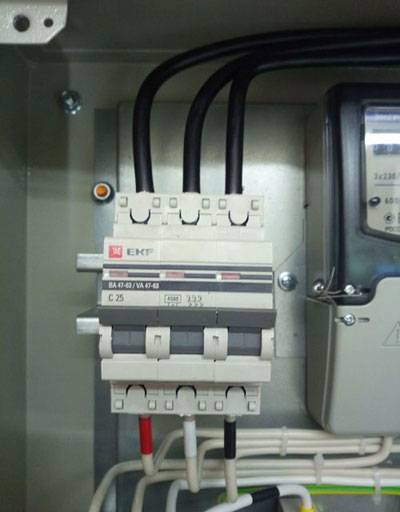
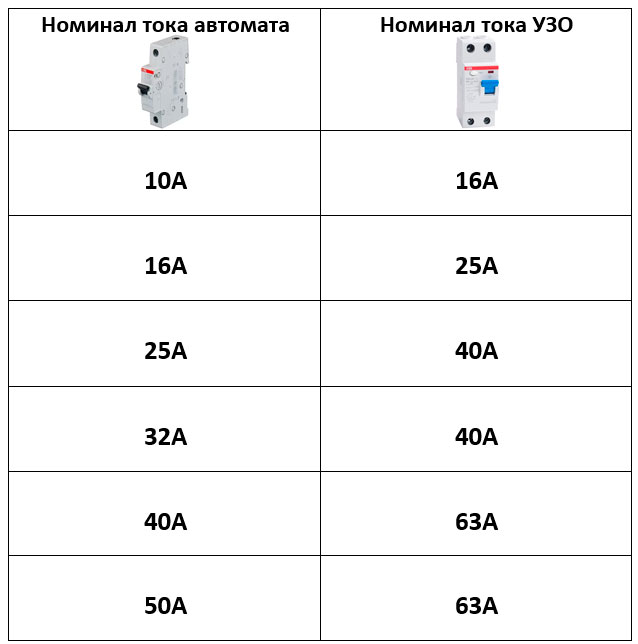
An introductory machine must be installed when an electrical cable is entered into an apartment or a private house. It protects the entire electrical network of the dwelling as a whole from overload, and also serves to turn off the power to the entire facility (for example, for electrical and other repairs). It also ensures the correct operation of the supply cable and does not allow exceeding the load set for this room.



Scheme and types of protection
A conditional diagram is also drawn on the case, where the types of protections installed in the machine are drawn.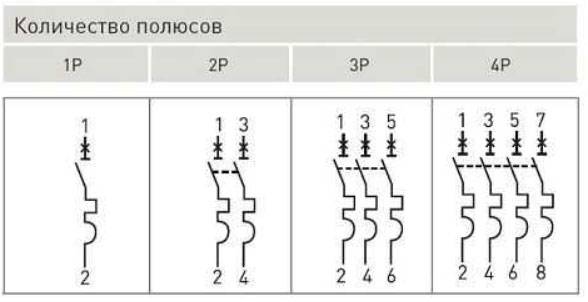
Semicircle - electromagnetic release. The rectangle is thermal.
Strange as it may seem, there are circuit breakers without a thermal release. They serve to protect electric motors with thermal relays. They are used in smoke exhaust systems and are connected to cables that can withstand significant overheating.
This is a special fire safety requirement to ensure long-term performance of devices at high ambient temperatures. If there were a "car" in such switches, they would have worked ahead of time, worsening the scenario for the development of a fire.
For additional markings related to differential protection devices or individual types of relays, look for specialized catalogs. Read all the information on marking modular starters and contactors in the article below. 
As you can see, even a few square centimeters can accommodate a huge amount of useful data, on the basis of which a competent choice of electrical equipment should be made.
Parameters of circuit breakers
An understanding of their operating principles, operating conditions, and trip times is essential to ensure correct sizing of trip devices.
Operating parameters of circuit breakers are standardized by Russian and international regulations.
Basic elements and markings
The design of the circuit breaker includes two elements that respond to the current exceeding the set range of values:
- The bimetallic plate heats up under the influence of the passing current and, bending, presses on the pusher, which disconnects the contacts. This is the “thermal protection” against overload.
- The solenoid, under the influence of a strong current in the winding, generates a magnetic field that presses the core, and it already acts on the pusher. This is a "current protection" against a short circuit, which reacts to such an event much faster than the plate.
Types of electrical protection devices are labeled by which their main parameters can be determined.
Each circuit breaker is marked with its main characteristics. This allows you not to confuse the devices when they are installed in the shield
The type of time-current characteristic depends on the setting range (the amount of current at which operation occurs) of the solenoid. To protect wiring and appliances in apartments, houses and offices, type “C” or, much less common, “B” switches are used. There is no particular difference between them in domestic use.
Type “D” is used in utility rooms or carpentry in the presence of equipment with electric motors that have high starting power.
There are two standards for disconnect devices: residential (EN 60898-1 or GOST R 50345) and more stringent industrial (EN 60947-2 or GOST R 50030.2). They differ slightly and machines of both standards can be used for residential premises.
In terms of rated current, the standard range of machines for domestic use contains devices with the following values: 6, 8, 10, 13 (rare), 16, 20, 25, 32, 40, 50 and 63 A.
Tripping time-current characteristics
In order to determine the speed of operation of the machine during overload, there are special tables for the dependence of the shutdown time on the excess of the nominal value, which is equal to the ratio of the existing current strength to the nominal one:
K=I/In.
A sharp break down the graph when the value of the range coefficient is from 5 to 10 units is due to the operation of the electromagnetic release. For type “B” switches, this occurs at a value from 3 to 5 units, and for type “D” - from 10 to 20.


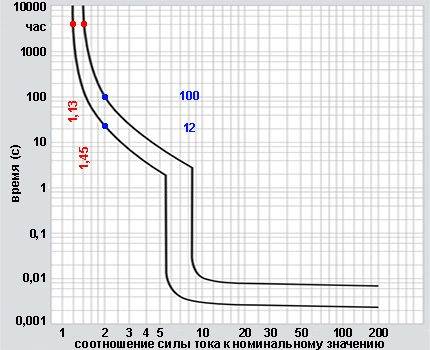
The graph shows the dependence of the operating time range of type “C” circuit breakers on the ratio of the current strength to the value that is set for this circuit breaker
With K = 1.13, the machine is guaranteed not to turn off the line within 1 hour, and with K = 1.45, it is guaranteed to turn off within the same time. These values are approved in clause 8.6.2. GOST R 50345-2010.
To understand how long the protection will operate, for example, at K = 2, it is necessary to draw a vertical line from this value. As a result, we get that according to the above graph, the shutdown will occur in the range from 12 to 100 seconds.
Such a large spread of time is due to the fact that the heating of the plate depends not only on the power of the current passing through it, but also on the parameters of the external environment. The higher the temperature, the faster the machine operates.
Deciding on a denomination
Actually, from the functions of the circuit breaker, the rule for determining the rating of the circuit breaker follows: it must operate until the current exceeds the wiring capabilities. And this means that the current rating of the machine must be less than the maximum current that the wiring can withstand.
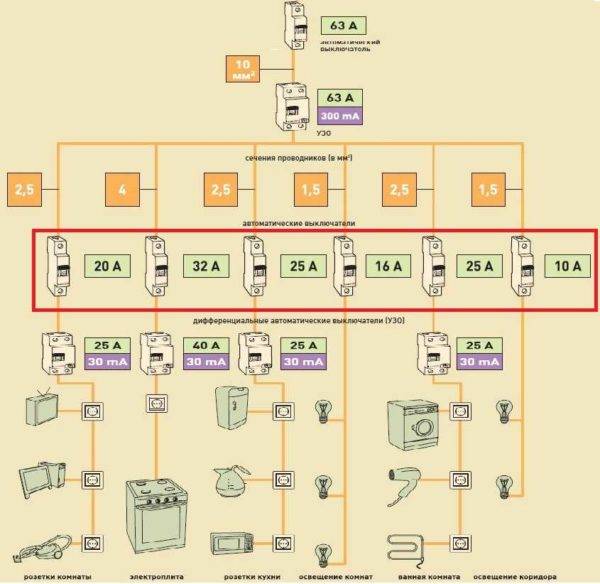
For each line, you need to choose the right circuit breaker
Based on this, the algorithm for choosing a circuit breaker is simple:
- Calculate the cross section of the wiring for a specific area.
- See what maximum current this cable can withstand (there is in the table).
- Further, from all the denominations of circuit breakers, we select the nearest smaller one. The ratings of the machines are tied to the permissible continuous load currents for a particular cable - they have a slightly lower rating (there is in the table). The list of ratings looks like this: 16 A, 25 A, 32 A, 40 A, 63 A. From this list, choose the right one.There are denominations and less, but they are practically not used anymore - we have too many electrical appliances and they have considerable power.
Example
The algorithm is very simple, but it works flawlessly. To make it clearer, let's look at an example. Below is a table that indicates the maximum allowable current for conductors that are used when laying wiring in a house and apartment. There are also recommendations regarding the use of machines. They are given in the column "Rated current of the circuit breaker". It is there that we are looking for denominations - it is slightly less than the maximum allowable, so that the wiring works in normal mode.
| Cross section of copper wires | Permissible continuous load current | Maximum load power for a single-phase network 220 V | Rated current of the circuit breaker | Circuit breaker current limit | Approximate load for a single-phase circuit |
|---|---|---|---|---|---|
| 1.5 sq. mm | 19 A | 4.1 kW | 10 A | 16 A | lighting and signaling |
| 2.5 sq. mm | 27 A | 5.9 kW | 16 A | 25 A | socket groups and electric underfloor heating |
| 4 sq. mm | 38 A | 8.3 kW | 25 A | 32 A | air conditioners and water heaters |
| 6 sq. mm | 46 A | 10.1 kW | 32 A | 40 A | electric stoves and ovens |
| 10 sq. mm | 70 A | 15.4 kW | 50 A | 63 A | introductory lines |
In the table we find the selected wire section for this line. Suppose we need to lay a cable with a cross section of 2.5 mm2 (the most common when laying to medium power devices). A conductor with such a cross section can withstand a current of 27 A, and the recommended rating of the machine is 16 A.
How will the chain work then? As long as the current does not exceed 25 A, the machine does not turn off, everything works in normal mode - the conductor heats up, but not to critical values.When the load current begins to increase and exceeds 25 A, the machine does not turn off for some time - perhaps these are starting currents and they are short-lived. It turns off if the current exceeds 25 A by 13% for a sufficiently long time. In this case, if it reaches 28.25 A. Then the electric bag will work, de-energize the branch, since this current already poses a threat to the conductor and its insulation.
Power calculation
Is it possible to choose an automatic machine according to the load power? If only one device is connected to the power line (usually it is a large household appliance with a large power consumption), then it is permissible to make a calculation based on the power of this equipment. Also in terms of power, you can choose an introductory machine, which is installed at the entrance to a house or apartment.
If we are looking for the value of the introductory machine, it is necessary to add up the power of all devices that will be connected to the home network. Then the found total power is substituted into the formula, the operating current for this load is found.
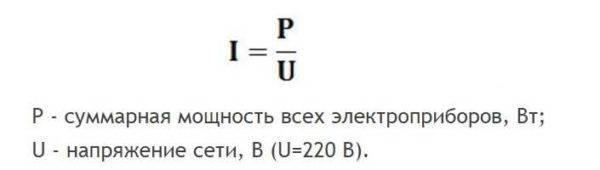
Formula for calculating current from total power
After we have found the current, select the value. It can be either a little more or a little less than the found value. The main thing is that its tripping current does not exceed the maximum allowable current for this wiring.
When can this method be used? If the wiring is laid with a large margin (this is not bad, by the way). Then, in order to save money, you can install automatically switches corresponding to the load, and not to the cross section of the conductors
But once again we pay attention that the long-term permissible current for the load must be greater than the limiting current of the circuit breaker.Only then the choice of automatic protection will be correct
What should the machine protect against?
First of all the machine is designed to protect the wiring from fire and destruction. electrical appliances,
as a rule, the machine does not protect, does not protect a person from electric shock - this function is performed by
differential switch (RCD among the people) or differential machine (combines RCD and
protective machine). So, since it protects the wiring, then the denomination should not be overestimated for
exclusion of unnecessary operations - if the wiring is in danger of fire or destruction, about no reserve
Power is out of the question! Simple wisdom: if you want reliable protection and a minimum
operations - increase the cross section of the conductors of the wires, within reasonable limits, of course.


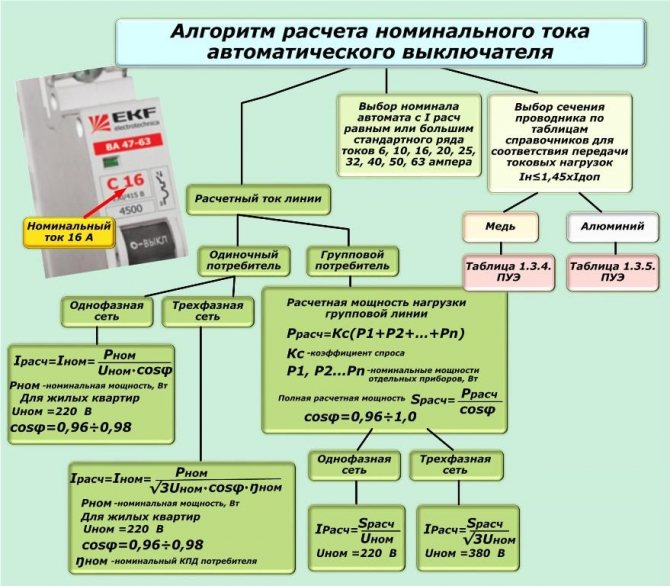

There is a misconception that if the wiring can withstand a current equal to the nominal value of the machine, then everything is in order.
and there will never be a fire. This is far from true. In the last article, we touched on the topic superficially.
wiring and machines, but most importantly, we got acquainted with the table, which shows the currents for various
wire sections. Now we will use this table and see which wires are of which value.
machine can be protected.
The formula for calculating power by current and voltage
| Conductor cross section, mm sq. | Permissible load power, W | Switch rating, A | ||
| Copper | Aluminum | 220 A, 1 phase | 380V 3 phase | |
| 1,5 | 2,5 | 2 200 | 5 300 | 10 |
| 2,5 | 4 | 4 400 | 10 500 | 20 |
| 4 | 6 | 5 500 | 13 200 | 25 |
For calculations on these parameters, the definitions of total (S), active (P) and reactive (Q) power are used. The following formulas are suitable for calculating single-phase 220 V networks:
- S = U*I;
- P = U * I * cos ϕ;
- Q \u003d U * I * sin ϕ.
The initial data for the calculation can be taken from reference books. The measurement results are also used.
Resistive load
Resistive load
Incandescent lamps and heaters do not have reactive characteristics. Such loads do not shift the phases of currents and voltages. Power is consumed completely at twice the frequency.
capacitive load
Energy ratio
In the explanations presented, an ideal situation is considered. However, in reality, each reactive element has a certain electrical resistance. Be aware of the corresponding losses in the connecting wires and other circuit components.
With significant values of the capacitive (inductive) component, the noted problems should be taken into account. In some schemes, in addition to increasing the load capacity of automata, additional compensation components are used.
The power of the protective device is selected according to the wiring current (calculated or tabular value), taking into account the consumption of the connected load. The nominal value of the machine is chosen less in order to maintain the integrity of the power line during operation. In different parts of the network, conductors of the appropriate section are installed, guided by the principles of a tree structure.
Negligent attitude to the choice of a device with the necessary parameters leads to serious negative consequences. Therefore, before choosing an automatic protective device, it is imperative to make sure that the installed wiring can withstand the planned load. In accordance with the PUE, the circuit breaker must provide overload protection for the weakest section of the circuit. Its rated current must correspond to the current of the connected device. Accordingly, the conductors are selected with the required cross section.
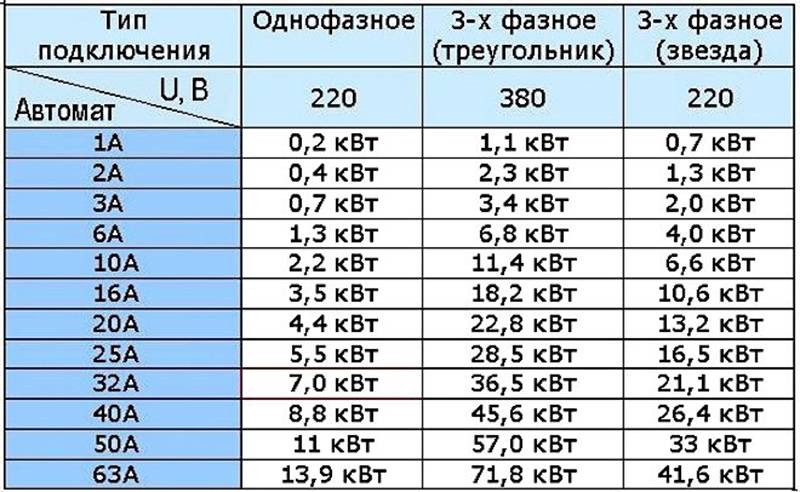
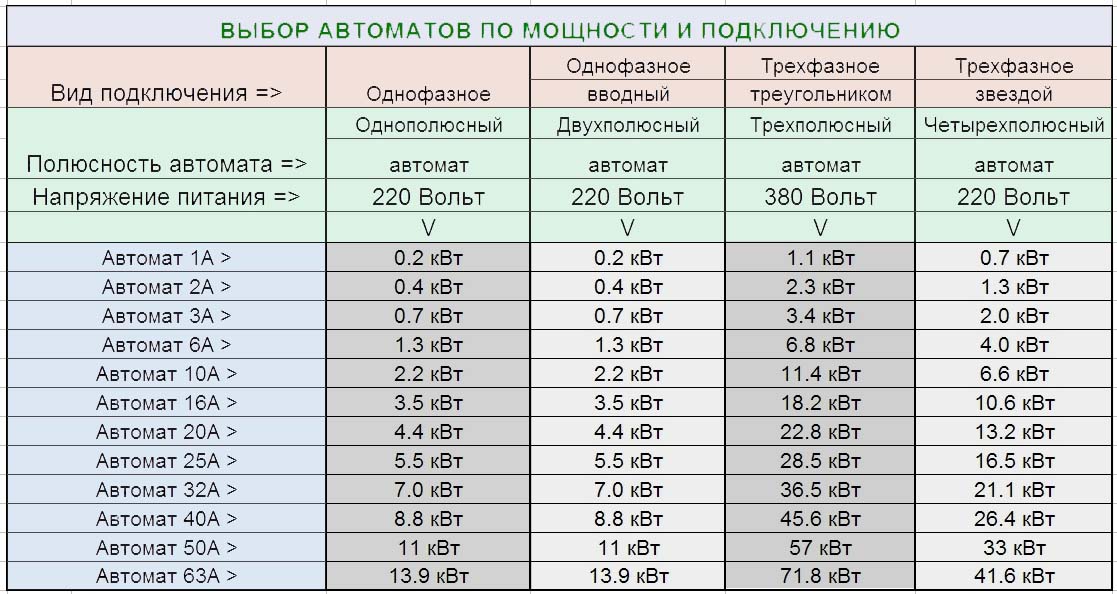
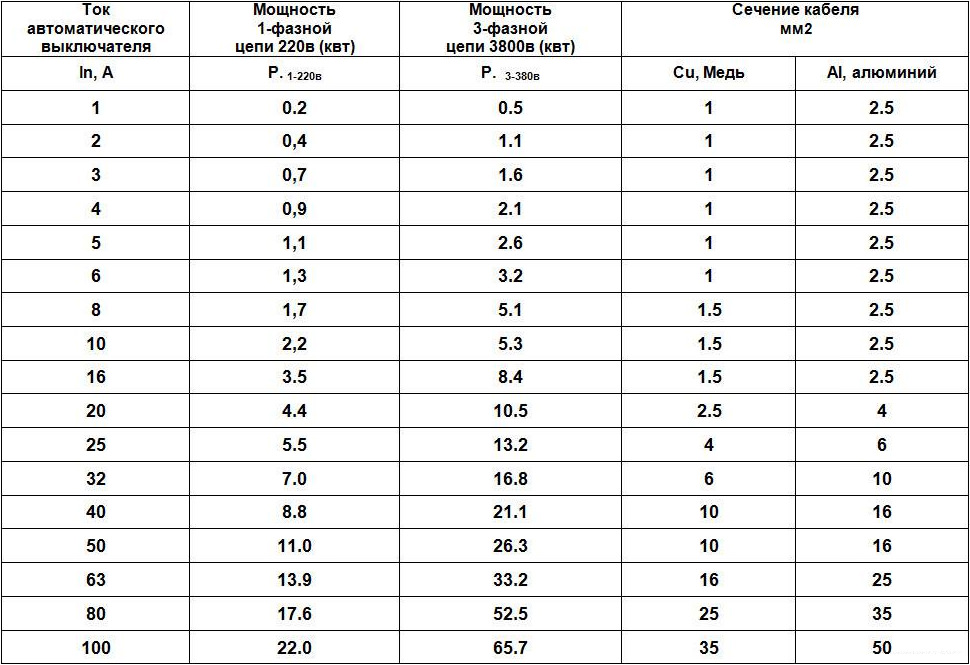
To calculate the current power of the machine, you must use the formula: I \u003d P / U, where P is the total power of all electrical appliances in the apartment. By calculating the required current, you can choose the most suitable machine. The table greatly simplifies the calculations, with the help of which you can select the circuit breaker depending on the specific operating conditions.
In each electrical wiring, there is a division into certain groups. Accordingly, each group uses an electrical wire or cable with a certain cross section, and protection is provided by an automatic machine with the most appropriate rating.
The table will help you choose a circuit breaker and cable section, depending on the expected load of the electrical network, calculated in advance. The table helps to make the right choice of the machine according to the load power. When calculating current loads, it should be remembered that the load calculations of one consumer and a group of household appliances differ from each other. When calculating, it is necessary to take into account the difference between single-phase and three-phase power supply.
Which machine to put on 15 kW
Calculation of the machine for power 380
Calculation of the wire cross-section according to the load
Automatic or differential machine: how to distinguish and what to choose
Load power factor
Calculation of current by power and voltage



