
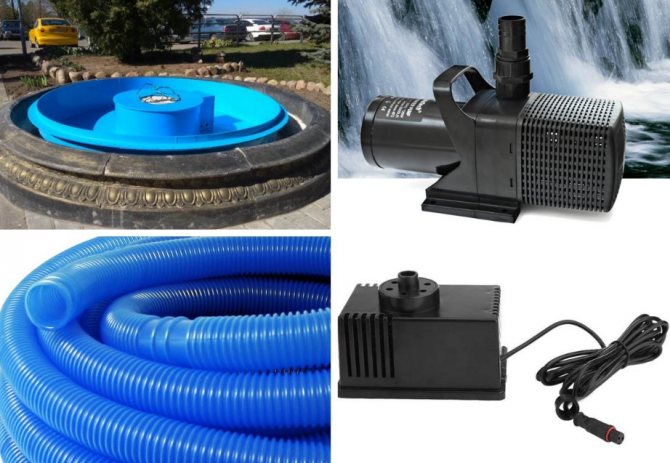
- Types of nozzles
- Pump selection
- Fountain lighting
- Main selection criteria
- Materials for creating a water pump
- Pump type No. 1: surface
- Purpose of the pump and method of use
- Diversity
- Pump installation
- How to make a flat stream
- Fountain pumps TM "Hozyain"
- Submersible and external pumps: differences
- How to make a fountain with your own hands
- Conclusion
Types of nozzles
The beauty of any reservoir depends on the type of water jet. This beauty can be created by nozzles that are put on the pump outlet and produce jets of the required configuration.
High-quality nozzles are made of aluminum bronze - this is a material that has anti-corrosion properties and a fairly high price. Budget models include nozzles made of stainless steel or brass. The cheapest option is plastic fixtures, but they are short-lived and are not used with high fluid pressure.
There are the following types of nozzles:
- Inkjet. A thin column of liquid rises upward, which breaks up into many small falling streams.
- Bell. Two discs are attached to the end of the pipe, one above the other, forming a gap between them, the size of which will determine the thickness of the water flow falling down.
- Hemisphere.This nozzle is a ball with many tubes through which liquid is splashed down in the form of a hemisphere.
- Fish tail. At an angle of 30º-40º, water flows out simultaneously from several nozzles.
- Tulip. The device resembles a “bell” nozzle, the only difference is that water does not flow out of the disks horizontally, but at an angle.
- Ring. This is a ring made of a pressure pipe in which holes are made at an equal distance from each other. A separate nozzle is installed in each hole, from which the input hits in different directions at an inclination of 120º.
- Tiered. In such a device, the holes are arranged in three tiers. From the central hole, the liquid is supplied with a strong pressure, from the holes of the second tier, water flows out with a weaker pressure, from the last - with the smallest one.
- Pinwheel. The device is located on a rotating base. Upward jets of liquid during rotation will twist in a spiral.
Pump selection
For small fountains, a submersible pump is the best option. It is not only more expedient in a home-made structure, but also cheaper.
External pumps are required only where the fountain has a complex structure and occupies a large area. Their noise is not extinguished by the water column, and in order to avoid theft, outdoor equipment has to be masked separately. On the other hand, "dry" outdoor pumps are easier to maintain.
An important parameter of the equipment is its power. If the height of the water jet does not exceed one and a half meters, then it is worth limiting to an indicator of 70 watts. If the power is greater, then the cascade will come out higher. Pumps with the ability to adjust the force of pressure are preferred, they allow you to change the height of the fountain.
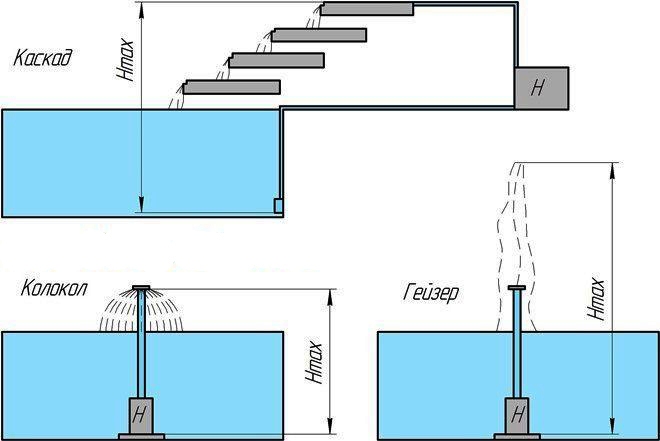
The strength of the water at the outlet depends on the power of the equipment
When choosing a pump, you should focus on the ratio of indicators such as pressure and device performance. The first parameter characterizes to what height the jet directed upwards can rise. The second indicates the volume of water that is pumped by the fountain pump per hour.
Fountain lighting
In this area, everything has become easier with the advent of LEDs. They are powered by 12V or 24V, which is much safer than the regular mains. There are even solar-powered lamps.
Fountain lighting
Lighting can be done using waterproof LED strips or the same spotlights and lamps. To power them, you need an adapter that converts 220 V to 12 or 24 V, but they are usually sold in the same place as LEDs, so there should be no problems. Installation is simple: spotlights have mounting brackets, the tape can be “shot” from a stapler, only the brackets need to be found larger than the size of the tape: it is unnecessary to punch it so as not to violate the tightness.
There are LEDs that change color. Shades from 8 to several thousand
Main selection criteria
Before you buy a pump for a fountain to the country, you need to pay attention to a whole list of features that should be considered. They are as follows:
They are as follows:
- Power. Its performance can be quite small. Due to the fact that most country fountains are relatively small, pumps have enough power in the range of 150-500 watts.
- Performance. Cheap pumps designed to operate simple fountains and waterfalls, as a rule, can pump 5-10 thousand liters of water per hour. More powerful devices have more performance.It reaches 15-20 thousand liters of water per hour.
- Liquid rise. In order to select a pump for this parameter, it is necessary to understand the height from the surface of the reservoir (or the location of the device) to the point where the water should eventually reach.
- Device placement type. If it is impossible to equip a special place for the pump, it is best to give preference to submersible pumps. They are not recommended to be installed in places where water intake is carried out with the rise of a large amount of silt. In such a situation, experts advise purchasing surface devices.
Submersible pumps are cheaper. Due to their design features, they may have less power to perform the same lifting of water as surface ones. Despite this, it is worth remembering that submersible pumps require more complex maintenance. This is due to the fact that they are constantly in the water. Because of this, impurities from the water or silt rising from the bottom constantly get on their surface and into the internal cavities.



Materials for creating a water pump
It is quite simple to design a full-fledged pump for a fountain, but it should be remembered that a self-made unit has a low power, so it is suitable for decorating small decorative bowls, sometimes for arranging pools or fountains.
It is impossible to increase the power of the pump and assemble a system capable of supplying water at an atmospheric pressure of 1 bar or more at home - it is more expedient and cheaper to purchase a ready-made design.
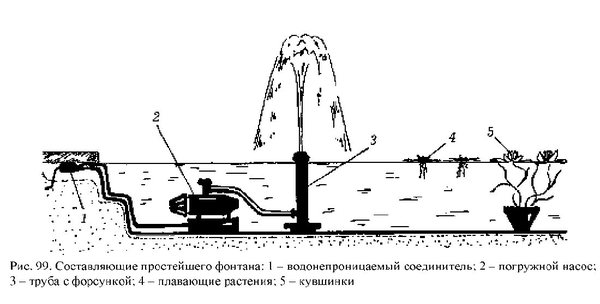
Before you start assembling a water pump, it is important to familiarize yourself with the principles of its operation. A typical fountain pump consists of a body shaped like a snail
It houses the motor and blades, similar to fan blades. Two pipelines are connected to the body - water is taken through one, and water is supplied through the other
A typical fountain pump consists of a body shaped like a snail. It houses the motor and blades, similar to fan blades. Two pipelines are connected to the body - water is taken through one, and water is supplied through the other.
With the help of the motor, the blades rotate, which contribute to the intake of water from the outside, pressurizing the system and supplying water to the injection line.
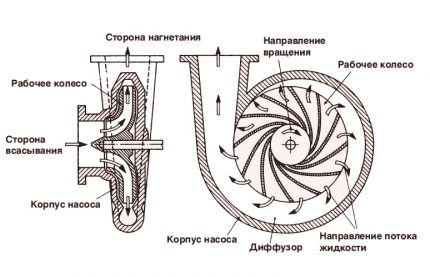 Due to the continuous circular rotation of the fan blades, a centrifugal force is generated, as a result of which water circulates, which is subsequently supplied under a certain pressure to the outside (+)
To create a fountain pump, you need the following items:
- micromotor;
- 3 ordinary plastic drink caps;
- 2 pens, felt-tip pens or any tubes of different diameters, made of durable and water-resistant material;
- a piece of plastic (you can take a mayonnaise lid, an unnecessary plastic card, disk, etc.);
- worm or gear;
- power unit.
The micromotor is the main element of the system. Thanks to him, the fan blades rotate. The device can be taken from a toy car, DVD player, old tape recorder, or purchased on the market.
It should be remembered that micromotors, depending on the power, have different dimensions and shapes.In this example, a device borrowed from a toy car is used.
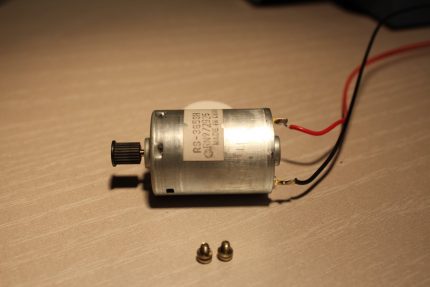
A micromotor for the manufacture of a water pump must necessarily have wiring and a shaft, on which the gear will subsequently be attached
Depending on the size of the motor, you need to select the dimensions of the case. In our case, the case will be made of three plastic caps. If the motor is larger, then you can take a can from under shaving foam with lid.
The case from under the pen or felt-tip pen will serve as a supply and discharge pipeline.
The back wall and blades for the pump are made of plastic, which will be mounted on a worm or gear. The mini fan will be glued onto the motor shaft, which will help rotate them when running.
As tools and auxiliary substances you will need:
- regular super glue, hot melt adhesive, or waterproof all-purpose adhesive;
- wire cutters and stripper for stripping wires;
- knife, drill or awl;
- a piece of sandpaper;
- soldering iron, metal file, jigsaw or grinder engraver with special wheels for cutting, stripping, drilling, etc.
You can choose any glue. The standard glue "Moment" has a high speed of gluing elements, while waterproof universal substances take longer to harden.
Sandpaper, tools are needed for finishing edges and surface cleaning, a knife is needed to create holes.
Pump type No. 1: surface
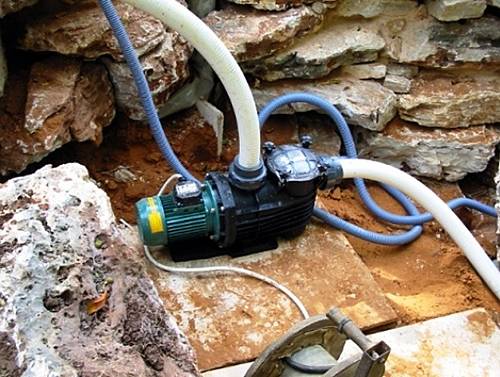
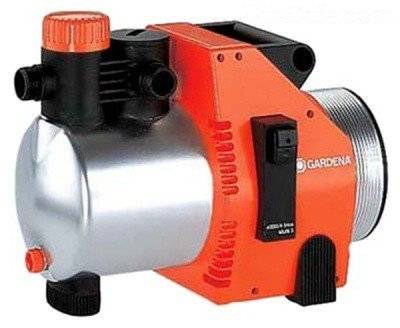
Most often, a surface pump is used to ensure the operation of the fountain and waterfall, as it is the easiest to maintain: the unit is installed directly on the ground, does not require super-complex fastenings and can be easily dismantled if necessary.
Surface devices are suitable for both small and multi-tiered water structures. They must be located as close as possible to the serviced object - the longer the distance from the pump to the fountain or waterfall, the less power the unit will give.

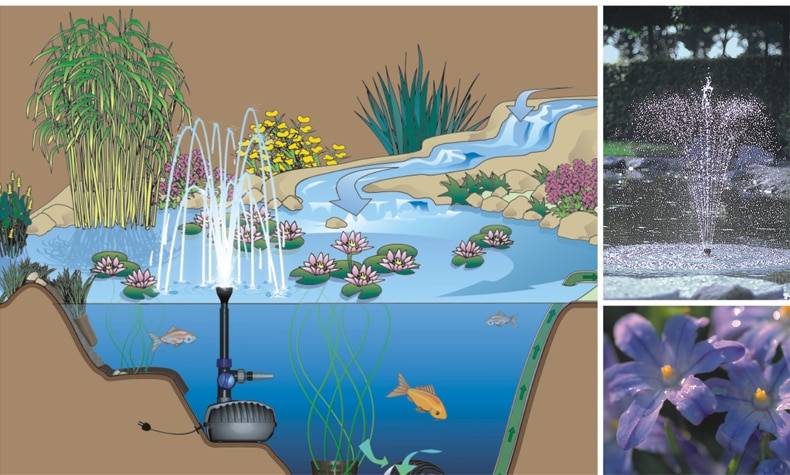


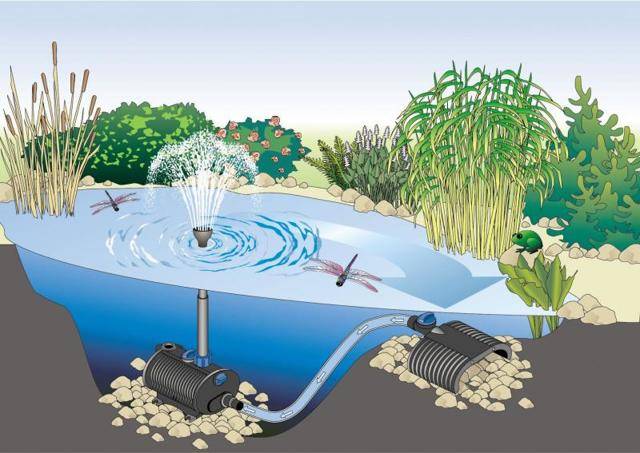

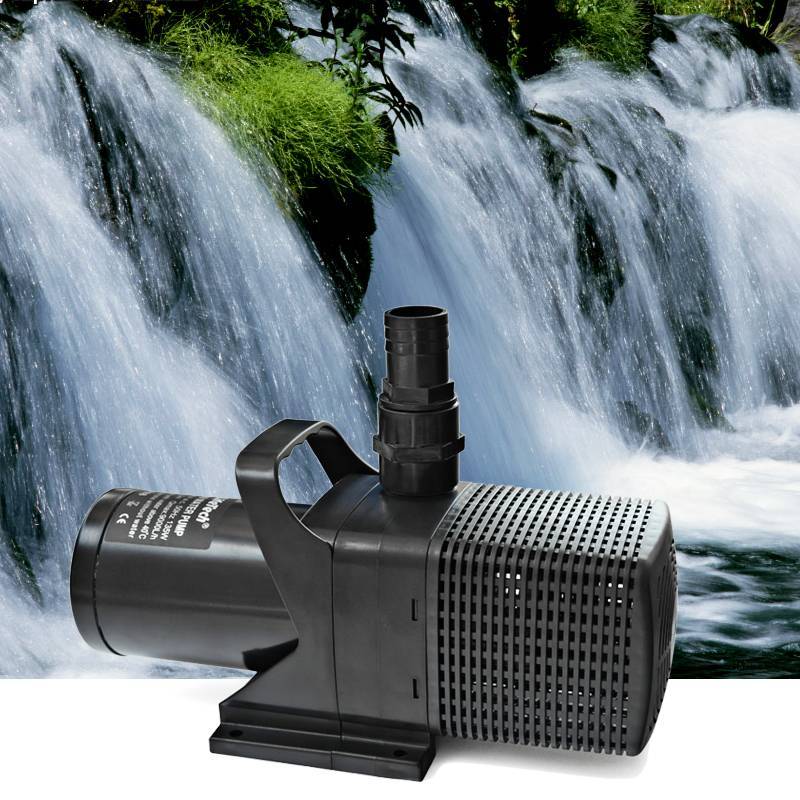
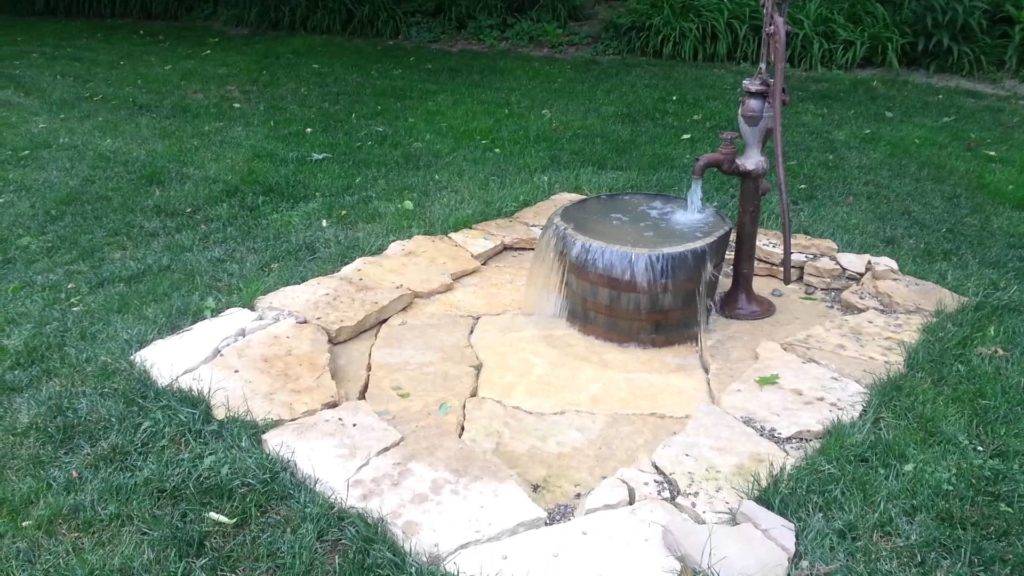


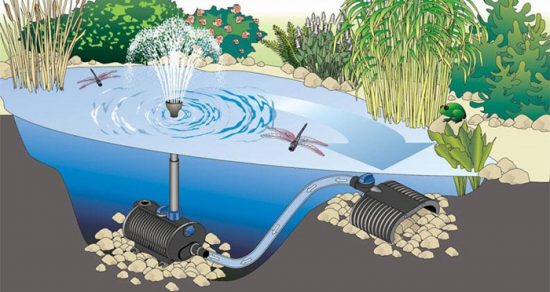 Arrangement of a reservoir with a fountain
It is recommended to close the surface pump with a casing that will perform two functions at once: soundproof - to reduce the noise level during operation of the unit, and protective - to protect the device from precipitation.
Purpose of the pump and method of use
A pump is a device that allows you to cyclically drive water along an established circuit. Often the equipment is used in decorative hydraulic structures and in summer cottages and country estates.
The principle of operation of the mechanism is that the device creates a positive pressure that pushes water out with a certain force. The power level corresponds to the height of the ejected jet.
Image gallery
Photo from
Small pond with a waterfall in the countryside
Filtration pump without watercourse nozzles
Water cascade with filter pump
Artificial waterfall with a slide at their summer cottage
Fountain with a pond in the landscape of a country estate
Fountain pump for ornamental pond
The choice of pumping equipment according to the size of the fountain
Water supply option using one of the nozzles
Country-type pumps are characterized by priority mobility for seasonal use.The unit is convenient because its operation does not require any additional extensions and communications. It does a good job of pumping water without the need for plumbing.
Almost all pumping equipment consists of similar parts: a rotating motor and an impeller that affects the flow force.
The apparatus consists of two parts connected by means of a flexible tube, predominantly made of plastic. In some cases rubber is used
Before installing the water supply system, it is recommended to correctly calculate everything.
The table shows the main characteristics of popular devices and the power ratio. Prices vary from 3 to 58 thousand rubles (+)

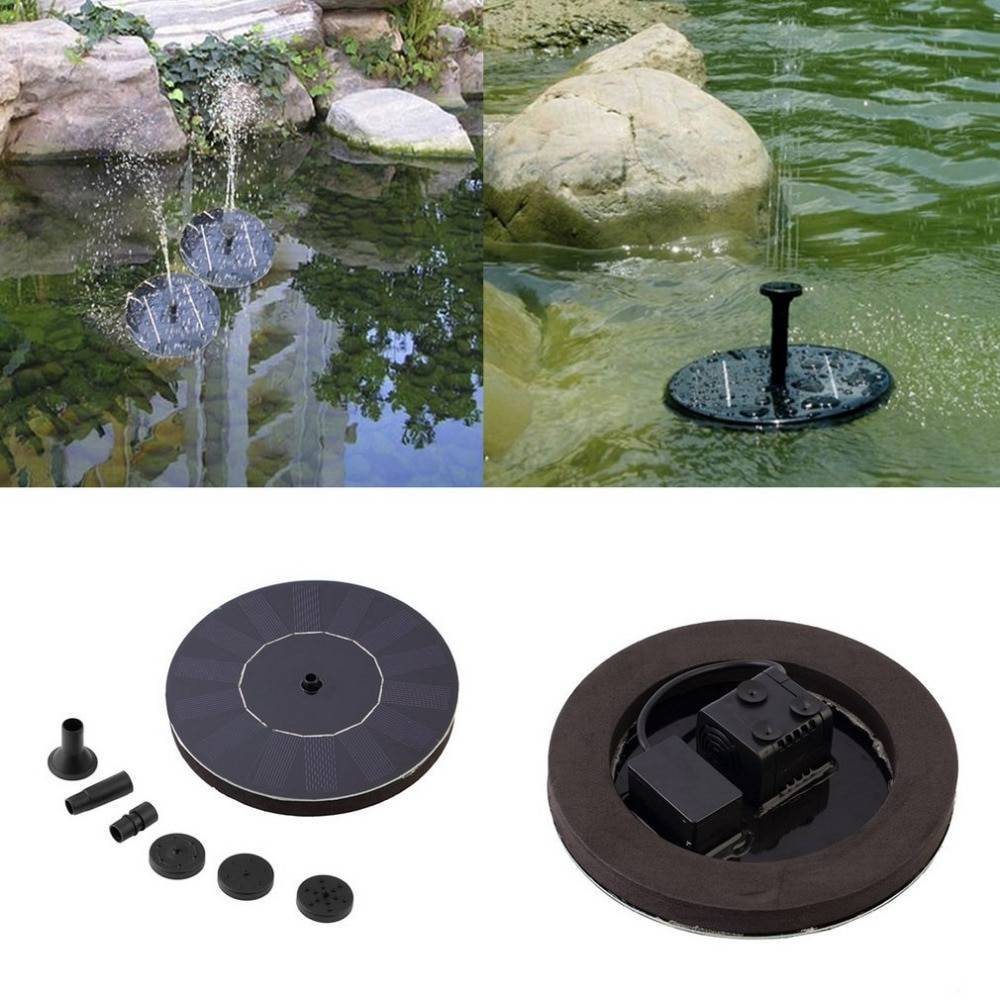


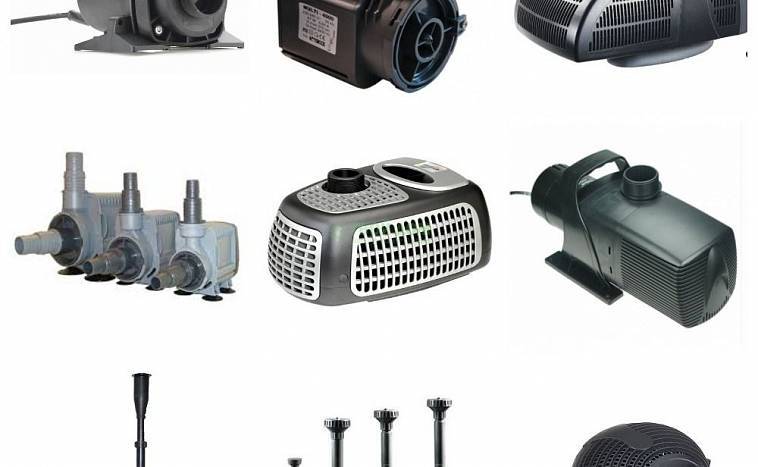
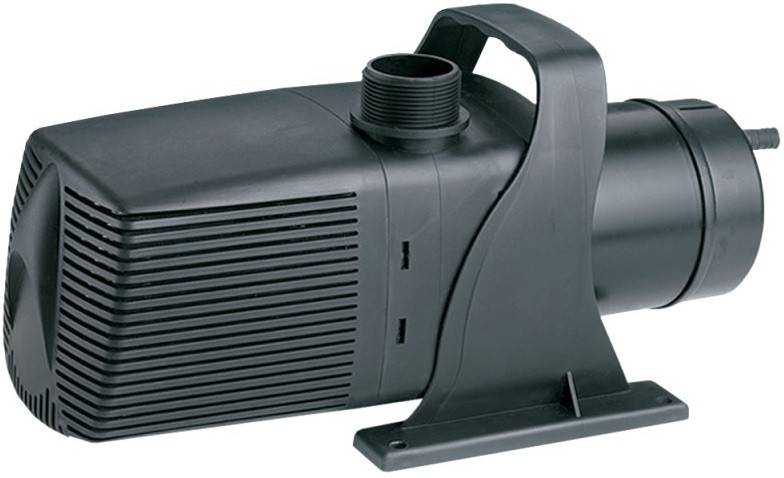
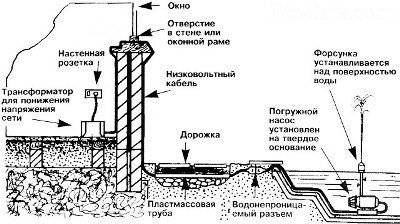

When choosing equipment, first of all, it is necessary to compare the power of the device with the dimensions of the bowl of an artificial reservoir. In most cases, the height of the jet of a fountain collected by such a system should not exceed a third of the width of the reservoir itself.
Naturally, the flow rate depends mainly on the dimensions of the reservoir. In order to achieve a height of 1.2 m, it is necessary to pump approximately 800 liters through the pump system. in hour. This is a fairly small amount compared to other devices that push water about 2 m high and pump about 3000 liters. in hour.
For each type of construction there is a device. Before buying, it is advisable to understand what exactly you want to build (+)
A feature of the pump is the ability to provide continuous circulation of fluid.If there is an architectural idea on the site, for example, a decorative cascading waterfall, water circulation is necessary. Because in the absence of special equipment, water simply cannot rise to the top of the scenery.
This is interesting: Landscape design of the courtyard of a private house, photos of modern courtyards and plots
Diversity
Water pumps are an indispensable attribute for servicing artificial reservoirs, arranging a waterfall, cascade or decorative fountain. They perform two functions: they help water circulate through a closed system and send it to the filter for cleaning. The devices have the following features:
- They are made of inert materials: stainless steel and plastics.
- Diverse in terms of feature set: you can always choose a model with the desired performance without overpaying for excess power.
- There are two types of pumps that differ in the way they are used: surface (installed on land) and submersible (operate in water) models.
- The design of the submersible units has an IP68 protection class, thanks to which it can withstand long-term immersion in water.
- They are easy to use: safe, do not require much attention, maintenance is reduced to minimal procedures.
- All models are designed for continuous operation in energy-saving mode.

Decorative pond with a waterfall
Pump installation
The pump for the waterfall in the country or in the area near the house is selected according to two parameters: the height to which it can raise water, and its performance.
With height, everything is more or less clear: it should be no less than the height difference in your homemade waterfall.The difference is measured from the bottom of the tank (the pump will stand there) and to the point where it should raise it. In small domestic ponds, it rarely exceeds 1.5-2 meters. But still, keep track of this indicator.
The performance of the pump shows how much water it can pump per minute. The power of the stream depends on this indicator.
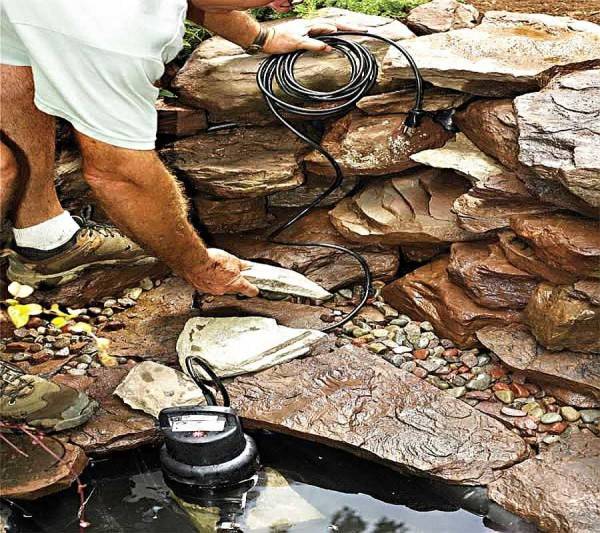
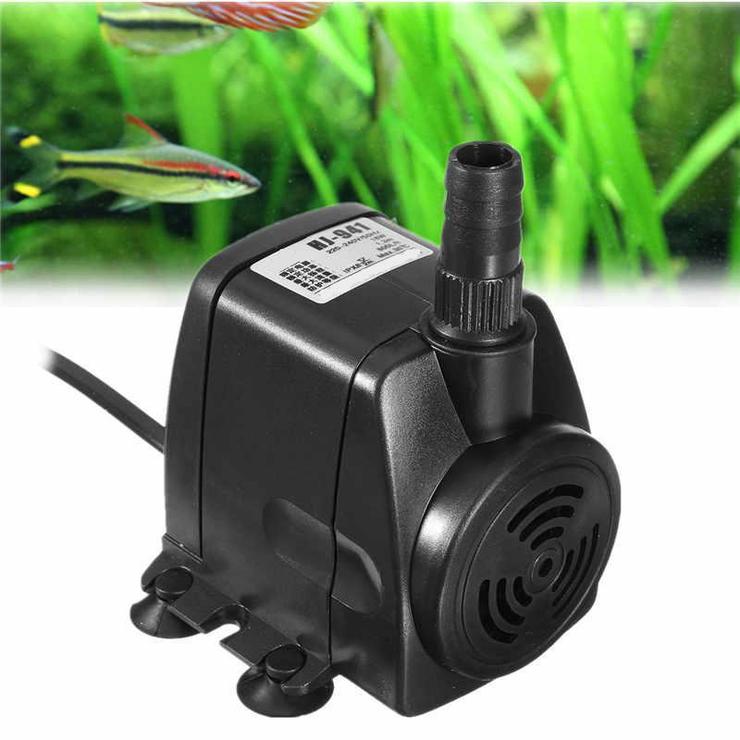
The pump is immersed in water
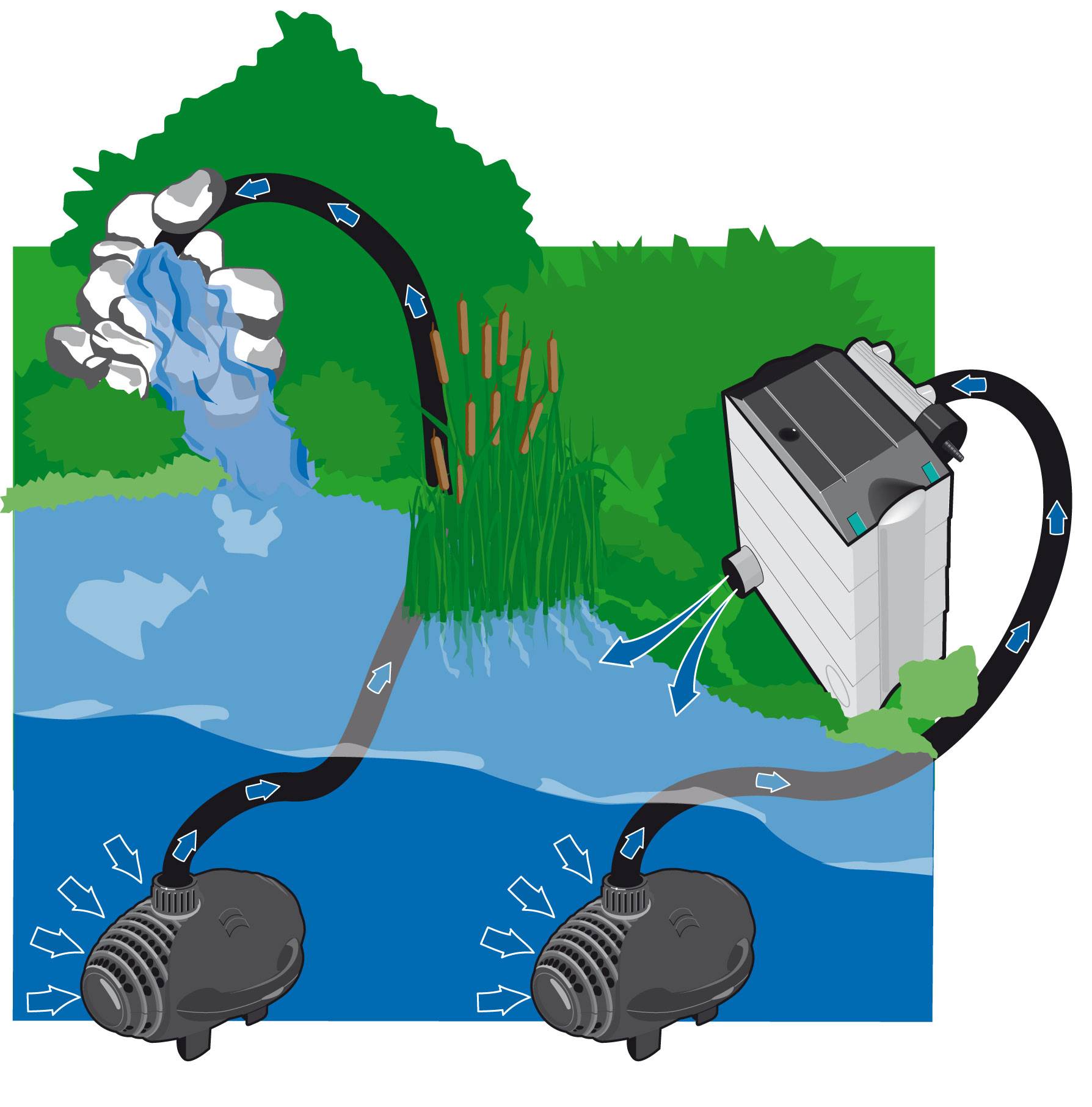
Submersible pumps are used in such reservoirs. They are placed on the bottom, installed in a basket with stones, or simply crushing the body with several boulders. He takes water from the tank, feeding it into a hose that is attached to the outlet pipe. This hose and lay to the place where the water will run.
To be able to pull out the hose, a plastic pipe of a decent diameter is built into the slide. So that you can easily lower the rubber sleeve into it.
It is better to put the pump in the basket. It works well with clean water, and your waterfall may contain leaves, all sorts of midges, dust and other contaminants inevitably get there. And the basket, or rather, the box, can be covered with several layers of filters of different densities. First - a fine mesh, and then something more dense, at least the same geotextile. This filter will trap major contaminants.
After installing this equipment, filling it with water and starting it up, you can consider the waterfall to be built with your own hands. There remains such a "trifle" as the design of the coast.
How to make a flat stream
If you want it not to be a jet, but a wide stream of water, you will have to install another container at the top of the hill, but already rectangular. One of its edges should be lower than the other.
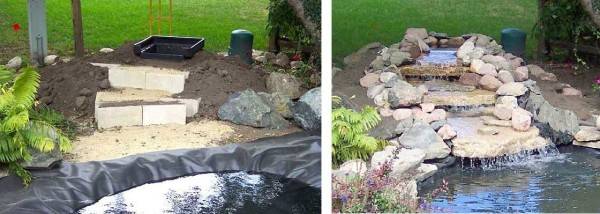
Garden waterfall with a wide stream
There are such special containers, but you can make them from any one by cutting off the edge and making a flat tray from which water will flow like a wall.
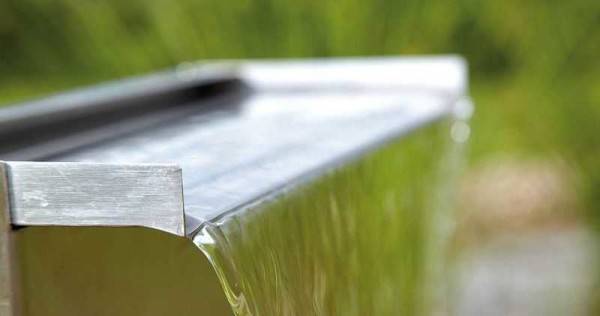
It is easy to make such a tray
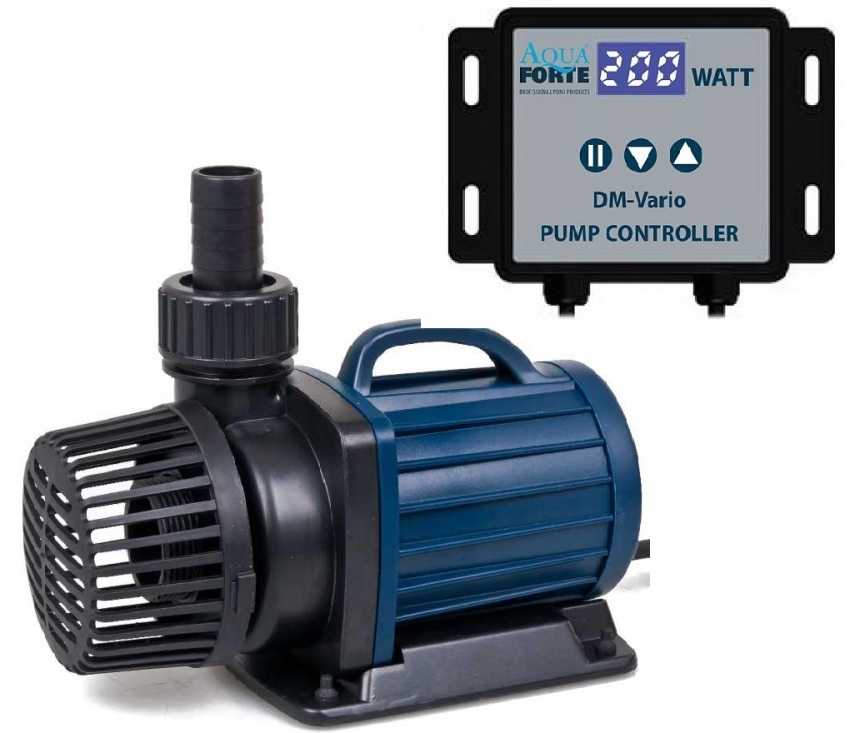
Fountain pumps TM "Hozyain"
This equipment is popular in creating decorative fountains in private households.
The quality of products of pumping equipment TM Host corresponds to its presentable appearance and stylish design. Reliable components and high build quality make the products of TM "Hozyain" in demand in the equipment market.
The company pursues a policy of loyal pricing, which makes the equipment as affordable as possible for the consumer. After all, each of us wants to buy a fountain pump that will have high reliability and at the same time have an acceptable price and quality. Fountain pumps "HOZYAIN" for a pond are able to work without failures for several seasons of operation, with proper care and storage.
Maintenance of the fountain pump does not require any specialized knowledge and skills. It is sufficient to clean the impeller and flush the filter element in a timely manner. The frequency of these actions depends on the contamination of the water and the period of operation. An indirect sign that the pump needs cleaning is a decrease in its pressure and flow. Visually, this means that the height of the water jet and its quantity will become less than usual.





Submersible and external pumps: differences
The consumer is faced with the question: what type of pump to choose for arranging the fountain. If the pump works correctly, the fountain will function properly. There are two types of equipment for water supply: submersible or surface.Both types have their own advantages, application features, characteristics.
There are many different types of pumps
In addition to differences in design, when choosing, you should pay attention to the level of power and performance of devices. The power consumption depends on the required number of watts for the pump to operate.
The performance level allows you to judge the amount of water pumped by the pump over a period of time.
Attention! The declared performance level of the pump may not correspond in practice. In some cases, the manufacturer indicates the performance is greater than it actually turns out.
This factor is influenced by the size of the height of the water column, the dimensions of the pipeline, the arrangement of nozzles in the fountain, the imperfect design of the plumbing system
In some cases, the manufacturer indicates the performance is greater than it actually turns out to be. This factor is influenced by the size of the height of the water column, the dimensions of the pipeline, the arrangement of nozzles in the fountain, and the imperfect design of the plumbing system.
If the pumps have a low power, then 0.5 inch pipe rolls and hoses are suitable for the system. For more powerful equipment, you need to purchase products in 1 inch. When choosing a pump take into account the degree of hydraulic resistance, which is inherent in individual structural elements
This is important if the fountain is large, or several small ones are connected into one system. You should also determine the performance of the model depending on the height of the fountain
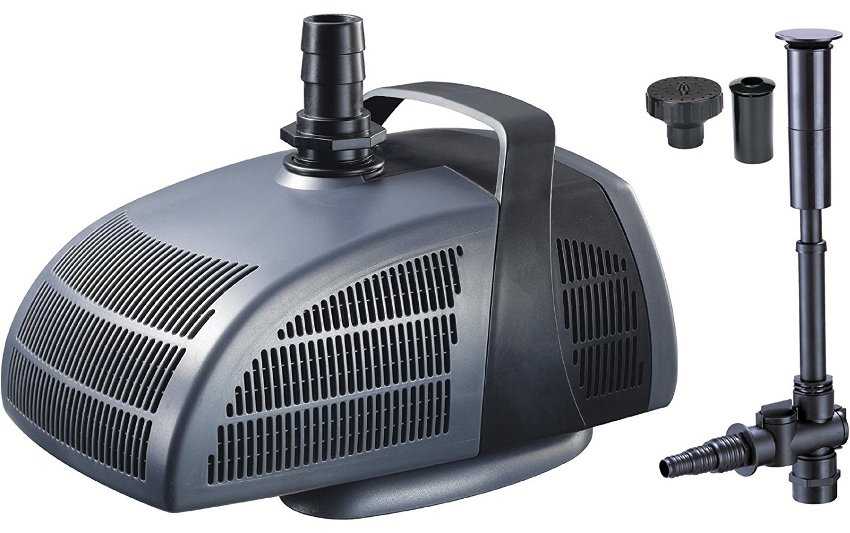
Attention! When purchasing a branded set of equipment with a suitable pump, the compliance with the main characteristics for the design of the fountain is taken into account. With the help of special nozzles on the pump, you can adjust the width, length of the water jet, as well as the frequency of fluid supply, direction
According to experts, submersible pumps are up to three times more economical than submersible pumps.
With the help of special nozzles on the pump, you can adjust the width, length of the water jet, as well as the frequency of the liquid supply, direction. According to experts, submersible pumps are up to three times more economical than submersible pumps.
Attention! To achieve the effect of a waterfall, you should choose special pumping equipment that can change pressure
How to make a fountain with your own hands
To build a simple stone fountain design, you will need the following materials and equipment:
pump for water from 1100 W in power; copper pipe with a cross section of 15 mm for delivering water from the pump to the top of the fountain; mm; a pipe made of plastic or metal for wiring an electric cable; a coupling for connecting a pipe made of copper and a pump; a float-type water supply regulator; a metal mesh to protect the tank from debris; drainage gravel; a polystyrene pipe for the output of the pump cord; bars for attaching the mesh; stones for the upper decorative part of the fountain (can be replaced with clay pots, concrete bowls, etc.); a faucet with an adapter and a filter.



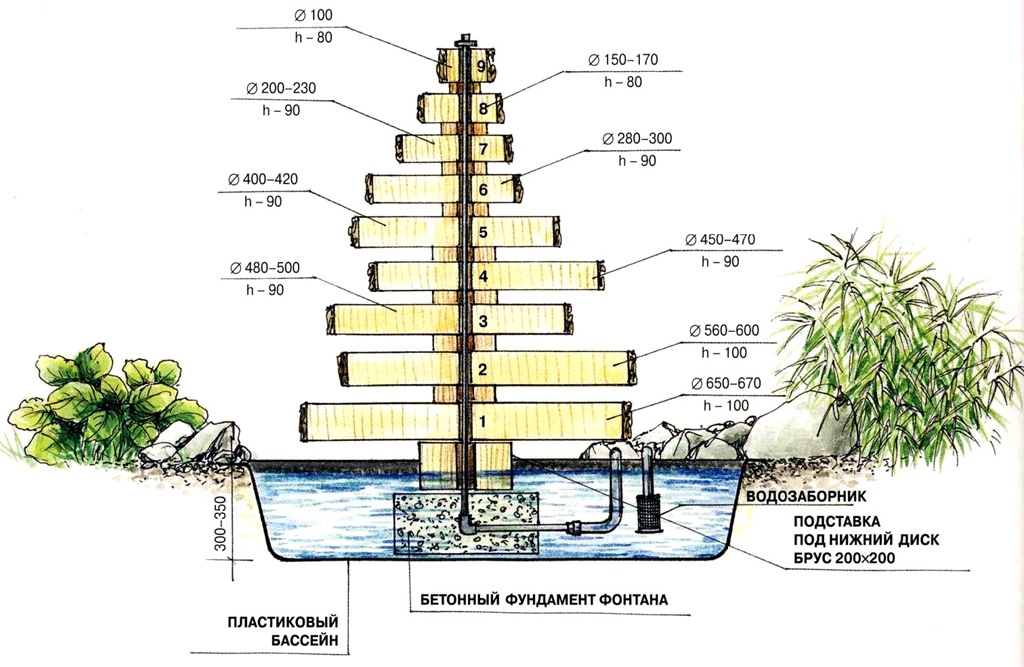


Having prepared all the necessary materials, they begin to implement the algorithm of step-by-step instructions for construction do-it-yourself fountain:
The design of any fountain consists of underground and ground parts.
Choice of location. This should be on the leeward side of the house to avoid moisture getting on the walls of the building. The distance between the building and the fountain must be at least three times the length of the hydraulic structure. Digging a hole for the fountain. The dimensions of the pit completely depend on the dimensions of the selected tank: a little wider so that it can be freely installed, and 5 cm above the edge of the sides. They provide for excavation in the groove for the electric cable. The pit should be slightly larger than the prepared tank Installation of the tank. The bottom of the prepared pit is leveled with small pebbles with a layer of 40-50 mm, the reservoir is installed and strengthened. Sand is poured into the sinuses between the sides and the ground, which is carefully shed, rammed and decorated with small stones. Or they simply line the bottom of the pit and its side surfaces with waterproofing material. The power supply from the pump is pulled into a plastic pipe of the required length, placed in a prepared groove, insulated and sprinkled with earth. The tank can be made of plastic, ceramic or metal Pump installation
When placing, take into account the need for regular preventive inspection and maintenance of the device. It is important to provide convenient access to the pump for further maintenance Laying the mesh. A mesh made of galvanized metal will serve as a reliable protection against debris and foreign objects. To access the pump, a hinged hole is cut in the mesh.
A metal pipe is attached to the pump to supply water to the top (its length should be 100 mm longer than the estimated height of the fountain), and wooden bars are laid on top of the metal mesh.The beam is taken with a section of 50x50, and their length should be 80-100 mm longer than the length of the tank. This will ensure the stability of the structure and prevent falling into the pit. Fix the water supply pipe well. Preparing stones. In each stone (pot, bowl, etc.) intended for the leg of the fountain, it is necessary to drill a hole, the diameter of which will be 0.5 cm larger than the pipe section. In order to avoid overheating of the drill and cracking of the stones, they must be periodically watered with water. Stones, pots or bowls are mounted on a pipe like a children's pyramid, fastened together with silicone-based glue. After it dries, the tank is filled with water 150–200 mm above the pump, the unit is connected to the mains and a test run is made to adjust the pressure. The ground part can be made in the form of a stone pyramid Decorating the base of the fountain. You can equip a small reservoir, make masonry, plant ground cover plants, etc. It is important that the decor does not interfere with monitoring the water level in the tank twice a month and performing other preventive work if necessary.
Conclusion
Is your cottage decorated with a fountain?
Of course! No, but it will be!
- Pumps for a fountain in a country house are devices that are simple enough in their design features, the main purpose of which is to lift liquid from a particular source with its subsequent supply to the supply system.
- There are two main types of fountain pumps on the market: submersible and surface.The former are cheaper, relatively inexpensive and compact, while the latter are characterized by high cost, very complex installation and noisy operation.
- When choosing a pump for a fountain in a country house, it is necessary to take into account several important factors, among which experts highlight their power, the level of liquid rise and performance.
- Pumps for a fountain in the country can be used, among other things, to supply water to an artificial waterfall. If the power of the device is sufficient, a tee must be installed on the hose, which will allow two objects to be supplied with liquid at the same time.
- Pumps for watering the garden. How to choose, rating models
- Pumping station for a summer residence. How to choose? Model overview
- Surface pumps for wells. Overview and selection criteria



