
- Pros and cons of creating
- Fountain pumps
- How to do without a pump
- Materials for creating a water pump
- How a fountain is created
- Tire Fountain
- Video description
- fountain decoration
- Fountain lighting
- Fountain Maintenance Tips
- Where to put
- forced circulation
- natural circulation
- Mounting Features
- We buy a pump for a country fountain
- Fountain device
- How are surface pumps installed?
- Types of fountains
- submersible fountain
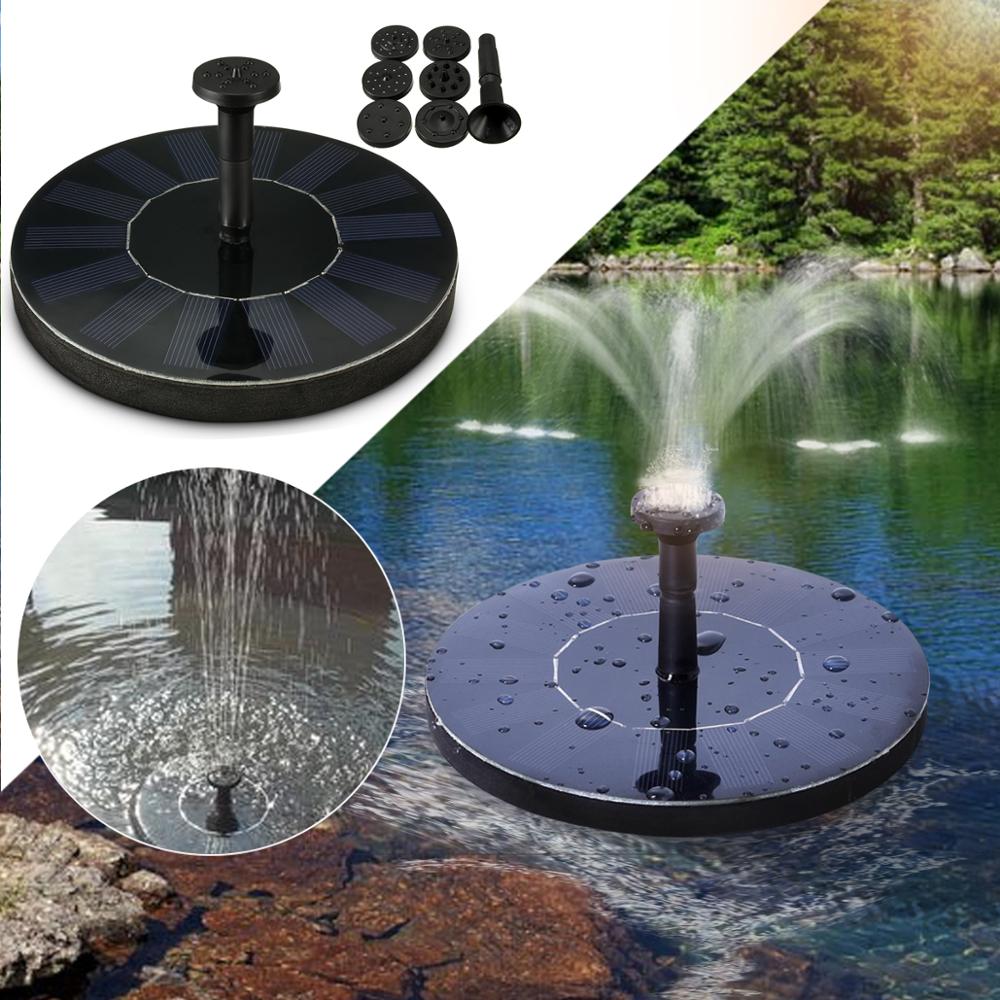
- floating fountain
- Stationary fountain
- wall fountain
- Waterfall fountain
- Portable indoor fountain
- Do-it-yourself fountain in the country: step by step instructions
- Step 1. Choosing a fountain.
- Step 2. Choosing a place to place the fountain.
- Step 3. Preparing the tank.
- Step 4. Decorating the finished fountain design.
- What should be a good pump?
- Types of pumps for a fountain or waterfall
- How to install a do-it-yourself fountain pump
Pros and cons of creating
A decorative fountain is primarily an element designed to decorate the surrounding space. It has several key advantages:
- >Bright and elegant appearance. The fountain will transform and refresh any design, perhaps it will become its main element.
- The fountain will perfectly cope with the role of a source of coolness and will be able to maintain fresh air in any place where you install it.
- Falling water is a very beautiful action. The sight of a seething stream or jets of water rushing down promotes relaxation, helps to distract from bad thoughts. Additionally, the sounds of water allow you to achieve harmony and unity with nature.
- With the right choice of location, a fountain can help complete the look of an area. Such structures can help hide unattractive objects, such as utility rooms.
When installing an open-type system, you will have to think over the water supply system, its level control, drainage and discharge. You can, of course, use the fountain reservoir as a container for heating water before watering, and make wiring around the garden from the bowl, but watering is not needed around the clock, and the fountain can work in this mode.
Plastic container, and the pump is at the bottom, right in the place where the pipe sticks out of the water
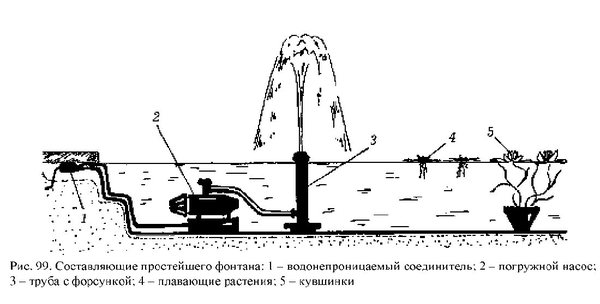
In the simplest version, to make a small fountain, you need some sealed container and a submersible pump. Any container can be adapted - a special plastic one for a pond, a barrel, an old bathtub, a basin, a cut tire covered with foil, etc. Pumps are a little more difficult.
Fountain pumps
Fountain pumps are sold special, with built-in filters. To do do-it-yourself fountain it was easier, you can buy such models. It is very easy to work with them: put them in a container, fix them so that they do not move, fill them with water, carry out the starting manipulations (described in the instructions) and turn them on.
Fountain pumps come in different capacities, raise the jet to different heights.Often included are interchangeable nozzle nozzles that change the nature of the jet. They are powered by 220 V, there are models powered by solar panels. Made hermetically, so there will be no problems when connecting, step-down transformers are not needed. The only thing that does not interfere is the machine and the RCD on the line to which the pump will be connected. This is just in case, to increase security. The price of the smallest and low-power fountain pump is $25-30. Performance models cost several hundred or more.
You can use any submersible pump for the fountain. But you need to buy or make a filter for it (you can make a sand filter) and a step-down transformer. A security group from an automatic machine and an RCD on the line will not be superfluous here either. This circuit is worth fiddling with if you have an old pump that is not currently in use.
How to do without a pump
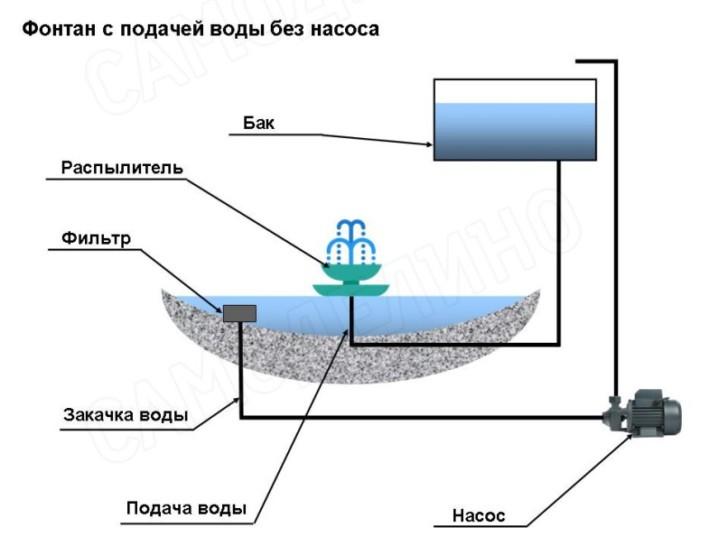
Is it possible to make a fountain without a pump? Yes, but open type. For example, bring a water pipe into the pond - central or supplying water from a well or well. The water coming out under pressure will give a jet of some height. By installing a tip on the pipe, we can change its shape. But with such a construction, it is necessary to figure out where to divert water. You can - back to the well or to the river, to the area for irrigation, etc. Although a pump is present with such an organization, it pumps water into the house, and the fountain is only one of the flow points.
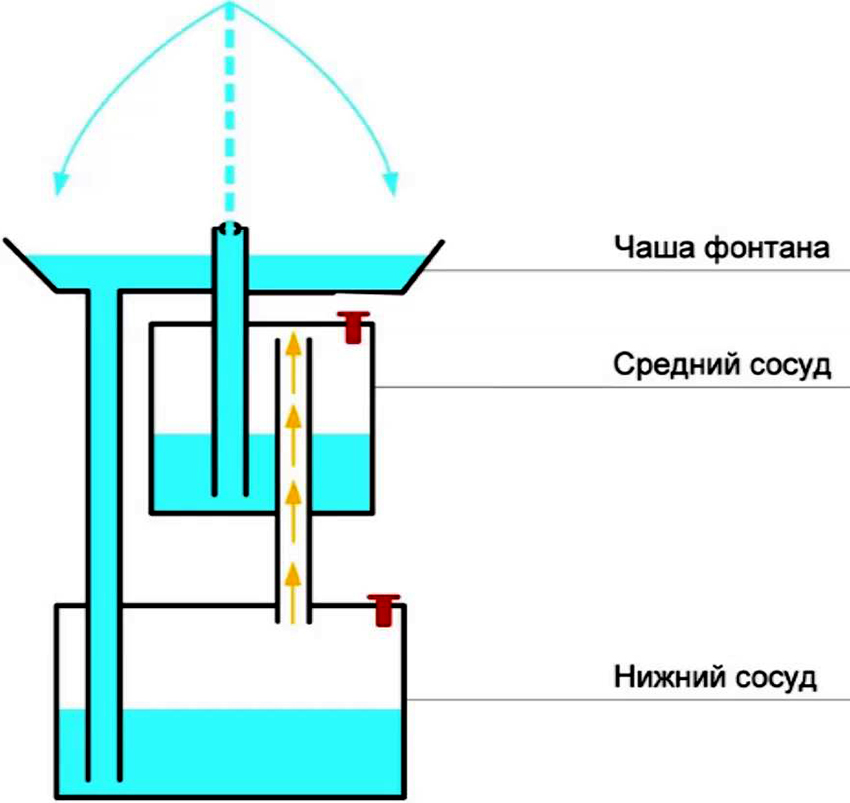
Scheme of organizing a fountain without a submersible pump
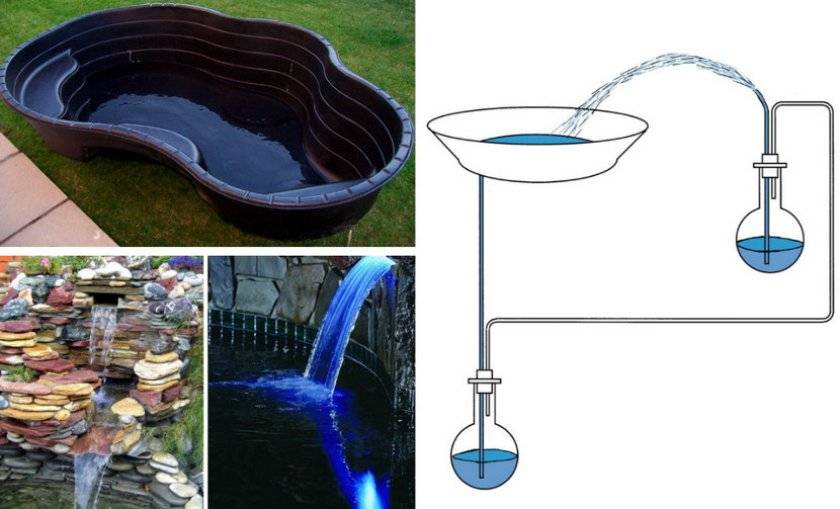
The second option is to put some kind of container at a height, supply water to it, and from there it is fed through pipes to the fountain located below. To create a more or less decent jet height, the container must be raised by 3 meters or more.But the question remains: how to supply water there. Again with the help of a pump, but no longer submersible. They are cheaper, but require a filter. You will also need a pit in which the equipment is installed. A system of pipes connects it with the bowl of the fountain.
Materials for creating a water pump
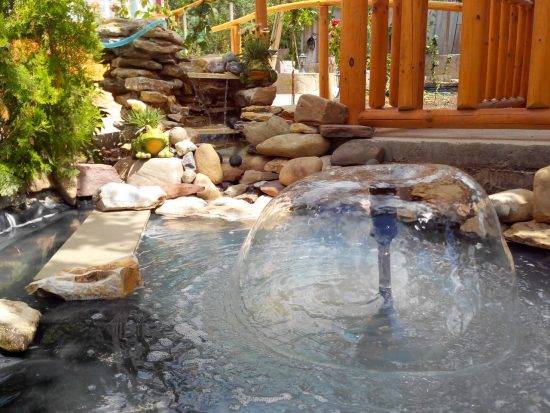
Having decided to move to the country, you should think about the cozy arrangement of the site. One of the options are various figures with water. The chosen form should be in harmony with the overall situation. The choice of materials should be approached responsibly.
For assembly you need:
- nozzles;
- hoses;
- atomizer type cascade;
- spray kit.
The spray form is also selected - a geyser, a jet separation system, and others.
A decorative fountain is a decoration of the site that will lighten and moisten the summer atmosphere. But for him, you should stock up on equipment that will ensure the fountain's uninterrupted operation.
How a fountain is created
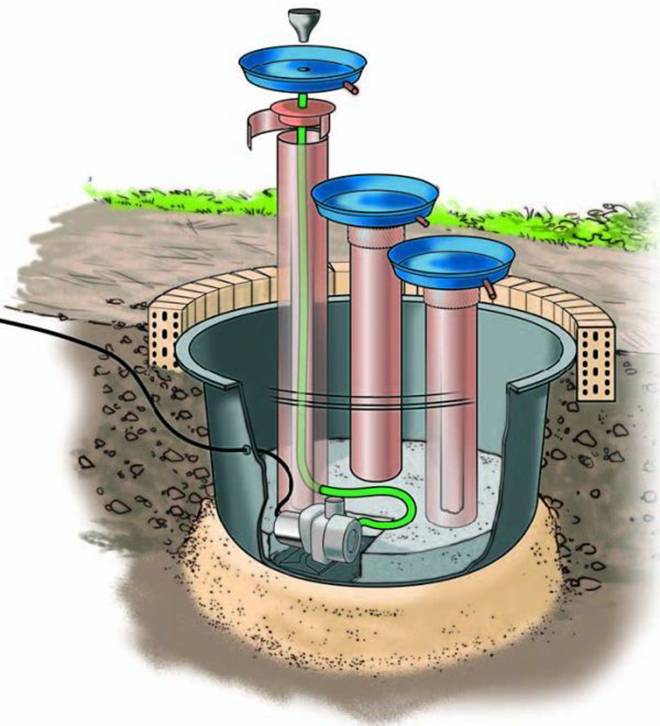
To do this, you first need to prepare the materials that will be required when building an artificial fountain for the house:
- capacity;
- stones;
- shovel;
- pump;
- sand or gravel;
- decor items;
- durable film.

Creating a fountain will not take long
Further, after choosing the right place, specialists proceed to construction, which consists of the following stages:
- Pit preparation.
- Fixing the trench.
- Installation of a container or flooring.
- Pump installation.
- Creating an attractive appearance with stones, sand, gravel and decor items.
Tire Fountain
A fairly simple and cheap construction option, since the most common tire is taken as its basis. In this case, you will need to follow the following action plan:
- A hole is dug a little larger than the size of the tire.
- A cement mortar is created, which is poured to the bottom to give rigidity and strength to the future structure. Such a "floor" should be even, which can be checked using the building level.
- After complete solidification, the tire is lowered, pre-cut on one side from above.
- The tire is sealed with mastic in the center of the structure.
- The free space between the tire and the ground is filled with the remaining cement mixture.
- The pump is installed.
- Decorated with decorative items.

Tire Fountain
Video description
A video that will clearly show the process of creating a fountain from a tire:
In general, many fountains are created according to a similar principle. Unless other dense products are used instead of a tire, for example, a dense film. A hole is created in the ground, where something is placed that can separate the water from the earth. After that, the structure is tightly fixed, the pump is installed and the structure is given the desired appearance.
fountain decoration
The main thing for which a fountain is created is appearance.
Therefore, the most important thing that is required is to properly decorate the finished structure. The design of the fountain for the house can be made using various stones, flowers, animal figurines and lighting.
Fountain lighting
Fountain lighting has become a lot easier when LEDs are available. Power comes from 12 V or 24 V, which reduces the risks and consequences of a short circuit. Power is possible not only from conventional networks, but also from solar energy.




The backlight will make the fountain more bright
One of the simplest and most commonly used backlighting methods are LED strips, projectors and lamps.If the house does not have a 12 V or 24 V socket, then you can purchase a converter that will allow the LED backlight to be connected to a 220 V network through it. The installation itself is simple: you just need to install the light sources as desired, and then connect to the power source .
Fountain Maintenance Tips
If the owner wants his fountain to serve for a long time, then he will need careful care. It is necessary to constantly maintain the purity and transparency of water. To do this, you will need to clean the tank from leaves, fluff, seeds, insects. Such debris can not only disrupt the aesthetic appearance of the structure, but also lead to pump failure.
It is important to drain the water at the end of the summer season, and remove the parts, if possible, or cover with foil
A fountain is the tool that will allow you to give your existing suburban area its zest. Its creation is not so expensive, and the rules of care are simple, especially for mini-fountains. The main thing is to properly decorate the building with decorative elements.
Where to put
It is recommended to install a circulation pump after the boiler, before the first branch, but it does not matter on the supply or return pipeline. Modern units are made from materials that normally tolerate temperatures up to 100-115 ° C. There are few heating systems that work with a hotter coolant, therefore considerations of a more “comfortable” temperature are untenable, but if you are so calmer, put it in the return line.
Can be installed in the return or direct pipeline after/before the boiler up to the first branch
There is no difference in hydraulics - the boiler, and the rest of the system, it does not matter whether there is a pump in the supply or return branch. What matters is the correct installation, in the sense of tying, and the correct orientation of the rotor in space
Nothing else matters
There is one important point at the installation site. If there are two separate branches in the heating system - on the right and left wings of the house or on the first and second floors - it makes sense to put a separate unit on each, and not one common one - directly after the boiler. Moreover, the same rule is preserved on these branches: immediately after the boiler, before the first branch in this heating circuit. This will make it possible to set the required thermal regime in each of the parts of the house independently of the other, as well as save on heating in two-story houses. How? Due to the fact that the second floor is usually much warmer than the first floor and much less heat is required there. If there are two pumps in the branch that goes up, the speed of the coolant is set much less, and this allows you to burn less fuel, and without compromising the comfort of living.
There are two types of heating systems - with forced and natural circulation. Systems with forced circulation cannot work without a pump, with natural circulation they work, but in this mode they have a lower heat transfer. However, less heat is still much better than no heat at all, so in areas where electricity is often cut off, the system is designed as hydraulic (with natural circulation), and then a pump is slammed into it. This gives high efficiency and reliability of heating. It is clear that the installation of a circulation pump in these systems has differences.
All heating systems with underfloor heating are forced - without a pump, the coolant will not pass through such large circuits
forced circulation
Since a forced circulation heating system is inoperative without a pump, it is installed directly into the gap in the supply or return pipe (of your choice).
Most problems with the circulation pump arise due to the presence of mechanical impurities (sand, other abrasive particles) in the coolant. They are able to jam the impeller and stop the motor. Therefore, a strainer must be placed in front of the unit.
Installing a circulation pump in a forced circulation system
It is also desirable to install ball valves on both sides. They will make it possible to replace or repair the device without draining the coolant from the system. Turn off the taps, remove the unit. Only that part of the water that was directly in this piece of the system is drained.
natural circulation
The piping of the circulation pump in gravity systems has one significant difference - a bypass is required. This is a jumper that makes the system operational when the pump is not running. One ball shut-off valve is installed on the bypass, which is closed all the time while pumping is in operation. In this mode, the system works as a forced one.
Scheme of installation of a circulation pump in a system with natural circulation
When electricity fails or the unit fails, the faucet on the jumper is opened, the faucet leading to the pump is closed, the system works like a gravitational one.
Mounting Features
There is one important point, without which the installation of the circulation pump will require alteration: it is required to turn the rotor so that it is directed horizontally. The second point is the direction of the flow. There is an arrow on the body indicating in which direction the coolant should flow. So turn the unit around so that the direction of movement of the coolant is “in the direction of the arrow”.
The pump itself can be installed both horizontally and vertically, only when choosing a model, see that it can work in both positions. And one more thing: with a vertical arrangement, the power (created pressure) drops by about 30%. This must be taken into account when choosing a model.
We buy a pump for a country fountain
When choosing a pump, it is necessary to take into account its power and performance. Power (indicated in watts - W) - an indicator of how much electricity this device consumes.


Productivity (indicated in liters or cubic meters per unit of time - l / min, m3 / h) informs about how much water the pump can pump per unit of time
It is important to remember: if it raises the water to a certain height, its performance decreases. The pump must be selected to the conditions of a particular reservoir and in accordance with a specific purpose: for a fountain, cascade or stream
Therefore, before going to the store, you need to decide on:
- fountain - what should be its height;
- stream and cascade - what will be the width of the channel and to what height (measured from the level of the water table) it will be necessary to raise the water.
With this information, you can choose the right pump.Since it is not easy to do this on your own, it is better to take the advice of an experienced specialist or first familiarize yourself with the tables in the company catalog.
Attention! Fountain nozzles, long or narrow hoses, and filters reduce pump performance. Therefore, it is more profitable to buy the entire set from one company at once - it is best at an authorized point of sale
Such a kit is initially designed as a system, taking into account the hydraulic resistance of individual elements.
Safety.
When buying a pump, be sure to check if it has a marking indicating the safety of the equipment. Read the operating instructions before starting the unit. The pump must only be connected to the mains via a residual current circuit breaker. During start-up, no one should come into contact with the water in which the pump is installed.
Guarantee.
It is necessary to check whether the manufacturer provides a guarantee, whether it performs warranty inspections and find out where the nearest service point is located. Care. Find out if it is not difficult to care for the pump and if it is possible to do it yourself
It is important that it can be easily cleaned
Price.
When comparing the cost of different pumps, it is worth considering how economical the model is (how much electricity the pump uses), what elements are offered in the kit. Sometimes it is more profitable to purchase a more expensive, but economical model.
What else?
Fountain nozzle.
The shape of the fountain jets depends on the type of nozzle. It is good if the nozzles provide smooth adjustment of the spray radius and jet height.
Electronic control devices.
For some pumps, you can additionally buy a remote control kit. It allows you to turn the pump on and off and even adjust the power of the fountain jets from a certain distance.
Nozzle extension.
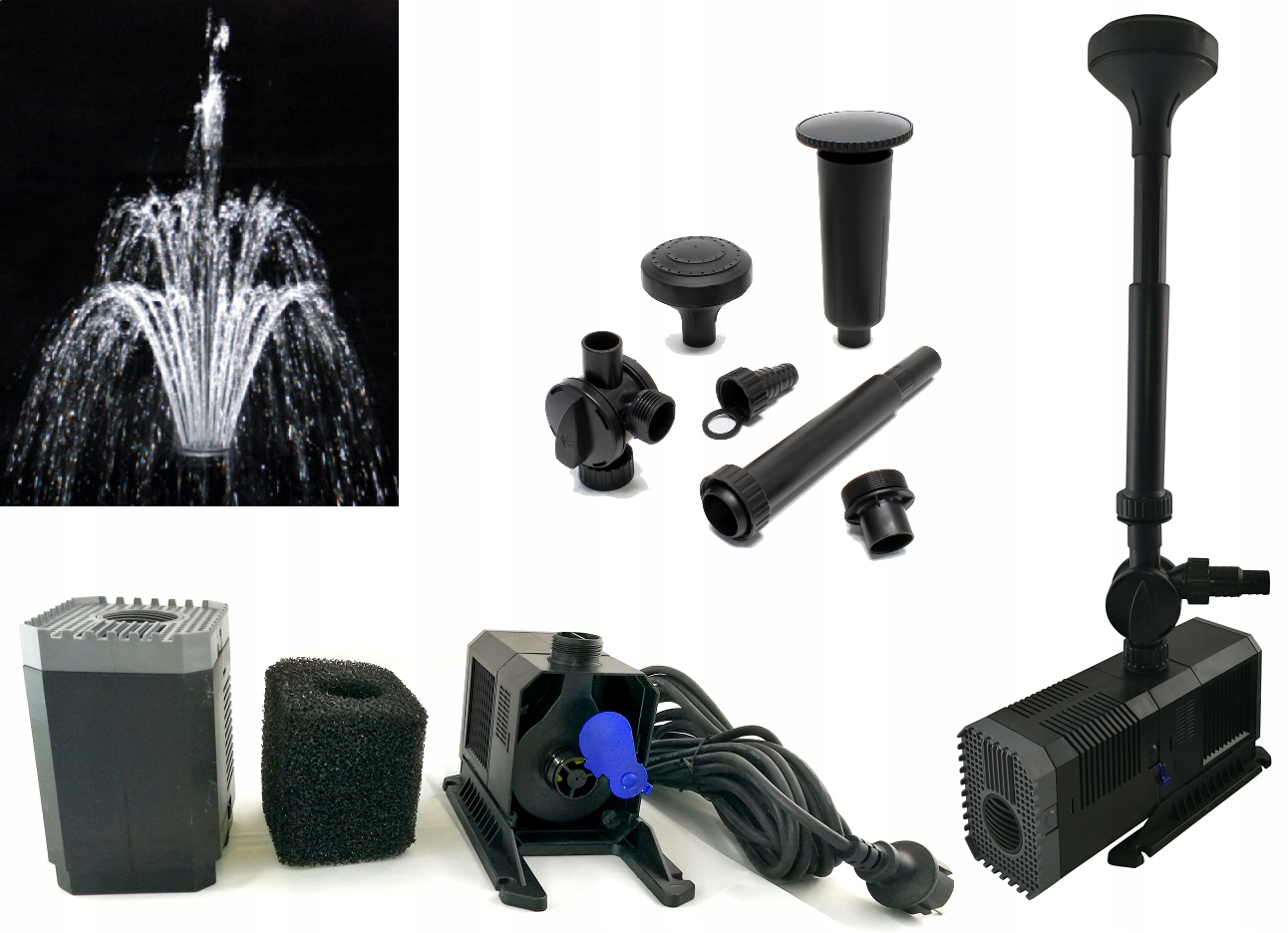
Allows you to install the fountain at different depths. The extension is mounted between the nozzle and the pump. Its length can be adjusted telescopically. Pipes (hoses). They must be flexible, durable and non-toxic.
Stand. Facilitates submersible pump installation on uneven ground, prevents dirt from being sucked in from the bottom. It can be a stove with adjustable
legs, plastic stand or stand. There are also racks for mounting the nozzle on the bottom of the pond.
Flow regulator.
In some pumps, the capacity and pressure can be changed. The regulator is usually mounted between the pump and the fountain nozzle. Usually it has an outlet (pipe, splitter) for connecting an additional pipe for water supply. Then you can simultaneously pump water, for example, into a fountain and a cascade.
Lighting.
With some pumps, you can connect underwater or floating lights and halogen reflectors to illuminate ponds, fountains, cascades. They can be installed on the bottom of the pond, attached to the nozzle of the fountain or pump stand.


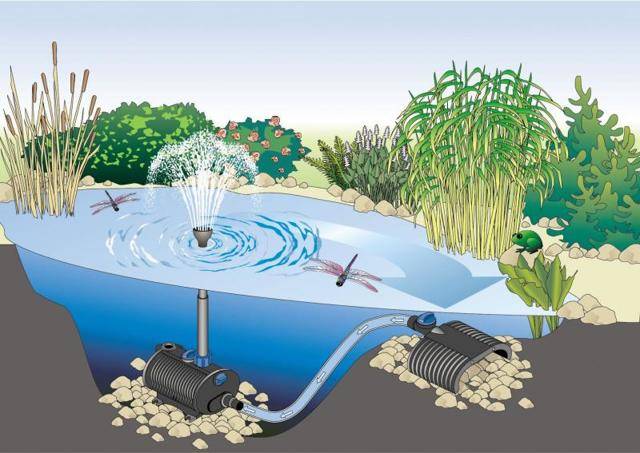
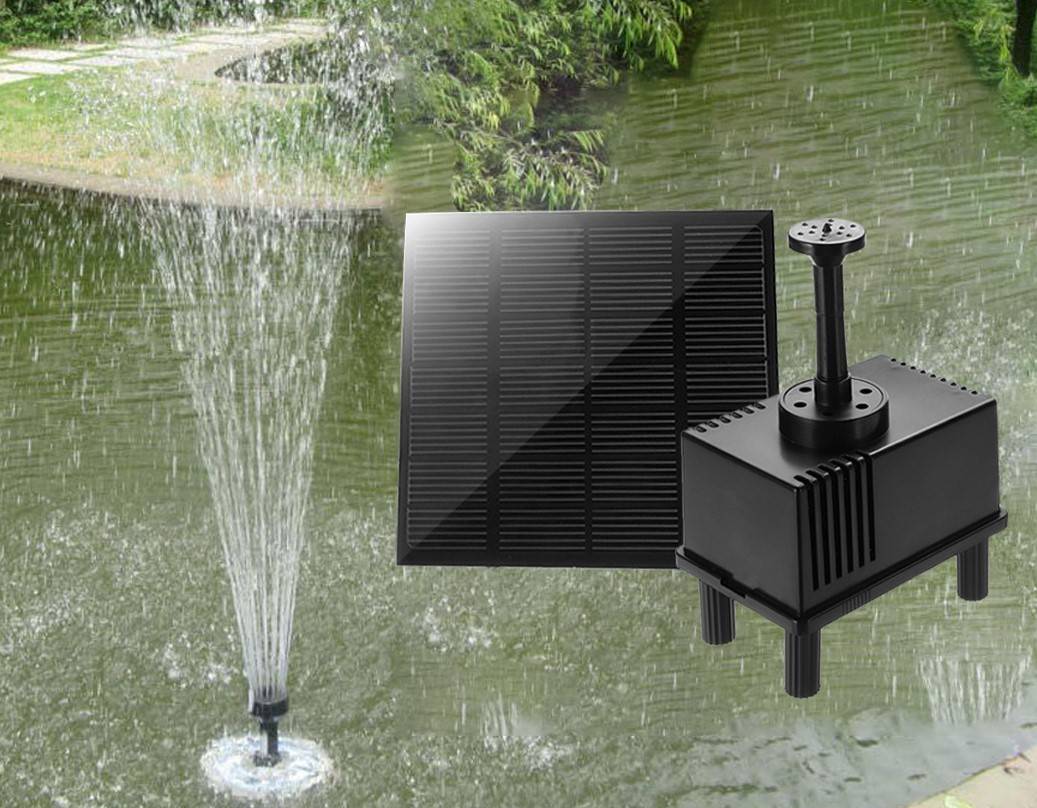

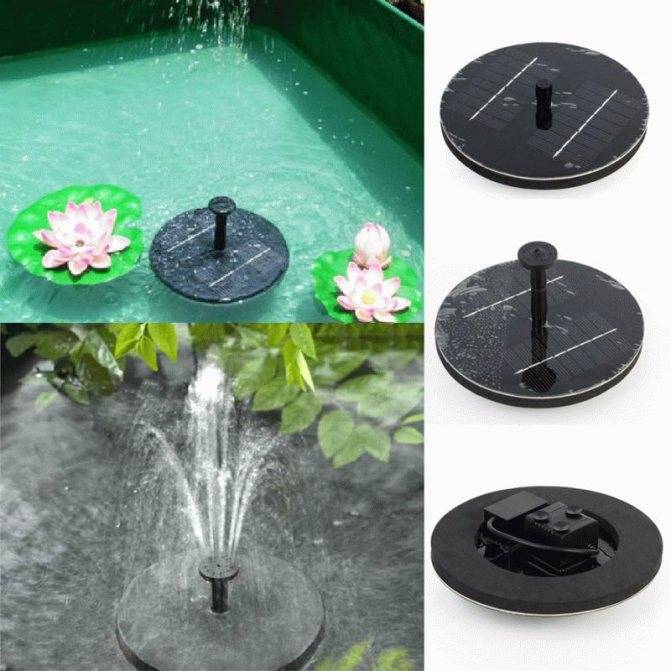

Kits.
Some manufacturers offer kits that include various nozzles, accessories, lighting, and even a steam generator.
- Anyone who loves the soft murmur of a stream can make a small stone cascade in the garden.
- Stone steps overgrown with plants and a stream flowing down them look very natural.
- Pumps feeding a spring, stream or cascade are connected according to the principle of a closed cycle: a hose is drawn from the pump to the spring, wall fountain, cascade or the beginning of the stream, through which water flows
- To prevent stagnant water, you need to organize its circulation. This is done with a pump. Its power depends on the size of the reservoir and the height to which you need to raise the water.
Fountain device
From the very beginning, it may seem that making a small fountain is very difficult, but this is not entirely true. Of course, there are also complex hydraulic structures, but for summer cottages they choose simple models that you won’t have to spend a lot on, since you can use improvised tools for work.
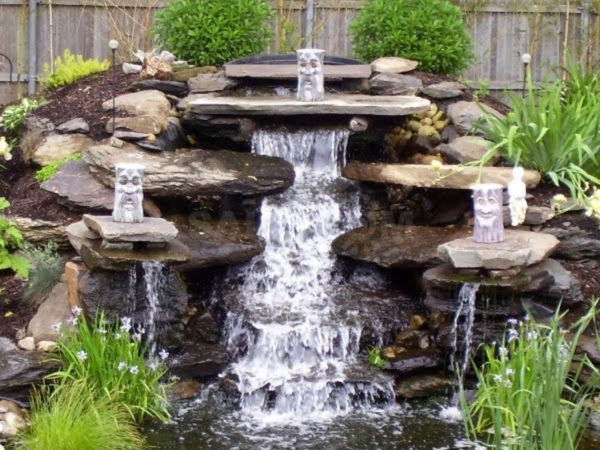
The main difficulty in manufacturing is its decoration.
All fountains are of two types:
- Closed - in them, water constantly circulates in a circle. The pump is installed in the main tank and supplies water from there to the pipeline system. The pressure in it is created only by pumping equipment.
- Open - water in such a system comes from extraneous sources. The source can be a natural reservoir or a river, or a country house water supply system. The pressure in such a system can be created by a pressure drop in the system due to physical laws. We will tell you more about this later.
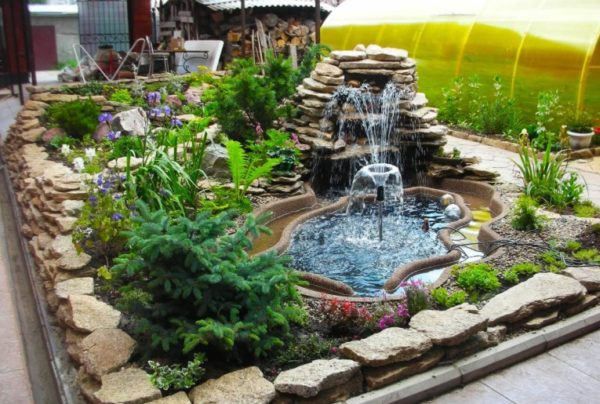
A garden fountain for a summer residence is an oasis on the territory of a summer cottage
In gardens, the first option is often built, as they are easy to maintain, easier to build. At the same time, water must be periodically topped up (it evaporates and splashes) and cleaned (filtration equipment is installed). Sometimes they even perform a complete pumping and replacement.
Open models need a water supply system, a water removal system.Requires good drainage, devices that control the filling level of the main tank.
An example of an open variant without a reservoir - water goes into the ground through the drainage system
How are surface pumps installed?
When planning complex ground structures of fountains and waterfalls, surface pumping devices are used. New structures (fountains and waterfalls) are easily connected to them, since the pump is on the surface.
For high pump performance, it should be located as close to the fountain as possible.
However, the equipment, as mentioned earlier, must be isolated. This will help to respect the landscaping and muffle the noise generated by the installation.
Surface pumps are more efficient than submersible pumps. And in order not to reduce it, they are placed near water bodies, since the pressure of the water jet is greatly reduced when passing through long hoses.
If it is planned that the pump for the fountain will also pump water for the waterfall, then the pump model must maintain pressure in two modes (low and high pressure).
AT end of the water pipe install a check valve that will retain water in the system before starting the pump.
Types of fountains
The classification of fountains is quite complex: they differ in design, principle of operation, type of spray, and may have additional functions such as lighting or musical accompaniment. Consider the most popular designs used in decorating private households.
submersible fountain
This type of fountains is used in artificial and natural reservoirs of a sufficiently large size and depth. It is a submersible pump equipped with a sprayer and an electrical supply cable.It is enough to place such a pump in a pond and install it on a flat and solid platform prepared in advance, and then connect it to the electrical network.
Submersible fountain in an artificial pond
The shape of the submersible fountain jet can be different and depends on the nozzles used, the most popular spray types are shown in table 1.
Table 1. Types of water spray in the fountain.
| Name | Description |
|---|---|
| Jet | A single nozzle with a truncated cone nozzle allows you to create a high head at the outlet and a high single jet that breaks up into individual drops. |
| cascading | Several single nozzles with different nozzle diameters and water delivery heights form a cascade of water jets. |
| "Bell" | Atomizer in the form of two discs, between which a jet of water comes out evenly. The smaller the distance between the discs, the thinner the water film. |
| "Tulip" | The device of the atomizer as a whole is the same as that of the "bell", but cones are used instead of discs, as a result, the water flow flows upward at an angle of 30-40 degrees, creating a funnel in the center. |
| "Fish tail" | The nozzles are located around the circumference and deliver individual jets at an angle of 30-40 degrees, without forming a water curtain, as in the "bell". |
| "Tiffany" | A combination of "fishtail" and "bell" - in the lower part, the water flows out in a curtain, at the top - in radially arranged thin jets. |
Fountain Spray Types
Nozzles for jet type
floating fountain
Floating fountains are also used in large enough reservoirs where there is room for them to move. A floating fountain is a plastic housing in which a pump and atomizer are installed. A filter is provided in the lower part of the housing to clean the suction water.The design of the fountain allows it to stay steadily on the water surface. Floating fountains are often equipped with lighting.
floating fountain
Stationary fountain
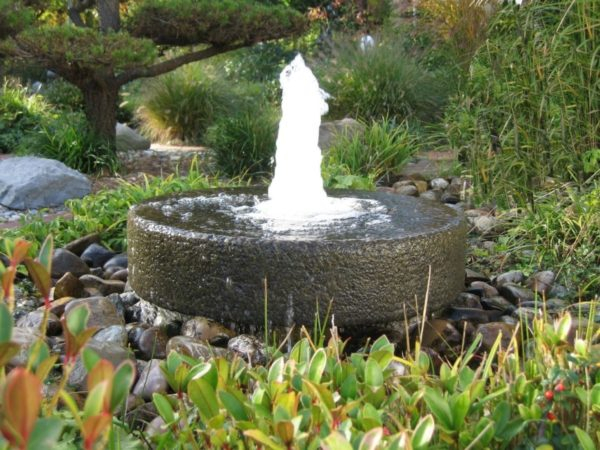
The main difference between a stationary fountain is a bowl that replaces a pond. The shape of the bowl and its dimensions can be completely different, as well as the place of installation. Depending on the type of pump used and the number of nozzles, a stationary fountain can form any water compositions and effects. For the winter, the fountain requires conservation.




wall fountain
A kind of stationary fountain, but a wall structure is installed at the blank wall of the building, at the fence or other massive element of landscape design. There are wall fountains with both jet spray and waterfalls. Cascading wall fountains look especially impressive.
cascading fountain
Waterfall fountain
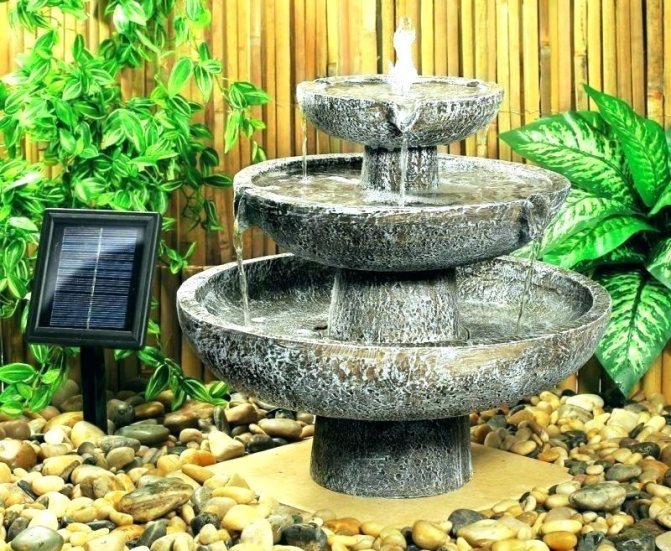
To create a waterfall, it is not necessary to attach it to the wall, you can create a composition of stones, bowls or jugs. Such a fountain can be connected directly to the water supply. Water from the lower bowl is diverted to a storage tank or directly to the garden irrigation system.
Waterfall fountain made of ceramic bowls
Portable indoor fountain
The simplest and most inexpensive design that can be installed in the house, on the terrace or outdoors. The power of such fountains is small, but they give the landscape charm and style.
portable fountain
Do-it-yourself fountain in the country: step by step instructions
You can buy a ready-made fountain and look for the best place for it in the country. But it is more correct to first decide on the place, type of fountain, design, and only after that proceed to its arrangement.
Step 1. Choosing a fountain.
The fountain is selected depending on the size and landscape design of the yard.On a large plot, it would be appropriate to look at a larger design; for small ones, something not very grandiose is selected. Fountains are of two types: stationary and submersible. The first in the form of some sculptures or other forms are placed above the surface of the earth, the second look like a reservoir, from which the stream rises.
When choosing a fountain, you need to focus on the size and design of the site.
You can either buy a completely finished design, or create something yourself. In the first case, installation will be simpler, in the second, you will have to buy and assemble everything manually.
Related article:
As a result, the result may not be pleasing if, for example, the pump is incorrectly selected in terms of power and performance, the diameter of the pipes is incorrectly selected, etc. But such a fountain in a private house can be much cheaper and have a completely unique look.
Step 2. Choosing a place to place the fountain.
It is advisable to place a fountain on a personal plot where it will be visible from all sides of the yard. The best option is near a place of rest, for example, a gazebo, a barbecue area, a playground. But you also need to take into account some other points:
- it is undesirable to place the fountain in an open area, since under the influence of the sun the water will not only evaporate quickly, but may also begin to “bloom”;
- it is better not to place the fountain on the site of a country house near large trees, as their roots can damage the waterproofing, and falling leaves will often pollute it;
- there is no need to place a fountain near the house; in the wind, drops can fall on windows and walls;
- also, do not place the fountain in a blown area, this will prevent the jets from being blown off by the wind.
It is undesirable to place the fountain under large trees
The best option is to place the structure between bushes and flowers in light partial shade.
Step 3. Preparing the tank.
Depending on the size of the fountain, a corresponding recess is dug in the soil. If you plan to install a finished tank, then the pit should be of the same dimensions. If you plan to use a film for waterproofing, then its depth and shape can be of various sizes. The bottom of the tank is covered with a small layer of sand and the side walls are strengthened. So that the film is not damaged during operation, it is advisable to use geotextiles both from below and on top of the film or use a special film for the fountain. All layers are fixed along the edges of the pit, for example, with the help of stones or sprinkled with sand, soil.
AT the place of the reservoir where jets will rise, a small pedestal is made under the pump. In the case of a submersible pump, it is simply installed on a pedestal. If a surface pump is used, then a structure is fixed on the pedestal that will hold the nozzle and lead the pipeline to the place where the pump will be installed. After that, the pit is filled with water and the operation of the fountain is checked.
A film is laid in the pit and fixed along the edges with stones.
Step 4. Decorating the finished fountain design.
The design of a garden fountain should not fall out of the general landscape of the yard. A pissing boy in a high-tech garden plot will look out of place. In addition to various stones, figurines and vegetation, the fountain can also be decorated with lighting.For these purposes, you can use underwater lights, various light strips, floating lights and, of course, ground lamps installed around the perimeter of the structure.
In addition to vegetation, fountains are decorated with various figurines and lighting.
What should be a good pump?
First you need to select and purchase a suitable pump, as well as a number of materials necessary for its successful installation. The pump is usually taken submersible, while it is very desirable that it be centrifugal.




Unlike centrifugal models, vibratory pumps cause dangerous vibrations in the well, which can lead to the destruction of the soil and casing. Such models are especially dangerous for sand wells, which are less stable than artesian counterparts.
The power of the pump must match the productivity of the well. In addition, the immersion depth for which a particular pump is designed should be taken into account. A model designed to work at a depth of 50 m can supply water from a depth of 60 meters, but the pump will soon break down.
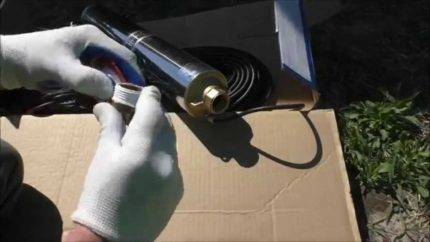
Submersible centrifugal pump - the best choice for the well. Its performance, dimensions and other indicators should be correlated with the characteristics of its own water source
Another risk factor is the level of drilling quality. If an experienced team drilled, the well will be better able to withstand the destructive effect. And for wells created by one's own hands or by the efforts of “shabashniki”, it is recommended to use not just a centrifugal pump, but special models for wells.
Such devices better tolerate the loads associated with pumping water heavily polluted with sand, silt, clay particles, etc. Another important point is the diameter of the pump.It must match the dimensions of the casing
It is important to take into account the features of the power supply of the pump. For wells, both single-phase and three-phase devices are used.
For four-inch pipes, finding equipment is easier than for three-inch pipes. It is good if this moment is taken into account at the well planning stage. The greater the distance from the pipe walls to the pump housing, the better. If the pump passes into the pipe with difficulty, and not freely, you need to look for a model with a smaller diameter.
Types of pumps for a fountain or waterfall

All pumps for fountains and waterfalls for summer cottages can be divided into two large groups according to their purpose and design features, such as:
- Submersible pumps. Their distinctive features are small overall dimensions and relative lightness. Installation of devices is carried out directly in a reservoir or a well. Blades are attached to the rotor shaft of such models. When the engine is turned on, they begin to supply water to the outlet. As a rule, the installation of submersible pumps is carried out on a specially created platform. This is due to the fact that in this way, the devices will be protected from getting into them an excessively large amount of sludge.
- surface pumps. Their installation should be carried out in close proximity to the reservoir. These devices make little noise. In addition, they must be protected from rain. To do this, they should be placed in a special casing. The advantages of these models include the fact that they are easily accessible, which is why the maintenance of such machines is quite easy. On the one hand, a suction hose is attached to the surface pumps, on the other, a hose leading to a waterfall or fountain.
Expert opinion
Kuznetsov Vasily Stepanovich
Thus, the choice between a submersible and a surface pump should be made based on the features of their work, practicality of use and, of course, aesthetic considerations.
How to install a do-it-yourself fountain pump
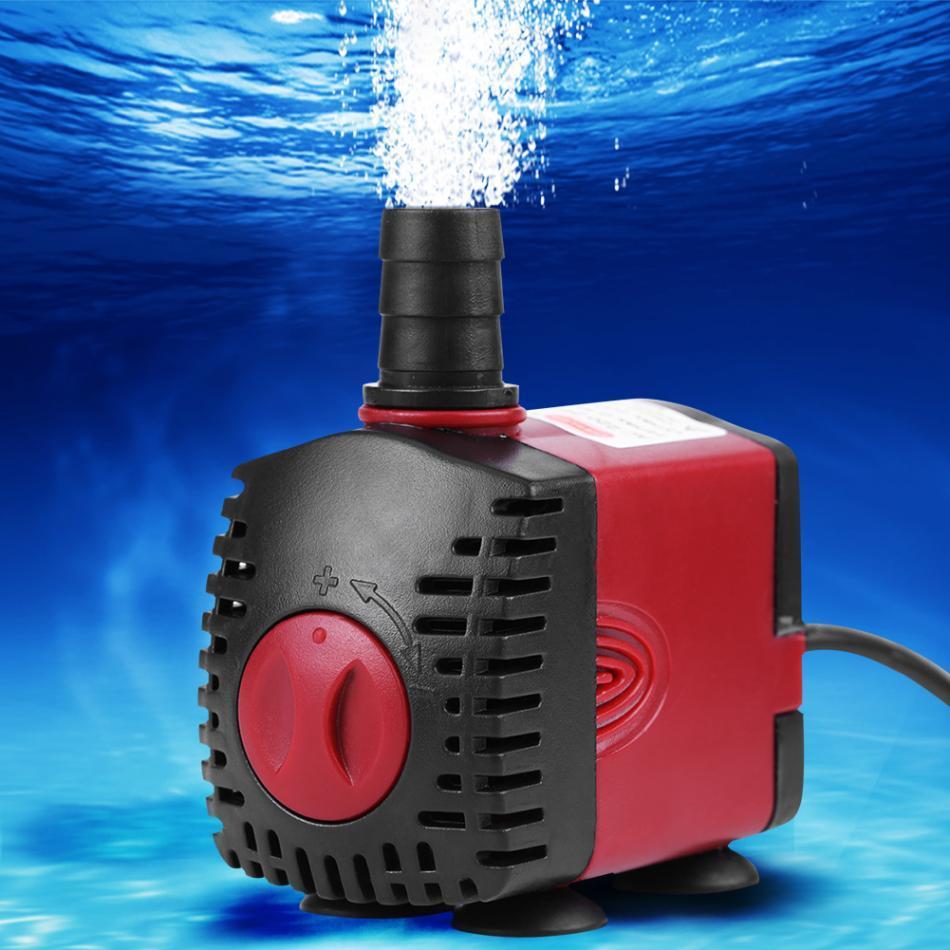
The submersible fountain pump is very easy to install. The main feature of the installation of the unit is a hill. A couple of bricks or a special plastic stand are perfect for this. The stand is necessary so that debris and silt from the bottom of the artificial reservoir do not fall into the pump filter. Thus, it is possible not only to extend the service life of the unit, but also to simplify the operation process. The pump is firmly attached to the pedestal with four suction cups.
Water from the pump is supplied just above the water level, creating a fountain or through a hose to any place in the water structure if a waterfall is being made.
Modern pumps have adapters and nozzles for various purposes. It can be both various types of nozzles for a jet of water from a fountain, and a device for pumping water out of a container.
When choosing a pump, you should pay attention to its size and power.
Job highlights:
- Water is taken from the place where the filter is located. As a rule, it is located on the side of the unit.
- An extension hose or various adapters, or the fountain itself, is attached to the device at the back. The rate of water supply from the nozzle is also regulated by nozzles.
- A wire comes out of the pump, which is connected to the network. Before connecting the pump to the power supply, it is imperative to make sure that the insulation on the wire is not damaged. It will also not be superfluous to install a device that reacts to current leakage.
When choosing a pump, it is important to consider its power and size.The material from which the unit is made must be resistant to corrosion. Even the highest quality pumps for the winter need to be removed to prevent them from freezing.
Even the highest quality pumps for the winter need to be removed to prevent them from freezing.



