- How to avoid trouble
- When is a video not allowed?
- The difference in regulations
- Summary
- [Situation #19]
- Where is photography really banned?
- Do they have the right
- Where and when is photography allowed?
- Is it possible to fix a working identity
- When should you not distribute a conversation with an employee?
- Practical Tips
- Responsibilities of traffic police officers
- controversial points
- Do I need to warn the traffic police officer about the shooting?
- You can shoot if the policeman breaks the law
- How people are photographed in Lithuania and Ukraine
- What to do if filming is prohibited
- The real state of affairs
How to avoid trouble
A citizen who wants to film some event with the participation of other citizens and police officers must understand that his wrong behavior threatens at least trouble. A police officer may unlawfully prevent filming if he does not want his illegal actions to be recorded.
At the same time, he will correctly justify his ban and point to a legislative act. Therefore, a citizen needs to be aware of this issue, what can be done and when, and what not. Otherwise, he will simply become a victim of exceeding the authority of an official, which he cannot actually prove.
Additionally, by prohibiting filming these circumstances, the police officer may indicate to the person concerned that he is preventing the police from performing their duties or will make other claims that at first glance may turn out to be significant. At the same time, a citizen cannot oppose the Russian police or its individual representative and disobey, otherwise he himself will fall under the severe punishment of the Criminal Code.
When a police officer demands to immediately stop filming, the citizen is nevertheless advised not to rush, but to behave respectfully and try to ask the representative of the authorities some questions:
- whether your requirements are laws;
- why should I stop filming;
- you are engaged in secret activities;
- what rules of law you are guided by;
- Based on which article of the law should I stop filming.
Often such a monologue from a private "director" is enough, but not always. But if there are no witnesses nearby, then you need to be prepared that the policeman will simply take away the camera and erase the recording. There will simply be no evidence of his illegal actions.
When is a video not allowed?
But there are a number of conditions under which it may be illegal:
- you can’t upload a video obtained illegally - in other words, if you filmed a conversation with the traffic police during the consideration of the case without the permission of the employee,
- it is forbidden to make video (as well as audio recording) also in the courtroom without the direct permission of the judge, because in this case we are talking about the consideration of the case,
- if the inspector stopped you in a place where filming is prohibited by other federal or regional legal acts - at a military facility, a closed secret area, during a special event, if the video ban is written directly in the documents for this event.
In addition, it is better not to post the video you shot if you yourself are breaking the law in it:
- insulting a police officer, moreover, trying to use physical force against him,
- behave antisocially in a public place (even while inside a car).
Something else useful for you:
- Is it possible to film a traffic police officer under the new law?
- Communication with the traffic police: what to read to improve legal literacy?
- Order No. 185 of the traffic police - canceled or not?
The difference in regulations
You can refer to the old law, where there was a direct permission to film the actions of police officers, this is the administrative regulation of the traffic police of October 20, 2017, now there is no such permission, but the ban on such actions has also disappeared. Let's consider the situation in more detail.
The driver has legal grounds for filming the inspector, but not in all cases, the regulations describe them, so study it before taking any action. In Order No. 185, the necessary information could be found in paragraph 25: it clearly stipulated that a police officer could not interfere with video filming that a driver or passenger could conduct, however, in accordance with the current regulations, this paragraph is absent. But if we turn to other legislative acts, we can find that there is no direct prohibition on such actions. In addition, if something is not prohibited by law, then it can be done, this is what the Constitution of the Russian Federation says.The media often try to mislead citizens and claim that filming is prohibited, but this is not true.
Summary
So, with rare exceptions, recording a conversation with a traffic police inspector is absolutely legal. In cases where it is illegal, the traffic police officer must report this, as well as provide a link to the law prohibiting filming. Moreover, the head of the Main Directorate of the Traffic Police V. Nilov not only confirmed the admissibility of video recordings of communication between drivers and employees of his department, but even called such a practice desirable in order to improve the quality of the work of the traffic police. So motorists can safely use their rights, while not forgetting to remain polite and tactful.
[Situation #19]
Where is photography really banned?
First of all, this is shooting in the buildings of courts and correctional institutions.
Such prohibitions are established by the relevant procedural codes having the force of federal laws:
The Code of Arbitration Procedure (Article 11, part 7) and the Code of Criminal Procedure (Article 241, part 5) allow filming of a trial with the permission of the presiding judge;
Civil Procedure Code (Article 10, part 7) - with the permission of the court;
(Article 24.3, part 3) - with the permission of the judge, body, official considering the case of an administrative offense;
(Article 24, part 4) filming of convicts held in correctional facilities is carried out with the written consent of the convicts themselves. Filming of objects that ensure the safety and security of convicts is carried out with the permission in writing of the administration of the institution or the body executing punishment (Article 24, part 5).
Such “objects” can even be understood as the walls of a correctional facility, so that its administration has a formal reason to prohibit filming this institution from the outside.
However, within the meaning of Article 24, which is called "Visit to institutions and bodies executing punishment", the prohibition applies only to persons who have visited the institution, i.e., it does not apply only to its internal territory.
In Art. 7 of the Law “On Private Detective and Security Activities” (clause 4), private detectives are prohibited from video and audio recording, photography and filming in office or other premises without the written consent of the relevant officials or individuals.
Other normative acts containing a ban on filming regulate, as a rule, the access control on the territories of state institutions.
Decree of the State Duma of the Federal Assembly of the Russian Federation dated January 22, 1998 N 2134-II DG “On the Regulations of the State Duma of the Federal Assembly of the Russian Federation” (Article 37) prohibits the bringing to a closed session of the State Duma and using during it filming equipment.
Decree of the Government of the Russian Federation of October 2, 1999 N 1102 "On the Rules for the navigation and stay of foreign warships and other government ships operated for non-commercial purposes in the territorial sea, in inland sea waters, at naval bases, at the bases of warships and seaports of the Russian Federation” (paragraph 70), it is prohibited to remove ships and military installations on the coast from the board of foreign ships.
Order of the Federal Customs Service of October 20, 2006 No.N 1032 "On the approval of the Instructions for the organization of access and intra-object regimes at the objects of the customs authorities of the Russian Federation" (paragraph 56), filming on the territory of the FCS objects is prohibited.
By order of the Gosstroy of the Russian Federation of November 3, 1999 N 105 “On ensuring access and intra-object control and security of the building of the Gosstroy of Russia” (clause 2.9), the entry of shooting equipment into the building of the Gosstroy of Russia for personal use is prohibited, the entry of equipment for other purposes is subject to permission.
By order of the Ministry of Fuel and Energy of the Russian Federation of October 29, 1997 N 333 "On the approval and implementation of the Regulations on the access and intra-object regime in the administrative buildings of the Ministry of Fuel and Energy of the Russian Federation" (clause 3.3), it is prohibited to bring filming equipment into the territory and premises of the Ministry, and shoot there.
Order of the Federal Security Service of the Russian Federation of September 10, 2007 N 458 "On approval of the Rules of the border regime" (clause 1.9.8, clause "b"), persons located within a five-kilometer strip of terrain along the state border are prohibited without the permission of the head of the border department of the FSB to shoot border patrols and objects of border authorities.
By order of the Federal Service for Supervision in the Sphere of Transport dated September 1, 2006 N VS-297fs “On approval of the Procedure for organizing security, access and intra-object regimes in administrative buildings of the Federal Service for Supervision in the Sphere of Transport” (clause 3.13) it is prohibited without special permission the leadership of Rostransnadzor to bring filming and sound recording equipment into its administrative buildings.
Pavel Protasov compiled a selection of the most frequently asked questions about photography rights.
Original text: Pavel Protasov Supplements and design: Anton Martynov
Do they have the right
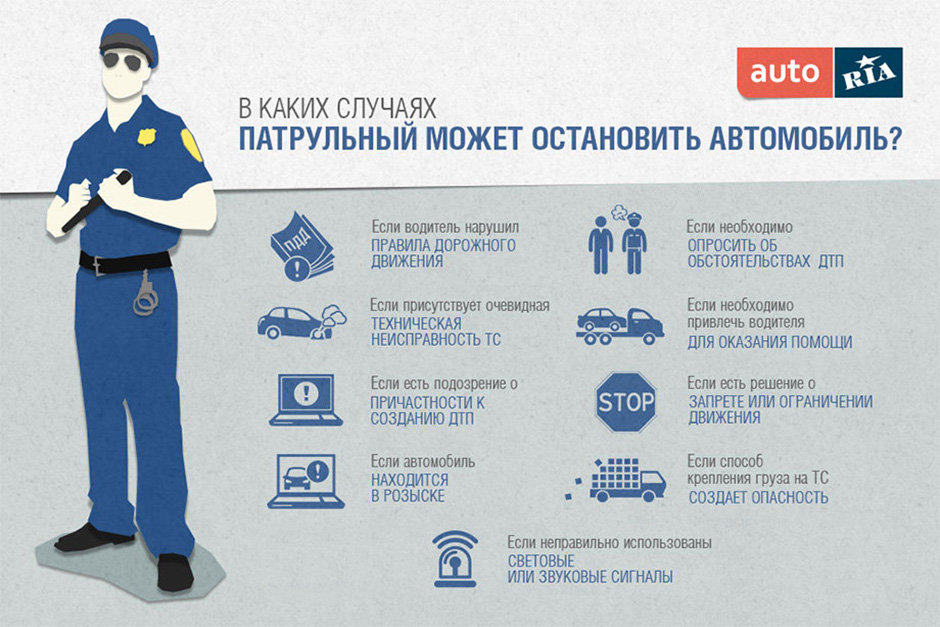
To answer this question, one should refer to two documents: the order of the Ministry of Internal Affairs No. 664 of August 23, 2017 and the federal law “On Police”. These regulations fully regulate the actions of an accident officer stopping a car.
Thus, paragraph 6.13 of the order states that the inspector has the right to use any video and audio equipment, including even special equipment that does not harm human life and health, and the environment. If everything is clear with the technique that allows you to capture the voice and what is happening, then certified measuring instruments are classified as special equipment in this case.
Article 13, paragraph 33 of the Law "On Police" also notes that a police officer has the right to use photo and video recording tools. Paragraph 40 provides that in the absence of witnesses, the inspector can even use a mobile phone to film what is happening. Moreover, the shooting can be carried out both after the car stops, and before. That is, we are talking about fixing the violation itself by the traffic police officer. This is provided for in Article 28.1 of the Code of Administrative Offenses. In this case, the device on which the recording is made for later use as evidence does not matter.

Where and when is photography allowed?
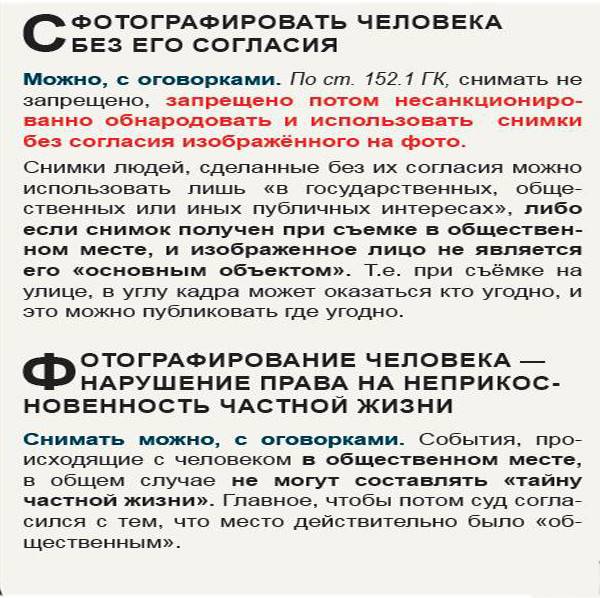
Article 152.1 of the Civil Code of the Russian Federation prohibits the use of a photograph or video image of a citizen without his consent. The exception is when:
- the photo was taken or the video was taken in a public place or at an event to which access was not restricted;
- filming permission obtained;
- the image is used in the interests of a wide range of people.
The law establishes the possibility of video filming and subsequent distribution of records about police officers in the performance of their duties. An exception is provided for carrying out operational-search activities, carrying out actions related to the preservation of state secrets, and compliance with the legislation on criminal proceedings.
Is it possible to fix a working identity
The legislation of the Russian Federation in 2019 does not contain a direct ban on photo or video recording of the work certificate of a police officer in the line of duty.
The citizen has the right to film it. However, the document must be in the hands of a police officer. It is impossible to demand its transmission for a better recording. Federal Law No. 152-FZ of July 27, 2006 “On Personal Data” does not classify a work certificate as confidential information.
When should you not distribute a conversation with an employee?
But it is much more effective to rely not only on a direct legislative ban, but also to take into account a simple advice to the car owner to carefully study the regulations that directly affect the moment of communication with the traffic police. There are many such videos on the Internet: usually in this way, drivers try to get an honest conversation with the human rights structure and think that the fact of filming will give them a tangible advantage. But in fact, many citizens themselves behave, to put it mildly, incorrectly and, first of all, do not put themselves in the best light on their own video.
A strict ban on filming video communication with the police is recorded only in Art. 24.3 of the Code of Administrative Offenses and refers specifically to the time of consideration of the case.Usually it begins with the preparation of mandatory documents, since a case can be initiated solely on the basis of a protocol (Article 28.1 of the Code of Administrative Offenses) on:
- violation (with a detailed description);
- inspection of the place where the violation was committed,
- detention, examination or examination;
- suspension and related security measures,
- investigation definitions.
As a rule, any photography, video recording, broadcast of an open hearing of a case on an administrative offense on radio, television and in the information and telecommunication network (Internet) is allowed only with the permission of the judge, body or official who is considering the case on an administrative offense.
Reference! But the inspector draws up such protocols quite rarely and after the decision is made. But when the employee issued a decision, the case has already been considered (in theory, without even starting to be considered - such a paradox).
In general, many drivers are right - they have the right to film a traffic police representative on video and then upload the video to the network without any special restrictions. If a police officer really violates the charter, then such a video may later turn out to be a serious argument. But do not forget that the driver himself must also behave decently and at the same time comply with other legislative acts.
Practical Tips
Recording a conversation with a traffic police officer is best done using a video camera. It can be either a camera built into a mobile phone, or a specific device - best of all, a video recorder.If the recorder or camera does not allow you to record sound in good quality, then it is better to connect additional audio receivers to them. The fact is that during a conversation there can be a fairly large amount of interference - for example, the wind or trucks passing by.
The expediency of using a DVR is due to the fact that many models allow not only to record video, but also to record the moments when the turn signals are turned on and the seat belt is unfastened
This is especially important when meeting with inspectors who, for lack of other arguments, often try to "catch" the driver with an unfastened seat belt. In addition, it is desirable that the recording device is within sight of the traffic police officer
Numerous testimonies from drivers confirm that an inspector who knows that he is being recorded behaves much more correctly.
Do not forget to properly prepare for the recording of the conversation. As soon as the traffic police officer stopped the car, you should turn on the device and dictate information about the place and time and circumstances of the stop. When talking with a traffic police inspector, you should speak clearly and clearly so that you can later unambiguously understand what is being said from the record. By the way, if earlier the courts very often did not agree to accept video recordings as evidence when considering cases of traffic violations, then after the amendments to the Code of Administrative Offenses (Note 3 to Article 1.5 of the Code of Administrative Offenses), the situation has changed for the better. In addition, in 2013 Russia may pass a law that will oblige the courts to use materials obtained from video recorders when considering cases.
There are a number of common mistakes associated with the process of recording the actions of traffic police officers:
1) Do not provoke the traffic police inspector. Many drivers have turned video cameras into a kind of tool for "hunting" for traffic police officers - with the subsequent posting of their "trophies" on the Internet
Even without taking into account the moral side of the issue, this can lead to increased attention to your car from the traffic police in the future.
2) Do not be rude or raise your voice to the inspector. This can be regarded as an insult to a representative of the authorities.




3) Do not forget that the traffic police can also record the conversation. And soon it may become a mandatory procedure. For example, in Moscow until the end of 2013 all patrol cars must be equipped video recorders, which will record every conversation with the driver of a stopped car.
Responsibilities of traffic police officers
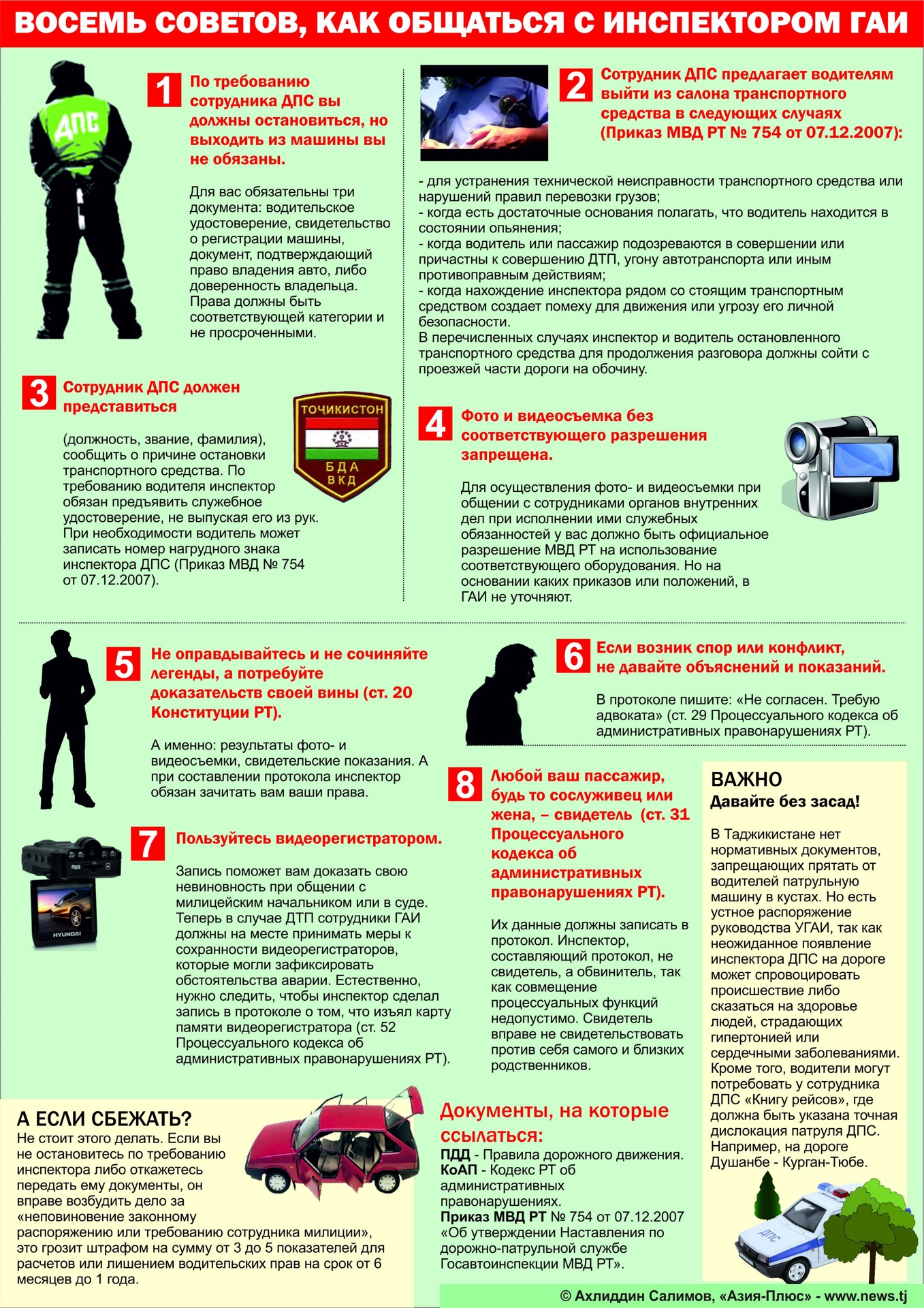
When the traffic police inspector stops the car and intends to resort to video filming, he is obliged to notify the driver about this. Such a rule is spelled out in paragraph 38 of the Administrative Regulations. Moreover, he must inform all other participants in the situation that the record is being kept. If witnesses are present at the scene, they must also be notified.
Even before the shooting begins, the employee must announce what exactly he is going to do: take a picture or make a video recording. He is also obliged to provide information about the brands and models of funds for which the recording is made. For example, iPhone6 or Sony FDR-AX700 camcorder. If the inspector silently starts shooting without saying anything to the driver, he has the right to demand that he comply with the rules of this procedure, based on the specified norm of the law.
After the recording is completed, the traffic police officer must attach the video to the protocol or act of examination for alcohol intoxication. It must be rewritten to disk and packed in an envelope marked accordingly.
controversial points
An employee may accuse you of disobeying his requirements. For this threatens up to 15 days of arrest, however, the driver is obliged to obey only the legal requirements of the inspector, and not his every whim. Again, the inspector himself cannot even arrest the violator; the measure of restraint is chosen by the court, which means that you have every chance to prove your case. Most often, such cases are resolved in favor of the driver.
However, the inspector may detain the driver, for example, to identify him, in some cases the driver may go to the temporary detention center until a court decision, usually up to three days.
Do I need to warn the traffic police officer about the shooting?
You have the right to film the actions of traffic police officers from any video recording device that is not prohibited for use in the Russian Federation, and in any situation that does not restrict you by law. Therefore, you decide whether to warn the inspector that he is being filmed, or not to warn.
In conclusion, it should be noted that, even if there is a broad legislative framework that gives you the right to film the actions of traffic police officers, you are defenseless. The legislation does not give clear definitions of your right to film, and traffic inspectors can turn the existing restrictions in their favor at any time.
It is important to understand that even if the requirement of an employee of the State traffic inspectorate to stop filming is illegal, you can only appeal it after the fact, and the WTO camera will have to be turned off immediately upon request.The traffic police inspector will later receive a minor official penalty for his actions, but you will still not be able to get the video evidence you need.
You can shoot if the policeman breaks the law
In Shymkent, drivers can film administrative police officers if the filming is not about secrecy. So says Sungat Tlenshin, deputy head of the department of internal affairs of the South Kazakhstan region.
Deputy Head of the Department of Internal Affairs of the North Kazakhstan region, Police Colonel Serik Idrisov
In the North Kazakhstan region, law enforcement officers can be removed when they violate the laws:
- As for the filming of administrative police officers by drivers, in accordance with the current laws of the Republic of Kazakhstan, every citizen has the right to respond to administrative offenses, including those committed by employees of internal affairs bodies. The Code of Administrative Violations applies to all citizens without exception. Service in the ranks of the police does not give the right to violate the established rules of the road, - explained the deputy head of the Department of Internal Affairs of the North Kazakhstan region, police colonel Serik Idrisov.



How people are photographed in Lithuania and Ukraine
On May 25, 2018, the General Data Protection Regulations (GDPR) came into force in the European Union. Among other things, he touched upon the issue of photographs and the ban on the dissemination of personal data. Vladimiras Ivanovas, a photographer for the Verslo Zhinios business newspaper in Lithuania, said that when the regulations were introduced, they were very concerned about this issue, but now they see that there have not been big changes.
Vilnius. Zamirovsky, TUT.BY. The photograph is illustrative.
Now in Lithuania it is undesirable to publish large portraits of people in the media without their consent, even if they were photographed in public places. An exception, perhaps, may be rallies or public discussions, when people realize that journalists and photographers are coming there. According to Vladimiras, if at a rally a person shows that he does not want to be photographed, it is also better to say that you will not use his photo.
If a person was in a public place, for example, a store, theater, at a rally, and it is difficult to understand from the photo that this is this person, then such a photo can be published without consent. The question of identification is important here.
- If you shoot people on the street and it is impossible to identify them in the photo, then you can publish such a photo without their consent. But if you shoot close-ups of women and men drinking coffee in a cafe, and they can distinguish themselves, then, under the new European rules, you need to approach them and ask permission to publish, he says.
Previously, children in Lithuania could not be photographed and published without the consent of their parents until the age of majority. Also before, and now it is impossible to publish photos of people with disabilities without consent, which is noticeable and by which it is easy to identify a person.
On the territory of apartments, houses, offices and other private areas, photographing and publishing photos is possible only with permission.
— For example, if you shoot in an office, you say that you represent such and such a publication and that photographs of people will be archived and used in the material. If someone is against being photographed, they can raise their hands, and then you will delete the photos with them. We worked this way even before the new regulations.But now, in order to protect ourselves, we pronounce everything more clearly when we come to private territory.
It is possible to photograph and publish their photographs of internal affairs officers on duty in Lithuania.
It is also important that when publishing a photo, even if people are difficult to identify at first glance, the facts are not distorted and the photo is used in the correct context. Kyiv, December 2013
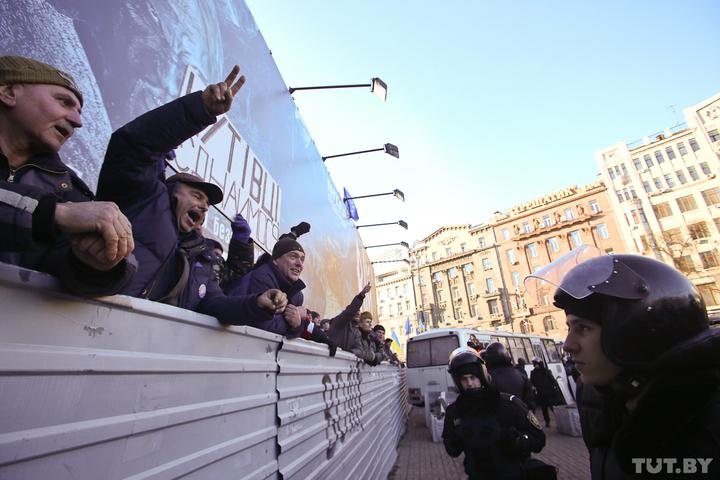 Kyiv, December 2013. Zamirovsky, TUT.BY. The photograph is illustrative.
Photographer from Ukraine Evgeny Maloletka says that you can shoot everyone on the street. Including law enforcement officers on duty.
But publishing is a different story. It matters what photos and why will be published. Let's say this is a photo from a protest near the Verkhovna Rada. The law on peaceful assemblies works here. And if a person came there, then he automatically gives his consent to fixing his portrait on a photo or video, he says.
Eugene notes that if he makes a portrait of a person for publication, he usually takes his oral or written consent. If this is a picture from the street and, for example, he photographed a girl under an umbrella, then such consent is not taken.
- Theoretically, one could approach and ask for permission to take a photo for publication. But this is unrealistic: after all, you photograph a lot of people with umbrellas, and then you choose one photo for publication.





What to do if filming is prohibited
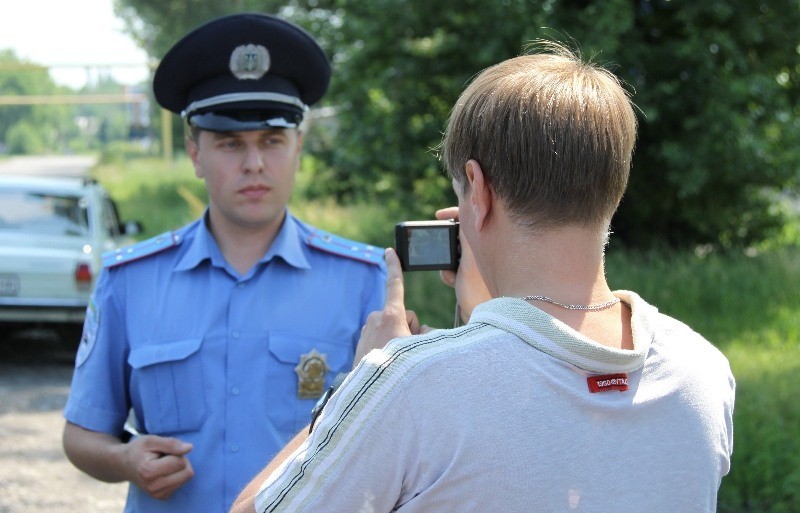
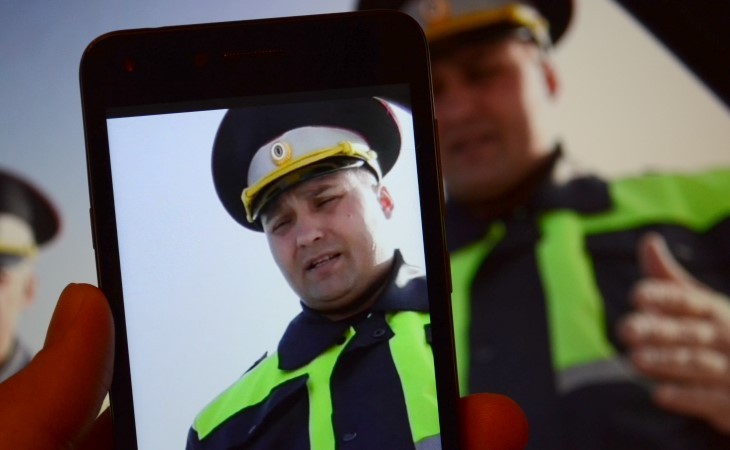
To begin with, the citizen should make sure that the police officer does not have a legitimate reason for preventing video recording. Before you start shooting, you should study in advance the legal acts that prohibit and allow such activities.Without knowing their rights, a citizen can easily become an object in relation to which the policeman exceeds his authority. In the event of such a conflict, video materials will help a citizen prove his case in court.
If the policeman demands to stop filming, then you need to clearly ask him on camera:
- whether the demand to stop filming is legal;
- what legal norms it is guided by;
- what article or law prohibits filming.
The employee is obliged to explain to the citizen all the points without threats and other actions that are unacceptable in this situation.
The real state of affairs
The absence of paragraph 25 does not mean that filming has become inaccessible, and does not give the inspector the right to interfere, just now this order will not duplicate existing legislative acts. In the event of a dispute with a police officer who is trying to prevent video filming, a legally savvy citizen can turn to Art. 29 of the Constitution of the Russian Federation. It states that any person has the right to receive and disseminate information using legal means. An exception is a state secret.
The second argument will be the law on the police, which speaks of the openness of the activities of law enforcement agencies. Filming will only be unacceptable if it violates someone's rights or jeopardizes state secrets.
These two laws are already enough to give a positive answer to the question posed. Even if some internal instruction prohibits filming, you can always use the highest legal act and solve the problem.
The explanations of the traffic police whether it is possible to remove traffic police officers also speak of the admissibility of these actions.