
- Who seals
- Registration and registration
- Why should they be mounted correctly, based on the purpose?
- Preparatory measures for installation
- Varieties of water meters
- Considering the savings from installing water meters
- 1. Find out the current tariffs for your region
- 2. We consider possible savings
- Calculation of payment when paying for water according to standards (without using water meters):
- Calculation of payment for water according to water meters
- Calculation of savings from the installation of water meters
- Installation instructions
- Comparison of tariffs with and without a water meter
- How much do you have to pay for community services?
- Water meter replacement procedure
- How to replace?
- Replacement terms
- Documentation
- What is an act of verification?
Who seals
Before considering who is authorized to install seals, one should consider the varieties of these protective equipment. There are the following types of seals:
- factory - installed by the manufacturer, preventing interference with the mechanism of the product, but not preventing its installation and connection;
- after connecting the device.
One of the types seals are anti-magnetic: read the article about the anti-magnetic seal.
The first of these types of protective devices should be of interest to the consumer only in terms of integrity control when purchasing a product.The owner purchases the device with a factory seal already installed, and its re-installation may be required only after the device has been repaired in the manufacturer's workshop or a specialized organization.
After the initial connection of the meter, or as a result of dismantling and re-installation associated with the next verification or repair, a representative of the energy supplier or the management company (if we are talking about an apartment in an apartment building) must install the seal.
We recommend: How to check and what to do if the electric meter winds more than used
It is not permitted to install this protective device yourself or to involve the company that installed the device for this. Such a connection will be declared illegal, and the instrument readings in this case will be invalidated. As a result, the owner will pay the organization to perform work that goes beyond its authority.
The cost of sealing in situations in which a fee must be charged from the owner ranges from 200 to 500 rubles, depending on the region and type of energy resources.
Registration and registration
Before you put water meters in your bathroom, you need to contact the local water utility in order to get your hands on the technical requirements for the water meter. This is done by the department for coordinating projects on water metering.
Having received permission, you can safely buy a meter. The rating of the best counters popular among users is given in our other article.
You may also find useful information about existing types of meters, discussed in our article: Types of water meters: overview of different types + recommendations to buyers
When purchasing a product, make sure of two parameters:
- The serial number on the water meter must match what is indicated in the passport.
- On the seal, the device must have an imprint of the State Standard.
- The date of the factory check must be recorded in the passport for the device.
At the time of purchase of the goods, the seller must stamp the store and indicate the date of sale.
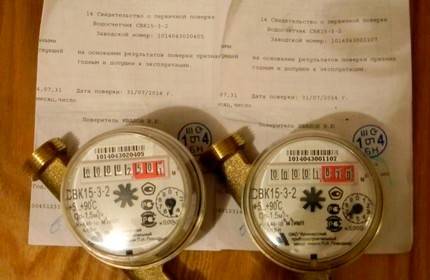
The best option is if there is not too long an interval between the date of the factory check of the meter and its sale
The purchased device must be checked by contacting one of the organizations listed below:
- department of the ZhEK;
- water utility management;
- private licensed firm.
For verification, the device is handed over together with a technical passport. Upon completion of the procedure, the stamp of the inspection organization will be entered in the passport and all relevant fields will be filled in. In parallel with this, a date for the sealing will be set.
Keep in mind that it is forbidden to damage the KIP seal, otherwise it will simply not be accepted in the water utility. If you accidentally damaged the factory seal, then the department can still accept the device.
But, if there is no KIP seal, then the meter data is considered invalid.
For self-insertion of the water meter, the housing office will provide a drawing and the necessary technical conditions, which will certainly be required during installation
In the equipment connection plan, the sequence of installation of parts will be clearly described.
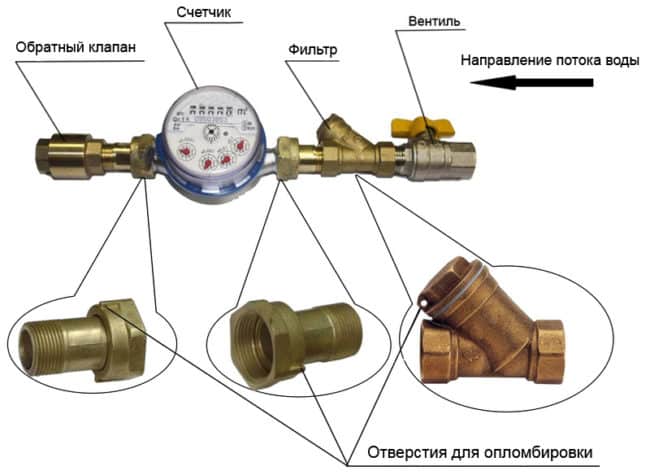
There is nothing difficult in this. Traditionally, the “garland” looks like this: the shut-off valve comes first, after it is a collapsible filter, followed by the water meter itself and the check valve completes the “chain”.
Why should they be mounted correctly, based on the purpose?
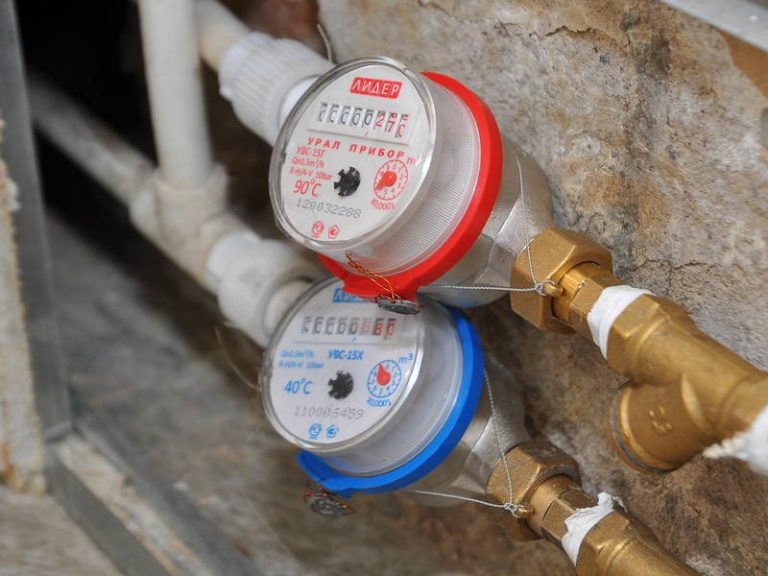
It is recommended to install the cold water device only on a pipe with cold water, and the DHW flow meter only on a pipeline with warm water, for the following reasons:
- the absence of further problems and questions from the management company and the water utility when sealing the device;
- no problem of possible failure of the metrological service to verify the device due to its incorrect fixation;
- preventing the problem of premature failure of the cold water supply meter if it was installed on a pipeline with warm water supply.
Installing the same type of instruments can lead to confusion when taking readings from them. The owner of water meters can transmit erroneous readings of water flow. As a result, he may be charged more utility bills than usual.


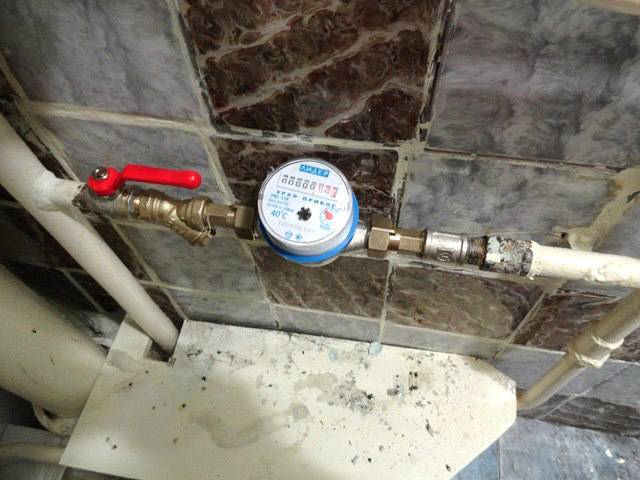

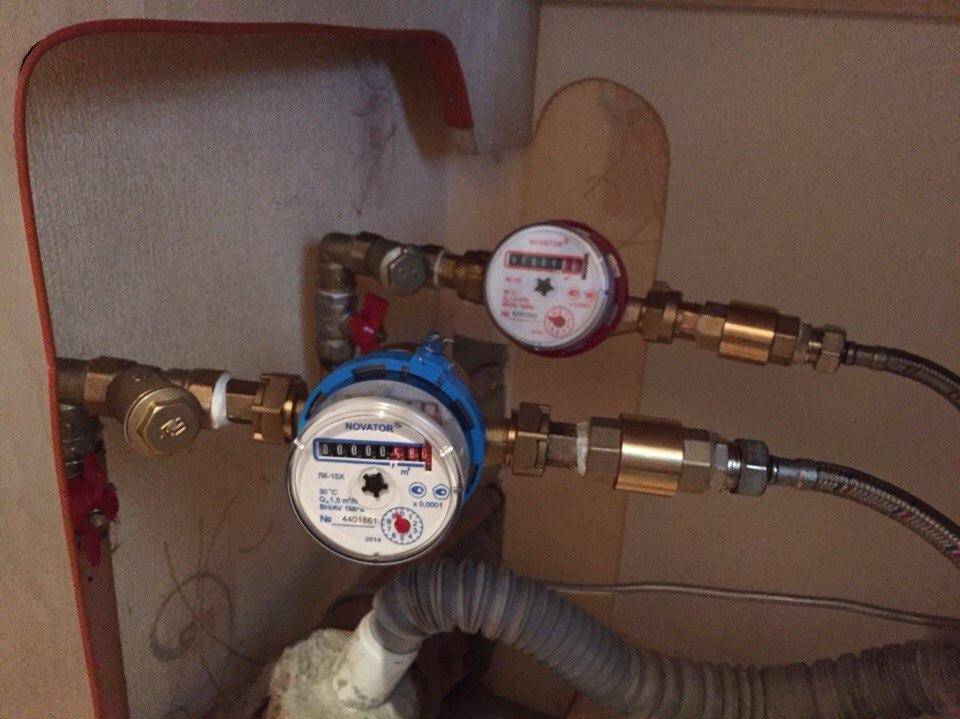
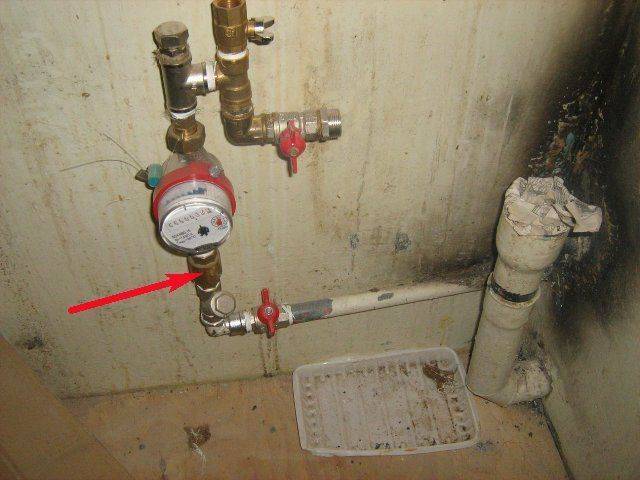

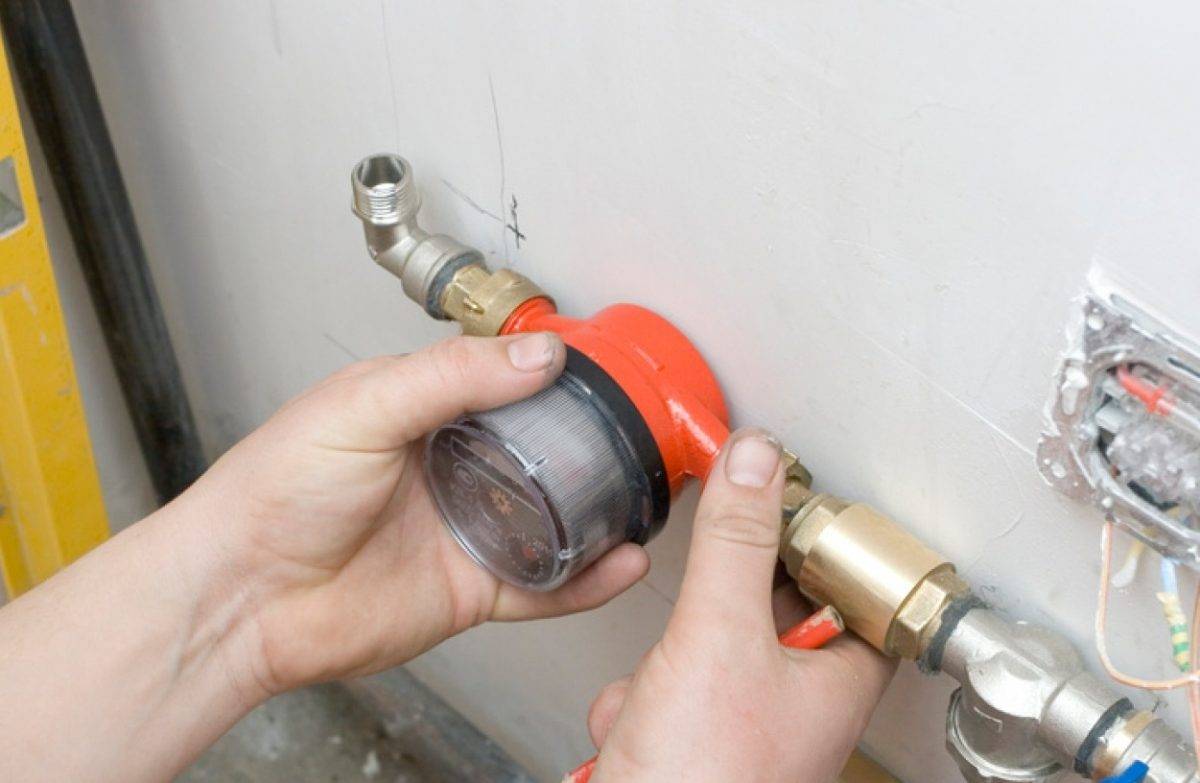


For this reason, it is important to install flowmeters in pipeline sections corresponding to their technical characteristics. It is better to install water meters correctly for financial reasons
Old models of hot water flow meters have a small calibration interval. They have to be trusted after 4 years
It is better to install water meters correctly for financial reasons. Old models of hot water flow meters have a small calibration interval. They have to be verified after 4 years.
If a tenant has DHW metering devices installed on both pipes, then he will have to calibrate them more often. This procedure is paid.
With the introduction of a single 6-year calibration interval for all types of water meters, this problem has become less relevant, but many residents in apartments and houses still have old-type flow meters installed.
All the most important and useful information about water meters is presented in this section.
Preparatory measures for installation
Any metering devices should be bought in specialized stores, and not from hand or on the market. At the same time, when buying, you need to check the complete set of the product, the availability of a technical passport, and also check the number indicated in the document with the number on the device itself. So you can be sure that you have purchased certified products that are suitable for use.
After the purchase and before you put the meter in the house or apartment, you need to take it along with the accompanying documentation for verification to the state office of instrumentation (KIP) of the housing office or to the water utility department. It is not forbidden to use the services of private firms to check the operation of metering devices, however, the company must be licensed.
After checking the technical product, a stamp will be put in its passport, and after installing the meter on the water, a seal will be installed on it, which absolutely cannot be damaged or removed, otherwise there will be problems with registering the device. After checking the meter, you can begin to develop a water meter connection diagram and prepare for installation.
The set of necessary tools depends on the type of pipeline, a certain section of which will have to be cut, so you will need a hacksaw for metal or a saw for plastic. You will also need:
- prepare a tool for cutting threads on metal pipes in order to install a block of counter and nozzles;
- purchase cutting scissors, connecting fittings and a special soldering iron if the pipes are made of plastic.
In addition, you will need ring and adjustable wrenches of the appropriate diameter to tighten the connections.
At the same time, it is important not to overdo it so as not to “tighten” the installed threads.
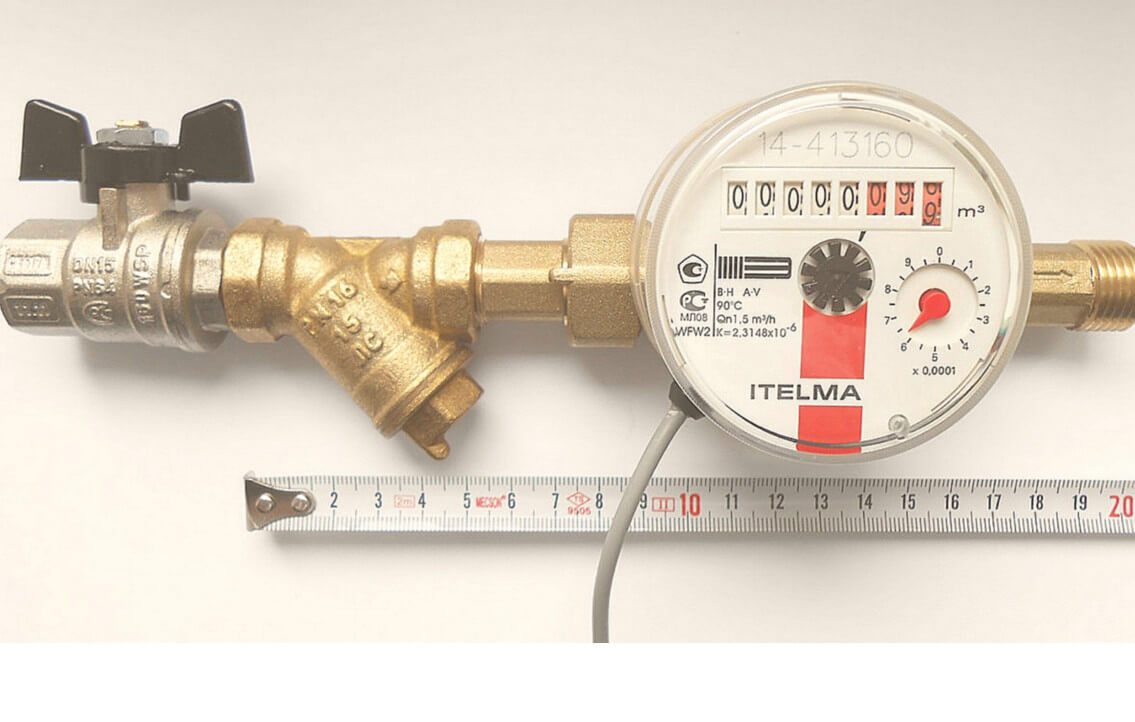
To check the completeness of the device, it is necessary to lay out on a flat surface all the elements of the block in the direction of the water flow:
- A shut-off valve (if included) allows you to shut off the flow at the right time. A valve is also required to regulate the water supply.
- A mechanical filter for retaining insoluble impurities and a coarse filter for water purification from debris. Able to extend the life of the meter, installed in front of the device.
- The first connecting pipe (with a union nut - American).
- The water meter.
- The second connecting pipe.
- A non-return valve that retains water in the system prevents the impeller from turning back when the water supply is turned off.
When laying out the elements of the metering device block, you need to pay attention to the arrows that indicate the direction of flow. All arrows must be in the same direction.
Before you install meters for hot and cold water yourself, you must turn off the water supply. In an apartment building, it will be necessary to block the entire riser, which only public utilities have the right to do.
Varieties of water meters
There are several options for water meters on the market for water meters. There are no regulations on how a water meter should be arranged by hand, so the choice of the type of device is up to the consumer. In the video you can see how a standard water meter works:
Regardless of the principle of operation and design, these devices have some characteristic features:
- location of the water meter - there are models designed specifically for vertical and horizontal pipelines, as well as universal devices for installation in any position;
- the diameter of the connecting pipes must fully correspond to the diameter of the pipeline, as a rule, these are models of the Du15 series;
- ambient temperature - theoretically, hot meters can be installed on a cold pipeline, the main requirement is that the water temperature does not exceed the maximum allowable value.
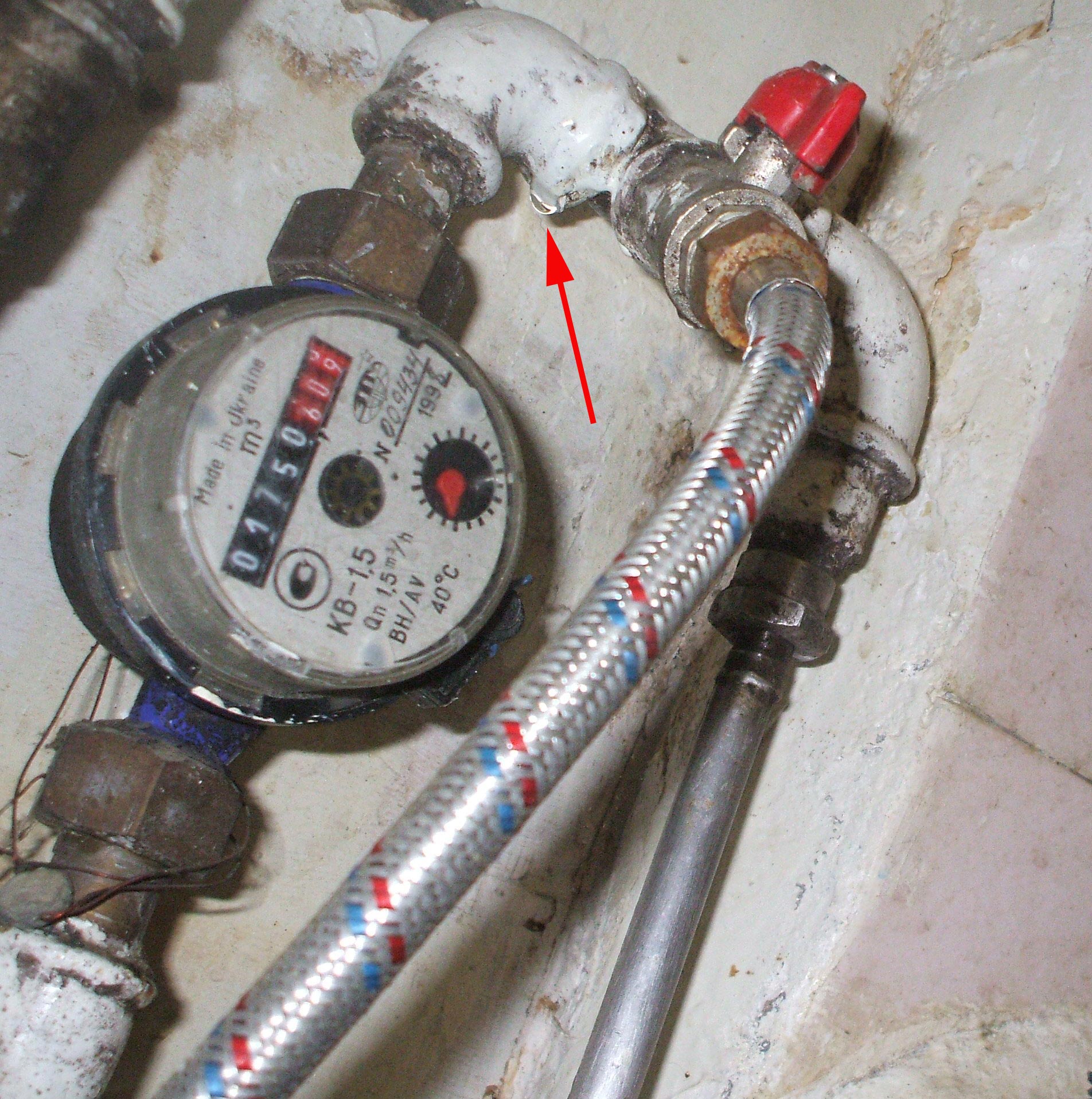
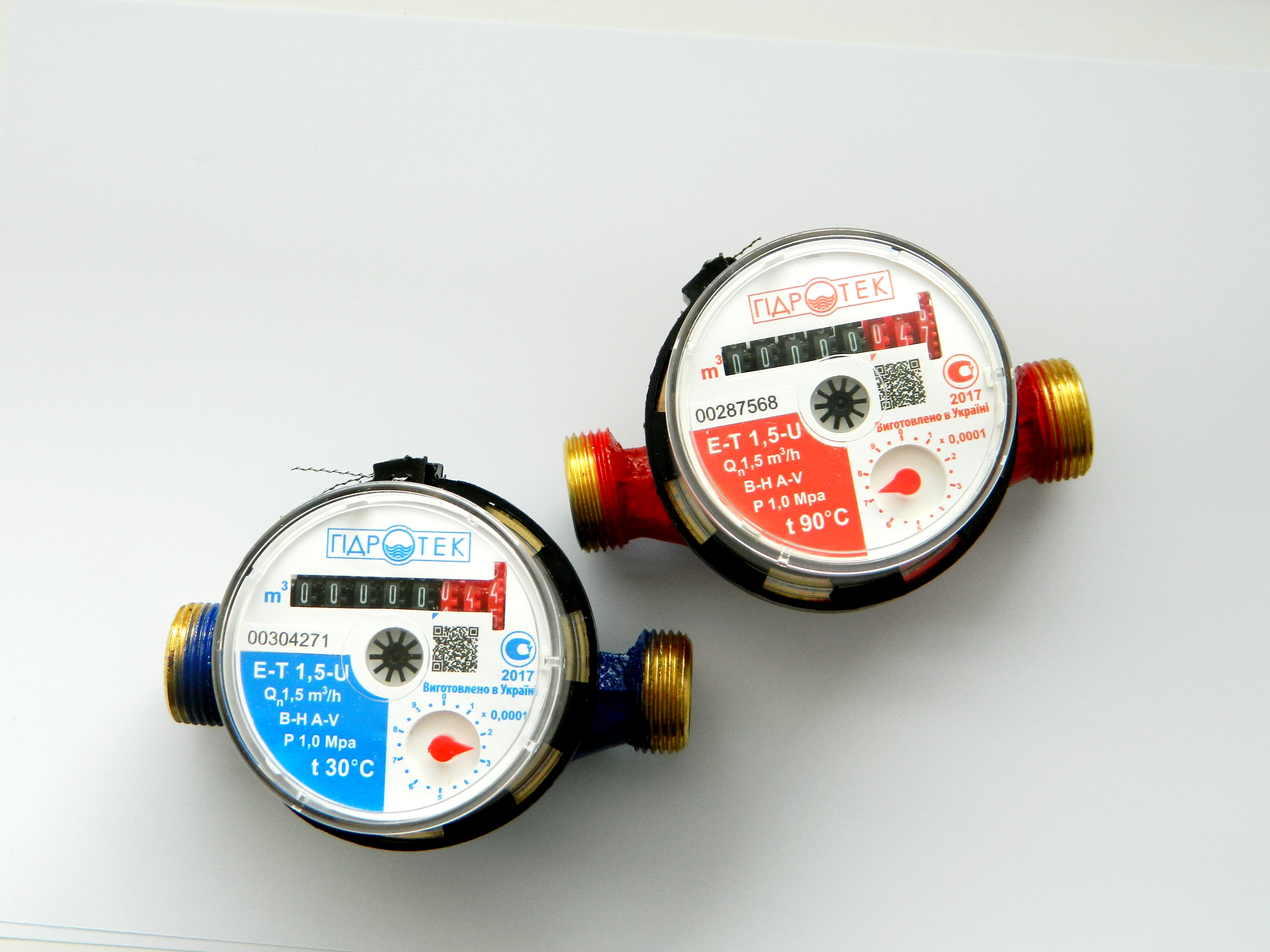
All water flow meters are divided into non-volatile and requiring the connection of an electricity network. The first type includes simple and reliable mechanical impeller meters. When the flow of liquid passes through them, the blades rotate, counting the number of revolutions.
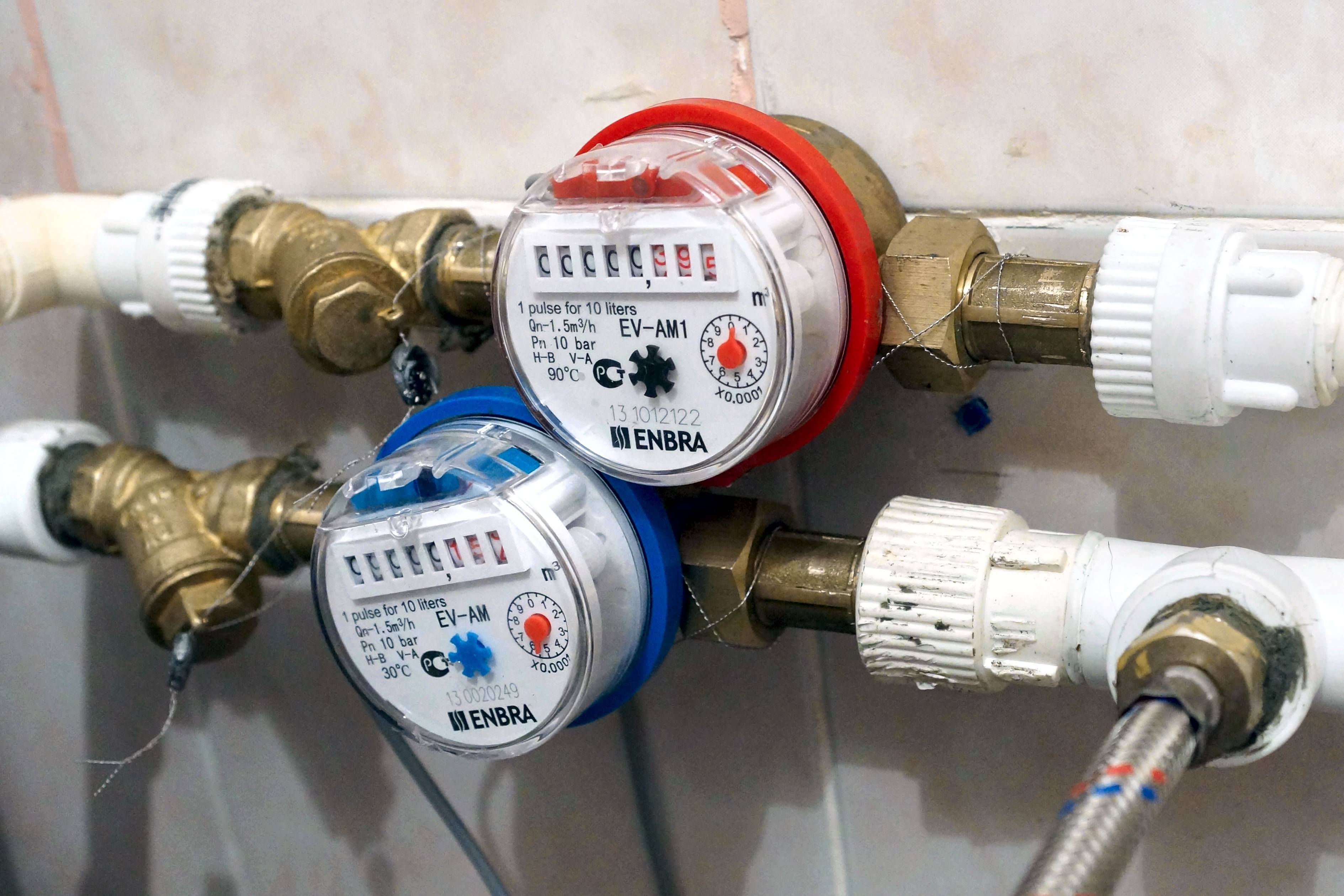
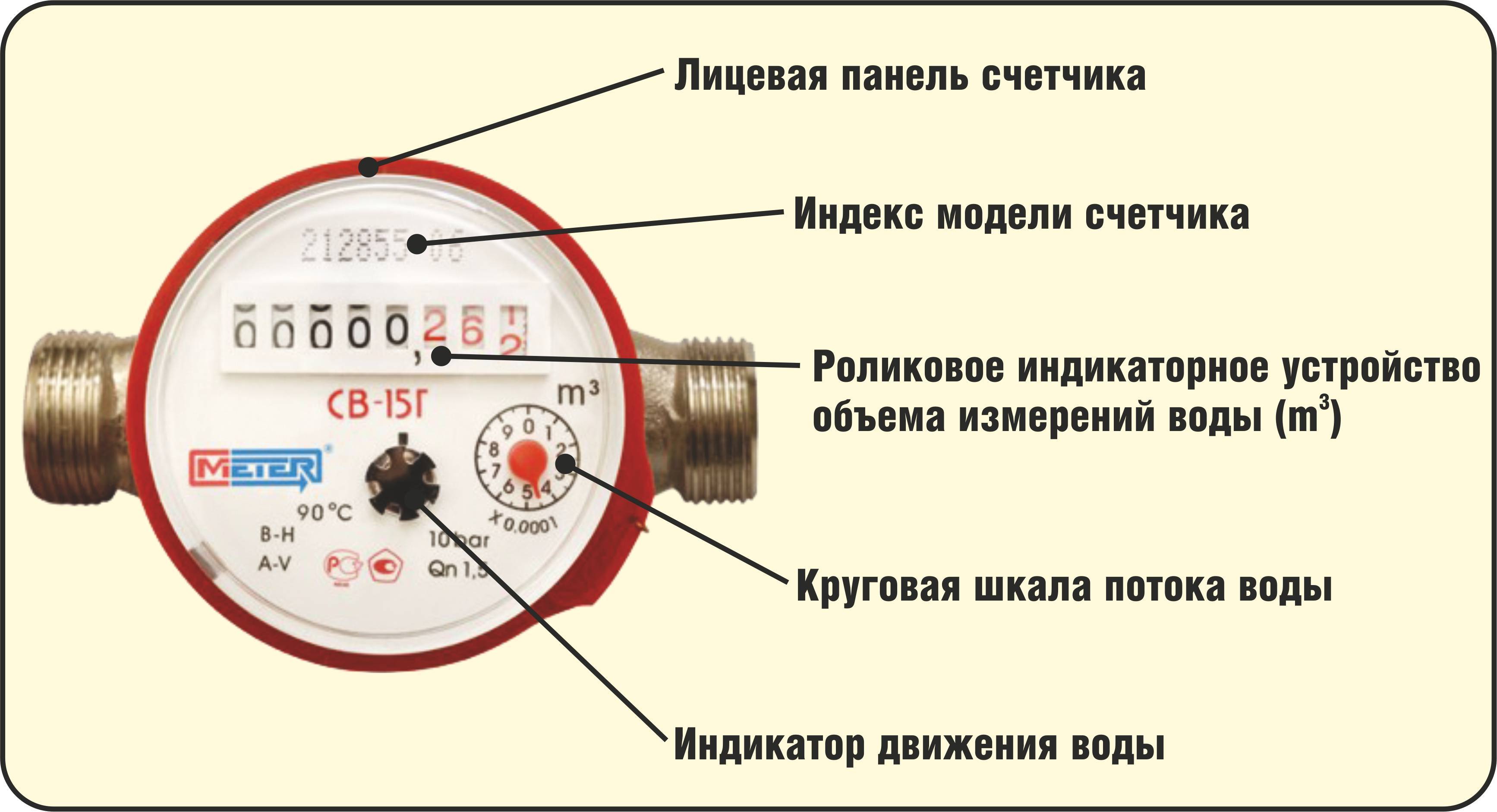

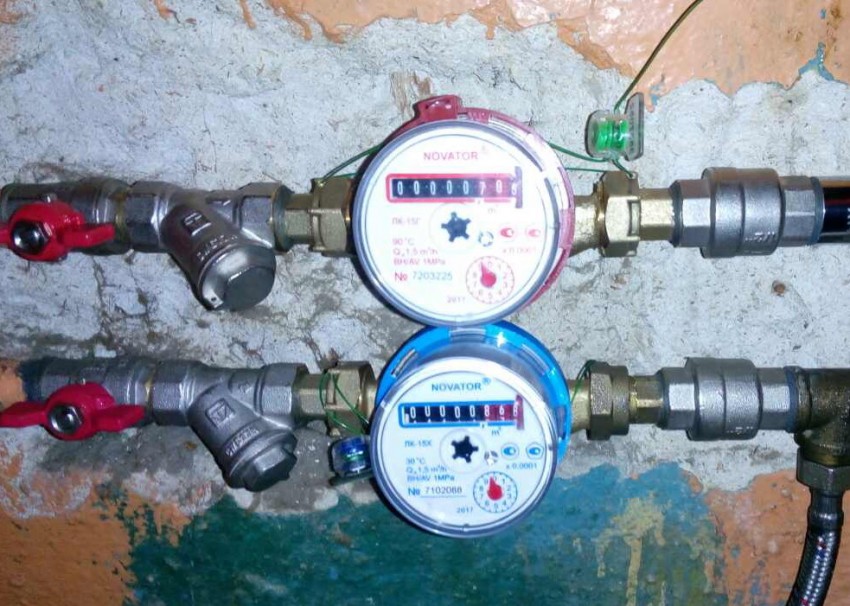


The device of volatile water meters is somewhat more complicated, and can be performed in one of the following options, depending on the principle of operation of the device:
- vortex - the product counts the vortices that are formed when the water flow passes through a special element inside the device;
- electromagnetic - the flow rate is calculated when the flow is affected by electromagnetic waves. These devices are very sensitive to the composition of the water;
- ultrasonic devices use sound waves of a certain frequency to determine the flow rate.
It is also worth noting that if the counting mechanism is isolated from the flow of water by a special partition, then such products are called “dry”, and models with non-isolated counting mechanisms are called “wet”.
Considering the savings from installing water meters
Tariffs for hot and cold water in different regions of the country may differ several times. I think it is clear that the colder the average air temperature in the region, the more expensive the tariffs for water, especially for hot water supply, will be.
1. Find out the current tariffs for your region
To calculate possible savings from installation of water meters Let's take the tariffs of central Russia.
For example, the tariffs in force in the city of Yekaterinburg:
- tariff for cold water supply services - 33.30 rubles per cubic meter of water;
- tariff for hot water supply services - 27.08 rubles per cubic meter of water;
- tariff for wastewater services - 19.19 rubles per cubic meter of water.
Please note that tariffs are reviewed, as a rule, twice a year, and, of course, not in the direction of reduction ...
Further, in order to calculate the savings from installing water meters, we need to know the basic consumption standards.
For the same city of Yekaterinburg, the following consumption standards are established in an apartment building equipped with bathrooms measuring 1500 - 1700 mm. for one person:
- hot water - 5.61 cubic meters.
- cold water - 6.79 cubic meters.
You can find out the tariffs in force in your locality on the website of your management company or on the website of the Unified Settlement Center of your city.
2. We consider possible savings
And so, we have learned the current tariffs, now we will calculate.
We take a family of three as the basis for the calculation (mother, father and child)
Please note that the calculation of payment for utilities is always carried out only on the number of people actually registered in the apartment
Calculation of payment when paying for water according to standards (without using water meters):
1) Payment for hot water (the number of people registered in the apartment is multiplied by the current consumption standard and multiplied by the hot water tariff):
3 * 5.61 * 27.08 \u003d 455.76 rubles - the amount for hot water according to the standard per month
2) Payment for cold water (the number of people registered in the apartment is multiplied by the current consumption standard and multiplied by the cold water tariff):
3 * 6.79 * 33.30 \u003d 678.32 rubles - the amount for cold water according to the standard per month
3) Payment for water disposal (the number of people registered in the apartment is multiplied by the current standard for the consumption of cold and hot water and multiplied by the water disposal rate):
3 * (5.61 + 6.79) * 19.19 \u003d 713.86 rubles - the amount for drainage according to the standards for the month
Total: 455.76 + 678.32 + 713.86 = 1,847.94 rubles.
That is, if you do not install water meters and pay for a family of three according to the established standards, the payment only for the supply of hot and cold water and for sanitation will be 1,847.94 rubles per month.
Calculation of payment for water according to water meters
In this calculation, I give personal examples of water consumption for a family of three.
In a month, the average water consumption for the whole family is as follows:
- cold water - 5.5 cubic meters
- hot water - 5.2 cubic meters
- drainage 5.5 + 5.2 = 10.7 cubic meters.
Of course, we save water, that is, we do not allow water to flow unnecessarily, but we also do not splash for “two hours” in running water while taking a bath.
If you have water meters in your apartment, the number of registered people no longer matters.
1) Payment for hot water (the amount of water actually consumed per month is multiplied by the tariff for hot water supply):
5.2 * 27.08 \u003d 140.82 rubles - the amount for hot water according to the meter per month
2) Payment for cold water (the volume of water actually consumed per month is multiplied by the tariff for cold water supply):
5.5 * 33.30 \u003d 183.15 rubles - the amount for cold water according to the meter per month
3) Payment for wastewater disposal (the amount of cold and hot water actually consumed per month is multiplied by the wastewater tariff):
(5.5 + 5.2) * 19.19 \u003d 205.33 rubles - the amount for drainage according to meters per month
Total: 148.94 + 173.16 + 205.33 = 529.30 rubles.
Calculation of savings from the installation of water meters
RUB 1,847.94 - 529.30 rubles. = 1,318.64 rubles. - monthly savings

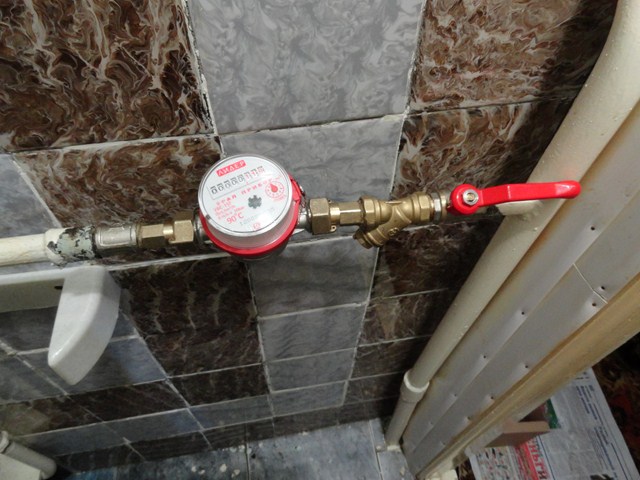


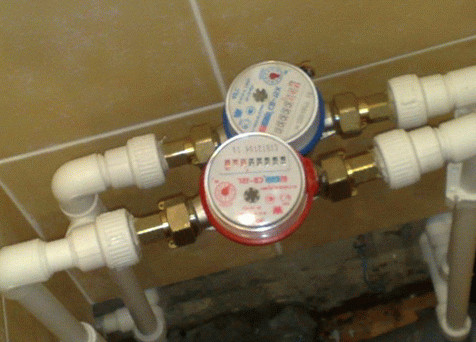
Thus, it turns out that if in an apartment in which three people are registered and actually live, the savings from installing water meters will be 1,318.64 rubles. in just one month.
By the way, in one year the savings will amount to 15,823.68 rubles. (1,318.64 * 12 = 15,823.68 rubles)!
Installation instructions
First, apply with the appropriate application for the installation of the device at the place of residence. ZhEK gives the applicant all the technical information that may be needed during installation. This is the most important condition that will avoid problems with registration.
Now for the technical part:
- Inspect the pipelines of hot and cold water supply, assess their condition, find out if there is a wiring from the risers. If the risers are equipped with conventional shut-off valves, it is advisable to replace them with more modern ball valves.
- As a rule, two meters are required. If there are several risers in the plumbing system, then you will have to buy devices for each of the risers separately.
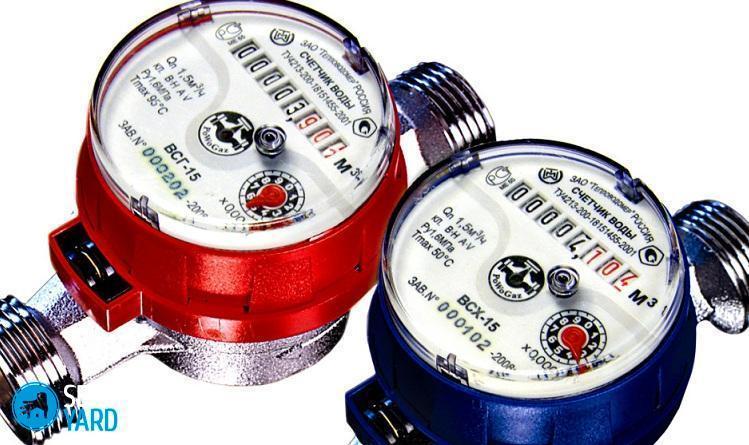
The parts are connected in accordance with the schemes received from the ZhEK. The assembly of the plumbing structure is carried out in the following order:
- Using the key, connect the filter to the water meter. Before connecting, wrap the thread with tow or FUM tape.
- Connect flexible hoses or squeegees, having previously processed their threads with FUM tape.
- After assembling the structure, turn off the water with a faucet or valve. Using a gas wrench, carefully disassemble the squeegee.
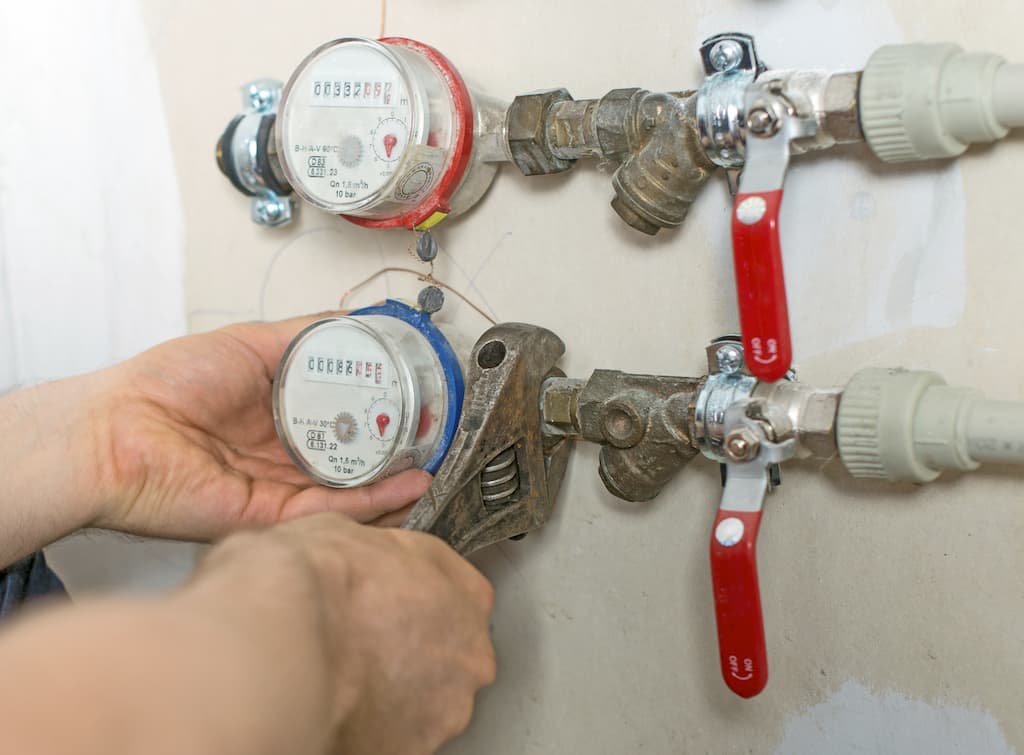
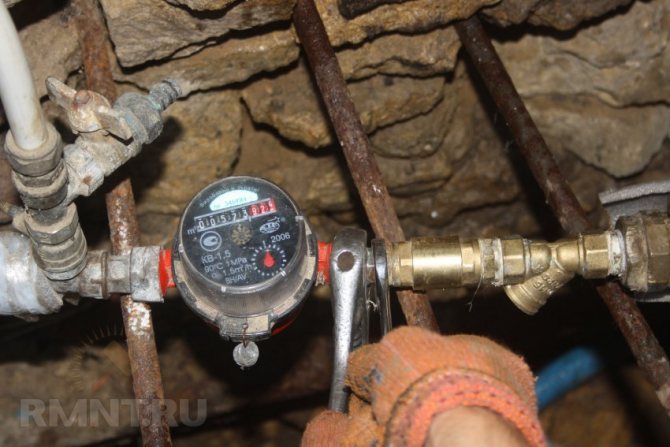
- Install a water meter in the resulting gap, connecting it to the shut-off valves on both sides. The filter is located on the water connection side. The index arrow of the device is directed towards the flow.
- The second counter is mounted in the same way.
As you can see, the work is quite understandable and not particularly laborious.
Comparison of tariffs with and without a water meter
The owners of premises with a meter pay for utilities according to indications - in this case, everything is quite simple.
Homeowners without metering devices will have to pay according to the standards, so it is important for them to take into account, which establishes the procedure for determining the rate of resource consumption per person. According to this document, the final decision is approved by the local authorities
For example, in Moscow cold water consumption rate is 6.94 m3, DHW - 4.75 m3, and in St. Petersburg 4.90 m3 and 3.48 m3, respectively
According to this document, the final decision is approved by the local authorities. For example, in Moscow, the rate of consumption of cold water is 6.94 m3, hot water - 4.75 m3, and in St. Petersburg 4.90 m3 and 3.48 m3, respectively.
The installed meter simplifies the process of calculating the amount due: it is enough to find the product of the device readings and the current tariff, taking into account the category of water supply.
In the absence of a device, the owner of the premises needs to:
- Find out the number of persons registered in this residential area.
- Clarify the water standard established by local authorities for the current period.
- Find out rates.
- Take into account the multiplying factor, which was introduced by Decree of the Government of the Russian Federation No. 344 of 2013. It applies to premises where a metering device is not installed or it is in a faulty condition. This indicator is 1.5.
For a more complete understanding, it is worth analyzing a specific example of calculating water fees without a meter for a family of three, registered in St. Petersburg:
- the rate of consumption of cold water per person - 4.9 m3;
- tariff for 1 m3 of cold water - 30.8 rubles;
- DHW consumption rate per person - 3.49 m3;
- the tariff for 1 m3 of hot water supply is 106.5 rubles.
The amount payable for water supply is determined as follows:
- For cold water 679.1 rubles = 3 * 4.9 * 30.8 * 1.5.
- For hot water 1,672.6 rubles = 3 * 3.49 * 106.5 * 1.5.
- Total 2351.7 rubles = 1672.6 + 679.1.
The real average monthly water consumption per person is: 2.92 m3 of cold water and 2.04 m3 of hot water. That is, the same family of three, after installing the meter, will need to pay:
- For cold water 269.8 rubles = 3 * 2.92 * 30.8.
- For hot water 651.8 rubles = 3 * 2.04 * 106.5.
- Total 921.6 rubles = 269.8 + 651.8.
After installing the meter, a family from St. Petersburg will have to pay almost 3 times less, which speaks in favor of the availability of the necessary equipment.
How much do you have to pay for community services?
The receipt for utilities also has a column "Common house needs", which the owners of MKD are forced to pay. This item includes the cost of water for cleaning premises, entrances, elevators, watering the club in the adjacent area, etc.
How much you have to pay depends on the availability of a common house and individual metering device.
If the devices are installed, payment is made as follows:
- When calculating ODN, first of all, readings are taken - PU shows how much resources were consumed by MKD during the reporting period.
For example, 2 thousand m3 is the amount of water that was used both for general house consumption and for individual consumption (by apartment owners).
- Further, the readings of the IPU, which were provided by the owners of the premises, are summarized. For example, 1.8 thousand m3. To ensure the correctness of the flow balance, the values for the general and individual devices are taken at the same time.
- At the third stage, the volume of consumption is allocated for the maintenance of common areas: 200 m3 = 2,000 - 1,800 (as much was spent on watering flower beds, washing entrances, etc.).
- The fourth step is the distribution of ODN to all tenants. To do this, you need to determine the volume per 1 m2. Let's say the total area of the MKD is 7 thousand m2. Then the desired value will be: 0.038 m3 = 200/7,000.
- To obtain a calculation for a specific apartment, you need to multiply the identified volume by the area of \u200b\u200bhousing. For example, it is 50 m2: 1.9 m3 = 0.038 * 50.
At the end, payment is calculated taking into account regional tariffs. A family from St. Petersburg will have to pay: 58.5 rubles = 1.9 * 30.8. If there is no common house meter, the calculation is carried out according to the established standards, taking into account the multiplying factor, which implies an increase in the amount by 4-5 times.



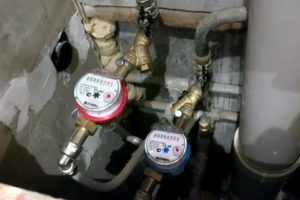

Water meter replacement procedure
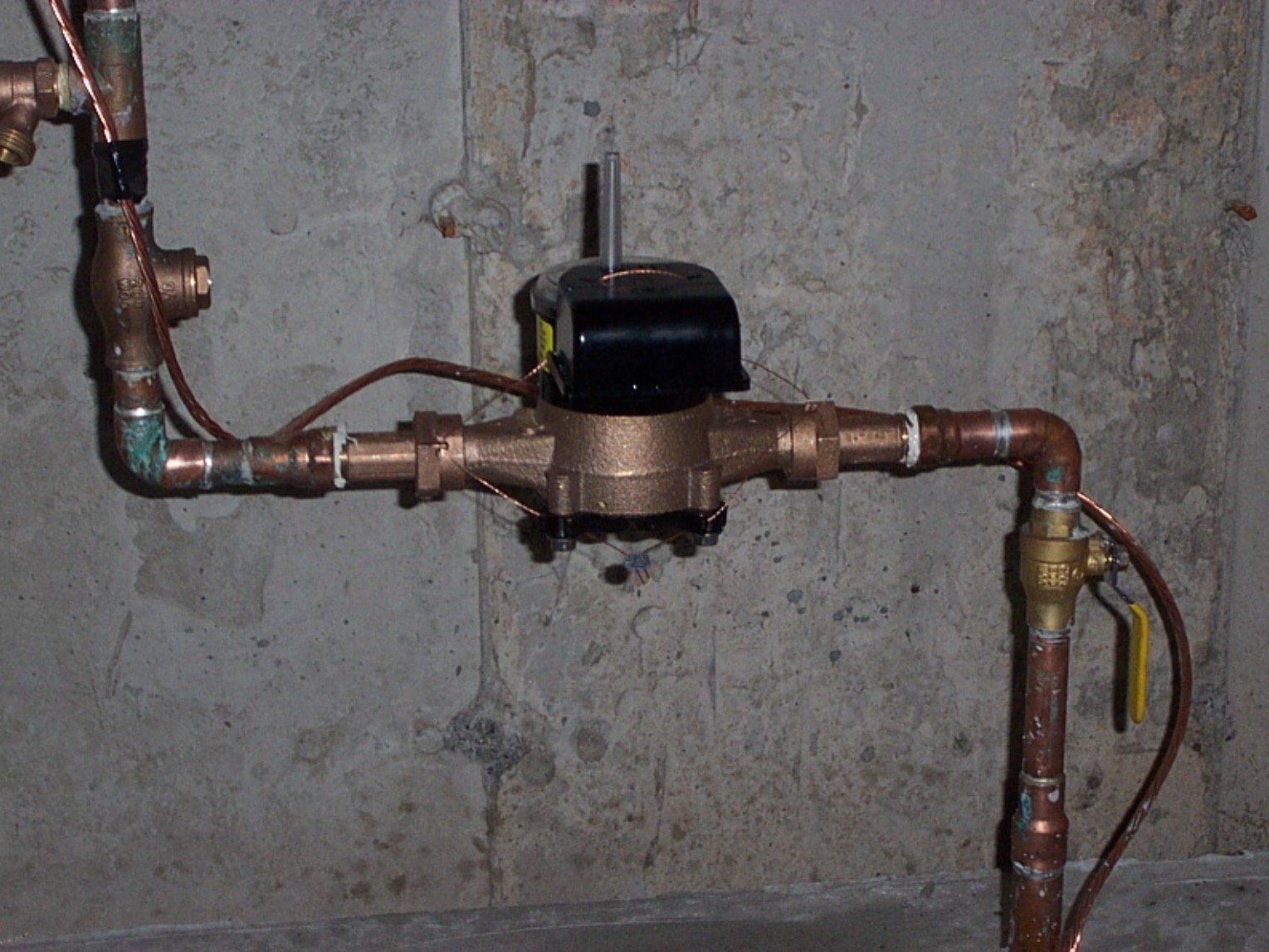
Alternative verification of water meters – their replacement, which involves the dismantling of the old registrar and installing a new appliance.
Is it possible not to change meters for water, but to make a verification? Yes, if the service life of the device permits.On average, the life of a water meter is 12 years, which means that it can pass 2-3 verifications.
Replacement of the water meter is necessary only if the verification showed a malfunction and the impossibility of repairing the device. Be sure to change devices that are recognized as unsuitable for further use.
The reasons are indicated in the act. It :
- natural wear and tear;
- obstruction of the pipes;
- housing depressurization due to mechanical impact;
- leak, etc.
All these factors serve as the basis for the mandatory reinstallation of the water meter.
How to replace?
To replace a broken meter, the owner must:
- Buy a new meter.
- Warn the management company about this fact and agree with it on the replacement period. The involvement of an employee of the Criminal Code is necessary, since the replacement of a water meter requires turning off the water throughout the riser.
- Arrange with a specialist installing metering devices.
- Prepare a place for work: disassemble the decorative box, move furniture or household appliances.
- At the end of the work, invite a representative of the Criminal Code to seal the new device (otherwise, the meter readings will not be accepted).
After installing the seal, the meter is ready for operation.
Replacement terms
It is impossible to answer this question unambiguously. Everything is very individual. Much depends on the water meters themselves, their quality, material, manufacturer.
The minimum figure is 6 years. This is the generally accepted timeframe for replacing used hot and cold water meters.
The average is 12 years. But the water meter can last up to 18 years.
They change the old device to a new one when unreliable indicators are recorded, or it is completely broken.
The service life is usually 4 years for a hot water meter and 6 years for a cold water meter. But if the meter works perfectly after this period, then you do not need to change it. It is enough to check periodically.
Documentation
After replacing the water meter, the owner will have a commissioning document from the contractor and a technical passport for the device.
Can I replace the water meter myself? Yes, the law allows for self-replacement of the water meter.
But after installing it, you should call the controller from the resource supplying organization, who will record the replacement of the device, take readings from both devices: dismantled and new. Next, the specialist will draw up an installation act and transfer this information to the employees of the accounting department.
What is an act of verification?
The certificate of verification of water meters is a document confirming the operability of measuring instruments, which guarantees the accuracy of their readings until the next diagnosis.
Who is doing verification of water meters without replacement and draws up an act? This is done by a specialist of the organization that performs verification.
The company that performs the verification of meters must necessarily obtain an accreditation certificate for the right to engage in this type of activity, to own the necessary equipment.
The act contains the following information:
- The name of the organization performing the verification.
- Information about the certificate of accreditation.
- Information about the meter: model, serial number, verification results, date of issue of the act, from which the countdown to the next verification will be conducted.



