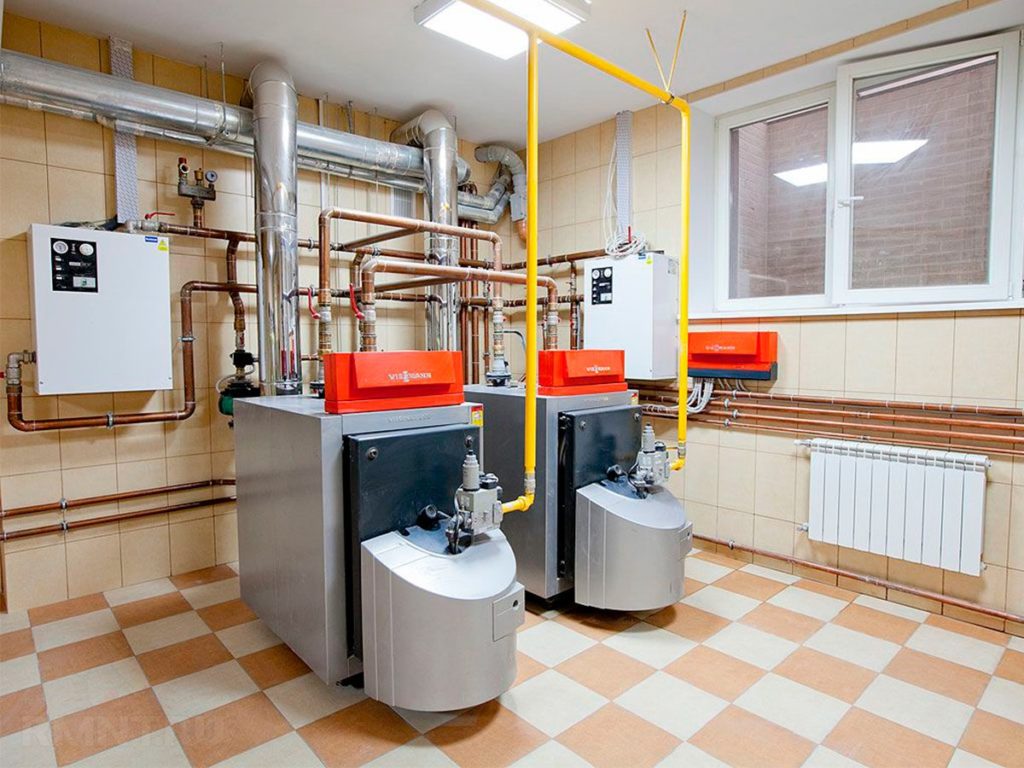
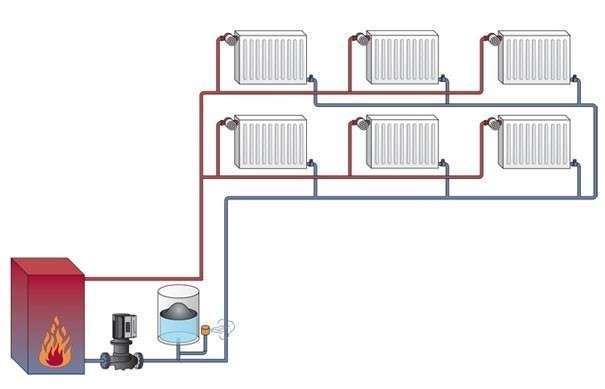
- One-pipe and two-pipe water heating system
- Do-it-yourself heating installation in a private house
- Selection of the optimal heating scheme
- The latest heating systems
- Feature of the horizontal pipe laying scheme
- Central horizontal heating
- Autonomous horizontal heating
- Collector scheme for heating a one-story house with forced circulation
- Main advantages
- Classification of heating systems of a private house
- Partitions
- Final stage of work
- Radiators
- Description of the installation of a two-pipe heating system with your own hands
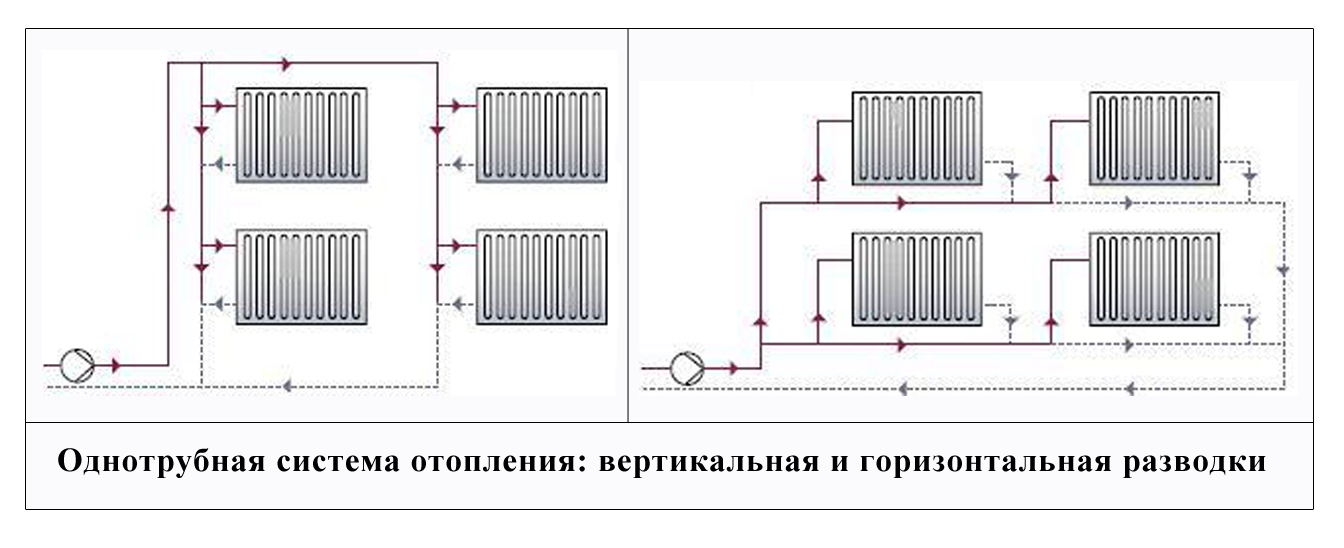
- Single pipe schemes
- Single pipe horizontal
- Single pipe vertical wiring
- Leningradka
One-pipe and two-pipe water heating system
In the process
designing a heating system choose one of the schemes - collector,
single pipe or double pipe. The most popular and demanded option -
two-pipe system with parallel connection of radiators. With such a system
various connection schemes are used: loop, sectional, star-shaped.
This type of wiring provides for the supply of individual pipes to each radiator,
which are connected to the manifold. This makes it possible to effectively regulate
coolant temperature and carry out concealed installation of pipes of a small
diameter.
Do-it-yourself heating installation in a private house
preliminary
do-it-yourself drawing up of a heating installation scheme for a private house, indicating
the location of radiators, the boiler and auxiliary devices is the key to a long and
uninterrupted operation of water heating. The scheme is drawn up in compliance with
specifications:
- Installation of two or more batteries in one room should
done at the same level. - Between the radiator and the floor, the distance is not less than 6
cm. - Radiators are mounted under the windows, in the corner
rooms, it is necessary to install an additional battery adjacent to the street
wall.
Power
boiler should be at least 1 kW per 10 sq. m living room. For a small
a boiler with a capacity of 25 kW will be enough at home, while large cottages and estates
over 350 sq. m are equipped with boilers with a capacity of about 50-65 kW.
It is advisable to use a forced water heating system
circulation, which allows to optimize fuel consumption, as well as providing
increased comfort thanks to automation systems.
Boiler installation
After
drawing up a diagram of the installation of heating in a private house with their own hands is done in
following order:
- Installation of the boiler on a special concrete
stand or asbestos block, it is not allowed to install a gas boiler in
basement. - Connecting the boiler to the chimney. The joint must be sealed
clay, which does not collapse under the influence of high temperatures. - Installation of radiators in regular places (under
windows and along the walls adjacent to the street). Radiators are easy to mount on
special brackets fixed in the wall with dowels.
Installation of radiators
For
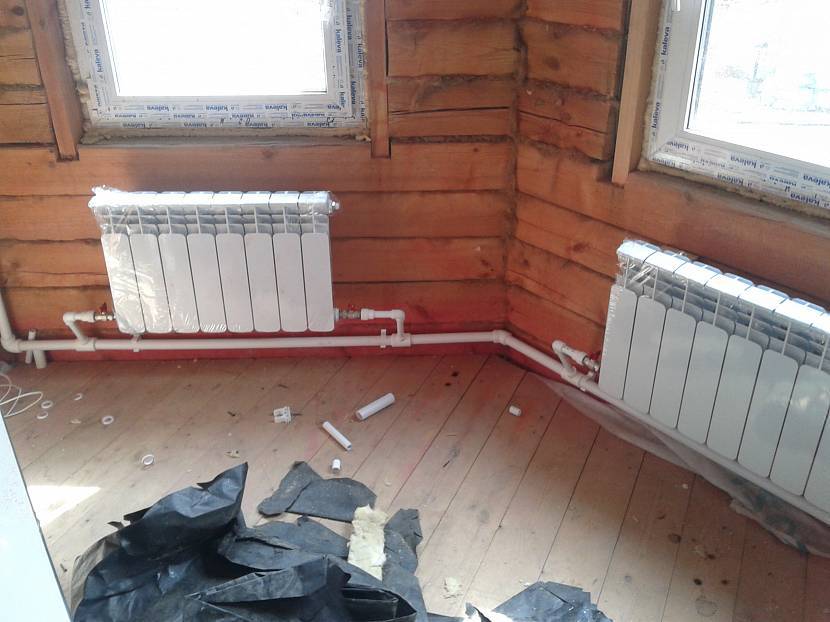
correct installation, it is necessary to make a preliminary marking of the walls on one
level so that all radiators are in a strictly horizontal position on
a distance of 6-7 cm from the floor. This will ensure optimal circulation of the coolant.
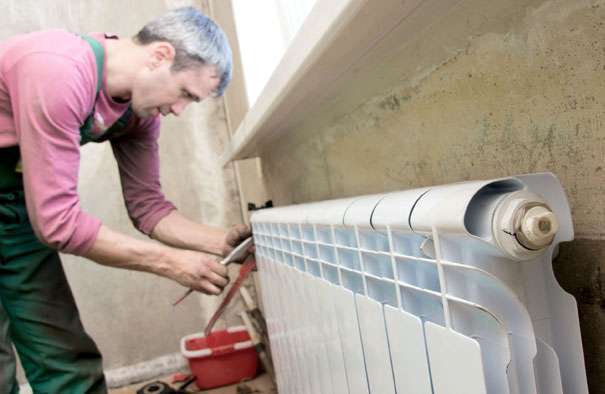
The distance from the wall is at least 2 cm. It is desirable to mount radiators, not
removing the factory packaging. After completing the installation of heating, carry out a test
start, and only then remove the packaging.
Installation of pipes and auxiliary elements
- Pipes are connected in various ways in
depending on the material from which they are made (soldering, welding,
crimping). - The heat pump is mounted on the return pipe
current, given that the flow of water must go to the boiler. - The expansion tank is mounted in the highest
point of the system with the flow cut off by a ball valve. Approximate height from the boiler -
3m. - Drainage of water, closed by a ball valve,
installed at the lowest point of the system. - Installation of additional pipes for organization
water flow bypassing the circulation pump (ensures the operation of the boiler when
faulty pump). - Installation of ball valves at joints
radiators and additional elements for quick dismantling and replacement
equipment during repairs. - Installation of balancing valves for adjustment
hydraulic resistance of the system (mandatory installation if available in
system of two or more risers).
quality
do-it-yourself heating system of a private house is subject to
mandatory inspection in the presence of professional craftsmen. After a successful
test run, you can start operating water heating.
What type of water heating system do you consider the most efficient? Share your opinion on .
Selection of the optimal heating scheme
To heat a home, the following schemes are most often used, how to install a heating boiler in a private house:
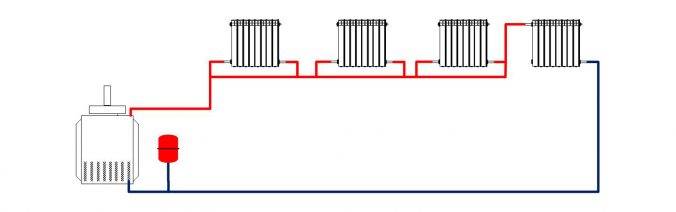
- Single-pipe. One manifold supplies all radiators. It plays the role of both supply and return, as it is laid in a closed loop next to all batteries.
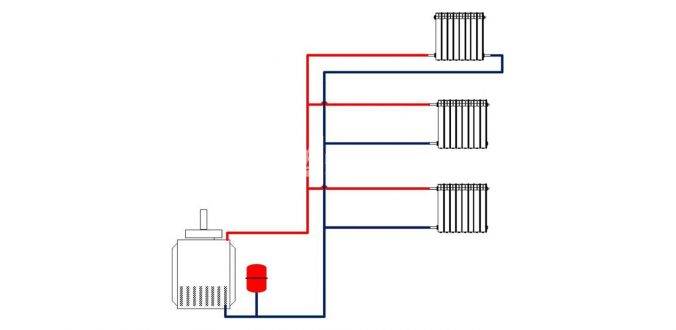
- Two-pipe. In this case, a separate return and supply is applied.
To choose the most optimal scheme for installing a heating boiler in a private house, it is recommended to consult with a specialist. However, in any case, a two-pipe system is a more progressive solution to the question of which heating scheme is best for a private house. Although at first glance it may seem that a single-pipe system saves on material, practice shows that such systems are both more expensive and more complicated.
It is important to understand that inside a single-pipe system, water cools much faster: as a result, more distant radiators have to be equipped with a large number of sections. Also, the distribution manifold must have a sufficient diameter that exceeds the two-pipe wiring lines.
In addition, in this scheme, there is a serious difficulty in organizing automatic control due to the influence of radiators on each other.
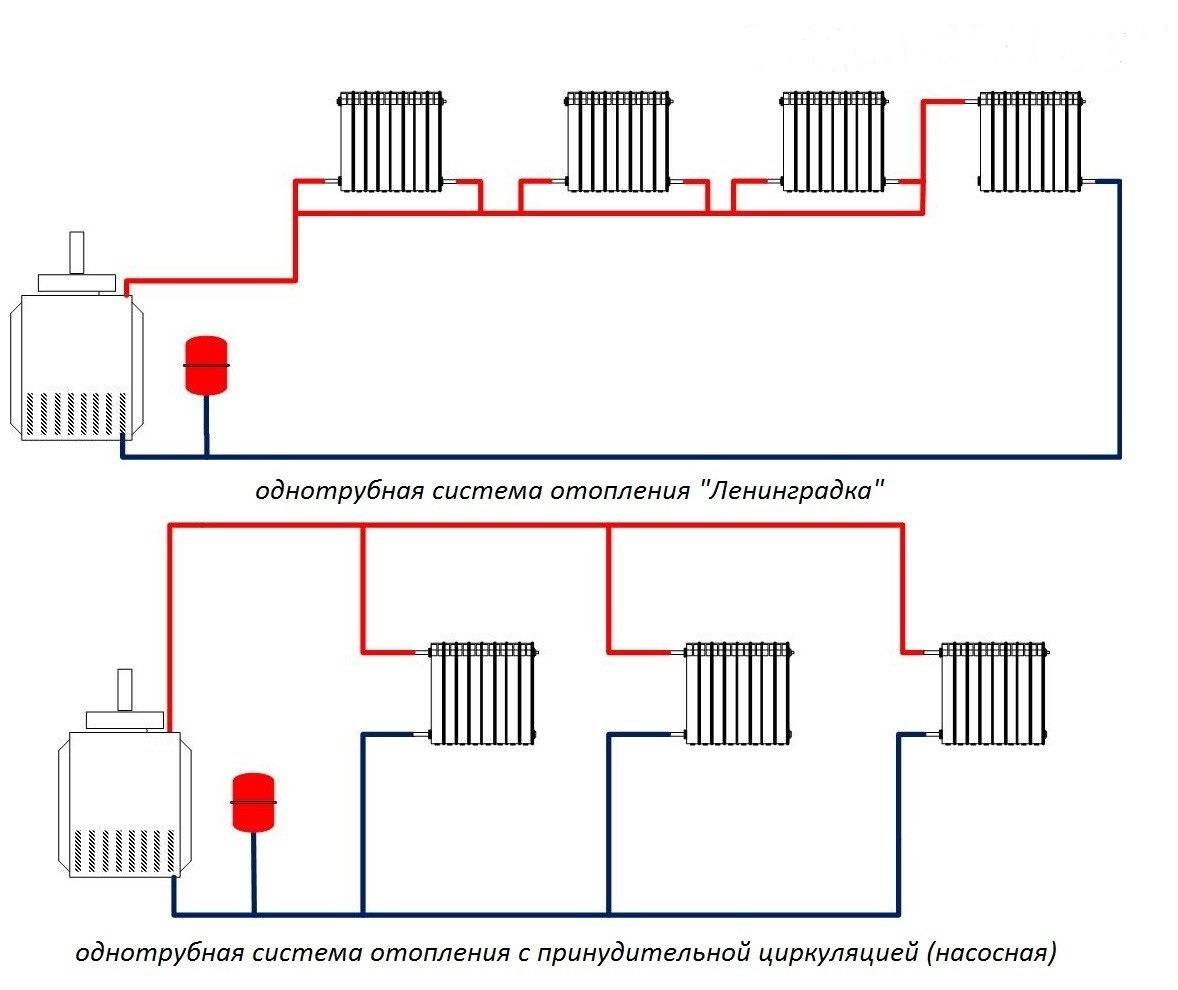
Small buildings such as summer cottages, where the number of radiators does not exceed 5, can be safely equipped with a single-pipe horizontal heating system for a private house with your own hands (it is also called "Leningradka"). If the number of batteries is increased, there will be failures in its functioning. Another application of such a decoupling is single-pipe vertical risers in two-story cottages. Such schemes are quite common and work without failures.
Two-pipe decoupling ensures delivery of coolant of the same temperature to all batteries. This allows you to refuse to build sections. The presence of a supply and return pipe creates optimal conditions for the introduction of automatic control of radiators, for which thermostatic valves are used. In this case, you can take pipes of smaller diameter and simpler schemes.



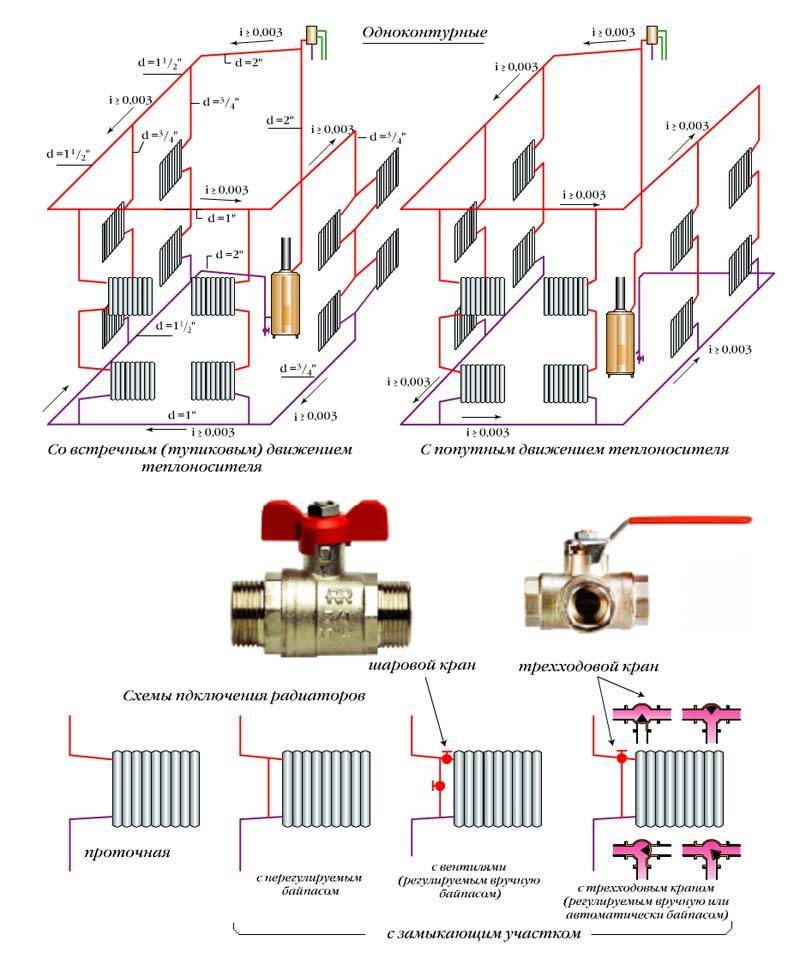


What are the heating schemes for a private house of a two-pipe type:
- dead end. In this case, the pipeline consists of separate branches, inside which the oncoming movement of the coolant is used.
- Associated two-pipe. Here, the return line acts as a continuation of the supply, which ensures the annular movement of the coolant inside the circuit.
- Radiation. The most expensive schemes, where each radiator has a separately laid hidden way (in the floor) line from the collector.
If, when laying horizontal lines of large diameter, a slope of 3-5 mm / m is used, then the gravitational mode of operation of the system will be achieved, and circulation pumps can be omitted. Thanks to this, complete energy independence of the system is achieved. This principle can be applied to both single-pipe and two-pipe schemes: the main thing is to create conditions for gravity-flow circulation of the coolant.
In open heating systems, an expansion tank will be required at the highest point: this approach is mandatory when arranging gravity circuits. However, the return pipe next to the boiler can be equipped with a diaphragm expander, which makes it possible to make the system closed, operating under overpressure conditions. This approach is considered more modern, and is most often used in forced-type systems.
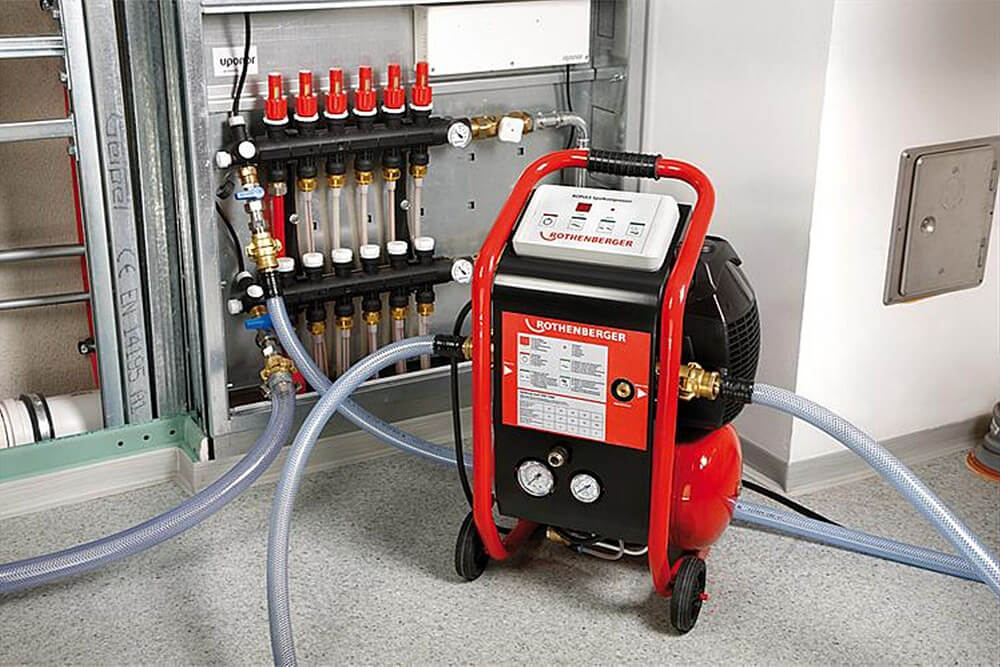
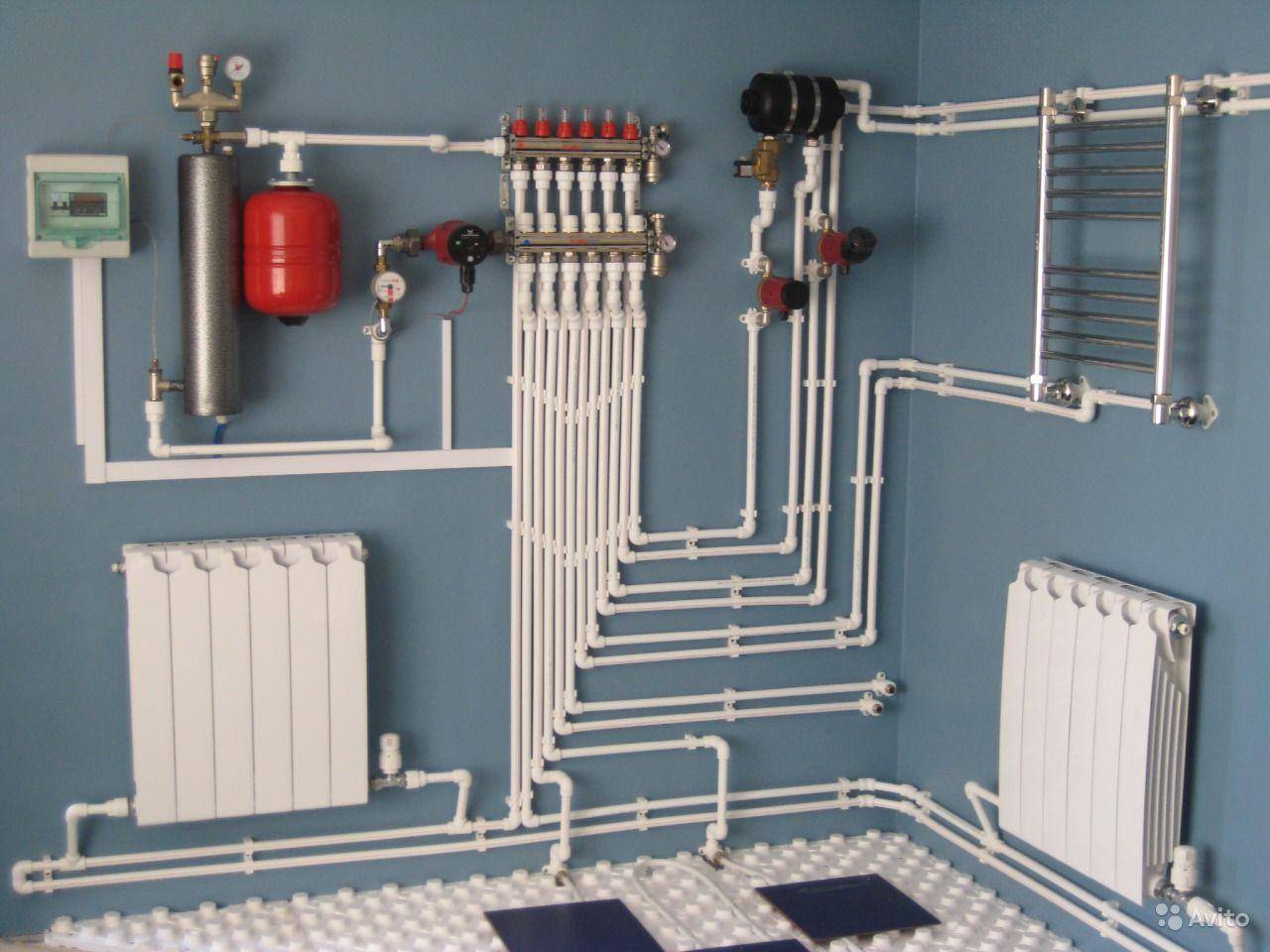
Underfloor heating deserves special mention when researching which heating scheme to choose for a private house. Such a system is quite expensive, since it requires several hundred meters of pipeline to be laid in a screed: this allows each room to be provided with a separate heating water circuit. The pipes are switched on the distribution manifold, which has a mixing unit and its own circulation pump. As a result, rooms are heated very evenly and economically, in a form that is comfortable for people. This type of heating can be used in various residential premises.
The latest heating systems
An example of a fairly affordable and at the same time effective system, suitable for both a country house and an apartment, is an electric underfloor heating. Having incurred relatively small expenses for the installation of such heating, it is possible to provide a home with heat and not buy any boilers. The only drawback is the cost of electricity. But given that modern floor heating is quite economical, yes, if you have a multi-tariff meter, this option may be acceptable.
For reference. When installing an electric floor heating, 2 types of heaters are used: a thin polymer film with coated carbon elements or a heating cable.
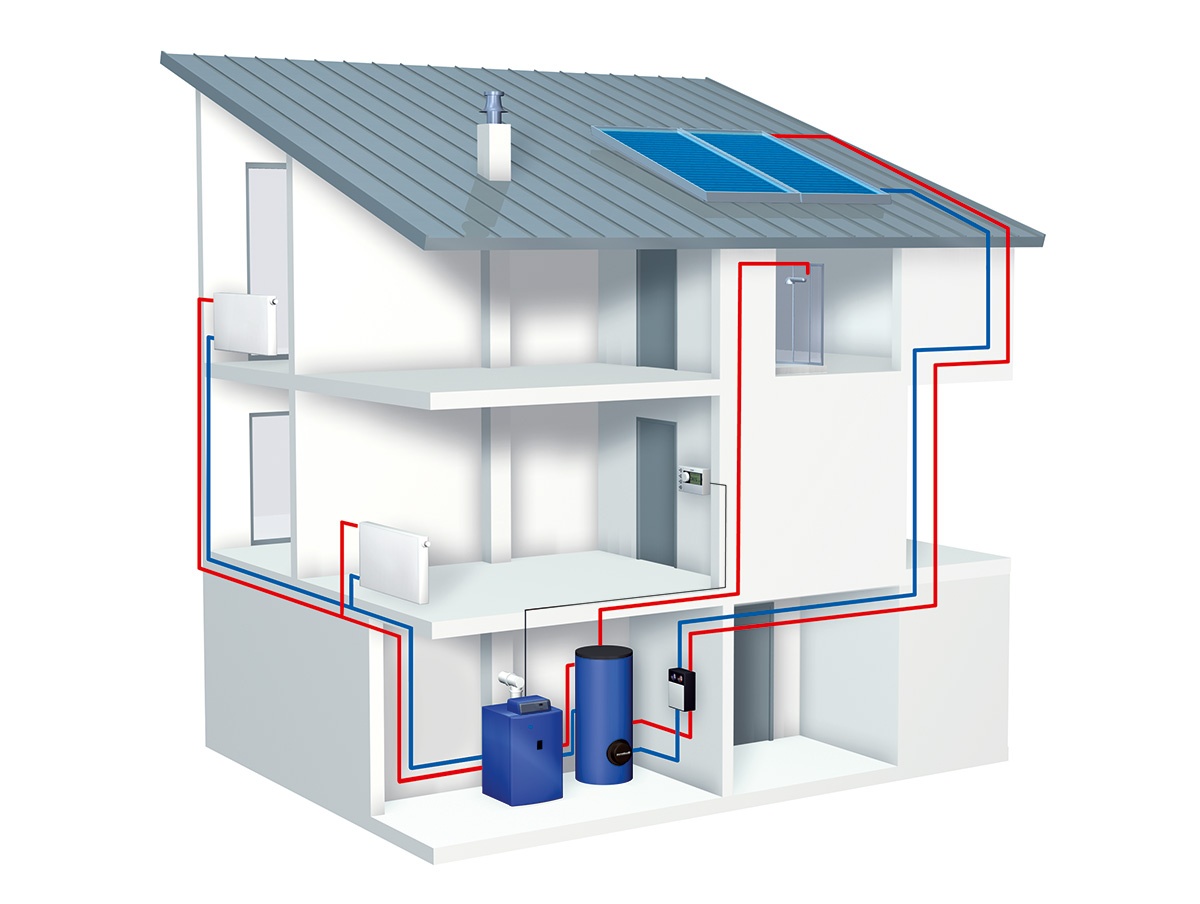
In the southern regions with high solar activity, another modern heating system performs well. These are water solar collectors installed on the roof of buildings or other open places. In them, with minimal losses, water is heated directly from the sun, after which it is fed into the house.One problem - the collectors are absolutely useless at night, as well as in the northern regions.
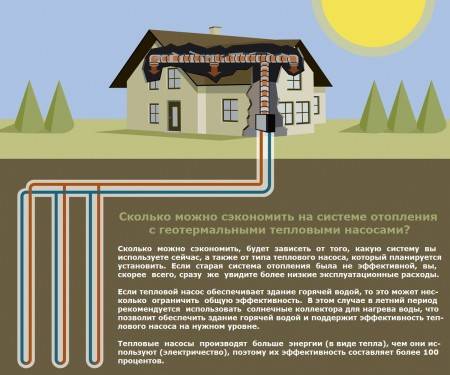
Various solar systems that take heat from the earth, water and air and transfer it to a private house are installations in which the most modern heating technologies are implemented. Consuming only 3-5 kW of electricity, these units are able to "pump" from the outside 5-10 times more heat, hence the name - heat pumps. Further, with the help of this thermal energy, you can heat the coolant or air - at your discretion.
An example of an air heat pump is a conventional air conditioner, the principle of operation is the same for them. Only the solar system equally well heats a country house in winter and cools in summer.
It is a well-known fact that the more efficient an innovation in a heating system is, the more expensive it is, although it requires lower operating costs. Conversely, high-tech electric heating systems that are cheap to install make us pay later for the electricity we use. Heat pumps are so expensive that they are not available to most citizens of the post-Soviet space.
The second reason why homeowners gravitate towards traditional systems is the direct dependence of modern heating equipment on the availability of electricity. For residents of remote areas, this fact plays a big role, because they prefer to build brick ovens and heat the house with wood.
Feature of the horizontal pipe laying scheme
Scheme of horizontal heating in a two-story house
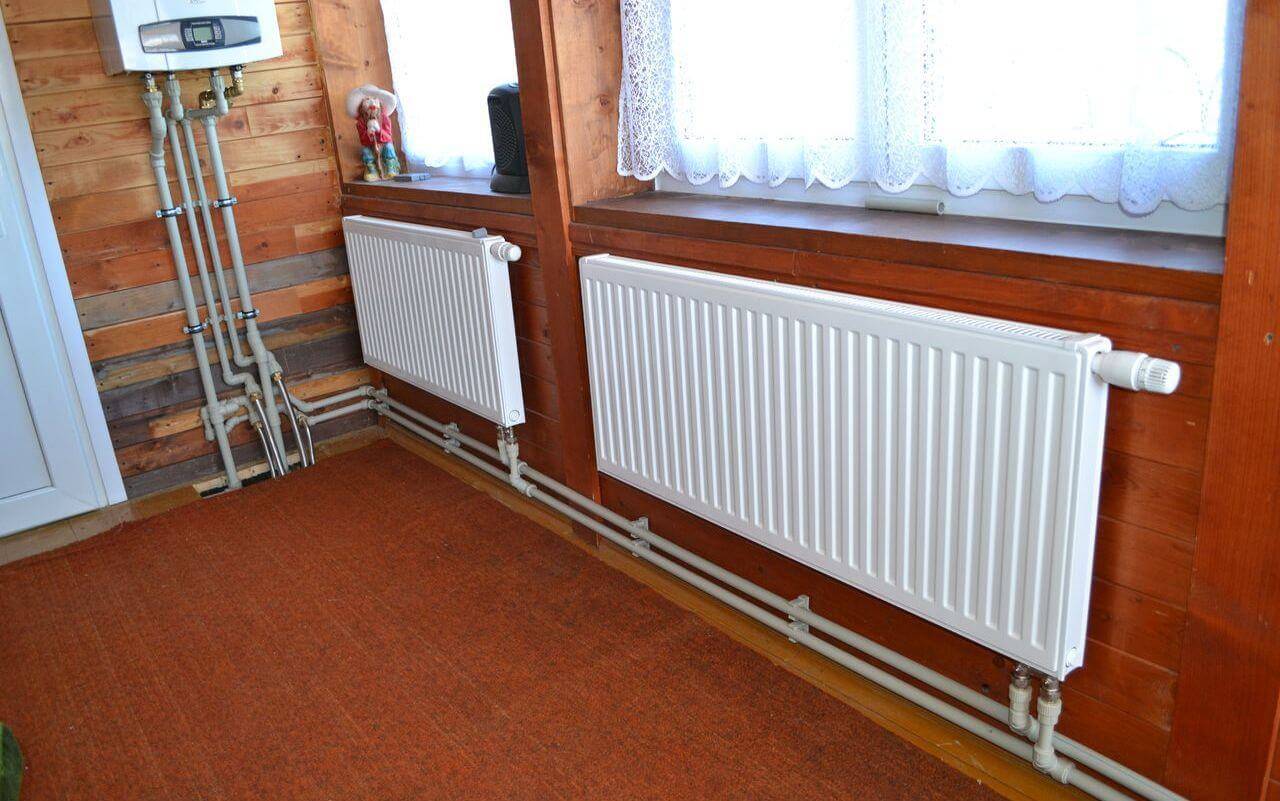
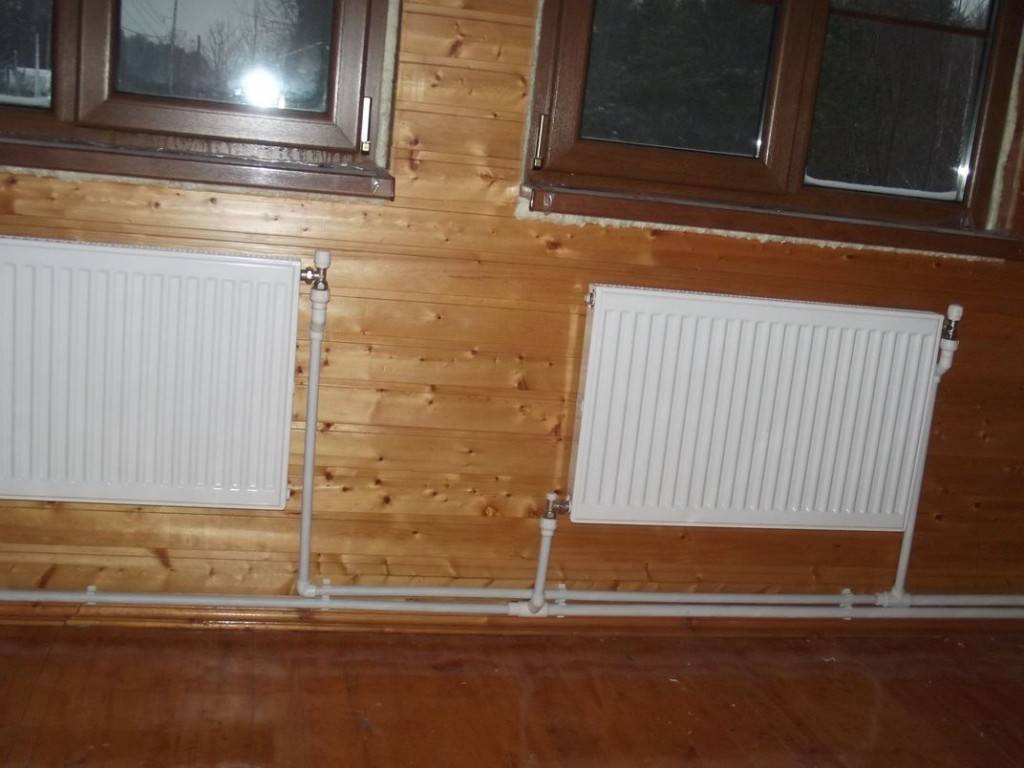
In the vast majority of cases, a horizontal two-pipe heating system with bottom wiring is installed in one or two-story private houses. But, besides this, it can be used to connect to centralized heating.A feature of such a system is the horizontal arrangement of the main and return (for a two-pipe) line.
When choosing this piping system, it is necessary to take into account the nuances of connecting to various types of heating.
Central horizontal heating
To draw up an engineering scheme, one should be guided by the norms of SNiP 41-01-2003. It says that the horizontal wiring of the heating system should ensure not only proper circulation of the coolant, but also ensure its accounting. To do this, two risers are equipped in apartment buildings - with hot water and for receiving cooled liquid. Be sure to calculate a horizontal two-pipe heating system, which includes the installation of a heat meter. It is installed on the inlet pipe immediately after connecting the pipe to the riser.
In addition, hydraulic resistance is taken into account in certain sections of the highway.
This is important, since the horizontal wiring of the heating system will only work effectively while maintaining the appropriate pressure of the coolant.
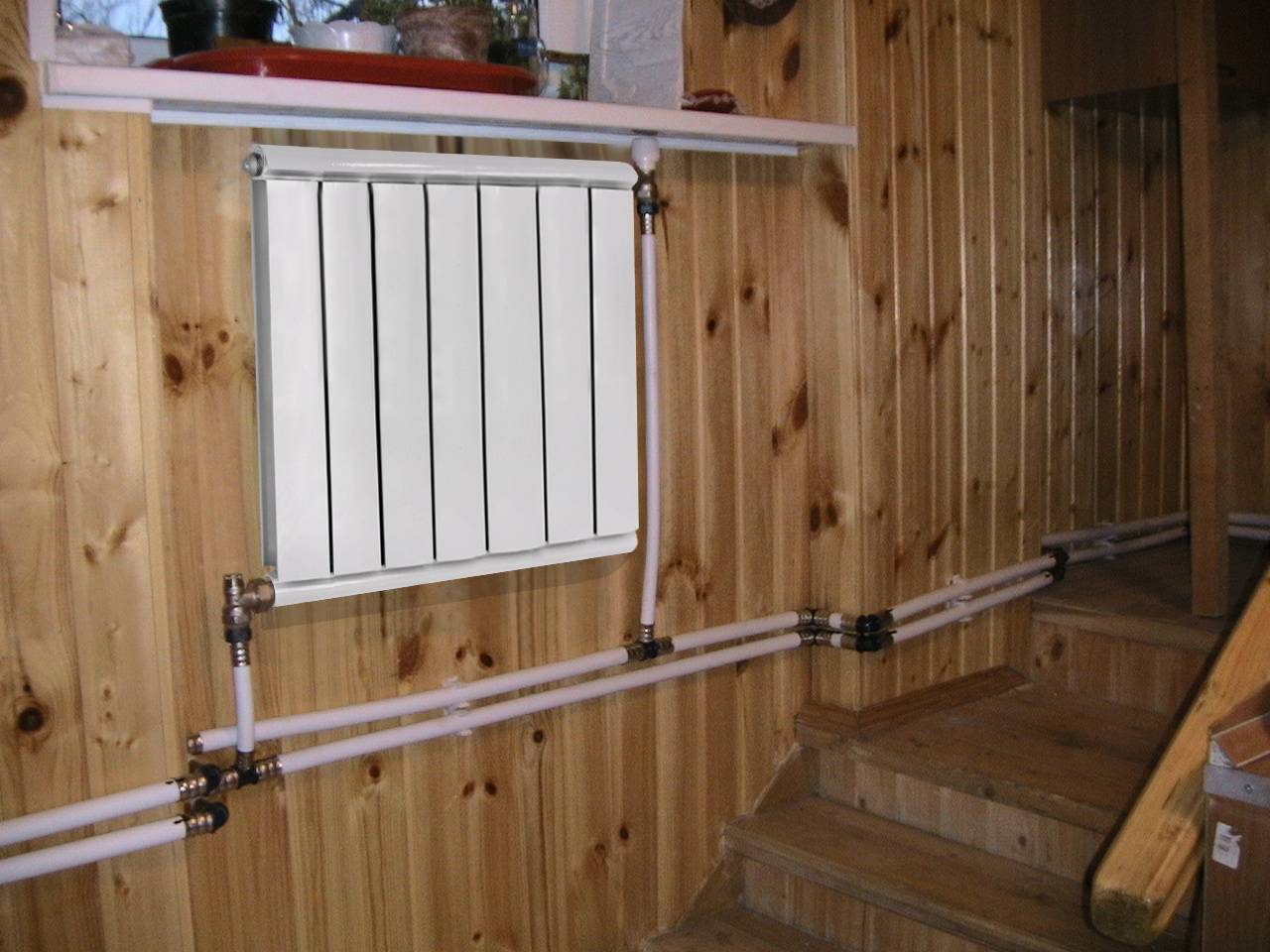
In most cases, a single-pipe horizontal heating system with a lower wiring is installed for apartment buildings. Therefore, when choosing the number of sections in radiators, one must take into account their distance from the central distribution riser. The further the battery is located, the larger its area should be.




Autonomous horizontal heating
Heating with natural circulation
In a private house or in an apartment without a central heating connection, a horizontal heating system with a lower wiring is most often chosen.However, it is necessary to take into account the mode of operation - with natural circulation or forced under pressure. In the first case, immediately from the boiler, a vertical riser is mounted to which horizontal sections are connected.
The advantages of this arrangement for maintaining a comfortable temperature level include the following:
- The minimum cost for the purchase of consumables. In particular, a horizontal single-pipe heating system with natural circulation does not include a circulation pump, a membrane expansion tank and protective fittings - air vents;
- Work reliability. Since the pressure in the pipes is equal to atmospheric pressure, the excess temperature is compensated with the help of an expansion tank.
But there are also disadvantages to be noted. The main one is the inertia of the system. Even a well-designed horizontal single-pipe heating system of a two-story house with natural circulation will not be able to provide rapid heating of the premises. This is due to the fact that the heating network begins its movement only after reaching a certain temperature. For houses with a large area (from 150 sq.m.) and with two floors or more, a horizontal heating system with lower wiring and forced circulation of the liquid is recommended.
Heating with forced circulation and horizontal pipes
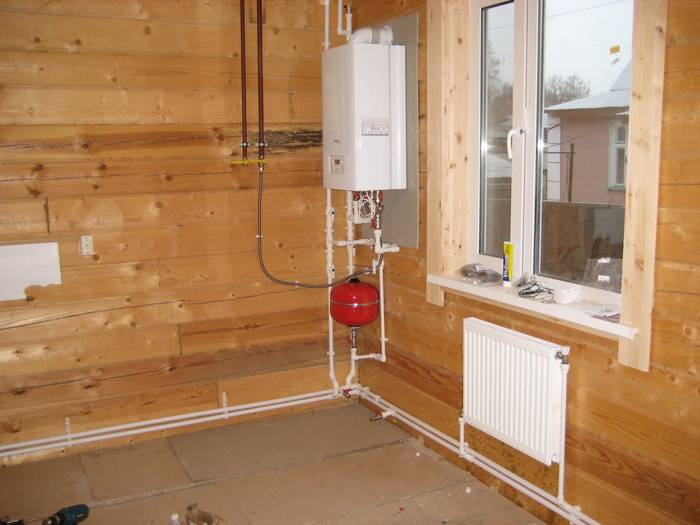
Unlike the above scheme, for forced circulation, it is not necessary to make a riser. The pressure of the coolant in a horizontal two-pipe heating system with bottom wiring is created using a circulation pump. This is reflected in the improvement of performance:
- Rapid distribution of hot water throughout the line;
- The ability to control the volume of coolant for each radiator (only for a two-pipe system);
- Requires less space for installation as there is no distribution riser.
In turn, the horizontal wiring of the heating system can be combined with a collector. This is true for long pipelines. Thus, it is possible to achieve an even distribution of hot water throughout all rooms of the house.
When calculating a horizontal two-pipe heating system, it is necessary to take into account the rotary nodes, it is in these places that the greatest hydraulic pressure losses are.
Collector scheme for heating a one-story house with forced circulation
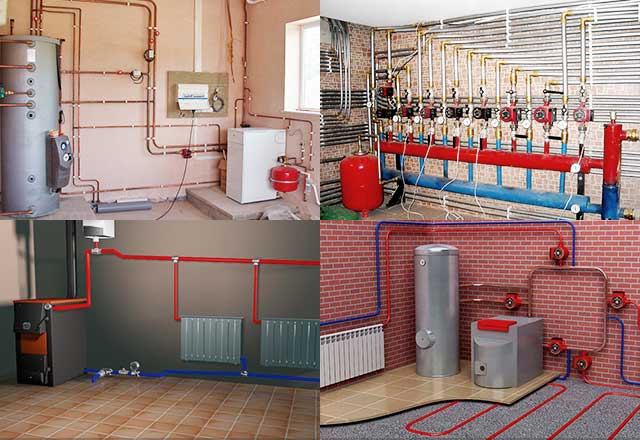
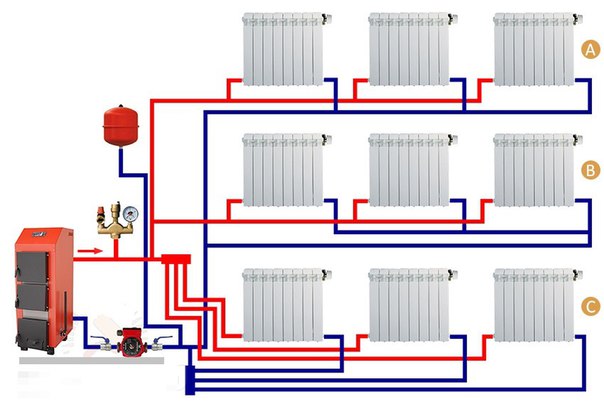
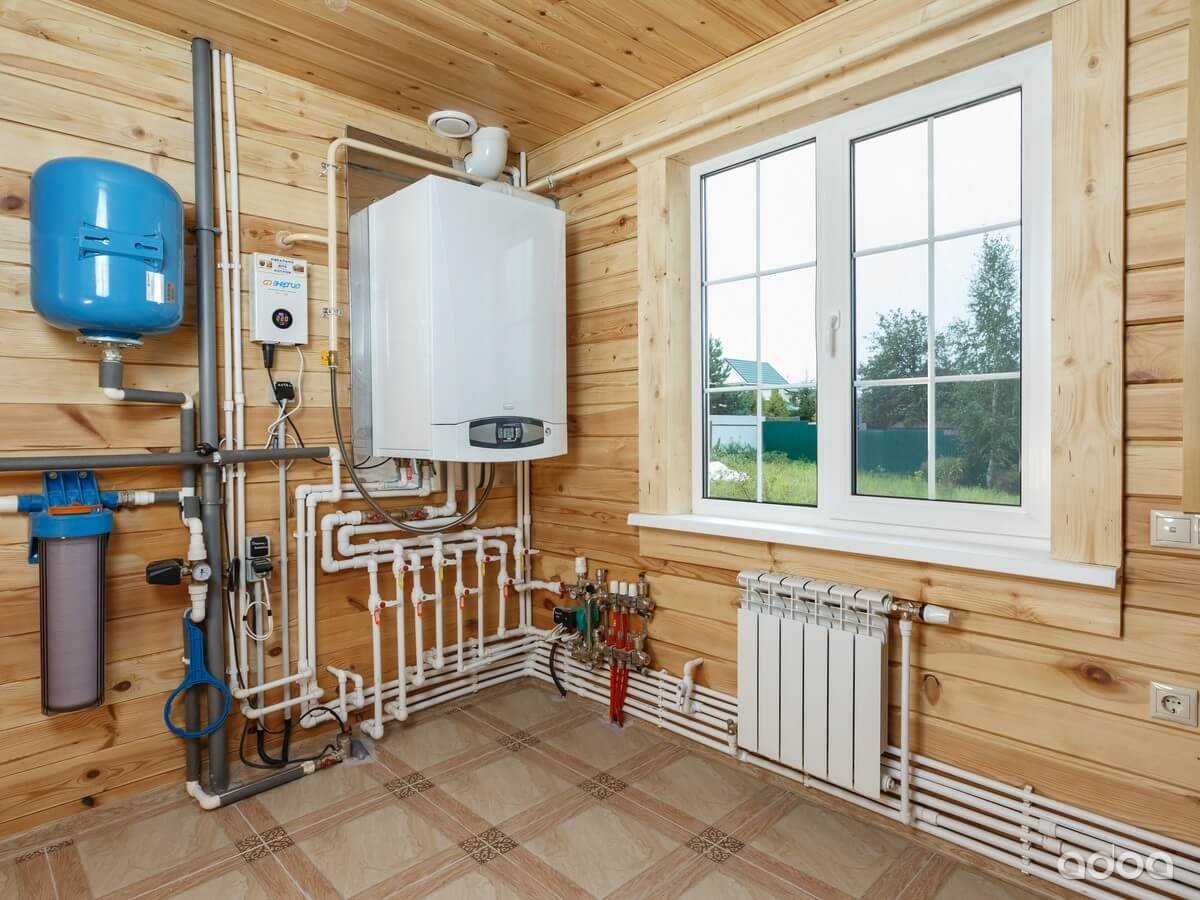
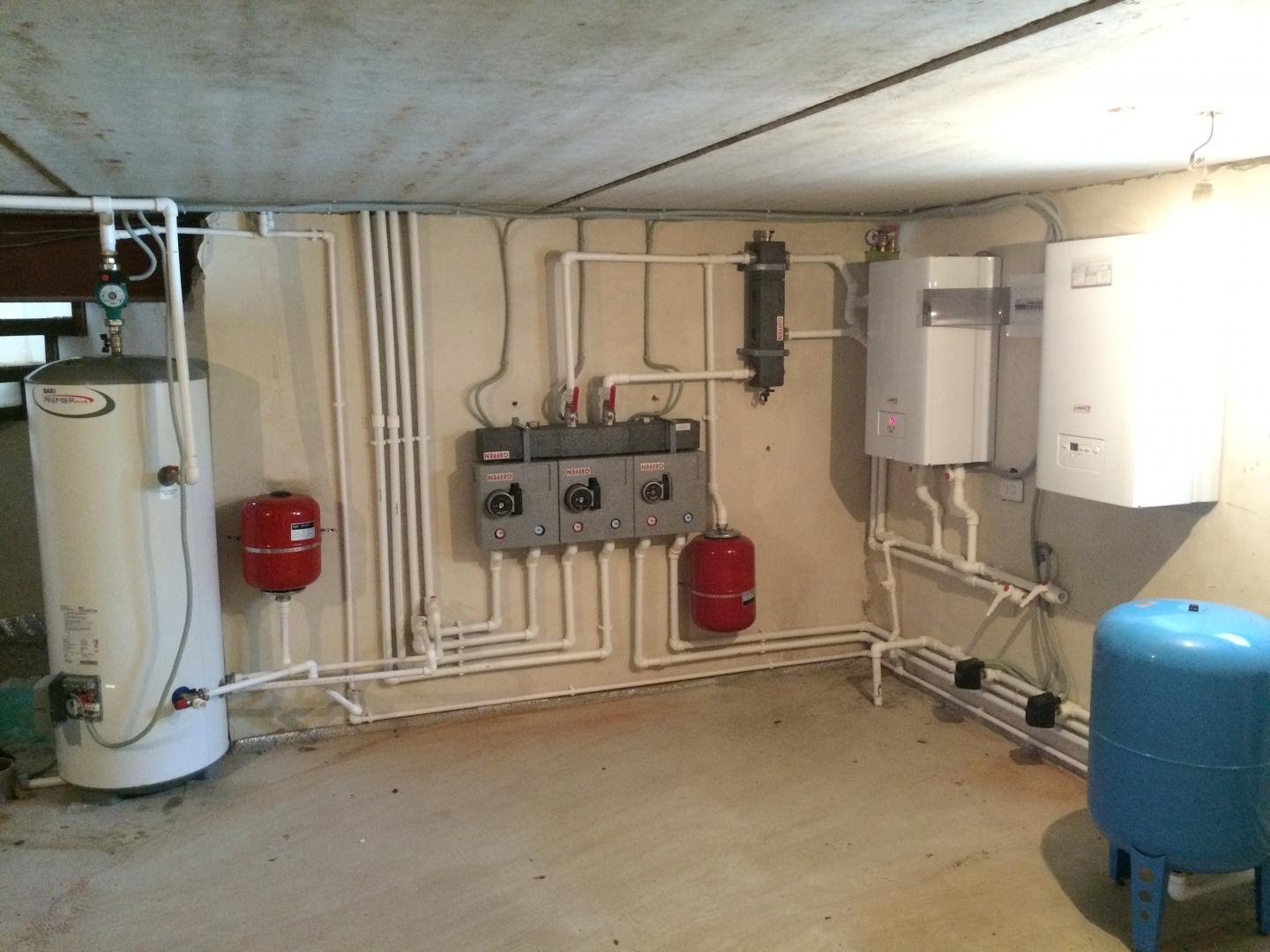
Another type of wiring is collector. This is the most complex system, involving the use of a large number of different pipes and special distribution devices, which are called collectors. The principle of operation of a system with a collector circuit for heating a one-story house with forced circulation is that boiling water from the boiler goes to special collectors that serve as distributors between various radiators. Each battery is connected to it by two pipes. Such a system, while effective, cannot boast of being cheap. It can regulate the temperature not only on each circuit, but also on each battery, which allows you to create your own temperature regime in any room.
For the development and installation of a collector heating system, it is better to invite specialists
They make such a heating scheme for a one-story house with forced circulation, since naturally water cannot circulate efficiently through numerous pipes and collectors. The essence of this scheme is that directly near the boiler a centrifugal circulation pump crashes into the return pipe, which continuously pumps water using an impeller. Due to this, the system develops the pressure necessary to completely pump the entire line, heating all the batteries evenly. If you purchased an expensive wall-mounted automatic boiler, then it most likely already has a circulation pump installed, which is set to the optimum pressure for this boiler. If your boiler is simple, then when buying a centrifugal pump, you need to consult about its compatibility in terms of pressure generated with this boiler in order to avoid an emergency.
Collector heating system compiled by a specialist
The collector circuit is rarely used in two-story houses, since it, although effective, is very cumbersome. The wiring for two floors will be too complicated. That is why it is in demand only in the heating scheme of a one-story house with forced circulation.
Useful advice! To install a collector water heating system in your country private house, you need to take care of purchasing the required number of thermostats and shut-off valves. This will allow you to adjust the climate in the house in a semi-automatic mode.
Circulation pump for forced water recirculation in the heating system
Summarizing the above, it can be noted that the choice of the three existing types of water heating wiring should be carried out deliberately. In a small one-story house, only one pipe can be laid. This scheme is also called "Leningrad". If the area of \u200b\u200bthe house is significant or it is two-story, then it is better to make a two-pipe heating system with a return pipe. To create a modern and efficient heating system in the house, you can mount it according to the collector scheme. It will cost more, but it will also be much more effective. The main thing is that any created system always works well and reliably in any, even difficult, conditions. To do this, you need to build it according to all the rules and recommendations.
Main advantages
The reasons for the popularity of water heating, especially in country houses, are not so few. Let's take a look at its main advantages together:
- You can quickly and efficiently control the temperature in each individual room of your home. For this, special equipment is installed - shut-off valves and temperature regulators.
- Such a heating system can be installed in a house at almost any stage of its construction. Moreover, even if the house is completely ready, you will not have any problems installing such a heating system.
- The equipment used for installation can be very diverse.
- The water itself, used here as a heat carrier, has excellent characteristics. It is cheap and affordable, conducts heat well, has a good heat capacity.
- There are many wiring options for such a system. You can choose one or the other based on many parameters, such as the area of \u200b\u200bthe house or your financial capabilities.
- Such systems are also versatile, since almost any fuel can be used with them.
Classification of heating systems of a private house
First of all, heating systems differ in the type of coolant and are:
- water, the most common and practical;
- air, a variation of which is an open fire system (i.e. a classic fireplace);
- electric, the most convenient to use.
In turn, water heating systems in a private house are classified according to the type of wiring and are single-pipe, collector and two-pipe. In addition, for them there is also a classification according to the energy carrier required for the operation of the heating device (gas, solid or liquid fuel, electricity), and according to the number of circuits (1 or 2). These systems are also divided by pipe material (copper, steel, polymers).


Partitions
The interior of the kitchen and living room begin to think over from the docking of the two zones.
- Here are some of the ways and objects that delimit space:
- installation of a bar counter;
- kitchen island;
- big table;
- installation of a low partition.
Designers advise installing a wide rack, since it will be possible to sit at it like at a regular table, and high chairs are quite suitable for the whole family.
However, narrow racks are installed in small rooms (16 sq m). Kitchen islands are convenient to use, but are only suitable for large kitchen-dining rooms (25 sq m or 30 sq m). Capital low partitions are installed only if it is decided in advance what they will be used for (for example, as a TV stand).
Final stage of work
In general, a well-designed, productive scheme for heating a residential apartment building allows you to achieve good performance in matters of heat supply and heating.
- How to pour water into an open and closed heating system?
- Popular Russian-made outdoor gas boiler
- How to correctly bleed air from a heating radiator?
- Expansion tank for closed heating: device and principle of operation
- Gas double-circuit wall-mounted boiler Navien: error codes in case of malfunction
Recommended reading
How is the heating in the apartment calculated correctly? Why do we need heat meters for heating? How to correctly calculate the heating? Why is a radiator valve necessary?
2016–2017 — Leading heating portal. All rights reserved and protected by law
Copying site materials is prohibited. Any copyright infringement entails legal liability. Contacts
Radiators
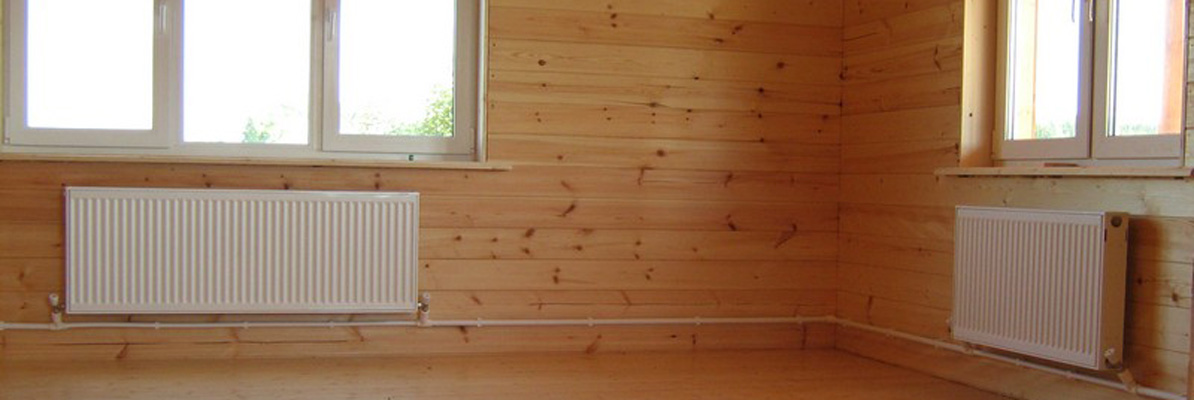
Installation of heating in a private house involves the use of any type of radiators - there are no such increased requirements as in high-rise buildings.
Cast iron - have good heat capacity, withstand high pressure, but do not react quickly enough, more precisely, they have inertia when using automation. To give a better design, they are covered with metal bars.
Steel - usually panel type, give off heat well. The disadvantage is the possibility of corrosion.
Aluminum - radiators of a new generation, excellent heat transfer performance, interaction with automation, lightweight, perfect design forms, but demanding on the chemical composition of the coolant.
aluminum radiators.
Bimetallic - have the positive qualities of the above-mentioned radiators, but the steel frame coated with aluminum gives additional resistance to physical, chemical, thermal influences.
Description of the installation of a two-pipe heating system with your own hands
When organizing heating, it is necessary to take into account not only which boiler to use, as discussed in the previous sections, but also what kind of wiring will be. There are two types of wiring: one-pipe and two-pipe. A single-pipe system is just one circuit or, simply, one pipe that passes through all heating devices - batteries. As for the two-pipe, two risers are installed here. One is the supply of coolant, and the second, the so-called return - the return of the coolant to the heater.
It would seem that there is no difference, but in fact it is significant. First of all, with a two-pipe scheme, it is possible to regulate heat transfer on each radiator. You may have seen a faucet standing on a pipe leading to a radiator. By blocking it, you can reduce or increase the amount of heat coming from the radiator. In everyday language, if it's hot at home, we close the tap, if it's cold, then we open it. As a result, we adjust the thermal comfort mode in the room.
As for the technical characteristics, with two-pipe heating, the temperature is kept evenly throughout the circuit, but with a single-pipe heating, there is a loss of heat on each subsequent radiator.
In multi-storey buildings, an exclusively two-pipe system is used.
To install such a system at home, you will need to purchase:
- The heating boiler can be gas, liquid fuel, solid fuel or electric.
- Expansion tank.
- Circulation pump. It is set if you mount with forced circulation.
- A set of pipes of the required length.
- Radiators.
The general scheme of a two-pipe heating system looks like:
Depending on the type of house, you can choose from several options for heating. If the house is one-story, then a horizontal mounting system is well suited. The pipes are laid horizontally. If the house has several floors, then a vertical, riser is installed. Several risers are mounted, which are located vertically, and a radiator is connected to each riser.


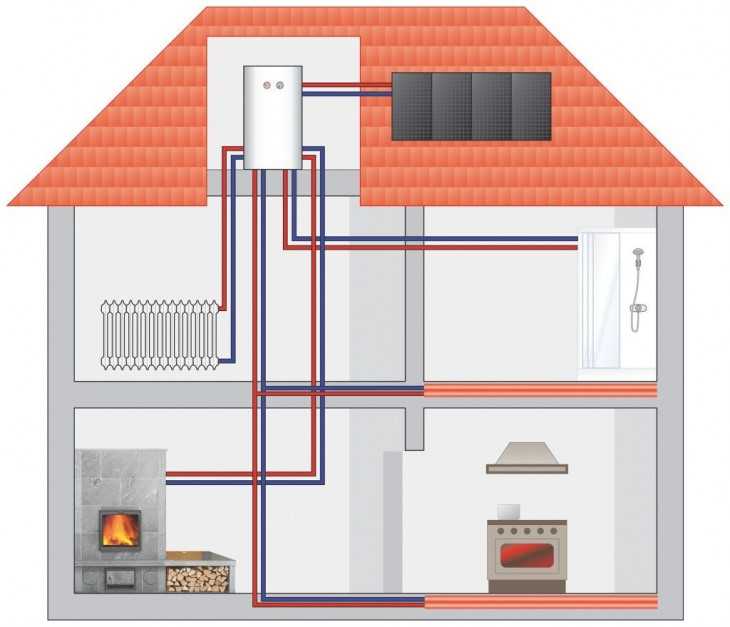
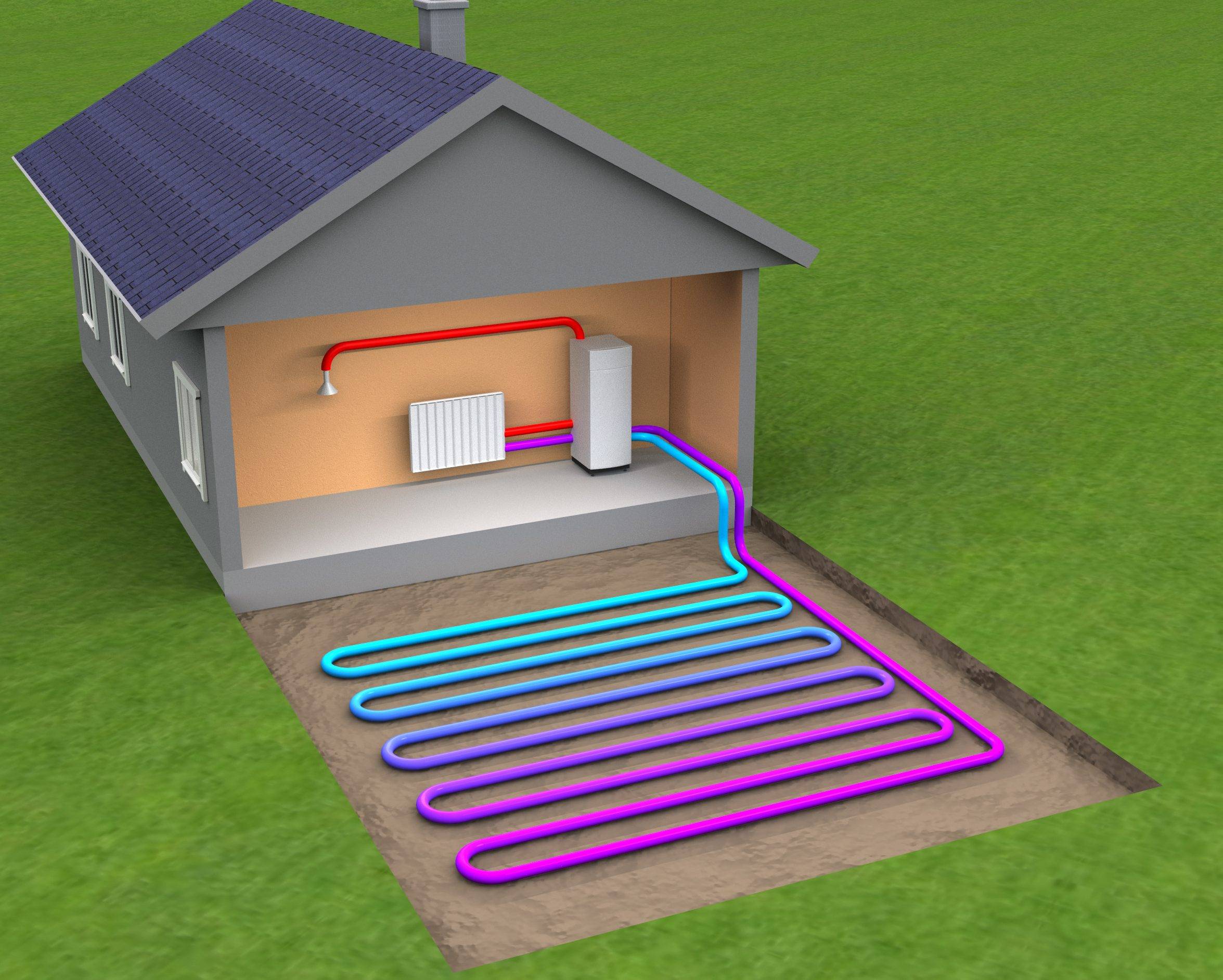


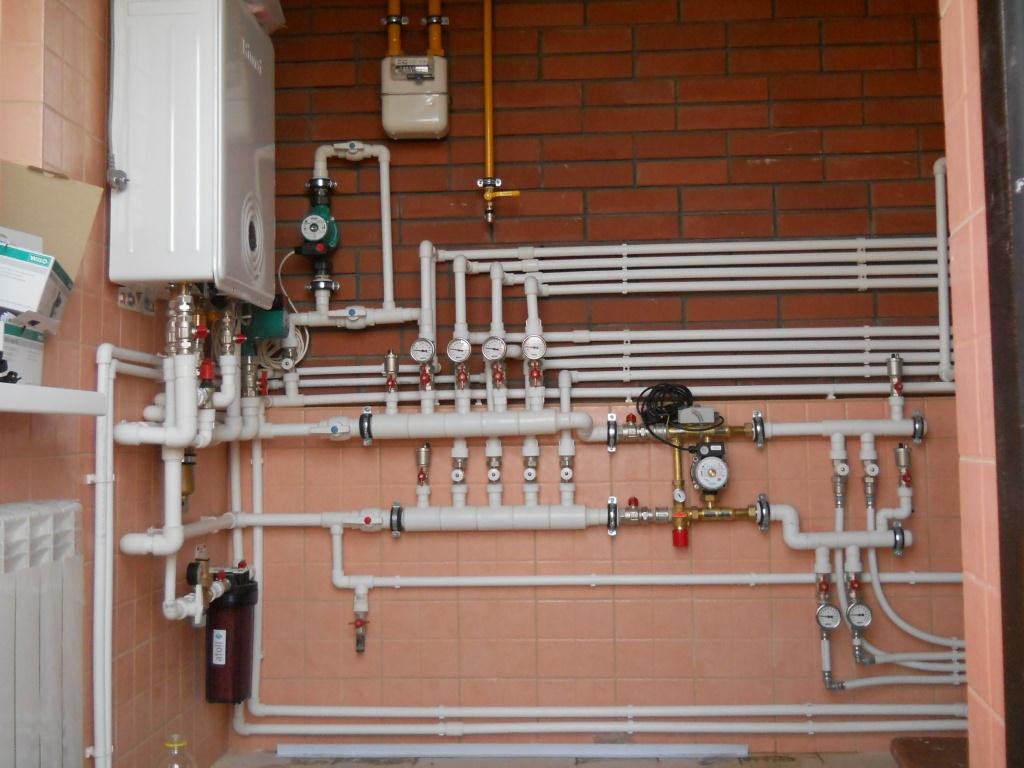
There are differences in installation depending on the location of the boiler and expansion tank. You can install these elements in the basement and in the attic. In the first version, pipes are laid in the gaps between the floor and window sills. In the second version, the pipes are laid under the ceiling, and from them there are already wiring to the radiators.
And the last thing you need to choose is whether your system will have natural circulation or with a pump. This will directly affect the installation of pipes.
So, when you have chosen the type of heating system, drawn its diagram and purchased all the necessary materials, you can proceed with the installation.
What do these jobs include?
The first step is to install a heating boiler and install pipes for supplying water to the radiators. Then an expansion tank with a drain cock and a control pipe is installed. Now you can lay the highway. Along with the main highway, the reverse is laid. The pump crashes into it. And the last step is the installation of radiators.The piping to the radiator may be different. Below are several options for such wiring.
It is recommended to install taps on the radiators at the inlet and outlet. In the event of a radiator breakdown, using taps, you can turn off the water supply to the idle radiator without turning off the entire system. In addition, it is necessary to install a Mayevsky crane. With its help, air is bled at start-up and its airing.
After the system has been mounted, everything is installed, you can start a trial run. It is needed to check the functionality. The first step is to turn off all installed taps.
Water is supplied to the system gradually, the water supply circuit to the radiators is filled first. On the very first radiator, the inlet valve and the Mayevsky valve open, through which air is bled. As soon as only water (without air bubbles) flows from the Mayevsky tap, it must be closed and the outlet valve opened. Similar actions are carried out on each heating radiator.
As a result, you will fill the system with water, removing air from it and it will be ready for full-fledged work.
Single pipe schemes
The easiest way is to perform calculations and assemble a heating system with a single-pipe piping scheme for the coolant. The heated water in it sequentially passes from the boiler through all the batteries in the house, starting with the first and ending with the last in the chain. At the same time, each subsequent radiator gets less and less heat.
With the installation of the pipeline according to this scheme and connecting it to the boiler with your own hands, with even minimal skills, you can handle it in two to three days.Plus, the cost of creating a water heating system in the house for single-pipe wiring is the most minimal in comparison with other options.
Fittings, fittings and pipes are required here a little. Savings on materials are significant
And it does not matter whether glued beams or bricks are chosen for the construction of the cottage. If the housing is well insulated, then even a simple one-pipe system for heating it is more than enough
In order to level the shortcomings, a circulation pump has to be built into a single-pipe system. But these are additional costs and potential equipment breakdowns. Plus, in case of any problems in any section of the pipe, the heating of the entire cottage stops.
Single pipe horizontal
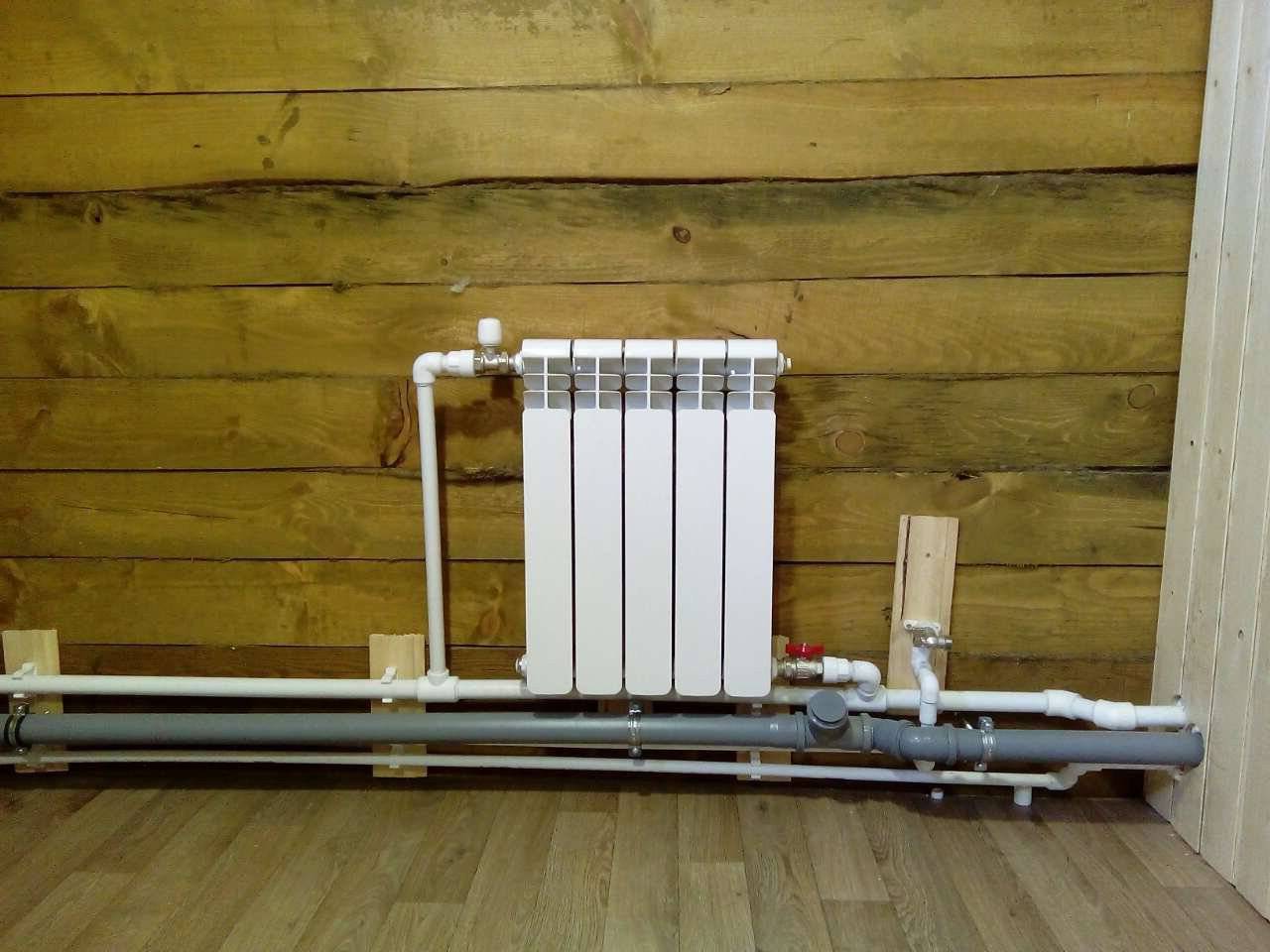
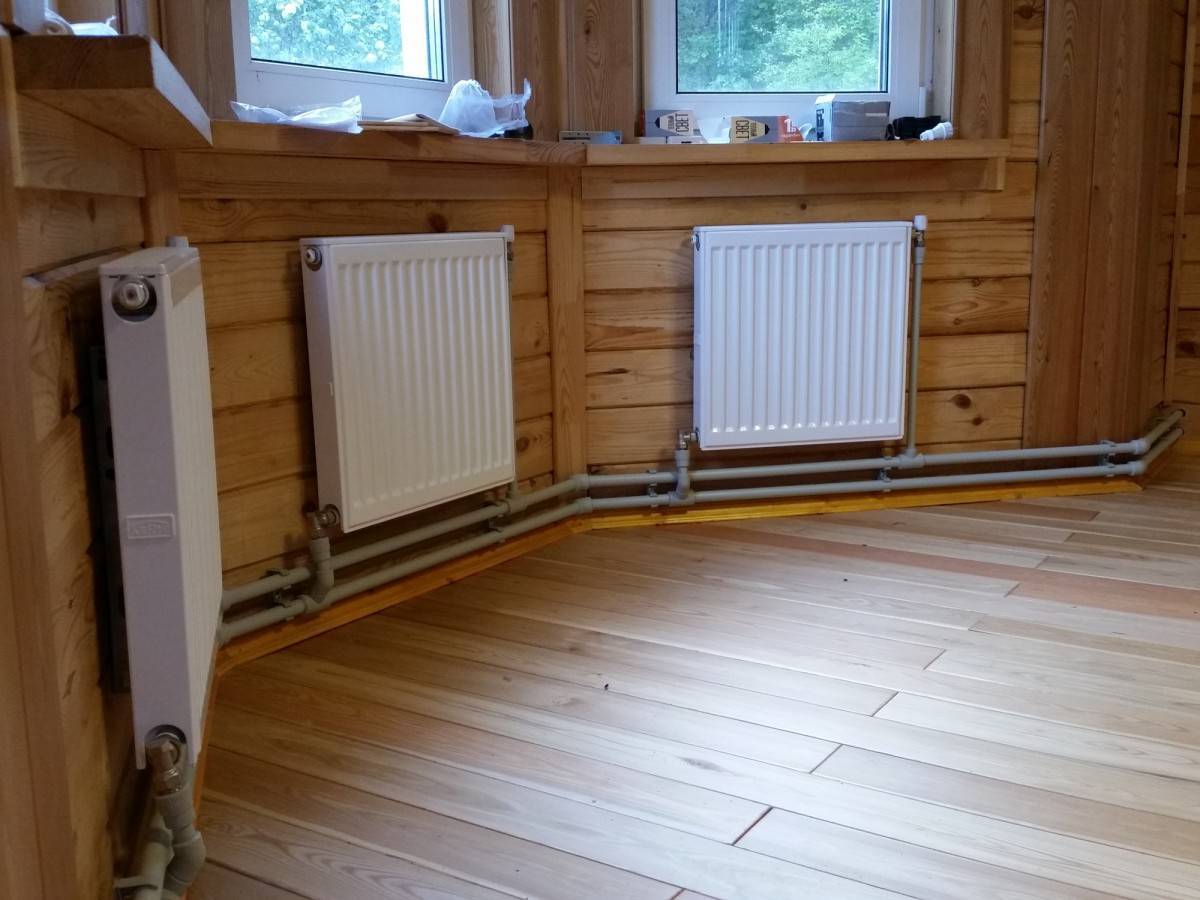
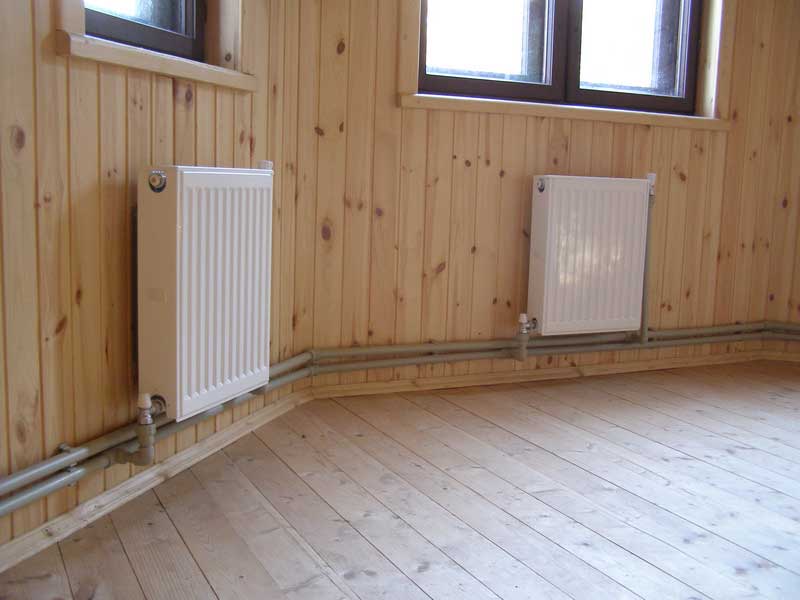
If a private house is small and one-story, then a single-pipe heating system is best done horizontally. To do this, in the rooms around the perimeter of the cottage, a ring of one pipe is laid, which is connected to the inlet and outlet of the boiler. Radiators cut into the pipeline under the windows.
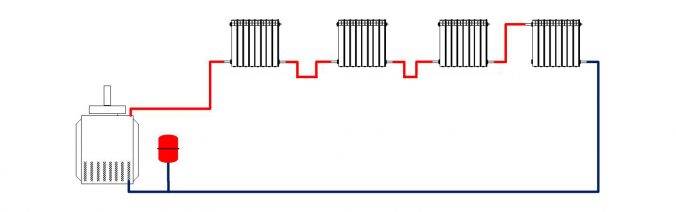
Single-pipe horizontal layout - ideal for small spaces
Batteries are connected here with a bottom or cross connection. In the first case, heat losses will be at the level of 12-13%, and in the second case they will be reduced to 1-2%. It is the cross-mounting method that should be preferred. Moreover, the coolant supply to the radiator should be done from above, and the outlet from below. So the heat transfer from it will be maximum, and the losses will be minimal.
Single pipe vertical wiring
For a two-story cottage, a single-pipe heating system of a vertical subspecies is more suitable. In it, the pipe from the water heating equipment goes up to the attic or second floor, and from there it descends back to the boiler room.The batteries in this case are also connected in series one after the other, but with a side connection. The pipeline for the coolant is usually laid in the form of a single ring, first along the second, and then along the first floor, with such a distribution of heating in a low-rise building.
Single-pipe vertical scheme - save on materials
But an example with vertical branches from a common horizontal pipe at the top is also possible. That is, first a circular circuit is made from the boiler up, along the second floor, down and along the first floor back to the water heater. And already between the horizontal sections, vertical risers are laid with the connection of radiators to them.



The coldest battery in such a heating system of a private house will again be the last one in the chain - at the bottom of the boiler. At the same time, there will be an excess of heat on the upper floor. It is necessary to somehow limit the amount of heat transfer at the top and increase them at the bottom. To do this, it is recommended to install jumper-bypasses with control valves on the radiators.
Leningradka
Both schemes described above have one common minus - the water temperature in the last radiator turns out to be very low, it gives off very little heat to the room. To compensate for this cooling, it is recommended to improve the single-pipe horizontal version of heating a private house by installing bypasses at the bottom of the battery.
Leningradka - advanced one-pipe system
This wiring was called "Leningrad". In it, the radiator is connected from above to a pipeline running along the floor. Plus, taps are placed on the taps to the batteries, with which you can adjust the volume of the incoming coolant. All this contributes to a more even distribution of energy in individual rooms in the house.