- How to properly install a gas tank on the site?
- Design and documentation
- Advantages of a stationary gas tank
- Working principle and classification
- Design
- Features of installation and operation
- Overview of popular models
- Trailer Models
- Models for 600 liters
- Vertical gas holders
- Why do you need a vertical gas tank
- Advantages and disadvantages of vertical gas tanks
- Types of gas tanks for summer cottages and private houses
- Advantages of gas tanks
- Design and installation features
- The main components of the gasification project
How to properly install a gas tank on the site?
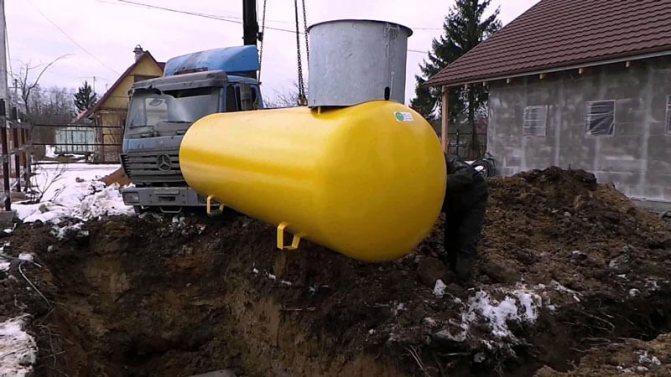
Before the installation of the gas tank, it is necessary to prepare the site. Regardless of how the installation will be carried out, a concrete slab is poured, which will serve as the foundation for the tank. Reinforcement is used to increase the strength characteristics.
For these purposes, you can use a factory concrete slab, but always solid, while its thickness should be at least 15–20 cm.
After installing the tank, it is required to lay communications through which gas will be delivered to the house to gas-consuming equipment.
For this, polyethylene pipes PE 100 are used. In this case, only fixed joints are used for installation, which are installed using butt or electrofusion welding.
When laying a gas pipeline on a site, it is important to follow certain rules and regulations:
- laying depth - not less than 1.5 m;
- when working on uneven areas, a slope of 1 cm per meter of pipeline length is allowed;
- if the intersection of the communications of the house and the gas pipe cannot be avoided, then there must be a distance of at least 2 m in height between them;
- between the house and the pipeline laid nearby, a distance of 2 m must be observed;
- all metal elements laid underground must have anti-corrosion protection;
- do not forget about the installation of a condensate trap.
And finally: all house wiring starts from the basement level or basement, so the input is carried out in this place, while the latter must be exclusively factory-made and have the appropriate certification.
Plinth entry - a special design of a crane, a steel pipe and a siphon compensator, which is responsible for the stability of the structure due to the effect of heaving, deformation, shrinkage and other phenomena on the house.
Due to the ability of the siphon to compensate for the negative impact due to bending, stretching, compression, it remains possible to ensure the tightness of the entrance to the house and, accordingly, to avoid gas leakage.
Electric storage water heaters (boilers). - here is more useful information.
Design and documentation
A “personal” gas system must be as reliable and safe as a centralized main. Carelessness in these matters is unacceptable, since even a small gas leak can cause huge problems up to and even lead to death.
If the owner of the house does not have special knowledge, then the design of the gas pipeline must be entrusted to a specialist with a license.
The installation location of a ground or underground gas tank is determined not only by convenience, but also by the distance for individual objects on the site (+)
Rather, this is done by entire design organizations that have the right to design and carry out work on the gasification of residential facilities.
It can be either a private company or a specialized subdivision of the gas service of a district, region, etc. Private traders charge a little more for work than state specialists, but they will also take care of the design.
When working with regional gas, the owner of the house will have to deal with the design on his own, but you can save a little.
When drawing up a project, you will not only have to draw up a couple of statements, but also attach a number of documents to them:
- owner's passport;
- certificate of ownership of the land;
- site plan;
- characteristics of the heating system, etc.
First, specialists develop technical specifications for the gasification of a building, which take into account fire safety requirements. Then, field studies are carried out, and a place is selected for the installation of a gas tank, taking into account the standards.





The gas tank must be located at a distance of:
- at least 10 m from residential buildings;
- at least 15 m from sources of drinking water and other water bodies;
- at least 5 m from trees and outbuildings;
- at least 2 m from fences.
In addition, it is necessary to take into account the presence of power lines near the installation site of the gas tank. The minimum distance to such structures should be half the height of the support. Another important point is the availability of convenient access roads for a car with a liquefied gas tank to fill the gas tank.
At the design stage, the features of the site are also evaluated: the corrosivity of the soil, the level of stray currents, etc.
Based on these data, a decision will be made on the features of the gas tank, for example, whether it needs additional galvanic protection, which will not affect the price of the device for the better.
Ground models of gas tanks are usually used only in the summer. Such tanks are subject to higher safety requirements than for underground counterparts.
Thus, the technical conditions for the gasification of the facility are determined. With their help, specialists will draw up a project that includes a number of documents: characteristics of a gas tank, evaporator, condenser, site plan, gas pipeline system layout, recommendations for grounding, chemical protection, lightning protection, etc.
These documents must be coordinated with the fire inspectorate, gas supply services, electricians, architects, environmentalists and other specialists of local departments. The result of the registration will be obtaining a building permit.
Advantages of a stationary gas tank
When using bottled propane-butane, one container is enough to connect a stove or a hot water boiler. The owner of the house is forced to buy several cylinders (including reserve ones), constantly renew fuel supplies.
The main advantage of an underground or above-ground gas storage will be the creation of a gas supply sufficient to fully supply the house. Along with the installation of an artesian well, a septic sewer, a gas tank in the house will fully satisfy the needs of several autonomous gas appliances (hot water boiler, heating boiler, stove), turning them on as needed.
Working principle and classification
The principle of operation of the gas tank is as follows:
- liquid gas is pumped into the tank;
- then the gaseous substance evaporates from the surface;
- the reactor forms a constant pressure in the gas distribution system;
- the process of gas supply to the dwelling is carried out.
The larger the evaporation area, the better the gas is supplied to the system. Therefore, horizontal gas holders are more preferable to use, because. they have a larger evaporation area.
Scheme of operation of the gas tank
These devices are classified according to various criteria: volume, location of the container, place of application, method of installation.
Gas holders by volume:
- Variable volume: gas is stored under pressure, which is similar to atmospheric pressure, depending on the volume of gas, the volume of the container also changes.
- Constant volume: the gas is under pressure, which differs from the ambient pressure and is 1.8 MPa.
According to the material of manufacture:
- steel;
- rubber;
- reinforced concrete.
By place of application:
- industrial;
- household.
In turn, household gas holders are divided into several types:
- mini-gas tank: the volume of such a tank is 480 liters, it does not need to be refilled often, usually when connected to a gas stove, its reserves are enough for 2 years or more;
- mobile gas holder: this is a container on wheels that can be moved to any place convenient for you.
Gas holders by installation method:
- vertical: to install it, you need a pit, the diameter of which is no more than 2.5 meters, therefore it is very convenient to use such a device in a country house with a small plot;
- horizontal: very capacious, it can contain 20 or more cubic meters of gas.
Autonomous gasification using a gas tank
According to the type of container placement:
- underground;
- ground;
- mobile.
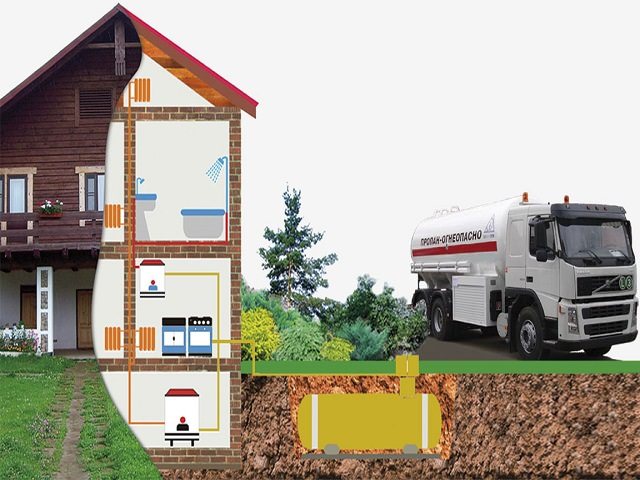
An underground gas tank is buried to a depth of at least 60 cm. This is necessary so that the tank does not freeze or get damaged, besides, placing it in this way will in no way spoil the appearance of your site.
An underground type tank should be located at a distance of at least 10 meters from the dwelling.
Has the following benefits:
- to provide the room with gas, it is enough to fill the tank once a year;
- the gas evaporates well even without the use of auxiliary mechanisms;
- large liquid evaporation area.
The soil for placing an underground gas tank should not be mobile.
The installation of ground gas tanks is simple, and the price does not bite them, so they are very popular in the EU countries, but for Russia, ground tanks are not a very good option. This is due to the severe frosts that the Russian winter is famous for.
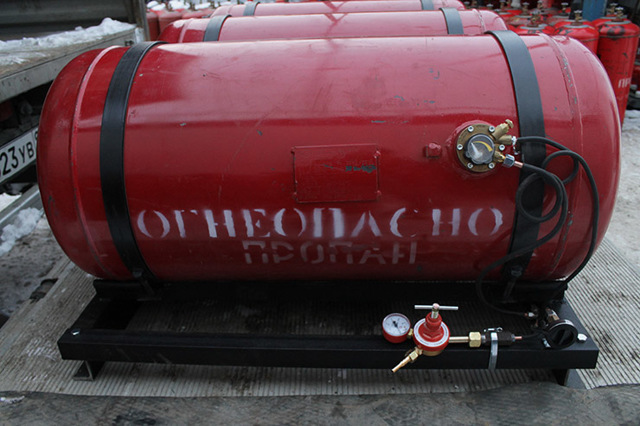




To install a ground-type gas tank, taking into account the weather conditions in Russia, in addition, you will need to install special evaporators, as well as spend money to insulate the tank body.
A ground-type gas tank must be installed 2-3 m from the edge of the site so that the filling hose can easily reach the gas tank neck.
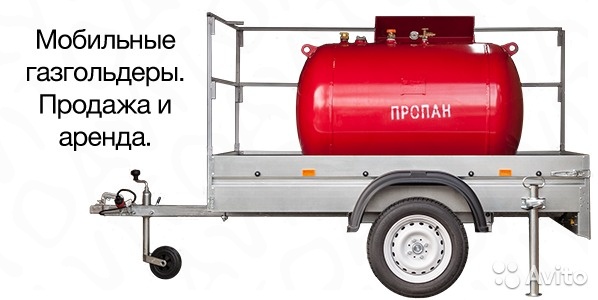
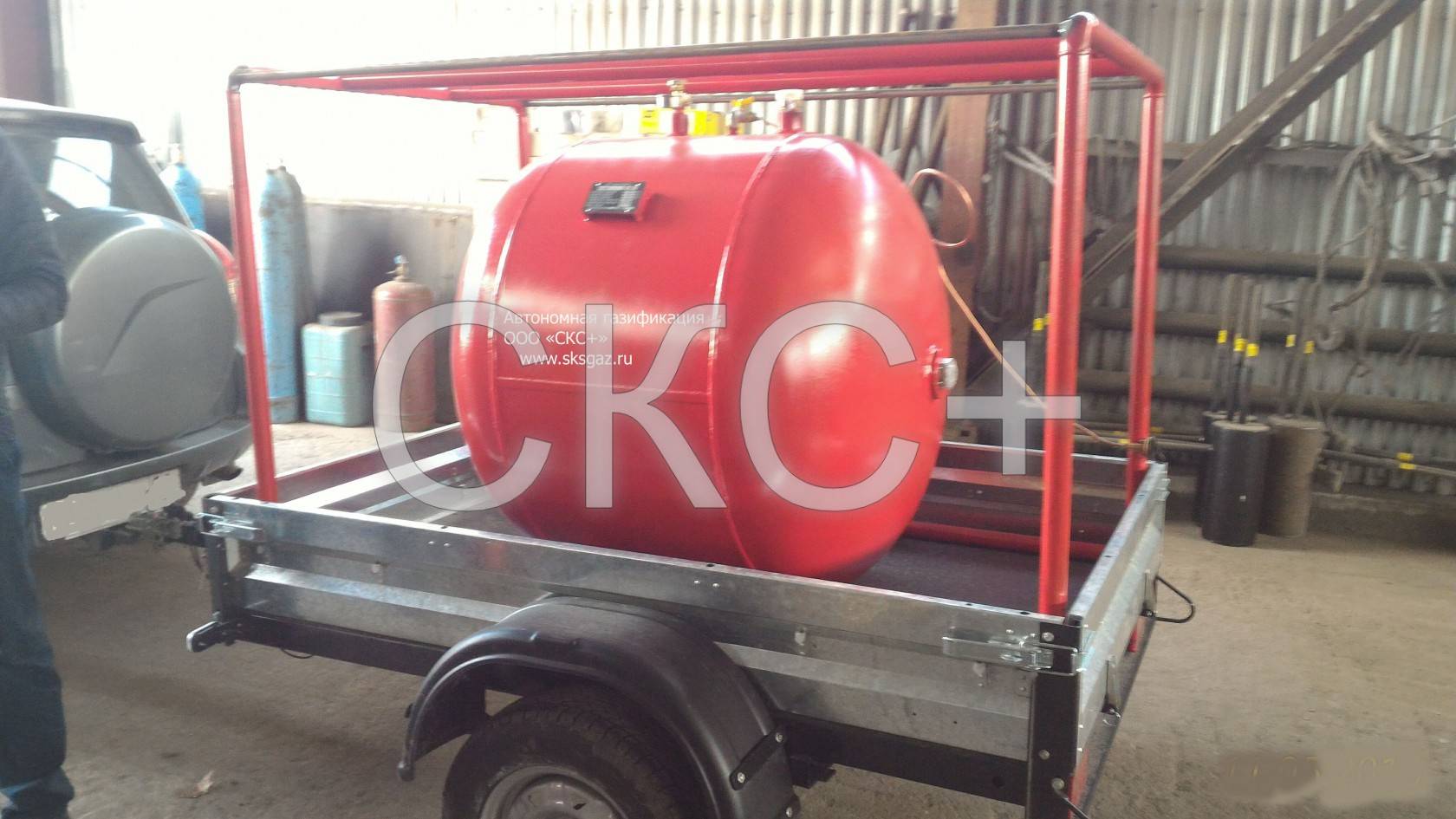
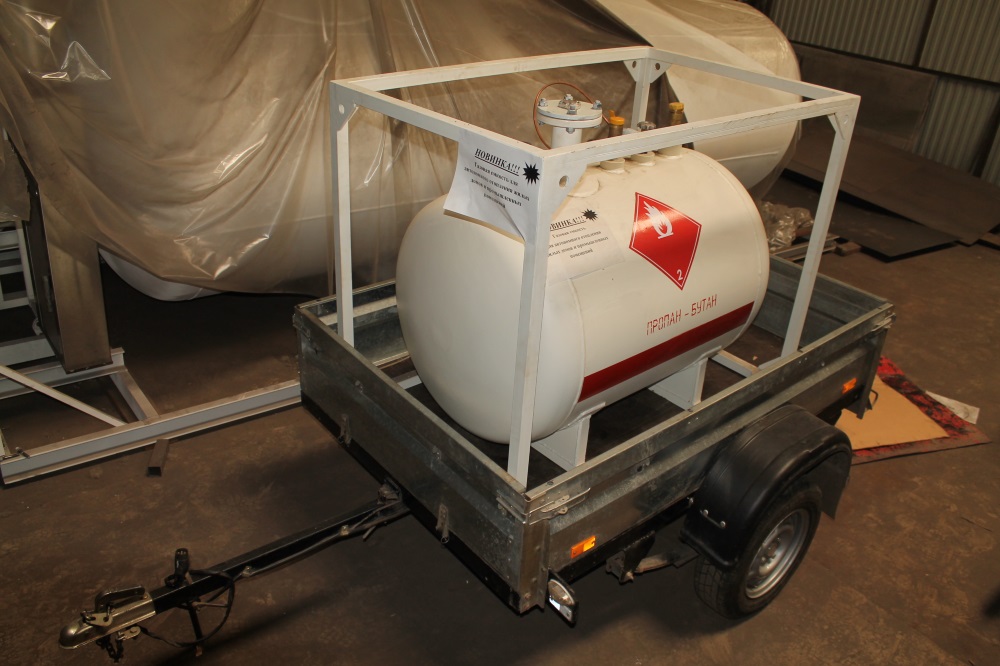
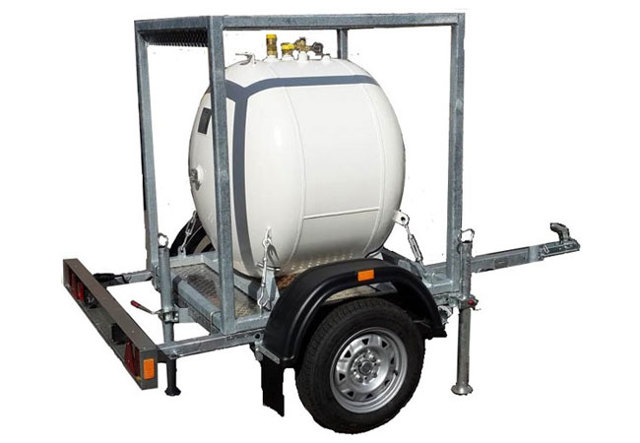
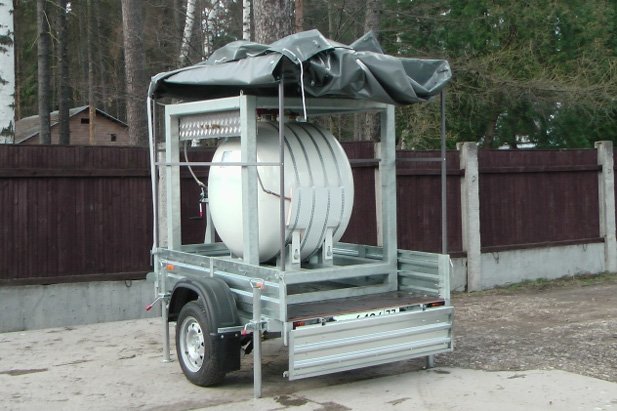
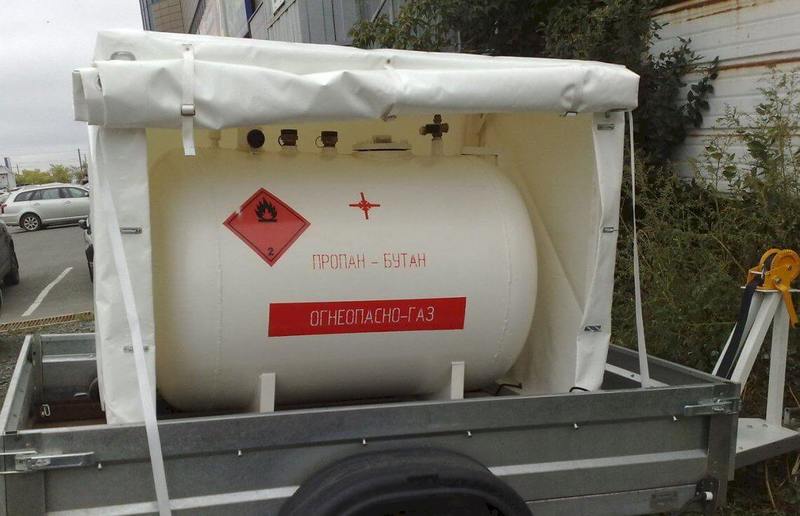
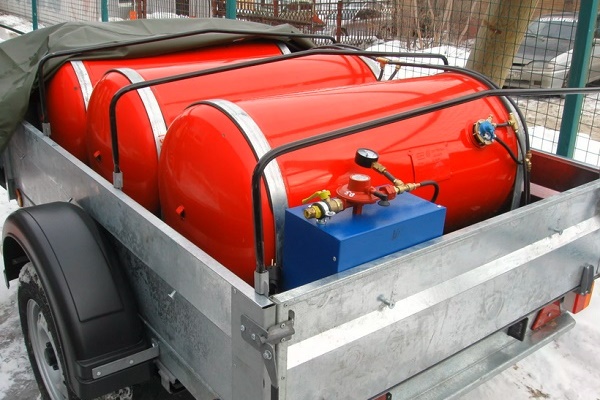
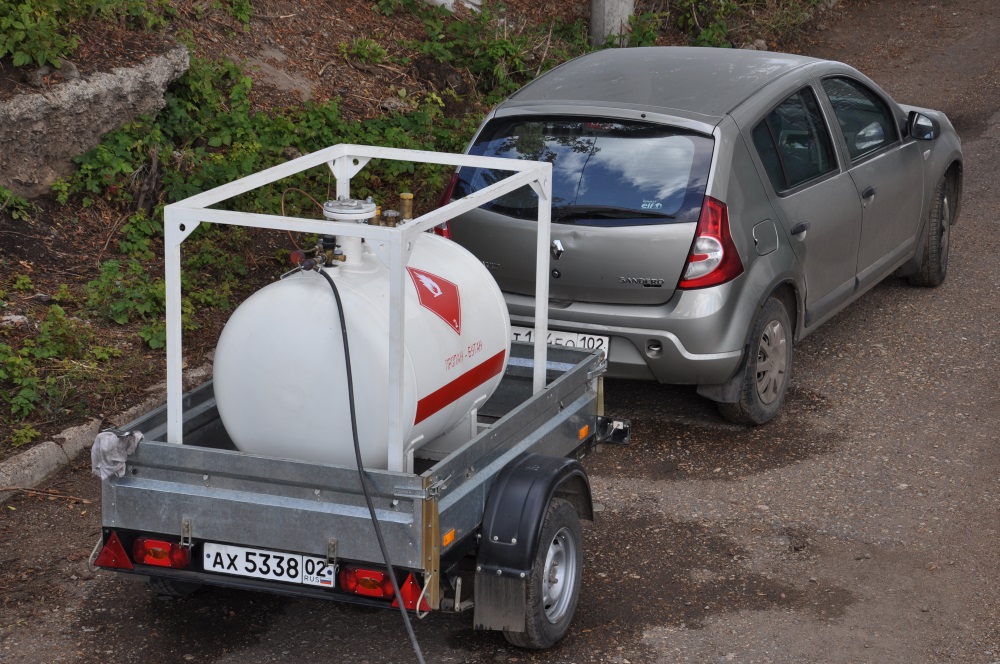
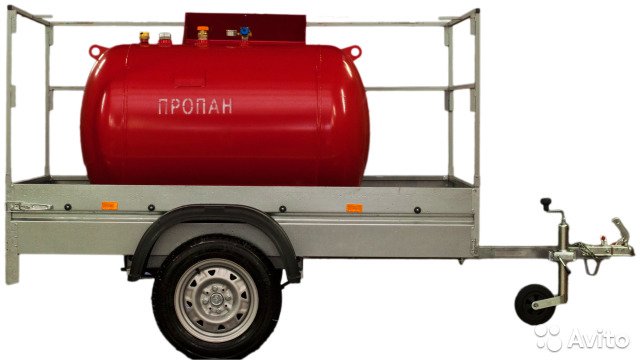
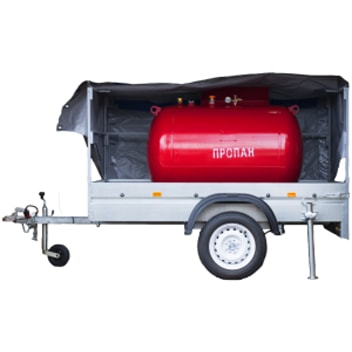
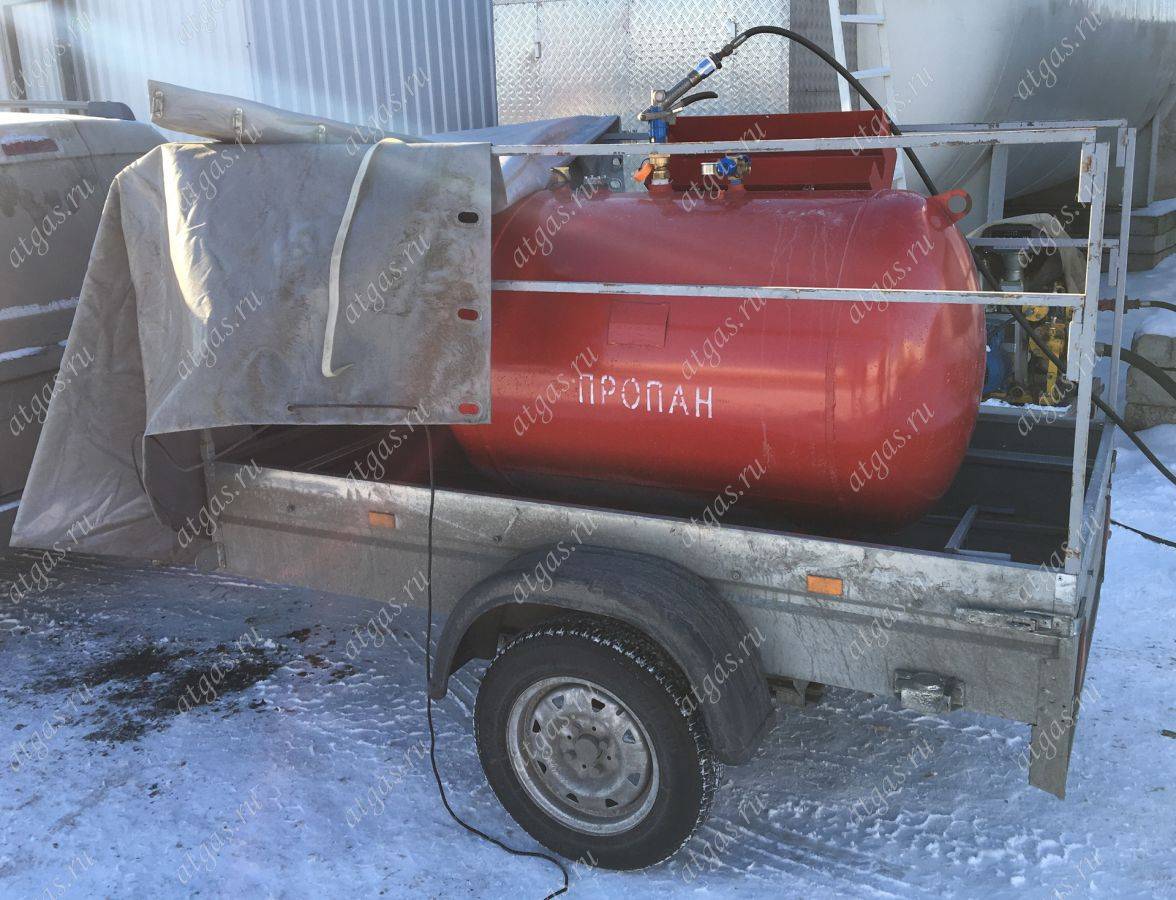
The mobile gas tank has a small capacity, it is quick and easy to install, it can be transported, for example, on a car trailer, and quickly connected to the heating system of your home.
Mobile gas tank on a trailer
You can buy fuel for a compact mobile gas tank at car gas filling stations. This is very convenient, because you can choose a gas station with the best gas price.
Mobile gas tanks have many advantages:
- capacity: you can purchase a tank with a capacity of up to 1000 liters;
- mobility: it can be moved to any place where gas is required;
- easy to refuel;
- maintains productivity even in cold weather, because the gas can always be safely heated;
- such a device is inexpensive.
Design
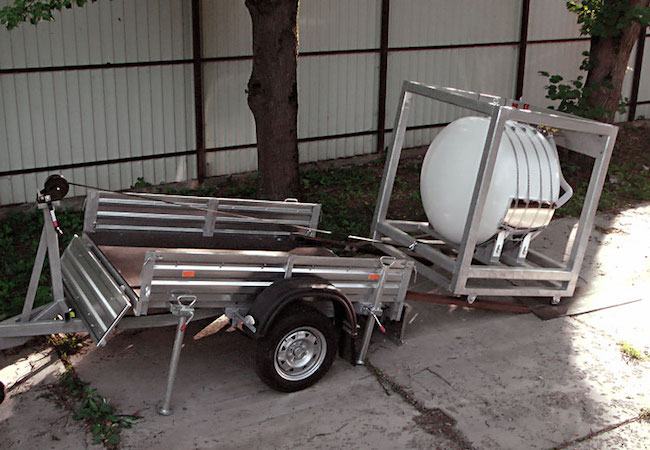
A container with a gas mixture is installed on a single-axle or two-axle wheelbase without a trailer, which is equipped with a mechanism for coupling with the car. The frame, through which the container is attached during transportation, is made of galvanized steel. An awning is designed to protect against natural gases and direct sunlight. The cover is made of polyvinyl chloride.
The gas tank package includes collapsible connections and corrugated pipes made of high-alloy steel, they provide quick connection to the pipelines of the heated object.
Thanks to four outriggers, the wheeled module is stationary and stable.
Mobile gas tank on a trailer
The manufactured mobile gas tank has several varieties:
- Without forced heating of the tank at low temperatures. This model is more suitable for areas where winter is not very cold and frosty.
- Heating of the fuel tank is achieved by connecting the gasified object to the heating circuit.
- Thanks to the docking nodes, the pipes are disconnected quickly, without loss of coolant, this is especially true when the device is transported to a gas station.
- An autonomous boiler plant, which is absolutely independent of electricity, is responsible for maintaining the positive temperature in the tank. The mini-boiler is equipped with automation and protection against overheating. If the pressure in the tank exceeds 500 kPa, the safety valve automatically activates.
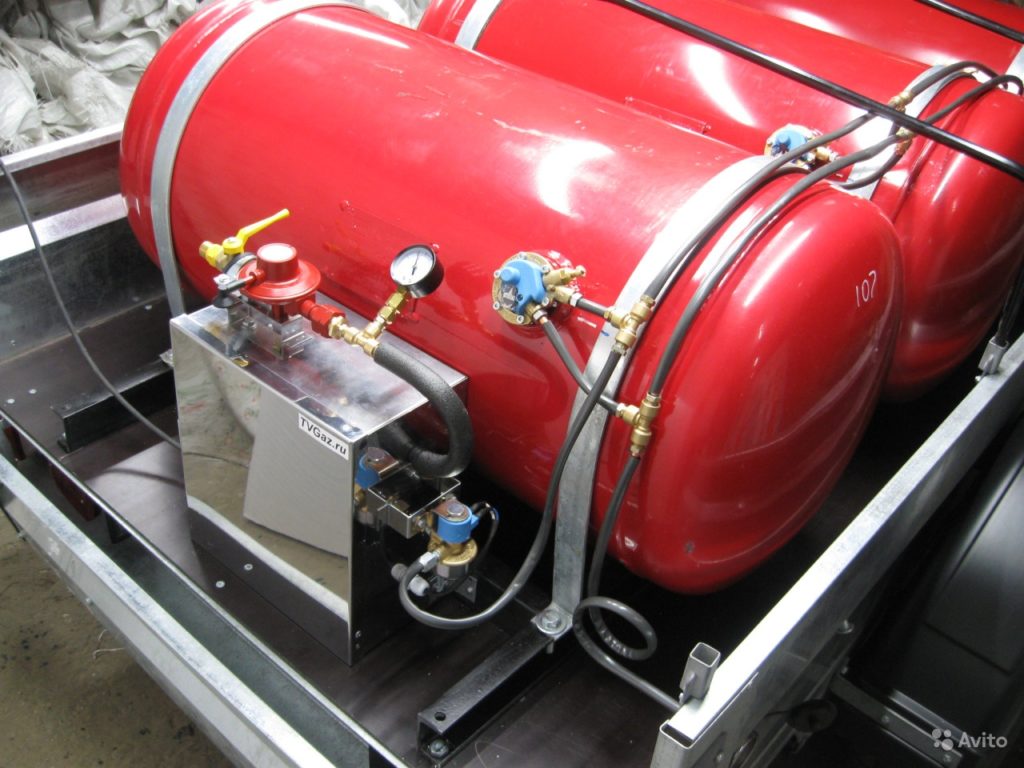
Also, the tank is equipped with control and measuring, safety devices, as well as shut-off and control valves. Due to the automatic bleed valve, excess pressure is not formed in the working medium, the negative consequences of which can be deformation of the container and its depressurization.
The mobile gas tank is refueled using a standardized connector, which is used in gas installations on cars.
Refueling of the mobile module is carried out both at the gas filling station and by automobile gas tanks equipped with injection equipment.
About gas balloon convector gas can be read here.
Features of installation and operation
It is much easier to arrange the installation of a mobile gas tank on a trailer with electric heating than the installation of a stationary model. In this case, special permits from the gas distribution company will not be needed. But the trailer chassis, of course, must be properly registered with the traffic police.
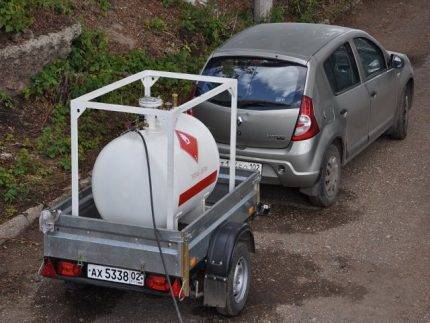
You do not need to obtain special permission to install a mobile gas tank, but it should be registered with the traffic police like any trailer
In doing so, the same registration procedure should be followed as is used when accounting for conventional mass-produced car trailers.
When purchasing a gas tank, you should make sure that all the necessary documentation is attached to the tank, namely:
- quality certificate;
- technical passport of the tank;
- vehicle passport;
- instruction manual for the device.
Permission to install a mobile gas tank is not required, however, the unit must have all the necessary certificates. If such documents are not available, the owner of the gas tank may be denied refueling the tank with liquefied gas.


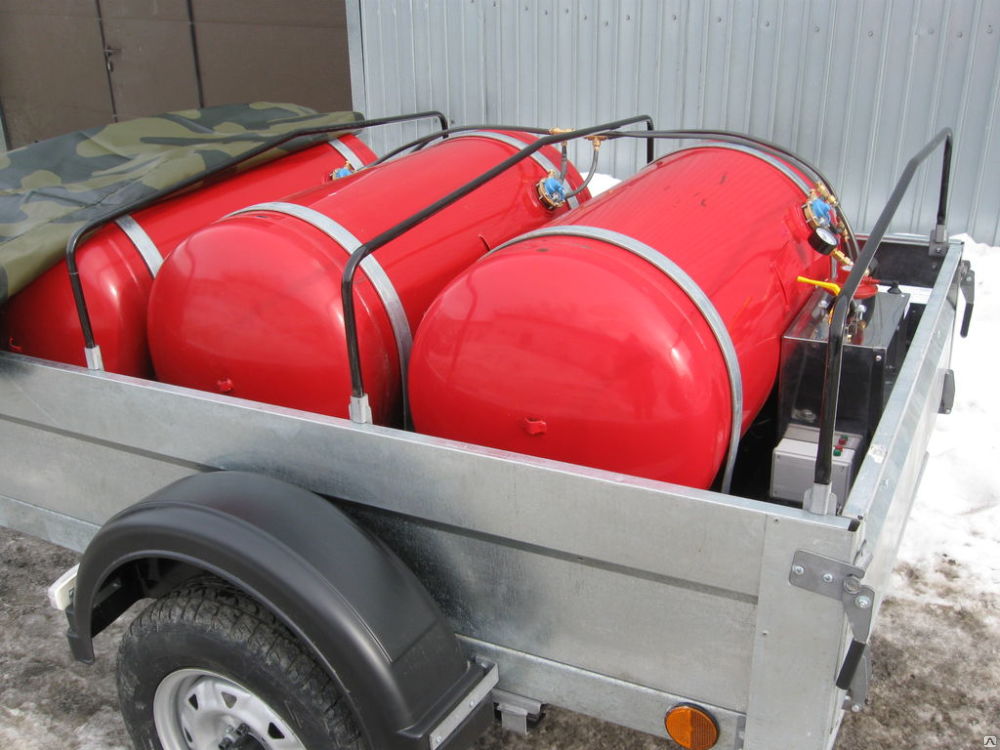


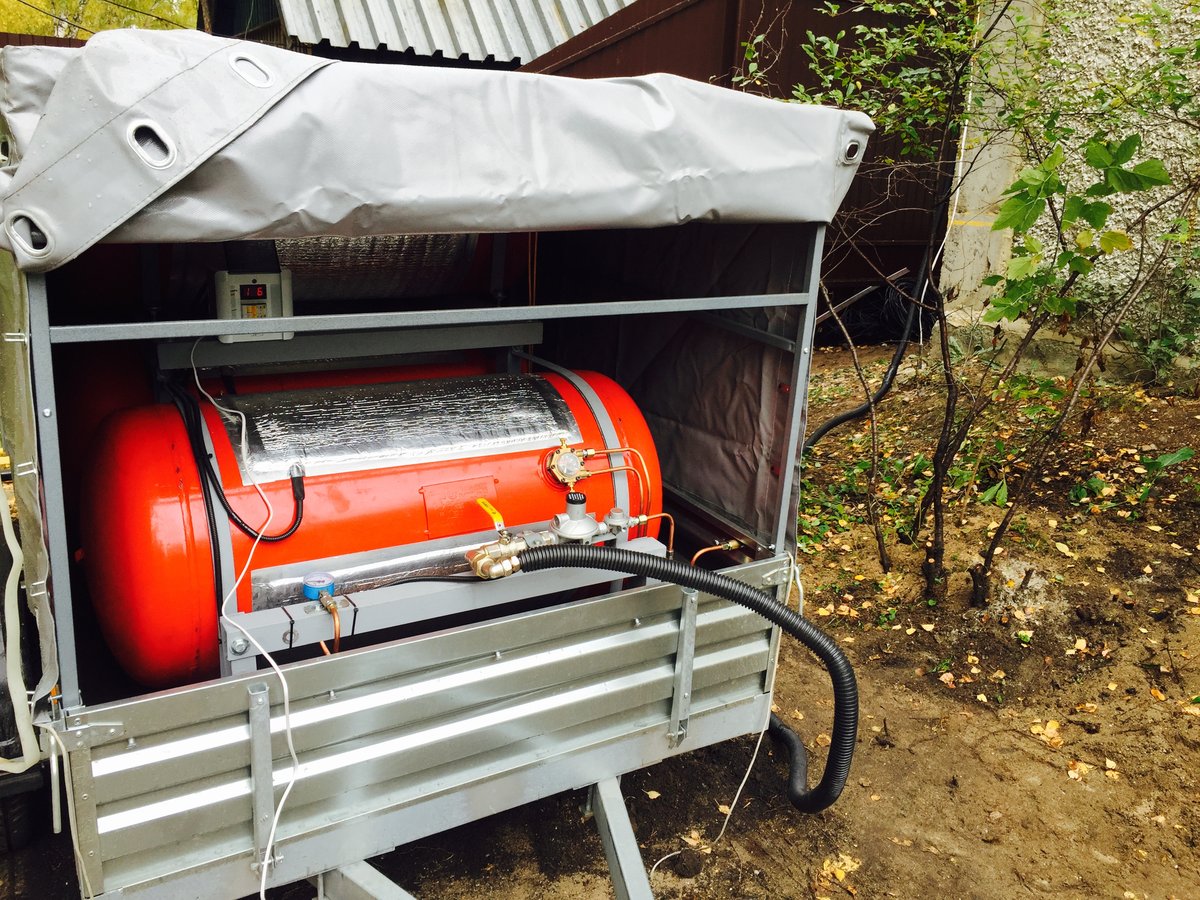


But the simplified registration procedure should not serve as a reason for careless handling of the device, which belongs to high-risk objects.
Even before refueling and connecting the gas tank, you should carefully study the instructions for its installation and operation, and then strictly follow all the manufacturer's recommendations.In order for the gas tank to be correctly and safely connected to the heating circuit or other equipment that consumes gas, it is best to invite an experienced specialist.
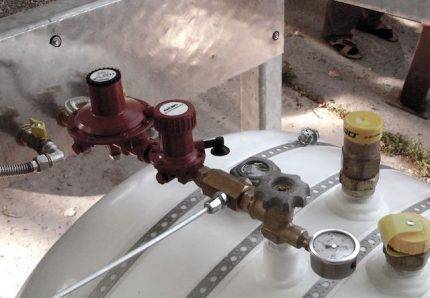
Standard models of mobile gas tanks are equipped with the necessary control and regulation equipment, which ensures the safe operation of the device, if the necessary conditions are met
This is especially true if a heated model is chosen, since a professional master will also set up a mini-boiler room. To connect the gas tank yourself, first you need to carefully study the instructions and follow the recommendations contained in it.
Quick connectors allow you to connect the device in just a few minutes.
This eliminates the leakage of gas from the system and the ingress of outside air into it. There are no strict requirements for the placement of such a gas tank on the site.
Of course, the distance from the gasification object is limited by the length of the supply pipe. In order for the device to last as long as possible without breakdowns and accidents, you should install it in such a way as to exclude prolonged exposure to direct sunlight. Additional protection from precipitation will not hurt either.
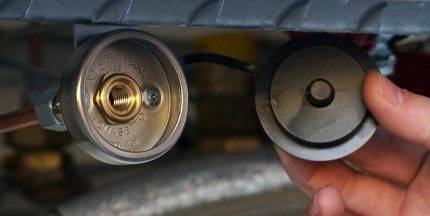
Mobile gas tank connectors are standardized so that the device can be charged using a conventional fuel nozzle at almost any gas station
Another important point is the control equipment. The device must be placed in such a way that unauthorized persons, such as children, cannot access the controls. It also makes sense to think about the likelihood of theft of a wheeled chassis with a gas tank and take measures to protect it.
Refueling of a mobile gas tank can be done in two ways: using a gas tank truck or at filling stations.
This compares favorably with a mobile gas tank from a stationary model, for refueling which you always need to call a gas filling station.
There is no need to wait until the tank is empty, it is recommended to refuel at a time when less than 20% of the total volume of the tank remains in the gas tank. At gas stations, the device can be filled using a standard filling nozzle.
If you have not yet decided on the method of gasification at home, and are thinking about buying a gas tank, then we advise you to read the articles:
- What is cheaper and better - a gas tank or main gas? Comparative review
- Varieties of gas tanks: the basics of classification + an overview of popular brands
Overview of popular models
Gas holders with constant and variable internal volume are produced. The first type has rigid and durable walls, the thickness of which is not less than 12 mm, the design withstands high pressure. Variable volume units are equipped with a lowering cover. The upper part represents a water dome or piston of considerable size.
Methane and propane gas holders differ in spatial position. Cylindrical tanks are placed horizontally or vertically. In the second case, the container takes up less space, but the evaporation area decreases, which leads to some decrease in the supply efficiency.
Trailer Models
 The Tosto Serbatoi brand of the Italian manufacturer represents plastic vessels of the Amico brand. Thick walls withstand 1 ton per m2. The material is protected from corrosion during precipitation and wet weather.Shut-off valves, safety sensors are sold in the kit.
The City Gas brand of Bulgarian manufacturers remains popular. The body is made in the form of a cylinder and has three welds. The company produces not only mobile, but also underground models. The outer surface is painted with polymers based on epoxy resin. The manufacturer guarantees 30 years of work without breakdowns and loss of quality.
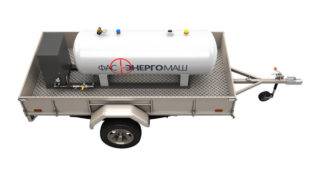
The well-known brand FAS is produced by our manufacturer FasKhimMash. The outside of the tank is treated with airless hot spray technology, which prevents the wall from breaking. The kit includes control detectors, angle valves, mechanical levels and pressure gauges.
Models for 600 liters
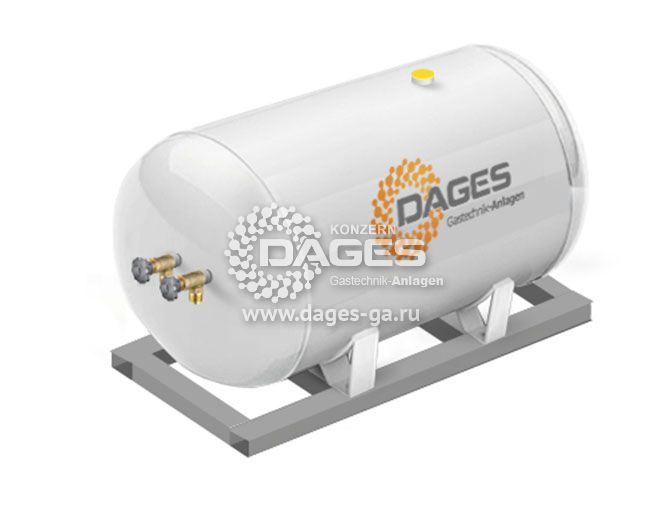
The Czech manufacturer represents the well-known VPS brand, in which the line is represented by horizontal containers. The catalog offers volume options from 600 to 10 thousand liters, which is enough to heat a private house.
The German company Deltagaz has been producing gas tanks for about 20 years, so it has gained a lot of experience. The line includes models from 400 to 10 thousand liters. The products are distinguished by the yellow color of the tank and are in deserved demand.
The Czech product Kadatec also has a high rating. Capacities are accompanied by certificates for use in residential buildings and summer cottages. The production test is carried out at 25 bar pressure, operation at 15 bar is considered safe. The volume of mobile, stationary and underground tanks varies from 500 to 100 thousand liters.


Vertical gas holders
For a long time, most manufacturers have been focused on the production of horizontal models of tanks for storing gaseous substances.But the needs of the consumer market have become an impetus for the production of vertical gas tanks.
Why do you need a vertical gas tank
Connection to centralized communications is not available for many owners of private houses, cottages, summer cottages. And to use the ancient methods of heating with the help of firewood is perceived by modern man as archaic. Burning coal or fuel oil is not a very comfortable occupation, and electricity is rapidly becoming more expensive.
Autonomous gas supply systems with a gas tank as the main element become the optimal solution to this problem. But quite often, the installation of a tank with liquefied gas stored in it is difficult due to the small area of the adjacent area. A good option in this case is to use a vertical model with placement underground. Also, vertical gas tanks are used in conditions of severe frosts, since the area of the tank is deeper than that of horizontal tanks.
Advantages and disadvantages of vertical gas tanks
According to reviews of ordinary consumers and professionals, the use of autonomous vertical tanks has both positive and negative sides.
Types of gas tanks for summer cottages and private houses
Most manufacturers see the maximum satisfaction of consumer needs as the main priority in their work. To do this, gas tanks of various types are supplied to the market.
The main criteria by which this equipment is classified are:
- according to the design features, vertical and horizontal containers are distinguished;
- modifications of the ground and underground type are produced taking into account the specifics of installation;
- samples with applied pressure with low and high rates;
- types depending on the volume - up to 1000l, up to 1650, up to 2000, from 4850 and more;
- with a low or high neck, as well as without it;
- new or used tanks;
- mobile gas holders.
The abundance of options allows you to choose the most suitable gas tank for each individual object.
Most suppliers offer their customers the opportunity to install a turnkey gas tank. The list of such services includes a set of measures for a preliminary inspection of the site, delivery of all components to the installation site, earthworks and arrangement of the gas pipeline, installation of measuring equipment, fixing the system.
Installing a gas tank is the best way to create comfortable living conditions in a country house.
But before making a decision in favor of a gas tank, it is necessary to carefully weigh the pros and cons. After all, the costs do not end with the installation of the tank. Maintenance, refueling and delivery of liquefied gas will be required.
Advantages of gas tanks
- Installation of an autonomous reservoir makes it possible to ensure energy security.
- Such tanks are easy to maintain and operate.
- The use of liquefied gas is absolutely safe for the environment.
- If you correctly calculate the gas consumption, then frequent refueling is not required and it can be done once a year.
- In many articles on the Internet, the disadvantages include the high cost of equipment and its installation. Apparently, the authors of such articles rarely encountered the realities that require a gas pipeline to a private house.In villages where some of the houses are gasified and some are not, and the central pipe runs at a distance of 200-300 meters from the house, the cost of a full connection will be from 250 to 400 thousand rubles. It is not worth talking about the pipeline from a neighboring settlement, even if it is located one kilometer away. That is why the cost can be attributed to the pluses. After all, the largest reservoir, together with installation and refueling, will cost no more than half a million. And if we talk about mini gas tanks, then its cost is less than 100 thousand.
Filling the gas tank
Design and installation features
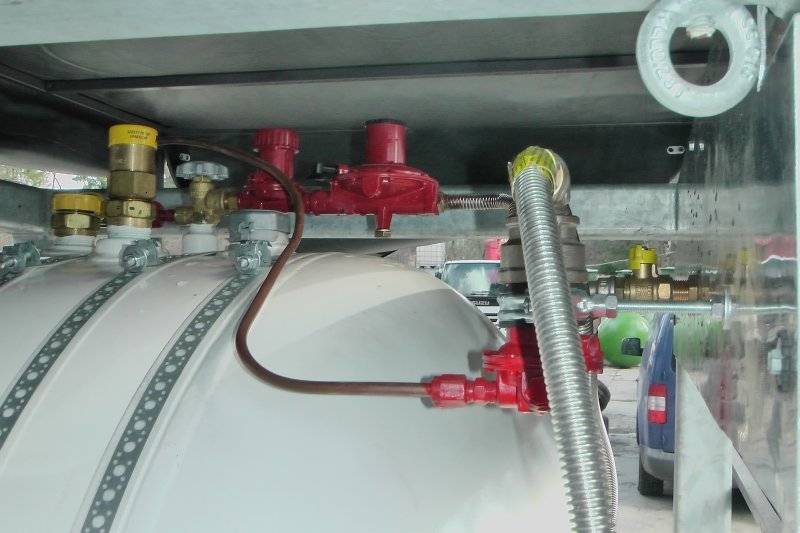 A tank with a gas mixture is installed on a single-axle or two-axle trailer wheelbase equipped with a mechanism for coupling with a car. The frame, with which the container is fixed during transportation, is made of galvanized steel.
An awning provides protection from natural precipitation and direct sunlight. Case material - wear-resistant polyvinyl chloride.
The gas tank is equipped with collapsible connections and corrugated pipes made of high-alloy steel for quick connection to the pipelines of the heated object. Stability, immobility of the module on wheels when placed on the ground is achieved by four outriggers.
Mobile storage for autonomous gasification is produced in several variations:
- Without forced heating of the tank at low temperatures. This model is acceptable for regions with mild winters.
- The heating of the tank with the fuel mixture is achieved by connecting the gasified object to the heating circuit.Docking nodes provide quick disconnection of pipes without loss of coolant, which is important when traveling to refuel.
- An autonomous boiler plant is responsible for maintaining the positive temperature in the tank necessary for the rational use of the propane-butane mixture. Its peculiarity is that it does not depend on electrical power. The mini-boiler is equipped with automation and protection that prevents overheating of the vessel. The fuse is activated when the pressure in the tank exceeds 500 kPa.
The tank is equipped with control and measuring, safety devices, shut-off and control valves. The automatic bleed valve prevents the build-up of excess pressure in the working medium, which can lead to vessel deformation or depressurization. The package of a mobile complex usually includes a flexible gas pipeline in a heat-insulating shell.
Refueling of a mobile gas tank is carried out by means of a standardized connector used in gas installations on cars.
Please note: refueling of the transported module is carried out both at stationary stations (AZGS) and by vehicles with gas tanks equipped with pumping equipment
The main components of the gasification project
Not every place on the site is suitable for installing a propane-butane tank. In order for all conditions to be met, it must have the appropriate dimensions. The main thing is that a free entrance is needed to the tank, otherwise it becomes impossible to fill and maintain it.






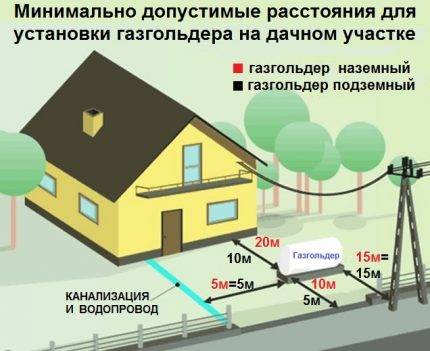
When choosing a place for a gas tank, it should be noted that the gas tanker has a hose no longer than 24 m.In accordance with SNIP, you need to retreat about 2.5 m from the perimeter of your household, and if there is a source of water intake, then the norm provides for a distance of 5 m to it
All communications can only be laid underground. The container itself should not be under a driveway or other road.
The optimal distance from the road to the reservoir is 5 m. At least 8 m should be retreated from household buildings on your site. To the foundation of the house - 10 m, and from the neighbor's house - 20 m. The factory data plate should be in sight. The rules for choosing a location for the location of a gas tank are given in an article devoted to this issue.
It is allowed that the installed tank rises above the ground by a maximum of 0.6 m. It must be grounded, and if static voltage is present on the site, measures must be taken to protect against electrochemical corrosion.
In terms of autonomous gasification, it consists of a tank that has been manufactured and passed all stages of testing at the factory, pressure regulators, protection, and a gas pipeline. Protection consists of magnesium electrodes located at a distance of about 0.35 m from the tank. The purpose of the condensate trap is to collect liquid butane, which then evaporates on its own.
The gas pipeline is assembled from pressure polyethylene pipes. A gas pipeline is laid before entering the house, assembled from metal pipes and equipped with a shut-off valve and a bellows type compensator. The internal pipeline is equipped with thermal shut-off valves.
To immerse the gas tank, a pit is prepared, at the bottom of which a pillow of sand and gravel is arranged. Next, a monolithic base with a height of at least 160 mm is poured.Without this, the unit can squeeze groundwater out of the pit. Sometimes the tank is immediately fixed on the finished reinforced concrete slab, and then all together lowered into the pit.
After fixing the tank, it is coated with a special grease that protects the metal from corrosion. The next stage is the anode-cathodic protection device. After that, the gas pipeline is laid, it and the pit are covered with soil.