- Luxury hatches under the feet of Muscovites
- antique riddle
- Why a cat was crossed with an ax and where hatches from Europe lie in Moscow
- Why hatches are round and how to decipher their "initials"
- In the Human World: Chameleon Hatches and Parrot Hatches
- Why a tree was driven into cast iron, and geotags were put on hatches
- Where did the waves come from and who “stole” the lightning
- Rules for choosing sewer manholes
- Conclusions and useful video on the topic
Luxury hatches under the feet of Muscovites
However, there is a trend: in many progressive cities of the world, manholes are no longer perceived as a boring object with a narrow function. In Japan, America and Europe, these are real art objects, next to which it’s not a shame to take a selfie. In the Italian city of Ferrara, sewer manholes and storm grates are exhibits of a museum whose collection includes more than 130 caps from around the world. And if you met a manhole from the Swiss city of Schaffhausen on the streets of Moscow, you would be surprised by an unexpectedly familiar image: like the coat of arms of the Russian capital, it depicts George the Victorious defeating a serpent.
 Overlay of the drainage system at the Cathedral of Christ the Savior. By the way, several years ago a similar design concept was already discussed among industrial designers who developed sketches of the “new face” of hatches based on the Moscow coat of arms.However, we are still far from the reckless tolerance of Europeans, and the main argument of the opponents of this idea was the phrase “It is not good for the Orthodox to trample on holy faces.” A compromise between stylish design and traditional religion has not been reached, so for now, believers are left to admire the neutral-decorative patterns of the overlay of the drainage system of the site near the Cathedral of Christ the Savior.
Nevertheless, urbanists believe that in the near future our hatches will also turn from a gray faceless mass into a noticeable element of urban infrastructure. Moreover, even now under the feet of Muscovites there are rare designer specimens. In 2013, on the occasion of the 190th anniversary of the founding of the Alexander Garden, commemorative polymer hatches appeared in it. During the improvement of the public space near the Chistye Prudy metro station, “navigation” hatches with the inscription “Boulevard Ring 2016” were built into granite slabs. And the students of the Institute of Industry Management of the RANEPA unanimously “rotate the planet with their feet”: on the territory of the university there are several hatches with the image of the Earth at once.
 Memorial hatch in the Alexander Garden.
In 2018, beautiful hatches with ornaments of animals and plants were installed in Zaryadye Park instead of the usual nondescript covers. In the same place last year, cast-iron covers with the inscription "Moscow Urban Forum 2018" were noticed - they met visitors to a large-scale event, at which experts talked about the metropolis of the future and a new space for life.
 Manhole installed in Zaryadye Park for the Moscow Urban Forum 2018.
Lids with the brand name were also installed on the territory of VDNKh - so to speak, the final touch of a large-scale reconstruction. The original birds are frozen in metal on the observation deck on Sparrow Hills.And Mosvodokanal, in honor of the 120th anniversary of the capital's sewage system, released a jubilee series of 200 copies: on the "cover" of each hatch, the facade of the main pumping station in Sarinsky Proezd flaunts.
 Luke on Sparrow Hills.
antique riddle
The sewer manholes of Muir and Maryliz have a rich pedigree and a difficult fate: before the revolution, the founders of the company, Andrew Muir and Archibald Maryliz, were well-known entrepreneurs, thanks to whom the country's main store, today's Central Department Store, appeared on Kuznetsky Most. In 1903-1912, a lot of cast-iron covers for drain wells with advertisements for "Mur and Maryliz" were installed in Moscow. Hatches have survived to this day in the Golikovsky lane of Zamoskvorechye, on the street. Zhukovsky, Chayanov, in Vspolny lane and on Malaya Pirogovskaya.
A hundred years ago, Moscow cabbies posed a riddle to visitors: “But here in Moscow, Alekseevsky rubles are lying around on the road. Big, enviable. Yes, if you want to lift it, the navel will untie. And if you raise it, you will never pay off. Apparently, modern Muscovites guessed the correct answer and decided to risk their navel: at the beginning of 2019, one of the rare antique sewer manholes of Muir and Maryliz disappeared from Timiryazevskaya Street, which the thieves immediately put up at an online auction.




Why a cat was crossed with an ax and where hatches from Europe lie in Moscow
Walking along Mayakovka, Novaya Basmannaya, Zemlyanoy Val or Sadovo-Chernogryazskaya, carefully look under your feet - and you will see a mysterious image on the hatches ... no, not a hammer and sickle, but crossed axes and cats.
This is the "revolutionary" emblem of the "People's Commissariat of Railways", and even earlier, since 1830 - the Department of Railways of the Russian Empire.The fact is that the first Tsarskoye Selo railway in our country opened only in 1837, and before that, the track facilities included bridges, which symbolized an ax; and river communication, habitually denoted by an anchor, as they said then - “cat”. Railway workers marked their hatches with the sign of “ax and cat” until 1932, and then they received a new symbol - a crossed wrench and a hammer.

There are also “stray” foreign hatches in Moscow, the origin of which history is silent. For example, in some unknown way, on the paving stones of Tsvetnoy Boulevard, there was a piece of the Berlin sewer, as evidenced by the inscription “Kanalisation Berlin” and the image of an eagle, traditional for German heraldry. Another manhole from Germany was spotted by the inscription “KanalGuss” on Federative Avenue in Perovo, and on Krymskaya Embankment, among the cubes of granite pavement, an elegant lattice of the company “Humberg Metall und Kunstguss”, which produces unique systems for watering and ventilating tree roots in urban environment.
 Gutter grating produced under the Polish brand Sfero. Novoslobodskaya street, 2016. On Rusakovskaya Street there is a Finnish-made cast-iron lid with the image of an atomic nucleus, hatches and the builders of the McDonald's restaurant on Krasnaya Presnya were brought from the same country of lakes. At the Avtozavodskaya metro station, near house number 1 on Masterkova Street, a manhole from the Polish city of Stomporkow, produced for the 50th anniversary of the Dutch company, was carefully rolled into the asphalt. Often on the roads of the capital there are also storm water inlets with holes in the form of cobwebs and a modest inscription "France" ...
Why hatches are round and how to decipher their "initials"
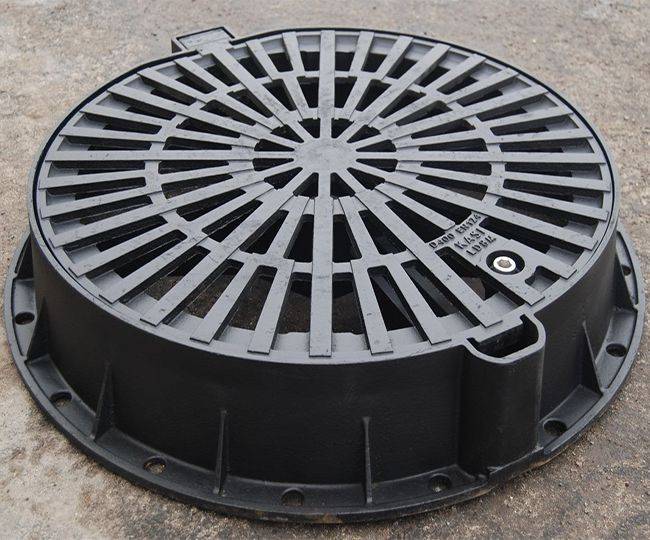
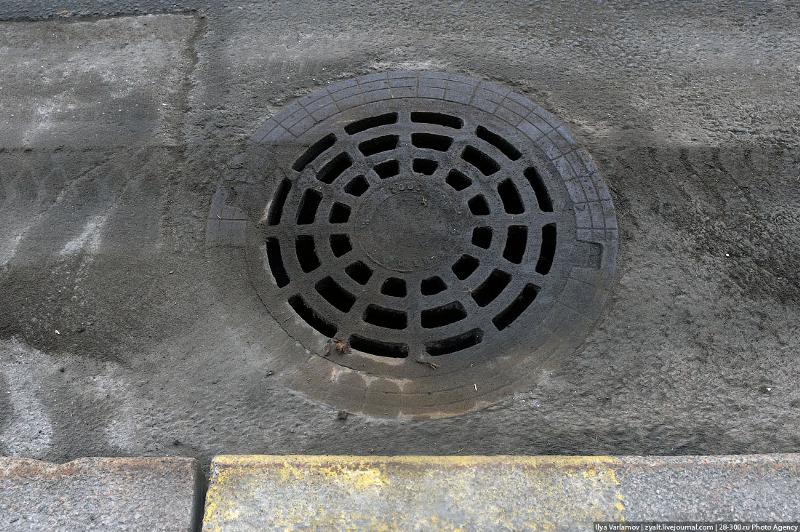
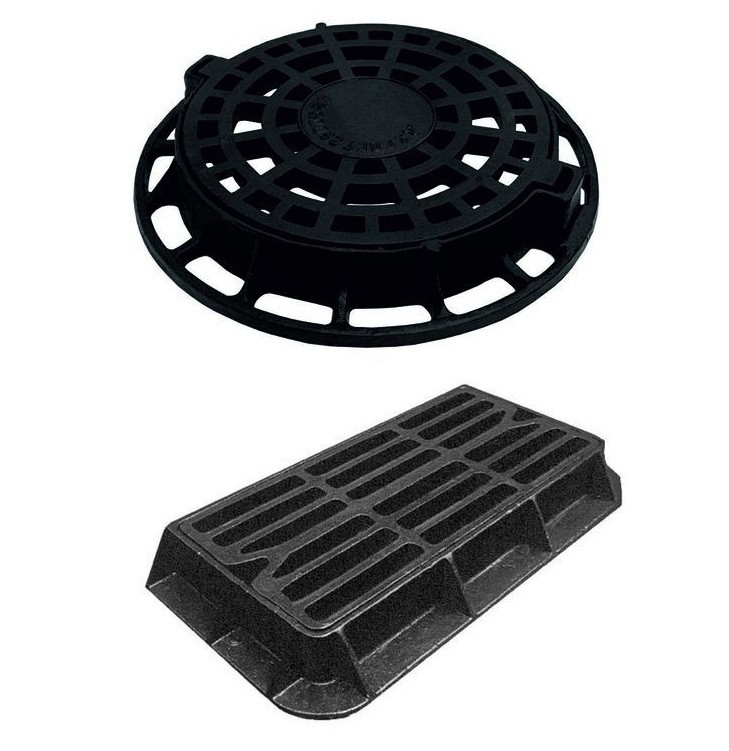
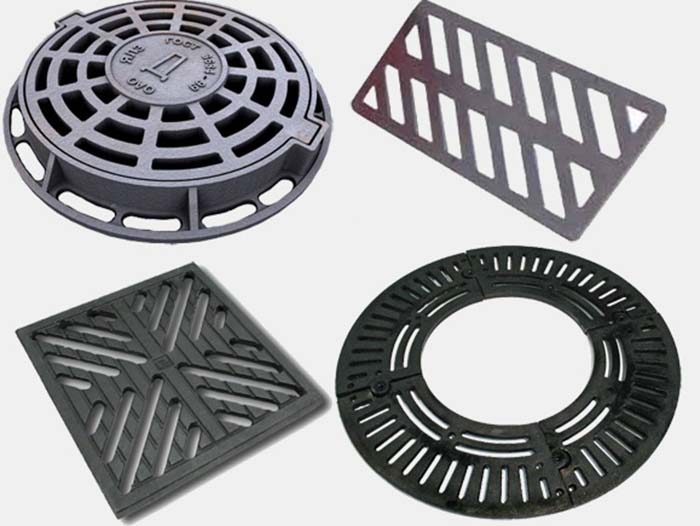
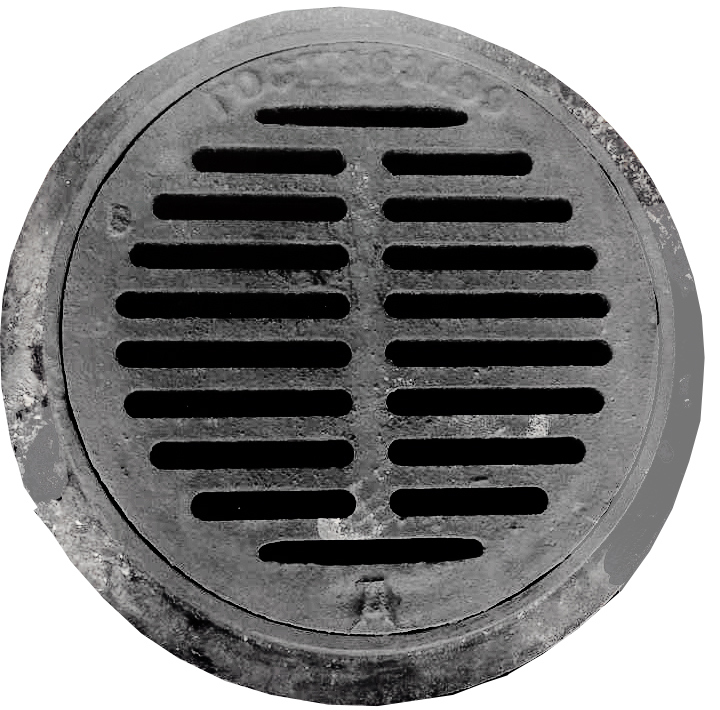
In general, hatches are square, triangular, and even barrel-shaped.But still, the ideal shape of the lid is exactly round, because, firstly, according to the laws of geometry, a round hatch cannot fall into a smaller diameter, no matter how you twist it. Secondly, according to the laws of physics, a round shape will distribute the load better than any other, while a square one is bursting at the seams, or rather at the corners. And besides this, the production of a round shape costs a third less than the same square one, and it is easier to move a round hatch - it can be rolled. Manholes of rectilinear forms, although rare, are still installed on pedestrian sidewalks, where the load on them is small, but it is more convenient to tile them.
 D ─ drainage.
 K - sewerage.
 GTS - urban telephone network.
 B - plumbing.
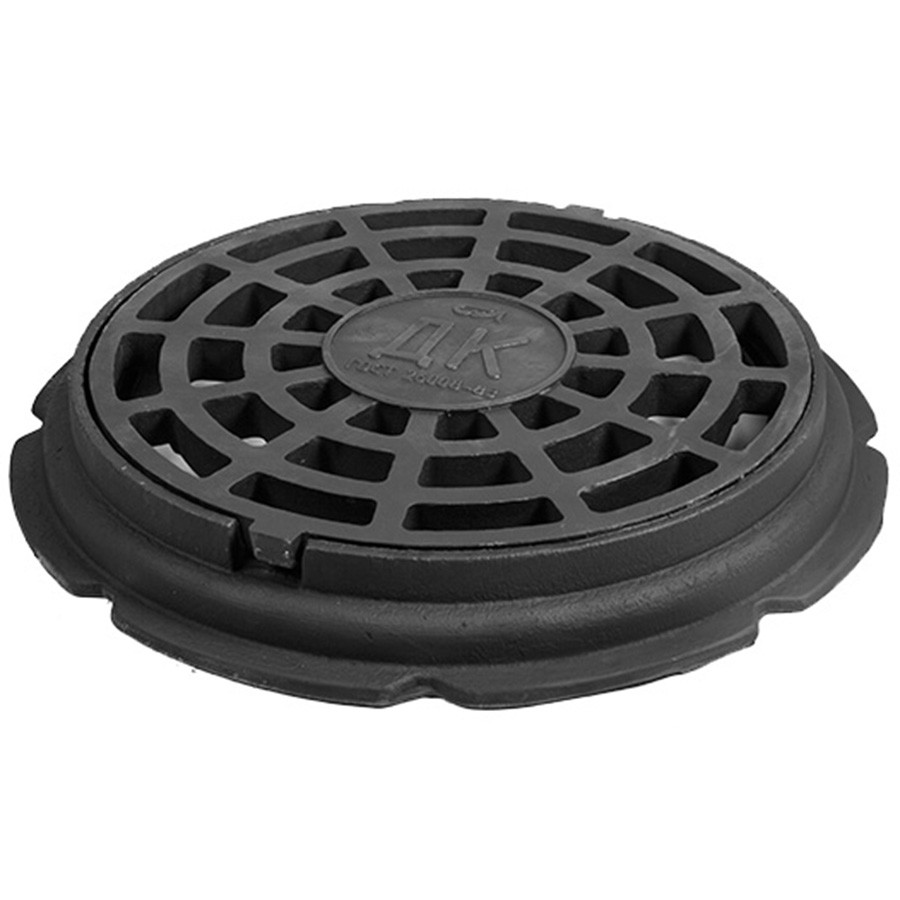
Finally, we will reveal the main secret - how to decipher the letters on the hatches. Everything is simple, as in the ABC: V is water supply, K is sewerage, D is drainage (aka rain sewer), TS is a heating network, GS is gas supply, T is a telephone, and GTS is a city telephone network, G or PG is a fireman hydrant. The abbreviation TSOD means "Technical Means of Traffic", that is, a traffic light cable network. Interestingly, according to the rules, an alphabetic cipher must be present on any, even on a designer hatch, and, moreover, be on an imaginary line connecting the ears of the cover.
Well, now all the secrets of the hatch are open and, believe me, from now on the world will never be the same for you: having this knowledge, you will now and then point your companions to ordinary and outstanding covers, with the air of an experienced public utility engineer explaining their true purpose.
In the Human World: Chameleon Hatches and Parrot Hatches
“It’s good that you are so green and flat!” the old woman Shapoklyak used to say to Genya the crocodile. The same can be said about the hatches installed in the thick grass on the lawns of Tyufeleva Grove: in order not to be an eyesore to visitors with their presence, they disguise themselves as the color of the grass. The green eco-lid near the landscaped pond in the former military town of the village of Mosrentgen is also painted with curly curls. If you suddenly get lost in Sokolniki Park, a light garden disc with a compass will tell you the right way to the metro.




 Luke in Mosrentgen.
 Luke at the restaurant "Old Tower".
 Manhole in Sokolniki Park.
But the hatch near the business center "The Yard" - as if just from London: it is so bright and so yellow that it is simply impossible to pass by and not notice it. Visitors to the Staraya Tower restaurant on Theater Square also probably remembered the red hatch at the entrance, which depicts the Round Tower, also known as the Zaikonospassskaya Tower of the Kitai-Gorod wall, built at the beginning of the 16th century, demolished in 1934, and recreated in 1997.
Manholes on the territory of the former Bolshevik confectionery factory on Leningradsky Prospekt are perhaps the most conceptual in Moscow. Probably, the new neighborhood obliges: today the Museum of Russian Impressionism operates in this cultural and business complex, where an interesting collection of Russian paintings and graphics of the late 19th and early 20th centuries is exhibited. And when an art cluster opened on the site of the former Krasny Oktyabr confectionery factory on Bolotnaya Embankment, its paths were also illuminated by skylights with a recognizable logo.
 Luke at the "Red October".
 Luke at the business center "Bolshevik".
The “muses of trade” are not silent either: personal hatches are located at the Usachevsky market, Tulsky and Sheremetevsky shopping centers, hotels on Nikolskaya street, in the Factoria and Wall Street business parks, and on the paths of the Savelovsky City residential area ".
Why a tree was driven into cast iron, and geotags were put on hatches
The first attempts to protect the access of citizens to the inner world of underground sewage happened more than two thousand years ago in ancient Rome. But we will not dig so deeply, but we will begin our dive into the history of the capital's sewer paraphernalia from 1898, when the 1st stage of the city sewer was launched in Moscow. This means that the very first hatches are now 120 years old!
Incredibly, by some miracle, in the old quarters of the capital, about a dozen of these cast-iron long-livers, which in previous years were called "menazhnitsa" - because of the shape of the lid with characteristic recesses, have survived to this day. These cavities were made not for beauty, but for comfort: wooden bars were driven into them, which did not slip in winter, and softened the blows of horse hooves in summer.
 "Menazhnitsa" is the oldest design of the Moscow manhole. For the second hundred years, rusty, but still strong “ancestors” have been lying on the territory of the Botkin hospital, on Pokrovka and Pokrovsky Boulevard, in the courtyard of pre-revolutionary houses in Bolshoy Kazenny Lane and not far from the Church of St. Nicholas in Khamovniki. Until now, the letters “GK” can be seen on them, which stand for “City Sewerage”. Although, with such experience, another reading is possible - for example, “the pride of the team”.
Another interesting and in its own way unique copy was found at 2nd Kadashevsky lane, 14, building 3.This ornate trapdoor blocks access to telephone wires, and is distinguished by its geotag, permanently frozen in cast iron, a precise location address.
 Hatch at the address: 2nd Kadashevsky lane, 14, building 3.





Where did the waves come from and who “stole” the lightning
The theft of cast-iron covers is, of course, a grief for hatches ... But if it seems to you that modern hatches have a nondescript appearance on purpose so as not to end up at the ferrous metal collection point, then it only seems to you. Because, for example, the main hatch weighing more than 200 kilograms, which is able to withstand a load of 40 tons, is not particularly up to beauty.
In fact, characteristic ornaments for cast-iron covers were invented back in the 19th century, when not only plumbers, but also electricians and signalmen began to lay underground networks of urban communications. In order to quickly - literally at a glance - determine "one's own among strangers", a graphic relief of waves and turbines was chosen to designate the water supply system, "wafers" were forever fixed behind the city sewerage, and telephone companies began to "draw" cobwebs or lightning bolts on the covers.
The people called the "lightning" covers "cockroaches" and "jellyfish", and today they can be found on the territory of the Timiryazev Academy, next to the fire tower on the street. Rusakovskaya, 26, in Medov lane, 12, on Begovaya, Novoslobodskaya and Leninskaya Sloboda.The abbreviation on them - "NKS USSR" - stands for "People's Commissariat for Communications", but the logo itself was unceremoniously borrowed by the Bolsheviks from the pre-revolutionary, bourgeois hatches of the "Swedish-Danish-Russian Telephone Joint-Stock Company", one of which since 1901 has been lying near the store " Buloshnaya" in Lyalin Lane.
 Luke near Buloshnaya in Lyalin Lane.
Rules for choosing sewer manholes
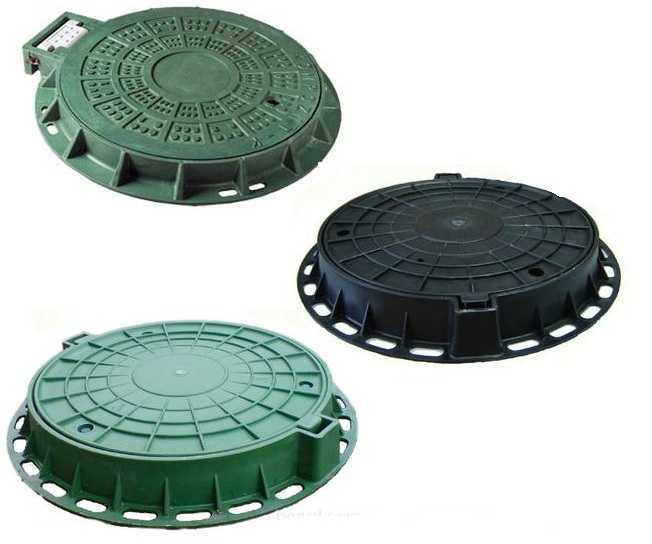
When choosing a hatch for drainage, storage and inspection sewer wells, first of all, you need to pay attention to the shape. If the outlet neck of the communication system is made in the form of a circle, it will need a round part
A square or rectangular hole is best closed with an element of the same shape.
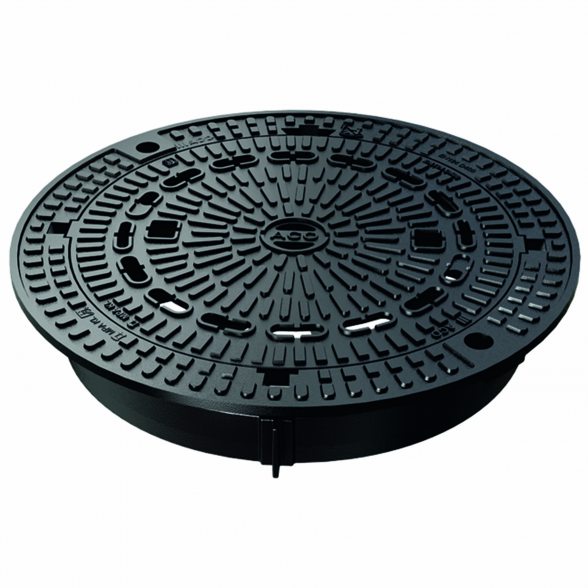
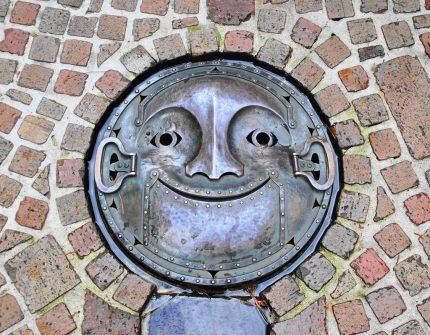 Modern industry offers sewer manholes with an original pattern on the lid. They not only perform the function of protecting internal communications, but also act as an original design element.
When the hatch is planned to be placed in a place subjected to serious mechanical stress, it is worth choosing a model made of cast iron. It will cost more than composites and polymers, but will last longer and withstand the constant pressure of passing heavy trucks.

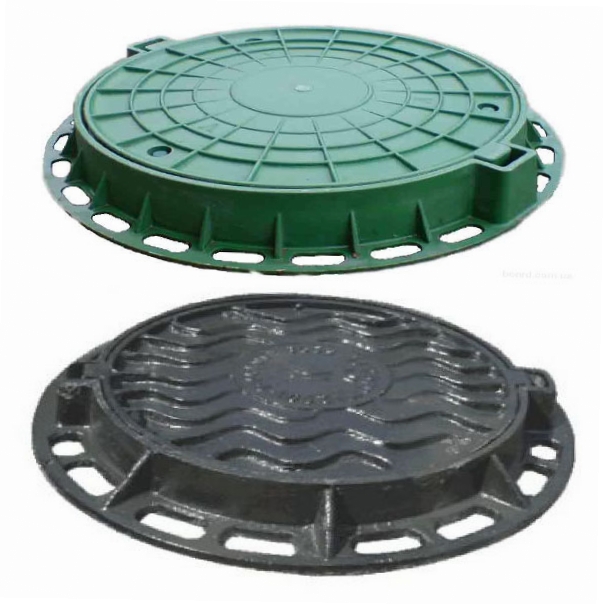
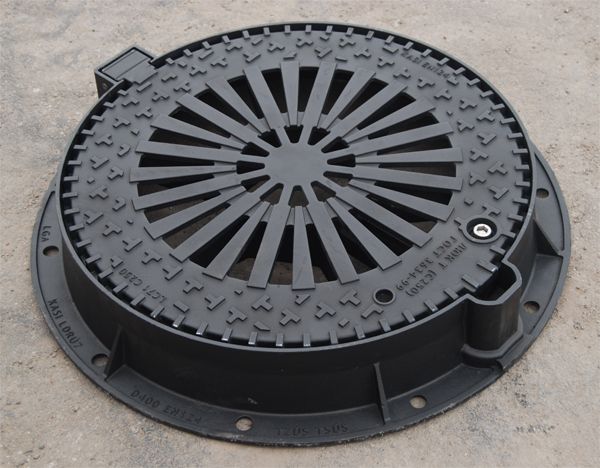


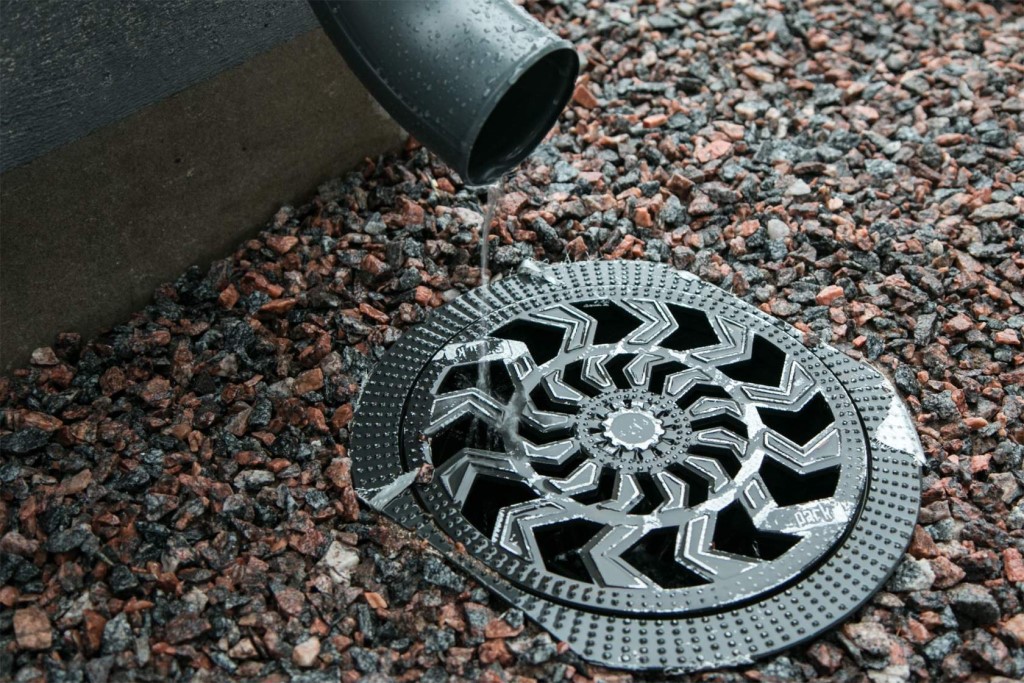
For private household conditions, it is not necessary to spend money on such a hatch, even if the owners have a heavy vehicle. One-time trips will easily transfer both composite and polymer counterparts.
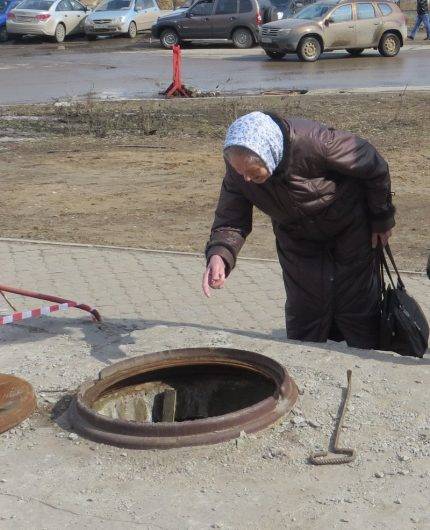 In the immediate vicinity of residential buildings with low traffic intensity, it is better to install composite or polymer hatches. They have soundproofing properties and do not make sharp sounds when a car passes over them.
For installation in an open area, it is better to choose models equipped with a locking element.Which is able to protect the cast-iron hatch from theft for the purpose of subsequent sale for recycling.
Polymer and composite parts cannot be sold for profit, but they can be carried away by hooligans or teenagers. Therefore, such models will not interfere with a reliable lock or latch.
Conclusions and useful video on the topic
Video #1 How to install a sewer hatch on the site with your own hands:
Video #2 Strength testing polymer and cast iron sewer manholes:
Video #3 What dangers are fraught with sewer manholes of foreign production:


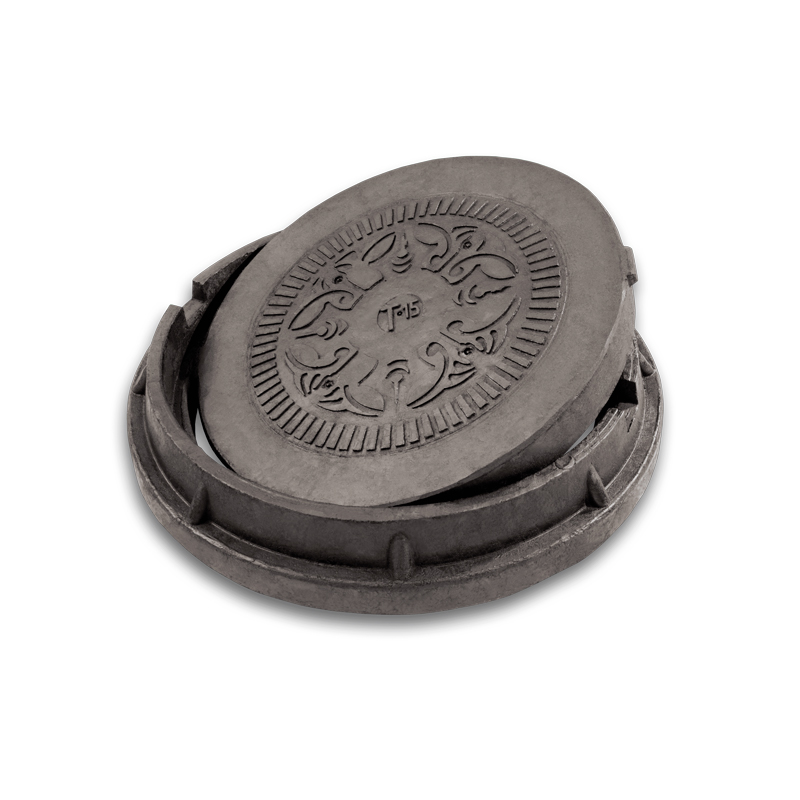


When choosing a suitable hatch, it is necessary to take into account its future location, the level of potential load and the climatic conditions in which the operation will take place.
Ignoring any of these important parameters will negatively affect the purchase and it will not bring the desired results. A model that does not meet the general criteria will not cope with the task and will quickly fail. The owners will have to spend money again to purchase a more suitable product.
Please write comments, ask questions, post photos on the topic of the article in the block below. Tell us about how you bought a hatch for arranging sewers in a suburban area. Share your own criteria based on which you made your choice.