- The main components of the drainage system
- Selection of pipe section
- Do-it-yourself alternative "rainfall" options
- Do-it-yourself PET storm sewer
- Laying "mesh"
- Natural outlet method
- Stormwater types
- Helpful Hints
- How to choose fan pipes
- The gutter as one of the main and important components of the device
- Wall
- Rain or suspension
- Gutter classification
- How to correctly calculate the gutters?
- Assembling the gutter structure
- Varieties of drainage systems
- Storm sewerage device in a private house
- How to properly install in the structure around the house?
- Calculation of the depth and slope of pipe laying, the volume of the well for collecting moisture
- Pipe laying depth
- Required pipeline slope
- Design Features
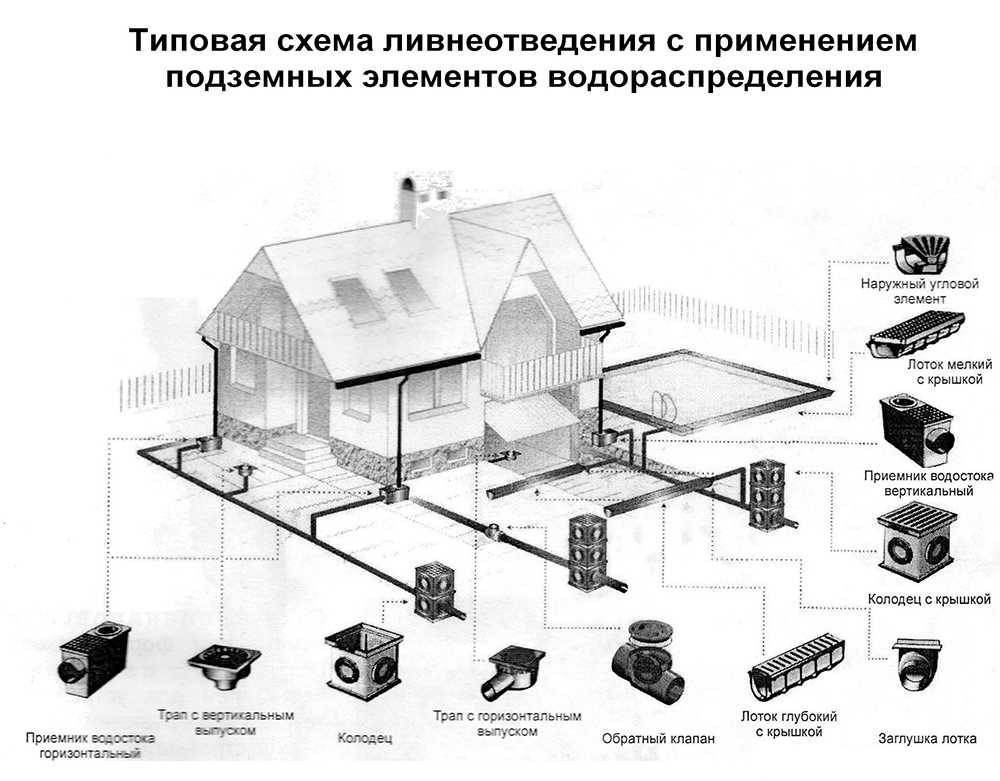
- Stormwater components and their types
The main components of the drainage system
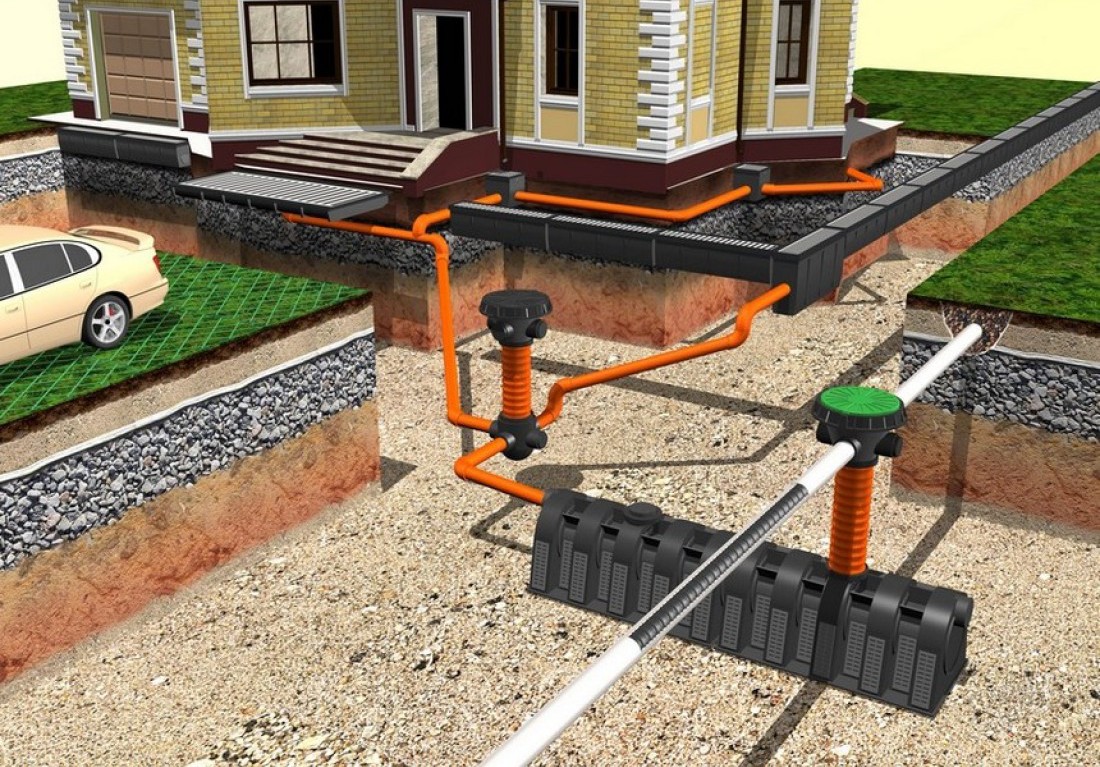
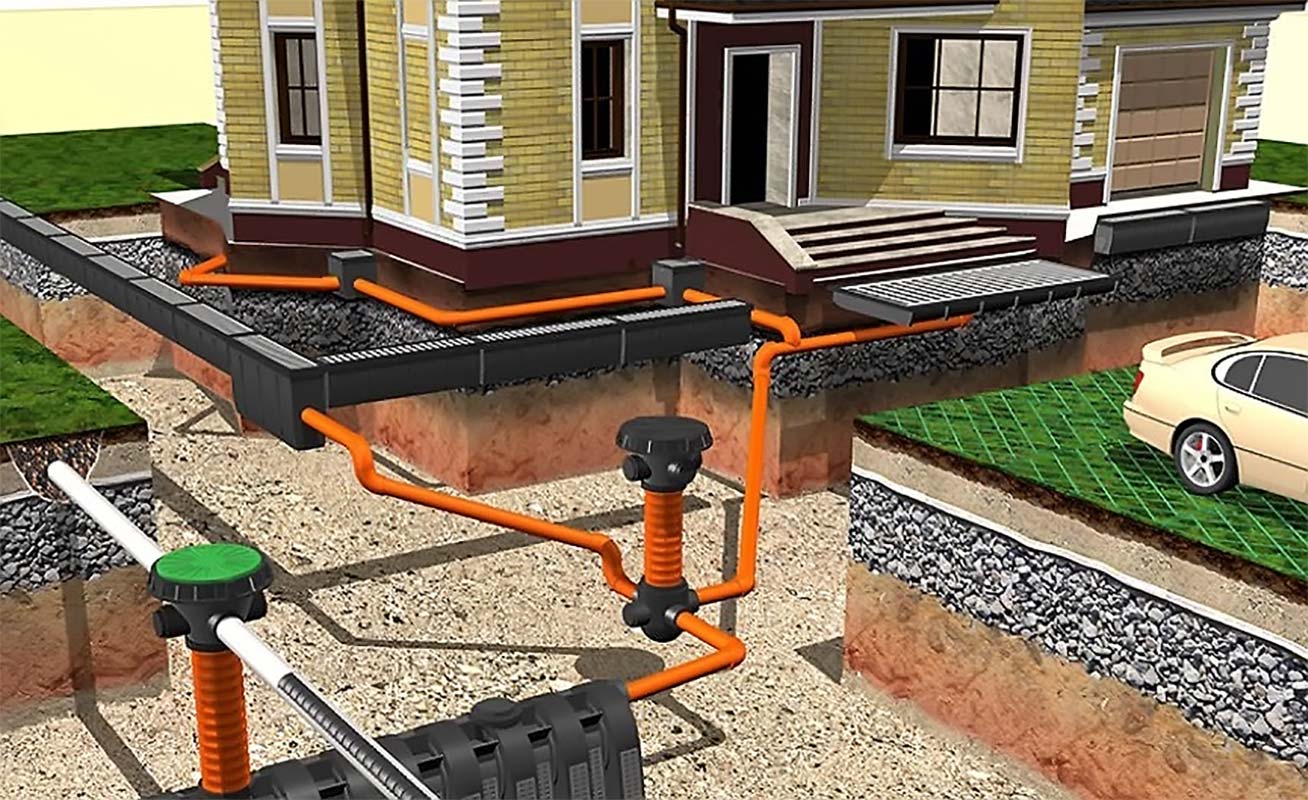
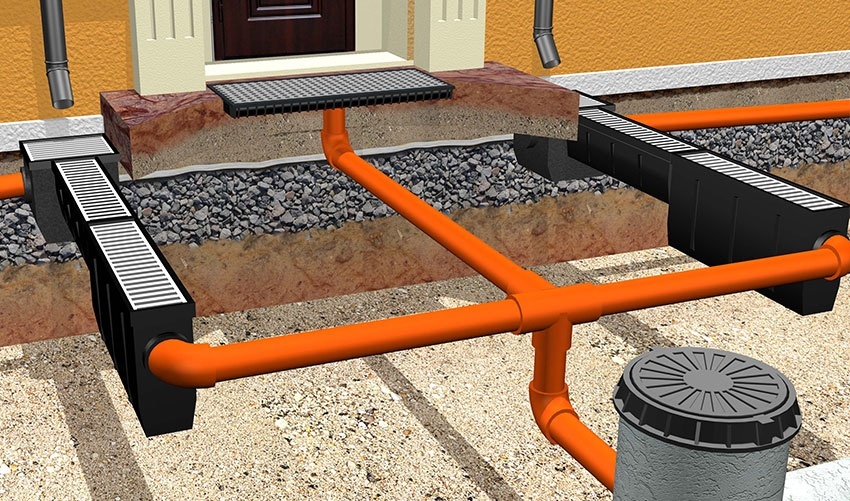
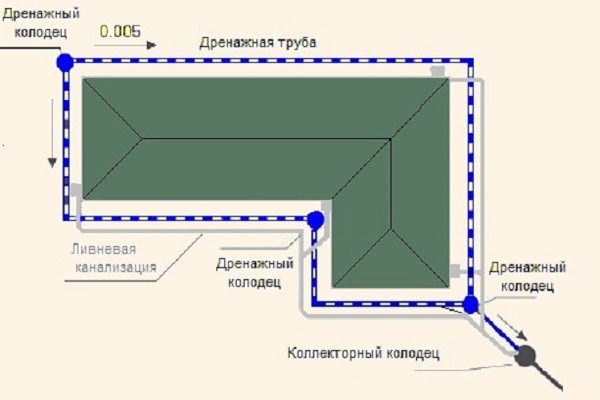
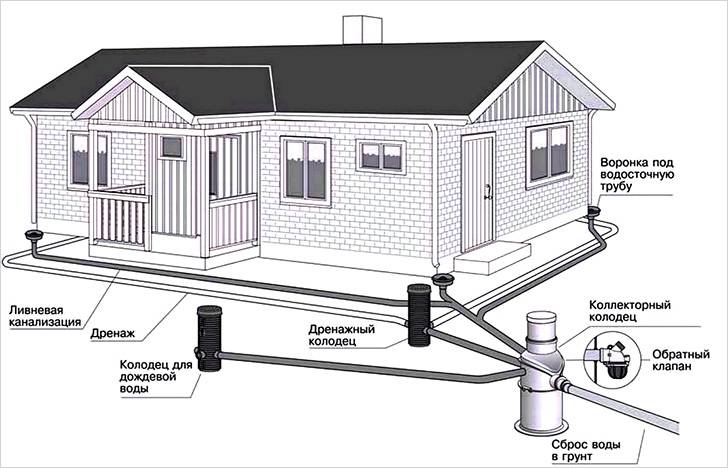
Drainage sewerage on the backyard should include the following elements:
- Drainage channels and gutters.
- Trays for receiving water in front of the entrance doors.
- Drainage funnels under downpipes.
- Wells for inspection.
- Sand catchers.
- Collector well.
Water can be discharged both through open gutters and through closed underground channels. The main requirement for gutters and channels for drainage is to maintain a slope in the direction of the water collectors.The flow of water through the channels can be carried out not only in special water collectors. Water can simply be diverted beyond the boundaries of the territory of the personal plot.
Rainwater receivers are installed under downpipes that drain water from the roofs of buildings. They are made in the form of plastic or polymer concrete rectangular funnels with different volumes. A necessary element of such a receiver is a basket that catches various debris washed off the roofs with water. From such funnels, water enters the drainage open gutters or underground channels.
Inspection wells provide the opportunity to inspect the channels, care for them and clean them if necessary. Usually they are created where drainage channels connect or intersect - it is in such places that the likelihood of clogging is highest.
Sand traps trap solid particles that are contained in the water flowing down the drainage channels. Such sand traps are installed on open storm sewers.
Through the drain channels, water is diverted to a collector well, in which it is collected and filtered into the soil layers.
Selection of pipe section
Next, we determine the cross section of the pipes, which will depend on their future slope. Based on the section and volume, which is determined using the above formula, we can determine the required diameter.
| Slope, % | Diameter | ||
| 10 cm | 15 cm | 20 cm | |
| 1,5-2 | 10,03 | 31,53 | 77,01 |
| 1-1,5 | 8,69 | 27,31 | 66,69 |
| 0,5-1 | 7,1 | 22,29 | 54,45 |
| 0,3-0,5 | 5,02 | 15,76 | 38,5 |
| 0-0,3 | 3,89 | 12,21 | 29,82 |
If one pipe will be connected to several gutters at once, then to determine the diameter, you simply add the numbers of each of the flows. All other elements of the system - trays, grates, funnels, etc., we will calculate in the same way as pipes. These elements, made of plastic, are now sold in all stores.If you wish, you can order parts from a locksmith - he will make them from galvanized sheet.
Do-it-yourself alternative "rainfall" options
The desire to save is especially pronounced when arranging a summer cottage. All improvised means are used, especially since in most cases, you do not need to pay for them at all. Of course, the use of such materials does not increase the quality of construction projects. However, it significantly reduces their cost.
For the device of storm sewers, you can also use various improvised materials. Most often it is:
- plastic bottles;
- worn out car tires;
- various remnants of building materials;
- polystyrene, etc.
Despite the fact that all these materials can hardly be called suitable, with proper installation and compliance with all necessary requirements, it is possible to mount a fully functional "stormwater" from them. Consider such a system on the example of plastic bottles.
Do-it-yourself PET storm sewer
The main reason for the use of improvised means, as mentioned above, is the relatively high cost of components for drainage systems. In addition, plastic bottles undergo special processing during the production process, which allows them to be used as an underground drainage pipeline for 50 years or more. Let us consider in more detail the method of installing storm sewers from PET.
Let's say right away:
Use of plastic bottles possible only with the construction of an internal (underground) sewer system. This is due to the fact that under the influence of ultraviolet radiation, polyethylene is not only intensively destroyed, but also releases toxic compounds into the atmosphere.
There are two installation options:
- grid;
- natural withdrawal.
Each of these options is quite effective and deserves separate consideration.
Laying "mesh"
This option involves removing the bottom of one of the bottles and installing the next one in the resulting hole, neck first. Such a connection is quite tight and quite reliable.
The sequence of installation work is as follows:
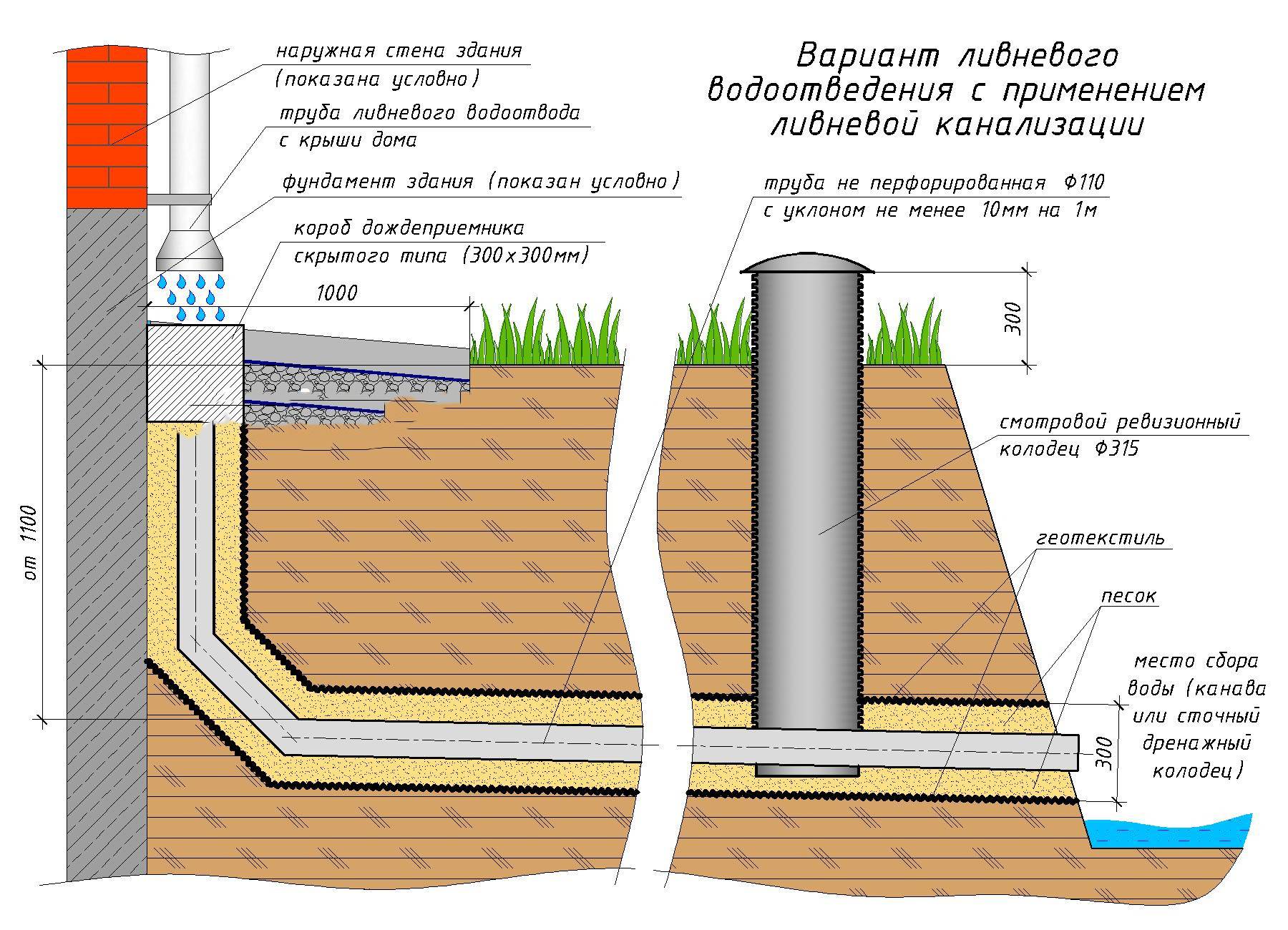
- According to the markup, trenches are dug on the territory of the site with a depth of about 50 cm. This figure is not mandatory, since soil features and the depth of the aquifer can vary significantly in different areas.
- A sand cushion 20-25 cm high is laid at the bottom of the ditch and carefully compacted.
- The previously obtained pipes are laid on the bed thus obtained. From above, the improvised pipeline must be insulated with some kind of moisture-resistant heat insulator (in extreme cases, sawdust is suitable), and then fill the trench with soil to the very surface. This is done in order to exclude the possibility of freezing of the drainage line in the cold season.
- At the end of the pipeline, a storage or grouting well is equipped. If the collected water is not planned to be used for irrigation of the site or for other purposes, it can be diverted to a ravine or reservoir located in the immediate vicinity.
Natural outlet method
The river system became the prototype for the design of rainwater drainage, arranged according to the principle of free drainage: the main outlet line, which has its own "tributaries", acts as a channel. This option is especially effective in large areas and in wetlands.
The installation sequence is as follows:
- In the direction of the lowest section, the main trench and its "tributaries" are dug, observing the required slope. The main trench should be a little deeper than the others.
- A sand or gravel cushion is laid at the bottom of the dug trenches, after which bottles with tightly twisted corks are laid on it.
- The last step is the thermal insulation of the bottles and the backfilling of the trenches with soil.
The advantages of such a sewer include:
- minimum cost;
- the possibility of independent installation work;
- simplicity and long service life of the structure;
- in such a system, the development of bacteria and the occurrence of unpleasant odors are unlikely.
As for the disadvantages of such systems, it is difficult to say anything definite. Plastic bottles can last 50 years or more, which is quite comparable to the period of operation of factory pipes. PET does not rot and does not collapse under the influence of moisture, and the ground cover reliably protects them from ultraviolet radiation.


Stormwater types
Sewerage, designed to drain melt and rainwater, is of two types:
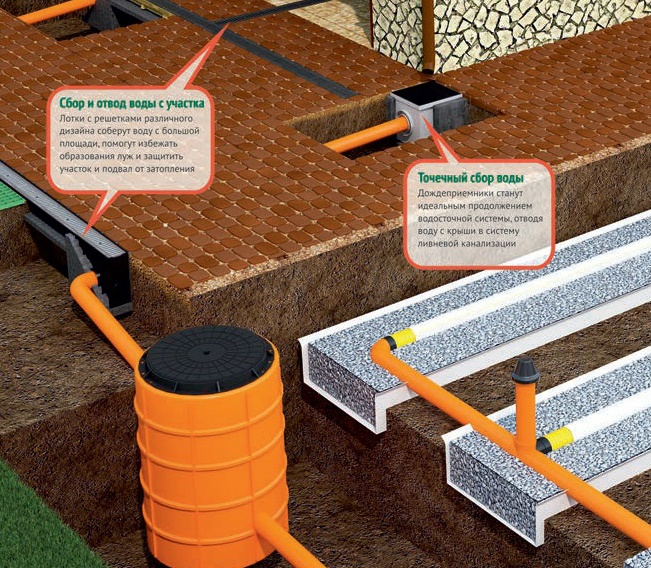
Point provides collection of water from the roofs of buildings. Its main elements are rain inlets located directly under the downpipes. All catchment points are provided with special sedimentation tanks for sand (sand traps) and are interconnected by a single highway. Such a sewerage system is a relatively inexpensive engineering structure that can cope with the removal of yards from roofs and yards.
Linear - a more complex type of sewer designed to collect water from the entire site. The system includes a network of ground and underground drains located along the perimeter of the site, along the footpaths and the yard.Usually, water from drainage systems placed along the foundation or protecting the garden and garden beds is diverted into the common collector of a linear storm. The system is extremely sensitive to slope towards the collectors. If it is not observed, the water will stagnate in the pipes and the drainage system will not be able to perform its functions.
According to the method of water drainage, stormwater is divided into:
On open systems that collect water through trays and deliver it to collectors. The trays are covered with shaped gratings on top, which perfectly complement the landscape design and provide protection from debris. Such systems are mounted in small private areas.
Such a project is implemented in practice by constructing canals that connect the catchment trays to each other and, ultimately, divert the collected water outside the designated area.
For mixed-type drainage systems - hybrid systems that include elements of closed and open systems. Mostly built for family budget savings. Outdoor elements are easier to install and cost less.
For closed systems consisting of storm water inlets, flumes, a pipeline and a collector that opens into a ravine or reservoir. This is an ideal solution for draining streets, industrial sites and suburban areas with a large area.
On the sewerage of open type in industrial execution. The main structural elements are concrete trays, on top of which lattice metal sheets are superimposed. By the same principle, open stormwater schemes for private housing construction are built.
The collected water is discharged through networks of pipelines laid and hidden underground. As a rule, the collected precipitation products are discharged to treatment facilities and further into the water area of natural reservoirs.
Separately, it is necessary to highlight the ditch (tray) rainwater collection and disposal system water. This storm sewer scheme, along with a simple scheme for its manufacture, is inherent in the versatility of operation.
Ditch storm sewerage has the advantage that, together with the function of removing rainwater, it can play the role of a supplier of moisture for agricultural plantations. It is also an economical construction option compared to other projects.
Thanks to the ditch design, it is possible to organize not only quite effective drainage precipitation products. The same system can be successfully used as an irrigation structure, for example, for the needs of a household (dacha) economy.
Helpful Hints
Often clogged stormwater, especially during leaf fall, is a source of headache and a lot of unpleasant work. There are several simple devices that significantly reduce the clogging of storm sewers with various debris: foliage, branches, needles, paper or polyethylene.
- Maintenance-friendly coarse debris filter in front of the rain inlet.
- An easy-to-clean sand trap or several sand traps in the right places.
These two devices usually make it much easier to clean and maintain the storm drain. But there are also industrial methods of protection, sometimes used in private homes: sedimentation tanks, oil traps, sorption blocks, filters for petroleum products, and even a block for ultraviolet treatment and disinfection of wastewater.
Share on your social network or leave your comment.
How to choose fan pipes
What pipes to choose for installing a drain system in the house? We will try to figure out what needs to be taken into account in order to avoid mistakes and create a sewer that will last a long time and without complaints.
First of all, it is important to understand what requirements such pipes must meet.
- Durability is an important factor. The sewerage system should work flawlessly for many decades, and if you take fragile pipes, then after a fairly short time you will again have to spend money on arranging it. In addition, due to possible pressure on the pipe walls, fragile options can quickly be damaged, which will lead to leaks and even emergencies.
- Resistant to chemicals and temperatures. Sewer drains are a very aggressive and sometimes quite hot environment. Therefore, good exhaust pipes should easily withstand the effects of these factors. In addition, it is desirable that they are resistant to UV rays, not afraid of mechanical damage.
- Smooth surface inside. It will ensure the durability of the system without blockages. Rough pipes tend to accumulate sediment inside, which will lead to blockages over time.
- Ease of installation is an important factor, especially if you do everything yourself. The easier it is to install the pipe, the better.
Types of pipes and fittings for sewers
When choosing pipes for drains, it is important to consider the conditions for their use. So, for example, to create internal and external systems, different types of products are used, which will have different properties.
Similarly, different pipes are used in homes and businesses.Thus, all types of sewer systems can be divided into three groups - storm, external and internal. Each of them has certain requirements for the use of materials.

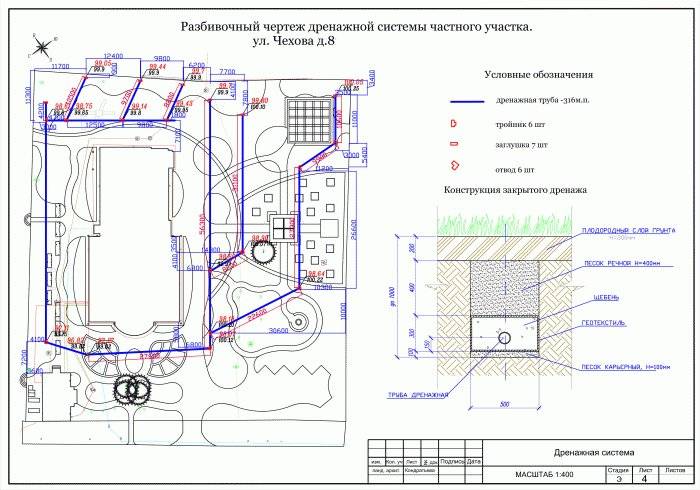
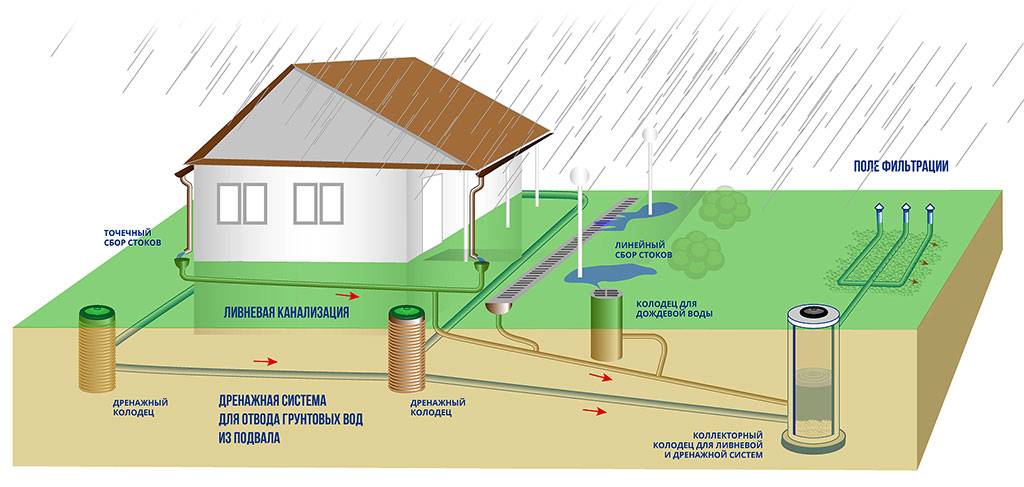


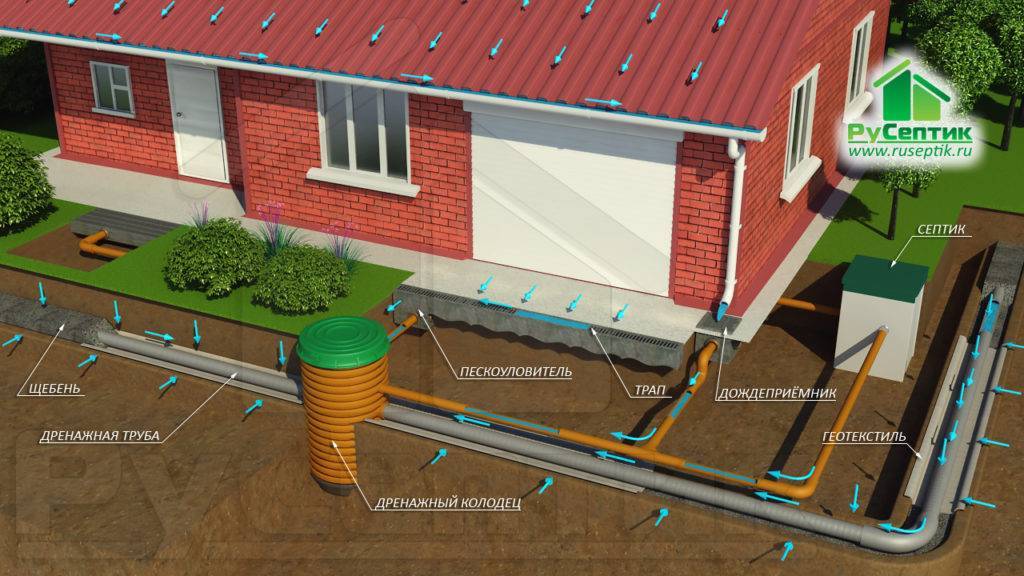
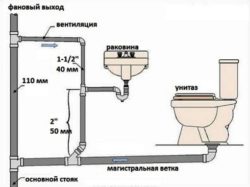
Now let's talk about the diameter of the pipes. It also depends on terms of use of products. For the system inside the house, pipes with a diameter of 50-100 mm are suitable, outside it is better to use more - 110-600 mm.
Do not forget about soundproofing
Any pipes should not conduct sound well, which is especially important for those inside residential buildings. Cast iron pipes are considered well soundproofed.
But plastic conducts sound very well, and after installation it must be additionally isolated with foam or mineral wool.
It is very important to take into account the load on the pipeline system. There is always internal pressure in the system, but it is also important to take into account the fact that for some reason it can increase, and the pipe must withstand a short-term heavy load
Another important point. Pipes in the house should not be toxic. Otherwise, they will be dangerous to use. Try to choose those made from environmentally friendly materials.
The gutter as one of the main and important components of the device
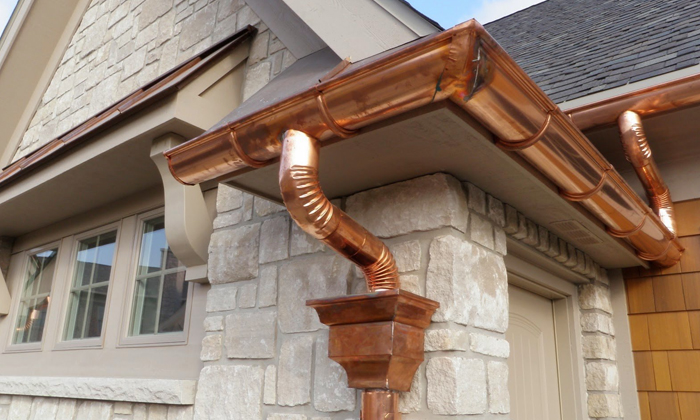
One of the main structural elements that receives water from the roof. There are several varieties of it: wall-mounted or suspended. For the manufacture of plastic, galvanized metal or copper is used.
Wall
It is localized close to the overhang of the roofing material at the very edge of the roof. The product is a side, up to 20 cm high and acts as a barrier to rainwater. Such gutters are installed at an angle to the overhang and are directed to the drain funnel. To connect the trays, glue or a double lying flange is used.The angle of their inclination is 15 degrees, which prevents the overflow of liquid over the edge.
Rain or suspension
It is tightly fastened directly under the roof overhang, which prevents the accumulated liquid from flowing under the gutter. For fixing, steel hooks are used, the shape corresponding to the product. Since this fragment does not bend, in order to avoid overflowing it, you need to make a hole in it in a pre-marked place. When calculating the slope in this case, the amount of precipitation that fell during the year is taken into account.
Gutter classification
The following types of gutters are distinguished by shape:
| Variety | Characteristic |
| semi-elliptical | Copes well with large water flows, as it provides a large throughput |
| Semicircular | It is resistant to stress, has a high level of rigidity. Such a gutter is universal, as it is used on most roof structures. |
Gutters are also classified according to the material of manufacture:
- Plastic. They have an attractive appearance, low weight and low cost. With proper fastening and application, the service life is 15-25 years. You can mount them yourself. Such fragments are fastened with the help of couplings or latches with rubber seals. Sometimes glue is used to fix it. But such products have a high risk of mechanical damage, become brittle at low temperatures. Small scratches on the surface can be masked with acrylic paint.
- Aluminum. For connection, fasteners with rubber and silicone seals or specialized glue are used. Untreated material can quickly rust. A layer of varnish will help to avoid this.
- Galvanized.They are metal products with pre-applied polymer protection. Characterized by a wide range of colors. For fastening, brackets with latches equipped with rubber seals are used. Such gutters have high strength and do not corrode, unless the polymer layer is damaged. The disadvantage is the frequent absence of the correct form, which complicates the assembly of the system.
You can also buy copper products in stores. They are durable, rust resistant, attractive appearance and long service life, but they have a high cost.
How to correctly calculate the gutters?
The standard element length is 3-4 m. For small buildings, products with a cross section of 70-115 mm are enough. Gutters are installed on large structures section up to 200 mm. It is necessary to calculate the specified fragment so that the distance between the nearest funnels is 8-12 m.
Assembling the gutter structure
If the length of the gutter is more than 12 m, then several fragments are required, interconnected fasteners. After that, plugs are installed at the edges of the structure and it is fixed on the brackets.
Varieties of drainage systems
There are two types of drainage system used to drain water on the site. These are deep (closed) drainage and surface drainage. The principle of operation of each of the systems comes directly from their name.
The surface open drainage system performs the function of removing melt water and rainwater from the open area of the site and the road surface. The principle of operation of such a drainage system is based on the collection of excess water and its subsequent diversion into the created sewer network.


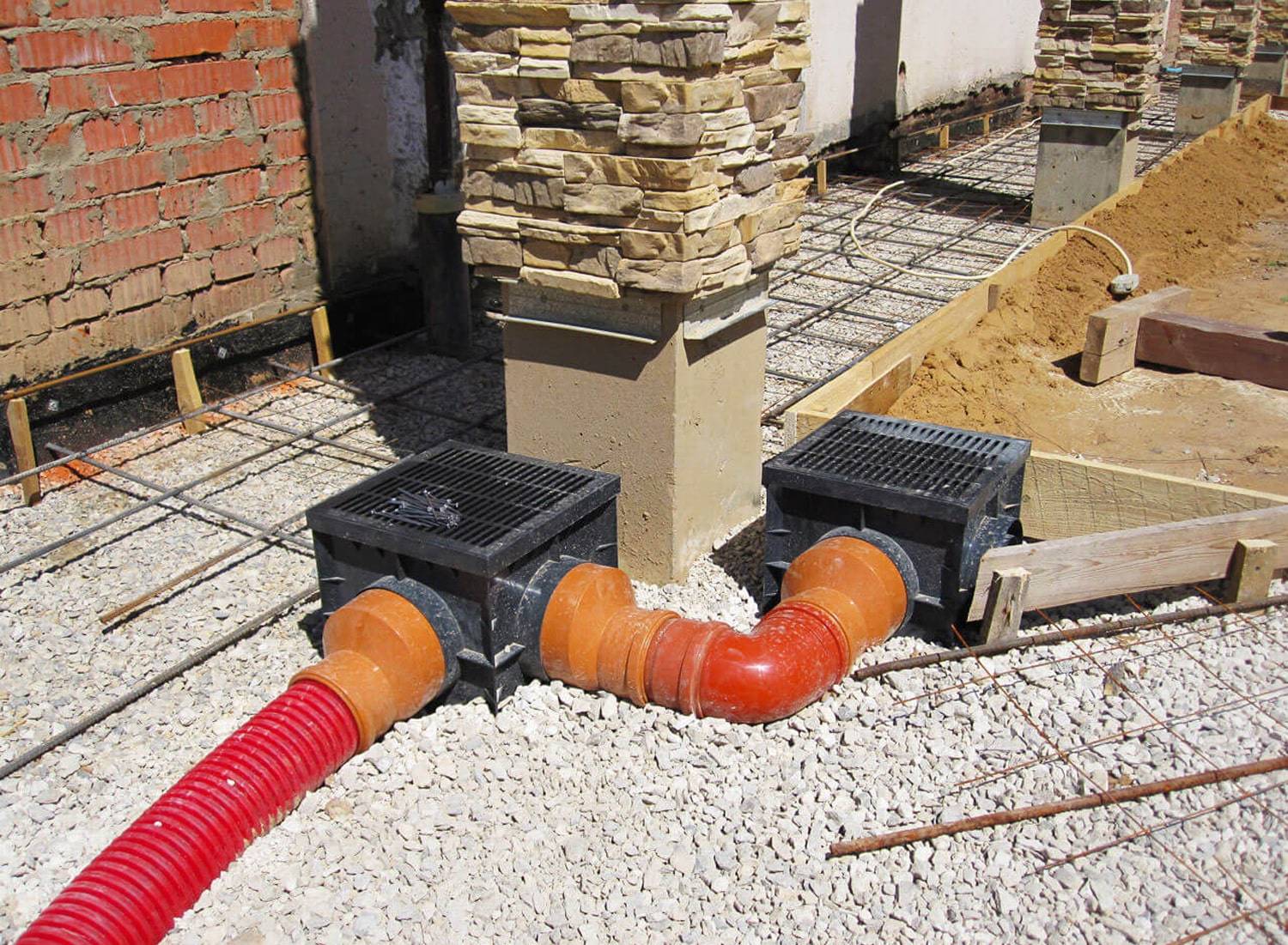


The surface drainage system consists of open water inlets and storm water inlets. For safety and ease of maintenance of the drainage system, all of its installed elements are equipped with removable steel or cast iron gratings, siphons and waste baskets. This equipment allows you to create a high-quality and durable surface drainage on a personal land plot.
Closed (underground) drainage is designed to lower and divert groundwater from the area close to the surface. Such a drainage system consists of a system of drainage pipes laid in the soil at the desired depth.
To create this system, ditches, manholes and settling tanks are dug on the site in the necessary places. Inside the ditch into which the pipe will be laid, a layer of sand mixed with fine gravel is poured
The equipment of manholes and settling tanks is very important and necessary to control the level of rising water and carry out its purification. A deep closed drainage system must necessarily be used in areas with a close approach to the groundwater surface and if the site is located in wetlands or lowlands. The two presented drainage systems - closed drainage and surface drainage, do not replace each other, as they perform different tasks for draining water from the developed area
It makes no sense to install an underground drainage system when the site is located on a hill or if the groundwater goes below the level mark of 1.5 meters
The two presented drainage systems - closed drainage and surface drainage, do not replace each other, as they perform different tasks for draining water from the developed area.It makes no sense to install an underground drainage system when the site is located on a hill or if the groundwater goes below the level mark of 1.5 meters.
If it is necessary to install a deep drainage system, special attention should be paid to the installation of an open drainage system. Properly executed surface drainage helps to reduce the length of the deep drainage system. Thus, the volume of construction work can be significantly reduced and savings in labor costs and equipment costs can be obtained.
In this way, the volume of construction work can be significantly reduced and savings in labor costs and equipment costs can be obtained.
Storm sewerage device in a private house
Above, we examined the methods of constructing storm sewers. in the suburban area level of water collection from the surface into the pipe. But this is not enough, it must be removed from the site.
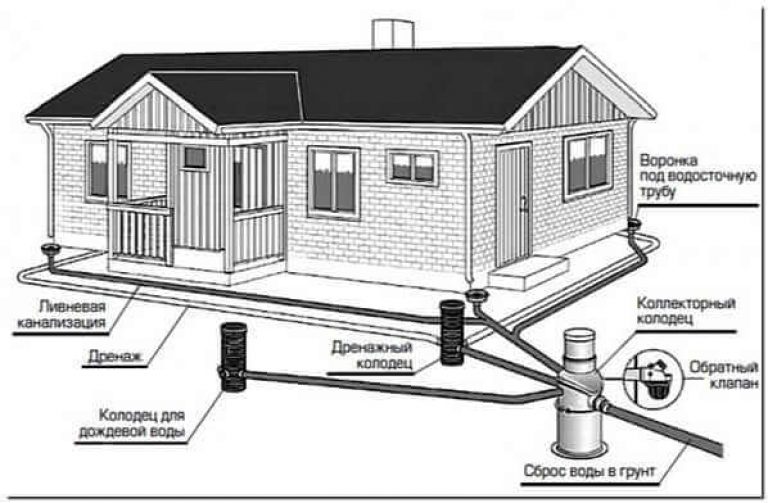
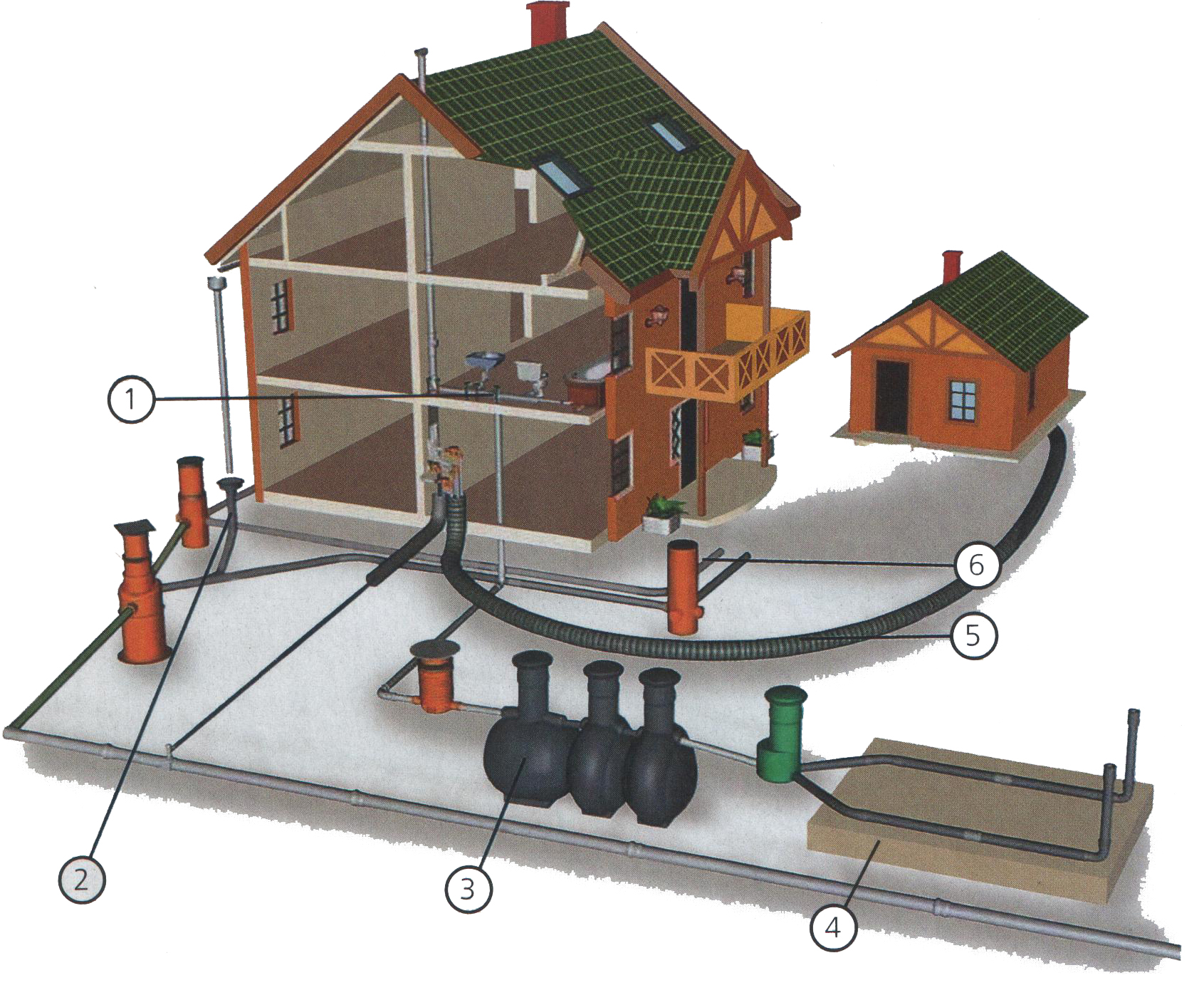
To do this, individual pipes are combined into a system, in the lower part of which a drain is arranged. The drainage and storm sewer scheme on the site can be organized as follows:
- First of all, you need to organize a storm drain on the roof, providing for this drain channels through which water flows down and enters the drain receiver.
- The liquid enters the waste cavities through the ladders with a reliable cover in the idea of \u200b\u200bthe grid.
- Then it flows through pipes (diameter 100 or 150 millimeters) into the storm water well.
- As it accumulates, water enters the outlet pipe, which is discharged into a special container with water or simply outside the site. Rainwater storage in an underground tank is used in areas where water resources are limited.It can be reused in the future for household needs, for example, for watering a personal plot, washing a car and other household needs.
This applies to the disposal of rain or melt water diverted from the house. But often it is required to simultaneously drain the site, which is typical for excessively flooded areas.
The drainage and storm sewer system on the site is a water supply network, the main feature of which is the presence of slopes that provide free flow of liquid. Mandatory design elements:
- Drainage perforated pipes. Depending on the total length of the water supply, products from 100 to 150 millimeters are used, as well as any types of fittings that facilitate the installation of the drain system.
- Inspection wells - they are installed at the points of change in the direction of the drain. Designed to monitor the condition of pipes and eliminate blockages in them. This is done using a hose with a pressurized water supply nozzle. The obstruction is washed out with the restoration of the free flow of liquid. Such wells are also called revision wells; they are equipped with metal or plastic covers protruding above the ground. They are needed for preventive work on cleaning the storm sewers of a country house.
- Collector wells - intended for servicing the system. Their diameter should provide penetration inside. The depth of the device is somewhat greater than that of the viewing ones; water settles in it. Therefore, it is necessary to periodically clean the well from precipitation using a mud pump.
- Filtration wells designed to separate debris from storm drains may also be used.They are arranged at intermediate points of the complexly branched storm sewer of a country house.
Wall drainage systems designed for for the removal of soil water from the foundation in heavily watered areas. The depth of such a device in any case should be greater than the depth of the foundation.
While doing works on the device of such a catchment area, first of all, the foundation itself is insulated and waterproofed. Various materials are used for this:
- Roofing material and bituminous mastic for waterproofing.
- Styrofoam for insulation.
Then, a geotextile is laid along the bottom of the trench, the edges of the canvas are wrapped up. Then you need to pour the gravel of the corresponding fraction and the corresponding slopes are formed. A layer of gravel is again poured over the pipes, which is covered with geotextiles with overlapping edges.
How to properly install in the structure around the house?
Initially, a drainage system is installed on the roof. Gutters are laid here, which, under a slope, carry precipitation into the drainpipe. Next, the water enters the storm sewer. Consider installing an open system.




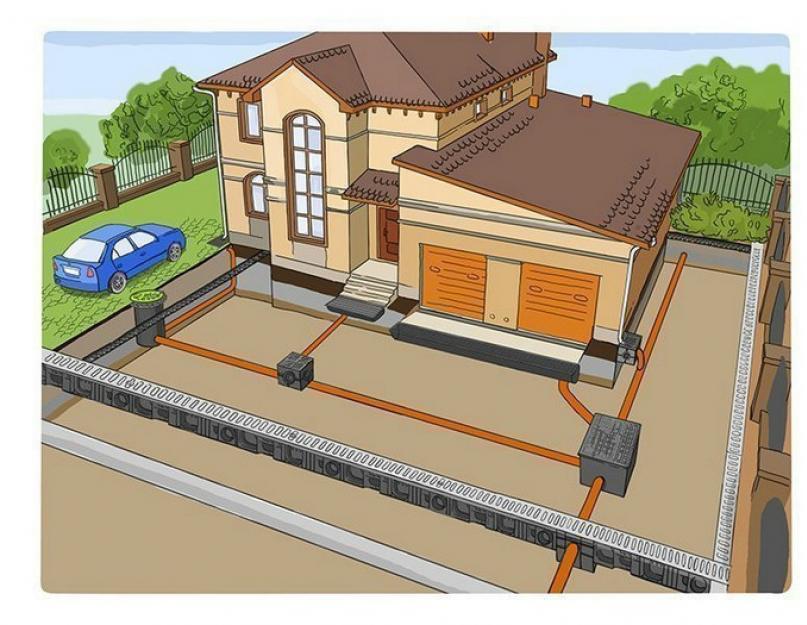
Regardless of its complexity, the creation consists of the following steps:
- Development of a trench for the pipeline. If the storm sewer passes through the blind area, trays and storm water inlets are installed first, and then the blind area is laid.
- The bottom of the trench is compacted under a slope towards the drain well. The depth depends on the size of the tray, it should come to the surface, but not exceed the height of the edge of the trench.
- A layer of concrete 5-10 cm is laid out at the bottom, a tray is installed in the liquid material.
- The trays will connect to each other evenly, to check the thread is pulled.The system must be leveled before the concrete hardens. The grids should already be installed on top.
- In places under the drains, storm water inlets are mounted, connected to pipes. Sand traps are installed on top.
- A formwork is installed along the side of the trench and the distance between it and the tray is poured with concrete. At the same time, the position of the system is leveled.
- Next, they wait for the concrete to solidify completely, periodically moisten it with water.
- After the formwork is dismantled, the laying of the blind area can begin. Such trays can be installed after the installation of the blind area. In this case, a gutter is laid out from the drainpipes over the blind area cover. Water will flow through it into the tank.
Underground storm sewer is mounted differently:
- set the markup with a peg and thread so that the entire system can be seen;
- dig trenches and recesses for storm water inlets;
- the bottom is covered with sand and tamped; if plants grow nearby, geotextiles are laid;
- first of all, install storm water inlets and trays (if the system is mixed);
- after they are connected by a pipeline at the required slope, sagging of the pipes must not be allowed, the pillow must support them along the entire length, in those places where the pipeline is suspended, sand must be added (and tamped);
- each piece of the drainage system is checked - for this, water is released from the hose under pressure, the joints must be airtight (covered with bituminous mastic, for example);
- if everything is in order, a sand-gravel layer and soil are placed on top.
Before burying the system at the blind area, it is connected to the stormwater area and carried out to the collector.
Installation of storm water inlets in the blind area - in the video:
Calculation of the depth and slope of pipe laying, the volume of the well for collecting moisture
To reliably protect the site and residential building from dirty streams after heavy rain, flooding and silting of the territory, you need to make the correct system calculations. The main thing is to make storm sewers so that the water entering the site is removed without residue, which is regulated by the provisions of SNiP 2.04.03-85.
Pipe laying depth
If the cross section of the pipes for removing rainwater is 5 cm, then a trench 30 cm deep is prepared for them. When laying thicker pipes, the laying depth increases to 70 cm. Any storm system must be above the drainage on the site.
Recommendation! According to the rules, parts of the structure must be laid below the freezing level of the soil, but they are often placed closer to the surface, insulating pipes, pouring a layer of crushed stone 20 cm thick in the trench, and then covering it with geotextile. This will reduce labor costs for earthworks.
Required pipeline slope
A slope at a suitable angle guarantees unhindered water removal. It is chosen taking into account the diameter of the storm sewer pipes. With a thickness of up to 20 cm, the slope is 7 mm per 1 meter / linear trench. If pipes with a thickness of 15 cm are laid - 8 mm per 1 meter / linear trench. When installing an open system, the slope should be 3-5 mm per meter/linear.
Design Features
Rainwater is collected and drained from the roof of a residential building using riser pipes installed under the extreme points of the gutters. It is necessary to install gutters around the entire perimeter of the roof. After that, the water flows down the risers into the rain receiver. The drain on flat roofs is directed to pipe risers.Usually they are placed vertically inside buildings, and bells are made on the roof, which make them integral with the roofing.
If the risers are installed inside a building with an open outlet, then in their design it is necessary to provide for the drainage of water in winter from melted snow into a sewer system with a water seal. Based on the planned amount of incoming water, is selected suitable pipe diameter for the organization of the riser.
It is best to use cast iron, asbestos or plastic pipes for drains. Products made of plastic and tin are used to create external storm sewers. Laying plastic pipes is not the best option, but such a system will cost the least. But frequent breakdowns of the sewer will eliminate all the savings. On risers, revisions are installed at the height of the lower floor of a residential building.
Stormwater components and their types
All elements of storm sewers in a private house must be connected to the system. Here's what it might be:
Well. It must be large. How much depends on the amount of rainfall, the size of the roof and the area from which water is collected. Most often it is made of concrete rings. It is distinguished from the water one only by the need to make the bottom. For this, you can put the bottom ring down (there are factory ones), or you can fill the stove yourself. Another option is plastic wells for rainwater drainage. They are buried to the required depth, anchored (chained) to flooded concrete pads - so as not to “float”. The solution is good because there is no need to worry about the tightness of the seams - such vessels are completely sealed.
A hatch over a storm well.It is best to take a ring and a separate hatch (plastic, rubber or metal - your choice). In this case, you can dig in the rings so that the upper edge of the installed cover is 15-20 cm below the ground level. Under the installation of the hatch, you will have to lay out a brick or pour a neck out of concrete, but the lawn planted on top will feel good and will not differ in color from the rest of the planting. If you take a finished cover with a hatch, you can pour only 4-5 cm of soil
On such a layer of soil, the lawn will differ in both color and density, paying attention to what is under it. Point storm water inlets
These are relatively small containers that are installed in places where precipitation accumulates.
Point storm water inlets. These are relatively small containers that are installed in places where precipitation accumulates.
They are placed under drainpipes, at the lowest points of the site. Storm water inlets can be made of plastic or concrete. Concrete is used for deep storm drains. They are put one on one, achieving the required height. Although today there are already built-in plastic storm water inlets.




Linear storm water inlets or drainage channels. These are plastic or concrete gutters. These devices are installed in places of the greatest amount of precipitation - along the roof overhangs, if a drainage system is not made, along the footpaths. Can be installed under gutters as gutters. This option is good if during construction pavements around the house no water pipes were installed. In this case, the receivers are placed outside the blind area, and the second end of the tray is connected to it. This is a way to make a storm sewer without destroying the blind area.
Sand traps. Special devices in which sand is deposited. They usually put plastic cases - they are inexpensive, but reliable. They are installed at some distance from each other on long sections of the pipeline. Sand and other heavy inclusions are deposited in them. These devices need to be cleaned periodically, but this is much more convenient than cleaning the entire system.
Lattices. In order for water to drain better, the holes in the grate should be large. They are:
cast iron, a good option, but the paint does not last longer than 2-3 years even on the most expensive ones;
steel - the worst option, as they rust very quickly;
aluminum alloys are the most durable and have a consistently good appearance, but also the most expensive.
Pipes. For storm sewers, it is best to install polyethylene pipes for outdoor use (red color). Their smooth walls do not allow precipitation to accumulate, and they also have a greater conductive capacity than pipes of the same diameter from other materials. Cast iron and asbestos pipes are also used. A little about the diameter of the pipes for storm water. It depends on the amount of precipitation, the branching of the system. But the smallest diameter is 150 mm, and better - more. The pipes are laid with a slope of at least 3% (3 cm per meter) towards the storm water inlets, and then towards the well.
revision wells. These are small plastic or concrete wells, which are placed on an extended section of the pipeline, at the points of branching of the system. Through them, if necessary, clean the pipes.
Storm sewers in a private house do not always contain all these devices, but a system of any configuration and complexity can be built from them.