
- The process of recycling thermometers
- If there are no reception points nearby
- Types of lamps containing mercury
- LED
- Incandescent and halogen
- How to increase the life of an incandescent lamp.
- How to dispose of a thermometer in its entirety
- Variety of lamps
- LED products
- Halogen and incandescent
- Recycling technology
- Reasons for disposal
- Disposal of fluorescent lamps. Rules and regulations for enterprises
- Why recycle fluorescent lamps
- What threatens the enterprise with non-compliance with the requirements for disposal
- Rules for the accumulation and storage of mercury-containing lamps before disposal
- Where and why to recycle energy-saving lamps
- Utilization of energy-saving lamps in Minsk
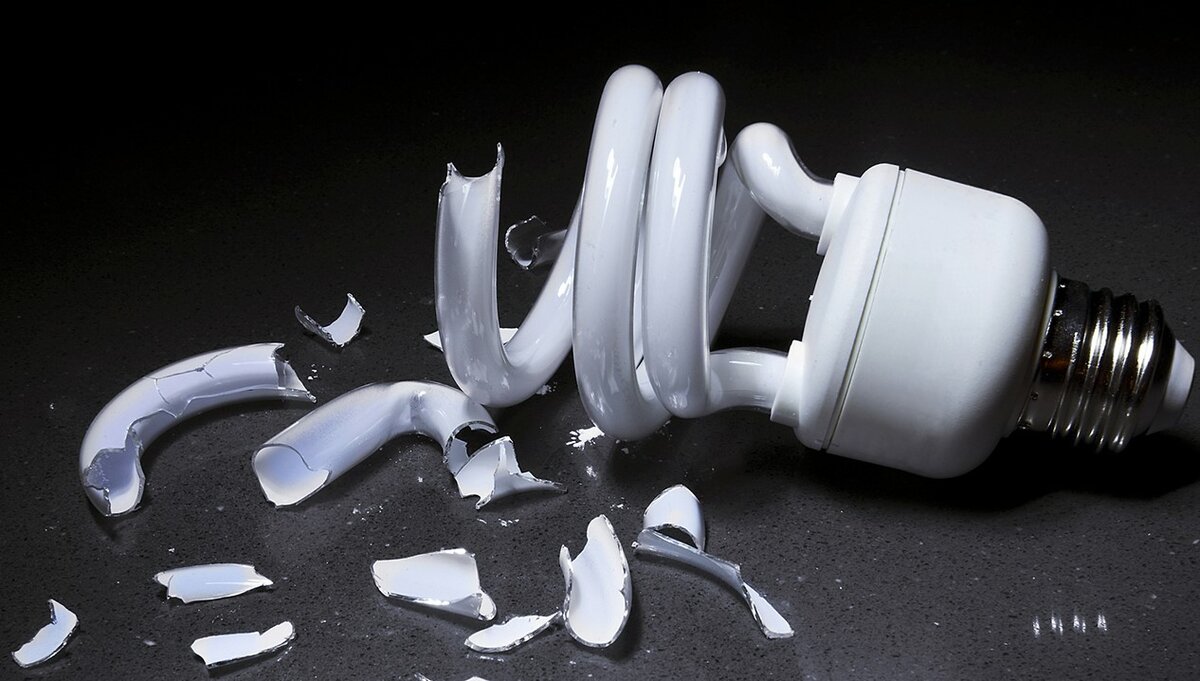
- What to do if the fluorescent lamp is broken?
- Disposal of other types
The process of recycling thermometers
Unfortunately, in our country there is no well-established system for the disposal of mercury thermometers. In large cities, you can hand over a damaged device to a specially organized collection point, at a station of the Ministry of Emergency Situations or SES, but in small towns there are no such places. Users have to either carry a thermometer to another city, or rely solely on their own imagination.Alas, fantasy in such a case can only dictate the removal of a thermometer to the nearest landfill, because of which mercury vapor enters the environment and poisons the air at a distance of several kilometers.
If there are no reception points nearby
If there are no special points nearby, try taking the thermometer to the hospital (not all hospitals accept them) or to the state pharmacy (where the devices are stored in special containers with potassium permanganate and transferred to the manufacture of mercury lamps). Some fire and rescue teams in Moscow and DEZ also accept thermometers (the list of addresses and contact numbers is easy to find on the Internet).
Types of lamps containing mercury
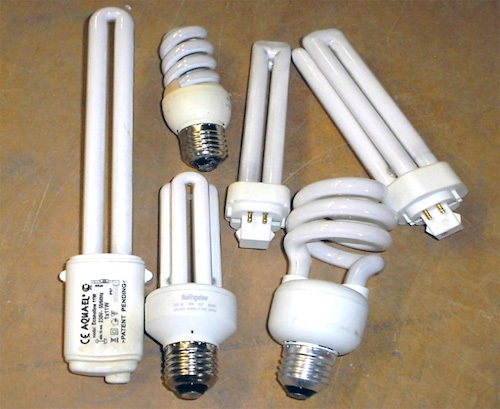
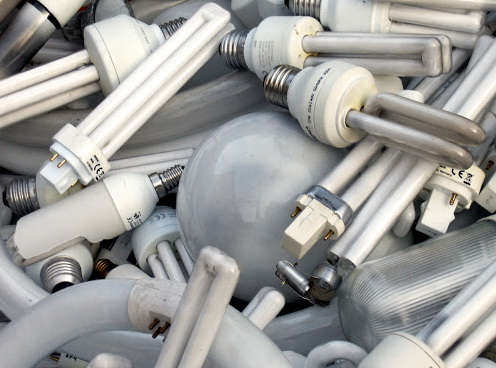
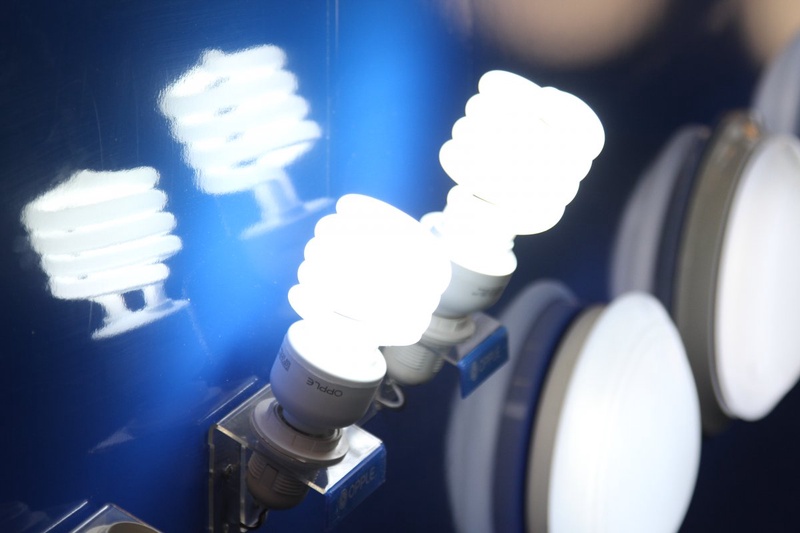
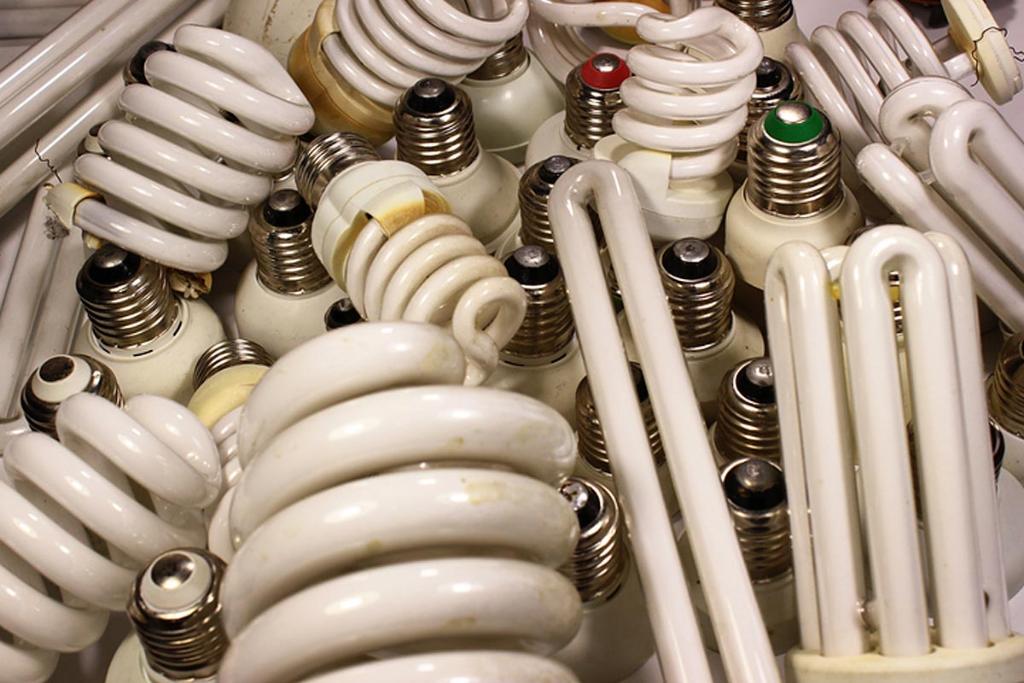
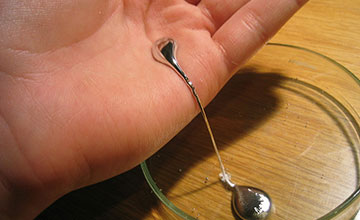 Mercury-containing are all fluorescent energy-saving daylight lamps.
Fluorescent lamps are filled with an inert gas, usually argon, and contain 1 to 70 mg of a silvery liquid metal.
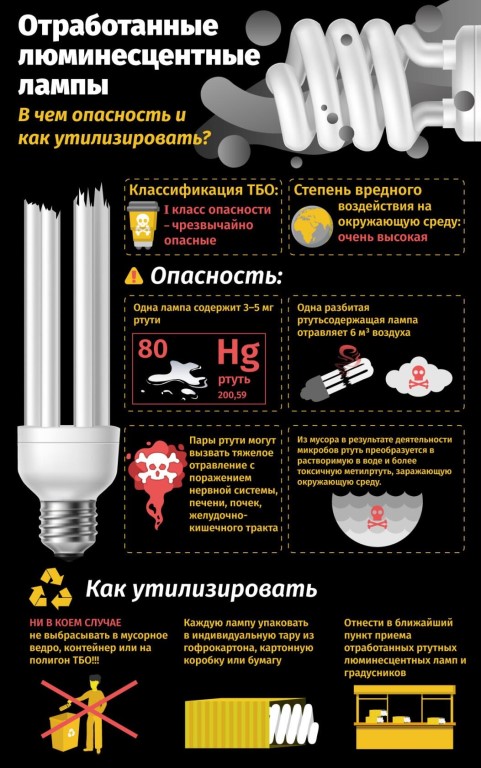
On average, a typical household fluorescent light bulb contains 3–5 mg of mercury.
The inner surface of the product is coated with a phosphor:
- calcium halophosphate,
- calcium zinc orthophosphate.
Mercury also contains the following types of lamps:
- xenon,
- bactericidal,
- neon.
Depending on their purpose, various materials for the manufacture of flasks and different filler gases are used in their production, but the only component is unchanged - this is mercury.
LED
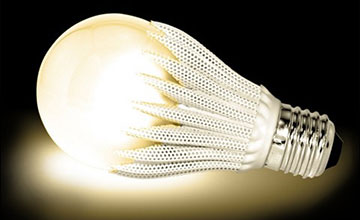 LED lamps are the most environmentally friendly. Mercury is not used in their production.
There are no special requirements for the transportation and disposal of such products.
The base of these lamps contains a stabilizer and other electronic components that can be recycled.
Therefore, it is desirable to dispose of such types of products as hazardous waste, although this is not prescribed by law.
However, in some types of LED lamps used in decorative garlands, automotive lighting devices, to reduce the cost of production, they use:
- lead,
- m,
- other potentially hazardous substances.
Incandescent and halogen
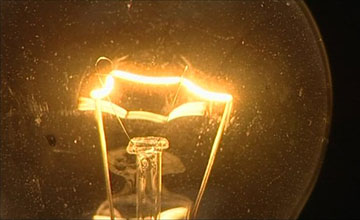 Due to their low efficiency (about 5%), incandescent lamps have recently been replaced by more efficient light sources, but their undoubted advantage is their environmental friendliness.
The light source in this type of product is a tungsten filament, and the lamp itself is filled with inert gases.
A special type of incandescent lamp is a halogen lamp. Their feature is that the lamp bulb is filled with halogens or their derivatives.
The use of these gases made it possible to extend the operating time of the product and increase the efficiency up to 15%.
Burnt out incandescent light bulbs are safe and do not require special disposal, although their recycling also provides raw materials that can be reused.
How to increase the life of an incandescent lamp.
In order to extend the resource and operational life, it is necessary to understand why electric incandescent lamps burn out. During prolonged operation of the light bulb, its filament, under the influence of a high heating temperature, gradually evaporates, decreasing in diameter and breaks (burns out).
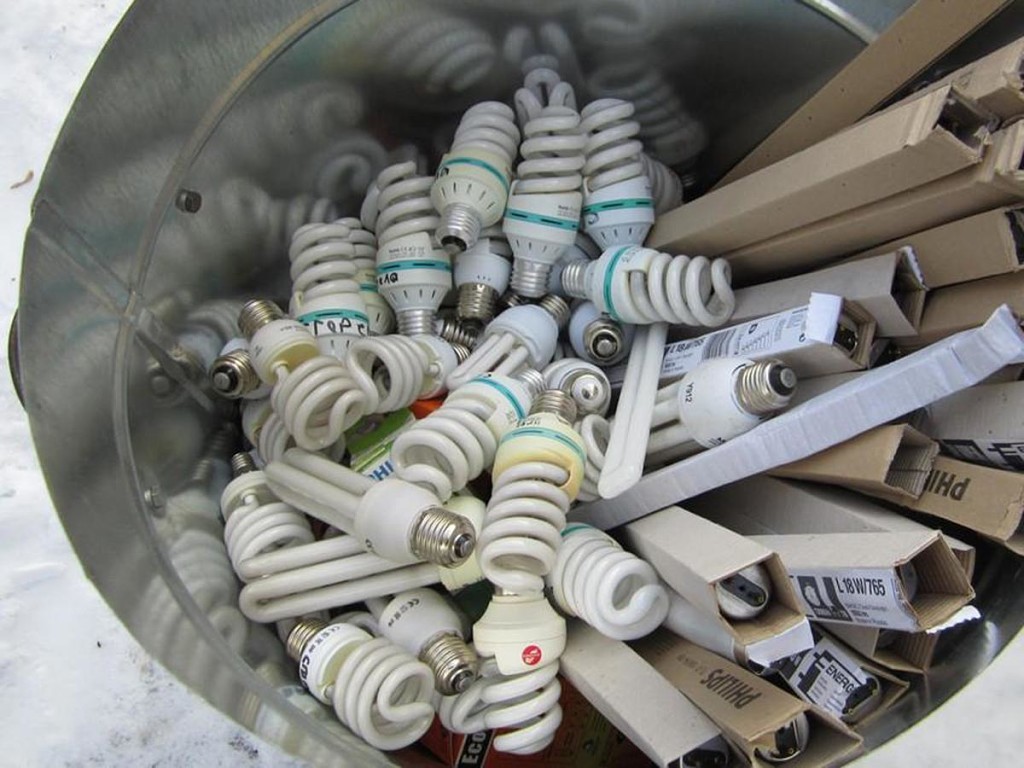
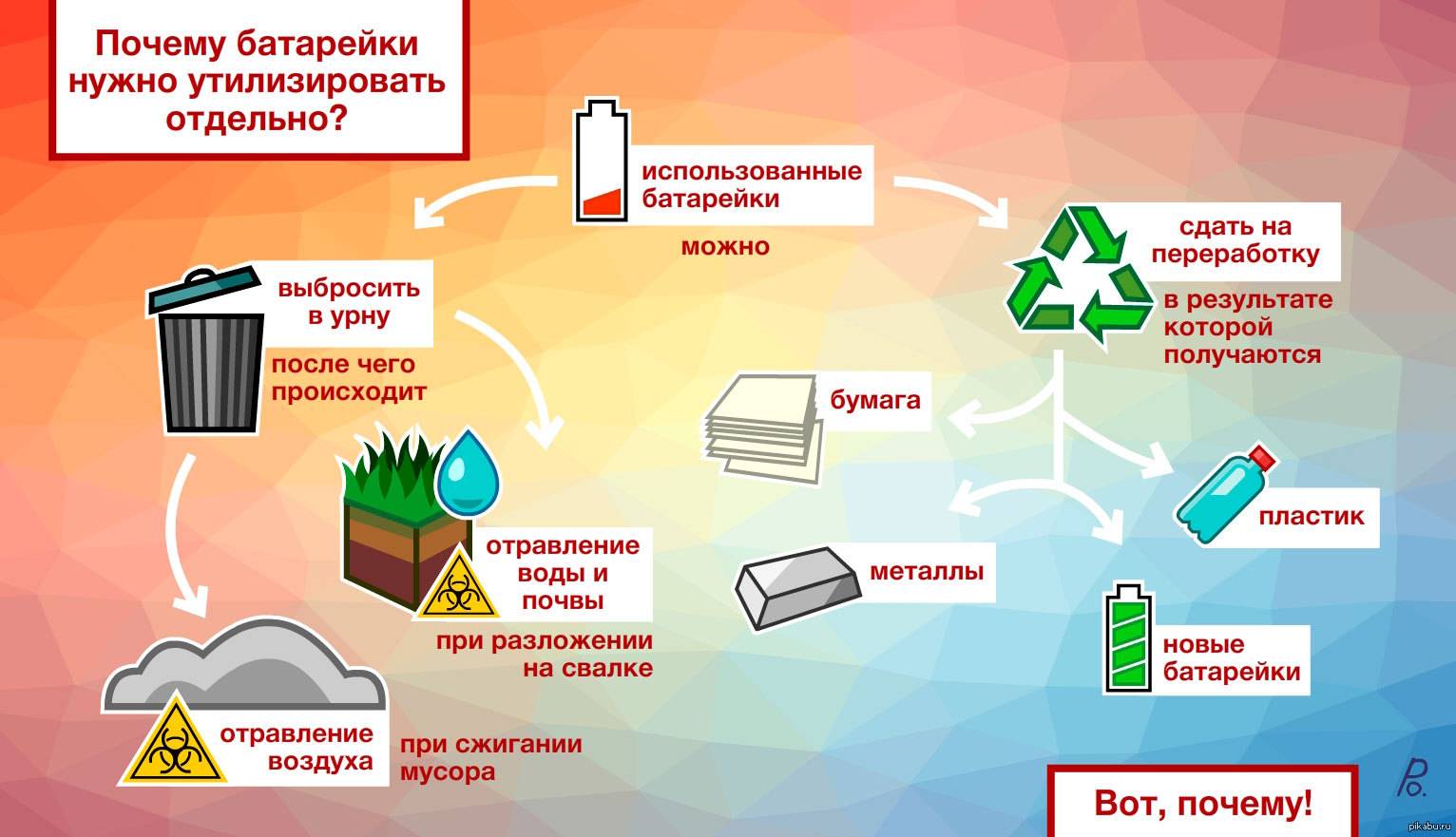
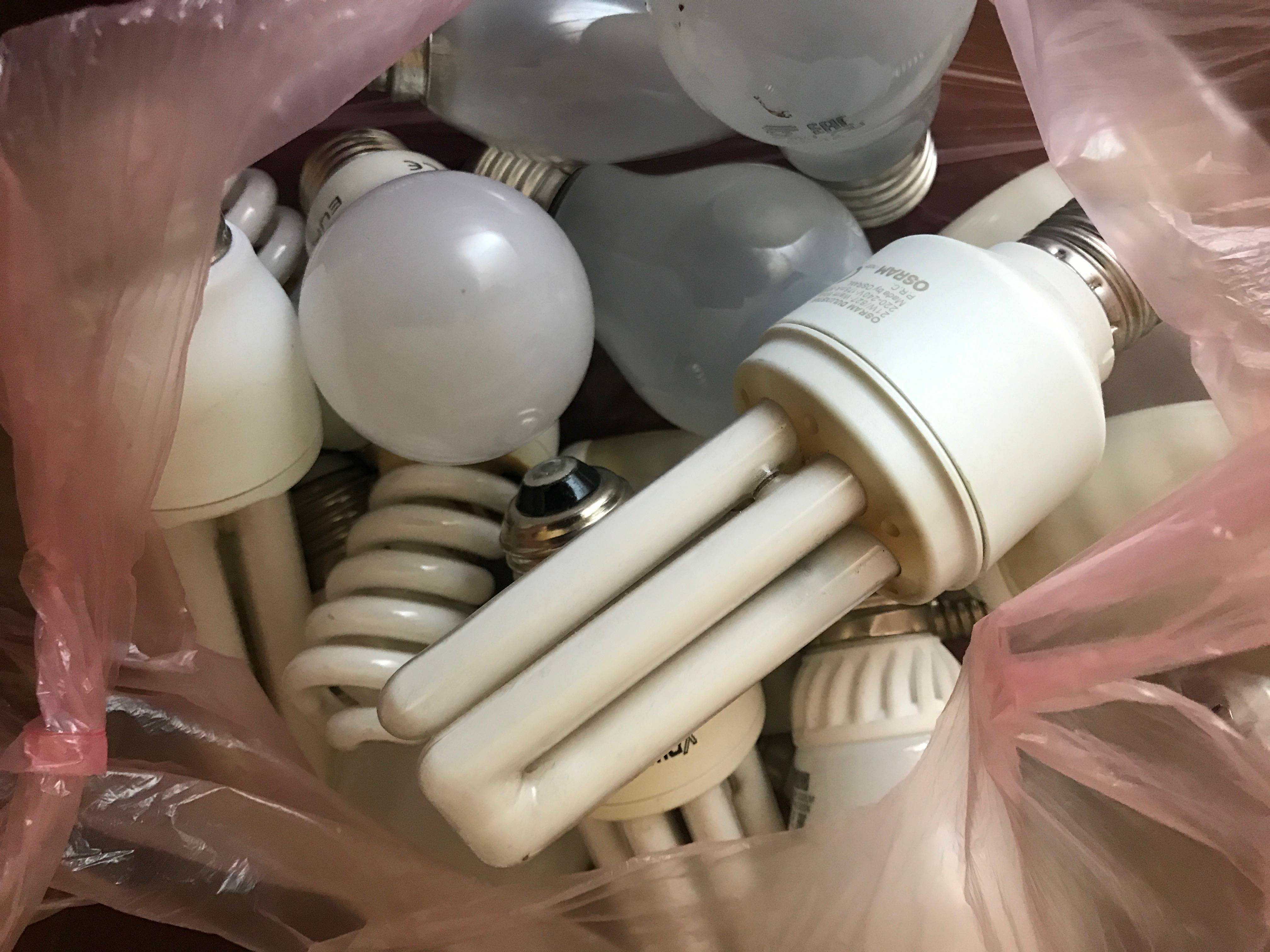
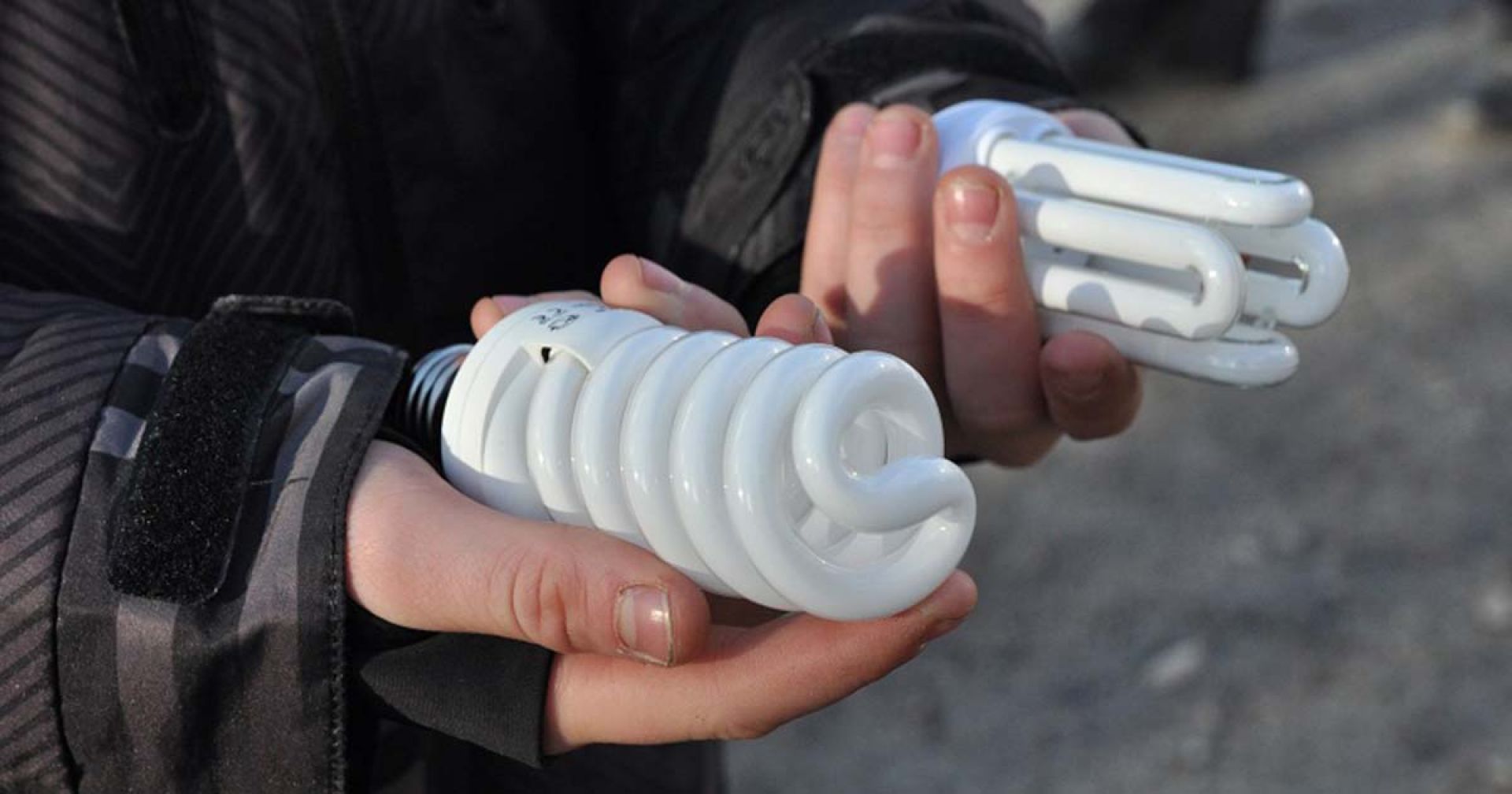
The higher the heating temperature of the filament, the more light it emits. In this case, the process of evaporation of the filament proceeds more intensively, and the service life of the lamp is reduced.Therefore, for incandescent lamps, such a filament temperature is set at which the necessary light output of the lamp and a certain duration of its service are provided.
Extend service life incandescent lamps can be switched on into a chain of soft starters that will smooth out the load that occurs at the start of a cold light bulb. For clarification of possible ways to extend the operation of lamps, consult a master. For example, our electrician in Mytishchi, at the entrance of an apartment building, assembled a staircase lighting circuit, calculating the optimal life of the lamps. Our craftsmen providing electrician services in Pushkino have the same experience.
How to dispose of a thermometer in its entirety
Diametrically opposite is the utilization of thermometers in good condition. It is not necessary to contact the Ministry of Emergency Situations on this issue.
It does not matter for what reasons the person decided to get rid of the medical thermometer, it is more important to decide where to take the mercury thermometer. The problem is solved in different ways, depending on where you live:
big cities;
small towns.
The utilization of mercury thermometers in megacities is much easier. For example, in St. Petersburg there is a special service "Ecomobil" - a mobile recycling point for receiving environmentally hazardous products. Alternatively, this service provides for the disposal of mercury lamps, other waste: batteries, expired medicines, household chemicals, paintwork materials, tires.

Ecomobile that accepts mercury-containing waste, including mercury thermometers
A number of regulatory documents have also been developed to regulate actions related to the disposal of mercury-containing equipment.We are talking about FKKO, where the metal is mentioned in almost every section. Here are some examples:
353 1 - these are mercury, fluorescent, other similar lamps;
47190000000 (2014) - waste of equipment containing mercury;
4 71 811 11 10 1 - mercury that has lost consumer qualities.
If individuals may not know about it, then employees of large enterprises should. Since the waste of the metal under discussion belongs to the first hazard class. This obliges organizations to dispose of it and equipment with it according to certain rules. Moreover, the level of danger obliges to develop a waste passport. Rosprirodnadzor considers the proposal of the owner of raw materials that have become unusable, then approves the code, as well as the disposal procedure.
If devices containing mercury accumulate in the hospital, the enterprise collects them, stores them, and then transfers them to the appropriate organizations for disposal. This type of medical waste is classified as class G, which is noted when registering the waste for storage.
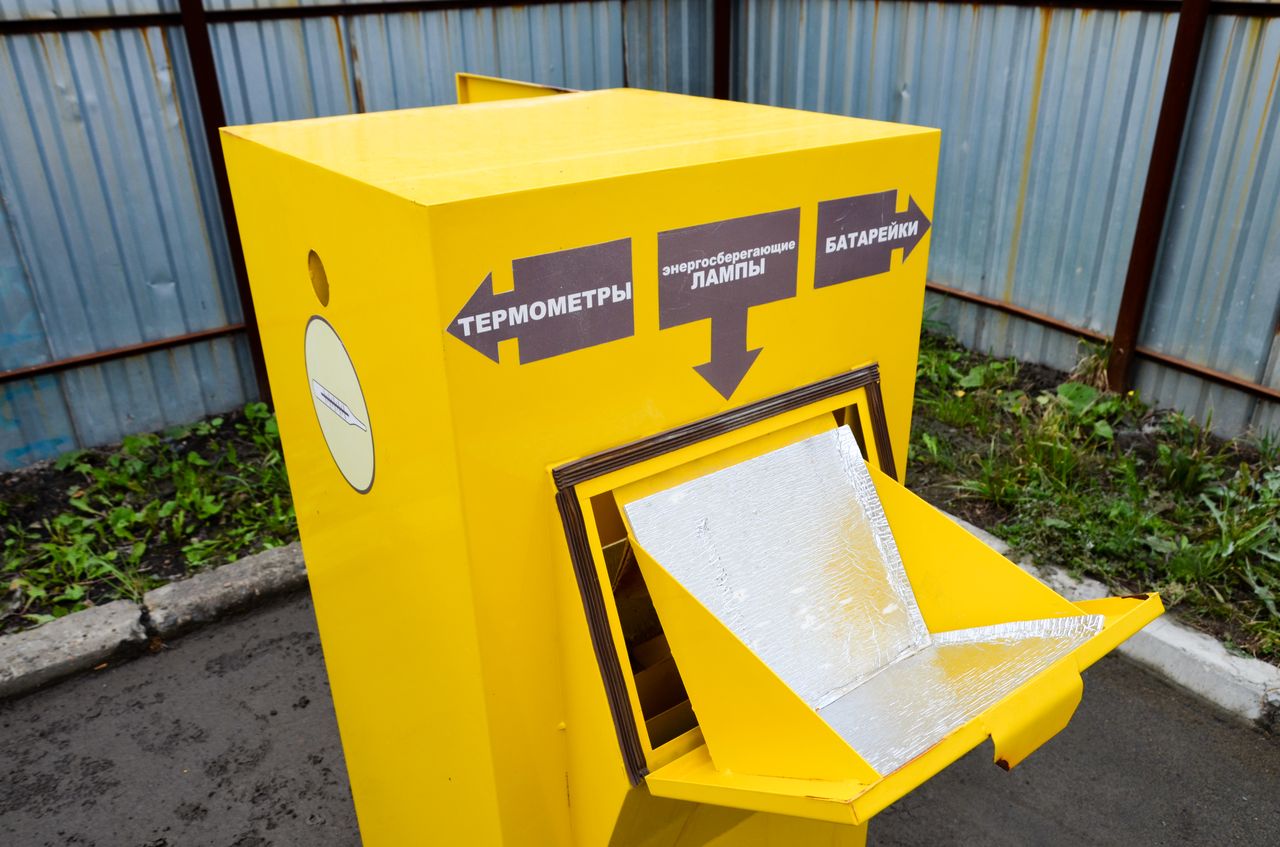
For individuals, there is another solution to hand over the thermometer for recycling, implemented in the form of eco-terminals, in almost all major cities of Russia. These are special blue machines placed at hotels, shopping centers, gas stations and other frequently visited places.

Ecoterminal for receiving hazardous waste
An alternative place to take thermometers is stationary demercurization points. They are also located mainly in large and medium-sized cities, which does not solve the problem of recycling for rural residents.
In this case, you have to contact the SES or district government.Although practical experience shows the inefficiency of this approach, the employees of both enterprises rarely know where to throw away a mercury thermometer, whole, but exhausted. It remains to be persistent or visit the regional center.
You should also remember the places where it is not recommended to dispose of:
in the ground;
in a landfill;
inside squares, plantings, nearby other green spaces.
You should not focus on thoughts, throw away the thermometer, get rid of mercury, hiding it from your eyes - the decision is wrong.
Variety of lamps
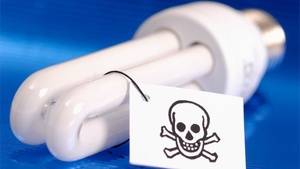 A hazardous substance is contained in all daylight energy-saving fluorescent lamps. They are filled with an inert gas, usually nitrogen. They can contain up to 70 mg of liquid metal. Light sources for domestic use contain between 3 and 5 mg of mercury on average. The surface of the device is covered with a phosphor from the inside.
Scientists conducted an experiment by breaking an energy-saving lamp in an isolated room. They found that the content of harmful substances in the atmosphere at the same time greatly exceeds the norm by more than 150 times.
Types of lamps, which include liquid metal:
- neon.
- Xenon.
- Bactericidal.
LED products
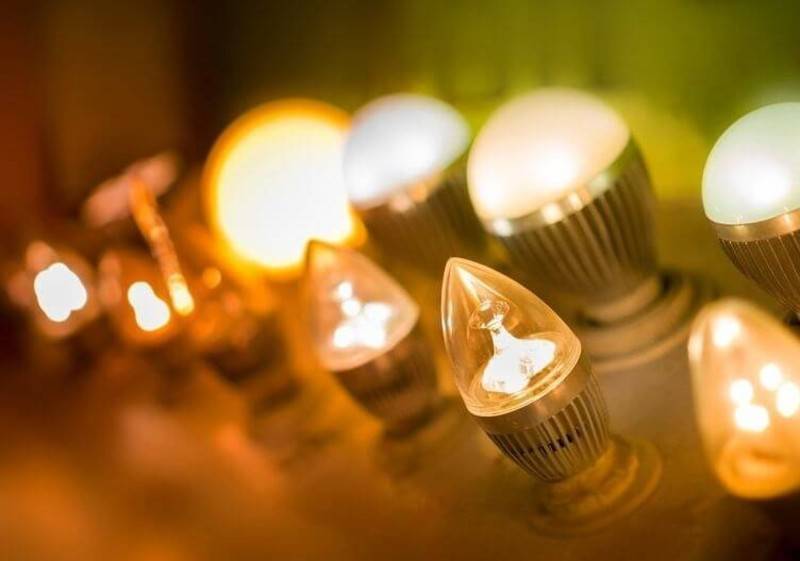
LED lamps are considered the safest for the environment. This is because they do not contain mercury. The base of the products has a stabilizer and other electronic components that can be used as secondary raw materials. The legislation does not impose special requirements for the disposal of LED products. It is recommended to dispose of such products as hazardous waste.
Halogen and incandescent
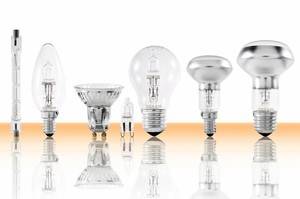 Due to the low efficiency of incandescent lamps, more efficient lighting products are gradually being squeezed out of the market.Despite the uneconomical and rapid burnout, they have one advantage. A damaged product does not pose any danger to the environment. The device works thanks to a tungsten filament. She is the source of light. The lamp cavity contains inert gases.
A special type of products with a tungsten filament is a halogen lamp. It can be filled with halogens or their derivatives. Such fillers were able to extend the life of the product and increase its efficiency up to 15%. Used incandescent bulbs are not hazardous. There are no special requirements for their disposal either. Products can be reused in production.
Recycling technology
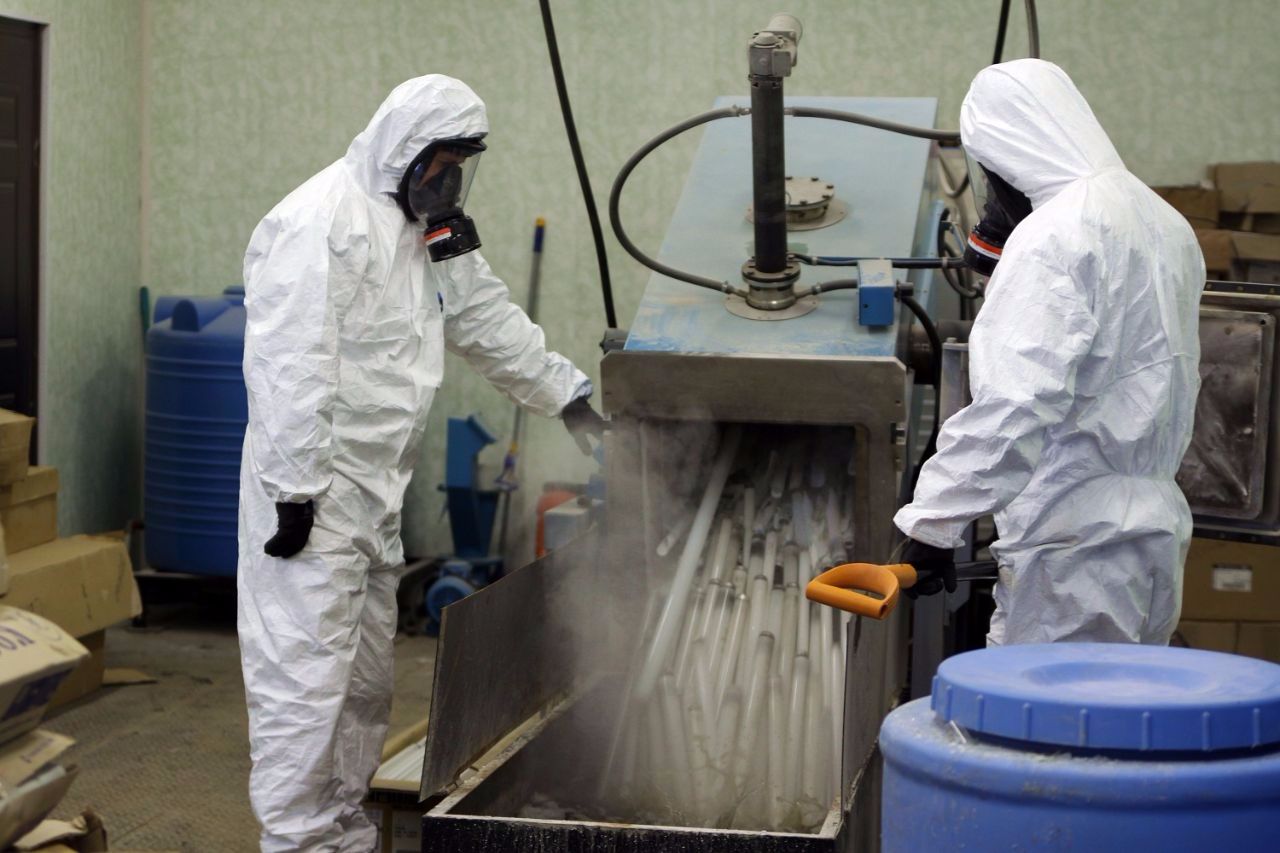
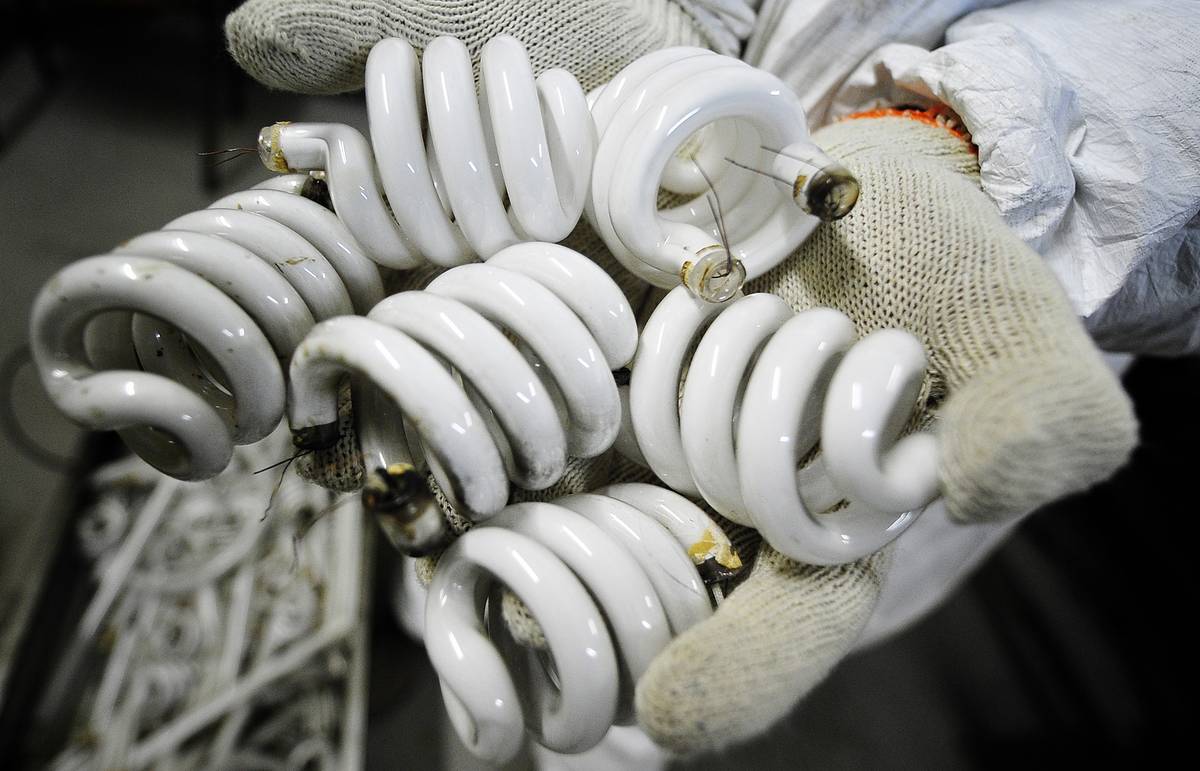
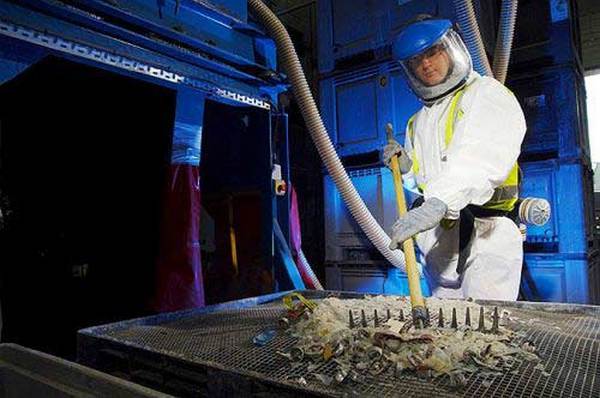
As part of the disposal of waste in the form of used lamps, a number of main stages are assumed, as a result of which they become completely safe. Raw materials obtained during disposal are allowed for further use.
Processing technology includes the manipulation of thermal and chemical effects. Moreover, waste light bulbs can be recycled in different ways.
The main manipulations are:
- Amalgamation (mercury conversion).
- Roasting at high temperature with the neutralization of all present substances with toxic properties.
- Disposal by thermal method with parallel collection of mercury vapor for future use.
- Grinding of fragments at high temperature in the presence of a number of chemicals - demercurization.
- Vibro-pneumatic technique.
Each of these methods has its own advantages and disadvantages. The choice of one or another of them remains with a specialized enterprise. Their activities are carefully monitored by the relevant supervisory authorities, as such waste is hazardous.
Reasons for disposal
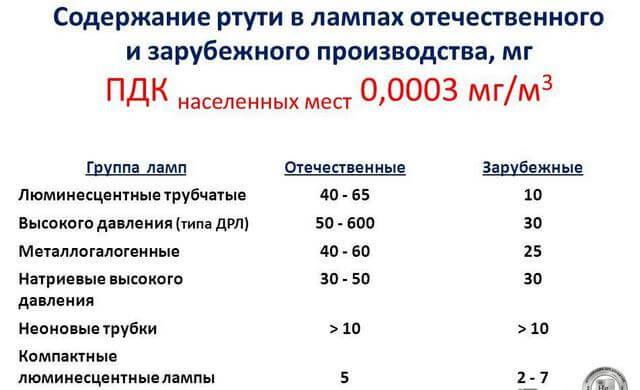
Mercury belongs to the group of substances of the 1st hazard class. Therefore, the disposal of mercury lamps, as well as fluorescent and other analogues that contain this chemical element, is mandatory. The amount of mercury may vary depending on the type of light bulb and is 3-5 mg per unit. Today, the use of fluorescent and other mercury-containing light sources is a popular phenomenon due to low energy consumption.


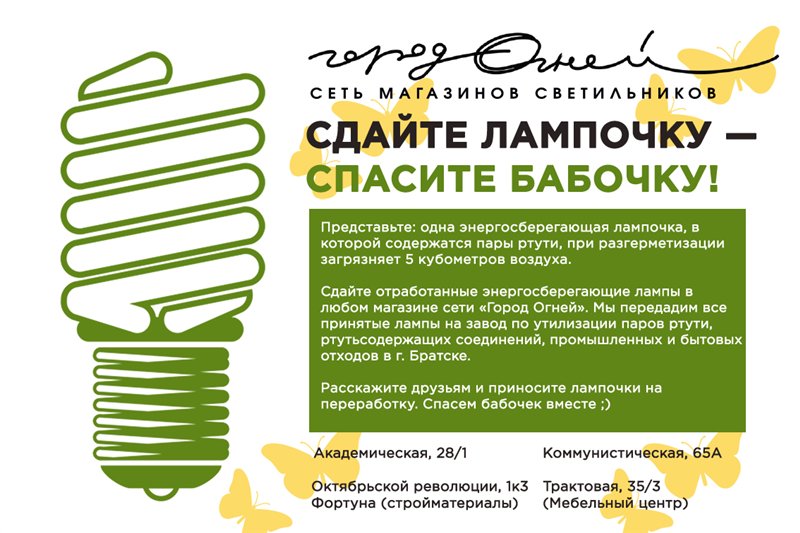
If 1-5 lamps of this type are installed in each house, then the threat of release of mercury vapor is quite serious.
Therefore, it is important to find out before buying where you can take the light source in case of damage or the end of its service life.
The danger of storing used and deformed light bulbs is due to the significant negative impact of this substance on a living organism. The consequences for human health can be different: from headaches and fatigue to death.
For these reasons, fluorescent, mercury light bulbs are disposed of. Such light sources should not be thrown away, because mercury penetrates first into the soil, and then into the water.
As a result, this substance poisons plants and enters the human body. Deciding in advance where to dispose of used lamps can reduce the amount of hazardous substances that enter the soil.
Violation of the instructions for the accumulation and temporary storage of harmful substances usually threatens with administrative fines. The amount of the penalty is determined on the basis of the Code of Administrative Offenses, Article 8.2: for legal entities, the amount of the fine varies from 100 to 250 thousand rubles; for individual entrepreneurs, the amount of the fine varies from 30 to 50 thousand rubles.rub.; for an official, the amount will be less (from 10 to 30 thousand rubles). An alternative to fines is to suspend the work of the organization for a short period (90 days).
Disposal of fluorescent lamps. Rules and regulations for enterprises
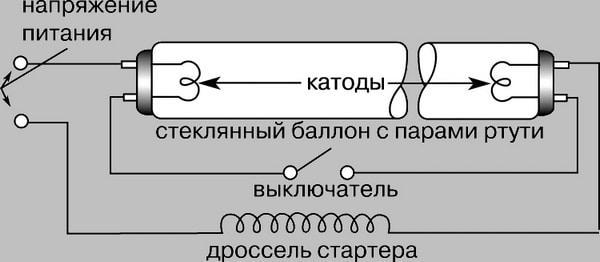
Energy-saving fluorescent lamps are used to illuminate socially significant objects: hospitals, offices, schools, etc. They are distinguished by high luminous efficiency and long service life. High-pressure fluorescent lamps are effective for illuminating large areas, and low-pressure light sources for illuminating apartments and small industrial facilities.
Fluorescent lamps have many advantages over classic incandescent lamps, but after they fail, the disposal problem arises.
Why recycle fluorescent lamps
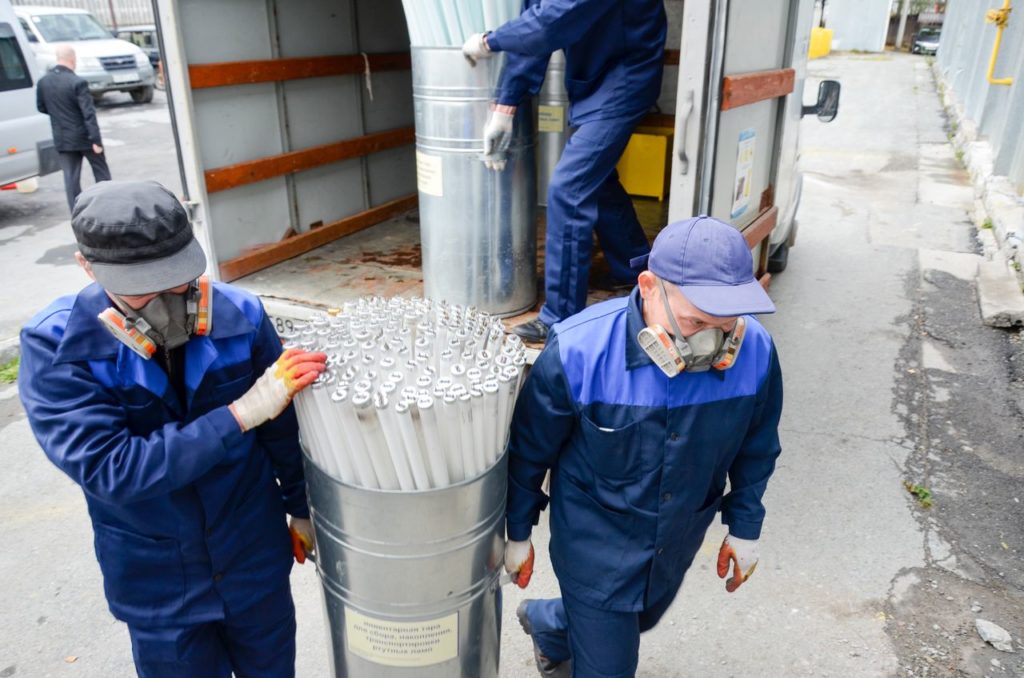
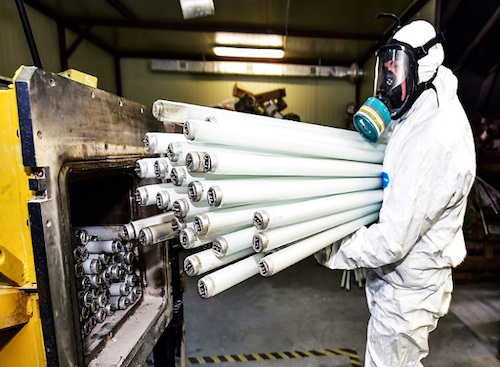
Fluorescent lamps must be disposed of at the end of their useful life. They contain from 3 to 5 mg of mercury, a substance belonging to the first class of toxic waste.
Incorrect disposal leads to the ingress of metal into the soil, water and air. Such products may harm human health and the environment.
Science has proven the adverse effects of toxic metal on the physical health of children, the reproductive function of women and men's health. Mercury from the atmosphere can be absorbed into mother's milk and passed through it into the baby's blood.
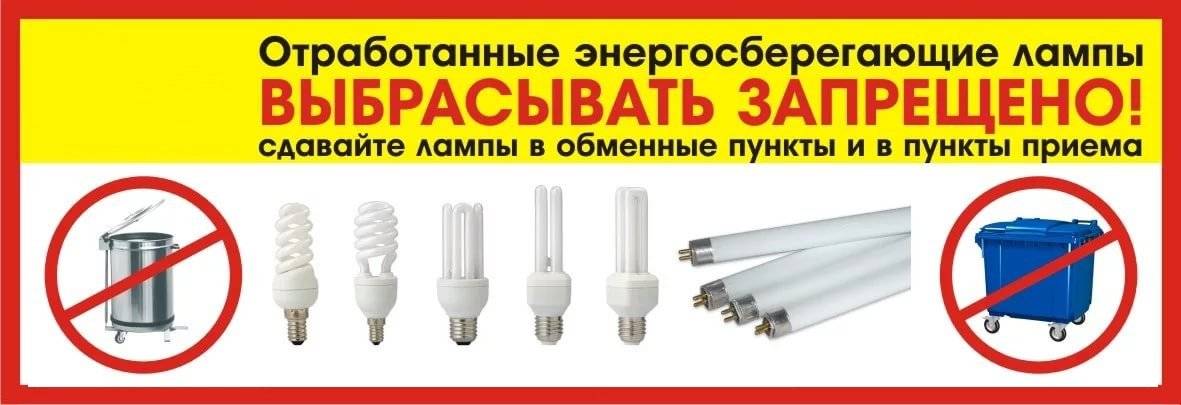
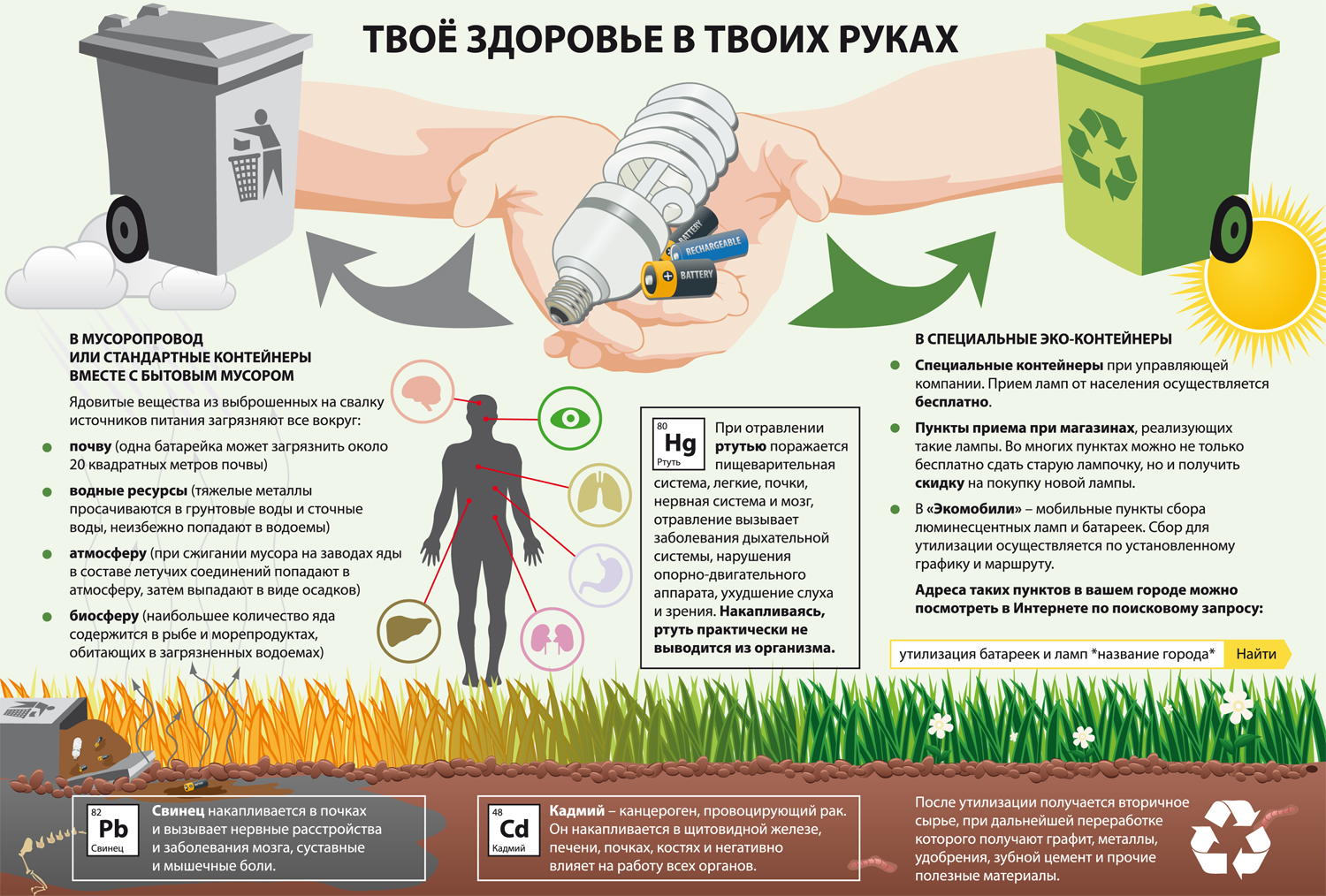
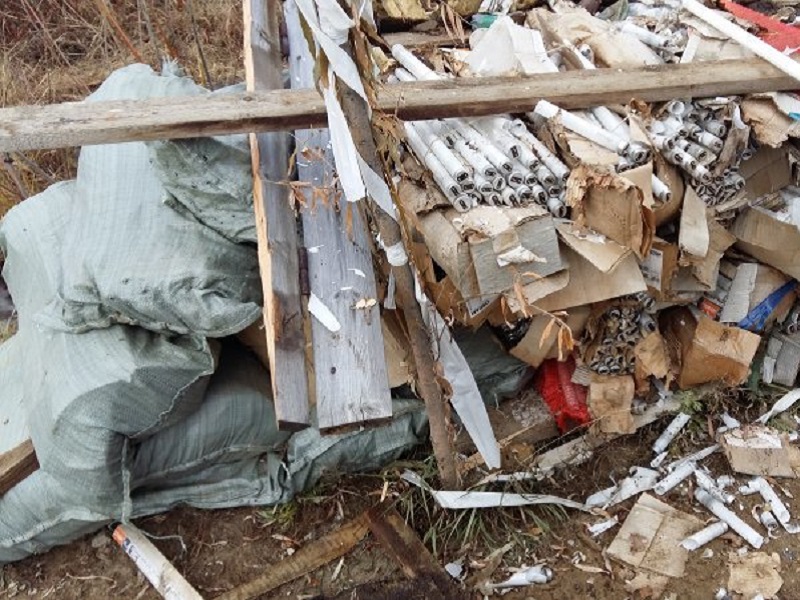
It is strictly forbidden to throw used lamps into the garbage chute or other containers for collecting domestic and industrial waste. Unauthorized release can damage the fragile bulb, allowing the mercury to evaporate into the environment.
On the basis of sanitary and hygienic standards, failed products containing mercury must be stored in specialized containers and containers in rooms equipped for this purpose.
It is forbidden to throw away fluorescent lamps
What threatens the enterprise with non-compliance with the requirements for disposal
The activities related to the handling of failed fluorescent lamps and their disposal are regulated by the following legislative acts:
- Federal Law No. 89 “On production and consumption waste”. It defines the main mechanisms for handling especially dangerous products and prevents the spread of its negative impact on nature and human health.
- Rules for handling production and consumption waste (in terms of lighting fixtures). They define the principles for the proper collection, storage, transport and disposal of fluorescent lamps. This legal document is mandatory for execution by legal entities and individual entrepreneurs.
- Code of Administrative Offenses.
- Legislative acts of the constituent entities of the Russian Federation in the field of handling spent fluorescent lamps.
According to the legislative framework, it is prohibited:
- storage of defective and expired llamas in premises where free access is organized for the personnel of the enterprise;
- storage or consumption of food in premises intended for the storage of hazardous products.
Failure to comply with the requirements of the law may result in an administrative fine.
According to article 8.2. of the Code of Administrative Offenses, the amount of the fine is:
- For an official - from 10 to 30 thousand rubles;
- For individual entrepreneurs - from 30 to 50 thousand rubles;
- For legal entities - from 100 to 250 thousand rubles.
As an alternative to a fine, the legislation provides for the suspension of activities for individual entrepreneurs and legal entities for up to 90 days. In case of repeated violation of the rules for handling toxic production and consumption wastes, criminal liability is provided.
Rules for the accumulation and storage of mercury-containing lamps before disposal
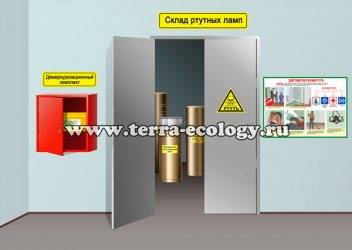
Storage of fluorescent lamps should be carried out in a room that is located separately from the production workshops. It must comply with the requirements of the rules for the storage of toxic waste and sanitary standards. It must have a ventilation system.
Floors in the room must be made of waterproof material that prevents harmful metal from entering the environment.
In case of an emergency, there should be at least 10 liters of water and a supply of potassium manganese in the storage room for fluorescent lamps.
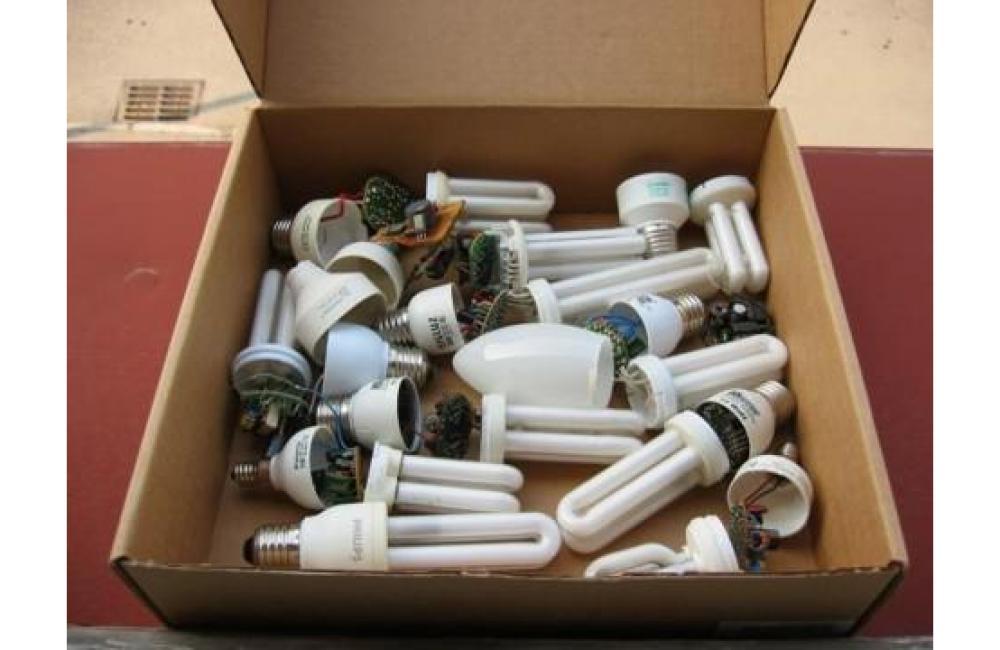
Waste fluorescent lamps should be placed in a tight container. It can be cardboard boxes, chipboard boxes, plywood, paper or plastic bags. There should be no more than 30 units of products in one cardboard box. Containers should be placed on racks to protect them from any mechanical impact. Each of them should have the inscription “Waste 1 class. danger. Waste fluorescent lamps».
Where and why to recycle energy-saving lamps
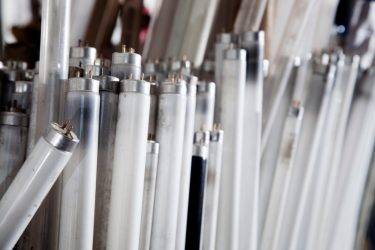
Compact energy-saving (fluorescent) lamps have long entered the lives of Minsk residents who do not like to overpay for electricity. You can buy such a lamp in a regular store, but what to do with it when it burns out?
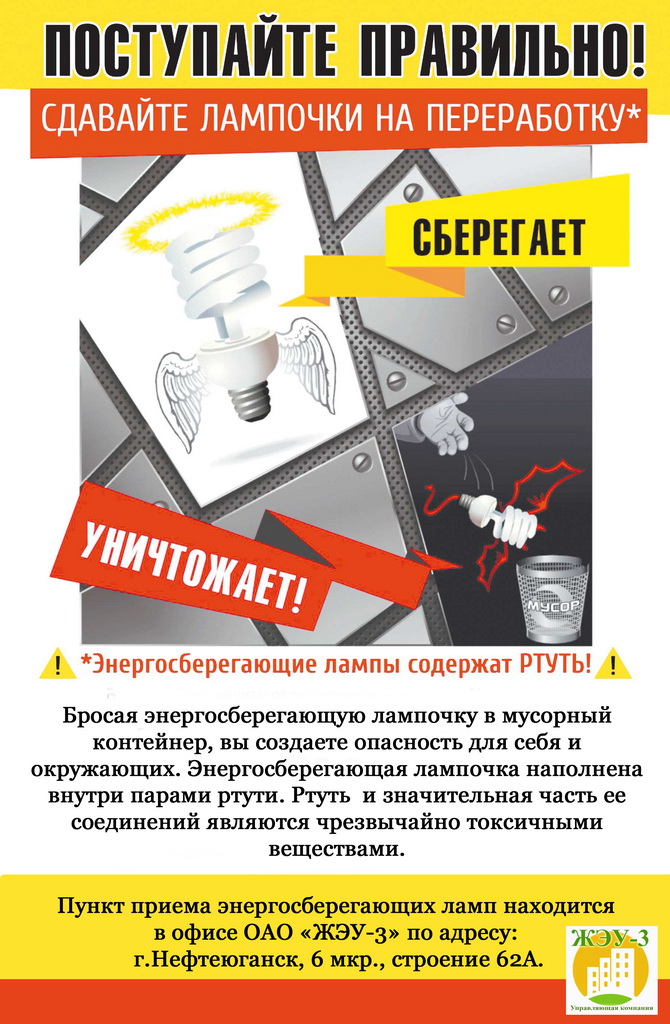
Under no circumstances should they be disposed of with household waste.Burnt out energy-saving (fluorescent) lamps must be disposed of!
Why is it important to recycle fluorescent lamps?
1. These lamps contain mercury. A standard energy-saving light bulb contains 3 to 5 milligrams of mercury. This metal is extremely poisonous and belongs to the first class of danger.
Mercury is a poisonous substance of the 1st hazard class (“extremely dangerous”). Mercury vapor, which has no color, taste and smell, quickly evaporates at room temperature and accumulates in the human body, affects the cells of the central nervous system and other organs and leads to serious diseases. Energy-saving mercury-containing lamps can only be disposed of by enterprises licensed to carry out activities for the disposal, collection, neutralization and disposal of waste of I-IV hazard class.
2. Recycling prevents the release of mercury into the environment. Compact fluorescent lamps and other fluorescent lamps often break when thrown into a dumpster or trash can, or end up in landfills when dumping garbage.
3. The materials in the lamps can be reused. Recycling compact fluorescent lamps and other fluorescent lamps allows the glass, metal and other materials that make up fluorescent lamps to be reused. Virtually all components of fluorescent lamps can be recycled.
Utilization of energy-saving lamps in Minsk
Acceptance of mercury-containing waste from individuals in the city ofMinsk, carried out by the divisions of the Minsk City Department of the Ministry of Emergency Situations, which are equipped with places for storing mercury-containing waste (round the clock and free of charge).
Subdivisions of district departments for emergency situations:
- Concrete passage, 33 (tel. (017) 208-66-31, Frunzensky ROChS);
- st. Mogilevskaya, 4a (tel. (017) 224-35-61, Oktyabrsky ROChS);
- st. Knorina, 9 (tel. (017) 280-27-91, Pervomaisky ROChS);
- Dzerzhinsky Ave., 77 (tel. (017) 272-58-92, Moscow ROChS);
- st. Rybalko, 20 (tel. (017) 298-18-49, Leninsky ROChS);
- st. Berezogorskaya, 6 (tel. (017) 279-50-01, Oktyabrsky ROChS).
The processing of mercury-containing lamps in Minsk is carried out by the following enterprises:
- CJSC Ecology-121 (Minsk, Smolyachkova St., 9 room 518, (8 017) 288-23-57, 284-41-61
- PE Postup LLC (Minsk, Inzhenernaya st., 43, (8 017) 344 55 51)
- UE "Beltsvetmet" (Minsk region, Gatovo village, Household building (8 017) 503 37 80)
Information about the places of reception of mercury-containing fluorescent tubes and energy-saving lamps by regions can be clarified on the website of the Department for Energy Efficiency of the Republic of Belarus.
What to do if the fluorescent lamp is broken?
To minimize the adverse health effects of exposure to mercury vapor, care must be taken when handling these lamps to avoid damage. If the lamp is broken, you must: If the lamp is broken, you must:
If the lamp is broken, you must:
- Open windows for at least 15 minutes to ventilate the room;
- Leave the room where the lamp broke, to all the people in it, along with the animals;
- If there is, turn off the forced air heating and air conditioning systems for several hours;
- Remove shards and parts of the light bulb using disposable rubber gloves. Do not touch the lamp with bare hands;
- Do not use a brush or vacuum cleaner to pick up the pieces! Collect all the fragments with a piece of hard cardboard or thick paper and place them in an airtight plastic bag;
- Wipe the surface on which the lamp broke with a damp paper towel or napkins and place it in the same plastic bag;
- Do not throw away pieces with all other garbage. Take them to a specialized disposal point for mercury-containing lamps in a sealed container (glass jar or plastic bag).
If you can't follow all the guidelines and do it right, then don't be alarmed. The following precautions reflect best practice for cleaning broken mercury-containing lamps. Be aware that compact fluorescent lamps contain very small amounts of mercury - less than 1/100th of that in a mercury thermometer.
Disposal of other types
Under Russian law, the responsibility for the acceptance and export of fluorescent and other mercury-containing lamps is assigned to specialized enterprises. The list and addresses of such organizations can be found on the Internet on the portal of urban services of large settlements.
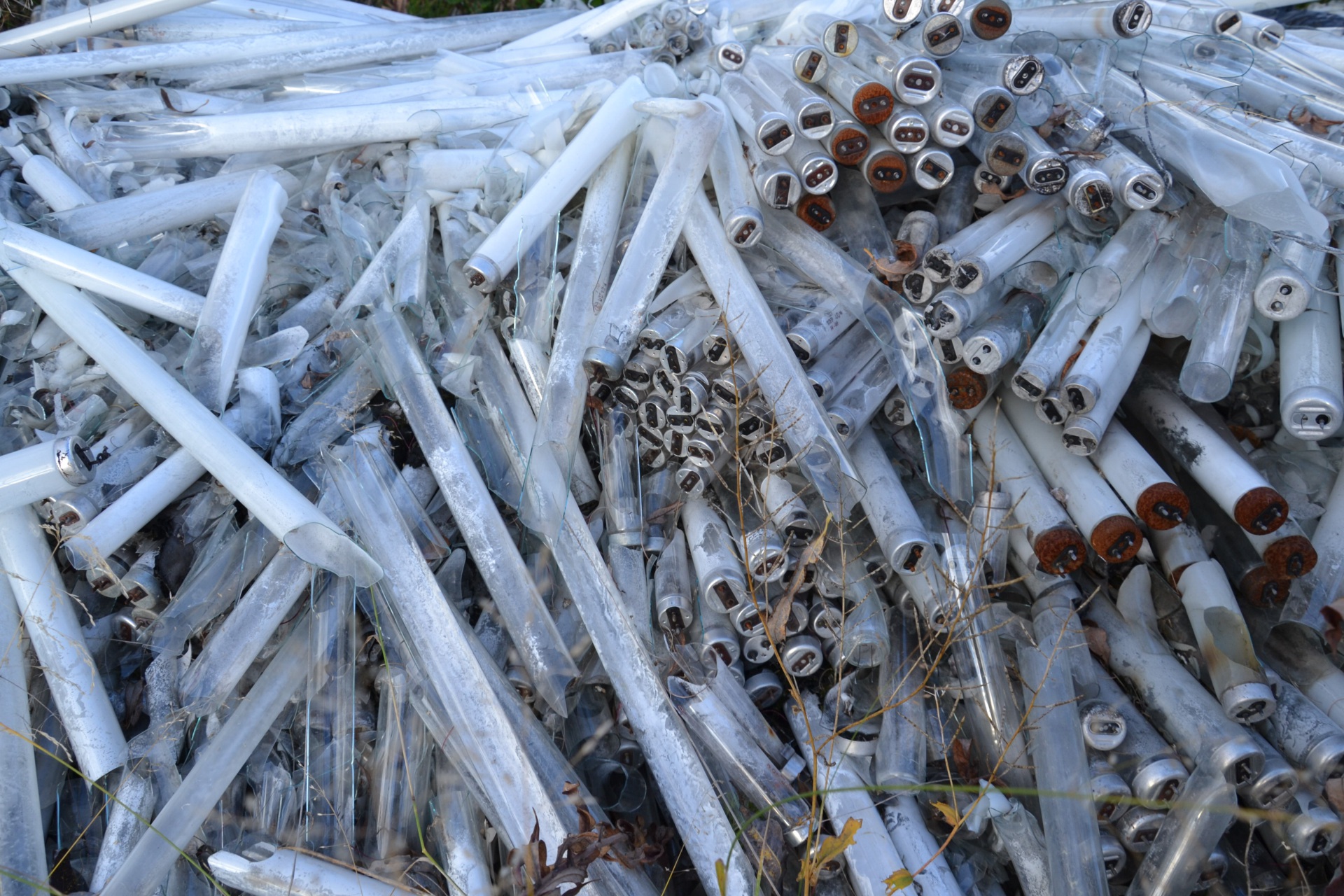
Here is some of them:
Specialized collection and storage points.
| City | Where to hand over | Address |
| Moscow | NPP Ecotron | st. Road 3, building 16, |
| Environmental Service Combine | st. Malaya Borodinskaya, 6 | |
| Reception points total 997 addresses | Addresses can be specified on the portal of the government of Moscow | |
| St. Petersburg | Ecological Service-St. Petersburg LLC | l. Rasstannaya, d. 2, bldg. 2, letter B, room 8-N. |
| Novosibirsk | LLC "SIBRUT" | Taiginskaya, 3 |
| Yekaterinburg | Reception point | st. Pushkina, 9A, Yekaterinburg entrance 1, office 210 |
| Kazan | EkKom LLC | Adel Kutuya street, 163a, office 3 |
| Rostov-on-Don | Technoecologist LLC | st. Trolleybus 24. Lit. V, pom. 812 |
- In cities of federal significance and other large cities, municipal services have created mobile collection points for hazardous waste, where you can hand over fluorescent, LED and other light bulbs. Such "Ecomobiles" drive and stop for the acceptance of garbage from the population in all areas according to the schedule. The traffic schedule can be viewed on the Internet portal of the municipalities of the city.
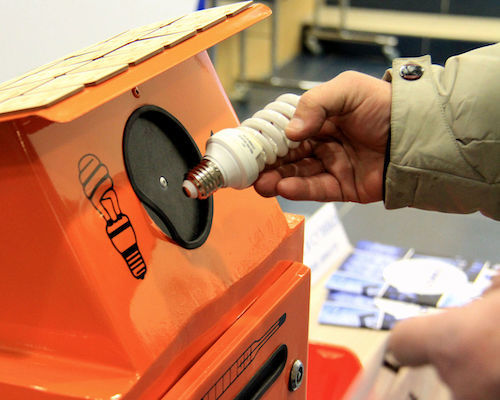
- Large hypermarkets such as Ikea, Leroy Merlin, Castorama, 220 Volt, construction and household shopping malls "Domovoy", etc., grocery stores of eco-goods "Vkusvill", etc. accept energy-saving lamps. At the entrance there are vending machines where you can return the used luminescent emitter. Moreover, some retail chains, when accepting unusable devices containing mercury, make discounts on the purchase of new ones.



