- Methods for arranging roof ventilation
- Basic and additional elements of ventilation
- Rules for the arrangement of ventilation outlets and other elements of aeration
- Three main misconceptions and elimination of consequences
- The first misconception is about the seasons
- The second misconception - it will be cold in the house ↑
- Misconception three - size does not matter ↑
- Exit with poor ventilation ↑
- Metal roof ventilation
- Installation of a point ventilation outlet
- Ventilation installation options
- How does a roof ventilation system work?
- Ventilation of a roof from a soft tile
- mansard roof
- Conclusions and useful video on the topic
Methods for arranging roof ventilation
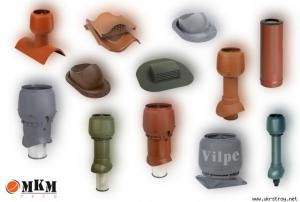 point ventilation elements
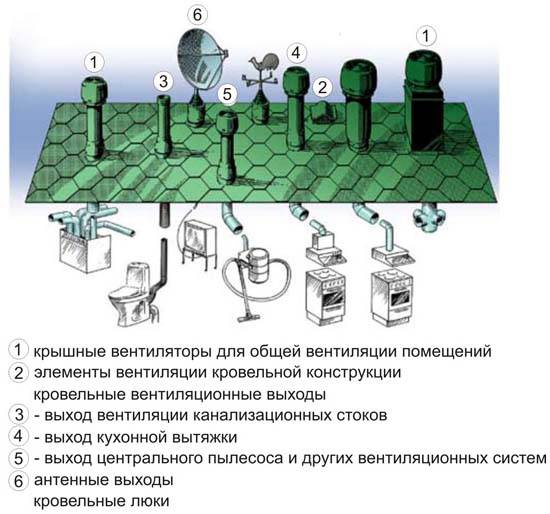
To ensure air exchange in the under-roof space, use:
- ventilation roof outlets;
- piece roofing with holes for ventilation;
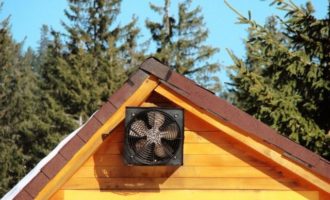
- roof fans;
- ventilation gap in the roofing cake;
- dormer windows.
The market offers a wide range of roof vents or vents, continuous or point type.
Continuous aerators include ridge and cornice vents.
The combination of continuous ridge and cornice products gives the maximum effect.
Such a scheme works on the basis of wind and thermal pressure.If the ventilation of the roof is done correctly, the air flow passes under the entire surface of the roof twice in an hour.
From above, the vents are covered with roofing material, so they do not spoil the appearance and do not let in precipitation.
The area of all ventilation openings must be calculated, since for the normal operation of roof ventilation, the following ratio must be met:
the area of the upper vents is 15% larger than the area of the lower ones.
In this case, the traction will be good. The total area of \u200b\u200bthe vents can be calculated as follows:
multiply the attic area by 0.03 - 0.05;
or like this:
per 100 sq. meters area of 20 sq. see products.
Basic and additional elements of ventilation
With natural continuous ventilation of metal roofing, fresh air is provided by openings and gaps in the eaves. The mining exit is carried out through the top, the space under the ridge bar is left unfilled. Forced ventilation is divided into roofing and through. In the first case, the above point exit scheme is used, the circulation conditions are controlled exclusively inside under the metal tile. In the second, a passage through the roof and all layers of the pie are arranged.
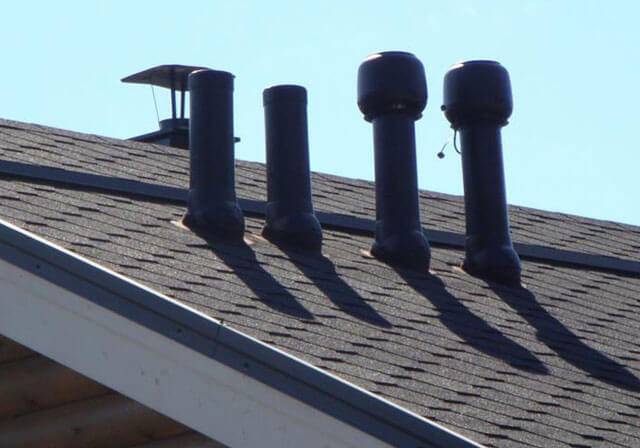
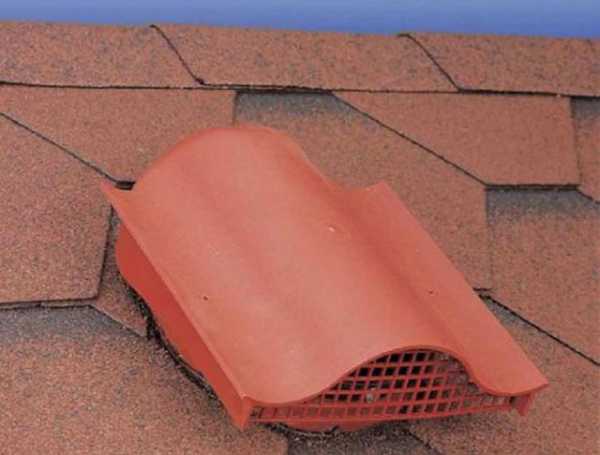
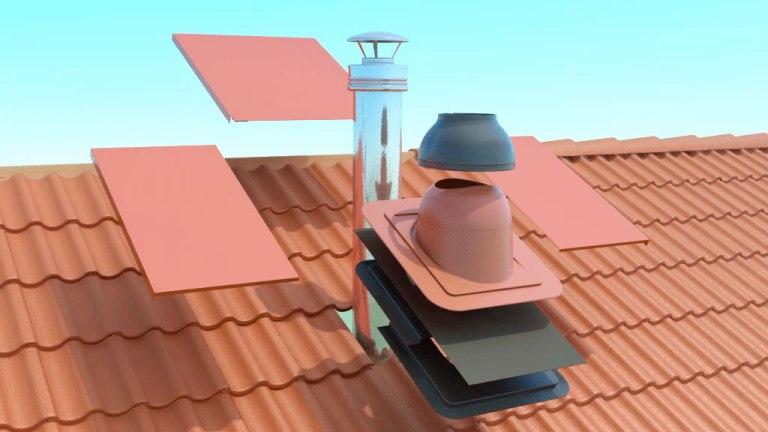
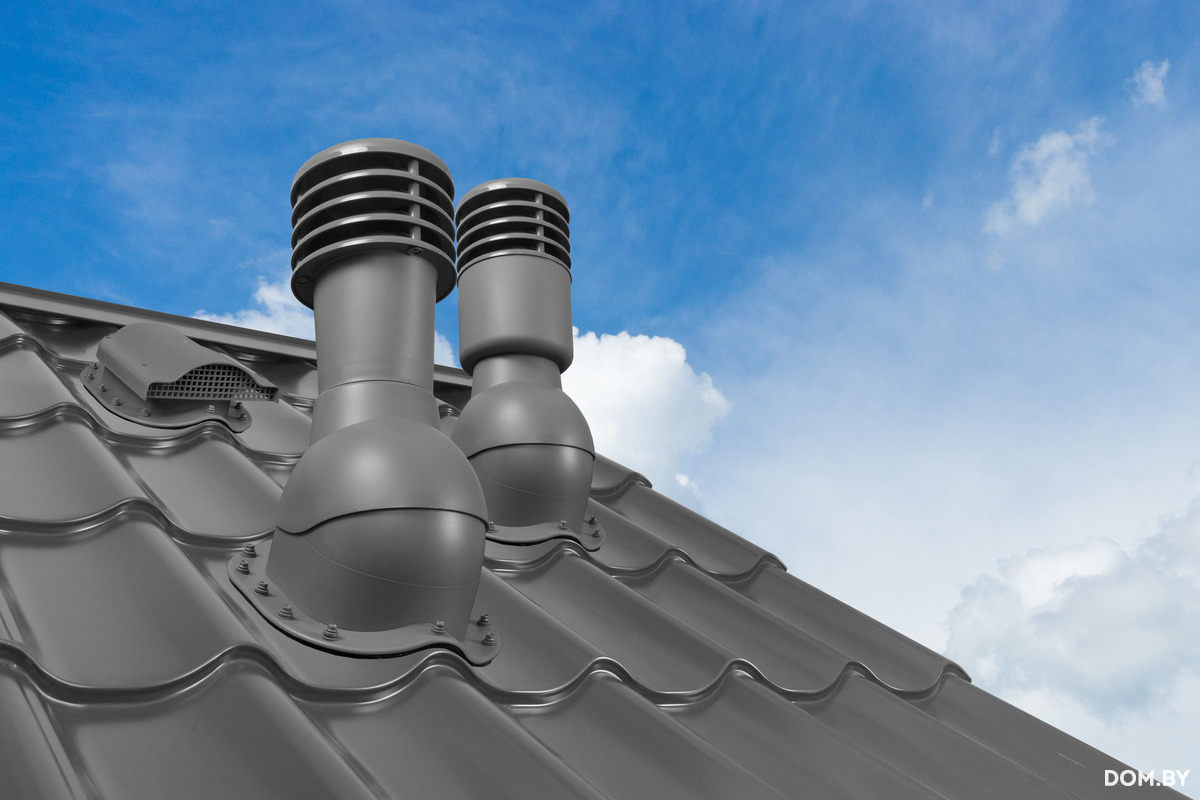
The standard ventilation outlet for a metal tile consists of three parts: a pipe for letting exhaust air out, a plastic passage that seals all areas of contact with the roof, and an umbrella deflector that closes the hole from above and protects the channel from precipitation and large debris. The diameter of such devices varies from 30 to 105 mm, the height reaches 50 cm. When choosing a pipe length, it should be remembered that the higher it is, the stronger the thrust, but the lower its resistance to wind.Under normal conditions, it is enough to bring a small part of it outside; in northern latitudes and areas with heavy snowfalls, it is set as high as possible. On sloping roofs with a slope length of more than 6 m, not ordinary pipes are placed, but adjuncts protruding by 40 cm, otherwise the thrust will not be enough.
Additional elements of the system that ensure proper ventilation of the under-roof space of the metal tile include:
- Hatches for inspection of all channels and wiring.
- Ridge aerators or continuous outlets.
- Lattices used when filing the overhang and in other parts of the supply and exhaust systems.
- Fans for ventilation of structures and attic spaces, including forced ones.
- Specialized deflectors for flat roofs and ridges.
The factors taken into account, in addition to the profile of the metal tile and climatic conditions, include: the size and color of the product, the presence of seals and other important components (in their absence, each small detail must be purchased separately)
Attention is drawn to the quality of anti-corrosion protection, ideally, the service life is not inferior to roofing. Devices with additional features (built-in fan or spirit level that simplifies installation) are more expensive, the cost of their purchase must be justified
Rules for the arrangement of ventilation outlets and other elements of aeration
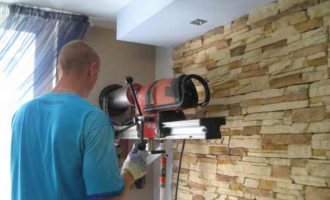
Work begins with cutting a hole in a sheet of metal. It is carried out using the included template, drill and nibblers. The main objective of this stage is to obtain a neat and airtight hole that matches the outer diameter of the pipe passage in cross section, without scratches and ruptures of the material.The grinder is categorically not suitable for these purposes because of the risk of damage to the protective polymer coating when heated.


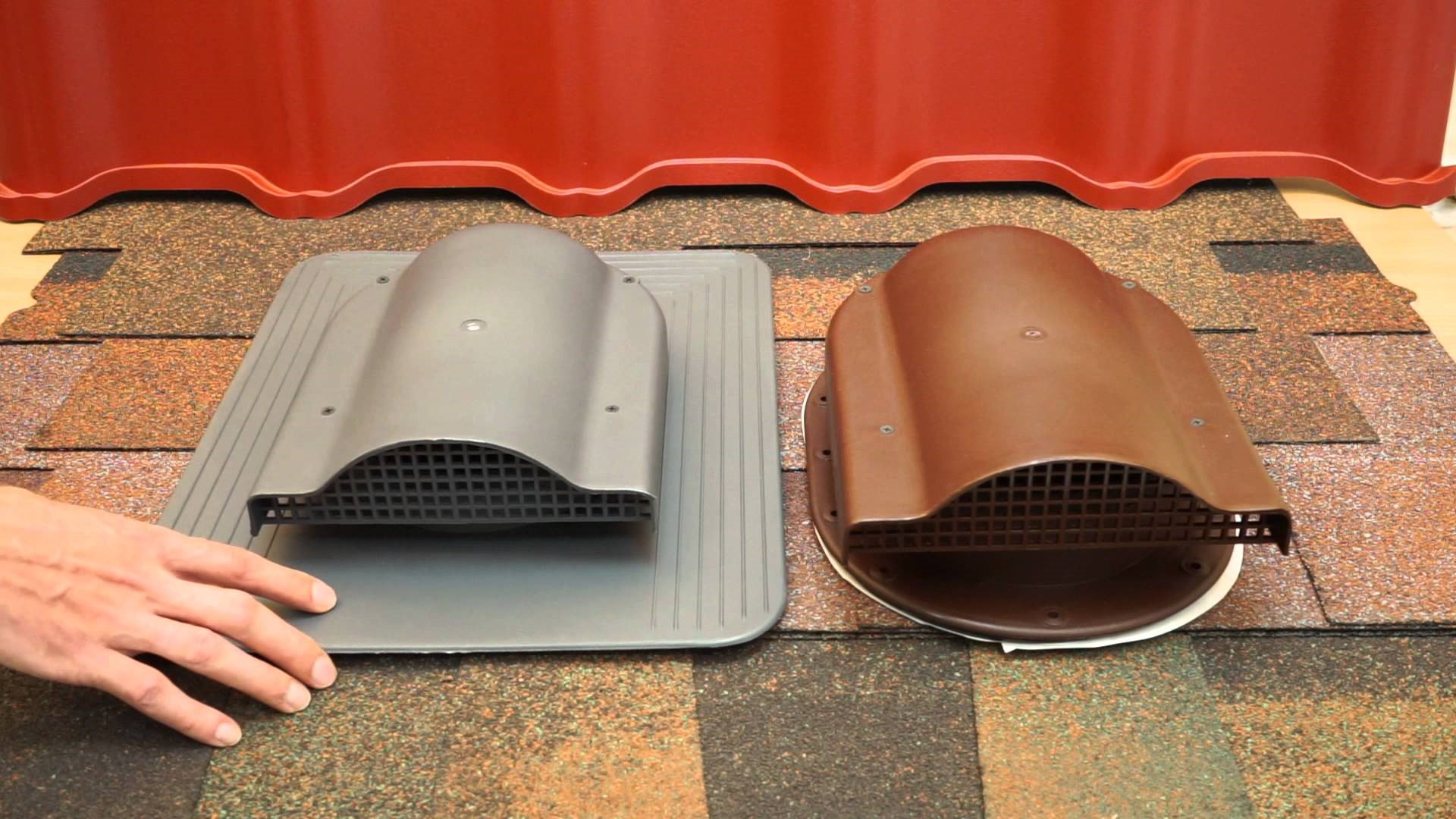
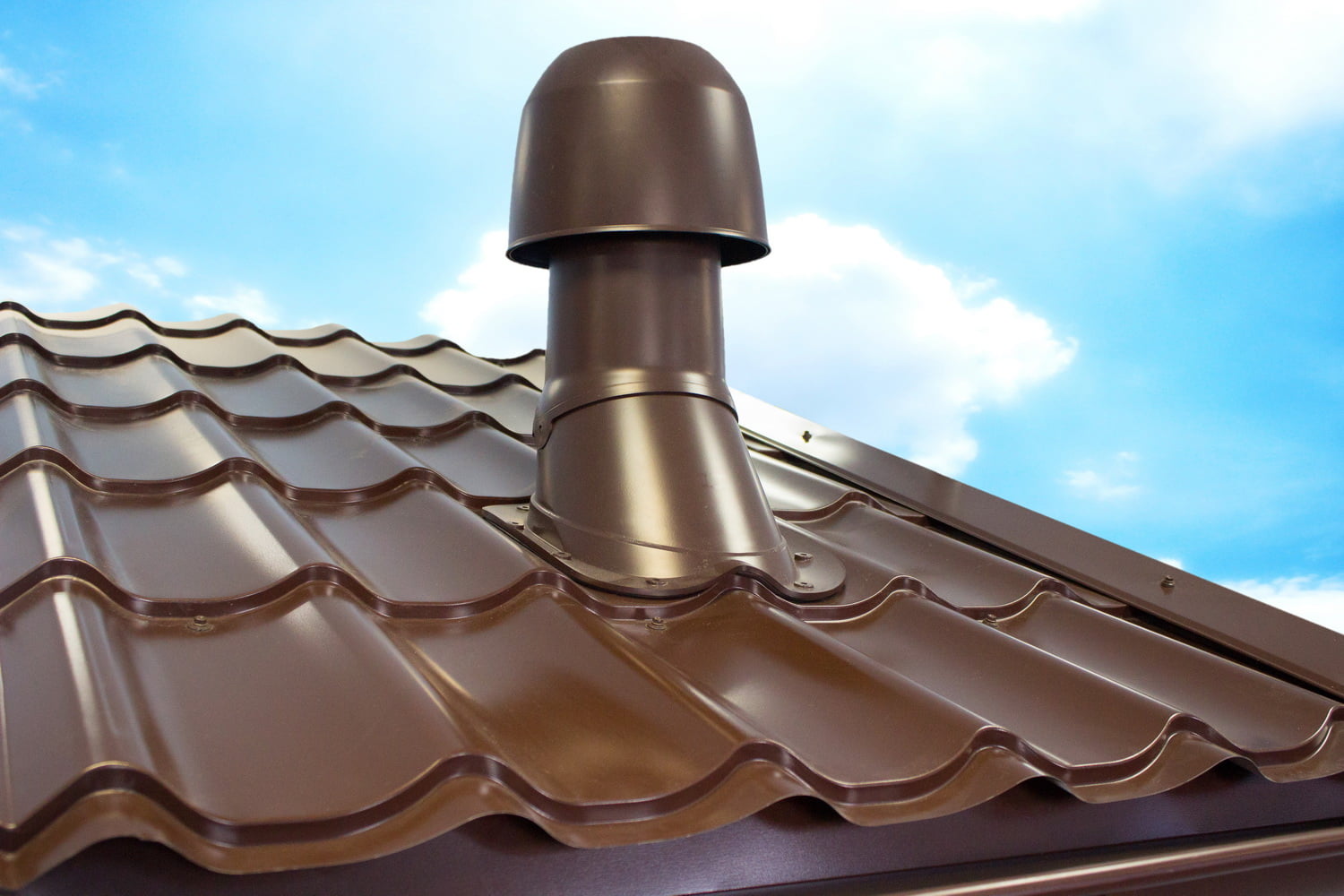
Next, a ventilation passage is inserted. The rubber ring or other version of the seal is fixed with screws and silicone sealants. The final fixation is carried out after checking the verticality of the device, if necessary, the pipe is corrected. At the end of the installation, the joints are once again carefully smeared with sealant, but without excessively filling the space under the roof with it. When organizing through ventilation, such processing is required on all layers of the cake, some experts recommend wrapping the areas adjacent to the passage with waterproofing films. The installation ends with the strengthening of decorative and protective products, including the deflector.
Important nuances include:
- Accounting for climatic conditions and wind roses when choosing the location of point exits and their height. Pipes should not be covered with snow or constantly blown out.
- Placement of output elements not lower than 60 cm from the ridge bar.
- Selection of the diameter and size of the holes, taking into account the total area and the complexity of the roof configuration.
- Ensuring free circulation of air flows in the space under the metal tile.
- The need for additional reinforcement of pipes if their high output is necessary (observed in case of poor traction).
- Compliance with the rules of technology for laying a roofing cake, namely: the use of a diffusion waterproofing film, the laying of gaps in the right places, the presence of a counter-lattice.
- Full supply of fresh air. The minimum allowable area of holes on the eaves is 200 cm2 per 1 running meter.the length of the ramp, when they are laid, a mandatory reserve is provided and protective measures are taken against clogging with debris or ice formation.
Three main misconceptions and elimination of consequences
The principle of roof ventilation
To ventilate the attic in a private house was done correctly, in addition to knowledge of the basic requirements, it is necessary to get rid of a misunderstanding of its purpose. There are three main misconceptions that have been falsely given the status of rules and applied in the design and construction of houses in the private sector.
The first misconception is about the seasons
It is generally accepted that flowing air circulation in the attic is needed only in the summer (hot) season:
- hot weather is not the only criterion for the need for attic ventilation. For unheated attics or for the ventilation gap of warm rooms, it is necessary to maintain a minimum difference between the internal and external temperatures;
- when it gets cold outside, the lack of flowing air circulation leads to the formation of condensate. This moisture contributes to the formation of dampness and fungal mold, and in winter - frost;
- this situation is extremely dangerous because spores of microorganisms can enter the living space through the ceiling. Dealing with the consequences will be extremely difficult.
Air flow pattern
The second misconception - it will be cold in the house ↑
Ventilation in the attic contributes to the cooling of the living space, since warm air is consumed to heat the floors:
- in fact, the reason for the cooling of the rooms is the insufficient thermal insulation of the walls, floor and ceiling.The room, to a greater extent, is cooled not from the loss of warm air, but from the penetration of cold;
- in addition, in the absence of waterproofing on the floor, not only heat passes through it, but also moisture, which is an additional reason for the formation of condensate in the attic.
Misconception three - size does not matter ↑
The dimensions of the air circulation holes do not matter:
- this is not the case, and if we are talking about a ventilation gap under the roof, then the minimum distance to the insulation should be 20mm. It is set by choosing the cross-section of the rails for the counter-lattice;
- when arranging products for cold attics, one should adhere to the norm - 1 sq. m of ventilation openings (in total) per 500 sq. m of the total area of the premises;
- if you meet these requirements (vent gap or airflow area), then you can get rid of condensate, while avoiding critical losses of warm air.
Exit with poor ventilation ↑
Frozen condensate on the rafter system and crate
If the ventilation was done taking into account the above misconceptions, then in the cold season condensation will form, which freezes in winter, as shown in the top photo. In such cases, you have to correct the situation, but there is a way out, and it leads to good results with simple actions.
The simplest roof aerator
You can make additional vents or dormer windows, protecting them with bars so that pigeons do not fly into and nest in the attic (they can also nest in vents if there is room).But it is most convenient, especially if the roof is made of metal (corrugated board, metal tiles or rebate), to install the simplest passive aerator. If desired, of course, you can purchase and install an electric or turbine hood of this type.
Depending on the roofing material, the base of the hood is selected - it can be wavy, under slate or ondulin, or flat, under the corresponding roofing materials. As a rule, such devices are equipped with installation instructions from the manufacturer, a set of self-tapping screws, as well as street sealant for fasteners.

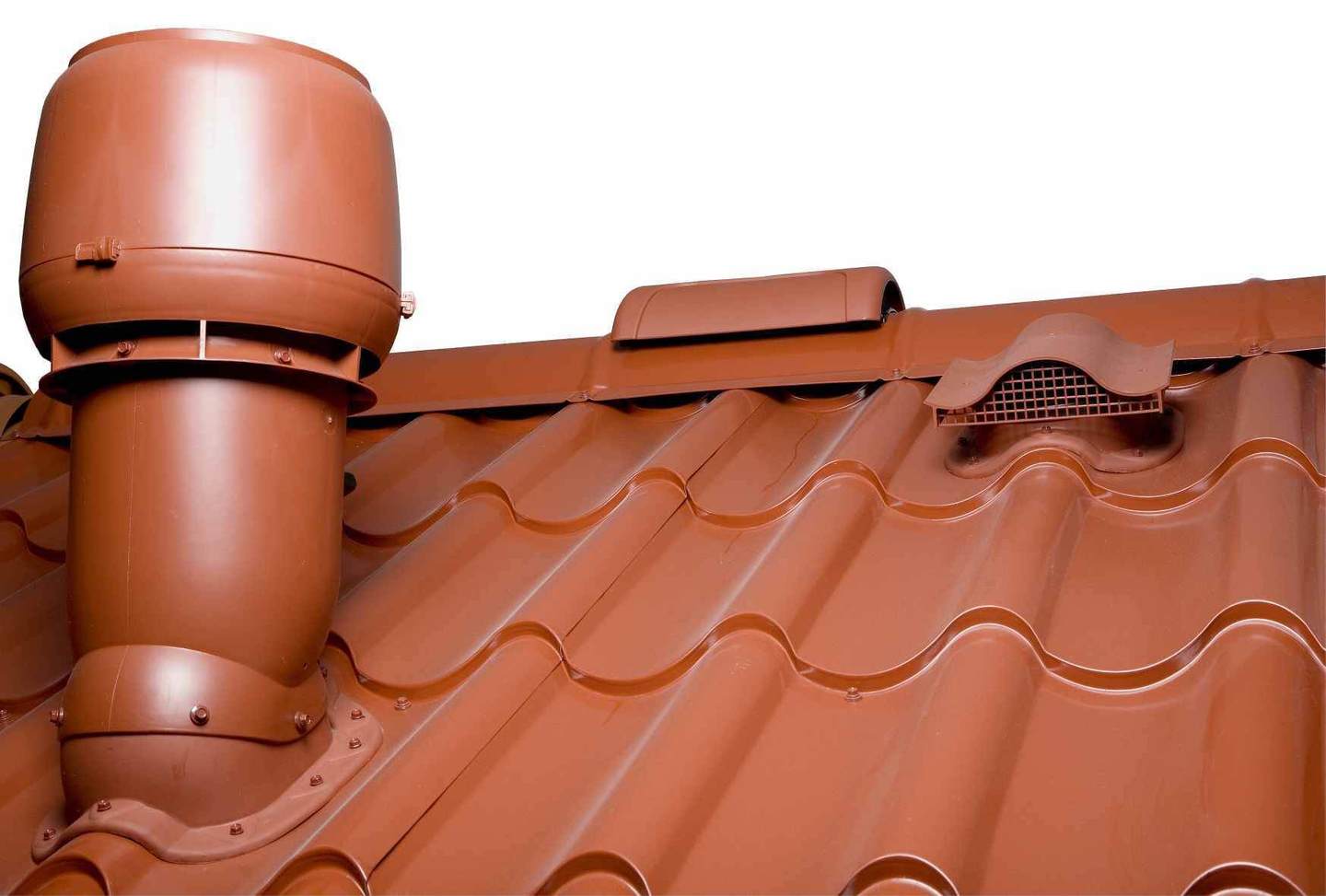


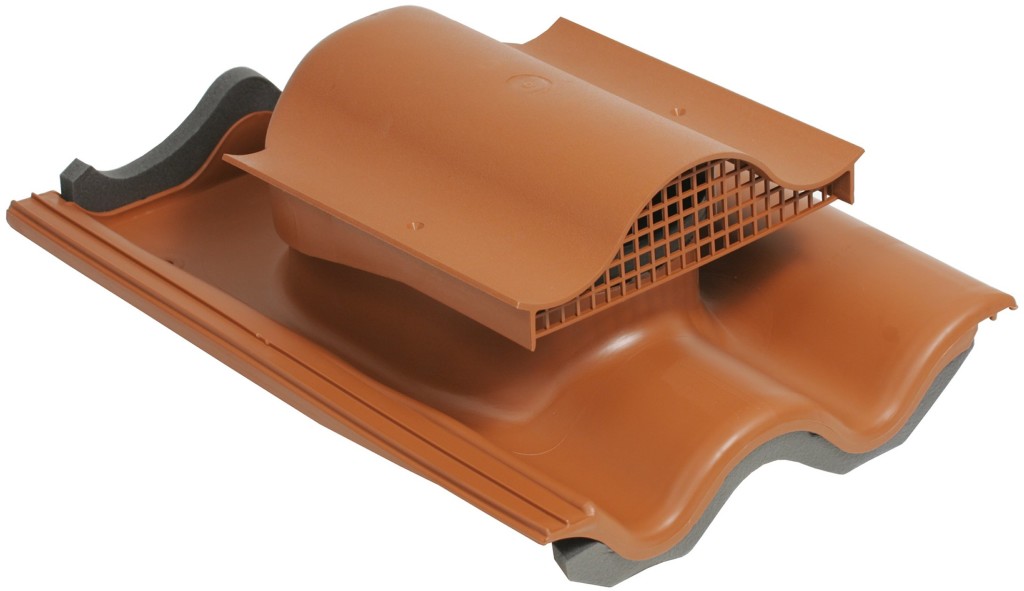

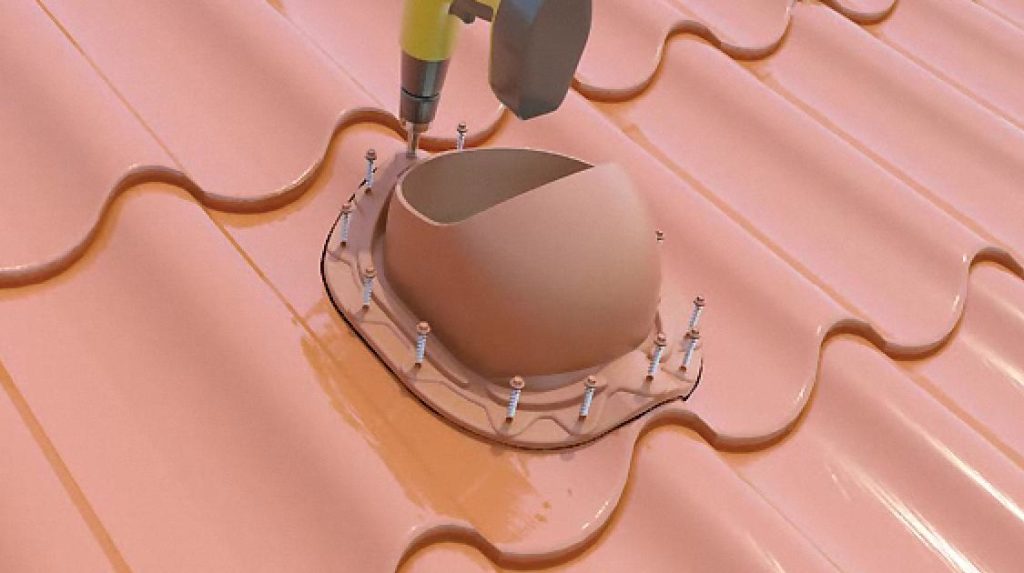

Attic ventilation is a must.
To install such a ventilation system in the attic, you need to cut a hole in the roof, the area of \u200b\u200bwhich should not be less than the hole in the hood, but not exceed the size of the mounting sole. For cutting, an angle grinder (grinder) is used, and the disc is selected in accordance with the roofing material (for metal or diamond-coated).
Summing up, we can say that ventilation in the attic is not an arrangement for elite houses, but an urgent need for each building, on which the comfort in the rooms depends. And the availability of do-it-yourself work significantly reduces the cost and allows you to quickly correct the situation with poor air circulation.
Metal roof ventilation
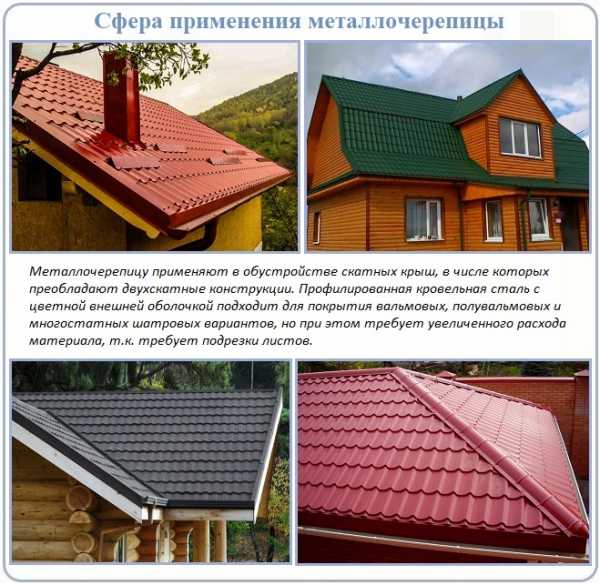
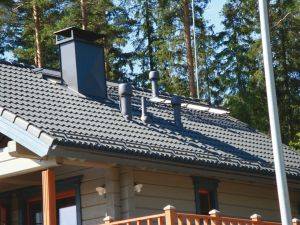 Type of metal roof
Ventilation of the roof of a metal tile house has some features.
Continuous ventilation is ensured during the installation of the roofing pie and lies in the fact that a gap of up to 5 cm is left between the roofing material and the thermal insulation.The lower layer of insulation is ventilated thanks to a 5 cm thick slot to the crate. And so that the wood does not get wet, a sealant is placed under the ridge.
The area of the ventilation slots at the cornice should be equal to the area of the ridge vents (the volume of inflow is equal to the volume of outflow). The total area of the vents should be 1% of the roof area. If during the design and construction of a house the ventilation of a metal roof is not thought out, there is an express method for ready-made roofs.
The basis of roof ventilation in this case are ventilation pipes and ventilation outlets. The height of the pipe must be 50 cm or more. For every 60 sq. meters of roof area, 1 pipe is installed as close to the ridge as possible. By the time of installation of point ventilation outlets, the video of which we present, the metal roof must be fully assembled.
In areas with heavy snowfalls in winter, pipes up to 65 cm long are installed. The places where the pipes adjoin the roof are hermetically sealed. When the roof is flat, and the slopes are more than 6 m long, ventilation junctions are equipped. The height of the junctions is from 40 cm above the roof. Instead of a conventional pipe, it is sometimes more efficient to use the deflectors shown in the metal roof ventilation video.
Ventilation of the roof ridge under the metal tile is provided by a ridge board separating two roof slopes. On the one hand, the air freely exits, preventing the formation of condensate.
Natural draft is used to ventilate the space under the roof. And it will work only if the number and location of ventilation outlets is accurately calculated.
Installation of a point ventilation outlet
Point exits are suitable as ventilation for hip and pitched roofs of a small area. Complex roofs with several ridges are equipped with an exit at each ridge. The distance to the ridge should not be more than 0.6 m. It is not advisable to mount two outlets on one sheet of metal tiles so as not to weaken the structure.
When purchasing a ventilation outlet for a metal roof, the following parameters are taken into account:
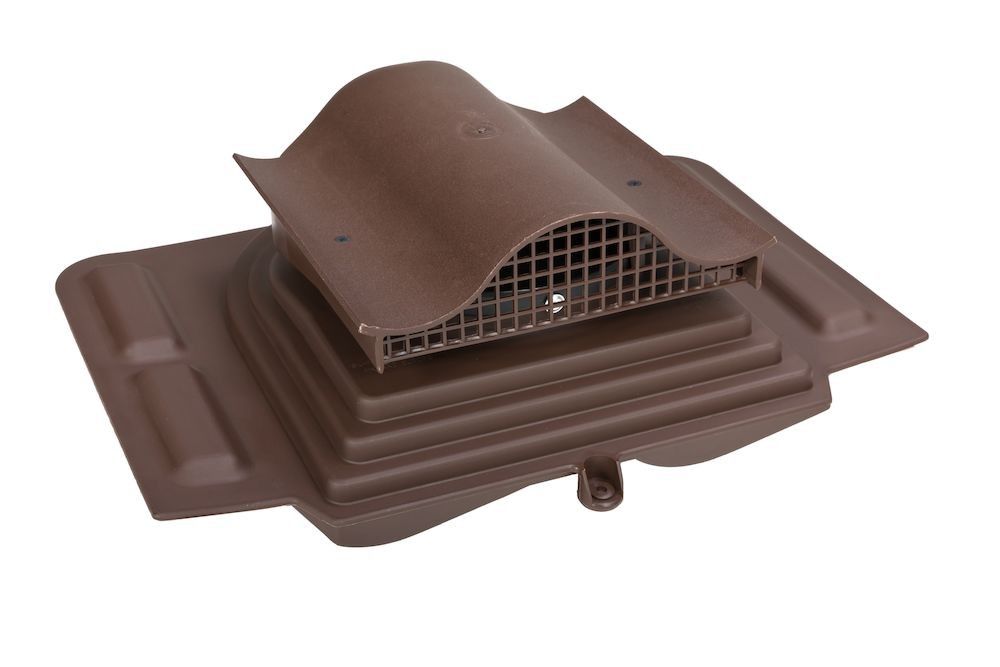
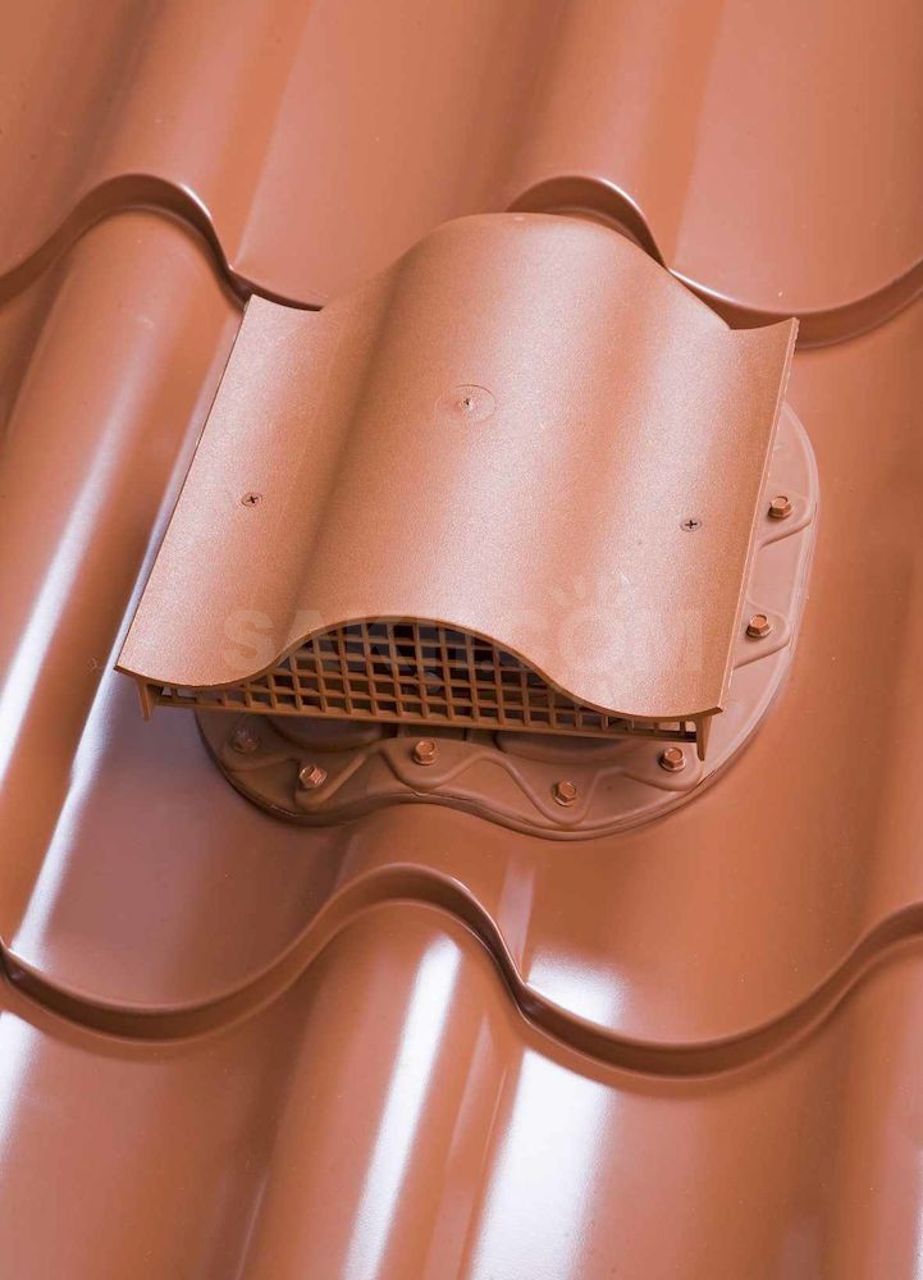
- the profile of the lining must match the profile of the metal tile;
- pipe color;
- temperature limits for a given instance;
- the kit should include installation instructions, linings, a template, fasteners, the pipe itself, as well as a passage element;
- the diameter of the pipe depends on the area of the roof.
The most important point in installing spot ventilation of a metal roof is cutting a hole of the right size and hermetically installing the pipe. If the device is assembled correctly, in accordance with the annotation, then the junction with the roof will be insulated from rain or snow.
Tightness is ensured by silicone, which is treated with a sealing circle. Next, the passage element is attached with screws from the kit and a pipe is inserted into it. The passage element is necessary for fixing the pipe. To make the fastening reliable, a hole is cut in it a quarter smaller than the diameter of the pipe. Sometimes this node is sold already assembled. The pipe must be installed vertically, which is checked by a level. Now it is fixed with screws and covered with decorative overlays.
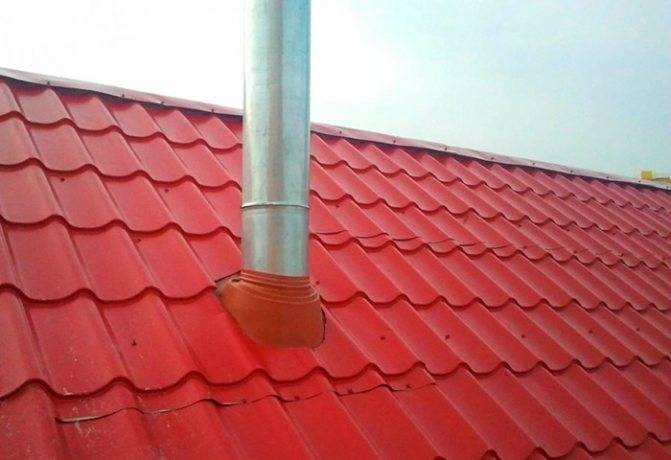





Ventilation installation options
To this end, it is possible to provide exhaust outlets on the ridge or near it. Such outlets are called roof aerators.They can be placed pointwise or made into a continuous gutter. The greatest efficiency will be ensured if they are located along the entire edge of the roof. Roof aerators can be combined with the general ventilation system of the house.
Roof aerators will not spoil the appearance of the house, as the main coating is laid on them. When constructing this type of ventilation, it is impossible to seal using mounting foam or special tapes. This will block the access of air, due to which the natural ventilation of the roof will become impossible. To make a roof with 2 gaps, you will need to cut holes in the film, as it will also block the access of air from the outside.
Practically for any roofing there are functional elements with which you can make ventilation. These elements include:
- plates with air channels;
- air elements;
- ventilation rolls.
With the help of these roofing elements, ventilation of the roof of the house can be ensured. The ventilated ridge system created using these elements, rather than installing them separately, gives the greatest efficiency.
The arrangement of a ventilated cornice is an opportunity to provide an area for air penetration sufficient for effective ventilation of the roof. Cornice ventilation can be of several types:
- soffit, which is the gap between the wall of the building and the cornice board;
- in the form of ventilation grilles embedded in spotlights;
- using a special material in which air vents are provided, laid slightly above the level of the cornice overhang.
In order not to block access to air, it is necessary to abandon the laying of heat-insulating material in the eaves or placing plantings on it. It is possible to provide effective protection of ventilation ducts located on the cornice overhang:
- special grilles and air elements;
- location under the roofing of the elements of the drainage system;
- installation of snow guards.
Attic ventilation scheme through dormer windows.
Roof valley or gutter is a more complex option for ventilation output. If the cornice overhang is too short and there are 2 ventilation gaps (or long grooves) on the roof, then certain difficulties may arise with the withdrawal of ventilation.
It is possible to ensure ventilation of the roof if ventilation openings are made in the film in each span of the truss system. Instead of an opening, you can make a solid channel for ventilation along the gutter.
In such difficult cases, aerator elements can be placed along the valley. This is very useful on roofs with a slope of 45°. If the roof is flat, then such ventilation will not be effective. In this case, the best option is roof fans powered by electricity, high ventilation nozzles, inertial turbines, etc. However, the cost of such ventilation is much higher than with the arrangement of ventilation in a natural way.
The most common way to create ventilation is to make a dormer window. This element carries not only a functional, but also a decorative load. The roof with a dormer window looks very attractive. You can make a hole for a dormer window of various shapes.
A single pitched dormer can be installed on any roof. The base of the gable should be a roof made of metal or soft coating. But if you wish, you can equip windows with a more complex design.



Thus, roof ventilation is an indispensable element that serves to remove warm and humid air from the house. With the help of a ventilation system, rotting and mold can be prevented on floor beams and roof supports. There are several ways to arrange ventilation on the roof. One method or another may be more or less effective depending on the design of the roof. In some cases, it may be necessary to include special devices in the ventilation system that operate from the mains. This will make ventilation more efficient, but will increase energy consumption. It is recommended to resort to this method of arranging ventilation only in cases where the roof structure prevents natural ventilation.
How does a roof ventilation system work?
Ventilation of the under-roof space is of two types:
- Natural.
- Forced.
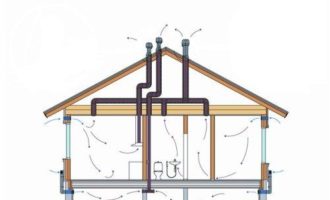
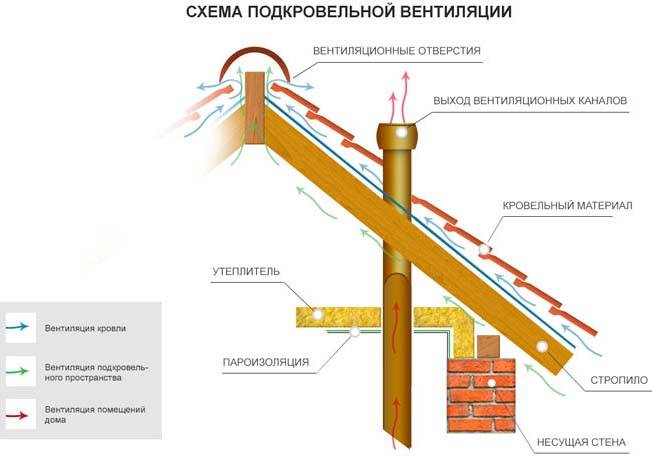
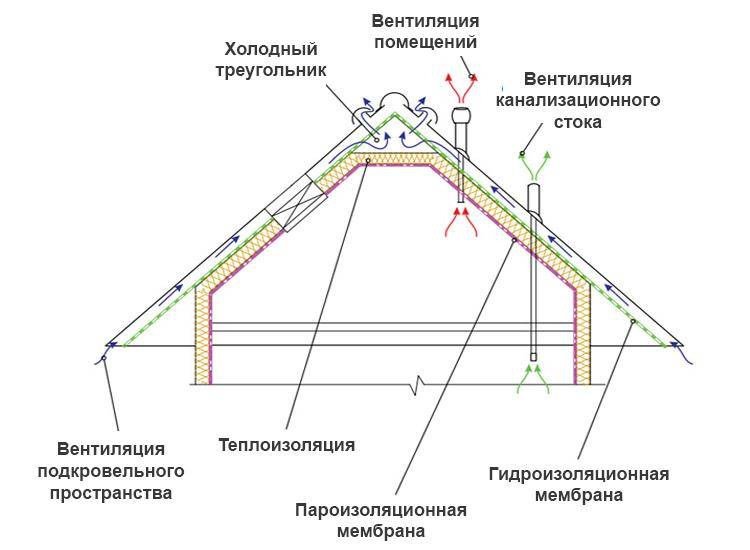
Natural ventilation operates without the involvement of mechanical devices, only thanks to the laws of physics. The movement of air here occurs due to the difference in pressure in the interior and outside the house. Through the exhaust holes, the air from the under-roof space is drawn out along with the vapor particles filling it.
The air exchange rate is directly affected by the difference in the height of the supply and exhaust openings. The larger it is, the stronger the resulting thrust will be.Therefore, exhaust ducts are often brought to a height exceeding the location of the ridge, and air inlets are located in the cornices.
In forced-type ventilation, ventilation devices are used to create a directed air flow. They can be located at the exhaust or supply opening, or at both points at the same time. Such modifications are more efficient than natural ventilation systems.
Ventilation of a roof from a soft tile
The tasks of soft roof ventilation are:
- removal of condensate;
- prevention of overheating of the lower layers of the roofing;
- ensuring temperature balance on the roof surface.
With properly organized ventilation, cold air flows enter the under-roof space in places of overhangs, and exit through the ridge or aerators.
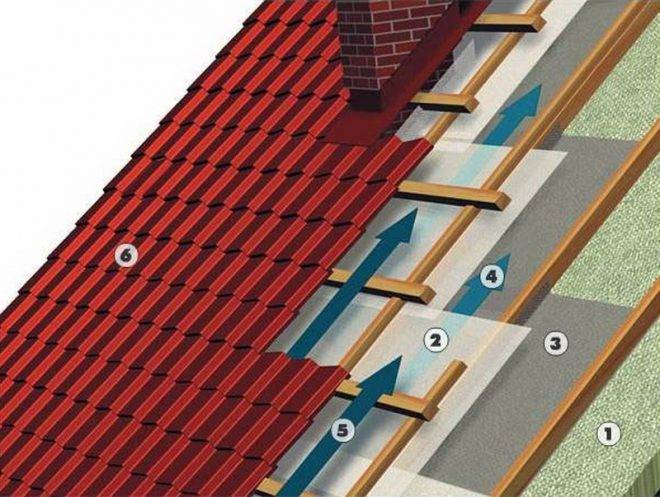
The arrows indicate the direction of air flow in the under-roof space with the correct ventilation device.
Soft roof ventilation can be single- or double-circuit. But for it to be sufficient, a number of conditions are met:
- the thickness of the air gap between the crate and the insulation is calculated in advance by the angle of inclination and the length of the slopes (but less than 4 cm);
- make additional holes along the bottom of the slope, tightening them with perforated tape, mesh, comb, lining the roof overhangs with breathable spotlights;
- arrange gaps on the roof in the form of ventilated skates or aerators for forced ventilation.
mansard roof
High-quality ventilation of the mansard roof is achieved due to the correct arrangement of the materials of the roofing pie. If everything is done correctly, then in the section, from inside the room to the outside, the cake will be viewed in the following order:
- Decorative or finishing material.
- Crate.
- Vapor barrier material.
- Insulation.
- waterproofing material.
- Counter-lattice with crate.
- Roofing material.
 mansard roof roofing pie
Installation of the pie can be carried out during the construction phase between the rafters. If the attic has already been built, you can install the cake on the rafters from inside the room.
When installing between rafters, you must:
- lay waterproofing material on the outer side of the rafters from top to bottom with an overlap of about 10 cm (sagging of the waterproofing material should not be more than 2 cm per meter of material)
- install a counter-lattice and a crate on top of the waterproofing agent (they act as a ventilation space)
- lay the roof
Continuation of work is carried out inside the attic:
- insulating material is laid between the rafters
- vapor barrier film installed
- the crate is mounted on the rafters with galvanized nails
- interior finishing is being carried out
If the attic has already been built, then the whole pie is attached to the rafters inside the room. Due to this installation, a fairly wide ventilated space is obtained, but the area of \u200b\u200bthe living space is reduced.



Conclusions and useful video on the topic
You can figure out how to properly install ridge ventilation on the roof with your own hands, using the following video:
Ventilation of a roof made of tiles allows not only to solve the problem of condensate accumulation in the under-roof space, but also to save on heating or cooling rooms, depending on the outside temperature. For a soft roof, a ridge aerator is ideal, providing an accessible outlet for exhaust air masses and an influx of fresh air into the roof.
If you had to mount the ridge aerator for soft ventilation roofs, please tell us your story. Your experience can help many of our readers decide on the type of roof ventilation and install the system correctly with their own hands. You can leave your comment in a special field located directly below the article.