
- Difference by location
- Features of the device LED lamps
- Extra options
- Flask type
- Weight
- Dimensions
- How to choose a LED lamp for the home according to technical specifications
- LED lamps for the home: product prices
- Types of LEDs Used
- Benefits of LED light bulbs
- 220V LED lamps: circuits, device
- Which illuminator is better - fluorescent or LED
- Let us determine the useful luminous flux
- The world of LEDs: a brief overview of the proposals of modern manufacturers
- Indicator LEDs
- Lighting LEDs
- Pros and cons of lighting LEDs
- 220V LED lamps: circuits, device
- What is an LED lamp, how it works
- Features of the device LED lamps
- Summing up
Difference by location
All LED linear lights are divided into types depending on various characteristics up to size.
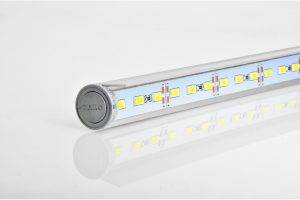
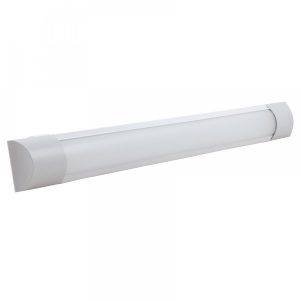
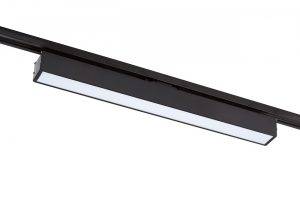
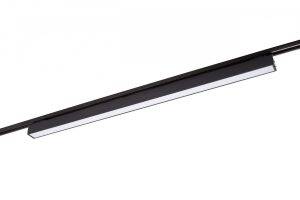
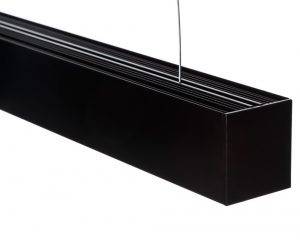
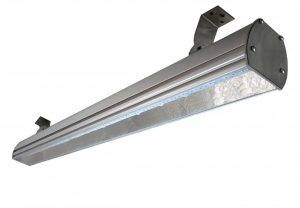
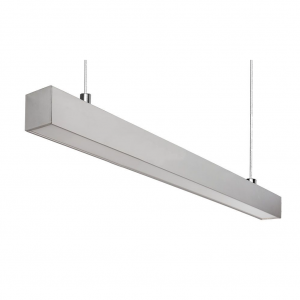
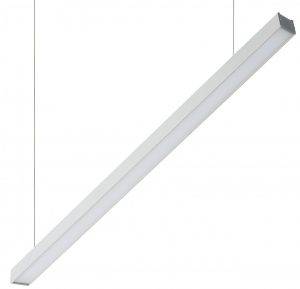
One of the most important of these characteristics is the location of the device.
This is important to consider when choosing, because exactly where the lamp will be located and under what conditions depends on how it will be.
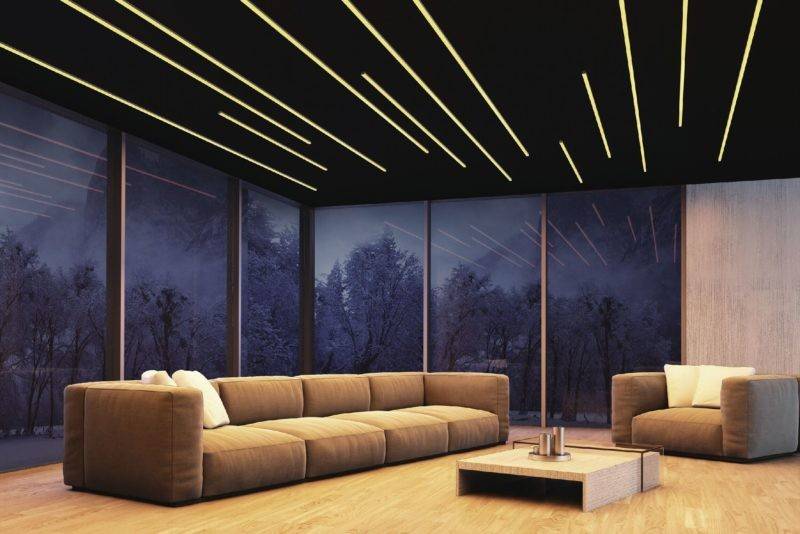
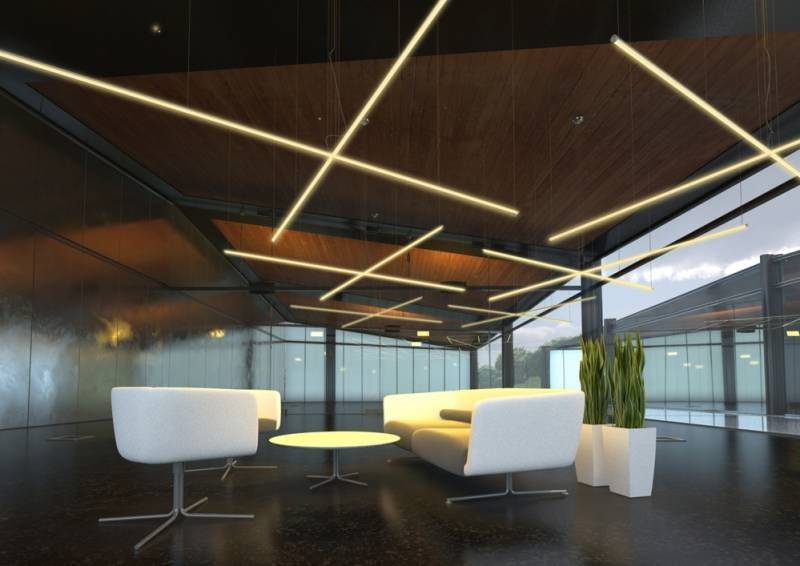
For example, in conditions of street lighting in a country house or in a private house, LED linear spotlights are often used.They are not only brighter able to shine, but also resist external environmental influences.

In this case, monochrome and full-color types of diodes are used. The first option is only one color of the glow - white and some of its shades. But full-color ones can shine in any shade of your choice.

Here it is also important to take into account the climatic features of the area in which the LEDs will be installed.

A lot depends on this parameter, including the service life of the devices. In an aggressive climate of a different nature, specialized protection is needed, which will also be different.
Features of the device LED lamps
Modern LED lamps are more complex than their incandescent predecessors. For LEDs to work, a number of electronic components are required, which are located on a printed circuit board.
All structural elements are compactly hidden inside the case. The light sources themselves take up a minimum amount of space in the lamp.
The weak point of inexpensive LED lamps are capacitors, the poor quality of which leads to light pulsation. In addition, they can burn out before the LEDs themselves.
The design of a standard LED lamp includes the following components:
- Plastic light diffuser. Promotes uniform distribution of the light flux in all directions around the lamp.
- Circuit board with capacitors, voltage converters and other electronic components.
- LEDs. Their number and operating voltage is in strict accordance with the built-in electronic circuit.
- Aluminum heatsink designed for heat dissipation in high power lamps.
- Ventilation slots for passive cooling of the board and LEDs.
- The base with which the lamp is attached to the lamp.
Thus, the LED lamp is a device with a complex internal structure. It is demanding on external temperature and power supply parameters.


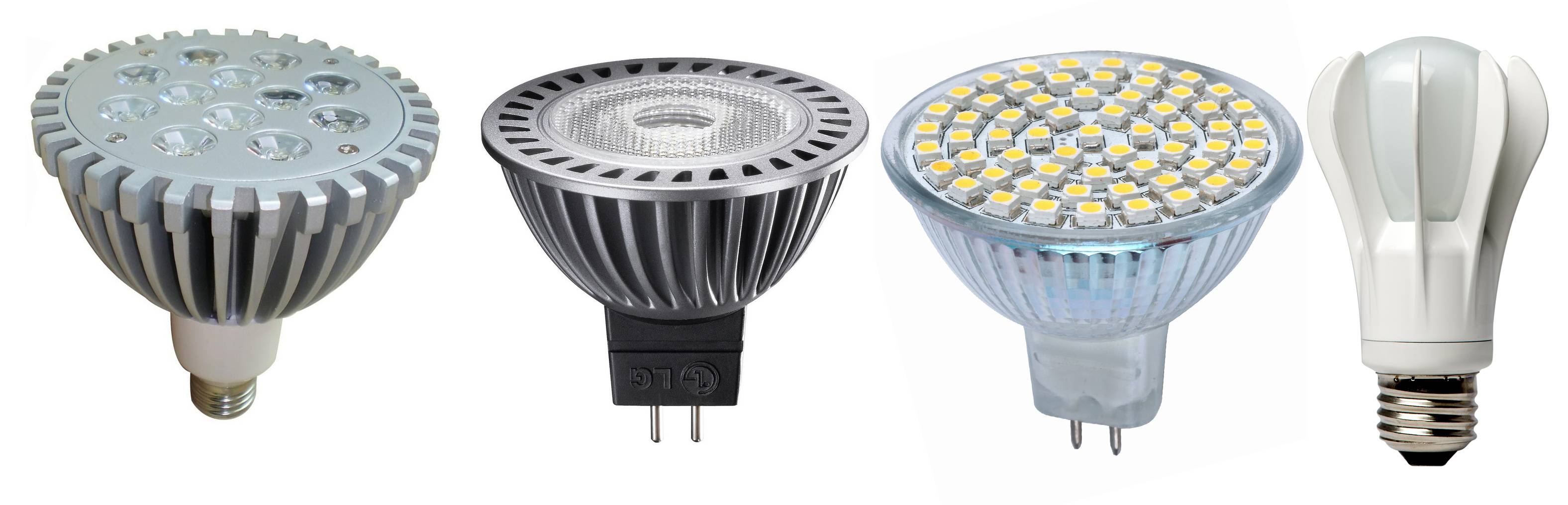
Extra options
LED lamps for household lamps have at least three more important characteristics - the type of bulb, weight and dimensions. Let's consider them in detail.
Flask type
According to the shape of the bulb, LED lamps can have several varieties:
- Pear-shaped. It is used in large ceiling lamps, has the shape of a standard incandescent bulb.
- spherical. Smaller dimensions allow it to be installed in flat ceiling lamps.
- Candle-shaped. Well suited for small narrowed chandeliers.
- In the form of a candle in the wind. As a rule, it is equipped with a dimmer, which, in combination with the curly shape, makes it possible to install it as a decorative lighting.
- Reflex. It is used for directional lighting, for example, in double-loop suspended ceilings.
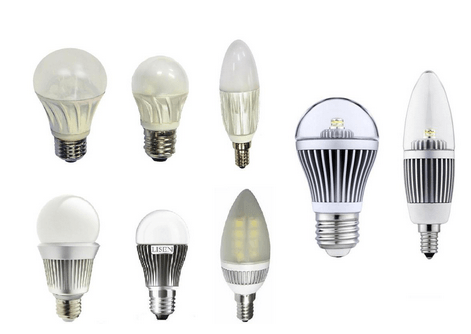
The shape of the bulb of the LED lamp can have any - from classic to exclusive
The main thing when choosing it is to pay attention to the characteristics and recommended scope of application.
Weight
Unlike a standard light bulb, which has an easy system for maintaining the filament in its structure, the LED lamp includes many extras. This includes a driver, a case with ice elements, and an aluminum heatsink. Therefore, the weight of such a device is much greater, which cannot be ignored when choosing the method of mounting the lamp on which it is installed. However, the advantage of such a body is a large margin of safety.
Dimensions
External dimensions of LED lamps can vary significantly - from ultra-compact to huge.This characteristic is determined primarily by power and purpose. Even with the same dimensions as a standard light bulb, it may not be suitable due to the difference and specificity of the bulb itself. This means that before choosing it, it is imperative to measure the parameters of the ceiling or chandelier itself.
How to choose a LED lamp for the home according to technical specifications
You need to choose an LED lamp according to its technical characteristics. If you master this rule, you will always be able to distinguish a good model from a poor quality product. In this case, you do not have to thoroughly study all the parameters of the light source.
It will be enough to pay attention to the main characteristics
Criterias of choice:
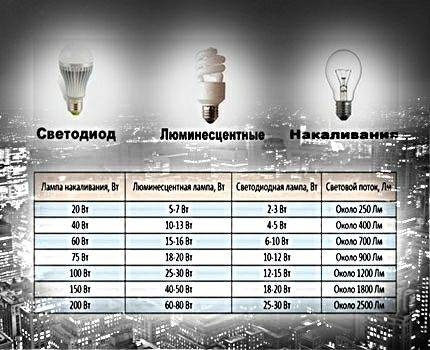
- Power. This parameter of LED bulbs is divided into actual and equivalent. The first indicates the amount of energy consumed, and the second indicates the equivalent for ordinary incandescent lamps. For example, a 5W model shines as brightly as a regular 40W light bulb. If you need the equivalent of a 60-watt light source, buy 8-watt units, and a 100-watt light source 14 watts.
- Light flow. This parameter allows you to determine the degree of brightness of the light bulb. The same principle of equivalence applies here. LED models with 400 lumens correspond to 40 watt incandescent lamps, 700 lumens to 60 watts, and 1300 lumens to 100 watts.
- Colorful temperature. According to this technical characteristic, you can understand what kind of light the bulb will burn (warm or cold). At an indicator of 2800 K, the LED lamp will shine with warm yellow light, 3000 K with warm white, 4000 K with neutral white, 5000 K with cold white. The first 2 options are suitable for apartments and private houses, the third one is for offices, and the last one is for utility rooms.
- Color rendering index. This characteristic indicates how strongly the light emitted by the lamp will affect the color of the illuminated objects. The best option would be if the color rendering index is 90 or higher. At a lower value, all objects will appear dull, with a grayish or yellowish tinge.
- Ripple factor. This parameter is responsible for the uniformity of the glow, which affects the load received by the eyes. So that the organs of vision do not get tired, choose lamps with a coefficient of 5 to 35%.
When choosing a light source for home or street lamps, give preference to LED lamps. They save energy and work for several years. Be sure to read our article before buying. It will help you make the right choice in favor of the products of a particular brand. If the information turned out to be useful to you, then like it and write an interesting comment.
LED lamps for the home: product prices
After getting acquainted with the main characteristics of LED light sources, it becomes clear which lamps are better. Although LED products have a high price, indisputable technical advantages distinguish them from other devices.
In lamps of the "corn" type, the external contacts of the diodes are energized, as a result of which they should be installed in a protective cover
Almost all products purchased from official representatives are covered by a manufacturer's warranty. The warranty period can be from 2 to 5 years.In addition, any of the purchased LED lamps can be exchanged for a more suitable model or returned within a period not exceeding 14 days from the date of purchase.
With the help of modern diode lamps, you can achieve really comfortable and harmonious lighting in the room.
Every year, the mass production of LED products is growing. In this regard, a decrease in the cost of approximately 25-30% is predicted. Nevertheless, the payback of LED lamps is possible even if they are purchased at current prices.
Types of LEDs Used
Additionally, fixtures differ from each other in the type of diodes installed in the lamp housing.
Indicator LED elements are considered obsolete and are extremely rare in everyday life. The quality of the output light output and the overall safety of these products fall short of the requirements accepted today.
SMD chips are among the most common and most widely used type. The minimum size and weak basic heating of the working elements make SMD lamps the most attractive among analogues.




Their use has no restrictions and is allowed in any systems and conditions.
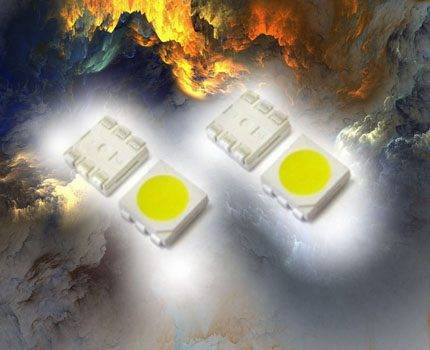
The only disadvantage of SMD-type diodes is their small size. Because of this, you need to mount them in a light bulb in large quantities, and this is not always convenient and expedient.
Units operating on high-power diodes of 1.3 and 5 W are in some situations very productive.
But the high level of heating during operation and the problematic organization of the correct heat removal from a small case significantly reduce their popularity.
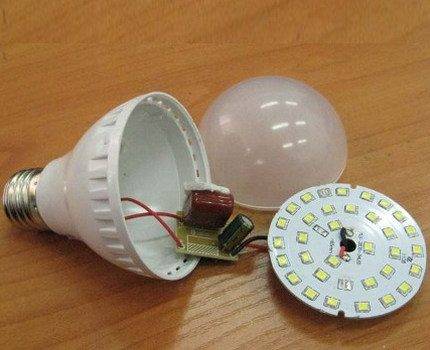
If there are any problems in the light bulb, it is not necessary to immediately run to the store and demand an exchange or a refund.Simple problems are easily fixed at home, even by craftsmen who do not have much experience in such a plan.
COB diodes are an innovative chip manufacturing technology. It is being developed very actively. Due to the direct mounting of diodes on the board, heat dissipation increases several times, and the overall reliability of the device increases.
Thanks to an improved optical system, the light stream spreads more evenly and creates a pleasant background glow in the room.
Filament is a progressive type of chip invented in 2013-2014 by a group of scientists. Designed exclusively for lighting.
It is fully used for arranging original and unusual decorative lighting for domestic and industrial premises for various purposes.
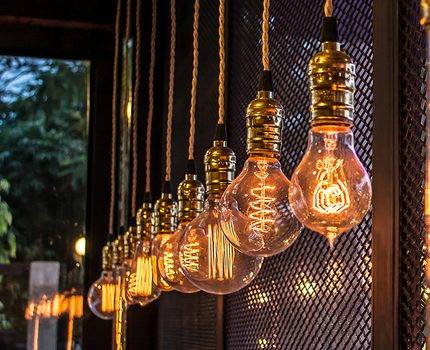
A filament-type light bulb has all the useful features of LED sources. It looks stylish and attractive, lasts a long time, consumes a minimum amount of energy and provides uniform illumination of the room within a 360 ° radius.
Provides in the room a spectrum of light that is pleasant for the human eye, similar in characteristics to the effect of burning a traditional incandescent lamp. By this parameter, it is several times superior to similar products of SDM and COB type.
It is sold at a reasonable price in company stores and is considered a practical option for an economical light source.
Benefits of LED light bulbs
 Having decided to replace the lamps in your home with LEDs, it is advisable to get some idea about the features and criteria for choosing LED lamps for your home.
The complexity of the choice lies in the many parameters of LED lamps, which must be known and understood.
Not only the efficiency of the lighting device will depend on the right choice, but also a number of important parameters, such as lighting comfort, luminous intensity, replacement cost, and others.
However, there is a lot of information about LED lamps. Even those who have never encountered their installation can easily understand all the characteristics of LED lamps for the home.
- Profitability. LED lamps are several times more economical than incandescent lamps.
- Durability. Manufacturers designate a warranty time interval of the product equal to 30,000 hours.
- Safety. No content of harmful components, as in energy-saving lamps, harmful radiation.
- Reliability. Resistance to mechanical influences and various kinds of vibrations.
- Lighting design. When using colored diodes, lighting of various color shades can be adjusted.
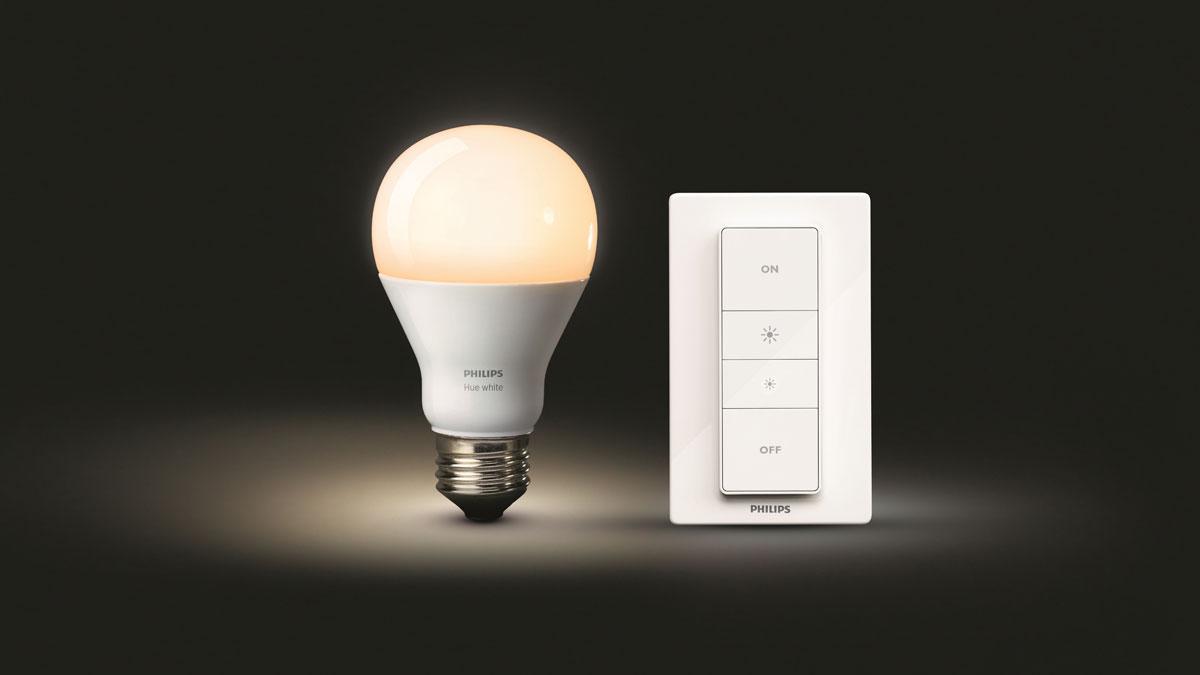
- Remote control and autonomous lighting. On sale there are lighting devices with autonomous batteries that allow the use of lamps even in the absence of electricity, and built-in control units make it possible to turn the light on and off using the remote control. It is these solutions that are usually used in smart home technology.
220V LED lamps: circuits, device
The design of the LED lamp includes the following elements:
- diffuser - to increase the angle and uniform distribution of light. Usually made of translucent plastic or durable polycarbonate;
- LED system - the number of LEDs used in the lamp determines its power, size and design. One lamp can use from one to several dozen diodes;
- aluminum printed circuit board - provides heat dissipation from the LEDs to the cooling radiator;
- radiator - made of several aluminum plates. Removes heat from the printed circuit board;
- capacitor - an element of the adapter, which serves to eliminate the effect of voltage ripple at the output;
- driver - used to convert alternating current. It rectifies and stabilizes the voltage to power the diodes;
- the base of the base - made of polymer, it provides protection for the body from electrical breakdown;
- brass base - provides contact with the lamp socket.

LED lamp device
Thus, the LED lamp is a block of diodes and a power supply circuit with resistors that limits the current. The 220V LED lamp circuit represents a sequence in which the mains voltage of 220V is applied to the bridge rectifier element through the current limiting capacitor, indicated in the diagram C1, and the resistor R2.
As a result, the system of LEDs HL1 is supplied with constant power passing through the resistor R4. The LEDs in the lamp begin to glow. The purpose of the capacitor C2 in the circuit is to obtain a smoothed rectified voltage. The discharge of the capacitor C1 when the LED light source is disconnected from the supply voltage occurs through the resistor R1.


Which illuminator is better - fluorescent or LED
To understand this issue, let's compare the main advantages and disadvantages of these two types of tubes.
Comparative characteristics of T8 fluorescent and LED tubes with g13 base
| fluorescent | LED |
| Service life 5 - 10 thousand hourshours (depending on switching frequency and quality of supply voltage) | Service life up to 50 thousand hours |
| Light output 40-50 lm/W (3-5 times higher than incandescent lamps) | Light output 80-100 lm/W |
| Chemical hazard (contains mercury), requires special disposal | It does not require special disposal, you can simply throw it away, it is classified as household waste |
| When using EMPRA, flickering at a frequency of 100 Hz | In high-quality devices, flicker is completely absent, cheap |
| Uneven spectrum, unpleasant for the eyes, aggravated by the degradation of the phosphor | Uniform spectrum throughout the lifetime, provided that the manufacturer has used appropriate LEDs |
| Low power factor in the choke supply circuit (leveled by the use of expensive electronic ballasts) | High power factor |
| Diffused light with a sector of 360 degrees along the axis of the tube, requires a reflector | Illumination angle depends on the design |
| Variety of color temperatures and color shades | Variety of color temperatures and color shades |
| Low mechanical strength (glass) | Increased impact resistance (high-strength plastic) |
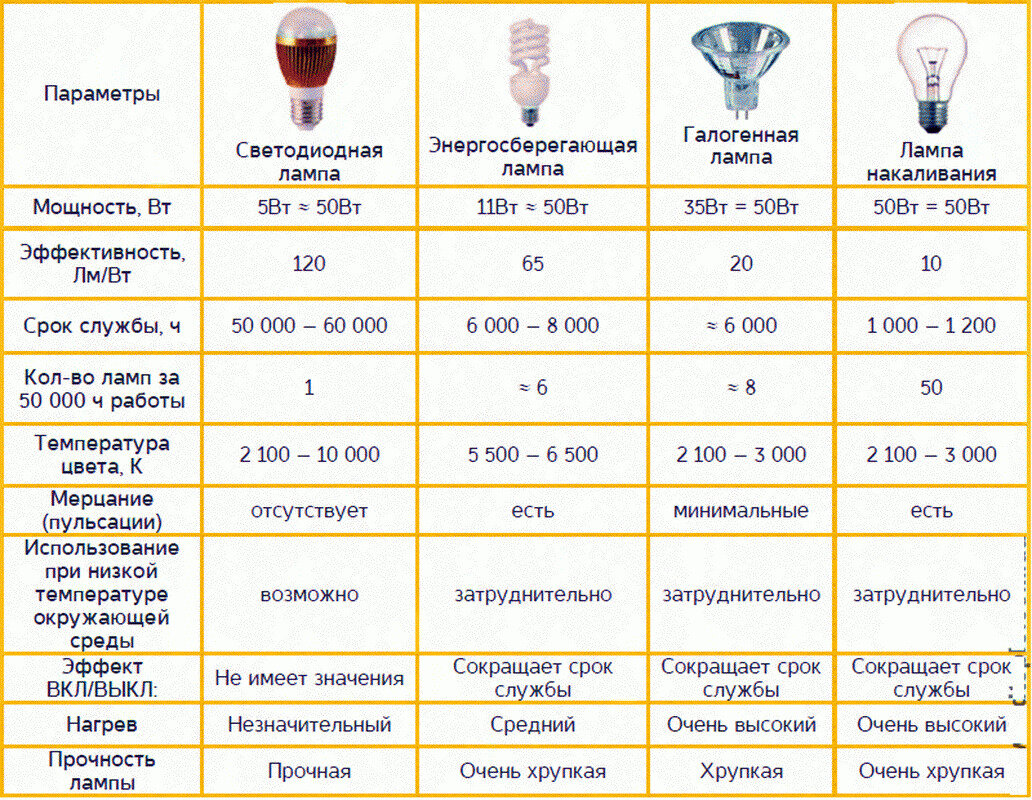
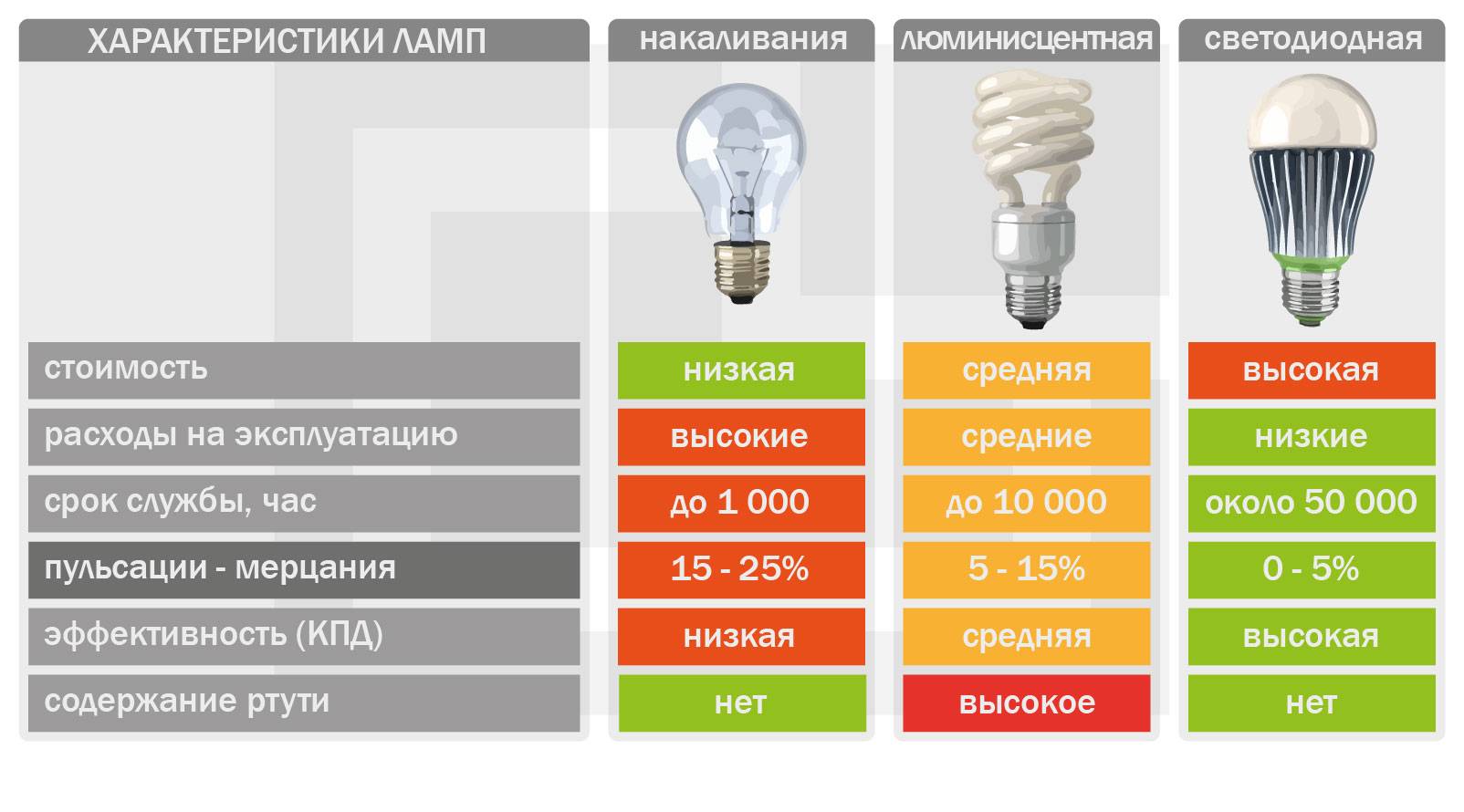
As can be seen from the table, the main advantages of T8 fluorescent tubes - efficiency and durability - LED ones are more than covered. The main disadvantage of semiconductor light sources is their rather high cost, but in the modern market everyone will find products according to their financial capabilities. At the same time, we must not forget that starting equipment must be used to power fluorescent lamps, and electronic ballasts sometimes cost more than 1 T8 LED tubular lamp. Consultants often advise replacing fluorescent with LED for this very reason.In addition, with the development of technology, super-bright diodes are rapidly becoming cheaper, and even such a high cost pays off with a long service life and economy.
So the conclusion is clear: an LED source is better in most situations. The exceptions are those situations when it is impossible or difficult to convert luminaires to LEDs for any reason, for example, when it is forbidden to interfere with the factory design. This can be a problem for organizations.
It remains to figure out how to change T8 fluorescent to LED with minimal effort and money.
Let us determine the useful luminous flux
| Light source | Fpol |
| Omnidirectional | Full luminous flux |
| Directional light sources with a beam angle greater than 90°, without filaments. This does not include sources for accent lighting. | Luminous flux within a 120° cone |
| Other Directional Lights | Luminous flux within a 90° cone |
Due to greater energy efficiency, we get more light with relatively little energy consumption. Until recently, the amount of light could only be indirectly determined by the fact that the more watts a lamp has, the brighter the light source will shine. With new LED technology, this number will not pass.

If we take ordinary incandescent and LED lamps as a comparison, then the energy efficiency of the former decreases if it is necessary to obtain a color other than the native warm one. For this, various filters are used. which absorb some of the light. LEDs do not have this, since we can get different colors without resorting to filters. And accordingly, the energy efficiency of colored diodes is an order of magnitude higher.
Energy efficiency of light sources by light emission
1 of 2
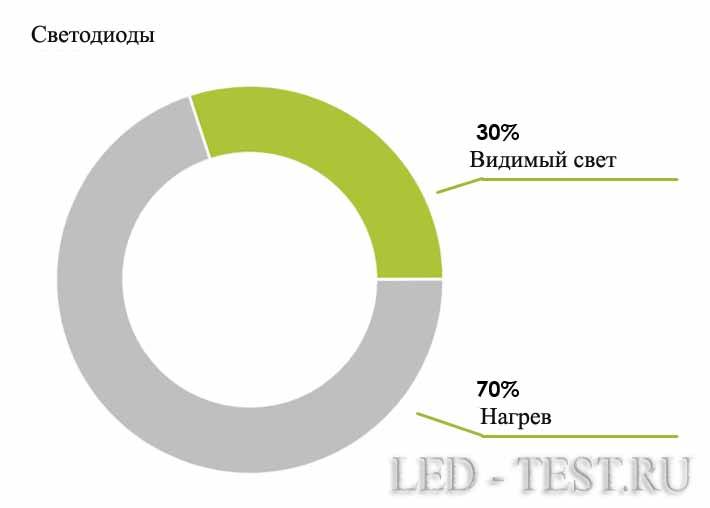
Energy efficiency of LEDs by glow
Energy efficiency of LED lamps by emitted light
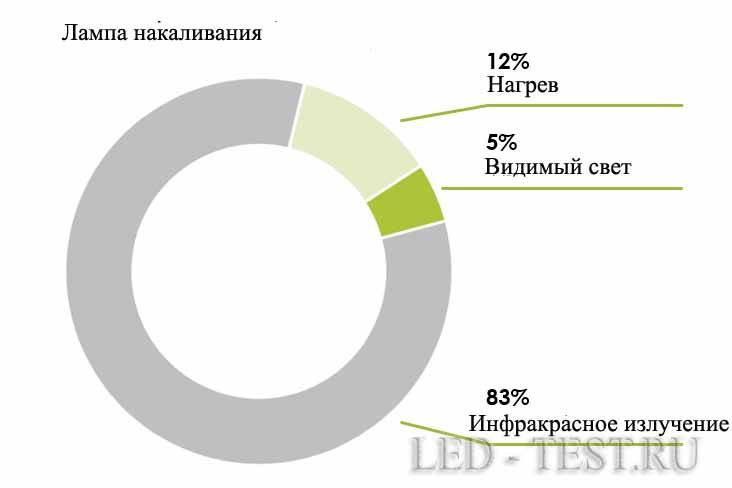
Energy efficiency of incandescent lamps
The world of LEDs: a brief overview of the proposals of modern manufacturers
The first successful experiments were carried out over a hundred years ago. But only in the late 70s of the last century, it was possible to create samples suitable for commercial use.
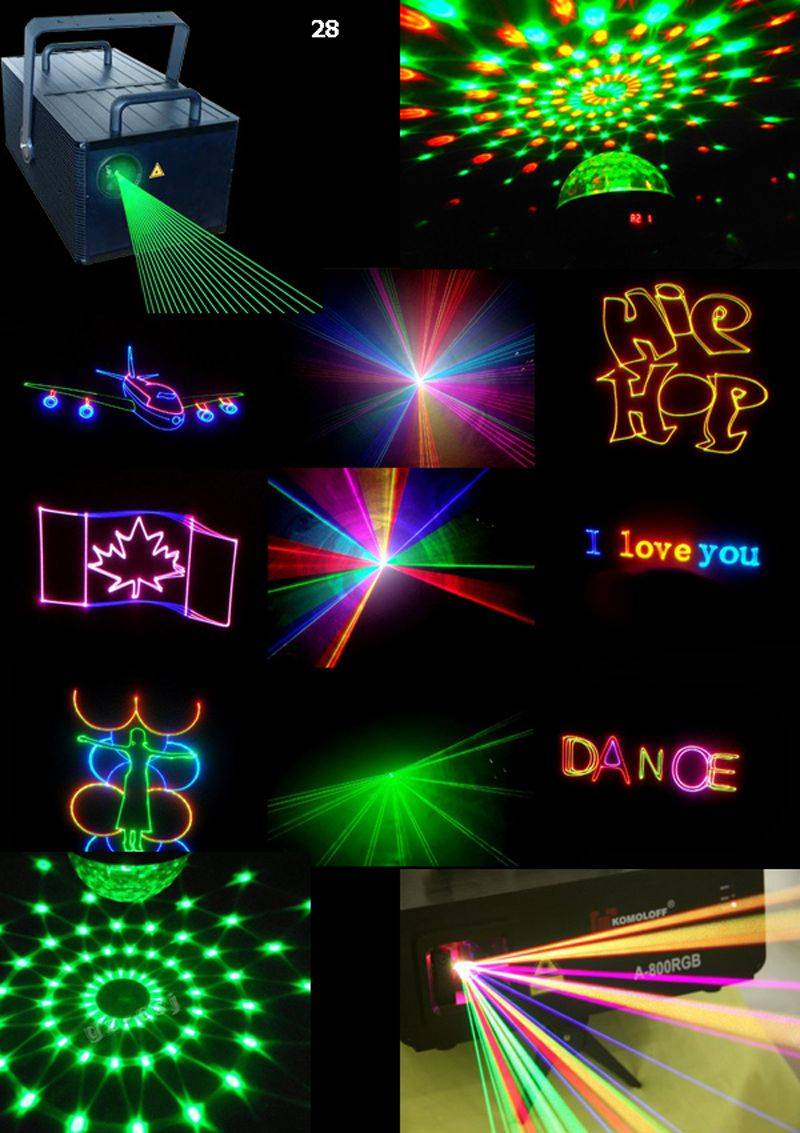 Different combinations of semiconductor materials create waves of a certain length
For green, AlGaInP (Aluminum-Galium-Indium Phosphide) is used. Red is obtained using AlGaAs (Aluminum Gallium Arsenide). For a long time they could not find a combination for blue. Only in the 90s was a suitable composition found, for which the authors received the Nobel Prize. The combination of these colors made it possible to create white light. Since that time, the mass introduction of technologies of this category into various spheres of human activity has been launched.

Indicator LEDs
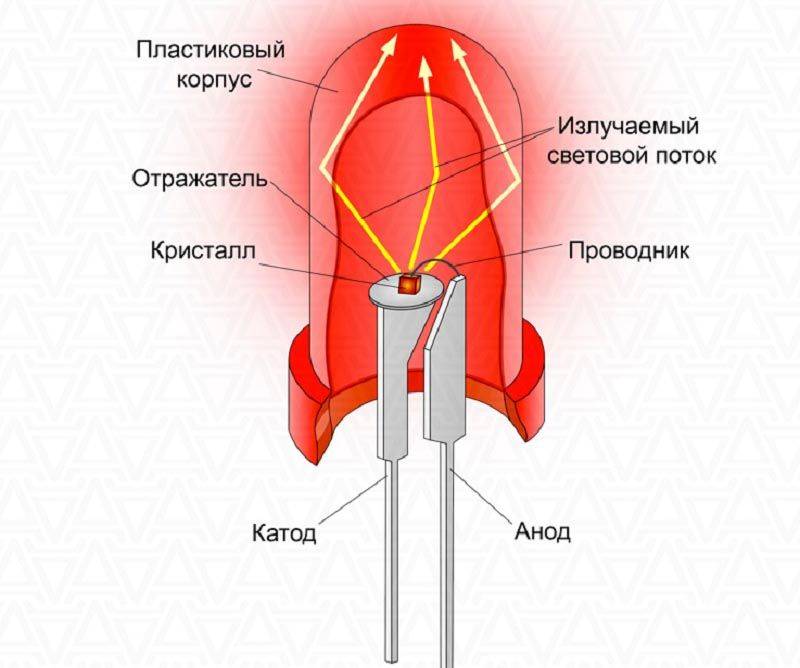 Design of the DIP device
To concentrate the light flux, the functions of reflectors are performed by the base plate and walls. Such devices are produced with convex lenses and rectangular ends with a diameter of 3 to 10 mm. They are connected to 2.5-5 V power supplies with a current limit of up to 20-25 mA. The scattering angle does not exceed 140°. Brightness - up to 1.1 lumens.
Indicator LEDs were previously used to create lamps, traffic lights, information stands and billboards. Nowadays, new modifications of semiconductor devices with greater light intensity have appeared.
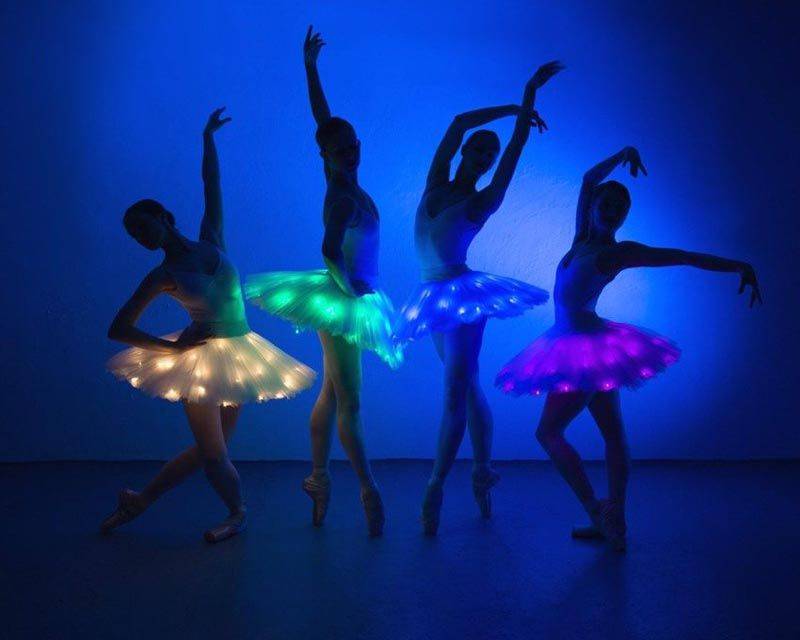 Original illumination of stage costumes
In practice, the following advantages of indicator LEDs are useful:
- low cost;
- good protection from moisture and other adverse external influences;
- safe currents and supply voltage;
- small energy consumption.
The last point must be supplemented with low heat generation. Such devices are able to operate for a long time in a wide temperature range without special cooling radiators.
Lighting LEDs
SMD semiconductor devices, as the most common products, are discussed in detail below. They are created in standard sizes on a special substrate, which is well suited for subsequent mounting on a printed circuit board.
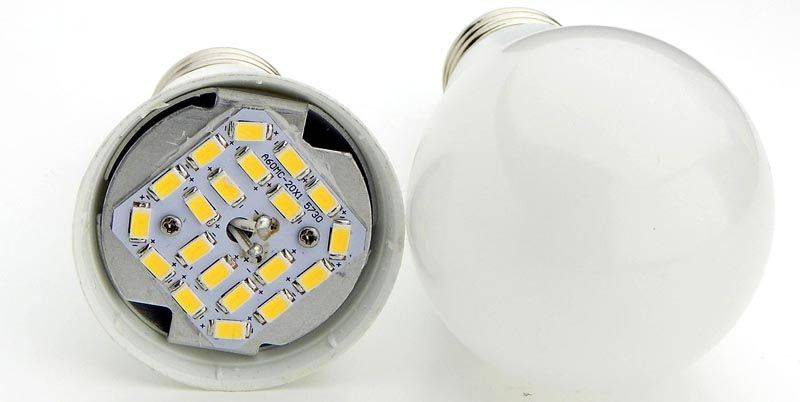 Lamp emitting field created from SMD LEDs
To improve security, semiconductors are mounted on a substrate inside a molded plastic case. The upper hemispherical part forms a lens, which helps to narrow the light output.
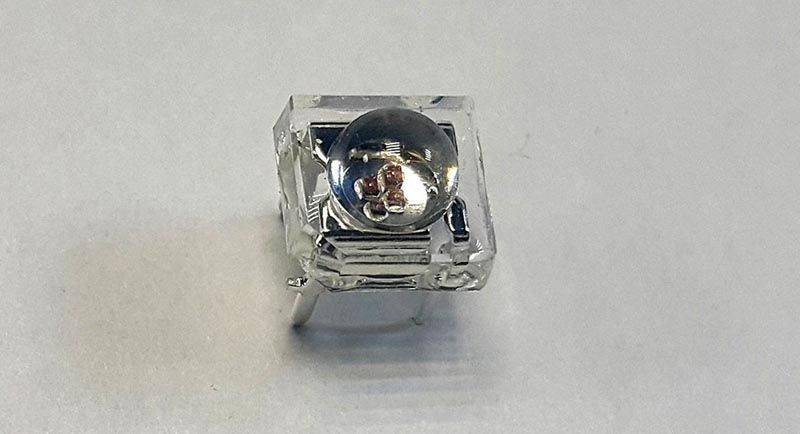 "Piranha". The formidable name of this category emphasizes the high efficiency of devices
The next group of products is designed specifically for lighting. Blue LEDs are placed on the substrate. Above - a layer of phosphor. In this case, a larger number of crystals per unit surface is used compared to SMD technology. This allows you to get a strong luminous flux.
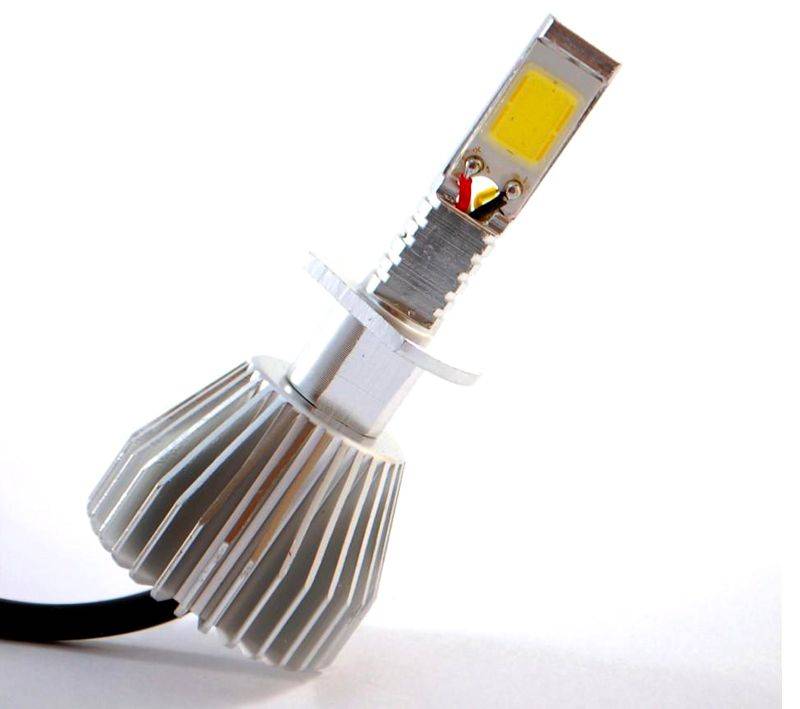 A powerful matrix of the COB (Chip On Board) category must be cooled. Such lamps are installed in car headlights of low and high beams.
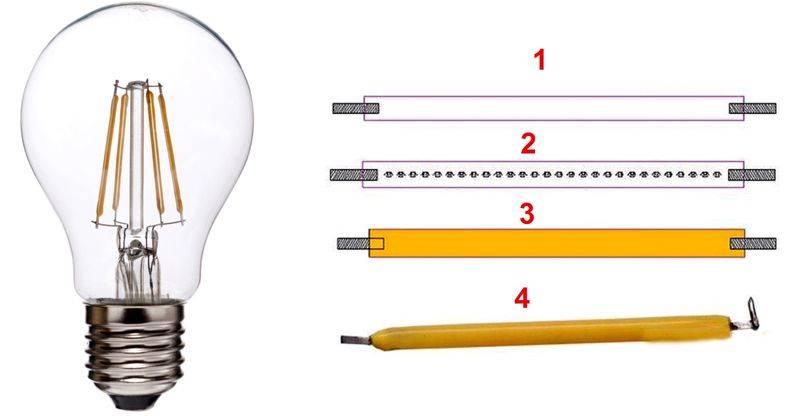 Chip On Glass Technology
The photo shows the main stages of the production process:
- A glass substrate of the desired shape is created.
- Semiconductor crystals are fixed on it in series.
- A layer of phosphor is placed on top.
- Next is the final protective coating.
A power supply is placed in the base of the light bulb, which creates a constant voltage with the desired current strength.
Pros and cons of lighting LEDs
Having found out what LEDs are, you need to list their advantages compared to alternative products:
- The best semiconductor devices are able to provide more than 200 lumens per 1 watt of energy. This consumption is 80-85% less compared to typical incandescent lamps.
- High-quality LED lamps are resistant to vibrations, voltage drops in the network. The durability of the best products approaches 100 thousand hours, which is equivalent to more than 11 years of continuous operation.
- The absence of mercury and other harmful compounds, along with a durable scatter bulb, increases the level of safety.
Do not forget that all associated costs must be included in the economic calculation. LED sources made by well-known manufacturers are expensive. Only after a few years will it be possible to recoup the initial investment. It should also be noted:
- Flickering due to insufficiently high-quality assembly of the power supply.
- Small spreading angle.
- Various specifications in one product batch.
- Narrow color temperature range, mismatch of the parameter with passport data.
220V LED lamps: circuits, device
The design of the LED lamp includes the following elements:
- diffuser - to increase the angle and uniform distribution of light. Usually made of translucent plastic or durable polycarbonate;
- LED system - the number of LEDs used in the lamp determines its power, size and design. One lamp can use from one to several dozen diodes;
- aluminum printed circuit board - provides heat dissipation from the LEDs to the cooling radiator;
- radiator - made of several aluminum plates. Removes heat from the printed circuit board;
- capacitor - an element of the adapter, which serves to eliminate the effect of voltage ripple at the output;
- driver - used to convert alternating current. It rectifies and stabilizes the voltage to power the diodes;
- the base of the base - made of polymer, it provides protection for the body from electrical breakdown;
- brass base - provides contact with the lamp socket.
LED lamp device
Thus, the LED lamp is a block of diodes and a power supply circuit with resistors that limits the current. The 220V LED lamp circuit represents a sequence in which the mains voltage of 220V is applied to the bridge rectifier element through the current limiting capacitor, indicated in the diagram C1, and the resistor R2.
As a result, the system of LEDs HL1 is supplied with constant power passing through the resistor R4. The LEDs in the lamp begin to glow. The purpose of the capacitor C2 in the circuit is to obtain a smoothed rectified voltage. The discharge of the capacitor C1 when the LED light source is disconnected from the supply voltage occurs through the resistor R1.
What is an LED lamp, how it works
Household LED, or LED lamps (from the English Light-Emitting Diode) are devices with a complex design. Despite the fact that outwardly they look like the usual incandescent lamps, their principle of operation is completely different.They should not be confused with energy-saving (or CFL compact fluorescent lamps), these are completely different devices both in terms of the principle of operation and in terms of efficiency. The LED lamp circuit demonstrates a complex and electronically rich device.
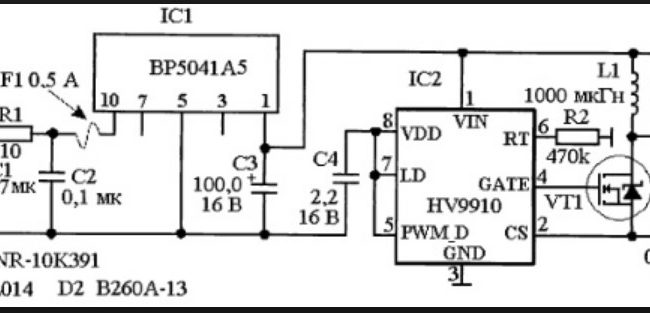
The circuit of the LED lamp consists of many parts.
A circuit from a SEA Electronics lamp has been demonstrated, but this option is not the only one. Each manufacturer seeks to improve the design by introducing additional elements into the circuit that change the operating parameters of the device. For example, until recently, the absence in the spectrum of LED lamps of the wavelength to which the pupil of the eye reacts (about 480 nm) was considered a serious drawback. A person could look at the lamp for a long time without feeling any discomfort. It was believed that the light does not harm the organs of vision at all. In this case, there was a harmful effect on the retina and lens, which received excessive and often traumatic exposure to blue light. This was taken into account by the manufacturers, and today's samples are adapted to the spectrum of human vision.
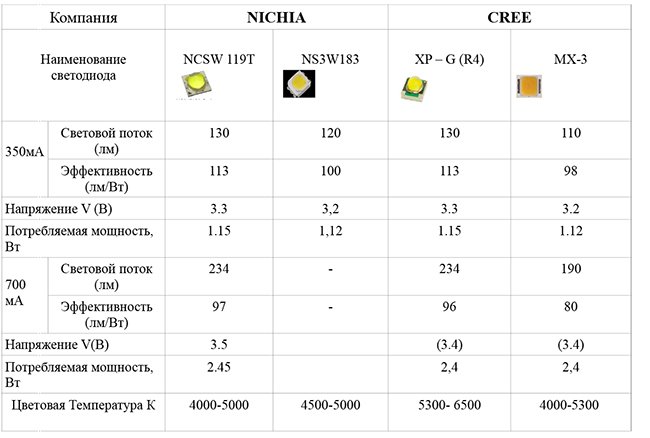


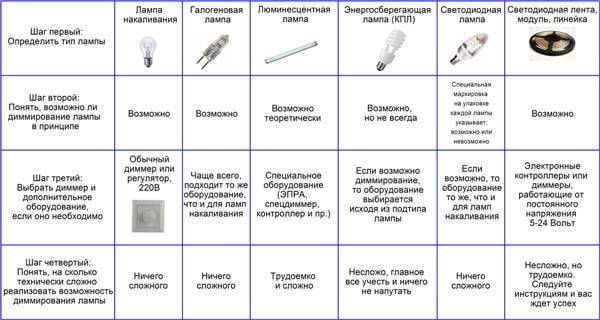


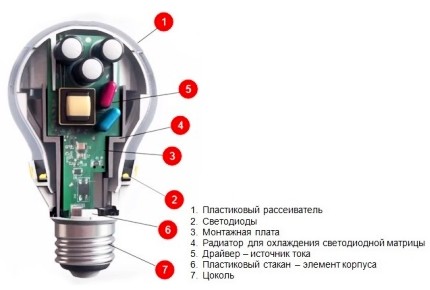
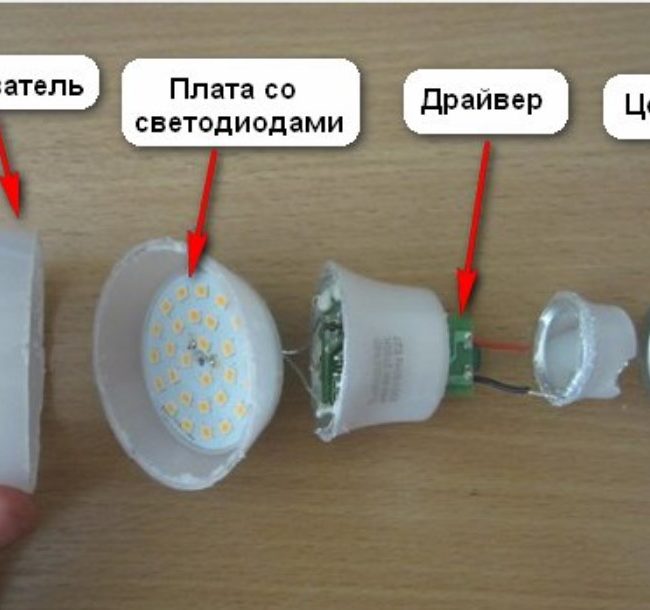
Lama is made up of several elements
The design consists of a plinth for a standard cartridge (there are models for all the most common types of plinth), a plastic or metal case, and a diffuser made of matte translucent plastic. Inside the case there is all the electronics, a power driver (a device that matches the voltage in the network with the necessary values for the circuit), a disk with installed LEDs. Despite the complexity of the design, manufacturers claim for their products a duration of use of up to 10 years, although in practice the duration of work is about 11,000 hours, i.e.approximately 3.5–4 years, depending on the duration of work during the day.
The advantages of LED lamps include:
- low power consumption. To shine as brightly as a 100-watt incandescent lamp, an LED lamp requires only 10 watts of energy;
- the absence of ultraviolet radiation in the spectrum. Fabrics do not burn out, there is no danger of damage to the retina, etc.;
- during operation, the lamps almost do not heat up;
- long service life;
- environmentally friendly, do not contain mercury;
- lightweight, impact resistant
- warming up occurs within 1 second.
The disadvantages of LED lamps are:
- high price;
- according to some users, LED lamps have an unpleasant spectrum.
Regarding the disadvantages, it can be noted that the prices for LED lamps are noticeably reduced, since their appearance, the cost has almost halved. The spectrum of the glow is a matter of either the user's personal preferences, or the wrong choice of a lamp model.
Features of the device LED lamps
Modern LED lamps are more complex than their incandescent predecessors. For LEDs to work, a number of electronic components are required, which are located on a printed circuit board.
All structural elements are compactly hidden inside the case. The light sources themselves take up a minimum amount of space in the lamp.
The weak point of inexpensive LED lamps are capacitors, the poor quality of which leads to light pulsation. In addition, they can burn out before the LEDs themselves.
The design of a standard LED lamp includes the following components:
- Plastic light diffuser. Promotes uniform distribution of the light flux in all directions around the lamp.
- Circuit board with capacitors, voltage converters and other electronic components.
- LEDs. Their number and operating voltage is in strict accordance with the built-in electronic circuit.
- Aluminum heatsink designed for heat dissipation in high power lamps.
- Ventilation slots for passive cooling of the board and LEDs.
- The base with which the lamp is attached to the lamp.
Thus, the LED lamp is a device with a complex internal structure. It is demanding on external temperature and power supply parameters.
Summing up
The power of the LED lamp, when choosing, is not of paramount importance. Much more important is the luminous flux emitted by it.
The same point applies to energy-saving CFLs. If we approach the replacement of burned-out artificial light sources with LED counterparts more meticulously, then in addition to comparing light fluxes, it is necessary to take into account the pulsation coefficient, color rendering index and a number of other points, which are described in detail in the article on choosing LED lamps
It is also recommended to pay attention to the design features of the lamp in which the light bulb will be used.



