- First start-up of instantaneous water heater
- VDT connection diagrams
- How does the protection device work?
- Why does a water heater need an RCD?
- Mounting Features
- When it knocks out
- Health check
- How does RCD work and why is it necessary?
- Types and sizes of electrical panels
- Why does the residual current device trip?
- And in conclusion…
- Purpose of RCD and difavtomatov
First start-up of instantaneous water heater
When turning off the hot water supply, close the hot water tap at the entrance to the house or apartment. Cold water remains open.
Next, open both shut-off valves on the water heater.
After that, turn on any hot water faucet in the kitchen or bathroom for 20-30 seconds.
Thus, you pass cold water through the device, expelling accumulated air from all tubes and cavities. Only after all these manipulations can you turn on the machine in the shield.
At the first start, it is advisable to select the default power, and later change the heating modes and temperature according to your needs.
Such an instantaneous water heater starts up for the entire season of turning off hot water supply. No need to click back and forth every day.
All modern models work on a simple principle - there is a supply of water through it, it heats. If not, it is disabled in standby mode.
That is, it does not constantly heat the water inside itself according to the principle of the same boiler.
After the hot water is restarted in the central system, you perform all operations in the reverse order:
turn off the machine
close the shut-off valve of the heater
open the DHW valve at the inlet
VDT connection diagrams
Power (electricity) can be supplied to both the lower and upper contacts of the RCD - this statement applies to all leading manufacturers of electromechanical RCDs.
Example from the manual for RCD ABB F200
I divide the RCD connection schemes into 2 types:
-
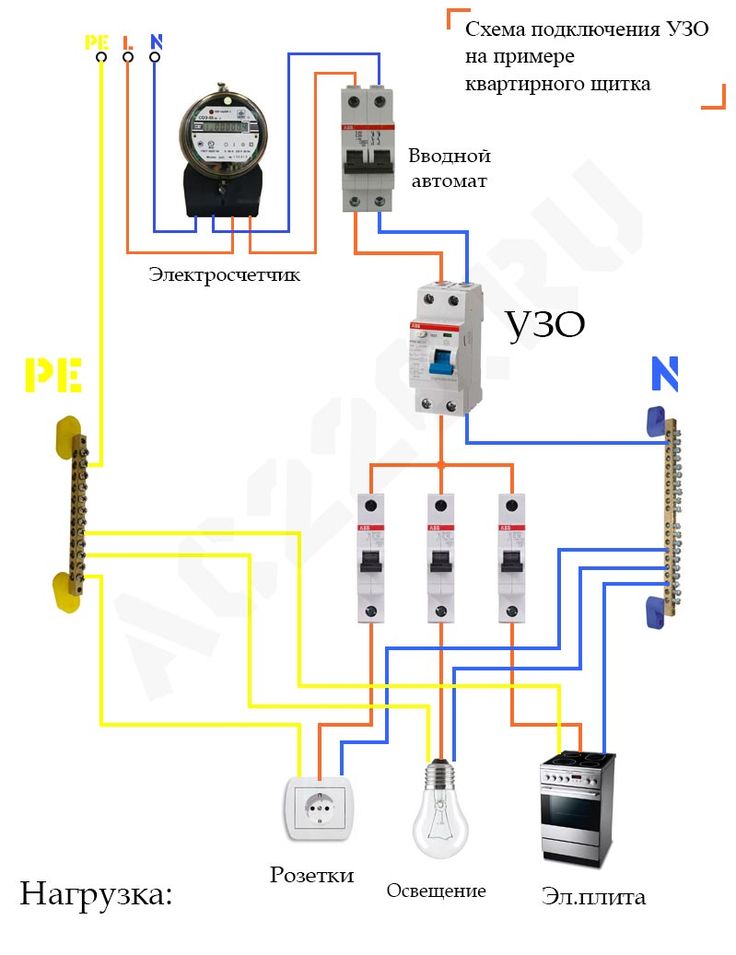
- This is a standard connection diagram, one RCD one machine. Remember that the RCD is selected with a rated current one step higher than the machine? If we have a machine on a 25A cable line, then the RCD should be selected at 40A. Below is an example of an RCD connection diagram for an electric stove (hob).
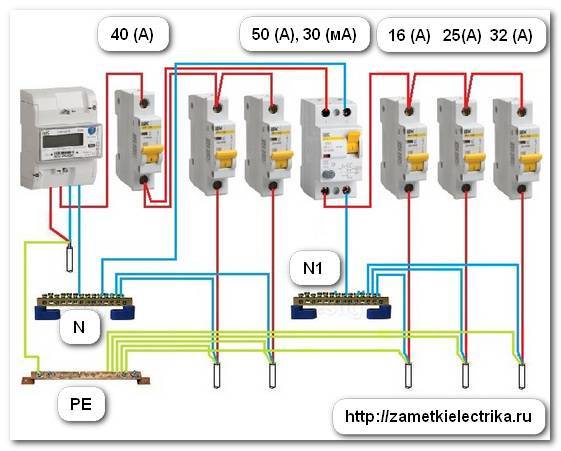
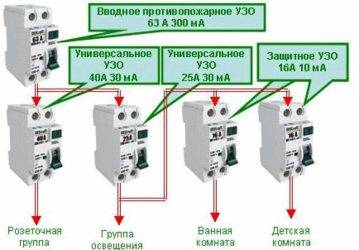
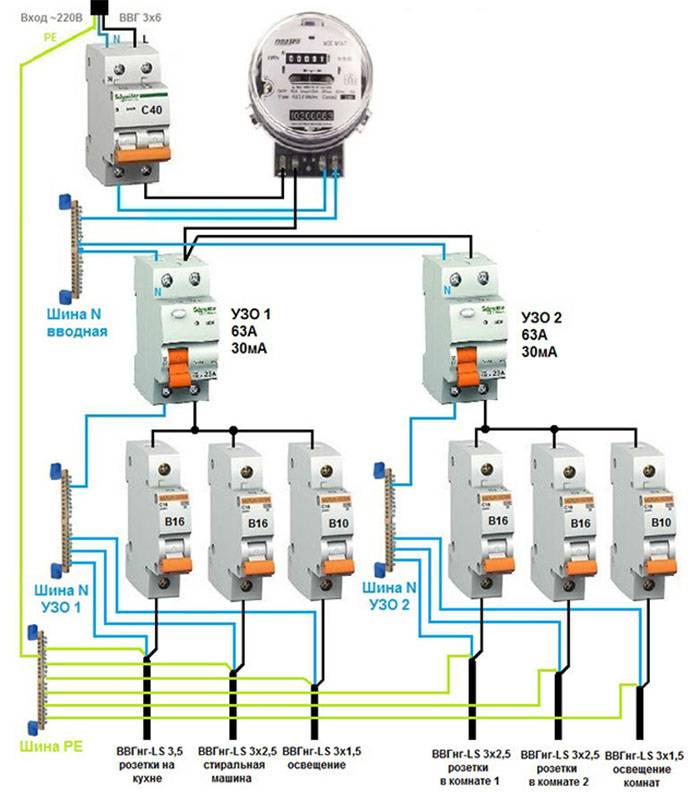
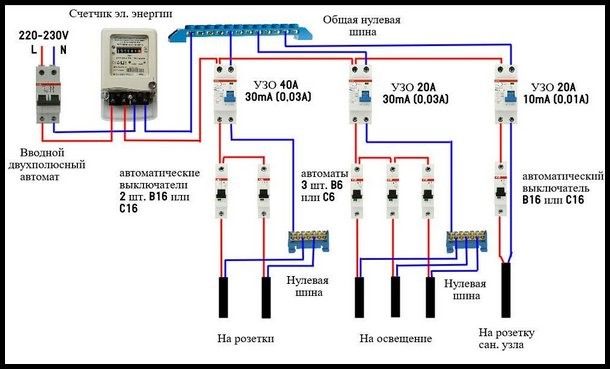
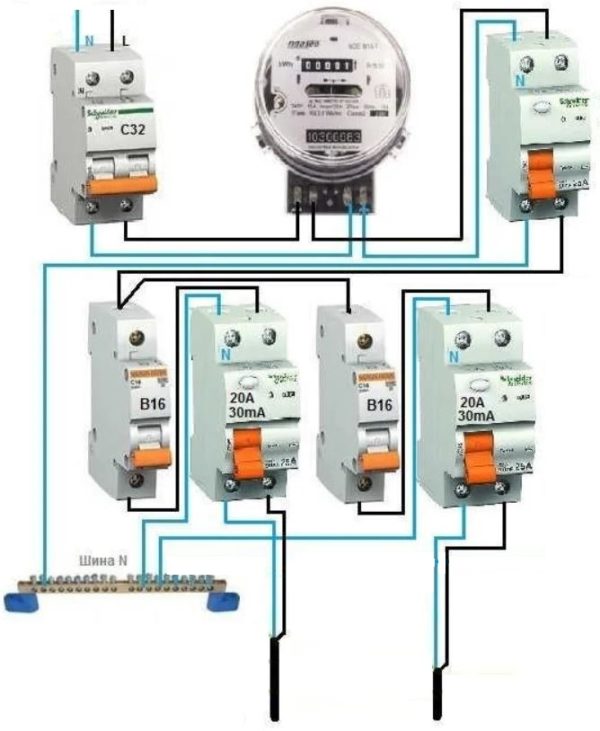
But, if we have an apartment or a private house, where there are 20-30 cable lines, then the shield according to the first connection scheme will be huge, and its cost will come out like a budget foreign car)). Therefore, manufacturers are allowed to install one RCD per group of machines. Those. one RCD for several machines
But here it is important to observe the following rule, the sum of the rated currents of the machines should not exceed the rated current of the RCD. If we have an RCD for three machines, for example, a machine 6 A (lighting) + 16 A (sockets in the room) + 16 A (air conditioning) = 38 A
In this case, we can choose an RCD for 40 A. But you should not “hang” more than 5 machines on the RCD, because.any line has natural leakage currents (cable connections, contact resistances of circuit breakers, sockets, etc.) as a result, you will get the amount of leakages that exceeds the tripping current of the RCD, and it will periodically work for you for no apparent reason. Or if you install an automaton with a lower rated current in front of the RCD, then you can “hook” automata to the RCD without thinking about their rated currents, but, of course, remember that more than 5 automata should not be connected to the RCD, because. the sum of natural leakage currents in cables and devices will be high and close to the RCD setting. Which will lead to false positives. It can be seen from this diagram that the sum of the rated currents of the outgoing automata is 16 + 16 + 16 \u003d 48 A, and the RCD is 40A, but in front of the RCD we have a 25A machine and in this case the RCD is protected from overcurrents. This scheme is borrowed from an article where I changed machines and RCDs in an apartment panel.
Scheme connection of a three-phase electric motor
Actually, there is nothing complicated about this, for the correct operation of a three-phase RCD, we connect the neutral conductor to the zero terminal of the RCD from the supply side, and from the motor side it remains empty.
The RCD should be checked at least once a month. This is done quite simply, just press the “TEST” button, which is on any RCD.


The RCD must turn off, this should be done with the load removed, when TVs, computers, a washing machine, etc. are turned off, so as not to once again “pull” sensitive equipment.
I like ABB RCDs, which, like the ABB S200 series circuit breakers, have an indication of the on (red) or off (green) position.
Also, like the ABB S200 circuit breakers, there are two contacts on each pole at the top and bottom.
Thank you for your attention
if (w.opera == "") {
d.addEventListener("DOMContentLoaded", f, false);
} else { f(); }
})(window, document, "_top100q");
How does the protection device work?
The connection of the protective module to the main electrical system is always carried out after the introductory circuit breaker and the electricity meter. RCD with one phase, designed for a network with a standard indicator of 220 V, has in its design 2 working terminals for zero and phase. Three-phase units are equipped with 4 terminals for 3 phases and a common zero.
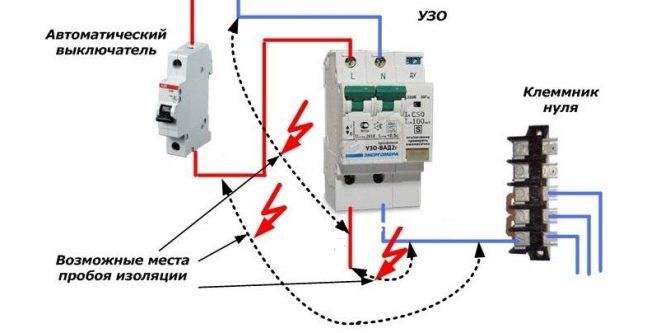
Being in the activated mode, the RCD compares the parameters of the incoming and outgoing currents, and calculates how many amperes go to all the electrical consumers in the room. When working correctly, these indicators do not differ from each other.
Sometimes an RCD can trip for no apparent reason. Usually this situation is provoked by sticky buttons and imbalance of the device caused by too intense operating load or condensation.
The difference in performance between the input and output currents clearly indicates that there is an electrical leak in the house. Sometimes it occurs due to human contact with a bare wire.
The RCD detects this situation and immediately de-energizes the controlled section of the network in order to protect the user from a potentially possible electric shock, burns and other household injuries associated with electricity.
The lowest threshold at which it works residual current device, is 30 mA. This indicator is called the level of non-letting go, at which a person feels a sharp current shock, but can still let go of an object that is energized.
With an alternating voltage of 220 V with a frequency of 50 Hz, a current of 30 milliamps is already felt very strongly and causes convulsive contraction of the working muscles. At such a moment, the user cannot physically unclench his fingers and throw aside a part or wire that is under high voltage.
All this leads to dangerous situations that threaten not only health, but also life. Only a well-chosen and correctly installed RCD can prevent these troubles.
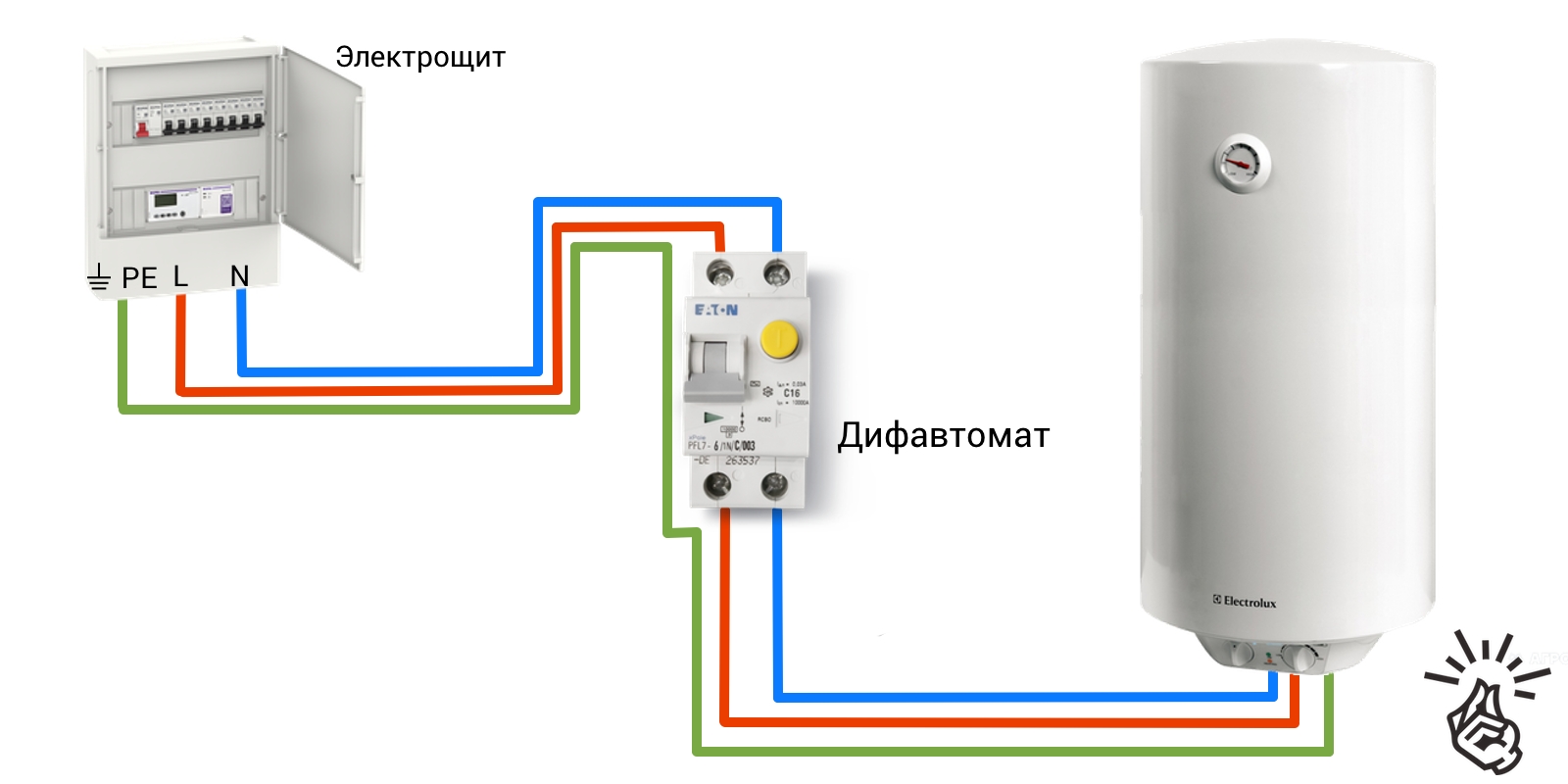
Why does a water heater need an RCD?
An electric boiler combines water and electric current, and with the slightest malfunction in a water heating element, this is a direct path to fire and electrical injury
The safety of the water heater supply must be given special attention.
With proper operation, this electrical appliance fully fulfills its service life, but if errors are made during its installation, problems may arise that lead to repair.
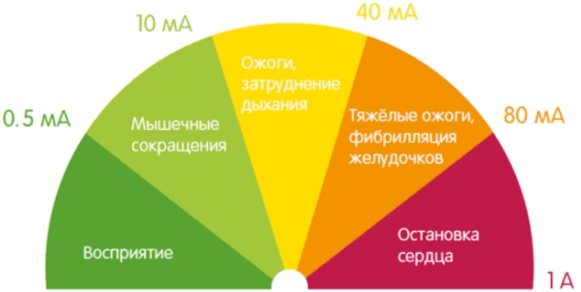
A person is affected not by electrical voltage, but by current - and the higher it is in amperes, the more harm is done to the human body that is in contact with a broken water heater (+)
The main purpose of the RCD is to break the power supply circuit of the electrical installation (its protective shutdown from the network) in the event of a leakage current. On the one hand, this safety switch prevents electric shock to a person, and on the other hand, it prevents overheating of the wire strands.





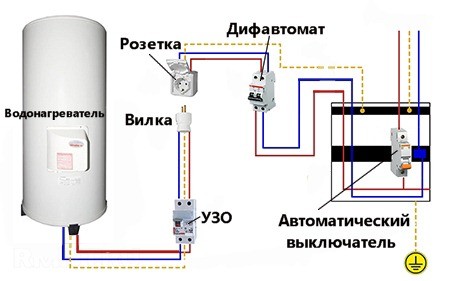
If the heating element or the cable suitable for it is suddenly damaged, then the condensate outside and the water inside the boiler turn into a natural conductive element, and when it comes into contact with them or the body of the water heater, a person has a leakage current.
As a result - unpleasant sensations, cardiac arrhythmia and possible death. It all depends on the strength of the acting electric current in amperes.
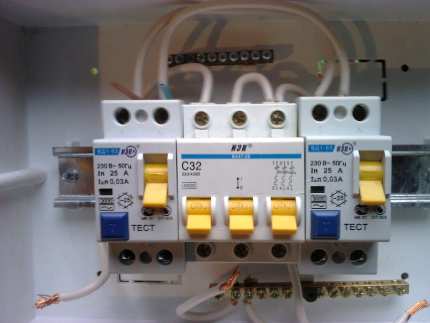
The RCD breaks the circuit in the event of a break in the neutral protective wire, a decrease in the level of insulation and a low value of the fault current - and, unlike other circuit breakers, the operation occurs much faster (within a few milliseconds)
When a powerful leakage current appears in the circuit, the wires begin to operate in extreme modes. But the cross section of the veins is simply not designed for such loads. As a result, the wire starts to get very hot, burning through the insulation. And this inevitably leads to an increased risk of fire in the house.
Thus, without an RCD, it is not recommended to connect a water heater to the mains.
The most common RCD triggering situations are:
- damage to the wire and short circuit of the bare core to the boiler body;
- damage to the insulation layer in the tubular electric heating element;
- incorrect selection of parameters of the protective device;
- incorrect connection of the water heater to the power supply;
- malfunction of the leakage current protection device itself.
In all these cases, in the absence of an RCD, a person's contact with the body of the water heater or the water heated in it is fraught with serious injury.
Mounting Features
For powerful electrical appliances, for example, boilers from 3.5 kW, an individual line with its own protective automation is highly recommended. A more reliable option is considered not to be turned on through a socket, but to be connected directly to the shield, of course, through a protective connection. It is advisable to choose automation that opens both phase and zero (two-pole).
The instructions above are advisory in nature.Any equipment can be connected on a line with other consumers, but it is necessary to calculate the wiring for their total power. It is also more difficult to choose automation, there is a greater risk that there will be false alarms. There are no particularly critical remarks for connecting through a socket, if it is matched to the parameters of consumers (the product must be rated for 16 or more Amperes).
If there is one common RCD + AV, then it is more difficult to determine where the problem is, where the breakdown occurred, the leak. The entire network will be de-energized, so they usually put not general automation, but on several lines (separately for lighting, for a powerful device, and so on).
When it knocks out
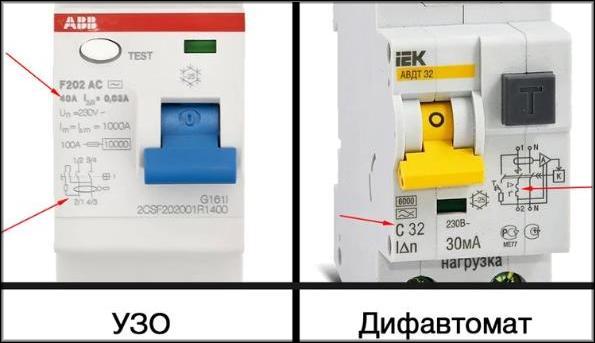
The connected device has one task - to de-energize the line when the current enters the electrical appliance (its design, housing). This device captures vibrations that are not available to the circuit breaker, so the latter is paired with it, thus providing complete protection - from surges, excesses (AB) and from leaks (RCD). In RCBOs, all these functions are in one package.
Reasons when the above bundle snaps off, de-energizing the network:
- leakage, short circuit, at overcurrents. Often this occurs when the insulation is damaged (old wiring), during breakdowns of heating elements, malfunctions of the electrical circuits inside the device;
- false alarm - too sensitive device is selected, the shutdown limit is too low;
- there was a short circuit on the "ground" or "zero" in the outlet, when they were combined;
- in conditions provoking dangerous factors: in humidity, during a thunderstorm with lightning;
- incorrect selection and installation.
Health check
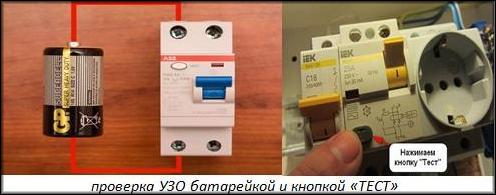
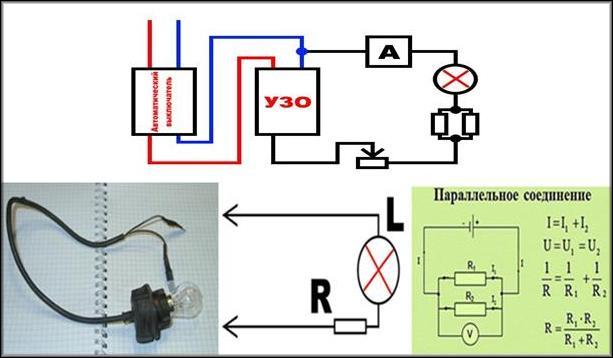
Process as connect RCD correctly involves verification. The methods of the procedure are a separate topic, especially for the control lamp, so we list them briefly:
- button "test" ("T") on the body of the product. When pressed, trigger conditions are simulated: on the phase, the current exceeds the value on the neutral. The disadvantages of the method are incomplete data, since there may be circumstances when the device is serviceable, for example, with improper installation, breakage of the “T” toggle switch (marriage);
- this method is only suitable for electromechanical models. It is convenient to apply on the spot when buying. The bottom line: the load goes to only one coil, a difference in magnitude appears. The device is disconnected, wires from a battery or a low-power power supply unit (charging for a smartphone) are connected to the terminals on one side, but the source current must be equal to the setting of the device or exceed it. Observe the polarity, if there is no operation, change it, but if after that there is no reaction, the product is faulty or of an electronic type.
- the third method - a control lamp creates a real leak. Assembly: wires are attached to the cartridge to touch the terminals. The power of the light bulb is selected: 10 W is suitable for a protection setting of 30 mA. 45mA will be drawn (I=P/U=>10/220=0.045). If 100 mA, then 25 watts will do. Exceeding the set power for checking the operating condition is not important. But when taking into account the decalibration, it must be taken into account exactly. Take a light bulb with an exact match, under mA. If there is none, then to obtain and modulate the required power, the assembly includes resistance - resistors.
How does RCD work and why is it necessary?
First, you need to understand the difference between RCDs and circuit breakers.
The machine is the main protection of the supply network. In the event of overcurrent at the time of overload or short circuit, the switching device will react to the excess current and turn off, cutting off the emergency section and saving the entire network from damage.
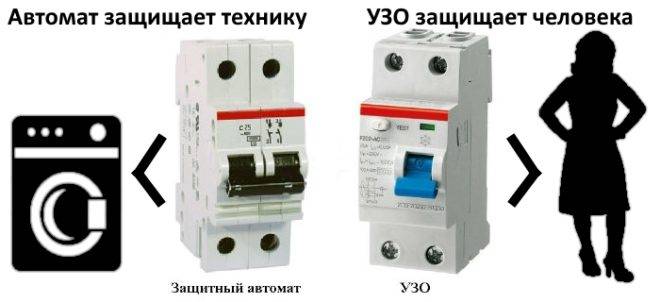
The main function of the RCD is to protect not the network, but the person, and this device reacts to small values of leakage currents. How does this happen?
Our homes now have a huge number of different household appliances, and some appliances have quite a lot of power. Electrical wiring does not have an eternal life, the longer it is in operation, the greater the likelihood of insulation failure. Damage to the insulating layer entails connecting the wiring to the ground, as a result, the current path changes, now it flows to the ground. And in some cases, a person can become a conductor for current leakage.



More clearly about the principle of operation of the device in the video:
Modern washing machines and water heaters are considered appliances with a higher energy class. They take the maximum power during the period when the heating element is working and the water is heated (about 3-3.5 kW). For electrical wiring, this is a very large load, which can cause premature aging of the insulation.
Let's suppose that a breakdown of the insulating layer occurred in the washing machine, as a result of which the body was energized. By touching the machine, a person may be exposed to electricity.
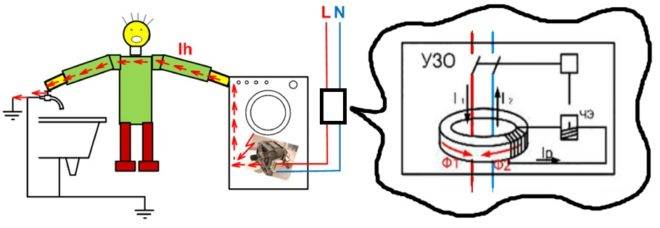
To protect yourself from such a situation, you need to install an RCD for the washing machine.
If there is a current leakage to earth, the device will turn off and stop supplying voltage.
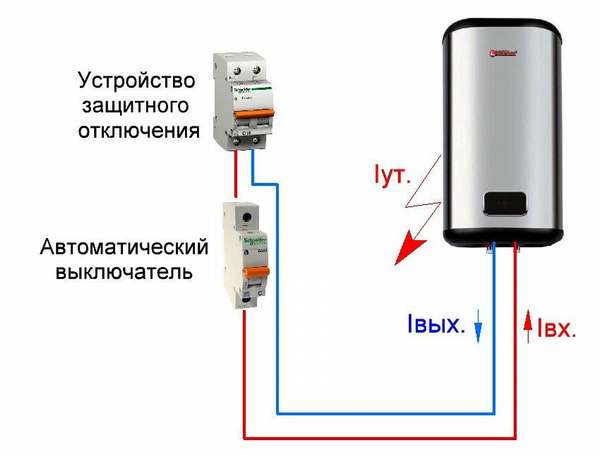
With the consumer, the RCD is connected in series to one circuit, and the principle of its operation is based on measuring the difference between the input and output current values. Ideally, it should be equal to zero, that is, what amount of current has entered, this has come out.As soon as a leak occurs, the output will already have a different reading, which is exactly less than the value of the current that has gone along the other path. The measured difference will change accordingly. As soon as the current leakage reaches the value for which the device is designed, it will immediately react and turn off.
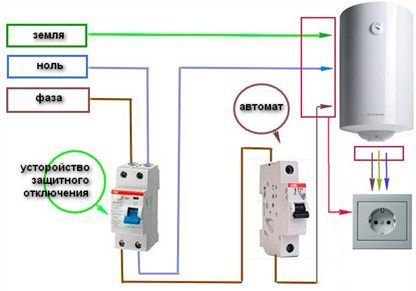
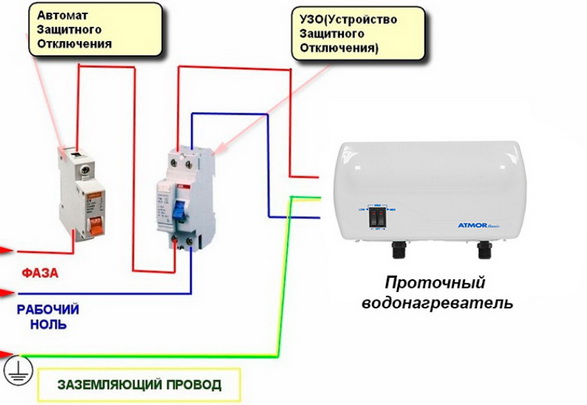
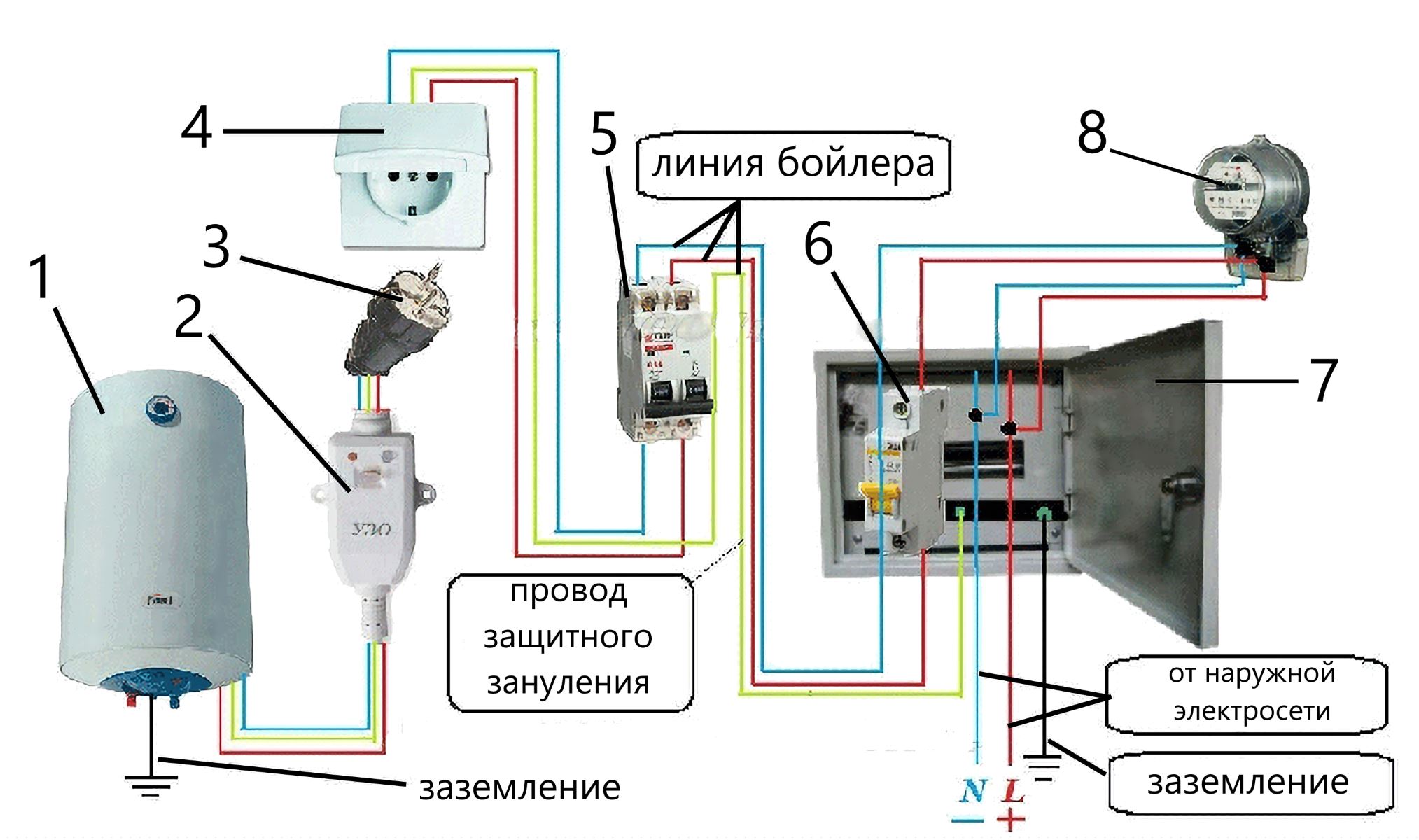
There are no particular difficulties in connecting the device. In the circuit, first there is a circuit breaker, after it an RCD, from the output contacts of which the wires go to the consumer, that is, the power outlet to the washing machine or boiler.
Types and sizes of electrical panels
We will talk about cabinets / drawers for the installation of machines and other electrical stuffing, about their varieties. According to the type of installation, electrical panels are for outdoor installation and for indoor. The box for outdoor installation is attached to the wall with dowels. If the walls are combustible, an insulating material that does not conduct current is laid under it. When mounted, the external electrical panel protrudes about 12-18 cm above the wall surface. This must be taken into account when choosing a place for its installation: for ease of maintenance, the shield is mounted so that all its parts are approximately at eye level. This is convenient when working, but can cause injury (sharp corners) if the place for the cabinet is chosen poorly. The best option is behind the door or closer to the corner: so that there is no possibility of hitting your head.
Electrical panel housing for outdoor installation
A flush-mounted shield implies a niche: it is installed and walled up. The door is on the same level with the wall surface, it can - protrude by several millimeters - depends on the installation and design of a particular cabinet.
Cases are metal, painted with powder paint, there are plastic ones.Doors - solid or with transparent plastic inserts. Various sizes - elongated up, wide, square. In principle, for any niche or conditions, you can find a suitable option.
One piece of advice: if possible, choose a larger cabinet: it is easier to work in it, this is especially important if you are assembling an electrical panel with your own hands for the first time
Complete set and installation of a hinged switchboard
When choosing a building, they often operate with such a concept as the number of seats. This refers to how many single-pole circuit breakers (12 mm thick) can be installed in a given housing. You have a diagram, it shows all the devices. Count them taking into account the fact that bipolar ones have a double width, add about 20%! n (MISSING) and network development (suddenly buy some other device, but there will be nowhere to connect, or during installation decide to make two from one group, etc. .P.). And for such a number of "seats" look for a shield that is suitable in geometry.
3
Tools when connecting - what we need
Installing circuit breakers is a rather complicated process, but with due attention, anyone can perform all the operations. Having opened the switchboard, you can see that the electrical equipment is attached to a special DIN rail using a special latch. The width of the specified rail is 35 mm.


The process of installing circuit breakers can be difficult
The following is a list of the main tools that will be required when installing meters:
Indicator screwdriverStripper - a special tool used when removing insulationCable cutter or ordinary wire cuttersPliers of various sizesA set of Phillips and slotted screwdriversCrimper - a device for crimping lugs in case of working with stranded wires.
Why does the residual current device trip?
How to check the RCD and why does the RCD work on the water heater?
Let's try to figure this out:
- Firstly, the cause may be a violation of the integrity of the insulating layer of the heating element. This happens while the water heater is running. Current, water and elevated temperature begin to damage the insulation of the heating element, and the liquid begins to come into contact with parts that conduct current. To check the heating element, it is worth getting it out of the boiler tank, cleaning it from scale, and also doing an inspection. If there are cracks on the surface, then the insulation layer is no longer suitable and it is worth replacing the heater.
- Secondly, the reason may be the following - the leakage of electric current. This can happen due, for example, to the fact that the boiler is connected to old electrical wiring, and the insulation has lost its appearance over time due to the wires being exposed, and a short circuit occurs.
- Thirdly, the protective device may not be selected in accordance with the voltage and power standards. Therefore, the RCD will not overpower such a load and may work from time to time.
- Fourthly, the device itself may be faulty. For example, the descent mechanism could become unusable and even with small fluctuations it can turn off.
You can read about the types and device of a heating element for a water heater here.
It is possible and even necessary to check the RCD on the water heater. Once a month will be enough. To start the test mode, you just need to press the "test" button on the device itself. The machine will create an electrical leakage situation and should automatically turn off.
What happens if you find a system failure? How to repair a cord for a water heater with an RCD? The residual current device is a complex device, electronic, only an electronic engineer can repair it with the help of the necessary spare parts. And most often the device is not repaired, but simply changed.
And in conclusion…
The issue of electrical safety has always been and will be the main one in dealing with electrical engineering, so pay special attention to both the installation of protection circuits and the presence of other important things - the presence of the necessary grounding, potential equalization circuit, reliable electrical wiring. It should also be remembered that the installation of an electrical outlet directly in the bathroom is strictly prohibited.
| The use of RCDs by leakage current ratings | Protection against electric shock and fire | Universal, protection against electric shock and fire | Fire protection only | Fire protection only | |
| The use of RCDs for operating current ratings | RCD 30mA | RCD 100mA | RCD 300mA | ||
| Total load power up to 2.2 kW | RCD 10A | ||||
| Total load power up to 3.5 kW | RCD 16A | ||||
| Total load power up to 5.5 kW | RCD 25A | ||||
| Total load power up to 7kW | RCD 32A | ||||
| Total load power up to 8.8 kW | RCD 40A | ||||
| RCD 80A | RCD 80A 100mA | ||||
| RCD 100A |
RCD selection example
As an example of use RCD selection tables, you can try to choose a protective RCD for washing machine.Electrical power for household washing machine usually carried out in a single-phase circuit, using two-wire or three-wire wiring. Based on the single-phase power supply, it is not necessary to use a three-phase RCD and choose four-pole RCDs and a single-phase one is quite enough, bipolar RCD, and therefore we consider only selection table bipolar modular RCDs. Because washing machine is a rather complex household device that uses both water and electricity at the same time, and often it is installed in a room that is dangerous from the point of view of electric shock, then the main purpose of using an RCD is to protect a person from electric shock. In other words, in terms of electrical safety, the main function of the RCDselected for the washing machine is protection against electric shock. For this reason, it can be used as RCD 10mAwhich is preferred or universal RCD 30mA, which also protects against electric shock, but allows a higher leakage current, which, however, leads to a stronger electric shock than when choosing a 10mA RCD. The choice of an RCD with a leakage current of 100mA and 300mA will not provide protection against electric shock, and therefore, RCDs with such ratings are not considered for connecting a washing machine.Washing machine power can be determined by looking at its technical data sheet, for example, suppose that its power is 4 kW, which corresponds to the power of a sufficiently large number of washing machines.Next, we look at which of the selected RCDs can withstand more than 4 kW of power and see that it is 5.5 kW (since the previous one, with a power of 3.5 kW, is not powerful enough, and the next one, at 7 kW, is suitable, but has an unreasonably large margin current) Thus RCD required to protect the washing machine, must be at the intersection of the columns with leakage current 10mA and 30mA with lines that indicate power greater than 5.5 kW. Considering that a 10mA RCD provides the best protection against electric shock, we leave for consideration only the column corresponding to a leakage current of 10 mA. RCDs from RCD 25A 10mA to RCD 100A 10mA. Based on the economic feasibility of using an RCD (the higher the operating current of the RCD, the more expensive it is), the best choice would be RCD 25A 10mA. More detailed information about the selected RCD can be viewed by clicking on the link corresponding to the selected RCD rating in the table, where you can check the correct choice of RCD, connection diagrams and other technical details and details necessary when connecting the selected RCD. Based on the methodology described in the RCD selection example described above, you can select an RCD for any other, not too complex application, such as protecting wiring in an apartment. To do this, it is necessary to initially calculate the RCD, namely its parameters suitable for the protected wiring and further, following the RCD selection method and using RCD selection table, select the desired RCD with the required ratings for power and leakage current.
Purpose of RCD and difavtomatov
To understand why RCDs or difavtomatov need to be used to protect bathroom circuits, you need to know their principle of operation and the tasks they are designed to perform.

An RCD or difavtomat, unlike a circuit breaker, operates on a leakage current that occurs when the external insulation of a conductor is broken or when conduction occurs in materials that are dielectrics in their properties.
How can a dielectric conduct electricity? This happens if, for example, the surface of the material is wet or the material of the porous structure is saturated with moisture. And these states are just characteristic of objects in the bathroom.
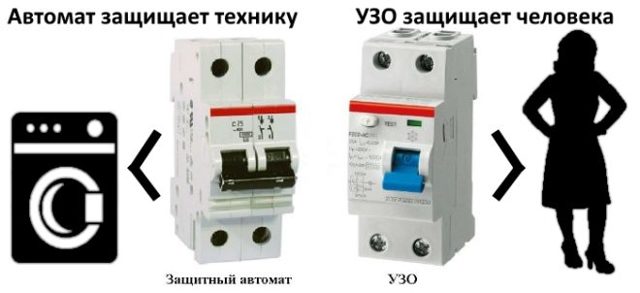

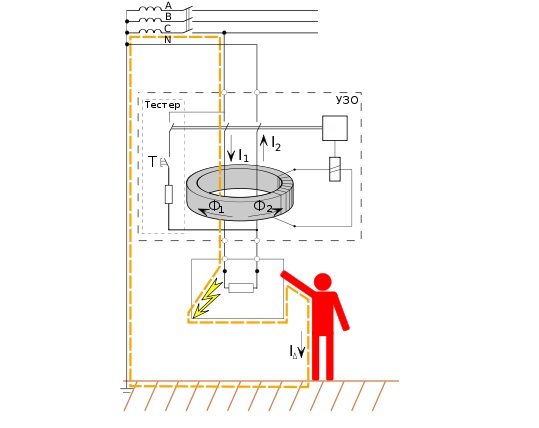
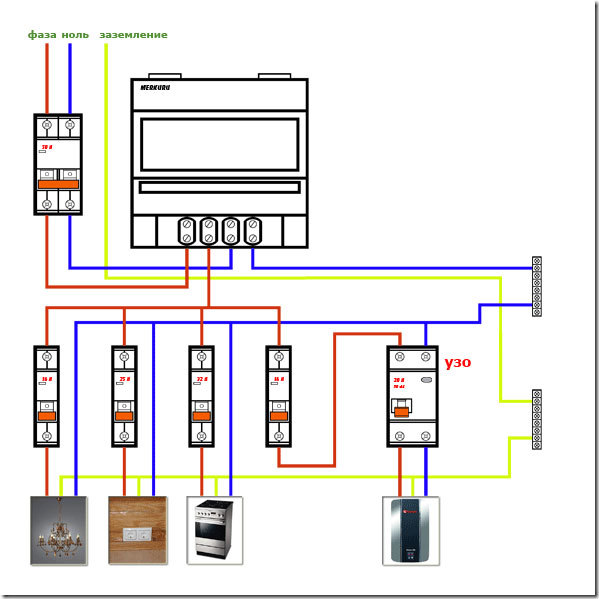


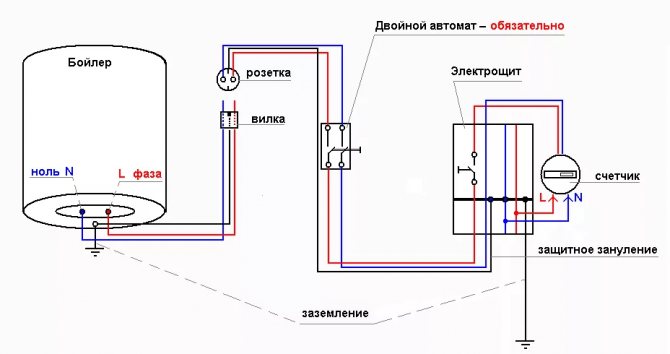


Circuit breakers will only operate when there is a short between phase and zero, that is, when, for example, water has entered an electrical appliance or socket and shorted both conductors. However, for the human body, the case when there is a potential difference between the phase and the "ground" is much more dangerous.
This can happen when a phase contact breaks down on the device case, which may be due to the penetration of water into the case. Until a person touches the body, no voltage will arise. Both the machine and the RCD will remain on.

But when touched, voltage will occur, and the likelihood of this occurring is increased due to the fact that the floor or walls in the bathroom can also be moistened, which increases their conductivity.
In this case, the machine, unlike the RCD, will remain on, because the current passing through the body is unlikely to exceed the nominal one at which the machine turns off.