
- Where should air vents be installed?
- Design
- Faucet installation
- Balancing Valve Manufacturers
- The need to use the Mayevsky crane in heating systems
- Model range and manufacturers of Mayevsky cranes: prices
- Site selection and installation procedure
- Criterias of choice
- Varieties of Mayevsky cranes
- What parameters should be considered when choosing
- Features of operation and installation
- Varieties and mechanism of action
- Manual faucet
- Auto
- With safety device
- Crane operation and installation
- Features of inclusion in the heating system
Where should air vents be installed?
When installing a heating system, installing air vents is a mandatory procedure; to determine the right amount, you need to know where to put these devices. Air vents are recommended to be located in the following places:
The highest points of the system. If during installation the pipeline rises up, bypassing any obstacle, and then goes down to the heat exchangers, an automatic air vent for the heating system should be installed from above. This will prevent air build-up because light air always rises and collects in the piping on the top floor.
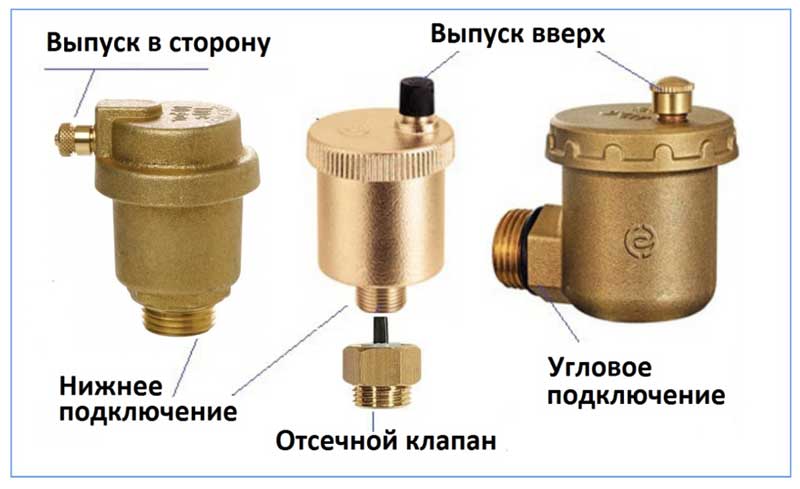
Rice. 9 Types of automatic air vents
- Heating radiators.Radiator heat exchangers have a complex shape, which includes a large number of sections - this creates convenient cavities for air accumulation. Therefore, Mayevsky outlet valves are always used in radiators; in an individual heating circuit, they are installed on each radiator, regardless of the connection scheme (single-pipe, two-pipe, lower, side, diagonal). Radiator manual models of exhaust valves, unlike automatic ones, are small in size, less expensive, fit aesthetically into the radiator circuit, therefore they are installed on batteries in the vast majority of cases by the manufacturer and, if necessary, by the owners of houses.
- Towel dryers. Towel warmers produced by the industry of a complex “ladder” shape popular in everyday life are always equipped with an air vent with a straight pipe located in its upper part. It is more convenient if the heated towel rail is equipped with an automatic air vent for the following reasons: the screw of the manual model located at the top is inconvenient to tighten, water may periodically be absent in residential buildings and manual adjustment becomes troublesome, besides, the channel protruding from the side spoils the aesthetic appearance of the heater.
- U-shaped branches and bypasses. Any section of the pipeline with an upward loop collects air, if a shut-off valve is used to turn off the loop, it is installed at the highest point using a model with a built-in Mayevsky automatic valve (naturally, the air vent at the top can also be installed separately from the valve).
- Boiler piping system.It is also recommended to equip the boiler piping with a valve to ensure the safe operation of the heating equipment in case of air in the line.
- Hydroguns. Not so often in domestic heating systems, hydraulic arrows are used, to which circulation pumps, radiator and underfloor heating collectors are connected - if the device is located vertically, an automatic air bleeder is screwed into its upper part.
- Collectors. When installing multi-circuit underfloor heating, collectors with combs are used, to which a pipeline of various circuits is connected. The collectors are located above the level of the water floors and are always equipped with automatic air vents that are installed in their housing by the manufacturer; the system includes two devices for the supply and return lines.
Rice. 10 Manual and automatic air vents in the heating system - layout diagram
Design
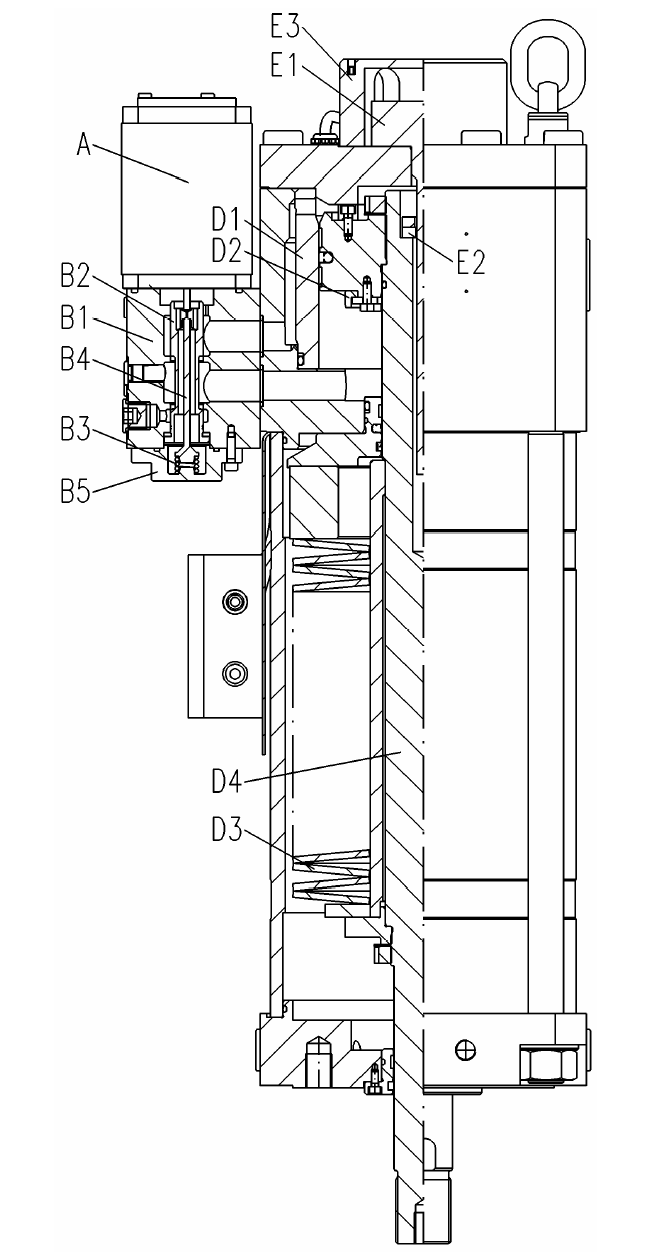
HP control valve drive
The servomotor consists of the following functional parts:
Voith control magnet VRM (A)
With integrated position and magnetic force adjustment
Control hydraulic valve, consisting of the following components:
Valve body (B1)
Control piston (B2)
Control spring (B3)
Rod (B4)
Cover (B5)
Drive unit consisting of the following components:
Power cylinder (D1)
Damper (D2)
Compression spring (D3)
Piston rod(D4)
Electronic position determination, consisting of the following components:
Position sensor (E1)
Sensor magnet (E2)
Cover (E3)
(Visited 1 217 times, 1 visits today)
Faucet installation
Documents of the Federal Service for Ecological, Technological and Nuclear Supervision.Documents on safety, supervisory and licensing activities in the field of supervision of lifting structures. The Collection includes the Rules for the Design and Safe Operation of Hoisting Cranes, approved by the Decree of the Gosgortekhnadzor of Russia No. Running Wheels. Load gripping bodies. Drums and blocks. Safety instruments and devices. Control devices.



Installation of a URAL trailer brake control valve - a list of parts and an M16x elbow of an air cylinder (JSC AZ URAL).
Crane manipulator, I load myself; I drive; "Teschina" hand - order, rent. General instructions for the production of works by cranes manipulators KAMAZ. Part 1. Cranes-manipulators can be allowed to move only those loads, the mass of which does not exceed their carrying capacity, taking into account the position of the outriggers. When operating a crane-manipulator, the requirements set forth in its passport and operating manual must not be violated.
Balancing Valve Manufacturers
Models of foreign and domestic manufacturers are widely represented on the construction market, some companies are leading suppliers of energy-saving equipment.
Danfoss is a Danish company founded in Nordborg in 1933 and is one of the world's leading manufacturers and suppliers of energy saving systems. The concern produces refrigeration equipment, power electronics, heat pumps, thermal and industrial automation, cable heating systems (warm floors). The product line is represented by shut-off, automatic and manual balance valves of the ASV and MSV series, combined models AB-QM, AB-PM.
Broen is a Danish company founded in 1948 by the Swedish engineer Paul Broen and entered the Russian market in 1996.The company's plant has been operating in the Kolomensky district since 2010. The concern is engaged in the production of a wide range of pipeline fittings, which include: ball valves, shut-off valves, check and balancing gates (Broen Ballorex), safety valves, cast iron filters. The line of fittings for balancing is represented by the Broen series: Venturi Fodrv, DRV, Dynamic, Venturi DRV.
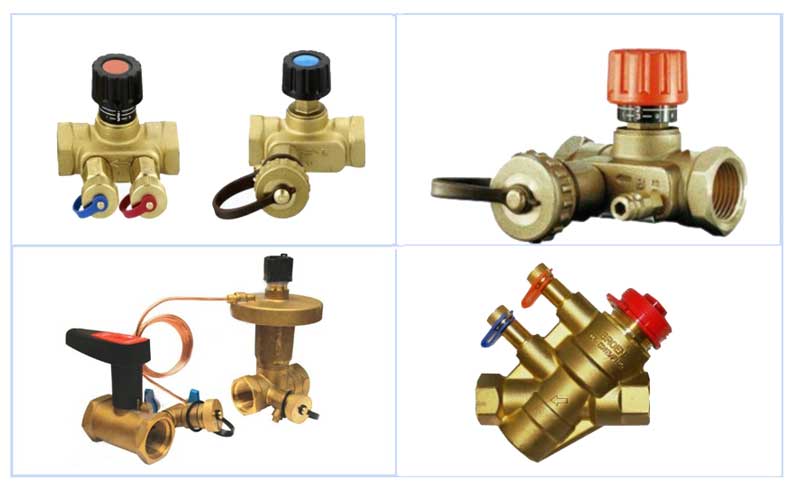
Rice. 13 Balancing fittings from Danfoss and Broen
Giacomini is an Italian supplier of pipe fittings. The concern was founded in 1951, has a turnover of 170 million euros per year, 3 factories in Italy and 18 branches around the world, employing about 1000 employees. The concern produces control and shut-off valves for radiators, thermostats, collectors for heating and water supply, pipes and fittings for energy metering equipment, solar panels. Balance valves are represented by modifications R206 A, R206 B.
ADL is a Russian manufacturer of engineering equipment for the housing and communal sector and various industries. The company was founded in 1994, and since 2002 it has had its first plant in the village of Raduzhny, Kolomna district, Moscow region.
The company produces a wide range of plumbing equipment: control valves, pumping units, gate valves, valves and ball valves, circulation and steam condenser pumps, heating points, separators. The line of balancing valve devices is called Granbalance and consists of models of the DN series.
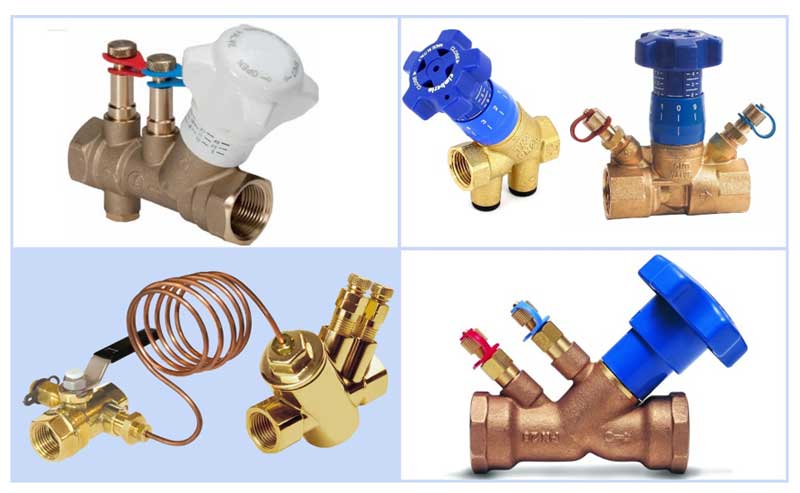
Fig.14 Giacomini automatic balancing valve and ADL
The balancing valve for the heating system is the most important device for maintaining a constant temperature in risers or heating radiators.Their use in everyday life is not entirely justified. The cost of one device from a well-known manufacturer reaches 100 USD, domestic devices are also not cheap. It is more rational to use devices to maintain the temperature in the risers of apartment buildings with a large number of radiators.
Any heating system must be properly configured. The main goal of this setting is to ensure the same performance in all parts of the network. For example, if this is the heating system of a multi-storey building, then the heat should be both on the top and bottom floors. These indicators should not only be equivalent, but also close to the normative ones. One of the most effective ways to adjust is to use a balancing valve, the installation of which should ideally be thought out at the stage of creating a heating system project.
The need to use the Mayevsky crane in heating systems
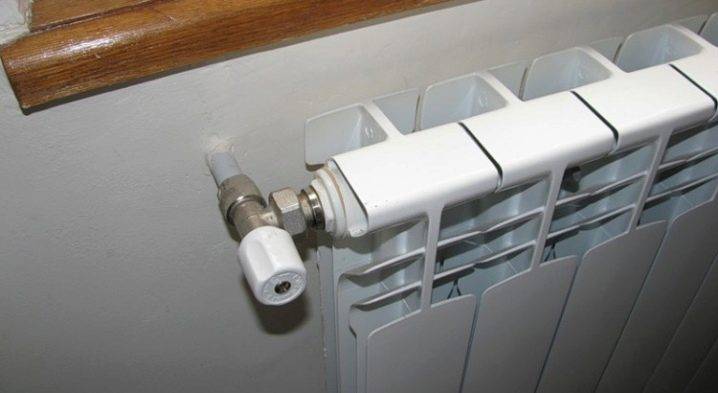
After installing the heating system and filling the circuit with coolant (water, antifreeze, technical oils), air always remains in the radiators. It forms the so-called air plugs and stops the circulation of the working fluid. This leads to a loss of efficiency of the heating system, since the boiler operates at a given temperature, and the radiators are “cold”. In this situation, one cannot do without the use of the Mayevsky crane.
After the end of the heating season, degassing occurs in the coolant medium.A certain amount of dissolved air in the coolant, when the temperature drops and is at rest, is released from the liquid and accumulates, forming the same "air locks". Therefore, before starting the heating, it is required to add coolant to the system and, if possible, use the Mayevsky crane.

Metal key for Mayevsky valve
Another negative factor in the formation of gas accumulations in the heating system is the process of hydrogen formation during the hydrolysis reactions of water and the inner walls of metal pipelines and radiators. This is especially true for radiators made of aluminum without protective anti-corrosion treatment. With the use of the Mayevsky crane in the system, this problem is completely solved.
Model range and manufacturers of Mayevsky cranes: prices
Currently, a large number of models of Mayevsky cranes, both domestic and imported, using various materials and components, are presented on the market for sanitary products. When buying one or another type, it is also possible and necessary to buy a metal key for the Mayevsky crane. On sale there are keys and in plastic execution.
The table provides information on the types and prices of Mayevsky cranes:
| product name | Trademark | Material | price, rub. |
| Crane Mayevsky Du 10, 15, 20 mm | LLC "Promart", Kazan | chrome steel | 21-51 |
| Crane Mayevsky Ru 16 mm and DN 10, 15, 20 mm | MetPromInteks LLC, Moscow | chrome steel | 63,8 |
| The key to the Mayevsky crane 5 mm, Meibes SX 11202 | COMFORT.RU LLC, Moscow | silumin | 18 |
| Wrench for radiator plugs and Mayevsky crane | MantekhBryansk LLC, Bryansk | polymer plastic | 118 |
| Mayevsky crane manual, DN 15 mm | OK Resan LLC, Perm | chrome steel | 152 |
| Crane Mayevsky Demin Dokum Classik Art, DN 15-20 mm | LLC "Laboratory of heat", Rostov-on-Don | brass | 138 |
| Automatic radiator air vent | PP "Termoklimat", Yaroslavl | stainless steel | 259 |
| Mayevsky crane (automatic) | "TECHNO-GROUP", Kirov | stainless steel | 230 |
| Ball valve with Mayevsky valve Du 15 mm (1/2?) | TECOM LLC, Krasnoyarsk | chrome plated brass | 243 |
| Tee with Mayevsky crane | Siberia GOST LLC, Omsk | chrome steel | 596 |
| Three-way valve with Mayevsky valve (G1/2 - G1/2) | AQUA-KIP LLC, Moscow | chrome steel | 245 |
| Mayevsky's crane with the filter of Du of 15 mm | Promarmatura LLC, Barnaul | chrome plated brass | 474 |
| Mayevsky crane automatic RR 374 full bore, for cast iron radiators | OOO "SantekhKlass", Moscow | chrome steel | 700 |
Site selection and installation procedure
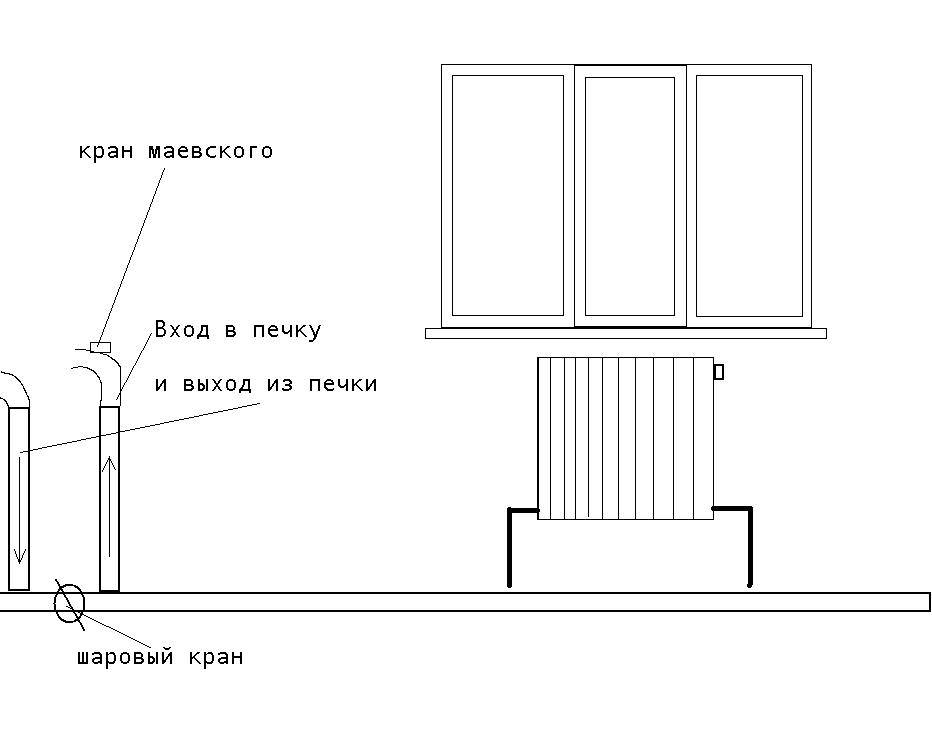
To install a Mayevsky air vent, simply screw a suitable model into the radiator cap on the supply side. Since the thread sizes on the device are standard, you need to select a device with the appropriate thread. If a plug without a thread is installed on the radiator, it should be replaced.

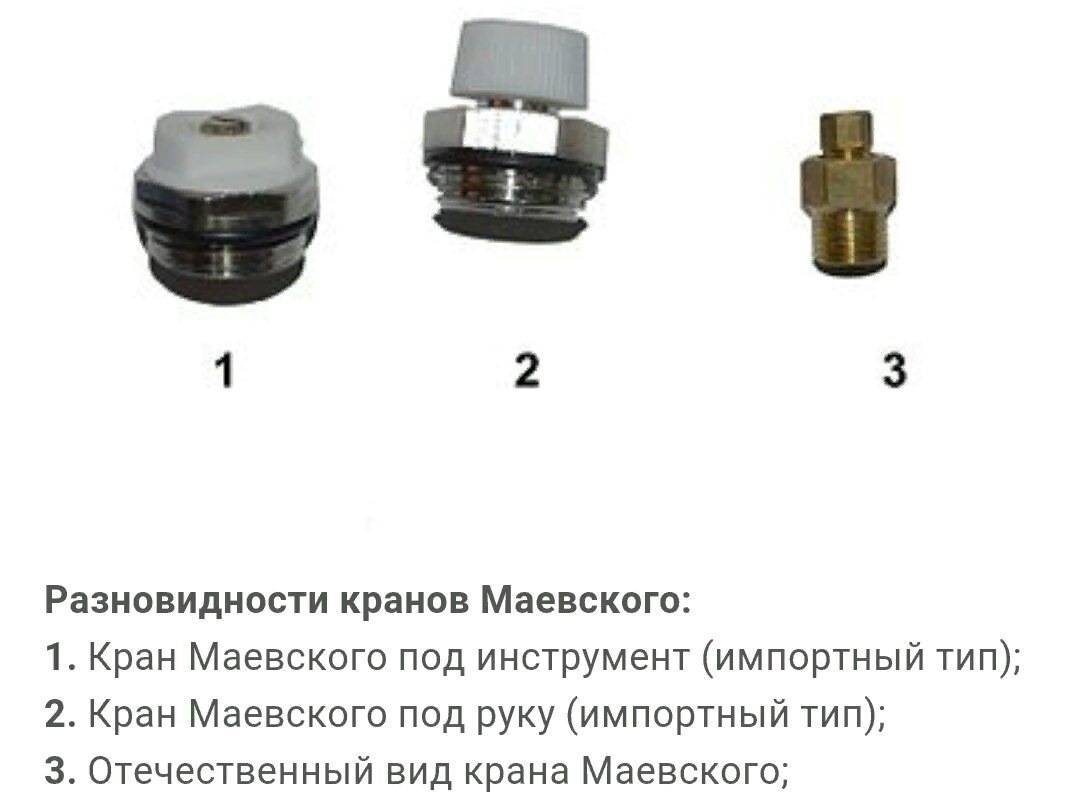

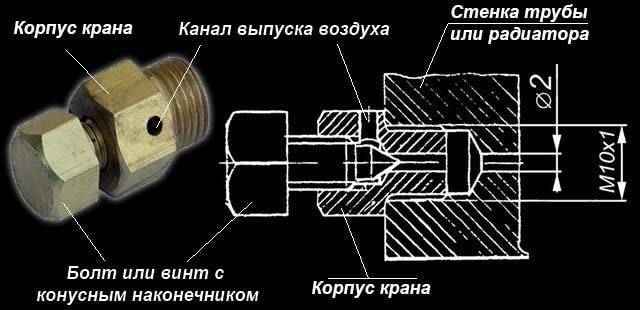


On a cast-iron plug, it is not difficult to make the necessary hole yourself. A hole should be drilled from the inside, and then threaded from the outside. You will need an electric drill, a 9 mm drill, as well as a tap with a 10x1 wrench.
The faucet has a right-hand thread, and the plug has a left-hand thread. During installation, hold the plug with an adjustable wrench so that its thread does not loosen. It should be remembered that when screwing in the air vent valve, the plug is loosened. When the faucet is unscrewed (for example, for replacement), the plug is screwed in harder.
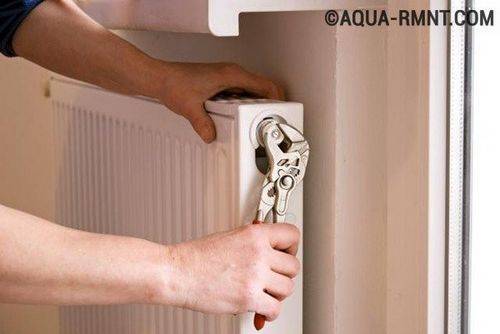
When installing the Mayevsky crane, use an adjustable or gas wrench to tighten the device or hold the plug into which the crane is mounted
When mounting the device, the thread should be reinforced with a special gasket. Such a gasket can be made of rubber or silicone, but it is not recommended to use paronite gaskets with a Mayevsky crane. Some prefer to additionally use linen winding or fum tape to strengthen the thread, but this is not necessary. Tip - when installing, you need to point the outlet slightly down. So it will be more convenient to collect water that will flow out of the radiator after bleeding is completed.
To install Mayevsky cranes, the highest point of the system is chosen, since the air rises. In this case, of course, it is necessary to take into account the features of the heating system of a particular house or apartment.
With a vertical heating scheme, air vents should be installed on all radiators of the upper floor, which have a lower supply with a return line. Also, all devices should be provided with Mayevsky cranes, the supply of which (or part of it) to the riser is located below the upper axis of the connection, since in this case the removal of air from the system will naturally be difficult.
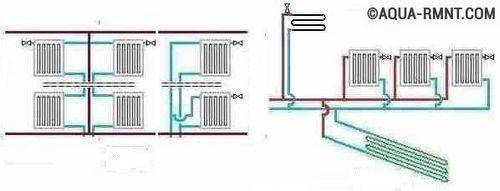
The diagram shows the principle of installing a Mayevsky crane with a vertical and horizontal heating system. A faucet is needed in places where air accumulates
With a horizontal heating system, air vent valves are installed on all heating devices: batteries, collectors, etc. The underfloor heating system does not always need to be vented, but very often such a valve still has to be installed.
The installation of an air vent on a heated towel rail deserves special attention. On models with a bottom connection, a special hole is even provided for this. But heated towel rails with side connection will have to be slightly modified. A metal tee with a thread of suitable diameter is mounted on the supply line. In this case, the outlet of the air outlet valve must be turned away from the wall.
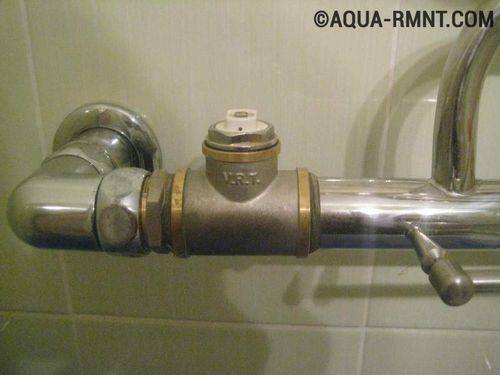
It is recommended to always install a Mayevsky faucet on a heated towel rail. Depending on the model, one or two taps should be installed
To understand whether you need to install an air vent in a particular place, you just need to imagine the movement of air in the system. If it is clear that air can move freely further through the system, a valve is not needed. If the air cannot leave the system naturally, a special device will be needed.
(0 votes, average: 0 out of 5)
Criterias of choice
To independently choose a Mayevsky crane for cast-iron radiators or batteries made of other materials, you must consider:
- type of air vent;
- equipment dimensions.
Varieties of Mayevsky cranes
To bleed air from the heating system, use:
air vent with manual control.
Such a device is characterized by ease of use and minimal cost. In most cases, it is mounted in the presence of a central heating system. To rotate the screw, a screwdriver that is suitable in size, a special key for the Mayevsky crane or a handle can be used.
The equipment, designed on a turnkey basis or a screwdriver, reliably protects the device from unauthorized opening, for example, by a child
When installing taps with a handle, additional precautions must be taken;
Cranes with manual control
Mayevsky automatic crane.
Unlike manually operated equipment, the faucet is safer for children and pets, as it works automatically.
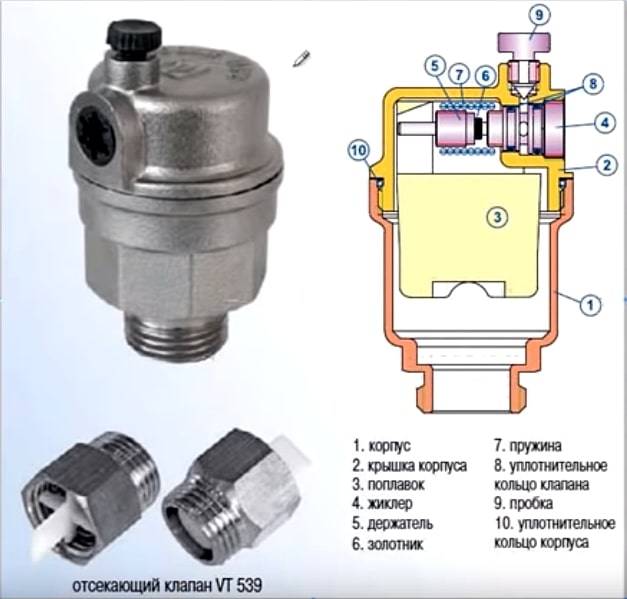
The equipment is equipped with a special float that reacts to the presence of air in the heating system. With excess air, the float rises and opens the drain hole to remove it. When the air is released, the float lowers and the valve closes.


The automatic tap is installed on individual heating systems, in which you can monitor the quality of the coolant. The presence of contaminants in the system can lead to the inoperability of the device;
The principle of operation of equipment with automatic control
All automatic cranes are additionally equipped with the possibility of manual control to ensure the operability of the equipment in emergency situations.
faucet with safety valve.
The device is also intended for individual systems, since the ingress of small particles leads to clogging of the equipment and its inoperability.
How does a faucet valve work? Unlike standard equipment, the device allows not only to remove air from the heating radiator, but also to control the level of internal pressure, which minimizes the possibility of hydraulic shock, which is especially important for plastic and metal-plastic pipelines
Mayevsky crane with safety valve
What parameters should be considered when choosing
To select a faucet for a heated towel rail or heating radiator, the following technical parameters must be taken into account:
- equipment diameter. For optimal operation of the device, it is necessary that the diameter of the shut-off and control valves fully correspond to the diameter of the outlet of the radiator (towel dryer);
- pitch and type of thread. Manufacturers offer faucets with right or left hand threads in 1/2 inch, 3/4 inch or 1 inch sizes;
- tightness class. For radiators of central heating systems, it is more expedient to use devices of the highest tightness class (A). Lower class devices can be installed in a private home (with low system pressure) and/or on a heated towel rail.
All technical parameters of the device are indicated in the attached documentation.
Technical parameters of the Mayevsky crane
Features of operation and installation
After installing the Mayevsky crane for a long service life, it is required to use it correctly. If the battery has ceased to warm up evenly, then to remove the air, it is necessary to do the following in order:
- free up space around the battery to prevent water damage to valuables during the airing process;
- prepare a basin for water and a screwdriver;
- install a screwdriver in a special thread located on the tap, and slowly rotate it counterclockwise;
- as soon as a hissing sound of escaping air is heard, the rotation must be stopped. After that, you should wait until all the excess air has escaped. The sound can be quite loud, but this is quite normal;
- as soon as water flows out of the tap along with air, you need to wait a bit until it flows in a uniform stream.After that, the tap can be closed by gently turning it in the opposite direction, clockwise;
- it may well happen that the air from the pipe will exit for quite a long time along with the water, while you should substitute the basin and wait for the air to completely escape.
If the removal of air using the Mayevsky crane was carried out exactly according to the instructions, and the battery still remains cold, then most likely the radiator is clogged. In this case, the help of a plumber or a complete battery replacement will be required.
Operating nuances:
- The Mayevsky crane is installed directly on the heating device.
- Usually, one screwdriver is enough to service the device. In some cases, if the faucet is located in a niche or in an inaccessible place, a small special key may be required.
- When using an air vent valve, it is strictly forbidden to place open flames or smoking nearby, as the slightest spark can ignite combustible gases, sometimes released with air.
- It is not recommended to keep the Mayevsky tap in the “open” position all the time, as this can cause damage to the radiator.
If the faucet has not been used for some time, the threads may be affected by rust. The rotation of the screw will be difficult. In this case, before opening the tap, lubricate the thread with kerosene and wait a few minutes.
Varieties and mechanism of action
With such an area of use, it would be surprising that there is one crane model for all cases. The principle of operation remains the same, but some nuances change. Depending on various factors, it makes sense to install one or another crane model.
Manual faucet
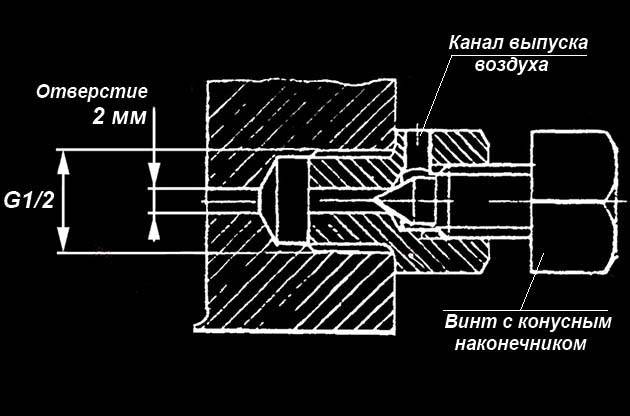
The manual crane is controlled by a square screw. The inspector opens the tap for 1-1.5 turns and the air is squeezed out by the flow of water. Until water starts running from the tap, the device is kept open. The manual crane is the simplest and cheapest version of the Mayevsky crane. It makes sense to put it on household radiators located in easily accessible places.
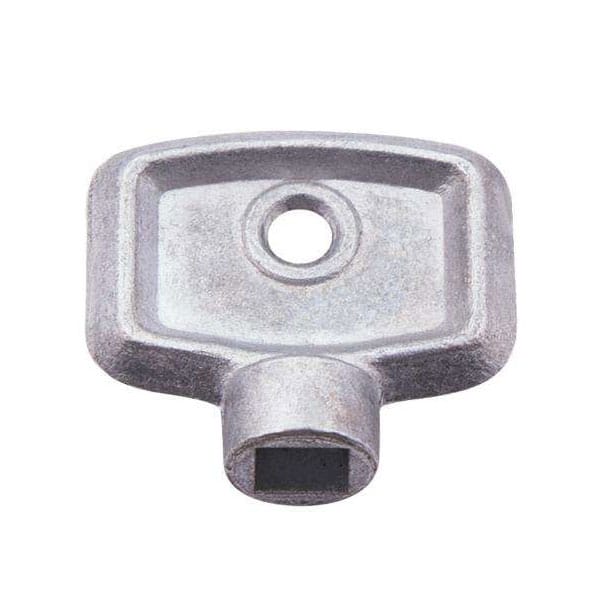 Key for Mayevsky's crane
Auto
The automatic crane is supplied with a plastic float. When the faucet is filled with water, the float closes the faucet outlet. As soon as air collects in the upper part of the valve, the float lowers along with the water level, the air is vented to the atmosphere. Such devices are more expensive than manual taps, but quite affordable.
So why not install such valves everywhere, neglecting manual counterparts? The fact is that the main sulfur of the use of Mayevsky cranes: apartment buildings. And the lion's share of apartment buildings is heated using centralized heating systems. The pipes of heating plants quickly become unusable, overgrown with rust and filled with debris. As a result of stray currents, leaks regularly occur, when the leaks are eliminated, the tightness of the system is violated, all this adds a lot of various kinds of garbage to the systems.
Most of the contaminants are filtered out at the entrance to the building, where a strainer is provided, but the smallest particles, including rust, still enter the internal heating system. As a result, the Mayevsky tap hole is regularly clogged. It is not known what is easier with constant airing of heating systems: bleed air manually or regularly clean the valve.


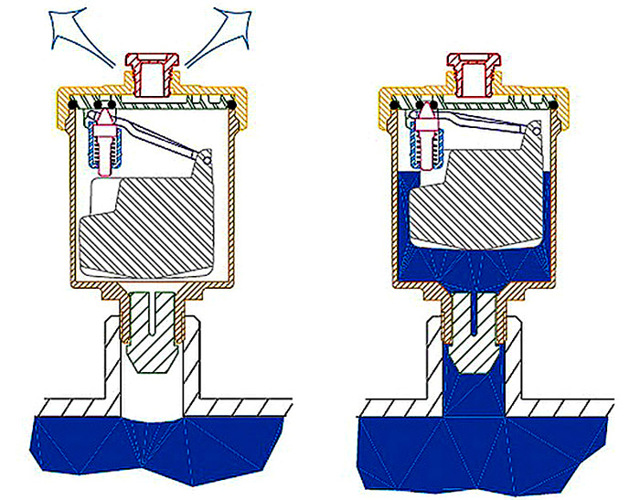

In addition, the automatic valve is prone to failure due to pressure surges in the system. And for centralized systems, small hydraulic shocks have long become a familiar reality.
In general, it is profitable and convenient to install automatic taps, first of all, in houses with an independent connection system. With this option, the heating system and the heating plant are connected by means of a heat exchanger and are not hydraulically connected. That is, it is possible to supply prepared water to the batteries with a really minimum amount of polluting particles. In addition, the hydraulic pressure in such a system is constant, since it does not depend on many neighboring houses.
An automatic tap can also be installed in a private house, but here again the problem of water preparation arises. Cleaning water at a sufficient level is too expensive. Even within the framework of apartment buildings, the installation of independent connection systems significantly increases the cost of the final construction cost, and therefore each individual apartment. As for private households, the installation of such systems only for the sake of automating air release seems completely unjustified.
 Mayevsky crane automatic
With safety device
Valves with a safety device are designed specifically for apartment buildings with central heating. These are all the same Mayevsky manual cranes, which, however, have a protective system against increasing pressure in the network. As already mentioned, for district heating, pressure surges in the network are considered the norm. But excess pressure can lead to a breakdown of the radiator. A simple aluminum radiator can simply break as a result of water hammer.Therefore, during installation, a Mayevsky crane with a safety device is provided.
If the pressure in the system exceeds 15 atmospheres, the valve automatically opens, bleeding water. Of course, this may be due to some inconvenience: few people like to see a small puddle under the radiator. But there will be little water, and the benefits of the device are quite significant.
Crane operation and installation
A Mayevsky manual type crane is installed in the upper part of the radiator, on the side opposite from the coolant supply point. Installation of the valve does not require special skills: simply screw the device into the fitting. The main thing is the correspondence of the connecting threads. The sealing of the connection is ensured by the use of a special sealing gasket. If it is not included in the delivery set of the device, then it is quite possible to get by with tow and plumbing paste.
Since, when using the device for its intended purpose, a small amount of liquid will flow out of the outlet opening during the release of air, it would be advisable to orient the valve with the outlet downwards.
The use of a Mayevsky crane of a special design allows you to direct the air-liquid jet in any direction in a circle. If you use the simplest device, the use of tow with paste will allow you to install it in the correct position, while maintaining the required tightness of the connection.
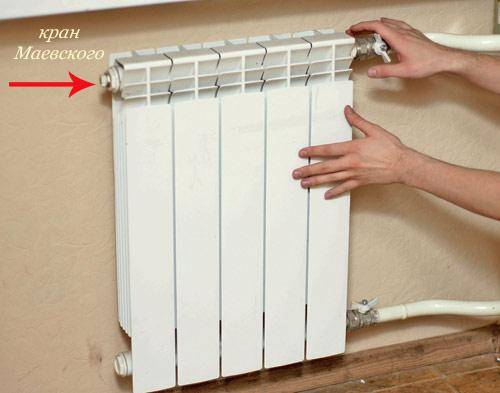
Installing a Mayevsky crane on a heating radiator
Installation of a Mayevsky faucet in a horizontal two-pipe heating system is mandatory for all heating appliances, including collectors and heated towel rails.Water heated floor systems, due to their location, do not require an air vent, although there are exceptions for non-standard connection of floor heating.
In heated towel rails, the design of which provides for a bottom supply of coolant, a threaded hole is provided for connecting a Mayevsky tap.
Devices with side connection do not have such an opportunity, therefore, in this case, a regular tee mounted on the supply pipeline before entering the heated towel rail will help to get out of the situation. An air vent is connected to the side outlet of the tee, orienting it with the outlet from the wall.
The Mayevsky crane is installed on the radiator by replacing the heater plug with the valve itself.
Modern radiators have a special threaded hole in the plug, which further facilitates the installation of the air vent. If you plan to install a tap on a cast-iron battery, then you can cut the thread in its plug right on the spot. To do this, you need a drill with a 9mm drill and a tap for cutting metric threads M10x1. It is necessary to drill a hole in the center of the futorka and cut the connecting thread. This process is simple and does not require special qualifications, therefore, in a couple of hours, all cast-iron batteries in the apartment can be equipped with Mayevsky cranes.
If your heating system is mounted from steel pipes welded into registers, then either a tee installed after the locking device at the pipe entry into the register, or a boss welded in the upper part of the register with the desired thread will help to install the air vent.
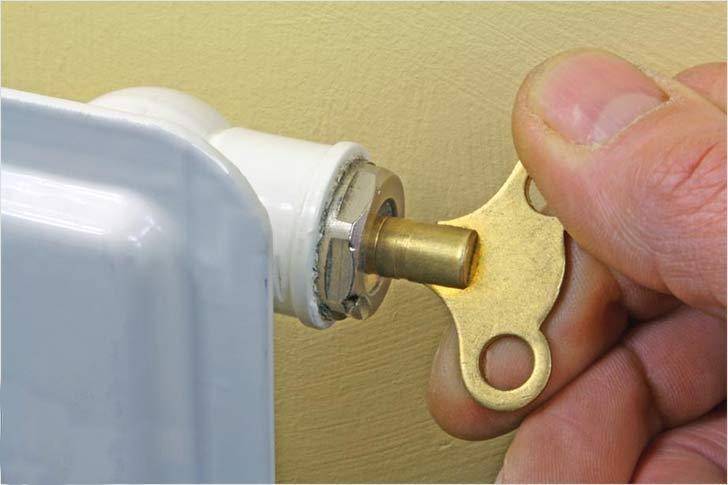
To remove the air lock, just turn the screw counterclockwise a little
Most often, the need to bleed air occurs in certain places of the heating system, so Mayevsky taps can be installed not on all heating appliances, but only on problem areas.
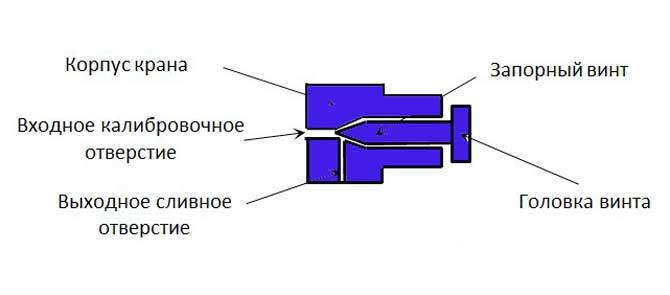
Unfortunately, despite the simple design and high reliability of the valve, during operation it often becomes necessary to clean the valve. This is not due to the operation of the device, but to the low quality of the coolant, which most often affects district heating networks. In this case, the conical screw must be unscrewed, and the device cleaned with a thin steel wire, pin or needle.
If the heating radiators of your heating system are not yet equipped with Mayevsky taps, be sure to install them. You will not incur serious material costs, however, you will significantly increase the usability and efficiency of the heating system.
Features of inclusion in the heating system
There are features in the installation of air vent valves when they are screwed into the body of existing radiator plugs. Radiator plugs are usually screwed in on the left-hand thread. The faucet twists to the right, and therefore the plumber needs to fix the plug with one key and at the same time turn the air vent with the second. But these are technical trifles, which it does not hurt to know about inexperienced townsfolk.
Circuitry for vertical placement of heating radiators using Mayevsky cranes. As can be seen from the diagram, depending on the type of connection, a specific installation of air vents is determined
The scheme for installing air outlet devices also has some features.So, if the radiator system is built according to the vertical arrangement of devices, air vent valves are usually placed on the radiators of the highest level.
But in the parallel connection scheme, even with a vertical structure, Mayevsky's taps are placed in the heating devices of the lower and upper levels. In general, in plumbing practice, installation in each individual case is done taking into account the possible accumulation of air in the system.



Another version of the scheme, which is widely used in everyday life. In this version, air vents are mounted on each individual radiator of the heating system.
If the installation of the heating system is carried out according to a horizontal scheme, here, as a rule, each heating device is equipped with air vents. By and large, it is desirable to equip with taps that remove air, almost any equipment of the heating system. In reality, the equipment is subject to:
- all heating batteries in the system;
- compensators, bypasses and similar devices;
- registrars and coils;
- pipelines of the upper level of the heating system.
Some circuit solutions even provide for the placement of the Mayevsky crane on heated towel rails. By the way, there are models of heated towel rails on sale, the designs of which have a Mayevsky tap entry point.
Before deciding on the purchase of air exhaust devices, it is recommended to carefully study the layout of the devices.
Small-sized special wrenches are convenient to use in cramped conditions, where closely spaced other objects interfere with the use of a screwdriver
Depending on the degree of freedom of access to the equipment, Mayevsky cranes of a suitable modification should be installed.
Where it is difficult to work with a screwdriver, turnkey models are better suited, and where it is difficult to work with keys, it is reasonable to place automatic devices. Careful analysis will help make device maintenance more efficient and save on purchases.
Automatic air vents are traditionally mounted on pipeline lines, at points of potential accumulation of air masses. On radiators, such devices, as a rule, are not used.
Manual devices have the most simplified design, for example, in comparison with automatic air vents. But, as practice shows, simplicity is the key to reliability.
If cast-iron radiators are used in the heating system, manual taps are more reliable for such a system than automatic ones. Meanwhile, the degree of reliability of the design largely depends on the quality of the metal (brass) from which the air vent is made.
Mayevsky's crane assembled on a kapron plug. Design specially prepared for installation in a system built on polypropylene pipes
You can also mention the experience of introducing Mayevsky taps into heating circuits built on plastic pipes. This material quite reliably keeps stable pressure and temperature, but is weak against water hammer.
Installing a Mayevsky crane paired with a safety valve increases the reliability of the system for such cases. In general, for schemes where pressure stability is in question, it is recommended to use valves as stabilizers.
The video demonstrates the principle of operation of the Mayevsky crane and gives recommendations for its installation:
Simple in design and easy to maintain, air vents are also an integral technical part of any heating system. Deliberate exclusion of devices from the system threatens to turn into serious consequences, up to defrosting of batteries and pipes in the winter. It is impossible to ignore Mayevsky cranes, they just need to be selected for a specific system.



